
Domestic flights in Nepal are not just a convenience -- for many treks, they are the only practical way to reach your starting point or return from your ending point. From the legendary Kathmandu-to-Lukla flight that launches Everest Base Camp treks to the remote airstrips serving Dolpo and Upper Mustang, Nepal's domestic aviation network is a critical piece of trekking logistics that demands careful planning.
This guide covers every major domestic flight route relevant to trekkers, compares airlines, breaks down the often-confusing pricing system, and provides strategies for dealing with the delays and cancellations that are an unavoidable part of flying in the Himalayas.
KTM-Lukla, KTM-Pokhara, PKR-Jomsom, KTM-Tumlingtar
Buddha Air, Yeti Airlines, Tara Air, Summit Air, Sita Air
15-20 kg (strictly enforced on small aircraft)
2-3x higher than Nepali citizen price
50-70% for mountain airstrips
2-4 weeks ahead for peak season
$180-220 one way (tourist)
$80-130 one way (tourist)
Understanding Nepal's Domestic Aviation Landscape
Nepal's domestic aviation operates under conditions found almost nowhere else in the world. Mountain airstrips at extreme elevations, unpredictable Himalayan weather, limited instrument landing capabilities, and a fleet of small aircraft designed for short takeoff and landing (STOL) operations create a unique flying environment.
For trekkers, understanding this landscape is essential because flight reliability directly impacts your trek. A cancelled flight to Lukla does not just delay your day -- it can cascade through your entire itinerary, affecting acclimatization schedules, lodge reservations, and return flights.
Key Airports for Trekkers
Nepal has over 50 airports and airstrips, but trekkers primarily use the following:
| Airport | Code | Elevation | Runway | Serves |
|---|---|---|---|---|
| Tribhuvan International (Kathmandu) | KTM | 1,338m | 3,050m paved | All domestic connections |
| Pokhara International | PKR | 827m | 2,500m paved | Annapurna region hub |
| Tenzing-Hillary (Lukla) | LUA | 2,845m | 527m paved | Everest region treks |
| Jomsom | JMO | 2,682m | 740m gravel | Annapurna Circuit, Upper Mustang |
| Tumlingtar | TMI | 304m | 615m paved | Makalu Base Camp |
| Surkhet | SKH | 720m | 1,500m paved | Dolpo region access |
| Simikot | IMK | 2,910m | 525m gravel | Humla, Kailash access |
| Taplejung (Suketar) | TPJ | 1,234m | 600m gravel | Kanchenjunga region |
Mountain Airstrips Are Weather-Dependent
Unlike Kathmandu and Pokhara, mountain airstrips like Lukla, Jomsom, and Simikot operate purely under Visual Flight Rules (VFR). There is no instrument landing system. If the pilot cannot see the runway, the flight does not go. Always build buffer days into your itinerary for mountain airstrip flights.
Major Flight Routes for Trekkers
1. Kathmandu to Lukla (Everest Region)
This is the most famous and most critical domestic flight for trekkers. It serves as the gateway to the Everest region, including Everest Base Camp, Gokyo Lakes, Island Peak, and the Three Passes trek.
Route Details:
- Distance: 139 km
- Duration: 30-40 minutes
- Aircraft: Twin Otter (DHC-6), Dornier Do 228
- Airlines: Tara Air, Summit Air, Sita Air
- Frequency: 15-30+ flights per day in peak season
- Tourist Price (2026): $180-220 one way
- Nepali Price (2026): NPR 6,000-8,000 one way
Important Note: During peak season (October-November), many Lukla flights now operate from Manthali (Ramechhap) instead of Kathmandu. This requires an additional 4-5 hour drive from Kathmandu to Ramechhap. Check your ticket carefully, as the departure point affects your logistics significantly.
For a detailed guide specifically about this route, see our Kathmandu to Lukla Flights Guide.
Book Round-Trip Lukla Flights Together
2. Kathmandu to Pokhara
The busiest domestic route in Nepal, serving trekkers heading to the Annapurna region and travelers visiting Pokhara for leisure.
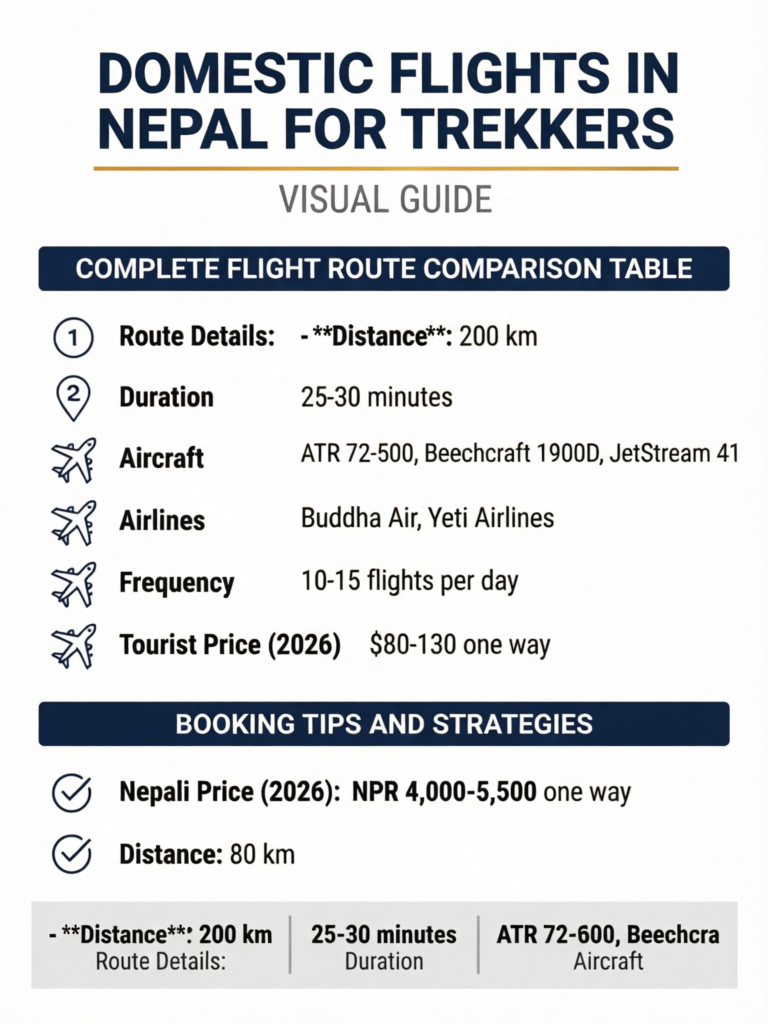
Route Details:
- Distance: 200 km
- Duration: 25-30 minutes
- Aircraft: ATR 72-500, Beechcraft 1900D, Jetstream 41
- Airlines: Buddha Air, Yeti Airlines
- Frequency: 10-15 flights per day
- Tourist Price (2026): $80-130 one way
- Nepali Price (2026): NPR 4,000-5,500 one way
Why Fly vs Bus? The Kathmandu-Pokhara bus journey takes 6-8 hours on a winding mountain road. The flight takes 25 minutes and offers spectacular Himalayan views. If your time is limited, the flight is worth the premium. However, the bus is perfectly comfortable (tourist buses are air-conditioned) and much cheaper at $8-15.
For land transport alternatives, see our Kathmandu to Pokhara Transport Guide.
3. Pokhara to Jomsom (Annapurna Circuit / Upper Mustang)
This short but dramatic flight takes you deep into the Kali Gandaki gorge, the world's deepest gorge, and serves as the gateway to Upper Mustang and the Annapurna Circuit (if starting from the Jomsom end).
Route Details:
- Distance: 80 km
- Duration: 20-25 minutes
- Aircraft: Twin Otter (DHC-6)
- Airlines: Tara Air
- Frequency: 2-4 flights per day in season
- Tourist Price (2026): $120-150 one way
- Nepali Price (2026): NPR 4,500-5,500 one way
Jomsom Flights Are Highly Weather-Dependent
Jomsom flights must depart before 9:00 AM because the Kali Gandaki valley generates extreme afternoon winds (gusting to 60+ km/h) that make landing impossible. If morning weather prevents takeoff, the flight is cancelled for the entire day. Delays of 2-3 days are common. Always have a backup plan -- the jeep road from Pokhara to Jomsom is the alternative (10-12 hours).
4. Kathmandu to Tumlingtar (Makalu Region)
The gateway to Makalu Base Camp and the remote eastern Himalaya. Tumlingtar sits at a relatively low elevation, making flights more reliable than mountain airstrips.
Route Details:
- Distance: 210 km
- Duration: 40-45 minutes
- Aircraft: Twin Otter, Dornier Do 228
- Airlines: Tara Air, Summit Air
- Frequency: 1-2 flights per day (seasonal)
- Tourist Price (2026): $150-180 one way
- Nepali Price (2026): NPR 5,500-7,000 one way
5. Kathmandu to Surkhet (Dolpo Region)
Surkhet serves as the entry point for treks to Dolpo, including Shey Phoksundo Lake and the Great Himalaya Trail western sections. From Surkhet, trekkers must take a long jeep ride to reach Dolpo trailheads.
Route Details:
- Distance: 520 km
- Duration: 70-80 minutes
- Aircraft: ATR 72-500, Beechcraft
- Airlines: Buddha Air, Yeti Airlines
- Frequency: 1-2 flights per day
- Tourist Price (2026): $140-170 one way
- Nepali Price (2026): NPR 6,000-8,000 one way
Alternative: Nepalgunj also serves as a gateway to Dolpo, with flights to Juphal (the closest airstrip to Dolpo). The Kathmandu-Nepalgunj-Juphal route is the traditional Dolpo access route.
6. Kathmandu to Taplejung/Suketar (Kanchenjunga Region)
The gateway to the Kanchenjunga Base Camp trek, one of Nepal's most remote trekking destinations.
Route Details:
- Distance: 395 km
- Duration: 55-65 minutes
- Aircraft: Twin Otter
- Airlines: Summit Air (limited service)
- Frequency: Sporadic, 2-4 flights per week in season
- Tourist Price (2026): $160-200 one way
- Nepali Price (2026): NPR 6,000-7,500 one way
Taplejung Flight Alternatives
7. Nepalgunj to Juphal (Direct Dolpo Access)
For trekkers heading to Lower Dolpo, Phoksundo Lake, or the Dolpo Circuit, the Nepalgunj-Juphal route provides the most direct access.
Route Details:
- Distance: 200 km
- Duration: 30-35 minutes
- Aircraft: Twin Otter
- Airlines: Tara Air, Summit Air
- Frequency: 1-2 flights per day in season
- Tourist Price (2026): $150-180 one way
- Nepali Price (2026): NPR 5,000-6,500 one way
Complete Flight Route Comparison Table
| Route | Airlines | Frequency | Duration | Tourist Price (One Way) | Reliability Rating |
|---|---|---|---|---|---|
| KTM - Lukla | Tara, Summit, Sita | 15-30/day (peak) | 30-40 min | $180-220 | Low (weather-dependent) |
| KTM - Pokhara | Buddha, Yeti | 10-15/day | 25-30 min | $80-130 | High |
| PKR - Jomsom | Tara | 2-4/day | 20-25 min | $120-150 | Low (morning only) |
| KTM - Tumlingtar | Tara, Summit | 1-2/day | 40-45 min | $150-180 | Medium |
| KTM - Surkhet | Buddha, Yeti | 1-2/day | 70-80 min | $140-170 | High |
| KTM - Taplejung | Summit | 2-4/week | 55-65 min | $160-200 | Very Low |
| KTM - Nepalgunj | Buddha, Yeti | 3-5/day | 70-80 min | $100-130 | High |
| NPG - Juphal | Tara, Summit | 1-2/day | 30-35 min | $150-180 | Low |
| KTM - Biratnagar | Buddha, Yeti | 5-8/day | 40-45 min | $80-120 | High |
| KTM - Simikot | Tara, Summit | 1-2/day | 80-90 min | $200-250 | Very Low |
Airlines Serving Nepal's Domestic Routes
Buddha Air
Nepal's largest and most established domestic airline. Known for reliability, modern fleet, and punctual operations on major routes.
- Fleet: ATR 72-500, Beechcraft 1900D
- Key Routes: KTM-Pokhara, KTM-Biratnagar, KTM-Nepalgunj, KTM-Surkhet
- Strengths: Best safety record, modern aircraft, reliable scheduling
- Limitations: Does not fly to STOL (short takeoff and landing) airstrips like Lukla or Jomsom
- Booking: buddhaair.com or through agencies
Yeti Airlines
One of Nepal's most popular domestic carriers with a wide route network.
- Fleet: BAe Jetstream 41, ATR 72-500
- Key Routes: KTM-Pokhara, KTM-Biratnagar, KTM-Nepalgunj
- Strengths: Competitive pricing, good frequency on major routes
- Limitations: Does not serve mountain STOL airstrips
- Booking: yetiairlines.com or through agencies
Tara Air (Subsidiary of Yeti Airlines)
The primary airline for mountain STOL airstrip operations. Tara Air is the workhorse of Nepal's mountain aviation.
- Fleet: DHC-6 Twin Otter, Dornier Do 228
- Key Routes: KTM-Lukla, PKR-Jomsom, NPG-Juphal, KTM-Simikot
- Strengths: Extensive mountain route network, experienced mountain pilots
- Limitations: Small aircraft, strict baggage limits, weather-dependent operations
- Booking: taraair.com or through agencies
Tara Air Safety Note
Following the May 2022 Tara Air crash near Jomsom that killed all 22 people aboard, Tara Air temporarily grounded its fleet and underwent safety reviews. The airline resumed operations with enhanced safety protocols. Trekkers should monitor the current safety status before booking. Tara Air remains the primary operator for many essential trekking routes.
Summit Air
Specializes in remote mountain operations and charter flights.
- Fleet: Dornier Do 228, Let L-410, DHC-6 Twin Otter
- Key Routes: KTM-Lukla, KTM-Taplejung, NPG-Juphal, charter operations
- Strengths: Flexible charter options, serves very remote airstrips
- Limitations: Smaller schedule than Tara Air
- Booking: summitair.com.np or through agencies
Sita Air
Smaller operator focusing on specific mountain routes.
- Fleet: Dornier Do 228
- Key Routes: KTM-Lukla (Ramechhap-Lukla during peak season)
- Strengths: Additional capacity on the crucial Lukla route
- Limitations: Limited route network
- Booking: Through agencies primarily
The Tourist vs Nepali Price Difference
One of the most discussed aspects of Nepal's domestic aviation is the dual pricing system. Foreign tourists pay significantly more than Nepali citizens for the same flights.
How the Pricing Works
| Route | Tourist Price | Nepali Price | Difference |
|---|---|---|---|
| KTM-Lukla | $180-220 | NPR 6,000-8,000 ($45-60) | 3-4x |
| KTM-Pokhara | $80-130 | NPR 4,000-5,500 ($30-42) | 2.5-3x |
| PKR-Jomsom | $120-150 | NPR 4,500-5,500 ($34-42) | 3-3.5x |
Why the Price Difference Exists
- Government mandate: The Civil Aviation Authority of Nepal sets different fare structures
- Tourism revenue: Tourist fares help fund aviation infrastructure development
- Subsidy model: Lower Nepali prices effectively subsidize domestic transportation for citizens
- Market economics: Tourists generally have higher purchasing power
Is It Fair?
This is a personal judgment, but context matters. Nepal is one of the poorest countries in Asia, and domestic air travel is essential for citizens in remote areas where no road access exists. The tourist premium helps maintain routes that would otherwise be financially unviable. Most trekkers accept it as part of the cost of visiting Nepal.
Agency Booking Can Save Money
Baggage Allowances and Restrictions
Baggage limits on Nepal's domestic flights are strictly enforced, especially on small STOL aircraft where weight directly impacts safety.
Standard Baggage Allowances
| Aircraft Type | Check-in Luggage | Hand Luggage | Total |
|---|---|---|---|
| ATR 72 (Buddha/Yeti) | 20 kg | 5 kg | 25 kg |
| Jetstream/Beechcraft | 15-20 kg | 5 kg | 20-25 kg |
| Twin Otter (STOL) | 10-15 kg | 5 kg | 15-20 kg |
| Dornier Do 228 | 10-15 kg | 5 kg | 15-20 kg |
Excess Baggage Charges
Excess baggage is charged at approximately $1-2 per kg on mountain routes. On the KTM-Lukla route, excess baggage can cost $1.50 per kg. However, during peak season, excess baggage may simply be refused if the aircraft is at maximum payload capacity.
Lukla Baggage Is Strictly 15kg
On Lukla flights, the 15kg check-in limit (including duffel bags carried by porters) is not negotiable. Every bag is weighed, and excess is removed. If you are sending trekking gear with your porter via a separate flight, account for the weight limit. Pack strategically and rent or buy missing items in Namche Bazaar if needed.
Tips for Managing Baggage
- Weigh your bags before the airport -- hotel front desks usually have scales
- Wear your heaviest items (boots, down jacket) to reduce bag weight
- Leave non-essential items at your Kathmandu hotel -- most offer free storage
- Split loads between check-in and carry-on to maximize total allowance
- Consider the porter's load -- if your porter is also flying, their bag counts separately
Dealing with Delays and Cancellations
Flight delays and cancellations are a fact of life when flying to mountain airstrips in Nepal. Understanding why they happen and how to cope is essential.
Why Flights Get Delayed or Cancelled
- Weather at destination: Cloud cover, fog, wind, or precipitation at the mountain airstrip
- Weather en route: Poor visibility along the flight path through mountain valleys
- Weather at origin: Rare for Kathmandu, but fog can affect early morning departures
- Technical issues: Aircraft maintenance requirements
- Congestion: Too many aircraft queued for a single mountain runway
Delay Statistics by Route
| Route | Peak Season Delay Rate | Average Delay When Delayed | Cancellation Rate |
|---|---|---|---|
| KTM-Lukla | 50-70% | 1-4 hours | 15-25% |
| PKR-Jomsom | 40-60% | Full day (no afternoon flights) | 20-30% |
| KTM-Simikot | 60-80% | 1-3 days | 30-40% |
| KTM-Taplejung | 50-70% | 1-2 days | 25-35% |
| KTM-Pokhara | 5-10% | 30-60 minutes | Under 5% |
| KTM-Biratnagar | 5-10% | 30-60 minutes | Under 5% |
What to Do When Your Flight Is Delayed
- Do not panic -- delays are normal and expected
- Stay at the airport -- flights can be called with short notice when weather clears
- Check with your airline counter regularly for updates
- Have your trekking agency on speed dial -- they can rebook or arrange alternatives
- Keep snacks and water handy -- airport facilities at mountain airstrips are minimal
- Consider alternatives if delays extend beyond one day (helicopter, jeep road)
Build Buffer Days Into Your Itinerary
Booking Tips and Strategies
When to Book
- Peak season (Oct-Nov, Mar-Apr): Book 2-4 weeks in advance for mountain flights, especially Lukla
- Shoulder season: 1-2 weeks advance booking is usually sufficient
- Off-season: Walk-up availability is common, but check schedules as some routes reduce frequency
How to Book
- Through your trekking agency: The easiest and often cheapest option for guided treks
- Airline websites: Buddha Air and Yeti Airlines have good online booking systems
- Travel agencies in Thamel: Walk-in bookings available, can compare airlines
- Airport counters: Possible for same-day travel on non-peak routes
Payment and Tickets
- Most airlines accept credit cards for online bookings
- Walk-in purchases may require cash (Nepali Rupees or USD)
- E-tickets are standard -- have a printed copy or PDF on your phone
- Reconfirm mountain flights 24 hours before departure
Reconfirmation Is Essential
Always reconfirm your mountain flights 24 hours before departure. Schedules change frequently, and flights can be moved to earlier times or cancelled. Your hotel front desk or trekking agency can call the airline for you. This simple step has saved countless trekkers from missing their flights.
Helicopter Alternatives
When fixed-wing flights fail, helicopters offer a more expensive but more flexible alternative for reaching or leaving trekking destinations.
Helicopter Charter Costs (Approximate 2026)
| Route | Helicopter Cost (charter) | Seats | Per Person (full charter) |
|---|---|---|---|
| KTM - Lukla | $3,000-4,000 | 5 | $600-800 |
| PKR - Jomsom | $1,500-2,500 | 5 | $300-500 |
| KTM - Namche | $4,000-5,000 | 5 | $800-1,000 |
| NPG - Juphal | $2,500-3,500 | 5 | $500-700 |
Sharing helicopters: During flight cancellation backlogs, trekking agencies often organize shared helicopter charters. The cost per person drops significantly when splitting among 4-5 trekkers. Ask your agency about shared options if fixed-wing flights are cancelled for multiple days.
Safety Considerations
Nepal's domestic aviation has a mixed safety record. While major airlines on major routes maintain good standards, mountain flying inherently carries higher risk.
Safety Tips for Trekkers
- Choose established airlines: Buddha Air has the best overall safety record for major routes
- Check recent incidents: A quick online search before booking can reveal recent safety issues
- Trust the pilot's decision: If a flight is cancelled due to weather, it is for your safety
- Travel insurance must cover domestic flights: Ensure your policy covers domestic flight cancellations and delays
- Avoid pressure to fly: If weather conditions seem marginal, do not pressure airlines to fly
For comprehensive information on flights to and from Nepal, see our Best International Flights to Kathmandu Guide.
Related Guides
- Kathmandu to Lukla Flights: Complete Guide
- Kathmandu to Pokhara Transport Guide
- Best International Flights to Kathmandu
- Jeep Transport to Trek Access Points
- Travel Insurance for Nepal Trekking
Frequently Asked Questions
How far in advance should I book domestic flights in Nepal?
For mountain airstrip flights (Lukla, Jomsom, Simikot), book 2-4 weeks in advance during peak season (October-November, March-April). For major routes like Kathmandu-Pokhara, 1-2 weeks is usually sufficient. Off-season travel typically has walk-up availability, though some routes reduce frequency.
Why do tourists pay more than Nepali citizens for the same flight?
Nepal's Civil Aviation Authority mandates different fare structures for tourists and citizens. This dual pricing system generates tourism revenue, subsidizes domestic air travel for citizens in remote areas, and reflects differences in purchasing power. The practice is government policy, not airline profiteering, and applies to all domestic carriers.
What happens if my flight to Lukla is cancelled?
You wait. Flights are rescheduled for the next available weather window, which could be later the same day or the next morning. Your ticket remains valid for the rescheduled flight. If cancellations persist for multiple days, options include helicopter charter (shared to reduce cost) or alternative access via Phaplu (jeep plus shorter flight). This is why buffer days are essential.
Can I bring my trekking poles on a domestic flight?
Trekking poles must go in checked luggage. They are not permitted in the cabin on any Nepal domestic airline. Ensure they are packed securely in your duffel bag or strapped to the outside of your backpack. The same applies to ice axes, crampons, and other sharp trekking equipment.
Is the Kathmandu-Pokhara flight worth it versus the bus?
It depends on your priorities. The flight costs $80-130 and takes 25 minutes with mountain views. The tourist bus costs $8-15 and takes 6-8 hours. If you have limited time, the flight is excellent value. If budget is the primary concern, the bus is comfortable (on tourist-class buses) and offers its own scenic experience along the Prithvi Highway.
How strictly is the baggage limit enforced?
Very strictly on mountain STOL flights (Lukla, Jomsom, Simikot). Every bag is weighed, and excess is removed -- no exceptions. On larger aircraft routes (Kathmandu-Pokhara on ATR 72), enforcement is slightly more lenient, but still checked. Excess baggage fees apply when available capacity exists. The safest approach is to stay within limits.
What should I do if I miss my domestic flight?
Contact the airline immediately. If you miss a flight due to your own error (late arrival), you may lose the ticket or pay a rebooking fee. If the airline changes the schedule or departs early without notification, you are entitled to the next available flight. Your trekking agency can assist with rebooking.
Are domestic flights in Nepal safe?
Major routes served by larger aircraft (Buddha Air, Yeti Airlines ATR 72s) have good safety records comparable to regional airlines worldwide. Mountain STOL operations carry inherently higher risk due to extreme terrain, weather, and short runways. Safety standards have improved significantly after recent incidents, with enhanced pilot training, aircraft maintenance requirements, and regulatory oversight. Choosing established airlines and never pressuring operators to fly in marginal weather are your best safety measures.
Can I fly directly from one trekking region to another without returning to Kathmandu?
In most cases, no. Nepal's domestic route network is hub-and-spoke, centered on Kathmandu. The main exception is Pokhara-Jomsom, which does not require returning to Kathmandu. For other region-to-region travel (e.g., Everest to Annapurna), you must transit through Kathmandu. Some helicopter charter services can arrange point-to-point transfers, but at significant cost.
Do I need to print my e-ticket or is a phone screenshot sufficient?
Having a printed copy is recommended, especially for mountain airstrip flights where power outlets and internet may not be available at the terminal. Most airlines will accept a digital copy on your phone, but small airport check-in counters occasionally request printed tickets. Print a copy at your hotel to be safe.
What is the weight limit difference between tourist class and regular for luggage?
There is no weight limit difference based on passenger nationality. The baggage allowance is determined by the aircraft type and route, not the fare class. A tourist and a Nepali citizen on the same Twin Otter to Lukla both get the same 15kg check-in allowance. The price difference is in the ticket cost, not the baggage allocation.
When is the best time of day to fly to mountain airstrips?
Early morning, always. The first flights of the day (6:00-7:00 AM departures) have the highest chance of operating because mountain weather is typically clearest in early morning. As the day progresses, thermals generate clouds around peaks and in valleys. By mid-morning, many mountain airstrips become unflyable. Book the earliest possible departure time for any mountain airstrip flight.