Jeep Transport to Trek Trailheads in Nepal: Complete 2026 Guide
Not every Nepal trek begins with a dramatic mountain flight. Many of the country's best treks start from roadheads accessible by vehicle -- specifically, by the rugged jeeps and 4x4s that navigate Nepal's notoriously challenging mountain roads. Whether you are heading to Syabrubesi for the Langtang Valley, Besisahar for the Annapurna Circuit, Arughat for the Manaslu Circuit, or Nayapul for the Annapurna Base Camp trek, understanding jeep transport is a critical piece of your trekking logistics.
This guide covers every major jeep route to trekking trailheads, compares private hire versus shared transport, breaks down costs and travel times, rates road conditions honestly (spoiler: many are rough), and helps you decide when a jeep is the better option compared to buses or flights.
KTM-Syabrubesi, PKR-Nayapul, PKR-Besisahar, KTM-Arughat
NPR 8,000-35,000 per vehicle
NPR 500-2,500 per person
Ranges from paved highway to extreme off-road
Mahindra Scorpio, Bolero, Tata Sumo
October-May (dry season)
June-September (monsoon - landslides common)
Through agency, hotel, or direct negotiation
Why Jeep Transport Matters for Trekkers
Nepal's road network has expanded dramatically over the past decade. Roads that did not exist five years ago now reach deep into mountain valleys. This is a double-edged sword for trekking: it provides more convenient access to trailheads but has also shortened some classic treks by replacing walking sections with motorable road.
For trekkers, the key question is usually: how do I get from Kathmandu or Pokhara to my trailhead efficiently, affordably, and safely?
The answer often involves a jeep. Nepal's mountain roads are frequently unpaved, narrow, steep, and winding. During monsoon season, landslides regularly block routes. Standard vehicles cannot handle these conditions -- you need a 4x4, and the ubiquitous Nepal mountain jeep (typically a Mahindra Scorpio or Tata Sumo) is the vehicle of choice.
Nepal Mountain Roads Are Not for the Faint-Hearted
If you are accustomed to developed-world road standards, Nepal's mountain roads will be an adventure in themselves. Single-lane tracks carved into cliff faces, no guardrails above thousand-meter drops, river crossings through the roadbed, and oncoming buses on blind corners are all normal. This is not hyperbole. Nepal's road accident statistics are among the worst in Asia. Accept the conditions, choose experienced drivers, and try to enjoy the scenery.
Major Jeep Routes to Trailheads
1. Kathmandu to Syabrubesi (Langtang Valley Trek)
The gateway to the Langtang Valley, Kyanjin Gompa, and the Langtang-Gosaikunda-Helambu traverse.
Route Details:
- Distance: 117 km
- Duration: 7-9 hours (private jeep), 8-10 hours (bus)
- Road Type: Paved to Dhunche, rough unpaved Dhunche to Syabrubesi
- Private Jeep Cost: NPR 12,000-18,000 (entire vehicle, fits 4-6 passengers)
- Shared Jeep Cost: NPR 1,200-1,800 per person
- Local Bus Cost: NPR 600-800 per person
- Road Quality: Moderate to poor (last section unpaved and winding)
Route Description: The journey follows the Trishuli River valley north from Kathmandu, passing through Nuwakot and Trishuli Bazaar. The road is paved and in reasonable condition to Dhunche (the Langtang National Park checkpoint). Beyond Dhunche to Syabrubesi, the road deteriorates significantly, with unpaved sections, tight switchbacks, and occasional landslide debris.
Start Very Early
2. Pokhara to Nayapul (Annapurna Base Camp / Ghorepani Poon Hill)
The most popular trailhead for ABC, Poon Hill, and Ghorepani-Tadapani treks.
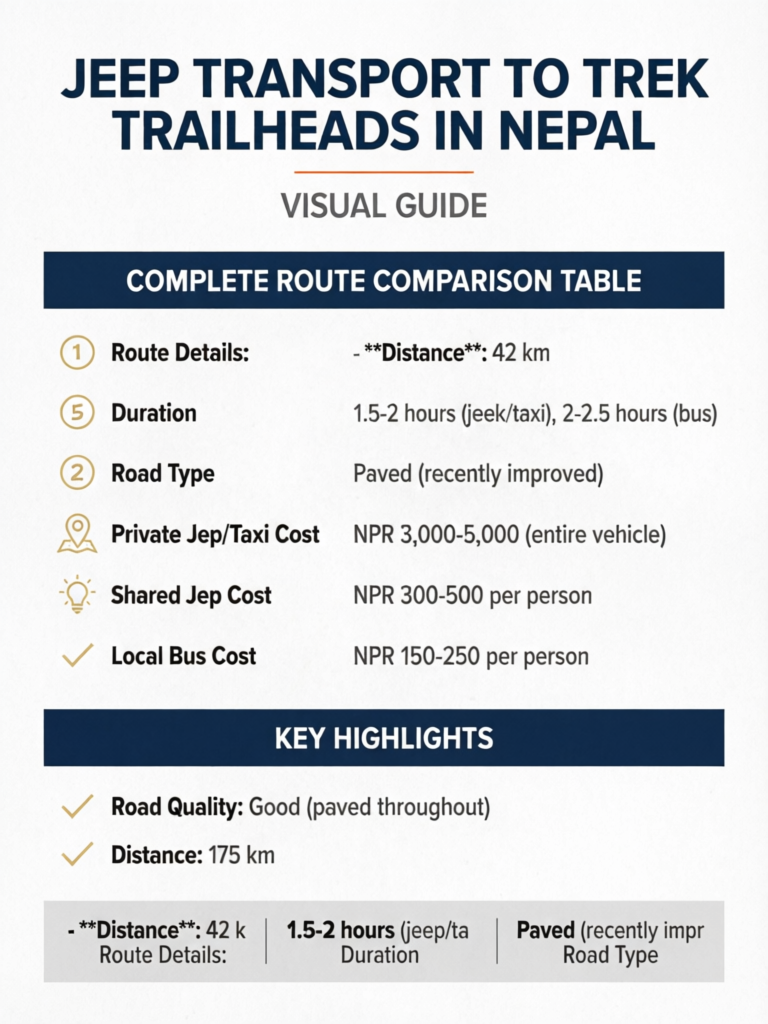
Route Details:
- Distance: 42 km
- Duration: 1.5-2 hours (jeep/taxi), 2-2.5 hours (bus)
- Road Type: Paved (recently improved)
- Private Jeep/Taxi Cost: NPR 3,000-5,000 (entire vehicle)
- Shared Jeep Cost: NPR 300-500 per person
- Local Bus Cost: NPR 150-250 per person
- Road Quality: Good (paved throughout)
Route Description: This is one of the easiest trailhead transfers in Nepal. The road from Pokhara to Nayapul follows the Modi Khola valley and is fully paved. Even during monsoon, this road is generally passable. Most trekkers take a taxi or shared jeep; the ride is straightforward and scenic.
Alternative Starting Points: Some trekkers start from Kimche (further up the road past Nayapul) to skip the flat initial walking section, or from Birethanti (just past Nayapul). Private jeep drivers can drop you at any point along the road.
3. Pokhara to Besisahar / Chame (Annapurna Circuit)
The traditional starting point for the Annapurna Circuit. Note that road construction has extended the motorable road well beyond Besisahar, and many trekkers now jeep further to Chame or even Dharapani.
Route Details (to Besisahar):
- Distance: 175 km
- Duration: 5-6 hours (private jeep), 6-8 hours (bus)
- Road Type: Paved to Dumre, mixed to Besisahar
- Private Jeep Cost: NPR 10,000-15,000 (to Besisahar)
- Shared Jeep Cost: NPR 800-1,200 per person (to Besisahar)
- Local Bus Cost: NPR 400-600 per person
- Road Quality: Good to Dumre, moderate to Besisahar
Route Details (Besisahar to Chame - extended jeep ride):
- Distance: Additional 80 km beyond Besisahar
- Duration: 6-9 hours (conditions vary enormously)
- Road Type: Rough unpaved mountain track
- Private Jeep Cost: NPR 15,000-25,000 (Besisahar to Chame)
- Road Quality: Poor to very poor (seasonal road closures common)
The Annapurna Circuit Road Debate
The extension of the road along the Annapurna Circuit has been controversial. Purists argue it has ruined the lower sections of the trek. Pragmatists note it allows trekkers with limited time to skip the lower, less scenic sections and start at higher elevations. Most trekking agencies now recommend starting from Chame (by jeep from Besisahar) or even Dharapani, saving 2-3 walking days without missing the best parts of the circuit. The choice is yours.
4. Kathmandu to Arughat / Sotikhola (Manaslu Circuit)
The starting point for the Manaslu Circuit trek, one of Nepal's finest long-distance treks.
Route Details (to Arughat):
- Distance: 135 km
- Duration: 7-9 hours (private jeep), 8-11 hours (local bus)
- Road Type: Paved to Dhading Besi, rough unpaved to Arughat
- Private Jeep Cost: NPR 15,000-22,000 (entire vehicle)
- Shared Jeep Cost: NPR 1,000-1,500 per person
- Local Bus Cost: NPR 500-800 per person
- Road Quality: Moderate to Dhading Besi, poor to Arughat
Route Details (Arughat to Sotikhola - extended start):
- Distance: Additional 25 km
- Duration: 3-5 hours by jeep (when road is open)
- Road Type: Very rough, seasonal track
- Private Jeep Cost: NPR 8,000-12,000 (Arughat to Sotikhola)
- Road Quality: Very poor (impassable during monsoon)
Route Description: The drive from Kathmandu to Arughat is long and tiring. The first half on the Prithvi Highway toward Pokhara is good, then you turn north at Dhading Besi onto progressively worse roads descending into the Budi Gandaki valley. The road to Sotikhola beyond Arughat is a rough jeep track that saves a full day of walking but is not always passable.
Consider the Sotikhola Start
5. Kathmandu to Dhunche (Gosaikunda / Langtang via Laurebina)
An alternative starting point for Langtang treks, and the primary access for Gosaikunda Lake.
Route Details:
- Distance: 117 km (same road as Syabrubesi, but stopping at Dhunche)
- Duration: 6-8 hours
- Road Type: Paved most of the way, some rough patches
- Private Jeep Cost: NPR 10,000-15,000
- Shared Jeep Cost: NPR 1,000-1,500 per person
- Road Quality: Moderate (better than continuing to Syabrubesi)
6. Pokhara to Tatopani / Beni (Lower Annapurna Circuit exit)
For trekkers completing the Annapurna Circuit and descending via Tatopani (hot springs) or Beni.
Route Details (Beni to Pokhara):
- Distance: 83 km
- Duration: 3-4 hours
- Road Type: Paved (Beni-Pokhara highway)
- Private Jeep Cost: NPR 6,000-10,000
- Shared Jeep Cost: NPR 500-800 per person
- Road Quality: Good (paved highway)
7. Kathmandu to Jiri (Everest Classic Route Start)
The traditional starting point for the classic walk-in route to Everest, before Lukla flights existed. Still used by trekkers who want the full experience or when Lukla flights are unavailable.
Route Details:
- Distance: 188 km
- Duration: 8-10 hours
- Road Type: Paved to Charikot, rough to Jiri
- Private Jeep Cost: NPR 15,000-20,000
- Shared Jeep Cost: NPR 1,000-1,500 per person
- Local Bus Cost: NPR 500-700 per person
- Road Quality: Moderate to poor (last section winding and rough)
Complete Route Comparison Table
| Route | Distance | Duration | Private Jeep Cost | Shared Cost/Person | Road Quality |
|---|---|---|---|---|---|
| KTM - Syabrubesi | 117 km | 7-9 hrs | NPR 12,000-18,000 | NPR 1,200-1,800 | Moderate-Poor |
| PKR - Nayapul | 42 km | 1.5-2 hrs | NPR 3,000-5,000 | NPR 300-500 | Good |
| PKR - Besisahar | 175 km | 5-6 hrs | NPR 10,000-15,000 | NPR 800-1,200 | Good-Moderate |
| Besisahar - Chame | 80 km | 6-9 hrs | NPR 15,000-25,000 | NPR 1,500-2,500 | Poor-Very Poor |
| KTM - Arughat | 135 km | 7-9 hrs | NPR 15,000-22,000 | NPR 1,000-1,500 | Moderate-Poor |
| Arughat - Sotikhola | 25 km | 3-5 hrs | NPR 8,000-12,000 | NPR 800-1,200 | Very Poor |
| KTM - Dhunche | 117 km | 6-8 hrs | NPR 10,000-15,000 | NPR 1,000-1,500 | Moderate |
| PKR - Beni | 83 km | 3-4 hrs | NPR 6,000-10,000 | NPR 500-800 | Good |
| KTM - Jiri | 188 km | 8-10 hrs | NPR 15,000-20,000 | NPR 1,000-1,500 | Moderate-Poor |
| KTM - Besi Sahar (direct) | 185 km | 6-8 hrs | NPR 14,000-18,000 | NPR 1,000-1,500 | Good-Moderate |
Private Jeep vs Shared Jeep vs Local Bus
Private Jeep Hire
Best for: Groups of 3-6 trekkers, families, those prioritizing comfort and flexibility
Advantages:
- Door-to-door service (pickup from your hotel)
- Flexible departure time
- Stops wherever you want (photo stops, bathroom breaks, lunch)
- More comfortable seating (fewer passengers)
- Luggage space guaranteed
- Driver waits if the road is blocked (shared transport may turn back)
Disadvantages:
- Most expensive option
- Need to negotiate price (risk of overcharging for tourists)
- Driver quality varies
How to arrange:
- Through your trekking agency (easiest, slight markup)
- Through your hotel (most hotels have trusted drivers)
- Direct negotiation with drivers at taxi stands (cheapest but requires Nepali or good bargaining skills)
Shared Jeep
Best for: Solo trekkers, budget travelers, those who do not mind crowds
Advantages:
- Much cheaper than private hire
- Departures on a schedule (usually early morning)
- No negotiation needed -- fixed price per seat
- Social experience with other trekkers
Disadvantages:
- Crowded (jeeps often packed with 8-10 people in a vehicle designed for 6-7)
- Fixed departure times (usually 6:00-7:00 AM)
- No flexibility for stops
- Your luggage may end up on the roof rack
- Can be extremely uncomfortable on long, rough roads
Local Bus
Best for: Ultra-budget travelers, cultural experience seekers, those with flexible timelines
Advantages:
- Cheapest option by far
- Authentic local experience
- Regular departures from main bus parks
Disadvantages:
- Slowest option (frequent stops for passengers and goods)
- Very crowded, especially on popular routes
- Limited luggage space (your trekking bag may go on the roof)
- No air conditioning
- Uncomfortable seats on long journeys
- Higher risk of breakdowns on mountain roads
Split the Private Jeep Cost
Road Conditions: What to Expect
Road Quality Rating System
Understanding what "road quality" means in Nepal context:
| Rating | Description | Example |
|---|---|---|
| Good | Paved, two lanes, guardrails on some sections | Kathmandu-Pokhara highway |
| Moderate | Paved but narrow, occasional potholes, tight curves | Kathmandu to Dhunche |
| Poor | Unpaved, single lane, steep sections, no guardrails | Dhunche to Syabrubesi |
| Very Poor | Rough track, river crossings, landslide zones, barely passable | Besisahar to Chame |
Monsoon Season Impact (June-September)
During monsoon season, road conditions deteriorate dramatically:
- Landslides regularly block mountain roads for hours or days
- River crossings become impassable when water levels rise
- Road surfaces wash away, creating deep ruts and mud
- Bridge damage can close routes entirely
- Travel times double or triple compared to dry season
Monsoon Road Closures
During monsoon season (June-September), the road to Syabrubesi, the Besisahar-Chame road, and the Arughat-Sotikhola road are all at high risk of closure due to landslides. If trekking during monsoon, have backup plans and flexible timelines. Road closures of 2-5 days are not uncommon.
Dry Season Conditions (October-May)
- October-November: Best conditions. Roads dry, minimal dust, clear weather
- December-February: Good conditions at lower elevations. Snow/ice possible above 2,500m on roads
- March-May: Increasingly dusty as dry season progresses. Pre-monsoon rains begin in May
When Jeep Is Better Than Bus (and Vice Versa)
| Factor | Choose Jeep | Choose Bus |
|---|---|---|
| Time | Limited days, need fast transfer | Flexible schedule |
| Budget | Group to split costs | Solo on tight budget |
| Comfort | Priority | Can tolerate discomfort |
| Road quality | Poor or very poor roads | Paved routes |
| Luggage | Heavy bags, lots of gear | Light pack |
| Flexibility | Need custom stops | Fixed route is fine |
| Season | Monsoon (4x4 needed) | Dry season |
Practical Tips for Jeep Travel
Before the Journey
- Negotiate price before departure -- agree on total cost, not per-person adjustments later
- Confirm the exact destination -- "Besisahar" and "Chame" are very different endpoints
- Ask about road conditions -- your driver will know current conditions
- Bring snacks and water -- stops may not coincide with your hunger
- Charge your phone -- you will want photos, and the journey is entertainment
During the Journey
- Sit in the front seat if possible -- less bouncing, better views, less motion sickness
- Wear a dust mask or buff on unpaved roads -- the dust is intense
- Hold onto something -- sudden bumps and swerves are normal
- Do not distract the driver on cliff-edge roads -- their full attention is essential
- Carry motion sickness medication if you are prone to car sickness
Safety Considerations
- Choose a sober driver -- alcohol consumption before driving is unfortunately not uncommon
- Wear a seatbelt when available (not always present in older vehicles)
- Do not travel after dark on mountain roads -- no streetlights, cliff edges, and livestock on the road
- If the driver is going too fast, ask them to slow down -- "bistari" means "slowly" in Nepali
- Avoid travel during heavy rain -- landslide risk increases dramatically
The Magic Word: Bistari
Cost-Saving Strategies
- Travel in groups: Splitting a private jeep 4-6 ways is the best value
- Book through local contacts: Hotel owners often get better rates than trekking agencies charge tourists
- Take the bus for easy routes: Pokhara-Nayapul by local bus costs under NPR 250
- Negotiate in Nepali Rupees: Avoid drivers who quote in USD -- the conversion is always unfavorable
- Compare prices: Ask at least 2-3 sources before committing
Tipping Your Driver
Tipping jeep drivers is appreciated but not strictly expected for standard transfers. For long, difficult drives (Besisahar to Chame, Kathmandu to Syabrubesi), a tip of NPR 500-1,000 is a generous acknowledgment of their skill. If the driver helped with luggage and was particularly careful on dangerous roads, tipping is a kind gesture.
Combining Jeep and Flight
For some treks, the most efficient approach combines a flight with jeep transport:
| Trek | Recommended Combination |
|---|---|
| Manaslu Circuit | Fly KTM-Pokhara, jeep Pokhara-Besisahar (if ending in Annapurna region) |
| Annapurna Circuit | Fly KTM-Pokhara, jeep PKR-Besisahar/Chame |
| Langtang Valley | Jeep KTM-Syabrubesi (no flight option) |
| Dolpo | Fly KTM-Nepalgunj, fly NPG-Juphal (or jeep from Surkhet) |
| Kanchenjunga | Fly KTM-Biratnagar, jeep BRT-Taplejung (12-14 hrs) |
Related Guides
- Kathmandu to Pokhara Transport Guide
- Domestic Flights in Nepal for Trekkers
- Annapurna Circuit 15-Day Itinerary
- Budget Trekking in Nepal
- Essential Nepali Phrases for Trekkers
Frequently Asked Questions
How do I book a private jeep to a trailhead in Nepal?
The easiest method is through your trekking agency or hotel. Both maintain networks of trusted drivers and can arrange pickup from your hotel at a specified time. For independent booking, visit the taxi stand near your hotel or use notice boards at hostels in Thamel (Kathmandu) or Lakeside (Pokhara) to find other trekkers to share a jeep. Negotiate the price before departure and confirm the exact destination.
How much does a private jeep cost compared to a shared jeep?
Private jeep costs range from NPR 3,000 (short routes like Pokhara-Nayapul) to NPR 35,000 (long routes like Besisahar to Chame). Shared jeep seats cost NPR 300-2,500 per person depending on route and distance. A private jeep split among 4-5 people often approaches shared jeep pricing while offering better comfort and flexibility.
Are Nepal mountain roads safe?
Nepal has one of the highest road accident rates in Asia, and mountain roads are particularly hazardous due to narrow widths, steep drops, lack of guardrails, and variable road surfaces. However, experienced local drivers navigate these roads daily and know the conditions intimately. Your best safety measures are choosing an experienced, sober driver, traveling during daylight, avoiding monsoon travel when possible, and not pressuring the driver to go faster than conditions warrant.
What type of vehicle is used for mountain transport?
The most common vehicles are the Mahindra Scorpio, Mahindra Bolero, and Tata Sumo -- all rugged Indian-made 4x4s designed for rough conditions. These vehicles have high ground clearance, four-wheel drive, and are relatively easy to repair with locally available parts. For shorter, paved routes, regular taxis or microvans may be used instead.
Can I take a bus instead of a jeep to every trailhead?
Local buses serve most trailhead towns (Syabrubesi, Besisahar, Arughat, Nayapul, Beni, Jiri). However, buses do not go beyond main roadheads into rougher mountain tracks. For example, buses reach Besisahar but not Chame -- you need a jeep for the extension. Buses are significantly cheaper but slower, less comfortable, and not 4x4 capable for rough roads.
How long does it take to drive from Kathmandu to Syabrubesi?
Allow 7-9 hours by private jeep, or 8-10 hours by shared transport or bus. The drive is roughly split between a reasonable paved road to the Dhunche area and a rougher unpaved section to Syabrubesi. During monsoon or after landslides, travel time can double. Start early morning (6:00-7:00 AM) to arrive in daylight.
Should I take a jeep from Besisahar to Chame for the Annapurna Circuit?
This is a matter of personal preference and available time. The Besisahar-Chame section follows a dusty road and is considered the least scenic part of the circuit. Jeeping to Chame saves 2-3 walking days, allowing you to focus your trekking days on the more spectacular high-altitude sections. Most agencies now recommend this approach unless you have unlimited time and want the full walking experience.
What happens if the road is blocked by a landslide?
Road crews typically clear landslides within hours to days depending on severity. Your driver will know alternative routes if they exist. In some cases, you may need to walk past the landslide zone and take another vehicle on the other side. For major blockages, the only option is to wait. This is another reason to build flexibility into your schedule.
Do I need to arrange return transport from the trailhead, or can I find it there?
For popular trailheads (Nayapul, Besisahar, Beni), shared transport is readily available for return trips. For remote trailheads (Sotikhola, Chame), prearranging return transport through your agency is recommended. Your trekking agency can arrange pickup at the trek endpoint, or you can negotiate with local drivers at the trailhead -- though availability is not guaranteed in remote locations.
Is it better to fly or drive to Pokhara from Kathmandu?
The flight takes 25 minutes and costs $80-130. The drive takes 6-8 hours and costs NPR 600-1,200 by bus or NPR 12,000-18,000 by private vehicle. Fly if time is limited; drive if budget is the priority or you enjoy road travel. The Prithvi Highway drive follows river valleys and offers its own scenic appeal. Tourist buses with air conditioning and reclining seats are comfortable for the journey.
Can I hire a jeep at the trailhead for the return trip?
At popular trailhead towns, yes. Drivers wait at Nayapul, Besisahar, Beni, and other common trek endpoints. At remote endpoints, this is less reliable. If your trek ends at a different point than it began (common for circuit treks), prearrange your return transport. Your trekking agency or guide can call ahead to arrange a vehicle for your expected arrival date.