
Essential Nepali Phrases for Trekkers: 50+ Words You'll Actually Use
Learning even basic Nepali transforms your trekking experience. While English is widely spoken on popular routes, using Nepali phrases opens doors to genuine connections with locals, earns you respect from guides and porters, and proves invaluable in remote areas or emergencies. Most importantly, the effort you make to speak their language shows respect for Nepali culture, and that respect will be warmly returned.
This guide focuses exclusively on phrases trekkers actually use. You won't find abstract vocabulary here - just practical language for the trail, tea houses, and villages you'll encounter.
Indo-Aryan (related to Hindi)
Devanagari (same as Hindi)
~17 million native speakers
Common on main routes, limited remote areas
Basic phrases: 2-3 days practice
Namaste (hello/goodbye)
Bistari (slowly) - useful for pacing
Dhanyabad (thank you)
Pronunciation Guide
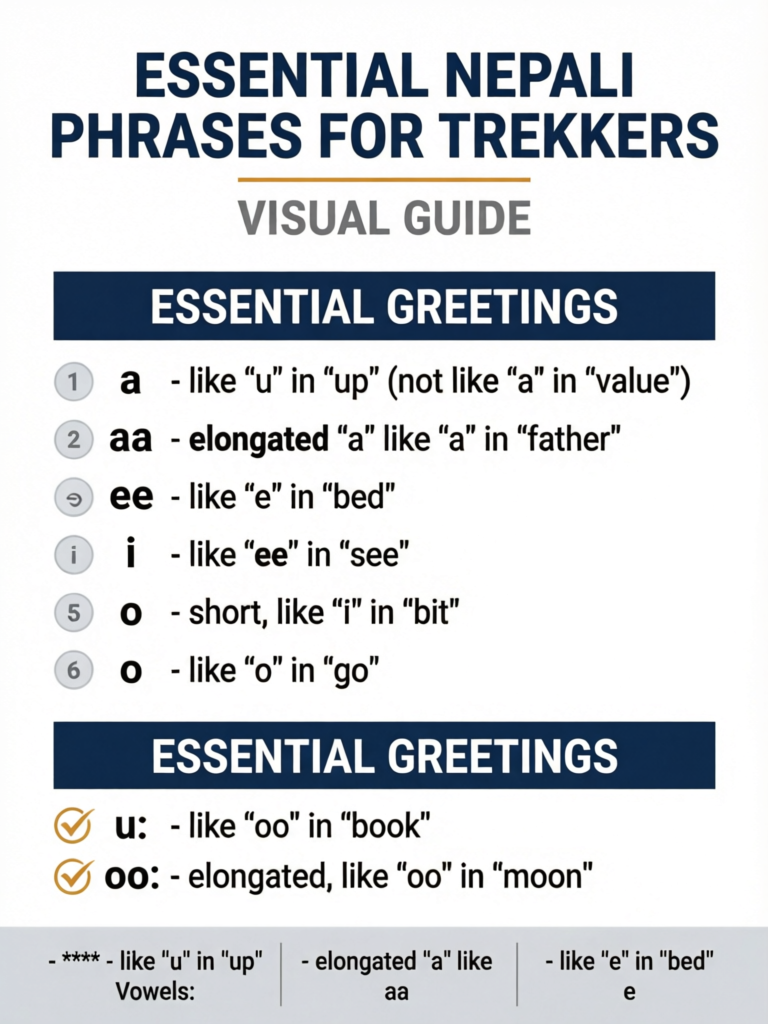
Before diving into phrases, understanding Nepali pronunciation will help you be understood.
Basic Pronunciation Rules
Vowels:
- a - like "u" in "up" (not like "a" in "cat")
- aa - elongated "a" like "a" in "father"
- e - like "e" in "bed"
- ee - like "ee" in "see"
- i - short, like "i" in "bit"
- o - like "o" in "go"
- u - like "oo" in "book"
- oo - elongated, like "oo" in "moon"
Consonants: Most consonants sound similar to English, with these exceptions:
- kh - aspirated "k" (more air)
- gh - voiced aspirated "g"
- ch - like "ch" in "church"
- jh - aspirated "j"
- th - aspirated "t" (NOT like English "th")
- dh - aspirated "d"
- ph - aspirated "p" (NOT like English "f")
- bh - aspirated "b"
The Secret to Being Understood
Retroflex Consonants
Nepali has "retroflex" consonants (T, Th, D, Dh, N) pronounced with the tongue curled back against the roof of the mouth. In this guide, these are written in capital letters. Don't worry too much about perfection - context usually helps locals understand.
Essential Greetings
These are the phrases you'll use dozens of times daily. Master these first.
Basic Greetings
| English | Nepali | Pronunciation | Usage |
|---|---|---|---|
| Hello/Goodbye | Namaste | na-ma-STAY | Universal greeting, any time |
| Respectful hello | Namaskar | na-ma-SKAR | For elders, formal situations |
| How are you? | Tapaaiko kasto cha? | ta-PAI-ko KAS-to CHA | Polite "you" |
| How are you? (informal) | Timi lai kasto cha? | ti-mi-LAI KAS-to CHA | To peers, younger people |
| I'm fine | Ma sanchai chu | ma san-CHAI chu | Standard response |
| And you? | Tapaaiko ni? | ta-PAI-ko NI | Follow-up question |
| Good morning | Subha prabhat | su-BHA pra-BHAT | Morning greeting |
| Good night | Subha ratri | su-BHA RAT-ri | Before sleeping |
| Goodbye (formal) | Namaste, pheri bhetaula | na-ma-STAY, FE-ri be-TAU-la | "Hello, we'll meet again" |
| See you later | Pheri bhetaula | FE-ri be-TAU-la | Casual goodbye |
Meeting People
| English | Nepali | Pronunciation |
|---|---|---|
| What is your name? | Tapaaiko naam ke ho? | ta-PAI-ko NAAM ke HO |
| My name is... | Mero naam ... ho | ME-ro NAAM ... HO |
| Where are you from? | Tapaaai kahaa bata ho? | ta-PAI ka-HAA ba-ta HO |
| I am from [country] | Ma [country] bata ho | ma [country] ba-ta HO |
| Nice to meet you | Tapaai lai bhetna khushi lagyo | ta-PAI-lai BHET-na KHU-shi la-GYO |
The Power of Namaste
"Namaste" is your Swiss Army knife. Use it as hello, goodbye, thank you (informal), and general acknowledgment. With hands pressed together (prayer position), it shows respect. Most Nepalis will light up when foreigners use proper namaste with the hand gesture.
Numbers 1-100
Numbers are essential for prices, distances, time, and understanding locals. Here's the complete system.
Numbers 1-20
| Number | Nepali | Pronunciation |
|---|---|---|
| 1 | ek | EK |
| 2 | dui | DOO-i |
| 3 | tin | TEEN |
| 4 | char | CHAR |
| 5 | paanch | PAANCH |
| 6 | chha | CHHA |
| 7 | saat | SAAT |
| 8 | aaTh | AATH |
| 9 | nau | NAU |
| 10 | das | DAS |
| 11 | eghaara | e-GHAA-ra |
| 12 | baara | BAA-ra |
| 13 | tera | TE-ra |
| 14 | chauda | CHAU-da |
| 15 | pandhra | PAN-dhra |
| 16 | sora | SO-ra |
| 17 | satra | SAT-ra |
| 18 | aThaara | a-THAA-ra |
| 19 | unnaais | un-NAA-is |
| 20 | biis | BEES |
Numbers 21-100 (Tens and Key Numbers)
| Number | Nepali | Pronunciation |
|---|---|---|
| 21 | ekkais | ek-KAIS |
| 25 | pachhis | pach-CHIS |
| 30 | tiis | TEES |
| 40 | chaalis | chaa-LIS |
| 50 | pachaas | pa-CHAAS |
| 60 | saaThi | SAA-thi |
| 70 | sattari | sat-TA-ri |
| 80 | asi | A-si |
| 90 | nabbe | NAB-be |
| 100 | ek saya | EK SA-ya |
Forming Compound Numbers
For numbers between tens, add the unit:
- 23 = teis (TE-is)
- 34 = chauntis (CHAUN-tis)
- 45 = paintalis (pain-TA-lis)
- 56 = chappanna (chap-PAN-na)
For larger amounts (prices):
- 150 = ek saya pachaas (EK SA-ya pa-CHAAS)
- 250 = dui saya pachaas
- 500 = paanch saya
- 1000 = ek hajaar (EK ha-JAAR)
Price Negotiation Numbers
Tea House Communication
These phrases will make your tea house stays smoother and more enjoyable.
Booking and Rooms
| English | Nepali | Pronunciation |
|---|---|---|
| Do you have a room? | Kotha cha? | KO-tha CHA |
| I need a room | Malai kotha chahincha | ma-LAI KO-tha cha-HIN-cha |
| For one person | Ek jana ko laagi | EK ja-na ko LAA-gi |
| For two people | Dui jana ko laagi | DOO-i ja-na ko LAA-gi |
| Single room | Single kotha | SINGLE KO-tha |
| Double room | Double kotha | DOUBLE KO-tha |
| How much per night? | Ek raat ko kati ho? | EK RAAT ko KA-ti HO |
| Is breakfast included? | Bihana ko khana pani cha? | bi-HA-na ko KHA-na PA-ni CHA |
| Can I see the room? | Ma kotha herna sakchu? | ma KO-tha HER-na SAK-chu |
| I'll take it | Ma linchu | ma LIN-chu |
| Too expensive | Dherai mahango | dhe-RAI ma-HAN-go |
| Is there hot water? | Taato paani cha? | TAA-to PAA-ni CHA |
| Where is the toilet? | Charpi kahaa cha? | CHAR-pi ka-HAA CHA |
| Extra blanket please | Ek ota kambal dinus | EK O-ta kam-BAL di-NUS |
Tea House Amenities
| English | Nepali | Pronunciation |
|---|---|---|
| Is there WiFi? | WiFi cha? | WiFi CHA |
| What's the password? | Password ke ho? | PASSWORD ke HO |
| Is there charging? | Charging cha? | CHARGING CHA |
| How much for charging? | Charging ko kati ho? | CHARGING ko KA-ti HO |
| Hot shower available? | Taato paani ko shower cha? | TAA-to PAA-ni ko SHOWER CHA |
| Is there electricity? | Bijuli cha? | bi-JU-li CHA |
| What time is dinner? | Khana kati baje ho? | KHA-na KA-ti BA-je HO |
| Can I store my bag? | Mero jhola rakhna milcha? | ME-ro JHO-la RAKH-na MIL-cha |
Food Ordering
Food vocabulary is crucial for ordering meals and understanding menus.
Basic Food Phrases
| English | Nepali | Pronunciation |
|---|---|---|
| Menu please | Menu dinus | MENU di-NUS |
| I'm hungry | Malai bhok lagyo | ma-LAI BHOK la-GYO |
| I'm thirsty | Malai tirkha lagyo | ma-LAI TIR-kha la-GYO |
| What do you have? | Ke cha? | KE CHA |
| What do you recommend? | Ke ramro cha? | KE RAM-ro CHA |
| I'll have... | Malai ... dinus | ma-LAI ... di-NUS |
| One more please | Ek ota aru dinus | EK O-ta A-ru di-NUS |
| Enough, thank you | Pugyo, dhanyabad | pu-GYO, dhan-ya-BAAD |
| The bill please | Bill dinus | BILL di-NUS |
| Very tasty! | Dherai mitho! | dhe-RAI MI-tho |
Common Foods
| English | Nepali | Pronunciation |
|---|---|---|
| Rice | Bhaat | BHAAT |
| Lentils | Daal | DAAL |
| Dal bhat (rice & lentils) | Daal bhaat | DAAL BHAAT |
| Vegetables | Tarkari | tar-KA-ri |
| Bread/Chapati | Roti | RO-ti |
| Fried rice | Bhuteko bhaat | bhu-TE-ko BHAAT |
| Noodles | Chowmein | CHOW-mein |
| Soup | Jhol | JHOL |
| Momos (dumplings) | Momo | MO-mo |
| Egg | Anda | AN-da |
| Chicken | Kukhura | ku-KHU-ra |
| Potato | Aalu | AA-lu |
| Vegetable | Sabji | SAB-ji |
Drinks
| English | Nepali | Pronunciation |
|---|---|---|
| Water | Paani | PAA-ni |
| Boiled water | Umaaleko paani | u-MAA-le-ko PAA-ni |
| Hot water | Taato paani | TAA-to PAA-ni |
| Tea | Chiya | CHI-ya |
| Black tea | Kalo chiya | KA-lo CHI-ya |
| Milk tea | Dudh chiya | DUDH CHI-ya |
| Coffee | Coffee | COFFEE |
| Beer | Beer | BEER |
| More tea please | Aru chiya dinus | A-ru CHI-ya di-NUS |
Dietary Needs
| English | Nepali | Pronunciation |
|---|---|---|
| Vegetarian | Shakahari | sha-ka-HAA-ri |
| I don't eat meat | Ma maasu khaadina | ma MAA-su KHAA-di-na |
| No spicy | Piro naraakhnuhos | PI-ro na-RAAKH-nu-hos |
| Less spicy please | Ali ali piro | A-li A-li PI-ro |
| Very spicy | Dherai piro | dhe-RAI PI-ro |
| No onion | Pyaaj naraakhnuhos | PYAAJ na-RAAKH-nu-hos |
| No garlic | Lasun naraakhnuhos | la-SUN na-RAAKH-nu-hos |
| I have allergy | Malai allergy cha | ma-LAI ALLERGY CHA |
Dal Bhat Power
The phrase "Dal bhat power, 24 hour!" is a popular trekker saying. Dal bhat is the staple meal you'll eat almost daily on the trail. It typically includes unlimited rice and lentil soup, vegetables, pickle (achar), and sometimes meat. Say "Aru bhaat dinus" (more rice please) when you need refills!
Directions and Trail Talk
Essential for navigating trails and understanding locals' guidance.
Basic Directions
| English | Nepali | Pronunciation |
|---|---|---|
| Where is...? | ... kahaa cha? | ... ka-HAA CHA |
| Which way to...? | ... jaane baato kun ho? | ... JAA-ne BAA-to KUN HO |
| How far is...? | ... kati Tadha cha? | ... KA-ti TA-dha CHA |
| Left | Baaya | BAA-ya |
| Right | Daaya | DAA-ya |
| Straight | Sidha | SI-dha |
| Up | Maathi | MAA-thi |
| Down | Tala | TA-la |
| Near | Najik | na-JIK |
| Far | Tadha | TA-dha |
| Here | Yahaa | ya-HAA |
| There | Tyahaa | tya-HAA |
Trail-Specific Terms
| English | Nepali | Pronunciation |
|---|---|---|
| Trail/Path | Baato | BAA-to |
| Bridge | Pul | PUL |
| Suspension bridge | Jhulunge pul | jhu-LUN-ge PUL |
| Village | Gaau | GAAU |
| Mountain | Pahad/Himal | pa-HAD / hi-MAL |
| River | Khola | KHO-la |
| Pass | Bhanjyang/La | bhan-JYANG / LA |
| Uphill | Ukalo | u-KA-lo |
| Downhill | Oralo | o-RA-lo |
| Flat | Samatal | sa-ma-TAL |
| Checkpoint | Checkpoint | CHECKPOINT |
| Tea house | Tea house/Bhatti | BHAT-ti |
Asking About Distance
| English | Nepali | Pronunciation |
|---|---|---|
| How many hours to...? | ... samma kati ghanta lagcha? | ... SAM-ma KA-ti GHAN-ta LAG-cha |
| How many kilometers? | Kati kilometer? | KA-ti KILOMETER |
| Is it far? | Tadha cha? | TA-dha CHA |
| Is it close? | Najik cha? | na-JIK CHA |
| Is it difficult? | Garo cha? | GA-ro CHA |
| Is it steep? | Biralo cha? | bi-RA-lo CHA |
Understanding 'Nepali Time'
Emergency Phrases
These phrases could be critical. Practice them before you need them.
Health Emergencies
| English | Nepali | Pronunciation |
|---|---|---|
| Help! | Guhaar! / Bachaau! | gu-HAAR / ba-CHAAU |
| I need a doctor | Malai doctor chahincha | ma-LAI DOCTOR cha-HIN-cha |
| I am sick | Ma birami chu | ma bi-RA-mi CHU |
| I have altitude sickness | Malai uchai ko samasya cha | ma-LAI u-CHAI ko sa-MAS-ya CHA |
| I can't breathe | Ma saas pherna sakdina | ma SAAS PHER-na SAK-di-na |
| Headache | Tauko dukhyo | TAU-ko DUKH-yo |
| Stomach pain | Pet dukhyo | PET DUKH-yo |
| I have diarrhea | Pakhala lagyo | pa-KHA-la la-GYO |
| I need medicine | Malai ausadhi chahincha | ma-LAI au-SA-dhi cha-HIN-cha |
| Hospital | Aspatal | as-pa-TAL |
| Health post | Swasthya chowki | swas-THYA CHOW-ki |
| I am allergic to... | Malai ... ko allergy cha | ma-LAI ... ko ALLERGY CHA |
Emergency Situations
| English | Nepali | Pronunciation |
|---|---|---|
| Emergency! | Aapatkaalin! | aa-pat-KAA-lin |
| Call for help | Madat bolaaunus | ma-DAT bo-LAAU-nus |
| I am lost | Ma haraye | ma ha-RA-ye |
| There's been an accident | Durghatana bhayo | dur-gha-TA-na BHA-yo |
| Someone is injured | Kasailai chot lagyo | ka-SAI-lai CHOT la-GYO |
| We need a helicopter | Haamilai helicopter chahincha | HAA-mi-lai HELICOPTER cha-HIN-cha |
| Where is the nearest phone? | Najik ko phone kahaa cha? | na-JIK ko PHONE ka-HAA CHA |
| Police | Prahari | pra-HA-ri |
| Fire | Aago | AA-go |
| Danger | Khatara | kha-TA-ra |
Critical Emergency Numbers
Before your trek, save these numbers:
- Tourist Police: 1144 (Kathmandu)
- Nepal Police: 100
- Himalayan Rescue Association: +977-1-4440292
- Your embassy contact
In remote areas, your guide or the nearest tea house owner can help contact rescue services.
Cultural Phrases
Using these phrases shows cultural awareness and earns respect.
Politeness and Respect
| English | Nepali | Pronunciation |
|---|---|---|
| Thank you | Dhanyabad | dhan-ya-BAAD |
| Thank you very much | Dherai dhanyabad | dhe-RAI dhan-ya-BAAD |
| You're welcome | Swagat cha | swa-GAT CHA |
| Please | Kripaya | kri-PA-ya |
| Excuse me | Hajur | ha-JUR |
| Sorry | Maaf garnuhos | MAAF gar-NU-hos |
| No problem | Kei chaina | KEI CHAI-na |
| It's okay | Thik cha | THIK CHA |
| Slowly please | Bistari | bis-TA-ri |
| I don't understand | Maile bujhina | MAI-le BUJH-i-na |
| Please repeat | Pheri bhannuhos | PHE-ri BHAN-nu-hos |
| I don't speak Nepali well | Ma Nepali ramro bolna sakdina | ma ne-PA-li RAM-ro BOL-na SAK-di-na |
Compliments and Appreciation
| English | Nepali | Pronunciation |
|---|---|---|
| Beautiful! | Ramro! | RAM-ro |
| Very beautiful | Dherai ramro | dhe-RAI RAM-ro |
| Delicious | Mitho | MI-tho |
| Excellent | Ekdam ramro | EK-dam RAM-ro |
| You are kind | Tapaaiko daya | ta-PAI-ko DA-ya |
| Nepal is beautiful | Nepal ramro cha | ne-PAL RAM-ro CHA |
| I love Nepal | Malai Nepal man parcha | ma-LAI ne-PAL MAN PAR-cha |
| I love the mountains | Malai himal man parcha | ma-LAI hi-MAL MAN PAR-cha |
Blessings and Well-Wishes
| English | Nepali | Pronunciation |
|---|---|---|
| Good luck | Subhakamana | su-bha-ka-MA-na |
| Have a good trip | Yatra shubha hos | YAT-ra SHU-bha HOS |
| Take care | Khyal rakhnus | KHYAL RAKH-nus |
| May you be blessed | Ashirwad hos | aa-shir-WAAD HOS |
| God bless you | Bhagwan ko aashirwad hos | bhag-WAAN ko aa-shir-WAAD HOS |
The Magic of 'Hajur'
Practical Phrases for the Trail
Pacing and Rest
| English | Nepali | Pronunciation |
|---|---|---|
| Slowly | Bistari | bis-TA-ri |
| Wait please | Parkhanus | PARKH-a-nus |
| I need to rest | Malai araam chahincha | ma-LAI aa-RAAM cha-HIN-cha |
| Let's take a break | Araam garau | aa-RAAM ga-RAU |
| I'm tired | Ma thakeko chu | ma tha-KE-ko CHU |
| Let's go | Jaau | JAAU |
| Ready? | Tayaar? | ta-YAAR |
| Not yet | Ajhai chaina | a-JHAI CHAI-na |
| Five minutes | Paanch minute | PAANCH MINUTE |
Photography
| English | Nepali | Pronunciation |
|---|---|---|
| May I take a photo? | Photo khichna milcha? | PHOTO KHICH-na MIL-cha |
| Photo together? | Sangai photo? | san-GAI PHOTO |
| Please don't take my photo | Mero photo nakhichnuhos | ME-ro PHOTO na-KHICH-nu-hos |
| Beautiful view | Ramro drishya | RAM-ro DRISH-ya |
Weather
| English | Nepali | Pronunciation |
|---|---|---|
| What's the weather tomorrow? | Bholi ko mausam kasto cha? | BHO-li ko MAU-sam KAS-to CHA |
| Rain | Paani/Barkha | PAA-ni / BAR-kha |
| Snow | Hiun | HI-un |
| Cold | Jaado | JAA-do |
| Hot | Garmi | GAR-mi |
| Sunny | Ghaam | GHAAM |
| Cloudy | Badali | ba-DA-li |
| Wind | Batash | ba-TASH |
Negotiating and Shopping
Bargaining Phrases
| English | Nepali | Pronunciation |
|---|---|---|
| How much? | Kati ho? | KA-ti HO |
| Too expensive | Dherai mahango | dhe-RAI ma-HAN-go |
| Can you reduce? | Ghataunus na | gha-TAU-nus NA |
| Last price? | Antim dam? | AN-tim DAM |
| I'll pay... | Ma ... dinchu | ma ... DIN-chu |
| Deal | Thik cha | THIK CHA |
| No thank you | Pardaina, dhanyabad | par-DAI-na dhan-ya-BAAD |
| I'm just looking | Ma herdai chu | ma HER-dai CHU |
| I'll think about it | Ma sochchu | ma SOCH-chu |
Useful Shopping Terms
| English | Nepali | Pronunciation |
|---|---|---|
| Big | Thulo | THU-lo |
| Small | Sano | SA-no |
| Too big | Dherai thulo | dhe-RAI THU-lo |
| Too small | Dherai sano | dhe-RAI SA-no |
| Different color | Arko rang | AR-ko RANG |
| This one | Yo | YO |
| That one | Tyo | TYO |
Practice Conversations
Here are some practical conversation flows you might have:
At a Tea House
You: Namaste! Kotha cha? (Hello! Do you have a room?)
Owner: Namaste! Cha, cha. Kati jana? (Hello! Yes, yes. How many people?)
You: Dui jana. Ek raat ko kati ho? (Two people. How much per night?)
Owner: Paanch saya rupiya. (500 rupees.)
You: Thik cha. Taato paani cha? (Okay. Is there hot water?)
Owner: Cha, bucket ma. (Yes, in buckets.)
Ordering Food
You: Namaste! Menu dinus. (Hello! Menu please.)
Server: Hajur, menu. (Yes, here's the menu.)
You: Daal bhaat kati ho? (How much is dal bhat?)
Server: Chaar saya rupiya. (400 rupees.)
You: Ek daal bhaat dinus. Piro naraakhnuhos. (One dal bhat please. No spicy.)
Server: Thik cha. (Okay.)
Asking for Directions
You: Namaste! Namche Bazaar jaane baato kun ho? (Hello! Which way to Namche Bazaar?)
Local: Sidha jaanus, ani daaya. (Go straight, then right.)
You: Kati ghanta lagcha? (How many hours does it take?)
Local: Dui ghanta jati. (About two hours.)
You: Dhanyabad! (Thank you!)
Quick Reference Card
Print or screenshot this for the trail:
| Situation | Phrase | Pronunciation |
|---|---|---|
| Hello/Bye | Namaste | na-ma-STAY |
| Thank you | Dhanyabad | dhan-ya-BAAD |
| Yes | Ho | HO |
| No | Hoina | HOI-na |
| How much? | Kati ho? | KA-ti HO |
| Water | Paani | PAA-ni |
| Tea | Chiya | CHI-ya |
| Food | Khana | KHA-na |
| Room | Kotha | KO-tha |
| Toilet | Charpi | CHAR-pi |
| Help! | Guhaar! | gu-HAAR |
| I don't understand | Maile bujhina | MAI-le BUJH-i-na |
| Slowly | Bistari | bis-TA-ri |
| Beautiful | Ramro | RAM-ro |
| Delicious | Mitho | MI-tho |
Final Tips for Learning Nepali
Before Your Trek:
- Practice basic greetings until they're automatic
- Learn numbers 1-10 thoroughly
- Master "Namaste," "Dhanyabad," and "Kati ho?"
On the Trail:
- Don't be shy - locals appreciate any effort
- Ask your guide or porter to teach you new words
- Practice with tea house staff during meals
- Keep a small notebook of new words
Common Mistakes to Avoid:
- Don't use informal "timi" with elders - use "tapaaai"
- Don't point with one finger - use your whole hand
- Remember to add "hos" or "nus" endings for polite requests
Learning even a few dozen Nepali phrases transforms you from a tourist passing through to a traveler engaging with the culture. The smiles, better service, and genuine connections make the effort worthwhile many times over.
Shubha yatra! (Have a good journey!)
Do I Need to Speak Nepali for Trekking in Nepal?
No, you do not need to speak Nepali. English is widely understood on popular trekking routes like Everest Base Camp, Annapurna Base Camp, and the Annapurna Circuit. Tea house staff, guides, and porters on major routes speak functional English. However, learning even basic Nepali phrases transforms your experience -- it earns respect from locals, opens doors to genuine connections, and proves invaluable on off-the-beaten-path treks where English is less common.
Frequently Asked Questions
What is the most important Nepali phrase for trekkers?
"Namaste" (hello/goodbye) combined with "dhanyabaad" (thank you) will carry you through most interactions. Adding "bistari bistari" (slowly, slowly) demonstrates cultural understanding of Nepal's trekking philosophy and will make your guide smile.
How do I say "how much?" in Nepali?
"Kati ho?" (How much is it?) is essential for tea house transactions, market shopping in Kathmandu, and negotiating in Thamel. Follow up with "mahango" (expensive) or "sasto" (cheap) if needed.
Do guides speak English on Nepal treks?
Licensed guides on major routes speak functional to excellent English. Guides from TAAN-registered agencies are typically better English speakers. On remote routes like Upper Mustang or Dolpo, English ability varies more widely.
Should I learn Devanagari script before trekking?
No. Learning the script is not necessary for trekking purposes. Romanized Nepali (as used in this guide) is sufficient for verbal communication. Trail signs on major routes include English text. Spend your preparation time on fitness training instead.
What do I say in an emergency in Nepali?
"Malaai help chaahiyo!" (I need help) and "Doctor chaahiyo!" (I need a doctor) are the critical emergency phrases. "Birami" means sick and "hospital" is the same in Nepali. These phrases could be critical on remote sections of any trek.
This guide uses simplified romanization for accessibility. Formal Nepali uses Devanagari script.