
Getting to Kathmandu is the first logistical challenge of any Nepal trekking adventure. Tribhuvan International Airport (KTM) is a relatively small airport with no direct flights from most Western countries, meaning virtually every trekker routes through a transit hub in Asia or the Middle East. The choice of airline, routing, and booking timing can mean the difference between a $500 ticket and a $2,000 one, and between a smooth 12-hour journey and a grueling 30-hour odyssey with overnight layovers.
This guide provides region-by-region route analysis, airline comparisons, seasonal pricing patterns, and booking strategies specifically for trekkers, who have unique timing constraints driven by trekking seasons. Whether you are flying from New York, London, Sydney, or Singapore, this guide will help you find the best combination of price, convenience, and reliability for your flight to Kathmandu.
KTM (Tribhuvan International)
6 km east of central Kathmandu
Yes (causes delays in peak season)
October-November most expensive
June-August (monsoon season)
$600-1,500 depending on origin
Delhi, Doha, Bangkok, Istanbul
Available for most nationalities
Understanding Kathmandu Flight Logistics
Why Most Flights Connect
Tribhuvan International Airport has a single runway, limited infrastructure, and restrictive terrain (mountains on three sides), which limits the size and frequency of aircraft that can operate there. No airline currently offers direct flights from North America, Europe, or Australia to Kathmandu. Every flight from these regions requires at least one connection.
The good news is that several major airlines compete fiercely for the Nepal route, particularly Middle Eastern carriers (Qatar Airways, FlyDubai), Gulf carriers (Oman Air), Southeast Asian carriers (Thai Airways, Malaysia Airlines), and Indian carriers (IndiGo, Air India). This competition keeps prices reasonable and provides multiple routing options.
Seasonal Pricing Patterns
Flight prices to Kathmandu follow a predictable pattern tied to Nepal's trekking seasons.
| Season | Months | Price Level | Notes |
|---|---|---|---|
| Peak Autumn | Oct-Nov | Highest (+40-60% above base) | Prime trekking season |
| Peak Spring | Mar-Apr | High (+20-40% above base) | Second trekking season |
| Winter | Dec-Feb | Moderate (base price) | Cold but clear, fewer trekkers |
| Monsoon | Jun-Aug | Lowest (-20-30% below base) | Rain, limited trekking |
| Shoulder | May, Sep | Moderate | Transition periods |
Key pricing insight: The single most expensive time to fly to Kathmandu is late September through early November, coinciding with the peak autumn trekking season. Booking 3-4 months in advance during this period can save 20-30% compared to last-minute fares.
Pro Tip
Best Routes by Region
From North America (USA and Canada)
North American travelers face the longest journey to Kathmandu, with minimum travel times of 18-24 hours including connections.
Best routing options:
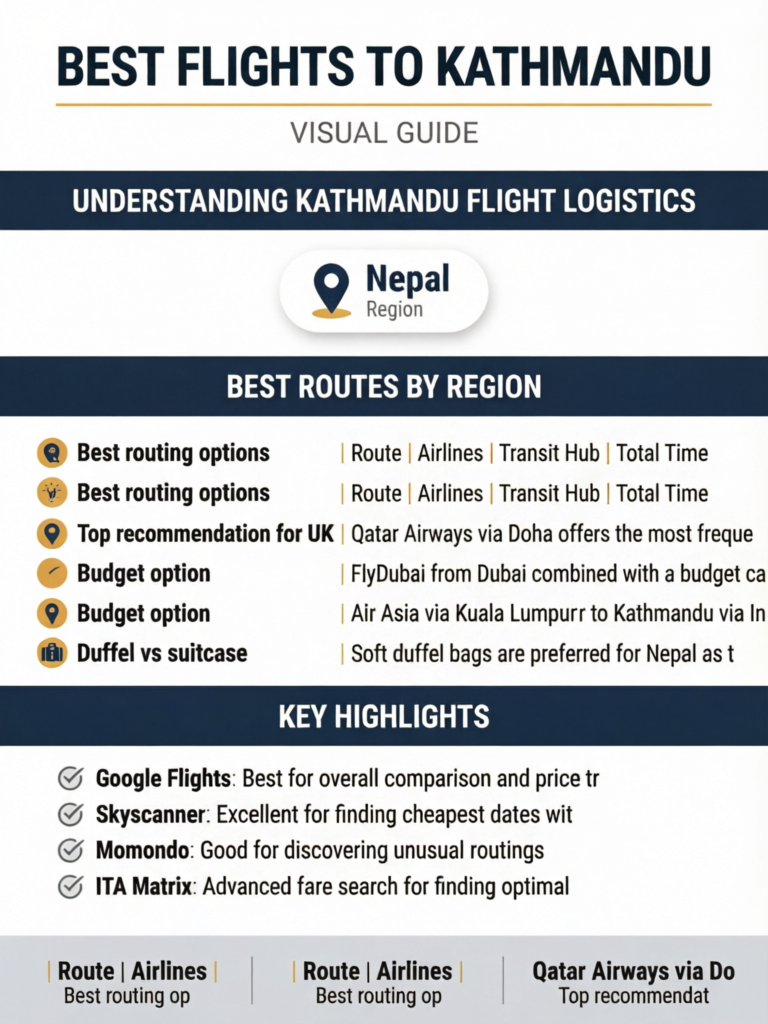
| Route | Airlines | Transit Hub | Total Time | Approximate RT Price |
|---|---|---|---|---|
| East Coast via Doha | Qatar Airways | Doha (DOH) | 20-24 hrs | $800-1,400 |
| East Coast via Istanbul | Turkish Airlines | Istanbul (IST) | 20-26 hrs | $750-1,300 |
| East Coast via Delhi | Air India + local | Delhi (DEL) | 22-28 hrs | $700-1,200 |
| West Coast via Bangkok | Multiple carriers | Bangkok (BKK) | 22-28 hrs | $800-1,400 |
| West Coast via Seoul | Korean Air / Asiana | Seoul (ICN) | 24-30 hrs | $900-1,500 |
| Any US via Dubai | FlyDubai / Emirates | Dubai (DXB) | 22-28 hrs | $800-1,400 |
Top recommendation for East Coast (NYC, Boston, DC): Qatar Airways via Doha offers the best combination of price, comfort, and connection convenience. The Doha connection is typically 2-4 hours, and Qatar's service quality is consistently excellent. Turkish Airlines via Istanbul is a strong alternative with slightly longer layovers but excellent business class pricing.
Top recommendation for West Coast (LA, SF, Seattle): Multiple options compete, but routing through Delhi on a combination of a US carrier to Delhi and then a separate ticket on IndiGo or Air India to Kathmandu often yields the lowest total fare. Bangkok is the most pleasant transit hub for long layovers, with affordable hotels and excellent airport facilities.
Two-Ticket Strategy
From Europe
European travelers have excellent options with shorter travel times (10-16 hours).
Best routing options:
| Route | Airlines | Transit Hub | Total Time | Approximate RT Price |
|---|---|---|---|---|
| London via Doha | Qatar Airways | Doha (DOH) | 12-15 hrs | EUR 500-900 |
| London via Delhi | Air India / BA | Delhi (DEL) | 12-16 hrs | EUR 450-800 |
| London via Istanbul | Turkish Airlines | Istanbul (IST) | 13-16 hrs | EUR 450-850 |
| Germany via Doha | Qatar Airways | Doha (DOH) | 12-15 hrs | EUR 500-900 |
| France via Dubai | Emirates | Dubai (DXB) | 14-18 hrs | EUR 550-950 |
| Scandinavia via Istanbul | Turkish Airlines | Istanbul (IST) | 14-18 hrs | EUR 550-950 |
Top recommendation for UK: Qatar Airways via Doha offers the most frequent service and competitive pricing. The Delhi route via Air India provides an interesting stopover option if you want to explore Delhi for a day.
Top recommendation for Continental Europe: Turkish Airlines offers the widest European network connecting to Kathmandu via Istanbul, with competitive pricing from most major European cities. The Istanbul hub has excellent facilities for layovers.
Budget option: FlyDubai from Dubai combined with a budget carrier to Dubai offers the cheapest fares, though with less comfort and longer total travel times.
From Australia and New Zealand
Australian and New Zealand travelers have moderate travel times (14-20 hours) with several excellent transit options.
| Route | Airlines | Transit Hub | Total Time | Approximate RT Price |
|---|---|---|---|---|
| Sydney via Bangkok | Thai Airways | Bangkok (BKK) | 14-18 hrs | AUD 800-1,400 |
| Sydney via KL | Malaysia Airlines | Kuala Lumpur (KUL) | 15-19 hrs | AUD 750-1,300 |
| Sydney via Singapore | Singapore Airlines | Singapore (SIN) | 15-19 hrs | AUD 850-1,500 |
| Melbourne via Delhi | Various | Delhi (DEL) | 16-22 hrs | AUD 800-1,400 |
| Auckland via Bangkok | Thai / NZ combined | Bangkok (BKK) | 18-24 hrs | NZD 1,000-1,800 |
Top recommendation: Bangkok via Thai Airways or a Thai carrier combination offers the best balance of price, transit comfort, and timing. Bangkok's Suvarnabhumi Airport is excellent for layovers, and direct flights from Bangkok to Kathmandu are frequent (2-3 daily).
Budget option: Air Asia via Kuala Lumpur to Kathmandu via India offers the cheapest routing but with multiple connections and budget carrier comfort levels.
Pro Tip
From Southeast Asia
Travelers already in Southeast Asia have the shortest and cheapest routes to Kathmandu.
| Route | Airlines | Flight Time | Approximate OW Price |
|---|---|---|---|
| Bangkok direct | Thai, Nepal Airlines, Buddha Air | 3.5 hrs | $100-250 |
| Kuala Lumpur direct | Malaysia Airlines, Nepal Airlines | 4.5 hrs | $120-280 |
| Singapore via Bangkok | Multiple | 6-8 hrs | $150-350 |
| Hong Kong via Bangkok | Multiple | 7-10 hrs | $200-400 |
Top recommendation: Bangkok has the most frequent direct flights to Kathmandu, with multiple daily departures at competitive prices.
From India
India offers the cheapest and most frequent connections to Kathmandu.
| Route | Airlines | Flight Time | Approximate OW Price |
|---|---|---|---|
| Delhi direct | IndiGo, Air India, Nepal Airlines | 1.5 hrs | $60-150 |
| Mumbai via Delhi | IndiGo, Air India | 4-6 hrs | $100-250 |
| Kolkata direct | IndiGo, Buddha Air | 1 hr | $50-130 |
| Bangalore via Delhi | Multiple | 5-7 hrs | $120-280 |
| Varanasi direct | Buddha Air | 45 min | $80-150 |
Top recommendation: IndiGo from Delhi offers the most frequent service (multiple daily flights) at the lowest prices. Book 2-4 weeks in advance for the best rates.
From the Middle East
Middle Eastern hubs offer efficient connections with premium service.
| Route | Airlines | Flight Time | Approximate RT Price |
|---|---|---|---|
| Doha direct | Qatar Airways | 4.5 hrs | $400-800 |
| Dubai direct | FlyDubai | 4 hrs | $350-700 |
| Abu Dhabi via Delhi | Etihad | 7-10 hrs | $400-800 |
| Muscat direct | Oman Air | 3.5 hrs | $350-700 |
Airline Comparison for the Kathmandu Route
Full-Service Carriers
| Airline | Hub | Service Quality | Baggage | Price Range | Reliability |
|---|---|---|---|---|---|
| Qatar Airways | Doha | Excellent | 30 kg checked | $$$ | Very High |
| Turkish Airlines | Istanbul | Very Good | 30 kg checked | $$ | High |
| Singapore Airlines | Singapore | Excellent | 30 kg checked | $$$$ | Very High |
| Thai Airways | Bangkok | Good | 30 kg checked | $$ | Moderate |
| Malaysia Airlines | Kuala Lumpur | Good | 30 kg checked | $$ | Moderate |
| Air India | Delhi | Variable | 25 kg checked | $ | Moderate |
Budget and Regional Carriers
| Airline | Hub | Service Quality | Baggage | Price Range | Reliability |
|---|---|---|---|---|---|
| IndiGo | Delhi | Basic | 15-25 kg (paid) | $ | High |
| FlyDubai | Dubai | Basic-Good | 20 kg checked | $$ | High |
| Nepal Airlines | Kathmandu | Basic | 30 kg checked | $ | Low |
| Buddha Air | Kathmandu | Basic | 25 kg checked | $ | Moderate |
| Oman Air | Muscat | Good | 30 kg checked | $$ | High |
Nepal Airlines Reliability
Baggage Considerations for Trekkers
Trekkers carry more luggage than typical tourists due to gear. Understanding airline baggage policies saves money and hassle.
- Full-service carriers: Typically include 25-30 kg checked baggage. Sufficient for most trekkers
- Budget carriers: Often include only 15-20 kg or charge extra for checked bags. Budget for an additional $30-80 per leg for extra baggage
- Trekking poles: Must be checked. Pack in your main bag or use a trekking pole bag
- Sleeping bags: Bulky but light. Compression sacks help fit them in standard luggage
- Duffel vs suitcase: Soft duffel bags are preferred for Nepal as they are easier to manage in Kathmandu's narrow hotel corridors and domestic flights
Total gear weight: Most trekkers carry 15-25 kg total (including carry-on). A duffel bag of 15-20 kg checked plus a 7-10 kg daypack is the standard trekker setup.
Booking Strategies
When to Book
| Booking Window | Savings Potential | Risk Level |
|---|---|---|
| 4-6 months ahead | Best prices, best seats | Very Low |
| 2-3 months ahead | Good prices | Low |
| 1 month ahead | Moderate prices | Moderate (limited seats) |
| 2 weeks ahead | High prices | High (may not get preferred routing) |
| Last minute | Highest prices | Very High (limited availability in peak season) |
Optimal booking window: 3-5 months before departure for peak season (October-November, March-April). For off-peak travel, 1-2 months is sufficient.
Price Comparison Tools
- Google Flights: Best for overall comparison and price tracking
- Skyscanner: Excellent for finding cheapest dates within a month
- Momondo: Good for discovering unusual routings
- Airline websites: Often match or beat aggregator prices and provide better rebooking options
- ITA Matrix: Advanced fare search for finding optimal pricing structures
Money-Saving Strategies
- Fly midweek: Tuesday, Wednesday, and Thursday departures are typically 10-20% cheaper
- Book early for peak season: September departures for autumn trekking should be booked by June
- Consider positioning flights: Flying to a cheaper departure city (e.g., London to Delhi on a separate ticket, then Delhi to Kathmandu) can save significantly
- Use airline miles: Qatar Airways, Singapore Airlines, and Turkish Airlines are all Star Alliance or Oneworld members with mileage earning opportunities
- Monitor sales: Middle Eastern carriers run periodic sales offering 30-40% discounts on economy class
- Flexible dates: Even shifting by 2-3 days can save hundreds of dollars in peak season
Pro Tip
Tribhuvan International Airport Arrival Guide
Airport Overview
Tribhuvan International Airport is small by international standards, with a single terminal for international flights. The airport is undergoing expansion, but facilities remain basic compared to the transit hubs you may have passed through.
What to expect:
- Small arrival hall with limited seating
- Electronic visa kiosks (not always working)
- Manual visa counters (expect queues in peak season)
- One luggage carousel for international flights
- Limited duty-free shopping
- No airside transit hotel or lounge access for economy passengers
Step-by-Step Arrival Process
Step 1: Arrival Card and Visa Form Fill out the arrival card on the plane or at the electronic kiosks in the arrival hall. If you completed the online visa application at Nepal's immigration website before departure, you can skip the kiosk step.
Step 2: Payment Counter Proceed to the visa fee payment counter. Have exact USD cash ready ($30 for 15 days, $50 for 30 days, $125 for 90 days). Other major currencies are accepted but USD provides the smoothest transaction. Keep your receipt.
Step 3: Visa Counter Present your passport, visa fee receipt, completed form, and two passport photos. The immigration officer will stamp your visa. Processing takes 2-5 minutes per person.
Step 4: Luggage Collection Proceed to the single baggage carousel. Luggage handling is manual and can be slow. Allow 20-40 minutes for bags to appear.
Step 5: Customs Walk through the customs area. Most trekkers have nothing to declare. Expensive electronics (cameras, drones) may occasionally be questioned. Drone import requires a separate permit.
Step 6: Arrivals Hall Exit into the small arrivals hall where you will find currency exchange counters, SIM card vendors, and pre-paid taxi counters. Hotel pickup drivers hold signs with guest names.
For complete Kathmandu arrival logistics including transport, accommodation, and first-day planning, see our Kathmandu arrival guide for trekkers.
Visa on Arrival Details
| Duration | Fee | Extension | Best For |
|---|---|---|---|
| 15 days | $30 | Up to 150 days total | Short treks (Poon Hill, ABC) |
| 30 days | $50 | Up to 150 days total | Standard treks (EBC, Annapurna Circuit) |
| 90 days | $125 | Up to 150 days total | Long treks, multiple treks, extended travel |
Most trekkers choose 30 days, which provides enough time for pre-trek preparation, the trek itself, and post-trek recovery. Extensions are available at the immigration office in Kathmandu or Pokhara for $3 per day.
For the complete visa process including extensions and special situations, see our Nepal visa guide.
Peak Season Visa Queues
Airport to Kathmandu Transport
| Option | Cost | Time | Notes |
|---|---|---|---|
| Pre-paid taxi | NPR 800-1,000 | 20-40 min | Buy at counter in arrivals hall |
| Hotel pickup | Free-NPR 1,500 | 20-40 min | Arrange with hotel in advance |
| Ride-hailing app | NPR 500-800 | 20-40 min | Need local SIM for app |
| Public bus | NPR 20-30 | 45-60 min | Not practical with luggage |
Recommended: Arrange hotel pickup in advance (most hotels offer free or low-cost airport transfers) or use the pre-paid taxi counter inside the arrivals hall. The pre-paid counter eliminates negotiation and ensures a fixed fair price.
Pro Tip
Connecting Domestic Flights
Many trekkers need domestic flights within Nepal after arriving in Kathmandu.
Kathmandu to Lukla (Everest Region)
The famous Lukla flight (now operating from Ramechhap, 5-6 hours drive from Kathmandu, during peak season) is the gateway to Everest Base Camp treks. Book this flight through your trekking agency or directly with Tara Air or Summit Air. Expect to pay $180-350 one way.
For complete details, see our Kathmandu to Lukla flights guide.
Kathmandu to Pokhara
For Annapurna region treks, you need to reach Pokhara. Options include a 25-minute flight ($80-120) or a 6-7 hour bus/tourist bus ride ($10-25). See our Pokhara guide for trekkers.
Frequently Asked Questions
What is the cheapest way to fly to Kathmandu?
The cheapest routing depends on your origin. From North America, flying to Delhi on a budget-friendly carrier and then taking a separate IndiGo flight to Kathmandu typically offers the lowest total fare. From Europe, Turkish Airlines via Istanbul or FlyDubai via Dubai offer the most competitive pricing. From Australia, Air Asia via Kuala Lumpur provides the lowest fares. Booking 3-5 months in advance and flying midweek maximizes savings.
How far in advance should I book flights for peak trekking season?
Book 3-5 months before your departure for October-November travel (autumn peak season) and 2-4 months before for March-April travel (spring season). Peak season flights from popular origins like London and Sydney sell out, and prices increase significantly within 6 weeks of departure.
Is it better to fly via Delhi or Doha?
Delhi offers shorter total travel time and cheaper fares but involves navigating Indian airports, which can be chaotic. Doha (Qatar Airways) offers a seamless premium experience with excellent connections but at a higher price. For comfort-focused travelers, Doha is superior. For budget-focused travelers, Delhi saves money. Istanbul (Turkish Airlines) is the best middle ground.
Can I fly directly to Kathmandu from the US or Europe?
No. There are no nonstop flights from North America or Europe to Kathmandu. All flights require at least one connection. The shortest total travel time from London is approximately 10-12 hours (via Delhi or Doha). From New York, minimum travel time is approximately 18-20 hours.
What happens if my connecting flight is delayed and I miss my Kathmandu connection?
If booked on a single ticket (through the same airline or airline alliance), the airline is responsible for rebooking you on the next available flight at no cost. If booked on separate tickets, you are responsible for any rebooking costs. This is why booking a single through-ticket on a reliable carrier like Qatar Airways or Turkish Airlines provides valuable insurance despite potentially higher ticket prices.
How much luggage can I bring for trekking?
Most full-service carriers allow 25-30 kg checked luggage plus 7-10 kg carry-on. This is sufficient for trekking gear. Budget carriers often include only 15-20 kg, requiring a paid upgrade for additional weight. Trekking poles must always be in checked luggage. Pack a compression sack for your sleeping bag to save space.
Should I buy travel insurance before or after booking flights?
Buy travel insurance immediately after booking flights. Insurance should cover trip cancellation, flight delays, medical evacuation, and emergency medical care. Nepal trekking insurance must specifically cover helicopter evacuation above 4,000m. See our travel insurance guide for detailed recommendations.
Is the Kathmandu airport safe and modern?
Tribhuvan International Airport is safe but not modern. It is a small, crowded airport with basic facilities. Expect slow visa processing during peak season, limited seating, no transit hotel, and basic food options. The airport is undergoing expansion, but current facilities are adequate rather than comfortable.
What time should I arrive in Kathmandu?
Aim for a daytime arrival if possible. Arriving between 10 AM and 6 PM gives you daylight for the taxi ride to Thamel, time to settle into your hotel, and the ability to exchange currency and handle immediate logistics. Late-night arrivals are fine but mean you lose most of the first day. Early morning arrivals (before 8 AM) mean longer visa queues as multiple flights arrive simultaneously.
Can I get a SIM card at the airport?
Yes. NTC (Nepal Telecom) and Ncell counters are in the arrivals hall. A tourist SIM with data costs NPR 500-1,500 depending on the plan. You need your passport and a passport photo. However, airport SIM prices are higher than in Thamel, so consider waiting if you can manage without data for the taxi ride.
Are there lounges at Kathmandu airport?
There is a small lounge (Landmark Lounge) accessible via Priority Pass, Diners Club, or a fee ($25-35). It offers basic snacks, drinks, WiFi, and seating. It is not comparable to lounges in major international hubs but provides a quiet refuge during long waits for domestic connections.
What currency should I carry?
Carry $100-200 USD cash for visa fees and initial expenses. Nepali Rupees are obtained at airport exchange counters or Thamel money changers (better rates). ATMs in Thamel dispense NPR. Credit cards are accepted at some Kathmandu hotels and restaurants but not on the trail. Carry enough NPR cash for your entire trek.
Your flight to Kathmandu is the beginning of your trekking adventure. Choose your routing and airline wisely, book early for peak season, and arrive with enough time to settle in before heading to the mountains. The journey may be long, but the moment you catch your first glimpse of the Himalayas through the airplane window, every hour of travel becomes worthwhile.
For what to do after you land, see our Kathmandu arrival guide for trekkers. For visa details, see our Nepal visa guide.