Mustang Villages
Two ancient settlements in the Kali Gandaki corridor — where the Annapurna Circuit converges with the gateway to Upper Mustang, set in the world's deepest gorge under a rain-shadow sky that feels more Tibetan plateau than Himalayan Nepal.
2
Villages
Kali Gandaki corridor
2,720–2,810m
Altitude Range
relatively similar elevation
~2pm onset
Daily Gales
fierce afternoon winds
Restricted Area
Access
Upper Mustang permits from Kagbeni
Where two worlds meet
Understanding the Mustang Corridor
The Mustang corridor contains two villages — Jomsom and Kagbeni — that occupy a geographic position unlike any other stretch of Nepal's trekking circuit. They sit in the Kali Gandaki gorge, recognised as the deepest canyon on Earth, carved between the flanks of Dhaulagiri (8,167m) to the west and Annapurna I (8,091m) to the east. The gorge channels a fundamental meteorological boundary: south of Kagbeni lies the monsoon-drenched Annapurna Circuit, green and terraced; north begins the rain-shadow of the Tibetan plateau, where ochre cliffs, wind-sculpted badlands and mud-brick fortresses define the landscape. This abrupt transition — from subtropical to high-altitude desert in a matter of kilometres — makes the Mustang corridor one of the most visually dramatic segments of any Himalayan trek. Jomsom and Kagbeni are not incidental stops along a route; they are the axis on which the entire upper Annapurna–Mustang experience turns, the point where a classic circuit trek can pivot into an expedition to one of Nepal's most restricted and rewarding destinations.
Jomsom functions as the administrative capital of Mustang district and the logistical spine of the region. Positioned at 2,720m on the western bank of the Kali Gandaki, it holds the district government offices, police checkpost, banks with ATMs (a rarity at this altitude), a fuel station, and a growing collection of lodges, restaurants and gear shops. Most critically, it has a domestic airport — the Jomsom Airport — with scheduled services to Pokhara operated by small Twin Otter and similar aircraft. These flights represent the fastest exit from the valley and are the primary reason many trekkers route through Jomsom rather than continuing south on foot or by jeep. For the majority of Annapurna Circuit trekkers arriving from the east via Thorong La pass, Jomsom marks the psychological endpoint: the pass has been crossed, the high drama is over, and the airport offers the option to skip the long descending valley walk back to Beni. The new all-weather road linking Beni to Jomsom, and onward toward Kagbeni and Lo Manthang, has substantially changed the town's character — jeeps and motorbikes now compete with pedestrians, and the formerly meditative quality of the lower Kali Gandaki walk has given way to dust and diesel. Jomsom itself has become more commercial as a result, though it retains its role as the indispensable hub for everything that happens in this part of the Himalayas.
The Kali Gandaki wind is the defining environmental fact of life in these two villages, and no amount of reading fully prepares a first-time visitor for the ferocity of the daily gales. The phenomenon is driven by atmospheric physics: during daylight hours, the Indian lowlands to the south heat rapidly, creating low pressure that pulls cold, dense air down from the Tibetan Plateau to the north. The Kali Gandaki gorge acts as a natural wind tunnel, concentrating and accelerating this airflow to remarkable speeds. In practice, mornings are typically calm — sometimes eerily so — and the valley is accessible and pleasant. By late morning the wind begins to pick up, and by early afternoon it commonly reaches gale force, driving clouds of sand and grit that scour exposed skin and make forward progress on the trail a genuine physical effort. Experienced trekkers and locals schedule their activities accordingly: all serious walking is done before noon, and afternoons are spent in teahouses or lodges with doors firmly shut against the blast. The airport schedule is dictated entirely by the wind — all flights depart before approximately 10am, and any departure missed due to weather, mechanical issues or late arrival cannot simply be rescheduled to the afternoon. Travellers who misunderstand or underestimate this constraint regularly find themselves stranded in Jomsom waiting a day or more for the next available morning slot.
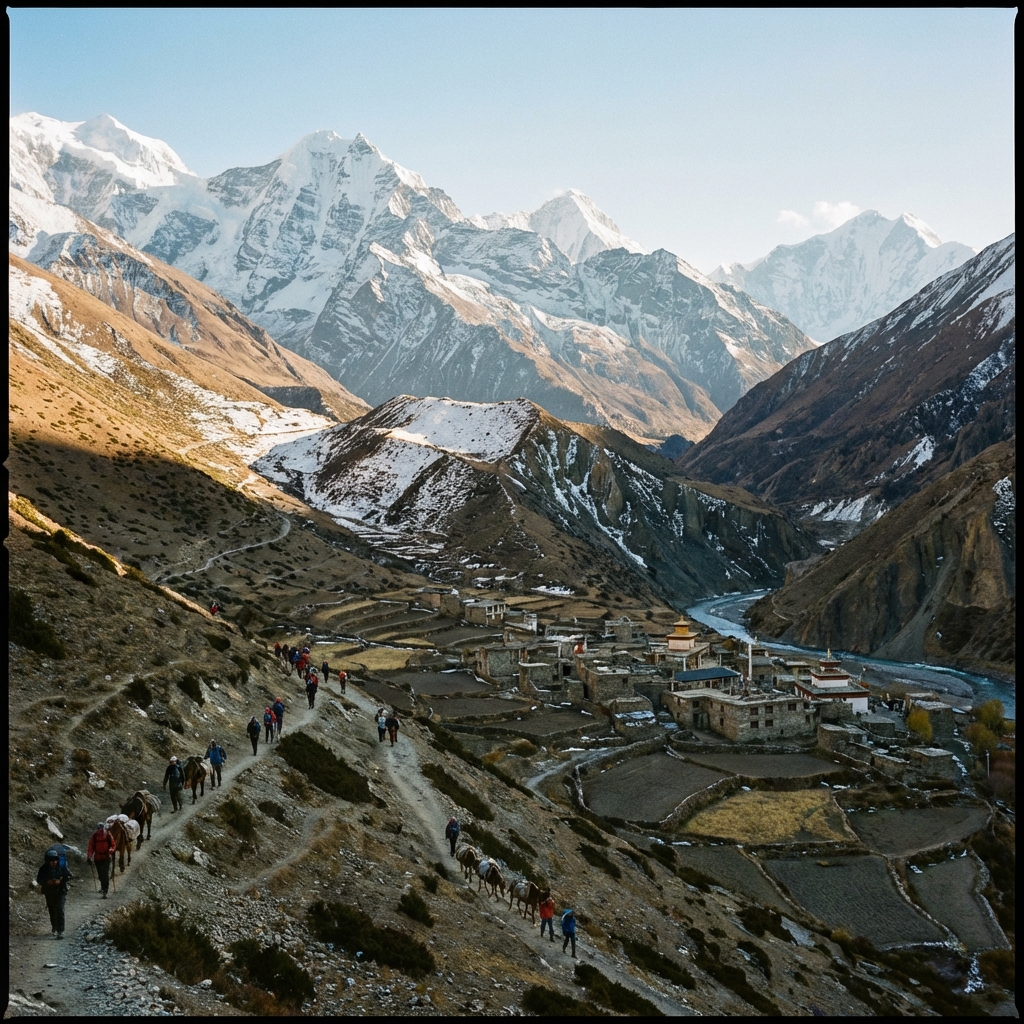
Kagbeni, 7km north of Jomsom at 2,810m, is one of the most architecturally arresting villages in Nepal — and arguably in the wider Himalayan region. The village is a compact, walled settlement of red-ochre and honey-brown mud-brick buildings clustered so tightly that the alleyways between them are essentially tunnels, dark and cool even at midday, with the upper storeys of houses forming a continuous canopy overhead. The buildings stack against each other in organic layers up the hillside, punctuated by the weathered whitewashed walls of Kag Chode Thupten Samphel Ling monastery, which anchors the skyline from a raised position at the village's northern edge. Fortress ruins on the ridge above attest to a strategic past — Kagbeni controlled the trade route between the lower valleys and the Tibetan borderlands for centuries, and the architecture reflects a place that was designed for defence as much as habitation. Prayer wheels, mani walls, chortens and the omnipresent flutter of wind-shredded prayer flags reinforce the Tibetan Buddhist character of daily life. For photographers, the village's warm stone tones, the raking light of morning and late afternoon, and the constant theatrical presence of clouds racing through the gorge create conditions that are difficult to exhaust.
Kagbeni's second identity is administrative rather than aesthetic: it is the official permit checkpoint for the restricted area of Upper Mustang. Beyond the police post at the northern end of the village, the road and trail continue into a zone requiring a special Restricted Area Permit — currently priced at USD 500 per person for a 10-day trekking period, one of the most expensive permits in Nepal's trekking system. Upper Mustang was opened to foreign trekkers only in 1992, and the permit price and mandatory guide requirement are maintained to limit visitor numbers and protect the extraordinary cultural heritage of Lo Manthang, the ancient walled capital, and dozens of cave monasteries, sky-burial sites and medieval fortresses scattered across the plateau landscape. The contrast between the world that ends at Kagbeni's checkpoint and the world that begins beyond it is stark: the Annapurna Circuit is one of the busiest trekking routes on Earth; Upper Mustang is one of the most exclusive and protected. Kagbeni is the hinge point — accessible to anyone on the Circuit, but serving as the threshold to something far more remote.
The apple orchards of the Mustang valley represent one of the most unexpected agricultural success stories in Himalayan Nepal. The Marpha village just south of Jomsom is the epicentre of a fruit-growing industry established through Japanese agricultural development programmes in the 1970s and 1980s, and the Mustang apple has become genuinely famous in Nepal. The rain-shadow climate — low humidity, intense solar radiation, cool nights — creates ideal conditions for fruit development, producing apples with high sugar content and a crisp texture rarely matched at lower elevations. Along the lodges and shops of both Jomsom and Kagbeni, and particularly through Marpha, visitors encounter apple products in remarkable variety: fresh apples in season (September–October), dried apple slices, apple jam, apple brandy (locally called raksi or cider depending on the producer), and — most beloved of trekkers — apple pie and apple pancakes, made to a standard that would not embarrass a bakery in Kathmandu. The local economy depends substantially on these products, and purchasing them directly from Marpha orchards or village shops is one of the most tangible ways visitors can support the communities of the upper Kali Gandaki.
The transformation brought by the Beni–Jomsom road — extended over the past decade toward Kagbeni and ultimately into Upper Mustang — is the most significant structural change to hit these villages in living memory. Where Annapurna Circuit trekkers once walked the entire length of the Kali Gandaki valley as a matter of course, many now take jeeps from Beni directly to Jomsom, bypassing several days of walking and a series of intermediate villages. The impact on those villages has been severe — lodges have closed, trails are underused and eroding in different ways than foot traffic erodes them. In Jomsom and Kagbeni themselves, the road has created economic opportunity: supply costs have dropped, more goods are available, and travellers can reach the area who lack the fitness or time for a full circuit. But both villages are navigating a tension between accessibility and preservation of the qualities that made them worth visiting. Kagbeni, with its walled medieval core largely intact and its upper-Mustang permit system limiting through-traffic, has maintained more of its traditional character. Jomsom is more visibly in transition. Visitors who arrive with realistic expectations — and who explore on foot rather than from a jeep window — still find two of the most compelling villages in Nepal.
Mustang Village Guides
Detailed guides to the two key villages in the Kali Gandaki corridor — the transport hub at Jomsom and the medieval gateway at Kagbeni.
Good to know
Frequently Asked Questions
Do I need a special permit to visit Kagbeni, or only for Upper Mustang beyond it?
Kagbeni village itself is within the standard Annapurna Circuit trekking zone and requires only the regular ACAP (Annapurna Conservation Area Project) permit and a TIMS card — no special permit is needed to walk through the village, stay in a lodge, or visit the monastery. The restricted area begins at the police checkpoint on the northern edge of Kagbeni, beyond which the Upper Mustang Restricted Area Permit (currently USD 500 for 10 days) is mandatory. You will not be allowed past the checkpoint without this permit, and it must be arranged in Kathmandu or Pokhara before departure — it cannot be purchased on-site at Kagbeni. So the short answer is: visit Kagbeni freely on a standard Annapurna permit; obtain the Upper Mustang RAP in advance if you plan to continue north.
How reliable are flights from Jomsom to Pokhara?
Jomsom Airport flights are notoriously unreliable by typical airline standards, though the cause is meteorological rather than operational. All departures must take off before the afternoon winds make flying impossible — typically before 10am. On a clear, calm morning the 15-minute flight to Pokhara operates without issue. But any combination of cloud, fog, rain, or early-onset wind can cancel all flights for the day. During peak trekking seasons (October and spring), backlogs build quickly: one cancelled day can mean two or three days of waiting, as seats fill with stranded passengers. Never book a flight from Jomsom with a tight onward connection from Pokhara. Build at least two buffer days into your schedule. The jeep road to Beni offers a reliable (if rough) alternative when flights are grounded.
What makes Kagbeni's medieval architecture unique in Nepal?
Kagbeni's architectural distinctiveness comes from its Tibetan vernacular style — red-ochre and earth-toned mud-brick construction with flat roofs, heavy timber lintels, and small windows designed to retain heat in a high-altitude desert climate — combined with its remarkable state of preservation and density. The village was built for both habitation and defence, and the buildings are pressed so closely together that upper storeys form tunnel passages over the narrow streets below. This creates an interior spatial experience fundamentally different from open-plan Nepali hill villages. The monastery, fortress ruins, chortens, and carved entrance gates reinforce the medieval character. Unlike many “traditional” Himalayan villages that have been partially modernised, Kagbeni's core remains largely intact, making it one of the most authentic examples of medieval Himalayan urban form accessible on any standard trekking permit in Nepal.
Can I integrate Jomsom and Kagbeni into an Annapurna Circuit trek?
Yes — both villages are natural inclusions in the standard Annapurna Circuit itinerary. After crossing Thorong La (5,416m), the classic route descends through Muktinath and continues south through Kagbeni and Jomsom. Most trekkers spend one night in Kagbeni (to explore the village and enjoy the dramatic evening light on the mud-brick architecture) and one night in Jomsom (for logistics, rest, and potentially a flight to Pokhara the following morning). Alternatively, day-trip between the two — they are only 7km apart on a flat valley floor — which allows you to base yourself in Kagbeni for two nights and walk to Jomsom for the airport or jeep connection. The Marpha apple orchards lie just south of Jomsom and are easily visited as a half-day addition. No detour or special routing is required; these villages are on the main circuit path.
What apple products should I try in the Mustang region?
The Mustang apple industry produces a surprisingly wide range of products beyond the fresh fruit available in September and October. Apple brandy — locally produced in Marpha using traditional distillation methods — is the regional speciality and ranges from rough homemade versions to more refined bottled products sold in Jomsom shops. Apple pie and apple pancakes appear on virtually every lodge menu along the Kali Gandaki and are consistently better than you might expect at 2,700m; the Marpha lodge kitchens have had decades to perfect them. Dried apple slices make an excellent trail snack and pack well. Apple jam and preserves are available in jars and are a practical souvenir. If you visit Marpha specifically (a 30-minute walk south of Jomsom), you can buy directly from orchard stalls during the harvest season. The local apple cider, where available, is worth sampling.
How has road development affected trekking in the Jomsom–Kagbeni area?
The Beni–Jomsom road, extended and improved over the past decade, has fundamentally altered how most people experience the lower Kali Gandaki valley. Many Annapurna Circuit trekkers now jeep directly from Beni to Jomsom, bypassing three or four days of walking that previously defined the circuit's southern leg. The intermediate villages of that section have suffered economically. In Jomsom and Kagbeni themselves, the road has brought increased supply reliability, lower lodge operating costs, and access for non-trekking visitors arriving by jeep from Pokhara. Both villages feel more connected to the lowland economy as a result. The tradeoff is increased traffic noise, dust, and the loss of the meditative walking approach that once made arrival in Jomsom feel earned. Kagbeni's compactness and restricted-area status have partially insulated it from the most disruptive effects. Trekkers who walk between Kagbeni and Jomsom — an easy 2-hour morning walk against the wind — still find the valley extraordinary.