
Kagbeni Village: The Medieval Gateway Where the Wind Howls and the Mountains Begin
Kagbeni village is a medieval walled settlement at 2,810m (9,219ft) in Lower Mustang, sitting where the Kali Gandaki valley narrows toward Upper Mustang. It is the official permit checkpoint for Upper Mustang, a key Annapurna Circuit waypoint near Muktinath and Jomsom, and famous for its mud-brick architecture, Tibetan Buddhist monastery, apple pie, and fierce afternoon winds.
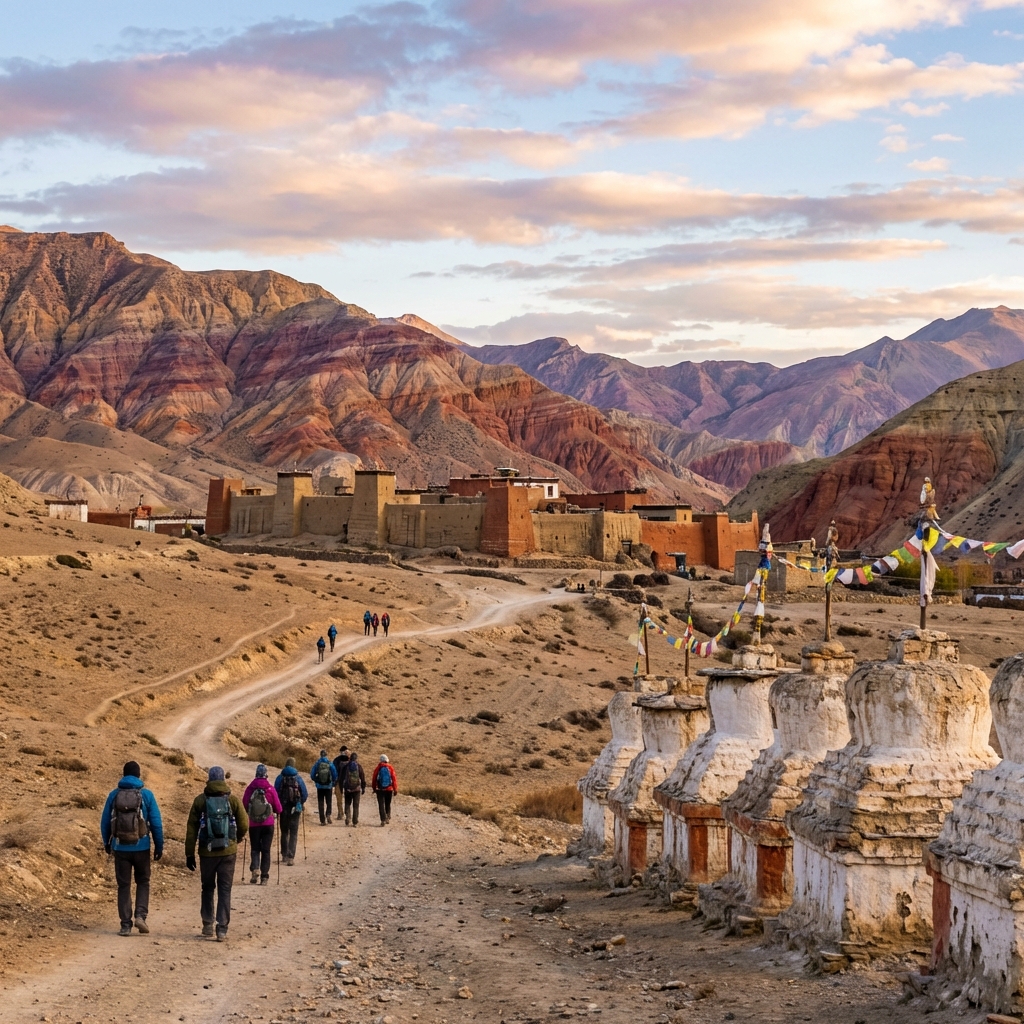
Kagbeni is one of the most atmospheric villages in all of Nepal. At 2,810 meters (9,219 feet), this ancient walled settlement sits at the precise point where the broad, wind-scoured Kali Gandaki valley narrows and turns north toward the forbidden kingdom of Upper Mustang. With its red-ochre mud-brick buildings, medieval fortress ruins, tunneled alleyways, apple orchards, and Buddhist monastery perched above narrow lanes, Kagbeni looks and feels like a village transported from medieval Tibet -- because culturally, that is exactly what it is.
For trekkers, Kagbeni serves multiple functions. It marks the end (or beginning) of the Annapurna Circuit variant that descends from Muktinath rather than continuing east to Jomsom by road. It is the official checkpoint where permits for Upper Mustang are verified before trekkers are allowed to proceed north into one of Nepal's most restricted and culturally pristine regions. And it is, in its own right, one of the most fascinating overnight stops on any Nepal trek -- a place where ancient Buddhist culture, dramatic desert-mountain landscapes, howling winds, and excellent apple pie converge in a package that is utterly unlike anything else on the trekking circuit.
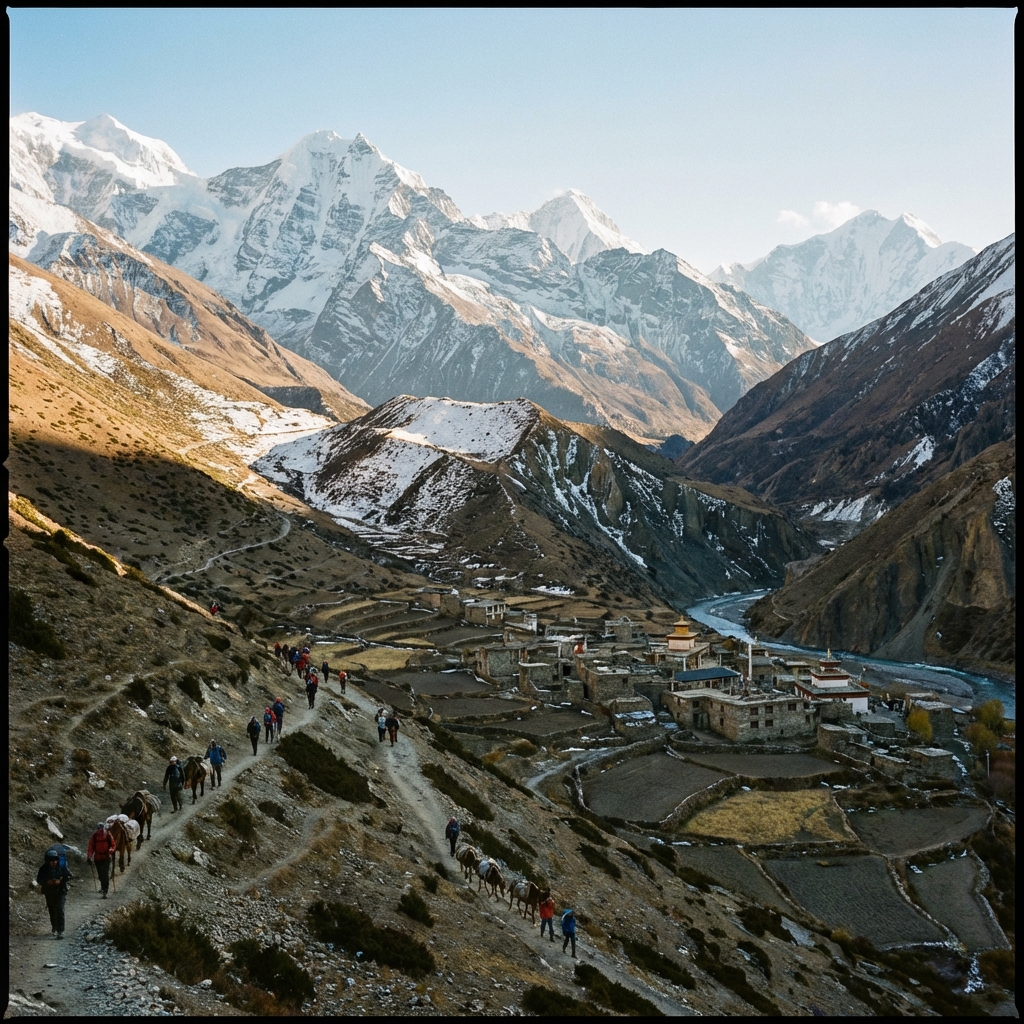
The village sits at the confluence of the Jhong Khola and the Kali Gandaki River, with the massive Nilgiri peaks (7,061m) rising to the east and the barren, eroded hills of lower Mustang stretching north. The contrast is striking. To the south, the landscape is relatively green and fertile; to the north, it transforms into an arid, almost lunar terrain of red and brown cliffs, wind-carved formations, and sparse vegetation. Kagbeni sits exactly on this geological and climatic boundary, making it a fascinating transitional point between the monsoon-influenced lowlands and the rain-shadowed trans-Himalayan desert.
2,810m (9,219ft)
Lower Mustang, Mustang District
Approximately 1,200 residents
Primarily Thakali and Gurung
Jomsom (1-2 hours walk south)
No - nearest in Jomsom (limited)
Available at most lodges
Ncell and NTC coverage
March-May, September-November
Upper Mustang permit checkpoint
Apple pie, medieval architecture, wind
4-5 hours uphill
Why Kagbeni Matters: Three Roles in One Village
Kagbeni is remarkable for the number of roles it plays in the trekking landscape. Understanding each helps you appreciate why this small village deserves more than a quick pass-through.
Gateway to Upper Mustang
Kagbeni is the official starting point for the Upper Mustang trek, one of Nepal's most exclusive and culturally significant trekking routes. The police checkpoint in Kagbeni verifies the special Upper Mustang Restricted Area Permit (currently USD 50/day per person for 10 days) before allowing trekkers to continue north toward Lo Manthang, the ancient walled capital of the former Kingdom of Lo.
The Upper Mustang permit is one of the most expensive in Nepal and requires trekkers to travel with a registered agency and licensed guide. The checkpoint in Kagbeni is strictly enforced -- no permit, no passage. This restriction has helped preserve Upper Mustang's extraordinary medieval Tibetan Buddhist culture and dramatic desert landscapes, making it one of the most culturally intact regions in the Himalaya.
Annapurna Circuit Waypoint
Trekkers completing the Annapurna Circuit often pass through Kagbeni after descending from Muktinath. The standard route continues south to Jomsom for a flight or jeep ride back to Pokhara. Kagbeni offers a pleasant overnight alternative to pushing straight through to Jomsom, with far more character and cultural interest than the administrative center down the valley.
Cultural Destination in Its Own Right
Even without the Upper Mustang connection, Kagbeni merits a visit for its extraordinary medieval atmosphere, monastery, apple orchards, and position at the gateway between two utterly different landscapes. Travelers who spend a night here consistently rank it among their most memorable stops in Nepal.
Upper Mustang Permit Information
The Upper Mustang Restricted Area Permit costs USD 50/day per person for the first 10 days, with additional days at $50 each. Permits must be arranged through a registered trekking agency in Kathmandu or Pokhara, and you must trek with a licensed guide. The permit is checked at the police post in Kagbeni. Independent trekking in Upper Mustang is not allowed.
What Does the Name Kagbeni Mean?
The name carries two overlapping meanings that reflect the village's role as a historic crossroads. In Tibetan, "kak" means blockage or barrier — fitting, because Kagbeni sits where four ancient routes converged and the local lord once controlled and taxed all salt-trade traffic moving between Tibet, Dolpa, Manang, and the mid-hills of Nepal. In Nepali, the name combines "Kag" (crow) and "beni" (the junction of two rivers), pointing to the meeting of the Kali Gandaki and the Jhong Khola directly below the village. Kagbeni is widely regarded as one of the oldest villages in the Himalaya.
Administratively, Kagbeni lies in ward 4 of Baragung Muktichhetra rural municipality, in Mustang District, Gandaki Province. It draws power from a small hydroelectric facility on the nearby Kali Gandaki and sits at the historic boundary between Lower Mustang and the restricted Upper Mustang region to the north.
Kagbeni as a Hindu Pilgrimage Site
While Kagbeni's visible culture is Tibetan Buddhist, the village is also a significant stop for Hindu pilgrims travelling to nearby Muktinath. Kagbeni is one of Nepal's recognised sites for Pitri-Puja (also called Pitri-Moksastala), the ritual performed to release the souls of departed ancestors and bless the living family. Many pilgrims pause here at the confluence of the two sacred rivers to perform the final ancestral rites — often the day before continuing up to Muktinath. In Hindu tradition the site is also associated with the name Yakshya-Tirtha, linking it to figures from the Puranas and the Ramayana.
This dual identity — a Tibetan Buddhist village that is simultaneously a Hindu shraddha site at the meeting of two holy rivers — is part of what makes Kagbeni feel unlike anywhere else on the trekking circuit.
Getting to Kagbeni
From Muktinath (Descending from Thorong La)
Most Annapurna Circuit trekkers reach Kagbeni by descending from Muktinath (3,710m) after crossing Thorong La Pass. The walk takes 3-4 hours and drops 900 meters through arid terrain, passing through Jharkot village with its ruined fortress and monastery.
Trail description:
- Steep descent from Muktinath through Jharkot (3,550m)
- Trail follows the Jhong Khola valley
- Increasingly arid landscape as you descend
- Final approach into Kagbeni through apple orchards
- Dramatic views of Nilgiri and Dhaulagiri en route
From Jomsom (Walking North)
From Jomsom (2,720m), Kagbeni is a pleasant 1.5-2 hour walk north along the Kali Gandaki riverbed. The trail is flat and easy, following the broad, wind-swept valley floor. This is typically an afternoon walk, though the fierce headwinds that develop by midday can make it surprisingly challenging.
From Pokhara (Via Jomsom)
Reach Jomsom by flight (25 minutes from Pokhara, weather permitting) or by jeep/bus along the rough road (8-12 hours). From Jomsom, walk north to Kagbeni.
Pro Tip
If arriving from Jomsom, start your walk early in the morning. The Kali Gandaki valley generates powerful winds that begin around 10:00-11:00 AM and intensify throughout the afternoon, often reaching gale force by midday. Walking into a headwind strong enough to knock you off balance is exhausting and unpleasant. Morning walks are calm and enjoyable.
The Wind: Kagbeni's Defining Feature
No guide to Kagbeni is complete without discussing the wind. The Kali Gandaki gorge is one of the deepest gorges on Earth, cutting between the massifs of Dhaulagiri (8,167m) and Annapurna (8,091m). This geographical feature creates a massive natural wind tunnel that channels air from the Tibetan Plateau southward through the valley with extraordinary force.
Wind Patterns
Morning (6:00-10:00 AM): Generally calm. This is the window for flights in and out of Jomsom airport, and the best time for walking in the valley.
Midday (10:00 AM-2:00 PM): Wind begins to build. Initially a stiff breeze, it strengthens rapidly.
Afternoon (2:00-6:00 PM): Peak wind. Gusts regularly exceed 60-80 km/h and can reach higher. Walking becomes extremely difficult. Dust and sand fill the air. Doors slam, prayer flags stretch horizontal, and conversation requires shouting.
Evening (6:00 PM onward): Wind typically subsides, sometimes dramatically. Evenings can be perfectly calm and pleasant.
Impact on Trekkers
- Plan all walking for morning hours
- Secure loose gear on your pack
- Wear eye protection (sunglasses minimum, goggles in extreme wind)
- Face protection against blowing sand and grit
- Hold onto hats and light items
- Close lodge windows and doors firmly
Wind Safety in the Kali Gandaki
The afternoon winds in the Kali Gandaki are not merely inconvenient -- they can be dangerous. Gusts strong enough to knock adults off their feet occur regularly. Flying debris, including rocks and gravel, can cause injury. Never attempt to walk the open valley floor during peak afternoon wind. If caught in strong winds, seek shelter immediately and wait for conditions to improve. All walking should be completed before 11:00 AM.
Accommodation in Kagbeni
Lodge Overview
Kagbeni offers 10-15 lodges, ranging from basic traditional guesthouses to comfortable mid-range options. The village is smaller and quieter than Jomsom, with a more intimate atmosphere.
| Feature | Budget Lodges | Mid-Range Lodges | Best Available |
|---|---|---|---|
| Price per night | $3-5 | $5-10 | $10-20 |
| Room type | Basic twin, traditional style | Twin/double, renovated | Private with attached bath |
| Hot shower | Solar (limited) | Solar or gas | Gas-heated, reliable |
| WiFi | Available (paid) | Available (paid) | Available (included) |
| Character | Traditional mud-brick | Mix of traditional and modern | Renovated with heritage charm |
Recommended Lodges
Red House Lodge
- Location: Central village, near the monastery
- Rooms: Renovated rooms in traditional building, excellent character
- Dining: Outstanding apple pie, diverse menu
- Notes: One of the most atmospheric lodges on any trek. The building itself is a medieval structure with modern comforts added thoughtfully.
New Shangrila Guest House
- Location: Southern edge of village
- Rooms: Clean, modern rooms
- Dining: Good food variety
- Notes: Good value, friendly owners
New Annapurna Lodge
- Location: Northern end, near checkpoint
- Rooms: Basic but clean
- Dining: Standard trekking menu
- Notes: Convenient for early Upper Mustang departures
Pro Tip
Stay at a lodge within the old village walls rather than on the outskirts. The medieval architecture and atmosphere of Kagbeni's core are the primary attraction, and staying inside the old village lets you experience the tunneled alleys, prayer wheels, and ancient stonework at dawn and dusk when the light is extraordinary and most day-trippers have left.
Food and Dining
Menu and Prices
Kagbeni's food benefits from its position in apple-growing country and relative accessibility from Jomsom. Menus are varied and prices reasonable by trekking standards.
Typical menu items and prices:
- Dal bhat: $5-7
- Fried rice/noodles: $4-6
- Apple pie (a must): $3-5
- Thakali thali set: $5-8
- Momos: $4-6
- Pizza: $5-7
- Pancakes: $3-5
- Apple cider/juice: $2-4
- Tibetan bread with honey: $2-4
- Coffee: $2-3
The Apple Connection
Kagbeni sits in the heart of Nepal's apple-growing belt, and the orchards surrounding the village produce excellent fruit. The apples appear in everything: fresh apple pie (some of the best in Nepal), apple cider, apple brandy (locally distilled and potent), dried apple rings, apple juice, and apple jam. If you eat only one apple pie on your entire trek, eat it in Kagbeni.
The apple industry in the Mustang region was largely developed with assistance from a Japanese aid program that introduced modern apple-growing techniques in the 1960s. Today, the orchards are a major economic contributor alongside tourism and traditional agriculture.
Thakali Cuisine
The Thakali people, who inhabit much of the Kali Gandaki valley, are renowned throughout Nepal for their culinary traditions. Thakali cuisine features a distinctive thali set: rice, dal, meat curry, pickles, and vegetables served on a metal plate. It is widely considered some of the best food in Nepal, and Kagbeni lodges prepare it exceptionally well.
Try the Apple Brandy
Kagbeni and the surrounding Mustang region produce local apple brandy that is remarkably smooth and flavorful. A small glass after dinner warms you from the inside on cold evenings. However, remember that alcohol affects you more strongly at altitude and contributes to dehydration. Limit consumption to a single small glass and drink extra water afterward.
Exploring Kagbeni: What to See and Do
The Medieval Village Core
Kagbeni's old village is a labyrinth of narrow alleys, tunneled passages, and mud-brick buildings that has changed remarkably little over centuries. Walking through the village feels like stepping back 500 years. Key features include:
Tunneled alleyways: Covered passages run between buildings, creating a network of sheltered walkways. These were designed for protection against the fierce winds and served defensive purposes in earlier centuries.
Mud-brick architecture: Traditional buildings constructed from local red-brown earth, with flat roofs used for drying grain and firewood. Many feature intricately carved wooden window frames and doors.
Prayer wheels and mani stones: Buddhist religious elements are everywhere. Spin the prayer wheels clockwise as you walk, following local custom.
The fortress ruins: Above the village, the remains of a medieval fortress (dzong) overlook the Kali Gandaki valley. The ruins are accessible via a short climb and provide excellent views.
Kag Chode Thupten Samphel Ling Monastery
Kagbeni's monastery, locally known as the Kag Chode Gompa, sits prominently above the village and dates back several centuries. The monastery belongs to the Sakya school of Tibetan Buddhism and contains ancient murals, statuary, and manuscripts.
Visiting information:
- Opening hours: Generally mornings and late afternoons
- Entry fee: Small donation expected (200-500 NPR)
- Photography: Ask permission; usually restricted inside prayer halls
- Etiquette: Remove shoes, walk clockwise, speak softly
The monastery houses a terrifying deity figure in its inner sanctum that guards against evil. Ask the caretaker monk to show you -- it is a striking example of wrathful Buddhist iconography.
Apple Orchards
The orchards surrounding Kagbeni make for a pleasant morning walk, particularly during the autumn harvest season (September-October) when trees are heavy with fruit. The contrast of green orchards against the barren brown hills beyond is visually striking.
Kali Gandaki Riverbed
The broad, braided riverbed of the Kali Gandaki stretches south from Kagbeni toward Jomsom. Walking on the riverbed in the calm morning hours offers dramatic views of Nilgiri (7,061m), Dhaulagiri (8,167m), and the Annapurna range. The river also yields shaligram fossils -- ancient ammonite fossils sacred to Hindus and prized as representations of Vishnu. Look for them in the dark river stones, but note that collecting them in large quantities is prohibited.
Tiri Village and Tharwa Chyoling Nunnery
For a rewarding half-day side trip that stays south of the restricted Upper Mustang line (no special permit needed), cross the bridge in Kagbeni and follow the only trail north toward the green terraced fields in the distance. About 30 minutes' walk brings you to Tiri, a tiny traditional village from where a steep path climbs to a monastery with sweeping views over the Kali Gandaki, the bare rock walls of the gorge, and the snow peaks beyond. Kagbeni itself also has the small Tharwa Chyoling Nunnery and several large chortens worth seeking out as you wander the lanes. From high points around the village you can pick out Nilgiri (7,061m), Tilicho Peak (7,139m), and other peaks of the eastern Annapurna massif.
Pro Tip
Visit the monastery in late afternoon when the light is warm and golden. The caretaker monk is usually most relaxed and willing to show visitors around at this time, and the setting sun illuminates the valley views from the monastery courtyard in spectacular fashion. Mornings are also good, but the light is harsher.
The Upper Mustang Checkpoint
How the Permit System Works
The police checkpoint in Kagbeni is the official entry point to Upper Mustang. All trekkers heading north must present their restricted area permit, ACAP permit, and passport. The checkpoint records your details, and you will be checked again at subsequent points within Upper Mustang.
Requirements:
- Upper Mustang Restricted Area Permit (USD 50/day/10 days)
- ACAP permit
- Valid passport
- Licensed guide (mandatory)
- Registered trekking agency booking
What Lies Beyond
North of Kagbeni, the landscape transforms dramatically. The verdant lower valley gives way to an arid, wind-eroded desert landscape of red and ochre cliffs, cave dwellings, and ancient Buddhist monasteries. The trail follows the Kali Gandaki north through Chele, Samar, Ghami, and eventually reaches Lo Manthang, the walled capital of the former Kingdom of Lo.
Upper Mustang remained closed to foreigners until 1992 and still receives relatively few visitors due to the high permit cost and logistical requirements. This isolation has preserved one of the world's most intact medieval Tibetan Buddhist cultures.
No Independent Trekking in Upper Mustang
Unlike most trekking regions in Nepal, Upper Mustang is a restricted area that absolutely requires an organized trek through a registered agency. Independent trekking is not permitted, and the checkpoint in Kagbeni enforces this rule strictly. If you arrive hoping to arrange a permit on the spot, you will be turned away. All permits must be arranged in advance through a trekking agency.
Transport Options
Walking Routes
| Destination | Distance | Duration | Difficulty |
|---|---|---|---|
| Jomsom (south) | 8 km | 1.5-2 hours | Easy (flat) |
| Muktinath (east/up) | 12 km | 4-5 hours | Moderate (uphill) |
| Chele (north/Upper Mustang) | 15 km | 5-6 hours | Moderate |
Jeep and Bus
A rough road connects Kagbeni to Jomsom (30 minutes by jeep). From Jomsom, jeeps and buses run to Pokhara (8-12 hours, rough road) and flights operate to Pokhara (25 minutes, weather dependent).
Flights
The nearest airport is Jomsom (1.5-2 hours walk south). Flights to Pokhara operate in the morning before winds build. Service is frequently disrupted by weather, and delays of 1-3 days are not uncommon. Build buffer days into any itinerary that depends on Jomsom flights.
Weather and Conditions
Seasonal Overview
| Season | Daytime Temp | Nighttime Temp | Conditions |
|---|---|---|---|
| Autumn (Oct-Nov) | 12 to 18C | 0 to 5C | Clear, dry, windy afternoons |
| Spring (Mar-May) | 15 to 22C | 3 to 8C | Warming, some dust, windy |
| Winter (Dec-Feb) | 5 to 12C | -8 to 0C | Cold, clear, less wind, few trekkers |
| Monsoon (Jun-Aug) | 18 to 25C | 8 to 12C | Some rain, less wind, Upper Mustang viable |
The Rain Shadow Advantage
Kagbeni benefits from the rain shadow effect of the Annapurna and Dhaulagiri ranges. Annual rainfall here is a fraction of what falls on the south side of the mountains. This makes the Mustang region one of the few areas in Nepal that is viable for trekking during the monsoon season (June-August), though conditions are not as ideal as spring and autumn.
Cost of Staying in Kagbeni
| Item | Typical Cost (NPR) | Typical Cost (USD) |
|---|---|---|
| Lodge room (per night) | 300-1,500 | $2-12 |
| Dal bhat | 500-800 | $4-6 |
| Apple pie | 350-550 | $3-5 |
| Thakali thali | 600-900 | $5-7 |
| Coffee | 200-350 | $1.50-3 |
| Apple brandy (glass) | 200-400 | $1.50-3 |
| Hot shower | 200-500 | $1.50-4 |
| WiFi (per day) | 200-400 | $1.50-3 |
Budget for one night: Plan approximately $15-25 per person for accommodation, meals, and basic services.
Pro Tip
If you have time, spend two nights in Kagbeni instead of one. The village deserves more than a hurried overnight stop. Use the extra day to explore the old town thoroughly, visit the monastery, walk to the apple orchards, and take a morning stroll on the Kali Gandaki riverbed hunting for shaligram fossils. Kagbeni is one of those rare trekking villages where slowing down pays enormous rewards.
What Facilities Are Available in Kagbeni?
Kagbeni (2,810m) offers comfortable teahouses with hot showers, varied menus featuring local apple products, WiFi at most lodges, and basic shops. The village has the checkpoint marking the Upper Mustang restricted area boundary — your restricted area permit is verified here. No ATM is available; carry cash from Jomsom or Pokhara. Kagbeni has a medieval monastery, apple orchards, and shaligram fossil hunting along the Kali Gandaki riverbed. See our Mustang region guide for full context.
Frequently Asked Questions
1. Do I need the Upper Mustang permit just to visit Kagbeni?
No. Kagbeni is accessible with standard ACAP permits. The Upper Mustang Restricted Area Permit is only required to continue north beyond Kagbeni.
2. Can I arrange the Upper Mustang permit in Kagbeni?
No. The permit must be arranged in advance through a registered trekking agency in Kathmandu or Pokhara. It cannot be obtained at the checkpoint.
3. How strong are the winds really?
Very strong. Afternoon gusts regularly exceed 60-80 km/h. The wind can knock adults off their feet and sends dust and gravel flying. Plan all outdoor activities for morning hours.
4. Is Kagbeni worth visiting if I am not going to Upper Mustang?
Absolutely. Kagbeni is one of the most atmospheric and culturally fascinating villages in Nepal, regardless of whether you continue to Upper Mustang. The medieval architecture, monastery, apple orchards, and dramatic landscape make it a highlight of any Annapurna Circuit or Mustang visit.
5. How do I get from Kagbeni to Pokhara?
Walk or take a jeep to Jomsom (1.5-2 hours walk, 30 minutes jeep). From Jomsom, fly to Pokhara (25 minutes, weather permitting) or take a jeep/bus (8-12 hours on a rough road).
6. Are there shaligram fossils in Kagbeni?
Yes. The Kali Gandaki riverbed contains shaligram fossils (ammonites), which are 140-165 million years old. These black stones with spiral fossil impressions are sacred to Hindus. Small specimens can be found along the riverbed, but large-scale collection is prohibited.
7. Can I visit Kagbeni during monsoon season?
Yes. Kagbeni lies in the rain shadow of the Himalaya and receives significantly less rainfall than the south side of the mountains. The Mustang region is one of few areas in Nepal suitable for monsoon-season trekking, though some rain does occur.
8. What is the food like in Kagbeni?
Excellent by trekking standards. The Thakali cuisine is considered among the best in Nepal, and the apple-based dishes (pie, cider, brandy) are outstanding. Expect a diverse menu at reasonable prices.
9. Is there mobile phone coverage?
Yes. Both Ncell and NTC have reasonable coverage in Kagbeni. Data connections are available but can be slow. WiFi at lodges is generally more reliable than cellular data.
10. How far is Kagbeni from Muktinath?
Muktinath is approximately 12 km from Kagbeni, uphill. The walk takes 4-5 hours ascending and 3-4 hours descending. Jeeps also operate on this road.
11. What currency should I bring?
Nepali rupees. There is no ATM in Kagbeni (the nearest is in Jomsom, which is often unreliable). Carry sufficient cash from Kathmandu or Pokhara.
12. Is Kagbeni connected by road?
Yes. A rough road connects Kagbeni to Jomsom and Muktinath. Jeep transport is available, though many trekkers prefer to walk.
13. What does the name "Kagbeni" mean?
Two meanings overlap. In Tibetan "kak" means blockage or barrier, reflecting the village's role as a control point on four ancient trade routes. In Nepali the name joins "Kag" (crow) and "beni" (river junction), marking the meeting of the Kali Gandaki and Jhong Khola rivers below the village.
14. Why do Hindu pilgrims visit Kagbeni?
Kagbeni sits at the confluence of two sacred rivers and is a recognised site for Pitri-Puja (Pitri-Moksastala), the ritual to release and honour departed ancestors. Many pilgrims perform these rites at Kagbeni, often the day before continuing to the Muktinath temple.
15. Is Kagbeni one of the oldest villages in Nepal?
Yes. Kagbeni is widely regarded as one of the oldest villages in the Himalaya, with a medieval core, a centuries-old monastery, and a history as a salt-trade crossroads. It lies in ward 4 of Baragung Muktichhetra rural municipality in Mustang District.
Related Guides
Final thoughts: Kagbeni stays with you. Long after the physical challenges of the trek have faded from memory, you will remember the tunneled alleyways at dawn, the prayer flags snapping in the wind, the taste of fresh apple pie in a medieval courtyard, and the moment the afternoon wind hit like a wall and you understood why this valley has shaped its people and architecture for centuries. Kagbeni is not just a checkpoint or waypoint -- it is one of Nepal's hidden treasures, a living museum of Himalayan culture that rewards every hour you spend within its ancient walls.