Off the Beaten Path
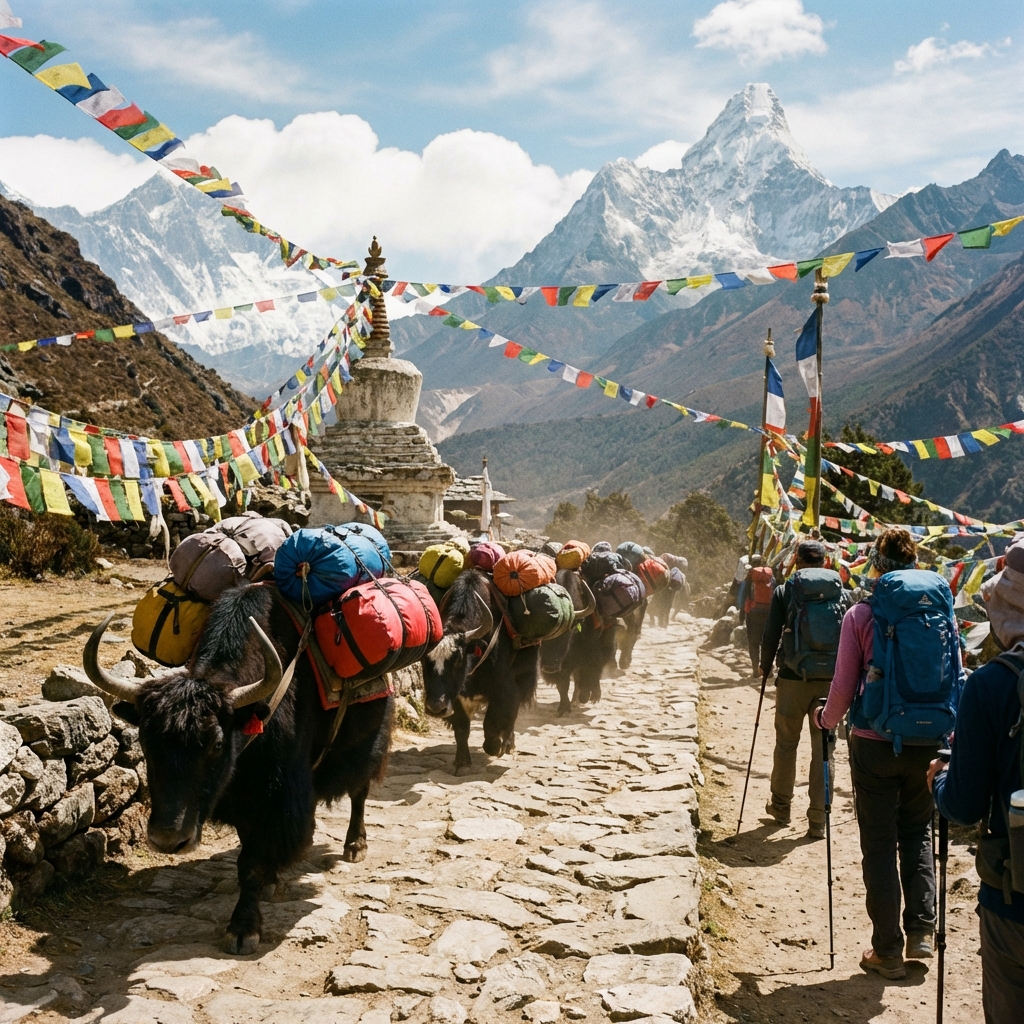
Beyond the main circuits lie Nepal's most authentic and demanding trekking experiences — Manaslu, Upper Mustang, Dolpo, Kanchenjunga, and Makalu. Restricted permits, minimal infrastructure, and extraordinary cultural and natural rewards await those who venture off the popular trail networks.
Permits & wilderness
Nepal's Restricted Trekking Regions
Nepal's government designates certain trekking areas as "restricted zones" — regions requiring special permits beyond the standard national park fees. These restrictions exist for a combination of environmental protection, cultural preservation, and border security reasons. The result is that restricted areas receive a fraction of the traffic of the main Annapurna and Everest circuits, offering an authenticity that the popular trails have gradually lost to commercialization.
The Manaslu Circuit is the most approachable restricted-area trek and has seen the fastest infrastructure development. Tea houses now line the route from Arughat to Dharapani, and the trail quality has improved dramatically since the early 2000s. The dramatic Larky La pass (5,106m) rivals Thorong La in terms of the trekking experience, but with perhaps a quarter of the traffic. The circuit circumnavigates Manaslu (8,163m), the eighth-highest mountain in the world, offering close-up views of this rarely-photographed giant.
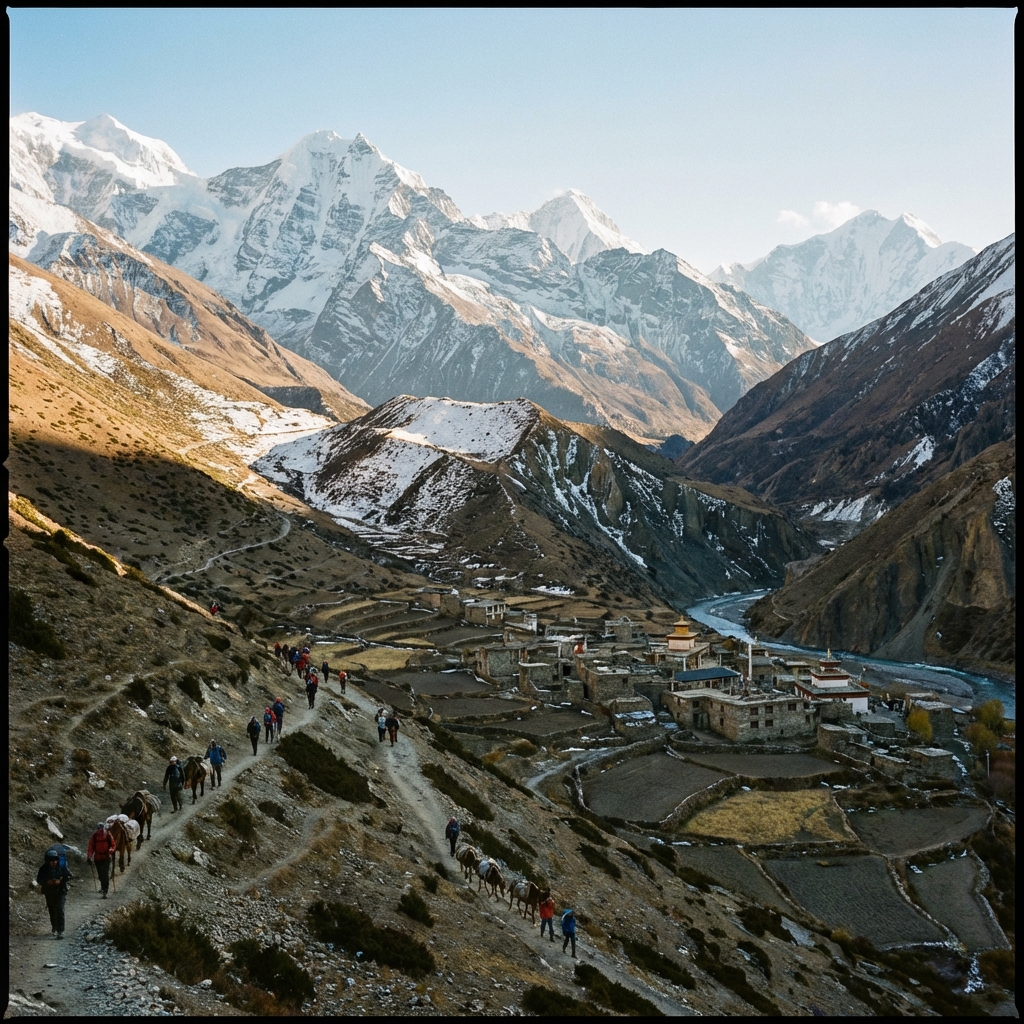
Upper Mustang — once the medieval Buddhist kingdom of Lo — opened to foreign trekkers only in 1992. The walled city of Lo Manthang preserves an extraordinary collection of 14th–15th century cave temples, royal palace architecture, and Tibetan Buddhist art largely untouched by the Cultural Revolution that ravaged similar sites across the border in Tibet. The landscape is high Tibetan plateau — barren, windswept, and extraordinarily photogenic in its stark beauty.
Dolpo, made famous in the West by Peter Matthiessen's book "The Snow Leopard," remains one of the world's most remote trekking destinations. The turquoise Phoksundo Lake (3,612m) is among Nepal's most beautiful, and the surrounding high-altitude terrain hosts the Bon Buddhist culture — a pre-Buddhist tradition that predates Tibetan Buddhism in this region. Upper Dolpo demands expedition-level logistics and experience.
Kanchenjunga (8,586m), the world's third-highest peak, anchors Nepal's remote far east. The trek to its northern and southern base camps traverses some of Nepal's wildest terrain, passing through rhododendron forests, high-altitude glacial valleys, and Limbu and Sherpa cultural zones rarely visited by outsiders. The region has no road access to the trailhead — it requires flights to Taplejung or a long overland journey — which keeps numbers genuinely low.
All restricted-area treks require a licensed local guide and must be booked through a registered trekking agency. This is not merely bureaucratic — in many of these areas, trail markings are minimal, rescue access is extremely limited, and local knowledge is essential for safety. Budget additional time and funds compared to the main circuits: restricted permits, guide fees, and camping equipment for routes without tea houses add significantly to the total cost.
By the numbers
Routes at a Glance
7 routes
Total Routes
Manaslu to far west Nepal
12–25 days
Duration Range
Manaslu to Dolpo
5,106m–5,416m
Altitude Range
Larky La to Manaslu Base
$100–$500
Permits
restricted area fees apply
Route guides
All Off-Beaten-Path Routes
Each guide covers permit requirements, logistics, infrastructure reality, and honest difficulty assessments for experienced trekkers ready to go beyond the main circuits.
Good to know
Frequently Asked Questions
What permits are required for the Manaslu Circuit?
The Manaslu Circuit requires three separate permits: the Restricted Area Permit (RAP) for the Manaslu Conservation Area (currently $100/week in high season, $75/week in low season), the Manaslu Conservation Area Project (MCAP) entry permit ($30), and the Annapurna Conservation Area Project (ACAP) permit ($30) for the section connecting to the Annapurna Circuit near Dharapani. The RAP must be obtained through a registered trekking agency — independent trekking without a licensed guide is not permitted in restricted areas. Minimum group size requirements apply (currently minimum 2 trekkers with a guide), though regulations occasionally change.
How do I access Upper Mustang and what does it cost?
Upper Mustang — the ancient walled kingdom of Lo — requires a special restricted area permit currently priced at $500 for the first 10 days ($50 per additional day). The permit must be arranged through a registered agency. The trek starts from Jomsom (accessible by flight from Pokhara, or by road from Pokhara via Beni and Kagbeni). Lo Manthang, the walled medieval capital, is the primary destination — the cave temples, royal palace, and Tibetan Buddhist art in the local monasteries are extraordinary. Most Upper Mustang itineraries run 12–16 days. The high permit cost has kept crowds low, making this one of Nepal's most authentic cultural trekking destinations.
How difficult is the Dolpo trek?
Dolpo is Nepal's most remote accessible trekking region and demands the most expedition-style logistics. Lower Dolpo (around Phoksundo Lake) is classed as hard — trails are primitive, altitude reaches 5,360m (Numa La pass), and tea house infrastructure is extremely limited. Upper Dolpo (beyond Phoksundo toward Do Tarap and Shey Phoksundo) is classified as very hard — it requires camping with full food supply, strong prior high-altitude experience, and physical fitness comparable to a mountaineering expedition. The permit for Upper Dolpo is also among Nepal's most expensive at $500/week. The reward is complete solitude, stunning high-altitude desert landscapes, and traditional Bon Buddhist communities essentially unchanged by the modern world.
Is camping required on remote treks, or are there tea houses?
It depends significantly on the specific route. Manaslu Circuit has a reasonable tea house network that has expanded rapidly in recent years — most trekkers now complete it tea house to tea house. Upper Mustang has adequate guesthouses throughout, including Lo Manthang. Kanchenjunga requires a mix: the lower sections have basic tea houses, but the upper sections near the northern and southern base camps are camping-only. Dolpo (especially Upper Dolpo) is almost entirely camping — you need to carry tents, sleeping bags, cooking equipment, and food for multiple days between supply points. Always confirm current infrastructure status with your agency, as facilities improve each year.
What is the minimum group size for restricted area trekking?
As of current regulations, most restricted areas in Nepal require trekking with a minimum of 2 trekkers accompanied by a licensed guide. Solo trekkers are officially not permitted in restricted zones, though enforcement has varied in practice. Some agencies can arrange solo restricted area permits by pairing single trekkers with a guide and treating the guide as the second "group member," though this interpretation varies by permit type and year. Always use a registered agency — restricted area permits cannot be obtained independently at immigration offices, only through licensed trekking companies. This regulation exists partly to ensure trekker safety in areas with limited rescue access.
Which off-beaten-path trek is best for first-time remote trekkers?
The Manaslu Circuit is the most accessible introduction to restricted-area trekking. It has the best tea house infrastructure of any remote route, well-documented trail conditions, and a logical circuit format that ends back near Arughat (with road access to Kathmandu). The high point, Larky La pass (5,106m), is demanding but regularly crossed by fit trekkers without technical climbing experience. Upper Mustang is also excellent for those prioritizing cultural experience over physical challenge — the high permit cost self-selects for fewer, more committed trekkers, and the trails are gentler than Manaslu or Dolpo. Kanchenjunga offers breathtaking scenery and cultural authenticity but requires more logistical planning and camping experience.
Keep exploring