The Last Beyul
Tsum Valley, known as the "Valley of Happiness" or "Hidden Valley," is one of Nepal's most sacred beyuls—mystical hidden valleys blessed by Guru Rinpoche. Opened to foreign trekkers only in 2008, this restricted area preserves ancient Tibetan Buddhist culture virtually untouched by modernity.
The Tsum Valley Trek is not just a journey through stunning Himalayan landscapes—it's a pilgrimage through time. Nestled in the remote northern reaches of Gorkha district, bordering Tibet, this sacred valley has maintained its polyandrous culture, ancient monasteries, and spiritual traditions for over a millennium. Unlike the increasingly commercialized Annapurna Circuit or even the challenging Manaslu Circuit, Tsum Valley offers something rare: authentic cultural immersion in one of the Himalaya's last untouched valleys.
The valley is home to approximately 2,000 ethnically Tibetan people who practice Tibetan Buddhism and maintain traditions that have disappeared elsewhere. Massive mani walls stretching hundreds of meters, ancient monasteries perched on cliff faces, and prayer wheels that have turned for centuries create an atmosphere of profound spirituality. This is trekking at its most meaningful—where every step brings encounters with living history.
Route Snapshot
MarchAprilMaySeptemberOctoberNovember
10-12 days (standalone) / 18-21 days (combined with Manaslu Circuit)
Moderate
3,700m (Mu Gompa)
Restricted Area Permit (RAP): $40-50 per weekManaslu Conservation Area Permit (MCAP): $30TIMS Card: $20
Why Trek Tsum Valley?
1. Authentic Tibetan Buddhist Culture
Tsum Valley is home to one of the most intact Tibetan Buddhist cultures in Nepal. Unlike other regions where modernization has diluted traditional practices, Tsum Valley maintains:
- Polyandry tradition: One of the few places where fraternal polyandry (one woman marrying multiple brothers) is still practiced
- Ancient monasteries: Including Mu Gompa (3,700m), the oldest monastery in the region dating back over 600 years
- Living Buddhism: Daily rituals, prayer ceremonies, and festivals celebrated as they have been for centuries
- Spiritual artifacts: Massive mani walls with millions of carved stones, elaborate chortens, and prayer wheels at every turn
2. Restricted Area Status = Fewer Trekkers
Opened to foreigners only in 2008, Tsum Valley remains one of Nepal's least-trekked routes. The restricted area permit requirements and mandatory guide keep numbers low—you might meet only 10-20 other trekkers during peak season, compared to hundreds on popular routes.
3. A Sacred Beyul
According to Tibetan Buddhist tradition, beyuls are hidden valleys blessed by Guru Rinpoche (Padmasambhava) in the 8th century. These valleys serve as sanctuaries during times of strife and places of spiritual enlightenment. Tsum Valley is considered one of the most sacred beyuls, a place where the veil between the physical and spiritual worlds is thin.
4. Stunning Mountain Scenery
While lower in altitude than the Manaslu Circuit, Tsum Valley offers spectacular views:
- Ganesh Himal range (7,422m) to the east
- Sringi Himal (7,187m) to the west
- Baudha Himal (6,672m) at the valley's head
- Countless 6,000m+ peaks forming an amphitheater around the valley
5. Combine with Manaslu Circuit
For the ultimate adventure, combine Tsum Valley with the Manaslu Circuit Trek for an 18-21 day journey that includes crossing the Larkya La Pass (5,160m). This creates one of Nepal's most diverse and rewarding long treks.
Pro Tip
The Tsum Valley Trek is ideal for trekkers who prioritize cultural immersion over high-altitude challenges. While reaching only 3,700m, the cultural richness far exceeds that of higher-altitude treks like Everest Base Camp.
Geography & Setting
Location and Access
Tsum Valley lies in the northern part of Gorkha district, directly bordering the Tibet Autonomous Region of China. The valley is accessed via a long but scenic drive from Kathmandu (approximately 6-8 hours) to Arughat (570m) or Soti Khola (710m), followed by 2-3 days of trekking along the Budhi Gandaki River.
The Valley Formation
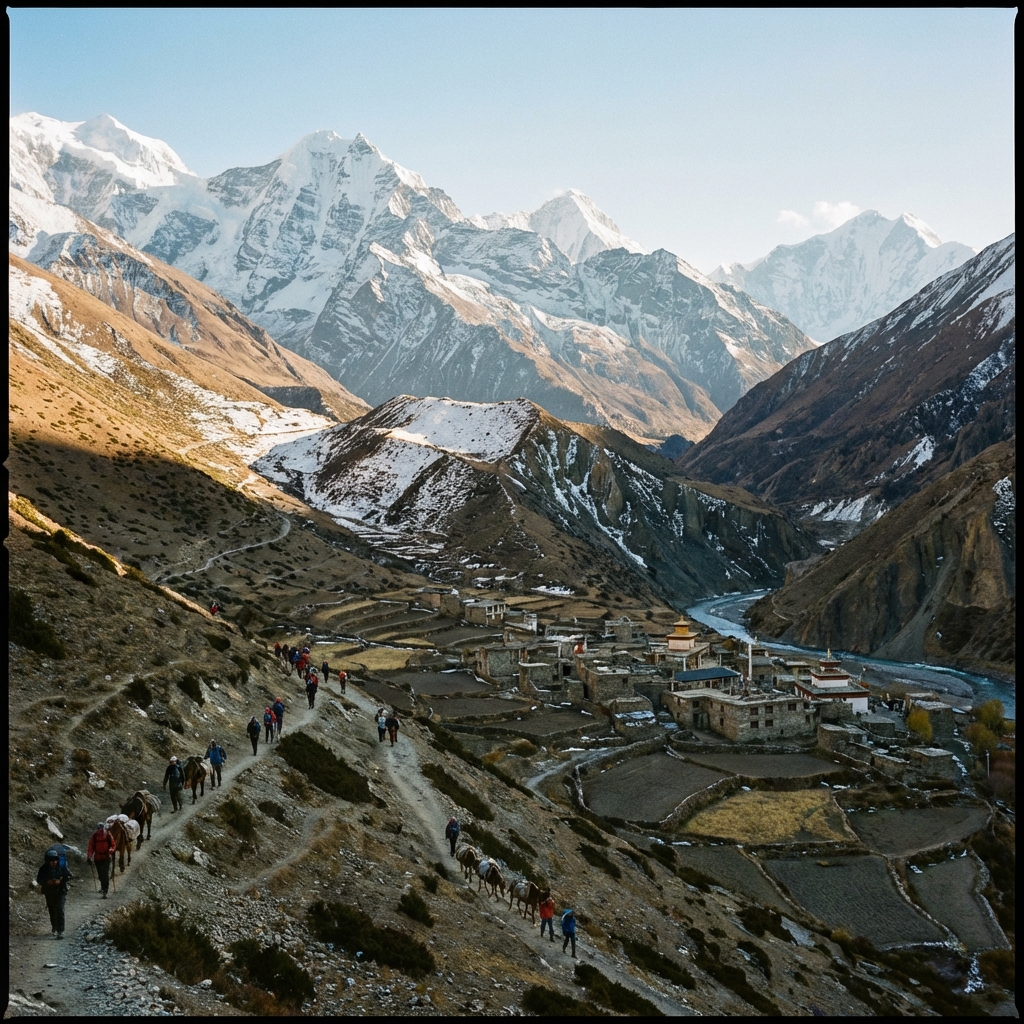
Tsum Valley is a narrow, steep-sided glacial valley carved by the Siyar Khola (Tsum River). The valley runs roughly north-south, with steep walls rising on both sides:
- Eastern wall: Ganesh Himal range
- Western wall: Sringi Himal range
- Northern head: Baudha Himal and the Tibetan border
The valley floor ranges from about 1,800m at Lokpa (the lower entrance) to 3,700m at Mu Gompa near the Tibetan border. The dramatic topography creates a sense of isolation and sanctuary—once you enter at Lokpa, you're in a world apart.
Climate Zones
Due to its northern location and rain shadow effect from the Himalayas, Tsum Valley receives less precipitation than southern Nepal:
- Lower valley (1,800-2,500m): Subtropical and temperate forests with rhododendron, oak, and pine
- Middle valley (2,500-3,200m): Alpine shrubs, juniper, and medicinal herbs
- Upper valley (3,200-3,700m): Alpine meadows and high-altitude desert influenced by Tibetan Plateau
Villages and Settlement Pattern
Unlike many trekking regions with scattered settlements, Tsum Valley has distinct villages:
- Lokpa (1,950m): Gateway to Tsum Valley, checkpoint for restricted area permits
- Chumling (2,386m): Lower Tsum's main village, first major settlement
- Chhokangparo (3,010m): Upper Tsum village with dramatic monastery views
- Nile (3,361m): Highest permanent settlement, gateway to Mu Gompa
- Mu Gompa (3,700m): Ancient monastery complex at valley's northern end
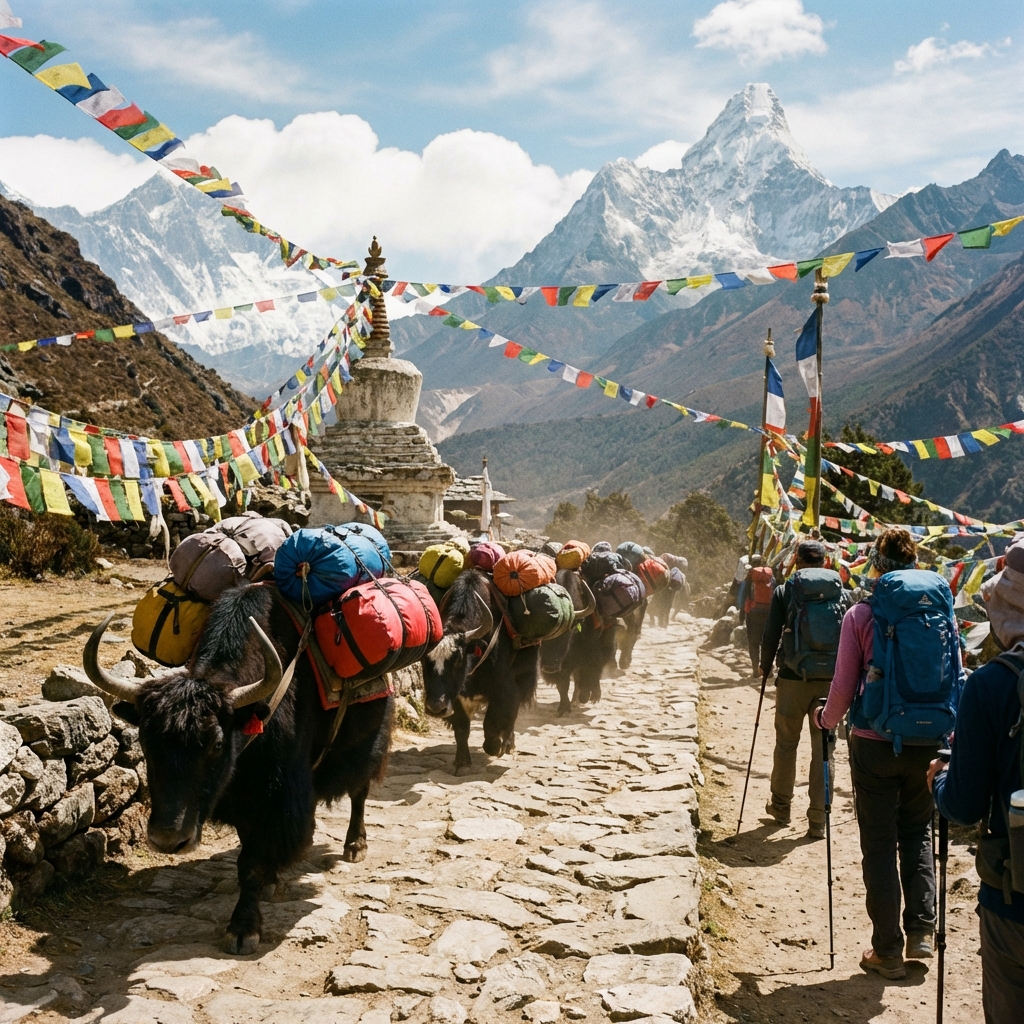
These villages maintain traditional stone architecture with flat roofs (reflecting Tibetan influence), prayer flags strung between houses, and community water-powered prayer wheels.
Complete Itinerary Options
The Tsum Valley Trek offers several itinerary variations depending on your time, fitness level, and whether you combine it with the Manaslu Circuit.
Option 1: Standalone Tsum Valley Trek (10-12 Days)
This is the most common option for those focused on cultural immersion without the extreme altitude of Larkya La Pass.
Day 1: Kathmandu to Arughat, drive to Soti Khola (710m)
- Driving time: 7-8 hours
- Distance: Approximately 140km
- Type: Jeep or local bus
Drive from Kathmandu through the Prithvi Highway, passing through Dhading and Arughat bazaar. The road is partially paved but rough in sections. Overnight at Soti Khola, a small village on the banks of Budhi Gandaki River.
Day 2: Soti Khola to Machha Khola (870m)
- Trekking time: 6-7 hours
- Distance: 14km
- Elevation gain: +160m
Follow the Budhi Gandaki River through subtropical forests. Cross several suspension bridges and pass through small Gurung villages. The trail undulates, climbing and descending multiple times. First day acclimatization to trekking rhythm.
Day 3: Machha Khola to Jagat (1,340m)
- Trekking time: 6-7 hours
- Distance: 22km
- Elevation gain: +470m
Continue along the dramatic Budhi Gandaki gorge. Pass through Khorlabesi, Tatopani (hot springs), and Dobhan before reaching Jagat. The trail includes several steep climbs and descents. Jagat is an important checkpoint village where permits are checked.
Permit Checkpoint
At Jagat, your Manaslu Conservation Area Permit (MCAP) and TIMS card will be checked. Ensure all permits are easily accessible.
Day 4: Jagat to Lokpa (1,950m)
- Trekking time: 6-7 hours
- Distance: 18km
- Elevation gain: +610m
Trek through Salleri, Sirdibas, and Philim before reaching Lokpa—the gateway to Tsum Valley. At Lokpa, you officially enter the restricted area, and your Restricted Area Permit (RAP) will be checked. The valley begins to open up with first views of Ganesh Himal.
Day 5: Lokpa to Chumling (2,386m)
- Trekking time: 5-6 hours
- Distance: 11km
- Elevation gain: +436m
Enter the sacred Tsum Valley proper. The landscape transforms—you'll encounter the first massive mani walls (some stretching 200+ meters), prayer wheels, and chortens. Pass through Lungdang and cross the Siyar Khola to reach Chumling, the lower Tsum's main village. First encounters with Tsum's distinct Tibetan culture.
Day 6: Chumling to Chhokangparo (3,010m)
- Trekking time: 5-6 hours
- Distance: 10km
- Elevation gain: +624m
Trek through Gho village and Domje before reaching Chhokangparo in Upper Tsum. The views become more dramatic as you gain altitude. Visit Rachen Gompa (nunnery) near Chhokangparo—home to about 40 Buddhist nuns who maintain daily prayer rituals.
Pro Tip
Time your arrival at Rachen Gompa for morning prayers (around 7-8 AM) to witness the nuns' devotional chanting. Respectful visitors are welcome, but ask permission before photographing and dress modestly.
Day 7: Chhokangparo to Nile (3,361m)
- Trekking time: 4-5 hours
- Distance: 8km
- Elevation gain: +351m
Continue up the valley to Nile, the highest permanent settlement. The landscape becomes more barren and alpine, with influences from the Tibetan Plateau. Visit Phurbe Monastery perched dramatically on cliffs above the village. Acclimatize for the next day's excursion to Mu Gompa.
Day 8: Nile to Mu Gompa (3,700m) and return to Chhokangparo (3,010m)
- Trekking time: 7-8 hours total
- Distance: 16km round trip
- Maximum elevation: 3,700m
Early morning excursion to Mu Gompa, the ancient monastery complex at the valley's northern end. This is the cultural and spiritual heart of Tsum Valley. The monastery, over 600 years old, houses precious thankas, manuscripts, and religious artifacts. On clear days, views extend to the Tibetan border.
After exploring Mu Gompa and surrounding hermitage caves, descend back to Chhokangparo for the night. This long day is the trek's highlight from a cultural perspective.
Mu Gompa Significance
Mu Gompa belongs to the Nyingma lineage of Tibetan Buddhism and was founded by the renowned Buddhist saint Tangton Gyelpo. The monastery hosts the annual Faku festival in March-April, featuring masked dances and religious ceremonies.
Day 9: Chhokangparo to Chumling (2,386m)
- Trekking time: 4-5 hours
- Distance: 10km
- Elevation loss: -624m
Descend back through Upper Tsum, retracing your steps to Chumling. Use this day to visit any monasteries or sites you missed on the way up. The descent offers different perspectives and photo opportunities.
Day 10: Chumling to Lokpa (1,950m) to Philim (1,590m)
- Trekking time: 6-7 hours
- Distance: 18km
- Elevation loss: -796m
Exit Tsum Valley, descending to Lokpa and continuing to Philim. Reflect on the extraordinary cultural journey as you transition back to the more developed Manaslu region.
Day 11: Philim to Jagat (1,340m) to Soti Khola (710m)
- Trekking time: 7-8 hours
- Distance: 32km
- Elevation loss: -880m
Long descent day retracing steps along the Budhi Gandaki gorge. Push through to Soti Khola to minimize days.
Day 12: Soti Khola to Arughat, drive to Kathmandu
- Trekking time: 2-3 hours to Arughat
- Driving time: 7-8 hours to Kathmandu
- Total time: 10-11 hours
Short morning trek to Arughat (or direct drive if vehicle can reach Soti Khola), then return drive to Kathmandu. Arrive evening, celebrate completion.
Option 2: Tsum Valley + Manaslu Circuit Combined (18-21 Days)
For trekkers seeking the ultimate Gorkha region adventure, combine both valleys for a comprehensive journey culminating in the Larkya La Pass (5,160m).
Days 1-9: Follow the standalone Tsum Valley itinerary above through Mu Gompa and return to Chhokangparo.
Day 10: Chhokangparo to Lokpa (1,950m) - Exit Tsum Valley
Day 11: Lokpa to Deng (1,804m) - Continue on Manaslu Circuit route
Days 12-18: Continue the Manaslu Circuit through Namrung, Samagaon, Samdo, over Larkya La Pass (5,160m), and down to Besisahar.
Day 19-21: Extra days for acclimatization, buffer, and drive back to Kathmandu/Pokhara.
This combined trek is one of Nepal's most rewarding long treks, offering cultural immersion in Tsum Valley followed by high-altitude adventure over Larkya La Pass with spectacular 8,000m peak views.
| Route | Duration | Max Altitude | Difficulty | Highlights | Best For |
|---|---|---|---|---|---|
| Tsum Valley | 10-12 days | 3,700m | Moderate | ||
| Nar Phu Valley | 12-14 days | 5,416m (Kang La Pass) | Moderate-Challenging | ||
| Upper Mustang | 12-14 days | 3,840m (Lo Manthang) | Moderate | ||
| Dolpo | 18-28 days | 5,360m+ (various passes) | Challenging |
Difficulty Assessment
ModerateThe Tsum Valley Trek is classified as Moderate difficulty, making it accessible to trekkers with basic fitness who may not be ready for extreme high-altitude passes.
Physical Requirements
Fitness Level: Moderate
- Daily trekking: 5-8 hours
- Cumulative ascent: ~3,200m over trek duration
- Longest single day: 7-8 hours (Mu Gompa day)
- Terrain: Mix of gradual ascents, some steep sections, well-defined trails
Comparison to Other Treks:
- Easier than: Manaslu Circuit (with Larkya La), Everest Three Passes, Annapurna Circuit (with Thorong La)
- Similar to: Langtang Valley Trek, Ghorepani Poon Hill (extended)
- Harder than: Everest View Trek, Annapurna Base Camp (shorter itineraries)
Altitude Profile
Maximum Altitude: 3,700m (Mu Gompa)
Unlike high passes like Thorong La (5,416m) or Larkya La (5,160m), Tsum Valley's maximum altitude is relatively moderate. This significantly reduces altitude sickness risk:
- Below 3,000m: Minimal altitude effects
- 3,000-3,700m: Mild effects possible but generally well-tolerated with proper acclimatization
- No extreme altitude: The trek never enters the "extreme altitude" zone (above 5,500m)
Acclimatization Considerations
The gradual ascent profile provides good natural acclimatization:
- Day 1-4: Slow gain from 710m to 1,950m
- Day 5-6: Moderate gain to 3,010m over 2 days
- Day 7-8: Final push to 3,700m with overnight below
Pro Tip
The itinerary's natural progression minimizes altitude sickness risk. However, listen to your body. Symptoms like persistent headache, nausea, or dizziness warrant a rest day or descent.
Trail Conditions
Trail Quality: Good to Fair
- Lower section (Soti Khola to Lokpa): Well-maintained trails shared with Manaslu Circuit trekkers
- Tsum Valley proper: Narrower, less maintained but clearly defined
- Upper Tsum: Rocky, sometimes steep, but no technical climbing required
Challenges:
- Suspension bridge crossings (some high above gorges)
- Steep ascents and descents, especially near river gorges
- Rocky terrain in upper valley
- Potential for snow/ice above 3,500m in winter months
Who Should Trek Tsum Valley?
Ideal For:
- Cultural enthusiasts seeking authentic Tibetan Buddhist immersion
- Photographers interested in monasteries, festivals, and mountain landscapes
- Trekkers wanting moderate altitude without extreme passes
- Those preferring remote areas with minimal tourist infrastructure
- Spiritual seekers interested in beyul mysticism and Buddhist culture
- Trekkers who want to "warm up" before attempting Manaslu Circuit
Not Recommended For:
- Trekkers seeking extreme high-altitude challenges (consider Everest Three Passes)
- Those requiring modern amenities and reliable connectivity
- Budget travelers (restricted permits add significant cost)
- Independent trekkers (guide mandatory)
Preparation Recommendations
Training:
- 4-6 weeks of cardiovascular training (hiking, running, cycling)
- Practice with daypack on gradually increasing inclines
- Stair climbing with weight (simulates trekking with backpack)
- Core strengthening for balance on rocky terrain
Prior Trekking Experience:
- Not required, but helpful
- If first trek in Nepal, consider hiring experienced guide familiar with altitude management
- Previous multi-day hiking experience beneficial
Ancient Tibetan Buddhist Culture
The cultural richness of Tsum Valley is its defining characteristic. This is not merely a scenic trek—it's an immersion in living Tibetan Buddhist traditions that have disappeared almost everywhere else.
The Sacred Beyul Tradition
Beyuls (hidden valleys) are sacred refuges blessed by Guru Rinpoche (Padmasambhava) in the 8th century. According to Tibetan Buddhist tradition, he concealed these valleys to serve as sanctuaries during times of war, persecution, or spiritual seeking. Tsum Valley is considered one of the premier beyuls in the Himalaya.
The valley's isolation has protected it from outside influences. Until 2008, foreigners were prohibited from entering. Even today, the culture remains remarkably intact:
- Traditional polyandry (one woman marrying multiple brothers) is still practiced
- Ancient festivals and rituals continue unchanged
- Monasteries maintain daily prayer schedules dating back centuries
- Local dialect is a unique mix of Tibetan and Tamang influences
Monasteries and Gompas
Tsum Valley is home to numerous monasteries, each with unique characteristics and spiritual significance.
Mu Gompa (3,700m)
The crown jewel of Tsum Valley, Mu Gompa is the oldest and most revered monastery in the region. Founded over 600 years ago by the Buddhist saint Tangton Gyelpo (who also built many of the iron chain bridges throughout Tibet and Nepal), it belongs to the Nyingma lineage.
What to See:
- Ancient thankas (Buddhist scroll paintings) depicting deities and mandalas
- Handwritten manuscripts in classical Tibetan
- Statue of Guru Rinpoche adorned with gold and precious stones
- Prayer wheels containing thousands of mantras
- Hermitage caves where monks undertake three-year meditation retreats
Visiting Etiquette:
- Remove shoes before entering prayer halls
- Walk clockwise around monasteries and chortens
- Don't point feet toward altars or religious objects
- Ask permission before photographing (photography often prohibited inside)
- Donations appreciated (200-500 NPR appropriate)
Faku Festival
Mu Gompa hosts the annual Faku festival in March-April (dates vary with lunar calendar). The festival features colorful masked dances (cham), religious ceremonies, and gatherings from throughout the valley. If your trek timing allows, witnessing this festival is unforgettable.
Rachen Gompa (Nunnery) (2,980m)
Located near Chhokangparo, Rachen Gompa is one of Nepal's most active nunneries, home to approximately 40 Buddhist nuns ranging in age from teenagers to elderly practitioners.
Daily Life:
- Morning prayers: 6-8 AM
- Study sessions: Morning to afternoon
- Evening prayers: 4-6 PM
- Self-sufficient community growing barley, buckwheat, and vegetables
The nuns welcome respectful visitors, especially women trekkers. Some speak basic English and enjoy sharing their spiritual path.
Phurbe Monastery (3,200m)
Dramatically perched on cliffs above Nile village, Phurbe Monastery appears to defy gravity. The monastery houses approximately 15 monks and features:
- Stunning location with panoramic valley views
- Collection of ancient musical instruments used in ceremonies
- Library of Buddhist texts
- Annual festivals in August-September
Gumba Lungdang (2,200m)
This lower valley monastery near Chumling is smaller but offers intimate glimpses into monastic life. Only 5-7 monks reside here, making interactions more personal.
Mani Walls and Chortens
Tsum Valley contains some of Nepal's most impressive mani walls—long stone walls carved with the Buddhist mantra "Om Mani Padme Hum" and other sacred texts.
Major Mani Walls:
- Chumling Mani Wall: Over 200 meters long with intricate carvings
- Lokpa Mani Wall: Gateway to Tsum Valley, adorned with colorful prayer flags
- Nile Mani Wall: High-altitude wall with thousands of carved stones
These walls represent centuries of devotional labor. Locals believe walking clockwise around mani walls accumulates merit and purifies negative karma. As a trekker, always pass mani walls with the wall on your right side.
Chortens (stupas) dot the landscape, especially at village entrances, trail junctions, and monastery complexes. Each architectural element symbolizes Buddhist cosmology:
- Square base: Earth element
- Hemispherical dome: Water element
- Conical spire: Fire element
- Upper lotus parasol: Air element
- Crowning jewel: Space element
Polyandry Tradition
Tsum Valley is one of the few places in the world where polyandry (one woman married to multiple brothers) is openly practiced. This tradition serves practical purposes:
Economic Reasons:
- Keeps family land holdings intact (no division among brothers)
- Provides labor force for agricultural work
- Ensures family continuity when brothers are away trading or on religious pilgrimages
Social Structure:
- Eldest brother typically assumes household leadership
- All brothers are considered fathers to children
- Women hold significant household decision-making power
- Practice declining but still common in remote villages
Prayer Wheels and Devotional Practices
Throughout Tsum Valley, you'll encounter prayer wheels ranging from small hand-held versions to enormous water-powered wheels at village entrances.
Water-Powered Prayer Wheels:
- Located at Chumling, Chhokangparo, and other villages
- Spin continuously, powered by diverted streams
- Each rotation believed to send prayers and mantras into the world
- Some wheels contain millions of written mantras
Daily Rituals:
- Early morning monastery prayers
- Incense offerings at household altars
- Circumambulation (walking clockwise) of monasteries and sacred sites
- Prostrations performed by devoted practitioners
- Butter lamp offerings
Buddhist Festivals
Tsum Valley celebrates numerous Buddhist festivals throughout the year. Timing your trek to coincide with a festival offers extraordinary cultural insights.
Major Festivals:
-
Faku Festival (March-April) at Mu Gompa
- Masked dances depicting Buddhist deities
- Religious ceremonies led by high lamas
- Communal feasts and gatherings
- Valley residents from all villages attend
-
Lhosar (Tibetan New Year, February-March)
- Celebrated valley-wide
- House blessings by monks
- Traditional songs and dances
- Special foods and chang (barley beer)
-
Saga Dawa (April-May)
- Commemorates Buddha's birth, enlightenment, and death
- Intensive prayer rituals
- Circumambulation of sacred sites
- Merit-making activities
-
Yarlung Festival (July-August)
- Horse riding competitions
- Traditional archery
- Folk dances and songs
Pro Tip
If interested in attending festivals, contact your trekking agency 2-3 months in advance. Festival dates vary with the lunar calendar, and permits may require extra processing time during peak seasons.
Cultural Etiquette for Trekkers
Respecting local customs is essential in this sacred valley:
DO:
- Dress modestly (cover shoulders and knees, especially at monasteries)
- Ask permission before photographing people, especially monks and nuns
- Walk clockwise around monasteries, mani walls, and chortens
- Remove shoes before entering homes or prayer halls
- Accept tea or food offered (refusing is impolite), at least take a sip
- Use both hands when giving or receiving objects
- Support local economy by purchasing handicrafts directly from artisans
DON'T:
- Point feet at people, altars, or religious objects (feet are considered impure)
- Touch another person's head (considered sacred)
- Step over religious texts, prayer flags, or sacred objects
- Kill animals (valley has strong prohibitions against hunting/fishing)
- Engage in public displays of affection
- Offer money directly to children (creates begging culture)
- Remove or disturb stones from mani walls
Best Time to Visit
Tsum Valley's northern location and rain shadow position create distinct seasonal patterns. Choosing the right time significantly impacts your experience.
| Month | High | Low | Conditions | Crowds | Notes |
|---|---|---|---|---|---|
| January2 | 5-10°C | -10 to -5°C | Clear, cold, snow at altitude | Very cold, upper valley may be snow-blocked. Only for experienced winter trekkers. | |
| February2 | 8-12°C | -8 to -3°C | Cold, increasingly clear | Still cold but improving. Possible Lhosar festival. Crystal clear mountain views. | |
| March4 | 12-16°C | -5 to 0°C | Spring emerging, clear mornings | Spring arrives. Rhododendrons blooming in lower valley. Faku festival possible. | |
| April5 | 15-20°C | 0-5°C | Pleasant, mostly clear | Peak season begins. Excellent weather, clear views, blooming flowers. Ideal trekking. | |
| May4 | 18-22°C | 5-10°C | Warm, occasional afternoon clouds | Warm and pleasant but afternoon clouds may obscure views. Pre-monsoon haze begins. | |
| June1 | 20-24°C | 10-12°C | Cloudy, rain frequent | Monsoon arrives. Heavy rain, leeches, landslide risk. Not recommended. | |
| July1 | 22-25°C | 12-15°C | Heavy rain, clouds, humid | Peak monsoon. Trails muddy, views obscured. Avoid. | |
| August1 | 22-25°C | 12-15°C | Heavy rain, clouds | Continued monsoon. Some festivals but weather too poor for trekking. | |
| September4 | 18-22°C | 8-12°C | Clearing, fresh greenery | Monsoon tapers off. Trails still wet but improving. Wildflowers abundant. Fewer crowds. | |
| October5 | 15-18°C | 3-8°C | Crystal clear, stable weather | Peak season. Best weather and visibility. Crowded but trails excellent. Perfect trekking. | |
| November4 | 10-15°C | -2 to 3°C | Clear, cold at altitude | Excellent visibility, fewer trekkers than October. Getting cold, especially at night. | |
| December2 | 6-10°C | -8 to -2°C | Clear but very cold | Winter sets in. Very cold, snow at high altitudes. Only for experienced trekkers. |
Best Months: April, May, October, November
Spring (March-May):
- Pros: Rhododendron blooms, clear mornings, warming weather, Faku festival possible
- Cons: Afternoon clouds in late May, pre-monsoon haze, moderate crowds
Autumn (September-November):
- Pros: Crystal clear skies, stable weather, excellent visibility, post-monsoon freshness
- Cons: October is peak season (more crowded), cold at night by late November
Shoulder Seasons: March, Early September, Late November
These months offer advantages for adventurous trekkers:
- Fewer crowds
- Lower lodge prices (negotiable)
- Unique seasonal perspectives (spring flowers or autumn colors)
- Risk of occasional bad weather
Avoid: June-August (Monsoon)
The monsoon season is strongly discouraged:
- Heavy daily rainfall
- Landslide and rockfall risk
- Leeches on lower trails
- Obscured mountain views
- Trails muddy and slippery
- Limited flight reliability (affects travel to/from Kathmandu)
Monsoon Hazards
During monsoon, the Budhi Gandaki River swells dramatically, making crossings dangerous. Landslides frequently block the road between Kathmandu and Arughat. Even if trekking is technically possible, conditions are miserable.
Permits Required
Tsum Valley's restricted area status means multiple permits are required. Unlike popular treks where you can obtain permits yourself, Tsum Valley permits must be arranged through a registered trekking agency with a licensed guide.
1. Restricted Area Permit (RAP)
Cost: $40-50 USD per week (per person)
- First 7 days: $40-50
- Additional days: $7-10 per day
Requirements:
- Minimum 2 trekkers (solo trekking not allowed in restricted areas)
- Licensed guide mandatory
- Must be arranged through registered trekking agency
- Processing time: 2-3 days in Kathmandu
Why Restricted: Tsum Valley's restricted status protects its fragile culture and environment. The permit system limits tourist numbers and ensures visitors are accompanied by guides who understand local customs.
Permit Processing
Your trekking agency will handle RAP applications. Provide passport copies and 2 passport photos at least 5-7 days before trek start to allow processing time. During peak season (October), allow extra time.
2. Manaslu Conservation Area Permit (MCAP)
Cost: NPR 3,000 (~$30 USD) per person for foreigners
- SAARC nationals: NPR 1,500 (~$15 USD)
Validity: Duration of trek (typically 30 days maximum)
Purpose: Conservation fee supporting:
- Trail maintenance
- Environmental protection programs
- Wildlife monitoring
- Community development projects
- Waste management initiatives
Where to Obtain:
- Nepal Tourism Board office, Kathmandu
- Manaslu Conservation Area Project office, Kathmandu
- Through trekking agency (most common)
3. TIMS Card (Trekkers' Information Management System)
Cost: NPR 2,000 (~$20 USD) per person
- Free Independent Trekker (FIT) card: Not available for restricted areas
- Organized/Group Trekker card: Required (even for 2-person groups)
Purpose: Trekker safety and security
- Emergency rescue coordination
- Statistical tracking
- Safety monitoring
Where to Obtain:
- Nepal Tourism Board, Kathmandu
- Trekking Agencies Association of Nepal (TAAN), Kathmandu
- Through trekking agency (included in package)
Total Permit Costs
Per Person:
- RAP: $40-50 (1 week)
- MCAP: $30
- TIMS: $20
- Total: $90-100 USD
For Tsum + Manaslu Combined (2-3 weeks):
- RAP: $54-70 (2 weeks + days)
- MCAP: $30 (covers both valleys)
- TIMS: $20
- Total: $104-120 USD
Mandatory Guide Requirement
All restricted area treks, including Tsum Valley, require a licensed guide. This is non-negotiable and enforced at checkpoints (Lokpa, Jagat).
Why Guides Are Mandatory:
- Cultural sensitivity: Guides educate trekkers on proper etiquette
- Language barrier: Most villagers speak limited English
- Safety: Guides know terrain, weather patterns, and evacuation procedures
- Economic distribution: Ensures local guides benefit from tourism
- Regulation enforcement: Guides ensure permits are properly used
Guide Costs:
- Licensed guide: $25-35 USD per day
- Guide's food/accommodation: Included (you pay their lodge/meal costs)
- Guide's transportation: Included
- Tip: 10-15% of total trek cost (customary)
Pro Tip
While guides are mandatory, they're invaluable assets. Experienced guides provide cultural insights, monastery access, local interactions, and safety management that solo trekkers would miss. Embrace the requirement—a good guide transforms the trek.
Permit Checkpoints
Your permits will be checked at multiple locations:
- Jagat: MCAP and TIMS verification
- Lokpa: RAP verification (official entry to Tsum Valley)
- Chumling: Secondary check
- Mu Gompa: Occasional checks
Carry permits in waterproof pouch and keep photocopies as backup.
Cost Breakdown
Tsum Valley is more expensive than non-restricted treks due to permit costs and mandatory guide requirements. However, it remains affordable compared to ultra-restricted areas like Upper Mustang ($500 permit).
Budget Breakdown (10-12 Day Standalone Trek)
Per Person Costs (based on 2-person group):
Permits & Fees: $90-100
- Restricted Area Permit: $40-50
- MCAP: $30
- TIMS: $20
Guide & Porter: $350-550
- Licensed guide: $25-35/day × 12 days = $300-420
- Porter (optional): $20-25/day × 12 days = $240-300
- Guide's meals/accommodation: ~$15/day × 12 days = $180 (you pay)
- Tips: $50-100 (10-15% of guide fee)
Note: Many trekkers share one porter between two people, reducing per-person cost.
Accommodation: $0-180
- Tea houses: $3-5 per night in lower sections
- Upper Tsum: $5-8 per night (limited options)
- Total: 10-11 nights × $5 average = $50-80
- Many lodges free if you eat meals there (common practice)
Food & Drinks: $240-360
- Breakfast: $4-6
- Lunch: $5-8
- Dinner: $6-10
- Snacks/tea: $3-5
- Daily total: $20-30 per person
- 12 days: $240-360
Upper Tsum Pricing: Expect 20-30% higher food costs above Chumling due to limited resupply.
Transportation: $60-100
- Kathmandu-Arughat-Soti Khola (round trip): $60-100 per person
- Tourist jeep: $80-100
- Local bus: $20-30 (uncomfortable but economical)
- Private jeep (shared among group): $200-300 total vehicle
Gear Rental (if needed): $50-150
- Sleeping bag: $1-2/day
- Down jacket: $1-2/day
- Trekking poles: $0.50-1/day
- Duffel bag: $10-15 total
- 12 days gear: $50-100 total
Insurance & Medical: $100-200
- Comprehensive travel/trekking insurance with helicopter evacuation coverage: $80-150
- First aid supplies: $20-30
- Altitude sickness medication (Diamox): $10-20
Miscellaneous: $100-200
- Hot showers: $2-5 each (limited in upper valley)
- Battery charging: $2-4 per device per charge
- WiFi (lower valley only): $3-5/hour
- Donations at monasteries: $20-50 total
- Snacks and treats: $30-50
- Emergency contingency: $50
Total Cost Estimates
Budget Trek (basic accommodation, local food, shared porter):
- $1,200-1,500 per person
Standard Trek (comfortable lodges where available, good food variety, private porter):
- $1,500-1,800 per person
Comfortable Trek (best available lodges, diverse food, experienced guide, private porter):
- $1,800-2,200 per person
Tsum Valley + Manaslu Circuit Combined (18-21 Days)
Add approximately $800-1,200 to above costs:
- Extended guide/porter fees: $500-700
- Additional permits (extra days): $14-30
- Extra food: $160-240
- Extra accommodation: $40-80
- Extended transportation: $20-40
Combined Trek Total: $2,000-3,400 per person
Package vs Independent Costs
Trekking Agency Package (all-inclusive):
- Budget package: $1,400-1,700
- Standard package: $1,800-2,200
- Premium package: $2,200-2,800
Packages typically include:
- All permits (RAP, MCAP, TIMS)
- Licensed guide and porter
- Accommodation (tea houses)
- Three meals per day
- Transportation Kathmandu-Arughat-Kathmandu
- Duffle bag
- First aid kit
Packages typically exclude:
- International flights
- Nepal visa ($50 for 30 days)
- Travel insurance
- Personal expenses (hot showers, charging, WiFi)
- Tips for guide/porter
- Emergency evacuation costs
Pro Tip
For restricted treks like Tsum Valley, agency packages often provide better value than independent arrangements. Agencies have established lodge relationships, permit processing experience, and vetted guides. Compare 3-4 agencies before booking.
Money and ATMs
Cash is King: Tsum Valley has no ATMs or banks. Bring sufficient Nepali Rupees from Kathmandu.
How much cash to bring:
- Budget trek: 50,000-70,000 NPR
- Standard trek: 70,000-90,000 NPR
- Comfortable trek: 90,000-120,000 NPR
Denominations: Carry mix of 100, 500, and 1,000 NPR notes. Upper valley lodges may struggle with change for large notes.
Credit Cards: Not accepted anywhere on the trek (except some Kathmandu agencies for advance payment).
Tea Houses & Villages
Unlike Everest or Annapurna regions with well-developed lodge infrastructure, Tsum Valley offers basic but authentic tea house experiences. The term "tea house" is generous—expect simple guesthouses with minimal amenities but genuine hospitality.
What to Expect
Accommodation:
- Rooms: Twin beds with thin mattresses, pillow, blanket
- Walls: Thin wooden partitions (expect to hear neighbors)
- Heating: Wood/yak dung stoves in dining areas only (not in rooms)
- Bathrooms: Shared squat toilets, often outdoor
- Showers: Limited, hot water rare above Chumling ($3-5 when available)
- Electricity: Solar power or generator (limited hours, typically 6-9 PM)
- WiFi/Mobile: None in upper valley; limited/slow in lower villages
Dining Areas:
- Central communal space with seating around stove
- Social hub where trekkers and locals gather
- Meals served family-style
- Evening storytelling and cultural exchange
Food:
- Dal bhat (lentils, rice, vegetables): Staple, unlimited refills
- Noodle dishes: Thukpa, chow mein, soup noodles
- Tibetan bread, chapati
- Momos (dumplings)
- Eggs, porridge
- Limited fresh vegetables in upper valley
- Meat rare (valley has hunting prohibitions)
Dal Bhat Power
The trekking adage "Dal bhat power, 24 hour" holds true. This nutritious, filling meal with unlimited refills is the best-value option. Order early (it takes 45-60 minutes to prepare) and embrace this staple.
Village Guides
Lodge Etiquette and Practices
Booking:
- No advance reservations possible (no phone/internet)
- Arrive by mid-afternoon to secure room during peak season
- Lodges operate first-come, first-served
Costs:
- Accommodation often free or nominal ($3-5) if you eat meals
- Meals more expensive than accommodation (lodge profit center)
- Eating at your lodge is expected (don't lodge at one place, eat at another)
Heating:
- Central stove in dining area (wood or yak dung fuel)
- No room heating—bring good sleeping bag (rated -10°C minimum)
- Stove lit late afternoon/evening only (fuel is precious)
Bathrooms:
- Squat toilets (bring own toilet paper)
- Outdoor facilities common
- Hand-washing with bucket water
- No flush toilets above Chumling
Charging:
- Limited solar power (typically 6-9 PM only)
- $2-4 per device per charge
- Bring power bank and charge multiple devices simultaneously
- Charging unreliable above Chhokangparo
Hot Water:
- Rare above Chumling
- When available: $3-5 for bucket hot shower
- Morning showers rare (fuel needed for cooking)
- Baby wipes recommended for daily hygiene
Pro Tip
Bring a good headlamp or flashlight. Solar electricity is limited, and lights often shut off by 9-10 PM. Late-night bathroom trips require navigation in complete darkness.
Food Menu Typical Items & Prices
Prices increase with altitude (supply difficulty). Approximate costs:
Lower Valley (Lokpa-Chumling):
- Dal bhat: 600-800 NPR
- Fried rice/noodles: 500-700 NPR
- Thukpa (noodle soup): 400-600 NPR
- Momos (dumplings): 400-500 NPR (8-10 pieces)
- Tibetan bread: 200-300 NPR
- Eggs (boiled/fried): 150-200 NPR each
- Porridge: 300-400 NPR
- Tea (milk/black): 80-150 NPR
- Coffee (instant): 150-250 NPR
Upper Valley (Chhokangparo-Nile):
- Dal bhat: 800-1,000 NPR
- Fried rice/noodles: 700-900 NPR
- Thukpa: 600-800 NPR
- Momos: 600-700 NPR
- Tibetan bread: 300-400 NPR
- Eggs: 200-250 NPR each
- Tea: 150-200 NPR
- Coffee: 250-350 NPR
Mu Gompa:
- Limited food available (monastery guesthouse)
- Simple dal bhat or noodles: 1,000-1,200 NPR
- Tea: 200-300 NPR
Beverages:
- Bottled water: 100-300 NPR (increases with altitude; discouraged for environmental reasons)
- Boiled water: 50-100 NPR (bring water purification tablets)
- Beer (lower valley only): 400-600 NPR
- Chang (local barley beer): 300-500 NPR
Environmental Tip
Avoid bottled water. Bring reusable bottle and purification tablets or filter. Lodges sell boiled water cheaply. Reducing plastic waste is critical in this pristine valley.
Combining with Manaslu Circuit
One of the Tsum Valley Trek's greatest assets is the option to combine it with the Manaslu Circuit, creating an epic 18-21 day journey through two spectacular valleys culminating in the Larkya La Pass (5,160m).
Why Combine?
Diverse Experiences:
- Cultural depth (Tsum Valley) + high-altitude adventure (Larkya La)
- Tibetan Buddhist culture + diverse ethnic communities
- Moderate altitudes + extreme pass crossing
- Intimate villages + dramatic mountain amphitheaters
Logistical Efficiency:
- Share transportation costs (Kathmandu-Arughat-Kathmandu)
- Single permit set covers both (MCAP, TIMS)
- Tsum Valley acts as acclimatization before Larkya La
- One guide for entire journey
Value:
- Incremental cost reasonable compared to two separate treks
- More varied experience per day of trekking
- Access two restricted/special permit areas in one trip
Combined Itinerary (19 Days)
Days 1-9: Tsum Valley Section
Follow the standalone Tsum Valley itinerary through Mu Gompa and return to Lokpa/Philim.
Day 10: Philim to Deng (1,804m)
- Trekking time: 5-6 hours
- Elevation: Slight descent then gradual ascent
Rejoin the Manaslu Circuit route. Trek through Pewa, crossing suspension bridges and passing through forests to Deng—a small village with basic lodges.
Day 11: Deng to Namrung (2,660m)
- Trekking time: 6-7 hours
- Elevation gain: +856m
Ascend through rhododendron and pine forests. Pass Rana village and enter the culturally Tibetan upper Manaslu region. Namrung offers first dramatic views of Manaslu (8,163m).
Day 12: Namrung to Samagaon (3,530m)
- Trekking time: 6-7 hours
- Elevation gain: +870m
Trek through Lihi and Sho, with increasingly spectacular mountain views. Samagaon is a large Tibetan-influenced village—important acclimatization stop.
Day 13: Acclimatization Day in Samagaon
- Options:
- Hike to Manaslu Base Camp (4,800m)
- Visit Pungyen Gompa and glacial lake
- Explore Birendra Lake
- Rest and cultural exploration
Critical acclimatization day. Active rest with altitude gain/descent helps preparation for Larkya La.
Day 14: Samagaon to Samdo (3,860m)
- Trekking time: 4-5 hours
- Elevation gain: +330m
Short day to allow continued acclimatization. Samdo is near the Tibetan border with traditional trade connections. Visit afternoon market if timing coincides.
Day 15: Acclimatization Day in Samdo
- Options:
- Hike toward Tibet border viewpoint
- Explore Samdo village and monastery
- Rest
Second acclimatization day before the big push over Larkya La.
Day 16: Samdo to Dharamsala/Larkya Phedi (4,460m)
- Trekking time: 4-5 hours
- Elevation gain: +600m
Trek to base of Larkya La Pass. Dharamsala (also called Larkya Phedi) is a basic shelter with minimal facilities. Early sleep essential—pass crossing starts pre-dawn.
Day 17: Cross Larkya La Pass (5,160m) to Bimthang (3,720m)
- Trekking time: 8-10 hours
- Elevation change: +700m ascent, -1,440m descent
- Difficulty: Strenuous
The trek's climax. Start 3-4 AM for dawn summit and glacier crossing. Spectacular 360° mountain views: Manaslu (8,163m), Himlung Himal (7,126m), Cheo Himal (6,820m), Kang Guru (6,981m). Long descent to Bimthang.
Larkya La Conditions
Larkya La requires good physical fitness, proper acclimatization, and favorable weather. Snow, wind, and altitude make this a serious undertaking. Start early (3-4 AM) to avoid afternoon weather deterioration.
Day 18: Bimthang to Tilije (2,300m)
- Trekking time: 6-7 hours
- Elevation loss: -1,420m
Descend through forests and meadows, passing high waterfalls. The dramatic descent brings rapid vegetation and temperature changes.
Day 19: Tilije to Dharapani (1,860m), drive to Besisahar, onward to Kathmandu/Pokhara
- Trekking time: 5-6 hours to Dharapani
- Driving time: 5-6 hours to Kathmandu or 3-4 hours to Pokhara
Trek to Dharapani on the Annapurna Circuit route. From here, jeep/bus transportation to Besisahar, then onward to Kathmandu or Pokhara. Celebrate completion of one of Nepal's great treks!
Acclimatization Strategy
The combined trek's itinerary provides excellent natural acclimatization:
Gradual Ascent:
- Days 1-6: Ascend slowly to 3,010m (Chhokangparo)
- Days 7-8: Peak at 3,700m (Mu Gompa), sleep lower
- Days 11-12: Gradual ascent to 3,530m (Samagaon)
- Day 13: Active acclimatization day
- Days 14-15: Slow gain to 3,860m with rest day
- Day 16-17: Final push over Larkya La (5,160m)
This profile minimizes altitude sickness risk if you follow guidelines:
- Drink 3-4 liters water daily
- Ascend slowly ("climb high, sleep low" when possible)
- Recognize altitude sickness symptoms early
- Don't push through serious symptoms
Logistics Differences
Permits:
- Same permits cover both valleys (RAP, MCAP, TIMS)
- Slightly higher RAP cost for additional days
Guide/Porter:
- Same team for entire trek (builds relationship)
- Longer employment benefits guide economically
Accommodation:
- Manaslu Circuit has better lodge infrastructure than Tsum Valley
- Expect upgrades in comfort after exiting Tsum
Food:
- More variety on Manaslu Circuit side
- Lower prices after descending from Larkya La
Which Option to Choose?
Choose Standalone Tsum Valley if:
- Primary interest is cultural immersion
- Prefer moderate altitudes (avoid extreme passes)
- Limited to 10-14 days total
- First high-altitude trek in Nepal
Choose Combined Tsum + Manaslu if:
- Want comprehensive experience (culture + high-altitude)
- Have 18-21 days available
- Good physical fitness and altitude experience
- Seeking one of Nepal's ultimate treks
Pro Tip
If uncertain about Larkya La capability, book Tsum Valley standalone. Many trekkers underestimate the pass difficulty and suffer. Tsum Valley alone is deeply rewarding without the extreme altitude challenge.
Wildlife & Nature
While trekkers visit Tsum Valley primarily for culture, the region's biodiversity is remarkable. The Manaslu Conservation Area (established 1998) protects diverse ecosystems and endangered species.
Himalayan Wildlife
Mammals:
-
Blue Sheep (Bharal)
- Most commonly spotted large mammal
- Herds graze on high slopes above tree line
- Best viewing: Upper valley near Mu Gompa, early morning/evening
- Not actually blue—gray-brown coat with blue sheen
-
Himalayan Tahr
- Wild goat species on rocky cliffs
- Excellent climbers
- Occasional sightings above Nile
-
Red Panda
- Rare, endangered
- Inhabits rhododendron and bamboo forests (2,200-4,000m)
- Extremely shy—sightings exceptional luck
- More common in lower valley forests
-
Snow Leopard
- Critically endangered, apex predator
- Tsum Valley is known snow leopard habitat
- Direct sightings extremely rare (mostly nocturnal/elusive)
- Signs: pugmarks, scat, scent markings
- Preys on blue sheep, musk deer
-
Himalayan Black Bear
- Inhabits forested lower/middle elevations
- Rarely seen (den in winter)
- Potentially dangerous—make noise on forested trail sections
-
Musk Deer
- Small, endangered deer species
- Males have distinctive long canine teeth
- Hunted historically for musk glands
- Protected but rare
-
Gray Langur Monkey
- Common in lower valley
- Arboreal, often in groups
- Sacred in Buddhist/Hindu tradition
Birds:
Tsum Valley is an Important Bird Area (IBA) with over 110 recorded species:
- Himalayan Monal (Danphe): National bird of Nepal, iridescent plumage
- Blood Pheasant: High-altitude specialist
- Snow Partridge: Above tree line
- Himalayan Griffon: Massive vultures soaring on thermals
- Lammergeier (Bearded Vulture): Feeds on bone marrow
- Golden Eagle: Apex avian predator
- Kalij Pheasant: Lower forest bird
- Various rosefinches: High-altitude specialists
- Grandala: Brilliant blue high-altitude bird
Spring (March-May) is best for birdwatching—breeding season with active behavior and plumage.
Flora and Vegetation Zones
Tsum Valley's dramatic elevation range (1,800m-3,700m+) creates distinct vegetation zones:
Subtropical/Temperate Forest (1,800-2,800m):
- Oak (Quercus species)
- Rhododendron (40+ species, bloom March-May)
- Pine (Chir and Blue Pine)
- Ferns, mosses, orchids
- Bamboo thickets
Sub-Alpine Zone (2,800-3,500m):
- Juniper (sacred in Buddhism)
- Birch
- Rhododendron shrubs
- Alpine meadows with wildflowers (spring)
- Medicinal herbs: Yarsa Gumba (Cordyceps), Jatamansi, Panchaule
Alpine Zone (3,500m+):
- Low shrubs and grasses
- Cushion plants
- Lichen-covered rocks
- High-altitude desert vegetation near Mu Gompa
Medicinal Plants
Tsum Valley is known for medicinal plant diversity. Locals harvest herbs for traditional medicine:
- Yarsa Gumba (Cordyceps sinensis): "Himalayan Viagra," caterpillar fungus, extremely valuable
- Panchaule (Dactylorhiza hatagirea): Orchid, anti-inflammatory properties
- Jatamansi (Nardostachys jatamansi): Aromatic, used in traditional medicine
- Yarsagumba harvesting season (May-June) brings locals to high pastures—trekkers may encounter harvesting camps
Conservation Challenges
Threats:
- Over-harvesting of medicinal plants
- Snow leopard-livestock conflict (leopards prey on yaks/sheep)
- Habitat degradation from grazing
- Climate change impacts on vegetation zones
- Tourism pressure (increasing but still low)
Protection Efforts:
- Manaslu Conservation Area management
- Community-based conservation programs
- Snow Leopard Conservation Committee
- Livestock insurance schemes (reducing retaliatory killing)
- Sustainable harvesting quotas for medicinal plants
Responsible Trekking
Support conservation by:
- Staying on trails (avoid vegetation trampling)
- Not purchasing wildlife products
- Reporting poaching/illegal activities to guides
- Supporting community lodges (revenue funds conservation)
- Carrying out all trash (Leave No Trace principles)
Photography Opportunities
Tsum Valley is a photographer's paradise, offering subjects ranging from dramatic Himalayan landscapes to intimate cultural portraits to wildlife.
Landscape Photography
Mountain Vistas:
- Ganesh Himal Range (7,422m): Eastern backdrop, best from Chumling-Chhokangparo
- Sringi Himal (7,187m): Western wall, dramatic from upper valley
- Baudha Himal (6,672m): Northern head, visible from Mu Gompa
- Sunrise/Sunset: Upper villages (Nile, Chhokangparo) offer golden hour drama
Best Viewpoints:
- Trail between Chumling and Chhokangparo: Ganesh Himal panoramas
- Phurbe Monastery cliffs: Valley overview
- Mu Gompa ridge: 360° Himalayan amphitheater
Photography Tips:
- Bring wide-angle lens (16-35mm) for expansive vistas
- Telephoto (70-200mm+) for isolated peak details
- Polarizing filter for sky saturation
- Graduated ND filter for high-contrast scenes
- Shoot during golden hours (45 min after sunrise, before sunset)
Cultural Photography
Monasteries and Religious Sites:
- Mu Gompa: Ancient architecture, prayer flags, mountain backdrop
- Rachen Gompa: Nuns in prayer, monastery daily life
- Mani Walls: Carved stones, prayer wheels, devotional activity
- Chortens: Architectural details, prayer flag dynamics
People and Portraits:
- Always ask permission before photographing locals
- Offer to show subjects photos on LCD screen (builds rapport)
- Avoid "paparazzi" approach—engage first, photograph second
- Consider sending prints back through trekking agency (locals appreciate)
Festivals:
- Faku Festival (March-April): Masked dances, ceremonies, crowds
- Bring telephoto for candid ceremony shots
- Respect sacred spaces—some ceremonies photography-prohibited
Cultural Details:
- Polyandry family structures (sensitive—ask permission)
- Traditional architecture: flat roofs, prayer flags, stone construction
- Daily life: Water collection, yak herding, barley threshing
- Textile weaving, butter lamps, monastery rituals
Wildlife Photography
Challenges:
- Wildlife is shy and rare
- Requires patience, luck, and long lenses
- Best early morning/dusk
Subjects:
- Blue sheep herds on high slopes (200-400mm lens minimum)
- Birds: Monal pheasants, lammergeiers (300-600mm ideal)
- Domestic animals: Yaks, dzos, sheep (easier subjects)
Technical Considerations
Gear Protection:
- Dust: Upper valley is dry—use protective covers
- Cold: Batteries drain faster—keep spares warm in inner pocket
- Humidity: Lower valley can be humid—silica gel packets in bag
- Altitude: Sensor dust more visible with altitude—bring cleaning kit
Backup and Storage:
- No electricity/charging above Chumling—bring sufficient batteries
- Multiple memory cards (no replacements available)
- Backup storage: Hard drive or cloud (if internet available in Kathmandu before/after)
Drone Photography:
- Generally discouraged/prohibited in restricted areas
- Requires special permits
- Culturally sensitive (monasteries, sacred sites)
- If considering, consult trekking agency well in advance
Pro Tip
The best Tsum Valley photos combine cultural and natural elements: prayer flags with mountain backdrops, monks against monastery architecture, mani walls with Himalayan context. Look for layers and storytelling in compositions.
Sharing and Ethics
Ethical Photography:
- Respect "no photography" signs at monasteries
- Never photograph without permission in sensitive cultural situations
- Don't disrupt religious ceremonies for photos
- Avoid giving money for photos (creates exploitative dynamic)
- Consider cultural context (some believe photography captures soul)
Sharing:
- Tag locations thoughtfully (over-promotion degrades pristine areas)
- Share respectfully (avoid stereotyping or exoticizing)
- Credit guides and local communities when possible
- Consider donating prints to communities or monasteries
Tsum Valley vs Other Remote Valleys
Nepal has several restricted or remote valley treks. Understanding differences helps choose the right trek for your interests.
Tsum Valley vs Nar Phu Valley
Similarities:
- Both restricted areas requiring special permits
- Authentic Tibetan Buddhist culture
- Limited tourist infrastructure
- Dramatic Himalayan landscapes
- Can combine with major circuits (Manaslu/Annapurna)
Differences:
| Aspect | Tsum Valley | Nar Phu Valley |
|---|---|---|
| Altitude | Max 3,700m (Mu Gompa) | Max 5,416m (Kang La Pass) |
| Difficulty | Moderate | Moderate-Challenging |
| Duration | 10-12 days standalone | 10-14 days |
| Permit Cost | $40-50/week | $90-100/week |
| Cultural Focus | Polyandry, ancient monasteries | Medieval villages, trade culture |
| Landscape | Lush lower valley, barren upper | High desert, dramatic gorges |
| Crowds | Very low | Low |
| Combine With | Manaslu Circuit | Annapurna Circuit |
Choose Tsum if: You prioritize cultural depth over extreme altitude, prefer lower/moderate elevations, want quieter trail.
Choose Nar Phu if: You want high pass crossing, enjoy stark desert landscapes, prefer connecting to Annapurna Circuit.
Tsum Valley vs Upper Mustang
Similarities:
- Restricted areas with special permits
- Ancient Tibetan Buddhist culture
- Former trade routes to Tibet
- Unique architecture and monasteries
Differences:
| Aspect | Tsum Valley | Upper Mustang |
|---|---|---|
| Permit Cost | $40-50/week | USD 50/person/day (no minimum days) |
| Accessibility | Drive + trek | Fly Jomsom or long drive |
| Landscape | Valley with peaks | High desert, Tibetan Plateau |
| Cultural Highlight | Polyandry, beyul mystique | Walled city (Lo Manthang), kingdom history |
| Altitude | 3,700m max | 3,840m (Lo Manthang) |
| Crowds | Very low | Low-Moderate |
| Infrastructure | Basic tea houses | Better lodges (relatively) |
| Duration | 10-12 days | 10-14 days |
Choose Tsum if: Budget-conscious, prefer greener landscapes with peaks, want extreme remoteness.
Choose Upper Mustang if: Budget allows, fascinated by walled cities and kingdom history, prefer Tibetan Plateau aesthetics.
Tsum Valley vs Dolpo (Lower/Upper)
Similarities:
- Remote, restricted areas
- Ancient Tibetan Buddhist and Bon culture
- Minimal tourist infrastructure
- Spectacular high-altitude landscapes
Differences:
| Aspect | Tsum Valley | Dolpo |
|---|---|---|
| Permit Cost | $40-50/week | $500-700 for 10 days |
| Difficulty | Moderate | Challenging |
| Duration | 10-12 days | 18-28 days |
| Altitude | 3,700m | 5,360m+ (multiple passes) |
| Logistics | Straightforward | Complex (camping often required) |
| Highlight | Beyul culture, Mu Gompa | Shey Phoksundo Lake, ancient Bon |
| Crowds | Very low | Extremely low |
| Best For | Cultural focus, moderate altitude | Ultimate remoteness, adventure |
Choose Tsum if: Moderate trek desired, limited time (10-12 days), budget-conscious.
Choose Dolpo if: Seeking ultimate remoteness, experienced high-altitude trekker, have 3-4 weeks, larger budget.
Summary: Which Remote Trek?
- Cultural depth + moderate altitude + best value: Tsum Valley
- High pass + desert landscapes + Annapurna combo: Nar Phu
- Walled city + kingdom history + Tibetan Plateau: Upper Mustang
- Ultimate remoteness + longest duration + highest difficulty: Dolpo
- Sacred beyul + polyandry + intimate experience: Tsum Valley
Cultural Etiquette Deep Dive
Tsum Valley's cultural preservation requires trekkers to be exceptionally mindful and respectful. This isn't a tourist attraction—it's a living community with sacred traditions.
Buddhist Monastery Etiquette
Visiting Monasteries:
- Remove shoes before entering prayer halls
- Remove hats and sunglasses
- Dress modestly (cover shoulders and knees)
- Sit lower than altars and monks (sign of respect)
- Don't point feet at altars, statues, or monks
- Walk clockwise around shrines and prayer wheels
- Don't touch religious artifacts without permission
Photography:
- Always ask permission before photographing
- Monks may request fee (50-200 NPR reasonable)
- Interior photography often prohibited (respect this)
- Never use flash on old thankas or manuscripts (damages them)
- Photography during ceremonies often prohibited
Behavior:
- Speak quietly
- Attend prayers if invited, but sit unobtrusively
- Don't interrupt ceremonies for selfies/photos
- Donations appreciated (200-500 NPR per monastery visit)
- Accept blessed items (khata scarves, blessed water) graciously
Interacting with Locals
General Etiquette:
- Namaste greeting with hands in prayer position
- Use both hands when giving/receiving objects
- Don't touch heads (considered sacred)
- Public displays of affection inappropriate
- Point with full hand, not single finger
- Eat with right hand (left considered impure for bathroom use)
Visiting Homes:
- Remove shoes at entrance
- Accept tea/food offered (at least take sip/bite)
- Don't refuse hospitality bluntly
- Offer small gift if invited for meal (fruit, sweets from Kathmandu)
- Sit where directed (seating has hierarchy)
- Compliment food and hospitality
Photography of People:
- Always ask permission: "Photo thik cha?" (Is photo okay?)
- Respect "no" without pressure
- Show photos on screen (builds rapport)
- Don't photograph without asking, especially:
- Monks in private moments
- Women (more conservative)
- Children (ask parents)
- Ceremonies without permission
Gift-Giving:
- Avoid giving money directly to children (encourages begging)
- Donate to schools/monasteries instead
- Pens, notebooks appreciated by schools
- Photos of Dalai Lama/Buddhist deities welcome at monasteries
- Don't distribute candy (causes dental problems, no dentists available)
Sacred Sites and Objects
Mani Walls and Chortens:
- Always pass with object on your right (clockwise)
- Don't sit on mani walls
- Don't remove carved stones (sacred)
- Don't place objects on tops of chortens
- Add stone to certain cairns if locally appropriate (ask guide)
Prayer Flags:
- Don't step on fallen prayer flags
- Don't remove prayer flags as souvenirs
- Observe but don't pull on flags (disrespectful)
Prayer Wheels:
- Spin clockwise only
- Use gentle continuous motion
- Don't spin rapidly or forcefully
- Large water wheels: observe, don't interfere
Environmental Etiquette
Waste Management:
- Carry out all non-biodegradable trash
- Don't burn plastics (toxic fumes)
- Bury toilet paper deeply (or carry out)
- Use designated toilet facilities (don't go near water sources)
- Minimize packaging by removing before trek
Water Sources:
- Don't contaminate water sources with soap/shampoo
- Wash at least 30 meters from streams
- Use biodegradable soap sparingly
- Respect water collection points (locals' drinking water)
Firewood:
- Don't request wood fires (scarce resource at altitude)
- Use lodges with alternative heating when possible
- Dress warmly rather than demanding more heating
Cultural Sensitivity
Polyandry:
- Understand but don't sensationalize
- Don't ask intrusive personal questions about marriages
- Photography of families requires extra sensitivity
- Respect this as normal cultural practice, not exotic curiosity
Religion and Spirituality:
- Treat all religious practices with respect
- Don't interrupt prayer or meditation
- Don't cross in front of people praying
- Avoid religious debates (not appropriate)
- Accept blessings graciously even if not Buddhist
Dress Code:
- No tank tops or revealing clothing at villages/monasteries
- Shorts acceptable on trail but not at cultural sites
- Women: sports bra sufficient on trail but cover at villages
- Bathing: privacy essential (no nude bathing)
Language Basics
Learning basic Nepali and Tibetan phrases shows respect:
Essential Nepali:
- Namaste: Hello/Goodbye
- Dhanyabad: Thank you
- Thik cha: Okay/Fine
- Mitho cha: Delicious
- Kati ho?: How much?
- Paani: Water
- Dal bhat: Rice and lentils
Tsum Valley/Tibetan:
- Tashi Delek: Hello (Tibetan)
- Thukche: Thank you (Tibetan)
- La: Yes
- Men: No
Guides teach more phrases—practice with locals who appreciate efforts.
Cultural Immersion
The more respect and cultural sensitivity you show, the richer your experience. Locals open up to respectful visitors, sharing stories, inviting to homes, explaining traditions. Cultural immersion is Tsum Valley's greatest reward.
What Makes Tsum Valley Special
After exploring numerous aspects of the Tsum Valley Trek, what truly sets it apart? Why choose this remote valley over countless other Himalayan treks?
Authentic Cultural Preservation
Tsum Valley represents one of the last places in the Himalaya where Tibetan Buddhist culture exists virtually untouched by modernity. While Everest, Annapurna, and even Manaslu regions have evolved with tourism, Tsum Valley remains remarkably authentic:
- Daily life follows centuries-old patterns
- Polyandry practice continues openly
- Monasteries maintain traditional schedules and rituals unchanged
- Children learn Tibetan script and Buddhist philosophy
- Trade and barter still common (limited cash economy)
This isn't a cultural museum or preservation project—it's living history. The isolation that once protected the valley from Tibetan persecution now protects it from homogenization.
The Sacred Beyul Experience
As one of the blessed hidden valleys (beyuls) of Guru Rinpoche, Tsum Valley carries a spiritual atmosphere palpable to even non-Buddhist trekkers. The valley's purpose as a sacred refuge creates:
- Prohibition on hunting and fishing (animals are safe)
- Dense concentration of spiritual sites (monasteries, mani walls, chortens)
- Community united by Buddhist practice
- Sense of sanctuary and peace
Many trekkers report the valley has a distinct "energy" or feeling of sacredness. Whether attributed to spirituality or simply the dramatic isolation and devotional landscape, Tsum Valley feels different from ordinary treks.
Intimacy and Connection
Low trekker numbers create opportunities for genuine cultural exchange impossible on crowded routes:
- Extended conversations with monks and nuns
- Invitations to local homes for tea or meals
- Personal interactions rather than transactional service
- Witnessing daily life undistorted by mass tourism
- Learning about polyandry, traditions, beliefs directly from practitioners
The mandatory guide requirement ensures meaningful interpretation—guides explain cultural nuances that independent trekkers would miss.
Pristine Environment
Tsum Valley's restricted status and Buddhist prohibitions preserve remarkable environmental quality:
- No hunting (wildlife less fearful, more visible)
- Limited development (no roads, electricity scarce)
- Minimal plastic pollution (compared to other treks)
- Intact forests and alpine meadows
- Crystal-clear streams and rivers
The valley looks much as it must have centuries ago—a rarity in the modern Himalaya.
The Human Scale
Unlike the "mega-peaks" of Everest (8,849m) or Manaslu (8,163m) dominating trekkers, Tsum Valley's mountains (6,000-7,400m) feel more approachable, creating an intimate amphitheater:
- Mountains surround rather than loom distantly
- Human settlements nestled among peaks (not dwarfed)
- Scale that emphasizes human-nature harmony
- Views impressive but not overwhelming
This creates a different relationship with the landscape—more about integration than conquest.
Flexibility and Combinations
Tsum Valley's position offers flexibility:
- Perfect standalone moderate trek (10-12 days)
- Excellent acclimatization for Larkya La crossing
- Combine with Manaslu Circuit for ultimate Gorkha experience
- Possible side trips (Ganesh Himal Base Camp with guide)
This adaptability suits various timeframes, fitness levels, and interests.
The Road Less Traveled
In an era where Everest Base Camp sees 50,000+ trekkers annually and Annapurna Circuit routes are increasingly motorable, Tsum Valley offers genuine remoteness:
- Opened to foreigners only 2008 (recent)
- Restricted permits limit numbers
- No roads penetrating valley (and unlikely ever)
- Minimal lodge infrastructure
- Multi-day walk just to reach valley entrance
For trekkers seeking the spirit of exploration and discovery, Tsum Valley delivers authenticity increasingly rare in Nepal.
Frequently Asked Questions
1. Can I trek Tsum Valley independently with a mandatory licensed guide?
No. Tsum Valley is a restricted area requiring a licensed guide. Permits won't be issued for independent trekkers, and checkpoints enforce this requirement. While some trekkers see mandatory guides negatively, in restricted areas they're valuable for cultural interpretation, language, monastery access, and navigation.
2. How difficult is Tsum Valley compared to Annapurna Base Camp or Everest Base Camp?
Tsum Valley is comparable to Annapurna Base Camp in difficulty—moderate with maximum altitude around 3,700m. It's significantly easier than Everest Base Camp (5,364m) due to lower altitude. The main challenges are daily trekking duration (5-8 hours) and basic facilities, not extreme altitude.
3. What is the best month to trek Tsum Valley?
Best months: April, May, October, November. April-May offer warmer weather, blooming rhododendrons, and possible Faku festival. October-November feature crystal-clear mountain views, stable weather, and autumn colors. October is peak season (more crowded but still low overall numbers).
4. How much does the Tsum Valley Trek cost?
Total cost: $1,200-2,200 per person for 10-12 day standalone trek, depending on comfort level and group size. This includes permits ($90-100), guide/porter ($350-550), food ($240-360), accommodation ($0-180 if eating at lodges), transportation ($60-100), and miscellaneous ($200-300).
5. Is altitude sickness a concern on the Tsum Valley Trek?
Altitude sickness risk is low to moderate. Maximum altitude is 3,700m (Mu Gompa)—well below the "extreme altitude" zone. Most trekkers experience minimal symptoms if properly acclimatized. The gradual ascent profile helps, but still drink 3-4 liters water daily, ascend slowly, and recognize symptoms (persistent headache, nausea, dizziness).
6. Can I get WiFi or mobile connectivity in Tsum Valley?
Very limited. Lower valley (Lokpa, Chumling) may have occasional mobile signal (Ncell/NTC) and very slow WiFi at some lodges ($3-5/hour). Above Chumling, expect no connectivity. Embrace digital detox—this is part of the valley's charm.
7. What kind of accommodation is available?
Basic tea houses with twin rooms, thin mattresses, shared squat toilets, and communal dining areas with central heating stoves. No hot showers above Chumling, limited electricity (solar, 6-9 PM), no room heating. Comfortable compared to camping but basic compared to Everest/Annapurna lodges.
8. How long does it take to trek Tsum Valley?
Standalone: 10-12 days (including transportation days). This allows proper acclimatization and cultural exploration without rushing. Combined with Manaslu Circuit: 18-21 days. Some trekkers condense to 8-9 days but this rushes the experience and reduces cultural immersion opportunities.
9. Do I need special insurance for Tsum Valley?
Yes. Comprehensive travel insurance with:
- Trekking coverage up to 4,000m minimum (6,000m if combining with Manaslu Circuit)
- Helicopter evacuation coverage
- Medical emergency coverage
- Trip cancellation/interruption
- Ensure policy doesn't exclude "restricted areas"
Cost: $80-200 depending on coverage and provider.
10. What permits do I need and how do I get them?
Three permits required:
- Restricted Area Permit (RAP): $40-50/week, through registered agency only
- Manaslu Conservation Area Permit (MCAP): $30, through agency or Nepal Tourism Board
- TIMS Card: $20, through agency or TAAN office
Total: $90-100. Must be arranged through registered trekking agency—solo permit procurement not allowed.
11. Can I trek Tsum Valley with children or elderly parents?
Possible but requires assessment. Children 10+ with trekking experience generally handle it well. Elderly trekkers in good health can manage moderate pace. Key considerations:
- Gradual ascent helps acclimatization at all ages
- Basic facilities (squat toilets, no hot showers) may challenge some
- Long daily trekking hours (5-8 hours) require endurance
- Helicopter evacuation possible but expensive
Consult doctor before committing. Many families successfully trek Tsum Valley.
12. How cold does it get at night?
Varies by season and altitude:
- October-November nights: 0-5°C lower valley, -5 to 0°C upper valley
- April-May nights: 5-10°C lower, 0-5°C upper
- Winter (December-February): -10 to -5°C upper valley
Bring sleeping bag rated to -10°C minimum. Rooms aren't heated—all warmth from personal sleeping gear.
13. What food is available?
Standard Nepali/Tibetan trekking fare:
- Dal bhat (rice and lentils, unlimited refills)
- Noodle dishes (chow mein, thukpa)
- Tibetan bread, chapati
- Momos (dumplings)
- Eggs, porridge
- Tea, coffee
Variety decreases in upper valley. Vegetarian food readily available; meat limited (Buddhist hunting prohibitions). Expect simple, nutritious meals—not gourmet dining.
14. Can I trek Tsum Valley in winter?
Possible for experienced winter trekkers but challenging:
- Very cold (-10°C nights in upper valley)
- Possible snow blocking trails above 3,500m
- Limited lodge operation (some close)
- Shorter daylight hours
- Risk of frostbite at higher elevations
Only recommended for those with winter high-altitude experience. Most agencies don't operate December-January.
15. How do I get to the trek starting point?
Kathmandu to Arughat/Soti Khola:
- Tourist jeep: 7-8 hours, $80-100 per person
- Local bus: 8-10 hours, $8-12 per person (very basic)
- Private jeep: 6-7 hours, $200-300 total vehicle (split among group)
Road is rough, partially paved. Motion sickness possible—bring medication. Most trekking packages include transportation.
16. Is the Tsum Valley Trek safe for solo female travelers?
Yes, when trekking with registered guide (mandatory). Tsum Valley has excellent safety record:
- Buddhist culture respectful toward women
- Low crime rate
- Guide provides security and cultural mediation
- Lodges family-run with women present
- Other trekkers often on trail for companionship
Follow standard precautions: dress modestly at villages, stay aware, trust guide's advice.
17. What's the difference between Tsum Valley and Manaslu Circuit?
Different experiences:
- Tsum Valley: Cultural focus, moderate altitude (3,700m), 10-12 days, Tibetan Buddhist immersion, very remote
- Manaslu Circuit: High-altitude pass crossing (Larkya La 5,160m), 12-16 days, diverse landscapes, more developed
They complement perfectly—combine for comprehensive 18-21 day trek. See Manaslu Circuit guide for details.
18. Can I see Everest from Tsum Valley?
No. Tsum Valley faces Ganesh Himal (7,422m), Sringi Himal (7,187m), and Baudha Himal (6,672m). Everest (8,849m) is ~150km east and blocked by intervening ranges. For Everest views, trek Everest Base Camp or Gokyo Lakes.
19. How fit do I need to be?
Moderate fitness required:
- Comfortable hiking 5-8 hours daily with daypack
- Handle gradual ascents and descents
- Basic cardiovascular health
- No technical climbing skills needed
Preparation: 4-6 weeks of cardio training (hiking, running, cycling, stairs with weight). Previous multi-day hiking helpful but not essential.
20. What happens if I get sick or injured?
Medical facilities:
- Lower valley: Basic health posts (limited capability)
- Upper valley: No medical facilities
- Serious cases: Helicopter evacuation to Kathmandu
Evacuation:
- Guide coordinates via satellite phone/radio
- helicopter rescue costs $1,800-$5,000 depending on location (EBC to Lukla $1,800-$2,500, EBC to Kathmandu $4,500-$5,000) (insurance essential)
- Weather must be flyable (not always possible)
Prevention: Travel insurance with evacuation coverage, first aid kit, trek with reputable agency with emergency protocols.
21. Can I charge electronic devices?
Limited charging available:
- Lower valley (Lokpa, Chumling): Solar power, $2-$7 per device, limited hours
- Upper valley: Very limited or none
- Bring power bank (20,000+ mAh recommended)
- Charge multiple devices simultaneously when possible
- Conserve battery (airplane mode, reduce screen brightness)
22. What should I pack?
Essential gear:
- Sleeping bag (-10°C rated minimum)
- Down jacket
- Layered clothing system
- Good trekking boots (broken in)
- Trekking poles
- Water purification (tablets or filter)
- First aid kit and medications
- Headlamp with extra batteries
- Sunscreen (SPF 50+) and sunglasses
See detailed packing list for Nepal treks for comprehensive gear recommendations.
23. How do I respect local culture?
Key etiquette:
- Dress modestly (cover shoulders/knees at villages)
- Remove shoes at monasteries and homes
- Walk clockwise around mani walls, chortens, monasteries
- Ask permission before photographing people
- Don't touch heads (sacred) or point feet at altars
- Accept tea/food offered (at least try)
- Donate to monasteries (200-500 NPR)
- Don't give money/candy to children
See Cultural Etiquette section above for comprehensive guidance.
24. Is Tsum Valley worth it compared to more popular treks?
Absolutely, if you value:
- Cultural immersion over mountain views alone
- Authenticity over comfort
- Low tourist numbers over social trekking scene
- Spiritual/cultural depth over extreme altitude challenge
Tsum Valley offers experiences impossible on commercialized routes—genuine cultural exchange, sacred beyul atmosphere, pristine environment. Different from Everest/Annapurna, not better or worse—just different priorities.
25. How much cash should I bring?
Cash requirements (no ATMs after Kathmandu):
- Budget trek: 50,000-70,000 NPR (~$400-560)
- Standard trek: 70,000-90,000 NPR (~$560-720)
- Comfortable trek: 90,000-120,000 NPR (~$720-960)
Bring mix of 100, 500, 1,000 NPR notes. Upper valley may struggle with large note change. Keep cash secure in money belt.
Final Thoughts
The Tsum Valley Trek is more than a trekking route—it's a pilgrimage through time to one of the Himalaya's last unspoiled sanctuaries. In an era of over-tourism and commercialization, this sacred beyul offers something increasingly rare: authenticity.
Whether you trek for the ancient Tibetan Buddhist culture, the pristine Himalayan landscapes, the spiritual atmosphere, or simply to escape into remote wilderness, Tsum Valley delivers. The moderate altitude makes it accessible without extreme challenges, while the restricted status ensures it remains uncrowded and genuine.
Yes, permits cost more than open areas. Yes, guides are mandatory. Yes, facilities are basic. These "limitations" are actually protections—preserving what makes Tsum Valley extraordinary.
If you seek the spirit of exploration, cultural immersion, and connection with something timeless, the Tsum Valley Trek awaits. Walk clockwise around the ancient mani walls, listen to monks chant morning prayers at Mu Gompa, share tea with families practicing polyandry, and discover why this hidden valley has been called a "beyul"—a sacred refuge—for over a millennium.
The mountains will inspire. The culture will transform. The journey will stay with you forever.
Ready to Trek Tsum Valley?
Start planning your journey to Nepal's sacred hidden valley. Contact reputable trekking agencies 2-3 months in advance, especially for peak season (October-November) or festival timing. The beyul is calling.
Related Treks & Resources
Similar Cultural Treks:
- Manaslu Circuit Trek - Combine with Tsum Valley
- Nar Phu Valley Trek - Another restricted cultural trek
- Upper Mustang Trek - Former kingdom, walled city
- Langtang Valley Trek - Moderate cultural trek closer to Kathmandu
Permit & Planning Resources:
- Restricted Area Permits Guide
- Manaslu Conservation Area Permits
- TIMS Card Information
- Nepal Trekking Permits Complete Guide
Preparation Guides:
- Nepal Trekking Packing List
- Altitude Sickness Prevention
- Best Time to Trek in Nepal
- Choosing a Trekking Agency
Regional Information:
- Gorkha Region Trekking Overview
- Tibetan Buddhist Culture in Nepal Treks
- Remote Valley Treks Comparison
Last Updated: January 30, 2025 | Trek Information Verified: 2026 Season
The Route
Interactive Route Map
Explore the trek on a topographic map. Tap a waypoint for elevation, accommodation, and day-by-day detail. Scroll to zoom.
Loading interactive map…
