
Everest Villages
The Khumbu corridor is one of the most dramatic sequences of human settlement on earth — a chain of Sherpa villages climbing from Lukla's chaotic airstrip at 2,860m to the frozen outpost of Gorakshep at 5,164m. Each village is a waypoint in both a physical journey and an acclimatization schedule, shaped by altitude, culture, and centuries of high-altitude trade.
An acclimatization ladder
Understanding the Khumbu Corridor
The Khumbu corridor is not a single destination — it is a linear chain of villages, each one higher and more austere than the last, stitched together by a trail that climbs from the subtropical forests below Lukla to the glacial rubble above Lobuche. Lukla sits at 2,860m; Gorakshep at 5,164m. Between them lie roughly 65km of trail, five principal villages, and an altitude gain that would qualify as a serious mountaineering objective in most parts of the world. What makes this corridor remarkable — and paradoxically accessible to non-climbers — is precisely the village spacing. Phakding, Namche, Tengboche, Dingboche, Lobuche, and Gorakshep are positioned at intervals that, when respected, create a near-ideal acclimatization ladder. Spend a night at each station, observe the mandatory rest days at Namche and Dingboche, and your body adjusts in a manner that was not designed but has been refined by generations of Sherpa traders, expedition logistics, and hard-won medical knowledge. The villages do not merely service trekkers — they structure the physiological experience of going very high.
Lukla is where the journey truly begins, and the Tenzing-Hillary Airport ensures it begins with adrenaline. The runway is 527 metres long, slopes upward at a 12-degree gradient, and terminates against a mountain wall — a combination that makes it one of the most technically demanding approaches in commercial aviation. Flights operate almost exclusively in the morning when valley winds are calm; by midday, turbulence and cloud typically close the airspace. Weather delays of two to three days are common, and the traveller who arrives in Kathmandu with a tight schedule is already testing fate. But the moment the Twin Otter banks over the ridgeline and the village of Lukla appears below — prayer flags, stone walls, lodge signs advertising hot showers and yak steak — something shifts. The bazaar streets are narrow and loud with porter traffic, the smell of juniper smoke hangs in the morning air, and the mountains above the valley are already impossibly large. Lukla is simultaneously a logistical hub and an emotional threshold: the last place where the modern world maintains a foothold before the trail absorbs everything.
Namche Bazaar is the commercial and cultural capital of the Khumbu region, a horseshoe-shaped town built into a steep south-facing bowl at 3,440m. Its Saturday market has drawn traders from Tibet and the lower valleys for centuries; today the stalls sell yak cheese alongside North Face jackets, and the same family that once traded salt now runs a bakery with a wood-fired oven and an Instagram account. Namche has ATMs, high-speed Wi-Fi in most lodges, a well-stocked gear shop for anything you forgot in Kathmandu, and enough coffee options to embarrass a European city. It is also, critically, the site of the first mandatory acclimatization day — typically spent hiking to the Everest View Hotel at 3,962m for a glimpse of Everest, Lhotse, and Ama Dablam before descending to sleep at 3,440m. The acclimatization day in Namche is not optional: it is the physiological foundation on which the entire upper trek rests, and the trekker who skips it to save time is statistically much more likely to be carried back down on a stretcher.
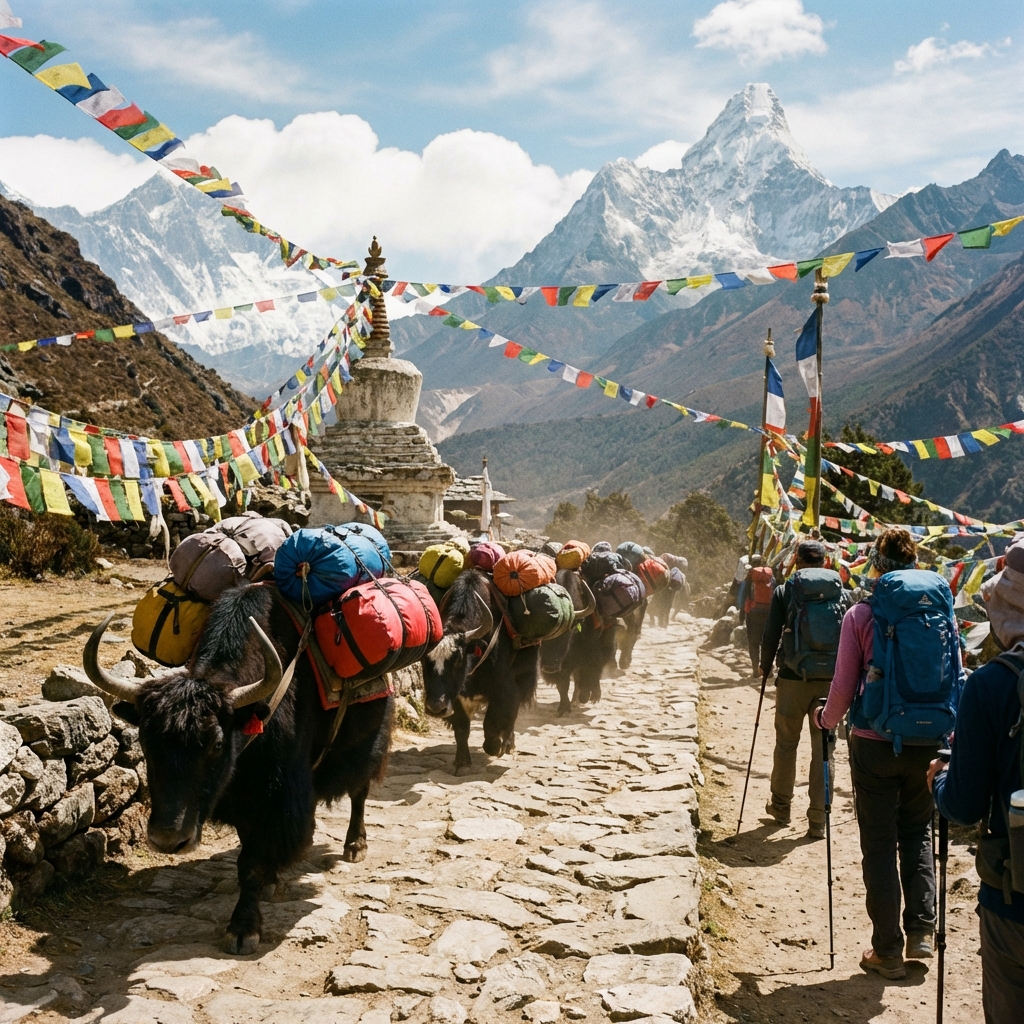
Above Namche, the trail climbs to Tengboche at 3,867m and the atmosphere changes completely. The monastery at Tengboche is the largest in the Khumbu region, its gompa a riot of butter lamps, thangka paintings, and the low drone of monks at prayer. Ama Dablam rises directly to the south in one of the most photographed mountain compositions on earth — a near-perfect pyramid flanked by hanging glaciers. The Mani Rimdu festival, held here annually in October or November on the full moon of the Tibetan month of Minlam, transforms the monastery courtyard into a stage for masked dancers representing the triumph of Buddhism over pre-Buddhist demons. Outside festival season, Tengboche is contemplative in a way that Namche never is: the lodges are smaller, the streets are quieter, and the sound of the monastery bell carries across the rhododendron forest at dawn. Many trekkers cite Tengboche as the emotional peak of the journey, the place where the aesthetic and spiritual dimensions of the Khumbu come into sharpest focus.
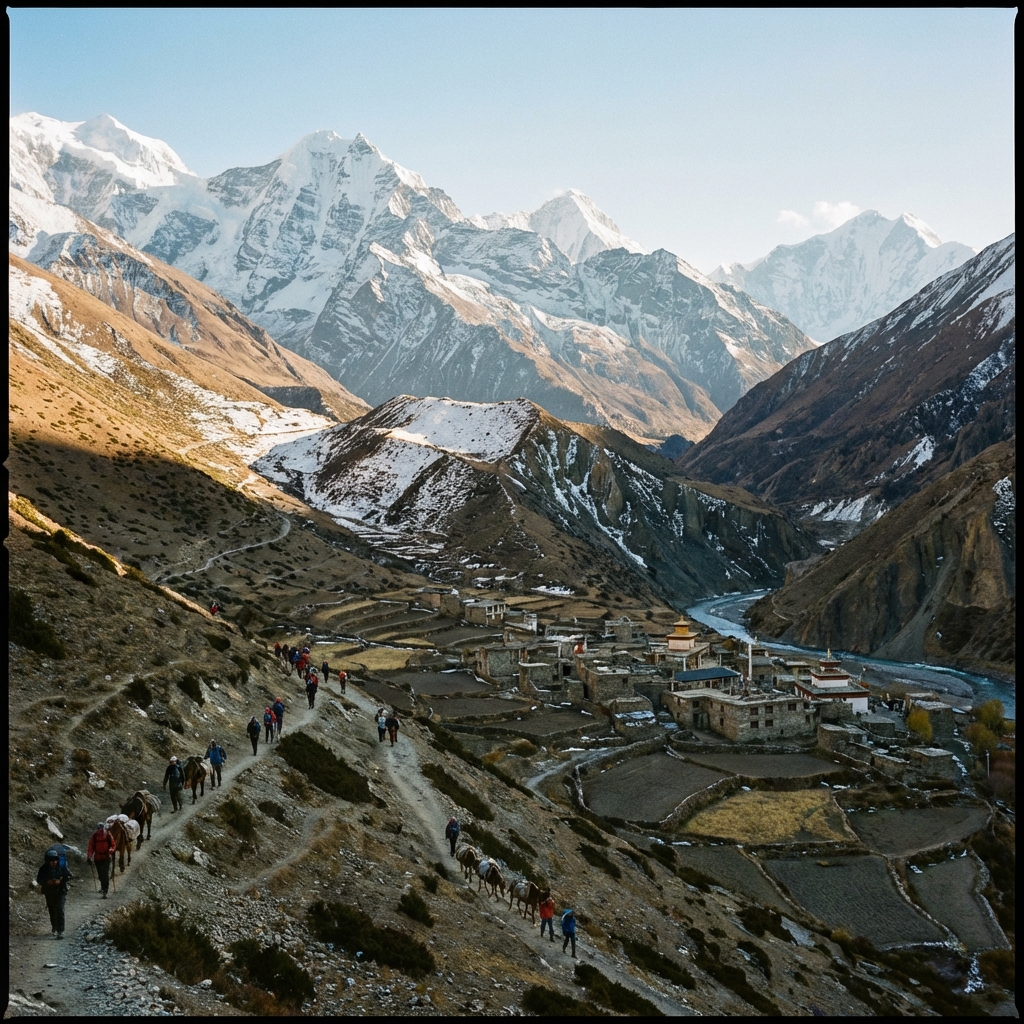
Dingboche at 4,410m is where the Khumbu stops being scenically dramatic and starts being physiologically serious. The village sits in a wide, dry valley framed by the sheer south face of Island Peak and the long ridgeline of Nuptse. Stone walls divide yak pastures in a grid pattern that dates back centuries, built to protect crops from high-altitude winds. The austere beauty of Dingboche is real, but it is the altitude that commands attention: by this point most trekkers are experiencing persistent headaches, disrupted sleep, and reduced appetite. The rest day here follows the same logic as Namche — a day hike to Nangkartshang Peak at 5,083m exposes the body to hypoxic stress while allowing it to recover at the lower sleeping altitude. The view from the top, which encompasses the Lhotse-Nuptse wall, Makalu, and the long sweep of the Khumbu valley, is among the finest in the entire region. Below, the yaks move slowly across the valley floor and smoke rises from lodge chimneys, and the distance to Everest Base Camp suddenly seems both vast and achievable.
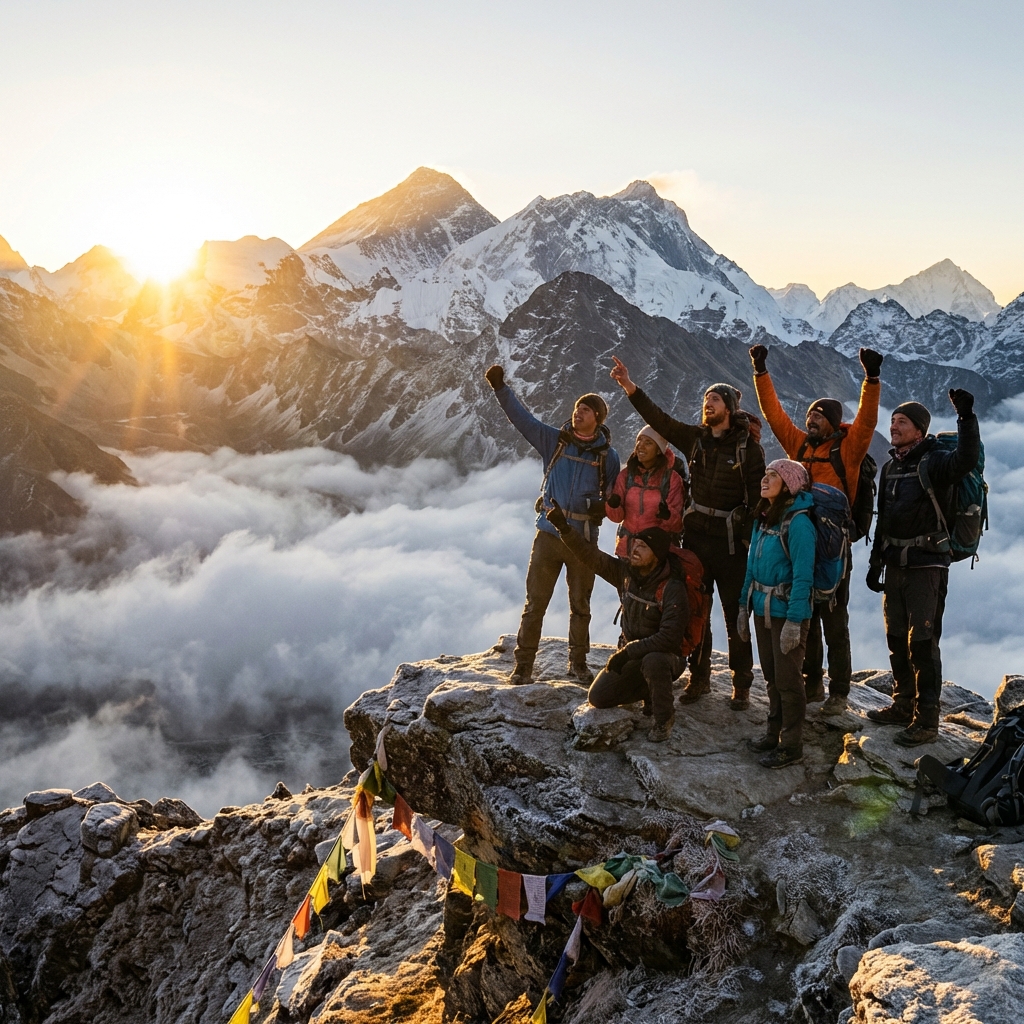
Gorakshep, the final village on the EBC corridor, sits at 5,164m on the shores of a dried glacial lake and exists almost entirely to service the last stretch of the EBC trek. It is not a village in any conventional sense — it has no permanent year-round residents, no market, no monastery — just a cluster of basic lodges that open during trekking season and close when the snow arrives. At this altitude the atmosphere holds roughly half the oxygen of sea level, cooking water boils at 84°C, and pipes freeze solid each night. Hot showers are nominal; the dining room is cold despite the wood stoves; sleep is fragmented by Cheyne-Stokes breathing. And yet Gorakshep carries an unmistakable psychological charge. You are sleeping higher than the summit of Mont Blanc. The Khumbu Glacier rumbles through the night. At 4:00am, a stream of headlamps moves up the dark slope of Kala Patthar toward a sunrise that most people will describe, inadequately, as the most beautiful they have ever seen.
Understanding the teahouse quality gradient is essential for managing expectations on the EBC trek. In Lukla and Phakding, lodges are warm, menus are extensive, and competition keeps prices reasonable. Namche represents the apex of Khumbu hospitality: heated dining rooms, en-suite rooms in the better lodges, cappuccinos, and fresh-baked goods. From Tengboche onward, the gradient inverts sharply — each 300m of altitude gained typically means one fewer menu option, colder rooms, thinner blankets, and higher prices. At Dingboche, expect simple wooden dormitories or private rooms with thin mattresses, meals centred on dal bhat and fried rice, and dining rooms that double as social spaces for everyone in the village simultaneously. At Gorakshep the lodge experience is genuinely Spartan: the toilet may require a bucket of water, the walls may not be insulated, and the extra blanket you request may not materialize. This is not a failure of the teahouse system — it is a function of what is physically possible at over 5,000m, where every piece of food, fuel, and building material has been carried by human or yak from Lukla. Trekkers who frame this gradient as an adventure rather than a disappointment consistently report better overall experiences; those who arrive at Gorakshep expecting Namche-quality comfort are setting themselves up for misery. The villages of the Khumbu are extraordinary precisely because they exist at all.
Everest Region Village Guides
Detailed guides to every major village on the Khumbu corridor, from the gateway at Lukla to the final settlement at Gorakshep.
Good to know
Everest Villages — Frequently Asked Questions
How does village spacing affect acclimatization on the EBC trek?
The Khumbu corridor's villages are spaced almost perfectly for safe acclimatization — but only if you resist the urge to push ahead. The standard itinerary enforces rest days at Namche Bazaar (3,440m) and Dingboche (4,410m) because the ascent rate otherwise exceeds the recommended 300–500m gain per sleeping day above 3,000m. Each village acts as a natural checkpoint: Phakding at 2,610m is a gentle first night, Namche absorbs the initial altitude shock, Tengboche bridges the mid-range, and Dingboche's extra night prepares your body for the brutal final push to Lobuche and Gorakshep. Skipping rest days dramatically raises your risk of AMS, HACE, and HAPE. Think of the village chain not as stopping points but as a medically calibrated ladder.
Can I withdraw cash from ATMs in Everest region villages?
Yes, but only up to Namche Bazaar (3,440m). Namche has several ATMs — generally reliable though lines can be long during peak season (October–November, March–April) and machines sometimes run out of cash on busy weekends. Withdrawal limits are typically NPR 35,000–40,000 per transaction. Above Namche, there are no ATMs; a few lodges in Tengboche and Dingboche accept cards but connectivity is unreliable. Gorakshep is cash-only, full stop. The practical rule: withdraw enough in Namche to cover everything from Tengboche to Gorakshep and back to Lukla. Budget generously — prices escalate sharply with altitude, and a single hot meal at Gorakshep can cost NPR 800–1,200.
What is the teahouse food quality like from Lukla to Gorakshep?
Lukla and Phakding offer surprisingly varied menus — pasta, pizza, momos, dal bhat, and even apple pie. Namche Bazaar is the culinary peak of the trek, with German bakeries, espresso machines, and fresh vegetables flown in weekly. From Tengboche onward the menus narrow: dal bhat, fried rice, noodle soup, and basic egg dishes dominate. Vegetables become scarcer and more expensive as altitude increases because everything is carried by porter or yak. By Gorakshep, you are eating fuel rather than food — portions shrink, cooking times increase in thin air, and the dining room is a fog of condensation and headlamp beams. Dal bhat remains the best calorie-to-cost option throughout; it is always hot, always reliable, and always refillable.
When should I visit Tengboche Monastery and what are the opening hours?
Tengboche Monastery (3,867m) is open to visitors most of the year, with morning prayers typically held between 6:00–7:30am and evening prayers around 5:00–6:30pm — attending one is a highlight of the entire trek. The monastery is most atmospheric during the Mani Rimdu festival, a three-day event held in October or November on the full moon of the Tibetan month of Minlam, featuring masked dances, fire ceremonies, and blessings. Exact festival dates shift with the lunar calendar, so check ahead. The monastery complex was rebuilt after a 1989 fire and houses important thangkas and butter lamp shrines. A small entry donation is customary. Note that the monastery may be closed during certain prayer retreats — lodge staff in Tengboche can confirm same-day access.
Why is the acclimatization day at Dingboche so important?
Dingboche sits at 4,410m, and your rest day there is arguably the most physiologically critical of the entire trek. By this point you have ascended roughly 1,600m from Namche, and your body's red blood cell production — stimulated by lower oxygen partial pressure — is still catching up. The recommended acclimatization hike to Nangkartshang Peak (5,083m) follows the golden rule: climb high, sleep low. Spending a night at Dingboche, day-hiking to over 5,000m, and sleeping again at 4,410m pushes a controlled hypoxic stress on your system, accelerating adaptation without the risks of actually sleeping at that altitude. Skipping this day and pushing straight to Lobuche (4,940m) is the single most common mistake trekkers make, and it correlates strongly with evacuation statistics above Lobuche.
What should I expect at Gorakshep — is it really that tough?
Gorakshep at 5,164m is the highest permanent settlement on the EBC trail, and it earns its brutal reputation. Lodges are basic wooden structures with minimal insulation; pipes freeze nightly, so hot showers are rare and toilets may be non-functional before dawn. Nights drop well below -15°C in October and November, and wind chill on the sandy lakebed can make conditions feel extreme. Altitude symptoms — persistent headaches, nausea, disrupted sleep, and Cheyne-Stokes breathing — are common even in well-acclimatized trekkers. The saving grace is that most people stay only one or two nights: one for the pre-dawn Kala Patthar (5,644m) sunrise hike, and optionally one for the Everest Base Camp day trip. Psychologically, Gorakshep carries enormous weight — you are sleeping higher than most mountains in Europe and North America.