
Complete Kathmandu Arrival Guide for Trekkers 2026
Arriving in Kathmandu is the exciting first step of your trekking adventure in Nepal. This comprehensive guide covers everything you need to know about your arrival, from stepping off the plane at Tribhuvan International Airport to your first night in Thamel, and all the essential preparations you'll need to complete before heading into the mountains.
Whether you're planning to trek the Everest Base Camp, Annapurna Circuit, Manaslu Circuit, or any other Himalayan route, Kathmandu serves as your gateway and preparation hub. This guide will help you navigate the city efficiently, avoid common pitfalls, and ensure you're fully prepared for your trek.
KTM - Tribhuvan International Airport
1,400m (4,593 ft)
Available for most nationalities - $30-125 USD
6km, 20-40 minutes depending on traffic
$10-15 USD (NPR 1,200-1,800)
UTC+5:45 (Nepal Time)
Nepali Rupee (NPR)
Thamel money changers, not airport
Understanding Kathmandu as Your Trekking Base
Kathmandu, Nepal's vibrant capital city, is more than just a stopover on your way to the mountains. For trekkers, it serves as a critical preparation hub where you'll obtain permits, buy or rent gear, exchange currency, get SIM cards, and make final arrangements. The city sits at 1,400 meters (4,593 feet) elevation, providing your first taste of altitude before heading higher into the Himalayas.
Most trekkers spend 2-3 days in Kathmandu before their trek and at least one day after returning. This time is essential for acclimatization, permit processing, gear preparation, and cultural adjustment. The Thamel district serves as the primary hub for trekkers, packed with gear shops, trekking agencies, restaurants, hotels, and all the services you'll need.
Understanding the rhythm of Kathmandu will make your preparation smoother. The city operates on Nepal Time (UTC+5:45), and most businesses in Thamel open around 9-10 AM and close by 7-8 PM. Government offices, including permit offices, typically operate from 10 AM to 5 PM Sunday through Friday (Saturday is the weekly holiday in Nepal).
Plan for 2-3 Preparation Days in Kathmandu
Tribhuvan International Airport Arrival Process
Before You Land: What to Prepare
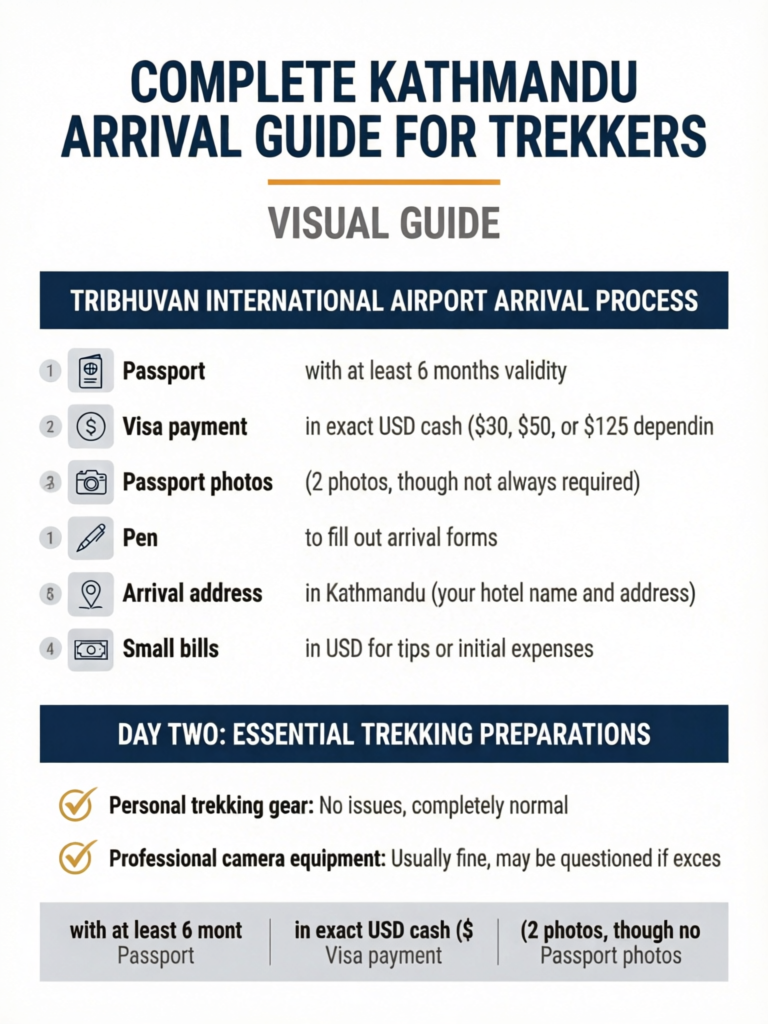
Before your flight lands at Tribhuvan International Airport (KTM), have these items easily accessible in your carry-on bag:
- Passport with at least 6 months validity
- Visa payment in exact USD cash ($30, $50, or $125 depending on duration)
- Passport photos (2 photos, though not always required)
- Pen to fill out arrival forms
- Arrival address in Kathmandu (your hotel name and address)
- Small bills in USD for tips or initial expenses
- Printed hotel confirmation (helpful but mandatory since April 2023)
The approach to Kathmandu airport offers spectacular views of the Himalayas on clear days. Sit on the right side of the aircraft (flying from Delhi or other Indian cities) or the left side (flying from Bangkok or Southeast Asia) for the best mountain views.
Visa on Arrival Process
Nepal offers visa on arrival for most nationalities at Tribhuvan International Airport. The process has been streamlined in recent years but can still be slow during peak trekking seasons (October-November and March-April). Here's the step-by-step process:
Step 1: Electronic Kiosks (Optional but Recommended)
Before joining the visa counter queues, you can pre-fill your application at electronic kiosks in the arrival hall. This saves time at the counter. You'll need to:
- Select your nationality and visa duration
- Enter passport details
- Enter arrival address (hotel name is sufficient)
- Print your completed form
If you've already filled out the online application before arrival, you can skip this step.
Step 2: Payment Counter
Take your completed form to the payment counter. Visa fees are:
- 15 days: $30 USD
- 30 days: $50 USD
- 90 days: $125 USD
Pay in exact USD cash (they rarely have change). Credit cards are sometimes accepted but cash is more reliable. Keep your receipt.
Step 3: Document Submission
Submit your form, receipt, and passport at the visa counter. The officer will:
- Verify your documents
- Take your photo (if the system is working)
- Stamp your visa in your passport
- Return your passport
During peak season, this entire process can take 45-90 minutes. During off-season, you might clear it in 20-30 minutes.
Step 4: Immigration
After receiving your visa, proceed to immigration counters. Show your passport with the visa stamp. The officer will stamp your entry and you're officially in Nepal. They may ask about your trekking plans or accommodation but usually just stamp and wave you through.
Visa Extension Available in Kathmandu
Important Visa Exemptions and Restrictions
Some nationalities receive free visas or cannot obtain visas on arrival. As of 2026:
- Free visa countries: SAARC nationals (India, Bangladesh, Pakistan, Sri Lanka, Maldives, Bhutan) receive free entry for varying durations
- No visa on arrival: Nigerian nationals must obtain visas from Nepali embassies before arrival
- Special procedures: Chinese nationals have simplified visa procedures under bilateral agreements
Always verify current requirements with the Nepal Immigration Department or your nearest Nepali embassy before travel.
Baggage Claim and Customs
After immigration, proceed to baggage claim. Tribhuvan International Airport has a single baggage hall for all international arrivals. The baggage system is relatively old, so expect some delays:
- Average wait time: 20-40 minutes for bags to appear
- Lost baggage: Report immediately at the baggage claim office
- Damaged baggage: Take photos and report before leaving the secured area
What to Do If Your Trekking Gear Is Lost
If your checked bag containing trekking gear is lost, don't panic. Kathmandu's Thamel district has excellent gear shops where you can buy or rent almost anything you need. File a lost baggage report at the airport office, get the reference number, and your bag will likely arrive on the next flight. Most trekkers' lost bags arrive within 24-48 hours.
Customs Declaration
After collecting your baggage, you'll pass through customs. Nepal has relatively relaxed customs for personal items:
- Personal trekking gear: No issues, completely normal
- Professional camera equipment: Usually fine, may be questioned if excessive
- Drones: Require permits and are restricted in many trekking areas
- Currency: You can bring unlimited foreign currency but must declare amounts over $5,000 USD
There are three exit channels:
- Green channel (nothing to declare): For most trekkers
- Red channel (items to declare): For commercial goods or large amounts of currency
- Crew channel: For airline crew only
Most trekkers simply walk through the green channel. Customs officers randomly check bags but usually wave tourists through, especially those obviously equipped for trekking.
Items Prohibited or Restricted
- Narcotics and drugs: Strictly illegal, severe penalties
- Antiques: Cannot export items over 100 years old
- Wildlife products: No animal parts, especially from protected species
- Excessive electronics: Commercial quantities may be questioned
- Satellite phones: Require permits from Nepal Telecommunications Authority
Airport Facilities You Should Know About
After clearing customs, you'll enter the arrival hall. Here are the facilities available:
Money Exchange Counters
There are several authorized money exchange counters in the arrival hall, operating 24/7. However, their exchange rates are typically 3-5% worse than Thamel money changers. Change only enough to cover your taxi to the hotel and first few hours ($50-100 USD is sufficient). You'll get better rates in Thamel.
ATMs
Several ATMs are available in the arrival hall:
- Nabil Bank: Accepts most international cards, NPR 35,000 withdrawal limit
- Himalayan Bank: Good reliability, NPR 40,000 limit
- Standard Chartered: Premium cards, higher limits possible
Most ATMs charge NPR 500 (about $3.50 USD) per transaction. Your home bank may add additional fees. Consider withdrawing a larger amount to minimize per-transaction fees, but be aware of daily limits.
SIM Card Counters
This is one of the most important stops for trekkers. Two main providers have counters in the arrival hall:
Ncell Counter
- Usually open 24/7
- Tourist SIM packages: NPR 1,000-1,500 ($7-11 USD)
- Best coverage on most trekking routes
- Data packages: 25GB-50GB options
- Activation: Immediate with passport copy
Nepal Telecom (NTC) Counter
- Open during flight arrivals
- Tourist packages: NPR 800-1,200 ($6-9 USD)
- Better coverage in remote areas like Manaslu, Upper Mustang
- Data packages: 20GB-40GB options
- Slightly better coverage above 4,000m elevation
For most popular treks (Everest Base Camp, Annapurna Base Camp, Langtang), Ncell has slightly better coverage. For remote treks (Manaslu, Kanchenjunga, Upper Mustang), NTC is often superior.
What You'll Need for SIM Card
- Passport (original)
- Passport photo (they usually have a camera)
- Registration form (provided at counter)
- Cash payment in NPR
The process takes 5-10 minutes. They'll activate the SIM, set up your phone, and explain the data package. Ask them to write down the Nepali number so you can share it with your trekking company or emergency contacts.
Tourist Information Counter
The Nepal Tourism Board operates an information counter in the arrival hall. The staff can provide:
- Maps of Kathmandu
- Information about trekking permits
- Recommendations for registered trekking agencies
- Help with tourist police if needed
- General tourist information
They cannot help with hotel bookings or transportation arrangements but are useful for first-time visitors with questions.
Luggage Storage
If you're transiting through Kathmandu before continuing to another destination, or if you want to store excess baggage before your trek, there are luggage storage facilities:
- Airport left luggage: Located near check-in area, NPR 200-300 per bag per day
- Hotel storage: Most Thamel hotels offer free luggage storage for guests
Many trekkers leave extra bags at their Kathmandu hotel while trekking. This is completely safe and standard practice.
WiFi
Free WiFi is available in the arrival hall, though it's often slow and unreliable. You'll need to register with a phone number. Once you get your Nepali SIM card, mobile data is generally more reliable than airport WiFi.
Transportation from Airport to Thamel
The journey from Tribhuvan International Airport to Thamel, the main tourist and trekking district, is about 6 kilometers and typically takes 20-40 minutes depending on traffic. Here are your transportation options:
Pre-Paid Airport Taxi Service
The most reliable and safest option for first-time visitors is the official pre-paid taxi service located just outside the arrival hall exit.
How It Works:
- Exit the arrival hall and look for the "Pre-paid Taxi" counter (clearly marked)
- Tell them your destination (hotel name in Thamel)
- Pay the fixed fare at the counter: NPR 1,200-1,500 ($9-11 USD)
- Receive a receipt with taxi number
- Walk to the taxi stand where a taxi will be assigned
- Show the driver your receipt and hotel details
- No additional payment needed (tip optional)
Advantages:
- Fixed, non-negotiable price (no haggling)
- Official receipt for records
- Driver accountability through vehicle registration
- No scam risk
- Suitable for late-night arrivals
Disadvantages:
- Slightly more expensive than negotiating directly
- May wait 5-10 minutes for taxi assignment during peak hours
Regular Taxi from Outside Airport
If you're comfortable negotiating, you can walk outside the airport premises to find regular taxis:
Process:
- Exit the airport building and walk past the pre-paid taxi area
- Continue to the main road (about 100 meters)
- Look for regular taxis (yellow license plates)
- Negotiate fare before getting in
- Agree on price: NPR 1,000-1,200 ($7-9 USD) to Thamel
Negotiation Tips:
- Know the fair price range beforehand
- Be willing to walk away if price is too high
- Confirm the price includes all bags
- Agree whether it's using the meter or fixed price
- Get large bags in the vehicle before finalizing the deal
Common Scams to Avoid:
- Driver claims your hotel is closed/bad and wants to take you elsewhere
- "Commission hotels" where drivers get kickbacks for bringing tourists
- Inflated prices (anything over NPR 1,500 is too much)
- Demanding extra payment for luggage
- Claiming meter is broken and quoting high fixed prices
Private Hotel Pickup
Many mid-range and upscale hotels offer free airport pickup if you book directly:
How to Arrange:
- Email hotel 24-48 hours before arrival
- Provide flight number and arrival time
- Confirm pickup service and meeting point
- Look for driver holding sign with your name
- Verify driver's identity and hotel name
This is the most comfortable option but only available if you've pre-booked accommodation. Budget guesthouses typically don't offer this service.
Ride-Sharing Apps
In 2026, ride-sharing services in Kathmandu include:
Pathao
- Most popular ride-sharing app in Nepal
- Download before arrival or use airport WiFi
- Typical fare to Thamel: NPR 600-900 ($4.50-7 USD)
- May have limited availability late at night
- Requires data connection to book
InDrive
- Growing popularity
- Similar pricing to Pathao
- Can negotiate fare with driver
- Good availability during day hours
Important Notes:
- Ride-sharing drivers cannot enter the airport taxi area
- You'll need to walk to the pickup point outside airport premises
- During peak hours or late at night, taxis may be more reliable
- Ensure your phone has data (buy SIM at airport first)
Public Transportation (Not Recommended for First-Time Arrivals)
While local buses do run from near the airport to various parts of Kathmandu, they are not recommended for arriving international trekkers:
Why Not Recommended:
- No direct route to Thamel
- Require transfers and local knowledge
- Difficult with large trekking backpacks
- Can be crowded and uncomfortable
- Risk of pickpocketing with valuable gear
- Saves only $5-8 USD versus taxi
The small cost saving is not worth the hassle and stress after a long international flight.
The Journey to Thamel: What to Expect
As you travel from the airport to Thamel, you'll get your first glimpses of Kathmandu:
Route Overview:
- Exit airport and join Ring Road
- Pass through Sinamangal area
- Continue through increasingly busy streets
- Enter Thamel through one of several entry points
- Navigate narrow lanes to your hotel
Traffic Conditions:
- Morning (6-10 AM): Heavy traffic, 30-45 minute journey
- Midday (10 AM-4 PM): Moderate traffic, 20-30 minutes
- Evening (4-7 PM): Very heavy traffic, 45-60 minutes possible
- Night (7 PM-6 AM): Light traffic, 15-25 minutes
Road Conditions: Roads in Kathmandu are a mix of paved highways and narrow, potholed lanes. Don't be alarmed by the seemingly chaotic traffic—it's normal. Drivers are generally skilled at navigating the chaos, though it can be stressful for first-time visitors.
Important Landmarks:
- Ring Road: The main highway circling Kathmandu
- Gaushala: Major intersection near airport
- Chabahil: Area with Boudhanath Stupa visible in distance
- Maharajgunj: Upscale residential area
- Thamel Gate: Official entrance to Thamel district
Your driver may or may not know the exact location of your hotel, especially in Thamel's maze-like lanes. Having the hotel's phone number ready (call ahead using your new SIM) allows the driver to call for directions if needed.
Have Hotel Address in Nepali Script
Your First Hours in Thamel
Checking Into Your Hotel
Thamel offers accommodation ranging from budget guesthouses (NPR 500-1,500 per night) to boutique hotels (NPR 5,000-15,000 per night). Most trekkers choose mid-range options (NPR 2,000-4,000 per night) that offer good value with hot showers, WiFi, and helpful staff.
Standard Check-In Process:
- Present your passport (required by law for foreigner registration)
- Fill out guest registration form
- Hotel will keep passport photocopy
- Receive room key and WiFi password
- Porter shows you to room (tip: NPR 100-200)
What to Verify:
- Hot water availability and timing (some hotels have scheduled hot water)
- WiFi password and reliability
- Breakfast timing and what's included
- Luggage storage availability for during your trek
- Safe deposit box for valuables
First Things to Do in Your Room:
- Check all electrical outlets for charging devices
- Test hot water and shower
- Verify door locks work properly
- Note location of fire exits (Thamel buildings can be maze-like)
- Ask about laundry service if needed
Immediate Practical Tasks
After settling in, tackle these immediate tasks:
1. Money Exchange
Walk to one of Thamel's many money exchange shops for better rates than the airport:
Best Exchange Locations:
- Mustang Money Exchange (competitive rates, professional)
- Himalayan Bank Limited exchange counter
- Various licensed money changers on main Thamel streets
What You'll Need:
- Passport (original)
- Foreign currency (USD, EUR, GBP all accepted)
- Completed exchange form
Current Rate Expectations (2026):
- Airport: NPR 128-130 per USD
- Thamel: NPR 133-135 per USD
- Banks: NPR 132-134 per USD
Exchange enough to cover your pre-trek expenses (permits, gear, meals, transportation). Many trekking routes now have ATMs along the way, but it's wise to carry cash for remote areas.
2. SIM Card Activation (If Not Done at Airport)
If you skipped the SIM card at the airport, numerous shops in Thamel sell tourist SIM cards:
Where to Buy:
- Official Ncell stores (multiple locations in Thamel)
- Nepal Telecom offices
- Authorized dealers (look for official signage)
Avoid:
- Unofficial sellers with "great deals"
- Registration scams where someone offers to register for you
The price in Thamel is similar to airport (NPR 1,000-1,500), and you'll need the same documents (passport, photo).
3. Inform Your Contacts
Use your new connection to:
- Message family/friends about safe arrival
- Email trekking company to confirm you've arrived (if you booked a guided trek)
- Post to social media if desired (while you still have enthusiasm and aren't exhausted)
- Check email for any urgent messages
4. Initial Rest and Recovery
Don't underestimate jet lag and travel fatigue:
- Most trekkers arrive from long-haul flights (12-24 hours with connections)
- Time zone changes can be significant (15+ hours from North America)
- Altitude (1,400m) may cause mild symptoms for some
Recovery Recommendations:
- Nap for 1-2 hours maximum (longer disrupts adjustment)
- Drink plenty of water (Kathmandu's air is dry and dusty)
- Take a shower to freshen up
- Eat a light meal
- Try to stay awake until at least 8-9 PM local time
Your First Meal in Kathmandu
Thamel is packed with restaurants catering to international trekkers. For your first meal, choose something gentle on your stomach:
Recommended First Meal Restaurants:
OR2K (Middle Eastern)
- Vegetarian and vegan options
- Gentle on stomachs
- Comfortable cushion seating
- Good for jet-lagged trekkers
- Popular dishes: Hummus, falafel, mezze platters
Third Eye Restaurant (Indian/Nepali)
- Authentic Indian cuisine
- Clean and well-maintained
- Good introduction to local flavors
- Rooftop seating available
- Popular dishes: Dal bhat, butter chicken, naan
Fire and Ice Pizzeria (Italian)
- Western comfort food
- Clean and modern
- Familiar flavors for nervous stomachs
- Good for those not ready for spicy food
- Popular dishes: Margherita pizza, pasta
Himalayan Java (Cafe)
- Coffee and light snacks
- Western-style breakfast items
- Clean and air-conditioned
- Good WiFi for catching up online
- Popular items: Sandwiches, pastries, excellent coffee
Food Safety Tips for First Meals:
- Avoid street food on arrival day (save it for when your stomach adjusts)
- Drink bottled water only (verify seal is intact)
- Avoid raw salads and uncooked vegetables initially
- Choose busy restaurants with high turnover
- Observe cleanliness and other customer presence
Try Dal Bhat on Your First Full Day
Evening Activities: Light Exploration
If you arrive in the morning or early afternoon and feel energetic after rest, consider light exploration:
Thamel Walking Orientation (1-2 hours)
- Walk the main streets to orient yourself
- Locate key shops and restaurants for later
- Find ATMs, pharmacies, and supermarkets
- Get a feel for the neighborhood layout
- Note locations for tomorrow's tasks
Key Locations to Identify:
- Permit office location (Nepal Tourism Board building)
- Your preferred gear rental shops
- Restaurant options for coming days
- Supermarkets for trek snacks (Bhat Bhateni, local shops)
- Pharmacies for any medical needs
Evening Thamel Atmosphere:
- Streets become pedestrian-heavy
- Restaurants fill up with trekkers
- Gear shops stay open until 7-8 PM
- Pleasant temperature for walking
- Good people-watching opportunities
What NOT to Do First Evening:
- Don't commit to any trek bookings from street touts
- Don't buy expensive gear without research
- Don't stay out too late (your body needs rest)
- Don't drink excessive alcohol (altitude + jet lag = bad hangover)
- Don't exchange money with unofficial street changers
Managing Jet Lag and Time Zone Adjustment
Nepal Time (UTC+5:45) is an unusual time zone that can be disorienting:
From North America (EST): +10:45 hours From Europe (CET): +4:45 hours From Australia (AEST): -4:15 hours From Japan/Korea: -3:15 hours
Adjustment Strategies:
Day 1 (Arrival Day):
- Short nap only (1-2 hours max)
- Get natural sunlight during the day
- Eat meals at local times
- Stay awake until 8-9 PM minimum
- Avoid caffeine after 3 PM
Day 2:
- Wake naturally or set gentle alarm for 7-8 AM
- Eat breakfast even if not hungry
- Stay active during daylight hours
- Continue sleeping at local time (9-10 PM)
Day 3+:
- Should be mostly adjusted
- Natural wake time around 6-7 AM
- Normal energy levels restored
Sleep Aid Options:
- Melatonin (bring from home if preferred)
- Available at Kathmandu pharmacies
- Natural remedies: chamomile tea, warm milk
- Avoid heavy sleeping pills (altitude makes them stronger)
Day Two: Essential Trekking Preparations
Your first full day in Kathmandu is crucial for trek preparations. Most trekkers need to complete permits, finalize gear, and make arrangements.
Trekking Permits: Complete Guide
Nepal requires various permits depending on your trekking route. Understanding which permits you need and where to get them is essential.
TIMS Card (Trekkers' Information Management System)
What It Is: A database registration system to track trekkers for safety and statistics.
Who Needs It:
- Independent trekkers: Required for most areas
- Agency/guided trekkers: Required (usually arranged by agency)
- Some restricted areas: Not required (other permits supersede)
Cost:
- Independent trekkers (FIT): NPR 2,000 (about $15 USD)
- Agency/organized trekkers: NPR 1,000 (about $7.50 USD)
Where to Get: Nepal Tourism Board Office
- Location: Pradarshani Marg, Exhibition Road, Kathmandu
- Hours: Sunday-Thursday 9 AM - 5 PM, Friday 9 AM - 3 PM (Closed Saturday)
- Processing time: 30 minutes to 2 hours depending on crowd
Tourist Service Center (Thamel)
- Location: Bhagwan Bahal, Thamel
- Hours: Similar to NTB office
- Often less crowded than main NTB office
Documents Required:
- Passport (original)
- 2 passport-size photos
- Completed application form
- Trekking itinerary details
- Guide information (if trekking with guide)
- Agency registration (if booking through agency)
Important Notes:
- TIMS cards must be carried throughout your trek
- Check points will verify your TIMS card
- Loss of TIMS card can cause problems (keep safe)
- Some areas like Upper Mustang, Manaslu don't require TIMS (other permits cover it)
Conservation Area Permits
Many trekking areas fall within protected conservation areas:
Annapurna Conservation Area Permit (ACAP)
- Required for: Annapurna Circuit, Annapurna Base Camp, Poon Hill, Mardi Himal
- Cost: NPR 3,000 (about $22 USD) for foreigners
- Where: Nepal Tourism Board office or ACAP entry gates
- Processing: Immediate if done in Kathmandu, available at entry points too
Langtang National Park Permit
- Required for: Langtang Valley, Tamang Heritage Trail, Gosaikunda
- Cost: NPR 3,000 (about $22 USD)
- Where: Nepal Tourism Board office or park entry gate
- Processing: Immediate
Sagarmatha National Park Permit
- Required for: Everest Base Camp, Gokyo Lakes, Three Passes Trek, Everest region treks
- Cost: NPR 3,000 (about $22 USD)
- Where: Nepal Tourism Board office in Kathmandu or entry gate at Monjo
- Processing: Immediate
- Note: Most trekkers get this at Monjo entry gate on the way to EBC
Makalu Barun National Park Permit
- Required for: Makalu Base Camp trek
- Cost: NPR 3,000 (about $22 USD)
- Where: Nepal Tourism Board office or entry gate
- Processing: Immediate
Kanchenjunga Conservation Area Permit
- Required for: Kanchenjunga Base Camp treks
- Cost: NPR 2,000 (about $15 USD)
- Where: Nepal Tourism Board office
- Processing: Immediate
Restricted Area Permits (RAP)
Some areas require special permits and must be trekked with a guide:
Manaslu Conservation Area + Restricted Area Permit
- Required for: Manaslu Circuit
- Cost:
- September-November: $100 USD per week (+ $15 per day after)
- December-August: $75 USD per week (+ $10 per day after)
- Plus MCAP: NPR 3,000
- Where: Must be arranged through registered trekking agency
- Requirements: Minimum 2 trekkers, licensed guide mandatory
- Processing: 1-2 days through agency
Upper Mustang Restricted Area Permit
- Required for: Upper Mustang trek
- Cost: USD 50/day USD for 10 days (+ $50 per day after)
- Where: Must be arranged through registered trekking agency
- Requirements: Minimum 2 trekkers, licensed guide mandatory
- Processing: 2-3 days through agency
Upper Dolpo Restricted Area Permit
- Required for: Upper Dolpo trek
- Cost: USD 50/day (no minimum) (+ $50 per day after)
- Where: Must be arranged through registered trekking agency
- Requirements: Minimum 2 trekkers, licensed guide mandatory
- Processing: 2-3 days through agency
Tsum Valley Restricted Area Permit
- Required for: Tsum Valley trek
- Cost:
- September-November: $40 USD per week (+ $7 per day after)
- December-August: $30 USD per week (+ $7 per day after)
- Where: Must be arranged through registered trekking agency
- Requirements: Minimum 2 trekkers, licensed guide mandatory
- Processing: 1-2 days through agency
How to Get Permits Yourself vs Through Agency
DIY Permit Process:
If you're trekking independently to non-restricted areas:
-
Research exact permits needed for your route
-
Gather documents:
- Passport
- Passport photos (bring 6-8 copies)
- Travel insurance copy (sometimes requested)
- Itinerary (rough plan is fine)
- Cash in NPR
-
Visit Nepal Tourism Board office (go early, by 10 AM for best experience)
-
Fill out application forms (available at office)
-
Submit documents at appropriate counter
-
Pay fees at payment counter
-
Receive permits (keep in safe plastic sleeve)
-
Make photocopies (in case of loss)
Agency Permit Arrangement:
If you're booking a guided trek or going to restricted areas:
- Choose registered trekking agency (verify registration with TAAN)
- Provide passport copy and photos (email or in person)
- Pay permit fees + service charge (usually $20-50 service fee)
- Agency processes paperwork (1-3 days depending on permit type)
- Collect permits from agency before trek departure
- Verify permit details (your name, dates, route all correct)
Which Method to Choose:
- DIY if: Trekking popular routes (EBC, ABC, Langtang), independent trekker, enjoy handling logistics, want to save service fees
- Agency if: Going to restricted areas (required), prefer convenience, limited time in Kathmandu, trekking with guide anyway, language barriers concern you
Thamel Orientation and Key Locations
Thamel is roughly divided into several sections, each with distinct characteristics:
Main Thamel (around Tridevi Marg)
- Highest concentration of restaurants
- Gear shops and trekking agencies
- Tourist-focused businesses
- Can be crowded and noisy
- Most tourist services available
Jyatha Thamel
- Mix of restaurants and guesthouses
- Slightly quieter than main Thamel
- Good budget accommodation options
- Several gear rental shops
Chaksibari Marg Area
- Popular restaurant street
- Live music venues
- Nightlife concentration
- Can be very busy in evenings
Paknajol Area (North Thamel)
- More residential feel
- Quieter guesthouse options
- Local restaurants and shops
- Easier to find parking
Key Streets to Know:
Tridevi Marg
- Main thoroughfare through Thamel
- Most shops and restaurants
- Can be very crowded
- Traffic and pedestrians mixed
Mandala Street
- Good restaurants and cafes
- Bookshops and art galleries
- Slightly upscale feel
- Popular evening walking area
JP Road (Jyatha Paicho)
- Mix of local and tourist businesses
- Good middle-ground street
- Less crowded than main areas
- Authentic local shops
Trekking Gear: Buy, Rent, or Bring from Home?
One of the biggest questions trekkers face is whether to bring all gear from home or buy/rent in Kathmandu. Here's a comprehensive breakdown:
What to Definitely Bring from Home
Personal fit-critical items:
- Hiking boots (already broken in—critical!)
- Backpack (fitted to your torso)
- Sleeping bag liner
- Prescription medications
- Prescription glasses/contacts
- Personal first aid items
Reliability-critical items:
- Headlamp (with spare batteries)
- Water purification (tablets or filter you trust)
- Sunscreen (high SPF, better quality abroad)
- Technical base layers (if you prefer specific brands)
Cost-effective to bring:
- Trekking poles (if you already own)
- Down jacket (if you own a good one)
- Quality rain gear (if you have it)
What to Buy or Rent in Kathmandu
Great to rent:
- Sleeping bags (NPR 150-300 per day, $1-2 USD)
- Down jackets (NPR 100-200 per day)
- Large duffels (NPR 50-100 per day)
- Crampons (NPR 200-300 per day)
- Ice axes (NPR 200-300 per day, for technical routes)
Good to buy if needed:
- Wool socks (excellent quality, NPR 300-800)
- Thermal underwear (good value, NPR 800-1,500)
- Fleece layers (NPR 1,000-2,500)
- Gloves and hats (NPR 300-1,000)
- Trekking pants (NPR 1,500-3,000)
- Gaiters (NPR 800-1,500)
Questionable to buy:
- Hiking boots (unless emergency or already decided to buy)
- Backpacks (unless yours broke)
- Sleeping bags (rent instead for one-time trek)
Where to Shop for Gear in Thamel
Premium Stores (Genuine Brands):
Shona's Alpine Rental
- Location: Tridevi Marg, central Thamel
- Specialties: Rental gear, climbing equipment
- Quality: Excellent, well-maintained equipment
- Prices: Premium but fair
- Services: Knowledgeable staff, good advice
Sherpa Adventure Gear
- Location: Multiple locations in Thamel
- Specialties: Locally-made quality gear
- Quality: Excellent, supports local economy
- Prices: Moderate, good value
- Services: Range from budget to premium
The North Face (Official)
- Location: Tridevi Marg
- Specialties: Genuine North Face products
- Quality: Guaranteed authentic
- Prices: Premium (similar to US/Europe prices)
- Services: Professional, warranty valid
Mountain Hardwear
- Location: Near Kathmandu Guest House
- Specialties: Technical mountaineering gear
- Quality: High-end, authentic
- Prices: Premium
- Services: Expert staff for technical advice
Mid-Range Options:
Hiking Himalayan Store
- Location: Central Thamel
- Specialties: Mix of brands and gear
- Quality: Good selection, verify authenticity
- Prices: Moderate
- Services: Helpful staff, rental available
Adventure Mountain Gear
- Location: Jyatha Thamel
- Specialties: Rental and sales
- Quality: Decent, inspect items carefully
- Prices: Affordable
- Services: Flexible rental terms
Budget Options (Knock-offs and Copies):
Thamel Bazaar Shops
- Location: Throughout Thamel side streets
- Specialties: "North Face" and other brand copies
- Quality: Variable, some surprisingly good
- Prices: Very cheap (1/10 of genuine prices)
- Services: Negotiation expected
Important Notes on Copy Gear:
- Zippers may fail (major issue on jackets)
- Waterproofing often inferior
- Down fill may be poor quality or quantity
- Acceptable for: casual trekking, backup items
- Risky for: extreme conditions, critical gear
Rental Shops Strategy:
Most gear rental shops operate on daily rates. Here's how to get best value:
- Visit multiple shops (prices vary significantly)
- Inspect items carefully:
- Check zippers work smoothly
- Verify no holes or tears
- Smell for dampness or mold
- Test buckles and straps
- Negotiate package deals (renting multiple items = better daily rate)
- Understand deposit system:
- Most require cash or credit card deposit
- Deposit equals replacement value
- Returned when you return gear
- Photograph rented items (document condition)
- Get receipt with:
- Item descriptions
- Daily rate
- Total cost
- Deposit amount
- Return deadline
- Shop contact number
Typical Rental Costs for Common Treks:
For a 2-week trek like EBC or ABC:
- Sleeping bag (-10°C rated): NPR 3,000-4,000 ($22-30 USD total)
- Down jacket: NPR 2,000-3,000 ($15-22 USD total)
- Duffel bag: NPR 1,000-1,500 ($7-11 USD total)
- Trekking poles: NPR 1,500-2,000 ($11-15 USD total)
Total rental package: $55-80 USD for 2 weeks
This is significantly cheaper than buying, especially for one-time trekkers.
Test Rental Sleeping Bags Before Your Trek
Currency Exchange and ATM Strategy
Managing money efficiently in Kathmandu saves hassle during your trek:
Best Places to Exchange Currency in Thamel:
Recommended Exchange Counters:
-
Mustang Money Exchange
- Competitive rates
- Professional service
- Multiple locations
- No commission on cash exchange
-
Himalayan Bank Exchange Counter
- Reliable bank rates
- Official receipts
- Slightly lower than money changers
- Good for large amounts
-
Prabhu Money Transfer
- Good rates
- Fast service
- Also handles money transfers
Exchange Rate Comparison (Approximate 2026):
- Airport counters: NPR 128-130 per USD
- Banks: NPR 132-134 per USD
- Licensed money changers: NPR 133-135 per USD
- Hotels: NPR 125-128 per USD (avoid)
- Street unlicensed: Variable (risky, avoid)
How Much to Exchange:
Calculate your needs:
-
Pre-trek in Kathmandu: NPR 15,000-25,000 ($110-185 USD)
- Permits: NPR 5,000-6,000
- Gear rental: NPR 5,000-8,000
- Meals and incidentals: NPR 5,000-10,000
-
For the trek: NPR 30,000-60,000 ($220-440 USD) depending on route
- Teahouse meals: NPR 800-1,500 per day
- Accommodation: NPR 500-1,000 per night
- Snacks and drinks: NPR 500-1,000 per day
- Emergency buffer: NPR 10,000-15,000
ATM Locations in Thamel:
Reliable ATMs:
- Nabil Bank (multiple locations, NPR 35,000 limit)
- Himalayan Bank (near Kathmandu Guest House, NPR 40,000 limit)
- Standard Chartered (higher limits for premium cards, NPR 50,000-100,000)
- NIC Asia Bank (good reliability, NPR 35,000 limit)
ATM Fees:
- Nepali bank fee: NPR 500 (about $3.70 USD) per transaction
- Your home bank fee: Variable (check before travel)
- Total cost: Often $6-10 USD per withdrawal
ATM Strategy:
- Withdraw maximum amount to minimize per-transaction fees
- Use ATMs during banking hours (easier to resolve problems)
- Try multiple ATMs if one fails (they often run out of cash)
- Inform your bank about Nepal travel before departure
- Have backup cards from different banks/networks
Cash Management Tips:
- Carry small bills (NPR 100, 500 notes) for daily use
- Keep NPR 1,000 notes for larger payments
- Store cash in multiple locations (backpack, money belt, hotel safe)
- Never flash large amounts of cash in public
- Keep emergency cash separate from daily spending money
Restaurants and Food Scene for Trekkers
Thamel's restaurant scene caters heavily to international trekkers. Here's a comprehensive guide:
Top Restaurants by Cuisine Type
Nepali/Traditional Food:
Bhojan Griha
- Location: Dillibazar (outside Thamel, worth the taxi ride)
- Specialties: Traditional Nepali set menus, cultural show
- Price: NPR 2,000-3,500 per person ($15-26 USD)
- Atmosphere: Traditional house, cultural performance
- Best for: Special dinner, cultural experience
- Reservations: Recommended
Yangling Tibetan Restaurant
- Location: Jyatha Thamel
- Specialties: Tibetan momos, thukpa, authentic recipes
- Price: NPR 400-800 per person ($3-6 USD)
- Atmosphere: Casual, popular with locals and trekkers
- Best for: Authentic Tibetan food, budget-friendly
New Everest Momo Center
- Location: Multiple Thamel locations
- Specialties: Momos (steamed dumplings), local favorite
- Price: NPR 200-400 per person ($1.50-3 USD)
- Atmosphere: Basic, busy, efficient
- Best for: Quick meals, momo lovers
International Cuisine:
OR2K (Middle Eastern/Mediterranean)
- Location: Mandala Street
- Specialties: Mezze platters, falafel, hummus, vegetarian focus
- Price: NPR 600-1,200 per person ($4.50-9 USD)
- Atmosphere: Cushion seating, relaxed, social
- Best for: Vegetarians, healthy options, hanging out
- Popular with: Long-term travelers, Israeli trekkers
Third Eye Restaurant (Indian)
- Location: Chaksibari Marg
- Specialties: North Indian curries, tandoori, naan
- Price: NPR 500-1,000 per person ($3.70-7.50 USD)
- Atmosphere: Rooftop seating available, comfortable
- Best for: Quality Indian food, groups
- Note: Excellent butter chicken, extensive menu
Fire and Ice Pizzeria (Italian)
- Location: Tridevi Marg (multiple locations)
- Specialties: Wood-fired pizza, pasta, Italian dishes
- Price: NPR 800-1,500 per person ($6-11 USD)
- Atmosphere: Modern, clean, air-conditioned
- Best for: Western comfort food, reliable quality
- Popular with: Families, those missing Western food
Helena's Restaurant (Mexican)
- Location: Paknajol
- Specialties: Burritos, tacos, Tex-Mex
- Price: NPR 600-1,000 per person ($4.50-7.50 USD)
- Atmosphere: Casual, friendly
- Best for: Mexican food cravings
- Note: Good margaritas, popular evening spot
Cafes and Breakfast Spots:
Himalayan Java
- Location: Multiple Thamel locations
- Specialties: Excellent coffee, breakfast, pastries
- Price: NPR 300-700 per person ($2.20-5 USD)
- Atmosphere: Modern cafe, air-conditioned, WiFi
- Best for: Morning coffee, working on laptop, pastries
- Note: Best coffee in Thamel
Pumpernickel Bakery
- Location: Tridevi Marg
- Specialties: German bakery, bread, cakes, breakfast
- Price: NPR 400-800 per person ($3-6 USD)
- Atmosphere: Bakery cafe, European style
- Best for: Breakfast, baked goods, coffee
- Note: Excellent bread for making sandwiches
Roadhouse Cafe
- Location: Thamel Chowk
- Specialties: Burgers, steaks, Western breakfast
- Price: NPR 700-1,500 per person ($5-11 USD)
- Atmosphere: American diner style
- Best for: Hearty meals, burgers, comfort food
- Note: Good WiFi, spacious
Budget Eats:
Yin Yang Restaurant
- Location: Tridevi Marg
- Specialties: Thai, Chinese, Nepali - huge portions
- Price: NPR 300-600 per person ($2.20-4.50 USD)
- Atmosphere: Basic but clean, very popular
- Best for: Budget trekkers, large servings
- Note: Consistently good value
Everest Steak House
- Location: Chaksibari Marg
- Specialties: Steaks, Western food, large portions
- Price: NPR 500-900 per person ($3.70-6.70 USD)
- Atmosphere: Rooftop, casual
- Best for: Pre-trek steak craving, budget-friendly
- Note: Don't expect premium steak, but good value
Typical Costs for Trekker Meals:
Breakfast: NPR 300-600 ($2.20-4.50 USD)
- Local breakfast: NPR 200-350
- Western breakfast: NPR 400-600
- Coffee and pastry: NPR 300-500
Lunch: NPR 400-800 ($3-6 USD)
- Dal bhat: NPR 300-500
- Sandwich/burger: NPR 400-700
- Momo plate: NPR 250-400
Dinner: NPR 600-1,200 ($4.50-9 USD)
- Local restaurant: NPR 500-800
- Mid-range international: NPR 700-1,200
- Premium restaurant: NPR 1,500-2,500
Daily Food Budget:
- Budget traveler: NPR 1,000-1,500 ($7.50-11 USD)
- Mid-range traveler: NPR 1,500-2,500 ($11-18 USD)
- Comfortable traveler: NPR 2,500-4,000 ($18-30 USD)
Food Safety and Health Considerations
Safe Eating Practices:
Water:
- Always drink bottled water (verify seal)
- Avoid tap water, even for brushing teeth initially
- Ice is often made from tap water (avoid in first days)
- Hot drinks (tea, coffee) are generally safe
Food Choices:
- Cooked hot meals are safest
- Avoid raw salads until stomach adjusts (3-5 days)
- Peel fruits yourself (bananas, oranges safer than apples)
- Avoid street food first few days
- Choose busy restaurants (high turnover = fresh food)
Restaurant Selection:
- Observe cleanliness
- Check if locals/other trekkers eating there
- Verify food is cooked fresh (not pre-prepared)
- Look for clean water practices
- Trust your instincts
Common Food-Related Issues:
Traveler's Diarrhea:
- Affects 30-50% of travelers to Nepal
- Usually mild and self-resolving in 3-5 days
- Prevention: careful food/water choices
- Treatment: Hydration, electrolytes, rest
- Severe cases: Antibiotics (bring from home or buy at pharmacy)
What to Have Ready:
- Oral rehydration salts (ORS)
- Anti-diarrheal medication (Imodium)
- Antibiotics if prescribed by doctor
- Probiotics (may help prevent)
Eat Where Trekkers Eat
Accommodation Options for Trekkers
Thamel offers hundreds of accommodation options. Here's how to choose:
Budget Guesthouses (NPR 500-1,500 / $3.70-11 USD)
What to Expect:
- Basic rooms, shared or attached bathrooms
- WiFi (usually works, sometimes slow)
- Hot water (often solar, limited hours)
- Simple breakfast (sometimes included)
- Basic cleanliness
- Minimal amenities
Recommended Budget Options:
Holy Himalaya Hotel
- Price: NPR 800-1,200
- Features: Clean, hot showers, WiFi, helpful staff
- Location: Central Thamel
- Good for: Budget solo trekkers
Tibet Guest House
- Price: NPR 600-1,000
- Features: Tibetan-run, friendly, rooftop area
- Location: Near Kathmandu Guest House
- Good for: Budget travelers, meeting other trekkers
Potala Guest House
- Price: NPR 700-1,200
- Features: Clean rooms, good value, quiet area
- Location: Paknajol
- Good for: Budget travelers wanting quieter location
Mid-Range Hotels (NPR 2,000-4,000 / $15-30 USD)
What to Expect:
- Private bathrooms with reliable hot water
- Comfortable beds
- Good WiFi
- Breakfast included
- Air conditioning or heating
- Helpful staff for trek arrangements
- Luggage storage
- Airport pickup (sometimes)
Recommended Mid-Range Options:
Hotel Ganesh Himal
- Price: NPR 2,500-3,500
- Features: Excellent value, rooftop, helpful with trek planning
- Location: Central Thamel
- Good for: Independent trekkers, solo travelers
- Note: Very popular, book ahead
Hotel Norbu Linka
- Price: NPR 3,000-4,000
- Features: Tibetan-style, comfortable, good restaurant
- Location: Thamel
- Good for: Those wanting cultural atmosphere
- Note: Beautiful traditional decor
Hotel Marshyangdi
- Price: NPR 2,500-3,500
- Features: Popular with trekkers, good breakfast, helpful staff
- Location: Thamel
- Good for: Trekkers, arranging permits/guides
- Note: Staff experienced with trekking needs
Kathmandu Guest House
- Price: NPR 3,000-4,500
- Features: Historic, large garden, multiple room types
- Location: Heart of Thamel
- Good for: Those wanting established hotel
- Note: Famous landmark, variable room quality
Upper Mid-Range (NPR 5,000-8,000 / $37-59 USD)
What to Expect:
- Very comfortable rooms
- Excellent WiFi
- Quality restaurants on-site
- Spa/wellness facilities
- Professional service
- Porter/bellboy service
- Tour desk
- Safe deposit boxes
Recommended Upper Mid-Range:
Hotel Tibet International
- Price: NPR 5,500-7,000
- Features: Tibetan culture, excellent service, good location
- Location: Thamel
- Good for: Comfort-seeking trekkers
- Note: Cultural performances some evenings
Hotel Vaishali
- Price: NPR 5,000-6,500
- Features: Comfortable, good restaurant, helpful staff
- Location: Thamel
- Good for: Comfort and convenience
- Note: Popular with trekking groups
Booking Strategies
Book in Advance if:
- Traveling in peak season (Oct-Nov, Mar-Apr)
- Want specific hotel
- Traveling as group
- Have particular requirements
Book on Arrival if:
- Traveling in low season
- Flexible about accommodation
- Want to see room first
- Like negotiating rates
Walk-in Discounts: During low season, walking in and negotiating can save 20-40% off published rates. Most hotels have empty rooms and prefer some income to none.
Long-Stay Rates: If staying multiple nights before and after your trek, negotiate a package rate. Many hotels offer significant discounts for 4+ nights.
Luggage Storage: Almost all Thamel hotels offer free luggage storage for guests. Store your extra bags while trekking. This is safe and standard practice.
Cultural Adjustment and Local Customs
Understanding Nepali culture helps your Kathmandu experience:
Basic Cultural Norms
Greetings:
- "Namaste" (nah-mah-stay): Hello, goodbye, respectful greeting
- Press palms together at chest level while saying namaste
- Slight bow shows additional respect
- Used for everyone, from shop workers to government officials
Dress Code:
- In Kathmandu: Relatively relaxed, but shoulders and knees covered shows respect
- Temples and religious sites: Conservative dress required, remove shoes
- Trekking: Practical clothing acceptable
- Avoid: Short shorts, tank tops in religious areas, offensive t-shirts
Social Customs:
- Remove shoes before entering homes, temples, some shops
- Don't touch anything (especially food) with your feet
- Left hand considered unclean (use right hand for eating, giving/receiving)
- Don't point feet at people or religious objects
- Public displays of affection are frowned upon
Religious Sensitivity:
- Nepal is predominantly Hindu and Buddhist
- Respect religious sites (no loud talking, no photos where prohibited)
- Walk clockwise around stupas and temples
- Don't touch prayer wheels or religious objects without permission
- Leather items are offensive in some Hindu temples
Language Basics
Essential Nepali Phrases:
Greetings and Basics:
- Namaste - Hello/Goodbye
- Dhanyabad (dhan-ya-bahd) - Thank you
- Kripaya (kri-pa-ya) - Please
- Maaf garnuhos (mahf gar-nu-hos) - Excuse me/Sorry
- Ho - Yes
- Hoina - No
Practical Phrases:
- Kati ho? (kah-tee ho) - How much is it?
- Mahango cha (ma-han-go cha) - Too expensive
- Ali kam garnuhos (ah-lee kam gar-nu-hos) - Please reduce the price
- Pani dinuhos (pah-nee dee-nu-hos) - Please give water
- Kaha cha? (ka-hah cha) - Where is it?
Trekking Phrases:
- Bistari (bee-stah-ree) - Slowly
- Thakayo (tha-ka-yo) - I'm tired
- Mitho cha (mee-tho cha) - It's delicious
- Ramro cha (ram-ro cha) - It's good/nice
Most people in Thamel speak functional English, but attempts at Nepali are always appreciated and often rewarded with smiles and better service.
Dealing with Touts and Scams
Thamel has its share of touts and scammers targeting tourists:
Common Scams:
Fake Earthquake Donations:
- Approach: People with clipboards asking for earthquake relief donations
- Reality: Scam, money doesn't go to victims
- Response: Politely decline, donate to verified organizations
Commission Hotels:
- Approach: Taxi driver says your hotel is closed/bad/full
- Reality: Driver gets commission from alternative hotel
- Response: Insist on your chosen hotel, walk away if needed
"Free" Rickshaw Tours:
- Approach: Free rickshaw tour of Kathmandu ending at "family shop"
- Reality: You'll face intense pressure to buy overpriced items
- Response: Decline or agree only to sightseeing, no shops
Gem/Pashmina Export Scam:
- Approach: "Business opportunity" to buy gems/pashminas to resell at home
- Reality: Worthless items, won't make money reselling
- Response: Decline all such offers
Overpriced Trek Bookings:
- Approach: Street touts offering "cheap" last-minute treks
- Reality: Often unlicensed, poor service, hidden costs
- Response: Book through verified agencies only
How to Avoid Issues:
- Research prices beforehand
- Book hotels in advance (removes commission scam opportunity)
- Ignore aggressive touts (polite but firm decline)
- Verify agency registration with TAAN (Trekking Agencies Association of Nepal)
- Don't buy expensive items impulsively
- Use recommended services from guidebooks or other trekkers
Legitimate Approaches:
Not everyone who approaches you is a scammer:
- Shop owners inviting you to look (normal)
- Genuine offers of assistance from locals (common Nepali hospitality)
- Trekking guides offering legitimate services
- Transport operators offering fair deals
Use judgment and don't become overly suspicious, but maintain healthy skepticism about too-good-to-be-true offers.
Altitude Acclimatization Starts in Kathmandu
Kathmandu sits at 1,400 meters (4,593 feet), which is a good baseline for beginning altitude acclimatization:
Understanding Altitude Effects
Altitude Zones:
- 0-1,500m: No significant altitude effects
- 1,500-3,000m: Mild effects possible for some people
- 3,000-4,500m: Moderate altitude, acclimatization important
- 4,500-5,500m: High altitude, serious risks if not acclimatized
- 5,500m+: Very high altitude, significant risks
Most Himalayan treks reach 4,000-5,500 meters. Kathmandu provides your first exposure to reduced oxygen levels.
Early Acclimatization in Kathmandu
Physiological Changes Beginning:
Even at 1,400m, your body begins adjusting:
- Increased breathing rate (slight)
- Slightly elevated heart rate
- Initial blood oxygen saturation changes
- Sleep disruption for some people
- Mild dehydration tendency
What to Do in Kathmandu:
-
Hydrate aggressively:
- Drink 3-4 liters of water daily
- Urine should be light colored
- Avoid excessive alcohol
- Limit caffeine initially
-
Sleep well:
- Aim for 8+ hours nightly
- Expect some sleep disruption first night (time zones + altitude)
- Nap if tired (helps recovery)
-
Eat properly:
- Carbohydrate-rich diet helps altitude adjustment
- Protein for strength
- Avoid heavy, greasy meals initially
- Smaller, more frequent meals
-
Light activity:
- Walk around Thamel (helps acclimatization)
- Avoid strenuous exercise first days
- Don't start trek immediately after arrival
-
Monitor symptoms:
- Mild headache: Normal, drink water
- Sleep disruption: Common, should improve after 1-2 nights
- Loss of appetite: Common at altitude
- Persistent severe symptoms: Consult doctor before trekking
Medications and Supplements:
Acetazolamide (Diamox):
- Altitude sickness prevention medication
- Available at Kathmandu pharmacies without prescription
- Typical dose: 125mg twice daily, starting day before ascending
- Side effects: Tingling, increased urination, altered taste
- Consult doctor about use
Ibuprofen:
- Helps with altitude headaches
- Take with food
- Don't mask serious symptoms
Iron Supplements:
- Can help oxygen carrying capacity
- Start weeks before trek ideally
- Consult doctor
Pre-Trek Medical Checks
Pharmacies in Thamel:
Several well-stocked pharmacies serve trekkers:
Recommended Pharmacies:
- Everest Pharmacy (Tridevi Marg): Experienced with trekking medications
- Thamel Pharmacy (multiple locations): Good stock, English-speaking
- Venus Pharmacy (Chaksibari): Helpful staff, good advice
What's Available:
- Altitude sickness medications (Diamox)
- Antibiotics (some without prescription)
- Pain relievers
- First aid supplies
- Hygiene products
- Basic medical equipment
Medical Clinics:
CIWEC Clinic
- Location: Near Russian Embassy, Baluwatar (outside Thamel, taxi needed)
- Services: Western-standard medical care, travel medicine
- Doctors: Experienced with altitude illness
- Languages: English
- Cost: Premium but excellent (consultation $80-150 USD)
- Good for: Pre-trek check-ups, travel vaccinations, health concerns
Nepal International Clinic
- Location: Uttardhoka, Lazimpat
- Services: General medical care, altitude consultation
- Doctors: Local and international trained
- Cost: Moderate ($40-80 USD consultation)
- Good for: General health checks
Altitude Sickness Prevention:
Before your trek, ensure you understand:
- Symptoms of acute mountain sickness (AMS)
- When to descend (critical safety knowledge)
- Your trek's acclimatization schedule
- Location of emergency services on your route
- Your travel insurance altitude coverage limits
Most trekking companies provide safety briefings, but educate yourself independently as well.
Final Preparations Before Your Trek
Last-Minute Purchases and Tasks
Snacks for Trekking:
Visit supermarkets in Thamel to stock up:
Bhat Bhateni Supermarket (near Thamel)
- Nepal's largest supermarket chain
- Good selection of trail snacks
- Reasonable prices
- Clean and organized
What to Buy:
- Energy bars (local brands cheaper than imported)
- Chocolate bars (for energy and morale)
- Nuts and trail mix (protein and calories)
- Electrolyte powder (for hydration)
- Cookies/biscuits (cheap calories)
- Instant coffee/tea (if particular about brands)
Budget: NPR 1,500-3,000 ($11-22 USD) for 2-week trek
Toiletries:
Most items available in Kathmandu:
- Toilet paper (buy quality brands, cheap ones fall apart)
- Wet wipes (essential for tea house trekking)
- Hand sanitizer (important for hygiene)
- Lip balm with SPF
- Biodegradable soap
- Quick-dry towel (if you don't have)
Medical Supplies:
Final additions to first aid kit:
- Blister treatment (Compeed or moleskin)
- Zinc oxide tape (for blister prevention)
- Pain relievers (ibuprofen, acetaminophen)
- Diamox (if using for altitude)
- Antibiotic ointment
- Bandages and gauze
- Personal medications (ensure adequate supply)
Confirming Domestic Flights
If your trek involves domestic flights (especially to Lukla for Everest region):
Flight Confirmation Process:
- Reconfirm 24-48 hours before: Call airline or visit office
- Check flight status morning of: Lukla flights especially weather-dependent
- Have backup plan: Flights cancel frequently in mountain regions
- Arrive airport early: Kathmandu domestic terminal very busy
Lukla Flight Considerations:
- Airlines: Tara Air, Summit Air, Sita Air
- Flight time: 25-30 minutes
- Weather dependency: High (expect potential delays)
- Weight limits: Strict 15kg checked + 5kg carry-on
- Season matters: October-November most reliable weather
Buffer Days:
Always include buffer days after trekking before international departure:
- Lukla return flights: Minimum 2 buffer days (3 safer)
- Mountain weather: Can ground flights for days
- Trek delays: Weather, illness, or pace changes
Packing Final Adjustments
Weight Check:
If using porter or luggage transport:
- Porter limit: Typically 15kg (33 lbs) including duffel bag
- Your daypack: 5-8kg (11-17 lbs) for daily essentials
- Overweight charges: Vary by company, negotiate beforehand
What Goes in Porter Duffel:
- Sleeping bag
- Extra clothing layers
- Extra socks and underwear
- Toiletries (main supply)
- Extra batteries
- Items needed only at teahouses
What Goes in Your Daypack:
- Water bottles/hydration system
- Rain gear (accessible)
- Warm layer (fleece or down jacket)
- First aid kit
- Snacks and lunch
- Camera
- Sunscreen and lip balm
- Trekking permits and passport
- Money
- Phone and battery bank
- Headlamp
- Toilet paper and trowel
Waterproofing:
Kathmandu is your last chance to ensure waterproofing:
- Buy dry bags for inside your pack
- Trash compactor bags work well (available at supermarkets)
- Ziploc bags for electronics, documents, money
- Rain cover for daypack (if not built-in)
Meeting Your Guide and Porter (If Arranged)
Pre-Trek Briefing:
If you've booked a guided trek, you'll typically meet your guide in Kathmandu:
What to Discuss:
- Daily schedule and pace
- Accommodation arrangements
- Meal arrangements and dietary needs
- Porter details (if included)
- Emergency procedures
- Communication plan
- Weather forecast
- Any route changes
Guide/Porter Expectations:
Guide Responsibilities:
- Route navigation
- Accommodation booking
- Safety monitoring
- Cultural interpretation
- Emergency response
- Permit handling
Porter Responsibilities:
- Carry agreed weight (usually 15kg per porter)
- Transport to each night's accommodation
- Basic pack care
What They're NOT Responsible For:
- Your personal daypack (you carry this)
- Your personal safety decisions
- Guaranteeing summit/completion
- Weather or flight delays
Tipping Guidelines:
Standard tipping at trek end:
- Guide: $5-8 USD per day of trek
- Porter: $3-5 USD per day of trek
- Combined guide/porter: $6-10 USD per day
These are guidelines; adjust based on service quality and trek difficulty. Tip in Nepali Rupees if possible (easier for them to use).
Embassy Registration
Some countries recommend or require citizens to register with their embassy:
Why Register:
- Emergency assistance if needed
- Natural disaster or political unrest communication
- Missing persons searches
- Medical emergency coordination
How to Register:
Most countries offer online registration:
- US Citizens: STEP (Smart Traveler Enrollment Program)
- UK Citizens: Locate service
- Canadian Citizens: Registration of Canadians Abroad
- Australian Citizens: Smartraveller registration
Embassy Locations in Kathmandu:
Major embassies are in Maharajgunj area (north of Thamel):
- US Embassy: Maharajgunj
- UK Embassy: Laincha
- Indian Embassy: Lainchaur
- Chinese Embassy: Baluwatar
- Australian Embassy: Banya Basti
Most embassy services don't require in-person visits unless you have specific issues (lost passport, emergency, etc.).
Download Offline Maps Before Your Trek
Understanding Thamel's Shopping and Services
Trekking Agencies and Booking Considerations
Registered Agencies:
Only book with agencies registered with TAAN (Trekking Agencies Association of Nepal) and/or NTB (Nepal Tourism Board):
How to Verify:
- Ask for registration number
- Check TAAN office (Maligaon, Kathmandu)
- Verify NTB registration certificate
- Look for office presence (not just street touts)
- Check reviews online (TripAdvisor, Google)
Red Flags:
- No physical office
- Only street presence
- Pressure tactics
- Prices too cheap (exploitation of guides/porters likely)
- No written contract
- Cash only, no receipts
Reputable Agencies (Examples):
These are well-established with good reputations:
Himalayan Guides Nepal
- Established, good safety record
- Fair wages to guides/porters
- Multiple trek offerings
- Professional service
Nepal Hiking Team
- Experienced guides
- Good reviews
- Reasonable prices
- Professional
Third Rock Adventures
- Smaller, personalized service
- Sustainability focus
- Good guide training
- Flexible itineraries
(Note: This is not exhaustive; many excellent agencies exist. Research and verify.)
What a Trek Package Should Include:
Clear contract listing:
- All included meals (B=Breakfast, L=Lunch, D=Dinner)
- Accommodation type (teahouse, camping, hotel)
- Guide and porter (numbers and qualifications)
- Permits (which ones, who arranges)
- Transportation (which legs included)
- Insurance coverage (theirs, not yours—you need your own)
- What's NOT included (drinks, snacks, tips, extra expenses)
Bookshops and Maps
Pilgrims Book House
- Location: Thamel (near Kathmandu Guest House)
- Selection: Excellent, largest in Nepal
- Trekking maps: Detailed topographic maps
- Guidebooks: Full range
- Other books: Nepal history, culture, Buddhism, mountaineering
Himalayan Map House
- Location: Thamel
- Specialties: Trekking maps, detailed topographic maps
- Maps: Waterproof, detailed, specific routes
- Good for: Serious map users, route planning
Recommended Maps:
Nepa Maps
- Waterproof trekking maps
- Detailed topographic information
- Village names and elevations
- NPR 800-1,200 per map
- Available for all major routes
National Geographic/Himalayan Map House
- High-quality printing
- Accurate elevations
- Cultural information included
- Slightly more expensive
Do You Need Paper Maps?
Pros:
- No battery needed
- Good overview of route
- Backup to phone maps
- Nice souvenir
Cons:
- Added weight
- Most trails well-marked
- Digital maps very good now
- Guides know routes
Most trekkers use phone apps (Maps.me, Organic Maps) with offline maps. Paper maps are nice backup but not essential for popular routes.
Photography Supplies and Electronics
Camera Shops:
Mishra Photo Concern
- Location: Thamel
- Products: Cameras, lenses, memory cards
- Services: Some repairs
- Prices: Reasonable for Nepal
What to Buy:
- Memory cards (bring extras from home if possible)
- Spare batteries (camera batteries available but expensive)
- Battery bank (power banks for charging phones)
- Solar chargers (useful for long treks, variable quality)
- Lens cleaning supplies (dust is everywhere in Himalayas)
Battery Banks:
Essential for multi-day trekking:
- 20,000+ mAh recommended for 2-week trek
- Charge multiple devices
- Available in Thamel electronics shops
- Prices: NPR 2,000-5,000 depending on capacity
Solar Chargers:
Tempting but consider:
- Need direct sun (not always available)
- Clouds and mountain shadows limit effectiveness
- Heavy and bulky
- Battery banks often more reliable
- Most teahouses now have charging (NPR 200-500 per device)
Laundry Services
Before Your Trek:
Most hotels offer laundry:
- Per kg pricing: NPR 200-300 ($1.50-2.20 USD)
- Per item pricing: NPR 50-100 per item
- Turnaround: 24 hours typical
- Quality: Generally good
Dedicated Laundries in Thamel:
Better for large loads:
- Cheaper per kg than hotels
- Usually done by weight
- Same-day service available (extra charge)
- Drop off morning, collect evening
Pre-Trek Laundry Strategy:
Start trek with everything clean:
- Wash all trekking clothes
- Ensure everything's dry (humid Kathmandu takes time)
- Test new clothes while cleaning (shrinkage check)
Miscellaneous Useful Services
Internet Cafes:
- Less common now (smartphones replaced need)
- Still available for printing, scanning
- Typical cost: NPR 50-100 per hour
- Useful for: Printing permits, flight confirmations
Barbers and Salons:
- Haircut before trek: NPR 200-500
- Shave: NPR 100-200
- Nice to go into mountains feeling fresh
Massage and Spa:
Post-trek, these are wonderful. Pre-trek:
- Seeing Hands (massage by blind therapists, social enterprise)
- Various hotel spas in Thamel
- Traditional Nepali massage: NPR 1,000-2,000/hour
- Good for relaxation after travel stress
Travel Agencies (Non-Trekking):
For other Nepal travel:
- Chitwan jungle safaris
- Pokhara sightseeing
- Mountain flights
- Rafting trips
- Multi-country tours
Book through hotel or established agencies, not street touts.
FAQ: Trekker Questions About Kathmandu Arrival
Visa and Immigration Questions
Q: Can I extend my visa in Kathmandu?
A: Yes, visit the Department of Immigration in Kalikasthan (Dilli Bazaar area). Extensions cost $3 per day up to a maximum 90-day total stay in a calendar year. Bring passport, passport photos, and cash. The process takes 1-2 hours typically. Extensions are usually granted readily for tourism purposes.
Q: What if I overstay my visa?
A: Overstays incur fines of $3 per day plus the visa extension cost. You'll pay this at the immigration office before you can exit the country. Avoid overstaying as it complicates future Nepal visits. If you realize you'll overstay, extend before your visa expires.
Q: Do I need a visa if I'm only transiting through Kathmandu?
A: If you're staying airside (not leaving the international terminal), you don't need a visa. However, most trekkers want to leave the airport, so you'll need a visa. There's no transit area allowing multi-day stays without visa.
Q: Can I enter Nepal multiple times on the same visa?
A: Yes, Nepali tourist visas allow multiple entries during their validity period. You can exit to India or Tibet and return on the same visa (as long as it hasn't expired). However, the 90-day maximum stay per calendar year limit still applies to cumulative days in Nepal.
Airport and Transportation Questions
Q: Is Kathmandu airport safe for solo female travelers arriving at night?
A: Generally yes. Use the official pre-paid taxi service and go directly to your hotel. Pre-book accommodation in Thamel (reputable area). Share your taxi details with your hotel or someone back home. Most late-night arrivals proceed without incident, but basic travel safety precautions apply.
Q: What if my flight arrives very late (after midnight)?
A: The airport operates 24/7, and pre-paid taxi service is available round the clock. Money exchange and some facilities remain open. However, your hotel should be informed of very late arrival. Most Thamel hotels have 24-hour reception, but guesthouses might need advance notice.
Q: Can I pay for taxis with credit card?
A: The pre-paid taxi counter sometimes accepts cards but cash (USD or NPR) is more reliable. Regular taxis are cash only. Have small USD bills or exchange a small amount at the airport if you arrive with no Nepali currency.
Q: How early should I arrive for domestic flights to Lukla or Pokhara?
A: Arrive at least 2 hours before scheduled departure for domestic mountain flights. These flights are weather-dependent and timing is unpredictable. Sometimes flights leave early if weather is good. Check-in counters close 30-45 minutes before departure.
Money and Banking Questions
Q: Are ATMs reliable in Kathmandu?
A: Generally yes, but carry backup cards from different banks/networks. ATMs occasionally run out of cash or have network issues. Himalayan Bank, Nabil Bank, and Standard Chartered are most reliable. Withdrawal limits vary (NPR 35,000-50,000 typical).
Q: Should I exchange all my money in Kathmandu or can I do it along the trek?
A: Exchange most in Kathmandu for best rates. Some trekking routes (Everest, Annapurna) have ATMs in major villages, but they're unreliable and charge higher fees. Remote routes (Manaslu, Kanchenjunga) have no ATMs. Carry adequate cash for your entire trek plus emergency buffer.
Q: Can I use credit cards in Thamel restaurants and shops?
A: Some accept cards but many are cash-only or add 3-5% credit card surcharge. Major hotels and some upscale restaurants accept cards. Gear shops generally prefer cash. Plan to pay cash for most purchases in Thamel.
Q: Is it better to exchange USD, EUR, or GBP?
A: USD gets slightly better rates and is most widely accepted. EUR and GBP are also exchangeable but fewer places accept them. Bring clean, newer USD bills (damaged or very old bills may be rejected or get poor rates).
Q: What denominations should I carry?
A: Mix of denominations is best: $100 bills for main exchanges (best rate), $50s and $20s for flexibility, and smaller bills for tips or emergencies. For daily use in Nepal, keep NPR 100, 500, and 1,000 notes handy.
Accommodation Questions
Q: Should I book Kathmandu hotel in advance or find on arrival?
A: Advance booking is recommended for peace of mind, especially during peak season (October-November, March-April). Walk-in can work during low season and may get better rates, but adds stress after long flights. Most trekkers book ahead.
Q: Can I leave luggage at my Kathmandu hotel while trekking?
A: Yes, this is standard practice and completely safe. All Thamel hotels offer free luggage storage for guests. Ensure items are labeled with your name and expected return date. Lock valuable items or use hotel safe for extra security.
Q: What if I don't have accommodation booked and arrive late?
A: Taxis can take you to hotel areas in Thamel and you can walk into hotels asking for rooms. During low season this works fine. Peak season (October-November) means you might need to try several hotels. This is why booking ahead is recommended.
Q: Are Thamel hotels noisy?
A: Many are, especially those on main streets. Request a back room away from street noise. Bring earplugs. Quieter areas of Thamel include Paknajol (north Thamel). Peak season brings more noise as Thamel fills with trekkers and tourists.
Health and Safety Questions
Q: Do I need vaccinations for Kathmandu?
A: Consult a travel medicine doctor 6-8 weeks before travel. Commonly recommended: Hepatitis A, Typhoid, Tetanus/Diphtheria. For longer stays or rural trekking: Hepatitis B, Rabies (pre-exposure), Japanese Encephalitis (seasonal). Yellow fever vaccination required if coming from endemic countries.
Q: Can I drink tap water in Kathmandu hotels?
A: No, drink bottled water only. Even for brushing teeth, use bottled water initially until your stomach adjusts. Ice in drinks is often made from tap water—avoid in first few days. After a week, some travelers brush teeth with tap water without issue, but be cautious.
Q: What should I do if I get sick in Kathmandu?
A: Minor issues: Visit pharmacy (excellent and inexpensive, English-speaking pharmacists). Moderate issues: Visit CIWEC Clinic or Nepal International Clinic. Serious issues: These clinics can arrange hospital admission or evacuation. Ensure your travel insurance covers Nepal and trekking up to your intended altitude.
Q: Is Kathmandu safe for tourists?
A: Generally very safe. Violent crime against tourists is rare. Main risks: Pickpocketing (crowded areas), scams (commission hotels, fake charities), traffic accidents (chaotic roads). Use common sense: Don't flash valuables, watch belongings in crowded areas, use registered taxis/agencies.
Q: What's the air quality like in Kathmandu?
A: Poor, especially winter months (December-February). Kathmandu valley traps pollution. Consider bringing face mask if you have respiratory sensitivities. Air improves significantly once you leave the valley for trekking. Most trekkers aren't bothered during short stays.
Permits and Paperwork Questions
Q: How long does it take to get trekking permits in Kathmandu?
A: Non-restricted area permits (TIMS, conservation area permits): Same day, 30 minutes to 2 hours depending on crowd. Restricted area permits (Manaslu, Upper Mustang, etc.): Must go through agency, 1-3 days processing. Visit permit offices early morning for shortest waits.
Q: Can I get permits on Saturday (Nepal's weekly holiday)?
A: No, government offices including Nepal Tourism Board are closed Saturdays. Also closed on public holidays. Plan accordingly. Offices open Sunday-Friday typically 10 AM - 5 PM (Friday until 3 PM).
Q: What happens if I lose my trekking permit on the trail?
A: This is problematic. Permits are checked at multiple points. You may be turned back or required to return to Kathmandu for replacement (expensive and time-consuming). Prevent this: Keep permits in waterproof plastic sleeve, take photos of permits as backup, keep permit photocopies separate from originals.
Q: Do children need the same permits as adults?
A: Yes, anyone entering trekking areas needs appropriate permits regardless of age. Some areas offer free or reduced permits for children under 10, but this varies. Check specific requirements for your route.
Communication Questions
Q: Which SIM card should I buy: Ncell or NTC?
A: Ncell: Better coverage on Everest Base Camp, Annapurna Circuit, Annapurna Base Camp, Langtang Valley, and other popular routes. Nepal Telecom (NTC): Better coverage on Manaslu Circuit, Upper Mustang, Kanchenjunga, and other remote routes. For popular treks, either works but Ncell has slight edge. Some trekkers buy both SIM cards (phones support dual SIM).
Q: Can I buy a SIM card in Thamel instead of the airport?
A: Yes, official Ncell and NTC stores throughout Thamel. Price is similar to airport. Process takes 10-15 minutes with passport. Airport advantage: Get connected immediately upon arrival. Thamel advantage: More time to research which provider is best for your route.
Q: How much data do I need for a 2-week trek?
A: Most trekkers use 10-25GB for a 2-week trek. Usage includes: WhatsApp communication, uploading photos (when signal available), checking weather, maps, email. Heavy users (uploading videos daily): 30-50GB. Tourist SIM packages typically offer 25-50GB which is adequate for most.
Q: Will my phone work in Nepal?
A: Most unlocked smartphones work in Nepal (GSM networks). Check your phone is unlocked (not carrier-locked). Nepal uses GSM 900/1800 MHz bands. Most modern international phones support these. Bring charger with appropriate plug adapter (Type C, D, and M sockets in Nepal—universal adapter recommended).
Shopping and Gear Questions
Q: Is it cheaper to rent or buy trekking gear in Kathmandu?
A: Rent if: One-time trek, flying internationally (weight limits), expensive item you won't use again. Buy if: Multi-week trek, planning future treks, very tall/short (rental sizes limited), want specific quality. Down jackets and sleeping bags are much cheaper to rent. Boots and backpacks better to bring from home (fit-critical).
Q: Are North Face and other brand-name items genuine in Kathmandu?
A: Mix of genuine and fake. Official stores (like North Face store in Thamel) sell genuine items at international prices. Small shops sell copies/fakes at very low prices. Copies range from terrible to surprisingly decent. For critical items (sleeping bags rated for temperature), buy genuine or rent from reputable shops.
Q: Can I return or exchange rented gear if it doesn't work properly?
A: Usually yes if you discover problems in Kathmandu. Test rented sleeping bags the night before departure. Most shops will exchange if there's an issue. Once you've left for the trek, exchanges are impossible. Shops have contact numbers—call if desperate, but they can't help from Kathmandu while you're on the mountain.
Q: What's the return process for rented gear?
A: Return to the same shop after your trek. They inspect items for damage. Normal wear is expected. Damage (rips, broken zippers, lost items) may result in partial deposit retention. Most trekkers get full deposit back. Keep rental receipt and shop contact number.
Food and Dining Questions
Q: Are there vegetarian/vegan options in Kathmandu?
A: Excellent vegetarian options (many Nepalis are vegetarian). Vegan is very possible though less common concept. Restaurants like OR2K specialize in vegetarian/vegan. Dal bhat is easily made vegan. Inform restaurants of dietary restrictions—they're generally accommodating.
Q: What about gluten-free options?
A: Increasingly available in tourist areas. Rice is staple (gluten-free). Dal bhat is naturally gluten-free. Momos and noodles contain gluten. Better restaurants in Thamel understand gluten-free requests. More challenging on the trek where options are limited.
Q: How do I avoid getting sick from food in Kathmandu?
A: Eat at busy restaurants (high turnover = fresh food), avoid raw salads initially (washed in tap water), peel your own fruit, drink bottled water only (verify seal), eat hot, freshly cooked food, wash hands frequently, avoid street food first few days, choose established restaurants over unknown places.
Q: Can I drink alcohol in Kathmandu?
A: Yes, alcohol is legal and available. Beware altitude effects (even 1,400m makes hangovers worse). Dehydration at altitude + alcohol = worse hangover. If drinking, also drink lots of water. Many trekkers avoid alcohol pre-trek to start hydrated. Nepal's local spirits: Raksi (strong rice liquor), Tongba (fermented millet beer).
Q: Are there Western fast food chains in Kathmandu?
A: Limited. KFC has locations in Kathmandu (though not central Thamel). No McDonald's, Burger King, or similar. Many Western-style cafes and restaurants serve burgers, pizza, pasta. Fire and Ice Pizzeria, Roadhouse Cafe serve familiar Western food. Most trekkers enjoy trying local food.
Pre-Trek Planning Questions
Q: How many days should I spend in Kathmandu before my trek?
A: Minimum 2 days recommended (day of arrival + one full day). This allows: Jet lag recovery, permit processing, gear organization, acclimatization start. 3 days is more comfortable with time for sightseeing (Swayambhunath, Boudhanath, Pashupatinath temples). Don't trek immediately after arrival—your body needs adjustment time.
Q: Can I change my trekking plans after arriving in Kathmandu?
A: Yes, easily. Many trekkers arrive with flexible plans and decide route in Kathmandu based on weather, recommendations, other trekkers' experiences. You can book treks last-minute (independent trekking) or through agencies (sometimes deals available for near-term departures). Restricted areas require advance permits through agencies (harder to change).
Q: Should I hire a guide/porter in Kathmandu or at the trailhead?
A: Kathmandu advantages: More choice, verify qualifications, arrange through registered agency, clear contracts, better communication. Trailhead advantages: Sometimes cheaper, support local economy directly. Recommendation: For first-time trekkers or remote routes, arrange in Kathmandu through reputable agency. Experienced trekkers on popular routes can arrange at trailhead if comfortable with less structure.
Q: What should I do if I have extra time in Kathmandu?
A: Sightseeing: UNESCO World Heritage Sites (Swayambhunath/Monkey Temple, Boudhanath Stupa, Pashupatinath Temple, Patan Durbar Square), Day trips: Bhaktapur (medieval city), Nagarkot (mountain views), Dhulikhel (hilltop views), Activities: Cooking class, meditation/yoga, bike tours, Shopping: Handicrafts, thangka paintings, singing bowls, Food tours: Explore Nepali cuisine.
Q: Can I book my return flight before I know exact trek end date?
A: Not recommended. Mountain weather can delay return (especially Lukla flights). Illness or altitude issues might slow you down. Route changes happen. Book return flight with at least 2-3 buffer days after expected trek end. Flexibility is crucial for Himalayan trekking. Many trekkers book one-way tickets or changeable return flights.
Weather and Timing Questions
Q: What's the weather like in Kathmandu?
A: October-November (peak season): Warm days (20-25°C), cool nights (10-15°C), clear skies, minimal rain. December-February (winter): Cool days (15-20°C), cold nights (5-10°C), clear skies, occasional fog. March-May (spring): Warm to hot (20-30°C), increasingly hazy, pre-monsoon showers possible. June-September (monsoon): Hot and humid (25-30°C), heavy rain, not ideal for most trekking.
Q: What should I pack for Kathmandu vs. for trekking?
A: Kathmandu: Light clothes (t-shirts, light pants), light jacket for evenings, comfortable walking shoes, sunscreen. Trekking: Layering system (base layers, fleece, down jacket), waterproof shell, warm hat and gloves, trekking boots, sleeping bag (or rental). Keep Kathmandu clothes separate to wear before/after trek. Don't pack all trekking gear in your daypack—porters carry main duffel.
Q: Is it possible to trek year-round in Nepal?
A: Some routes yes, others no. October-November and March-May: Best for all routes. December-February: Possible but cold at high altitude, some passes snowed in. Good for lower routes (Poon Hill, short Langtang). June-September (monsoon): Only rain-shadow areas (Upper Mustang, Upper Dolpo). Most routes not recommended (leeches, muddy trails, poor visibility, landslide risk).
Post-Trek Questions
Q: What should I do in Kathmandu after my trek?
A: Recovery: Massage, hot shower, real bed, laundry service. Dining: Enjoy diverse restaurants after simple trek food. Shopping: Souvenirs, gifts, thank you cards. Sharing: Upload photos, update social media, call home. Relaxation: Don't schedule activities immediately—your body needs rest. Many trekkers spend 2-3 days in Kathmandu post-trek before flying home.
Q: Can I extend my stay in Nepal after trekking?
A: Yes. Visit Department of Immigration for visa extension ($3/day up to 90 days total per calendar year). Consider: Chitwan National Park (jungle safari), Pokhara (lakeside town, paragliding, boating), Lumbini (Buddha's birthplace), Bandipur or Gorkha (traditional hill towns).
Q: What's the best way to give back to Nepal after my trek?
A: Support local economy: Buy directly from artisans, eat at local restaurants, hire local guides. Environmental responsibility: Pack out all trash, use refillable water bottles, follow Leave No Trace principles. Donations: Support verified organizations (Room to Read, Himalayan Trust, local schools). Avoid: Giving money/candy to children (encourages begging), unverified "orphanages" or "charity" touts.
Q: How do I share my experience and help other trekkers?
A: Write reviews: TripAdvisor, Google for hotels/restaurants/agencies you used. Share tips: Trekking forums, blogs, social media. Answer questions: Help first-time trekkers with advice. Report issues: Inform tourism board about scams or problems to help improve future travelers' experiences.
Information current as of January 2025.
Kathmandu
Thamel
Tribhuvan International Airport (KTM)
Conclusion: Setting Yourself Up for Trek Success
Your time in Kathmandu before your trek is not just transit—it's an essential preparation phase. By following this guide, you'll navigate arrival smoothly, complete all necessary preparations, and start your trek properly equipped and acclimatized.
Key Takeaways:
-
Take your time: Don't rush preparations. Budget 2-3 days minimum in Kathmandu.
-
Prioritize permits: Get trekking permits sorted on your first full day. They're essential and can't be obtained on the trail for most routes.
-
Test everything: Rent gear early enough to test it. Sleep in your rented sleeping bag before departure. Break in new boots if you bought them.
-
Stay healthy: Drink water, eat carefully, rest well. Starting your trek sick or dehydrated guarantees problems.
-
Research thoroughly: Verify agencies, check reviews, understand your route's requirements.
-
Budget realistically: Kathmandu is affordable but costs add up (permits, gear, food, transportation, incidentals).
-
Embrace the culture: Kathmandu offers rich cultural experiences. Visit temples, try local food, interact respectfully with locals.
-
Plan buffer days: After your trek, allow 2-3 buffer days before international flights. Mountain weather causes delays.
The organized chaos of Kathmandu might feel overwhelming initially, but thousands of trekkers navigate it successfully every year. With preparation and the information in this guide, you'll handle arrival smoothly and set yourself up for a successful, safe, and memorable trek in the Himalayas.
Final Preparation Checklist Before Leaving Kathmandu:
- All permits obtained and verified (check names, dates, routes)
- Trekking gear tested (especially sleeping bag and boots)
- Adequate Nepali currency for entire trek plus emergency buffer
- SIM card activated and working
- Travel insurance verified (covers altitude, evacuation)
- Accommodation for return to Kathmandu arranged
- Luggage stored at hotel with itemized list
- Guide/porter confirmed (if using) with clear agreement
- Route research completed (know daily schedule, altitudes)
- Emergency contacts informed of trek dates
- First aid kit stocked
- Medications adequate for trek duration plus extras
- Offline maps downloaded
- Water purification method ready
- Trek snacks purchased
- Batteries and battery banks charged
- Camera equipment ready
- Weather forecast checked
- Physical and mental preparation complete
With everything prepared, you're ready to leave Kathmandu and begin your Himalayan adventure. The mountains await—trekkers who prepare well in Kathmandu enjoy their treks more and face fewer problems. Safe travels, and enjoy the incredible experience ahead!
Namaste and happy trekking!
This guide is regularly updated to reflect current conditions, prices, and procedures in Kathmandu. However, situations can change rapidly. Always verify critical information (visa requirements, permit processes, prices) closer to your travel date. The information provided here is for general guidance and should not replace professional travel advice or official government sources.
Last updated: February 2026