The Everest region is one of the most photogenic landscapes on Earth. From the iconic pyramid of Ama Dablam rising above Tengboche monastery to the sweeping panorama from Kala Patthar at dawn, every turn on the trail presents opportunities for images that can define a photographer's portfolio. But knowing where to point your camera and when to be there separates exceptional images from ordinary snapshots.
This guide is designed for photographers trekking the EBC route and the broader Khumbu region. It covers the specific viewpoints that produce the most compelling images, the optimal times of day and seasons to shoot them, the mountains visible from each location, composition strategies for classic shots, tips for village and cultural photography, techniques for astrophotography at altitude, and practical gear advice for the harsh conditions of the world's highest trekking region.
Whether you are carrying a professional mirrorless system or a capable smartphone, understanding these locations and timing principles will dramatically improve the images you bring home.
Khumbu / Everest, Nepal
October-November (clearest skies)
March-April (spring; some haze)
5:45-6:30 AM / 4:30-5:15 PM
Kala Patthar, 5,545m
Ama Dablam from Tengboche
Excellent above 4,000m
Cold, altitude, battery drain
Top 10 Photography Spots in the Everest Region
The following table summarizes the best photography locations, organized by position along the standard EBC trekking route. Each is described in detail in the sections below.
| Rank | Location | Elevation | Best Time of Day | What You Can Photograph | Difficulty to Reach |
|---|---|---|---|---|---|
| 1 | Kala Patthar | 5,545m | Sunrise (5:00-6:30 AM) | Everest, Nuptse, Pumori, Changtse panorama | Strenuous pre-dawn hike |
| 2 | Tengboche Monastery overlook | 3,867m | Sunrise and sunset | Ama Dablam, Everest, Lhotse, monastery foreground | Easy from Tengboche lodge |
| 3 | Gokyo Ri | 5,357m | Sunrise | Everest, Cho Oyu, Gokyo Lakes, Ngozumpa Glacier | Strenuous 2-3 hour hike |
| 4 | Namche Bazaar overlook | 3,440m+ | Morning, golden hour | Town amphitheater, Kongde Ri, Thamserku | 20-30 min hike above town |
| 5 | Hotel Everest View | 3,880m | Morning | First Everest view, Ama Dablam, Thamserku | 1-2 hour hike from Namche |
| 6 | Dingboche to Chhukung ridge | 4,730m | Morning | Island Peak, Ama Dablam south face, Lhotse wall | 1-2 hour hike from Dingboche |
| 7 | Khumbu Glacier moraine | 5,100m+ | Morning | Ice seracs, glacier features, Pumori | Walk from Gorak Shep |
| 8 | Pangboche village | 3,930m | Morning light | Ancient village, Ama Dablam close-up | On main trail |
| 9 | Phortse ridge trail | 3,810m | Morning | Dramatic valley views, Ama Dablam, Thamserku | Alternate route from Namche |
| 10 | Cho La Pass approach | 5,420m | Early morning | Dramatic glacial landscape, Cholatse | Strenuous; Three Passes route |
Detailed Photography Location Guide
1. Kala Patthar (5,545m) -- The Definitive Everest Viewpoint
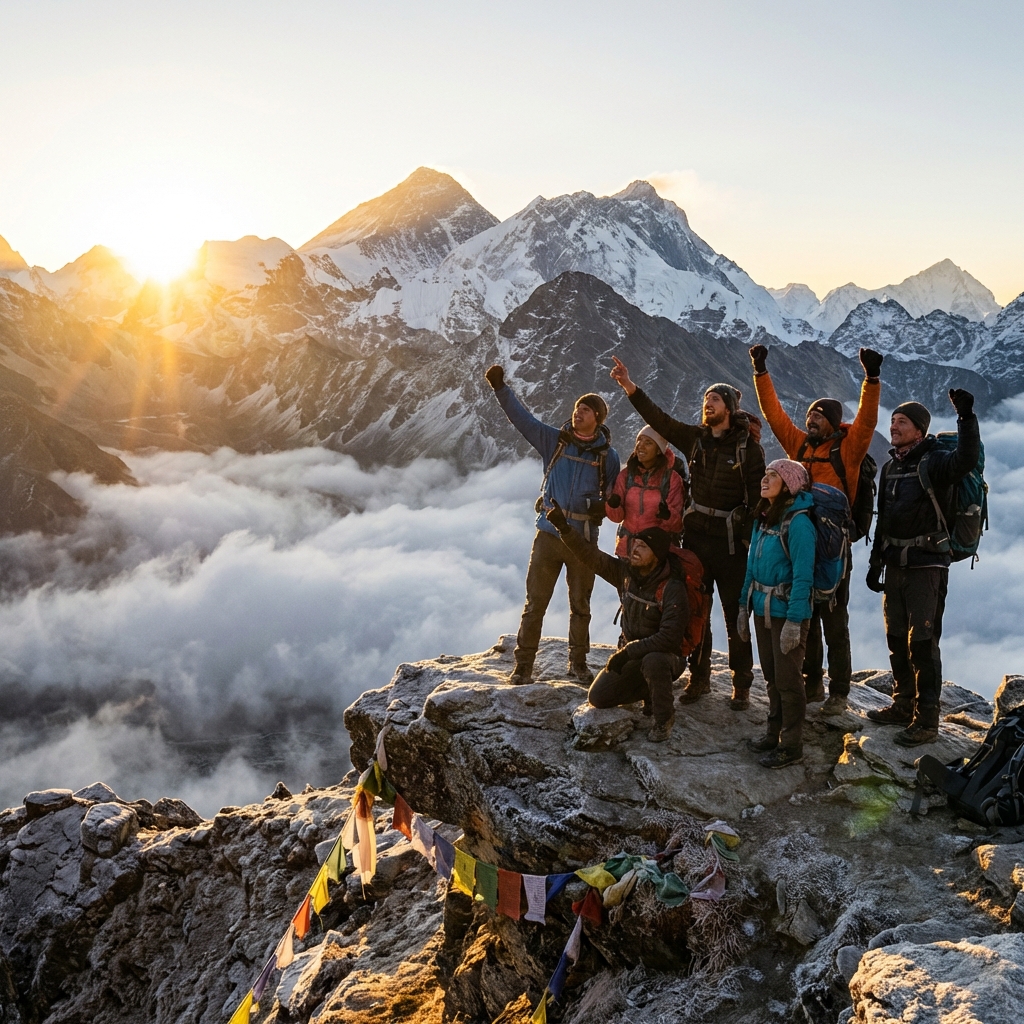
Kala Patthar is the single most important photography location in the Everest region. It provides the best accessible view of Mount Everest's summit pyramid, unobstructed by closer peaks. The classic Kala Patthar photograph -- Everest glowing gold at sunrise with the Khumbu Glacier below -- is one of the most iconic mountain images in the world.
What you can see and photograph:
- Mount Everest (8,849m): The full summit pyramid, clearly visible and dominant in the frame
- Nuptse (7,861m): The dramatic wall-like ridge that flanks the Khumbu Glacier
- Pumori (7,161m): Directly behind you as you face Everest; beautiful at sunrise
- Changtse (7,543m): The north peak visible beside Everest
- Khumbu Icefall: The dramatic ice cascade descending from the Western Cwm
Best time to shoot: Pre-dawn through the first 30 minutes after sunrise. Most trekkers depart Gorak Shep between 4:00-5:00 AM to reach the summit by sunrise (approximately 5:45-6:15 AM in October/November). The golden light on Everest lasts only 15-20 minutes before the sun rises high enough to flatten the light.
Composition tips:
- The summit is approximately northwest from Kala Patthar; sunrise light comes from the east-southeast, creating side-lighting that reveals texture and depth on Everest's face
- Include the Khumbu Glacier in foreground compositions for scale and depth
- Use a medium telephoto (70-200mm equivalent) to isolate the summit pyramid, or a wide angle (16-35mm) for the full panorama
- Prayer flags at the Kala Patthar summit make excellent foreground elements
- Panoramic stitches from this location can be extraordinary -- shoot a sequence from Pumori (left) through Everest to Nuptse and Lhotse (right)
The Second Kala Patthar Visit
Most trekkers visit Kala Patthar once for sunrise, then descend. If you have the energy and acclimatization, a second visit at sunset produces dramatically different images -- warm side-lighting from the west that illuminates Everest's south face differently. Fewer than 5% of trekkers make this second trip, so you may have the summit to yourself. See our EBC 14-day itinerary for schedule options.
Altitude and Photography at Kala Patthar
At 5,545m, you are operating at extreme altitude. Cold fingers make camera controls difficult, altitude impairs cognitive function (making composition decisions harder), and the physical effort of the climb leaves you breathless. Prepare your camera settings before leaving Gorak Shep. Set exposure compensation, frame rate, and ISO the night before. Use gloves that allow touchscreen operation. Move deliberately and take your time with compositions rather than rushing.
2. Tengboche Monastery Overlook (3,867m)
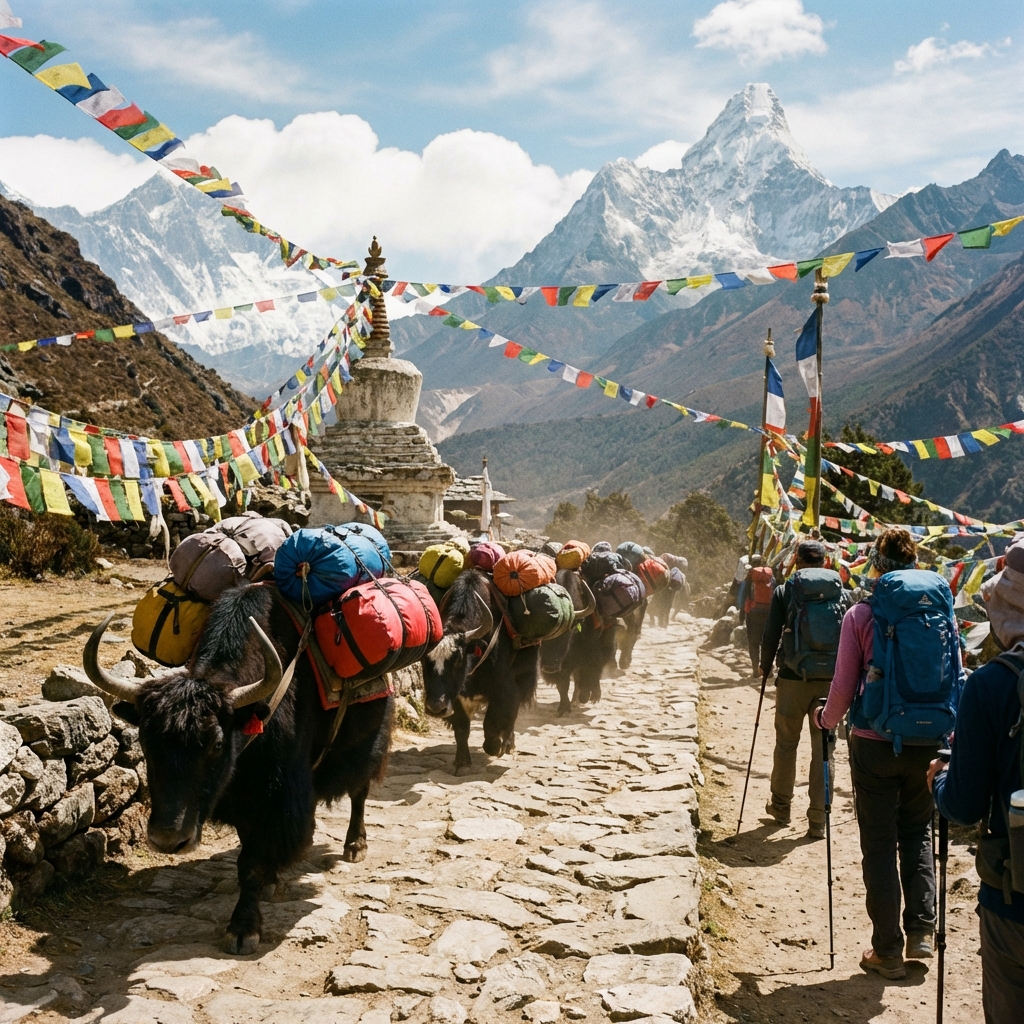
Tengboche produces what many photographers consider the most beautiful single image in the Everest region: Ama Dablam rising behind the monastery with its prayer flags and golden roofs. This composition combines natural grandeur with human cultural presence in a way that few locations on Earth can match.
What you can see and photograph:
- Ama Dablam (6,812m): The stunningly pyramidal peak dominates the southern horizon. From Tengboche, its proportions are perfect -- close enough to fill the frame, distant enough to show its full form
- Everest and Lhotse: Visible above the Nuptse ridge to the north
- Tengboche Monastery: The largest monastery in the Khumbu, with ornate roofing and colorful facade
- Prayer flag lines: Connecting the monastery to surrounding trees and structures
Best time to shoot:
- Sunrise: Ama Dablam catches the first light while the monastery is still in shade, creating dramatic contrast
- Late afternoon (3:00-4:30 PM): Warm light illuminates both the monastery and Ama Dablam's face
- Blue hour (5:15-5:45 PM): If the monastery interior is lit, the combination of warm artificial light and blue twilight sky is magical
Composition tips:
- The classic shot uses the monastery as foreground with Ama Dablam behind. Walk to the helipad area above the monastery for the best angle.
- A 24-35mm equivalent lens captures both the monastery and Ama Dablam without excessive distortion
- Include prayer flags as leading lines drawing the eye from foreground to mountain
- For a telephoto approach, isolate Ama Dablam's summit with the monastery's golden roof ornaments in the lower frame
3. Gokyo Ri (5,357m)
Gokyo Ri provides what is arguably the finest panoramic viewpoint in the entire Everest region, surpassing even Kala Patthar for sheer breadth of mountain scenery. From the summit, you can see four peaks over 8,000m (Everest, Lhotse, Makalu, and Cho Oyu), the turquoise Gokyo Lakes, and the massive Ngozumpa Glacier -- the longest glacier in Nepal.
What you can see and photograph:
- Four 8,000m peaks: Everest, Lhotse, Makalu, Cho Oyu -- visible simultaneously
- Gokyo Lakes: The famous turquoise glacial lakes strung along the valley floor
- Ngozumpa Glacier: Nepal's longest glacier, a vast river of debris-covered ice
- Gyachung Kang (7,952m): The highest peak in the world under 8,000m
Best time to shoot: Sunrise, departing Gokyo village by 4:00-4:30 AM. The climb takes 2-3 hours. The lakes turn deep turquoise in direct sunlight (mid-morning), so staying past sunrise rewards you with lake color.
Composition tips:
- Use the lakes as foreground elements with the Everest massif as backdrop
- A vertical panorama captures both the lakes below and peaks above
- The glacier's texture and scale are best captured in raking early-morning light
- Include trekkers on the summit for scale against the enormous landscape
Gokyo Lakes Color
The turquoise color of Gokyo Lakes is caused by glacial flour -- fine rock particles suspended in meltwater. The color is most vivid when the lakes are directly lit by the sun and the sky is clear. Autumn (October-November) produces the most vivid colors. Overcast skies mute the turquoise to a dull gray-green. If you have a flexible schedule, time your Gokyo Ri ascent for the clearest morning.
4. Namche Bazaar Overlook (3,440m+)
Namche Bazaar, the Khumbu's bustling trading town, is photogenic from multiple angles. The town fills a natural amphitheater-shaped depression in the hillside, creating an extraordinary visual pattern of terraced buildings radiating outward from the center.
What you can see and photograph:
- The town itself: The horseshoe-shaped settlement pattern is visually striking, especially from above
- Kongde Ri (6,187m): The snow-capped peak rises directly above the town
- Thamserku (6,623m): Visible from viewpoints east of town
- Market day: Saturday markets bring color, activity, and human interest
Best time to shoot:
- Morning (8:00-10:00 AM): Sun illuminates the town while peaks remain in good light
- Sunset: The town's western-facing slope catches evening light beautifully
- Saturday market: If your schedule allows, Saturday morning is the most photogenic time for street photography in Namche
Viewpoints:
- Climb the trail toward the Everest View Hotel for 20-30 minutes above town for the classic overhead view
- The stupa on the ridge above the market provides an elevated perspective with prayer flags as framing
- The military checkpoint lookout (ask permission) offers views down into the amphitheater
5. Hotel Everest View (3,880m)
The Everest View Hotel claims to be the highest-altitude luxury hotel in the world, but for photographers, the real value is the viewpoint. This is typically the first place trekkers see Mount Everest, and the combination of Everest, Lhotse, Ama Dablam, and Thamserku in a single panorama is unforgettable.
Best time to shoot: Morning, as clouds typically build over the peaks by early afternoon. The view is best in autumn when visibility is highest.
What you can see: Everest summit appearing between Nuptse and Lhotse, Ama Dablam to the right, Thamserku closer and to the right. The depth of field -- from foreground rhododendron forests to 8,849m summit -- is staggering.
Tip: You can order tea or lunch at the hotel and shoot from their terrace. The cost is reasonable and supports a unique business.
6. Dingboche to Chhukung Valley Ridge (4,730m)
The ridge above Dingboche that leads toward Chhukung offers a remarkably different perspective on the Everest region's peaks. Rather than the frontal views common elsewhere, you get dramatic side and rear angles on Ama Dablam, plus close views of the Lhotse wall and Island Peak.
What you can photograph:
- Ama Dablam south face: A rarely photographed angle showing the mountain's steeper, more rugged side
- Lhotse wall: The vast south face of Lhotse (8,516m) is one of the most intimidating mountain walls in the world
- Island Peak (Imja Tse, 6,189m): The popular climbing peak appears accessible from this angle
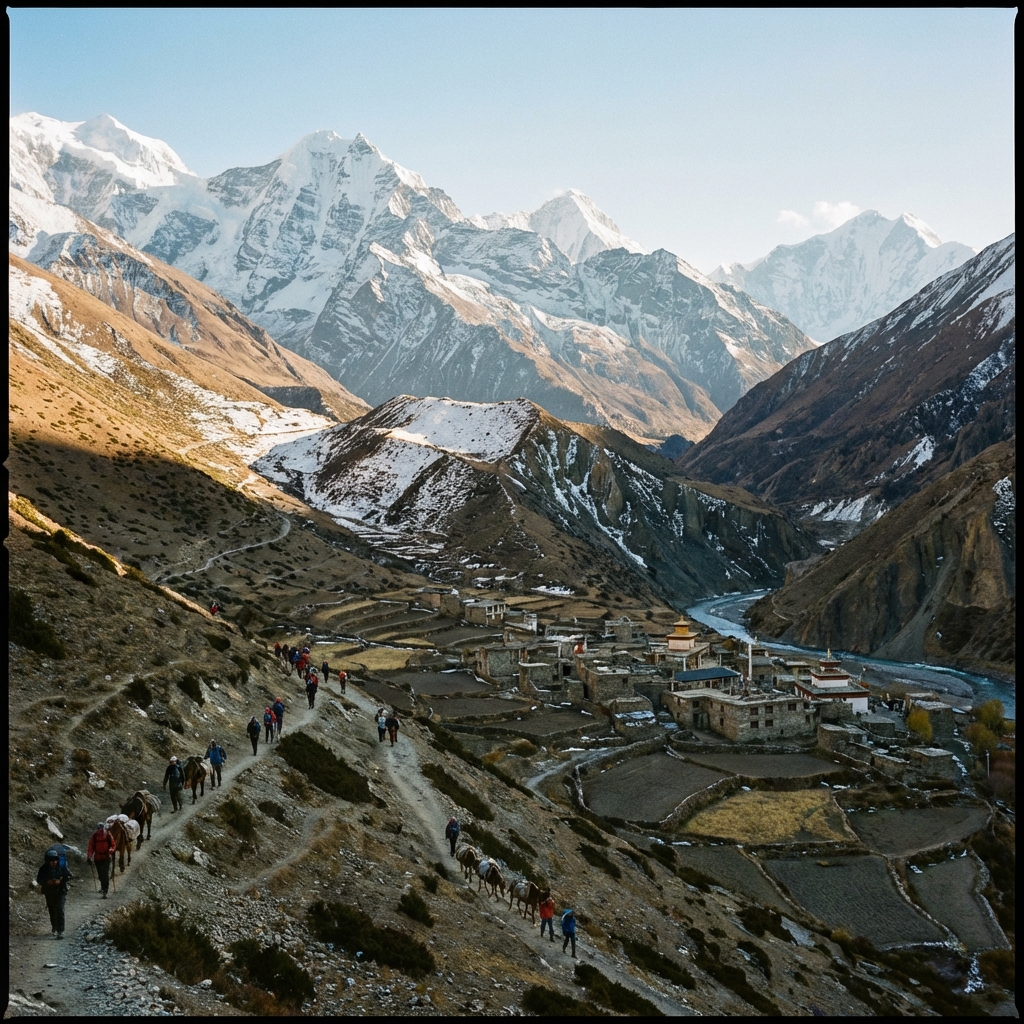
- Dingboche village: Spread across the valley floor with stone-walled fields creating geometric patterns
This is an excellent location for acclimatization day activities, combining photography with beneficial altitude acclimatization.
7. Khumbu Glacier Moraine (5,100m+)
The walk from Gorak Shep toward Everest Base Camp traverses the lateral moraine of the Khumbu Glacier, providing close-up access to one of the world's most famous glaciers.
What you can photograph:
- Ice seracs and pinnacles: Towering ice formations along the glacier's edge, particularly dramatic in early morning light
- Pumori (7,161m): Towers above the glacier approach
- Scale shots: Trekkers walking the moraine against the glacier and surrounding peaks provide powerful scale references
- Everest Base Camp: The camp itself (during climbing season, April-May) is a colorful sprawl of tents against the icefall
Tip: The ice formations change constantly. What you see may not exist a few weeks later. Photograph the glacier as a dynamic, living entity rather than a static landscape.
EBC Is Not the Best Photo Spot of Everest
A common misconception is that Everest Base Camp itself offers great views of Everest. In fact, Everest's summit is not visible from Base Camp -- the view is blocked by the surrounding ridges. Kala Patthar (described above) is where you photograph Everest. Base Camp is photogenic for its glacier ice and expedition atmosphere, but not for summit views.
8. Pangboche Village (3,930m)
Pangboche is one of the oldest permanently inhabited villages in the Khumbu and offers rich opportunities for both landscape and cultural photography. The village sits at a point on the trail where Ama Dablam is extraordinarily close and dramatic.
What you can photograph:
- Ama Dablam close-up: From Pangboche, Ama Dablam appears massive and immediate, with dramatic ridgeline detail visible
- Ancient monastery: The oldest monastery in the Khumbu (said to date from the 16th century), with weather-worn stone walls and ancient prayer wheels
- Village life: Stone houses, yak pastures, and traditional farming activity
- Juniper forests: The gnarled, ancient juniper trees around the monastery create atmospheric foreground elements
9. Phortse Ridge Trail (3,810m)
The alternate trail from Namche to Tengboche via Phortse village follows a dramatic ridge with sweeping valley views. This trail is less traveled than the main route and offers photography opportunities you won't find on the standard path.
What you can photograph:
- Dramatic valley views: The Imja Khola valley stretches out below, with peaks rising on both sides
- Ama Dablam: Profile view from a different angle than Tengboche
- Phortse village: A traditional Sherpa village with excellent cultural photography potential
- Forested trail sections: Rhododendron and birch forests provide atmospheric, intimate mountain forest scenes
10. Cho La Pass Approach (5,420m)
For trekkers on the Three Passes route, the approach to Cho La from the Gokyo side offers otherworldly glacial landscapes that few trekkers photograph well due to the physical demands of the crossing.
What you can photograph:
- Glacial lakes: Small, intensely colored lakes formed in the moraine
- Cholatse (6,440m): The dramatic peak that dominates the pass from the south
- Glacial ice: Close-up textures of glacial ice and moraine formations
- Scale and isolation: The emptiness and vastness of the high glacial landscape
Never Compromise Safety for Photography
Several photography locations in this guide involve early-morning departures in cold, dark conditions at extreme altitude. Always prioritize safety over photography. Travel with a headlamp, warm layers, and a companion. Do not wander off established trails in the dark. If weather conditions deteriorate, retreat. No photograph is worth a fall, frostbite, or altitude emergency. The mountains will be there tomorrow.
Golden Hour and Lighting Guide
Understanding light timing is critical for mountain photography. The Everest region's latitude (approximately 28 degrees North) and altitude create specific lighting conditions.
Autumn (October-November) -- Best Season
| Time | Light Condition | Photography Notes |
|---|---|---|
| 5:15-5:45 AM | Blue hour | Stars still visible; peaks in deep blue shadow; tripod essential |
| 5:45-6:15 AM | Golden hour | First light hits high peaks; dramatic warm-cold contrast |
| 6:15-6:45 AM | Warm morning light | Full sunrise; peaks glow gold and orange |
| 6:45-9:00 AM | Good working light | Clear, directional light with manageable shadows |
| 9:00-11:00 AM | High morning light | Flatter but still good; clouds may begin building |
| 11:00 AM-2:00 PM | Midday | Harsh overhead light; best for detail/texture shots |
| 2:00-4:00 PM | Afternoon | Light softens; shadows lengthen; clouds often present |
| 4:00-5:15 PM | Golden hour | Warm evening light on west-facing slopes |
| 5:15-5:45 PM | Blue hour | Alpenglow on peaks; dimming valley; tripod essential |
| 5:45-7:00 PM | Twilight | Deepening blue sky; first stars; long exposure potential |
Spring (March-April)
Spring golden hours are similar in timing but the atmosphere contains more moisture and dust haze, creating warmer (more orange/red) but less crisp light. Visibility ranges tend to be shorter. Rhododendron blooms at lower elevations (2,500-3,500m) add color not available in autumn.
Star and Night Photography at Altitude
The Khumbu region above 4,000m offers some of the best astrophotography conditions accessible to trekkers. The combination of extreme altitude (thinner atmosphere means less light pollution from the atmosphere itself), remoteness from artificial light, and dry autumn air creates extraordinary conditions for Milky Way, star trail, and night sky photography.
Best Locations for Astrophotography
- Gorak Shep (5,164m): Dark skies, Pumori and Nuptse as foreground, Milky Way rises over the glacier
- Dingboche (4,410m): Wide valley provides open sky; Ama Dablam as night-sky foreground
- Gokyo (4,790m): Lakes reflect starlight; Cho Oyu under the Milky Way
- Tengboche (3,867m): Monastery silhouette against star-filled sky
Technical Tips for Night Photography at Altitude
- Exposure: Start at f/2.8, ISO 3200-6400, 15-20 second exposure. Adjust based on results.
- Focus: Autofocus fails in darkness. Switch to manual focus and use live view magnification on a bright star or distant light to achieve critical focus. Some photographers pre-set focus during daylight and tape the focus ring.
- Batteries: Cold drains batteries rapidly. Carry multiple batteries inside your jacket and swap frequently. A battery at minus 15 degrees Celsius may show 0% charge but recover to 30% when warmed.
- Tripod: Essential. A lightweight travel tripod is sufficient; weight savings matter at altitude. Ensure it is stable in wind.
- Timer or remote: Use a 2-second timer or remote trigger to avoid camera shake from pressing the shutter.
- Moisture: Bringing a cold camera into a warm teahouse causes immediate condensation on all surfaces. Let the camera warm gradually in your bag, or seal it in a zip-lock bag before entering the lodge.
The Headlamp Light Painting Trick
During long exposures at night, a brief sweep of a headlamp across foreground rocks or a mani wall creates dramatic light painting that adds depth and interest to star photos. Have a companion walk with a headlamp during a 15-second exposure for a "trekker under the stars" composition that tells a story. Use a red or warm-colored headlamp for more atmospheric results.
Gear Recommendations for Everest Region Photography
Camera and Lens Guide
| Purpose | Recommended Gear | Weight Consideration | Priority |
|---|---|---|---|
| Wide landscape | 16-35mm f/4 zoom | 400-600g | Essential |
| Standard / village | 24-70mm f/4 zoom | 500-700g | Essential |
| Mountain details | 70-200mm f/4 zoom | 800-1,200g | Highly recommended |
| Astrophotography | Fast prime (20mm f/1.8 or similar) | 200-400g | If interested in night photography |
| Backup / casual | Smartphone | Negligible added weight | Always carry |
Essential Accessories
- Extra batteries: Minimum 3-4 camera batteries. Cold kills batteries fast.
- Microfiber cloths: Multiple. Dust and moisture are constant issues.
- UV / clear filter: Protects front element from dust and scratches; always on.
- Polarizing filter: Dramatically deepens blue skies and reduces glare on snow. Essential for mountain photography.
- ND graduated filter: Balances bright sky with darker foreground, especially at golden hour.
- Lightweight tripod: For golden hour, blue hour, and night photography. A travel tripod under 1.5kg is ideal.
- Padded camera insert: For protecting gear inside your trekking pack.
- Silica gel packets: Place in camera bag to absorb moisture.
Protecting Your Gear
The Khumbu environment is harsh on camera equipment:
- Dust: The trails are dusty, especially in autumn. Change lenses as infrequently as possible. Use a body cap on the unused lens immediately.
- Cold: Below minus 10 degrees Celsius (common above 5,000m), LCD screens slow, batteries die, and metal becomes painfully cold to touch with bare hands. Keep camera inside your jacket between shots.
- Moisture: Morning frost, clouds, and the temperature differential between outdoors and teahouses all create condensation risks. Never breathe directly on a cold lens.
- Altitude: Camera equipment functions normally at high altitude (unlike batteries), but drops onto rock are more damaging than at lower elevations because cold makes materials more brittle.
For comprehensive gear advice, see our photography gear for Nepal trekking guide.
Smartphone Photography Is Better Than Ever
Modern smartphones (iPhone 15 Pro and later, Samsung Galaxy S24 Ultra, Google Pixel 9 Pro) produce excellent mountain photography in good light. Computational photography, multi-lens systems, and night modes have closed much of the gap with dedicated cameras. If carrying a full camera system is too much weight, a flagship smartphone plus a small tripod can produce images you will be proud of. The best camera is the one you have with you.
Composition Strategies for Mountain Photography
The Foreground Problem
The biggest composition challenge in mountain photography is the "big sky, big mountain, nothing in between" problem. Without foreground interest, even the most spectacular peaks become flat postcard images. In the Everest region, effective foreground elements include:
- Prayer flags: Available at most viewpoints; create color and leading lines
- Mani walls and chortens: Cultural elements that ground the image in place
- Stone trails and paths: Leading lines drawing the eye toward the peaks
- Trekkers: A human figure provides scale and narrative
- Teahouses and lodges: Architectural elements showing human habitation in extreme environments
- Water reflections: Gokyo Lakes, small tarns, and even puddles after rain
The Scale Challenge
Mountains are so large that photographs often fail to convey their actual scale. Techniques that help:
- Include a known-size reference (person, building, yak) at various distances
- Use telephoto compression to stack foreground elements against mountain backdrop
- Shoot vertical panoramas that include both immediate foreground and distant summit
- Compare peak heights in the same frame (Everest behind Nuptse, for example)
Frequently Asked Questions
Final Thoughts
The Everest region offers a lifetime's worth of photographic opportunities compressed into a two-week trek. The key to exceptional images is not expensive equipment but rather being in the right place at the right time with a clear vision of what you want to capture. Wake up early. Stay out late. Pay attention to light. Include foreground elements that tell a story beyond "big mountain." And remember that some of the most powerful images from the Khumbu are not of peaks at all, but of the people, the prayer flags, the weathered stone walls, and the small human details that speak to life at the roof of the world.
The mountains are patient subjects. They will wait for your composition to come together. The light, however, waits for no one. When the golden hour arrives at Kala Patthar or Tengboche, be ready.