
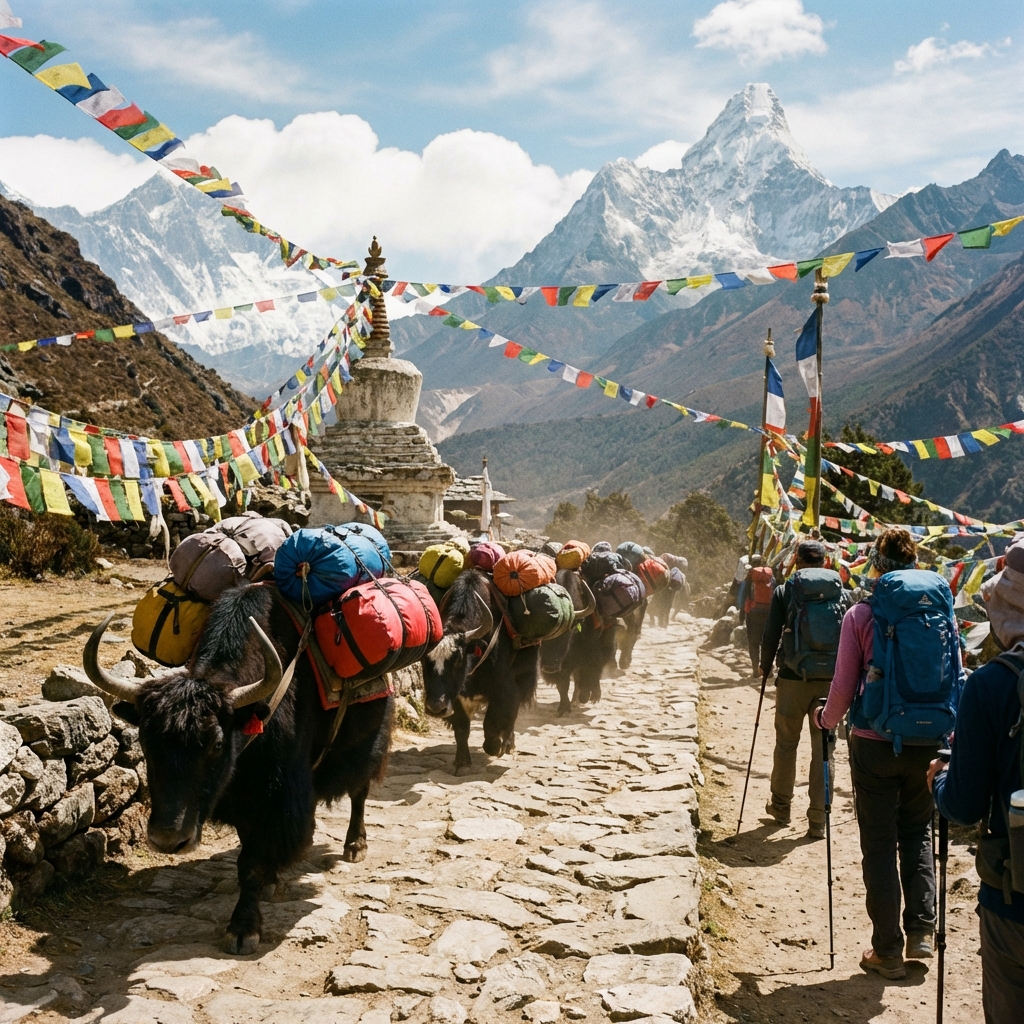
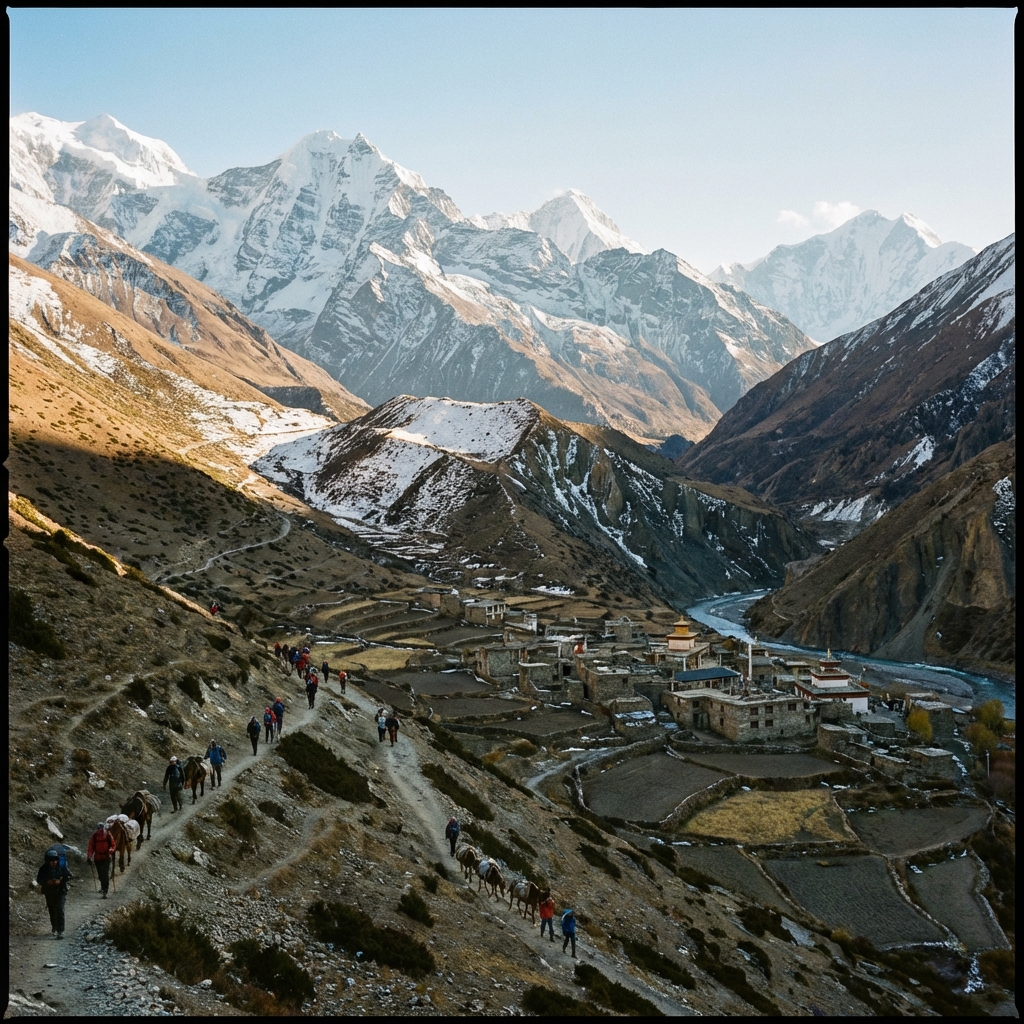
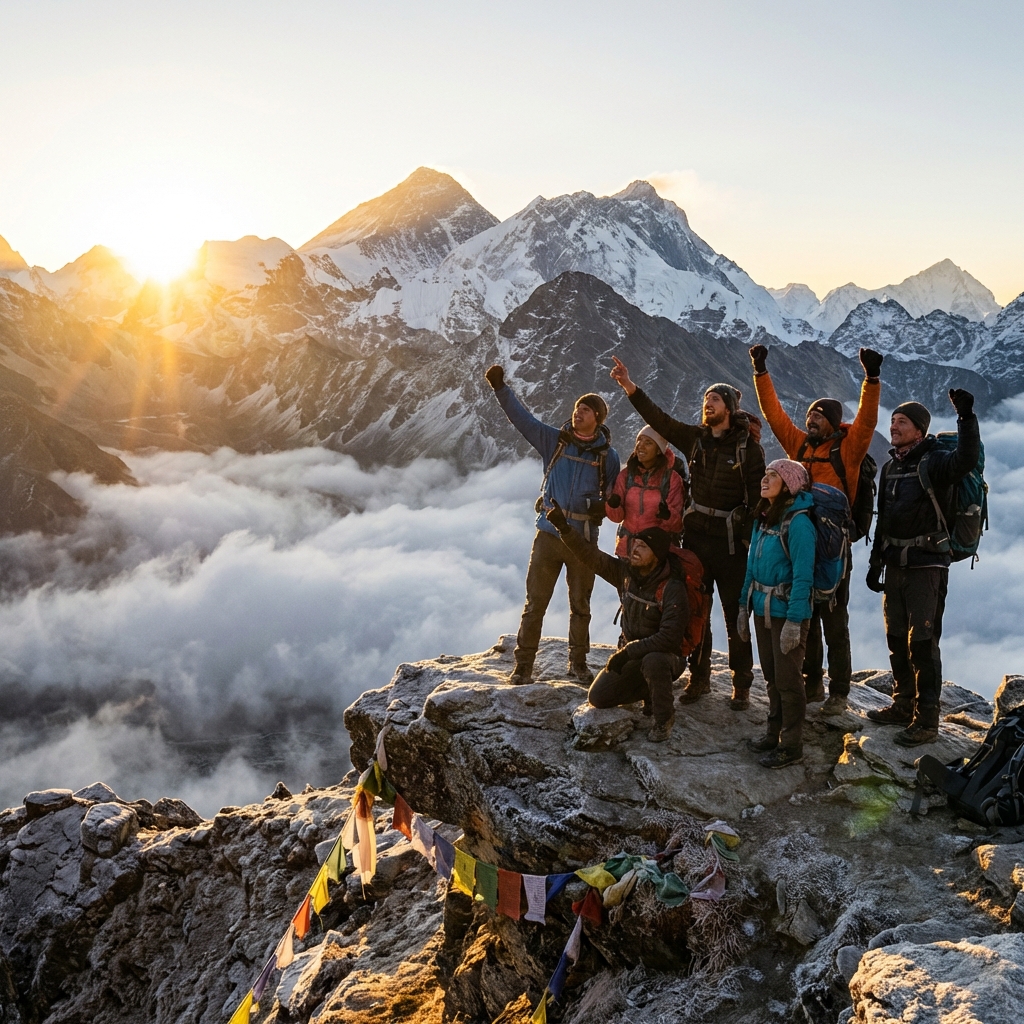
The Annapurna Circuit is one of the world's greatest treks. Pisang Peak makes it even greater. At 6,091 meters (19,983 feet), this elegant summit rises directly above Upper Pisang village on the northern side of the Annapurna Circuit, offering climbers the rare opportunity to add a genuine 6,000-meter peak to one of Nepal's most iconic trekking routes without a significant detour.
Pisang Peak occupies a distinctive position in Nepal's trekking peak hierarchy. It is more technical than Mera Peak, comparable to Island Peak in difficulty, and yet far less crowded -- receiving perhaps a tenth of Island Peak's annual summit attempts. For climbers who have completed the Annapurna Circuit trek and wondered what lies above the trail, or for those planning their first 6,000-meter peak and wanting to avoid the crowds of the Khumbu region, Pisang Peak delivers an outstanding climbing experience in one of Nepal's most spectacular mountain settings.
The summit panorama is world-class. From the top of Pisang Peak, you look directly across the Manang Valley at the Annapurna massif -- Annapurna II (7,937m), Annapurna IV (7,525m), and Annapurna III (7,555m) form an overwhelming wall of ice and rock. To the east, Manaslu (8,163m) rises above the horizon. Below, the terraced fields and stone walls of the Manang Valley stretch toward Thorong La, the high pass that completes the circuit.
This comprehensive guide covers everything you need to climb Pisang Peak: route description, technical requirements, a day-by-day itinerary combining the peak with the Annapurna Circuit, equipment lists, cost breakdowns, permit logistics, and practical advice for making this climb a success.
6,091m (19,983 ft)
PD (Peu Difficile) - Alpine Grade
18-20 days combined with Annapurna Circuit
8-12 hours round trip
$350 USD (autumn season)
$2,000-$3,500 with agency
October-November, April-May
65-75% depending on conditions
5,500m (18,045 ft)
High-altitude trekking, basic crampon and ice axe skills
Why Climb Pisang Peak?
The Best Peak on the Annapurna Circuit
The Annapurna region offers several trekking peaks, but Pisang Peak stands out for its accessibility from the main circuit trail and the quality of the climbing experience. Chulu peaks (East and West) are alternatives, but they require longer detours and are more expensive. Pisang Peak sits right beside the trail -- Upper Pisang village, the starting point for the climb, is a standard overnight stop on the circuit.
This integration with the Annapurna Circuit means you do not sacrifice trekking time for climbing. You simply add 3-4 days to a standard circuit itinerary and gain a Himalayan summit.
Stunning Annapurna Panorama
The view from Pisang Peak's summit is among the best in the Annapurna region:
- Annapurna II (7,937m) -- the massive north face dominates the western skyline, closer and more imposing than from any other accessible viewpoint
- Annapurna IV (7,525m) -- adjacent to Annapurna II, completing the wall of ice
- Annapurna III (7,555m) -- further south, its steep flanks catching the morning light
- Manaslu (8,163m) -- the world's eighth highest mountain visible to the east
- Gangapurna (7,455m) -- across the valley, its glaciated summit catching sunlight
- Tilicho Peak (7,134m) -- to the northwest, above the famous lake
The panorama is distinct from what you see on Khumbu peaks. Instead of Everest and Lhotse, you are immersed in the Annapurna massif -- a wall of peaks that many consider more visually dramatic than the Everest group.
Less Crowded Than Khumbu Peaks
Pisang Peak receives approximately 100-200 summit attempts per year, compared to over 1,000 for Island Peak and 500+ for Mera Peak. This translates to a more intimate climbing experience, less competition for fixed rope sections, and a genuine feeling of wilderness that the Khumbu peaks increasingly lack during peak season.
Excellent First 6,000m Peak
Pisang Peak's PD grade places it in the same difficulty range as Mera Peak but with a more varied climbing experience. The glacier approach, snow and ice slopes, and fixed rope sections provide a thorough introduction to Himalayan mountaineering without the extreme technicality of peaks like Lobuche East or the concentrated difficulty of Island Peak's headwall.
Combines with One of the World's Great Treks
The Annapurna Circuit is consistently rated among the world's top long-distance treks. Adding Pisang Peak to the circuit transforms an already exceptional trek into a climbing expedition. You experience the cultural diversity of the circuit -- from subtropical lowlands to arid Tibetan landscapes -- and cap it with a summit experience.
Pro Tip
The optimal way to combine Pisang Peak with the Annapurna Circuit is to attempt the summit before crossing Thorong La. This means you climb the peak from Upper Pisang (the first major stop in the Manang Valley), continue the circuit to Manang, and then cross Thorong La. This sequencing gives you excellent acclimatization for the pass -- after reaching 6,091m on Pisang Peak, Thorong La at 5,416m feels noticeably more manageable.
Difficulty Assessment: PD Grade in Practice
Alpine Grade: PD (Peu Difficile)
Pisang Peak is graded PD on the International French Adjectival System -- the same grade as Mera Peak. In practical terms, this means moderate mountaineering difficulty with the following characteristics:
- Glacier travel on the approach requiring rope team technique
- Snow and ice slopes up to 40-50 degrees on the upper mountain
- Fixed ropes on the summit ridge and steeper sections
- Crampon use throughout the climbing portion
- Basic ice axe technique for balance and self-arrest
- Moderate exposure on the summit ridge
Route Description: The Southwest Ridge
The standard route ascends the southwest ridge from a base camp at approximately 4,380m and a high camp at approximately 5,500m.
Section 1: Base Camp to High Camp (4,380m to 5,500m) The route climbs steeply from base camp through rocky moraines before reaching the glacier. Once on the glacier, the angle is moderate but crevasse awareness is important. The route weaves between crevassed zones, typically following a well-trodden path in season. High camp is established on a relatively flat section of the glacier at approximately 5,500m, with views across the Manang Valley.
Section 2: High Camp to Summit Ridge (5,500m to 5,800m) From high camp, the route ascends increasingly steep snow slopes. The angle progresses from 25-30 degrees to 40-45 degrees as you approach the summit ridge. Fixed ropes are typically in place for the steepest sections, and jumar technique is used for ascending.
Section 3: The Summit Ridge (5,800m to 6,091m) The summit ridge is the highlight and the crux of the climb. A narrow snow and ice ridge leads to the summit with moderate exposure on both sides. The ridge is not knife-edge sharp in most conditions, but it narrows enough to demand careful foot placement and attention. In high winds, this section can be challenging. Fixed ropes are usually available along the most exposed portions.
Crevasse Danger on the Glacier
The glacier approach to Pisang Peak's high camp crosses an active glacier with hidden crevasses. Travel must be in roped teams with proper spacing. Several incidents of climbers falling into crevasses have occurred on this route. Ensure your guide carries crevasse rescue equipment and that you understand basic self-rescue techniques. Never walk on the glacier unroped, even if the surface appears solid.
Comparison with Other PD-Grade Peaks
| Factor | Pisang Peak | Mera Peak | Island Peak |
|---|---|---|---|
| Grade | PD | PD | PD+ |
| Elevation | 6,091m | 6,476m | 6,189m |
| Glacier Travel | Yes (moderate) | Yes (extensive) | Yes (short) |
| Fixed Ropes | Yes (summit ridge) | Minimal | Yes (headwall) |
| Ice Steepness | 40-50 degrees | 25-35 degrees | 45-60 degrees |
| Summit Ridge | Moderate exposure | Broad, minimal exposure | Moderate exposure |
| Crevasse Risk | Moderate | Low-Moderate | Moderate |
| Crowding | Low | Low-Moderate | High |
Technical Requirements
Essential Skills
Crampon Technique: You will wear crampons for 6-10 hours on summit day. Proficiency in:
- French technique (flat-footing) on moderate slopes
- Front-pointing on steeper ice sections (40-50 degrees)
- Transitioning between techniques as terrain changes
- Walking confidently on narrow ridgelines
Fixed Rope Ascending: The steeper sections and summit ridge feature fixed ropes. You must be able to:
- Use a mechanical ascender (jumar) efficiently
- Clip in and out of anchors safely
- Manage the rope system while wearing gloves at altitude
Ice Axe Skills:
- Self-arrest technique on snow and ice slopes
- Use as a balance tool on steep terrain
- Proper carrying and transition techniques
Glacier Travel:
- Roped team movement with proper spacing
- Crevasse awareness and basic rescue knowledge
- Route-finding on glaciated terrain
Rope Management:
- Tying into a climbing rope
- Managing rope on a team
- Understanding basic knots (figure-8, clove hitch)
Fitness Requirements
Pisang Peak demands sustained fitness over a longer expedition than most Khumbu peaks. The Annapurna Circuit trek itself is 15+ trekking days before you add the climbing days.
Cardiovascular: Ability to trek 6-8 hours daily for 15+ consecutive days with a daypack. Strong aerobic base essential.
Leg Strength: Sustained climbing in crampons on steep snow requires powerful legs. Squats, lunges, and stair climbing should be part of your training.
Endurance: The combination of multi-week trekking and a technical summit day demands deep endurance reserves. Long-distance hiking training is more important than gym sessions.
Upper Body: Jumar ascending and ice axe work require functional arm and shoulder strength.
Pro Tip
The best training for a Pisang Peak + Annapurna Circuit expedition is back-to-back long hiking days. Aim to complete at least three sessions of 3 consecutive hiking days (5-7 hours each day) in the 8 weeks before departure. This simulates the sustained demands of the circuit far better than individual intense workouts.
Day-by-Day Itinerary: Pisang Peak + Annapurna Circuit (20 Days)
This itinerary integrates a Pisang Peak summit attempt into a standard Annapurna Circuit trek, following the counter-clockwise direction. The climb occurs at Upper Pisang before continuing to Manang and crossing Thorong La.
Day 0: Arrive in Kathmandu (1,400m)
- Agency briefing, equipment check, permit processing
- Explore Thamel, last-minute gear purchases
- Early rest before the expedition begins
Day 1: Kathmandu to Besisahar (760m) to Chame (2,670m)
- Transport: Bus or jeep to Besisahar (6-7 hours), then jeep to Chame (4-5 hours)
- Alternative: Fly Kathmandu to Pokhara, then drive to Chame (longer but more comfortable)
The long drive follows the Marsyangdi River valley, climbing through terraced farmland and tropical vegetation into the increasingly dramatic mountain gorge. Many trekkers now take jeeps directly to Chame, skipping the lower circuit sections where the road has replaced much of the trail.
Starting Point Debate: Besisahar vs Chame
The traditional Annapurna Circuit starts at Besisahar, but road construction has extended vehicle access to Chame (and sometimes beyond). Most trekkers now drive to at least Chame, as the lower sections between Besisahar and Chame follow the road rather than a separate trail. Starting from Chame saves 3-4 days without missing the circuit's best scenery, which begins in the Manang Valley. If you have unlimited time, walking from Besisahar adds cultural immersion through lowland villages.
Day 2: Chame to Upper Pisang (3,300m)
- Trek distance: 15km
- Trek time: 5-6 hours
- Elevation change: Ascend 630m
The trail follows the Marsyangdi River through pine forests with increasingly dramatic mountain views. The route passes through Bratang (apple orchards) and climbs to Pisang, where the valley opens dramatically. Upper Pisang is the traditional Tibetan-style village perched on the hillside above the river -- take the upper trail for the best views and to reach your base for the Pisang Peak climb.
Important: This is where the Pisang Peak side trip begins. While standard circuit trekkers continue to Manang, you will spend the next 3-4 days on the peak before rejoining the circuit.
Day 3: Upper Pisang to Pisang Peak Base Camp (4,380m)
- Trek time: 4-5 hours
- Elevation change: Ascend 1,080m
From Upper Pisang, the trail climbs steeply through sparse forest and alpine scrub onto the moraine below Pisang Peak's southwest face. Base camp is a tent camp on a flat area of moraine at approximately 4,380m, with views across the Manang Valley to the Annapurna range. The afternoon is spent resting, checking equipment, and receiving a climbing briefing from your guide.
Day 4: Base Camp to High Camp (5,500m)
- Trek time: 5-6 hours
- Elevation change: Ascend 1,120m
The route climbs through the moraine and onto the glacier. Rope up for glacier travel -- your guide will lead the team through crevassed terrain to the high camp at approximately 5,500m. The ascent is sustained and demanding, gaining over 1,000 meters in a day at altitude. High camp is a tent camp on the glacier with stunning sunset views across the Manang Valley.
Spend the late afternoon hydrating, eating, and preparing gear for the summit attempt. Your guide will brief the team on the route, start time, turnaround time, and safety procedures. Try to sleep early -- the alarm comes soon.
Day 5: Summit Day -- Pisang Peak (6,091m), Descend to Base Camp (4,380m)
- Start time: 2:00-3:00 AM
- Summit time: 7:00-10:00 AM (typical)
- Round trip to base camp: 8-12 hours
The climb begins in darkness, headlamps illuminating the snow slope ahead. From high camp, the route ascends increasingly steep snow and ice, progressing from moderate angles to 40-50 degree slopes where fixed ropes provide security. Jumar technique is essential on the steepest sections.
As you gain the summit ridge, dawn breaks across the Annapurna massif. The ridge narrows and requires careful footwork -- crampon points in firm snow, ice axe for balance, eyes fixed on the trail ahead rather than the drops on either side. The final meters to the summit are profoundly satisfying.
From the top, Annapurna II's massive north face fills the western sky. Manaslu gleams to the east. The entire Manang Valley is spread below you -- from Pisang village to the distant notch of Thorong La. This is the Annapurna Circuit seen from above, and it is magnificent.
After summit photos and a brief rest (weather and warmth dictate timing -- do not linger if wind is building), descend the same route. The descent of the steep sections requires careful technique -- down-climbing on crampons is more demanding than ascending. Return to base camp, break camp, and rest.
Day 6: Base Camp to Upper Pisang (3,300m), Then to Manang (3,540m)
- Trek time: 5-6 hours total
- Elevation change: Descend then ascend
Descend from base camp to Upper Pisang, then continue along the Annapurna Circuit trail to Manang. This is a long day but the descent to Pisang is quick and the onward trek to Manang follows an excellent trail through the upper valley. You rejoin the standard circuit trekkers here.
Alternative: Take a rest day in Upper Pisang if energy is low, then continue to Manang the following day (adds one day to the itinerary).
Day 7: Acclimatization Day in Manang (3,540m)
- Activities: Ice Lake hike (4,600m), Gangapurna Lake, Praken Gompa
- Duration: 4-6 hours for acclimatization hike
A rest and exploration day in Manang. After the Pisang Peak climb, this day serves as recovery as much as acclimatization. The hike to Ice Lake (Kicho Tal, 4,600m) is the classic option -- a steep climb through pine forest to a stunning turquoise glacial lake beneath Annapurna III.
Pro Tip
Having already climbed to 6,091m on Pisang Peak, you are exceptionally well-acclimatized for the rest of the circuit. Thorong La (5,416m) will feel significantly easier after Pisang Peak's summit. This is one of the great advantages of combining the peak with the circuit -- your acclimatization profile is far superior to trekkers who have only been walking the trail.
Day 8: Manang to Yak Kharka (4,018m)
- Trek distance: 10km
- Trek time: 4-5 hours
- Elevation change: Ascend 478m
The trail continues up the Marsyangdi Valley, leaving the relative comfort of Manang behind. Vegetation becomes sparse, the air thinner, and the landscape increasingly stark and beautiful. Yak Kharka is a small settlement with basic tea houses, named for the yak grazing pastures surrounding it.
Day 9: Yak Kharka to Thorong Phedi (4,450m)
- Trek distance: 8km
- Trek time: 3-4 hours
- Elevation change: Ascend 432m
A shorter day, allowing the body to adjust before the big push over Thorong La. Thorong Phedi ("foot of Thorong") is the last settlement before the pass, a collection of tea houses huddled at the base of the steep ascent. Some trekkers push on to High Camp (4,850m) to shorten tomorrow's pass day, but if you are well-acclimatized from Pisang Peak, staying at Phedi is sufficient.
Day 10: THORONG LA PASS DAY -- Thorong Phedi to Muktinath (3,760m)
- Start time: 4:00-5:00 AM
- Pass elevation: 5,416m (17,769 ft)
- Trek distance: 20km
- Trek time: 8-10 hours total
- Elevation change: Ascend 966m, then descend 1,656m
The biggest day on the Annapurna Circuit. You ascend steadily from Thorong Phedi through switchbacks and scree to reach Thorong La, the highest point on the circuit. Prayer flags mark the pass, and on clear days the views are extraordinary -- Dhaulagiri (8,167m) to the west, the Annapurna range behind you to the east.
After the pass, a long, knee-punishing descent leads to Muktinath, a sacred pilgrimage site for both Hindus and Buddhists. The landscape has transformed completely -- you have crossed from the wet, green side of the Himalaya to the arid rain shadow of the Mustang region.
For detailed Thorong La preparation and strategy, see our Thorong La Pass guide.
Day 11: Muktinath to Jomsom (2,720m)
- Trek distance: 20km
- Trek time: 5-6 hours
- Elevation change: Descend 1,040m
The trail descends through the arid Kali Gandaki Valley, passing through the medieval-feeling town of Kagbeni and continuing to Jomsom. The landscape is barren and windswept, utterly different from the green valleys you started in. Jomsom has an airport with flights to Pokhara, offering an exit option if time is short.
Day 12: Jomsom to Tatopani (1,190m) or Fly to Pokhara
Option A: Continue trekking to Tatopani
- Trek distance: 35km (most take jeep for part)
- Elevation change: Descend 1,530m
- Highlight: Hot springs at Tatopani -- the perfect recovery after weeks of trekking
Option B: Fly Jomsom to Pokhara
- Flight time: 20 minutes
- Cost: $100-130
- Note: Flights operate mornings only (afternoon winds close the runway)
Most trekkers choose to fly from Jomsom or take a jeep to Tatopani/Beni, as the lower circuit trail now follows a road with vehicle traffic.
Days 13-16: Tatopani to Pokhara (by trek or transport), Pokhara to Kathmandu
If trekking from Tatopani:
- Day 13: Tatopani to Ghorepani (2,860m) -- steep ascent through forest
- Day 14: Ghorepani to Poon Hill sunrise (3,210m), then to Tikhedhunga (1,540m)
- Day 15: Tikhedhunga to Nayapul, drive to Pokhara
- Day 16: Pokhara to Kathmandu (flight or bus)
If flying from Jomsom or taking transport:
- Day 13: Arrive Pokhara, rest and explore
- Day 14: Pokhara to Kathmandu
The Poon Hill Extension
If you trek from Tatopani rather than flying from Jomsom, you can include Poon Hill -- one of Nepal's most famous sunrise viewpoints. The detour via Ghorepani adds 2-3 days but provides a spectacular conclusion to the circuit, with sunrise views of Dhaulagiri and the Annapurna range from a different angle than you have seen during the circuit. It is a fitting bookend to the expedition.
Shorter Itinerary Option: Pisang Peak Only (14-16 Days)
If the full Annapurna Circuit is too long, a focused Pisang Peak expedition can be done in 14-16 days:
- Days 1-2: Kathmandu to Chame (drive)
- Days 3: Chame to Upper Pisang
- Day 4: Rest/acclimatization at Upper Pisang
- Day 5: Upper Pisang to Base Camp
- Day 6: Base Camp to High Camp
- Day 7: Summit day, descend to Base Camp
- Day 8: Buffer/rest day
- Day 9-10: Return to Chame or Besisahar
- Day 11: Drive to Kathmandu
This approach sacrifices the full circuit experience but is viable for climbers focused on the peak itself.
Equipment List
Climbing-Specific Gear
| Item | Notes |
|---|---|
| Mountaineering boots | B2 or B3 rated, crampon-compatible |
| Crampons | Step-in or semi-automatic, fitted to boots |
| Ice axe | 50-60cm standard mountaineering axe |
| Climbing harness | Lightweight with gear loops |
| Mechanical ascender (jumar) | For fixed rope sections |
| Belay/rappel device | Figure-8 or ATC |
| Locking carabiners | Minimum 3 |
| 120cm sewn sling | Safety connection to fixed ropes |
| Climbing helmet | Essential for rockfall and ice fall protection |
Clothing (Selected Key Items)
| Item | Notes |
|---|---|
| Down jacket | 700+ fill for high camp and summit |
| Hardshell jacket and pants | Waterproof, windproof |
| Insulated pants | For high camp and cold summit morning |
| Expedition gloves and mittens | Three-layer system |
| Balaclava and warm hat | Wind protection essential |
| Glacier sunglasses | Category 4 with side shields |
Trekking Gear
Standard Annapurna Circuit gear including:
- Trekking boots (for approach days)
- Trekking poles
- 50-65L backpack
- Sleeping bag rated to minus 15 degrees Celsius
- Rain gear
- Sun protection
- Water purification
Pro Tip
Pack your climbing-specific gear separately from your trekking gear. For the circuit days before and after the climb, your climbing equipment can be carried by a porter, reducing your pack weight. On climb days, switch to a smaller summit pack (25-35L) with only essential climbing gear. Good organization saves energy.
Cost Breakdown
Full Cost Range: $2,000 - $3,500 USD
Pisang Peak's costs fall between the budget-friendly Yala Peak and the pricier Khumbu peaks, reflecting its longer duration (combined with the circuit) and moderate technical requirements.
Detailed Cost Breakdown
| Expense | Budget | Mid-Range | Premium |
|---|---|---|---|
| NMA Climbing Permit | $350 | $350 | $350 |
| ACAP Entry Permit | $30 | $30 | $30 |
| TIMS Card | $20 | $20 | $20 |
| Climbing Guide | $400 (shared) | $700 (1:2) | $1,000 (private) |
| Kathmandu-Chame Transport | $40 (bus) | $80 (shared jeep) | $200 (private) |
| Return Transport | $40 (bus) | $130 (Jomsom flight) | $200 (private) |
| Tea House Accommodation | $150 | $250 | $400 |
| Food and Drinks | $300 | $500 | $700 |
| High Camp Equipment | $100 (rental) | $150 | included |
| Climbing Gear Rental | $80 | $120 | included |
| Porter Support | $200 | $300 | $400 |
| Tips and Gratuities | $80 | $150 | $250 |
| Travel Insurance | $80 | $120 | $180 |
| Contingency | $80 | $100 | $150 |
| Total | $1,950 | $3,000 | $3,880 |
Agency Package Costs
- Group expedition (4-8 climbers): $2,000-$2,500 per person
- Small group (2-3 climbers): $2,500-$3,000 per person
- Private expedition: $3,000-$4,000 per person
Most packages include the full Annapurna Circuit trek combined with the Pisang Peak climb.
Permit Requirements
NMA Climbing Permit
Pisang Peak is classified as an NMA trekking peak. The permit must be obtained through a registered trekking agency.
Permit fees (2026 season):
| Season | Fee Per Person |
|---|---|
| Spring (Mar-May) | $350 |
| Autumn (Sep-Nov) | $350 |
| Summer (Jun-Aug) | $250 |
| Winter (Dec-Feb) | $180 |
Annapurna Conservation Area Permit (ACAP)
- Fee: $30 USD for foreign nationals
- Covers: Entry to the Annapurna Conservation Area
- Obtainable: Kathmandu (Nepal Tourism Board), Pokhara (ACAP office), or Besisahar checkpoint
For detailed ACAP information, see our Annapurna Conservation Area permit guide.
TIMS Card
- Fee: $20 USD
- Purpose: Trekker registration and safety monitoring
- Obtainable: Through your agency or at TIMS counters
Mandatory Guide Requirement
All NMA trekking peak climbs require a licensed climbing guide through a registered agency. For Pisang Peak specifically, the guide is essential due to glacier travel and crevasse risks on the approach.
Success Rates
Overall Success Rate: 65-75%
Pisang Peak's success rate falls in the middle range of Nepal's trekking peaks, higher than Lobuche East (60-70%) but lower than Mera Peak (75-85%) and Yala Peak (85-90%).
Success Factors
Weather (primary factor): The Manang Valley can generate strong winds that make the summit ridge dangerous. Weather windows are more predictable in autumn than spring.
Acclimatization: Climbers who take proper acclimatization days before the summit attempt have significantly higher success rates. The Annapurna Circuit approach provides natural acclimatization, but climbers attempting the peak too early in the circuit (without adequate days at altitude) may struggle.
Crevasse conditions: Some seasons see more open crevasses on the glacier approach than others, which can slow progress or prevent reaching high camp.
Guide quality: Experienced Pisang Peak guides who know the glacier route intimately achieve better results than guides unfamiliar with the specific crevasse patterns.
Best Seasons
Primary: October-November
- Stable weather and clear skies
- Cold but manageable temperatures
- Best conditions on the glacier (less melting, fewer open crevasses)
- Good snow conditions on the upper route
- Peak season for Annapurna Circuit -- well-maintained trails and open tea houses
Secondary: April-May
- Warmer temperatures overall
- More snow on the upper route (can be advantageous or challenging depending on conditions)
- Rhododendron blooms below 3,500m
- More afternoon cloud than autumn
- Slightly fewer trekkers on the circuit
Avoid
Monsoon (June-September): Heavy rain on the circuit, dangerous snow and ice conditions on the peak, very poor visibility, landslide risk on the road access.
Winter (December-February): Extreme cold at high camp, very high winds, most tea houses on the circuit closed, snow-blocked Thorong La. Only for experienced winter mountaineers.
Risks and Safety
Primary Hazards
Crevasses: The glacier approach crosses hidden crevasses that can be difficult to detect, especially after fresh snow. Always travel roped.
Weather: High winds on the summit ridge are the most common cause of summit day turnarounds. The Manang Valley funnels wind, and the ridge is fully exposed.
Altitude: At 6,091m, all standard altitude risks apply. AMS, HACE, and HAPE are possible, particularly for climbers who have not acclimatized adequately.
Falls: The summit ridge and steep snow/ice sections present genuine fall hazards. Fixed ropes mitigate this, but proper technique is essential.
Avalanche: While not a major risk on the standard route, heavy snowfall can create unstable conditions on the slopes above the glacier approach. Your guide will assess conditions daily.
Thorong La After Pisang Peak
After summiting Pisang Peak, do not underestimate Thorong La. You will be well-acclimatized, but also potentially fatigued from the climb. Give yourself at least one full rest day (ideally in Manang) before the Thorong La crossing. The pass is a serious undertaking even for acclimatized trekkers -- 966 meters of ascent followed by 1,656 meters of descent in a single day.
Combining Pisang Peak with Other Objectives
Pisang Peak + Full Annapurna Circuit
The standard combination described in this guide. 18-20 days total. The most popular and recommended option.
Pisang Peak + Tilicho Lake
Add a 2-3 day detour to Tilicho Lake (4,919m), the world's highest large lake, from Manang before crossing Thorong La. This extends the expedition to 22-24 days but adds one of Nepal's most spectacular high-altitude lake visits.
Pisang Peak + Poon Hill
If trekking the full circuit (not flying from Jomsom), add the Poon Hill sunrise trek for a comprehensive Annapurna experience. 22-25 days total.
Pisang Peak + Chulu East
For ambitious climbers, both Pisang Peak and Chulu East (6,584m) can be attempted on a single circuit expedition. This requires 25-28 days and a high level of fitness. Chulu East is more technical than Pisang Peak and adds significant cost.
Frequently Asked Questions
Is Pisang Peak harder than Island Peak?
They are comparable, with some differences in character. Pisang Peak (PD grade) is technically slightly easier than Island Peak (PD+), but the glacier approach with crevasse risk adds a dimension that Island Peak lacks. Island Peak has a more concentrated technical challenge (the headwall), while Pisang Peak distributes difficulty more evenly across the route. Overall, experienced guides consider them similar in total difficulty.
Can beginners climb Pisang Peak?
Yes, with proper preparation and guidance. Pisang Peak is achievable for fit trekkers with no prior climbing experience, provided they are willing to learn basic mountaineering skills (crampon use, fixed rope ascending, rope team travel). Many agencies include training at base camp or high camp. However, having some prior high-altitude trekking experience (above 4,500m) is strongly recommended.
How does the Annapurna Circuit combine with Pisang Peak?
Seamlessly. Upper Pisang is a standard stop on the circuit, so you simply add 3-4 days for the climb without any backtracking or major route deviation. The peak provides excellent acclimatization for Thorong La, making the pass crossing easier. Most trekkers find that Pisang Peak enhances rather than interrupts the circuit experience.
What about the Chulu peaks as alternatives?
Chulu East (6,584m) and Chulu West (6,419m) are alternatives in the same area. Chulu East is significantly more technical and expensive. Chulu West is comparable to Pisang Peak in difficulty but requires a longer approach from the trail. For most climbers, Pisang Peak offers the best balance of accessibility, quality, and value among the Annapurna region trekking peaks.
Do I need crampons for Thorong La after Pisang Peak?
In most conditions, no. Thorong La is a trekking pass, not a climbing route. However, in early spring or after heavy snowfall, the approach to the pass can be icy, and microspikes or light crampons are helpful. Since you will already have crampons from the Pisang Peak climb, carrying them over Thorong La as insurance is easy.
What is the food like at Pisang Peak camps?
Base camp and high camp are tent camps where your expedition staff prepares meals. Expect dal bhat, noodle soup, rice with vegetables, and hot drinks -- standard Nepali expedition fare, cooked fresh. At high camp, meals are simpler due to altitude and logistics, but adequate for energy needs. On the circuit itself, tea house food is excellent in the Manang Valley -- dal bhat, pizza, pasta, and even apple pie from locally grown apples.
Can I do Pisang Peak without doing the full Annapurna Circuit?
Yes. A focused Pisang Peak expedition can be done in 14-16 days by driving to Chame, climbing the peak, and returning the same way. This sacrifices the circuit experience but is viable for climbers with limited time.
What is the guide-to-climber ratio for Pisang Peak?
Reputable agencies maintain a 1:2 or 1:3 ratio (one climbing guide for every 2-3 climbers). Budget operators may push this to 1:4 or even 1:5, which reduces safety margins, particularly for crevasse rescue capability. Ask about the ratio before booking and avoid operators offering ratios worse than 1:3.
How cold is high camp?
Expect overnight temperatures of minus 15 to minus 25 degrees Celsius at 5,500m in autumn. Spring is slightly warmer (minus 10 to minus 20 degrees Celsius). Wind chill can make it feel significantly colder. Ensure your sleeping bag is rated to at least minus 20 degrees Celsius and that you have an insulated sleeping mat with a high R-value.
What is the rockfall risk on Pisang Peak?
Lower than on Lobuche East but present on the lower moraine section. The upper route on snow and ice is generally free from rockfall. Your guide will choose the safest line through the moraine on the approach to base camp.
Is Pisang Peak a good first 6,000m peak?
Excellent. The PD grade is manageable for well-prepared first-time climbers, the Annapurna Circuit approach provides gradual acclimatization, and the combination with one of the world's great treks makes it a complete and deeply satisfying expedition. For climbers who prefer the Annapurna region over the increasingly crowded Khumbu, Pisang Peak is arguably the best first 6,000-meter peak available.
What happens if weather prevents a summit attempt?
Most itineraries include a buffer day at base camp or high camp for weather contingency. If multiple days of bad weather prevent a summit attempt, you rejoin the Annapurna Circuit and continue to Thorong La -- still an extraordinary trek even without the summit. Some agencies offer partial refunds for failed summit attempts; clarify before booking.
Final Thoughts: The Annapurna Circuit's Hidden Gem
Pisang Peak does not receive the attention it deserves. While Island Peak and Mera Peak dominate the conversation about Nepal's trekking peaks, Pisang Peak quietly offers something they cannot: the chance to combine a genuine 6,000-meter summit with one of the world's legendary long-distance treks, in a setting that many climbers find more visually dramatic than the Khumbu.
The view from the summit -- Annapurna II's massive north face filling your vision, Manaslu distant on the eastern horizon, the Manang Valley stretching toward Thorong La below -- is the reward for choosing a path less traveled. And when you cross Thorong La a few days later, you will do so with the quiet confidence of someone who has already stood 675 meters higher.
Pisang Peak is the Annapurna Circuit's best-kept secret. It is time to let it be known.
Planning the Annapurna Circuit? See our complete Annapurna Circuit route guide and 15-day itinerary. For Thorong La preparation, read our Thorong La pass guide. Compare Pisang Peak with other trekking peaks in our comprehensive peak climbing guide. For permit details, see the ACAP permit guide. And check safety and altitude guidance before departure.