Nepal in May: Trekking Weather, Best Routes & Pre-Monsoon Guide
Nepal in May is excellent for high-altitude trekking above 4,000m and challenging below 3,000m. Routes like Everest Base Camp, Gokyo, and Upper Mustang enjoy the year's warmest high-camp conditions, 70-80% fewer crowds than October, and 20-30% lower costs—while lower treks like Poon Hill swelter in 30-35°C heat with afternoon storms. Choose altitude, start early, and finish by late May before the monsoon.
May occupies a unique and often misunderstood position in Nepal's trekking calendar—it's the final month before the monsoon arrives, characterized by brilliant high-altitude conditions above 4,000m but challenging heat and increasing humidity at lower elevations. This creates a distinctive split personality: high routes like Everest Base Camp, Gokyo, and Upper Mustang experience some of the year's warmest and most stable weather, while lower-elevation treks like Poon Hill and Annapurna Base Camp swelter in 30-35°C heat with afternoon storms becoming increasingly common.
Understanding May's elevation-dependent conditions is critical. This is emphatically NOT a "trek anywhere" month like October or April. Success in May requires strategic route selection (prioritizing high-altitude destinations), tactical timing (ultra-early morning starts to escape midday heat), and realistic expectations (afternoon clouds will obscure views 50-70% of days, even in good weather).
However, May offers compelling advantages for those who choose wisely: 70-80% fewer crowds than peak October, 20-30% cost savings across all services, warm temperatures perfect for high camps (no -20°C sleeping bags required), and the unique cultural experience of Buddha Jayanti festival (May 5, 2025). This comprehensive guide provides detailed weather analysis across altitude zones, route-specific ratings identifying which treks work well in May and which don't, heat management strategies, monsoon preparation timing, and honest comparisons to help you decide if May aligns with your priorities.
Good (Selective Routes Only)
Pre-monsoon transition
HIGH altitude routes (4,000m+)
30-35°C (challenging)
50-70% of days (increasing)
Low (20-30% of October)
20-30% cheaper than peak
Buddha Jayanti (May 5, 2026)
Why May Is Misunderstood: The Elevation Split
May's reputation suffers from oversimplification—it's often dismissed as "too hot" or "almost monsoon," but this misses critical nuances that make May excellent for specific routes and challenging for others.
The Fundamental May Reality: Altitude Determines Success
Above 4,000m: May is excellent—warm days (10-15°C), comfortable nights (0-5°C), minimal snow, stable mornings, some of the warmest high-altitude conditions all year.
Below 3,000m: May is challenging—hot days (25-35°C), humid conditions, afternoon thunderstorms, hazy visibility, uncomfortable trekking in midday heat.
The 3,000-4,000m Zone: May is mixed—moderate heat (15-25°C), increasing afternoon clouds, acceptable but not ideal.
Strategic Implication: Choose routes that minimize time below 3,000m and maximize time at 4,000m+. Everest Base Camp, Gokyo, Upper Mustang, and high passes work well. Poon Hill, lower Annapurna, and Langtang Valley below Kyanjin struggle.
May's Position in the Pre-Monsoon Transition
May sits in the transition between the dry spring season (March-April) and the summer monsoon (June-August). This creates predictable patterns:
Early May (1-15):
- Extension of April conditions—still quite good
- Morning stability strong, afternoon clouds building
- Heat noticeable but not extreme
- Precipitation minimal (15-25mm monthly average)
- Best half of May for trekking
Late May (16-31):
- Clear monsoon approach—conditions deteriorating
- Afternoon storms becoming daily occurrences
- Heat and humidity intensifying
- Precipitation increasing (40-80mm late May)
- Most experienced trekkers finish by mid-May
Weather Progression: May weather worsens week by week. The difference between May 5 and May 25 is substantial—plan accordingly.
1. Warmest High-Altitude Conditions of the Year
For high-elevation destinations (Everest Base Camp at 5,364m, Gokyo at 4,790m, Thorong La at 5,416m), May delivers the year's warmest temperatures. This is genuinely advantageous.
Practical Benefits:
- High camps comfortable without extreme cold-weather gear
- Sleeping bags rated to -10°C sufficient (vs. -20°C in winter/November)
- No frozen water bottles, no ice in teahouse rooms
- Easier acclimatization hiking (warmth improves comfort during rest days)
- Minimal snow on passes (melted from spring sun)
Temperature Comparison at Gorak Shep (5,164m):
- May: Nights 0 to -5°C, Days 8-12°C
- October: Nights -5 to -10°C, Days 5-10°C
- November: Nights -10 to -15°C, Days 2-8°C
- January: Nights -15 to -20°C, Days 0-5°C
Reality Check: May's warmth at altitude is a genuine advantage that's often overlooked. If you're cold-sensitive or concerned about extreme high-altitude temperatures, May offers more forgiving conditions than autumn or winter.
2. Dramatically Fewer Crowds: 70-80% Reduction
May sees 20-30% of October's trekker volumes—one of the year's quietest periods alongside December-February.
What This Means in Practice:
- Teahouses have ample bed availability (walk-up trekking feasible)
- No queueing for viewpoints (Kala Patthar, Poon Hill to yourself)
- Intimate dining experiences (vs. packed communal halls in October)
- Guides and porters readily available (no 4-month advance booking)
- Authentic village interactions (locals not overwhelmed by tourists)
Popular Routes in May:
- Everest Base Camp: 150-250 trekkers/day (vs. 800-1,200 in October)
- Annapurna Circuit: 50-100 trekkers/day (vs. 300-500 in October)
- Poon Hill: 30-60 trekkers/day (vs. 200-400 in October)
Social Atmosphere: May still feels social (you'll meet fellow trekkers), but the atmosphere is relaxed rather than bustling. You'll have space to think, photograph without crowds, and enjoy quieter trails.
3. Significant Cost Savings: 20-30% Lower Prices
May's shoulder season status translates to measurable price reductions while infrastructure remains fully operational (though some lodges close after mid-May as monsoon approaches).
Price Reductions:
- Teahouse accommodation: 20-30% cheaper than peak season
- Food prices: 15-20% lower (dal bhat $4-5 vs. $6-7 in October)
- Guide/porter rates: 20-25% lower
- Package treks: 20-30% cheaper overall
- Domestic flights: Occasionally discounted (Lukla flights less overbooked)
- Gear rental: Better availability, lower prices
Value Proposition: May offers good weather at high altitudes with substantial cost savings—excellent value for budget-conscious trekkers willing to accept afternoon clouds and lower-elevation heat.
4. Buddha Jayanti Festival: Unique Cultural Experience
Buddha Jayanti (also called Buddha Purnima or Vesak) celebrates Buddha's birth, enlightenment, and death. In 2026, it falls on May 5 (the date shifts each year with the lunar calendar).
Cultural Significance:
- Nepal's most important Buddhist holiday
- Especially significant in Sherpa/Buddhist communities (Everest region)
- Monasteries hold special ceremonies and prayers
- Lumbini (Buddha's birthplace) sees massive pilgrimages
Festival Impact on Trekking:
Cultural Experiences:
- Special ceremonies at Tengboche, Thame, and other Khumbu monasteries
- Butter lamps lit throughout Sherpa villages
- Prayer flag replacements and blessings
- Traditional music and chanting
- Festive meals and community gatherings
Practical Implications:
- Some shops/services in Kathmandu close for the day (May 5)
- Lodges on trails remain open
- Slight domestic tourism increase (Nepali Buddhist families trek)
- Beautiful cultural photographic opportunities
- Warm, welcoming atmosphere in Buddhist regions
Timing Strategy: Trekking during early May (May 1-10) allows you to experience Buddha Jayanti celebrations while enjoying May's best weather (before late-month deterioration).
5. Green Landscapes and Rhododendron Blooms
May catches the tail end of spring's rhododendron blooms (peak is March-April) and benefits from monsoon-prelude rains that keep valleys lush and green.
Visual Appeal:
- Lower valleys vibrant green (not the dried-brown of winter)
- Rhododendrons still blooming at mid-elevations (2,500-3,500m)
- Waterfalls flowing strongly (snowmelt from warming temperatures)
- Agriculture active (terraced fields being planted for monsoon growing season)
- Wildflowers abundant at mid-elevations
Best Regions for May Scenery:
- Annapurna foothills: Rhododendrons still colorful
- Langtang Valley: Lush vegetation, wildflowers
- Everest lower section: Green valleys contrasting with snow peaks
Photography Consideration: May's afternoon clouds reduce mountain clarity, but valley and forest photography benefits from lush vegetation and dramatic cloud formations.
Pro Tip
Early May (May 1-15) offers the best balance: Weather remains relatively stable (extension of April), Buddha Jayanti cultural experiences (May 5), heat manageable, afternoon storms less frequent, and spring scenery still vibrant. Late May (May 16-31) sees significant deterioration as monsoon approaches—only commit to late May if you have flexibility to adapt or cut the trek short.
May Weather Breakdown: Detailed Conditions by Altitude
Understanding May's altitude-dependent conditions is essential for route selection and gear planning.
Lower Elevations (1,000-2,500m)
Representative Locations: Pokhara, Lukla (2,860m), Besisahar, Jiri, Salleri, lower Annapurna foothills
Daytime Temperatures: 20-30°C (68-86°F), occasionally reaching 35°C in valleys Nighttime Temperatures: 12-18°C (54-64°F) Conditions: Hot, humid, increasing afternoon thunderstorms, hazy visibility
What This Means:
- Trekking in midday heat uncomfortable to dangerous
- Early morning starts essential (5-6am departures)
- Afternoon storms develop 50-70% of days (especially late May)
- Humidity makes heat feel more oppressive than raw temperature suggests
- Sleeping comfortable (warm nights, no heating needed)
- Sun exposure intense—sunscreen and sun protection critical
Practical Considerations:
- Minimize time at these elevations—ascend quickly
- Carry extra water (3-4 liters/day due to heat)
- Rest during peak heat (12pm-3pm) if possible
- Lightweight, breathable clothing essential
- Afternoon storms brief but intense—carry rain jacket
Warning: Heat exhaustion and dehydration are real risks at lower elevations in May. Older trekkers and those sensitive to heat should carefully consider May timing.
Mid Elevations (2,500-4,000m)
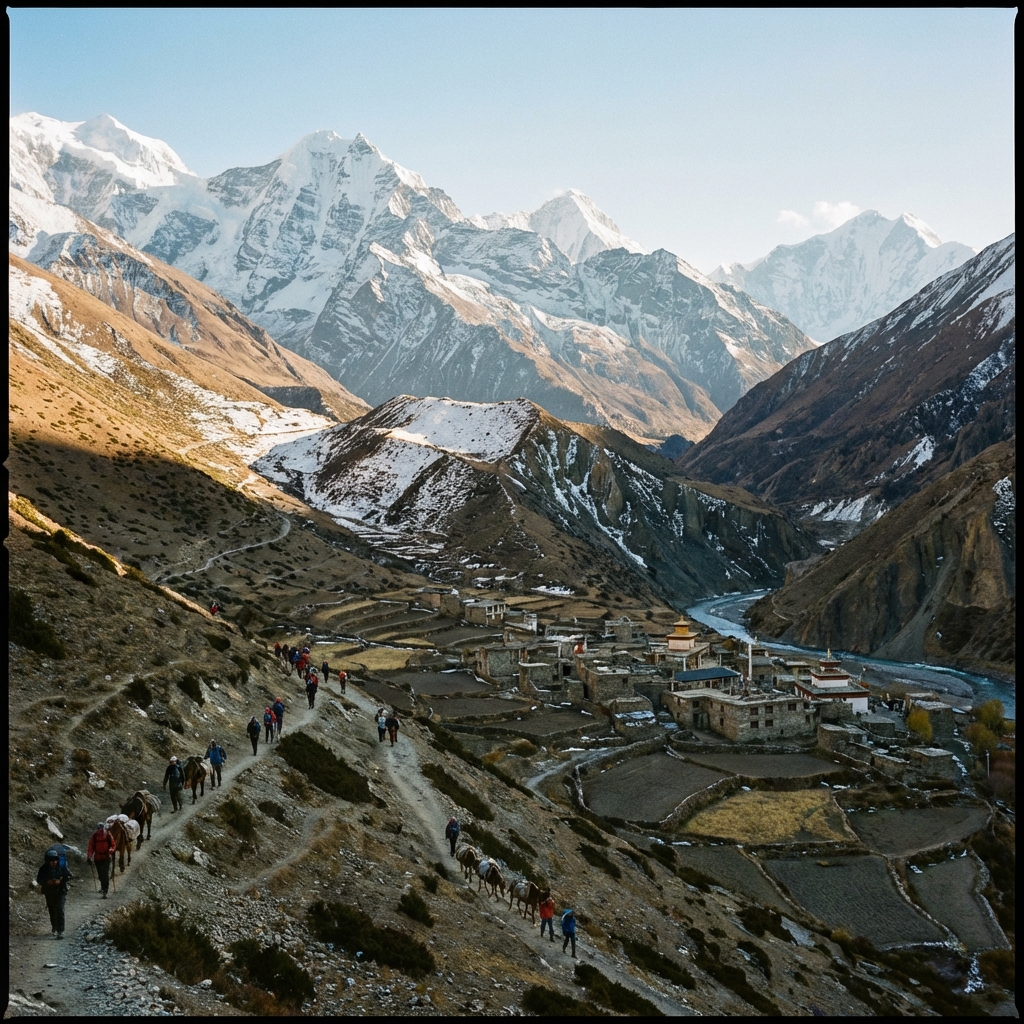
Representative Locations: Namche Bazaar (3,440m), Ghorepani (2,870m), lower Manang (3,540m), Kyanjin Gompa (3,870m)
Daytime Temperatures: 15-24°C (59-75°F) Nighttime Temperatures: 5-12°C (41-54°F) Conditions: Warm and pleasant mornings, afternoon clouds building, moderate humidity
What This Means:
- Morning trekking very comfortable (perfect temperatures)
- Afternoon clouds develop 11am-1pm (obscuring mountain views)
- Evenings pleasant (light fleece sufficient)
- Sleeping bags rated to -5°C adequate
- Afternoon showers possible but not daily (40-60% chance)
- Sunrise/early morning offers best mountain visibility
Practical Considerations:
- Start trekking at dawn to maximize clear weather window
- Expect views to disappear by midday
- Layer system: base layer + light fleece + light rain jacket
- Afternoons good for resting, reading, socializing
- Village exploration pleasant in afternoon shade
Strategy: This elevation zone is where May's trade-offs become apparent—comfortable trekking temperatures but reduced visibility. Experienced trekkers accept this and optimize morning hours.
High Elevations (4,000-5,000m)
Representative Locations: Dingboche (4,410m), Lobuche (4,940m), Gokyo (4,790m), Thorong High Camp (4,925m)
Daytime Temperatures: 10-15°C (50-59°F) Nighttime Temperatures: 0-5°C (32-41°F) Conditions: Warm and pleasant days, comfortable nights, afternoon clouds common
What This Means:
- This is May's sweet spot elevation
- Warmest high-altitude conditions of the year
- Daytime trekking very comfortable (t-shirt weather in sun)
- Nights cool but not extreme (no frozen water bottles)
- Sleeping bags rated to -10°C comfortable
- Morning visibility often excellent (2-3 hours of clear views)
- Afternoon clouds roll in but usually above peaks
- Minimal snow (melted from spring warmth)
Practical Considerations:
- Base layer + fleece + light down jacket sufficient
- Acclimatization hiking pleasant (warm days)
- High camps like Lobuche surprisingly comfortable
- Sunscreen essential (intense UV at altitude despite warm temps)
- Morning photography opportunities excellent
Why This Matters: May is the BEST month for first-time high-altitude trekkers concerned about extreme cold. Gorak Shep at 0°C overnight is vastly more comfortable than -15°C in November.
Extreme High Elevations (5,000m+)
Representative Locations: Gorak Shep (5,164m), Everest Base Camp (5,364m), Kala Patthar (5,545m), Thorong La Pass (5,416m), Larkya La (5,160m)
Daytime Temperatures: 5-12°C (41-54°F) Nighttime Temperatures: -5 to 0°C (23-32°F) Conditions: Cool days, cold nights, high UV, afternoon clouds
What This Means:
- Cold but not extreme (warmest conditions for these elevations)
- Sleeping bags rated to -10 to -15°C sufficient
- No extreme cold-weather gear needed (vs. -20°C bags in winter)
- Mornings calm and clear (60-70% success rate for Kala Patthar)
- Afternoons cloudy but temperatures remain tolerable
- Snow minimal on passes (best crossing conditions)
Practical Considerations:
- Full layering system: base layers + fleece + down jacket + windproof shell
- Insulated gloves and warm hat essential
- Water bottles don't freeze (vs. winter challenges)
- Altitude sickness risk same as any month (not weather-dependent)
- Helicopter rescue reliable (good May flying weather)
Pass Crossing in May:
- Thorong La: Excellent conditions, minimal snow, warm crossing day
- Larkya La: Good conditions, some afternoon weather
- Kongma La/Cho La: Very good, warm temperatures aid glacier crossings
| Month | High | Low | Conditions | Crowds | Notes |
|---|---|---|---|---|---|
| Lower (1,000-2,500m) | 20-30°C | 12-18°C | Moderate (40-80mm) | Very Low | HOT, humid, afternoon storms—challenging |
| Mid (2,500-4,000m) | 15-24°C | 5-12°C | Moderate (30-60mm) | Low | Warm mornings, afternoon clouds obscure views |
| High (4,000-5,000m)Best | 10-15°C | 0-5°C | Low (15-30mm) | Low | IDEAL—warmest high-altitude conditions, comfortable |
| Extreme High (5,000m+)Best | 5-12°C | -5 to 0°C | Low (10-20mm) | Very Low | Excellent—warm for elevation, minimal snow |
Route-Specific May Ratings: What Works and What Doesn't
May demands strategic route selection. Here's honest assessment of major treks in May conditions.
HIGH ALTITUDE ROUTES: EXCELLENT IN MAY
These routes maximize time above 4,000m where May's warmth is advantageous and minimize lower-elevation heat exposure.
1. Everest Base Camp — May's Best Major Trek
Duration: 12-14 days Max Altitude: 5,364m (EBC), 5,545m (Kala Patthar) Difficulty: Moderate-Challenging May Rating: ★★★★☆ (8/10 - Very Good)
Why May Works for EBC:
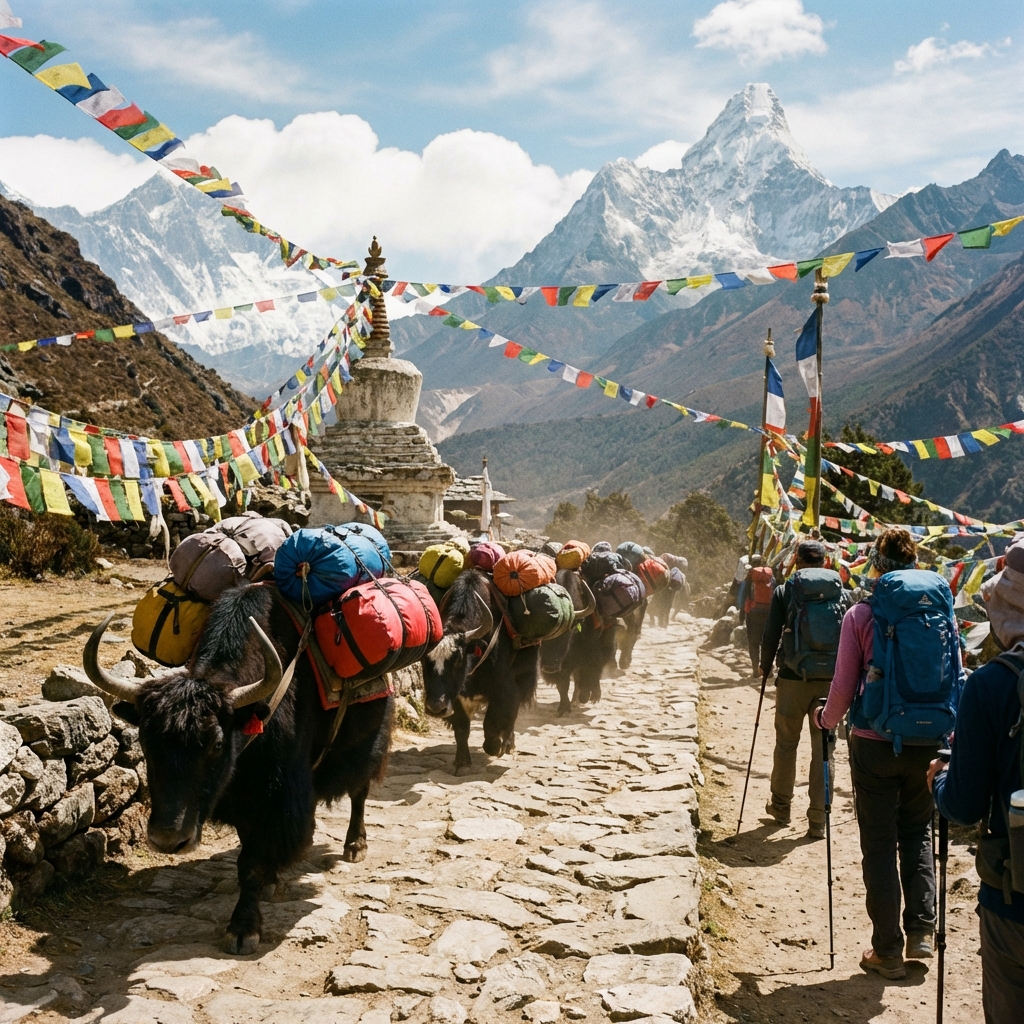
- Route spends 7-8 days above 4,000m (May's optimal zone)
- Gorak Shep and high camps warm and comfortable (0 to -5°C vs. -15°C in November)
- Morning Kala Patthar views excellent 60-70% of days
- Fewer crowds mean better lodge availability and intimate experience
- Flight to Lukla (2,860m) minimizes low-elevation trekking
- Sherpa communities celebrating Buddha Jayanti (cultural bonus)
May Challenges:
- Afternoon clouds obscure Everest 50-60% of days (morning views essential)
- Lukla and lower Khumbu hot (but brief exposure)
- Late May sees increasing humidity
- Views not as crystalline as October/November (some haze)
Optimal May Strategy:
- Trek early May (finish by May 15)
- Start trekking days at 6-7am for clear morning windows
- Plan Kala Patthar for early morning (4-5am start)
- Accept that afternoons will be cloudy (use for rest/acclimatization)
- Bring sleeping bag rated to -10°C (vs. -20°C in autumn/winter)
Heat Management:
- Lukla to Namche (Day 1-2): Start very early, slow pace, extra water
- Namche to Tengboche (Day 3-4): Comfortable—already at good elevation
- Tengboche to Gorak Shep (Day 5-8): Excellent conditions, minimal heat
Detailed Guide: Everest Base Camp Complete Guide
2. Gokyo Lakes — May's Hidden Gem
Duration: 10-13 days Max Altitude: 5,357m (Gokyo Ri) Difficulty: Moderate-Challenging May Rating: ★★★★★ (9/10 - Excellent)
Why May Is Perfect for Gokyo:
- Even higher percentage of trek above 4,000m than standard EBC
- Gokyo valley (4,790m) warm and comfortable in May
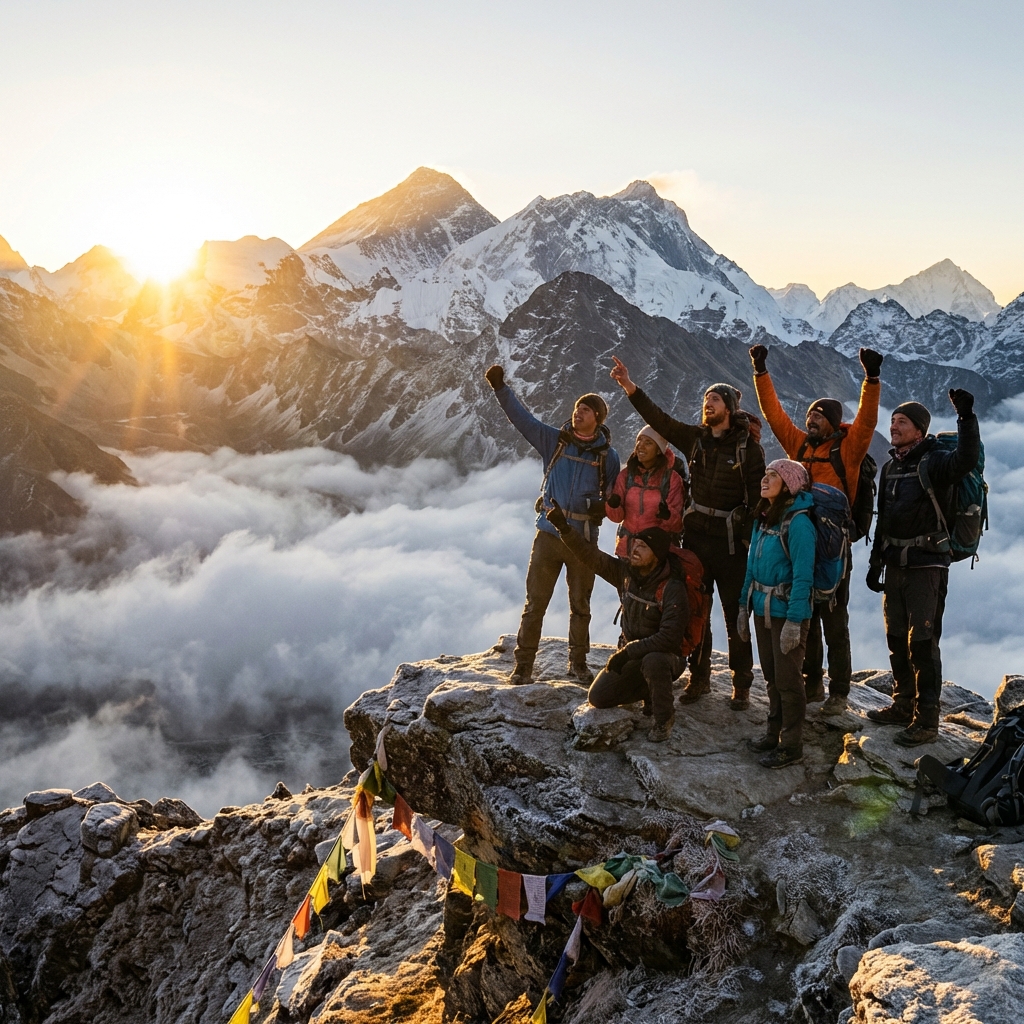
- Gokyo Ri sunrise views of Everest, Lhotse, Makalu, Cho Oyu spectacular on clear mornings
- Fewer crowds than EBC (already quieter route, May reduces further)
- Turquoise glacial lakes stunning against spring snow
- Can combine with Cho La Pass to EBC (excellent May conditions)
May Advantages:
- Warmest conditions for high-altitude camping/lodges
- Lakes partially thawed (vs. frozen in winter)
- Minimal snow on Gokyo Ri trail
- Very few trekkers (30-50/day vs. 150-250 on EBC trail)
May Strategy:
- Same early-morning approach for viewpoints
- Spend extra day at Gokyo (4,790m) for acclimatization and multiple Gokyo Ri attempts
- Fifth lake hike offers afternoon activity when clouds obscure peaks
- Cho La crossing excellent in May (warm, minimal snow)
Why Gokyo Over EBC in May: If views are your priority and you accept morning-only visibility, Gokyo's less-crowded trails and equally spectacular panoramas make it May's best Everest region choice.
Detailed Guide: Gokyo Lakes Complete Guide
3. Upper Mustang — May's Perfect Destination
Duration: 10-14 days Max Altitude: 3,840m (Lo Manthang) Difficulty: Moderate May Rating: ★★★★★ (10/10 - Perfect)
Why May Is IDEAL for Upper Mustang:
- Rain shadow region—monsoon barely affects Mustang
- May precipitation minimal (5-15mm vs. 300-500mm in Annapurna)
- Warm temperatures perfect for high desert plateau
- Strong winds of spring (March-April) calming down
- Tibetan culture and landscapes at their most accessible
- Very few trekkers (restricted permit area)
May Advantages:
- Bypasses monsoon entirely (Mustang's secret weapon)
- Comfortable trekking temperatures (15-25°C days)
- Apple blossoms and agricultural activity in full swing
- Clear views of Dhaulagiri, Annapurna, Nilgiri ranges
- Dry conditions ideal for exploring ancient monasteries and caves
- Jeep roads dry and accessible (vs. winter snow closures)
Mustang-Specific Benefits:
- May is actually BETTER than October for Mustang (drier, less wind)
- Premium season for this region
- Lo Manthang festival season (various cultural celebrations)
- Comfortable camping conditions for multi-day horse treks
Practical Considerations:
- Restricted area permit (USD 50/day (no minimum days)) + guide mandatory
- Book 2-3 months ahead for permit processing
- Fly to Jomsom, trek north into rain shadow
- Bring sun protection (intense high-altitude desert sun)
Verdict: If you're committed to trekking in May, Upper Mustang is arguably the BEST choice in Nepal—it sidesteps May's primary challenges (heat, humidity, afternoon storms) entirely.
Detailed Guide: Upper Mustang Complete Guide
4. Everest Three Passes — For Experienced May Trekkers
Duration: 18-21 days Max Altitude: 5,545m (Kongma La) Difficulty: Very Challenging May Rating: ★★★★☆ (8/10 - Very Good for Experienced)
Why May Works:
- Extended time above 4,500m benefits from May's warmth
- All three passes (Kongma La, Cho La, Renjo La) in excellent condition
- Minimal snow on passes (melted from spring sun)
- Fewer trekkers than autumn (trails to yourself)
- Warm high camps make multi-week high-altitude exposure more comfortable
May Challenges:
- Long trek means accepting 2-3 weeks of afternoon clouds
- Lower sections (Lukla, Namche) hot on entry/exit
- Must be comfortable with variable visibility
- Requires strong fitness to move efficiently in morning windows
May Strategy:
- Plan pass crossings for early morning (3-4am starts)
- Build in rest days for weather flexibility
- Accept that afternoon views will be clouded—optimize mornings
- Sleeping bag rated to -15°C sufficient (vs. -20°C in autumn)
Who Should Consider This:
- Experienced high-altitude trekkers
- Those who've done EBC/Gokyo before and want May challenge
- Trekkers prioritizing solitude over perfect visibility
- Strong hikers comfortable with early starts
Detailed Guide: Three Passes Trek Complete Guide
MID-ALTITUDE ROUTES: MARGINAL IN MAY
These routes spend significant time in the 2,500-4,000m zone where May is warm but cloudy.
5. Annapurna Circuit — Mixed May Conditions
Duration: 12-18 days Max Altitude: 5,416m (Thorong La) Difficulty: Moderate-Challenging May Rating: ★★★☆☆ (6/10 - Acceptable with Caveats)
Why May Is Challenging:
- Long approach through lower elevations (Besisahar at 760m, Bahundanda, Syange)
- Hot and humid on southern approach (Marshyangdi valley)
- Manang valley warm but cloudy afternoons
- Post-Thorong La descent into lush Kali Gandaki valley (monsoon approaching)
Why May Still Works (Partially):
- Thorong La pass crossing excellent (warm, minimal snow, 95% success rate)
- Manang (3,540m) comfortable for acclimatization days
- Upper Manang valley (Khangsar, Tilicho) still in rain shadow
- Fewer crowds than peak season
May Strategy:
- Consider REVERSE direction (Jomsom to Besisahar)
- Fly to Jomsom (rain shadow side)
- Trek UP to Thorong La from west
- Descend east quickly through hot zones
- Ultra-early starts in lower sections (4-5am departures)
- Plan Thorong La crossing for early May (before late-month weather deterioration)
Alternative: Skip lower circuit entirely—fly to Jomsom, trek Muktinath to Manang, cross Thorong La, exit at Manang via jeep to Besisahar. This maximizes high-elevation time and minimizes heat exposure.
Verdict: Annapurna Circuit is POSSIBLE in May but requires smart route modifications. Not ideal for first-time circuit trekkers—choose October/November instead.
Detailed Guide: Annapurna Circuit Complete Guide
6. Manaslu Circuit — Marginal to Poor in May
Duration: 14-18 days Max Altitude: 5,160m (Larkya La) Difficulty: Challenging May Rating: ★★☆☆☆ (4/10 - Not Recommended)
Why May Is Problematic:
- Approaches monsoon-prone southern slopes
- Lower Budhi Gandaki valley extremely hot and humid
- Lush subtropical forests become oppressive in May heat
- Leeches begin appearing (monsoon arrival signal)
- Afternoon storms increasingly frequent
Limited May Positives:
- Larkya La pass itself in good condition (warm crossing day)
- Upper valley (Samagaon, Samdo) still acceptable
- Fewer crowds than peak season
Why You Should Reconsider:
- Heat and humidity dominate experience
- Late May risks early monsoon rains
- Better alternatives exist (Everest region, Mustang)
Verdict: Choose autumn (October-November) or spring (April) for Manaslu. May is sub-optimal.
Detailed Guide: Manaslu Circuit Complete Guide
LOW-ALTITUDE ROUTES: POOR IN MAY
These routes stay primarily below 3,000m where May heat and storms are most severe.
7. Poon Hill — Not Recommended in May
Duration: 4-5 days Max Altitude: 3,210m (Poon Hill) Difficulty: Easy-Moderate May Rating: ★★☆☆☆ (3/10 - Poor)
Why May Doesn't Work:
- Entire route below 3,500m (May's problem zone)
- Rhododendron blooms mostly finished (peak is March-April)
- Afternoon clouds obscure Annapurna/Dhaulagiri views 70-80% of days
- Heat and humidity uncomfortable on ascents
- Monsoon approach makes mornings unreliable by late May
What You'll Experience:
- Hot trekking (25-30°C midday)
- Brief morning views (6-8am window only)
- Afternoon storms and clouds
- Lush greenery (positive) but limited mountain visibility
Better Alternatives:
- Trek Poon Hill in October-November (peak season, guaranteed views)
- Trek in March-April (rhododendrons blooming, clearer weather)
- If committed to May, choose Mardi Himal instead (higher elevation)
Verdict: Poon Hill is Nepal's most popular short trek for good reasons—but May negates most advantages. Postpone or choose different route.
Detailed Guide: Poon Hill Complete Guide
8. Annapurna Base Camp — Challenging in May
Duration: 7-10 days Max Altitude: 4,130m (ABC) Difficulty: Moderate May Rating: ★★★☆☆ (5/10 - Marginal)
Why May Is Problematic:
- Lower Modi Khola valley hot and humid
- Approach through rhododendron forests (beautiful but hot)
- ABC amphitheater clouds over by 10-11am most days
- Afternoon storms frequent in narrow valley
- Best views (early morning) require overnight at ABC in clouds
Limited May Positives:
- ABC itself (4,130m) has comfortable May temperatures
- Fewer crowds than peak season (more intimate experience)
- Green landscapes and tail-end rhododendron blooms
- Sunrise at ABC can be spectacular (if clear)
May Strategy IF You Commit:
- Trek early May (before late-month deterioration)
- Start trekking days at 5-6am
- Plan 2 nights at ABC to improve sunrise odds
- Accept 50-60% chance of clouds obscuring amphitheater
- Bring adequate rain gear for afternoon storms
Better Alternatives:
- Mardi Himal (higher, slightly better May conditions)
- Postpone to October-November for guaranteed ABC amphitheater views
Verdict: ABC is doable in May but requires accepting significant compromises. Best saved for optimal seasons.
Detailed Guide: Annapurna Base Camp Complete Guide
9. Langtang Valley — Mixed May Conditions
Duration: 7-10 days Max Altitude: 4,984m (Tserko Ri) Difficulty: Moderate May Rating: ★★★☆☆ (6/10 - Acceptable)
Why May Is Challenging:
- Lower Langtang valley warm and increasingly humid
- Kyanjin Gompa (3,870m) sits in transitional zone
- Afternoon clouds obscure Langtang Lirung and peak views
- Monsoon approaches from south (Langtang Valley faces south)
Why May Still Works (Partially):
- Tserko Ri (4,984m) reaches May's optimal high-altitude zone
- Kyanjin Gompa comfortable temperature-wise
- Close to Kathmandu (7-8 hour drive—no flight logistics)
- Fewer crowds than peak season
- Valley lush and green
May Strategy:
- Plan Tserko Ri climb for clearest morning
- Spend extra day at Kyanjin (multiple viewpoint attempts)
- Trek early May for best conditions
- Accept afternoon cloud cover as normal
Verdict: Langtang is acceptable in May if you have limited time and want to avoid Lukla flights, but conditions are noticeably inferior to autumn.
Detailed Guide: Langtang Valley Complete Guide
SHORT & OFF-BEAT MAY OPTIONS
Two routes competitors rightly flag for May deserve a place here—one easy, one remote.
10. Everest View Trek — Best Short May Trek
Duration: 5-7 days Max Altitude: 3,880m (Tengboche) / 3,860m (Hotel Everest View) Difficulty: Easy-Moderate May Rating: ★★★★☆ (7/10 - Very Good)
If you want Everest scenery in May without the 12-14 day commitment, the Everest View Trek is the smart pick. You fly to Lukla (2,860m), climb to Namche Bazaar (3,440m) and Tengboche (3,860m), and stay mostly in May's comfortable mid-to-high zone. Mornings deliver excellent views of Everest, Lhotse, and Ama Dablam before clouds build, and you can time arrival in the Khumbu for Buddha Jayanti (May 5) ceremonies at Tengboche Monastery. Heat is brief (lower Khumbu only), and crowds are a fraction of October's. Ideal for first-timers, families, and anyone short on time.
11. Nar Phu Valley — Rain-Shadow Hidden Gem
Duration: 11-14 days Max Altitude: 5,320m (Kang La Pass) Difficulty: Challenging May Rating: ★★★★☆ (8/10 - Very Good)
Tucked behind the Annapurna massif, Nar Phu Valley shares Upper Mustang's rain-shadow advantage—May precipitation stays low while southern routes turn stormy. Expect warm, dry days, dramatic Tibetan-influenced villages (Nar and Phu), and the high Kang La crossing in good May condition with minimal snow. As a restricted area, it requires a special permit plus a licensed guide, and trekker numbers are tiny. A strong May alternative for experienced trekkers wanting solitude and culture without monsoon interference. See best time for Nar Phu Valley for timing details.
Heat Management Strategies: Surviving May's Lower Elevations
Successfully trekking in May requires tactical heat management, especially in lower sections.
Ultra-Early Starts: The May Imperative
Standard Peak Season: Start trekking 7-8am May Requirement: Start trekking 5-6am (or earlier)
Why This Matters:
- May mornings (5-9am) offer coolest temperatures and clearest skies
- By 10am, heat builds and clouds form
- By 11am-12pm, trekking becomes uncomfortable
- Afternoon (12-3pm) is hottest and cloudiest
Practical Implementation:
- Wake 4-4:30am
- Light breakfast (tea, biscuits)
- On trail by 5-5:30am
- Trek 4-5 hours in cool morning
- Arrive destination by 10-11am
- Rest during peak heat afternoon
- Second meal/full lunch after arrival
Benefits:
- Escape worst heat (20-25°C mornings vs. 30-35°C midday)
- Best visibility window for mountain views
- Empty trails (most trekkers still sleeping)
- Arrive lodges early (better bed selection)
- Afternoon free for rest, reading, acclimatization
Challenges:
- Requires discipline (early wake-ups hard for some)
- Breakfast options limited at 4:30am
- Headlamps needed for pre-dawn starts
- Must adjust dinner time (eat early to sleep early)
Hydration: Critical in May Heat
Water Requirements:
- Lower elevations (below 3,000m): 4-5 liters/day
- Mid elevations (3,000-4,000m): 3-4 liters/day
- High elevations (4,000m+): 3 liters/day
Why More Than Other Months:
- Heat increases perspiration
- Humidity still causes fluid loss
- Dry air at altitude compounds dehydration
- May heat makes water needs 30-50% higher than October
Practical Tips:
- Start drinking before thirsty (proactive hydration)
- Carry 2-3 liters during trekking
- Refill at every tea house/water source
- Electrolyte tablets helpful (replace salts lost in sweat)
- Monitor urine color (should be pale yellow)
- Morning headaches often indicate dehydration
Water Treatment:
- Boiled water widely available (₹50-100/liter)
- Water purification tablets (backup)
- UV purifiers (SteriPEN) work well
- Avoid single-use plastic—refill water bottles
Sun Protection: Intense May UV
May combines high-altitude UV intensity with extended sun exposure (longer days than winter).
Essential Sun Protection:
- Sunscreen SPF 50+: Apply every 2 hours, even when cloudy
- Lip balm with SPF: High-altitude sun causes severe lip burning
- Glacier sunglasses: UV protection essential (Category 3-4)
- Sun hat with wide brim: Protects face, ears, neck
- Neck gaiter/buff: Covers neck and can cover face
UV Intensity:
- May UV at 5,000m is extreme (30-50% higher than sea level)
- Reflection from snow doubles exposure
- Clouds don't block UV (can still burn on cloudy days)
Common Mistakes:
- Underestimating cloud-day UV exposure
- Forgetting ears and back of neck
- Assuming tan skin doesn't need sunscreen
- Not reapplying after sweating
Clothing Strategy: Managing Temperature Swings
May's challenge is managing dramatic temperature swings from cool mornings to hot middays to cool evenings.
Layering System:
- Base layer: Lightweight, moisture-wicking (mornings/evenings)
- T-shirt/shirt: For midday heat (breathable, sun-protective)
- Light fleece: Morning starts and evenings
- Light down jacket: High camps and early mornings
- Rain jacket: Afternoon storms, wind protection
Lower Elevations (below 3,000m):
- Lightweight, breathable pants (or convertible pants/shorts)
- Moisture-wicking t-shirts (multiple for sweat changes)
- Sun hat essential
- Light rain jacket (afternoon storms)
High Elevations (above 4,000m):
- Trekking pants (cooler temperatures)
- Fleece + down jacket for evenings
- Warm hat and gloves (mornings/nights)
- Layering allows adjustment throughout day
Fabric Choices:
- Avoid cotton (stays wet from sweat, doesn't dry)
- Merino wool or synthetic fabrics ideal
- Light colors reflect heat better than dark
Afternoon Storm Preparation
Late May sees afternoon thunderstorms 50-70% of days. Be prepared.
Storm Timing:
- Typically develop 12pm-2pm
- Peak intensity 2-4pm
- Taper off 4-6pm
- Evenings often clear again
Preparation:
- Reach destination before noon (storms start early afternoon)
- Carry rain jacket always (even if morning clear)
- Waterproof pack cover or dry bags for electronics/sleeping bag
- Lightning risk on ridges—descend to valleys if caught out
- Storm duration usually 1-3 hours (wait it out in tea house)
If Caught in Afternoon Storm:
- Seek shelter immediately (tea house, lodge)
- Avoid exposed ridges and peaks (lightning risk)
- Wait out storm (rarely lasts more than 2-3 hours)
- Trails become muddy—trekking poles helpful
- Postpone viewpoint climbs if storm approaching
May vs April Comparison: Which Spring Month to Choose?
Both April and May are spring shoulder seasons, but with meaningful differences.
Weather Stability
April:
- More stable than May (still firmly in dry season)
- Afternoon clouds less frequent (30-40% of days)
- Morning visibility more reliable (80-90% clear mornings)
- Precipitation lower (20-40mm monthly average)
May:
- Transitioning toward monsoon (increasing instability)
- Afternoon clouds frequent (50-70% of days)
- Morning visibility good but less reliable (60-70% clear mornings)
- Precipitation increasing (40-80mm monthly average, especially late May)
Verdict: April has better weather stability. May's weather worsens week by week.
Temperature
April:
- Cooler than May (5-8°C cooler at all elevations)
- Lower elevations comfortable (15-25°C vs. 25-35°C in May)
- High camps cold but not extreme (-5 to 0°C vs. 0 to 5°C in May)
- Better balance overall
May:
- Warmest spring month (approaching summer temperatures)
- Lower elevations hot (25-35°C—uncomfortable)
- High camps warm and comfortable (0 to 5°C—easiest conditions)
- Heat at low elevations problematic
Verdict: April better for low/mid-elevation routes. May better for high-altitude routes (warmth advantage).
Crowds and Pricing
April:
- Moderate crowds (40-50% of October levels)
- Moderate pricing (10-20% cheaper than peak October)
- Some advance booking helpful
May:
- Low crowds (20-30% of October levels)
- Lower pricing (20-30% cheaper than peak October)
- Walk-up trekking generally feasible
Verdict: May offers quieter trails and better value.
Rhododendron Blooms
April:
- PEAK rhododendron season (March-April)
- Lower Annapurna and Langtang forests ablaze with color
- Major draw for photographers and nature lovers
- Best time to see Nepal's national flower
May:
- Tail-end rhododendrons (mostly finished blooming)
- Some blooms remain at higher elevations (3,500-4,000m)
- Greenery beautiful but blooms past peak
Verdict: April is unquestionably better for rhododendron viewing.
Route Suitability
April Works Better For:
- Poon Hill (rhododendrons + views)
- Annapurna Base Camp (cooler, clearer)
- Annapurna Circuit (lower sections more comfortable)
- Langtang Valley (better visibility)
- Most low/mid-elevation routes
May Works Better For:
- Everest Base Camp (warm high camps)
- Gokyo Lakes (comfortable high-altitude)
- Upper Mustang (warming temperatures)
- Three Passes (extended high-altitude comfort)
- All high-altitude routes
Verdict: Choose April for versatility across all routes. Choose May specifically for high-altitude treks.
Summary Recommendation
Choose April if:
- You want maximum route flexibility
- Rhododendron blooms are important
- You prefer cooler temperatures overall
- You want more reliable visibility
- You're trekking lower/mid-elevation routes
Choose May if:
- You're specifically trekking high-altitude routes (EBC, Gokyo, Upper Mustang)
- You're cold-sensitive (May's warmth at altitude is genuine advantage)
- You prioritize low crowds and cost savings
- You want Buddha Jayanti cultural experience
- You're experienced and can optimize morning weather windows
Best Compromise: Late April (April 20-30) offers April's stability with May's warming temperatures and thinning crowds—arguably ideal spring timing.
When May Doesn't Work: Honest Assessment
May is NOT for everyone or every situation. Here's when you should reconsider.
Skip May If You Prioritize Crystal-Clear Mountain Views
Reality Check:
- May delivers 50-70% afternoon cloud cover
- Mountain views obscured by midday most days
- Haze reduces long-distance visibility (vs. October's 100+ km clarity)
- Photography limited to early morning windows
Who This Affects:
- First-time Himalaya trekkers wanting guaranteed iconic views
- Photographers prioritizing perfect conditions
- Trekkers for whom the view is 80%+ of the experience
Better Alternatives: October, November, December, early April
Skip May If You're Heat-Sensitive
Heat Reality:
- Lower elevations reach 30-35°C (86-95°F)
- Humidity makes heat feel more oppressive
- Heat exhaustion risk for older trekkers or those with heat sensitivity
- Uncomfortable trekking conditions in valley sections
Who This Affects:
- Older trekkers (60+) with heat intolerance
- Anyone with cardiovascular conditions exacerbated by heat
- Trekkers from cool climates unused to tropical heat
- Those who find 30°C+ uncomfortable
Better Alternatives: October, November, March, early April
Skip May If You Want Multi-Day Visibility
Weather Pattern:
- May mornings often clear (2-4 hours)
- Afternoons cloud over reliably
- If you arrive in afternoon, you've missed the view window
- Multi-day rest days at high points may not guarantee clear days
Who This Affects:
- Trekkers wanting leisurely photography (not just dawn shoots)
- Those unable to do ultra-early starts daily
- People wanting full-day viewpoint experiences
Better Alternatives: October, November (all-day clarity)
Skip May If You're Doing Low-Elevation Routes
Route Reality:
- Poon Hill, lower Annapurna, Helambu poor in May
- Heat, humidity, clouds negate route advantages
- May transforms easy treks into uncomfortable slogs
Who This Affects:
- Beginners planning first Himalaya trek on easy route
- Trekkers limited to lower elevations by fitness/age
- Those choosing scenic low-altitude routes
Better Alternatives: October-November for low routes
Skip May If You Can't Be Flexible
May Volatility:
- Late May weather can deteriorate suddenly
- Early monsoon arrival possible (rare but happens)
- You may need to adjust itinerary or cut trek short
Who This Affects:
- Trekkers with tight schedules (no buffer days)
- Those unable to adapt plans if weather worsens
- Anyone with fixed return flights (no flexibility)
Better Alternatives: October, November (highly predictable)
Skip May If It's Your Only Himalaya Trip
Once-in-a-Lifetime Consideration:
- If this is your sole Nepal trek, choose optimal conditions
- May is good for high routes, but October/November are excellent for everything
- Why accept compromises on your one chance?
Who This Affects:
- First-time Nepal trekkers with no plans to return
- Bucket-list trekkers (Everest Base Camp as lifetime goal)
- Anyone for whom this represents significant investment
Better Alternatives: Save for peak season (October-November)—worth the wait and cost
Packing for May: Specific Gear Considerations
May requires a different gear approach than autumn or winter.
Sleeping Bag: Lighter Than Autumn
May Requirement:
- Comfort rating: -10 to -15°C (vs. -20°C in Nov/Dec)
- High camps (Gorak Shep, Thorong High Camp) reach 0 to -5°C
- This is 10-15°C warmer than November
Practical Impact:
- Lighter sleeping bag (saves 300-500g)
- Easier to find rental bags in this range
- More compact pack size
- Adequate warmth for May conditions
Options:
- Down sleeping bag -10°C comfort (ideal)
- Synthetic -15°C (slightly heavier, cheaper)
- Rental available in Kathmandu/Pokhara (₹100-150/day)
Don't Bring:
- -20 to -25°C expedition bags (massive overkill for May)
Clothing: Lighter Layers, More Sun Protection
May-Specific Clothing:
Upper Body:
- 2-3 moisture-wicking t-shirts (more than autumn—sweat changes)
- 1 long-sleeve sun shirt (sun protection + breathable)
- 1 mid-weight fleece (lighter than winter)
- 1 light down jacket (vs. heavy down in winter)
- 1 rain jacket (critical for afternoon storms)
Lower Body:
- 2 trekking pants (one lightweight for lower elevations)
- OR 1 convertible pants/shorts (versatile for heat)
- 1 thermal leggings (high camps only)
- Avoid heavy insulated pants (too warm for May)
Head/Hands:
- Wide-brim sun hat (essential sun protection)
- Warm beanie (high camps and early mornings)
- Light gloves (vs. expedition gloves in winter)
- Sun-protective buff/neck gaiter
Feet:
- Trekking boots (well broken-in)
- 3-4 pairs trekking socks (wool or synthetic)
- Camp shoes/sandals (for afternoons, lodge use)
Sun Protection: Maximum Priority
Critical May Gear:
- Sunscreen SPF 50+: 2-3 tubes for 2-week trek
- Lip balm SPF 30+: High-altitude lip burn severe
- Glacier sunglasses Category 3-4: UV protection essential
- Sunhat with wide brim: Face, ear, neck protection
- Neck gaiter: Versatile sun protection
UV Reality:
- May UV at altitude is extreme
- Reflection from snow doubles exposure
- Underestimated by most trekkers
- Severe burns possible even on cloudy days
Rain Gear: Essential for Afternoon Storms
Must-Have:
- Waterproof rain jacket (breathable, not rubber poncho)
- Rain pants or waterproof pants (late May especially)
- Pack rain cover or dry bags
- Waterproof stuff sacks for sleeping bag, electronics
Storm Frequency:
- Early May: 30-50% of days
- Late May: 60-80% of days
- Storms brief (1-3 hours) but intense
What You DON'T Need in May
Compared to Winter:
- No heavy expedition down jacket
- No heavy insulated pants
- No expedition gloves (-40°C rated)
- No face mask/balaclava
- No -25°C sleeping bag
Weight Savings:
- May pack 2-3kg lighter than November/December pack
- Easier trekking with lighter load
- Less porter weight (lower costs)
Electronics and Photography
May Considerations:
- Batteries drain slower (warmer temps vs. winter)
- Afternoon clouds limit photography windows (morning focus)
- Waterproofing critical (afternoon storms)
- Dust and humidity—protect cameras
Recommended:
- Spare camera batteries (2-3)
- Portable charger/power bank (20,000mAh)
- Waterproof camera bag or dry bag
- Lens cleaning kit (dust management)
Monsoon Preparation: Late May Transition
Late May (May 15-31) sees clear monsoon transition. Understanding this helps you adapt.
Signs of Monsoon Approach
Weather Indicators:
- Afternoon storms becoming daily (vs. occasional)
- Humidity increasing noticeably
- Morning clarity window shrinking (clear until 9am vs. 11am)
- Overnight precipitation (rain at lower elevations)
- Increased cloud buildup earlier in day
When to Adjust Plans:
- If 3+ consecutive days of heavy afternoon rain
- If morning windows disappearing (cloudy by 7-8am)
- If weather forecast shows multi-day rain systems
- If lower valleys flooding or trails becoming muddy
Late May Strategies
If Trekking Late May (May 15-31):
Route Selection:
- Prioritize rain-shadow regions (Upper Mustang, Manang)
- Avoid southern-facing routes (Annapurna south, Langtang)
- High-altitude routes still better than low
Itinerary Flexibility:
- Build in 2-3 extra days (possible weather delays)
- Have contingency exit routes
- Don't schedule tight connections afterward
- Consider helicopter evacuation insurance
Mindset Adjustment:
- Accept higher likelihood of rain
- Optimize rare clear windows
- View as adventure (vs. picture-perfect trek)
- Monsoon trekking has unique appeal
Early Monsoon Arrival: How to Recognize and Respond
Typical Monsoon Start: June 10-15 in most regions
Early Monsoon Indicators:
- Multi-day rain systems (vs. afternoon storms)
- Lower-elevation rain overnight (not just afternoon)
- Leeches appearing on trails (monsoon signature)
- Landslide warnings on road sections
- Locals commenting on early arrival
If Early Monsoon Arrives (Rare):
- Assess location: High-altitude routes may still be viable
- Monitor weather: Is this 2-3 day system or true monsoon start?
- Make decision: Continue with adjusted pace or exit early
- Have exit plan: Helicopter, early descent route, road access
Insurance Consideration:
- Comprehensive travel insurance that covers "adverse weather" evacuations
- Helicopter rescue coverage ($5,000-10,000 limit)
- Trip interruption coverage if you cut trek short
June 1 Cutoff: Why It Matters
Recommendation: Finish treks by May 31 at latest
Rationale:
- Monsoon typically starts June 10-15
- Buffer days essential before monsoon arrival
- June 1-10 is transition period (conditions deteriorating)
- Trekking agencies often refuse to operate after May 31
If You Must Trek into June:
- Only consider rain-shadow routes (Upper Mustang)
- Have very flexible plans
- Excellent rain gear essential
- Accept significant weather compromises
Buddha Jayanti Festival: Cultural Experience (May 5, 2026)
Buddha Jayanti, also called Buddha Purnima or Vesak, celebrates Buddha's birth, enlightenment, and death—all believed to have occurred on the same calendar date. In 2026, it falls on May 5 (dates vary yearly based on lunar calendar).
Cultural Significance
Religious Importance:
- Nepal's most important Buddhist holiday
- Buddha was born in Lumbini (southern Nepal)
- Nepal considers Buddha Jayanti a national treasure
- Public holiday throughout country
Spiritual Meaning:
- Celebrates three major events: Birth, Enlightenment, Death of Buddha
- Day of merit-making, meditation, and generosity
- Buddhists seek to live Buddha's teachings on this day
- Auspicious for pilgrimages to sacred sites
Celebrations in Trekking Regions
Everest/Khumbu Region (Sherpa Buddhist Communities):
- Tengboche Monastery: Special ceremonies, prayers, mask dances
- Thame Monastery: Traditional celebrations
- Namche Bazaar: Community gatherings, butter lamp offerings
- Private homes: Families visit monasteries for blessings
- Prayer flags: New flags strung across villages and passes
Annapurna Region:
- Manang: Ceremonies at Braga and other monasteries
- Muktinath: Hindu-Buddhist pilgrimage site sees extra visitors
- Lower villages: Buddhist communities celebrate, Hindu communities respect
Kathmandu Valley:
- Swayambhunath (Monkey Temple): Massive gatherings, thousands of pilgrims
- Boudhanath Stupa: Circumambulation, butter lamps, prayer ceremonies
- Lumbini (Buddha's birthplace): Largest celebrations in Nepal
Impact on Trekking
Positive Impacts:
- Cultural immersion opportunity
- Monastery visits more meaningful (special ceremonies)
- Festive atmosphere in Sherpa villages
- Witness unique Buddhist traditions
- Photographic opportunities (butter lamps, ceremonies, decorations)
Practical Considerations:
- Some shops/restaurants in Kathmandu close May 5
- Teahouses on trails remain open (trekking unaffected)
- Slight domestic tourism increase (Nepali Buddhists trek to monasteries)
- Lodges may be busier near major monasteries (Tengboche)
- Cultural respect essential
How to Participate Respectfully
Dos:
- Attend monastery ceremonies if invited (usually open to visitors)
- Dress modestly (cover shoulders/knees in monasteries)
- Remove shoes before entering monastery buildings
- Photograph respectfully (ask permission, no flash during ceremonies)
- Offer donations (monks often collect for monastery upkeep)
- Wish people "Happy Buddha Jayanti" or "Tashi Delek"
Don'ts:
- Don't interrupt ceremonies or prayers
- Don't touch religious artifacts without permission
- Don't wear shoes in monastery halls
- Don't point feet toward Buddha statues
- Don't be loud or disruptive during observances
Planning Around Buddha Jayanti
Trek Timing Strategies:
Experience Festival (May 1-10 trek):
- Be in Everest region for May 5 celebrations
- Plan to be at/near Tengboche on May 5 for ceremonies
- Cultural immersion opportunity
- Lodges may be busier around monasteries
Avoid Festival Crowds (May 10-20 trek):
- Start trek after May 5
- Quieter trails post-festival
- Normal lodge availability
Indifferent (Any May timing):
- Impact on trekking is minimal
- Kathmandu affected more than trails
- Cultural bonus if you encounter it
Tengboche Monastery on Buddha Jayanti
If you're in the Everest region around May 5, Tengboche Monastery offers the most accessible and impressive Buddha Jayanti celebrations.
What to Expect:
- Special puja (prayer ceremony) in main monastery hall
- Monks chanting and playing traditional instruments
- Butter lamp offerings (hundreds of small lamps lit)
- Possible masked dance performances
- Community feast or special meal
- Visitors welcome to observe
Logistics:
- Arrive Tengboche by May 4 afternoon
- Book lodge in advance (slightly busier this day)
- Ceremony timing: Usually morning (8-10am)—ask lodge owner
- Dress respectfully, bring camera (respectful photography allowed)
Photo Opportunities:
- Butter lamps glowing in monastery
- Monks in ceremonial dress
- Mt. Ama Dablam backdrop
- Prayer flags and decorations
May Crowd Analysis: What "Quiet" Really Means
May sees 20-30% of October's trekker volumes. Here's what that actually looks like on the ground.
Numerical Comparison: Trekkers Per Day
Everest Base Camp Trail:
- October peak: 800-1,200 trekkers/day
- May average: 150-250 trekkers/day
- 70-80% reduction
Annapurna Circuit:
- October peak: 300-500 trekkers/day
- May average: 60-120 trekkers/day
- 70-80% reduction
Poon Hill:
- October peak: 200-400 trekkers/day
- May average: 30-60 trekkers/day
- 85% reduction (but May conditions poor for Poon Hill anyway)
Langtang Valley:
- October peak: 100-200 trekkers/day
- May average: 20-50 trekkers/day
- 75-80% reduction
What This Feels Like
May Trail Experience:
- See other trekkers daily (not solitary)
- Pass/meet 10-30 trekkers per day (vs. hundreds in October)
- Dining halls have 5-15 people (vs. 30-50 in October)
- Viewpoints to yourself or small groups (vs. crowds in October)
- Quiet trails with space to think and reflect
Social Atmosphere:
- Still social (meet people at lodges)
- International community vibe (diverse nationalities)
- More intimate conversations (smaller groups)
- Less overwhelming than peak season bustle
Lodge Availability and Booking
Walk-Up Trekking:
- Generally feasible in May (vs. impossible in October)
- Popular lodges (Namche, Tengboche, Ghorepani) usually have beds
- High camps (Gorak Shep, Thorong High Camp) less crowded
- Flexibility to adjust itinerary day-by-day
When to Book Ahead:
- May 1-10 (slightly busier, especially around Buddha Jayanti)
- Popular lodges at high camps (still advisable)
- If trekking with large group (4+ people)
- If you want specific lodge (vs. any available bed)
Booking Lead Time:
- 2-4 weeks generally sufficient
- vs. 3-4 months in October
- Guide/porter availability good (not overbooked)
May Crowds vs Other Shoulder Seasons
May vs March:
- Similar crowd levels (both 30-40% of October)
- March slightly busier (better weather reputation)
May vs December:
- May slightly quieter (December has Christmas trekkers)
- Both shoulder seasons with reduced crowds
May vs January-February:
- May busier (Jan-Feb is true low season—10-15% of October)
- But Jan-Feb is VERY cold (limited by weather, not crowds)
Verdict: May offers excellent crowd reduction while maintaining social atmosphere and full infrastructure operation.
Cost Analysis: May Savings Breakdown
May's shoulder season pricing offers tangible savings compared to peak October.
Teahouse Accommodation
Room Rates:
- Peak October: ₹500-800/night ($6-10 USD)
- May: ₹400-600/night ($5-7 USD)
- Savings: 20-30%
Reality:
- Lower elevations (Namche, Manang): More negotiable in May
- High camps (Gorak Shep): Smaller discount (still cold/remote)
- Walk-up booking often allows negotiation (vs. pre-booked rates)
Food Prices
Dal Bhat (Standard Trekker Meal):
- Peak October: ₹600-700 ($7-8.50 USD)
- May: ₹450-550 ($5.50-7 USD)
- Savings: 15-25%
Other Meals:
- Breakfast (porridge, eggs, toast): 15-20% cheaper
- Snacks (chocolate, chips): 10-15% cheaper
- Hot drinks (tea, coffee): Similar prices (minimal discount)
Altitude Price Escalation:
- Prices still increase with altitude (transport costs)
- But May baseline is lower across all elevations
Guide and Porter Rates
Guide Daily Rates:
- Peak October: $25-30 USD/day
- May: $20-25 USD/day
- Savings: 20-25%
Porter Daily Rates:
- Peak October: $18-22 USD/day
- May: $15-18 USD/day
- Savings: 20-25%
Why Lower:
- Less demand (guides/porters more available)
- More negotiation flexibility
- Agencies offer discounts to fill schedules
Trekking Agency Packages
Standard EBC Package (12-14 days):
- Peak October: $1,200-1,500 USD
- May: $950-1,200 USD
- Savings: 20-30% ($200-350)
Annapurna Circuit Package (14-16 days):
- Peak October: $1,100-1,400 USD
- May: $850-1,100 USD
- Savings: 20-30% ($200-400)
Package Inclusions:
- Guide, permits, accommodation, some meals
- Domestic flights (if applicable)
- Airport transfers
Domestic Flights
Kathmandu-Lukla:
- Peak October: $180-200 USD (each way)
- May: $165-185 USD (each way)
- Savings: 10-15% ($15-30)
Why Smaller Discount:
- Fuel costs remain constant
- Fewer flights in May (less competition)
- Still weather-dependent (helicopter backup costs similar)
Ramechhap Consideration:
- May less likely to require Ramechhap (less demand)
- Kathmandu-Lukla direct more feasible
- Saves 4-5 hour pre-dawn drive
Gear Rental
Sleeping Bag Rental:
- Peak October: ₹150-200/day ($1.80-2.40 USD/day)
- May: ₹100-150/day ($1.20-1.80 USD/day)
- Savings: 25-35%
Down Jacket Rental:
- Peak October: ₹100-150/day
- May: ₹80-100/day
- Savings: 20-35%
Better Availability:
- Less demand means better gear selection
- Can be picky about condition/quality
- Last-minute rental feasible
Total Cost Comparison: 14-Day EBC Trek
October (Peak Season):
- Package/guide: $1,400
- Additional meals: $200
- Lukla flights: $215
- Gear rental: $215
- Permits/fees: $50
- Total: ~$2,200
May (Shoulder Season):
- Package/guide: $1,100
- Additional meals: $160
- Lukla flights: $215
- Gear rental: $215
- Permits/fees: $50
- Total: ~$1,760
Total Savings: $440 (20% reduction)
Value Proposition
May Offers:
- Meaningful cost savings (20-30% across all categories)
- Full infrastructure operational (not reduced services)
- Good weather at high altitudes (not compromised conditions)
- Reduced crowds (less competition for resources)
Trade-Offs:
- Afternoon clouds (morning-only views)
- Heat at lower elevations (manageable with early starts)
- Late May monsoon approach (timing critical)
Best For:
- Budget-conscious trekkers
- Those prioritizing high-altitude routes where May works well
- Flexible travelers who can optimize morning weather windows
- Value-seekers willing to accept some compromises
Detailed 30+ FAQs: May Trekking Questions
Related Planning Resources
Seasonal Guides
- Best Time to Trek Nepal: Complete Seasonal Guide
- Nepal Trekking Seasons Overview
- Best Time to Trek Everest Region
- Trekking Nepal in April: Late Spring Guide
- Trekking Nepal in June: Early Monsoon Guide
- Trekking Nepal in October: Peak Season Guide
- Trekking Nepal in November: Cooling Excellence
- Trekking Nepal in December: Early Winter Guide
High-Altitude Route Guides (Best for May)
- Everest Base Camp Trek — Complete Guide
- Gokyo Lakes Trek — May's Hidden Gem
- Upper Mustang Trek — Perfect May Destination
- Three Passes Trek — Advanced May Challenge
- Everest View Trek — Best Short May Trek
- Nar Phu Valley — Rain-Shadow Hidden Gem
- Ama Dablam Base Camp Trek
Regional Hubs
- Everest Region (Khumbu) — All Routes
- Annapurna Region — Complete Overview
- Mustang Region — Rain Shadow Routes
- Manaslu Region — Remote Alternative
Practical Planning
- Nepal Trekking Permits Explained (2026)
- Altitude Sickness: Signs, Prevention & Turnaround Rules
- Heat Management for High-Altitude Trekking
- How to Choose a Trekking Agency in Nepal
- Everest Base Camp Trek Cost Breakdown
Is May a Good Time to Trek in Nepal?
May is good for high-altitude routes above 4,000m, including Everest Base Camp, Gokyo Lakes, and Upper Mustang. Warm conditions make high camps comfortable, and crowds are 70-80% lower than October. However, lower-elevation treks suffer from 30-35C heat and increasing afternoon storms. Success requires strategic route selection favouring altitude.
What's the Weather Like in Nepal in May?
May's weather splits by elevation. Above 4,000m: warm days (5-15C), mild nights (-5 to 5C), and stable mornings with afternoon cloud buildup. Below 3,000m: oppressive heat (30-35C), high humidity, and increasingly frequent afternoon thunderstorms as the pre-monsoon transition intensifies. For altitude preparation, see our acclimatization guide.
Frequently Asked Questions
Ready to Plan Your May Trek?
May offers Nepal's warmest high-altitude conditions and significant cost savings for the right routes. Whether you're planning Everest Base Camp, Gokyo Lakes, or Upper Mustang, our trek planning wizard provides personalized recommendations based on your priorities, fitness level, and heat tolerance.
This comprehensive guide to trekking Nepal in May is maintained by the Trek and Tour Nepal editorial team using data from Nepal Department of Hydrology and Meteorology, Nepal Tourism Board, regional weather stations, mountain weather forecasting services, teahouse networks, and verified trekking agency reports. Weather represents historical May averages from 2015-2024; actual conditions vary year to year. Buddha Jayanti date (May 5, 2026) is based on the lunar calendar—confirm closer to May. Climate change is affecting traditional monsoon timing patterns—always check recent conditions before departure. Last updated June 2026.
Have questions about planning your May trek? Contact our editorial team for personalized guidance on routes, timing, heat management strategies, and booking recommendations.