The Annapurna Circuit is one of the world's greatest treks, a 160-230 kilometer loop around the Annapurna massif that crosses the legendary Thorong La Pass at 5,416m. But before you pack your bags, you face a decision that will shape every day of your trek: which direction should you walk?
The overwhelming convention is counterclockwise, starting from Besisahar (or Chame) on the east side and finishing at Jomsom or Naya Pul on the west. Approximately 90-95% of trekkers walk this direction, and there are strong reasons for this consensus. A small minority walk clockwise, starting from the Jomsom/Muktinath side and finishing on the Manang/Besisahar side, and they have their own reasons for doing so.
This is not a trivial choice. The direction you walk determines your acclimatization profile (which affects your safety), your Thorong La approach (which affects your success rate), the wind you face (which affects your daily comfort), the crowds you encounter (which affects your experience), and even the scenic narrative of your trek (which affects your memories).
This guide provides a thorough analysis of both directions, explains why counterclockwise is the standard recommendation, and identifies the specific scenarios where clockwise might make sense for certain trekkers.
Who should read this guide:
- First-time Annapurna Circuit trekkers planning their itinerary
- Repeat trekkers considering the reverse direction for a different experience
- Anyone whose schedule or logistics suggest starting from the Jomsom side
- Guides and agency staff advising clients on direction choice
Quick Comparison: Side-by-Side Overview
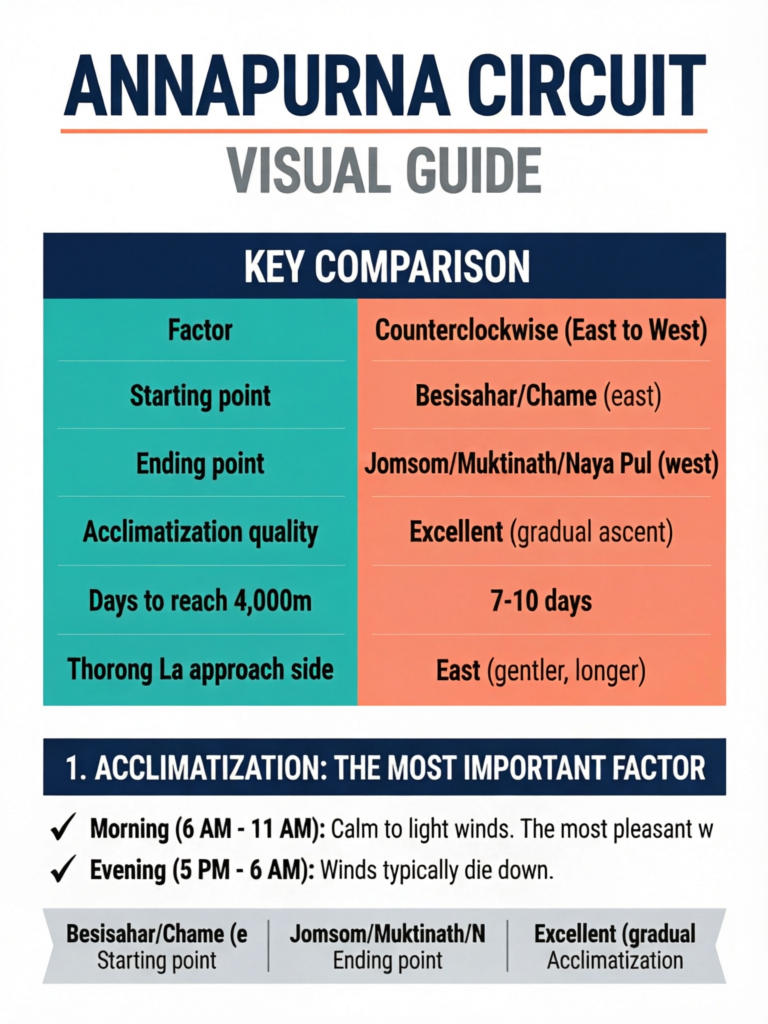
Counterclockwise (Besisahar/Chame to Jomsom). Chosen by 90-95% of trekkers.
Counterclockwise: gradual gain over 7-10 days. Clockwise: rapid gain in 3-5 days.
Counterclockwise: east side (gentler gradient). Clockwise: west side (steeper, 1,600m gain).
Counterclockwise: wind at your back (Kali Gandaki). Clockwise: headwind on Kali Gandaki.
Counterclockwise: significantly safer acclimatization profile.
Counterclockwise: with the majority. Clockwise: against traffic.
Counterclockwise: gradual build to dramatic Thorong La climax. Clockwise: dramatic start, gradual wind-down.
Counterclockwise: easier start, hard climax. Clockwise: hard start, easier finish.
Counterclockwise: tea houses expect this flow. Clockwise: some logistical friction.
Counterclockwise for nearly all trekkers. Clockwise only in specific circumstances.
Master Comparison Table
| Factor | Counterclockwise (East to West) | Clockwise (West to East) | Advantage |
|---|---|---|---|
| Starting point | Besisahar/Chame (east) | Jomsom/Muktinath (west) | Tie |
| Ending point | Jomsom/Muktinath/Naya Pul (west) | Besisahar/Chame (east) | Tie |
| Acclimatization quality | Excellent (gradual ascent) | Poor (rapid altitude gain) | CCW |
| Days to reach 4,000m | 7-10 days | 2-4 days | CCW |
| Thorong La approach side | East (gentler, longer) | West (steeper, shorter) | CCW |
| Thorong La elevation gain on crossing day | 600-1,000m up, 1,600m down | 1,600m up, 600-1,000m down | CCW |
| AMS risk | Lower | Higher | CCW |
| Thorong La success rate | 85-90% | 60-75% (estimated) | CCW |
| Prevailing wind | At your back (descending Kali Gandaki) | In your face (ascending Kali Gandaki) | CCW |
| Crowd flow | With 90-95% of trekkers | Against traffic | CCW (or CW if seeking solitude) |
| Scenery narrative | Build-up to climax | Climax first, gradual descent | CCW |
| Tea house logistics | Oriented for CCW flow | Possible friction | CCW |
| Fitness build | Easier days first, harder later | Hard days first, easier later | Tie (preference-dependent) |
| Escape routes if ill | Descend the way you came (eastward) | Descend toward Jomsom (westward, road access) | CW (faster evacuation from altitude) |
| Views walking direction | Mountain views ahead on approach | Mountain views behind on approach | CCW |
CCW = Counterclockwise, CW = Clockwise
1. Acclimatization: The Most Important Factor
The acclimatization comparison is the single most compelling reason to trek counterclockwise, and it is a safety issue, not just a comfort preference.
Counterclockwise Acclimatization Profile
Walking counterclockwise, your altitude progression looks like this:
| Day | Location | Altitude | Daily Gain |
|---|---|---|---|
| 1 | Besisahar | 760m | Starting point |
| 2 | Bahundanda/Jagat | 1,300-1,340m | 540-580m |
| 3 | Dharapani/Chame | 1,860-2,670m | 500-1,370m |
| 4 | Chame | 2,670m | Rest or short gain |
| 5 | Upper Pisang | 3,300m | 630m |
| 6 | Manang | 3,540m | 240m |
| 7 | Manang rest day | 3,540m | Acclimatization hike |
| 8 | Yak Kharka | 4,018m | 478m |
| 9 | Thorong Phedi | 4,450m | 432m |
| 10 | Thorong La (5,416m) to Muktinath (3,710m) | Cross and descend | +966m then -1,616m |
Key acclimatization features:
- You spend 7-9 days gradually ascending from 760m to 4,450m before crossing the pass
- You gain altitude slowly, rarely exceeding 500m per day above 3,000m
- You have a rest day in Manang (3,540m) for acclimatization
- Your body has nearly a week above 3,000m before reaching 5,416m
- The "climb high, sleep low" principle is naturally built into the route
This altitude profile follows every major mountaineering and trekking organization's acclimatization guidelines. It is one of the reasons the Annapurna Circuit has a high success rate and relatively low altitude sickness incidence.
Clockwise Acclimatization Profile
Walking clockwise, the altitude profile is dramatically different:
| Day | Location | Altitude | Daily Gain |
|---|---|---|---|
| 1 | Jomsom | 2,720m | Starting point |
| 2 | Muktinath | 3,800m | 1,080m |
| 3 | Thorong La (5,416m) to Thorong Phedi/Ledar (4,450-4,250m) | Cross and descend | +1,616m then -966m |
| 4 | Yak Kharka/Manang | 4,018-3,540m | Descending |
| ... | Continue descent through circuit | Gradually lower | Descending |
Key acclimatization problems:
- You arrive in Jomsom at 2,720m (already moderate altitude)
- By day two, you sleep at 3,800m in Muktinath (a 1,080m gain)
- By day three, you attempt to cross Thorong La at 5,416m, gaining 1,616m in a single day from your sleeping altitude
- You have had virtually no acclimatization time above 3,000m
- Your body has not adapted to altitude before attempting the highest and most demanding day
This profile violates fundamental acclimatization principles. Ascending 1,616m in a single day from 3,800m to 5,416m, with only one night above 3,000m, is a recipe for severe altitude sickness.
Clockwise Acclimatization Danger
Trekking the Annapurna Circuit clockwise without adequate acclimatization is genuinely dangerous. Ascending from Muktinath (3,710m) to Thorong La (5,416m) with only 1-2 days above 3,000m dramatically increases the risk of acute mountain sickness (AMS), high altitude pulmonary edema (HAPE), and high altitude cerebral edema (HACE). These conditions can be fatal if not recognized and treated promptly. If you choose to trek clockwise, you MUST add 3-5 extra acclimatization days in the Muktinath/Kagbeni area before attempting Thorong La. This largely negates the time advantage some clockwise trekkers seek.
Acclimatization Verdict
Counterclockwise is dramatically safer. The gradual altitude gain over 7-10 days provides textbook acclimatization. The clockwise direction requires deliberate additional acclimatization days that most trekkers do not plan for, creating a serious safety gap. This single factor is sufficient reason for the near-universal counterclockwise recommendation.
2. Thorong La: East Side vs West Side Approach
The character of Thorong La changes completely depending on which side you approach from.
Counterclockwise: East Side Approach (Standard)
Approaching from the east (counterclockwise), the Thorong La crossing looks like this:
Start: Thorong Phedi (4,450m) or High Camp (4,800-4,900m) Summit: Thorong La (5,416m) Elevation gain: 600-1,000m (from Phedi) or 500-600m (from High Camp) Ascent time: 4-6 hours from Phedi, 3-4 hours from High Camp Character of ascent: Steady, moderate gradient on a well-worn trail. Switchbacks through scree and rock. The trail is wide and well-marked. The gradient is steep but never extreme. Hands are not needed.
Descent (west side): 1,616m descent from the pass to Muktinath over 3-4 hours. Steep, knee-punishing descent through rocky terrain into the dramatically different Mustang landscape. Long but straightforward.
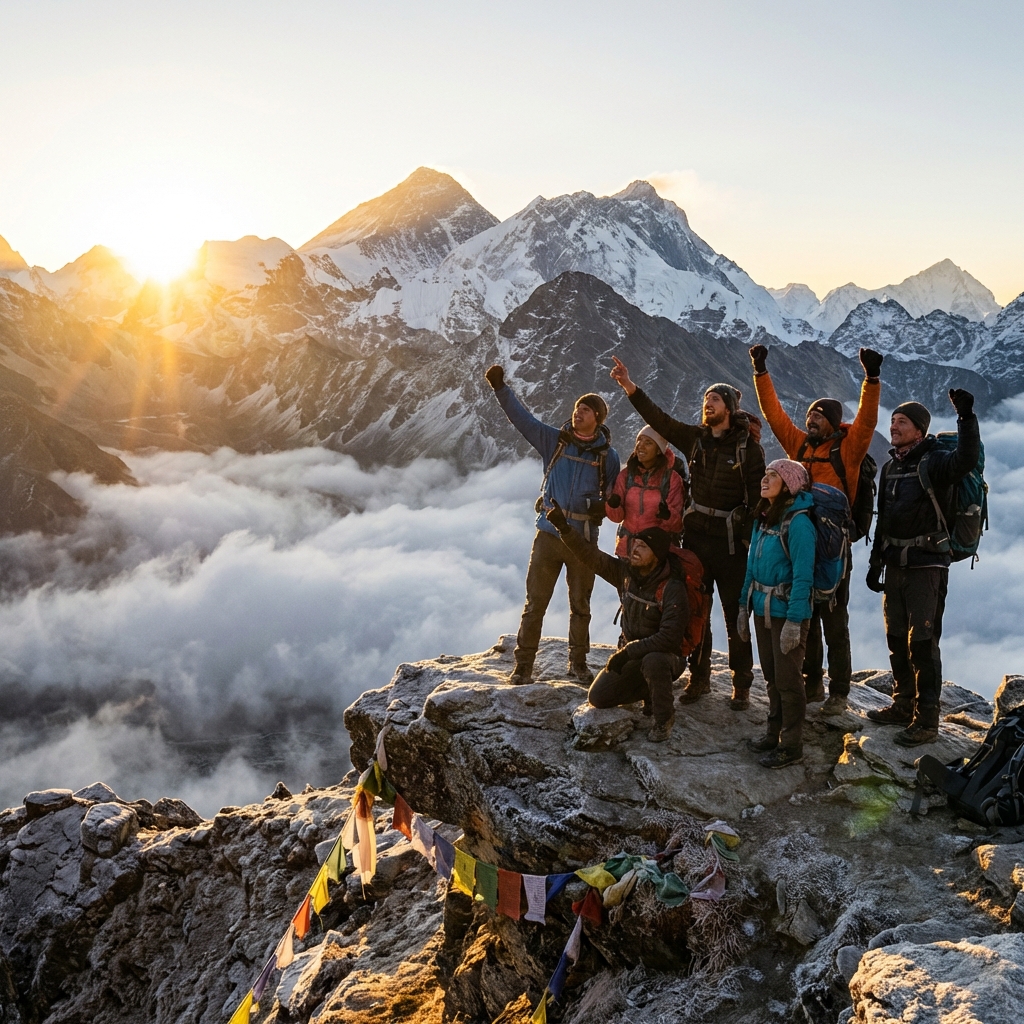
The experience: You wake before dawn, climb steadily upward through darkness into sunrise, and reach the prayer-flag-festooned pass as the Himalayan panorama reveals itself. The descent is long and dramatic, dropping into a completely different world. The entire day has a narrative arc: darkness to light, effort to achievement, one landscape to another.
Clockwise: West Side Approach
Approaching from the west (clockwise), the crossing reverses:
Start: Muktinath (3,710m) Summit: Thorong La (5,416m) Elevation gain: 1,616m Ascent time: 6-8 hours (more if unacclimatized) Character of ascent: The west side is steeper than the east. You gain 1,616m in a single ascent, one of the largest single-day altitude gains on any major trekking route. The trail is less established from this direction (fewer trekkers means less worn path). Some sections involve steep, loose scree that is more challenging to ascend than descend. The gradient is relentless.
Descent (east side): 600-1,000m descent from the pass to Thorong Phedi or High Camp over 2-3 hours. Gentler gradient, well-worn trail. Relatively comfortable.
The experience: You face a grueling 1,616m climb that is both physically exhausting and altitude-dangerous. If not properly acclimatized, this is where altitude sickness strikes. The descent is easier but by this point you have been walking for 8-10 hours at extreme altitude.
Thorong La Verdict
Counterclockwise is significantly easier and safer. The east side approach gains only 600-1,000m (from Phedi/High Camp) versus 1,616m from the west. The descent on the west side (1,616m down) is hard on the knees but far easier than climbing that same distance. The gradient is gentler on the east approach. The trail is better worn and marked.
Clockwise turns Thorong La into a substantially harder challenge that compounds the acclimatization problem: you are less acclimatized AND facing a harder ascent. This double disadvantage is why clockwise success rates on Thorong La are estimated at 60-75%, compared to 85-90% for counterclockwise.
Pro Tip
If trekking counterclockwise, consider sleeping at High Camp (4,800-4,900m) rather than Thorong Phedi (4,450m) the night before the crossing. High Camp reduces the next morning's ascent by 350-450m and allows a later start. The accommodation at High Camp is more basic than Phedi, but the easier crossing day is worth the less comfortable night. Your guide can advise based on your acclimatization status and the weather forecast.
3. Wind: The Kali Gandaki Factor
The Kali Gandaki valley, which forms the western portion of the Annapurna Circuit, is the world's deepest gorge and acts as a massive wind tunnel. Understanding the wind pattern is important for direction choice.
The Wind Pattern
The Kali Gandaki wind follows a daily pattern driven by differential heating between the Tibetan Plateau and the Indian lowlands:
- Morning (6 AM - 11 AM): Calm to light winds. The most pleasant walking conditions.
- Late morning to afternoon (11 AM - 5 PM): Strong winds blow up the valley from south to north. Gusts can reach 40-60 km/h. Dust, sand, and debris make walking unpleasant.
- Evening (5 PM - 6 AM): Winds typically die down.
This pattern is remarkably consistent during the trekking seasons (October-November, March-May) and is one of the most powerful and predictable wind systems in any trekking area worldwide.
Counterclockwise: Wind at Your Back
Trekking counterclockwise, you descend through the Kali Gandaki valley (from Muktinath/Jomsom toward lower elevations). The prevailing afternoon wind blows in the same direction you are walking: from north to south, pushing you along. Walking with the wind is:
- Physically easier (wind assists your movement)
- More comfortable (no dust blowing in your face)
- Psychologically pleasant (you are not fighting the elements)
- Warmer (wind pushes cool air from behind, not into your face)
Clockwise: Wind in Your Face
Trekking clockwise, you ascend through the Kali Gandaki valley. The prevailing afternoon wind blows directly against you. Walking into the wind is:
- Physically harder (wind resistance adds significant effort)
- Uncomfortable (dust, sand, and grit blown directly at you for hours)
- Psychologically draining (fighting constant headwind is demoralizing)
- Cold (wind chill effect is significant)
Clockwise trekkers in the Kali Gandaki often describe the afternoon wind as the single most unpleasant aspect of their trek. The wind is not dangerous, but it is relentlessly uncomfortable and can turn a 5-hour walking day into a 7-hour ordeal.
Wind Verdict
Counterclockwise avoids the headwind problem entirely. You descend with the wind rather than climbing against it. This makes the western section of the circuit significantly more pleasant.
Clockwise trekkers can mitigate the wind by starting early (before 6 AM) and finishing before the afternoon winds begin. But this requires discipline and limits your daily walking hours, potentially extending the overall trek duration.
Early Morning Strategy for Clockwise Trekkers
If you do trek clockwise through the Kali Gandaki, plan your walking days to start at dawn (5:30-6:00 AM) and finish by 11:00 AM, before the afternoon winds begin. This limits your daily walking to 5-6 hours but avoids the worst headwind conditions. Discuss this strategy with your guide and ensure tea house hosts know you will be departing very early.
4. Crowd Direction and Social Dynamics
Counterclockwise: With the Flow
Trekking counterclockwise, you join 90-95% of fellow trekkers walking the same direction. This means:
- Companions at tea houses: You meet the same trekkers at tea houses each evening, forming natural friendships over multiple days
- Shared experiences: You cross Thorong La with a group of trekkers who have shared the same journey for the past week
- Guide knowledge: All guides walk this direction and know the optimal stops, best tea houses, and daily distances
- Porters and support: The entire support infrastructure (porters, mule trains, supply chains) moves counterclockwise
Clockwise: Against the Current
Trekking clockwise, you walk against the majority of trekkers. This has interesting social implications:
- Brief encounters: You pass counterclockwise trekkers going the other way, exchanging greetings but not forming relationships
- Different tea house dynamics: You arrive at tea houses with few or no other clockwise trekkers, potentially eating alone
- Unique perspective: Trekkers you meet going the other way can tell you about trail conditions ahead (from your direction)
- Feeling of going "wrong way": Some clockwise trekkers report feeling like they are walking against the current, which can be slightly disorienting
The social verdict: Counterclockwise provides a better social experience for most trekkers. Clockwise provides more solitude, which appeals to some experienced trekkers.
5. Scenic Narrative: Build-Up vs Climax-First
The direction you walk determines the scenic story your trek tells.
Counterclockwise: The Grand Crescendo
Walking counterclockwise, the circuit builds from gentle beginnings to a dramatic climax:
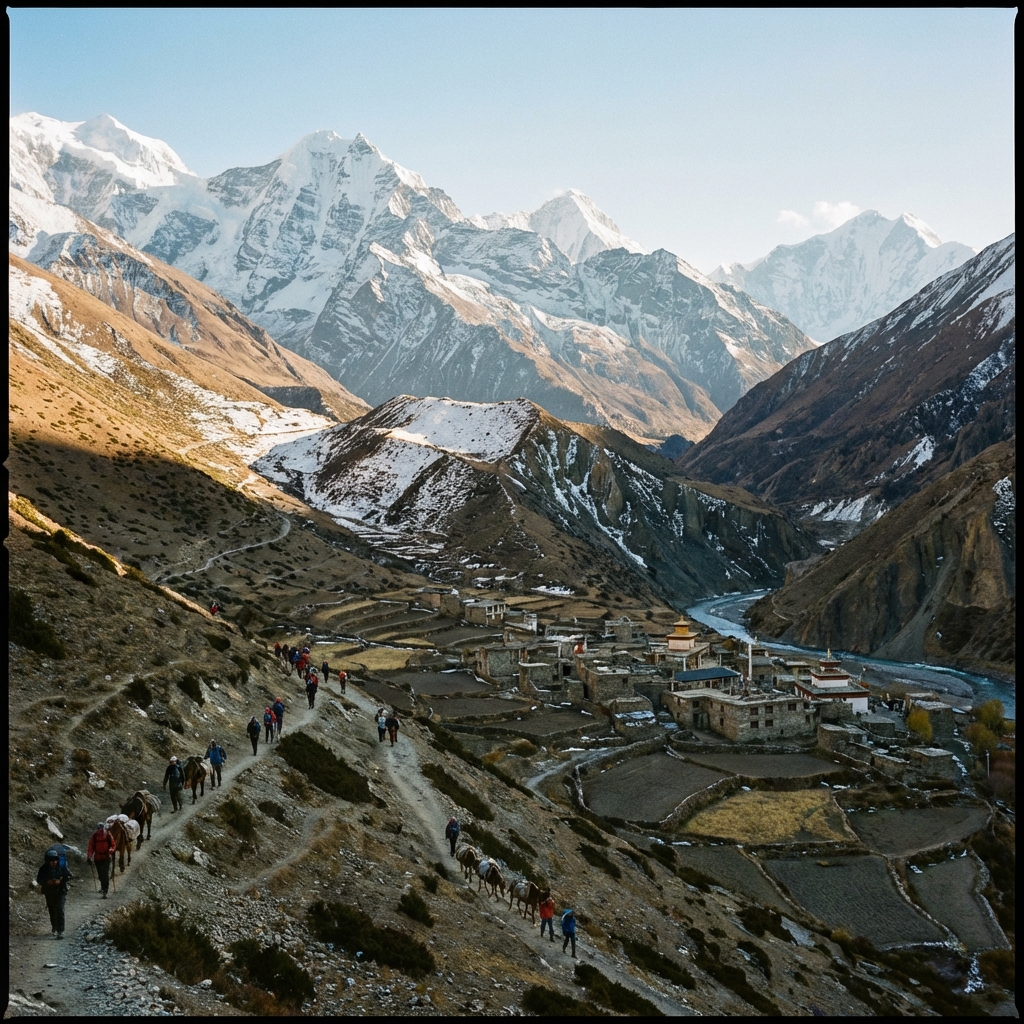
Act 1 (Days 1-4): The Approach Subtropical lowlands, rice paddies, and river valleys. The mountains are distant giants glimpsed through haze. The landscape is lush, warm, and gentle. You are warming up physically and mentally.
Act 2 (Days 5-7): The Alpine Transition As you climb through Manang and the upper Marsyangdi valley, the landscape transforms. Forests give way to scrubland, then alpine meadow. The Annapurna range fills the skyline. The air thins. The sense of elevation and exposure grows daily.
Act 3 (Days 8-10): The Climax The approach to Thorong La, the pre-dawn crossing, the summit panorama, and the dramatic 1,600m descent into the alien Mustang landscape. This is the emotional and physical peak of the trek, perfectly positioned at the moment when you are most acclimatized and most invested in the journey.
Act 4 (Days 11-14): The Resolution The descent through the Kali Gandaki, through apple orchards and Thakali villages, provides a gentle wind-down. The drama is behind you. The body recovers. The memories settle.
This narrative arc, from gentle beginning through building tension to dramatic climax and gentle resolution, is one of the counterclockwise circuit's greatest strengths. It is a complete story.
Clockwise: The Reverse Narrative
Walking clockwise inverts this narrative:
Act 1: Immediate Drama Starting at Jomsom or Muktinath puts you at altitude immediately. The Thorong La crossing comes in the first few days, before you have fully immersed yourself in the trek. The climax arrives before the story has been told.
Act 2-3: Gradual Descent After crossing Thorong La, you spend the remainder of the trek descending through Manang, the forests, and the lowlands. While the scenery is beautiful, the sense of building toward something is absent. Each day is slightly lower, slightly warmer, slightly less dramatic.
Act 4: The Quiet Finish The trek ends in the lowlands, among rice paddies and road traffic. There is no final climax, no dramatic conclusion.
Scenic Verdict
Counterclockwise creates a superior scenic narrative. The build-up, climax, and resolution structure mirrors classic storytelling and creates a more emotionally satisfying experience. Most trekkers remember the Thorong La crossing as the highlight precisely because it arrives after days of anticipation and preparation.
Clockwise puts the climax first, which can feel anticlimactic. The remaining days after Thorong La, while beautiful, lack the narrative tension that counterclockwise builds.
Pro Tip
Counterclockwise trekkers experience a remarkable "reveal" moment in the Manang Valley, typically around Upper Pisang or Ghyaru, where the Annapurna range suddenly dominates the skyline ahead of you. This view is behind you if you trek clockwise, which means you might not even notice it. The direction of your gaze while walking matters enormously for how you experience the mountains.
Pro Tip
If you are photographing the Annapurna Circuit, the counterclockwise direction keeps the major mountain views consistently ahead of you and to your left during the Manang Valley approach. This means the afternoon sun illuminates the mountain faces you are walking toward, creating warm, dramatic light on the peaks. Clockwise trekkers see these same peaks behind them, requiring constant turning to photograph effectively, and the lighting angle is less favorable for the approach direction.
6. Tea House Logistics
Nepal's tea house system on the Annapurna Circuit is organized around the counterclockwise flow.
Counterclockwise Logistics
- Tea house spacing: Distances between tea houses are calibrated for counterclockwise daily stages. The standard daily walks end at villages with adequate accommodation.
- Room availability: Tea house owners expect the flow of trekkers moving counterclockwise. Room booking, food preparation, and staffing are oriented to this pattern.
- Supply chains: Food and supplies move up the circuit from both sides, but the service rhythm matches counterclockwise trekker flow.
- Guide familiarity: Every guide knows the counterclockwise stops, preferred tea houses, and daily distances.
Clockwise Logistics
- Tea house spacing mismatch: The daily stages walking clockwise may not align well with tea house locations. A comfortable counterclockwise day might be too long or too short in reverse.
- Unexpected arrivals: Tea house owners may not expect clockwise trekkers, leading to surprise arrivals at off-hours or confusion about bookings.
- Less refined recommendations: Fewer guides walk clockwise regularly, meaning less refined knowledge of the best stops and lodges in this direction.
- Supply chain quirks: Some tea houses near Thorong La may not be stocked or staffed for clockwise arrivals (especially early in the season).
Logistics Verdict
Counterclockwise is logistically smoother. The infrastructure is designed for this flow. While clockwise is certainly possible (tea houses serve trekkers from both directions), the experience is slightly less optimized.
7. When Clockwise Might Make Sense
Despite the strong counterclockwise recommendation, there are a few specific scenarios where clockwise could be the better choice:
Scenario 1: Already Acclimatized
If you have just completed another high-altitude trek in Nepal (for example, Langtang Valley to 4,984m) and are already acclimatized above 4,000m, the clockwise acclimatization disadvantage is eliminated. You can safely ascend to Thorong La without the gradual build-up. This is the strongest argument for clockwise direction.
Scenario 2: Repeat Trekker Seeking a New Experience
If you have already trekked the circuit counterclockwise and want to experience it differently, walking clockwise transforms familiar terrain into something new. The mountains you saw ahead are now behind you. The villages arrive in reverse order. The experience is genuinely different.
Scenario 3: Logistical Constraints
If your travel logistics make it significantly easier to start from the Jomsom side (for example, you are already in Pokhara and have limited time to reach Besisahar), clockwise allows a quicker start. However, add adequate acclimatization days before attempting Thorong La.
Scenario 4: Avoiding Crowds Deliberately
The few clockwise trekkers report a much quieter experience. With 90-95% of trekkers coming the other way, clockwise trekkers often have tea houses to themselves. For solitude seekers, this is a genuine advantage.
Scenario 5: Fitness Profile Suits Front-Loading Difficulty
Some very fit trekkers prefer to tackle the hardest challenge (Thorong La from the west, 1,616m gain) when they are freshest, even at the cost of harder acclimatization. They would rather grind out a huge ascent on day 3 than on day 10 when cumulative fatigue has built up.
Clockwise Acclimatization Protocol
If you choose to trek clockwise, follow this minimum acclimatization protocol before attempting Thorong La. Spend at least 2 nights in Kagbeni (2,810m). Spend at least 2 nights in Muktinath (3,710m) with an acclimatization hike to 4,200-4,400m. Only attempt Thorong La after at least 4-5 days above 2,800m. If you experience any altitude sickness symptoms in Muktinath, do not proceed upward. This protocol adds 3-4 days to the clockwise itinerary, which many trekkers do not account for, reducing the time savings that clockwise theoretically offers.
Which Direction Is Safer?
Counterclockwise is dramatically safer. The gradual altitude gain over 7-10 days provides textbook acclimatization before crossing Thorong La Pass at 5,416m. Clockwise trekkers face a dangerous 1,616m ascent from Muktinath with minimal acclimatization time, dramatically increasing altitude sickness risk. See our Annapurna Circuit difficulty assessment for detailed safety information.
Which Direction Has Better Views?
Counterclockwise provides a superior scenic experience. Walking this direction keeps the major Annapurna mountain views consistently ahead of you during the Manang Valley approach. The scenic narrative builds from gentle lowlands to a dramatic Thorong La climax. Clockwise puts the climax first, which many trekkers find anticlimactic. For photography, afternoon sun illuminates mountain faces you walk toward counterclockwise.
Which Direction Is More Popular?
Counterclockwise is chosen by 90-95% of trekkers. This means walking counterclockwise places you in the flow with companions at tea houses, shared Thorong La crossing experiences, and infrastructure calibrated for this direction. Clockwise trekkers walk against the current, which offers more solitude but fewer social connections. See our Annapurna Circuit itinerary for the standard counterclockwise plan.
8. The Expert Recommendation
The recommendation of experienced guides, agencies, the ACAP office, and trekking authorities is near-unanimous: trek the Annapurna Circuit counterclockwise.
Why guides prefer counterclockwise:
- Safer acclimatization reduces guide stress and liability
- Higher Thorong La success rate means happier clients
- Better scenic narrative creates more satisfying overall experience
- Infrastructure alignment reduces logistical problems
- Wind comfort on the Kali Gandaki section improves client satisfaction
- Familiarity with counterclockwise stops allows better tea house recommendations
Why the ACAP office supports counterclockwise:
- Fewer altitude sickness incidents mean fewer rescues and evacuations
- Consistent trekker flow simplifies checkpoint management
- Safety record is stronger for counterclockwise trekkers
The only guides who routinely recommend clockwise are those accompanying already-acclimatized clients on repeat treks or those combining the circuit with other high-altitude treks in the region.
Frequently Asked Questions
Is it actually possible to trek the Annapurna Circuit clockwise?
Yes, it is entirely possible and legal. There are no regulations requiring a specific direction. Tea houses serve trekkers from both directions, and ACAP checkpoints process permits regardless of direction. The counterclockwise recommendation is based on safety and experience quality, not rules.
How many extra days does clockwise require for acclimatization?
Add at least 3-4 days for acclimatization before attempting Thorong La from the west. This means spending extra time in the Kagbeni/Muktinath area hiking to higher elevations and sleeping low. Without these days, the altitude sickness risk is unacceptably high.
Is clockwise faster than counterclockwise?
Not when you add proper acclimatization days. The counterclockwise direction naturally builds acclimatization into the walking days. Clockwise requires dedicated acclimatization days before Thorong La that counterclockwise trekkers do not need. Net result: similar total duration for a safe clockwise trek.
Will tea houses refuse to serve clockwise trekkers?
No. Tea houses welcome trekkers from both directions. You may encounter surprise or curiosity from hosts and fellow trekkers, but service will not be affected. Some tea house owners may need a moment to adjust their expectations (they may have prepared rooms assuming counterclockwise arrivals at certain times), but this is minor.
Do I need a different permit for clockwise trekking?
No. The ACAP permit and TIMS card are identical regardless of direction. Checkpoints process permits in both directions.
Is the west side of Thorong La dangerous in the clockwise direction?
The west side is steeper than the east, making it a harder ascent but not technically dangerous. The danger comes from attempting it without adequate acclimatization, not from the terrain itself. The trail is rough but walkable. The primary risk is altitude sickness due to rapid altitude gain, not trail difficulty.
Can I do a partial counterclockwise and partial clockwise?
Some trekkers combine elements. For example, you could trek counterclockwise to Manang, cross Thorong La, and then retrace back to Manang rather than continuing to Jomsom. However, this creates an out-and-back format that loses the circuit's loop advantage. It is uncommon and generally not recommended.
What do counterclockwise trekkers I meet think of clockwise trekkers?
Reactions range from curiosity to mild admiration to concern. Many counterclockwise trekkers assume clockwise trekkers are either very experienced or not well-informed. You will be asked "why clockwise?" frequently. Have an answer ready.
Is the Kali Gandaki wind really that bad?
Yes, during the afternoon it is powerful, consistent, and unpleasant to walk into. The wind is a defining feature of the Kali Gandaki valley and has been documented as one of the world's most powerful valley wind systems. Walking into it for multiple days is one of the most commonly cited complaints from clockwise trekkers.
Should a first-time trekker ever go clockwise?
No. First-time Annapurna Circuit trekkers should always trek counterclockwise. The acclimatization advantages, easier Thorong La approach, and overall experience quality make counterclockwise the only responsible recommendation for first-timers. Clockwise should only be considered by experienced, already-acclimatized trekkers with specific reasons.
Related Resources
- Annapurna Circuit 15-Day Itinerary
- Thorong La Pass Guide
- Annapurna Circuit Difficulty Assessment
- Annapurna Circuit vs EBC
- Annapurna Circuit vs Manaslu Circuit
- Best Time to Trek Nepal
Final Verdict: Counterclockwise, Almost Always
The counterclockwise direction is recommended for the Annapurna Circuit for reasons that are not arbitrary or conventional. They are rooted in human physiology (acclimatization), meteorology (wind patterns), geography (Thorong La gradients), infrastructure (tea house orientation), and narrative psychology (scenic build-up). Every major factor favors counterclockwise, and no single factor compellingly favors clockwise.
Trek the Annapurna Circuit counterclockwise. Start from Besisahar or Chame, build your strength and acclimatization through the stunning Marsyangdi valley, immerse yourself in Manang's Tibetan-influenced culture, cross Thorong La from its gentler east side at the perfect moment of your acclimatization, descend dramatically into Muktinath and the Mustang landscape, and walk home through the Kali Gandaki with the wind at your back and the world's deepest gorge around you.
The circuit was meant to be walked this way. Your body, your lungs, and your memories will thank you.
The only exception: if you are already acclimatized, have done the circuit before, and deliberately want a different experience, clockwise offers a genuinely novel perspective on familiar terrain. But even then, you will understand why 90-95% of trekkers walk the other way.
Last updated: February 2026. All data verified against ACAP office records (Manang and Jomsom), TAAN licensed agency reports, and Nepal Tourism Board data from the 2026/2027 trekking season. Wind patterns and Thorong La conditions reflect multi-year observations from ACAP monitoring stations.