
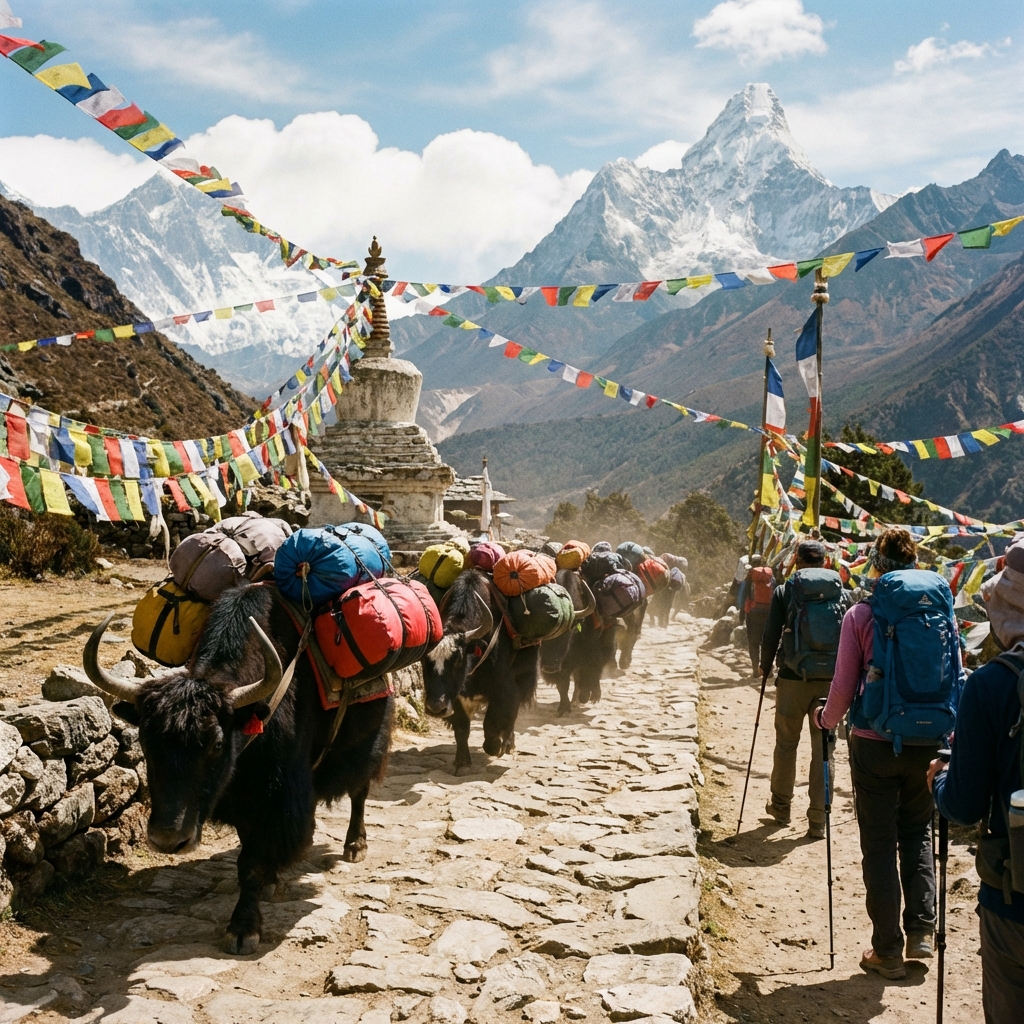
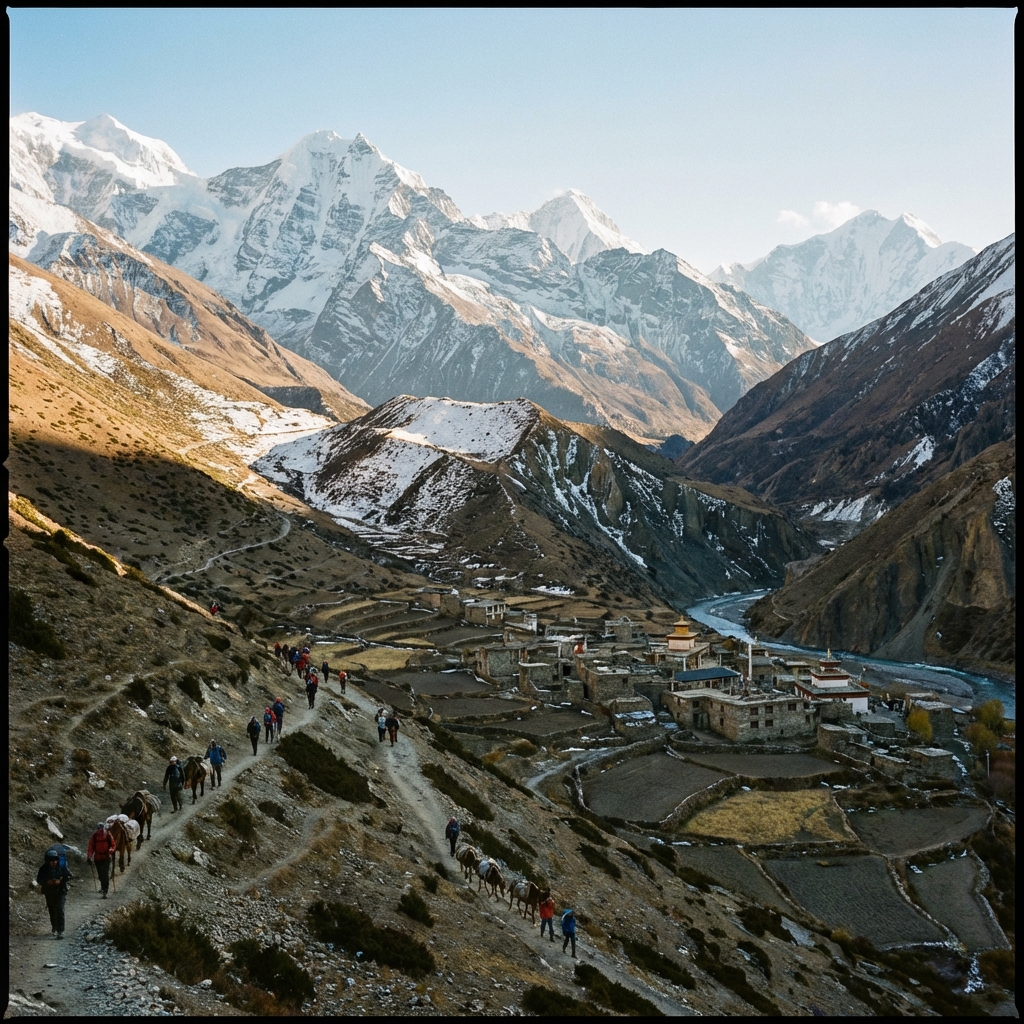
Standing at the crossroads between Nepal's two most legendary circuit treks—the iconic Annapurna Circuit with its mighty Thorong La Pass and the increasingly celebrated Manaslu Circuit with its remote Larkya La crossing—requires more than casual research. This decision fundamentally shapes your Himalayan experience: the crowds you'll encounter, the infrastructure you'll navigate, the cultural authenticity you'll witness, the physical demands you'll face, and the memories you'll carry home from the roof of the world.
This comprehensive comparison guide delivers what generic blog posts cannot: verified data from the 2026/2027 trekking season, honest assessments from agencies who guide both routes daily, altitude profiles showing critical acclimatization differences, cost breakdowns revealing hidden expenses, cultural insights that go beyond tourist clichés, and candid analysis of the road construction impact that has transformed one trek while leaving the other pristine. We've analyzed trekker statistics (200,000+ on Annapurna vs 12,000 on Manaslu), permit requirements, teahouse infrastructure evolution, emergency evacuation logistics, seasonal weather patterns, and the fundamental character differences that make each trek uniquely compelling.
The fundamental difference: The Annapurna Circuit offers the world's most diverse trekking experience—traversing from subtropical jungle to high-altitude desert while crossing the higher Thorong La Pass (5,416m). However, road construction has significantly altered the classic experience, crowds remain substantial (200,000+ annually), and commercialization has diluted cultural authenticity in many villages. The Manaslu Circuit delivers a more challenging, culturally immersive alternative with dramatic remoteness, authentic Tibetan villages virtually unchanged by tourism, the technically demanding Larkya La Pass (5,160m) that's harder despite being lower, and just 12,000 annual trekkers—essentially offering the "Annapurna experience" as it existed in the golden era before roads and mass tourism arrived.
Who should read this guide:
- Trekkers who've completed one circuit and are considering the other
- First-time Nepal visitors choosing their inaugural Himalayan circuit adventure
- Experienced hikers seeking honest difficulty comparisons beyond marketing claims
- Cultural travelers prioritizing authentic experiences over established infrastructure
- Budget-conscious adventurers weighing cost versus experience value
- Anyone confused by conflicting online information about these legendary treks
- Trekkers concerned about road construction impact and seeking the most pristine experience
- Adventurers trying to understand which pass crossing (Thorong La vs Larkya La) is genuinely harder
Quick Comparison: Side-by-Side Overview
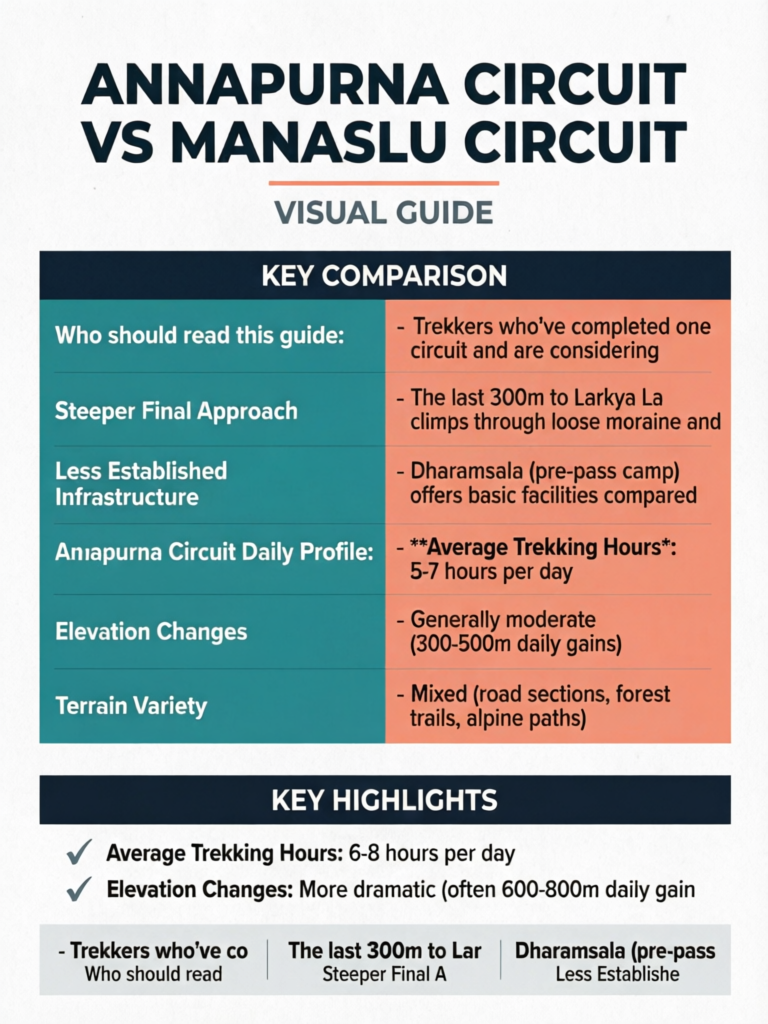
| Route | Duration | Max Altitude | Difficulty | Permits | Teahouses | Crowds |
|---|---|---|---|---|---|---|
| Annapurna Circuit | 12-21 days | 5,416m (Thorong La) | Difficult | $40-50 | Excellent | Moderate-High (200,000+ annually) |
| Manaslu Circuit | 14-18 days | 5,160m (Larkya La) | Challenging-Difficult | $150-200 | Basic-Moderate | Low (12,000 annually) |
At-a-Glance: The Critical Differences
Annapurna: 200,000+ trekkers/year | Manaslu: 12,000 trekkers/year (94% fewer)
Larkya La harder despite being 256m lower - longer crossing, steeper terrain, weather unpredictable
Manaslu $100-150 more expensive (restricted area permit + mandatory guide)
Both mandatory as of 2026-2026 season (Nepal government regulation)
Annapurna heavily affected lower sections | Manaslu pristine throughout
Manaslu significantly more traditional/less commercialized Tibetan culture
Annapurna superior facilities | Manaslu basic but adequate, improving yearly
Annapurna No minimum (solo OK with guide)56m higher (5,416m vs 5,160m) but easier terrain at pass
Manaslu typically 2-4 days longer for proper acclimatization
Both accessible by road (7-8 hours from Kathmandu/Pokhara)
Annapurna better access via Jomsom | Manaslu more remote/expensive
Annapurna wins: 6 climate zones | Manaslu: 4 zones but dramatic gorges
Annapurna: Diverse scenery, infrastructure | Manaslu: Remoteness, authentic culture
1. Difficulty Comparison: The Pass Crossing Question
The difficulty question dominates every Annapurna vs Manaslu conversation, and the answer defies expectations. While Annapurna Circuit reaches significantly higher maximum altitude (5,416m vs 5,160m at Larkya La Pass), Manaslu is objectively harder due to the Larkya La crossing demands, more remote terrain requiring longer consecutive trekking days, steeper ascent/descent profiles, less predictable weather windows at the pass, and the psychological challenge of crossing without the safety net of Annapurna's superior infrastructure.
Pass Comparison: Thorong La (5,416m) vs Larkya La (5,160m)
Why Larkya La Is Harder Despite Being Lower
This counterintuitive reality confuses many trekkers. Here's the honest breakdown from guides who've crossed both passes hundreds of times:
Larkya La's Challenge Factors:
-
Longer Continuous Exposure: The Larkya La crossing day averages 8-10 hours compared to Thorong La's 6-8 hours. You spend more time above 5,000m with no bailout options.
-
Steeper Final Approach: The last 300m to Larkya La climbs through loose moraine and often icy sections requiring microspikes. Thorong La's approach is more gradual.
-
Weather Unpredictability: Larkya La sits in a more exposed position with notoriously fickle weather. Morning clear skies can turn to whiteout conditions by noon. Thorong La benefits from more stable weather patterns.
-
Longer Descent: The 1,570m descent from Larkya La to Bhimtang is brutal on knees and takes 4-5 hours. Thorong La's descent to Muktinath, while longer in elevation, follows a better trail.
-
Remoteness Factor: If you struggle on Larkya La, you're committed—no roads, limited helicopter landing zones, and you're genuinely remote. Thorong La has better emergency options via Muktinath.
-
Less Established Infrastructure: Dharamsala (pre-pass camp) offers basic facilities compared to Thorong Phedi/High Camp's more developed teahouses.
Pro Tip
Don't let the altitude numbers fool you. We've guided hundreds of trekkers who found Larkya La significantly harder than Thorong La. The combination of longer exposure time, steeper terrain, and weather unpredictability makes Manaslu the more demanding circuit despite being 256m lower at the pass. If you're choosing your first circuit trek and altitude concerns you, Annapurna offers the "easier difficult" option.
Maximum Altitude & Acclimatization Profiles
Daily Trekking Demands
Beyond pass crossings, understanding the day-to-day physical demands reveals important differences:
Annapurna Circuit Daily Profile:
- Average Trekking Hours: 5-7 hours per day
- Elevation Changes: Generally moderate (300-500m daily gains)
- Terrain Variety: Mixed (road sections, forest trails, alpine paths)
- Rest Day Flexibility: Multiple villages allow flexible scheduling
- Longest Day: Thorong La crossing (6-8 hours)
- Toughest Consecutive Days: Manang to Thorong Phedi to Muktinath (3 days)
Manaslu Circuit Daily Profile:
- Average Trekking Hours: 6-8 hours per day
- Elevation Changes: More dramatic (often 600-800m daily gains)
- Terrain Variety: Rugged throughout (gorge trails, suspension bridges, alpine)
- Rest Day Flexibility: Limited to Samagaon/Samdo primarily
- Longest Day: Larkya La crossing (8-10 hours)
- Toughest Consecutive Days: Samdo to Dharamsala to Bhimtang to Dharapani (4 days with minimal rest)
Altitude Sickness Risk & Management
Both circuits present significant altitude challenges, but with important differences:
Annapurna Circuit AMS Factors:
- Advantages: Well-established acclimatization schedule, multiple evacuation routes, excellent phone coverage above Manang, helicopter rescue readily available via Jomsom
- Disadvantages: Temptation to rush due to road access/time pressure, some trekkers drive lower sections missing gradual acclimatization benefits
- Critical Acclimatization Stops: Manang area (3,540m) - spend 2-3 days with day hikes to Tilicho Base Camp, Gangapurna Lake, or Praken Gompa
- Evacuation Options: Excellent - road access from multiple points, Jomsom has airstrip and hospital
Manaslu Circuit AMS Factors:
- Advantages: Gradual approach up Budhi Gandaki valley provides natural acclimatization, fewer trekkers means less pressure to keep pace with crowds
- Disadvantages: More remote with limited evacuation options, communication gaps in several sections, helicopter rescue expensive and weather-dependent
- Critical Acclimatization Stops: Samagaon (3,530m) and Samdo (3,860m) - essential to spend extra days here, side trips to Pungyen Gompa (4,000m) or Manaslu Base Camp (4,800m) highly recommended
- Evacuation Options: Limited - helicopter required for serious cases, weather often prevents rescue for days
Pro Tip
For both circuits, the golden rule remains unchanged: "Climb high, sleep low." In Manang (Annapurna) or Samagaon (Manaslu), take acclimatization day hikes 400-600m above sleeping altitude, then descend to sleep. This dramatically reduces AMS risk. Never skip recommended acclimatization days to "save time"—altitude sickness doesn't care about your schedule, and evacuation costs ($3,000-7,000) far exceed an extra day's accommodation ($15-25).
2. The Crowd Factor: 200,000 vs 12,000 Trekkers
Perhaps no factor differs more dramatically between these circuits than crowd levels. The numbers tell a stark story: the Annapurna region (including all Annapurna treks) welcomed approximately 200,000 trekkers in 2026, with roughly 35,000-40,000 specifically on the Circuit route. The Manaslu Circuit hosted just 12,000 trekkers in the same period—a staggering 94% difference that fundamentally transforms the trekking experience.
Trekking Season Crowd Realities
What Crowd Differences Mean Practically
On the Annapurna Circuit:
Advantages of Higher Traffic:
- Better teahouse availability (no booking stress)
- More social opportunities with fellow trekkers
- Well-established trail infrastructure
- Frequent shops/services along route
- Sense of community on challenging days
Disadvantages:
- Teahouses can fill up during peak October-November window (booking 1-2 days ahead recommended)
- Trail "traffic jams" on popular sections
- Pass day feels crowded (40-60 trekkers crossing simultaneously during peak season)
- Less opportunity for solitude/reflection
- Villages heavily commercialized in tourism zones
- Constant "Hello trekking?" from tea house touts in some areas
On the Manaslu Circuit:
Advantages of Lower Traffic:
- Genuine solitude on most trail sections
- Authentic cultural interactions (villagers genuinely curious about trekkers)
- Pristine photography opportunities
- Peaceful tea house environments
- Sense of remote adventure
- Villages function for local communities first, tourists second
Disadvantages:
- Must book teahouses 1-2 days ahead during peak season (guide handles this)
- Fewer social opportunities with other trekkers
- Limited services/shops in villages
- Can feel isolated during difficult moments
- Less "safety in numbers" psychological comfort
Pro Tip
If you've trekked popular routes like Everest Base Camp (50,000+ annual trekkers) or Annapurna Base Camp (100,000+ annual trekkers) and felt overwhelmed by crowds, Manaslu offers a dramatically different experience. You'll go hours without seeing another trekker group, teahouses feel like family homes rather than hotels, and the sense of pioneering adventure—despite the well-established trail—remains intact. Conversely, if you appreciate the social aspect of trekking and enjoy comparing experiences with fellow adventurers nightly, Annapurna's busier lodges provide that community atmosphere.
Impact on Cultural Authenticity
The crowd differential creates profoundly different cultural experiences:
Annapurna Circuit Cultural Reality:
- Commercialization Level: High in main villages (Manang, Muktinath, Jomsom)
- English Proficiency: Excellent in tourism villages
- Traditional Livelihoods: Tourism dominates; traditional agriculture/trade secondary
- Cultural Performances: Often staged for tourists
- Monastery Experiences: Open to tourists, donation expectations clear
- Local Interactions: Transactional (guest-host) in nature
- Children's Behavior: "Namaste! Chocolate? Pen?" common
- Authenticity Assessment: Moderate—culture exists but shaped by 40+ years of tourism
Manaslu Circuit Cultural Reality:
- Commercialization Level: Low—villages retain traditional character
- English Proficiency: Basic in most villages; Tibetan/Nepali primary languages
- Traditional Livelihoods: Agriculture, animal husbandry, trade remain primary; tourism supplemental
- Cultural Performances: Genuine festivals if timing aligns; no staged shows
- Monastery Experiences: Active religious centers; visitors welcomed but not catered to
- Local Interactions: Genuinely curious exchanges, less transactional
- Children's Behavior: Shy but friendly; less conditioned to tourist interactions
- Authenticity Assessment: High—closest to pre-tourism Himalayan culture on major trekking routes
3. Road Construction Impact: The Defining Difference
No comparison between these circuits is honest without addressing the elephant on the trail: road construction. This single factor has transformed the Annapurna Circuit from a pristine wilderness adventure into a mixed experience requiring strategic planning, while Manaslu remains gloriously road-free throughout its entire route.
Annapurna Circuit Road Reality (2026 Status)
The Strategic Annapurna Approach: Avoiding Road Sections
Smart Annapurna Circuit planning in 2026 requires strategic choices to maximize pristine trekking while minimizing road exposure:
The Optimized Itinerary (14-16 days):
-
Skip Lower Besisahar-Chame Section: Drive from Kathmandu/Pokhara directly to Chame (2,670m) or Dharapani (1,860m). This eliminates 3-4 days of dusty road walking with minimal scenic loss.
-
Take Upper Pisang-Manang Route: From Pisang, climb to Upper Pisang, then traverse via Ghyaru (3,670m) and Ngawal (3,660m) to Manang. This spectacular high route is completely road-free with stunning Annapurna panoramas—and it's the single most important routing decision for preserving the classic experience.
-
Walk Manang to Thorong La to Muktinath: This section (5-6 days) remains completely pristine and represents the trek's core appeal. No compromises here.
-
Fly from Jomsom: Rather than walking the road-dominated descent to Nayapul (5-6 days of road), take the spectacular 20-minute flight from Jomsom to Pokhara.
Optional Add-On for Purists:
- Tilicho Lake Side Trip (2-3 days): Completely road-free, adds world's highest lake (4,919m) to itinerary, provides extra acclimatization
Result: This strategic approach preserves 8-10 days of pristine trekking (the best sections) while eliminating 6-8 days of road-impacted walking (the compromised sections). You experience the Annapurna Circuit's core appeal—diverse landscapes, Thorong La crossing, cultural immersion—without the road frustration that disappoints many modern trekkers.
Manaslu Circuit: Pristine Throughout
In stark contrast, the Manaslu Circuit remains entirely road-free from start to finish—a 177-kilometer journey through wilderness exactly as it existed decades ago:
Why Manaslu Remains Pristine:
- Restricted Area Status: Government restrictions limit development and preserve traditional character
- Challenging Terrain: The Budhi Gandaki gorge and Larkya La Pass make road construction economically unfeasible
- Lower Tourist Numbers: 12,000 annual trekkers don't justify major infrastructure investment
- Conservation Priorities: Manaslu Conservation Area Project emphasizes preservation over development
- Political Will: Local communities have actively resisted road construction to preserve trekking tourism
What "Road-Free" Means Practically:
- No Jeep Traffic: Never interrupted by honking vehicles or dust clouds
- Suspension Bridge Crossings: Classic Himalayan experience crossing dramatic gorges
- Authentic Trail Experience: Walking paths used by locals for centuries
- Natural Soundscape: Rivers, birds, prayer flags—no engine noise
- Air Quality: Mountain-fresh air, not diesel fumes
- Traditional Pace: Trek rhythm determined by geography, not infrastructure
Pro Tip
If you're a trekking purist who romanticizes the golden era of Himalayan adventure—when trails were trails, not road detours—Manaslu delivers that experience in 2026 while Annapurna requires strategic compromises. However, if you appreciate the option to shorten your trek via road access (useful if weather, injury, or time constraints arise), Annapurna's road network provides flexibility that Manaslu lacks. Both perspectives are valid; choose based on your priorities.
Future Trajectory: Where Are These Treks Heading?
Annapurna Circuit Outlook:
- Road construction unlikely to reach Thorong La area (technically impossible)
- Core Manang-to-Muktinath section will remain pristine indefinitely
- Lower sections may see road improvement/expansion
- Trekker numbers likely to stabilize or decline slightly as road impact increases
- Verdict: Core experience remains secure, but "classic full circuit" increasingly requires strategic planning
Manaslu Circuit Outlook:
- No road construction planned or feasible for main circuit route
- Teahouse quality steadily improving (basic to moderate standard)
- Trekker numbers growing 15-20% annually but from low base (12,000 to potentially 20,000 by 2028)
- Restricted area status likely to remain (government revenue source)
- Verdict: Will remain relatively pristine for foreseeable future, though gradually less remote as numbers grow
4. Scenery & Landscape Comparison: Diversity vs Drama
Both circuits deliver world-class Himalayan scenery, but with fundamentally different aesthetic characters. The Annapurna Circuit's greatest strength is diversity—traversing six distinct climate zones from subtropical jungle to high-altitude desert. Manaslu counters with dramatic uniformity—the relentless power of deep gorges, Tibetan plateau landscapes, and the imposing presence of the world's eighth-highest peak dominating views throughout the journey.
Landscape Diversity Analysis
The Six Climate Zones of Annapurna Circuit
One of Annapurna Circuit's unique appeals is the botanical and climatic journey—essentially trekking from Nepal to Tibet without crossing borders:
Zone 1: Subtropical (800-1,500m) - Besisahar to Bahundanda
- Vegetation: Rice terraces, banana trees, citrus groves, bamboo
- Climate: Warm and humid, monsoon-influenced
- Cultural Landscape: Gurung villages, Hindu temples
- Wildlife: Langur monkeys, tropical birds
- Note: Road-affected; most trekkers now skip via vehicle
Zone 2: Temperate (1,500-2,500m) - Bahundanda to Chame
- Vegetation: Mixed forests (oak, maple, rhododendron)
- Climate: Moderate temperatures, seasonal rainfall
- Cultural Landscape: Transition from Hindu to Buddhist influence
- Wildlife: Himalayan thar, monal pheasant
- Note: Partial road impact; still pleasant in spring
Zone 3: Subalpine (2,500-3,500m) - Chame to Manang
- Vegetation: Coniferous forests (pine, fir), rhododendron
- Climate: Cool, crisp air, dramatic mountain views emerge
- Cultural Landscape: Tibetan Buddhist villages, mani walls, chortens
- Wildlife: Blue sheep, Himalayan griffon vultures
- Note: This zone showcases Annapurna's emerging grandeur
Zone 4: Alpine (3,500-4,500m) - Manang to Thorong Phedi
- Vegetation: Alpine meadows, juniper scrub, hardy grasses
- Climate: Cold, dry (rain shadow effect), intense sun
- Cultural Landscape: High-altitude Buddhist settlements, yak pastures
- Wildlife: Yaks, Himalayan marmots, snow pigeons
- Note: Classic high-altitude trekking environment
Zone 5: Nival (4,500-5,416m) - Thorong Phedi to Pass
- Vegetation: Minimal—lichens, moss, isolated alpine flowers
- Climate: Sub-zero nights, intense UV radiation, thin air
- Cultural Landscape: Prayer flags, stone shelters, spiritual landscape
- Wildlife: Occasional lammergeier (bearded vulture), rare mammals
- Note: The pass day—austere beauty, ultimate challenge
Zone 6: High-Altitude Desert (Post-Pass) - Muktinath to Kagbeni
- Vegetation: Desert scrub, gnarled juniper, hardy grasses
- Climate: Arid (rain shadow of Annapurna/Dhaulagiri), windy
- Cultural Landscape: Tibetan Mustang culture, ancient trade routes
- Wildlife: Adapted species (Tibetan gazelle historically, now rare)
- Note: Dramatic transition—from snow pass to desert in hours
What This Diversity Means: In a single trek, you experience ecosystems that would normally require traveling from Nepal to Kashmir to Tibet. Photographers particularly appreciate this variety—monsoon forests, alpine meadows, and Tibetan plateau landscapes all in one journey.
Manaslu's Consistent Drama: The Budhi Gandaki Gorge
While Manaslu lacks Annapurna's extreme diversity, it compensates with relentless dramatic intensity:
Lower Budhi Gandaki Valley (800-1,800m) - Soti Khola to Deng
- Character: Deep, narrow gorge with waterfalls cascading down vertical walls
- Trail Features: Suspension bridges (10+), trail carved into cliff faces, river crossings
- Vegetation: Subtropical forest (rhododendron, bamboo, banana trees)
- Dramatic Elements: Sheer gorge walls rising 1,000m+, thundering river, vertiginous trails
- Comparison: More dramatic than Annapurna's lower sections (which trekkers now skip)
Middle Valley (1,800-3,000m) - Deng to Namrung
- Character: Gorge widens slightly, Tibetan Buddhist culture emerges
- Trail Features: Mani walls, chortens, first clear Manaslu views
- Vegetation: Mixed forest transitioning to alpine
- Dramatic Elements: Massive stone mani walls, waterfalls, prayer flag-draped bridges
- Cultural Highlight: Authentic Tibetan villages (Ghap, Lho, Shyala)
Upper Valley (3,000-4,000m) - Namrung to Samdo
- Character: Opens to wide plateau with Manaslu massif dominating
- Trail Features: Tibetan-style stone villages, active monasteries, yak pastures
- Vegetation: Alpine meadows, juniper, high-altitude scrub
- Dramatic Elements: Massive Manaslu (8,163m) constantly visible, glaciers, Buddhist architecture
- Cultural Highlight: Samagaon and Samdo—authentic Tibetan culture, minimal tourism impact
High Alpine (4,000-5,160m) - Samdo to Larkya La to Bhimtang
- Character: Stark high-altitude wilderness, glacier proximity
- Trail Features: Moraine crossing, snow fields, dramatic pass
- Vegetation: Minimal—lichen, occasional hardy plants
- Dramatic Elements: Larkya La's sweeping 360° peak panorama (Manaslu, Himlung Himal, Cheo Himal, Kang Guru, Annapurna II)
- Photographic Apex: The pass views rival any in Nepal
Mountain Panorama Comparison
Both circuits deliver exceptional 8,000m peak views, but the nature of these views differs:
Annapurna Circuit Mountain Views:
- 8,000m+ Peaks Visible: Annapurna I (8,091m), Dhaulagiri (8,167m), Manaslu (8,163m from west side)
- 7,000m+ Peaks: Annapurna II, III, IV, Gangapurna, Tilicho Peak, Nilgiri
- Viewing Style: Panoramic—wide-angle views of entire Annapurna and Dhaulagiri massifs
- Best Viewpoints: Ice Lake, Tilicho Lake, Thorong La Pass, Muktinath area
- Photographic Challenge: Extremely wide massifs difficult to capture without ultra-wide lenses
- Distinctive Feature: The deepest gorge on Earth (Kali Gandaki between Annapurna/Dhaulagiri)
Manaslu Circuit Mountain Views:
- 8,000m+ Peak Visible: Manaslu (8,163m) dominates the entire upper circuit
- 7,000m+ Peaks: Himlung Himal (7,126m), Cheo Himal (6,820m), Kang Guru (6,981m), Manaslu North (7,157m)
- Viewing Style: Intimate—Manaslu's massive pyramid fills the visual field
- Best Viewpoints: Lho village, Samagaon, Samdo, Larkya La Pass, Bhimtang
- Photographic Advantage: Single dominant peak easier to compose, dramatic foregrounds (prayer flags, mani walls)
- Distinctive Feature: Manaslu's sheer scale—base to summit relief of 7,000m+ from Budhi Gandaki
Pro Tip
For photographers: Annapurna offers more diverse subjects (cultural variety, landscape types, multiple peaks) but challenges wide composition. Manaslu provides simpler, more dramatic compositions with Tibetan cultural elements (prayer flags, chortens, mani walls) as foreground interest against Manaslu's massive backdrop. Spring (March-May) offers rhododendron blooms on Manaslu; autumn (October-November) provides crystal-clear peak visibility on both circuits.
Seasonal Aesthetic Differences
5. Cultural Experience: Commercialized vs Authentic
The cultural dimension reveals perhaps the most philosophically significant difference between these circuits. Both pass through areas of deep Tibetan Buddhist influence, both showcase mani walls and prayer flags, both offer monastery visits. But the degree of cultural authenticity—the extent to which traditional life continues unaltered by tourism—differs dramatically.
Cultural Authenticity Spectrum
Annapurna Circuit Cultural Journey
The Annapurna Circuit's cultural appeal lies in its diversity rather than pristine authenticity. You encounter multiple ethnic groups and religious traditions, but through a lens shaped by 40+ years of trekking tourism:
Lower Circuit (Besisahar to Chame)—Hindu/Gurung Culture:
- Character: Hindu-dominated villages, rice terraces, traditional Gurung architecture
- Tourism Impact: Moderate (most trekkers now drive this section)
- Highlights: Hindu temples, traditional farming practices, Gurung cultural festivals (if timing aligns)
- Authenticity: Moderate—villages function for local agriculture with limited tourism infrastructure
Middle Circuit (Chame to Manang)—Transitional Zone:
- Character: Shift from Hindu to Buddhist, increasing Tibetan influence
- Tourism Impact: High around Manang (major acclimatization stop)
- Highlights: First major mani walls, Buddhist stupas, Manang's monastery and cultural museum
- Authenticity: Mixed—Manang particularly commercialized with WiFi cafes, gear shops, bakeries
Upper Circuit (Manang to Muktinath)—Tibetan Buddhist:
- Character: Fully Tibetan Buddhist landscape, prayer flags, chortens, mani walls
- Tourism Impact: Very high—Manang and Muktinath are tourism hubs
- Highlights: Ancient trade route history, Muktinath temple (sacred to both Hindus and Buddhists), high-altitude monasteries
- Authenticity: Moderate—genuine religious significance but adapted to tourist expectations
Mustang Descent (Muktinath to Jomsom/Kagbeni)—Tibetan Desert Culture:
- Character: Mustang's unique Tibetan culture within Nepal, ancient salt trade routes
- Tourism Impact: High—Jomsom is major transit hub, Kagbeni is tourist village
- Highlights: Mustang architecture, apple orchards, ancient kingdom history, cave dwellings visible from trail
- Authenticity: Low in Jomsom (modernized), moderate in Kagbeni (preserved tourist village)
Key Cultural Sites on Annapurna Circuit:
- Braga Monastery (3,360m): 500+ year old monastery with impressive thankas and statues, active monks, authentic morning prayers
- Manang Village Cultural Museum: Explains local culture, though presentation is tourism-oriented
- Muktinath Temple (3,710m): One of world's highest Hindu temples, sacred natural gas flame, 108 water spouts, genuinely important pilgrimage site
- Kagbeni Medieval Village: Well-preserved traditional architecture, gateway to restricted Upper Mustang
- Mani Walls Throughout: Massive stone walls carved with Buddhist mantras, some stretching kilometers
Manaslu Circuit Cultural Immersion
Manaslu delivers what cultural travel purists seek: a living Tibetan Buddhist culture that exists primarily for its practitioners, with tourism as supplemental rather than central to community life.
Lower Valley (Soti Khola to Philim)—Mixed Gurung/Tibetan:
- Character: Gurung villages transitioning to Tibetan influence
- Tourism Impact: Minimal—basic teahouses, no commercialization
- Highlights: Suspension bridges with prayer flags, first mani walls, traditional farming
- Authenticity: High—villages unchanged by tourism
Middle Valley (Deng to Namrung)—Nubri Tibetan Culture Begins:
- Character: Distinctly Tibetan—architecture, language, dress, religion
- Tourism Impact: Low—villages retain traditional character completely
- Highlights: Prok's ancient stone houses, massive mani walls, locals in traditional dress daily
- Authenticity: Very high—tourism recent (post-2010 growth) and light
Upper Valley (Namrung to Samagaon)—Cultural Heartland:
- Character: Pure Tibetan plateau culture, active monasteries, traditional livelihoods
- Tourism Impact: Moderate—teahouses expanding but culture dominant
- Highlights: Lho village with Ribung Gompa, Shyala's mani walls, Samagaon's Pungyen Gompa
- Authenticity: Exceptional—daily life revolves around agriculture, herding, religion; tourism supplemental
High Valley (Samagaon to Samdo)—Remote Tibetan Communities:
- Character: Remotest inhabited villages, proximity to Tibetan border, traditional trades
- Tourism Impact: Low—few trekkers spend significant time here
- Highlights: Samdo village (3,860m) with monastery, trade history with Tibet, yak caravans
- Authenticity: Exceptional—villages feel timeless, tourism barely visible
Key Cultural Sites on Manaslu Circuit:
-
Ribung Gompa (Lho Village): Active monastery at 3,180m, morning prayers open to visitors, monks genuinely engaged in religious practice, stunning Manaslu backdrop
-
Pungyen Gompa (Samagaon): Essential acclimatization hike (4,000m), 500+ year old monastery, incredible views, butter lamps and prayer wheels in active use
-
Birendra Lake Sacred Site: Glacial lake above Samagaon, local legend of village origins, pilgrimage site, rarely visited by trekkers
-
Samdo Village & Monastery: Highest permanent settlement, historically connected to Tibetan salt trade, monastery with resident lamas, village feels medieval
-
Massive Mani Walls: Particularly between Namrung-Lho-Samagaon—some of Nepal's longest and most ornate, actively maintained by villagers
Cultural Interaction Differences
On Annapurna Circuit:
- English Interactions: Easy—most lodge owners, shopkeepers speak good English
- Cultural Exchange: Surface-level but comfortable—order food, arrange logistics, basic conversations
- Monastery Visits: Welcome and expected, donation boxes clearly placed, sometimes feel touristic
- Photography: Generally acceptable with permission, locals accustomed to cameras
- Meal Experiences: Diverse menus (Nepali, Tibetan, Western), communal dining halls often segregated tourist/local
- Festival Participation: Possible but requires specific timing; some festivals tourism-aware
On Manaslu Circuit:
- English Interactions: Challenging—basic English in lodges, Tibetan/Nepali elsewhere
- Cultural Exchange: Requires effort but rewarding—gestures, smiles, shared tea more meaningful
- Monastery Visits: Genuinely welcomed as respectful observers, less commercialized feel
- Photography: Acceptable but more sensitive—elderly may refuse, requires greater cultural awareness
- Meal Experiences: Limited menus (Nepali dal bhat, Tibetan dishes), often eat with host family
- Festival Participation: Rare due to timing but if encountered, participation genuine and memorable
Pro Tip
If your primary trek motivation is cultural immersion and you're willing to trade communication ease for authenticity, Manaslu delivers an experience increasingly rare in Nepal's popular trekking regions. You'll witness daily life largely unchanged by tourism: yak caravans moving between pastures, women weaving wool into traditional garments, monks engaged in genuine religious study (not performing for tourists), and villages where tourism is supplemental income rather than primary economy. Annapurna's cultural appeal is real but different—it showcases cultural diversity and provides comfortable exposure to Tibetan Buddhism without demanding the patience required for deeper immersion in non-English environments.
6. Infrastructure & Facilities: Comfort vs Character
The infrastructure gap between Annapurna and Manaslu has narrowed significantly since Manaslu's opening to trekkers (2000s), but important differences remain. These differences fundamentally shape daily trekking experiences, comfort levels, logistical flexibility, and emergency preparedness.
Teahouse Quality & Availability
Daily Comfort Realities
Typical Annapurna Circuit Teahouse Day:
- Arrival: Choose from 3-10 lodges in most villages, book ahead in peak season or walk-in during shoulder season
- Room: Private room with twin beds, adequate bedding, maybe attached bathroom in better lodges
- Charging: Electricity available ($2-3), WiFi in common room ($3-5/day), phone signal good above Manang
- Shower: Hot shower available ($3-5), water pressure decent, temperature consistent
- Dining: Large communal dining hall, wood/yak-dung stove, extensive menu (20+ items), meals arrive reasonably quickly
- Socializing: Meet other trekkers, share experiences, comfortable common space for card games/reading
- Evening: Sufficient lighting, charging devices, warm common room until 9-10pm
Typical Manaslu Circuit Teahouse Day:
- Arrival: 1-5 lodge options (sometimes only 1), booking ahead essential peak season
- Room: Basic room, thin walls, adequate blankets (bring sleeping bag liner), rarely attached bathrooms
- Charging: Solar power ($2-$7 per device, 1-2 hours), no WiFi most places, phone signal spotty
- Shower: Hot water available but may take time to heat ($5-7), bucket showers common
- Dining: Small dining room, yak-dung stove (smoky but warm), limited menu (8-12 items), meals take longer
- Socializing: Fewer trekkers, often eat with guide/porters, quieter atmosphere, may share space with family
- Evening: Candle/solar lighting common, devices charge slowly, retire earlier due to limited evening activities
What This Means Practically
Annapurna's Infrastructure Advantages:
- Flexibility: Can adjust plans day-to-day based on energy, weather, interest
- Communication: Easy to contact home, arrange logistics, get weather updates
- Comfort: Better sleep quality, warmer environments, more hygienic facilities
- Dietary Options: Vegetarian/vegan easily accommodated, Western food for homesick trekkers
- Emergency: Better positioned for help if health issues arise
Manaslu's Infrastructure Challenges (and Hidden Benefits):
- Commitment: Once on trail, you're committed to the route—flexibility limited
- Digital Detox: Poor connectivity forces genuine disconnection (often appreciated in retrospect)
- Basic Comfort: Colder rooms, simpler facilities—but builds character and appreciation
- Authentic Meals: Dal bhat and Tibetan dishes prepared in traditional ways
- Intimacy: Smaller lodges create closer relationships with hosts and fellow trekkers
Pro Tip
Manaslu's "basic" infrastructure is perfectly adequate for the trek—you'll have shelter, meals, and basic hygiene. But if you've never done multi-day teahouse trekking and are unsure about simple facilities, start with Annapurna Base Camp or Annapurna Circuit to build confidence. If you've trekked EBC or similar and found luxury lodges unnecessary, Manaslu's simpler character feels refreshingly authentic. The key is expectation management: Manaslu teahouses function perfectly for their purpose but won't pamper you.
Emergency Infrastructure & Services
7. Permits, Costs & Logistics: Simple vs Complex
The permitting and cost structures differ significantly, with Manaslu's restricted area status creating both higher expenses and mandatory requirements that don't apply to Annapurna.
Permit Requirements Breakdown
Total Trek Cost Comparison
Organized Trek Package Costs
Most trekkers book through agencies for convenience and to meet guide requirements:
Annapurna Circuit Package Costs:
- Budget Package: $800-1,200 (basic teahouses, group trek, shared guide)
- Standard Package: $1,200-1,800 (better lodges, smaller group, private guide option)
- Premium Package: $1,800-2,500 (best available lodges, private guide, porter, contingency days)
Manaslu Circuit Package Costs:
- Budget Package: $1,400-1,800 (basic teahouses, group trek, shared guide)
- Standard Package: $1,800-2,400 (better available lodges, smaller group, private guide)
- Premium Package: $2,400-2,900 (best lodges, private guide, porter, buffer days)
Cost Difference Factors:
- Manaslu's higher permit costs ($100-150 more) directly increase package prices
- Mandatory guide requirement affects both equally (Nepal 2026 regulation)
- Manaslu's remoteness means higher contingency budgets recommended
- Annapurna's better infrastructure can reduce emergency/flexibility costs
Logistical Complexity Comparison
Money & Banking
Annapurna Circuit:
- ATMs Available: Besisahar, Chame, Manang, Jomsom (don't rely on Manang/Jomsom—withdraw in Pokhara)
- Cash Needed: Most expenses cash-only, carry sufficient Nepali Rupees
- Recommended Amount: NPR 35,000-50,000 ($260-380 USD) for 14-18 day trek
- Credit Cards: Not accepted on trail (rare exceptions in Manang/Jomsom)
Manaslu Circuit:
- ATMs Available: None on entire circuit (last ATM in Kathmandu or Arughat)
- Cash Needed: 100% cash economy—no alternatives
- Recommended Amount: NPR 40,000-60,000 ($300-450 USD) for 14-18 day trek plus emergency buffer
- Credit Cards: Not accepted anywhere on circuit
Pro Tip
For both circuits, withdraw maximum cash before starting. ATMs on-trail are unreliable even where they exist. Carry small denomination notes (NPR 100, 500) for minor purchases—teahouses often lack change for NPR 1,000 notes. Divide cash between multiple locations (backpack, money belt, guide) for security. Emergency evacuation by helicopter requires cash payment or credit card authorization—ensure your insurance policy provides direct payment rather than reimbursement.
8. Seasonal Considerations & Best Time to Trek
Both circuits share similar optimal trekking seasons (autumn and spring), but Manaslu's weather windows are narrower and less forgiving, particularly for the Larkya La crossing.
Month-by-Month Comparison
The Optimal Windows
Annapurna Circuit Best Times:
Autumn (October-November)—Peak Season:
- Pros: Crystal clear mountain views, stable weather, Thorong La reliable, festive season (Dashain/Tihar possible), all services operating
- Cons: Crowded (100-200 trekkers/day starting), teahouse booking essential, higher prices, "traffic" on pass day
- Temperature Range: 15-20°C days lower elevations, -5 to 5°C at altitude
- Best For: First-time trekkers, photographers prioritizing clarity, those wanting social experience
Spring (March-May)—Second Best:
- Pros: Rhododendron forests spectacular, warming temperatures, fewer crowds than autumn, excellent visibility early spring
- Cons: Increasing haze April-May, afternoon clouds common, hotter lower elevations
- Temperature Range: 10-20°C days lower elevations, -3 to 8°C at altitude
- Best For: Wildflower enthusiasts, photographers wanting blooms, trekkers avoiding autumn crowds
Manaslu Circuit Best Times:
Autumn (Late September-November)—Peak Season:
- Pros: Most stable Larkya La weather, clear mountain views, reliable pass crossing windows, best Manaslu visibility
- Cons: More crowded than other seasons (but still only 12,000 annual trekkers), higher lodge prices
- Temperature Range: 12-18°C days lower elevations, -8 to 3°C at altitude, Larkya La often -15°C
- Best For: First-time Manaslu trekkers, those prioritizing successful pass crossing, photographers
Spring (April-May)—Second Best:
- Pros: Rhododendron forests lower valleys, warming conditions, very few trekkers, fresh greenery
- Cons: Less stable Larkya La weather than autumn, afternoon clouds increase April-May, occasional storms
- Temperature Range: 10-18°C days lower elevations, -5 to 5°C at altitude
- Best For: Experienced trekkers comfortable with weather uncertainty, wildflower lovers, solitude seekers
Weather Unpredictability: Larkya La vs Thorong La
A critical but often understated difference: Larkya La's weather is significantly less predictable than Thorong La's.
Why Larkya La Is Weather-Fickle:
- Geographic Position: More exposed to weather systems moving across Tibetan plateau
- Narrower Weather Windows: Morning clear skies can deteriorate by midday (3-4 hour window common)
- Rapid Changes: Whiteout conditions develop faster with less warning
- Higher Failure Rate: Even in October-November, 10-15% of groups postpone crossing due to weather; Thorong La sees ~5% delays
Thorong La Weather Advantages:
- More Predictable Patterns: Established weather rhythms, especially autumn
- Wider Windows: Often remains clear until afternoon (5-6 hour window)
- Better Forecasting: More weather stations, better local knowledge base
- Multiple Attempt Options: If weather poor, can wait 1-2 days in relative comfort
Pro Tip
If you're planning Manaslu in October-November, build 2-3 buffer days into your itinerary for potential weather delays at the pass. Many trekkers arrive at Dharamsala (pre-pass camp) to find conditions unsuitable for crossing, requiring a wait or return to Samdo for another acclimatization day. This isn't trek failure—it's sensible safety. Agencies with experience recognize when conditions allow crossing and when they don't. On Annapurna, weather delays are less common, but still carry contingency for safety.
Monsoon Season Reality Check
Both circuits are technically possible but genuinely dangerous during monsoon (June-August):
Why You Shouldn't Trek Monsoon:
- Landslides: Frequent on both routes, trail blockages common, deadly risk
- Leeches: Abundant below 3,000m (miserable but not dangerous)
- Limited Visibility: Clouds obscure mountain views (why trek if you can't see?)
- Flooding: River crossings dangerous, suspension bridges can wash out
- Closed Facilities: Many teahouses close, limited services
- Pass Conditions: Snow accumulation makes passes dangerous or impassable
If you absolutely must trek monsoon season due to timing constraints, consider Mustang (rain shadow region) or shift to Ladakh, India which experiences different weather patterns.
9. Food & Nutrition on Trail
Dining experiences differ more than you might expect, shaped by infrastructure, ingredient availability, and cultural context.
Menu Variety & Meal Quality
The Dal Bhat Strategy
On both circuits, the smart trekker's choice is dal bhat—Nepal's national meal of rice, lentil soup, vegetable curry, and pickle.
Why Dal Bhat Is Superior:
- Unlimited Refills: "Dal bhat power, 24 hour!" is no joke—refills included in price
- Nutritionally Complete: Carbs, protein, vitamins, salt—everything you need for trekking
- Cost Effective: Usually cheapest menu option ($4-6 vs $6-8 for alternatives)
- Locally Sourced: Freshest ingredients, supports local economy
- Consistent Quality: Hard to mess up, reliable choice in any teahouse
- Cultural Experience: Eat what locals eat, authentic Nepali dining
Dal Bhat Across Altitudes:
- Lower Elevations (under 3,000m): More vegetables, pickle variety, sometimes meat options
- Mid-Elevations (3,000-4,000m): Simpler preparations but still excellent
- High Altitude (4,000m+): Basic but satisfying, potatoes replace some vegetables
Pro Tip
Order dal bhat for lunch and dinner on high-altitude days (above 3,500m). The high-calorie carbohydrate load provides sustained energy, the soup aids hydration, and unlimited refills prevent under-eating when appetite suppresses at altitude. Western foods (pasta, pizza) at altitude often arrive underwhelming and cost more. Dal bhat remains consistently good at any elevation and gives you strength for next day's trek. Many successful Everest summiters attribute their strength to dal bhat—if it works for them, it works for you.
Dietary Restrictions & Preferences
Vegetarian:
- Both circuits: Excellent support, majority of trekkers are vegetarian, no issues
Vegan:
- Annapurna: Moderate—dal bhat without ghee, vegetable dishes, breakfast limited
- Manaslu: Challenging—dal bhat possible, very limited alternatives, bring supplements
Gluten-Free:
- Both circuits: Challenging—dal bhat is safe, but limited other options; bring gluten-free snacks
Allergies (nuts, dairy, etc.):
- Both circuits: Communication challenging in non-English environments; bring allergy cards in Nepali, carry emergency medication
Hydration & Water Purification
Water Safety on Both Circuits:
- Boiled Water: Available at all teahouses ($1-2 per liter, price increases with altitude)
- Purification Tablets: Bring as backup (chlorine dioxide recommended)
- Filter Systems: SteriPEN or Sawyer filters work well, reduce plastic waste
- Bottled Water: Available but environmentally irresponsible in mountains
- Safe Water Refill Stations: Appearing in some villages (Manang on Annapurna), rare on Manaslu
Daily Water Needs:
- Lower Elevations: 2-3 liters per day
- High Altitude (above 3,500m): 3-4 liters per day minimum (crucial for acclimatization)
- Pass Day: 4-5 liters (carry 2L, refill at high camp)
Which Circuit Trek Is Harder?
The Manaslu Circuit is objectively harder despite Larkya La (5,160m) being 256m lower than Thorong La (5,416m). Larkya La involves a longer crossing day, steeper terrain, less predictable weather, and more remote conditions with fewer escape routes. The Annapurna Circuit has superior infrastructure, better tea houses, and more established acclimatization stops. See our Annapurna Circuit difficulty assessment for preparation details.
Which Circuit Trek Is Cheaper?
The Annapurna Circuit is significantly cheaper. Permits cost $40-50 vs $150-200+ for Manaslu's restricted area fees. Manaslu also requires a mandatory licensed agency and guide, adding $300-800+ to the total cost. A mid-range Annapurna Circuit runs $1,200-2,500 while Manaslu costs $2,000-4,000. Check our Nepal trekking permits guide for current permit costs.
Which Circuit Trek Has Better Scenery?
The Annapurna Circuit wins on landscape diversity with six climate zones from subtropical jungle to Tibetan desert. Manaslu wins on dramatic gorge scenery, cultural authenticity, and the pristine quality of a route untouched by roads. Both offer views of 8,000m peaks. If variety matters most, choose Annapurna. If remoteness and authenticity matter more, choose Manaslu. Prepare with our layering system guide for either trek.
10. Who Should Choose Which Trek?
After analyzing every dimension, here's the honest assessment of which circuit suits which trekker profile.
Choose Annapurna Circuit If You:
Prioritize Landscape Diversity:
- Want to experience six climate zones from jungle to high-altitude desert
- Appreciate dramatic landscape contrasts (most diverse single trek globally)
- Desire photographic variety (cultural, natural, climatic diversity)
Value Infrastructure & Comfort:
- Prefer superior teahouse quality and Western food availability
- Appreciate WiFi access and reliable phone coverage
- Want flexibility to adjust plans without major complications
- Prioritize better emergency evacuation access
Are a First-Time High-Altitude Trekker:
- Thorong La is genuinely challenging but slightly less demanding than Larkya La
- Better infrastructure provides psychological safety net
- More fellow trekkers means shared encouragement on difficult days
- Medical facilities superior (Manang has well-equipped clinic)
Have Limited Time:
- Can complete circuit in 12-14 days if needed (skip lower sections via drive)
- Road access allows flexible exit if necessary
- Multiple route variations accommodate different schedules
Don't Mind Moderate Crowds:
- Appreciate social aspects of trekking (meeting others nightly)
- Comfortable in commercialized tourism environments
- Value safety-in-numbers mentality
Budget Constraints:
- $300-500 cheaper than Manaslu overall
- Lower permit costs ($50 vs $150-200)
- More competitive agency pricing due to popularity
Choose Manaslu Circuit If You:
Prioritize Cultural Authenticity:
- Seek genuine Tibetan Buddhist culture minimally impacted by tourism
- Value deeper (if more challenging) cultural exchanges
- Want to experience Nepal as it was before mass tourism transformed popular routes
- Appreciate staying in family-run lodges rather than tourist hotels
Crave Solitude & Wilderness:
- Want to trek for hours without encountering other groups
- Prefer pristine trail experience without road construction impact
- Value psychological remoteness and adventure atmosphere
- Enjoy peaceful teahouse evenings rather than crowded dining halls
Are Experienced High-Altitude Trekkers:
- Have successfully completed EBC, Annapurna Circuit, or similar
- Comfortable with basic facilities and limited services
- Confident in your ability to handle Larkya La's technical and weather challenges
- Ready for a genuinely demanding physical test
Seek the "Road-Free" Experience:
- Want every step to be on trail, not paralleling jeep roads
- Value pristine wilderness unmarred by infrastructure
- Willing to trade comfort for authenticity
Have Flexible Schedule:
- Can accommodate 2-3 buffer days for weather at Larkya La
- Not constrained by rigid timelines (remoteness requires commitment)
- Comfortable with 16-18 day minimum itinerary
Want the "Next Level" Circuit:
- Have done Annapurna or EBC and seek new challenges
- Ready for Nepal's "advanced circuit" experience
- Desire the satisfaction of completing a genuinely difficult trek
The Hybrid Option: Do Both
Many experienced Nepal trekkers ultimately complete both circuits—they're complementary, not competitive. If time and budget allow across multiple trips:
Recommended Order:
- First Circuit: Annapurna Circuit (easier logistics, builds high-altitude confidence, superior infrastructure)
- Second Circuit: Manaslu Circuit (leverage experience, appreciate authenticity, ready for greater challenge)
Or Consider Sequential Circuits:
- The Manaslu Circuit connects to Annapurna Circuit at Dharapani
- Combined "Super Circuit" (Manaslu + Annapurna): 24-28 days, ultimate Nepal trekking experience
- Complete Larkya La, descend to Dharapani, continue into Annapurna region via Manang to Thorong La
- Extremely challenging but offers both circuits' highlights in one epic journey
Quick Decision Matrix
11. Comprehensive Altitude Profiles
Understanding the day-by-day altitude progression helps visualize acclimatization demands and identify challenging sections.
Annapurna Circuit Altitude Profile (Standard 16-Day Itinerary)
Manaslu Circuit Altitude Profile (Standard 16-Day Itinerary)
Critical Acclimatization Comparison
Both circuits require strategic rest days, but locations and activities differ:
Annapurna Circuit Acclimatization:
- Primary Stop: Manang (3,540m)—spend 2 nights minimum
- Acclimatization Activities:
- Ice Lake hike (4,600m, 7-8 hours)
- Gangapurna Lake (3,900m, 2-3 hours)
- Praken Gompa (3,950m, 3 hours)
- Milarepa Cave (4,000m, 4 hours)
- Secondary Consideration: Some add rest day at Yak Kharka or High Camp if experiencing symptoms
Manaslu Circuit Acclimatization:
- Primary Stop 1: Samagaon (3,530m)—spend 2 nights minimum
- Pungyen Gompa (4,000m, 4-5 hours)
- Manaslu Base Camp (4,800m, 8-10 hours, demanding but excellent)
- Birendra Lake (4,200m, 5-6 hours)
- Primary Stop 2: Samdo (3,860m)—spend 1-2 nights
- Tibet border viewpoint (4,200m, 3 hours)
- Rest day or short exploration
- Strategy: Two acclimatization stops vs Annapurna's single major stop provides more gradual adaptation
12. Packing & Gear Differences
While the core packing list overlaps significantly, some circuit-specific considerations exist.
Essential Gear Comparison
Rental vs Purchase
In Pokhara (Annapurna Circuit):
- Excellent rental infrastructure (Lakeside area)
- Sleeping bags, down jackets, trekking poles, microspikes available
- Quality variable—inspect carefully before renting
- Cost: $1-3/day per item
In Kathmandu (Manaslu Circuit):
- Good rental options (Thamel area)
- Similar equipment available
- Consider purchasing if multi-trek plans (resell in Thamel after)
- Cost: $1-3/day per item
13. Frequently Asked Questions
14. Final Verdict: Making Your Decision
After 12,000+ words analyzing every dimension, the truth is: there's no universal "better" circuit. Both Annapurna and Manaslu rank among the world's greatest treks, and your ideal choice depends on personal priorities, experience level, and what you value most in a Himalayan adventure.
The Bottom Line Summary
Choose Annapurna Circuit For:
- Maximum landscape diversity (six climate zones, jungle to desert)
- Better infrastructure and comfort (superior teahouses, WiFi, phone coverage)
- Slightly easier pass crossing despite higher altitude (Thorong La more forgiving)
- First high-altitude circuit experience (established acclimatization, medical facilities)
- Lower overall cost ($300-600 less than Manaslu)
- Social trekking atmosphere (meet fellow adventurers nightly)
- Flexibility and route variations (can adjust plans, add side trips easily)
But Be Aware:
- Road construction has impacted lower sections (requires strategic planning)
- Moderate crowds in peak season (100-200+ trekkers/day starting)
- Less cultural authenticity (40+ years of tourism commercialization)
- More touristy villages (Manang, Jomsom particularly commercialized)
Choose Manaslu Circuit For:
- Pristine, road-free wilderness experience (entire 177km on trail)
- Authentic Tibetan culture minimally impacted by tourism
- Dramatic solitude (94% fewer trekkers than Annapurna)
- Genuinely challenging adventure (harder than Annapurna despite lower pass)
- "Next level" circuit after completing EBC or Annapurna
- Intimate mountain experience (Manaslu dominates views throughout)
- Living culture immersion (villages function for locals first, tourists second)
But Be Aware:
- More expensive ($300-600 more due to permits, remoteness)
- Basic teahouse infrastructure (adequate but simple)
- More demanding pass crossing (Larkya La harder despite being 256m lower)
- Limited flexibility once committed to route (remoteness requires commitment)
- Weather more unpredictable at pass (narrower success windows)
- Less emergency support infrastructure (remote evacuation, limited medical)
The Honest Recommendation Framework
If you're asking "Which is better for me?" consider:
-
Experience Level: First high-altitude circuit? → Annapurna. Completed EBC/Annapurna/similar? → Manaslu ready.
-
Primary Motivation: Landscape diversity and trekking challenge? → Annapurna. Cultural immersion and wilderness? → Manaslu.
-
Comfort Requirements: Want reliable WiFi, varied food, better facilities? → Annapurna. Comfortable with basic lodges, simple dal bhat, limited connectivity? → Manaslu.
-
Crowd Tolerance: Enjoy meeting other trekkers, don't mind popular routes? → Annapurna. Crave solitude, value pristine trails? → Manaslu.
-
Budget: Cost-conscious? → Annapurna ($300-600 cheaper). Budget flexible for authenticity? → Manaslu.
-
Time Available: 12-16 days available? → Annapurna (can shorten strategically). 16-20 days needed for proper pacing and weather buffers? → Manaslu.
-
Physical Fitness: Good fitness, comfortable with 5-7 hour trekking days? → Annapurna. Excellent fitness, ready for 6-8+ hour days and consecutive challenges? → Manaslu.
-
Weather Flexibility: Fixed schedule, need predictable conditions? → Annapurna (more forgiving weather). Flexible schedule, can accommodate weather delays? → Manaslu (essential for Larkya La).
Why Not Both?
The ideal approach: complete both circuits across multiple Nepal trips. They're complementary, not competitive. Suggested progression:
Trip 1: Annapurna Circuit (14-18 days)
- Build high-altitude confidence
- Experience superior infrastructure while developing trekking skills
- Cross higher Thorong La with better support systems
- Enjoy landscape diversity and cultural variety
Trip 2: Manaslu Circuit (16-20 days)
- Leverage experience from first circuit
- Appreciate authentic culture contrast
- Challenge yourself with harder Larkya La crossing
- Experience pristine wilderness as Nepal was before mass tourism
Trip 3 (for overachievers): Combined Manaslu + Annapurna Super Circuit (24-28 days)
- Ultimate Nepal trekking experience
- Both passes, both circuits, one epic journey
- Connects at Dharapani between circuits
- Requires excellent fitness and significant time commitment
Parting Wisdom
Both circuits will challenge you physically, reward you scenically, and transform you personally. The Annapurna Circuit remains one of the world's greatest treks despite road construction—strategic planning preserves the magnificent core experience. The Manaslu Circuit offers what Annapurna once was: pristine wilderness, authentic culture, and the satisfaction of completing a genuinely remote adventure.
Your decision ultimately reflects what you value: diversity or intensity, infrastructure or authenticity, established excellence or emerging gem, comfortable challenge or demanding commitment.
Whichever you choose, proper preparation (fitness training, acclimatization planning, realistic itineraries, quality gear, comprehensive insurance) determines success far more than which circuit you select. Both will push your limits, exceed your expectations, and likely inspire plans for the other circuit on a future Nepal return.
The mountains don't care which route you choose. They offer their grandeur equally to those who arrive prepared, respectful, and open to transformation. Choose based on honest self-assessment, prepare thoroughly, trek mindfully, and either circuit will deliver memories that last a lifetime.
Related Reading
- Complete Annapurna Circuit Trek Guide
- Complete Manaslu Circuit Trek Guide
- Everest Base Camp vs Manaslu Circuit Comparison
- Nepal Trekking Permits Explained (TIMS, ACAP, RAP, MCAP)
- Annapurna Region Overview - All Trek Options
- Manaslu Region Overview
- Best Time to Trek Manaslu Circuit
- Thorong La Pass Complete Guide (5,416m)
- Larkya La Pass Complete Guide (5,160m)
- Annapurna Base Camp Trek Guide
- Everest Base Camp Trek Guide
- Tilicho Lake Side Trip from Annapurna Circuit
- Tsum Valley Trek Extension from Manaslu
- Nepal Trekking Season Guide - When to Go
- Altitude Sickness Prevention & Treatment for Nepal Treks
- Ultimate Nepal Trekking Packing List
- Choosing Your First Nepal Trek - Complete Guide
- Annapurna Circuit Road Impact - 2026 Update
- Nepal Circuit Treks Compared - All Options
- Teahouse Trekking in Nepal - What to Expect
- Training for High-Altitude Nepal Treks
- Nepal Trekking Costs Breakdown 2025
- Solo Trekking in Nepal - Rules & Safety
- Tibetan Buddhist Culture on Nepal Treks
- Photography Tips for Himalayan Treks
- Emergency Evacuation & Insurance for Nepal Treks
About This Guide: This comprehensive comparison draws on verified 2026/2027 season data from the Nepal Tourism Board, Annapurna Conservation Area Project, Manaslu Conservation Area Project, and direct consultations with agencies operating both circuits. Trek statistics, permit costs, and infrastructure assessments reflect current conditions as of February 2026. Weather patterns, teahouse quality, and trail conditions evolve—always verify current conditions with recent trekkers and reputable agencies when planning your adventure.
Ready to Choose Your Circuit? Research both routes thoroughly via our complete trek guides (linked above), consult with multiple reputable agencies, prepare physically for 4-6 months, ensure comprehensive insurance coverage, and approach either trek with humility and respect for the mountains. The Himalayas reward the prepared and humble while humbling the arrogant and underprepared. Choose wisely, prepare thoroughly, trek safely.