
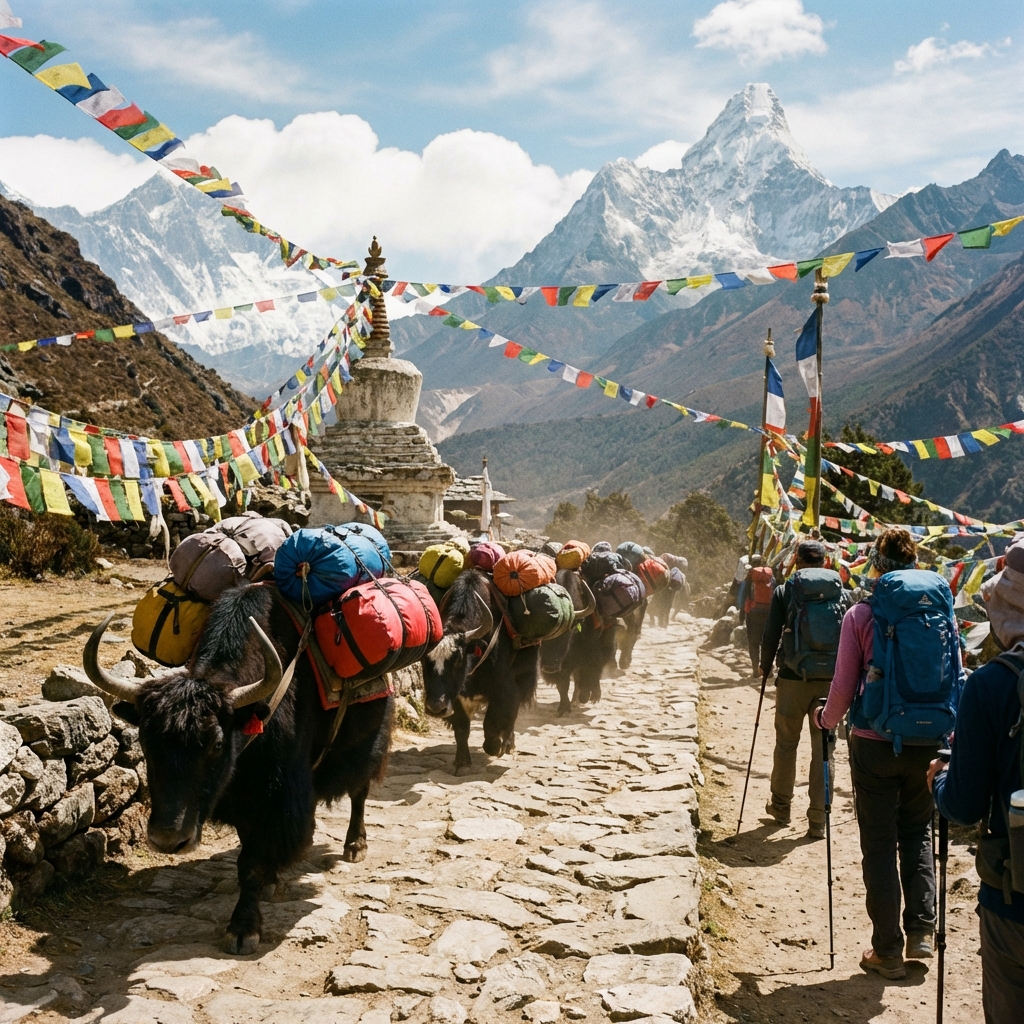
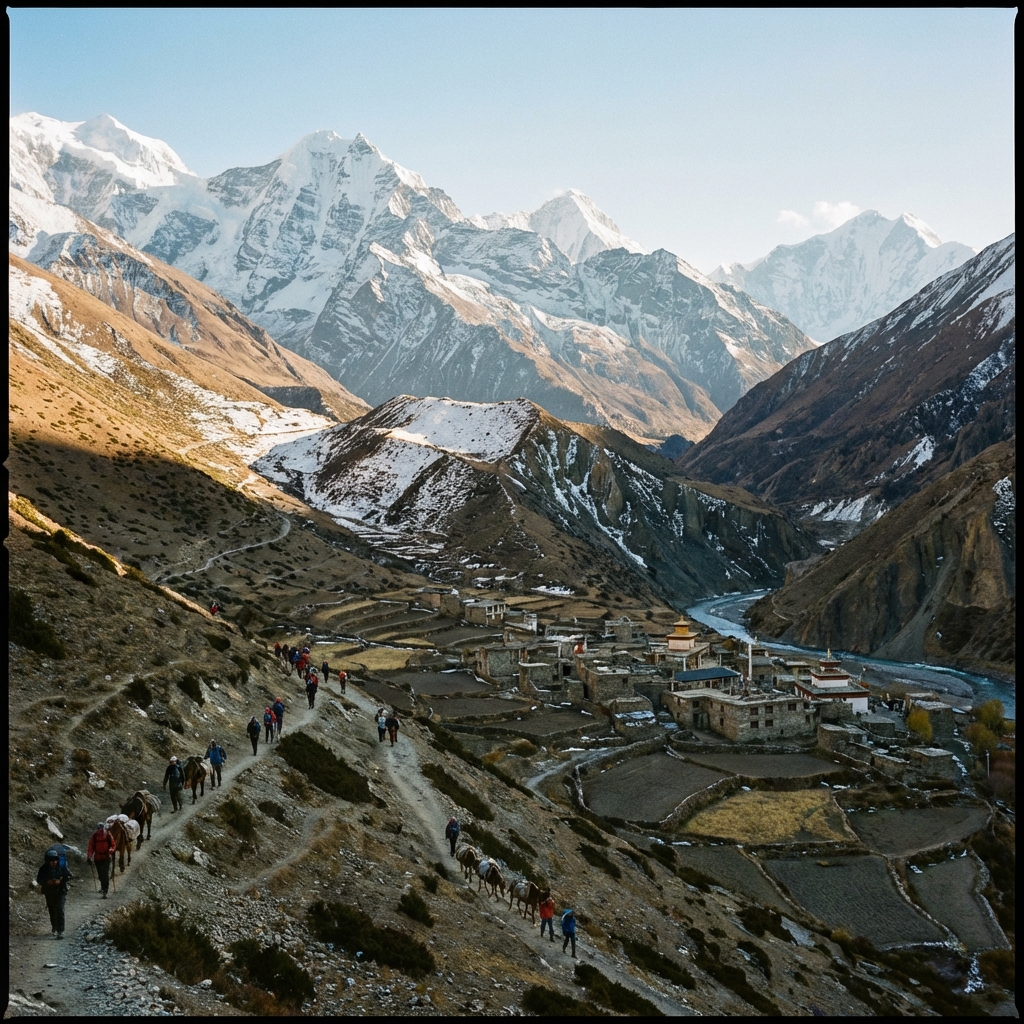
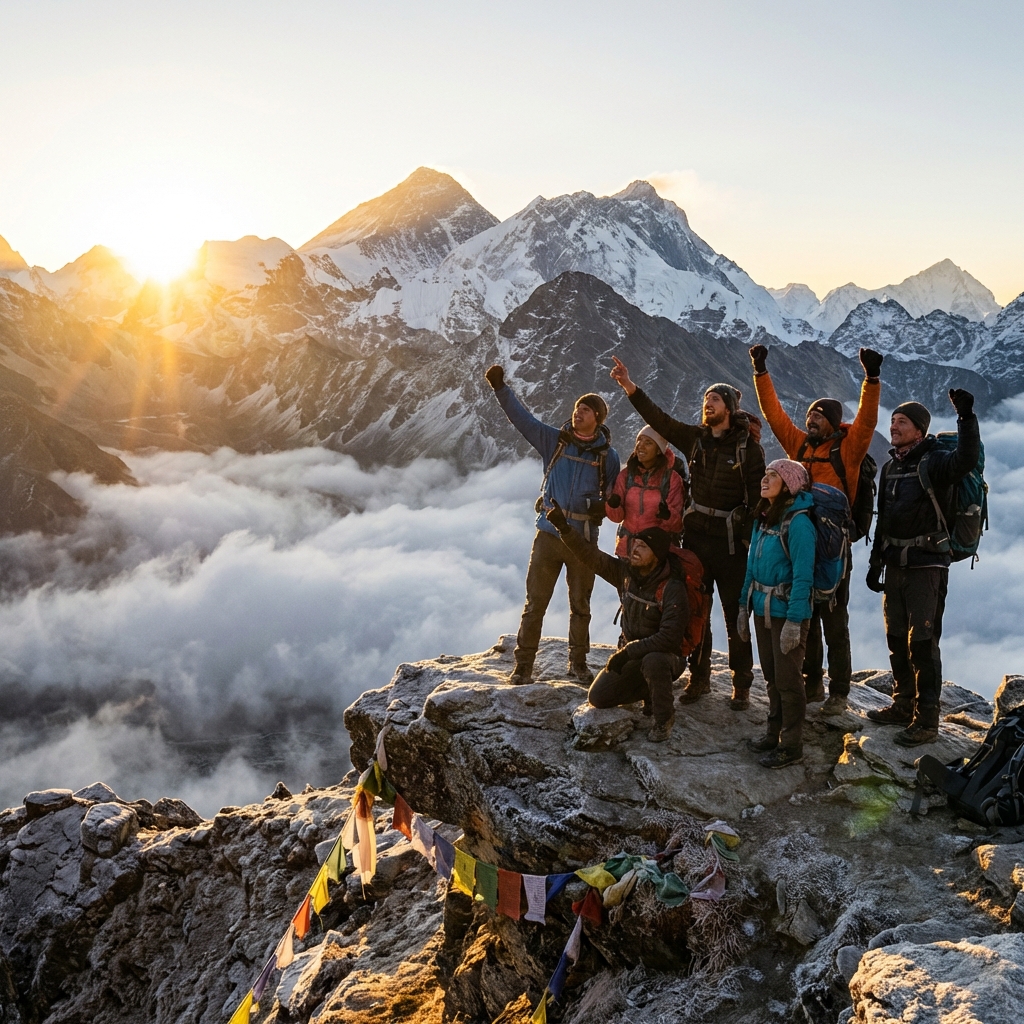
Nepal's two most famous treks present the quintessential Himalayan dilemma. The Annapurna Circuit takes you on a 160-230 kilometer loop through the world's deepest gorge, over the legendary Thorong La Pass at 5,416m, and across a staggering range of climate zones from subtropical jungle to arctic desert. Everest Base Camp leads you through Sherpa heartland to stand at the foot of Earth's highest mountain at 5,364m, with the optional 5,545m ascent of Kala Patthar for the most famous mountain sunrise on the planet.
Both treks are bucket-list experiences of the highest order. Both deliver extraordinary mountain scenery, cultural immersion, and physical challenge. And choosing between them genuinely matters, because they are fundamentally different journeys that appeal to different trekking priorities.
This is not a simple comparison of two similar routes. The Annapurna Circuit and EBC differ in almost every dimension: scenery type, cultural diversity, logistics, cost, altitude challenge, landscape variety, and the character of the journey itself. Understanding these differences in depth requires going beyond superficial metrics to examine what each trek actually feels like, day by day, and what kind of trekker each one serves best.
Who should read this guide:
- First-time Nepal trekkers choosing their debut Himalayan trek
- Experienced trekkers deciding which of these two to do next
- Those who can only do one Nepal trek ever and need to choose wisely
- Trekkers comparing logistics, costs, and difficulty
- Anyone planning a Nepal trip and weighing their route options
Quick Comparison: Side-by-Side Overview
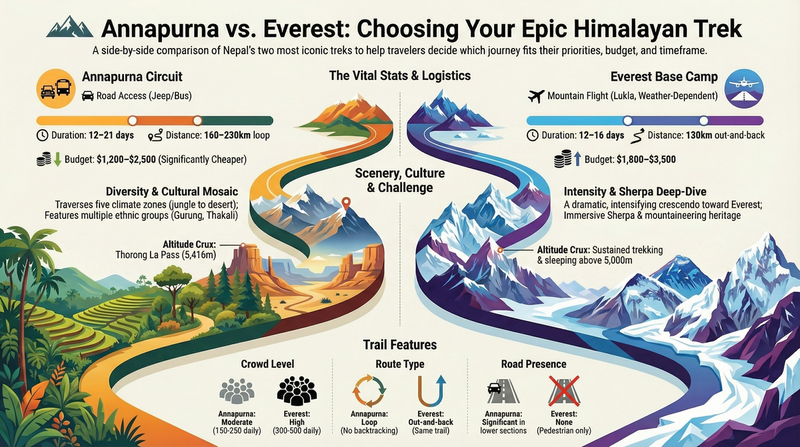
Annapurna Circuit: 12-21 days. EBC: 12-16 days.
Annapurna Circuit: 5,416m (Thorong La Pass). EBC: 5,545m (Kala Patthar) or 5,364m (Base Camp).
Annapurna Circuit: 160-230 km. EBC: 130 km round-trip.
Circuit (loop): start and end at different points. Out-and-back: same trail both ways.
Annapurna: crossing a 5,416m pass (one big effort). EBC: reaching 5,364m destination + optional 5,545m viewpoint.
Annapurna Circuit wins: rice paddies to arctic desert in one trek. EBC: Sherpa highlands throughout.
Annapurna Circuit wins: Gurung, Thakali, Manangba, Tibetan-influenced communities. EBC: Sherpa culture throughout.
Both extraordinary. Annapurna: Annapurna massif, Dhaulagiri, Machapuchare. EBC: Everest, Lhotse, Ama Dablam.
Annapurna Circuit: moderate. EBC: high to very high.
Annapurna Circuit: $800-2,500. EBC: $1,200-4,000 (Lukla flights add $215-400).
Annapurna: road access (bus/jeep). EBC: requires Lukla flight (weather-dependent).
EBC wins: global recognition of standing at the foot of Everest.
Master Comparison Table
| Factor | Annapurna Circuit | Everest Base Camp | Advantage |
|---|---|---|---|
| Duration | 12-21 days (typically 14-18) | 12-16 days (typically 12-14) | EBC (shorter) |
| Maximum altitude | 5,416m (Thorong La) | 5,545m (Kala Patthar) / 5,364m (EBC) | Tie |
| Highest sleeping altitude | 4,800-4,900m (Thorong Phedi/High Camp) | 5,164m (Gorak Shep) | AC (lower sleep) |
| Total distance | 160-230 km | 130 km round-trip | EBC (shorter) |
| Route type | Circuit (loop) | Out-and-back | AC (no backtracking) |
| Daily walking hours | 5-7 hours | 5-7 hours | Tie |
| Difficulty rating | Moderate-Challenging | Moderate-Challenging | Tie |
| Landscape variety | Extraordinary (5 climate zones) | Moderate (Sherpa highlands) | AC |
| Cultural diversity | Multiple ethnic groups | Sherpa culture throughout | AC |
| Mountain views | Annapurna I, Dhaulagiri, Machapuchare, Manaslu | Everest, Lhotse, Nuptse, Ama Dablam | Tie |
| Number of 8,000m peaks visible | 3 (Annapurna I, Dhaulagiri, Manaslu) | 3-4 (Everest, Lhotse, Makalu from higher) | Tie |
| The iconic moment | Crossing Thorong La at dawn | Standing at EBC + Kala Patthar sunrise | EBC |
| Crowds (October peak) | 150-250 daily on trail | 300-500 daily on trail | AC |
| Tea house quality | Good to very good | Very good to excellent | EBC |
| Permit cost | $50-65 (ACAP + TIMS) | $38-45 (SNP + municipal) | AC (slightly more) |
| Transport cost | Bus/jeep ($15-50 each way) | Lukla flight ($215-400 round-trip) | AC (far cheaper) |
| Total budget (mid-range) | $1,200-2,500 | $1,800-3,500 | AC |
| Road encroachment | Significant (lower sections) | None (no roads above Lukla) | EBC |
| Best season | Spring (April) or Autumn (October) | Autumn (October) or Spring (April) | Tie |
1. The Scenery Showdown: Diversity vs Intensity
This is the most subjective comparison, and the one that matters most to many trekkers. Both treks deliver world-class Himalayan scenery, but the character of that scenery is fundamentally different.
Annapurna Circuit: The Diversity Champion
The Annapurna Circuit is arguably the world's most diverse single trek. In 14-18 days, you traverse five distinct climate zones, each with its own landscape, vegetation, and atmosphere:
Zone 1: Subtropical Lowlands (800-1,500m)
- Rice paddies, banana trees, bamboo forests
- Humid, warm air; lush green hillsides
- Gurung and Brahmin villages with traditional stone architecture
- Waterfalls cascading down jungle-covered slopes
Zone 2: Temperate Forests (1,500-3,000m)
- Rhododendron and oak forests (spectacular in spring bloom)
- Mountain rivers in deep gorges
- The Marsyangdi Valley narrows dramatically
- Pine forests replace broadleaf as altitude increases
Zone 3: Alpine Zone (3,000-4,000m)
- Sparse vegetation, scrubland, alpine meadows
- Manang Valley opens into a wide, arid bowl surrounded by giants
- Views of Annapurna II, III, IV; Gangapurna; Tilicho Peak
- Yak pastures and stone-walled fields
Zone 4: High Desert/Arid Steppe (4,000-5,416m)
- Thorong La approach through barren, wind-swept terrain
- Arctic conditions; minimal vegetation
- Prayer flags marking the legendary pass
- The Tibetan-influenced landscape of Muktinath
Zone 5: Rain Shadow Desert (Mustang side, 2,700-3,800m)
- Dramatic descent into the Kali Gandaki gorge (the world's deepest)
- Arid, eroded cliffs and canyon landscapes
- Apple orchards and Thakali villages
- Jomsom's windy, stark beauty
Key mountain views:
- Annapurna I (8,091m): Nepal's highest peak in the Annapurna range
- Dhaulagiri (8,167m): the world's seventh highest, dominating the Kali Gandaki gorge
- Machapuchare (6,993m): the sacred "Fish Tail" mountain, one of Nepal's most beautiful
- Manaslu (8,163m): visible from higher sections
- Gangapurna, Tilicho Peak, Annapurna II-IV: surrounding the Manang valley
Everest Base Camp: The Intensity Champion
The EBC trek does not match the Annapurna Circuit's diversity. Instead, it delivers something different: an intensifying crescendo of increasingly dramatic Himalayan scenery culminating in proximity to Earth's highest mountain.
Zone 1: Khumbu Foothills (2,600-3,400m)
- Pine and rhododendron forest
- Suspension bridges over the Dudh Kosi river
- Sherpa villages: Lukla, Phakding, Monjo
- First glimpses of Everest and Ama Dablam
Zone 2: Khumbu Highlands (3,400-4,500m)
- Namche Bazaar (the Sherpa capital, 3,440m)
- Tengboche Monastery with its famous Everest-Ama Dablam panorama
- Alpine terrain with yak pastures
- Ama Dablam dominates the skyline from every angle
Zone 3: High Khumbu (4,500-5,545m)
- Barren moraine and glacial landscapes
- Khumbu Glacier visible and crossable
- Gorak Shep: the windswept final settlement
- Everest Base Camp: expedition tents, the Khumbu Icefall
- Kala Patthar: the legendary viewpoint where Everest fills your vision
Key mountain views:
- Everest (8,848m): the ultimate mountain, increasingly dominant as you approach
- Lhotse (8,516m): the fourth highest, directly adjacent to Everest
- Ama Dablam (6,812m): one of the world's most beautiful peaks, a constant companion
- Nuptse (7,861m): Everest's dramatic neighbor
- Makalu (8,485m): visible from Kala Patthar
- Pumori (7,161m): directly above Gorak Shep
The Scenery Verdict
For landscape diversity: Annapurna Circuit wins decisively. The transition from subtropical jungle to high desert in a single trek is unmatched anywhere in the trekking world. Every day brings a fundamentally different landscape.
For mountain drama and intensity: EBC wins. The Khumbu Valley builds toward Everest with a dramatic narrative arc that culminates in the world's most famous mountain filling your field of vision. The emotional intensity of standing at the foot of Everest is unmatched.
For photography: Both are extraordinary. Annapurna offers more compositional variety (gorges, forests, deserts, villages, rivers). EBC offers more iconic single images (Everest from Kala Patthar, Ama Dablam from Tengboche).
Pro Tip
If you could see only one mountain view in your life, Kala Patthar sunrise on a clear October morning is hard to beat. But if you want the most visually diverse trekking portfolio, the Annapurna Circuit delivers more variety in a single trip. These are fundamentally different photographic experiences, not better-or-worse versions of the same thing.
2. Cultural Immersion: Multi-Ethnic vs Deep Sherpa
Annapurna Circuit: A Cultural Mosaic
The circuit passes through the territories of multiple ethnic groups, each with distinct traditions, architecture, cuisine, and religious practice:
- Gurung communities (lower sections): Hindu-Buddhist blend, round stone houses, military tradition (Gurkhas)
- Manangba people (Manang Valley): Tibetan-influenced traders, Buddhist monasteries, unique cultural autonomy
- Thakali communities (Kali Gandaki): Known as Nepal's finest cooks, distinctive flat-roofed architecture
- Tibetan-influenced villages (Muktinath area): Buddhist shrines, prayer flags, chortens, Tibetan-style dress
- Mixed Hindu-Buddhist lowlands: Rice farming communities, colorful festivals, terraced agriculture
This cultural diversity means the circuit is not just a landscape trek. It is a cross-cultural journey through Nepal's extraordinary ethnic tapestry. Architecture changes every few days. Food traditions shift. Religious sites transition from Hindu temples to Buddhist stupas to ancient Bon shrines.
Everest Base Camp: Sherpa Deep Dive
The EBC trek passes almost exclusively through Sherpa territory. While this means less ethnic diversity, it provides a deeper immersion into a single, fascinating culture:
- Sherpa villages: Namche Bazaar, Khumjung, Tengboche, Dingboche, Pheriche
- Tengboche Monastery: The largest in the Khumbu, with regular prayer ceremonies
- Sherpa mountaineering heritage: Stories of Tenzing Norgay, modern-day climbing legends
- Yak herding traditions: Daily life centered around yak husbandry at altitude
- Buddhist practice: Mani walls, prayer wheels, chortens, and sky burial traditions
For trekkers specifically interested in Sherpa culture and mountaineering heritage, EBC provides deeper engagement than the circuit's broader but shallower cultural sampling.
Cultural Verdict
For cultural diversity: Annapurna Circuit wins. Multiple ethnic groups, changing architecture, evolving cuisine, and shifting religious practices create a richer cross-cultural experience.
For cultural depth: EBC wins for Sherpa culture specifically. The concentration of Sherpa villages, monasteries, and mountaineering heritage provides a focused cultural deep dive unavailable on the circuit.
3. The Altitude Challenge: Pass Crossing vs High Destination
Both treks reach similar maximum altitudes but present the altitude challenge differently.
Annapurna Circuit: The Big Pass
The Annapurna Circuit builds toward a single, definitive altitude challenge: Thorong La Pass at 5,416m. This is the trek's climax and crux.
Thorong La characteristics:
- Maximum altitude: 5,416m
- Approached from Thorong Phedi (4,450m) or High Camp (4,800-4,900m)
- Crossed in a single long day (7-10 hours from Phedi, 5-7 from High Camp)
- Significant elevation gain on crossing day: 900-1,000m up, 1,600m down
- Best crossed in early morning before afternoon wind and weather
- Clear and crossable in autumn (October-November) and spring (April-May)
- Success rate: approximately 85-90% of trekkers who reach Manang
The experience: Thorong La crossing is an event. You start before dawn, climb steadily through darkness, reach the prayer-flag-draped pass as the sun rises on Annapurna and Dhaulagiri, and then descend dramatically 1,600m to Muktinath. It is exhausting, exhilarating, and unforgettable.
Everest Base Camp: The Sustained High
EBC presents altitude differently. There is no single dramatic pass crossing. Instead, you spend multiple days above 4,500m, sleeping progressively higher until reaching 5,164m at Gorak Shep.
EBC altitude characteristics:
- Maximum viewpoint: 5,545m (Kala Patthar)
- Maximum destination: 5,364m (Everest Base Camp)
- Highest sleeping altitude: 5,164m (Gorak Shep)
- Days above 4,000m: 6-8 days
- Days above 5,000m: 1-2 days
- Altitude exposure is sustained rather than peaked
- Success rate: approximately 85-90% of trekkers who follow proper acclimatization
The experience: EBC's altitude challenge is cumulative rather than climactic. Each day pushes slightly higher. Gorak Shep's night at 5,164m is the hardest, with most trekkers sleeping poorly. The next morning, you push to either Kala Patthar (5,545m) or Base Camp (5,364m), or both, on a single demanding day.
Altitude Verdict
Annapurna Circuit advantage: The pass-crossing format means your maximum altitude is a single-day effort. You climb high and descend dramatically. You do not sleep above 4,900m. The sustained exposure at extreme altitude is shorter.
EBC advantage: More gradual altitude progression with two acclimatization days. The sustained exposure builds tolerance progressively. However, sleeping at 5,164m (Gorak Shep) is demanding.
For altitude-sensitive trekkers: Annapurna Circuit may be slightly easier because the highest sleeping altitude (4,800-4,900m) is 250-350m lower than EBC's Gorak Shep (5,164m). However, the Thorong La crossing day is more physically demanding than any single EBC day.
Thorong La Pass Safety
The Thorong La crossing is the Annapurna Circuit's most dangerous day. Altitude sickness, sudden weather changes, and the long exposure above 5,000m create real risk. Never cross if you are experiencing moderate or severe AMS symptoms. Always start before dawn to avoid afternoon weather. Carry adequate warm clothing, food, and water for 7-10 hours. Your guide should carry emergency medication and a satellite phone. Turn back if conditions deteriorate. Several trekker deaths have occurred on Thorong La, mostly from ignoring warning symptoms or pushing through bad weather.
4. Logistics Comparison: Road Access vs Mountain Flight
This practical factor significantly affects both cost and experience.
Annapurna Circuit: Road Access
Getting there:
- Bus or jeep from Kathmandu or Pokhara to starting point (Besisahar or Chame)
- Duration: 6-10 hours from Kathmandu, 4-7 hours from Pokhara
- Cost: $15-50 per person depending on vehicle type
- No flights required (unless adding Jomsom return flight to Pokhara: $120-150)
- All-weather road access (though landslides can cause delays in monsoon season)
Getting back:
- Bus or jeep from Jomsom or Tatopani to Pokhara
- Duration: 6-10 hours depending on road conditions
- Cost: $15-50 per person
- Alternative: flight from Jomsom to Pokhara ($120-150, weather-dependent)
Road encroachment issue: The Annapurna Circuit has been significantly affected by road construction over the past decade. Roads now reach Chame (3,600m) on the east and Jomsom (2,700m) on the west, reducing the purely trail-based sections. Some trekkers take jeep transport through the lower, road-affected sections and begin trekking at higher altitudes. This is the circuit's most significant recent change and a frequent criticism.
Everest Base Camp: The Lukla Flight
Getting there:
- Flight from Kathmandu (or Ramechhap during peak season) to Lukla (2,860m)
- Duration: 25-35 minutes
- Cost: $215-400 round-trip
- One of the world's most famous (and dramatic) short flights
- Weather-dependent; cancellations and delays are common
- Always build 1-2 buffer days for flight disruptions
Getting back:
- Same flight in reverse: Lukla to Kathmandu/Ramechhap
- Same weather vulnerability
- Helicopter alternative if flights cancelled ($400-600 shared, $3,500-4,500 private)
The Lukla factor: The Lukla flight is simultaneously one of EBC's greatest experiences and greatest frustrations. The approach to Tenzing-Hillary Airport (one of the world's shortest runways, perched on a mountainside) is thrilling. But weather cancellations can strand you for days. This flight adds $350-400 to the EBC cost and introduces significant scheduling uncertainty.
Logistics Verdict
Annapurna Circuit advantages:
- No expensive flights required (saves $350-400)
- No weather-dependent flight risk
- More flexibility in start/end dates
- Multiple starting points available
EBC advantages:
- The Lukla flight is an experience in itself
- No road encroachment on the trail
- The entire trek is on foot (no jeep sections)
- Trail feels more pristine and remote despite higher traffic
For budget trekkers: Annapurna Circuit saves $215-400 on flights alone. Combined with slightly lower daily costs (more competitive lodges), the circuit can be $500-800 cheaper overall.
For schedule-sensitive trekkers: Annapurna Circuit is safer. No flight cancellations means more predictable timing. EBC requires buffer days that may not fit tight schedules.
5. Cost Comparison: Detailed Breakdown
| Cost Category | Annapurna Circuit | Everest Base Camp |
|---|---|---|
| Transport to/from trailhead | $30-100 (bus/jeep) | $350-400 (Lukla flights) |
| Permits | $215-65 (ACAP + TIMS + local) | $38-45 (SNP + municipal) |
| Accommodation (12-18 nights) | $24-270 ($2-15/night) | $48-300 ($4-25/night) |
| Food (12-18 days) | $180-540 ($15-30/day) | $180-420 ($15-35/day) |
| Guide (12-18 days) | $300-630 ($25-35/day) | $300-490 ($25-35/day) |
| Porter (optional) | $200-450 ($15-25/day) | $200-350 ($15-25/day) |
| Tips | $80-200 | $100-250 |
| Hot showers, charging | $30-80 | $40-100 |
| Travel insurance | $100-150 | $100-150 |
| Kathmandu/Pokhara hotels | $30-100 | $30-100 |
| Budget total | $800-1,500 | $1,200-2,200 |
| Mid-range agency total | $1,200-2,500 | $1,800-3,500 |
| Premium agency total | $2,000-4,000 | $3,000-5,500 |
The cost difference is driven primarily by the Lukla flight ($215-400) and the longer potential duration of the Annapurna Circuit. On a per-day basis, daily costs are similar. But the circuit's road access versus EBC's mandatory expensive flight creates a structural cost gap.
Pro Tip
If budget is your primary constraint, the Annapurna Circuit is the clear winner. The $350-400 Lukla flight saving alone is significant, and the circuit's competitive tea house market (more lodges competing for fewer trekkers) keeps daily costs slightly lower. A budget-conscious trekker can complete the Annapurna Circuit for $800-1,200 all-in, compared to $1,200-1,800 for EBC.
6. Crowds and Trail Experience
Annapurna Circuit Crowds
The Annapurna Circuit distributes trekkers across 160-230 km, and not all sections are equally busy:
- Lower sections (Besisahar to Chame): Quiet; many trekkers jeep through these sections
- Chame to Manang: Moderate traffic; the most popular walking section
- Manang (acclimatization stop): Busy; convergence point for all circuit trekkers
- Thorong La crossing day: Concentrated; 50-150 trekkers cross on any October morning
- Muktinath to Jomsom: Moderate; thinning as trekkers exit
- Below Jomsom: Road traffic mixes with trekkers; less appealing
Peak season (October) daily trekker count: 150-250 on the main trail sections.
Everest Base Camp Crowds
EBC concentrates all trekkers on a single corridor:
- Lukla to Namche: Heavy traffic; 200-400 trekkers daily in October
- Namche (rest day hub): Very busy; the commercial center
- Namche to Tengboche: Moderate-heavy; many day-trippers return to Namche
- Tengboche to Dingboche: Heavy; the scenic corridor
- Dingboche to Gorak Shep: Heavy; every EBC trekker passes through
- Kala Patthar sunrise: 80-150 people at the summit in October
Peak season (October) daily trekker count: 300-500 on the main trail.
Crowd Verdict
Annapurna Circuit is less crowded. The circuit's longer distance, multiple starting points, and road access options spread trekkers more effectively. The Thorong La crossing concentrates traffic, but the rest of the circuit feels spacious.
EBC is busier. The single corridor, combined with higher overall trekker numbers and the Lukla bottleneck, creates consistent traffic. Lodge dining rooms are full, trails are busy, and popular viewpoints are crowded.
7. The Road Encroachment Issue
This is the Annapurna Circuit's most significant modern challenge and deserves honest discussion.
The situation: Over the past decade, roads have been built along much of the Annapurna Circuit's lower sections. The road from Besisahar now reaches Chame (3,600m) on the eastern side, and from Beni reaches Jomsom (2,700m) on the western side. This means significant portions of the original circuit are now shared with jeep and motorcycle traffic.
Impact on trekkers:
- Lower sections (Besisahar to Chame) are dusty, noisy, and unpleasant to walk
- Many trekkers now start at Chame or Dharapani rather than Besisahar
- The Jomsom to Beni descent is largely road-walking
- The pure trail experience has been shortened from 200+ km to approximately 100-130 km
- Some intermediate villages have become less charming as road infrastructure develops
Mitigation strategies:
- Start trekking at Chame or Dharapani (jeep from Besisahar)
- End at Muktinath or Jomsom (fly or jeep back)
- Take alternative off-road trail sections where they exist (guides know these)
- Focus on the Manang to Muktinath section, which remains road-free and spectacular
EBC has no road issue. There are no roads above Lukla, and the entire EBC trail is pedestrian-only (plus the occasional yak caravan). This is a genuine advantage for trail purists.
The Circuit Is Still Worth It
Despite road encroachment, the Annapurna Circuit remains one of the world's great treks. The core section from Chame through Manang, over Thorong La, and down to Muktinath is road-free and spectacular. Smart itinerary planning (skipping road sections by vehicle) delivers the circuit's best scenery without the road frustration. Do not let road concerns prevent you from doing this trek; do let them shape your itinerary planning.
8. Can You Do Both? The Double Trek Option
Yes, and many Nepal enthusiasts eventually do both. The question is whether to do them in a single trip or on separate visits.
Both in One Trip
Is it feasible? Yes, with 30-35 days available. Do the Annapurna Circuit first (14-18 days), rest 3-5 days in Kathmandu or Pokhara, then do EBC (12-14 days).
Advantages:
- One international flight covers both experiences
- Your body is already altitude-acclimatized from the circuit, making EBC acclimatization smoother
- You maximize a long Nepal trip
Disadvantages:
- Physical fatigue accumulates; the second trek may feel exhausting
- 30-35 days is a significant time commitment
- Risk of injury or illness on trek one derailing trek two
- Cost adds up significantly
Recommendation: Feasible for fit, experienced trekkers under 50 with flexible schedules. Not recommended for first-timers or those with limited time.
Separate Trips
Most trekkers do these on different visits, which allows:
- Full recovery between treks
- Different seasons (spring for the circuit, autumn for EBC, or vice versa)
- Each trek gets your full energy and attention
- No schedule pressure from one trek affecting the other
Which Trek Is Harder?
Both are rated moderate-challenging, but they challenge you differently. The Annapurna Circuit crosses Thorong La at 5,416m in a single demanding day after 12-18 days of walking 160-230 km. EBC reaches 5,545m at Kala Patthar but has no pass crossing -- you ascend gradually and return the same way. The Annapurna Circuit's longer duration and pass crossing make it slightly harder overall, while EBC's higher sleeping altitude at Gorak Shep (5,164m) creates greater altitude exposure. See our Annapurna Circuit difficulty guide and EBC difficulty guide for preparation advice.
Which Trek Is Cheaper?
The Annapurna Circuit is significantly cheaper. A mid-range Annapurna Circuit costs $1,200-2,500, while EBC runs $1,800-3,500. The main cost difference is transport: the Annapurna Circuit uses road access (bus/jeep, $15-50 each way) while EBC requires the expensive Lukla flight ($215-400 round-trip). Permits are similar ($50-65 for Annapurna vs $38-45 for EBC). See our Annapurna Circuit cost breakdown and EBC cost breakdown for details.
Which Trek Has Better Views?
Both deliver world-class mountain scenery of different character. The Annapurna Circuit shows three 8,000m peaks (Annapurna I, Dhaulagiri, Manaslu) across five climate zones with extraordinary landscape diversity. EBC provides intimate views of Everest, Lhotse, Nuptse, and Ama Dablam, culminating in the famous Kala Patthar sunrise. The Annapurna Circuit wins on variety; EBC wins on the iconic factor of standing at the foot of the world's highest mountain. Pack right with our complete trekking gear list.
9. Decision Framework: Which Trek Matches You?
Choose the Annapurna Circuit If:
You value landscape diversity above all else. The circuit's passage through five climate zones is unmatched. If you want to experience Nepal's full environmental range in a single trek, no other route delivers this.
Cultural variety excites you. Gurung, Thakali, Manangba, and Tibetan-influenced communities each add distinct flavor. If encountering multiple ethnic groups, architectural styles, and culinary traditions enriches your experience, the circuit is richer.
Budget is a significant factor. Saving $350-400 on flights plus slightly lower daily costs makes the circuit $500-800 cheaper than EBC at comparable comfort levels.
You prefer a circuit over an out-and-back. Walking a loop means new scenery every day. EBC's return on the same trail can feel anticlimactic after reaching Base Camp. The circuit never backtracks.
You want fewer crowds. The circuit is 30-40% less crowded than EBC during peak season. If trail solitude matters, this is the better choice.
The pass crossing appeals to you. If the idea of a single, climactic day crossing a 5,416m pass at sunrise excites you, Thorong La delivers one of trekking's greatest moments.
Schedule flexibility matters. No Lukla flight means no flight cancellation risk. Your start and end dates are more predictable and controllable.
Choose Everest Base Camp If:
Standing at Everest's foot is a life goal. No scenic diversity or cultural variety substitutes for the symbolic achievement of reaching Everest Base Camp. If this is your bucket-list destination, nothing else will satisfy.
Mountain drama and intensity are your priority. EBC's crescendo toward the world's highest peak creates an emotional intensity that the circuit, despite its diversity, does not match. The final days above 5,000m with Everest filling the sky are extraordinary.
You prefer a shorter, more focused trek. At 12-14 days, EBC is 2-6 days shorter than the circuit. If time is limited, EBC delivers a complete epic experience in a shorter window.
Trail purity matters. No roads, no jeep traffic, no dust. The EBC trail from Lukla to Base Camp is pristine walking territory. If the Annapurna Circuit's road sections would frustrate you, EBC avoids this entirely.
Sherpa culture fascinates you. The EBC trek is a deep immersion in Sherpa culture, from Namche Bazaar's trading hub to Tengboche's ancient monastery to the mountaineering legends that permeate every village.
You want the Lukla flight experience. The approach to Tenzing-Hillary Airport is one of aviation's great adventures. Some trekkers look forward to this flight as much as the trek itself.
First-time trekker wanting the safest bet. EBC's superior infrastructure, medical facilities, and sheer volume of fellow trekkers provide a stronger safety net for first-timers. The trail is well-marked, lodges are plentiful, and help is always nearby.
Frequently Asked Questions
Which trek is harder: Annapurna Circuit or EBC?
They are similar in overall difficulty. The Annapurna Circuit is longer (more total days of effort) with a demanding single-day pass crossing (Thorong La). EBC is shorter but reaches a higher sleeping altitude (5,164m at Gorak Shep vs 4,800-4,900m on the circuit). Most trekkers rate them equally challenging. If pressed, the Thorong La crossing day is the single hardest day on either trek, but EBC's sustained high altitude over multiple days is more cumulatively draining.
Which has better mountain views?
Both have extraordinary views, but of different character. EBC builds toward Everest with the Khumbu Valley's dramatic intensity. The Annapurna Circuit provides more varied views: the deep Kali Gandaki gorge flanked by Annapurna and Dhaulagiri (two eight-thousanders facing each other), the Manang valley panorama, and the Thorong La summit view. Neither is objectively better. EBC wins for single-peak drama; the circuit wins for panoramic diversity.
Can I do the Annapurna Circuit in 12 days?
Technically possible but not recommended. Rushing the circuit means skipping acclimatization days (risking AMS), missing cultural highlights, and exhausting yourself. The ideal circuit duration is 14-18 days. Trekkers short on time can jeep through the lower road sections and focus on the Chame-to-Jomsom core (10-12 days of trekking), which captures the circuit's best scenery.
Is the Annapurna Circuit ruined by roads?
No. Roads affect the lower sections, but the core of the circuit (Chame to Muktinath, including Thorong La) remains road-free and spectacular. Smart itinerary planning that jeeps through road sections preserves the circuit's world-class trekking. The road issue is real but manageable, not trek-destroying.
Which trek is better for first-time Nepal trekkers?
Both are excellent first treks. EBC offers stronger infrastructure, more fellow trekkers (safety in numbers), and the bucket-list credential. The Annapurna Circuit offers more diversity, lower cost, and no Lukla flight risk. Truly anxious first-timers may prefer EBC's more structured, predictable experience. Adventurous first-timers may prefer the circuit's variety and lower crowds.
Can I do EBC without taking the Lukla flight?
Yes, by trekking from Jiri (7-9 additional days each way), the original 1953 Everest expedition approach route. This eliminates flight risk and adds a beautiful lowland trek through Sherpa country. However, it extends the total trip to 25-30 days. Most modern trekkers accept the Lukla flight to save time.
Which trek is better in spring?
The Annapurna Circuit benefits more from spring conditions: warmer Thorong La crossing, rhododendron bloom on the lower sections, and the Manang Valley's greening. EBC in spring offers warmer nights at Gorak Shep and the April-May expedition atmosphere at Base Camp. Both are excellent in spring, but the circuit arguably gains more from the seasonal advantages.
How do I get from the Annapurna Circuit back to Kathmandu?
From Jomsom (circuit endpoint): fly to Pokhara ($120-150, 20 minutes) or jeep to Pokhara (8-10 hours, $30-50). From Pokhara: fly to Kathmandu ($100-130, 25 minutes) or bus/tourist bus ($10-25, 7-8 hours).
Which trek has better food?
Very similar menus (dal bhat, noodles, soup, eggs, bread). The Annapurna Circuit benefits from Thakali cuisine (considered Nepal's best regional cooking) in the Kali Gandaki section. EBC's competitive lodge market means slightly more menu variation. Overall, food quality is comparable on both.
Is altitude sickness more common on one trek vs the other?
Rates are similar (40-50% experience mild symptoms on both). EBC's higher sleeping altitude (5,164m vs 4,800-4,900m) may produce slightly more overnight symptoms at the highest camps. The Annapurna Circuit's Thorong La crossing creates a concentrated high-altitude risk on a single day. Both require identical acclimatization discipline: rest days at Namche/Manang, gradual ascent, hydration, and willingness to descend if symptoms worsen.
Which trek should I do if I can only do one Nepal trek ever?
This is the ultimate question, and it depends on your single most important priority. If you want the world's most famous trekking achievement and the symbolic power of standing at Everest, choose EBC. If you want the most diverse, varied, and complete Himalayan trekking experience, choose the Annapurna Circuit. For most first-and-only trekkers, EBC's global recognition tips the balance. But the circuit is the better overall trek by several objective measures (diversity, cost, crowds). There is no wrong choice.
Related Resources
- Annapurna Circuit: Complete Route Guide
- Everest Base Camp: Complete Route Guide
- EBC vs ABC Comparison
- Thorong La Pass Guide: Preparation and Crossing
- Kathmandu to Lukla Flights: Complete Guide
- Best Time to Trek Nepal
Final Verdict: Two Legends, One Choice
The Annapurna Circuit and Everest Base Camp are not just two treks. They are two visions of what Himalayan trekking can be.
The Annapurna Circuit is the journey. It is the transformative experience of crossing an entire mountain range, passing through cultures and climates and landscapes that shift daily, building toward a legendary pass crossing, and emerging on the other side of the Himalayas into a different world. It is the trek that experienced guides and trekkers most often name as their favorite. It is also cheaper, less crowded, and more diverse.
Everest Base Camp is the destination. It is the pilgrimage to the foot of the world's highest mountain, through the heartland of Sherpa culture, on a trail that builds emotional intensity with every step. It is the trek with the most famous name, the most recognized achievement, and the most dramatic mountain scenery in its final days. It costs more, draws more crowds, and carries the weight of mountaineering history.
If you love the trek more than the destination, choose the Annapurna Circuit. If the destination is everything, choose Everest Base Camp.
Both will change you. Both will give you stories for a lifetime. The only bad choice is choosing neither.
Last updated: February 2026. All data verified against Nepal Tourism Board records, ACAP and SNP permit data, and licensed trekking agency reports from the 2026/2027 season. Road conditions on the Annapurna Circuit continue to evolve; always verify current trail status with agencies before departure.