
60-80L for tea house treks
Under 15kg packed for porter carry
Under 25-30kg with shared group gear
Lockable zippers and padded shoulder straps
Essential — rain covers or waterproof fabric
$30-150 for quality trekking duffels
Basic duffels NPR 1,500-5,000; brands limited
Most 60-80L duffels qualify as checked luggage
Trekking Duffle Bag for Nepal: The Complete Porter-Carry Guide
The best trekking duffle bag for Nepal is a 60-80L soft-sided duffel that packs under 15kg, has lockable zippers, water-resistant TPU or DWR fabric, and stowable padded shoulder straps. Porters carry this bag while you carry only a daypack, so it must conform to traditional carrying systems rather than ride like a framed backpack.
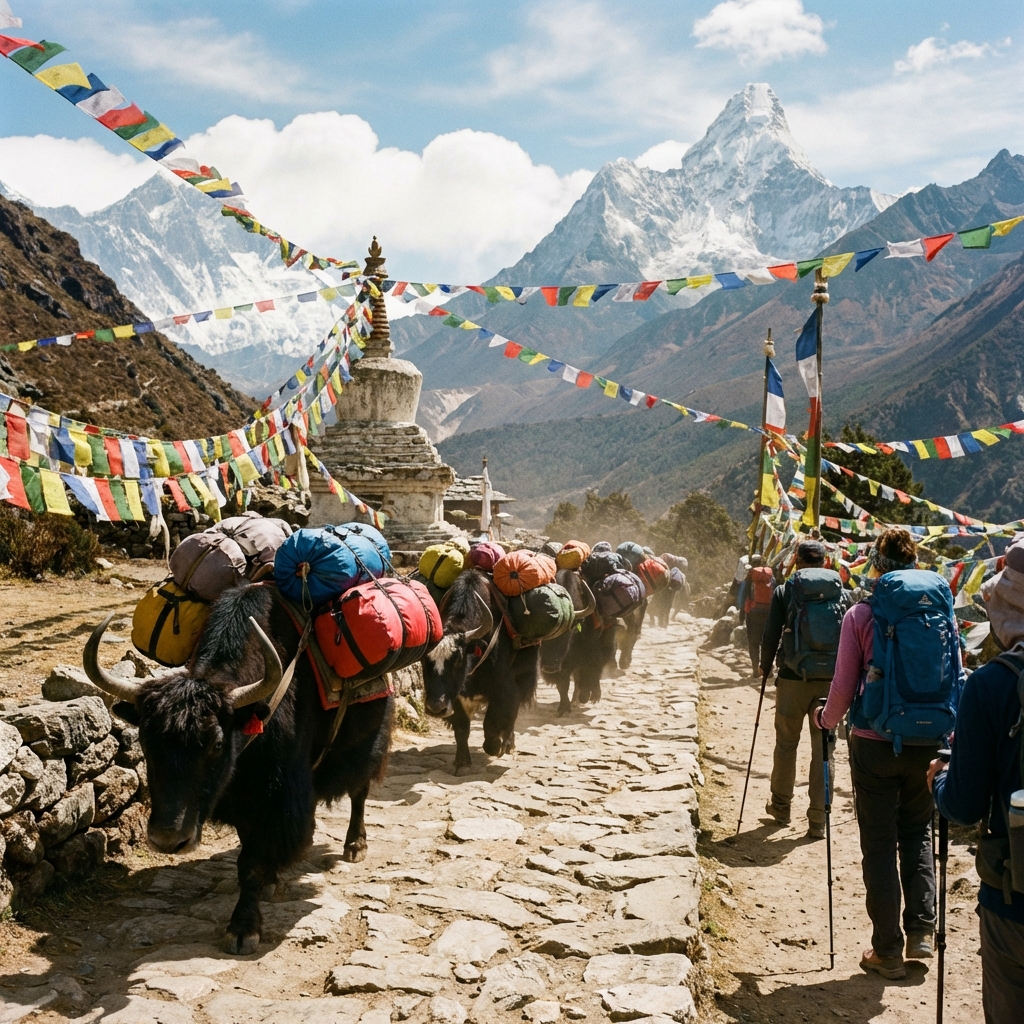
On a Nepal tea house trek, your gear travels in two separate systems. You carry a daypack with essentials -- water, snacks, rain jacket, camera -- on your own back. Everything else goes into a duffel bag that your porter carries. This duffel is not a minor logistics detail. It is the container that protects your sleeping bag, clothing, electronics, and personal items as a porter carries it across suspension bridges, through rain showers, up steep mountain trails, and occasionally across river crossings for 10 to 14 days.
The wrong duffel bag -- too large, too fragile, not water-resistant, impossible for a porter to carry comfortably -- creates problems that cascade through your entire trek. An oversized duffel tempts you to overpack, pushing porter weight above ethical limits. A non-waterproof duffel soaks through in the first rain, leaving your sleeping bag damp and your electronics at risk. A duffel without proper carry straps digs into your porter's shoulders, causing pain and slowing the pace for everyone.
This guide covers everything you need to know about choosing, packing, and using a duffel bag for Nepal trekking. We explain why duffels (not suitcases, not backpacks) are the standard, what size you actually need, the features that matter for porter carry, weight limits you must respect, how to organize your gear inside the duffel, and specific product recommendations at every budget level.
Why a Duffel Bag and Not Something Else
Why Not a Suitcase
Suitcases, even soft-sided rolling luggage, are completely impractical for Nepal trekking. Porters carry your gear on their backs using a tumpline system (a strap across the forehead with the load resting on the back) or shoulder straps. A suitcase has no attachment points for these carrying systems, its rigid structure does not conform to the porter's back, and wheels are useless on rocky mountain trails. A suitcase is also heavier empty than a duffel of equivalent volume, wasting precious weight allowance on the container rather than the contents.
Your suitcase stays at your hotel in Kathmandu. Your trekking gear transfers into a duffel for the trek.
Why Not a Large Backpack
A large expedition backpack (60-80L) theoretically holds the same gear as a duffel, and some trekkers do send their large backpack with the porter. However, there are practical problems. Backpacks have rigid internal frames, waist belts, and multiple adjustment straps designed for one person's torso length. When a porter carries a backpack designed for someone else's body, the fit is wrong, the weight distribution is poor, and the dangling straps catch on rocks and branches. Backpacks also have multiple pockets and openings that are difficult to secure and lock.
Porters strongly prefer duffel bags because they are flexible (conforming to the back), have simple carry handle or strap attachment points, and can be lashed together with other duffels when a porter is carrying gear for multiple trekkers.
Why a Duffel Is the Standard
A duffel bag is essentially a cylinder or rectangle of durable fabric with a large opening, a few external pockets, and carry straps. Its simplicity is its strength:
- Flexible enough to conform to a porter's back and be lashed to carrying systems
- Wide opening for easy packing and access
- Lockable main zipper secures your belongings
- Lighter empty weight than equivalent-volume backpacks
- Available with both shoulder straps (for you to carry at airports) and porter-compatible lashing points
- Compresses when not full, unlike rigid suitcases
The Tumpline System
Traditional Nepali porters carry loads using a namlo (tumpline) -- a woven strap that loops over the forehead with the load resting against the back, often supported by a wicker basket called a doko. Your duffel bag is placed in or strapped to this system. Modern porters on tourist routes increasingly use padded shoulder straps similar to backpack straps, but the tumpline remains common, especially on remote routes. A soft, flexible duffel bag works with both carrying systems. A rigid container does not.
What Size Trekking Duffle Bag Do You Need?
For most Nepal tea house treks, a 60-80L trekking duffle bag is the right size. Choose 60-65L if you pack lightly and use compression sacks, or 70-80L if you carry bulkier gear. Camping treks may need 80-100L, and peak climbing expeditions 80-120L. Going larger than 80L for a tea house trek only tempts you to overpack and push your porter past the 15kg limit.
Duffel bag sizing for Nepal trekking depends on your trek type, the season, and how disciplined your packing is. (A note on spelling: "duffle bag" and "duffel bag" are the same item -- both spellings are correct and used interchangeably throughout this guide.)
Tea House Treks: 60-80L
For standard tea house treks (EBC, Annapurna Circuit, Langtang, Manaslu), a 60-80L duffel is the sweet spot. This volume comfortably holds:
- Sleeping bag (5-8L compressed)
- Down jacket (3-5L compressed)
- 3-4 days of clothing in stuff sacks (10-15L)
- Thermal base layers and fleece mid-layer (5-8L)
- Personal items: toiletries, first aid, book, charger, electronics (5-8L)
- Misc: towel, water purification, snacks, headlamp backup (5-8L)
- Total: approximately 35-55L of gear
A 60L duffel works for disciplined, lightweight packers who bring minimal clothing and compact gear. A 70-80L duffel provides breathing room for bulkier items and less careful packing. Going above 80L is unnecessary for tea house treks and increases the temptation to overpack.
Camping Treks: 80-100L
For camping treks where your duffel carries not only personal gear but also shared group items (tent components, cooking equipment, food), a larger duffel may be needed. However, most trekking agencies provide separate porter loads for group gear, so your personal duffel remains in the 60-80L range with additional items distributed across the group.
Peak Climbing Expeditions: 80-120L
Peak climbing requires technical equipment -- harness, crampons, ice axe, rope hardware, double boots -- that significantly increases your gear volume. An 80-120L duffel or expedition bag accommodates personal gear plus technical equipment. These treks also have higher porter weight allowances for the technical equipment portion.
Weight Limits: Respecting Your Porter
This is the most important section of this guide. The weight your porter carries directly affects their health, safety, and dignity. Nepal has porter weight regulations, and ethical trekking practices demand strict compliance.
Tea House Trek Weight Limits
The standard weight limit for a porter's load on tea house treks is 15kg per porter per trekker. This is the combined weight of your packed duffel bag. Some agencies allow slightly more (up to 20kg), but 15kg is the ethical standard endorsed by responsible trekking organizations.
At 15kg, your duffel must contain only what you actually need. This forces disciplined packing, which is a benefit, not a limitation. A well-packed 15kg duffel contains everything needed for a comfortable tea house trek at any altitude.
Camping Trek Weight Limits
Camping treks allow 25-30kg total porter loads because the porter carries group equipment (tent, kitchen gear, food) in addition to personal gear. However, your personal duffel should still be under 15kg, with additional weight coming from shared items assigned by the trekking agency.
Weighing Your Duffel
Before leaving Kathmandu, weigh your packed duffel using a luggage scale (available at most hotels and trekking agency offices). If you are over the limit, ruthlessly remove items. The most common excess weight culprits are:
- Too many clothing changes (you need 3-4 days of clothes, not 14)
- Hardcover books (switch to e-reader or paperback)
- Full-size toiletries (decant into small bottles)
- Redundant electronics (do you really need a laptop, tablet, and phone?)
- Items available at tea houses (blankets, pillows, basic snacks)
Exceeding Porter Weight Limits Is Not a Tipping Issue
Some trekkers believe that paying extra or tipping generously makes it acceptable to exceed porter weight limits. It does not. Porters carry loads at altitude on steep, uneven terrain for 6-8 hours per day, often in challenging weather. Excessive weight causes back injuries, knee damage, and exhaustion that can have lasting health consequences. No tip compensates for a spinal injury. If your gear exceeds 15kg for a tea house trek, remove items -- do not add rupees. For more on ethical porter practices, see our guide on porter ethics and responsible trekking.
Pro Tip
A useful weight discipline trick: before your trek, lay out everything you plan to pack in the duffel. Remove one-third of the clothing. You will not miss it. Nepal tea house treks involve wearing the same few items repeatedly, washing them in warm-water basins, and drying them on tea house clotheslines. Three sets of underwear, two pairs of trekking pants, three to four upper-body layers, and one set of thermals is sufficient for any trek length. See our detailed packing list for the complete breakdown.
Essential Duffel Bag Features
Lockable Zippers
Your duffel will be out of your sight for most of each trekking day. The porter is ahead of or behind you on the trail, and your duffel is on their back or in a lodge storage room. Lockable zippers -- zippers with compatible pulls that accept a small padlock or TSA lock -- are essential for peace of mind. They do not prevent determined theft (a knife through fabric defeats any zipper lock), but they deter casual rifling and signal that your bag is secured.
Most quality trekking duffels come with lockable zipper pulls. If your duffel does not, aftermarket zipper locks are available for a few dollars. Carry two small padlocks: one for the main compartment and one for any secondary compartment.
Water Resistance
Nepal trails encounter rain. Even in peak October-November season, brief afternoon showers occur, and passes can bring sudden weather changes. Your duffel needs water resistance sufficient to protect contents during a one to two hour rain event. This comes in three forms:
Waterproof fabric (best): Some duffels use fully waterproof TPU-coated fabric with welded seams. These keep contents dry in sustained rain and can survive brief water submersion (river splashes, puddle drops).
DWR-coated fabric (good): Most quality trekking duffels use DWR-treated nylon or polyester. This sheds light rain effectively but soaks through in sustained downpours.
Rain cover (supplementary): A separate rain cover that wraps over the duffel provides additional protection. Some duffels include an integrated rain cover in a base pocket. If yours does not, a generic rain cover or heavy-duty trash bag over the duffel works.
Pro Tip
Regardless of your duffel's water resistance, always use internal dry bags and stuff sacks to protect critical items. Your sleeping bag, down jacket, electronics, and documents should each be in their own waterproof container inside the duffel. This double protection -- waterproof duffel exterior plus waterproof internal bags -- ensures your gear survives even the worst rain on the trail.
Padded Shoulder Straps
You will carry your duffel yourself at airports, on bus transfers, and during the walk from Kathmandu to the trailhead. Padded shoulder straps that convert the duffel into a backpack make these transfers manageable. Look for straps that are at least 5cm wide with foam padding, a sternum strap for stability, and attachment points that distribute load evenly.
For porter carry, the shoulder straps tuck away (so they do not snag on the trail) and the porter uses the duffel's top handles or their own tumpline system.
Grab Handles
Multiple grab handles -- top, side, and end -- make it easy to pick up, position, and maneuver the duffel. Porters use the top handle when loading and adjusting. You use the side handles when pulling the duffel from a pile of bags at a lodge. End handles help when sliding the duffel in and out of vehicle cargo areas.
Internal Organization
Some duffels offer internal pockets, dividers, or compression straps. These are helpful for separating clean clothes from dirty, keeping electronics accessible, and compressing the load. However, most experienced trekkers achieve better organization using separate stuff sacks and dry bags rather than relying on built-in duffel compartments.
Durability
Your duffel will be dragged across airport floors, tossed onto bus roofs, dropped on rocky lodge porches, and scraped against trail walls. The fabric needs to survive this treatment for the duration of your trek (and ideally for many treks). Look for minimum 600D nylon or polyester, reinforced stress points (corners, handle attachments, zipper endpoints), and bartack or double stitching at all load-bearing seams.
Duffel Bag Comparison Table
| Product | Volume | Weight | Material | Waterproof | Lockable | Shoulder Straps | Price |
|---|---|---|---|---|---|---|---|
| Patagonia Black Hole Duffel 70L | 70L | 1,050g | Recycled polyester, TPU | Highly water-resistant | Yes | Padded, stowable | $149 |
| The North Face Base Camp Duffel M | 71L | 1,390g | TPU laminate | Highly water-resistant | Yes | Padded, stowable | $135 |
| Osprey Transporter 65 | 65L | 1,300g | Nylon, TPU coated | Water-resistant | Yes | Padded, harness system | $130 |
| Sea to Summit Duffle 65L | 65L | 960g | Nylon, DWR | Water-resistant | Yes | Padded, stowable | $100 |
| Eagle Creek Migrate Duffel 60L | 60L | 1,050g | Recycled nylon | Water-resistant | Yes | Padded | $99 |
| REI Co-op Big Haul 60 | 60L | 1,100g | Polyester, TPU | Highly water-resistant | Yes | Padded | $80 |
| Kathmandu Market Duffel | 70-80L | 800-1,200g | Nylon, basic DWR | Minimal | Sometimes | Basic | $15-30 |
Premium Pick: Patagonia Black Hole Duffel 70L
The benchmark trekking duffel. TPU-coated recycled polyester shrugs off rain, the U-shaped lid opening provides full access to contents, padded shoulder straps convert it to a backpack for airport carry, and the construction is bombproof. At 1,050g, it is lighter than many competitors. The 70L size is ideal for tea house treks. Available in multiple colors for easy identification in a pile of similar bags.
Best Value: REI Co-op Big Haul 60
Eighty percent of the Black Hole's functionality at sixty percent of the price. TPU-laminated polyester, lockable main zip, padded shoulder straps, and reinforced base. The 60L size suits disciplined packers. Slightly heavier and less refined than the Patagonia, but the performance gap is negligible for trekking use.
Budget Option: Kathmandu Market Duffel
Thamel's gear shops sell unbranded nylon duffels for NPR 1,500-5,000 ($12-40). These come in 60-100L sizes, often with a basic rain cover included. Quality varies: inspect stitching, test zipper smoothness, and check strap attachment strength before buying. For a single trek, a well-chosen Kathmandu duffel works fine. For repeated use, invest in a name brand.
Ultralight Option: Sea to Summit Duffle 65L
At 960g, this is the lightest quality duffel on the list. Good for trekkers who want to minimize total pack weight. The DWR-coated nylon is water-resistant but not waterproof, so internal dry bags are essential. The stowable shoulder straps and compact fold make it excellent for travel.
Packing Your Duffel: Organization System
A well-organized duffel saves time at every tea house stop and ensures you can find what you need without unpacking everything.
The Layer System
Pack your duffel in horizontal layers, with the items you need most frequently on top.
Bottom layer (accessed least):
- Sleeping bag in its stuff sack (or compressed in a compression sack)
- Extra clothing you will not need until higher altitude (heavy fleece, thermal layers)
- Items for the return journey (city clothes if applicable)
Middle layer:
- Daily clothing rotation in a stuff sack
- Down jacket in its stuff sack
- Toiletries bag
- First aid kit
Top layer (accessed most):
- Items needed at each tea house stop: headlamp, book/e-reader, charger
- Snack bag
- Any items you might need to pull out quickly
The Stuff Sack System
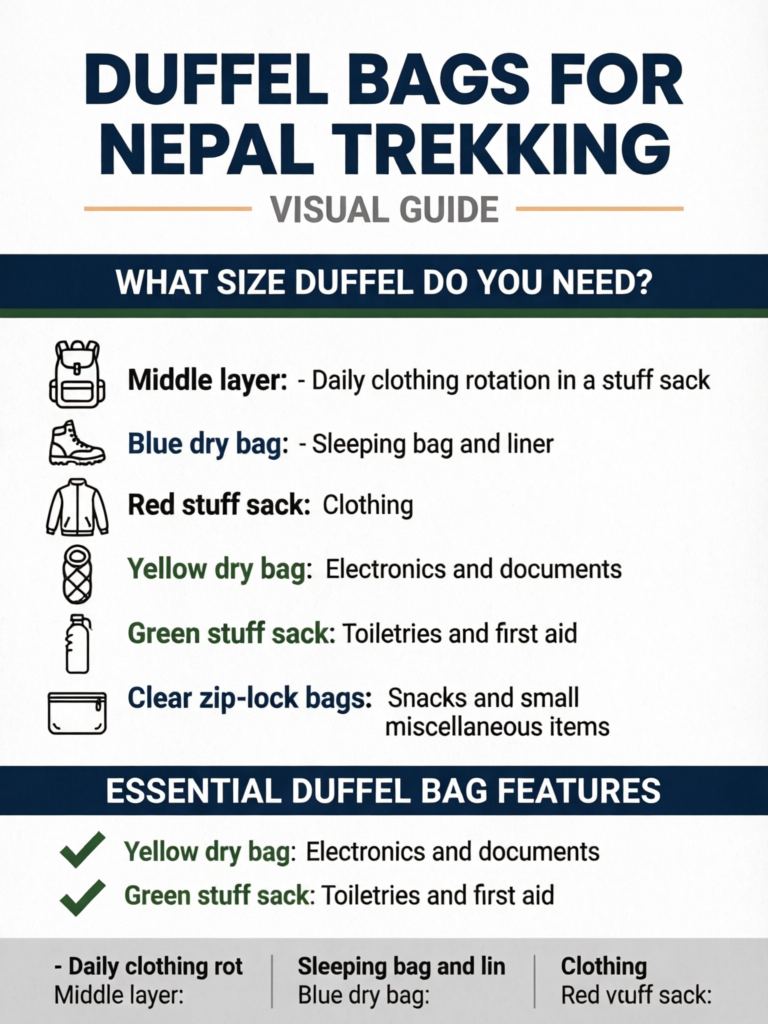
Rather than packing items loose, use color-coded stuff sacks or dry bags for each category:
- Blue dry bag: Sleeping bag and liner
- Red stuff sack: Clothing
- Yellow dry bag: Electronics and documents
- Green stuff sack: Toiletries and first aid
- Clear zip-lock bags: Snacks and small miscellaneous items
This system means you pull out one bag at a time rather than rummaging through loose items. It also protects everything from water regardless of the duffel's exterior water resistance.
Keep Valuables in Your Daypack, Not Your Duffel
Your passport, cash, credit cards, flight tickets, trekking permits, phone, and camera should always be in your daypack, which stays with you at all times. The duffel is out of your sight for most of the day and is accessible to others at lodges. Even with a locked duffel, keep anything irreplaceable or high-value on your person. The duffel carries clothing, sleeping gear, and items that are important but replaceable.
Airline Considerations
Your duffel bag likely doubles as your checked luggage for the flight to Kathmandu and the domestic flight to Lukla or Pokhara.
International Flights to Kathmandu
Most international airlines allow one checked bag of 20-30kg (depending on airline and class). A 60-80L duffel packed for trekking typically weighs 12-18kg, well within checked bag limits. The duffel's soft construction means it fits through standard baggage handling systems without issues.
Dimensions: Most airlines require checked bags to have combined dimensions (length + width + height) under 158cm. A 70L duffel typically measures approximately 70cm x 40cm x 35cm, totaling 145cm -- comfortably under the limit.
Domestic Flights (Kathmandu to Lukla)
Domestic flights to Lukla on small aircraft have strict baggage limits: typically 10-15kg checked and 5-7kg carry-on. Your duffel goes in checked cargo. Your daypack is carry-on. If your duffel exceeds the domestic weight limit, you pay excess baggage fees (approximately NPR 200-350 per kg).
Pro Tip
To stay under domestic flight weight limits, wear your heaviest items on the flight: trekking boots, down jacket, and heavy fleece. This shifts 2-3kg from your checked duffel to your body. The small planes are not temperature-controlled, so wearing warm layers is comfortable rather than excessive. This trick alone can save you NPR 400-1,000 in excess baggage fees.
Storing Your Suitcase in Kathmandu
If you fly to Kathmandu with a suitcase and transfer to a duffel for the trek, most Kathmandu hotels and trekking agencies offer free or low-cost luggage storage (NPR 100-300 per item per week). Pack your city clothes, non-trekking items, and souvenirs in the suitcase, lock it, and retrieve it when you return from the trek.
Duffel Bag Care and Longevity
During the Trek
Your duffel lives a rough life on a Nepal trek. A few practices protect it:
- Use a rain cover in any precipitation, even if the duffel is water-resistant
- Do not overstuff -- an overpacked duffel strains zippers and seams
- Keep it off wet ground at tea houses by placing it on a bench or shelf
- Check zippers periodically for jammed fabric or accumulated dirt
After the Trek
- Shake out dirt and debris
- Wipe the interior with a damp cloth
- Spot-clean any stains with mild soap
- Air-dry completely before storage (mildew develops in stored damp bags)
- Store loosely, not compressed, in a dry location
- Reapply DWR spray if the exterior no longer sheds water
When to Replace
Replace your duffel when: zippers no longer close smoothly despite cleaning and lubrication, fabric shows persistent tears (not just scuffs), shoulder strap attachment points show fraying or loosening, or the base fabric has worn through. A quality duffel should last 5-10 years of regular trekking use.
Buying a Duffel in Kathmandu vs. Bringing from Home
Advantages of Buying in Kathmandu
- No need to carry an empty duffel on the flight (if your suitcase serves as flight luggage)
- Can choose size after seeing exactly what gear you have
- Cheap options available (NPR 1,500-5,000 for basic duffels)
- Can test with your actual packed gear before the trek
Advantages of Bringing from Home
- Quality and brand selection vastly superior
- You can test the duffel with your gear before traveling
- Waterproofing quality is more reliable in name-brand duffels
- Straps, zippers, and hardware are more durable
- Better return policy if the product is defective
Our Recommendation
If you already own a quality duffel in the 60-80L range, bring it. If you need to buy one, purchase a reputable brand at home if budget allows. If you are on a strict budget and prefer to minimize pre-trip purchases, a Kathmandu-purchased duffel works for a single trek but will likely need replacement after one to two trips.
Frequently Asked Questions
Do I Need a Duffel Bag for Nepal Trekking?
Yes. On tea house treks like Everest Base Camp, the Annapurna Circuit, and the Manaslu Circuit, a porter carries your main gear while you carry only a daypack. Porters strongly prefer duffel bags over backpacks because duffels conform flexibly to their carrying systems and can be lashed together when carrying gear for multiple trekkers. A 60-80L duffel with lockable zippers and water-resistant fabric is the standard container for all your sleeping gear, clothing layers, dry bags, and personal items.
What Duffel Bag Do I Need for Everest Base Camp?
For the standard EBC tea house trek, a 65-75L duffel is ideal. This volume holds a sleeping bag, down jacket, 3-4 days of clothing, and personal items within the 15kg porter weight limit. Choose a TPU-coated or DWR-treated duffel for rain protection, and organize contents with color-coded stuff sacks and dry bags. For peak climbing additions like Island Peak after EBC, you may need 80-100L to accommodate technical equipment. See our rent vs buy guide for Kathmandu purchasing options.
Final Recommendation
For most Nepal trekkers, a 65-75L duffel bag with TPU-coated water-resistant fabric, lockable zippers, and padded shoulder straps is the ideal choice. The Patagonia Black Hole 70L and REI Co-op Big Haul 60L are both excellent options at different price points.
Pack your duffel under 15kg for tea house treks, organize contents with stuff sacks and dry bags, lock the zippers, and let your porter carry it with dignity and comfort. Your duffel is not just luggage -- it is your portable closet, your gear vault, and the container your porter will carry for up to two weeks on some of the most demanding trails in the world. Choose one that respects both your gear and your porter.
For the complete picture of what goes inside your duffel, see our comprehensive gear list and packing list. For route-specific considerations, check our guides for the Langtang Valley and Gokyo Lakes treks.
Ready to plan your Nepal trek?
Get a tailored kit list and a porter-friendly packing plan from a verified local agency before you book.