

Usually NOT needed (mattresses provided)
Essential (no mattresses exist)
R 3.0 minimum, R 4.0+ recommended
Closed-cell foam at 200-400g
Insulated air pad at 350-550g
$20 (foam) to $200+ (premium air pad)
Bulky -- strapped to outside of pack
1-liter water bottle size
Sleeping Pads & Mats for Nepal Trekking
Do you need a sleeping pad for Nepal trekking? For standard tea house trekking on popular routes in peak season, most trekkers do not — lodges provide foam mattresses. A sleeping pad or mat is essential for camping treks, winter trekking above 3,000m, side sleepers, and cold sleepers. For altitude, choose an insulated pad with an R-value of 3.0 minimum (4.0+ recommended above 4,000m).
The sleeping pad question divides Nepal trekkers more than almost any other gear decision. On one side: experienced tea house trekkers who say a pad is unnecessary weight because every lodge provides a mattress. On the other: light sleepers, cold sleepers, and camping trekkers who consider a pad essential for any night in the Himalayas. Both perspectives are valid, depending on your specific trek, your sleep sensitivity, and the conditions you will face.
The honest answer is this: for standard tea house trekking on popular routes like Everest Base Camp, the Annapurna Circuit, or Langtang Valley during peak season, most trekkers do not need to bring a sleeping pad. The mattresses provided by tea houses, while thin and basic, are adequate when combined with a good sleeping bag and sleeping bag liner. For camping treks like Upper Dolpo, Makalu Base Camp, or any route that involves nights in tents, a sleeping pad is absolutely essential. And for a specific subset of tea house trekkers -- cold sleepers, winter trekkers, side sleepers sensitive to thin mattresses, and those on less-popular routes with basic facilities -- a pad is a worthwhile addition.
This guide helps you determine whether you are in the "need a pad" or "skip the pad" category, explains the technology behind different pad types, breaks down the R-value system for altitude and temperature, and recommends specific pads for every budget and use case.
Do You Need a Sleeping Pad for Tea House Trekking?
Let us address the most common question first, with a realistic assessment of what you will actually sleep on in Nepal's tea houses.
What Tea House Mattresses Are Like
Tea house sleeping arrangements vary by altitude, route popularity, and the specific lodge. Here is what to expect:
Below 3,000m (Lukla, Phakding, Birethanti, Jagat): Beds with 5-10cm thick foam mattresses, often covered with a sheet. These are generally comfortable enough for a good night's sleep. Rooms may be shared (dorm-style) or private. The mattress quality at lower altitudes is comparable to a budget hostel anywhere in the world. No sleeping pad needed by anyone.
3,000-4,000m (Namche Bazaar, Tengboche, Manang, Chhomrong): Beds with 3-7cm thick foam mattresses. Quality varies by lodge. Popular, well-established tea houses like those in Namche Bazaar have relatively comfortable mattresses. Remote or newly-built lodges may have thinner, more compressed foam. Most trekkers sleep adequately on these mattresses with a good sleeping bag. Side sleepers may notice hip and shoulder pressure on the thinner examples.
4,000-5,000m (Dingboche, Lobuche, Thorong Phedi, Machhapuchhre Base Camp): Beds with 2-5cm thin foam mattresses, sometimes on wooden platforms, sometimes on stone or concrete. At this altitude, tea house construction is basic, and mattress replacement is infrequent because everything must be carried up by porters or yaks. Mattresses are often well-compressed from years of use, providing minimal cushioning. The thin foam transmits cold from the wooden or stone platform beneath, which can be a significant factor when room temperatures drop to minus 5 to minus 15 degrees Celsius.
Above 5,000m (Gorak Shep, Italian Pyramid area, high camps): The most basic sleeping surfaces. Thin foam pads on wooden platforms are standard. Some lodges provide little more than a raised wooden shelf with a carpet or thin blanket as a mattress substitute. At Gorak Shep (5,164m), the combination of extremely cold temperatures, thin mattresses, and the physical toll of altitude means sleep quality is already compromised. A sleeping pad makes a meaningful difference here.
When You DO NOT Need a Sleeping Pad
- Standard tea house treks in peak season (EBC, Annapurna Circuit, Langtang, ABC) if you are a stomach or back sleeper who is not particularly sensitive to firm surfaces
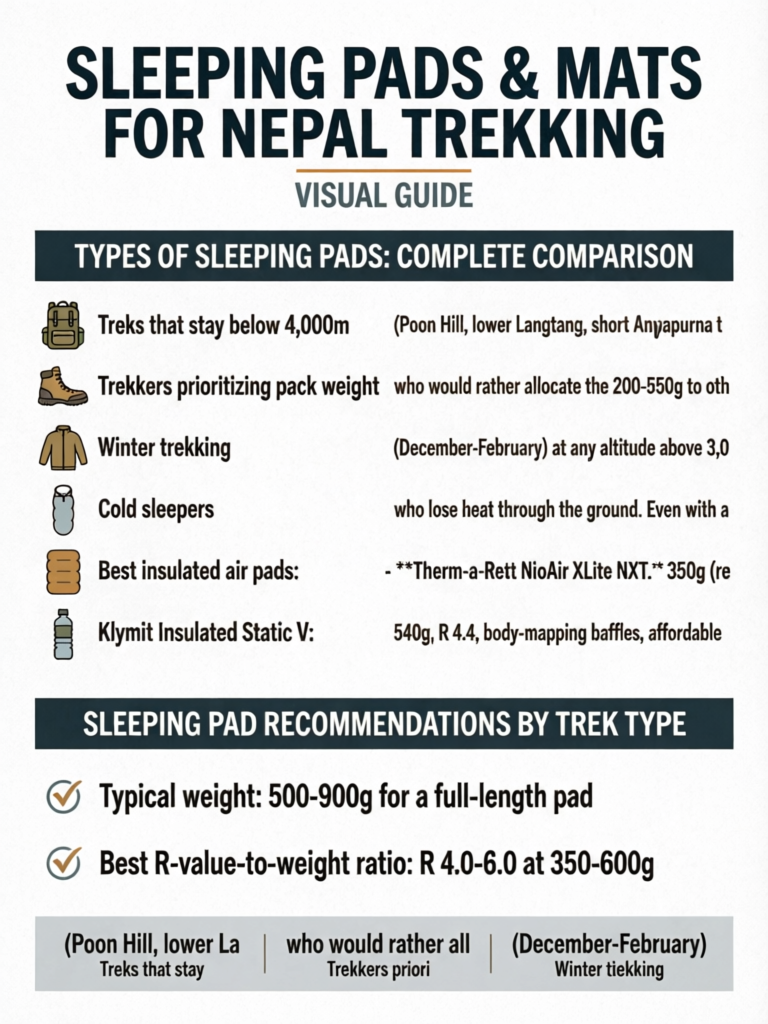
- Treks that stay below 4,000m (Poon Hill, lower Langtang, short Annapurna treks)
- Trekkers prioritizing pack weight who would rather allocate the 200-550g to other items
- Warm sleepers who generate enough body heat that cold transfer through a thin mattress is not an issue
When You DO Need a Sleeping Pad
- All camping treks (Upper Dolpo, Makalu Base Camp, Great Himalaya Trail sections, any trek with nights in tents). There is no mattress. Your pad is your mattress.
- Winter trekking (December-February) at any altitude above 3,000m, where the cold radiating up from frozen ground and cold platforms makes tea house mattresses inadequate
- Side sleepers who experience hip and shoulder pain on thin mattresses. The hip pressure from sleeping on 3cm of compressed foam on a wooden platform is enough to wake many side sleepers repeatedly throughout the night
- Light sleepers who find that even moderate discomfort disrupts their sleep. At altitude, good sleep is critical for acclimatization and recovery. If a thin mattress costs you two hours of sleep per night, the downstream effects on your trek performance and enjoyment compound rapidly.
- Cold sleepers who lose heat through the ground. Even with a good sleeping bag, heat loss through a thin mattress on a cold platform can create a persistent chill on your underside that the sleeping bag cannot compensate for. A pad with an R-value of 3.0 or higher blocks this ground-level heat loss.
- Less popular routes (Kanchenjunga, Upper Mustang, remote Dolpo tea houses) where facilities are more basic and mattress quality is lower than on the standard EBC or Annapurna routes
Pro Tip
If you are unsure whether you need a pad, consider this test: sleep on your living room floor with only a thin folded blanket (approximately 3cm thick) for one night. If you sleep through the night without significant discomfort, you will likely be fine on tea house mattresses. If you wake up with hip pain, shoulder soreness, or repeatedly toss and turn, bring a pad. The floor test at home simulates the firmness of a high-altitude tea house bed better than any product description can convey.
Types of Sleeping Pads: Complete Comparison
Closed-Cell Foam Pads
The simplest, most reliable, and cheapest sleeping pad technology. A closed-cell foam pad is a single piece of dense foam, typically 1-2cm thick, with no moving parts, no inflation mechanism, and nothing that can fail.
How it works: Closed-cell foam traps air in tiny sealed chambers within the foam structure. These air pockets provide both cushioning and insulation. The foam cannot absorb water (the cells are closed, meaning sealed), making it impervious to rain, snow, condensation, and spills.
Advantages:
- Essentially indestructible: cannot puncture, pop, leak, or mechanically fail
- Lightest insulating option per R-value at lower R-values (200-400g for R 2.0-2.6)
- Cheapest option: $15-40
- No inflation needed: ready to use in seconds
- Works as a sit pad, pack frame stiffener, or improvised splint when not being slept on
- Zero maintenance
- Performs consistently in all temperatures (no temperature-sensitive inflation)
Disadvantages:
- Bulky: cannot be compressed, must be strapped to the outside of your pack or carried separately
- Least comfortable: the thin, firm surface provides minimal cushioning for side sleepers
- Lower R-values than equivalent-weight insulated air pads
- Thickness limited to 1.5-2cm (thicker foam becomes impractically bulky)
- Can develop permanent compression over years of heavy use
Best closed-cell foam pads:
- Therm-a-Rest Z Lite SOL: 410g, R 2.0, accordion-fold design. The most popular foam pad for trekking. $30-40.
- Nemo Switchback: 415g, R 2.0, alternating hexagonal cutouts for better cushioning. $35-45.
- Generic Kathmandu foam pad: 300-500g, R-value unrated (estimated 1.5-2.0), available for $10-15 in Thamel. Functional for a single trek.
The Half-Pad Strategy
Some experienced trekkers cut a closed-cell foam pad in half or to three-quarter length to save weight and bulk. The pad covers shoulders to hips (the critical insulation zone), and the legs rest on the tea house mattress or a stuff sack filled with clothing. This saves 150-200g and reduces bulk significantly. The trade-off is that your feet and lower legs have no extra insulation, which matters on very cold nights. For tea house trekkers supplementing an existing mattress, a half-pad (or torso-length pad) is an excellent compromise.
Self-Inflating Pads
Self-inflating pads combine open-cell foam inside an airtight shell. When you open the valve, the foam expands and draws air in, partially inflating the pad. You then blow a few breaths to top it off to your preferred firmness.
How it works: The open-cell foam core provides both insulation and structure. The airtight shell traps the air drawn in by the foam's expansion. The combination provides better comfort than closed-cell foam (the surface conforms to your body) and decent insulation from the foam core.
Advantages:
- More comfortable than closed-cell foam: 2.5-5cm thick, softer surface
- Reasonable R-values: R 2.5-4.0 depending on thickness
- Moderate packability: rolls down to about 2-3 times the size of an air pad
- Good durability: less puncture-prone than pure air pads because the foam core provides structure even if the shell leaks
- Partially self-inflating reduces the effort of setup (though a few top-off breaths are always needed)
Disadvantages:
- Heavier than both closed-cell foam (for equivalent R-value) and air pads (for equivalent comfort)
- Typical weight: 500-900g for a full-length pad
- Bulkier than air pads when packed (the foam core does not compress as small)
- Can still puncture (the airtight shell is vulnerable, though less critically than air pads since the foam provides partial insulation even when deflated)
- Slower to inflate and deflate than either foam or air pads
Best self-inflating pads:
- Therm-a-Rest ProLite: 480g (regular), R 2.4, the lightest self-inflating pad. Packs to 28cm x 10cm. $70-100.
- Therm-a-Rest Trail Scout: 680g (regular), R 3.1, better insulation for cold conditions. $50-70.
- Sea to Summit Camp Mat SI: 780g (regular), R 4.2, maximum comfort in the self-inflating category. $80-100.
Air Pads (Insulated)
Insulated air pads use a lightweight shell filled with air, with internal insulation (synthetic fibers, reflective films, or down) to prevent heat loss through the air column. They represent the modern gold standard for backcountry sleep systems, offering the best comfort-to-weight ratio and the highest R-values at any given weight.
How it works: You inflate the pad using a pump sack, built-in pump, or lung power. The internal baffles control air distribution, creating a stable sleep surface. The insulation within the air chambers (typically synthetic fibers or reflective thermal barriers) prevents convective heat loss through the air column, which is the primary weakness of uninsulated air pads.
Advantages:
- Most comfortable: 6-10cm thick, cushioning surface that supports side sleepers' hips and shoulders
- Best R-value-to-weight ratio: R 4.0-6.0 at 350-600g
- Most compact: packs to roughly the size of a 1-liter water bottle
- Stable sleeping surface with internal baffles preventing rolling off
- Width and shape options (mummy, rectangular, wide) for different sleeper preferences
Disadvantages:
- Puncture vulnerability: a single hole deflates the pad completely. At 2am in a tea house or tent at 4,800m, a flat pad means sleeping on a thin floor with no insulation. Always carry a patch kit.
- More expensive: $100-250 for quality insulated air pads
- Require inflation: 15-40 breaths or use of a pump sack. At altitude, where you are already breathing hard, inflating a pad is noticeably more effort.
- Moisture from breath can condense inside the pad in cold conditions, reducing insulation over time. Use a pump sack instead of lung inflation when possible.
- Noise: some pads crinkle when you shift position, which can disturb light sleepers or tea house roommates
Best insulated air pads:
- Therm-a-Rest NeoAir XLite NXT: 350g (regular), R 4.5, the benchmark ultralight insulated pad. Exceptional warmth and packability. $200-230.
- Sea to Summit Ether Light XT Insulated: 490g (regular), R 3.2, excellent comfort with air-sprung cell technology. $170-200.
- Nemo Tensor Insulated: 425g (regular), R 4.2, quiet fabric, excellent warmth. $170-200.
- Klymit Insulated Static V: 540g, R 4.4, body-mapping baffles, affordable. $80-110.
Uninsulated Air Pads
Uninsulated air pads are filled with air only, with no internal insulation. They provide excellent cushioning but poor cold-weather insulation.
R-values: R 1.0-2.0 (inadequate for temperatures below 5 degrees Celsius)
Verdict for Nepal: Not recommended as a standalone pad for any trek that goes above 3,000m in any season. The air column inside an uninsulated pad conducts heat away from your body, making you colder than sleeping on the tea house mattress alone. If you already own an uninsulated air pad, pair it with a closed-cell foam pad underneath for insulation.
The Altitude Inflation Warning
Air pads inflate based on the pressure differential between the inside and outside. At altitude, lower atmospheric pressure means the pad inflates with less effort but also means the internal pressure is lower relative to sea-level inflation. At 5,000m, atmospheric pressure is roughly 50% of sea level. An air pad inflated at 5,000m will feel less firm than the same pad inflated at sea level with the same number of breaths. You may need to add extra breaths to achieve comfortable firmness. Conversely, a pad inflated at high altitude and then carried to lower altitude (on descent) will feel over-inflated. Open the valve to release excess pressure.
R-Value Explained: Insulation for Altitude and Temperature
What R-Value Means
R-value measures a material's resistance to heat transfer. A higher R-value means more insulation -- less of your body heat passes through the pad to the cold ground or platform beneath you. The R-value scale is linear: an R 4.0 pad provides exactly twice the insulation of an R 2.0 pad.
Since 2020, the outdoor industry has standardized R-value testing under the ASTM F3340-18 standard, which replaced the previous inconsistent manufacturer-specific testing. Modern R-values from reputable brands are directly comparable across manufacturers. Older pads tested under different standards may have inflated R-values compared to the current standard.
R-Value Requirements for Nepal Treks
| Temperature Range | R-Value Needed | Typical Altitude/Situation |
|---|---|---|
| Above 10°C | R 1.0-2.0 | Below 2,000m, warm season |
| 5°C to 10°C | R 2.0-3.0 | 2,000-3,000m, peak season |
| 0°C to 5°C | R 3.0-4.0 | 3,000-4,000m, peak season |
| -5°C to 0°C | R 3.5-4.5 | 4,000-4,500m, autumn; 3,000-4,000m, winter |
| -10°C to -5°C | R 4.0-5.0 | 4,500-5,000m, autumn; 4,000-4,500m, winter |
| Below -10°C | R 5.0+ | Above 5,000m, any season; high camps, winter |
The critical detail: These R-values apply to the pad alone. On a tea house trek, your tea house mattress provides an additional R 1.0-2.0 of insulation beneath you (depending on thickness and condition). So a tea house trekker sleeping on a 4cm mattress (approximately R 1.5) plus a pad with R 3.0 has a combined R-value of 4.5, which is adequate for most conditions to minus 10 degrees Celsius.
On a camping trek where you are sleeping on the ground (frozen or otherwise), the pad R-value is your only insulation from below. This is why camping trekkers need higher R-value pads than tea house trekkers.
How R-Value Relates to Your Sleeping Bag
Your sleeping bag insulates you from the cold air above and around you. Your sleeping pad (and tea house mattress) insulates you from the cold surface below you. These are independent systems that work together.
A common mistake is choosing a sleeping bag rated for very cold temperatures and then sleeping on a thin, low R-value surface. The sleeping bag insulation compressed beneath your body weight provides minimal insulation (compressed down or synthetic fiber traps almost no air). Without a pad or mattress providing insulation from below, you lose heat through the bottom of your sleeping system regardless of how warm the bag is.
Think of it this way: your sleeping bag warms the top and sides. Your pad warms the bottom. If either is inadequate, you are cold.
Pro Tip
R-values stack additively. If you carry a closed-cell foam pad (R 2.0) and place it under your insulated air pad (R 4.0), the combined R-value is 6.0. This stacking strategy is common on winter camping treks where extreme insulation is needed but a single R 6.0 pad would be heavy and expensive. The foam pad also serves as insurance: if the air pad punctures, you still have R 2.0 insulation from the foam pad, which is survivable in most tea house situations.
Sleeping Pad Recommendations by Trek Type
Standard Tea House Trek (EBC, Annapurna, Langtang) -- Peak Season
Recommendation: Most trekkers do not need a pad. The tea house mattresses on popular routes are adequate for back and stomach sleepers. A good sleeping bag rated to minus 15 degrees Celsius comfort with a sleeping bag liner handles the insulation needs.
Exception -- side sleepers and cold sleepers: Bring a Therm-a-Rest Z Lite SOL (410g, R 2.0, $35) or cut it to three-quarter length (approximately 300g). Place it on top of the tea house mattress for combined R 3.5-4.0 and meaningful cushioning improvement. The added comfort for side sleepers is worth the weight.
Standard Tea House Trek -- Winter (December-February)
Recommendation: Bring a pad. Winter temperatures drop the tea house bedroom to minus 10 to minus 20 degrees Celsius. The thin mattresses transmit cold aggressively from frozen wooden platforms. An insulated pad transforms winter tea house sleep quality.
Best choice: Therm-a-Rest NeoAir XLite NXT (350g, R 4.5, $200) or Klymit Insulated Static V (540g, R 4.4, $90). Combined with the tea house mattress, you achieve R 5.5-6.5, which is adequate for the coldest conditions.
Camping Trek (Upper Dolpo, Makalu, Great Himalaya Trail)
Recommendation: Essential. Non-negotiable.
On camping treks, you sleep in a tent on the ground. At altitude, the ground may be frozen solid, covered in snow, or sitting on permafrost. The insulation provided by your pad is the only barrier between your body and a surface that is actively drawing heat away from you.
Best choice: Therm-a-Rest NeoAir XLite NXT (350g, R 4.5, $200) as primary pad. Add a Therm-a-Rest Z Lite SOL (or half-length version at approximately 200g) underneath for combined R 6.5 and puncture insurance. Total weight: 550g for a sleep system that handles minus 20 degrees Celsius ground temperatures.
Budget alternative: Therm-a-Rest Z Lite SOL (410g, R 2.0) plus a Klymit Insulated Static V (540g, R 4.4) for combined R 6.4 at 950g total. Heavier but significantly cheaper.
Peak Climbing High Camps
Recommendation: Essential, with high R-value.
High camp sleeping surfaces are often snow, ice, or bare rock at 5,500-6,000m. Temperatures inside tents can reach minus 15 to minus 25 degrees Celsius. Your pad needs maximum insulation in minimum weight.
Best choice: Therm-a-Rest NeoAir XTherm NXT (430g, R 7.3, $230) -- the highest R-value-to-weight pad available. Combined with a closed-cell foam pad underneath (R 2.0, 200g for half-length), you achieve R 9.3, which handles the most extreme conditions on Nepal's trekking peaks.
Off-the-Beaten-Path Tea House Routes
Routes like Kanchenjunga Base Camp, Tsum Valley, Upper Mustang, and remote sections of the Great Himalaya Trail have tea houses with more basic facilities than EBC or Annapurna routes. Mattresses may be thinner, more worn, or absent in some lodges.
Recommendation: Bring a lightweight pad. The Therm-a-Rest Z Lite SOL (410g) or a three-quarter length version provides insurance against substandard mattresses at minimal weight.
Weight vs Comfort vs Warmth: Decision Matrix
| Pad | Type | Weight | R-Value | Packed Size | Comfort (1-10) | Cost | Best For |
|---|---|---|---|---|---|---|---|
| Therm-a-Rest Z Lite SOL | Foam | 410g | 2.0 | 51 x 13 x 14cm (bulky) | 4/10 | $35 | Backup, tea house supplement, bombproof reliability |
| Nemo Switchback | Foam | 415g | 2.0 | 51 x 13 x 14cm (bulky) | 5/10 | $40 | Slightly more comfortable foam option |
| Therm-a-Rest ProLite | Self-Inflating | 480g | 2.4 | 28 x 10cm | 6/10 | $85 | Lightweight self-inflating, moderate warmth |
| Klymit Insulated Static V | Air (Insulated) | 540g | 4.4 | 20 x 8cm | 8/10 | $90 | Best value insulated air pad |
| Nemo Tensor Insulated | Air (Insulated) | 425g | 4.2 | 20 x 8cm | 9/10 | $180 | Quiet, comfortable, warm |
| Therm-a-Rest NeoAir XLite NXT | Air (Insulated) | 350g | 4.5 | 23 x 10cm | 8/10 | $210 | Best warmth-to-weight, ultralight |
| Therm-a-Rest NeoAir XTherm NXT | Air (Insulated) | 430g | 7.3 | 23 x 10cm | 8/10 | $230 | Maximum insulation for extreme cold |
| Sea to Summit Ether Light XT | Air (Insulated) | 490g | 3.2 | 22 x 10cm | 9/10 | $180 | Maximum comfort, moderate warmth |
Caring for Your Sleeping Pad on Trek
Foam Pads
Virtually maintenance-free. Wipe off dirt and moisture. Do not store compressed for extended periods (months), as the foam may permanently deform. On trek, strap to the outside of your pack and forget about it.
Air Pads
Air pads require more care but reward it with years of service:
- Inflation: Use a pump sack (many pads include one) instead of blowing directly into the pad. Breath moisture condenses inside the pad in cold conditions, degrading insulation over time and encouraging mold growth. A pump sack eliminates this issue.
- Puncture prevention: Clear your sleeping surface of sharp objects (stones, thorns, exposed nails in tea house bed frames) before placing the pad. In tents, sweep the floor and check for thorns that may have been brought in on boots.
- Patch kit: Always carry the small patch kit that comes with the pad. In a pinch, duct tape or tenacious tape provides a temporary repair. The standard repair takes 5 minutes: locate the leak (inflate the pad, listen and feel for air movement, or submerge sections in water), clean the area, apply adhesive patch, allow to cure for 8 hours if possible.
- Storage: At home, store the pad unrolled and with the valve open. This prevents the foam insulation from permanently compressing and allows air circulation to prevent moisture buildup.
Pro Tip
Carry a small strip of Tenacious Tape (the clear, adhesive repair tape from Gear Aid) in your first aid kit. It weighs 5 grams and can repair a punctured air pad, torn rain jacket, or broken tent fabric in seconds without needing to wait for adhesive to cure. This is one of the highest value-per-gram items you can carry on any trek. Apply it to the pad surface while the pad is inflated and smoothed flat, pressing firmly to ensure adhesion.
Self-Inflating Pads
- Inflation: Open the valve and wait 3-5 minutes for auto-inflation, then add a few breaths to reach desired firmness.
- Deflation and packing: Open the valve, fold the pad in half lengthwise, then roll from the opposite end of the valve to force air out. Close the valve while still compressed.
- Puncture risk: Lower than air pads but still possible. The foam core provides partial insulation and cushioning even when the shell is punctured, making a puncture less catastrophic. Still carry a patch kit.
What to Buy at Home vs Buy in Kathmandu
Buy Before You Leave
Quality insulated air pads (Therm-a-Rest, Sea to Summit, Nemo). These are not available in Kathmandu. The technical insulation, precision valve mechanisms, and lightweight materials are not replicated by any locally available product.
Quality self-inflating pads from reputable brands. Same reasoning as above.
Foam pad accessories like half-length trimming (cut your Z Lite at home with a sharp knife to save weight, rather than carrying a full-length pad you do not need).
Available in Kathmandu
Basic closed-cell foam pads are available in Thamel outdoor shops for $10-15. These are simple foam mats with no brand or R-value rating. They work -- foam is foam -- but they tend to be slightly heavier and less comfortable than branded options like the Z Lite SOL.
Basic self-inflating pads from Chinese brands are occasionally available in Kathmandu for $20-40. Quality and R-value are uncertain. Adequate for a single trek but not a long-term investment.
Camping mats from agencies: if you are joining a guided camping trek, your agency may provide sleeping mats as part of the camping equipment. Confirm this and ask about the specific mat provided. Agency mats are often thin, heavy, and worn from repeated use.
Agency-Provided Camping Mats: Set Expectations Low
Most trekking agencies that provide sleeping mats for camping treks supply basic 1-2cm closed-cell foam pads. These provide minimal cushioning and R 1.0-1.5 of insulation. At high-altitude camps where ground temperatures are well below freezing, these mats are insufficient for warm sleep without supplementation. If you are joining a camping trek, bring your own insulated pad and treat the agency mat as a base layer beneath it. The comfort and warmth difference is dramatic.
Advanced Strategies
The Dual-Pad System for Extreme Cold
For winter camping or peak climbing high camps where ground temperatures reach minus 15 to minus 25 degrees Celsius, the dual-pad system provides maximum insulation:
Bottom layer: Closed-cell foam pad (R 2.0, 200-410g). This provides a puncture-proof, reliable insulation base and protects the air pad above from rough ground surfaces.
Top layer: Insulated air pad (R 4.0-7.3, 350-430g). This provides the majority of the insulation and all of the comfort.
Combined R-value: R 6.0-9.3 depending on specific pads chosen. Combined weight: 550-840g.
This system is used by experienced mountaineers and winter camping trekkers throughout the Himalayas. The redundancy is a key advantage: if the air pad punctures at 3am, the foam pad beneath keeps you off the frozen ground while you either repair the air pad or endure until morning.
Sleeping Pad as Pack Insulation
Some trekkers carry a three-quarter-length closed-cell foam pad inside their backpack, folded against the back panel. This serves double duty: it provides back panel structure and rigidity to the pack, and it insulates the pack contents (especially water bottles) from your sweating back during hiking. At night, it comes out of the pack and goes under your sleeping bag. This dual-use approach means the pad's weight is justified for two functions rather than one.
Chair Kit Conversion
Several pad manufacturers offer lightweight "chair kit" accessories that convert an inflated air pad into a camp chair. After a long day of hiking, sitting in a proper chair at the tea house (rather than a hard wooden bench) is surprisingly pleasant. The Therm-a-Rest Trekker Chair Kit ($35, 225g) works with all rectangular and mummy-shaped pads. Whether the 225g weight of the chair kit is justified is a personal decision, but repeat trekkers often swear by it.
Frequently Asked Questions
Final Recommendations
Tea house trekker who sleeps well anywhere: Skip the pad. Save the weight. Focus your gear budget on a quality sleeping bag and liner.
Tea house trekker who is a side sleeper or cold sleeper: Therm-a-Rest Z Lite SOL (410g, R 2.0, $35) cut to three-quarter length. Light, cheap, indestructible, and meaningfully improves sleep quality on thin tea house mattresses.
Camping trekker (standard season): Therm-a-Rest NeoAir XLite NXT (350g, R 4.5, $210). The best warmth-to-weight ratio available. Pack a small foam pad section underneath for puncture insurance on rough ground.
Camping trekker (winter) or peak climbing high camps: Therm-a-Rest NeoAir XTherm NXT (430g, R 7.3, $230) on top of a half-length Z Lite SOL (approximately 200g, R 2.0). Combined R 9.3 at 630g handles the most extreme ground temperatures in the Nepal Himalayas.
Budget-conscious camping trekker: Klymit Insulated Static V (540g, R 4.4, $90) plus a basic foam pad from Kathmandu ($12, approximately 300g, R 1.5). Combined R 5.9 at 840g for a total cost under $110.
Whatever your choice, the principle is the same: insulation from below matters as much as insulation from above. Your sleeping bag keeps you warm from the top and sides. Your pad keeps you warm from the bottom. Together, they create a complete sleep system that lets you rest, recover, and wake ready for the next day's adventure in the Himalayas. Pair your pad decision with the right sleeping bag for Nepal trekking and check your complete trekking gear list before you fly.