
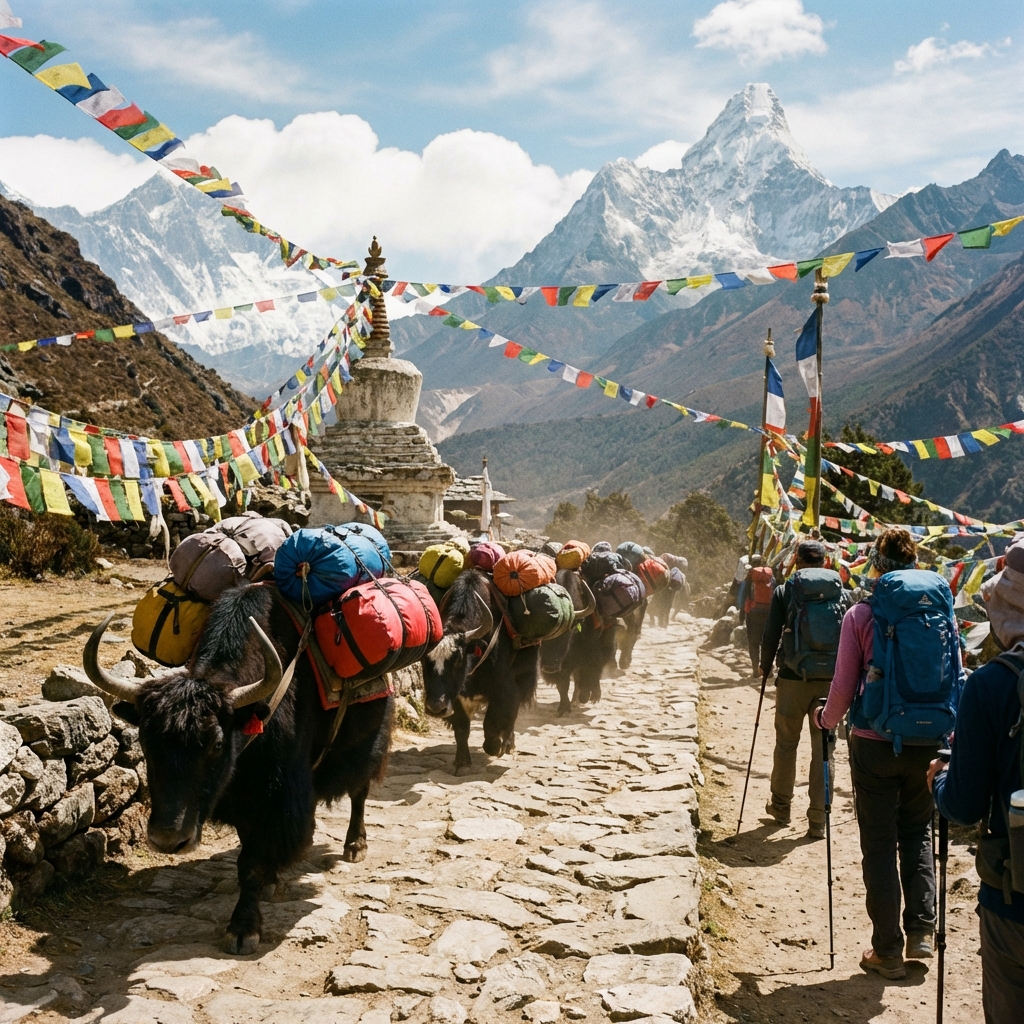
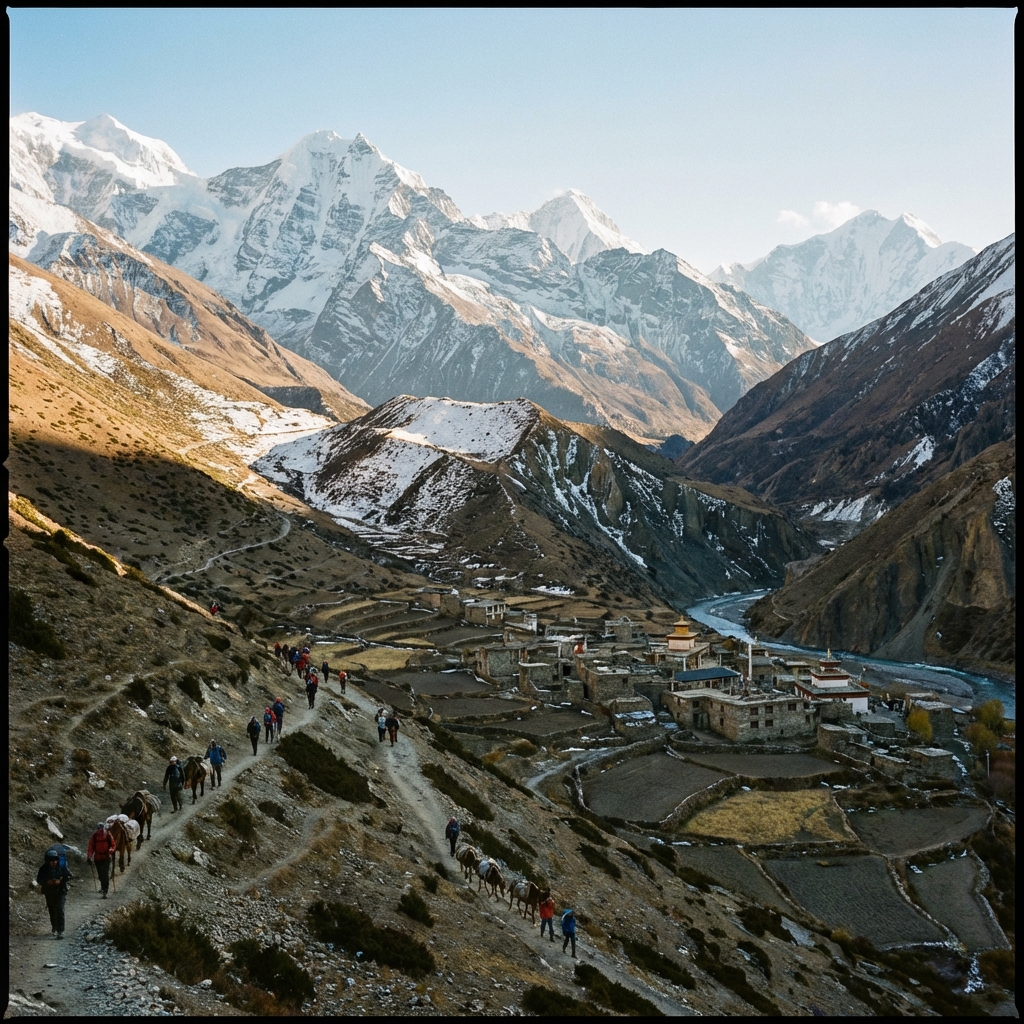
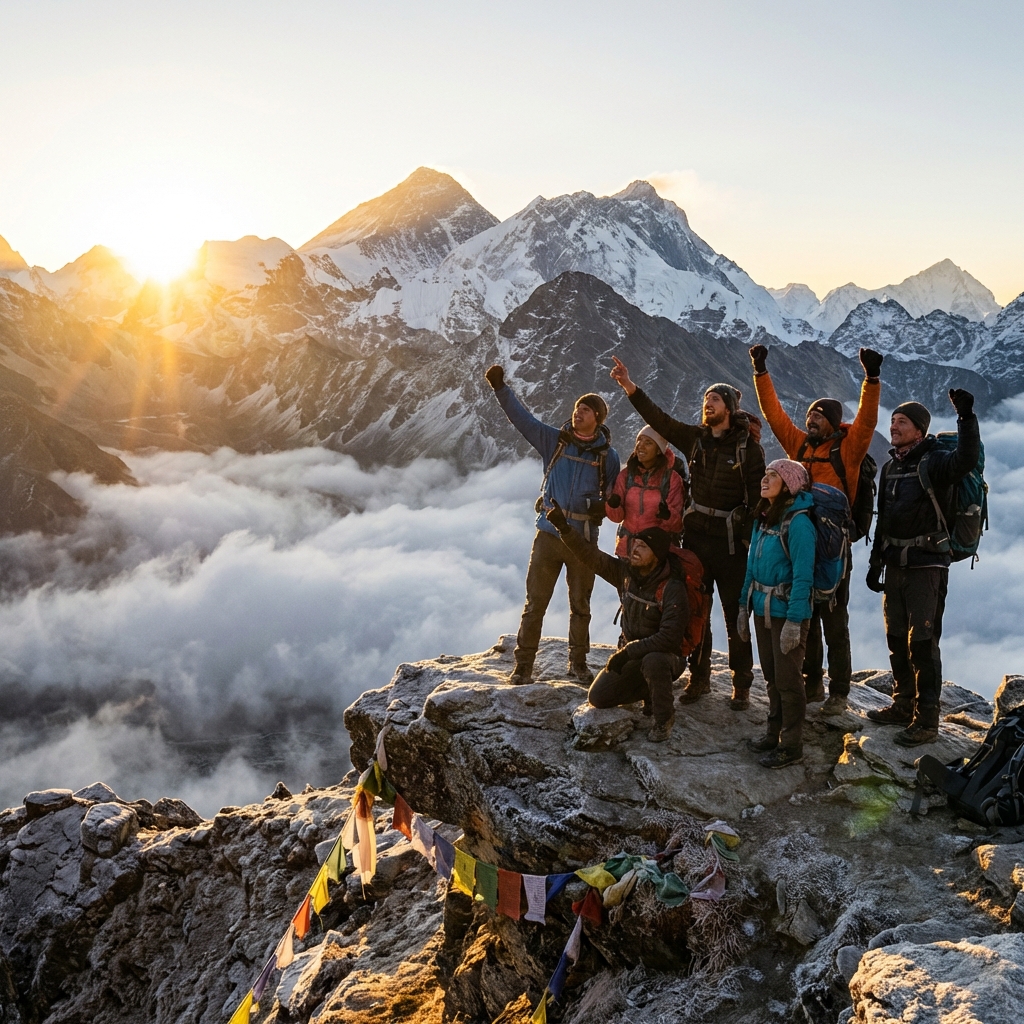
Why choose between Nepal's most famous sunrise viewpoint and its most spectacular mountain amphitheater when you can have both? The ABC and Poon Hill combination trek links two of the Annapurna region's greatest highlights into a single 12-14 day journey, creating what many consider the ultimate Annapurna trekking experience.
This combined itinerary takes you first to Ghorepani for the legendary Poon Hill sunrise panorama (over 30 Himalayan peaks visible), then continues through Tadapani and Chhomrong to the glacial sanctuary of Annapurna Base Camp (4,130m) -- all without backtracking to Pokhara between the two destinations.
Key highlights of the combination trek: Poon Hill sunrise with 360-degree Himalayan panorama, Annapurna Base Camp in the glacial sanctuary surrounded by 7,000-8,000m peaks, diverse ecosystems from rhododendron forest to alpine glacier, Gurung cultural villages throughout, shared trail sections that make the combination natural and efficient, and two bucket-list experiences in one trip.
Quick Facts: ABC + Poon Hill Combination Trek
12-14 days
10-12 days on trail
4,130m (Annapurna Base Camp)
Poon Hill (3,210m) for sunrise
95-110km
Moderate to Challenging
March-May, September-November
$25-45 per day on trail
Why Combine ABC and Poon Hill?
The Logic of Combination
The ABC and Poon Hill treks share significant trail infrastructure in the Annapurna region. Rather than doing them as two separate trips (which would mean two separate journeys from Pokhara, two separate permit periods, and overlapping trail sections), combining them creates a single continuous route that is both more efficient and more rewarding.
Geographic connection: After Poon Hill, instead of descending back to Nayapul (the standard Poon Hill return), you traverse east through Tadapani to Chhomrong -- the gateway to the Annapurna Sanctuary and ABC. This connecting trail passes through spectacular rhododendron forest and avoids any backtracking.
What You Get vs. Separate Treks
| Factor | Poon Hill Only (3-4 days) | ABC Only (10 days) | Combined (12-14 days) |
|---|---|---|---|
| Poon Hill sunrise | Yes | No | Yes |
| Annapurna Base Camp | No | Yes | Yes |
| Total days needed | 3-4 | 10 | 12-14 |
| Separate trips to Pokhara | 1 | 1 | 1 (saves a trip) |
| Permit costs | $38 | $38 | $38 (same permits) |
| Unique trail sections | 25km | 60km | 95-110km |
| Ghorepani village | Yes | Usually no | Yes |
| Chhomrong village | No | Yes | Yes |
| Diversity of experience | Moderate | High | Very High |
The bottom line: In 12-14 days, you experience everything both treks offer separately, with only 2-4 extra days compared to the standard ABC trek alone. It is the most complete Annapurna region experience available in under two weeks.
Who Is This Trek For?
- Trekkers with 12-14 days who want maximum Annapurna highlights
- First-time Nepal visitors wanting the definitive Annapurna experience
- Photographers seeking both sunrise panoramas and glacial amphitheater shots
- Anyone who cannot decide between Poon Hill and ABC
- Repeat visitors who did one and want to add the other
- Cultural enthusiasts wanting extended immersion in Gurung villages
Pro Tip
The combination trek is one of the best "value for time" experiences in Nepal trekking. For just 2-4 extra days compared to the standard ABC route, you add the world-famous Poon Hill sunrise, the beautiful village of Ghorepani, and spectacular rhododendron forest sections that the standard ABC route misses entirely. If you have the extra days, the combination is vastly superior to ABC alone.
Complete Day-by-Day Itinerary (13-Day Version)
This itinerary uses 13 trekking/travel days, which is the sweet spot for the combination trek. It can be extended to 14 days by adding a rest day, or compressed to 12 days by combining certain stages.
Itinerary Overview
| Day | Route | Altitude | Distance | Time | Highlights |
|---|---|---|---|---|---|
| 0 | Pokhara preparation | 822m | -- | -- | Permits, gear check |
| 1 | Pokhara to Nayapul, trek to Tikhedhunga | 1,540m | 11km | 4-5hr | Trek start, riverside trail |
| 2 | Tikhedhunga to Ghorepani | 2,860m | 11km | 6-7hr | Stone staircase climb, forest |
| 3 | Poon Hill sunrise, trek to Tadapani | 2,630m | 13km | 7-8hr | Sunrise panorama, rhododendron forest |
| 4 | Tadapani to Chhomrong | 2,170m | 10km | 5-6hr | Connecting trail, Gurung villages |
| 5 | Chhomrong to Bamboo/Dovan | 2,310m | 10km | 5-6hr | Enter Annapurna Sanctuary |
| 6 | Bamboo to Deurali | 3,230m | 9km | 5-6hr | Bamboo and rhododendron forest |
| 7 | Deurali to ABC via MBC | 4,130m | 8km | 5-6hr | Reach Annapurna Base Camp |
| 8 | ABC morning, descend to Bamboo | 2,310m | 17km | 6-7hr | Sunrise at ABC, long descent |
| 9 | Bamboo to Jhinu Danda | 1,780m | 11km | 5-6hr | Chhomrong area, hot springs |
| 10 | Jhinu to Nayapul, drive to Pokhara | 822m | 14km | 5-6hr + drive | Trek end, return to Pokhara |
Day 0: Pokhara -- Preparation Day (822m)
Activities: Permits, gear check, transportation booking
Pokhara, Nepal's lakeside adventure capital, serves as the starting and ending point for the combination trek. Use this day to:
- Obtain permits: TIMS card and Annapurna Conservation Area Permit (ACAP) from the Tourism Board office in Damside or Lakeside
- Final gear check: Trekking shops line Lakeside's main street with everything you need
- Book transport: Arrange a morning jeep or bus to Nayapul (departure point)
- Brief your guide: Discuss the itinerary, dietary needs, and any health concerns
- Enjoy Pokhara: Last chance for diverse cuisine, Phewa Lake sunset, comfortable bed
Accommodation: Lakeside hotels ($5-50) Daily costs: $25-100
Day 1: Pokhara to Nayapul (1,070m), Trek to Tikhedhunga (1,540m) -- 4-5 Hours
Starting Elevation: 1,070m (Nayapul) Ending Elevation: 1,540m (Tikhedhunga) Elevation Gain: +470m Distance: 11km Difficulty: Easy to Moderate
The trek begins with a 1.5-2 hour drive from Pokhara to Nayapul. From there, the trail follows the Modi Khola river through terraced farmland and small settlements. This is a gentle introduction to trekking, with the trail passing through Birethanti (where you check in at the ACAP checkpoint) and climbing gradually to Tikhedhunga.
The landscape is subtropical -- lush green terraces, banana trees, and warm temperatures. You will encounter other trekkers heading both to Poon Hill and ABC, as the first day's trail is shared.
Key waypoints:
- Nayapul to Birethanti (1,025m): 30 minutes, flat trail with ACAP checkpoint
- Birethanti to Hille (1,475m): 2 hours, gentle riverside trail
- Hille to Tikhedhunga (1,540m): 1.5-2 hours, gradual climb through farmland
Accommodation: Tea houses in Tikhedhunga ($4-8) Daily costs: Transport $6-20, Trail $15-25. Total: $21-45
Day 2: Tikhedhunga to Ghorepani (2,860m) -- 6-7 Hours
Starting Elevation: 1,540m (Tikhedhunga) Ending Elevation: 2,860m (Ghorepani) Elevation Gain: +1,320m Distance: 11km Difficulty: Challenging
Day 2 is the hardest day of the Poon Hill portion. The trail climbs relentlessly from Tikhedhunga through Ulleri to Ghorepani, gaining over 1,300m in elevation. The infamous stone staircase between Tikhedhunga and Ulleri (approximately 3,300 stone steps) is the most physically demanding section.
Key waypoints:
- Tikhedhunga to Ulleri (2,070m): 2-2.5 hours, steep stone staircase (+530m)
- Ulleri to Banthanti (2,210m): 1-1.5 hours, entering rhododendron forest
- Banthanti to Nangethanti (2,430m): 1 hour, gradual climb through forest
- Nangethanti to Ghorepani (2,860m): 1.5-2 hours, final push through dense forest
Ghorepani village: A charming mountain village that serves as the base for the Poon Hill sunrise. The village offers numerous lodges, shops, and restaurants. Arrive by mid-afternoon to rest and prepare for the early morning sunrise climb.
For detailed information about the village, see our Ghorepani village guide.
Accommodation: Tea houses in Ghorepani ($5-12) Daily costs: $25-40
Rhododendron Season
If trekking in March-April, the forests between Ulleri and Ghorepani explode with blooming rhododendrons -- Nepal's national flower. The trail becomes a tunnel of red, pink, and white blossoms, creating one of the most spectacular botanical displays in the Himalayas. This is a highlight unique to the Poon Hill portion and not experienced on the standard ABC-only route.
Day 3: Poon Hill Sunrise (3,210m), Trek to Tadapani (2,630m) -- 7-8 Hours
Starting Elevation: 2,860m (Ghorepani) High Point: 3,210m (Poon Hill) Ending Elevation: 2,630m (Tadapani) Elevation Gain: +350m (Poon Hill), then -580m (to Tadapani) Distance: 13km Difficulty: Moderate
This is the first marquee day of the combination trek -- the famous Poon Hill sunrise.
Poon Hill Sunrise
Wake-up: 4:30-5:00 AM Departure from Ghorepani: 5:00-5:15 AM (headlamp required) Ascent time: 45 minutes to 1 hour Sunrise: Approximately 6:00-6:30 AM (varies by season) Time at summit: 30-45 minutes for sunrise display Descent to Ghorepani: 30-45 minutes
The climb from Ghorepani to Poon Hill summit follows a well-maintained stone staircase through forest. In the dark with headlamp, the trail is straightforward. Arrive at the summit platform before sunrise to secure a good viewing position.
Sunrise panorama from Poon Hill (3,210m):
- Dhaulagiri (8,167m) -- the seventh highest mountain, massive and close
- Annapurna I (8,091m) -- the tenth highest, visible to the east
- Annapurna South (7,219m) -- prominent and beautifully lit at sunrise
- Machhapuchre/Fishtail (6,993m) -- the iconic double-peaked sacred mountain
- Annapurna III (7,555m) and Annapurna IV (7,525m) -- the full range
- Nilgiri (7,061m) -- visible to the north
- Hiunchuli (6,441m) -- the gateway peak of the Annapurna Sanctuary
The sunrise light sweeping across this wall of peaks -- from the golden tip of Dhaulagiri to the fiery glow on Machhapuchre -- is consistently rated among the top sunrise experiences in the Himalayas. On clear mornings, you can count over 30 named peaks.
Trek to Tadapani
After descending to Ghorepani for breakfast, the day continues with the connecting trail to Tadapani. This is the section that links Poon Hill to the ABC route.
Key waypoints:
- Ghorepani to Deurali Pass (3,100m): 1.5-2 hours, climb through forest
- Deurali Pass to Banthanti (2,510m): 1.5-2 hours, descent through rhododendron forest
- Banthanti to Tadapani (2,630m): 1-1.5 hours, gentle climb to the village
Tadapani is a small settlement perched on a ridge with spectacular views of Machhapuchre and Annapurna South. This is where the combination route meets the standard ABC trail -- from here onward, you follow the ABC itinerary.
Accommodation: Tea houses in Tadapani ($5-10) Daily costs: Poon Hill entry NPR 50 ($0.40), Trail costs $20-35. Total: $20-35
Pro Tip
At Poon Hill, position yourself on the eastern edge of the summit platform for the best Dhaulagiri views, or the western edge for Annapurna and Machhapuchre. If the platform is crowded (common in October), the area just below the main platform also offers excellent views. Bring a thermos of hot tea prepared by your lodge the night before -- it makes the cold pre-dawn wait much more pleasant.
Day 4: Tadapani to Chhomrong (2,170m) -- 5-6 Hours
Starting Elevation: 2,630m (Tadapani) Ending Elevation: 2,170m (Chhomrong) Elevation Change: -460m (net, with ups and downs) Distance: 10km Difficulty: Moderate
The trail from Tadapani to Chhomrong traverses through beautiful forest with views of Machhapuchre becoming increasingly dominant. The route involves a descent to the Modi Khola river and then a significant climb to Chhomrong village.
Key waypoints:
- Tadapani to Chuile (2,040m): 2-2.5 hours, descent through forest
- Chuile to Jhinu Danda (1,780m): 1 hour, continued descent to river area
- Alternative via Ghandruk (1,940m): 3-3.5 hours, through a major Gurung village
Chhomrong village: This large, terraced Gurung village is the last major settlement before the Annapurna Sanctuary. It cascades down a steep hillside with stone-paved paths, traditional stone houses, and panoramic views of Annapurna South and Hiunchuli. Chhomrong has the best lodge selection and facilities of any village between Ghorepani and ABC.
For detailed information, see our Chhomrong village guide.
Accommodation: Tea houses in Chhomrong ($5-12) Daily costs: $25-40
The Chhomrong Staircase
The descent into and climb out of Chhomrong involves hundreds of stone steps. The village sits on a steep hillside, and no matter which direction you approach from, you face a significant stair climb. This is notorious for tiring legs and sore knees. Take it slow, use trekking poles, and remember -- the views from Chhomrong are worth every step.
Day 5: Chhomrong to Bamboo/Dovan (2,310-2,505m) -- 5-6 Hours
Starting Elevation: 2,170m (Chhomrong) Ending Elevation: 2,310m (Bamboo) or 2,505m (Dovan) Elevation Change: +140m to +335m (net, with significant descent and re-ascent) Distance: 10km Difficulty: Moderate
From Chhomrong, the trail descends steeply to the Chhomrong Khola river, crosses a bridge, and then climbs to Sinuwa before descending again into the Modi Khola valley. You are now entering the Annapurna Sanctuary -- the glacial amphitheater enclosed by the Annapurna and Machhapuchre massifs.
Key waypoints:
- Chhomrong to Sinuwa (2,340m): 2-2.5 hours (steep descent, river crossing, climb)
- Sinuwa to Bamboo (2,310m): 1.5-2 hours, descent through bamboo forest
- Bamboo to Dovan (2,505m): 1-1.5 hours (optional -- extend to shorten Day 6)
The forest becomes increasingly dense and lush as you descend into the valley. Bamboo groves, moss-covered trees, and the sound of the river below create a primeval atmosphere. Keep an eye out for Danphe (Impeyan pheasant, Nepal's national bird) in the undergrowth.
Accommodation: Tea houses at Bamboo or Dovan ($5-10) Daily costs: $20-35
Day 6: Bamboo/Dovan to Deurali (3,230m) -- 5-6 Hours
Starting Elevation: 2,310m (Bamboo) or 2,505m (Dovan) Ending Elevation: 3,230m (Deurali) Elevation Gain: +725 to +920m Distance: 9km Difficulty: Moderate-Challenging
The trail climbs steadily through the narrowing valley, passing through Himalaya Hotel (2,920m) and ascending through increasingly sparse vegetation to Deurali. The forest transitions from bamboo to rhododendron to alpine scrub. Mountain views begin opening up as the valley walls close in.
Key waypoints:
- Bamboo to Dovan (2,505m): 1-1.5 hours (if starting from Bamboo)
- Dovan to Himalaya Hotel (2,920m): 1.5-2 hours, steady climb
- Himalaya Hotel to Deurali (3,230m): 1.5-2 hours, steeper sections
Avalanche zone: The section between Dovan and Deurali passes through areas with avalanche risk, particularly in winter and early spring. Your guide will assess conditions and advise on timing. The danger is highest on warm afternoons when snow becomes unstable.
Accommodation: Tea houses at Deurali ($5-10) Daily costs: $25-40
Avalanche Risk Above Dovan
The Annapurna Sanctuary approach trail passes beneath steep, snow-laden slopes between Dovan and Machhapuchre Base Camp. Avalanche risk is highest in December-February and during warm spring afternoons (March-April). Start early in the morning when snow is frozen and stable. If you hear cracking sounds from above, move quickly to the nearest safe zone. Your guide should be experienced with this section and knowledgeable about current conditions.
Day 7: Deurali to ABC (4,130m) via MBC (3,700m) -- 5-6 Hours
Starting Elevation: 3,230m (Deurali) Ending Elevation: 4,130m (Annapurna Base Camp) Elevation Gain: +900m Distance: 8km Difficulty: Challenging (altitude)
The culmination of the ABC portion -- reaching the glacial amphitheater of the Annapurna Sanctuary. The trail climbs from Deurali to Machhapuchre Base Camp (MBC, 3,700m) and then continues to Annapurna Base Camp.
Key waypoints:
- Deurali to MBC (3,700m): 2.5-3 hours, gradual climb emerging from tree cover
- MBC to ABC (4,130m): 2-2.5 hours, gentle gradient across moraine
Machhapuchre Base Camp (3,700m)
MBC is a collection of lodges on a rocky plateau with stunning views of Machhapuchre's south face. Despite the name, it has never been a climbing base camp -- Machhapuchre is sacred and climbing is forbidden. Most trekkers stop for lunch and continue to ABC.
Annapurna Base Camp (4,130m)
Arriving at ABC is one of trekking's great moments. You step into a natural amphitheater enclosed by a 360-degree wall of massive peaks:
- Annapurna I (8,091m) -- the main event, the tenth highest mountain on Earth
- Annapurna South (7,219m) -- towering to the south
- Hiunchuli (6,441m) -- guarding the sanctuary entrance
- Machhapuchre (6,993m) -- the sacred Fishtail peak behind you
- Annapurna III (7,555m) -- to the east
- Gangapurna (7,455m) -- glacier and peak
- Tent Peak/Tharpu Chuli (5,663m) -- closest to camp
The glacial moraine, prayer flags, and the sheer scale of the surrounding peaks create an overwhelming sense of being at the heart of the mountains.
Accommodation: Tea houses at ABC ($8-15) Daily costs: $30-50
Pro Tip
The sunset at ABC is extraordinary -- the last light catches Annapurna I's summit and turns it gold, then pink, then deep purple as night falls. But the sunrise is even better. If skies are clear, set your alarm for 5:30 AM and step outside to watch the sun hit the peaks one by one. Having already experienced the Poon Hill sunrise earlier in the trek, you can compare two of Nepal's greatest sunrise experiences firsthand.
Day 8: ABC Morning, Descend to Bamboo (2,310m) -- 6-7 Hours
Starting Elevation: 4,130m (ABC) Ending Elevation: 2,310m (Bamboo) Elevation Loss: -1,820m Distance: 17km Difficulty: Moderate (long descent)
After sunrise at ABC, begin the long descent. Most trekkers leave ABC by 7:00-8:00 AM and reach Bamboo by early-to-mid afternoon. The descent reverses Days 6-7, dropping through MBC, Deurali, Himalaya Hotel, and Dovan to Bamboo.
This is a significant descent that will test your knees. Use trekking poles, take small steps, and tighten your boot laces to prevent toe damage.
Key stops:
- ABC to MBC: 1.5-2 hours
- MBC to Deurali: 1-1.5 hours
- Deurali to Bamboo: 2.5-3 hours
Accommodation: Tea houses at Bamboo ($5-10) Daily costs: $20-35
Day 9: Bamboo to Jhinu Danda (1,780m) -- 5-6 Hours
Starting Elevation: 2,310m (Bamboo) Ending Elevation: 1,780m (Jhinu Danda) Elevation Change: -530m (net) Distance: 11km Difficulty: Moderate
The trail climbs from Bamboo back through Sinuwa and across to the Chhomrong area before descending to Jhinu Danda. This day reverses parts of Day 5 and adds the descent to Jhinu.
The reward: Hot springs
Jhinu Danda is famous for its natural hot springs on the Modi Khola river, approximately 20 minutes walk (steep descent) below the village. After 8 days of trekking, soaking in the warm mineral water with mountain views is the perfect reward.
Hot springs details:
- Entry fee: NPR 100-200 ($0.80-1.50)
- Temperature: Naturally heated, pleasantly warm
- Facilities: Changing rooms, basic
- Best time: Late afternoon after the trek day
- Duration: 1-2 hours recommended
Accommodation: Tea houses at Jhinu Danda ($4-8) Daily costs: $20-35
Day 10: Jhinu Danda to Nayapul (1,070m), Drive to Pokhara (822m) -- 5-6 Hours + Drive
Starting Elevation: 1,780m (Jhinu Danda) Ending Elevation: 1,070m (Nayapul) then 822m (Pokhara) Elevation Loss: -710m to trailhead Distance: 14km trekking + 1.5 hour drive Difficulty: Easy-Moderate
The final trekking day descends through terraced farmland and small villages to Nayapul, where a jeep or bus returns you to Pokhara. The trail is easy and mostly downhill, a fitting end to a spectacular trek.
Key waypoints:
- Jhinu Danda to Majgaon (1,350m): 2-2.5 hours
- Majgaon to Birethanti (1,025m): 1.5-2 hours
- Birethanti to Nayapul (1,070m): 30 minutes
Transport from Nayapul to Pokhara:
- Shared jeep: NPR 500-800 ($4-6), 1.5-2 hours
- Private jeep: NPR 8,000-10,000 ($60-75), 1.5 hours
- Local bus: NPR 200-300 ($1.50-2.30), 2-2.5 hours
Arriving in Pokhara: Most trekkers arrive by mid-afternoon. Celebrate with a lakeside dinner, cold beer, and a comfortable bed.
Daily costs: Trail $15-25, Transport $2-75, Pokhara dinner $10-20. Total: $27-120
Altitude Profile: The Combined Route
| Day | Location | Sleep Altitude | Day High Point |
|---|---|---|---|
| 1 | Tikhedhunga | 1,540m | 1,540m |
| 2 | Ghorepani | 2,860m | 2,860m |
| 3 | Tadapani | 2,630m | 3,210m (Poon Hill) |
| 4 | Chhomrong | 2,170m | 2,630m |
| 5 | Bamboo | 2,310m | 2,340m |
| 6 | Deurali | 3,230m | 3,230m |
| 7 | ABC | 4,130m | 4,130m |
| 8 | Bamboo | 2,310m | 4,130m |
| 9 | Jhinu Danda | 1,780m | 2,310m |
| 10 | Pokhara | 822m | 1,780m |
Acclimatization analysis: The combination route provides excellent natural acclimatization. Days 1-3 (Poon Hill section) climb to 3,210m, which pre-acclimatizes your body before the ABC section. By the time you reach 4,130m on Day 7, you have had 6 days of altitude exposure. This is actually better acclimatization than the standard ABC-only route, which reaches 4,130m on Day 7 from a lower starting profile.
Trail Map: Understanding the Route Logic
The combination route forms a rough figure-eight pattern in the Annapurna foothills:
Leg 1 (Days 1-3): Poon Hill Circuit Nayapul → Tikhedhunga → Ulleri → Ghorepani → Poon Hill → Tadapani
Connection (Day 4): The Link Tadapani → Chhomrong (this trail connects the Poon Hill area to the ABC approach)
Leg 2 (Days 5-8): ABC Out-and-Back Chhomrong → Bamboo → Deurali → MBC → ABC → (return same route) → Bamboo
Exit (Days 9-10): Return to Pokhara Bamboo → Chhomrong area → Jhinu Danda → Nayapul → Pokhara
Key insight: The only new trail section compared to doing both treks separately is the Day 4 connection from Tadapani to Chhomrong. Everything else would be walked on either the standard Poon Hill or standard ABC route.
Difficulty Assessment
The ABC-Poon Hill combination is rated Moderate to Challenging overall:
| Day | Difficulty | Key Challenge |
|---|---|---|
| 1 | Easy-Moderate | Gentle introduction |
| 2 | Challenging | 1,320m elevation gain, stone staircase |
| 3 | Moderate | Early wake-up + long day with Poon Hill |
| 4 | Moderate | Ups and downs with staircases |
| 5 | Moderate | Significant descent and re-ascent |
| 6 | Moderate-Challenging | Sustained uphill, entering altitude |
| 7 | Challenging | Altitude gain to 4,130m |
| 8 | Moderate | Long descent day, knee strain |
| 9 | Moderate | Continued descent |
| 10 | Easy-Moderate | Final downhill walk |
Physical requirements:
- Walk 5-7 hours per day for 10 consecutive days
- Handle 1,000m+ elevation changes (up and down) on multiple days
- Carry a daypack of 5-8 kg (if using a porter for main bag)
- Moderate cardiovascular fitness
- No technical climbing skills required
The hardest days:
- Day 2 (Tikhedhunga to Ghorepani): The stone staircase to Ulleri is grueling with over 3,300 steps
- Day 7 (Deurali to ABC): Altitude makes everything harder above 3,500m
- Day 8 (ABC to Bamboo): The 1,820m descent punishes knees and quads
Best Season for the Combination Trek
Autumn (October-November) -- Peak Season
Pros: Clear skies, best mountain views, stable weather, all lodges open Cons: Crowded (especially Poon Hill and Ghorepani), accommodation can fill up Poon Hill experience: Expect 100-200 people at the summit platform in October. Arrive early for a good position. ABC experience: 30-50 trekkers at ABC on peak days Recommendation: Excellent choice. Book lodges ahead in Ghorepani and Chhomrong.
Spring (March-May) -- Best for Combination
Pros: Rhododendron blooms (the Poon Hill section is spectacular in March-April), warmer temperatures, fewer crowds than October, all lodges open Cons: Occasional afternoon clouds, hazy views toward late April Poon Hill experience: 30-80 people. More manageable crowds. ABC experience: 15-30 trekkers. Comfortable numbers. Recommendation: Arguably the best season for this specific combination because the rhododendron forests between Ulleri and Ghorepani are at their most spectacular.
Winter (December-February) -- For Experienced Trekkers
Pros: Very few trekkers, clear skies, lower costs Cons: Cold nights at Ghorepani and ABC, some lodges closed above Deurali, short days Recommendation: Possible but check lodge openings. December and February are more feasible than January.
Monsoon (June-September) -- Not Recommended
Pros: Lush green landscapes, waterfalls in full force Cons: Rain, leeches below 3,000m, clouds obscure mountain views, trail conditions poor, avalanche risk on ABC approach Recommendation: Avoid.
Spring Rhododendron Season
If you are trekking the combination route in March or early April, the forests between Ulleri, Ghorepani, and Tadapani burst with blooming rhododendrons. Nepal's national flower creates tunnels of red, pink, and white blossoms that are among the most spectacular botanical displays in the Himalayas. This is a unique advantage of the combination route -- the standard ABC-only trail from Chhomrong misses these extensive rhododendron forests entirely.
Costs and Budget
Permit Costs
| Permit | Cost (Foreigners) | Cost (SAARC) |
|---|---|---|
| ACAP | NPR 3,000 ($23) | NPR 200 ($1.50) |
| TIMS Card | NPR 2,000 ($15) | NPR 1,000 ($8) |
| Poon Hill Entry | NPR 50 ($0.40) | NPR 50 ($0.40) |
| Total | $38.40 | $9.90 |
Important: The ACAP and TIMS permits cover BOTH the Poon Hill and ABC portions. You do not need separate permits for each section. This is a cost advantage of the combination trek -- one set of permits covers the entire route.
Total Budget Estimates
Budget Independent Trek (12-14 days):
- Trail costs: $20-30/day x 10 trek days = $200-300
- Transport: $10-30
- Permits: $38
- Pokhara accommodation (2 nights): $10-30
- Grand total: $258-398
Standard Guided Trek (12-14 days):
- Trail costs: $30-45/day x 10 days = $300-450
- Guide ($25-35/day x 12): $300-420
- Porter ($15-20/day x 12): $180-240
- Transport: $20-50
- Permits: $38
- Pokhara accommodation: $20-60
- Tips: $100-200
- Grand total: $958-1,458
Agency All-Inclusive Package: $800-1,800 depending on service level
Packing Notes Specific to This Trek
The combination trek covers a wider altitude range than ABC alone (822m to 4,130m), which means more diverse conditions:
- Lower sections (Days 1-2, 9-10): Warm and potentially humid. T-shirt weather.
- Mid sections (Days 3-6): Cool mornings and evenings, comfortable daytime. Fleece needed.
- Upper sections (Days 7-8): Cold, especially at ABC. Down jacket essential.
Items specific to the combination:
- Headlamp with full batteries for the Poon Hill pre-dawn climb
- Thermos for hot drinks on Poon Hill morning and ABC morning
- Camera with fully charged batteries for both sunrise experiences
- Light rain gear for lower forest sections (especially in spring)
- Leech socks if trekking in late spring (May)
Frequently Asked Questions: ABC and Poon Hill Combination Trek
Related Planning Resources
- ABC 10-Day Itinerary -- the standard ABC-only route for comparison
- Poon Hill 3-Day Itinerary -- the standalone Poon Hill route
- Ghorepani Village Guide -- detailed Ghorepani information
- Chhomrong Village Guide -- detailed Chhomrong information
- Best Time for ABC Trek -- seasonal breakdown
- ABC Trek Cost Breakdown -- detailed budget planning
Final Thoughts: Is the ABC-Poon Hill Combination Right for You?
The ABC and Poon Hill combination trek is, quite simply, the best way to experience the Annapurna region in under two weeks. You get two of Nepal's most iconic experiences -- the Poon Hill sunrise panorama and the Annapurna Base Camp glacial sanctuary -- on a single continuous route that flows naturally through the landscape.
Choose the combination trek if:
- You have 12-14 days and want the complete Annapurna experience
- You love sunrise photography and mountain panoramas
- You want to trek through the famous rhododendron forests (especially March-April)
- You cannot decide between Poon Hill and ABC (why choose when you can have both?)
- You want better natural acclimatization than the ABC-only route provides
- You enjoy diverse landscapes and cultural villages
Choose a different option if:
- You have fewer than 12 days (do ABC-only in 10 days or Poon Hill in 3-4 days)
- You have done both previously and want something new
- You prefer lower-altitude trekking only (do Poon Hill standalone)
- You want a higher-altitude challenge (consider EBC or Annapurna Circuit instead)
The Annapurna region has given trekkers two extraordinary gifts in Poon Hill and ABC. The combination trek lets you unwrap both in a single, unforgettable journey.
Namaste, and safe trekking!
Sources:
This guide was researched using data from:
- Nepal Tourism Board -- Annapurna Region Statistics 2026/2027
- Annapurna Conservation Area Project (ACAP) -- Trail and Permit Information
- Annapurna region lodge networks and pricing surveys 2026/2027
- Himalayan Rescue Association -- Altitude and Safety Guidelines
- Local guide associations -- Combination route feedback and timing data