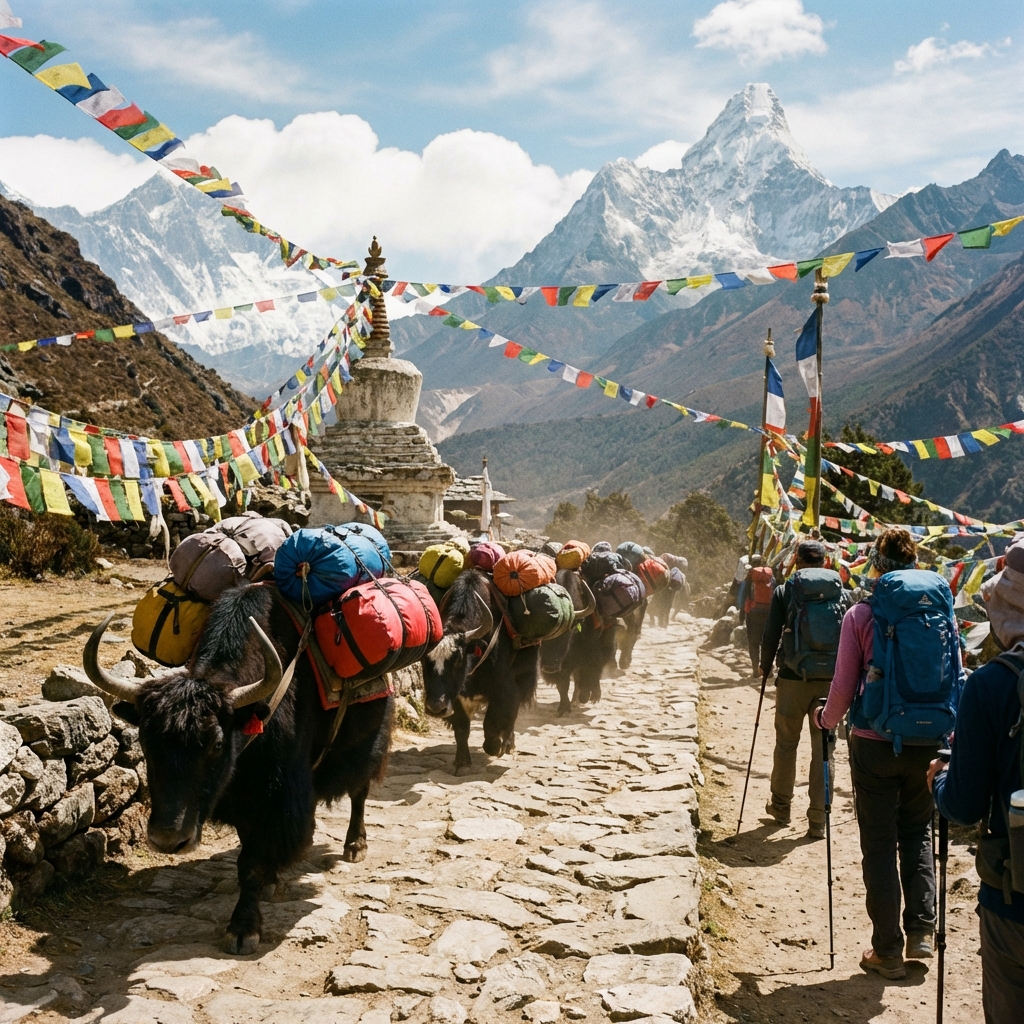
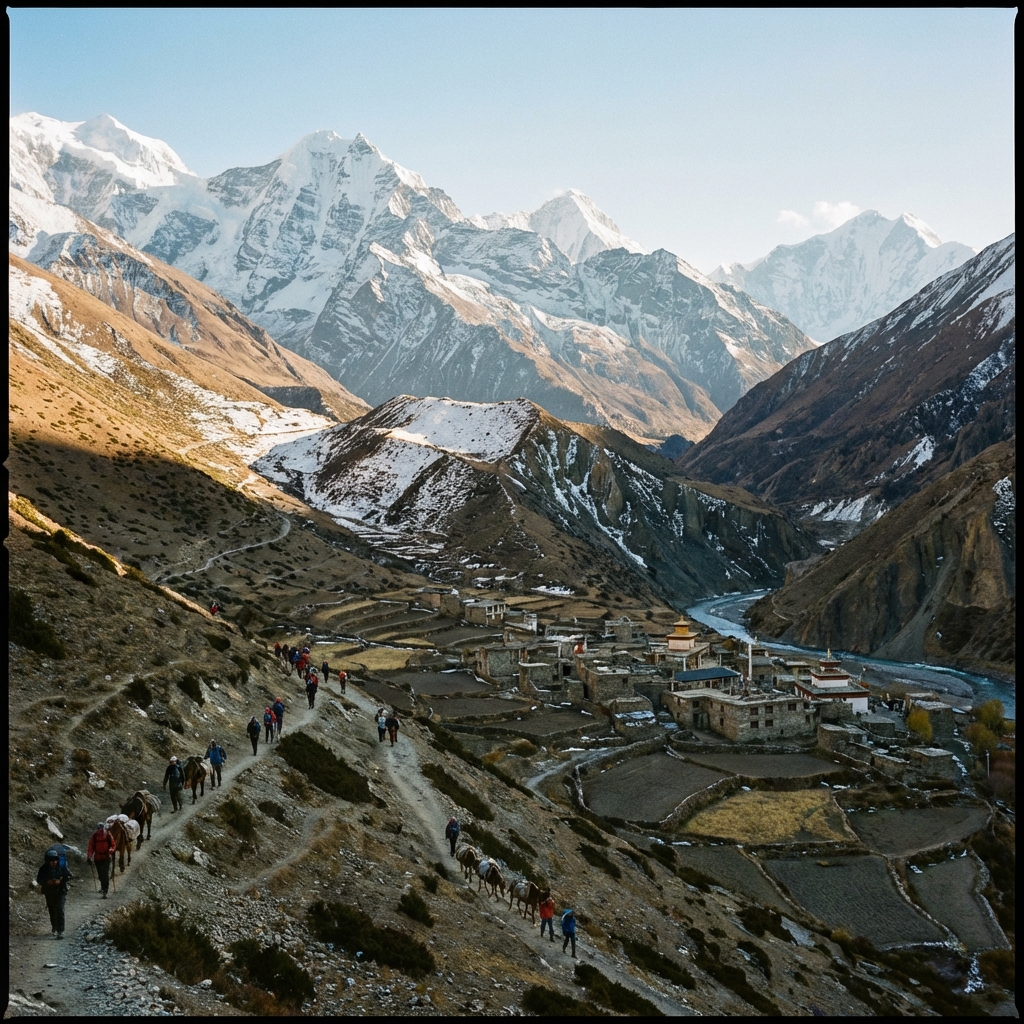
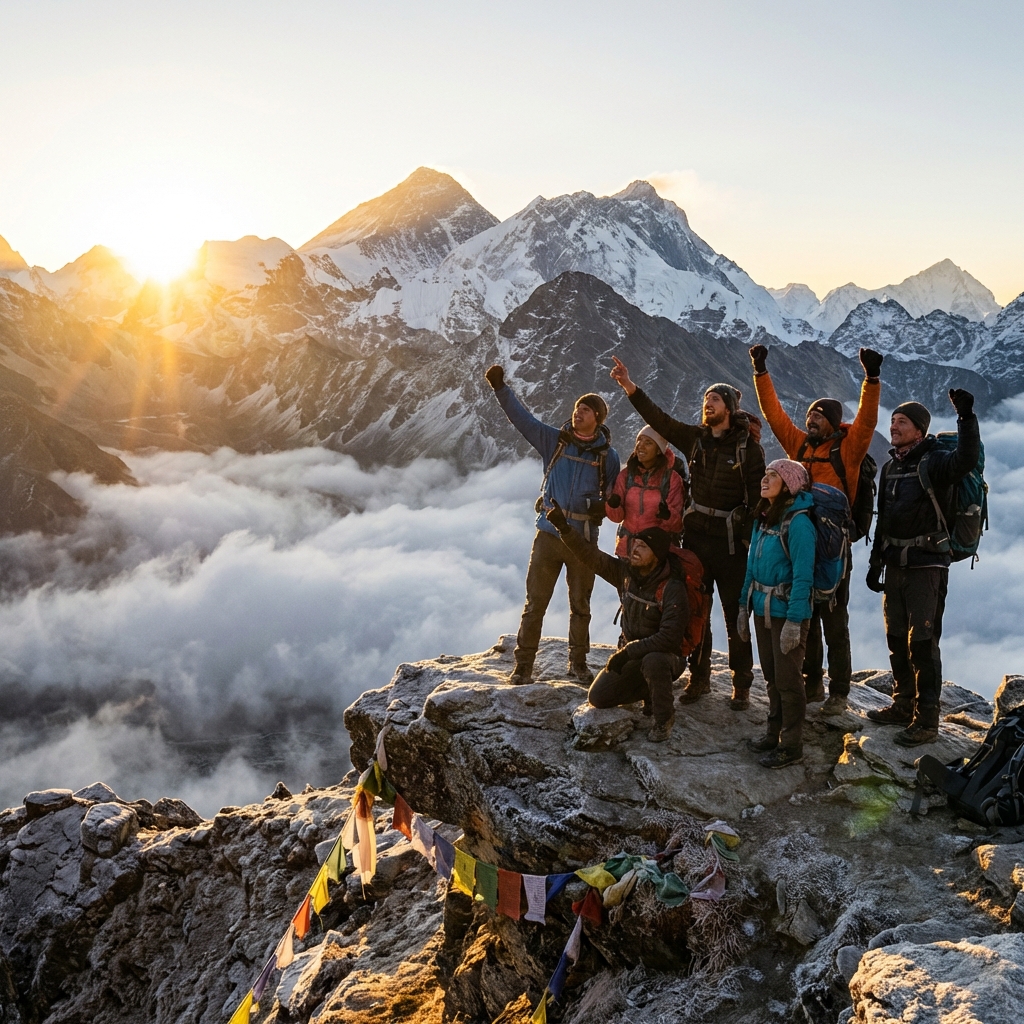
Your body at 5,000 meters is a fundamentally different machine than your body at sea level. Your metabolism runs faster, burning through calories at a rate that would fuel two normal days. Your appetite, perversely, drops to nearly nothing. Your digestive system slows. Water evaporates from your lungs with every breath in the thin, dry air. And the very foods that fuel you best at altitude are different from what you would choose at home.
Most trekkers arrive in Nepal with a detailed packing list, a carefully researched itinerary, and almost no plan for what they will eat or how they will fuel their body through the most physically demanding days of the trek. This is a critical oversight. Proper nutrition at altitude is not merely about comfort. It directly affects your acclimatization, your energy levels, your mood, your sleep quality, and ultimately your chances of reaching your destination whether that is Everest Base Camp, Annapurna Base Camp, or Thorong La Pass.
This guide provides a complete altitude nutrition strategy for Nepal trekkers. It covers why your appetite disappears, how many calories you actually need, the optimal ratio of carbohydrates to protein to fat at altitude, hydration strategies that work, what snacks to carry, when to eat for maximum energy, and specific pre-pass-day nutrition protocols.
4,000-5,000+ calories while trekking at altitude
Most trekkers only consume 2,000-3,000 calories at altitude
Average trekker loses 2-5 kg during a 14-day trek
3-4 liters of fluid per day above 3,000m
60-70% carbs, 15-20% protein, 15-20% fat
Common above 3,500m, significant above 4,500m
Dal bhat: high carb, easily digestible, unlimited refills
Every 1-2 hours on the trail
Why Your Appetite Disappears at Altitude
Understanding the physiological reasons behind altitude-related appetite loss helps you fight against it strategically rather than simply accepting it.
The Hormonal Shift
At altitudes above 3,000m, your body increases production of the hormone leptin, which signals satiety (fullness) to your brain. Simultaneously, your body decreases production of ghrelin, the "hunger hormone" that normally triggers appetite. This hormonal double-whammy means your brain is receiving constant "I am full" signals even when your energy reserves are depleted and your muscles are crying out for fuel.
Research on trekkers in the Himalaya shows that this appetite suppression begins at moderate altitude and intensifies progressively. By the time you reach 4,500m to 5,000m, many trekkers report that eating feels like a chore rather than a pleasure. Food that sounded delicious at lower altitude becomes unappealing. Portion sizes that seemed manageable now feel overwhelming.
Digestive Slowdown
Altitude slows your entire digestive system. Food takes longer to process. Your stomach empties more slowly. Bloating and gas become common. This creates a feedback loop: your digestive system works slowly, you feel full and uncomfortable, so you eat less, which means you get fewer calories exactly when you need more.
Psychological Factors
Fatigue, headaches, cold, and the general discomfort of altitude all reduce your desire to eat. When you arrive at a tea house after a demanding day of trekking at altitude, sitting down to a large meal may be the last thing you want to do. Many trekkers default to ordering "something light" when what their body actually needs is a massive plate of dal bhat.
Eating Is Not Optional at Altitude
Failing to eat adequately at altitude is one of the leading contributors to exhaustion, failed summit attempts, and increased susceptibility to altitude sickness. You must treat eating as a medical necessity, not a matter of appetite. Even when you do not feel hungry, you need to eat. Force yourself if necessary.
The Calorie Deficit Trap
The combination of increased calorie expenditure and decreased appetite creates what researchers call the "altitude calorie deficit." Studies on Himalayan trekkers consistently show that most people consume only 50 to 60 percent of the calories they burn at altitude. Over a two-week trek, this deficit results in:
- Weight loss of 2 to 5 kilograms (sometimes more)
- Progressive muscle fatigue and weakness
- Reduced mental clarity and decision-making ability
- Impaired thermoregulation (feeling colder)
- Slower recovery between trekking days
- Increased vulnerability to altitude sickness
The goal of altitude nutrition is not to eliminate this deficit entirely, which is nearly impossible, but to minimize it through strategic eating and drinking.
How Many Calories You Actually Need
Calorie Expenditure at Altitude
Your body burns calories at an accelerated rate at altitude for several reasons:
Basal Metabolic Rate Increase: Simply existing at altitude burns more energy. Your body works harder to breathe, your heart beats faster, and your metabolism accelerates to compensate for reduced oxygen. Studies show basal metabolic rate increases by 10 to 20 percent above 4,000m.
Physical Activity: Trekking 6 to 8 hours per day over mountainous terrain is enormously energy-intensive. Uphill walking at altitude burns 400 to 700 calories per hour depending on gradient, pack weight, and pace.
Thermoregulation: Your body burns additional calories maintaining core temperature in cold mountain environments. At high camps where nighttime temperatures drop to minus 10 to minus 20 degrees Celsius, your body may burn an extra 200 to 400 calories overnight just staying warm.
Daily Calorie Targets
| Activity Level | Altitude Range | Estimated Daily Need |
|---|---|---|
| Rest day (acclimatization) | 3,000-4,000m | 2,500-3,000 calories |
| Moderate trekking day (4-5 hours) | 2,500-3,500m | 3,000-3,500 calories |
| Full trekking day (6-8 hours) | 3,000-4,000m | 3,500-4,500 calories |
| Demanding day (8+ hours, significant elevation gain) | 4,000-5,000m | 4,500-5,500 calories |
| Pass day (Thorong La, Cho La, etc.) | Above 5,000m | 5,000-6,000 calories |
These numbers are substantially higher than what most people eat at home. A typical adult consumes 2,000 to 2,500 calories per day in normal life. On a demanding trekking day at altitude, you may need double that amount.
Do Not Count Calories Obsessively
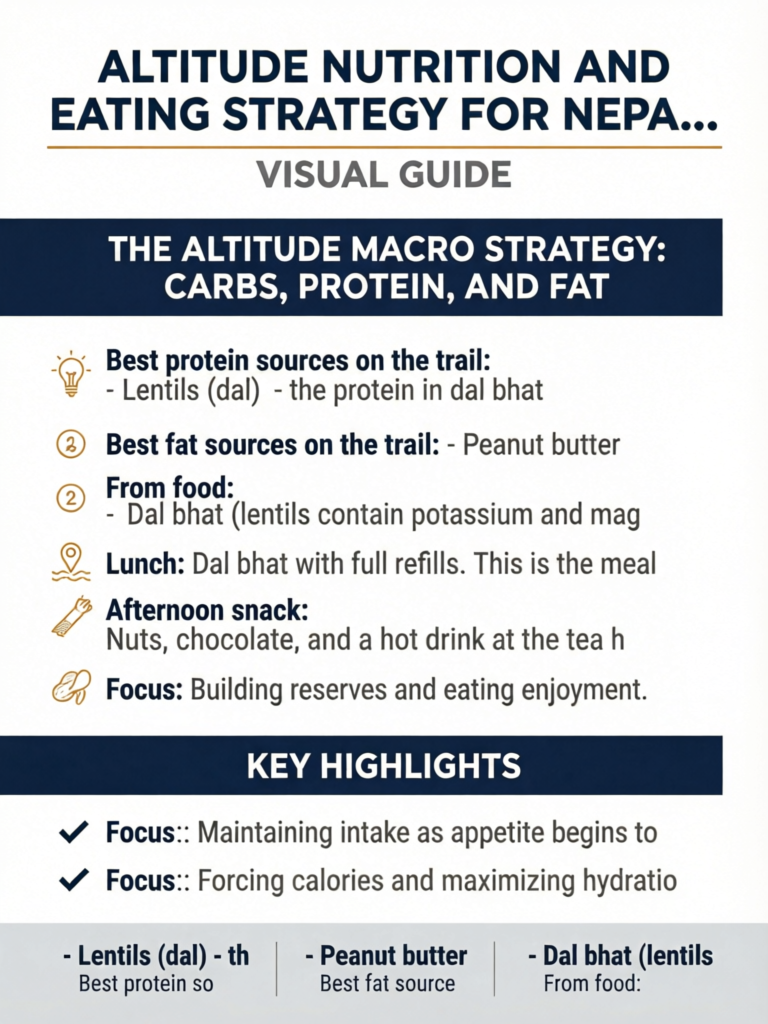
The Altitude Macro Strategy: Carbs, Protein, and Fat
The optimal ratio of macronutrients shifts at altitude compared to what sports nutritionists recommend at sea level.
Carbohydrates: Your Primary Fuel (60-70% of Calories)
Carbohydrates become even more important at altitude than at sea level for a critical biochemical reason: carbohydrates require less oxygen to metabolize than fats or protein. When oxygen is scarce (which it is at altitude), your body preferentially burns carbohydrates because they are more oxygen-efficient.
Best carbohydrate sources on the trail:
- Rice (the base of dal bhat)
- Noodles (chow mein, thukpa)
- Potatoes (fried, boiled, or in curry)
- Bread and chapati
- Pancakes
- Porridge
- Pasta
- Energy bars and trail mix
- Biscuits and crackers
At altitude, focus your meals around rice and noodle-based dishes. These are not only the best carbohydrate sources on the tea house menu but also among the easiest to digest.
Protein: Necessary but Secondary (15-20% of Calories)
Protein is essential for muscle repair and recovery, but it should not be your primary fuel source at altitude. Protein requires more oxygen and more water to metabolize than carbohydrates. Excessive protein intake at altitude can contribute to dehydration and increases the metabolic workload on your body.
Best protein sources on the trail:
- Lentils (dal) - the protein in dal bhat
- Eggs (boiled, fried, scrambled)
- Nuts and peanut butter
- Cheese (yak cheese at altitude)
- Chicken (at lower altitudes only)
- Milk powder in tea and hot chocolate
- Protein bars (carried from Kathmandu)
The lentil-rice combination in dal bhat creates a complete protein with all essential amino acids. This is one of the many reasons why dal bhat is the ideal trekking food.
Fat: Concentrated Energy (15-20% of Calories)
Fat is the most calorie-dense macronutrient at 9 calories per gram compared to 4 calories per gram for carbohydrates and protein. At altitude, fat serves as a concentrated energy source that helps close the calorie deficit without requiring you to eat enormous volumes of food.
Best fat sources on the trail:
- Peanut butter
- Nuts (almonds, cashews, walnuts)
- Cheese
- Chocolate
- Ghee (used in Nepali cooking)
- Fried foods (Tibetan bread, spring rolls)
- Butter on toast or chapati
The Peanut Butter Strategy
Hydration: The Foundation of Altitude Performance
Hydration at altitude is arguably more important than food intake. Dehydration impairs acclimatization, reduces physical performance, exacerbates altitude sickness symptoms, and makes everything harder.
Why You Need More Water at Altitude
Respiratory Water Loss: At altitude, you breathe faster and deeper to compensate for lower oxygen levels. Each exhaled breath carries moisture. In the cold, dry mountain air, this respiratory water loss is substantial, often exceeding 1 liter per day just from breathing.
Increased Urination: As part of the acclimatization process, your kidneys excrete more fluid. This is actually a healthy sign that your body is adapting, but it increases your hydration needs.
Sweat and Exertion: Trekking 6 to 8 hours per day produces significant sweat loss, even in cold conditions. The dry air wicks moisture so quickly that you may not notice how much you are sweating.
Dry Air: Relative humidity at high altitude is extremely low. You lose moisture through your skin and respiratory tract constantly.
How Much to Drink
| Altitude | Minimum Daily Fluid Intake | Recommended Daily Intake |
|---|---|---|
| Below 3,000m | 2-3 liters | 3 liters |
| 3,000-4,000m | 3-4 liters | 4 liters |
| 4,000-5,000m | 3.5-4.5 liters | 4-5 liters |
| Above 5,000m | 4-5 liters | 5+ liters |
These volumes include water from all sources: plain water, tea, soup, and the moisture content of food.
Hydration Monitoring
The simplest and most reliable way to monitor hydration is urine color. Your urine should be light yellow (like lemonade). If it is dark yellow or amber, you are dehydrated and need to drink more immediately. If it is completely clear, you may be over-hydrating, which can dilute electrolytes.
Dehydration Mimics Altitude Sickness
Many symptoms of dehydration overlap with symptoms of Acute Mountain Sickness (AMS): headache, fatigue, nausea, dizziness, and confusion. Before assuming your headache is altitude sickness, drink a liter of water and wait 30 minutes. If the headache improves significantly, dehydration was likely the cause or a contributing factor. Proper hydration is the first line of defense against altitude-related illness.
Practical Hydration Strategy
Morning: Drink 500ml of water or tea before starting your trek. Many trekkers fill a water bottle the night before so they can drink immediately upon waking.
On the trail: Drink small amounts frequently rather than large amounts infrequently. Take a sip every 15 to 20 minutes. Carrying a hydration bladder with a drinking tube makes this easy. If you use water bottles, stop for a drink break every 30 to 45 minutes.
At tea houses: Order soup before your main meal for additional fluid. Drink hot lemon, ginger, and honey tea throughout the afternoon and evening. Avoid relying solely on cold water, as warm fluids are absorbed more efficiently and help maintain core temperature.
Before bed: Drink a cup of warm water or tea. Keep a water bottle inside your sleeping bag overnight so it does not freeze and so you can drink if you wake up thirsty.
The Warm Water Bottle Trick
Electrolytes: The Missing Piece
Water alone is not enough. When you sweat, breathe, and urinate at altitude, you lose essential electrolytes, primarily sodium, potassium, magnesium, and calcium. Replacing these is important for preventing cramping, maintaining energy, and supporting proper hydration.
Signs of Electrolyte Imbalance
- Muscle cramps, especially in calves and thighs
- Fatigue that persists despite rest
- Headaches that do not respond to hydration
- Nausea and loss of appetite
- Tingling in fingers and toes
- Irregular heartbeat
Electrolyte Sources on the Trail
From food:
- Dal bhat (lentils contain potassium and magnesium)
- Bananas (potassium, available at lower altitudes)
- Potatoes (potassium)
- Salted nuts and trail mix
- Pickle/achar (sodium)
- Cheese (sodium, calcium)
Supplements to carry:
- Oral rehydration salts (ORS packets, available in Kathmandu pharmacies)
- Electrolyte tablets (Nuun, GU, or similar brands)
- Electrolyte powder (Liquid IV, LMNT, or similar)
Pack enough electrolyte supplements for one serving per day for the high-altitude portion of your trek. Many trekkers add half an ORS packet to their morning water bottle as a daily practice above 3,500m.
Oral Rehydration Salts Are Cheap and Effective
ORS packets (called "Jeevanjal" in Nepal) are available at every pharmacy in Kathmandu for NPR 10 to 20 per packet. They contain the World Health Organization-recommended balance of sodium, potassium, glucose, and citrate. Buy 15 to 20 packets before your trek. They weigh almost nothing and can be a lifesaver if you experience diarrhea or severe dehydration at altitude.
The Snack Strategy: Eating Between Meals
Tea house meals are served at fixed times: breakfast around 6:30 to 7:30 AM, lunch around 11:30 AM to 1:00 PM, and dinner around 6:00 to 7:00 PM. That leaves long gaps during active trekking when your body needs fuel. A well-planned snack strategy bridges these gaps and helps you meet your calorie targets.
What to Buy in Kathmandu
Stock up on trail snacks in Thamel or at supermarkets in Kathmandu before your trek begins. Prices are dramatically lower than on the trail.
Best snacks to carry:
- Trail mix / mixed nuts: Calorie-dense, lightweight, non-perishable. Buy pre-mixed or create your own from the bulk bins at Thamel shops.
- Energy bars: Snickers bars (available everywhere in Nepal), imported protein bars, and local alternatives. Aim for bars with 200 or more calories each.
- Chocolate: Milk chocolate provides quick sugar energy plus fat calories. Dark chocolate is more calorie-dense per gram.
- Dried fruit: Apricots, raisins, dates, and mango provide quick sugar energy plus vitamins.
- Biscuits and crackers: Inexpensive, lightweight, and available everywhere. Glucose biscuits are a Nepali staple.
- Peanut butter sachets: Individual-serving packets are available in some Thamel shops.
- Hard candy: Provides quick sugar when energy dips. Hard candy also helps with dry throat at altitude.
- Instant noodle packets: For emergency calories, some trekkers carry a couple of instant noodle packets that they can ask tea house kitchens to prepare with hot water.
Snacking Schedule
| Time | Snack Suggestion | Calorie Target |
|---|---|---|
| 9:00-9:30 AM (first trail break) | Trail mix, energy bar | 200-300 cal |
| 10:30-11:00 AM (mid-morning) | Chocolate, dried fruit | 150-250 cal |
| 2:00-2:30 PM (afternoon trail) | Energy bar, nuts | 200-300 cal |
| 3:30-4:00 PM (pre-arrival) | Biscuits, hard candy | 100-200 cal |
| 8:00-9:00 PM (before bed) | Chocolate, nuts in sleeping bag | 100-200 cal |
This schedule adds 750 to 1,250 additional calories per day on top of your three tea house meals, significantly reducing the altitude calorie deficit.
The Pocket Snack System
Specific Foods That Help at Altitude
Certain foods have specific properties that support altitude performance and acclimatization.
Garlic
Garlic has been used as a traditional altitude remedy for centuries in the Himalaya. While scientific evidence is limited, many experienced mountaineers and altitude medicine practitioners believe garlic helps improve blood circulation and may support oxygen delivery. At minimum, garlic soup is hot, hydrating, and cheap. Order garlic soup before dinner every day above 3,000m.
Ginger
Ginger is a proven anti-nausea remedy that also aids digestion. Hot ginger tea or lemon-ginger-honey drinks help combat the nausea that often accompanies altitude gain. Ginger also has anti-inflammatory properties that may help with the headaches and joint soreness common during trekking.
Iron-Rich Foods
Iron supports hemoglobin production, which is crucial for oxygen transport in your blood. Your body ramps up red blood cell production at altitude as part of acclimatization. Supporting this process with iron-rich foods makes physiological sense.
Iron sources available on the trail: Lentils (dal), spinach and dark leafy greens (when available), eggs, and fortified cereals.
Complex Carbohydrates
Foods with a low glycemic index provide sustained energy rather than the spike-and-crash of simple sugars. Rice, lentils, potatoes, and porridge are all excellent low-glycemic carbohydrate sources that release energy steadily over hours.
Honey
Available at most tea houses as a toast topping or tea sweetener, honey provides quick energy from natural sugars plus small amounts of antioxidants and antimicrobial compounds. Many trekkers add honey to hot water as an energy drink during rest stops.
Foods to Limit or Avoid at Altitude
High-Fat, Heavy Meals
While fat is a necessary part of your diet, extremely heavy or greasy meals can be difficult to digest at altitude where your digestive system is already sluggish. Avoid deep-fried items as your primary meal above 4,000m. A few french fries as a side are fine, but a plate of fried food as your main dinner may leave you feeling bloated and uncomfortable.
Excessive Fiber
Large amounts of raw fiber can cause bloating, gas, and digestive discomfort at altitude. While fiber is important, focus on cooked vegetables rather than raw salads, and choose white rice over brown rice or whole grains if available.
Caffeine in Excess
Moderate caffeine (one to two cups of coffee or tea per day) is fine and can even improve alertness and performance. However, excessive caffeine is a diuretic that increases fluid loss and can disrupt sleep, both of which are problematic at altitude. If you are a heavy coffee drinker at home, this is not the time to quit entirely (caffeine withdrawal at altitude is miserable), but consider reducing your intake.
Alcohol
Alcohol at altitude is significantly more impactful than at sea level. It dehydrates you, disrupts sleep, impairs judgment, and can mask symptoms of altitude sickness. Most altitude medicine experts advise avoiding alcohol above 3,000m, especially during the acclimatization phase.
Gas-Producing Foods
Beans (other than lentils, which are generally well-tolerated), carbonated drinks, and certain raw vegetables can produce uncomfortable gas at altitude. Intestinal gas expands at lower atmospheric pressure, making bloating more pronounced and painful than at sea level.
Meal Timing for Energy Management
When you eat matters almost as much as what you eat at altitude. Strategic meal timing maximizes energy availability during the most demanding parts of each day.
Pre-Trek Breakfast
Eat breakfast 30 to 60 minutes before starting your trek. Choose easily digestible, carbohydrate-rich foods: porridge with honey, Tibetan bread with peanut butter, or pancakes. Avoid heavy egg-based breakfasts if you are facing a steep morning climb, as protein takes longer to digest and can feel heavy during exertion.
Lunch Timing
Stop for lunch when you still have 2 to 3 hours of trekking ahead. Eating too late in the afternoon means you are trekking on a full stomach during the final hours when you should be coasting on absorbed energy. Most trekkers find that stopping for lunch between 11:00 AM and 12:30 PM works best.
Dinner Timing
Eat dinner as early as the tea house kitchen allows, typically 5:30 to 6:30 PM. Earlier dinner means more time for digestion before bed, which improves sleep quality. At altitude, digestion is already slow, so giving your body 2 to 3 hours between dinner and bedtime is ideal.
Pre-Sleep Snack
A small snack before bed helps maintain blood sugar overnight and reduces the morning calorie deficit. A few nuts, a piece of chocolate, or a biscuit eaten in your sleeping bag is sufficient.
Pre-Pass Day Nutrition Protocol
The day before crossing a high pass such as Thorong La (5,416m), Cho La (5,420m), or Renjo La (5,360m) is not the time to experiment with new foods or skip meals. Your body needs maximum fuel reserves for the most demanding day of your trek.
The Day Before the Pass
Breakfast: Large portion of porridge or pancakes with honey. Extra toast with peanut butter. Hot sweet tea.
Lunch: Dal bhat with full refills. This is the meal where you load up on calories. Eat until you are genuinely full, even if it takes longer than usual.
Afternoon snack: Nuts, chocolate, and a hot drink at the tea house.
Dinner: Another dal bhat with refills, or a large plate of fried rice with a side of Sherpa stew or garlic soup. Eat as much as you can comfortably handle.
Before bed: Fill your water bottles. Prepare your trail snacks for the next day. Eat a final small snack (chocolate bar or nuts).
Hydration: Drink at least 4 liters throughout the day. Add electrolytes to at least one liter.
Pass Day Morning
Wake up early and eat a hot breakfast even if you have no appetite. Porridge, Tibetan bread, or toast with peanut butter are all excellent choices. Drink at least 500ml of warm water or tea. Fill all water bottles with warm water (it will cool as you trek, and warm water is easier to drink in the cold).
Never Cross a Pass on an Empty Stomach
The temptation on pass day is to skip breakfast because you are nervous, not hungry, or want to start early. This is dangerous. Crossing a high pass requires 6 to 10 hours of sustained effort at extreme altitude. Starting without breakfast dramatically increases your risk of exhaustion, hypothermia, and poor decision-making. Eat something, even if it is just half a portion of porridge and a cup of sweet tea.
Nutrition for Acclimatization Days
Rest days built into your itinerary for acclimatization are not just for resting. They are also critical opportunities to catch up on nutrition and hydration.
Making the Most of Rest Days
On acclimatization days, your body is actively adapting to altitude. Support this process by:
Eating more than usual: Without the physical demands of a full trekking day, your appetite may be slightly better. Take advantage of this by eating larger meals and adding extra snacks.
Hydrating aggressively: Aim for 4 to 5 liters of fluid on rest days. Use the time to drink steadily throughout the day.
Eating iron-rich foods: Your body is producing extra red blood cells during acclimatization. Lentils (dal), eggs, and any available leafy greens support this process.
Avoiding alcohol: Rest days in towns like Namche Bazaar can feel social, and the temptation to have a beer is strong. Resist during the acclimatization phase. Your body is doing critical physiological work.
Supplements Worth Carrying
While whole foods should be your primary nutrition source, a few supplements can be genuinely useful at altitude.
| Supplement | Purpose | Recommended Dose |
|---|---|---|
| Electrolyte tablets/powder | Replace lost minerals | 1 serving per day above 3,500m |
| Multivitamin | Insurance for nutritional gaps | 1 daily |
| Iron supplement | Support red blood cell production | As per package (with vitamin C for absorption) |
| Vitamin C | Immune support, iron absorption | 500-1,000mg daily |
| Ginger tablets | Anti-nausea, digestive support | As needed |
| Melatonin | Sleep support at altitude | 0.5-3mg before bed (optional) |
Start Iron Supplements Early
Nutrition by Trek Phase
Your nutritional strategy should evolve as your trek progresses through distinct altitude phases.
Phase 1: Lower Altitudes (Below 3,000m)
Focus: Building reserves and eating enjoyment.
At lower altitudes, your appetite is normal, food variety is greatest, and digestion works normally. This is the time to eat heartily and enjoy the full range of tea house menu options. Eat dal bhat, try different dishes, snack frequently, and build your calorie reserves. Your body is still operating at near-normal efficiency.
Phase 2: Moderate Altitude (3,000-4,000m)
Focus: Maintaining intake as appetite begins to decline.
Appetite suppression begins subtly. You may not notice it until you realize you left food on your plate for the first time. This is the phase where discipline becomes important. Eat full meals even when a smaller portion feels sufficient. Increase your soup orders for hydration. Begin using electrolyte supplements.
Phase 3: High Altitude (4,000-5,000m)
Focus: Forcing calories and maximizing hydration.
This is where nutrition becomes a deliberate effort. Your appetite may be significantly reduced, meals may feel unappetizing, and you may feel full after just a few bites. Counter this by:
- Ordering two courses (soup plus main) at every meal
- Taking full advantage of dal bhat refills even when you do not want more
- Eating calorie-dense snacks between meals
- Drinking constantly
- Adding sugar and honey to drinks for extra calories
Phase 4: Extreme Altitude and Pass Days (Above 5,000m)
Focus: Any calories you can consume.
At extreme altitude, survival nutrition takes over. Eat whatever appeals to you, regardless of nutritional optimization. If chocolate is the only thing you can stomach, eat chocolate. If hot soup is all you can manage, drink soup. The priority shifts from optimal nutrition to simply getting enough energy to function safely.
Frequently Asked Questions
How much weight will I lose on a trek?
Most trekkers lose 2 to 5 kilograms during a two-week trek. This varies based on starting weight, eating habits, altitude reached, and individual metabolism. The weight loss is primarily from muscle glycogen depletion and fat burning, with some muscle loss. Most trekkers regain the weight within 2 to 4 weeks of returning to normal altitude and eating patterns.
Should I eat meat at altitude for protein?
Meat is not necessary for adequate protein at altitude. The lentil-rice combination in dal bhat provides complete protein. If you enjoy meat, stick to chicken at lower altitudes where refrigeration is available. Above 3,500m, most meat has been carried for days without refrigeration, increasing food safety risks.
Can I take protein powder on the trek?
Yes, but it is not necessary and can be counterproductive. Protein requires more oxygen and water to metabolize than carbohydrates. At altitude, your body benefits more from carbohydrate-rich foods. If you insist on protein powder, use it sparingly and always with extra water.
What if I cannot eat at all due to nausea?
Persistent nausea that prevents eating may be a symptom of altitude sickness. Try ginger tea to settle your stomach, then attempt small amounts of bland food (plain rice, crackers, or broth). If nausea persists and you cannot keep fluids down, this is a serious warning sign that may require descent.
Is it safe to drink the water at tea houses?
Never drink untreated tap or stream water. Tea house water should be treated by boiling, filtering, or chemical purification. Hot drinks made with boiled water (tea, coffee, soup) are safe. Read our water purification guide for complete details.
How do I stay hydrated when water freezes in my bottle?
Above 4,500m in cold weather, water bottles can freeze overnight and even during the day. Solutions include: sleeping with your water bottle inside your sleeping bag, filling bottles with warm water from tea houses, using insulated bottle covers, and keeping bottles inside your jacket close to your body heat.
Should I eat breakfast before an early morning start?
Always. Even if you wake at 4:00 AM for a pass crossing and have zero appetite, eat something. Hot porridge, tea with sugar, or bread with peanut butter are all manageable even with a suppressed appetite. The calories will become critical 3 to 4 hours into your trek.
What about caffeine at altitude?
Moderate caffeine intake (one to two cups of coffee or tea daily) is fine and can improve alertness. However, do not dramatically increase your caffeine intake at altitude, and do not rely on caffeine to compensate for poor nutrition or inadequate rest. If you are a daily coffee drinker, continue your normal intake to avoid withdrawal headaches.
How do I know if I am eating enough?
Monitor your energy levels, mood, and physical performance. If you feel progressively weaker, unusually irritable, constantly cold, or unable to maintain your normal trekking pace, insufficient calorie intake is likely a contributing factor. Also monitor urine color for hydration status.
Can I fast or do intermittent fasting while trekking at altitude?
Absolutely not. Fasting at altitude is dangerous. Your body needs a constant supply of fuel to support both physical exertion and the metabolic demands of acclimatization. Skip no meals, snack frequently, and eat as much as you can at every opportunity.
What snacks should I avoid bringing?
Avoid snacks that melt easily (some chocolate bars in lower altitudes), become rock-hard in cold temperatures (some protein bars freeze solid above 4,000m), or create excessive packaging waste. Also avoid unfamiliar foods that might upset your stomach. Stick to snacks you know your body tolerates well.
Is sugar bad at altitude?
No. Sugar provides quick energy and can be beneficial at altitude when your appetite is suppressed and you need rapid fuel. Adding sugar to tea, eating candy, and consuming sweet snacks are all acceptable strategies for maintaining calorie intake. This is not the time for a low-sugar diet.
Summary: The Seven Rules of Altitude Nutrition
- Eat even when not hungry. Treat meals as medicine at altitude.
- Prioritize carbohydrates. Rice, noodles, potatoes, and bread are your primary fuel.
- Hydrate constantly. Drink 3 to 4 liters daily, more above 4,000m.
- Snack between meals. Bridge the calorie gap with nuts, bars, and chocolate.
- Eat dal bhat. Unlimited refills make it the most efficient calorie source on the trail.
- Use electrolytes. Replace the minerals you lose through sweat and respiration.
- Front-load pass days. Eat big the day before any major high-altitude crossing.
Following these principles will not eliminate the altitude calorie deficit entirely, but it will keep you stronger, more alert, better acclimatized, and significantly more likely to complete your trek successfully and enjoyably.