Drinking Alcohol at Altitude on a Nepal Trek
Drinking alcohol at altitude on a Nepal trek is riskier than at sea level: thinner air amplifies impairment, accelerates dehydration, masks early altitude sickness, and degrades sleep. Below 3,000m a drink or two with food is generally fine. Above 3,500m while acclimatizing, the Himalayan Rescue Association advises avoiding alcohol — and above 4,500m most physicians recommend none at all.
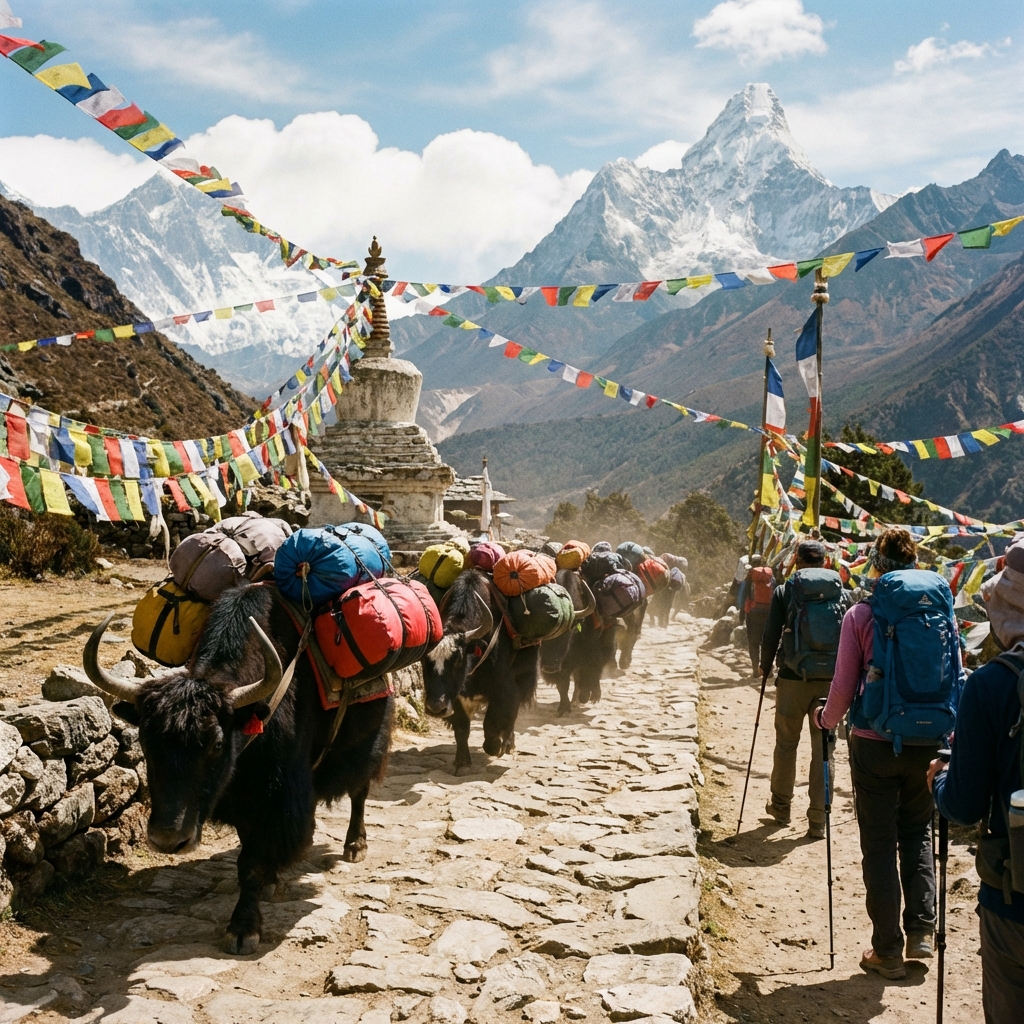
The sun is hitting Ama Dablam's southeast ridge. You're sitting on the tea house terrace in Namche Bazaar after a hard day on the trail. The menu includes Everest Beer. This is a situation that requires some thought.
Alcohol and altitude form a complicated relationship. At moderate elevations (below 3,000m), the effects are largely similar to drinking at sea level — moderated by fitness, hydration, and food intake. As altitude increases, the physiological changes wrought by thinner air interact with alcohol's effects in ways that demand more caution.
This guide covers the science, the specific risks on Nepal treks, the myths worth dispelling, local drinks you'll encounter, how alcohol interacts with altitude medication, and practical guidelines by elevation that let you enjoy Himalayan hospitality without sabotaging your acclimatization.
How Altitude Changes Alcohol's Effects
The Core Mechanism
At altitude, your body is already under physiological stress. Reduced partial pressure of oxygen means your blood carries less oxygen per unit volume. Your breathing rate has increased. Erythropoietin production has ramped up. Your body is working harder to maintain normal function.
Alcohol adds another layer of impairment to a system already working at reduced efficiency.
The specific interactions:
Respiratory depression: Alcohol is a mild respiratory depressant — it reduces the drive to breathe deeply. At altitude, where you've been hyperventilating to compensate for thin air, even mild respiratory depression reduces oxygen uptake further. At extreme altitudes (above 5,000m), this interaction becomes more meaningful.
Dehydration compounding: You're already dehydrating at altitude faster than at sea level — the dry air and increased respiratory rate accelerate moisture loss. Alcohol is a diuretic, increasing urine output and accelerating fluid loss. The combination is particularly dehydrating.
Impaired judgment: Altitude itself causes mild cognitive impairment — slower processing, poorer risk assessment, reduced coordination — that worsens as you ascend. Alcohol adds an additional layer of the same effects.
Sleep quality degradation: Altitude already disrupts sleep — periodic breathing (Cheyne-Stokes respiration), frequent waking, and reduced sleep quality are universal above 3,500m. Alcohol fragments sleep further, particularly suppressing REM sleep in the first half of the night and then causing rebound wakefulness in the second half.
The "Two Beer Effect"
Anecdotally reported by virtually every trekker who's tried it: two beers at altitude feel like four at sea level. While controlled research on this specific question is limited, the physiological mechanisms are well understood. The impaired liver metabolism at altitude, the already-compromised oxygen delivery to the brain, and possible interactions with acclimatization hormones all contribute to amplified effects.
Many trekkers report being noticeably impaired after a single beer at Namche (3,440m) — particularly in the first 24–48 hours of acclimatization before the body has adapted to that altitude.
Does Altitude Affect Your Alcohol Tolerance?
Not chemically — but functionally, yes, and the difference matters on the trail. Your liver metabolizes alcohol at the same rate whether you're in Kathmandu or at Dingboche, and your blood alcohol concentration (BAC) per drink does not rise simply because you climbed higher. What changes is your capacity to cope with that alcohol.
At altitude your brain is already running on reduced oxygen, your balance and coordination are already mildly degraded, and you fatigue faster. Adding alcohol stacks impairment on top of impairment. The practical result is exactly what trekkers describe: you stumble sooner, slur earlier, tire more quickly, and wake feeling worse — even though the bottle is no stronger than at home. Seasoned drinkers are not immune; tolerance built at sea level does not transfer cleanly to 3,500m.
This is why "I can handle my drink" is poor reasoning on a high pass. The question is not how much alcohol your liver can process, but how much impairment your already-stressed body can safely absorb before a misjudged step on icy moraine or a dismissed warning symptom turns serious.
The AMS Confusion Problem
The most clinically significant issue with alcohol at altitude is its ability to mask or mimic altitude mountain sickness (AMS) symptoms.
AMS symptoms include: headache, nausea, fatigue, dizziness, poor sleep, and reduced appetite.
Hangover symptoms include: headache, nausea, fatigue, dizziness, poor sleep, and reduced appetite.
This is not coincidental — both conditions involve similar physiological pathways (cerebral vasodilation, dehydration, electrolyte disruption). The problem is that they require different responses:
AMS: The correct response is rest, hydration, possibly medication, and potentially descent if symptoms worsen. Continuing to ascend with AMS can lead to High Altitude Cerebral Edema (HACE) or High Altitude Pulmonary Edema (HAPE) — both potentially fatal.
Hangover: The correct response is time, hydration, and electrolytes.
The danger: If you drink the night before an early-morning pass crossing and wake up feeling unwell, how do you know which condition you're dealing with? The conservative answer — given the stakes — is to treat it as AMS until proven otherwise. That means not ascending, which means delaying your crossing by a day.
Practical Rule
Do not drink alcohol the evening before any planned ascent above your current sleeping altitude, especially before major pass crossings. The risk of misattributing AMS symptoms to a hangover — and ascending when you shouldn't — is not a risk worth taking.
If you are unsure whether what you're feeling is a hangover or early altitude sickness, treat it as altitude sickness. For the symptoms, thresholds, and turnaround rules that decide whether you ascend, rest, or descend, see our guide to altitude sickness signs and turnaround rules.
Common Myths About Drinking at Altitude
A handful of persistent beliefs lead trekkers to make bad decisions on the trail. Each one is wrong, and each can be dangerous in the Himalaya.
Myth: "Alcohol keeps you warm in the cold"
This is the most dangerous myth of all. Alcohol dilates the blood vessels near your skin, which produces a brief flush of warmth — but it does so by pulling heat away from your core and dumping it to the surface, where it radiates away. At a cold, exposed teahouse at 4,000m+, that accelerates heat loss rather than preventing it. Worse, alcohol dulls your awareness of the early signs of hypothermia, so you may not notice you're getting dangerously cold until you're shivering uncontrollably. On winter routes and at high camps, a "warming" drink can push you toward hypothermia, not away from it. See frostbite and hypothermia prevention for the real cold-weather playbook.
Myth: "A nightcap helps you sleep at altitude"
Alcohol makes you feel drowsy, but it wrecks the sleep you actually get. It suppresses restorative REM sleep early in the night, then triggers rebound wakefulness in the second half — the same fragmented pattern that altitude already imposes through periodic breathing. It also worsens sleep apnea, which is common above 3,500m. Two poor mechanisms compound into a genuinely bad night's rest right when your body needs recovery most for acclimatization.
Myth: "You can drink your way through mild altitude sickness"
You cannot. Alcohol does nothing to treat AMS and actively masks its early warning signs — the headache, nausea, and subtle confusion that should trigger rest or descent. Drinking when you have any AMS symptoms is the trekking equivalent of disabling a smoke alarm because the noise is annoying.
Myth: "I'll just sleep off the hangover"
Hangovers hit harder at altitude, not softer. Oxygen deprivation amplifies headache and brain fog, the dry air plus alcohol's diuretic effect deepens dehydration, and altitude insomnia compounds with alcohol-fragmented sleep. The next morning you may face headache, nausea, dizziness, and a measurable drop in physical performance — exactly what you don't want before a long trekking day or a pass crossing.
Alcohol and Altitude Medication
If you are taking Diamox (acetazolamide) for altitude sickness prevention, be deliberate about alcohol. Diamox is itself mildly dehydrating and increases urination; alcohol is a diuretic too, so combining them compounds fluid loss at an elevation where dehydration already undermines acclimatization. Both can also cause dizziness and lightheadedness, so their side effects can stack. There is no notorious dangerous reaction between a single drink and a standard Diamox dose, but the combination works directly against the hydration strategy the medication is meant to support. If you're on Diamox and choose to drink at lower elevations, keep it minimal and pair every drink with extra water.
The same caution applies to sleeping pills and strong painkillers: do not combine sedatives with alcohol at altitude, where respiratory depression and impaired judgment carry higher stakes. For next-day aches, paracetamol is gentler on the stomach than ibuprofen.
By Altitude: Practical Guidelines
Below 2,500m (Pokhara, lower approach valleys)
Guidelines: Standard drinking applies. Altitude is not yet a significant factor. Hydration and moderation remain sensible but the altitude-specific risks are minimal.
2,500m–3,500m (Namche Bazaar, Ghorepani, Manang)
Guidelines: Moderate consumption is generally fine after initial acclimatization. Limit yourself to 1–2 drinks per evening. Drink 500ml of water with every drink. Avoid drinking if you have any AMS symptoms. Do not drink the night before ascending to a higher sleeping altitude.
Practical example: You arrive in Namche (3,440m) on day 4. Your acclimatization day is day 5 (a rest day with a day hike). Having one beer with dinner on your first or second Namche evening is generally fine for most people. Having three beers and a raksi shot before your early departure up to Tengboche is a bad idea.
3,500m–4,500m (Tengboche, Dingboche, Manang)
Guidelines: Reduce significantly. One drink maximum, if at all. The body is under genuine altitude stress at these elevations and benefits enormously from full physiological resources directed at acclimatization. The dehydration effect of alcohol is particularly significant at this altitude.
Practical note: Many teahouses at this elevation still serve beer and local spirits. The fact that they serve it doesn't mean it's advisable.
Above 4,500m (Lobuche, Gorak Shep, Thorong High Camp)
Guidelines: Avoid entirely. At these altitudes, alcohol's respiratory depression effect combines with already-reduced oxygen availability to create meaningful risk. Many altitude medicine physicians recommend complete abstinence above 4,000m; the Himalayan Rescue Association advises against drinking above 3,500m when actively acclimatizing.
The reality check: Some trekkers drink a celebratory beer at Gorak Shep or Everest Base Camp and suffer no apparent consequences. Human variation in altitude response and tolerance means the effects are not uniform. But the physiological risks remain real regardless of individual experience.
Quick Reference: Alcohol Limits by Altitude
| Altitude band | Typical Nepal locations | Guideline |
|---|---|---|
| Below 2,500m | Pokhara, Lukla, lower valleys | Standard drinking; hydrate and eat as usual |
| 2,500–3,500m | Namche, Ghorepani, Manang | 1–2 drinks max after acclimatizing; 500ml water per drink; none before ascent |
| 3,500–4,500m | Tengboche, Dingboche | One drink maximum, ideally none; dehydration risk is high |
| Above 4,500m | Lobuche, Gorak Shep, Thorong High Camp | Avoid entirely; respiratory and AMS-masking risk |
How to Drink Safely on a Nepal Trek
If you do choose to drink, a few rules keep a celebratory beer from becoming a problem:
- Wait until your body has adapted. The safest drinks come after a successful acclimatization day, at lower elevations, or — best of all — on your final night as you descend. Save the real celebration for Pokhara or Kathmandu.
- Never drink before gaining altitude. No alcohol the evening before climbing to a higher sleeping altitude or crossing a pass like Thorong La or Cho La.
- Hydration is non-negotiable. Drink at least 500ml of water for every alcoholic drink, on top of your normal trekking intake of 3–4 litres a day. See water purification and hydration.
- Eat first. A full plate of dal bhat slows absorption and steadies blood sugar at elevation.
- Favour low-ABV options. A single beer is gentler on your system than raksi or other spirits. Beer beats wine beats spirits.
- Tell your group, and watch each other. If you or a companion feels dizzy, breathless, unusually emotional, or off-balance, stop drinking immediately and reassess for AMS.
- Stop at any AMS symptom. Headache, nausea, or poor appetite means no alcohol, full stop.
Pro Tip
The simplest rule that keeps most trekkers safe: no alcohol on any night before you go higher. Treat your highest nights as alcohol-free by default, and save the celebration for the descent — by then your body has won the acclimatization fight and a drink costs you nothing.
Local Drinks You'll Encounter
Understanding what you're offered helps you make informed decisions.
Chang (चाँग)
What it is: Fermented barley (or millet) beer, traditionally brewed by Sherpa and Tamang households. Cloudy, mildly alcoholic (typically 4–6% ABV), with a sour, slightly tart flavour.
Where: Available in teahouses throughout the Khumbu and Annapurna regions, particularly in ethnically Sherpa or Tamang communities. More commonly offered at lower to mid elevations.
Experience: A cup of chang with the local family around a yak-dung fire is a genuine cultural experience. Drink slowly — the alcohol content varies significantly between batches.
Raksi (रक्सी)
What it is: Distilled grain spirit, similar to a rough white spirit. Made from millet or rice. Typically 30–45% ABV — significantly stronger than chang.
Where: Available throughout Nepal's hill communities. Offered socially, at festivals (notably Dashain and Tihar), and as a warming drink.
Experience: Raksi is powerful. A small cup by the fire at 3,000m after a long day is a singular experience. Treat it with the respect afforded to any spirit above 40%.
Tongba (टोङ्बा)
What it is: A warm millet beer unique to the eastern Himalayan communities (Rai, Limbu, and Sherpa cultures). Millet ferment served in a tall wooden cylinder with hot water poured over. Drunk through a bamboo straw filtered at the bottom. You keep adding hot water to the same millet base.
Where: Common in eastern Nepal trekking routes, the Kanchenjunga approach, and some Sherpa communities in the Khumbu.
Experience: Tongba is a ceremony as much as a drink. The continuous hot-water refilling means the full alcoholic content extracts gradually — it is easy to underestimate how much you've consumed. Take your time.
Commercial Beer
Everest Beer, Gorkha Beer, Tuborg (canned): Nepal's commercially brewed beers are available in most teahouses throughout the main trekking routes. Prices increase dramatically with altitude (NPR 400–800 in Namche; NPR 700–900+ at Gorak Shep). The familiar form factor makes it easy to drink too much — treat it like any other drink at altitude.
Hot Drinks as Alternatives
The practical alternative to alcohol on cold evenings at altitude:
Butter tea (Po cha): Traditional Tibetan tea made with yak butter and salt. Warming, caloric, and hydrating. Offered throughout the Khumbu and Manang. Acquired taste for most Western trekkers but worth trying.
Sweet milk tea (Chai): Spiced, sweet, with fresh milk — a genuine comfort at altitude.
Apple cider (Jomsom): Non-alcoholic apple juice from Mustang's famous apple orchards. Available from Jomsom southward. Refreshing and genuinely local.
Is It Safe to Drink Beer at Everest Base Camp?
Technically beer is available at tea houses throughout the Everest Base Camp route, but drinking at altitude above 4,000m carries meaningful risks. Alcohol exacerbates dehydration, masks AMS symptoms (a headache from altitude feels identical to a hangover headache), and impairs sleep quality at altitudes where sleep is already compromised. The general medical advice from the Himalayan Rescue Association is to avoid alcohol above 3,500m until you are well acclimatized, and to limit consumption even then. One beer at Namche Bazaar (3,440m) after a proper acclimatization day is unlikely to cause problems. Multiple drinks at Gorak Shep (5,164m) is genuinely risky.
Frequently Asked Questions
Does alcohol affect altitude sickness?
Alcohol does not directly cause altitude sickness, but it masks AMS symptoms. A trekker who drinks may dismiss a worsening altitude headache as a hangover, delaying critical recognition of AMS. Alcohol also causes dehydration, which worsens the body's ability to acclimatize, and disrupts sleep quality at altitude.
What is chang and is it safe to drink?
Chang is a traditional Nepali/Tibetan fermented rice or millet beer with 2-5% alcohol content. It is widely offered in tea houses, sometimes as a cultural gesture. One small cup is generally safe below 3,500m. Quality and hygiene vary -- it is homemade, unregulated, and occasionally causes GI illness.
Can I drink alcohol on acclimatization days?
Medical guidance is clear: avoid alcohol on acclimatization days. Your body is working to adapt to reduced oxygen, and alcohol interferes with this process. Dehydration from alcohol directly counteracts the hydration strategy critical for successful acclimatization.
How much does beer cost on the trekking trail?
Beer prices increase dramatically with altitude. Expect NPR 400-500 ($3-4) in Lukla or lower Annapurna villages, NPR 600-800 ($4-6) at Namche Bazaar, and NPR 800-1,200 ($6-9) at Gorak Shep or above Deurali. Wine is rarely available above 3,000m.
Should I bring my own alcohol on a Nepal trek?
Carrying alcohol adds unnecessary weight and encourages consumption at altitude. Most trekkers find that their desire for alcohol naturally diminishes with altitude as appetite decreases and the body focuses on acclimatization. If you want celebratory drinks, buy them at the tea house rather than carrying them.
Does alcohol keep you warm at altitude?
No — it makes you colder where it matters. Alcohol dilates surface blood vessels, creating a brief sensation of warmth while actually drawing heat away from your core and dulling your awareness of the cold. At high, exposed teahouses and on winter routes this raises hypothermia risk rather than lowering it. Hot tea, soup, and proper layering are the real way to stay warm.
Can I drink alcohol while taking Diamox?
Be cautious. Diamox (acetazolamide) is mildly dehydrating and increases urination, and alcohol is also a diuretic, so combining them compounds fluid loss and can stack dizziness. There is no notorious dangerous interaction with a single drink, but the combination undermines the hydration that acclimatization depends on. If you drink at all on Diamox, keep it to lower elevations, minimal amounts, and extra water.
When is the best time to drink on a trek?
After your body has acclimatized — ideally on your final night before or during descent, at lower elevations, and never on a night before you climb higher or cross a pass. A celebratory drink back in Lukla, Pokhara, or Kathmandu is far smarter than a beer at a high camp.
What is tongba and how strong is it?
Tongba is a warm millet beer from eastern Nepal, served in a wooden cylinder with hot water poured over fermented millet and sipped through a bamboo straw. Because you keep refilling the same base with hot water, the alcohol extracts gradually and it's easy to underestimate how much you've had. Pace yourself, especially at altitude.
Related Resources
Planning a High-Altitude Trek in Nepal?
Get a realistic acclimatization plan and altitude-aware advice from a verified local agency before you go.