
Medical Facilities on Nepal Trekking Routes
Medical facilities on Nepal's trekking routes follow a tiered system: internationally accredited hospitals in Kathmandu and Pokhara, district hospitals at trailheads, government health posts in major villages, and seasonal high-altitude aid posts run by the Himalayan Rescue Association (HRA) at Pheriche (4,240m), Manang (3,519m) and Machermo (4,470m). Above roughly 4,000m there are almost no staffed clinics — serious cases are stabilised on-site and evacuated by helicopter.
Knowing where to find medical help before you need it is one of the most important preparations for any Nepal trek. The gap between recognising a medical emergency and accessing qualified care can be the difference between a bad day and a tragedy — and in remote mountain environments, that gap is measured in hours or days.
Nepal's medical infrastructure for trekkers is better than many assume, particularly on the major routes. The Himalayan Rescue Association operates seasonal aid posts at key altitude points on the Everest and Annapurna circuits. Kathmandu has internationally accredited hospitals with altitude medicine specialists. Helicopter evacuation can reach most trekking regions within 1–2 hours in flyable weather.
But the coverage is uneven. In the far west, in Dolpo, in Humla, and on many off-the-beaten-path routes, the nearest qualified medical care may be days away by foot and hours by helicopter in ideal conditions. Understanding this distribution is essential for trip planning, medical kit preparation, and insurance decisions before you go trekking in Nepal.
How Medical Care Is Tiered in the Himalaya
There are no large, multi-specialty hospitals once you leave the gateway cities. Building and maintaining modern hospital infrastructure in vertical, road-isolated terrain is virtually impossible, so Nepal relies on a tiered system of medical support tailored for the mountains:
| Tier | Where | What it handles |
|---|---|---|
| Tertiary hospitals | Kathmandu, Pokhara | ICU, surgery, trauma, altitude medicine, post-evacuation care |
| District hospitals | Trailheads (Besisahar, Jomsom, Syabrubesi, Soti Khola area) | Fractures, X-rays, stabilisation, GI infections |
| Government health posts | Hub villages (Chame, Muktinath, Namche, Samagaun) | Primary care, basic medication, wound care, pulse oximeter checks |
| HRA aid posts (seasonal) | Pheriche, Manang, Machermo | Altitude illness diagnosis, oxygen, Gamow bag, evacuation coordination |
| No facility | Above ~4,000m and remote routes | First aid kit + guide only; descent or helicopter |
If you experience a critical, life-threatening emergency or severe trauma on the upper reaches of any trek, you will not be treated in a local hospital. Instead, you will be stabilised on-site and urgently evacuated by charter helicopter to a tertiary care hospital in Pokhara or Kathmandu.
Kathmandu: Base-Level Medical Infrastructure
Before you leave Kathmandu for any trek, know the city's main hospitals and travel medicine resources. This is also where you should handle pre-trek medical preparation — consultations, prescriptions, and any vaccinations for Nepal trekking.
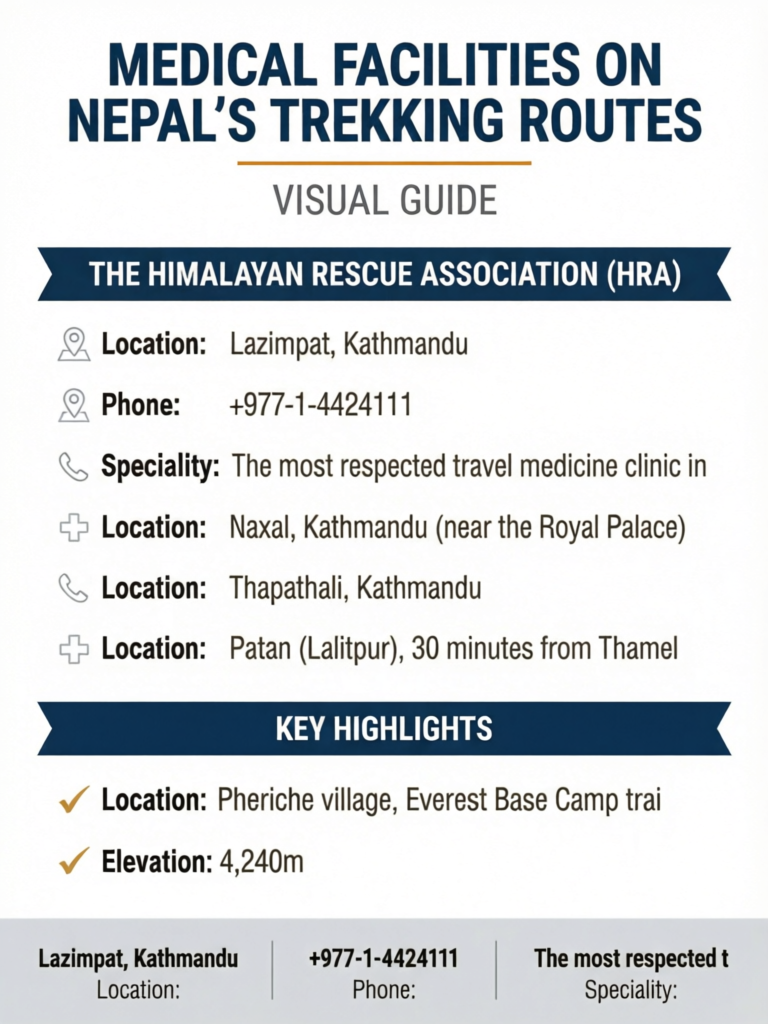
CIWEC Travel Medicine Center
Location: Lazimpat, Kathmandu Phone: +977-1-4424111 Speciality: The most respected travel medicine clinic in Nepal, staffed by international physicians familiar with altitude illness, tropical diseases, and expedition health.
CIWEC is where most experienced trekkers and expedition members go for pre-trek medical consultations, Diamox prescriptions, vaccinations, and post-trek evaluation. If you need a Diamox (acetazolamide) prescription before your trek, CIWEC is the most experienced provider in Kathmandu.
Nepal International Clinic
Location: Naxal, Kathmandu (near the Royal Palace) Speciality: General travel medicine, altitude sickness consultation, vaccinations
Another solid option for pre-trek consultations, particularly for those without CIWEC appointments.
Norvic International Hospital
Location: Thapathali, Kathmandu Facilities: Full surgical and emergency facilities, ICU, laboratory, radiology
The best option for post-trek emergencies or serious illness requiring hospitalisation. Accepted by most international travel insurance providers.
Patan Hospital (Patan Academy of Health Sciences)
Location: Patan (Lalitpur), 30 minutes from Thamel Note: Teaching hospital with good emergency medicine but longer waits than private hospitals
Pokhara is the western gateway hospital hub
For Annapurna, Mustang, Dolpo and Manaslu treks, Pokhara — not Kathmandu — is usually the nearest tertiary care city. It has well-equipped private hospitals and is the destination for fixed-wing and helicopter evacuations from Jomsom and the western Annapurna region. Build your evacuation plan around the gateway city closest to your route.
The Himalayan Rescue Association (HRA)
The Himalayan Rescue Association is a non-profit organisation founded in 1973 that operates the most important network of altitude medicine resources in Nepal. Their aid posts are staffed by volunteer physicians (mostly western-trained doctors from international programmes) and local medical assistants during the trekking seasons.
HRA posts are not just consultation rooms — they carry the equipment that actually treats altitude emergencies: oxygen cylinders, pulse oximeters to check blood-oxygen saturation, a Gamow bag (a portable hyperbaric chamber that simulates a lower altitude), and the core altitude drugs — Diamox (acetazolamide), Dexamethasone for HACE, and Nifedipine for HAPE. This is care you will not find in an ordinary village health post.
HRA Pheriche Aid Post (4,240m) — Khumbu Region
Location: Pheriche village, Everest Base Camp trail Elevation: 4,240m Season: March–May (spring), September–November (autumn) Services: Altitude sickness consultation, emergency treatment, oxygen, Gamow bag, evacuation coordination Fee: Donations requested; sliding scale based on ability to pay Altitude medicine lectures: Daily at 3 PM during trekking season — essential viewing for anyone heading above 4,000m
Pheriche is 30 minutes from Dingboche (4,410m), where most trekkers spend their acclimatisation days. The post sees hundreds of patients each season, primarily with AMS, HACE, and HAPE. Evacuation coordination is a core service — the post maintains contact with helicopter operators.
Note: An alternative post operates from Khunde (3,840m) in the Namche Bazaar area, run by the Khunde Hospital funded by the Hillary Himalayan Trust.
HRA Manang Aid Post (3,519m) — Annapurna Region
Location: Manang village, Annapurna Circuit Elevation: 3,519m Season: March–May, September–November Services: Altitude consultation, emergency care, oxygen, Gamow bag, evacuation coordination Altitude lectures: Daily at 3 PM during trekking season
The Manang post has been operating since 1981 and is equivalent in services to Pheriche — the best-equipped medical stop on the entire circuit. The Annapurna Circuit passes directly through Manang village, and the post occupies a critical position before the major push to Thorong La (5,416m). Physicians here have experience with the full spectrum of altitude illness and the specific acclimatization challenges of the circuit. Alongside the HRA clinic, the Manang Health Post offers basic consultations, pulse-oximeter checks, and standard medications at highly subsidised rates.
Attend the HRA Altitude Lecture
The daily HRA altitude lectures at Pheriche and Manang are among the most practical medical education available to trekkers. In 45 minutes, the physician on duty covers AMS recognition, treatment, descent criteria, and the specific risks of the sections ahead. It is free, targeted to your exact situation, and potentially life-saving. Attend if you can.
HRA Machermo Aid Post (4,470m) — Gokyo Region
Location: Machermo village, Gokyo Lakes trail Elevation: 4,470m Season: October–November (autumn only) Services: Basic altitude consultation, emergency care, evacuation coordination
The Machermo post covers the Gokyo Lakes approach and the Three Passes Trek junction area. It is smaller than Pheriche and may not be staffed continuously throughout the season — check current status with the HRA Kathmandu office before departing.
Route-by-Route Medical Coverage
Everest Base Camp / Three Passes
Namche Bazaar (3,440m): The Khunde Hospital (3,840m) is 2–3 hours above Namche. Namche has a health post for basic care. Several pharmacies stock altitude medications.
Tengboche (3,860m): Basic health post. Limited supplies.
Dingboche (4,410m): Basic health post. The HRA Pheriche post is 30 minutes below. This is effectively your last reliable medical resource before Lobuche.
Lobuche (4,940m): No dedicated medical facility. Lodge owners have basic first aid and can coordinate evacuation.
Gorak Shep (5,164m): No medical facility. Helicopter landing zone near the lodges.
Gokyo (4,750m): No dedicated medical facility. Machermo HRA post is 2 hours below.
Evacuation: Helicopter landing zones at Pheriche (4,240m), Dingboche (4,410m), Chhukung (4,730m), and several lower villages. In good weather, evacuation from Gorak Shep can be arranged to Kathmandu via Lukla in 2–3 hours.
For the full picture of the EBC route, see the Everest Base Camp trek guide.
Annapurna Circuit
The medical landscape on the Annapurna Circuit divides cleanly into four phases, from road-connected trailhead to the facility-free high pass.
Phase 1 — Trailhead and lower valley (760m to 2,670m):
- Besisahar (760m): District hospital. Full range of services for the altitude of the region — standard illnesses, minor fractures, GI infections.
- Dharapani / lower villages: A rough jeep road now connects Besisahar all the way to Manang, so lower villages have steady access to medical supplies and small pharmacies.
- Chame (2,670m): Health post (administrative headquarters of Manang district). Basic medications available.
Phase 2 — Critical altitude zone (3,519m to ~4,000m):
- Manang (3,519m): HRA Aid Post (seasonal) plus the Manang Government Health Post. The most important and best-equipped medical facility on the circuit, and your acclimatisation buffer before the pass.
Phase 3 — The danger zone (Yak Kharka to Thorong La, ~4,000m to 5,416m):
- Yak Kharka (4,110m), Thorong Phedi (4,450m), Thorong High Camp (4,950m): No professional medical facilities, clinics or doctors. You depend entirely on your guiding team and your first aid kit. Teahouse owners keep basic supplies and sometimes emergency oxygen, but they are not medical professionals. If a trekker develops severe altitude sickness here, the only cure is immediate descent — often in the dark — back toward Manang.
Phase 4 — Descent and Lower Mustang (3,710m down to 2,720m):
- Muktinath (3,710m): Basic health post handling post-pass fatigue, knee injuries, and minor ailments.
- Jomsom (2,720m): Airport town with a fully functional district hospital and the effective evacuation point for the upper circuit. Regular fixed-wing flights to Pokhara (25 minutes) in all but the worst weather; helicopter service throughout.
Annapurna Base Camp
Chhomrong (2,170m): Health post. Evacuation point — porters can carry stretchers from here.
ABC Sanctuary (4,130m): No dedicated medical facility. Lodge owners have basic first aid. Helicopter landing is technically possible near the sanctuary (weather and altitude permitting) but is considered challenging.
Evacuation: The ABC evacuation window via helicopter is narrow due to altitude and weather. In serious emergencies, lower altitude landing zones (Chhomrong, Jhinu Danda) are more reliable. See the Annapurna Base Camp route guide for the full trail profile.
Langtang Valley
Syabrubesi (1,460m): District hospital level care.
Langtang Village (3,430m): Basic health post (rebuilt after 2015 earthquake).
Kyanjin Gompa (3,870m): No dedicated medical facility.
Evacuation: Helicopter landing zone at Kyanjin Gompa. Syabrubesi is the evacuation hub with road access to Kathmandu (7–8 hours). The Langtang Valley route guide covers the trail in detail.
Manaslu Circuit
The Manaslu Circuit is more remote than the Annapurna or Khumbu routes, with fewer health posts and fewer reliable helicopter landing zones because of the narrow valley.
Soti Khola / lower trailhead (~710m): A common starting point. Medical options are limited mostly to small pharmacies selling painkillers, antiseptics and bandages — bring your own kit.
Jagat (~1,340m): Basic health post and pharmacy; one of the few facilities in the southern section.
Dharapani (1,860m): Health post and the last reliable pharmacy before the circuit proper.
Namrung / central villages: Small clinics with basic services for minor injuries, dehydration, and early altitude symptoms.
Samagaun (3,520m) and Samdo (3,875m): Basic health posts in the high northern section. These handle primary care and oxygen support but not serious emergencies.
Dharamsala / Larkya Phedi (~4,460m) and Larkya La Pass (5,106m): No facilities. This stretch — crossed early in freezing pre-dawn conditions — is where hypothermia, frostbite and severe AMS risk peaks.
Evacuation: The Manaslu Circuit has fewer reliable helicopter landing zones than the Khumbu due to valley width. Dharapani is the primary evacuation point for serious emergencies. A guide is mandatory on this restricted route, which also improves your access to coordination and rescue.
Remote Routes (Dolpo, Humla, Far East)
These routes have minimal medical infrastructure. The nearest physician may be multiple days away by foot and hours by helicopter in good weather.
Dolpo: Juphal has a health post and an airstrip. For Upper Dolpo, the nearest evacuation point is Juphal (several days away). All serious emergencies require helicopter evacuation. See the Dolpo and Phoksundo Lake guide.
Humla/Simikot: Simikot has an airstrip and a basic health post. No HRA presence. Satellite communication is essential.
For these regions, a comprehensive first aid kit, satellite communication device, and thorough Wilderness First Aid or Wilderness First Responder training is strongly recommended rather than just suggested.
What Medical Emergencies Actually Happen on the Trail
Knowing what facilities exist matters most when you understand which problems send trekkers to them. Five categories account for the overwhelming majority of cases.
Altitude-related illness. The most common serious risk above 2,500m. Acute Mountain Sickness (AMS) presents as headache, nausea, dizziness, fatigue and disturbed sleep. It can progress to two emergencies: HAPE (High Altitude Pulmonary Edema — fluid in the lungs causing breathlessness) and HACE (High Altitude Cerebral Edema — brain swelling causing confusion, poor coordination and loss of consciousness). Both demand immediate descent and professional treatment. Use the acclimatization guide and the HAPE/HACE emergency guide to prepare.
Trekking injuries. Ankle sprains, muscle strains, blisters, and slips or falls on rocky, snow-covered trails — most common on steep descents and near high passes. Sturdy boots, trekking poles and regular breaks cut the risk. See common trekking injuries and treatment.
Food and water contamination. Untreated water and poorly handled food cause diarrhoea and food poisoning, which dehydrate you fast and impair acclimatisation. Drink only purified or boiled water and choose busy, reputable teahouses. Review food safety on Nepal treks.
Cold exposure. Hypothermia and frostbite are real risks near high passes crossed before dawn, where temperatures sit well below freezing. Read frostbite and hypothermia prevention.
Pre-existing conditions. Asthma, heart disease, diabetes and high blood pressure are all harder to manage in thin air under physical stress. Consult a doctor before you go, carry prescribed medication, and tell your guide. The trekking with health conditions guide covers this in depth.
What To Do If You Feel Unwell on the Trail
- Stop and assess honestly. Do not push through symptoms to "make the day." Tell your guide and trekking partners immediately — denial is the most dangerous response at altitude.
- If symptoms are altitude-related, do not ascend further. Rest at the current elevation; if symptoms worsen or you show any sign of HAPE or HACE, descend at least 500–1,000m without delay.
- Reach the nearest facility. If you are near an HRA post or village health post, get assessed — a pulse-oximeter reading and a doctor's opinion are worth the detour.
- Treat what you can. Hydrate, use your first aid kit, and take altitude medication only as prescribed and as taught at the HRA lecture.
- Escalate early. If descent is not possible or the patient is deteriorating, trigger evacuation. It is far better to call early and stand down than to wait until weather closes the window.
Helicopter Evacuation: How it Works
When local clinics cannot handle a situation, or a road evacuation would take 12–15 hours through gorges and over mountain walls, helicopter evacuation becomes the definitive lifeline. For the full procedure, see the dedicated helicopter rescue in Nepal guide.
The Process
- Identify the emergency and confirm that evacuation is needed, not just descent
- Contact your insurance company's 24/7 emergency line — they coordinate directly with operators
- Get a deposit authorization from your insurance company — helicopter operators require financial guarantee before departure
- Identify the nearest safe landing zone — your guide should know this; confirm in advance
- Signal the landing zone — smoke signals, bright clothing, mirrors, or the GPS coordinates shared with the operator
- Estimated arrival time: 45 minutes to 2 hours from Kathmandu in good weather; add time for weather delays
Insurance Requirements
Travel insurance for Nepal must include helicopter evacuation coverage. The absolute minimum is $20,000. For expeditions or remote routes, $50,000+ is advisable.
Key insurers with Nepal-specific experience: World Nomads (verify altitude limit — must cover 6,000m+ for Khumbu), Global Rescue, International Medical Group (IMG). Read the policy small print carefully — some policies exclude pre-existing conditions or require "medically necessary" evacuation rather than allowing precautionary descents. Compare options in the travel insurance for Nepal trekking guide, and understand the insurance claims process before you go.
Costs Without Insurance
Helicopter evacuation without insurance:
- Khumbu to Kathmandu: $3,500–$5,000 USD
- Annapurna region: $2,500–$4,000 USD
- Remote western regions: $5,000–$8,000+ USD
These costs are non-negotiable, must be pre-paid (or guaranteed by insurance), and are payable by cash or credit card transfer. A single evacuation can exceed the total trip budget for most independent trekkers.
Pack Your Own Medical Backstop
Because staffed care thins out fast above 3,500m, your personal kit is your first line of treatment on most of the trail. At minimum carry blister treatment, altitude medication (Diamox), painkillers, anti-diarrheal medication, broad-spectrum antibiotics if your doctor prescribes them, rehydration salts, and water purification supplies. A first aid and medical kit checklist and a pulse oximeter for altitude monitoring turn vague symptoms into measurable data your guide and the next health post can act on.
Book with a guide who knows the medical map
A verified local guide knows where every health post, landing zone and HRA lecture sits on your route, carries the contacts to trigger an evacuation, and can read early altitude symptoms before you do. For restricted routes like Manaslu, Upper Mustang and Dolpo, a licensed guide is also legally required.
Frequently Asked Questions
Related Resources
- Altitude Sickness Prevention and Treatment
- HAPE & HACE Emergency Guide
- Helicopter Rescue in Nepal
- Common Trekking Injuries and Treatment
- First Aid & Medical Kit for Nepal Trekking
- Satellite Communication for Nepal Trekking
- Travel Insurance for Nepal Trekking
- Everest Base Camp Trek Guide
- Annapurna Circuit Trek Guide