

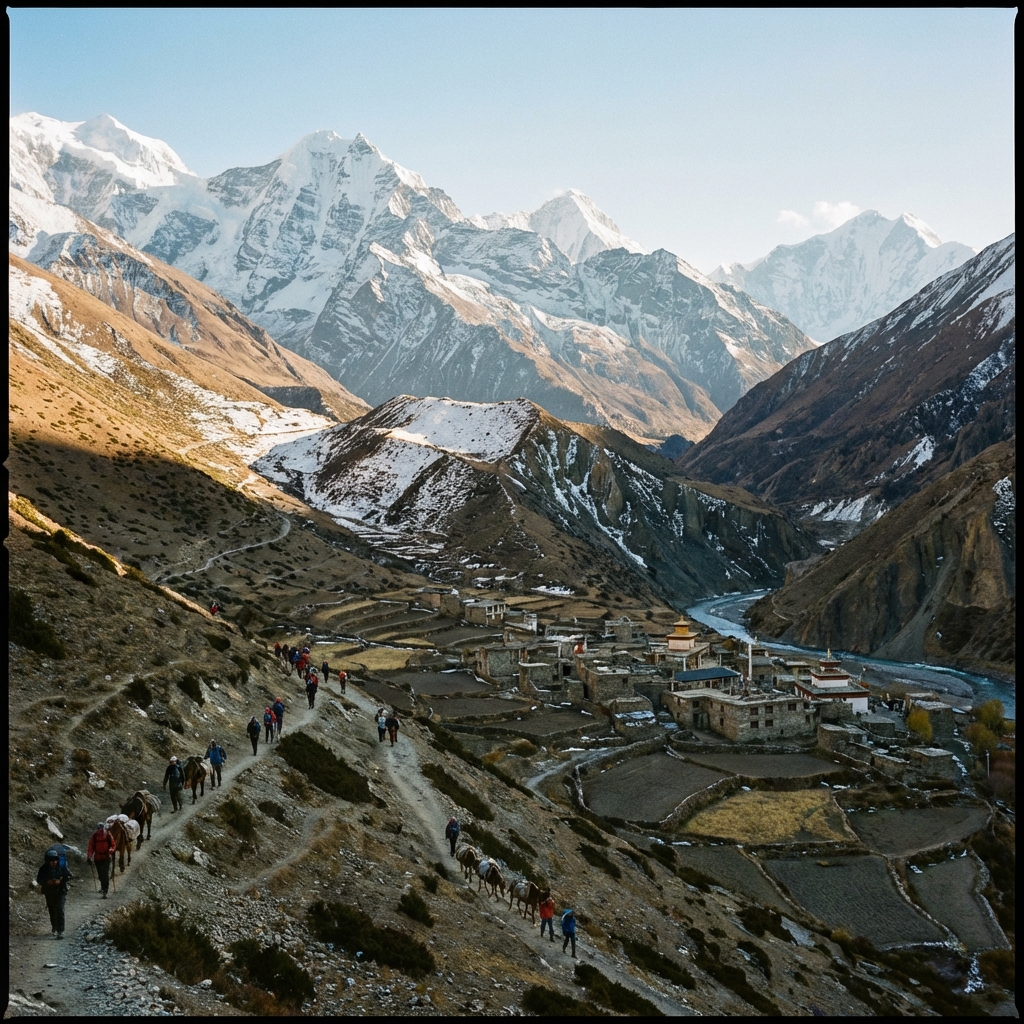

Satellite communication for Nepal trekking means carrying a device that can send your GPS coordinates and a distress signal to emergency services — or two-way message your contacts and insurance company — from anywhere with open sky, including the remote valleys where cellular coverage ends. For most trekkers in 2026, a Garmin inReach two-way device is the right choice; a Personal Locator Beacon (PLB) is the cheapest genuine emergency option, and a satellite phone is best reserved for guided expeditions that need voice calls.
In the Khumbu valley above Namche Bazaar, Nepal's mobile phone network reaches surprisingly well. You can often send WhatsApp messages from Dingboche (4,410m). From Gorak Shep (5,164m), connections are intermittent but exist.
This coverage creates a false sense of security. The moment you step off the classic routes — into the Rolwaling Valley, upper Dolpo, the Nar–Phu side valley, or many sections of the Great Himalayan Trail — cellular coverage ends completely and can remain absent for days at a stretch. And even on well-serviced routes, emergencies choose their own timing. A storm that closes down helicopter operations for three days also tends to interfere with cellular reception.
Satellite communication solves this gap. A satellite device transforms a life-threatening situation from a dice roll into a manageable process — which is why it now sits alongside travel insurance and a proper first-aid kit as a core safety item on remote treks.
This guide covers every satellite communication option available to trekkers in Nepal: how they work, comparative costs, legal status under Nepal's telecommunications rules, what each is best suited for, and recommendations for different trek types.
Quick Facts: Device Comparison
Garmin inReach Mini 2
PLB (Personal Locator Beacon)
Satellite Phone (Iridium/Thuraya)
Global (Iridium), Regional (Thuraya)
All types permitted; registration advisable
inReach or equivalent two-way device
$150 (PLB) to $1,500+ (satellite phone)
$15/month (inReach Freedom) to $1.50/min (sat phone)
Which Satellite Device Should You Choose?
If you only read one section, read this. Match your trek and budget to a device:
- Classic teahouse trek (EBC, Annapurna Base Camp, Langtang) on a normal budget → Garmin inReach Mini 2 or inReach Messenger. Two-way messaging, SOS, and tracking for family at home.
- You want emergency capability for the lowest ongoing cost → a PLB. One-time hardware cost, no subscription, sends a 406 MHz distress signal with your coordinates.
- Off-route or restricted-area trek (Dolpo, Humla, Nar–Phu, Makalu) → inReach as your primary device, with a PLB as a backup. Redundancy matters where no other trekkers pass.
- Guided expedition or long traverse needing voice logistics → a satellite phone (rented or owned), usually alongside an inReach.
The rest of this guide explains how each device works, what it costs in 2026, and why these recommendations hold for trekking in Nepal.
Why Satellite Communication Matters on Nepal Treks
The Cellular Coverage Reality
Nepal's mobile network has expanded dramatically since 2010. Ncell and Nepal Telecom now provide 4G in most major towns and along established trekking routes up to considerable altitude. For day-to-day connectivity, a local SIM card covers a lot of ground. However, satellite communication exists for the moments when that network is not enough:
Coverage gaps remain on:
- Most sections of Dolpo, Humla, far-western Nepal
- Rolwaling Valley
- Nar–Phu Valley (except at Manang junction)
- Upper Mustang deep interior
- Many cross-country routes between valleys
Coverage unreliability exists on:
- All routes during heavy storms (precisely when emergencies are most likely)
- High passes where the device may be in the wrong angle relative to towers
- Valley bottoms between ridge-top relay stations
Do not rely on cellular for emergency communication from any remote section. Even on well-covered routes, the margin for error is too small to bet on. A SIM card and a satellite device serve different jobs: the SIM is for convenience and connectivity in towns and on popular trails; the satellite device is your guaranteed lifeline when the towers run out.
The Emergency Coordination Gap
Nepal's helicopter evacuation system requires upfront financial guarantee before a helicopter departs. This means the injured or ill trekker (or someone on their behalf) must:
- Contact the insurance company's emergency line
- Provide location coordinates
- Receive a guarantee authorization number
- Relay that to the helicopter operator
Without two-way satellite communication, none of this is possible from an area without cellular coverage. You are dependent on other trekkers passing by, your guide walking to the nearest cellular signal, or a lodge owner with a satellite phone — none of which are guaranteed in a real emergency. Two-way satellite messaging is the piece that makes the emergency protocols for remote regions actually work when you are days from a road.
A satellite device is not a substitute for prevention
Communication speeds up rescue, but it does not prevent the emergency. The most common reason trekkers need evacuation is altitude illness, which is largely preventable with proper acclimatization. Read altitude sickness prevention and treatment and treat your inReach as a backstop, not a safety net that lets you climb faster.
Device Categories: How Each Works
1. Personal Locator Beacons (PLBs)
PLBs are the simplest, most reliable, and least expensive emergency communication device. When activated, they transmit a distress signal on the 406 MHz international distress frequency to the Cospas-Sarsat satellite network, which relays your registered identity and GPS coordinates to the nearest Rescue Coordination Centre (in Nepal's case, typically coordinated through the Aeronautical Rescue Centre).
Key characteristics:
- One-way only: you can send an emergency signal but cannot communicate
- No subscription fee: the device is ready when you need it; no monthly charges
- Battery life: 24–48 hours of continuous transmission after activation
- Lifespan: typically 5–7 years before battery replacement required
- Waterproof and rugged: designed for survival conditions
- Activation is irreversible: once activated, emergency services respond
Best for: Trekkers on a budget who want genuine emergency capability without the cost of a subscription service. Also excellent as a backup device carried alongside an inReach or satellite phone.
Recommended PLBs:
- ACR ResQLink 400 (~$350 USD)
- McMurdo Fast Find 220 (~$200 USD)
- Ocean Signal rescueME PLB1 (~$250 USD)
Important: PLBs must be registered with your country's national registration system before use. Unregistered PLBs may not receive priority response. Registration is free and takes 10 minutes online.
PLB vs. two-way device: the key trade-off
A PLB sends one message: "I have an emergency, here are my coordinates." It cannot tell rescuers what is wrong, confirm the message was received, or stand down a false alarm. A two-way device like the inReach lets the monitoring centre ask whether you need a litter, a doctor, or just a guarantee number — which can change the response. If budget allows only one device for a remote trek, a two-way communicator is the more capable choice; a PLB shines as a no-subscription backup.
2. Garmin inReach Devices (Recommended)
The Garmin inReach family uses the Iridium satellite network — a constellation of 66 low-earth-orbit satellites that provides genuinely global coverage. With an inReach device, you can:
- Send and receive text messages (two-way) to any phone number or email
- Track and share your location with contacts in real time
- Trigger an SOS that connects to the GEOS international emergency monitoring centre
- Get basic weather forecasts
- Navigate with offline maps (on the inReach GPS models)
inReach models for Nepal trekking:
Garmin inReach Mini 2 (~$350 USD hardware): The best option for most trekkers. Small (about the size of a large lighter), lightweight (100g), and clips to a pack strap or shoulder strap. The Mini 2 uses a paired smartphone app for full-text messaging — the device itself has limited buttons for SOS activation.
Garmin inReach Messenger (~$250 USD hardware): Newer, even smaller, and more affordable than the Mini 2 with comparable functionality.
Garmin inReach GPSMAP 67i (~$700 USD): Combines the inReach satellite communicator with a full GPS unit. For trekkers who want dedicated navigation and satellite communication in one device.
Subscription Plans:
The inReach requires an active subscription to function. Plans include:
| Plan | Monthly Cost | Messages | Tracking |
|---|---|---|---|
| Safety | $14.95/month | 10 messages | 10-minute intervals |
| Recreation | $34.95/month | 40 messages | 10-minute intervals |
| Expedition | $64.95/month | Unlimited | 2-minute intervals |
| Freedom | $4.95/month base + usage | Pay-per-message | On demand |
For a 3-week Nepal trek, the Safety or Recreation plan is typically sufficient. The Freedom plan (activating only for the trek) is cost-effective if you don't use the device between trips.
The inReach SOS System
When you trigger an SOS on an inReach device, GEOS (the 24/7 monitoring centre) receives your GPS coordinates, your pre-registered emergency contact information, your planned trek route (if you uploaded one), and your insurance details (if registered). They then coordinate response with local emergency services. GEOS has experience with Nepal helicopter evacuations and maintains relationships with Kathmandu operators. This is significantly more sophisticated than a raw PLB signal.
Pro Tip
Add your travel insurance policy number and emergency assistance phone number to your inReach emergency contacts before you fly to Kathmandu. In a real evacuation, GEOS can then relay those details to the operator and speed up the financial guarantee that Nepal's helicopter system requires. Doing this from a teahouse over a slow connection is far harder than doing it at home.
3. SPOT Satellite Messenger
SPOT is the major competitor to Garmin inReach, using the Globalstar satellite network rather than Iridium. The key difference: Globalstar's coverage has gaps at high latitudes and in some mountainous terrain. For Nepal specifically, SPOT coverage is generally adequate on standard routes but less reliable in deep valleys or at high altitudes compared to Iridium.
SPOT Gen4 (~$150 USD): The basic SPOT device allows tracking, pre-set message buttons (OK/Custom/Help/SOS), and one-way communication. It does not support two-way messaging.
SPOT X (~$250 USD): Two-way messaging capability added. A valid competitor to inReach for standard routes.
Coverage consideration: The Iridium network used by Garmin is considered more reliable in Nepal's Himalayan terrain than Globalstar. If choosing between equivalent SPOT and Garmin devices, the Garmin's network advantage in mountainous Nepal terrain is a meaningful factor.
4. Satellite Phones
Satellite phones provide voice calling from anywhere in the world with open sky. They are the most capable communication tool but also the most expensive and least portable.
Iridium satellite phones (e.g., Iridium 9555, ~$1,000–1,500 USD hardware):
- Truly global coverage (the same Iridium constellation as Garmin inReach)
- Voice calling at approximately $1.50–$2.50 per minute
- Data (slow, for email) at high per-KB costs
- Large and relatively heavy (300–500g with battery)
- Airtime cards or monthly plans
Thuraya satellite phones (~$700–900 USD):
- Regional coverage (covers Asia, Europe, Africa, Middle East — good for Nepal)
- More affordable airtime than Iridium
- Not truly global — cannot be used in Americas, Oceania, or polar regions
Best for: Guided expeditions, group treks with multiple people sharing the device, commercial operators who need voice communication ability. For individual trekkers, the size, weight, and cost of a satellite phone is rarely justified when a Garmin inReach provides emergency communication at 20% of the cost.
Satellite phone rental: Kathmandu trekking agencies and gear shops rent Iridium and Thuraya satellite phones. Rates are approximately $15–20 USD per day plus airtime. Renting for a 3-week trek costs $300–400 before airtime — more expensive than buying an inReach.
5. Other Connectivity Tools (and Their Limits)
Satellite devices are the heart of off-grid communication, but trekkers in Nepal often pair them with simpler tools. None of these replace a satellite communicator for emergencies, but they shape how you stay connected:
- Walkie-talkies / two-way radios: Useful within a group or between a guide and porters who are spread out on a long stage, and popular with commercial expeditions. Range is line-of-sight only — typically a few kilometres in open terrain, far less in steep valleys — so they coordinate a team, not call for rescue.
- Cell phone + local SIM: Excellent on popular routes and in towns. See the dedicated Nepal SIM cards and WiFi guide for which network performs best in each region. Treat it as your everyday connectivity, not your emergency lifeline.
- Offline navigation apps: Apps like Gaia GPS, OsmAnd and downloaded Google Maps let your phone navigate without signal. They help you report an accurate location to a satellite SOS, but they cannot send a distress message themselves. Our best offline maps for Nepal trekking guide covers setup.
- Teahouse and lodge WiFi: Available on many classic routes (often paid, often slow). Convenient for messages home, irrelevant in an emergency in a remote valley.
The takeaway: these tools improve comfort, navigation and team coordination, but only a satellite communicator guarantees a message out when you are beyond the cellular network.
Power and Keeping Your Device Alive
A satellite device is useless with a dead battery, and cold drains batteries fast. The inReach Mini 2 lasts for days of normal tracking, but high passes and sub-zero nights shorten that:
- Carry a power bank sized for your trek length — 10,000–20,000 mAh covers most teahouse routes between charging opportunities.
- Keep the device and spare batteries inside your jacket or sleeping bag in cold weather; lithium cells lose capacity below freezing.
- Switch off continuous tracking when you don't need it; sending a few pre-set check-in messages per day uses a fraction of the power.
- On longer or higher routes where lodge charging is scarce or expensive, a small solar panel paired with a power bank keeps everything topped up.
Legal Considerations in Nepal
Satellite phones are technically regulated under Nepal's telecommunications law. The Nepal Telecommunications Authority (NTA) has in the past required satellite phone import permits and registration. In practice, enforcement for individual trekkers has been minimal, and tens of thousands of satellite phone units have entered Nepal without issue.
The current practical situation: Individual trekkers carrying one satellite phone or inReach device for personal emergency use are not typically stopped or required to register devices. However, the regulatory environment can change and it is worth checking current NTA guidance via the Nepal Tourism Board or your trekking agency before departure.
GPS devices (including the Garmin inReach GPS functions) are not restricted.
Practical tips for customs and checkpoints
Carry your purchase receipt or a printout showing the device is a personal emergency communicator. Keep the device in your carry-on, not buried in a checked duffel. On restricted-area treks, mention to your agency that you are carrying a satellite communicator so it can note it if a checkpoint asks — see the restricted area permits overview for which regions involve formal checks.
Recommendations by Trek Type
| Trek Type | Recommended Device | Reasoning |
|---|---|---|
| Classic Everest/Annapurna routes | inReach Mini 2 | Good cellular backup; inReach provides reliable emergency and messaging |
| Off-route/remote treks (Dolpo, Humla) | inReach + PLB backup | Two devices provides redundancy in highest-risk areas |
| Full GHT traverse | inReach + satellite phone rental | Voice communication needed for complex logistics across months |
| Short popular treks (Poon Hill, Langtang Valley) | inReach or PLB | Lower risk but still worth having; cellular largely covers these routes |
| Family treks with children | inReach | Two-way messaging to family at home; tracking shared with contacts |
Buy or Rent? A Quick Cost Comparison
For a typical 3-week trek, here is how the main options stack up before airtime:
- Buy an inReach Mini 2 (
$350) + Freedom plan activated for one month ($35 with usage) → roughly $385 the first trip, then ~$35 per future trip. The clear winner if you trek more than once. - Buy a PLB (~$200–350) → one-time cost, no subscription ever. Cheapest over a lifetime if you only need emergency SOS.
- Rent a satellite phone in Kathmandu (~$15–20/day) → about $300–400 for three weeks before airtime, and you hand it back. Sensible only if you genuinely need voice calls.
- Rent an inReach in Thamel (~$5–8/day) → about $105–170 for three weeks plus subscription. Convenient if you forgot to buy one, but availability is tight in peak season.
For most international trekkers planning a Nepal trip months out, buying an inReach and activating the Freedom plan only for travel months is the best value.
Frequently Asked Questions
Related Resources
- Nepal SIM Cards & WiFi for Trekking
- Best Offline Maps for Nepal Trekking
- Power Banks & Electronics for Trekking
- Emergency Protocols in Remote Regions
- Helicopter Rescue in Nepal
- Medical Facilities on Nepal's Trekking Routes
- Common Trekking Injuries and Treatment
- Great Himalayan Trail Guide
- Restricted Area Permits Overview
- Technical Pass Crossings in Nepal
- Dolpo Trekking Guide
- Altitude Sickness Prevention and Treatment