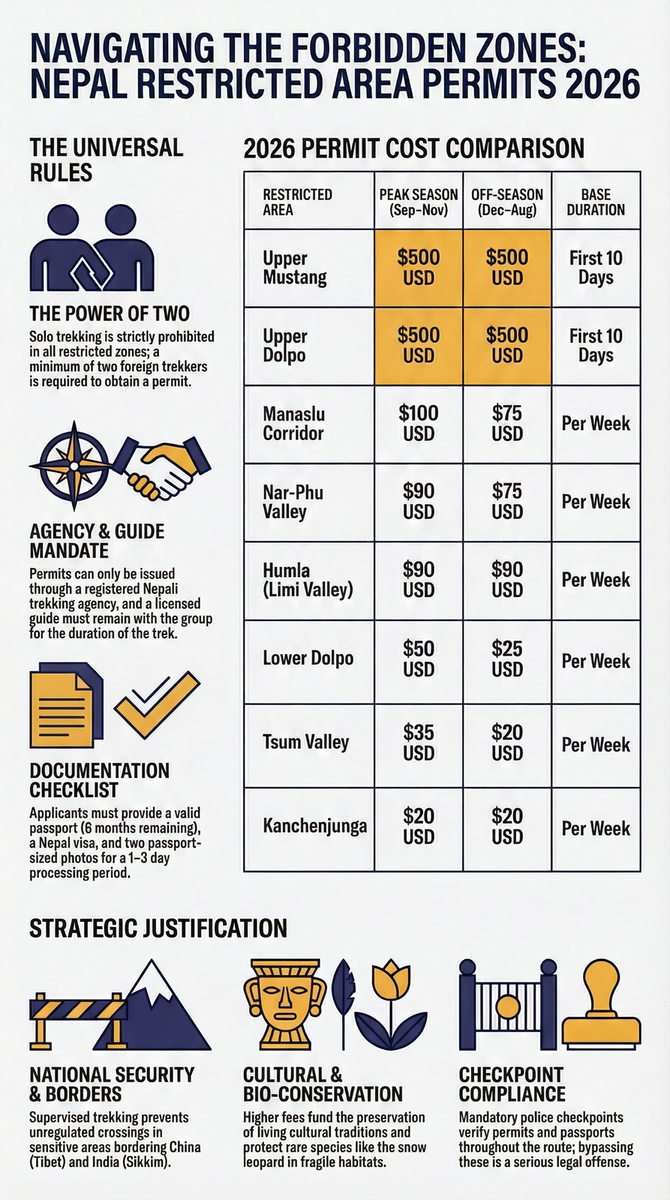
Restricted Area Permits Overview: Nepal's Special Trekking Zones
This restricted area permits overview covers every special-zone authorisation a foreign trekker needs to enter Nepal's most culturally and geopolitically sensitive regions — Upper Mustang, Manaslu, Dolpo, Nar–Phu, Tsum Valley, Kanchenjunga, and Humla. A restricted area permit (RAP) is issued by the Department of Immigration, must be arranged through a registered Nepali trekking agency, requires a minimum of 2 trekkers and a licensed guide throughout, and carries a higher per-person fee that funds local conservation. Below you'll find where each zone is, its exact 2026 permit cost, and the step-by-step application process.
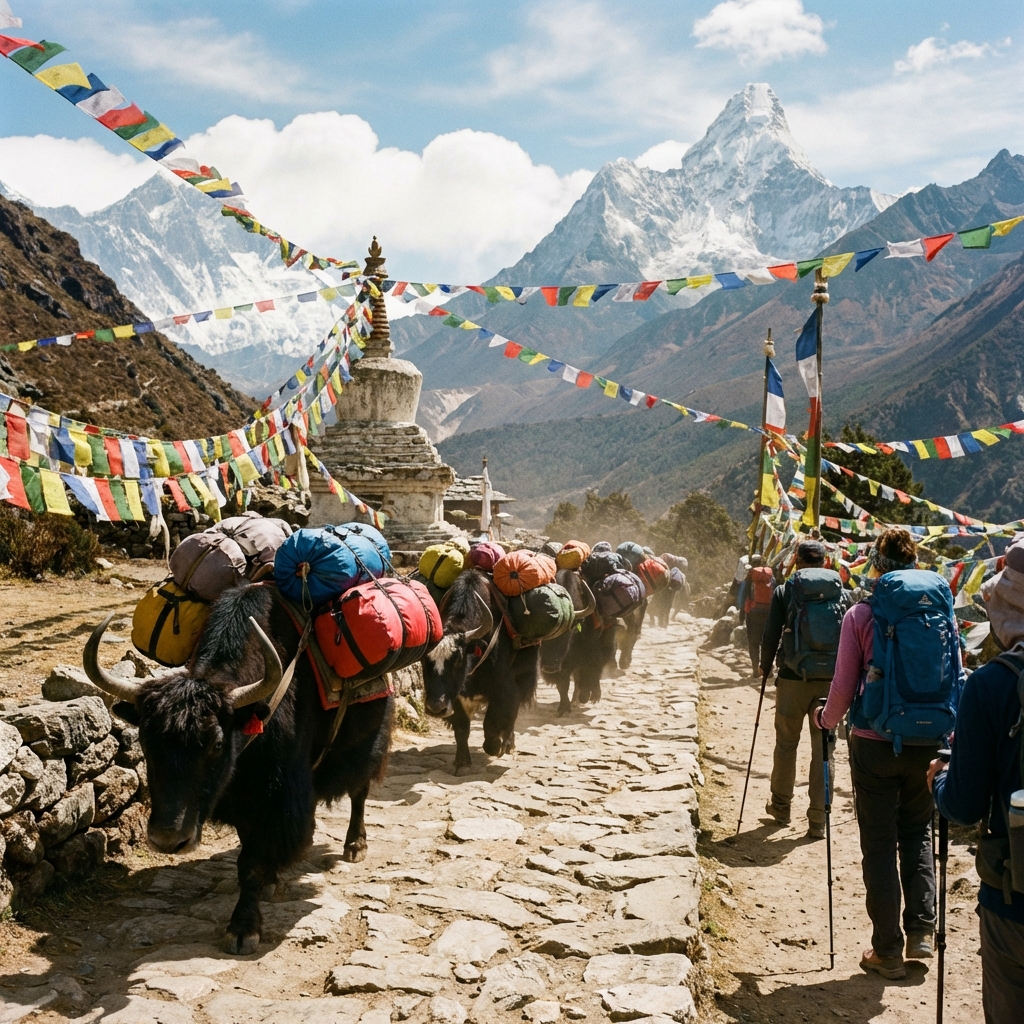
Nepal's restricted areas are among the most extraordinary places in the Himalayan world. Bordering Tibet (China) or Sikkim (India), sheltering cultures that have remained largely unchanged for centuries, and containing landscapes of rare geological and ecological significance, these zones are deliberately kept off the standard trekking circuit through a permit system that limits visitor numbers and requires agency-assisted access.
The restricted area permit system was established in the 1990s as Nepal gradually opened previously closed regions. The logic was threefold: protect fragile cultures from mass tourism, generate revenue specifically from the communities visited, and ensure visitors were accompanied by knowledgeable guides rather than wandering unescorted through politically sensitive border areas.
This guide covers all of Nepal's current restricted areas — what they are, why they require special permits, how the permit system works, current costs, and the practical process of obtaining your permits before departure. For the broader picture of every permit type, see our Nepal trekking permits explained overview.
8 zones
Upper Mustang — USD 50 per day
Kanchenjunga — $20 per week
2 trekkers for all restricted areas
Registered Nepali trekking agency — mandatory
Licensed guide required throughout
Department of Immigration, Kathmandu
1–3 working days
Varies — weekly or per-trip basis
What Is a Restricted Area Permit in Nepal?
A restricted area permit is a special-zone authorisation issued by Nepal's Department of Immigration under the Immigration Rules, separate from the ordinary TIMS card and national park or conservation area entry fees. It applies only to designated border and culturally sensitive districts. The defining features are that you cannot trek these areas solo or independently, you must be part of a group of at least two foreigners, you must hire a licensed guide, and the application must be filed by a government-registered Nepali agency on your behalf. The fee is charged per person and is non-refundable once issued.
In practice, this means restricted area treks require more planning and a larger budget than mainstream routes like Everest Base Camp or Annapurna Base Camp, but they reward you with far thinner crowds and intact Tibetan-influenced cultures.
What Makes an Area "Restricted"?
An area becomes "restricted" in Nepal when it combines a sensitive international border, a culturally fragile community, and an ecologically vulnerable high-altitude environment. The government then limits access through the permit system rather than closing the zone entirely. Nepal's restricted areas share several characteristics that distinguish them from standard trekking regions:
Sensitive border geography: All restricted areas border either Tibet (China) or Sikkim (India). The government requires that foreign trekkers be supervised in these zones to prevent unregulated border crossings and for national security reasons.
Cultural fragility: Areas like Upper Mustang, Tsum Valley, and Nar–Phu Valley contain Tibetan Buddhist communities with living cultural traditions that mass tourism would irreversibly damage. Permit fees fund local conservation and cultural preservation programmes.
Ecological sensitivity: High-altitude ecosystems in these zones are extremely fragile. Snow leopard habitats, rare medicinal plants, and undisturbed wetlands require protection from the ecological pressure that large trekker numbers would bring.
Revenue generation: Higher permit costs ensure that the revenue generated from these areas flows back to community development funds, often administered by local conservation committees.
Restricted Area Permits vs Standard Trekking Permits
Many first-time visitors confuse restricted area permits with the conservation area and national park permits required on mainstream routes. The differences are significant and affect both your budget and how you organise the trip.
For zones such as Manaslu, Kanchenjunga, and Dolpo, the restricted area permit is layered on top of a separate conservation area permit — meaning you pay both. Your agency coordinates these so you do not have to queue at multiple offices.
Which Areas of Nepal Require a Restricted Area Permit?
Nepal currently maintains restricted-area status across eight trekking zones spread along its northern and eastern frontiers. Each one borders either Tibet or Sikkim and protects a distinct Tibetan-influenced culture. Here is the full list at a glance before the detailed cost breakdowns below:
| Restricted Zone | District / Region | Borders | Headline 2026 Fee |
|---|---|---|---|
| Upper Mustang | Mustang | Tibet | USD 50 / day |
| Upper Dolpo | Dolpa | Tibet | USD 50 / day |
| Lower Dolpo | Dolpa | Tibet | USD 50 / week (peak) |
| Manaslu (restricted portion) | Gorkha | Tibet | USD 100 / week (peak) |
| Tsum Valley | Gorkha | Tibet | USD 35 / week (peak) |
| Nar–Phu Valley | Manang | Tibet | USD 90 / week (peak) |
| Kanchenjunga | Taplejung | Tibet & Sikkim | USD 20 / week |
| Humla (Limi / Saipal) | Humla | Tibet | USD 90 / week |
A handful of other border districts — such as parts of Mugu (Rara), Bajhang, and Gorkha's far north — carry restricted status for specific routes, but the eight zones above account for virtually all foreign trekking permits issued each year. If you are weighing these against mainstream routes, the Nepal trekking permits explained hub maps how every permit type fits together.
Why Are a Guide and Agency Mandatory in Restricted Areas?
The two-trekker minimum, the licensed guide, and the registered-agency requirement all exist for the same reason: accountability inside a politically sensitive border zone. Because the application form must carry an agency's government registration number, immigration can trace every permit holder to a licensed operator who is legally responsible for the group's conduct, route adherence, and timely exit.
A guide is not a bureaucratic formality here. In camping-only zones like Upper Dolpo and Humla, your guide coordinates porters, a cook, and tents; in teahouse zones like Manaslu and Tsum, the guide handles checkpoint registrations, dialect translation in villages, and altitude judgement on high passes. Hiring well matters — read how to choose a trekking agency and questions to ask trekking agencies before you commit, and review hiring guides and porters in Nepal for fair-wage norms.
Current Restricted Areas and Permit Costs (2026)
Upper Mustang
Permit cost: USD 50 per person per day (no minimum number of days) Minimum group: 2 trekkers Agency required: Yes (registered Nepali agency) Guide required: Yes (licensed guide) Duration of permit: Typically 10–21 days Also required: Annapurna Conservation Area Permit (ACAP)
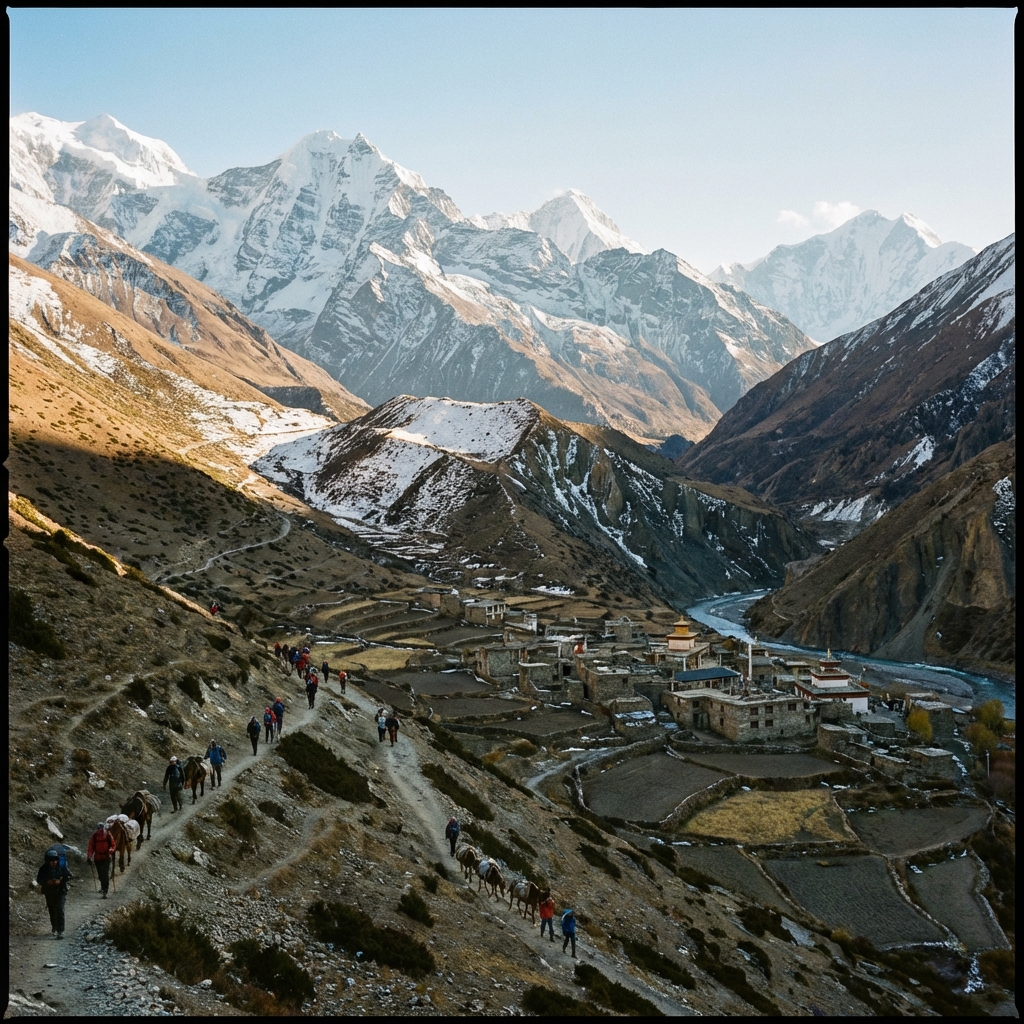
Upper Mustang — the Forbidden Kingdom — is one of Nepal's most famous and most visited restricted areas. A former independent kingdom whose king, Lo Manthang, retained his throne until the abolition of Nepal's monarchy in 2008, Upper Mustang sits on the Tibetan plateau, north of the Annapurna massif, in a high-altitude rain-shadow desert.
The walled city of Lo Manthang (3,840m), with its whitewashed buildings, ancient monasteries, and preserved Tibetan-influenced architecture, is the centrepiece. Getting there requires trekking north from Kagbeni through a lunar landscape of eroded canyons and occasional oases of poplar and apple orchards.
At USD 50 per day, the Upper Mustang permit is the most expensive trekking permit in Nepal. This reflects both the cultural sensitivity of the area and the deliberate cap on visitor numbers. Approximately 3,000–4,000 foreign trekkers visit Upper Mustang annually — compared to the 50,000+ who trek to Everest Base Camp each year.
For more detail on the Upper Mustang permit process, see the dedicated Upper Mustang permit guide. To plan the trek itself, read our Upper Mustang trek itinerary and Upper Mustang cost breakdown.
Upper and Lower Dolpo
Upper Dolpo permit: $500 USD per person per 10 days (equivalent to USD 50/day beyond the first period) Lower Dolpo permit: $50 USD per person per week (peak season: Sep–Nov), $25 off-season Minimum group: 2 trekkers Agency required: Yes Guide required: Yes Also required: Shey Phoksundo National Park entry permit
Dolpo is Nepal's largest district and arguably its most remote. Divided by the Phoksundo River into "lower" and "upper" zones, Dolpo contains Shey Phoksundo National Park — the setting for Peter Matthiessen's celebrated book "The Snow Leopard" — and supports the Bon religion, Tibet's pre-Buddhist tradition, in communities that have practiced it continuously for over a thousand years.
Upper Dolpo is camping-only territory. No teahouse network exists. Trekkers must carry all food and camping equipment, typically requiring 8–10 porter loads for a group of two. The combination of extreme remoteness, high passes including Kagmara La (6,146m on the Great Himalayan Trail), and complete self-sufficiency makes Upper Dolpo one of Nepal's most demanding destinations.
Lower Dolpo, centred on Phoksundo Lake — Nepal's deepest and most beautiful lake — is more accessible. Juphal has an airstrip served by Twin Otter flights from Nepalgunj, and several established teahouses operate around the lake. The lower Dolpo permit is more affordable and represents excellent value for one of Nepal's most scenic landscapes.
See the dedicated Dolpo permits guide for complete information, plus the Lower Dolpo trek guide and Upper Dolpo trek guide for routes and logistics.
Manaslu Corridor (Restricted Area Portion)
Permit cost: $100 USD per person per week (Sep–Nov peak), $75 per week (Dec–Aug) Minimum group: 2 trekkers Agency required: Yes Guide required: Yes Also required: Manaslu Conservation Area Permit (MCAP) and Annapurna Conservation Area Permit (ACAP)
The Manaslu Circuit passes through a restricted area that extends roughly from Samagaon to the northern sections of Larkya La. The restriction recognises the border-adjacent nature of this section, which passes within kilometres of Tibet at its northern extreme.
The Manaslu restricted area permit is one of the best values among Nepal's special permits. The circuit offers dramatic scenery rivalling the Annapurna Circuit, a genuine sense of remoteness despite the developing teahouse network, and the cultural depth of the Tibetan-influenced Nubri and Tsum peoples. Full details are in the Manaslu restricted area permit guide, and you can plan the walk with our Manaslu Circuit trek guide and Manaslu Circuit cost breakdown.
Tsum Valley
Permit cost: $35 USD per person per week (Sep–Nov), $20 off-season Minimum group: 2 trekkers Agency required: Yes Guide required: Yes Also required: Manaslu Conservation Area Permit (MCAP)
The Tsum Valley extends northeast from the Manaslu region and is reached by a side valley branching from the main Manaslu Circuit route. "Tsum" derives from the Tibetan word for "vivid," and the valley lives up to its name — a lush, enclosed world of ancient monasteries, mani walls stretching hundreds of metres, and communities that maintained near-total isolation from outsiders until 2008.
The Tsum permit is relatively affordable and is usually combined with the Manaslu restricted area permit as a two-in-one trip. The valley sits at a sweet spot: genuinely remote and culturally extraordinary, but with sufficient teahouse infrastructure to make it accessible to non-expedition trekkers. See the Tsum Valley trek guide and the Manaslu and Tsum Valley combination for itinerary options.
Nar–Phu Valley
Permit cost: $90 USD per person per week (Sep–Nov), $75 off-season Minimum group: 2 trekkers Agency required: Yes Guide required: Yes Also required: Annapurna Conservation Area Permit (ACAP)
Nar and Phu are twin villages in a hidden valley north of Manang on the Annapurna Circuit. The valley opens toward Tibet through a series of high passes and is surrounded by peaks exceeding 6,000 metres. Until 2002, this was one of Nepal's most inaccessible inhabited areas.
The Nar–Phu Valley is typically combined with the Annapurna Circuit — trekkers branch north from Koto village in the Marsyangdi valley, spend several days exploring Nar and Phu (including the Kang La pass at 5,320m), and rejoin the circuit at Manang. This combination adds 4–6 days to the standard circuit and transforms it into one of Nepal's finest routes. For planning, see the Nar–Phu Valley trek guide and the best time for Nar–Phu Valley.
Kanchenjunga Conservation Area
Permit cost: $20 USD per person per week Minimum group: 2 trekkers Agency required: Yes Guide required: Yes Also required: Kanchenjunga Conservation Area Permit (KCAP)
Kanchenjunga — Nepal's easternmost trekking destination and the world's third-highest mountain — requires a restricted area permit reflecting its proximity to both the Tibetan and Sikkimese borders. Despite being Nepal's least expensive restricted area permit, the Kanchenjunga Base Camp trek is one of the most remote and least-visited major treks in the country.
The full Kanchenjunga circuit, visiting both the north and south base camps, typically takes 20–28 days and involves a long approach through lowland forests before reaching the high alpine terrain near the mountain. The permit system ensures that the communities along this route receive direct benefit from tourism. See the Kanchenjunga permit guide and the Kanchenjunga Base Camp trek guide for full logistics.
Humla (Limi Valley and Saipal Region)
Permit cost: $90 USD per person per week Minimum group: 2 trekkers Agency required: Yes Guide required: Yes
Humla is Nepal's most remote and most northwestern district. Trekking here requires a flight to Simikot (the nearest airstrip) followed by multi-day walks to reach destinations like the sacred Limi Valley, the Humla Karnali River, and Tibet border crossings at Nara La. The Bon religion is widely practiced alongside Tibetan Buddhism in Humla's villages. Like Upper Dolpo, much of Humla is camping-only territory requiring a full support crew, so budget for porters, a cook, and tents in addition to the permit fee.
When Is the Best Time to Trek Nepal's Restricted Areas?
The best windows are spring (March–May) and autumn (September–November) — the same prime trekking seasons as the rest of Nepal, but with an important twist unique to the restricted zones. Most of these treks lie in the rain shadow north of the main Himalayan range, so they behave very differently from Annapurna Base Camp or Everest in the wet months.
- Upper Mustang, Upper Dolpo and Humla sit in deep rain shadow, which makes them rare candidates for summer monsoon trekking (June–August) when the rest of the country is wet. Trails stay relatively dry while the lowland approaches turn green.
- Manaslu, Tsum Valley, Nar–Phu and Kanchenjunga follow the standard pattern: clear, stable autumn for the best mountain views, and warm, rhododendron-filled spring. Note that Manaslu, Tsum and Nar–Phu permits cost more in the September–November peak ($100, $35 and $90 per week respectively) than off-season — a pricing signal worth factoring into your budget.
- Winter (December–February) is possible on lower-altitude sections but high passes like Larkya La, Kang La and the Kanchenjunga circuit can be snow-blocked. Off-season permit fees are lower in winter, but the trade-off is genuine cold and route risk.
For the wider seasonal picture, see Nepal trekking seasons overview and the best time to trek Nepal guide. Zone-specific timing is covered in best time for Nar–Phu Valley and Manaslu Circuit best time.
What Does the Restricted Area Permit Fee Pay For?
Restricted area permit revenue is split between the central government and local community development. Because the system was designed to channel money back to the villages most affected by tourism, a meaningful share funds trail maintenance, conservation committees, school and health-post support, and cultural-preservation programmes administered locally. This is why the per-person fees are deliberately higher than ordinary entry permits, and why they are charged per person rather than per group — the model ties revenue directly to visitor numbers in fragile zones. Conservation area permits (ACAP, MCAP, KCAP) and the Shey Phoksundo National Park fee work the same way; see Nepal national parks and conservation areas for how those funds are managed.
The Application Process: Step by Step
Step 1: Book Through a Registered Nepali Agency
Restricted area permits cannot be obtained by individual trekkers independently. A registered Nepali trekking agency must apply on your behalf. This is not optional — the permit application form requires the agency's registration number, and immigration officials verify agency registration.
When choosing an agency, verify their Nepal Tourism Board registration number. Reputable agencies will handle the entire permit process as part of their service package. Our guides on how to choose a trekking agency and trekking agency red flags and scams help you book with a verified local operator.
Step 2: Prepare Your Documents
For each restricted area permit application, you need:
- Valid passport (minimum 6 months remaining validity)
- Nepal visa (must already be obtained — see our Nepal visa guide)
- 2 passport-sized photos
- Completed permit application form (provided by agency or immigration office)
- Agency registration details
Pro Tip
Bring extra passport photos (4–6) and a couple of photocopies of your passport's data page and Nepal visa. Restricted area treks often require additional photos for conservation area permits and TIMS, and checkpoints occasionally request a copy of your permit. Having spares saves a scramble in Kathmandu.
Step 3: Apply at the Department of Immigration
Kathmandu office: Kalikasthan, Dillibazar Open: Sunday–Friday, 9 AM–5 PM Processing time: Same day to 3 working days
Pokhara office: Near Prithivi Chowk Open: Sunday–Friday, 9 AM–5 PM Note: Not all restricted area permits can be issued from Pokhara, and most restricted permits are processed in Kathmandu — verify with your agency before travelling.
For full addresses, contact details, and queue tips, see the Nepal permit offices directory.
Step 4: Additional Permits
Restricted area permits are typically required alongside:
- Conservation area or national park entry permits (issued separately — see the table in each zone above)
- TIMS card (in most regions)
Your agency should coordinate all permits simultaneously to avoid delays. Allow at least one full working day in Kathmandu before your trek starts so the paperwork can be finalised.
How Long Does It Take to Get a Restricted Area Permit?
Processing a restricted area permit at the Department of Immigration typically takes same day to 3 working days, depending on the office workload and whether your agency has all documents in order. Because the office closes on Saturdays and public holidays, build a buffer day into your Kathmandu schedule. Agencies usually submit the application 1–2 days before departure once your passport and visa are confirmed, so do not arrange permits remotely or expect online issuance — restricted permits are not available online, at trailheads, or in most cases from Pokhara.
Important Rules and Conditions
The two-person minimum is strictly enforced. Solo trekkers cannot obtain restricted area permits regardless of experience level. If you are trekking solo, you must either find another trekker to pair with or hire a second person (some agencies can arrange a "permit companion" for exactly this purpose). For context on going it alone elsewhere, see our solo trekking Nepal safety guide.
Guides cannot be dismissed once in restricted areas. Your licensed guide must remain with your group throughout the permitted zone. Dismissing a guide partway through and continuing alone is a permit violation.
Checkpoints are mandatory stops. Police and army checkpoints within restricted areas verify your permit and passport. Record your details in their registers as required. Attempting to bypass checkpoints is a serious offence and can result in deportation or a ban.
Permits are zone-specific and route-specific. Each restricted area permit covers a defined trekking corridor. You cannot use a Manaslu permit to enter Tsum Valley, or an Upper Mustang permit to wander into adjacent off-limits areas. If your itinerary spans two zones (for example Manaslu plus Tsum), you need both permits.
Extensions must be applied for before expiry. If you need additional days beyond your permit period, contact your agency immediately. They can arrange an extension through the immigration office — but this requires advance notice and is not always possible from remote areas. Plan conservatively.
Permit fees are non-refundable once issued — even if your trek is cancelled for weather, illness, or a flight delay. Always carry comprehensive travel insurance with trip-cancellation and high-altitude helicopter-rescue cover. See our travel insurance for Nepal trekking guide for what to look for.
Cost Comparison Table (2026)
| Restricted Area | Peak Season | Off-Season | Min. Days | Typical Total Cost (2 weeks) |
|---|---|---|---|---|
| Upper Mustang | $50/day (no minimum days) | $50/day | 10 days | $700–$1,000 |
| Upper Dolpo | $50/day | $50/day | 10 days | $700–$1,000 |
| Lower Dolpo | $50/week | $25/week | 7 days | $100–$150 |
| Manaslu | $100/week | $75/week | 7 days | $200–$300 |
| Tsum Valley | $35/week | $20/week | 7 days | $70–$100 |
| Nar–Phu | $90/week | $75/week | 7 days | $180–$250 |
| Kanchenjunga | $20/week | $20/week | 7 days | $40–$80 |
| Humla/Limi | $90/week | $90/week | 7 days | $180–$250 |
Remember that these figures are the restricted area permit only. Most zones also require a conservation area or national park permit on top, plus your TIMS card, guide and porter wages, food, and transport. For the all-in picture, use the cost breakdowns linked under each zone above and our Nepal trekking costs complete guide.
Pro Tip
When budgeting a restricted-area trek, add the permit, the conservation/park fee, the TIMS card, and roughly 25–30 USD per day for guide and porter wages, then layer on food, lodging, and flights. On long camping-only routes like Upper Dolpo or Humla, the support crew and logistics — not the permit — are usually the largest single cost. Build in one buffer day in Kathmandu for paperwork and one or two contingency days on the trail for weather.
How Much Do Nepal Restricted Area Permits Cost?
Restricted area permit costs vary significantly by region. The cheapest is Kanchenjunga at $20 per week, while Upper Mustang and Upper Dolpo top the scale at USD 50 per day. The Manaslu Circuit offers the best balance of affordability ($75–$100/week) and trekking quality. All fees are per person and non-refundable. See the cost comparison table above for a full 2026 breakdown.
Where Do I Get a Restricted Area Permit in Nepal?
All restricted area permits are issued by the Department of Immigration in Kalikasthan, Kathmandu. They cannot be obtained at trailheads or online, and most cannot be issued in Pokhara. Your registered trekking agency submits the application on your behalf. Processing takes 1–3 working days. See the Nepal permit offices directory for addresses, hours, and tips. For more about the TIMS card required alongside restricted permits, see our TIMS card guide.
Which Restricted Area Trek Should You Choose?
Your choice depends on budget, time, and how much remoteness you want.
- Best value and best for first-timers: Manaslu Circuit — developing teahouses, a clear trail, scenery rivalling Annapurna, and a moderate permit fee.
- Most iconic culture: Upper Mustang — the walled city of Lo Manthang and a true Tibetan-plateau desert, at the highest permit cost.
- Deepest remoteness: Upper Dolpo or Humla — camping-only, full support crew, and weeks away from the nearest road.
- Cheapest gateway: Kanchenjunga at $20/week, though the trek itself is long (20–28 days) and committing.
- Add-on to a classic: Nar–Phu or Tsum Valley, bolted onto the Annapurna and Manaslu circuits respectively.
If this is your first time trekking in Nepal, build fitness and altitude awareness first — read how to start trekking in Nepal and our acclimatization guide before committing to a remote restricted-area route.
Plan a restricted-area trek with a verified local agency
Restricted permits must be filed by a registered Nepali agency. Get matched with a vetted operator who handles the paperwork, guide, and logistics end to end.