
One of the most common questions from first-time Nepal trekkers is deceptively simple: what will I eat and how much will it cost? The answer is both reassuring and surprising. Tea house menus across Nepal are remarkably standardized. Whether you are in the Everest region, on the Annapurna Circuit, or trekking through the Langtang Valley, you will find nearly identical menus with the same items listed in the same order. The difference is the price, which climbs steadily with altitude as the cost of transporting ingredients to remote mountain kitchens increases.
Understanding the tea house menu system before you arrive saves confusion, prevents budget surprises, and helps you make smarter food choices that keep your energy high and your stomach healthy throughout your trek. This guide walks you through every section of a typical tea house menu, explains what each item actually is, provides real prices at different altitudes, and shares practical advice on what to order for the best combination of nutrition, taste, safety, and value.
Whether you are budgeting for an Everest Base Camp trek or planning your first Annapurna Base Camp adventure, this is the food and pricing information you need.
Nearly identical menus across all major trekking regions
Dal bhat at low altitude: NPR 600-800 ($4.50-6)
Western dishes above 4,500m: NPR 1,200-1,800 ($9-14)
Food costs roughly double from trailhead to highest point
Dal bhat with unlimited refills at every altitude
Hot drinks have highest profit margin for tea houses
Cash only at most tea houses (Nepali Rupees)
Not expected but appreciated for good service
How Tea House Menus Work
Every tea house along Nepal's major trekking routes operates from a laminated menu that is presented to you when you sit down in the dining room. These menus follow a remarkably consistent format across the entire country, organized into clear sections: breakfast, soups, main courses, snacks, and drinks.
Why Menus Are Standardized
The standardization is not coincidental. Local tea house committees and trekking associations establish pricing guidelines for each settlement along popular routes. This prevents destructive price competition between neighboring lodges while ensuring trekkers are not overcharged. The committees set maximum prices that increase at each higher settlement, reflecting the genuine cost increase of transporting goods to more remote locations.
The result is that you can walk into any tea house in a given village and find essentially the same menu at the same prices. Your choice of where to eat should therefore be based on the quality of cooking, the warmth of the dining room, and recommendations from other trekkers rather than on price differences.
The Unwritten Rule: Eat Where You Sleep
Before diving into the menu, you need to understand the most important unwritten rule of tea house trekking. When you stay at a tea house, you are expected to eat all your meals there. Room rates are kept artificially low, often just NPR 200 to 500 per night, because tea houses make their actual profit from food and drink sales. If you sleep at one lodge but eat at another, you are essentially taking a subsidized room without contributing to the business.
Always Eat Where You Sleep
Eating at a different tea house from where you are staying is considered very poor etiquette and can result in the lodge owner charging you the full room rate, which can be NPR 2,000 to 5,000 or more. Always order your dinner, breakfast, and any drinks from the lodge where you are spending the night.
Reading the Menu
Tea house menus are written in English with Nepali translations. Prices are listed in Nepali Rupees (NPR). Most menus are several pages long, often laminated and slightly grubby from years of handling. Do not be intimidated by the length. Despite offering what appears to be 40 to 60 items, most tea house kitchens work from a limited set of base ingredients: rice, noodles, potatoes, eggs, flour, vegetables (primarily cabbage, carrots, and onions at altitude), lentils, and limited spices. The apparent variety comes from different combinations and cooking methods applied to these core ingredients.
Breakfast Menu: What to Expect
Breakfast at a tea house is served from roughly 6:00 to 8:00 AM, though this varies by region and altitude. Most trekkers eat early and hit the trail by 7:00 or 7:30 AM to take advantage of clear morning weather.
Porridge and Cereals
Porridge (NPR 300-600 depending on altitude): This is typically oat porridge, sometimes called "hot cereal" on menus. It is served plain, with sugar, or occasionally with honey. At lower altitudes, you may get the option of milk porridge versus water porridge. Porridge is an excellent breakfast choice because it is hot, easy to digest, provides sustained energy from complex carbohydrates, and is virtually impossible to prepare unsafely.
Muesli (NPR 400-700): Dry muesli served with milk (fresh at lower altitudes, powdered above approximately 3,500m). Some lodges offer homemade muesli with local honey, dried fruit, and nuts. Others serve imported packaged muesli. This is a reliable cold breakfast option but provides less sustained energy than hot options.
Tibetan Bread (NPR 200-400): A fried dough bread that is a Himalayan staple. Served with honey, jam, or peanut butter. It is filling, calorie-dense, and tasty, though the deep-frying makes it heavier than other options. Tibetan bread with honey and a cup of tea is a classic trail breakfast.
Egg Dishes
Fried Eggs (NPR 250-500): Usually two eggs fried in oil or butter. Specify how you want them, though "sunny side up" is the default. Eggs are one of the safest protein sources on the trail because they come in their own sealed packaging and are cooked to order.
Scrambled Eggs (NPR 250-500): Often cooked with onions and sometimes tomatoes. A solid protein-rich breakfast option.
Omelette (NPR 300-600): Plain, cheese, vegetable, or mixed omelettes. The vegetable omelette with onions, tomatoes, and peppers is a hearty choice. Cheese omelettes use yak cheese at higher altitudes, which has a distinctive sharp flavor.
Boiled Eggs (NPR 150-350): Hard-boiled eggs, sometimes served at breakfast, more commonly ordered as a snack. An excellent portable protein source you can carry in your pocket for the trail.
Pancakes and Toast
Pancakes (NPR 300-600): Usually two thick, American-style pancakes served with honey, jam, or chocolate sauce. Filling and calorie-dense. The quality varies enormously between tea houses. Some produce fluffy, golden pancakes; others serve dense, doughy discs. Either way, they fuel a morning of trekking.
Toast with Jam/Honey/Peanut Butter (NPR 200-450): Bread toasted over the fire or on a pan. At lower altitudes, you may get actual bread. Higher up, the "toast" is often chapati or Tibetan bread toasted. Peanut butter toast is a popular high-calorie option.
French Toast (NPR 350-600): Bread dipped in egg batter and fried. A filling, protein-enriched option that combines the best of eggs and bread.
Best Breakfast Strategy
Breakfast Price Comparison by Altitude
| Breakfast Item | Below 2,500m | 2,500-3,500m | 3,500-4,500m | Above 4,500m |
|---|---|---|---|---|
| Porridge | NPR 300-350 | NPR 400-450 | NPR 500-550 | NPR 550-650 |
| Muesli with milk | NPR 400-450 | NPR 500-550 | NPR 600-650 | NPR 650-750 |
| Tibetan bread | NPR 200-250 | NPR 300-350 | NPR 350-400 | NPR 400-500 |
| Two fried eggs | NPR 250-300 | NPR 350-400 | NPR 400-450 | NPR 450-550 |
| Omelette | NPR 300-350 | NPR 400-450 | NPR 500-550 | NPR 550-650 |
| Pancakes | NPR 300-350 | NPR 400-500 | NPR 500-600 | NPR 600-700 |
| French toast | NPR 350-400 | NPR 450-500 | NPR 550-600 | NPR 600-700 |
Lunch and Dinner: The Main Menu
Lunch and dinner menus at tea houses are identical. Most trekkers stop for lunch at a tea house along the trail between 11:00 AM and 1:00 PM, then eat dinner at their overnight lodge between 5:30 and 7:00 PM.
Dal Bhat: The King of the Menu
Dal Bhat (NPR 600-1,200): This is the single most important item on the menu and the one you should eat at least once per day, ideally twice. Dal bhat is a complete meal of steamed rice, lentil soup (dal), vegetable curry (tarkari), and pickle (achar). At lower altitudes, it may include additional sides like papad, salad, or curd.
The critical advantage of dal bhat is the unlimited refills tradition. When you order dal bhat, the kitchen staff will come around and offer you more rice, more dal, and more vegetables until you cannot eat another bite. No other menu item offers this. When you calculate value per calorie, dal bhat is unbeatable.
Dal bhat with meat (chicken, buffalo, or egg) costs an additional NPR 150 to 400 depending on altitude and protein choice. The meat version provides extra protein but is not necessary if you are eating dal bhat twice daily, as the rice and lentil combination creates a complete protein.
The Dal Bhat Power Strategy
Fried Rice and Noodles
Fried Rice (NPR 500-900): Rice stir-fried with vegetables, egg, or sometimes chicken. Comes in vegetable, egg, chicken, or mixed varieties. A reliable choice that provides carbohydrates and calories. Vegetable fried rice is the safest option at high altitude, as the ingredients are simple and the cooking process kills pathogens.
Chow Mein / Fried Noodles (NPR 450-850): Stir-fried noodles with vegetables and optional egg or meat. A popular lunch option. The noodles used are similar to Chinese-style egg noodles, cooked on a hot pan with vegetables and soy sauce. Chow mein is filling and tasty but provides less nutritional complexity than dal bhat.
Thukpa / Noodle Soup (NPR 450-800): A Tibetan-style noodle soup that becomes increasingly popular as altitude increases. Hot broth with noodles, vegetables, and sometimes meat. Thukpa is excellent at altitude because the hot broth aids hydration, warms you from the inside, and the soup format is easier to eat when appetite is reduced. Many experienced trekkers consider thukpa the second-best menu item after dal bhat.
Pizza and Pasta
Pizza (NPR 600-1,100): Tea house pizza bears little resemblance to Italian pizza. The base is typically chapati or flatbread, topped with tomato sauce (sometimes ketchup), cheese (processed or yak cheese), and vegetables. Despite its humble origins, tea house pizza can be surprisingly satisfying. Pizza is cooked to order and served hot, making it generally safe.
Pasta / Spaghetti (NPR 500-950): Boiled pasta with tomato sauce, cheese sauce, or occasionally a mixed vegetable sauce. The pasta is often overcooked by Western standards but provides good carbohydrate energy. Cheese pasta offers additional calories and fat.
Macaroni (NPR 450-850): Similar to pasta but using elbow macaroni. Often served with a thicker sauce. Some tea houses serve a surprisingly good macaroni and cheese.
Western Food Quality Varies
Pizza, pasta, and other Western dishes are adapted to available ingredients at altitude. Do not expect restaurant-quality Western food. These items are best thought of as calorie-delivery systems rather than culinary experiences. For genuine flavor and satisfaction, dal bhat and Nepali dishes are always the better choice.
Momos and Snacks
Momos (NPR 400-800): Nepali dumplings filled with vegetables, cheese, or (at lower altitudes) chicken or buffalo. Steamed or fried. Momos are a beloved trail snack and can serve as a lighter meal. Steamed momos are the safer choice from a food safety perspective, as the steaming process thoroughly cooks the filling.
Spring Rolls (NPR 350-700): Deep-fried vegetable rolls. A calorie-dense snack but heavy on oil.
French Fries / Chips (NPR 300-600): Fried potatoes, sometimes served with ketchup. Potatoes are one of the few fresh ingredients available at high altitude, so french fries are generally freshly made and safe. A useful calorie boost but low in nutritional complexity.
Hash Browns (NPR 300-550): Grated potato patties fried until crispy. Similar nutritional profile to french fries but a different texture.
Soups
Soups deserve special attention because they are among the smartest orders on the tea house menu, especially at high altitude.
Garlic Soup (NPR 250-500): A simple broth-based soup heavy on garlic. This is practically medicinal on a trek. Garlic is believed to aid acclimatization, the hot liquid contributes to hydration, and the warmth is deeply comforting at altitude. Many trekkers order garlic soup as a starter before their main course.
Tomato Soup (NPR 250-500): A hot tomato-based soup, sometimes thickened. Good for hydration and warmth.
Vegetable Soup (NPR 300-550): A mixed vegetable broth with whatever vegetables are available. Provides vitamins, minerals, and hydration.
Sherpa Stew (NPR 400-700): A hearty, thick soup with noodles, vegetables, and sometimes meat or egg. This is essentially a meal in a bowl and one of the most satisfying orders on the menu. Sherpa stew warms you thoroughly and provides substantial calories in an easily digestible format.
Order Garlic Soup Daily
Main Course Price Comparison by Altitude
| Menu Item | Below 2,500m | 2,500-3,500m | 3,500-4,500m | Above 4,500m |
|---|---|---|---|---|
| Dal Bhat (veg) | NPR 600-700 | NPR 750-850 | NPR 900-1,000 | NPR 1,000-1,200 |
| Dal Bhat (meat) | NPR 750-850 | NPR 900-1,000 | NPR 1,100-1,200 | NPR 1,200-1,500 |
| Fried Rice (veg) | NPR 500-550 | NPR 600-700 | NPR 750-850 | NPR 850-1,000 |
| Chow Mein | NPR 450-500 | NPR 550-650 | NPR 700-800 | NPR 800-950 |
| Thukpa | NPR 450-500 | NPR 550-650 | NPR 650-750 | NPR 750-900 |
| Pizza | NPR 600-700 | NPR 750-850 | NPR 900-1,000 | NPR 1,000-1,200 |
| Pasta | NPR 500-550 | NPR 600-700 | NPR 750-850 | NPR 850-1,000 |
| Momos (veg) | NPR 400-450 | NPR 500-600 | NPR 650-750 | NPR 700-850 |
| Sherpa Stew | NPR 400-500 | NPR 500-600 | NPR 600-700 | NPR 700-850 |
| Garlic Soup | NPR 250-300 | NPR 300-350 | NPR 400-450 | NPR 450-550 |
Drinks: The Hidden Budget Item
Drinks are where many trekkers are caught off guard by costs. Tea houses apply their highest profit margins to beverages, and at altitude, you will be drinking constantly to stay hydrated.
Hot Drinks
Black Tea (NPR 100-250): The cheapest drink on the menu and a staple of Nepali culture. Simple, warming, and essentially just hot water with tea leaves. Perfectly safe to drink.
Milk Tea (NPR 150-350): Tea with milk and sugar, served in the sweet, milky Nepali style. A comforting classic. At high altitudes, powdered milk replaces fresh milk.
Lemon Tea (NPR 150-300): Hot water with lemon juice and sometimes honey. Excellent for hydration and vitamin C. Many trekkers drink this throughout the day.
Hot Lemon Honey Ginger (NPR 200-400): The trekker's medicinal drink. Hot water with fresh ginger, lemon, and honey. Soothes sore throats, aids digestion, and provides warmth. Worth ordering even if you feel perfectly healthy.
Coffee (NPR 200-450): Instant coffee is the norm at most tea houses. Some lower-altitude lodges and premium lodges now offer filter or French press coffee. If you are particular about coffee quality, manage your expectations and consider bringing your own instant coffee sachets.
Hot Chocolate (NPR 250-500): Made from cocoa powder, milk powder, and sugar. A calorie-dense comfort drink that provides a genuine morale boost at the end of a cold day. The quality varies, but even mediocre hot chocolate at 4,500m feels luxurious.
Cold Drinks
Bottled Water (NPR 150-400): The price of bottled water increases dramatically with altitude because every bottle must be carried up by porters or yaks. At higher elevations, consider using water purification methods instead to reduce both cost and plastic waste.
Soft Drinks / Colas (NPR 200-500): Coca-Cola, Fanta, and Sprite are available at most tea houses up to surprisingly high altitudes. Like water, the price reflects transport costs.
Fresh Juice (NPR 300-500): Available at lower altitudes only, typically orange or apple juice. Above 3,000m, "fresh juice" usually means reconstituted from powder or concentrate.
Alcoholic Drinks
Beer (NPR 500-1,000+): Local brands like Everest, Gorkha, and Nepal Ice are available at most tea houses. Prices escalate sharply with altitude. A beer that costs NPR 500 in Lukla may cost NPR 1,000 or more in Gorak Shep. Be aware that alcohol at altitude has intensified effects and contributes to dehydration.
Local Spirits (NPR 200-500): Chang (rice beer) and raksi (distilled spirit) are sometimes available, especially at locally run tea houses.
Drink Budget Adds Up Quickly
Many trekkers budget carefully for food but underestimate drink costs. If you drink three to four hot drinks per day plus bottled water, you can easily spend NPR 1,000 to 2,000 daily on beverages alone. At high altitude over a two-week trek, drinks can add NPR 15,000 to 25,000 ($110-190) to your total food budget.
Drink Price Comparison by Altitude
| Drink | Below 2,500m | 2,500-3,500m | 3,500-4,500m | Above 4,500m |
|---|---|---|---|---|
| Black Tea | NPR 100-120 | NPR 150-180 | NPR 180-220 | NPR 200-250 |
| Milk Tea | NPR 150-180 | NPR 200-250 | NPR 250-300 | NPR 300-350 |
| Lemon Tea | NPR 150-180 | NPR 200-250 | NPR 250-300 | NPR 280-350 |
| Coffee | NPR 200-250 | NPR 300-350 | NPR 350-400 | NPR 400-450 |
| Hot Chocolate | NPR 250-300 | NPR 350-400 | NPR 400-450 | NPR 450-500 |
| Bottled Water (1L) | NPR 150-180 | NPR 200-250 | NPR 300-350 | NPR 350-400 |
| Soft Drinks | NPR 200-250 | NPR 300-350 | NPR 350-400 | NPR 400-500 |
| Beer (650ml) | NPR 500-550 | NPR 600-700 | NPR 750-900 | NPR 900-1,100 |
What to Order vs What to Avoid
Not everything on the tea house menu is created equal when it comes to food safety, nutrition, and value. Here is practical guidance on making smart menu choices.
Best Orders at Any Altitude
Dal Bhat: Always the smartest choice. Freshly cooked, complete nutrition, unlimited refills, and the safest option because every component is cooked at high heat. The rice and lentils combined create a complete protein, the vegetables add vitamins and fiber, and the pickle stimulates appetite.
Garlic Soup: Cheap, hydrating, warming, and the garlic supports acclimatization. Order this as a starter whenever possible.
Thukpa / Noodle Soup: Hot broth-based meals are excellent at altitude because they contribute to hydration while providing calories. The cooking process sterilizes the ingredients.
Fried Rice or Noodles (vegetable or egg): Simple, well-cooked, and reliably safe. The high cooking temperature kills pathogens.
Porridge: A safe, gentle breakfast that is easy on the stomach, especially in the first days of altitude adjustment.
Items to Approach with Caution
Meat dishes above 3,500m: Refrigeration is unreliable or nonexistent at high altitude. Meat may have been carried for days before reaching the kitchen. If you want meat, choose chicken over red meat, as it tends to be consumed faster, and always ensure it is cooked thoroughly. At lower altitudes, meat is generally fine.
Salads and raw vegetables: These carry a risk of contamination from wash water. Below 2,500m at reputable lodges, salads are usually fine. Above that altitude, stick to cooked vegetables.
Yak cheese and dairy products: Safe when fresh but can cause digestive issues if the milk or cheese has not been stored properly. At altitude, dairy products are less reliably fresh.
Items That Are Generally Safe Everywhere
Anything served boiling hot: If it arrives at your table steaming, the cooking process has killed any pathogens.
Eggs: They arrive in their own sterile packaging (the shell) and are cooked to order.
Bread and baked items: The baking or frying process makes these safe.
Packaged snacks: Biscuits, chocolate bars, and chips from sealed packages are always safe.
The Sniff Test
Portion Sizes: What to Expect
Portion sizes at tea houses are generally generous, with the notable exception that they decrease slightly at the highest altitudes where ingredients are most expensive and scarce.
Dal Bhat: The largest meal on the menu. The initial serving is substantial, and with unlimited refills, you can eat as much as your appetite allows. A single dal bhat meal with one round of refills easily provides 1,000 to 1,500 calories.
Fried Rice / Noodles: A full plate, roughly equivalent to what you would get at a casual restaurant. Approximately 600 to 900 calories per serving.
Pizza: Usually individual-sized, roughly 8 to 10 inches in diameter. Around 600 to 800 calories.
Soups: Served in a medium bowl, roughly 300 to 400ml. Soups alone are not filling enough for a main meal but make an excellent starter or supplementary order.
Pancakes: Usually two large pancakes per order. Around 400 to 600 calories with toppings.
For most trekkers, a main course plus a soup or side is sufficient for lunch, while dinner might require a main course, soup, and possibly a dessert or extra bread to meet caloric needs.
Daily Food Budget by Altitude
Understanding total daily food costs helps you budget accurately for your trek. These estimates include three meals, hot drinks, and snacks.
| Altitude Zone | Budget Trekker | Moderate Spender | Comfortable Budget |
|---|---|---|---|
| Below 2,500m | NPR 2,000-2,500 ($15-19) | NPR 2,500-3,500 ($19-27) | NPR 3,500-4,500 ($27-35) |
| 2,500-3,500m | NPR 2,500-3,000 ($19-23) | NPR 3,000-4,000 ($23-30) | NPR 4,000-5,500 ($30-42) |
| 3,500-4,500m | NPR 3,000-3,500 ($23-27) | NPR 3,500-5,000 ($27-38) | NPR 5,000-7,000 ($38-53) |
| Above 4,500m | NPR 3,500-4,500 ($27-35) | NPR 4,500-6,000 ($35-46) | NPR 6,000-8,000 ($46-61) |
Budget trekker: Dal bhat twice daily, black or lemon tea, no snacks, no beer.
Moderate spender: Dal bhat once, one other main course, two to three hot drinks, occasional snacks.
Comfortable budget: Varied meals, multiple hot drinks, snacks, occasional beer, desserts.
Total Food Budget for Popular Treks
For a 14-day Everest Base Camp trek, budget NPR 40,000 to 70,000 ($300-530) for food and drinks. For a 12-day Annapurna Base Camp trek, budget NPR 30,000 to 55,000 ($230-420). These ranges cover moderate to comfortable spending. Budget trekkers eating dal bhat twice daily can reduce these numbers by 20 to 30 percent.
Why Prices Increase with Altitude
The price increases at higher altitude are not arbitrary or exploitative. They directly reflect the genuine cost of getting food to remote mountain settlements.
Transport Costs
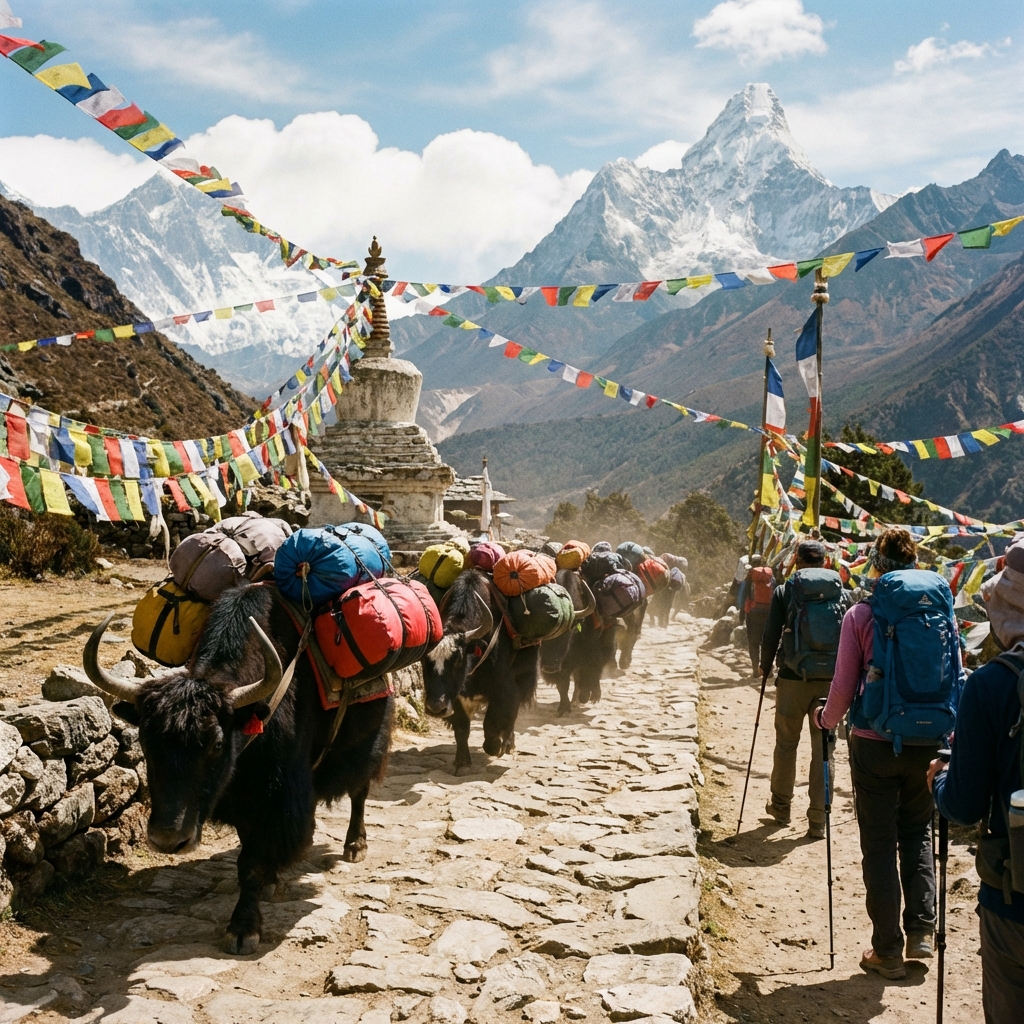
Below 2,500m, supplies can often reach tea houses by road or short porter carry. Above that, everything arrives on the backs of porters, yaks, or mules. A porter carrying supplies from Lukla (2,860m) to Gorak Shep (5,164m) takes four to five days each way. The porter's wages, food, and accommodation for those days are factored into the price of every meal served at high altitude.
Fuel Costs
Cooking at altitude requires fuel, which also must be transported. Many high-altitude tea houses cook with gas cylinders that cost multiple times their lowland price by the time they reach the kitchen. Some still use yak dung or wood, but gas has become standard on most popular routes.
Limited Supply
At the highest tea houses, menu items may be unavailable simply because supplies have not arrived. The further from road access, the more limited and expensive the ingredients become. This is why you will notice menus gradually narrowing as you gain altitude, with certain items crossed out or noted as unavailable.
Seasonal Variation
During peak trekking season (October-November and March-May), high demand can strain supplies at popular stops. Prices may occasionally exceed the standard menu rates for items in short supply. Conversely, off-season trekkers may find lower prices and more attentive service.
Carry Emergency Snacks
Menu Items by Region: Notable Differences
While the core menu is standardized, each trekking region has slight variations worth knowing about.
Everest Region
The Everest region benefits from strong Sherpa culinary traditions. You will find excellent Sherpa stew, yak cheese items, and some of the better bakeries on the trail (particularly in Namche Bazaar and Lukla). The best lodges in the Everest region tend to have slightly more varied menus, including apple pie and cinnamon rolls from dedicated bakeries.
Annapurna Region
The Annapurna Circuit and Annapurna Base Camp routes offer the widest food variety at lower altitudes because road access reaches many settlements. You will find fresh vegetables, more meat options, and genuine variety below 3,000m. The Manang area is known for surprisingly good bakeries. The apple pie in the Mustang and Manang areas, made from locally grown apples, is legendary among trekkers.
Langtang Region
Langtang menus are similar to the standard but with stronger Tamang influence. You may find more Tibetan-style items like thentuk (hand-pulled noodle soup) and tingmo (steamed bread). The cheese factory at Kyanjin Gompa produces excellent yak cheese that appears in various menu items at local lodges.
Tips for Getting the Most from Tea House Meals
Timing Your Orders
Tea house kitchens prepare everything to order on a first-come, first-served basis. During peak hours, especially when large groups arrive simultaneously, wait times can stretch to 45 minutes or longer. Order as soon as you arrive to minimize waiting. If you are in a group, coordinate orders to make things easier for the kitchen.
Befriending the Kitchen
A smile, a few words of Nepali, and genuine appreciation for the food go a long way. Kitchen staff who know you often give larger portions, extra sides, and better service. A simple "mitho chha" (it is delicious) after a meal creates goodwill that lasts the entire stay.
Supplements and Extras
Some tea houses sell small packets of ketchup, chili sauce, or spice mixes that can liven up repetitive meals. Carrying your own hot sauce, salt, or spice mix from Kathmandu is a popular trekker hack for adding variety to meals.
Charge Your Devices During Dinner
Frequently Asked Questions
Can I get Western food on the trek?
Yes, every tea house menu includes Western options like pizza, pasta, pancakes, and sandwiches. However, these are adapted to available ingredients and should not be compared to restaurant-quality Western food. They serve as familiar calorie sources for trekkers who want variety.
Is the food on the trek safe to eat?
Most food at tea houses is safe, especially items that are cooked fresh and served hot. The main risks are raw salads, improperly stored meat at high altitude, and contaminated water. Read our complete food safety guide for detailed advice.
How much should I budget for food per day?
A moderate budget is NPR 3,000 to 5,000 ($23-38) per day including three meals and drinks. This increases at higher altitudes. Budget trekkers eating dal bhat twice daily can spend NPR 2,000 to 3,000 ($15-23) per day at lower and mid altitudes.
Are there vegetarian and vegan options?
Yes, Nepal is one of the most vegetarian-friendly trekking destinations in the world. The majority of the tea house menu is vegetarian, with dal bhat being the flagship plant-based meal. Vegan trekkers need to communicate about ghee and dairy in cooking.
Can I get coffee on the trek?
Yes, but manage your expectations. Most tea houses serve instant coffee. Some lower-altitude lodges and premium lodges now offer brewed coffee. If you are particular about coffee, bring your own preferred instant coffee sachets.
Do tea houses accept credit cards?
No. The vast majority of tea houses are cash only. Bring enough Nepali Rupees for your entire trek, with a buffer for unexpected expenses. ATMs are available in Namche Bazaar (Everest region) and a few Annapurna Circuit towns, but they are unreliable and should not be depended upon.
Can I bring my own food?
You can carry snacks purchased in Kathmandu or along the route. However, preparing and eating your own meals at a tea house where you are staying is considered disrespectful. Snacks between meals on the trail are perfectly fine and encouraged.
Why is the same food more expensive at higher altitude?
Everything at high altitude must be carried by porters, yaks, or mules from lower elevations. A bag of rice that costs NPR 100 per kilogram in Kathmandu may cost NPR 300 or more per kilogram at 4,500m after accounting for transport costs. These increased ingredient costs are reflected in menu prices.
What if I have food allergies or special dietary needs?
Tea house kitchens can accommodate basic requests, but communication can be challenging at higher altitudes where English proficiency decreases. For serious allergies, carry a card written in Nepali explaining your needs. Read our special dietary needs guide for detailed strategies.
Is tipping expected at tea houses?
Tipping is not expected or required at tea houses. However, leaving a small tip (NPR 100-200) for particularly good food or service is appreciated. Some tea houses have a communal tip jar in the dining room.
How many calories should I eat per day while trekking?
Active trekkers burn 3,500 to 5,000 calories per day depending on altitude, terrain, and pace. Most trekkers struggle to eat this much due to altitude-related appetite suppression. Aim to eat as much as you comfortably can, focusing on calorie-dense options. Our altitude nutrition guide covers this in detail.
Can I get hot water for free?
Policies vary. Some tea houses provide free hot water for drinking if you are staying and eating there. Others charge NPR 100 to 300 for a thermos of hot water. Boiled water is safer than tap water and cheaper than buying bottled water at altitude.
Summary: Your Tea House Menu Strategy
The smartest approach to eating on a Nepal trek combines nutritional strategy with budget awareness. Eat dal bhat at least once daily for its unbeatable combination of complete nutrition, unlimited refills, and safety. Supplement with soups for hydration, eggs for protein, and carry snacks from lower altitudes for trail energy. Budget for higher costs as you gain altitude, and remember that drinks can be a significant hidden expense.
Understanding the tea house menu before you arrive lets you spend less time puzzling over laminated pages and more time enjoying your meals, your fellow trekkers, and the extraordinary mountain scenery that surrounds every dining room in the Himalayas.