
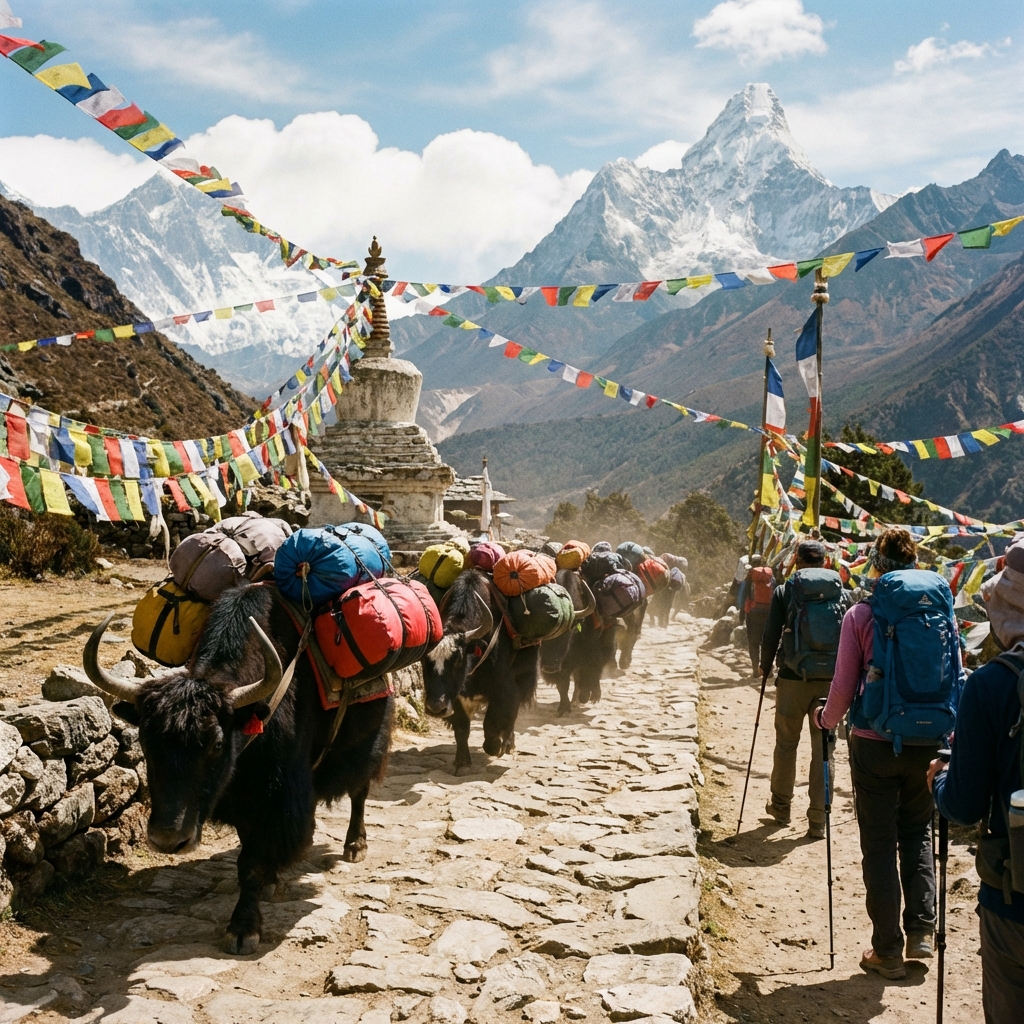
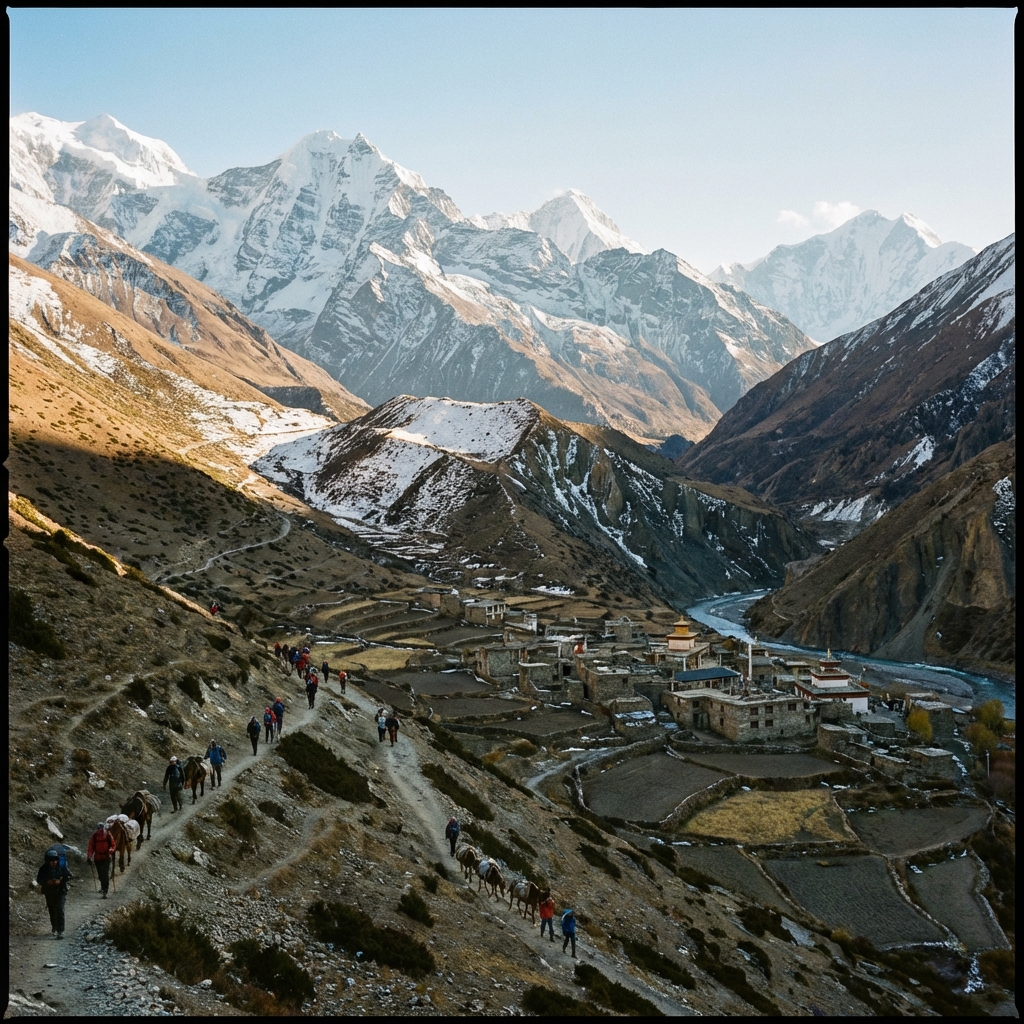
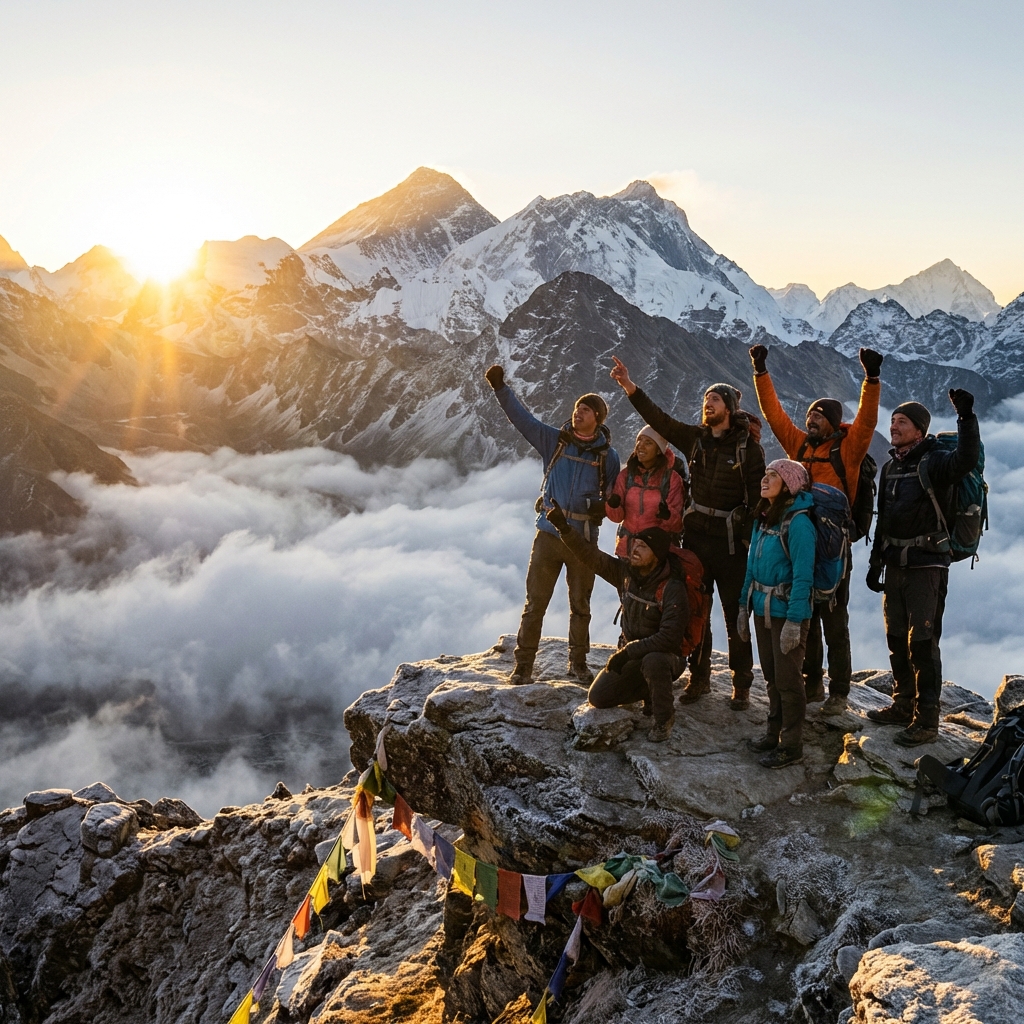
Nepal is famous for its towering mountains and legendary trekking routes, but the country offers far more than high-altitude adventures. In the subtropical lowlands of southern Nepal, Chitwan National Park provides an entirely different kind of wilderness experience that makes the perfect complement to a Himalayan trek. Swapping snow-capped peaks for dense jungle, yak bells for elephant calls, and mountain trails for canoe rides through crocodile-filled rivers, a Chitwan safari adds remarkable diversity to any Nepal itinerary.
Designated as Nepal's first national park in 1973 and inscribed as a UNESCO World Heritage Site in 1984, Chitwan protects 952.63 square kilometers of pristine subtropical wilderness in the inner Terai lowlands. The park is home to one of the last viable populations of the greater one-horned rhinoceros, critically endangered Bengal tigers, gharial crocodiles, wild elephants, sloth bears, and over 600 species of birds. For trekkers who have spent their Nepal trip focused on mountains, Chitwan offers a fascinating contrast that showcases the country's extraordinary biodiversity.
This guide covers everything you need to plan a Chitwan safari: what wildlife to expect, activity options, ethical considerations, package types and costs, how to get there from Kathmandu and Pokhara, the best time to visit, what to pack for the subtropical heat, and how to combine Chitwan with your trekking itinerary.
World Heritage Site since 1984
952.63 sq km (367.8 sq mi)
100-815m (328-2,674ft)
One-horned rhino, Bengal tiger, gharial
NPR 2,000 (~$15 USD) per day for foreigners
$150-$400 for 2-3 days
Oct-Mar (dry season)
150 km (5-6 hours by road)
Why Trekkers Should Add Chitwan to Their Nepal Trip
If you have traveled all the way to Nepal, spending your entire trip in the mountains means missing half of what makes this country extraordinary. Nepal spans an elevation range from 60 meters in the Terai plains to 8,849 meters at the summit of Everest, and this dramatic range creates ecological zones from tropical jungle to arctic tundra, all within a country smaller than many U.S. states.
A Complete Contrast to Trekking
After days of hiking through cold, high-altitude terrain, the warm subtropical environment of Chitwan feels like entering a different world. Where trekking involves gradual physical exertion over many days, a Chitwan safari delivers wildlife encounters through relatively relaxed activities like jeep drives, canoe rides, and guided walks. The change of pace is refreshing, especially for trekkers recovering from the physical demands of routes like the Everest Base Camp trek or Annapurna Circuit.
World-Class Wildlife in a Compact Area
Chitwan is not just a nice park. It is one of the best wildlife viewing destinations in Asia. The density of large mammals, particularly rhinoceroses, is among the highest of any protected area in the region. The park's relatively compact size and well-maintained network of trails and waterways mean that wildlife encounters are frequent and accessible, even on short 2-day visits.
Cultural Immersion with the Tharu People
The indigenous Tharu people who live in communities around Chitwan have their own distinct culture, architecture, cuisine, and performing arts that are entirely different from the mountain cultures you encounter while trekking. Tharu cultural programs, village visits, and traditional meals add a fascinating cultural dimension to the wildlife experience.
Position Chitwan Between Pokhara and Kathmandu
Wildlife of Chitwan National Park
Greater One-Horned Rhinoceros
The star attraction of Chitwan is the greater one-horned rhinoceros (Rhinoceros unicornis). These magnificent creatures can weigh up to 2,200 kg and stand nearly 2 meters tall at the shoulder. Chitwan is home to approximately 700 rhinos, making it one of the most important populations in the world.
Your chances of seeing a rhino in Chitwan are excellent, probably above 90% on a 2-day visit. Rhinos favor the grasslands and riverine areas that are accessible by jeep and on foot. They are surprisingly approachable (from a safe distance), and sightings are often extended, allowing excellent photography opportunities.
Bengal Tiger
Chitwan hosts approximately 130 Bengal tigers, making it one of the most important tiger habitats globally. However, tigers are elusive, nocturnal, and occupy large territories, so sighting one requires luck. Realistic expectations are important: even on a multi-day visit, your chances of seeing a tiger are around 10-20%. Pugmarks (footprints) and other signs are commonly spotted.
That said, when tiger sightings do occur, they are unforgettable. The best chances come during early morning and late afternoon jeep safaris, particularly in February-April when dry conditions concentrate wildlife around water sources and visibility through the undergrowth improves.
Other Notable Wildlife
| Animal | Population in Chitwan | Sighting Probability (2-day visit) | Best Viewing |
|---|---|---|---|
| Greater one-horned rhino | ~700 | Very high (above 90%) | Grasslands, rivers |
| Bengal tiger | ~130 | Low (10-20%) | Dense forest edges |
| Asian elephant (wild) | ~60-80 | Moderate (30-40%) | Riverine forests |
| Gharial crocodile | ~200+ | High (70-80%) | Rivers, canoe trips |
| Mugger crocodile | Common | High (80%+) | Rivers, riverbanks |
| Sloth bear | ~200+ | Low (15-25%) | Forest edges |
| Gaur (Indian bison) | ~400+ | Moderate (30-50%) | Grasslands |
| Wild boar | Common | Very high | Everywhere |
| Spotted deer | Abundant | Certain (100%) | Grasslands, forest |
| Langur monkey | Common | Very high (90%+) | Forest canopy |
| Indian python | Present | Low (10-15%) | Riverbanks, forest |
Birdwatching Paradise
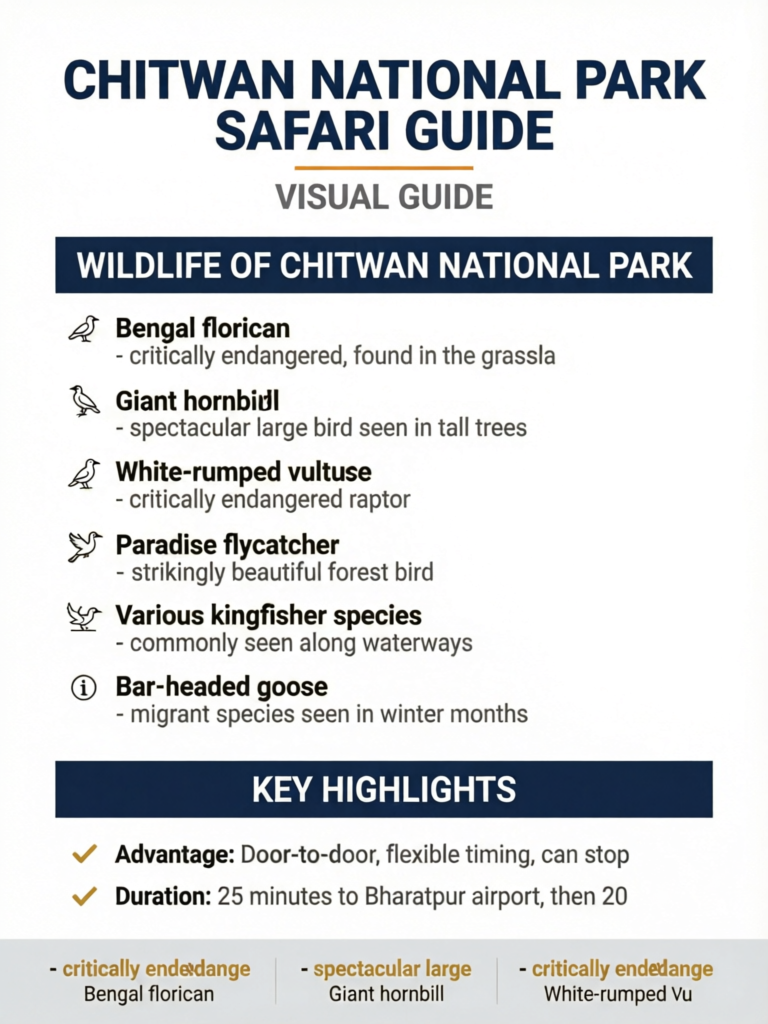
Chitwan is one of the premier birdwatching destinations in Asia, with over 600 recorded species. Even casual observers will notice the remarkable diversity, from giant hornbills to tiny kingfishers. Key species include:
- Bengal florican - critically endangered, found in the grasslands
- Giant hornbill - spectacular large bird seen in tall trees
- White-rumped vulture - critically endangered raptor
- Paradise flycatcher - strikingly beautiful forest bird
- Various kingfisher species - commonly seen along waterways
- Bar-headed goose - migrant species seen in winter months
Bird Photography Tips
Chitwan is a world-class birding destination. If you are interested in birdwatching, bring binoculars and a camera with at least a 200mm zoom lens. Early morning (6:00-9:00 AM) is the best time for birding. Let your guide know birding is a priority so they can adjust the safari pace accordingly.
Safari Activities in Chitwan
Jeep Safari (Most Popular)
The jeep safari is the primary wildlife viewing activity and the one most likely to produce close encounters with large mammals. You will ride in an open-top 4WD vehicle with a driver and a naturalist guide who knows the park intimately.
What to expect:
- Duration: 3-5 hours per drive (morning or afternoon)
- Vehicle: Open-top Land Cruiser or similar, seating 6-8 passengers
- Terrain: Mix of gravel tracks, grassland, and riverine forest
- Stops: Your guide will stop whenever wildlife is spotted
- Best timing: Early morning (6:00-10:00 AM) or late afternoon (2:00-5:30 PM)
Jeep safaris cover more ground than any other activity, giving you the best statistical chance of encountering rhinos, elephants, deer, crocodiles, and potentially tigers.
Canoe/Dugout Boat Safari
A quiet canoe ride along the Rapti or Narayani rivers provides a completely different perspective on Chitwan's wildlife. Traditional dugout canoes (locally called "dongas") glide silently through the water, allowing close approaches to riverside wildlife.
What you will see:
- Gharial and mugger crocodiles basking on riverbanks
- Various turtle species
- Kingfishers, herons, storks, and other water birds
- Occasionally, rhinos and deer coming to drink
- Fish eagles and other raptors
The canoe ride typically lasts 1-2 hours and is one of the most peaceful experiences in Chitwan. The silence of the canoe allows you to hear the jungle sounds that a vehicle engine would mask.
Jungle Walk (Guided)
Walking through the jungle with an armed naturalist guide and a park warden is an exhilarating experience that puts you at ground level with the wildlife. This is fundamentally different from viewing animals from a vehicle; you feel the immensity of the forest, hear every rustle, and develop a primal awareness of your surroundings.
Safety notes:
- Always led by a licensed guide and park-assigned warden
- Guides carry deterrent devices for wildlife encounters
- Groups are kept small (typically 4-8 people)
- Walking pace is slow and deliberate, with frequent stops to listen and observe
- Duration: 2-4 hours
The jungle walk is not about covering distance. It is about immersing yourself in the ecosystem, learning to read animal tracks, identifying birds by sound, and understanding the interplay between species in the forest.
Never Walk in the Park with a mandatory licensed guide
Chitwan is home to rhinos, tigers, sloth bears, and wild elephants, all of which can be dangerous if encountered unexpectedly. Independent hiking inside the park is strictly prohibited. Always go with a licensed guide and park warden. This is not a rule to bend; people have been seriously injured and killed by wildlife encounters while walking with a mandatory licensed guides.
Tharu Cultural Program
Most safari packages include a Tharu cultural program, typically held in the evening at your lodge or in a nearby village. The Tharu stick dance, Peacock dance, and other traditional performances provide insight into the rich cultural heritage of the people who have lived alongside this wildlife for centuries.
Beyond performances, some packages include:
- Tharu village walks - visiting traditional Tharu homes and learning about their way of life
- Traditional Tharu meals - cuisine that uses local ingredients and recipes passed down through generations
- Handicraft demonstrations - basket weaving, pottery, and other traditional crafts
Elephant Breeding Center Visit
The government-run elephant breeding center near Sauraha allows visitors to see elephants being cared for in a breeding and rehabilitation program. This is a more ethical way to observe elephants up close compared to elephant rides.
Ethical Consideration: Avoid Elephant Rides
We strongly recommend against elephant-back safaris in Chitwan. While traditionally popular, elephant riding raises significant animal welfare concerns. The training methods (known as "phajaan" or "the crush") used to make elephants accept riders involve physical and psychological distress. The weight of multiple riders and the howdah (seat structure) can cause long-term spinal damage to elephants. Many international animal welfare organizations have classified elephant riding as a form of animal exploitation. Choose jeep safaris, walking safaris, and canoe trips instead. These alternatives provide equal or better wildlife viewing experiences without the ethical concerns. The park has been progressively moving away from elephant-back tourism.
Chitwan Safari Packages: Budget vs. Luxury
Most visitors to Chitwan book a package through their hotel, lodge, or a travel agency. Packages typically include accommodation, meals, park entry fees, and all activities. Understanding the differences between budget and luxury options helps you choose the right experience.
Package Comparison
| Feature | Budget Package | Mid-Range Package | Luxury Package |
|---|---|---|---|
| Duration | 2 days / 1 night | 2-3 days / 1-2 nights | 3 days / 2 nights |
| Accommodation | Basic guesthouse in Sauraha | Comfortable jungle lodge | Premium resort (Inside Jungle, Barahi, Meghauli Serai) |
| Meals | Simple Nepali/Western food | Good quality buffet meals | Gourmet dining, varied menu |
| Jeep Safari | 1 drive (shared vehicle) | 1-2 drives (smaller groups) | 2-3 drives (private vehicle) |
| Canoe Ride | Included | Included | Included (private) |
| Jungle Walk | Included | Included | Included (private guide) |
| Cultural Show | Included | Included | Private/premium performance |
| Elephant Center | Sometimes | Included | Included |
| Guide Quality | Standard | Experienced naturalist | Expert naturalist, flexible itinerary |
| Total Cost (per person) | $150-$200 | $250-$350 | $400-$800+ |
Budget Option ($150-$200)
Budget packages are run by the many small guesthouses and tour operators in the town of Sauraha, which sits just outside the park boundary. Accommodation is basic but clean, meals are simple but filling, and activities follow a fixed group schedule.
Best for: Solo travelers, backpackers, those prioritizing budget over comfort.
What to expect: Shared rooms with basic facilities, group jeep safari with 8-10 people, standard canoe and walk, adequate but not spectacular food. The wildlife experience itself is largely the same since everyone enters the same park and follows similar routes.
Mid-Range Option ($250-$350)
Mid-range packages offer the best balance of comfort, quality, and value. Accommodation is in established jungle lodges with private rooms, attached bathrooms, and good dining. Activities are conducted in smaller groups with more experienced guides.
Best for: Most trekkers, couples, those who want comfort without premium pricing.
Luxury Option ($400-$800+)
Premium lodges like Meghauli Serai (Taj), Barahi Jungle Lodge, and Kasara Resort offer an entirely different level of experience. These properties feature stunning design, exceptional dining, private safari vehicles, and expert naturalists who can customize your itinerary based on recent wildlife sightings.
Best for: Those who want a premium experience, wildlife photography enthusiasts, special occasions.
Mid-Range Offers the Best Value for Trekkers
Getting to Chitwan
From Kathmandu
By Tourist Bus:
- Duration: 5-6 hours
- Cost: $10-15 one way
- Departure: Morning from Thamel area
- Route: Follows the Prithvi Highway through the Trisuli gorge before turning south
- Arrival: Sauraha (the main tourist hub for Chitwan)
By Private Vehicle:
- Duration: 4-5 hours
- Cost: $80-120 for private car/jeep
- Advantage: Door-to-door, flexible timing, can stop en route
By Domestic Flight:
- Duration: 25 minutes to Bharatpur airport, then 20 minutes to Sauraha
- Cost: $100-150 for the flight plus taxi
- Airlines: Buddha Air, Yeti Airlines operate daily flights
From Pokhara
By Tourist Bus:
- Duration: 4-5 hours
- Cost: $10-12 one way
- Route: Through the scenic Prithvi Highway along river gorges
- This is the route most trekkers use after completing an Annapurna trek
By Private Vehicle:
- Duration: 3.5-4.5 hours
- Cost: $70-100 for private car/jeep
For detailed information on transport between Kathmandu and Pokhara, see our Kathmandu to Pokhara transport guide.
Strategic Routing for Trekkers
The most efficient itinerary for trekkers combining an Annapurna trek with Chitwan is: Fly Kathmandu to Pokhara, complete your trek, bus Pokhara to Chitwan (4-5 hours), then bus Chitwan to Kathmandu (5-6 hours). This creates a loop that avoids backtracking and adds minimal travel time compared to the Pokhara-Kathmandu direct route.
Best Time to Visit Chitwan
Seasonal Guide
| Season | Months | Temperature | Wildlife Viewing | Vegetation | Overall Rating |
|---|---|---|---|---|---|
| Early Winter | Oct-Nov | 15-30°C | Excellent | Green, clearing | Best overall |
| Winter | Dec-Feb | 8-25°C | Very Good | Dry, open views | Good (cool mornings) |
| Spring | Mar-Apr | 20-38°C | Excellent | Dry, best visibility | Best for tigers |
| Pre-Monsoon | May-Jun | 28-40°C | Good | Very dry, hot | Too hot for many |
| Monsoon | Jul-Sep | 25-35°C | Poor | Lush, flooded trails | Not recommended |
October-November: Prime Season
The post-monsoon period offers pleasant temperatures, lush green vegetation, and excellent wildlife activity. This aligns with peak trekking season, making it ideal for trekkers adding Chitwan to their itinerary. Water sources are still plentiful throughout the park, so wildlife is more dispersed, but the comfortable temperatures and beautiful scenery more than compensate.
February-April: Best for Wildlife Spotting
As the dry season progresses, vegetation thins and water sources shrink, concentrating wildlife around remaining rivers and water holes. This makes animals easier to spot. February-March offers warm but not unbearable temperatures, while April can be quite hot. This period offers the statistically best chances of tiger sightings.
Combine Autumn Trek with Chitwan
What to Pack for Chitwan (After Trekking)
The packing challenge for trekkers is that Chitwan's subtropical lowlands require completely different clothing than the cold mountain environment. Temperatures in Chitwan can reach 30°C even in October, compared to freezing temperatures at high altitude.
Essential Items
- Lightweight, breathable clothing - cotton or moisture-wicking fabrics in neutral/earth tones
- Long sleeves and pants - for protection against sun, insects, and thorny vegetation during walks
- Comfortable walking shoes - light hiking shoes or sturdy sneakers (not heavy trekking boots)
- Sunhat and sunglasses - essential in the open grasslands
- Strong insect repellent - DEET-based preferred, mosquitoes carry dengue and malaria in the Terai
- Sunscreen - SPF 30+ minimum
- Binoculars - invaluable for wildlife and bird spotting
- Camera with zoom lens - 200mm minimum for decent wildlife photos
- Light rain jacket - for unexpected showers (October-November)
- Swimwear - some lodges have pools; river activities are available
What to Leave Behind
Your heavy trekking gear (down jacket, heavy boots, thermal layers) can be stored at your hotel in Pokhara or Kathmandu. Many lodges in Chitwan offer luggage storage for transit guests.
Malaria and Dengue Precautions
The Chitwan area is in a malaria and dengue risk zone. While the risk for short-term visitors is relatively low, take precautions: use DEET-based insect repellent, wear long sleeves and pants during dawn and dusk (peak mosquito hours), and consider sleeping under a mosquito net. Consult your travel doctor about antimalarial medication before your trip, especially if visiting during or just after the monsoon season.
Planning Your Chitwan Itinerary
Recommended 2-Day / 1-Night Itinerary
Day 1:
- Morning: Arrive in Sauraha from Pokhara or Kathmandu
- Afternoon: Canoe ride on the Rapti River (1.5-2 hours), followed by a short jungle walk
- Evening: Tharu cultural program, dinner at lodge
Day 2:
- Early morning: Full jeep safari (4-5 hours in the park)
- Afternoon: Visit elephant breeding center, explore Sauraha
- Evening: Depart for Kathmandu or stay another night
Recommended 3-Day / 2-Night Itinerary (Ideal)
Day 1:
- Morning: Arrive in Sauraha
- Afternoon: Canoe ride and nature walk along the river
- Evening: Tharu cultural program
Day 2:
- Early morning: Full-day jeep safari (the best chance for tiger sighting)
- Afternoon: Guided jungle walk in community forest
- Evening: Birdwatching at sunset, relaxation
Day 3:
- Early morning: Second jeep safari or dedicated birdwatching walk
- Mid-morning: Visit elephant breeding center, explore Sauraha village
- Afternoon: Depart for Kathmandu
The 3-day itinerary significantly increases your chances of seeing major wildlife, especially tigers, and allows a more relaxed pace that is particularly welcome after a strenuous trek.
Costs Breakdown
| Item | Budget | Mid-Range | Luxury |
|---|---|---|---|
| Park entry (per day) | $15 | $15 | $15 |
| Accommodation (per night) | $10-25 | $40-80 | $150-400 |
| Jeep safari (per session) | $20-30 | $30-50 | Included in package |
| Canoe ride | $8-12 | $10-15 | Included |
| Jungle walk | $10-15 | $15-20 | Included |
| Cultural program | $5-8 | Included | Included |
| Meals (per day) | $10-15 | $20-30 | Included |
| Transport from Pokhara | $10-15 | $10-15 | $70-100 (private) |
| Total (2-day estimate) | $100-$170 | $200-$350 | $400-$800+ |
Combining Chitwan with Lumbini
If you have extra time in your Nepal itinerary, Chitwan and Lumbini (the birthplace of Buddha) are close enough to combine into a single southern Nepal excursion. Lumbini is approximately 170 km west of Chitwan, reachable in 4-5 hours by road.
A combined Chitwan-Lumbini itinerary might look like:
- Days 1-2: Chitwan safari
- Day 3: Travel to Lumbini, explore Sacred Garden
- Day 4: Explore Lumbini monastery zone, travel to Pokhara or Kathmandu
This combination provides wildlife, culture, and spiritual experiences that beautifully complement a trekking-focused Nepal visit.
Frequently Asked Questions
Final Thoughts
Chitwan National Park deserves a place on every Nepal trekker's itinerary. The contrast between high-mountain trekking and subtropical jungle safari creates a richness of experience that defines Nepal at its best. Whether you spend two days or three, budget or luxury, the sight of a wild rhinoceros grazing peacefully in tall grass, the silent glide of a canoe past basking crocodiles, and the rhythmic beats of Tharu stick dancers will remain among your most vivid Nepal memories.
For trekkers, Chitwan is not a detour; it is a natural extension of the Nepal adventure. The wildlife encounters, cultural experiences, and sheer ecological diversity complement your mountain experience in ways that nothing else can replicate.
For information about wildlife you might encounter during your trek, or for help planning your journey between cities, check our Kathmandu to Pokhara transport guide.