
Laundry and Clothes Washing on Nepal Treks: Practical Guide 2026
NPR 100-300 per item ($0.75-2.25)
Very limited or unavailable
Merino wool and synthetic (never cotton)
2-3 sets with rotation system
2-4 hours for synthetic fabrics
12-24+ hours, may not fully dry
NPR 40-150 per kg
Dr. Bronner's or any biodegradable soap
Managing laundry on a Nepal trek is one of those unglamorous practical topics that no one thinks about until they are three days into a two-week trek, running out of clean clothes, and discovering that nothing dries in cold mountain air. This guide covers everything you need to know about keeping your clothes functional (if not always fresh) during your trek, from tea house laundry services to hand washing techniques, drying strategies, and the clothing rotation system that experienced trekkers swear by.
Whether you are on the Everest Base Camp trail, Annapurna Circuit, or any other route, understanding laundry logistics helps you pack lighter, smell better, and avoid the mistake of bringing too many clothes.
The Laundry Reality of Nepal Trekking
Before we dive into solutions, let us set realistic expectations about hygiene on a Nepal trek.
Accept This Truth
You will not be clean. Not truly clean, not by your normal standards. For 10-18 days, you will be walking 5-8 hours daily, sweating, sleeping in unheated rooms, and operating in conditions where laundry facilities range from basic to nonexistent. This is normal. Every trekker experiences it. After day 3, nobody notices because everyone is in the same situation.
That said, managing your clothes intelligently makes a real difference in comfort, health, and morale. Clean base layers reduce chafing and skin irritation. Dry socks prevent blisters. A fresh shirt at the end of a hard day feels luxurious. Laundry management is not about vanity; it is about trekking effectively.
The Altitude Factor
Laundry difficulty increases with altitude:
| Altitude Range | Laundry Situation |
|---|---|
| Below 2,000m | Tea house laundry common, drying easy, warm temperatures |
| 2,000-3,000m | Some laundry services, reasonable drying conditions |
| 3,000-4,000m | Limited laundry services, slower drying, cooler air |
| Above 4,000m | Almost no laundry services, very slow drying, cold temperatures |
| Above 4,500m | Hand wash only, items may freeze before drying |
Wet Clothes at Altitude Are Dangerous
Wearing damp clothes at high altitude is not just uncomfortable - it is a genuine safety concern. Wet clothing loses most of its insulating ability and accelerates heat loss. At 4,000-5,000 meters where temperatures drop well below freezing at night, wearing damp base layers increases your risk of hypothermia. Always prioritize dry clothing over clean clothing at altitude.
Tea House Laundry Services
Many tea houses along popular trekking routes offer laundry services. Here is what to expect.
How Tea House Laundry Works
The service is simple: you hand your dirty clothes to the tea house owner, they wash them (usually by hand), and return them dried (hopefully) the next morning. In some cases, they hang them near the kitchen stove or in a sunny spot outside.
The process:
- Ask the tea house owner/staff if laundry service is available
- Hand over items, agree on price
- Clothes are hand washed in a basin, sometimes with a scrub board
- Hung to dry (outside in sun or inside near kitchen/stove)
- Returned to you, typically next morning before departure
Pricing
Tea house laundry is charged per item, not by weight:
| Item | Typical Price Range | Notes |
|---|---|---|
| T-shirt/base layer | NPR 100-200 | Higher at altitude |
| Trekking pants | NPR 150-250 | Longer drying time |
| Socks (per pair) | NPR 50-100 | Most commonly washed item |
| Underwear | NPR 50-100 | Quick to wash and dry |
| Fleece/mid layer | NPR 200-300 | Takes longer to dry |
| Down jacket | Not available | Never wash down on the trail |
| Buff/neck gaiter | NPR 50-100 | Small, dries quickly |
Important: Prices increase with altitude. The same t-shirt that costs NPR 100 to wash in Lukla might cost NPR 250-300 in Gorak Shep or Thorong Phedi. This reflects the effort and resources (water, firewood) required at higher elevations.
Availability by Region
| Region | Below 3,000m | 3,000-4,000m | Above 4,000m |
|---|---|---|---|
| Everest (Khumbu) | Common | Available at major stops | Rare/unavailable |
| Annapurna Circuit | Common | Available at most stops | Limited above Manang |
| Annapurna Base Camp | Common | Available at most stops | Very limited at ABC |
| Langtang | Common | Some stops | Limited |
| Manaslu | Available | Limited | Rare |
When Not to Use Tea House Laundry
- When you leave early the next morning: Clothes may not be dry in time
- During rain or cloudy weather: Outdoor drying is unreliable
- At very high altitude: Water is scarce and may be heated with expensive fuel
- For technical fabrics with DWR coating: Harsh washing can damage water-repellent treatments
- For down insulation: Never have a tea house wash your down jacket or sleeping bag
Time Your Laundry Days
Hand Washing on the Trail
For most trekkers, hand washing is the primary laundry method. Here is how to do it effectively in mountain conditions.
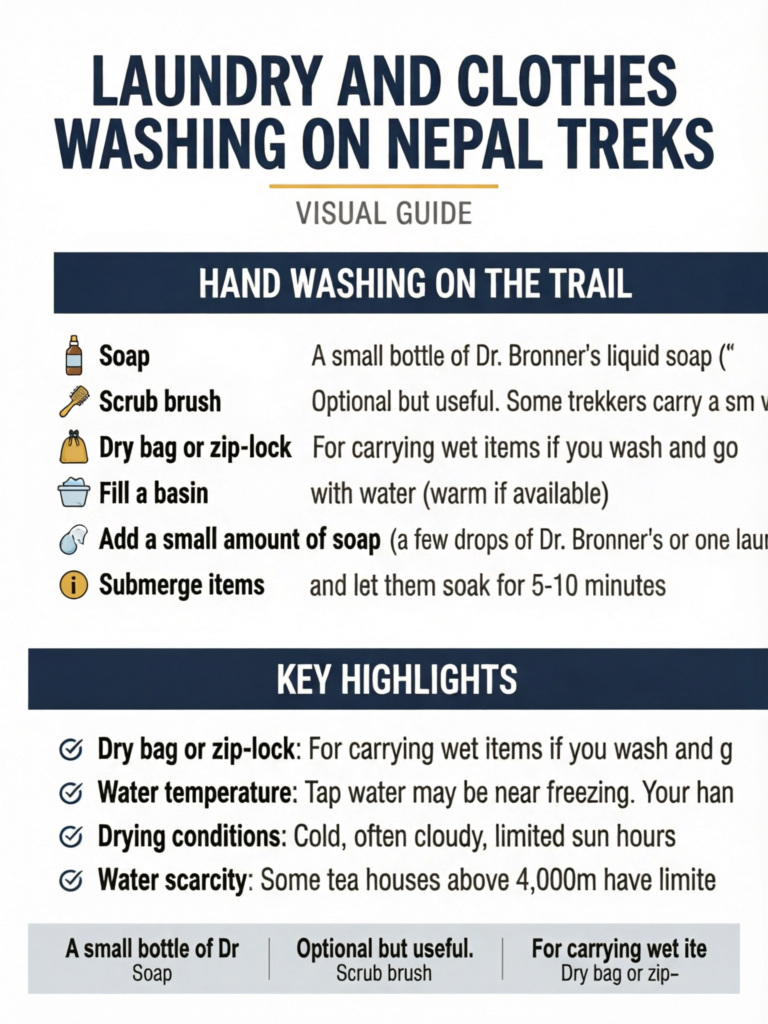
What You Need
- Soap: A small bottle of Dr. Bronner's liquid soap (biodegradable, multi-purpose), a few sheets of travel laundry soap (Sea to Summit Pocket Laundry Wash), or a small bar of laundry soap purchased in Kathmandu
- Basin/sink: Most tea houses have an outdoor tap or basin you can use. Always ask permission.
- Water: Cold tap water is usually available. Warm water may be available for an extra fee (NPR 100-200 for a bucket of hot water).
- Scrub brush: Optional but useful. Some trekkers carry a small nail brush for scrubbing collars and armpits.
- Dry bag or zip-lock: For carrying wet items if you wash and go
Hand Washing Step-by-Step
- Fill a basin with water (warm if available)
- Add a small amount of soap (a few drops of Dr. Bronner's or one laundry sheet)
- Submerge items and let them soak for 5-10 minutes
- Agitate and scrub: Focus on armpits, collar, and crotch areas where odor concentrates
- Rinse thoroughly: Soap residue irritates skin, especially on base layers. Rinse until water runs clear.
- Wring out excess water: Twist items firmly. For synthetic fabrics, you can wring aggressively without damage.
- Roll in a dry towel: The towel absorbs additional moisture, dramatically speeding drying time. This is the single most effective drying acceleration technique.
- Hang to dry: In sun, near stove, or on a clothesline (see drying section below)
Water Considerations
- Respect water sources: At altitude, water is precious. Use minimal water for washing.
- Never wash directly in streams or rivers: Soap (even biodegradable) pollutes water sources. Carry water away from the source to wash.
- Grey water disposal: Pour wash water onto rocks or soil well away from water sources. Never pour soapy water back into streams.
- Tea house taps: Ask before using. Some tea houses meter their water or have limited supply.
The Biodegradable Soap Rule
Always use biodegradable soap for washing clothes on the trail. Dr. Bronner's, Sea to Summit Wilderness Wash, and Campsuds are popular options. Regular detergent contains chemicals that harm mountain water systems. Even biodegradable soap should never enter streams or lakes directly - always wash away from water sources.
What to Wash vs. What to Just Air Out
Not everything needs washing on every cycle:
| Item | Wash Frequency | Alternative to Washing |
|---|---|---|
| Base layer top | Every 2-3 days | Air out overnight, turn inside out |
| Base layer bottoms | Every 3-4 days | Air out overnight |
| Socks | Daily or every 2 days | None - wash socks regularly |
| Underwear | Daily or every 2 days | None - wash underwear regularly |
| Mid layer (fleece) | Every 5-7 days | Air out, hang in sun |
| Trekking pants | Every 5-7 days | Spot clean, air out |
| Down jacket | Never on trail | Air out in sun, spot clean only |
| Buff/neck gaiter | Every 3-4 days | Air out in sun |
| Hat | Every 5-7 days | Air out in sun |
The key insight: merino wool base layers need washing far less frequently than synthetic. Merino naturally resists odor-causing bacteria and can often be worn 3-5 days between washes with just overnight airing. This is a major practical advantage of merino over synthetic for trekking.
Drying Techniques
Getting clothes dry is the biggest laundry challenge on Nepal treks. At altitude, air is cold, humidity can be high, and drying space is limited.
Outdoor Drying
Best conditions: Sunny, breezy days below 4,000m
- Clothesline: Some tea houses have clotheslines in their courtyards. Use these when available.
- Backpack drying: Clip wet items to the outside of your backpack with carabiners or safety pins while trekking. The movement and airflow dry items within 2-4 hours on a sunny day. This is one of the most effective methods.
- Rock drying: Spread items on sun-heated rocks during lunch breaks. Flip after 30 minutes.
- Bush hanging: Drape items over bushes near the tea house. Keep an eye on them (wind can carry items away).
Indoor Drying
When needed: Rainy days, cold temperatures, evenings at altitude
- Tea house dining room: The communal stove/heater is the warmest spot. Hang items on the back of chairs, along walls, or from hooks near (not on or directly above) the stove. Ask the tea house owner before draping clothes everywhere.
- Drying lines in dining room: Some tea houses have indoor clotheslines. These fill up fast in peak season - claim your spot early.
- Your room: Hang items from hooks, door handles, bedframes, or string a line across the room. Your room will be cold, so drying will be slow.
- Towel-dry method: Roll wet items in your microfiber towel and press. Repeat with a dry section of towel. This removes significantly more moisture than wringing alone.
Emergency Drying Methods
When nothing will dry and you need something wearable:
- The sleeping bag method: Place damp (not soaking) items inside your sleeping bag at night. Your body heat and the insulation slowly dry the items overnight. Not ideal (slightly damp sleeping bag), but effective for critical items like socks.
- Wearing items to dry: Put on a damp base layer under your dry mid-layer. Your body heat dries it within 1-2 hours. Works well for thin synthetic base layers.
- Tea house kitchen: Ask very politely if you can hang one or two items in the kitchen area. Kitchens are the warmest room in any tea house. Not always allowed, but sometimes yes.
The Carabiner Clothesline
Drying Times by Fabric and Condition
| Fabric Type | Sunny/Breezy | Overcast/Calm | Cold/Altitude | Indoor/Stove |
|---|---|---|---|---|
| Thin synthetic base layer | 1-2 hours | 3-5 hours | 8-12 hours | 2-4 hours |
| Merino wool base layer | 2-4 hours | 5-8 hours | 12-24 hours | 3-6 hours |
| Trekking pants (synthetic) | 3-5 hours | 6-10 hours | 12-24 hours | 4-8 hours |
| Socks (synthetic) | 1-2 hours | 3-4 hours | 6-12 hours | 2-3 hours |
| Socks (merino) | 2-3 hours | 4-6 hours | 10-18 hours | 3-5 hours |
| Fleece mid-layer | 3-5 hours | 6-10 hours | 12-24+ hours | 4-8 hours |
| Cotton t-shirt | 4-8 hours | 10-16 hours | 24+ hours | 6-10 hours |
Notice how cotton takes dramatically longer to dry. This is another reason why cotton has no place on a trek. See our what to wear guide for fabric recommendations.
The Clothing Rotation System
Experienced trekkers use a rotation system that keeps them in functional clothing while minimizing the amount they need to carry and wash.
The Basic 3-Set Rotation
Set A: Wearing today Set B: Drying (washed yesterday or this morning) Set C: Clean and ready (tomorrow's set)
This rotation requires a minimum of 3 sets of base layers and socks:
| Item | Quantity | Rotation |
|---|---|---|
| Base layer tops | 3 | Wear 1, dry 1, reserve 1 |
| Underwear | 3-4 | Wear 1, dry 1, reserve 1-2 |
| Trekking socks | 3 pairs | Wear 1, dry 1, reserve 1 |
| Liner socks | 3-4 pairs | Wear 1, dry 1, reserve 1-2 |
| Trekking pants | 2 | Wear 1, air/reserve 1 |
| Mid-layer | 1-2 | Wear 1, air as needed |
| Down jacket | 1 | Never wash on trail |
How the Rotation Works Daily
Morning:
- Put on Set C (clean, dry clothes)
- Pack Set A (yesterday's worn clothes) for washing later or airing on pack
- Set B should be dry from yesterday - pack as tomorrow's Set C
Midday/Evening:
- Wash Set A if a washing opportunity presents itself
- Hang Set A to dry (becomes Set B)
- Move the dried previous Set B to Set C (clean reserve)
The cycle repeats continuously throughout the trek.
The Merino Advantage for Rotation
Fabric Selection for Easy Laundry
Your fabric choices directly impact how easy or difficult laundry management will be on the trek.
Fabric Comparison for Laundry
| Fabric | Wash Frequency Needed | Drying Speed | Hand Wash Ease | Odor Resistance | Trek Suitability |
|---|---|---|---|---|---|
| Merino wool | Every 3-5 days | Moderate | Easy | Excellent | Excellent |
| Synthetic (polyester/nylon) | Every 1-3 days | Fast | Very easy | Poor to moderate | Good |
| Cotton | Daily (if wet) | Very slow | Easy | Poor | Poor - never use |
| Cotton/synthetic blend | Every 1-2 days | Slow | Easy | Poor | Poor |
| Bamboo | Every 2-3 days | Moderate | Easy | Good | Moderate |
| Silk | Every 2-3 days | Fast | Delicate handling | Moderate | Good (as liner) |
Why Cotton Is the Enemy
Cotton absorbs 25 times its weight in water and takes hours longer to dry than synthetic or merino. On a trek where drying opportunities are limited, wearing cotton means wearing damp, cold clothing. The trekking adage "cotton kills" exists because wet cotton loses its insulating properties almost entirely, making hypothermia more likely.
If you are wearing cotton on your trek, you are making laundry management exponentially harder for zero benefit. Switch to synthetic or merino for everything.
No Cotton on the Trek
This is worth repeating: do not bring cotton clothing on a Nepal trek. No cotton t-shirts, no cotton underwear, no cotton socks. Every cotton item in your pack is a liability - heavy when wet, slow to dry, cold against the skin, and difficult to manage in a laundry rotation. Synthetic and merino alternatives exist for every single item.
Pre-Trek and Post-Trek Laundry in Kathmandu
Before Your Trek
Do laundry in Kathmandu before heading to the mountains so you start with completely clean clothing.
Kathmandu laundry options:
| Service | Location | Cost | Turnaround |
|---|---|---|---|
| Hotel laundry | Most hotels | NPR 50-150/kg | Same day or next morning |
| Street laundry shops | Throughout Thamel | NPR 40-100/kg | 4-8 hours |
| Self-service laundromat | Limited, ask at hostels | NPR 200-300/load | 1-2 hours |
| Dry cleaning | Thamel shops | NPR 200-500/item | 24-48 hours |
| Express laundry | Premium hotels | NPR 150-250/kg | 2-4 hours |
Thamel laundry shops: Several dedicated laundry shops line the streets of Thamel. They wash by weight, and turnaround is typically 4-8 hours. Quality is generally good - clothes come back clean, folded, and in a plastic bag. Most charge NPR 60-100 per kg.
After Your Trek
When you return from the trail, your clothes will need serious washing. Everything will smell. This is universal and nothing to be embarrassed about.
Post-trek laundry strategy:
- Return to your hotel, dump all trekking clothes in a bag
- Take the bag to the nearest laundry shop or use hotel service
- Enjoy a shower while your clothes are being professionally cleaned
- Most laundry shops will have everything back to you within 4-8 hours
Cost for a full trek wardrobe wash: NPR 300-600 ($2.25-4.50) at a Thamel laundry shop. This is one of the great bargains of Kathmandu.
Pack a Fresh Set of City Clothes
Odor Management Between Washes
When washing is not possible (common at higher altitudes), these techniques help manage odor:
Daily Odor Reduction
- Air out clothes: Hang worn items outside your room overnight. UV light and fresh air reduce bacteria.
- Turn inside out: The inside of your base layer, which contacts your skin, accumulates the most bacteria. Turn it inside out when airing.
- Spot clean high-odor areas: Wipe armpits and collar with a damp cloth and a drop of soap without full washing.
- Merino rotation: If wearing merino, alternate between two tops. The off-day top recovers naturally.
- Deodorant: Apply to clean skin each morning. Solid deodorant works better than spray at altitude.
Gear-Based Solutions
- Antimicrobial treatment: Some base layers come pre-treated with silver-ion technology (Polygiene, HeiQ) that resists odor for longer between washes.
- Baking soda: A small amount sprinkled inside shoes and on base layers between wears neutralizes odors. Weighs almost nothing.
- Essential oils: A tiny drop of tea tree or eucalyptus oil on collar areas provides temporary freshness. Pack a small vial.
Special Considerations
Washing at Altitude (Above 4,000m)
At high altitude, laundry becomes genuinely difficult:
- Water temperature: Tap water may be near freezing. Your hands will hurt.
- Drying conditions: Cold, often cloudy, limited sun hours
- Water scarcity: Some tea houses above 4,000m have limited water supply
- Fuel costs: Hot water for laundry requires burning expensive fuel (propane, yak dung, kerosene)
- Priority shift: Staying warm and dry trumps being clean. Do not risk wet clothes.
Recommendation: Above 4,000m, focus on sock and underwear rotation. Air out base layers. Full washes can wait until you descend. On the Everest Base Camp trek, your next good laundry opportunity after ascending above 4,000m is when you descend back to Namche Bazaar.
Rain Gear and Outer Layers
Outer layers (rain jackets, hardshell pants) have DWR (Durable Water Repellent) coatings that can be damaged by improper washing.
- Never use regular detergent on DWR-treated items
- Spot clean only during the trek
- Professional cleaning when you return home, using DWR-specific wash (Nikwax Tech Wash)
- Reapply DWR after washing (Nikwax TX.Direct or similar)
Down Jacket Care
Your down jacket should never be fully washed on the trail. Down insulation clumps when wet and requires careful drying to restore loft.
- Spot clean: Wipe stains with a damp cloth
- Air out: Hang in sun regularly to air out body odor
- Professional wash: Have it professionally cleaned when you return home using down-specific detergent (Nikwax Down Wash Direct)
Sleeping Bag Hygiene
Your sleeping bag cannot be washed on the trail either. Use a sleeping bag liner (cotton, silk, or synthetic) to keep body oils and dirt off the sleeping bag's interior. The liner can be washed on the trail and dries relatively quickly. This is the best way to maintain sleeping bag hygiene during a multi-week trek. Wash the actual sleeping bag when you return home.
Packing Your Laundry Kit
Carry these items for laundry management:
| Item | Weight | Purpose |
|---|---|---|
| Dr. Bronner's soap (60ml bottle) | 70g | Multi-purpose wash soap |
| OR Sea to Summit Pocket Laundry sheets | 20g | Lightweight alternative to liquid soap |
| Microfiber towel (small) | 60g | Towel-drying wet clothes |
| Paracord (3 meters) | 15g | Clothesline |
| Small carabiners (3-4) | 30g | Hanging clothes from pack and lines |
| Zip-lock bags (2 large) | 10g | Dirty clothes separation, wet item transport |
| Mesh stuff sack | 20g | Dirty laundry bag |
| Total | ~225g | Complete laundry kit |
This entire kit weighs about 225 grams. A small investment for significantly better clothes management over a multi-week trek.
A Typical Trekking Day: Laundry Routine
Here is how laundry management fits into a typical trekking day:
6:00 AM - Wake up: Check yesterday's items hanging in your room. If dry, pack as tomorrow's clean set.
6:30 AM - Dress: Put on today's clean set. Pack everything else.
7:00 AM - Departure: Clip any still-damp items to the outside of your backpack for on-the-go drying.
12:00 PM - Lunch break: If items on your pack are dry, stow them inside. If at a tea house with washing facilities, quick-wash socks and underwear if needed.
2:00-3:00 PM - Arrive at tea house: Immediately change out of sweaty walking clothes. Hang them to dry. If a laundry service is available and you are staying two nights (rest day), consider using it.
5:00 PM - Before dinner: Check drying items. Move to indoor drying if sun is gone. If nothing will dry outdoors overnight, bring everything inside.
8:00 PM - Before bed: Final check on drying items. Place truly critical items (tomorrow's socks) inside sleeping bag if still damp.
Frequently Asked Questions
How often should I wash clothes on a Nepal trek?
Socks and underwear should be washed every 1-2 days. Base layer tops every 2-3 days (or 3-5 days for merino). Trekking pants every 5-7 days. Mid-layers every 5-7 days. The exact frequency depends on your comfort level, available washing facilities, and drying conditions.
Can I do laundry every day on a trek?
You can wash small items (socks, underwear) daily, but washing larger items every day is impractical because drying time often exceeds the time between tea houses. Focus on rotating a small wardrobe rather than trying to wash daily.
What soap should I bring for hand washing on the trail?
Dr. Bronner's liquid castile soap (the small 60ml bottle) is the most popular choice among trekkers. It is biodegradable, concentrated (a few drops go far), and multi-purpose (body wash, clothes wash, dish soap). Sea to Summit Pocket Laundry Wash sheets are a lighter alternative. Always use biodegradable soap near water sources.
Is there dry cleaning available in Kathmandu?
Yes, several dry cleaning shops operate in Thamel and other tourist areas of Kathmandu. Expect NPR 200-500 per item and 24-48 hour turnaround. This is useful for down jackets, technical outer layers, and delicate items after your trek.
How do I dry clothes when it is raining for days?
Continuous rain is the toughest laundry scenario. Prioritize: only wash what you absolutely need (socks, underwear). Dry items near the tea house dining room stove. Use the towel-wringing method to remove maximum moisture before hanging. As a last resort, use the sleeping bag body-heat method for tomorrow's essential items.
Will tea house laundry damage my technical fabrics?
Tea house laundry involves hand washing with whatever soap is available and hanging to dry. This is gentle enough for most trekking fabrics. However, it may gradually degrade DWR coatings on waterproof items and is too harsh for down insulation. Avoid having DWR-treated or down items washed at tea houses.
How many sets of clothes should I bring to avoid laundry entirely?
You would need approximately 14-18 sets of base layers, socks, and underwear to avoid all laundry on a standard EBC trek. This is impractical - the weight and volume would be enormous. The 3-set rotation system with regular washing is far more efficient. Pack 3 base layers, 3-4 pairs of socks, 3-4 underwear, and wash as you go.
Can I use the tea house kitchen stove to dry clothes?
Sometimes, if you ask politely. The kitchen stove is the hottest spot in any tea house, and some owners allow trekkers to hang socks or small items near it. However, the kitchen is a working space, and your wet laundry is an inconvenience. Never drape clothes directly on cooking surfaces or food preparation areas. The dining room stove is a more appropriate drying location.
What about odor-eliminating sprays?
Products like Febreze or similar odor sprays add weight and volume for limited benefit. They mask odor temporarily without addressing the cause (bacteria). Airing out clothes in UV light and regular washing are more effective. If you want a spray, a small bottle of isopropyl alcohol (rubbing alcohol) sprayed on armpits kills odor-causing bacteria effectively and evaporates completely.
How do I handle laundry on a camping trek (not tea house)?
On camping treks, you have even fewer laundry options. Your support crew may wash items if asked politely, but this is not a standard service. Hand wash in camp using the same soap and technique described above. Dry items on tent guy lines, bushes, or rocks during the day. Pack a slightly larger wardrobe for camping treks since washing is more difficult.
Is there a laundry service at Everest Base Camp?
No. At Everest Base Camp (5,364m), there is no laundry service. The conditions are too cold and water is too scarce. Focus on dry rotation and odor management. Your next good laundry opportunity on the descent is Dingboche or Namche Bazaar.
Should I bring fabric softener sheets?
Some trekkers tuck a couple of fabric softener sheets into their stored clothing to keep it fresh-smelling during storage. For trail use, they add minimal value and are not biodegradable. Skip them for the trek itself but consider them for your stored luggage in Kathmandu.
Summary: Laundry Survival Rules for Nepal Treks
- No cotton, ever. Synthetic and merino only.
- Pack 3 sets of base layers and socks. Rotate daily.
- Wash socks and underwear regularly. Everything else can wait.
- Use the backpack-drying method. Clip damp items to your pack while walking.
- Carry a tiny laundry kit (soap, cord, carabiners). Total weight: 225g.
- Prioritize dry over clean at high altitude.
- Use tea house laundry services when available and time allows.
- Do a full laundry wash in Kathmandu before and after your trek.
- Choose merino base layers if budget allows - fewer washes needed.
- Lower your standards and embrace it. You will be dirty. Everyone is.
For more on what to wear trekking in Nepal and tea house facilities, see our dedicated guides.