
Luggage Storage in Kathmandu for Trekkers: Complete Guide 2026
For luggage storage in Kathmandu, the easiest option is your hotel: most Thamel hotels hold excess bags free while you trek if you book your return stay. Trekking agencies store client gear free, dedicated lockers run NPR 100-300/day, and airport left-luggage costs NPR 200-500/day.
Hotel storage room (free if you return to stay)
NPR 100-300/day ($0.75-2.25 USD)
Usually free when booking through them
NPR 200-500/day at Tribhuvan Airport
10-18 days of storage needed
Varies - hotel is safest, always lock bags
October-November, book hotel in advance
Never store passports - carry originals always
Here is a scenario nearly every trekker faces: you arrive in Kathmandu with a full-sized suitcase packed for weeks of travel, but your trek only requires a small duffel bag and daypack. That leaves 15-25 kg of clothes, electronics, city shoes, and travel gear that you absolutely do not need on the trail. Dragging your roller suitcase to Namche Bazaar is not an option.
So where does everything else go?
This guide covers every luggage storage option available in Kathmandu, with honest assessments of security, cost, convenience, and reliability. Whether you are trekking Everest Base Camp, the Annapurna Circuit, or any other Himalayan route, your extra gear needs a safe home while you are in the mountains.
Why Luggage Storage Matters for Nepal Trekkers
Most international trekkers arrive with significantly more luggage than they need on the trail. A typical trekking setup weighs 8-12 kg total (duffel bag plus daypack), but travelers often arrive with 20-30 kg of total luggage. The excess includes city clothes, extra electronics, travel documents, formal wear, toiletries not needed on the trail, and gifts or shopping items.
Carrying unnecessary weight into the mountains creates several problems. First, porters are limited to carrying 25-30 kg total (for two clients), so your excess gear eats into that allowance. Second, internal flights to Lukla have strict 10-15 kg baggage limits. Third, hauling extra weight on a bus to Pokhara or Besisahar is uncomfortable and unnecessary.
The solution is straightforward: store what you do not need in Kathmandu and retrieve it when you return. The question is where and how.
Pack with Storage in Mind
Option 1: Hotel Storage (Most Popular)
Hotel storage is by far the most common and convenient option for trekkers in Kathmandu. The vast majority of Thamel hotels offer this service, and most trekkers use it without any issues.
How Hotel Storage Works
The system is simple. You check in before your trek, leave your excess luggage with the hotel when you check out for the trek, and collect it when you return. Most hotels in Thamel and the broader tourist district are accustomed to this arrangement because a significant percentage of their guests are trekkers.
Hotels typically store your bags in a locked storage room, behind the front desk, or in a designated luggage area. Some hotels use numbered tags to track bags, while others simply label them with your name and room number.
Cost of Hotel Storage
| Scenario | Typical Cost | Notes |
|---|---|---|
| Returning to same hotel after trek | Free | Most common arrangement |
| Pre-paid booking for return stay | Free | Book before and after trek at same hotel |
| Storage only (no return stay) | NPR 100-200/day | Some hotels charge for this |
| Budget hotels | Free to NPR 50/day | Often informal arrangement |
| Mid-range hotels | Usually free | Especially if you rebook |
| Premium hotels | Free | Part of guest services |
The key insight is that most hotels offer free storage if you book your return stay with them. This is the standard arrangement and hotels expect it. You stay 2-3 nights before your trek, leave your bags, trek for 10-18 days, then return to the same hotel for 1-2 nights. The hotel holds your luggage at no charge because they get your business on both ends.
Security at Hotels
Hotel storage security varies considerably:
- Budget hotels (under $15/night): Storage may be a closet behind reception or an unlocked room. Security depends on the staff's attention. Lock your bags with padlocks.
- Mid-range hotels ($15-50/night): Usually have a dedicated locked storage room. Staff track bags with a basic system. Reasonably secure.
- Premium hotels ($50+/night): Dedicated locked luggage rooms, sometimes with CCTV. Very secure. Some offer itemized receipts for stored luggage.
Never Store Valuables Unlocked
Always lock your stored luggage with sturdy padlocks. Keep a written inventory of what you have stored, and photograph the contents before closing the bag. While theft from hotel storage rooms is uncommon, it does happen occasionally, especially in budget accommodations. Combination locks are better than key locks since you cannot lose the key on the trail.
Tips for Hotel Storage
- Confirm storage before booking: When reserving your hotel, explicitly ask about luggage storage during your trek. Get written confirmation via email.
- Book your return stay in advance: This guarantees free storage and a room when you return (important during peak season when hotels fill up).
- Choose a reputable hotel: Read reviews on Booking.com or TripAdvisor that mention luggage storage specifically. Hotels in Thamel with long track records are safest.
- Use quality locks: Bring two TSA-approved padlocks or combination locks from home.
- Get a receipt: Ask the hotel to write down what they are storing for you. Take a photo of the receipt.
The Return Stay Strategy
Option 2: Trekking Agency Storage
If you have booked your trek through a trekking agency, their office is another excellent storage option.
How Agency Storage Works
Most trekking agencies in Kathmandu have an office in or near Thamel. These offices typically have a storage room or area for client gear. When you visit the agency before your trek for briefings and paperwork, you can leave your excess luggage at the office. The agency holds it until your trek concludes and you return to Kathmandu.
Cost of Agency Storage
Almost always free when you have booked a trek through the agency. This is considered a standard part of their service. Even budget agencies include luggage storage as part of the package.
If you have not booked through an agency but want to use their storage, some may accommodate you for a small fee (NPR 200-500/day), but most will decline since they are primarily serving their own clients.
Security at Agencies
Agency offices are typically staffed during business hours and locked at night. Security is generally good because:
- Agencies have a reputation to protect
- Your stored luggage is alongside their own equipment (tents, gear, etc.)
- Staff are present daily during business hours
- The office is their place of business, so security is maintained
However, agency offices are not designed as storage facilities. Your bags may sit in a corner or in a back room. The level of organization varies.
Pros and Cons
Pros: Free, convenient (often combine with pre-trek briefing), agency is accountable if anything goes wrong, can access stored items during city time if needed.
Cons: Office hours only for pickup (usually 9 AM - 6 PM), may be in a different location from your hotel, quality of storage space varies.
Option 3: Dedicated Luggage Storage Services
A growing number of dedicated luggage storage services have appeared in Kathmandu, particularly in the Thamel area. These are businesses specifically designed to store travelers' luggage.
Available Services
| Service Type | Location | Cost (per day) | Security Features |
|---|---|---|---|
| Commercial storage shops | Thamel | NPR 100-300 | Locked room, receipt system |
| Hostel-operated storage | Thamel/Freak Street | NPR 50-150 | Variable, shared spaces |
| LuggageHero-style services | Thamel | NPR 150-250 | Tagged, tracked, some insured |
| Co-working space storage | Thamel | NPR 200-400 | Good security, limited hours |
What to Expect
Dedicated storage services offer a middle ground between hotel storage and airport storage. They typically provide:
- A locked room or cage system
- A numbered tag and receipt for each bag
- Set business hours for drop-off and pickup
- Sometimes basic insurance coverage
The quality and reliability of these services varies. Some are well-established businesses with years of positive reviews, while others are informal operations that may not be around next season.
Growing Market
Dedicated luggage storage services in Kathmandu are a relatively new market. While the options are improving each year, the most reliable approach is still hotel storage or agency storage. If you choose a dedicated service, check recent reviews and ask your hotel or agency for recommendations.
Option 4: Airport Storage (Tribhuvan International)
Tribhuvan International Airport (TIA) offers a left-luggage service for passengers. While this is the least commonly used option for trekkers, it exists as a backup.
Details
- Location: Domestic terminal area
- Cost: NPR 200-500 per bag per day (rates may change)
- Hours: Aligned with airport operating hours
- Security: Airport-level security with scanning
- Duration: Typically limited to 15-30 days maximum
When Airport Storage Makes Sense
Airport storage is mainly useful if:
- Your itinerary is tight and you are flying out of Kathmandu immediately after returning from a trek
- You have a very early departure and cannot retrieve bags from a hotel
- You are transiting through Kathmandu between two different destinations
For most trekkers, airport storage is not recommended as the primary option. The airport is 6 km from Thamel, requiring a taxi each way. Over a 14-day trek, the cost adds up significantly compared to free hotel storage. Access during your pre-trek and post-trek days is inconvenient.
Airport Storage Limitations
Airport left-luggage services in Nepal can be inconsistent. Hours may change, the service may be temporarily unavailable, and staff changes can cause confusion with retrieval. Always have a backup plan if you choose this option. Confirm current availability before relying on it.
Left Luggage and Luggage Lockers in Kathmandu
You will see this service advertised under several names, and they all mean roughly the same thing. "Left luggage" (British English), "luggage locker," "bag storage," "baggage deposit," and the Italian "deposito bagagli" that some European guesthouses post on signs all describe a place to leave bags short-term while you are away.
A few practical points trekkers should know:
- True coin-operated lockers are rare in Kathmandu. Outside the airport, most "lockers" are actually a locked storage room where staff tag your bag and hand you a receipt, not a self-service metal locker. Bring your own padlock.
- Per-bag pricing is the norm. Dedicated services charge per bag per day (NPR 100-300), so two bags cost roughly double. Hotel and agency storage is per arrangement, not per bag.
- No passport required to store. You only need a receipt or tag; keep your original passport on you for the trek.
- Ask about maximum hold time. Hotels are flexible (a typical 10-18 day trek is no problem), while commercial lockers and airport left-luggage often cap at 15-30 days.
For most trekkers the cheapest and most secure "locker" is simply the locked storage room at the hotel where you book your return stay.
What to Store vs. What to Take
One of the most important decisions is what goes into storage and what goes into your trek bag. Here is a comprehensive breakdown:
Items to Store in Kathmandu
| Category | Items to Store | Why |
|---|---|---|
| Clothing | City clothes, jeans, formal wear, extra shoes | Not needed on trail, heavy |
| Electronics | Laptop, tablet, extra chargers, hair styling tools | Heavy, fragile, no use on trail |
| Toiletries | Full-size bottles, makeup, cologne/perfume | Bring only travel sizes on trek |
| Travel gear | Rolling suitcase, garment bags, dress shoes | Impractical for mountain trails |
| Documents | Extra passport copies, travel printouts, guidebooks (physical) | Keep digital copies on phone |
| Shopping | Items bought in Kathmandu before trek | Collect after returning |
| Valuables | Expensive jewelry, watches (wear a cheap one) | Risk of loss on trail |
Items to Take on Trek
- Passport (original, always carry it)
- Trekking permit documents
- Cash (Nepali Rupees and some USD emergency cash)
- Travel insurance documents (printed and digital)
- Phone and power bank
- Camera and memory cards
- All trekking clothing and gear
- Personal medications
- Sunscreen and lip balm
- Basic toiletries in travel sizes
The Gray Area Items
Some items require judgment calls:
- Laptop: Most trekkers store it. If you need it for remote work between trek segments, consider the weight penalty (1-2 kg) vs. benefit. WiFi on the trail is too slow for serious work anyway.
- Kindle/e-reader: Weighs only 200g, lasts weeks on a charge. Worth taking for tea house evenings.
- Extra camera lenses: If photography is a priority, the weight may be worth it. See our photography gear guide for lens recommendations.
- Journal and pen: Lightweight and highly rewarding. Take it.
The Passport Copy Strategy
Security Best Practices
Regardless of which storage option you choose, follow these security practices:
Before Storage
- Photograph everything: Take photos of all stored items, especially electronics with serial numbers visible. This is essential for insurance claims.
- Create an inventory list: Write down every item being stored. Keep the list on your phone and email a copy to yourself.
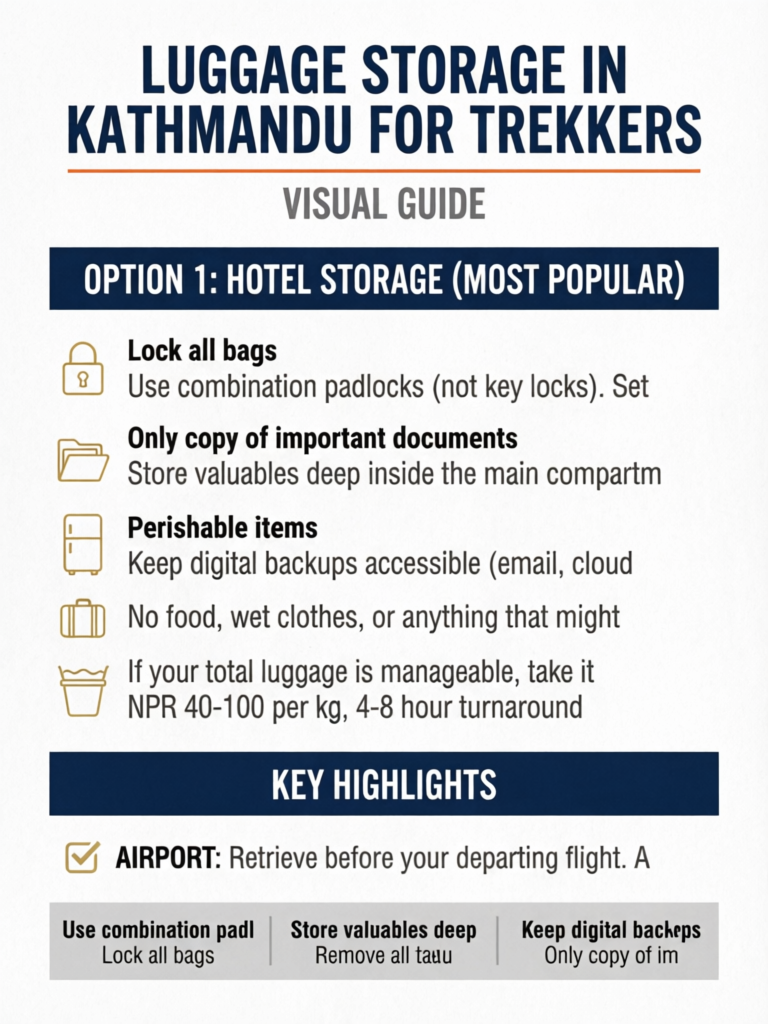
- Lock all bags: Use combination padlocks (not key locks). Set a combination you will remember after 2-3 weeks.
- Remove all valuables from outer pockets: Store valuables deep inside the main compartment.
- Use a luggage cable: For extra security, cable-lock your bags together and to a fixed point if possible.
What Never to Store
Some items should never go into storage:
- Original passport: Always carry it. Required for trekking permits, tea house registration, and emergencies.
- All your cash: Carry what you need. Leave some USD emergency cash deep in your stored bag, but take sufficient NPR and some USD on the trek (see our ATMs and cash guide for how much to carry).
- Only copy of important documents: Keep digital backups accessible (email, cloud storage).
- Irreplaceable items: If you cannot replace it and would be devastated to lose it, either carry it or leave it at home.
- Perishable items: No food, wet clothes, or anything that might spoil over 2-3 weeks.
The Emergency Cash Envelope
Cost Comparison: All Storage Options
Here is a side-by-side cost comparison for a typical 14-day trek:
| Storage Option | Daily Cost | 14-Day Total | Notes |
|---|---|---|---|
| Hotel (returning guest) | Free | Free | Best value, most common |
| Hotel (storage only) | NPR 100-200 | NPR 1,400-2,800 ($10-21) | If not returning |
| Trekking agency | Free | Free | When booked through agency |
| Dedicated service | NPR 100-300 | NPR 1,400-4,200 ($10-32) | Varies by provider |
| Airport storage | NPR 200-500 | NPR 2,800-7,000 ($21-53) | Plus taxi costs |
| Hostel storage | NPR 50-150 | NPR 700-2,100 ($5-16) | Variable security |
The math clearly favors hotel storage (with a return booking) or agency storage. Both are free and offer reasonable security.
Special Situations
Storing Luggage During Multi-Trek Itineraries
If you are doing multiple treks (e.g., Everest Base Camp followed by Annapurna Base Camp), your storage needs extend longer. In this case:
- Hotel strategy: Book a hotel room in Kathmandu between treks. Most hotels will hold your stored luggage even if you change rooms between stays.
- Agency strategy: If using the same agency for both treks, they will hold your gear the entire time.
- Long-term storage: For stays exceeding 30 days, negotiate a flat monthly rate with your hotel (NPR 2,000-5,000 per month is reasonable).
Arriving and Departing from Different Cities
Some trekkers arrive in Kathmandu but depart from Pokhara (or vice versa). If you are not returning to Kathmandu:
- Ship your stored bags: Some hotels and agencies can arrange bus transport of your luggage to Pokhara (NPR 500-1,000, takes 6-8 hours). This requires advance coordination and trust.
- Carry everything: If your total luggage is manageable, take it all to Pokhara and store it there instead.
- Return to Kathmandu briefly: Add a travel day to collect your bags. Kathmandu-Pokhara flights are quick and affordable.
Group Storage
If you are trekking with a group, coordinate storage together:
- One hotel room with all group luggage reduces risk and simplifies management
- Designate one person to handle storage logistics
- Create a shared inventory document
- Use a shared lock combination that everyone knows
Peak Season Warning
During October-November peak season, Thamel hotels fill up fast. If you want to guarantee free storage with a return stay, book your post-trek hotel room well in advance (at least 2-4 weeks before your trek start date). Last-minute availability in peak season is unreliable, and you do not want to return from an exhausting trek to find your hotel has no rooms.
Packing for Storage: A Step-by-Step Process
Here is a practical walkthrough for splitting your luggage in your Kathmandu hotel room:
Step 1: Lay Everything Out
Spread all your belongings on the hotel bed and floor. Separate into three piles:
- Definitely taking on trek: Trekking clothes, boots, rain gear, sleeping bag, medications, toiletries
- Definitely storing: City clothes, excess electronics, suitcase, dress shoes
- Decision items: Items you are unsure about
Step 2: Apply the Weight Test
For every "decision item," ask: Is this worth carrying for 10-18 days, uphill, at altitude? If the answer is not an immediate yes, it goes into storage.
Step 3: Pack Your Trek Bag
Pack your duffel bag (for porter/yak transport) and daypack first. Weigh them if possible:
- Duffel bag: Should not exceed 10-12 kg
- Daypack: Should not exceed 5-7 kg
If you are over these weights, move more items to storage.
Step 4: Pack Storage Items Securely
Place everything else in your suitcase or storage bag:
- Electronics wrapped in clothing for padding
- Important items buried deep, not in outer pockets
- Valuables in inner zippered compartments
- Emergency cash envelope hidden inside
Step 5: Lock and Document
Lock all zippers. Take photos. Write your inventory list. Hand the bags to your hotel with a smile.
The Compression Bag Trick
Laundry Before and After Storage
Before storing clothes for 2-3 weeks, wash and dry everything. Stored dirty clothes develop odors and can attract insects. Kathmandu has excellent and affordable laundry services in Thamel:
- Hotel laundry: NPR 50-150 per kg, usually returned same day or next morning
- Street laundry shops: NPR 40-100 per kg, 4-8 hour turnaround
- Self-service: Some hostels offer washing machines (NPR 200-300 per load)
Similarly, when you return from the trek, you will want to do laundry immediately. Your trekking clothes will need thorough washing after 2+ weeks on the trail.
Retrieving Your Luggage
Timing Your Return
Most trekkers return to Kathmandu in the afternoon or evening after a morning flight from Lukla or a bus from Pokhara. Plan your retrieval accordingly:
- Same hotel: Walk to reception and ask for your bags. Simple.
- Agency office: Visit during business hours (9 AM - 6 PM). Call ahead to confirm they have your bags ready.
- Dedicated storage: Check operating hours. Some close by 7 PM.
- Airport: Retrieve before your departing flight. Allow extra time.
What If Something Is Missing?
If you discover items missing from your stored luggage:
- Report to the storage provider immediately
- Check your photo inventory against actual contents
- File a written complaint with the hotel/agency
- Contact your travel insurance provider - most policies cover theft from locked storage
- File a police report at the nearest tourist police office if the value is significant
In practice, significant theft from hotel storage is rare. Minor items occasionally go missing, usually due to confusion with other guests' bags rather than deliberate theft.
Frequently Asked Questions
Is it safe to leave luggage at a hotel in Kathmandu?
Yes, hotel luggage storage in Kathmandu is generally safe, especially at mid-range and higher-end hotels in the Thamel district. Hotels store luggage for trekkers routinely and understand the responsibility. Use padlocks, photograph your items, and choose a reputable hotel with good reviews. Significant theft incidents are uncommon, though taking basic security precautions is always wise.
How much does luggage storage cost in Kathmandu?
The most common arrangement (storing at your hotel with a return booking) is free. If you are using a dedicated storage service, expect NPR 100-300 per day ($0.75-2.25 USD). Airport storage costs NPR 200-500 per day. Trekking agency storage is typically free if you booked your trek through them.
Can I store luggage at Tribhuvan Airport?
Yes, Tribhuvan International Airport has a left-luggage service near the domestic terminal. Rates are NPR 200-500 per bag per day. However, this is the most expensive option and least convenient for most trekkers since the airport is 6 km from Thamel.
What should I not leave in stored luggage?
Never store your original passport (you need it on the trail for permits and registration), all of your cash, the only copy of important documents, or perishable items. Keep irreplaceable items with you or leave them at home. Store digital copies of important documents in your email or cloud storage.
How long can I store luggage in Kathmandu?
Most hotels will store luggage for the duration of a typical trek (10-21 days) without issue. For longer periods (30+ days), discuss with the hotel in advance and negotiate terms. Dedicated storage services may have maximum duration policies, typically 30 days.
What happens if my trek gets extended and I am late retrieving luggage?
Hotels almost always hold your luggage without issue even if you return later than expected. Treks frequently get extended due to weather, Lukla flight delays, or personal choice. Call the hotel if possible to let them know, but your bags will not be discarded or moved for a few extra days.
Do trekking agencies store luggage for all clients?
Most agencies offer free storage for clients who have booked treks through them. This is a standard service. However, agencies typically will not store luggage for non-clients. If you are trekking independently and want agency storage, you would need to find one willing to offer paid storage, which is uncommon.
Can I access my stored luggage during the trek?
Only if you return to Kathmandu between trek segments. There is no way to access luggage stored in Kathmandu while you are on a remote mountain trail. Plan accordingly and ensure everything you might need on the trek is in your duffel bag and daypack.
What is the best storage option for solo travelers?
Hotel storage with a return booking is the best option for solo travelers. It is free, convenient, and provides a guaranteed room when you return exhausted from the trail. Choose a well-reviewed hotel in Thamel with explicit mention of luggage storage in reviews.
Should I insure my stored luggage separately?
Your standard travel insurance typically covers theft of personal belongings, including stored items. Review your policy to confirm. You generally do not need separate luggage insurance. However, document everything with photos and an inventory list to support any potential claim.
How do I find a reliable hotel for luggage storage in Thamel?
Look for hotels with 4+ star ratings on Booking.com or TripAdvisor, specifically those with recent reviews mentioning luggage storage for trekkers. Hotels that cater primarily to trekkers (rather than general tourists) are most experienced with this service. Our best hotels in Thamel guide includes recommendations with proven luggage storage track records.
Where can I store luggage in Thamel?
In Thamel, your best storage options are your own hotel, your trekking agency's office, or a dedicated luggage-storage shop. Hotel and agency storage are usually free for guests and clients; commercial shops charge NPR 100-300 per bag per day. Most are within a 5-10 minute walk of the main Thamel chowk, so you can drop bags on your way to the airport or bus park.
Is there a luggage locker or left-luggage service at Kathmandu airport?
Yes. Tribhuvan International Airport (TIA) has a left-luggage counter near the domestic terminal charging NPR 200-500 per bag per day, with bags scanned through airport security. Self-service coin lockers are not standard, so plan on staffed storage with set hours. Because the airport sits about 6 km from Thamel and costs more than free hotel storage, most trekkers only use it for very early or very late flights.
Can I store trekking gear rented in Kathmandu?
No. Rented gear goes with you on the trek and is returned to the rental shop when you finish. Do not store rented equipment. If you rented items you realize you do not need, return them before the trek to avoid extra rental days.
Do I need to book luggage storage in advance?
For hotels and agencies, no separate booking is needed. Storage is arranged on the spot when you check out for the trek, included free with your return stay or trek package. The only thing worth reserving in advance is your post-trek hotel room during October-November peak season, since that is what guarantees the free storage and a bed when you return.
Where can I leave my bags before hotel check-in on arrival day?
If you land before your room is ready, most Thamel hotels will hold your bags at reception for a few hours at no charge so you can explore or finish paperwork. This is the same storage room used for trek luggage. If you booked a Thamel hotel with a return stay, mention your trek dates at the same time so they note your longer-term storage too.
Final Tips for Stress-Free Luggage Storage
- Book the same hotel for pre-trek and post-trek stays. This single decision solves your storage problem for free.
- Lock everything with combination locks. Do not use key locks that you might lose on the trail.
- Photograph all stored items with timestamps. This is your insurance documentation.
- Pack a fresh set of city clothes on top of your stored bag so you can change immediately upon return.
- Do not overthink it. Thousands of trekkers store luggage in Kathmandu every season without problems. Choose a decent hotel, lock your bags, and focus on your trek.
For more information on preparing for your Kathmandu stay, see our Kathmandu Arrival Guide and Thamel District Guide. If you are still finalising what to carry versus leave behind, our Nepal trekking packing list and duffel bags guide help you split gear cleanly before storage.