
Lukla Flight Delays and Alternatives: What to Do When Flights Cancel
30-40% of flights affected
Tenzing-Hillary Airport (LUA)
527 meters (one of world's shortest)
25-35 minutes from Kathmandu
$215-500 per person (charter)
Drive to Phaplu + 2-day walk
Minimum 2, ideally 3
Early morning only (6:30 AM - 11 AM)
If you are planning to trek to Everest Base Camp, Gokyo Lakes, or anywhere in the Khumbu region, the flight between Kathmandu and Lukla is the most unpredictable part of your entire journey. Flights cancel regularly due to weather, sometimes for multiple consecutive days, leaving hundreds of trekkers stranded on both ends.
This is not a rare inconvenience. It is a normal part of the Everest trekking experience that you must plan for. This guide explains why flights cancel, how often it happens, what your alternatives are, and how to build a trip plan that survives delays without ruining your trek or missing your international flight home.
Why Lukla Flights Cancel So Often
Understanding why flights cancel helps you plan better and react calmly when it happens.
The Runway Problem
Tenzing-Hillary Airport in Lukla is one of the most challenging airports in the world. The runway is only 527 meters long (compared to 2,000-4,000 meters for most airports), slopes at a 12% gradient, and ends at a cliff edge on one side and a rock wall on the other. There is no room for error.
Pilots need perfect visibility to land safely. The runway has no instrument landing system (ILS) and relies entirely on Visual Flight Rules (VFR). If the pilot cannot clearly see the runway on approach, the flight turns back.
Weather Factors
Multiple weather conditions cause cancellations:
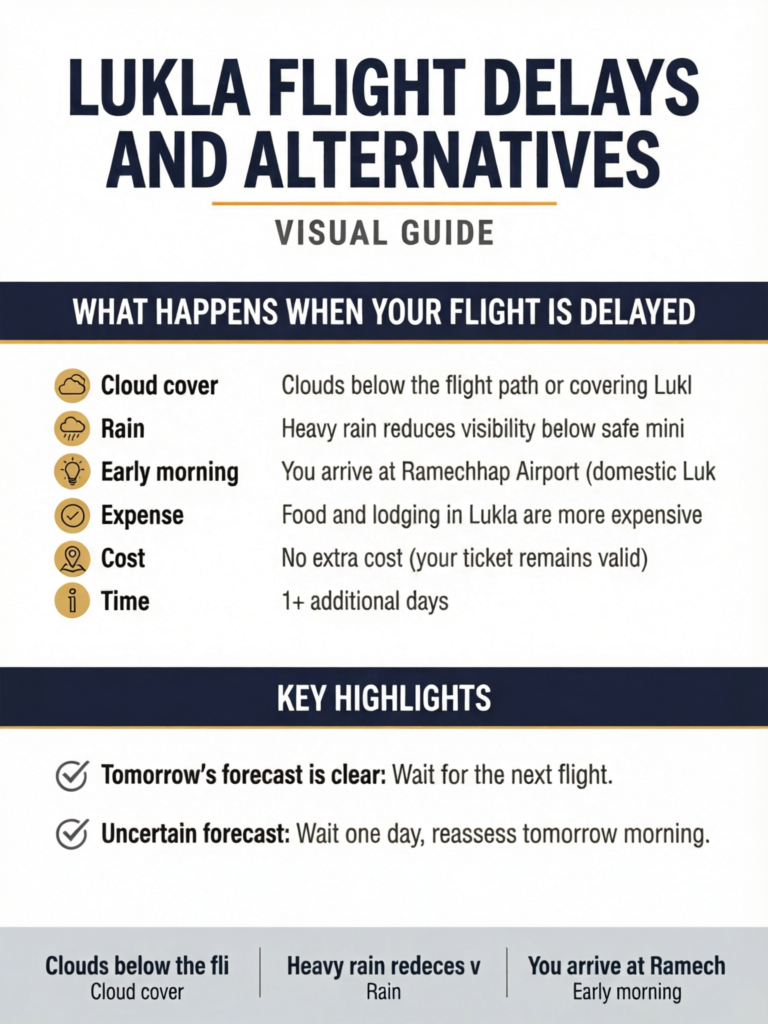
- Cloud cover: Clouds below the flight path or covering Lukla Airport make landing impossible. This is the most common cause of delays.
- Wind: Strong crosswinds on the short runway are dangerous. Even moderate winds can cancel flights.
- Rain: Heavy rain reduces visibility below safe minimums.
- Fog: Morning fog in the Kathmandu valley or Lukla area delays the first flights, creating a cascading effect all day.
- Monsoon season: June-September flights are extremely unreliable due to constant cloud cover and rain.
The Cascade Effect
Lukla flights operate in a narrow window, typically 6:30 AM to 11:00 AM. After mid-morning, cloud buildup in the valleys makes flying unsafe. If morning fog delays the first flight by even one hour, fewer total flights operate that day. Each delayed day creates a backlog of passengers that can take 2-3 days to clear.
During peak season (October-November), 30-50 flights per day are scheduled. When one day is completely cancelled, 500+ passengers join the next day's queue on top of the normal load. This cascading backlog is why delays sometimes last 3-5 consecutive days.
The Multi-Day Delay Reality
Do not assume delays last only one day. Weather patterns in the Khumbu can shut down flights for 3-5 consecutive days, especially during late November, December, and the monsoon shoulder season. The longest recorded delay in recent years was 7 days in November 2023. Your trip plan must account for this possibility.
How Often Do Flights Get Delayed?
Here are realistic delay statistics based on Nepal Civil Aviation Authority data and airline records:
Delay Rates by Month
| Month | Delay Rate | Cancellation Rate | Notes |
|---|---|---|---|
| March | 15-25% | 5-10% | Spring season beginning |
| April | 20-30% | 10-15% | Increasing haze and cloud |
| May | 30-40% | 15-25% | Pre-monsoon weather |
| June-August | 50-70% | 30-50% | Monsoon, very unreliable |
| September | 40-50% | 20-30% | Late monsoon |
| October | 20-30% | 10-15% | Peak season, generally good |
| November | 25-35% | 10-20% | Late peak, weather deteriorating |
| December | 30-45% | 15-25% | Winter weather, short days |
| January-February | 25-40% | 10-20% | Cold, clear but windy |
Key distinction: "Delay" means your flight departs later than scheduled (possibly hours later). "Cancellation" means the flight does not operate that day at all, and you must try again the next day.
Best Time for Reliable Flights
Early October and early March offer the most reliable Lukla flights. The atmosphere is typically stable, visibility is excellent, and the flight schedule runs close to normal. Late November and May are the least reliable months outside the monsoon.
Early Morning Flights Are Most Reliable
What Happens When Your Flight Is Delayed
Here is the typical sequence of events when Lukla flights are disrupted:
Day of Delay
- Early morning: You arrive at Ramechhap Airport (domestic Lukla flights now depart from here, not Kathmandu) or Kathmandu for helicopter flights.
- Waiting begins: You sit in the terminal with hundreds of other trekkers. Information is scarce.
- Updates: The airline or your agency checks conditions every 30-60 minutes. Pilots assess visibility.
- Decision point (usually by 10-11 AM): Either flights begin operating (you might still fly that day) or all flights are cancelled for the day.
- If cancelled: You return to your hotel and try again the next day. The airline rebooks you automatically.
Multiple Day Delays
When delays extend to multiple days:
- You are placed in a queue based on your original ticket date
- Each day you return to the airport and wait
- Priority goes to the oldest tickets first
- Your agency (if you have one) monitors the situation and advises
- You stay in a hotel in Ramechhap or Kathmandu
Return Flight Delays (Lukla to Kathmandu)
Return flight delays are equally common and arguably more stressful because you have an international flight to catch. The same weather factors apply. Trekkers stuck in Lukla face:
- Limited accommodation: Lukla has finite lodging, and during multi-day delays, every room fills up
- Expense: Food and lodging in Lukla are more expensive than Kathmandu
- Anxiety: Watching your international flight date approach while stuck in a mountain town
This is precisely why buffer days are essential (covered below).
Join the WhatsApp Group
Alternative Options When Flights Cancel
When your Lukla flight is cancelled, you have several alternatives:
Option 1: Wait for the Next Day's Flight
Cost: No extra cost (your ticket remains valid) Time: 1+ additional days Reliability: Depends on weather pattern
This is the default option and works most of the time. Weather patterns usually clear within 1-2 days. However, there is no guarantee, and the passenger backlog means even when flights resume, you may not get on the first day back.
Option 2: Helicopter Charter
Cost: $300-500 per person (shared charter with 4-5 passengers) Time: Same day, 25-minute flight Reliability: Higher than fixed-wing (helicopters can fly in more conditions)
Helicopter charters are the fastest alternative. Helicopters can fly in weather conditions that ground fixed-wing aircraft because they can navigate around cloud formations and land in limited visibility. However:
- Not guaranteed: Very bad weather grounds helicopters too
- Cost: Significantly more expensive than fixed-wing tickets ($150-180)
- Availability: Limited helicopter fleet, high demand during delays
- Booking: Your trekking agency arranges this, or you book through helicopter companies at the airport
| Helicopter Detail | Information |
|---|---|
| Typical cost | $300-500/person (shared), $1,500-2,500 (private) |
| Capacity | 4-5 passengers per helicopter |
| Flight time | 25-30 minutes |
| Baggage limit | 10 kg per person (strict) |
| Booking lead time | Often same-day or next-day |
| Best for | Time-critical situations, return flights |
Helicopter Pricing During Delays
When flights have been cancelled for multiple days and hundreds of trekkers are stranded, helicopter prices can surge to $500-700 per person or higher. Some operators take advantage of desperate trekkers. Negotiate firmly, use your agency as intermediary, and compare prices between companies before committing.
Option 3: Drive to Phaplu, Walk to Lukla Route
Cost: $30-50 for jeep transport Time: 8-10 hours driving + 2 days walking Reliability: Very high (road access is reliable in good conditions)
This is the main overland alternative and the one most agencies use when multi-day cancellations occur.
The route:
- Drive from Kathmandu to Phaplu (8-10 hours by jeep on rough roads)
- Walk from Phaplu to the Everest trail (joins at Ringmo or Junbesi)
- Continue walking to Lukla (1-2 days) or directly to Namche Bazaar
Advantages:
- Does not depend on weather at Lukla
- Less expensive than helicopter
- Beautiful scenery through Solu region
- Cultural experience through lower Sherpa villages
Disadvantages:
- Very long and uncomfortable jeep ride
- Adds 2-3 days to your itinerary
- Road conditions can be poor, especially during rain
- Walking with full trek gear before the "official" trek starts
Option 4: Drive to Salleri, Walk to Lukla
Cost: $30-60 for jeep Time: 10-12 hours driving + 1-2 days walking Reliability: High
Similar to the Phaplu option but uses a different road. Salleri is the district headquarters of Solukhumbu and has a more established road connection. From Salleri, it is a 1-2 day walk to reach the main Everest trail.
Option 5: The Classic Jiri Walk-In
Cost: $15-25 for bus to Jiri Time: 7-8 days walking from Jiri to Lukla/Namche Reliability: 100% (no flights needed)
Before the Lukla airport existed, every Everest expedition walked from Jiri. This classic route takes 7-8 days to reach Namche Bazaar and passes through incredibly beautiful but less-visited countryside. While impractical for most modern trekkers on tight schedules, it remains a legitimate option for those with time and a sense of adventure.
The Phaplu Compromise
Decision Flowchart for Flight Delays
Use this decision framework when your Lukla flight is cancelled:
Step 1: Assess Your Time Buffer
- 3+ buffer days remaining: Wait for the next flight. You have time.
- 2 buffer days remaining: Wait one more day. If cancelled again, switch to helicopter or Phaplu drive.
- 1 buffer day remaining: Book a helicopter immediately. Do not wait.
- 0 buffer days: You are already in trouble. Helicopter is your only realistic option.
Step 2: Check Weather Forecast
- Tomorrow's forecast is clear: Wait for the next flight.
- Multi-day weather system: Consider alternatives now rather than burning multiple buffer days.
- Uncertain forecast: Wait one day, reassess tomorrow morning.
Step 3: Check Alternative Availability
- Helicopter available same day: Consider it if time is tight.
- Helicopter available tomorrow: Book it as backup while also being on the flight list.
- No helicopters available: Phaplu drive is your best option.
Step 4: Consult Your Agency
If you are trekking with an agency, rely on their experience. Good agencies:
- Monitor weather forecasts continuously
- Have relationships with helicopter companies
- Know when to switch to overland alternatives
- Handle rebooking logistics
- May absorb some or all of the extra cost (depends on the agency and your contract)
Building Buffer Days Into Your Itinerary
Buffer days are the single most important planning decision for any Khumbu trek. Do not skip this section.
How Many Buffer Days?
| Risk Tolerance | Buffer Days | Recommendation |
|---|---|---|
| Conservative | 3-4 days | Best protection, allows for extended delays |
| Standard | 2-3 days | Recommended minimum for most trekkers |
| Tight schedule | 1-2 days | Risky, may require helicopter backup plan |
| No buffer | 0 days | Not recommended under any circumstances |
Our strong recommendation: Build in a minimum of 2 buffer days, ideally 3. These are days between your planned return to Kathmandu and your international departure flight.
Where to Place Buffer Days
Buffer days should go at the end of your trek, between your Lukla-Kathmandu return flight and your international departure. Here is why:
- If your outbound flight (Kathmandu to Lukla) is delayed, you lose days at the start but can sometimes compress the trek itinerary
- If your return flight (Lukla to Kathmandu) is delayed, buffer days give you time to still make your international flight
- Return delays are more stressful and consequential than outbound delays
Example itinerary with buffer days (14-day EBC itinerary):
| Day | Activity |
|---|---|
| Day 1-2 | Arrive Kathmandu, preparations |
| Day 3 | Fly to Lukla, trek to Phakding |
| Day 4-14 | Trek (Everest Base Camp and return) |
| Day 15 | Fly Lukla to Kathmandu (planned) |
| Day 16 | Buffer day 1 |
| Day 17 | Buffer day 2 |
| Day 18 | International departure |
If Day 15's flight operates normally, you have 2 bonus days in Kathmandu for shopping, sightseeing, and relaxation. If the flight is delayed by 1-2 days, you still make your international flight without stress.
International Flights Are Non-Negotiable
Your international flight home will not wait for Lukla weather to clear. Airlines do not care that your mountain flight was cancelled. If you miss your international flight because you had no buffer days, you will pay full price for a new ticket (often $500-2,000+). Buffer days are cheap insurance by comparison.
Insurance Considerations for Flight Delays
What Travel Insurance Covers
A comprehensive travel insurance policy should cover Lukla flight delays. Typical coverage includes:
- Trip delay coverage: Reimbursement for additional accommodation and meals when delayed beyond a threshold (usually 6-12 hours)
- Missed connection coverage: Costs incurred if you miss your international flight due to Lukla delays
- Alternative transport: Some policies cover helicopter costs when flights cancel (check your specific policy)
- Trip interruption: If delays force you to cut your trek short
What Insurance Typically Does Not Cover
- Normal delays under threshold: Waiting 3-4 hours at the airport
- Choosing to take a helicopter when flights resume the next day: If an alternative flight was available
- Loss of vacation days: Insurance does not compensate for lost trekking days
- Pre-existing knowledge: If you bought insurance after knowing about a weather system
Documentation for Claims
If you plan to file an insurance claim for delay-related costs:
- Get a written delay/cancellation notice from the airline
- Keep all receipts for additional accommodation, food, and transport
- Photograph the flight board showing cancellations
- Keep records of helicopter charter payments
- Document the timeline of events
- Report to your insurance company within their required timeframe (usually 30-60 days)
Check Helicopter Coverage Before You Trek
What to Do in Kathmandu While Waiting
If you are stuck in Kathmandu waiting for Lukla flights to resume, make the most of it:
Cultural Activities
- Visit Boudhanath Stupa (one of the world's largest Buddhist stupas)
- Explore Pashupatinath Temple (UNESCO World Heritage Site)
- Wander through Durbar Square and the old city
- Visit Swayambhunath (Monkey Temple) for panoramic views
- Explore Bhaktapur (medieval city 13 km from Kathmandu)
Practical Activities
- Shop for last-minute gear in Thamel
- Get a massage (excellent and affordable in Thamel)
- Do laundry and repack
- Update your travel journal or blog
- Research your trek route in more detail
- Connect with other delayed trekkers (instant community in hotel lobbies)
What Not to Do
- Do not drink heavily the night before an early morning flight attempt
- Do not wander far from your hotel - flight status can change quickly
- Do not cancel your hotel and sleep at the airport (flights are confirmed by 5-6 AM)
Ramechhap Airport: The Current Departure Point
Since 2019, most domestic fixed-wing flights to Lukla depart from Ramechhap (Manthali Airport), not Kathmandu. This adds a 4-5 hour drive before the flight.
What This Means for Delays
- Earlier wake-up: You leave Kathmandu at 1-2 AM for a 6:30 AM flight
- Longer delay days: If cancelled, the 4-5 hour return drive adds to your frustration
- Accommodation: Ramechhap has limited hotels if you prefer staying near the airport
- Agency coordination: Good agencies handle the drive logistics; you just show up
When Flights Operate from Kathmandu
Some airlines still operate from Kathmandu's domestic terminal, and helicopter flights depart from Kathmandu. During peak season, flight operations can shift. Your agency or airline will confirm your departure airport.
Ramechhap Transition
The shift to Ramechhap was implemented to reduce congestion at Kathmandu's busy airport. While less convenient, Ramechhap Airport has a slightly better weather profile than Kathmandu for early morning departures. Your trekking agency should arrange the Kathmandu-Ramechhap ground transfer as part of your trek package.
Frequently Asked Questions
How common are Lukla flight cancellations?
Lukla flights are delayed or cancelled on roughly 30-40% of operating days during peak trekking season (October-November). This does not mean 30-40% of flights are cancelled, but on about one in three days, at least some flights are disrupted. Complete day-long cancellations affecting all flights occur on approximately 10-15% of days during peak season.
What is the longest Lukla flight delay recorded?
Extended delays of 5-7 consecutive days have occurred multiple times, most notably during November and during monsoon shoulder periods. In November 2023, flights were grounded for nearly a week, stranding over 2,000 trekkers. While delays of this length are uncommon, they are not unprecedented.
Should I buy a helicopter ticket in advance as backup?
Generally no. Helicopter availability is best arranged when needed, as conditions change daily. However, if you are on a very tight schedule with minimal buffer days, your agency can pre-arrange a helicopter standby. This typically costs nothing unless you actually fly.
Can I drive to Lukla instead of flying?
There is no direct road to Lukla. The nearest road-accessible points are Phaplu (2-day walk from the Everest trail) and Salleri (1-2 day walk). A road to Lukla has been under construction for years but is not reliably passable for vehicles. The overland alternative always involves some walking.
What happens to my return flight if I am delayed getting to Lukla?
If your outbound flight is delayed, your return flight is typically rebooked to maintain your trek duration. Your agency handles this rebooking. However, the return flight date shift means your buffer days may now be consumed, increasing the risk of being stuck on the return.
Is helicopter travel to Lukla safe?
Yes, helicopter travel to Lukla is generally safe and operated by experienced pilots familiar with mountain flying. Helicopters used for these flights are specifically designed for high-altitude operations. However, like all mountain aviation, there is inherent risk. Helicopters will not fly in dangerous conditions.
Do flights cancel more in the morning or afternoon?
Morning flights (6:30-8:30 AM) are the most reliable. Cancellations increase as the day progresses because cloud cover builds throughout the morning. By 10-11 AM, conditions frequently deteriorate. Flights rarely operate after noon.
What should I pack for potential delay days?
Keep a small "delay bag" accessible with: a change of clothes, phone charger, a book or entertainment, snacks, your insurance documents, and cash. You do not want to be stuck in an airport or hotel without essentials while your trekking duffel is sealed up.
Can my trekking agency guarantee flights?
No agency can guarantee Lukla flights. Weather is beyond anyone's control. However, good agencies include helicopter backup in their packages or have contingency plans. When comparing agencies, ask specifically: "What happens if our Lukla flight is cancelled?" The answer reveals their quality.
Will my travel insurance cover a missed international flight due to Lukla delays?
Most comprehensive travel insurance policies cover missed connections due to weather-related domestic flight cancellations. However, policies vary significantly. Read the fine print and confirm before purchasing. Budget policies often exclude this scenario. See our travel insurance guide for recommended providers.
How early should I arrive at the airport on delay days?
Arrive at whatever time your agency or airline instructs, typically very early (4-5 AM at Ramechhap, 5-6 AM for Kathmandu helicopter flights). Flights can be confirmed and depart with very short notice when weather windows open. If you are not at the airport, you miss your chance.
Are there any routes that avoid Lukla entirely?
Yes. If you want to trek in the Everest region without the Lukla flight, consider the classic Jiri walk-in (7-8 days to Namche Bazaar) or the Salleri/Phaplu approach (2-3 days walking to join the main trail). These add significant time but eliminate flight dependency entirely. Alternatively, consider treks in other regions like Annapurna or Langtang that do not require domestic flights.
Planning Summary
The Lukla flight is not something to fear, but it is something to respect and plan for. Here is your checklist:
- Build in 2-3 buffer days between your planned return to Kathmandu and your international departure
- Book the earliest possible flight (6:30-7:00 AM slot)
- Confirm your travel insurance covers flight delays and helicopter alternatives
- Discuss contingency plans with your agency before the trek begins
- Keep a delay bag accessible with essentials for unexpected waiting
- Stay calm - delays are normal, temporary, and part of the Everest adventure
- Have a backup plan (know the helicopter and Phaplu options in advance)
For detailed flight booking information, see our Kathmandu to Lukla flights guide. For complete Everest Base Camp trek planning, see our EBC 14-day itinerary.