
Nepal's tea house system is one of the great innovations in mountain tourism. For just a few dollars a night, you get a bed, a roof, and access to hot meals cooked fresh by mountain families who have opened their homes to travelers from around the world. But this remarkable system runs on an unwritten social contract between trekkers and tea house operators -- a set of customs, expectations, and courtesies that are rarely explained in guidebooks.
Understanding tea house etiquette is not just about being polite (though that matters). It is about respecting the economic reality of how tea houses survive, the cultural values of the families who run them, and the communal nature of shared mountain accommodation. Trekkers who understand these norms have better experiences, build genuine connections with their hosts, and help sustain the system for future visitors.
This guide covers everything from the cardinal rule of "eat where you sleep" to navigating the shared charging outlets, the unspoken heater economy, and the cultural customs that will make you a welcome guest rather than an oblivious one.
Eat where you sleep -- always order meals at your lodge
$2-10/night (subsidized by food purchases)
9:00-10:00 PM (lights out by 10 PM)
NPR 200-500 for tea house staff
NPR 200-500 per device/per charge
Buy drinks/snacks to sit by the common room heater
Remove shoes before entering rooms and dining areas
Off-limits unless explicitly invited
The Social Contract: How Tea Houses Actually Work
To understand tea house etiquette, you first need to understand the tea house business model. This is the single most important thing to grasp, because nearly every etiquette rule flows from this economic reality.
The Business Model
Tea houses provide accommodation at artificially low prices -- often NPR 200-500 ($1.50-4.00) per night for a room. At these prices, rooms alone cannot cover operating costs. The real revenue comes from food and beverage sales. This is not hidden or deceptive; it is the fundamental bargain:
- Tea houses provide cheap rooms in exchange for your commitment to eat there
- Food is priced higher than in cities because everything must be carried or transported to remote locations
- Drinks, snacks, and extras (charging, WiFi, hot showers) provide additional revenue
- Your food spending per night ($15-30) is what actually keeps the tea house viable
This model has made trekking accessible to people of all budgets. Before tea houses, trekking in Nepal required expensive camping expeditions. The tea house system democratized Himalayan trekking, but it only works if guests honor the implicit agreement.
The Number One Rule: Eat Where You Sleep
The most important tea house etiquette rule is simple: eat your meals at the tea house where you are staying. This is not optional. It is the foundation of the entire system. Taking a room at one tea house and eating at another is considered extremely disrespectful and can genuinely anger your host. Some tea houses will charge you a "room-only" fee of NPR 500-2,000 if you do not order food, effectively eliminating any savings from eating elsewhere.
Why This Rule Matters
Consider the economics: a tea house owner invested their life savings to build a lodge in a remote mountain village. They pay for building materials carried by porters, cooking fuel, staff wages, and maintenance. A room at NPR 300/night barely covers the cost of clean bedding. If trekkers take the cheap room and eat at the lodge next door, the tea house cannot survive.
When you eat at your tea house, you are:
- Supporting the family that is hosting you
- Ensuring the tea house system remains viable
- Showing respect for the unspoken agreement
- Making your host happy (which leads to better service)
Order Generously
Room Allocation and Check-In Etiquette
First Come, First Served
Room allocation at most tea houses operates on a first-come, first-served basis. There is no reservation system at most lodges (though some popular ones on the EBC route now accept advance bookings during peak season). This means:
- Arrive early (ideally by 1:00-3:00 PM) for the best room selection
- Do not demand specific rooms -- accept what is available graciously
- Solo trekkers may need to share during peak season if the lodge is full
- Couples and groups get priority for private rooms
Check-In Process
- Greet the owner or staff -- a simple "Namaste" goes a long way
- Ask if rooms are available -- "Room cha?" (Is there a room?)
- Look at the room before committing if you prefer (this is normal, not rude)
- Leave your bag in the room and head to the dining area
- Order tea or a drink to signal you are staying and will be ordering food
Room Expectations
Tea house rooms are basic. Set your expectations accordingly:
| Feature | Lower Altitude (below 3,000m) | Higher Altitude (above 3,500m) |
|---|---|---|
| Bed type | Twin beds with mattress | Plywood bed with thin mattress |
| Bedding | Blankets provided (variable cleanliness) | Minimal -- bring your sleeping bag |
| Walls | Solid wood or stone | Thin plywood partitions |
| Lock | Usually yes (padlock) | Sometimes (bring your own small lock) |
| Bathroom | Shared, sometimes attached | Shared, basic squat toilet |
| Hot water | Often available | Rarely available or expensive |
| Insulation | Reasonable | Minimal -- walls may not reach ceiling |
Bring Your Own Sleeping Bag
Even in tea houses that provide blankets, bring your own sleeping bag. Above 3,500m, rooms can drop well below freezing at night. Tea house blankets are often thin and not always freshly laundered. Your sleeping bag is your most important comfort item.
Dining Room and Common Area Etiquette
The dining room is the social heart of every tea house. It is where trekkers eat, socialize, warm up, charge devices, play cards, and share stories. Getting the etiquette right here makes everyone's experience better.
Ordering Meals
- Order from the menu provided by the tea house. Most menus are standardized within a region (pricing is coordinated by local committees)
- Order within a reasonable timeframe -- dinner orders by 6:00-7:00 PM are ideal so the kitchen can plan
- Do not bring outside food into the dining room to eat -- this is considered rude (trail snacks in your room are fine)
- Be patient -- food is cooked fresh, and the kitchen serves many trekkers with limited resources. Expect 30-60 minutes for meals during busy times
- Dal bhat is the best value -- it comes with unlimited refills of rice and dal at most tea houses, making it the most cost-effective and nutritious meal option
The Heater Economy
At higher altitudes, many tea house dining rooms have a central heater -- typically a wood or yak dung-burning stove. The heater creates a warm zone in an otherwise frigid room, and it has its own etiquette:
- The heater is not free -- tea house owners pay for fuel (which is expensive at altitude)
- Buy drinks or snacks if you want to sit by the heater. Ordering nothing while occupying a warm seat near the heater for hours is considered freeloading
- Do not hog the closest seats -- rotate positions so everyone gets a turn warming up
- Do not dry wet clothing directly on the heater without asking permission. Wet boots and socks draped on the heater create unpleasant smells for other guests
- Some tea houses charge explicitly for heater use (NPR 200-500 added to your bill)
The Hot Lemon Honey Strategy
Seating and Shared Tables
- Tea house dining rooms use long shared tables and benches. You will sit with strangers
- Do not spread your belongings across multiple seats -- keep your space compact
- Introduce yourself to tablemates -- it is part of the trekking social experience
- Do not play loud music or videos on your phone at the table. Use headphones if you want entertainment
- Move to make room when new trekkers arrive, especially if the dining room is filling up
Noise and Quiet Hours
The 9-10 PM Curfew
Most tea houses operate with an informal quiet curfew:
- 9:00 PM: Conversations should move to a whisper. Some tea houses turn off the common room heater
- 9:30-10:00 PM: Lights in common areas are typically turned off
- 10:00 PM: Silence is expected. Trekkers who are still talking loudly after 10:00 PM will receive glares from both staff and other guests
Why Quiet Hours Matter
- Early starts: Most trekkers wake at 5:00-6:00 AM. Late-night noise disrupts sleep needed for altitude and long days
- Thin walls: Tea house walls (especially at altitude) are thin plywood. Sound carries everything
- Generator hours: Electricity from generators or solar is limited. Lights go off when power does
- Staff sleep too: Tea house families wake before dawn to prepare breakfast. They need rest
Be the Trekker Everyone Appreciates
Nothing damages trekking community goodwill faster than loud groups partying past quiet hours. If you are celebrating a pass crossing or birthday, do it before 9:00 PM. Your fellow trekkers will thank you, and the tea house staff will remember you positively. Late-night noise is the most common complaint from both tea house operators and other guests.
Morning Noise Etiquette
Mornings can be equally disruptive:
- Packing your bag: Do it quietly. Rustling through plastic bags at 4:30 AM wakes everyone
- Alarms: Use a vibration alarm, not a blaring ringtone
- Conversations: Keep morning voices low until you are in the dining room
- Headlamps: Shield your headlamp beam from other people's faces in shared spaces
Pack the Night Before
WiFi, Charging, and Electronics Etiquette
WiFi Access
WiFi is available at many tea houses, though quality ranges from barely functional to surprisingly decent:
- WiFi costs NPR 200-500 per device at most tea houses above 2,500m
- Do not stream video -- bandwidth is extremely limited and shared among all guests
- Limit usage to essential communication -- email, messaging, quick social media posts
- Do not complain about slow speeds -- you are in the Himalayas, not a city hotel
- Some tea houses offer free WiFi at lower altitudes to attract customers
Charging Devices
Electricity at altitude comes from solar panels or small generators, making it a precious resource:
- Charging costs NPR 200-500 per device at most high-altitude tea houses
- Do not hog outlets -- charge your device and then unplug to let others charge
- Bring a multi-port charger so you can charge multiple devices from a single outlet
- Never unplug someone else's device without asking
- Charge during the day (when solar panels produce power), not at night (when battery reserves are limited)
- Bring a portable power bank -- this reduces your dependence on tea house electricity and saves money
Invest in a Good Power Bank
Shoe and Cleanliness Etiquette
Remove Your Shoes
One of the most important cultural customs:
- Always remove shoes before entering the dining room at most tea houses (look for a pile of shoes at the door as your cue)
- Remove shoes in your room -- do not track mud across the floor
- Bring camp shoes or sandals for moving between your room and the dining area
- Some tea houses are flexible about shoes in the dining room, especially at lower altitudes -- follow what other guests are doing
General Cleanliness
- Do not spit inside the tea house or on the building exterior
- Use provided toilet facilities and do not relieve yourself near the tea house
- Dispose of trash properly -- carry out what you carry in
- Do not pour washing water on floors or pathways
- Wipe mud from boots before entering, even if shoes are permitted
Kitchen Access and Staff Interactions
The Kitchen Is Off-Limits
- Never enter the tea house kitchen unless explicitly invited by the owner
- The kitchen is the owner's private workspace, and health/hygiene standards mean guests should not be there
- If you have dietary restrictions, communicate them to the staff -- do not go into the kitchen to supervise
- Do not request custom meals that deviate significantly from the menu unless you have genuine medical dietary needs
Interacting with Staff
- Greet staff with "Namaste" and a genuine smile
- Learn a few Nepali words -- "dhanyabad" (thank you), "mitho" (delicious), "ramro" (good/nice)
- Be patient with language barriers -- gesture, point at the menu, use simple words
- Do not yell or snap fingers to get attention. Make eye contact or approach the counter politely
- Remember names -- tea house staff appreciate being recognized as individuals, not anonymous servants
The Power of 'Mitho Cha'
After eating your meal, telling the cook "mitho cha" (it is delicious) is one of the simplest and most appreciated gestures you can make. These cooks prepare dozens of meals daily under challenging conditions with limited ingredients. Genuine compliments about their food brighten their day and often lead to even better hospitality.
Tipping at Tea Houses
Tipping is mandatory since April 2023 in Nepal's tea houses but is increasingly appreciated and expected by international trekkers.
Tipping Guidelines
| Recipient | Suggested Tip | When |
|---|---|---|
| Tea house staff (per night) | NPR 100-300 | Upon departure |
| Exceptional meal/service | NPR 200-500 | After the meal |
| End-of-trek tip for a memorable tea house | NPR 500-1,000 | Upon departure |
| Your trekking guide (full trek) | $8-$15 /day | End of trek |
| Your porter (full trek) | $8-15/day | End of trek |
How to Tip
- Cash only -- Nepali Rupees are preferred
- Give tips directly to the person you want to receive them
- Tip the cook separately from the room staff if possible -- cooks often work the hardest
- A small tip jar is present at some tea houses -- this is communal and split among staff
Respecting Local Cultural Customs
Tea houses are family homes that have been opened to travelers. Respecting local customs is essential.
Important Cultural Norms
- Use your right hand for eating and passing items. The left hand is considered unclean in Nepali culture
- Do not touch food on someone else's plate -- once you touch food, it is considered "jutho" (contaminated) for others
- Avoid public displays of affection -- while Nepali society is becoming more liberal, kissing and intimate behavior in common areas can make hosts uncomfortable
- Ask permission before photographing tea house staff, family members, or the interior of their home
- Do not point your feet at people or at religious objects -- feet are considered the lowest and most impure part of the body
- Walk clockwise around Buddhist stupas and mani stones if you encounter them near the tea house
- Do not sit on or lean against prayer walls (mani walls with carved stones)
Small Gifts Go Far
Alcohol Etiquette
- Alcohol is available at most tea houses (beer, local raksi, whiskey)
- Drink in moderation -- altitude amplifies alcohol's effects, and being drunk in a shared space is disrespectful
- Do not pressure others to drink -- respect that many trekkers (and locals) abstain
- Beer prices increase with altitude -- expect to pay NPR 600-1,000 for a bottle of beer above 3,500m
- Local raksi (rice/millet wine) is offered at some tea houses -- it is strong, so sip carefully
Bathroom and Hygiene Etiquette
Using Tea House Toilets
- Squat toilets are standard at most tea houses, especially at higher altitudes
- Do not put toilet paper in the toilet -- use the bin provided. Plumbing cannot handle paper
- Bring your own toilet paper -- it is not always supplied, or runs out during busy periods
- Flush properly using the water bucket and scoop provided
- Close the door after using the bathroom
- Wash your hands -- hand sanitizer is wise to carry as soap is not always available
Hot Showers
- Hot showers cost NPR 200-500 at most tea houses above 2,500m
- Solar showers are best in the afternoon when water has been heated by the sun
- Gas or electric heated showers are available at some lodges at lower altitudes
- Keep showers short (5 minutes or fewer) -- hot water is a limited resource
- At very high altitude (above 4,500m), hot showers are rare or unavailable. Wet wipe baths become the norm
Managing Expectations
What Tea Houses Are Not
- They are not hotels -- do not expect hotel-level service, amenities, or responsiveness
- They are not restaurants -- menus are limited, and the kitchen has constraints you cannot see
- They are not soundproof -- you will hear other trekkers, wind, dogs, and rooster alarms
- They are not heated -- except for the common room stove, expect cold rooms
Adjusting Your Mindset
The trekkers who have the best tea house experiences are those who:
- See tea houses as cultural experiences, not accommodation to endure
- Appreciate the incredible effort required to build and run a lodge at 4,000m+
- Embrace simplicity -- the cold room makes the warm dining room more cherished
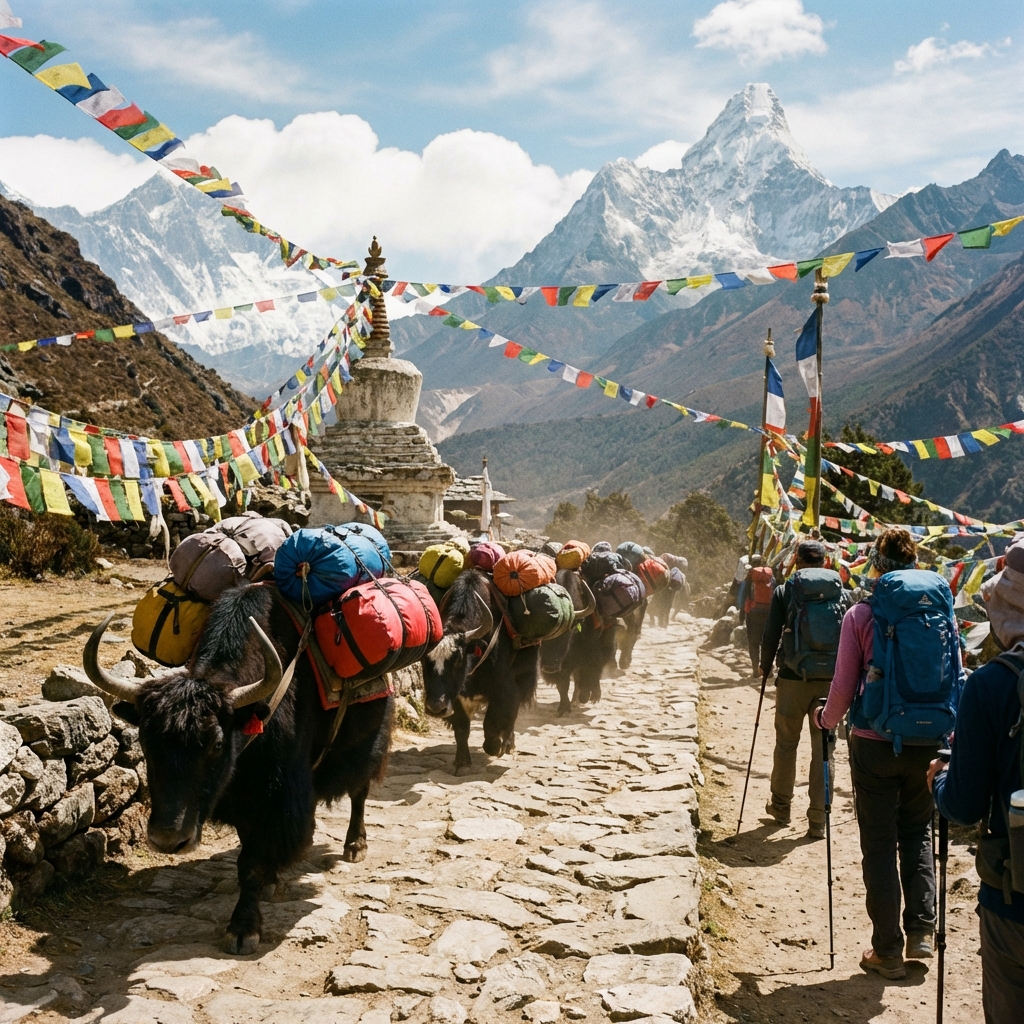
- Understand that everything was carried here -- every nail, every plank, every kilo of rice
- Engage with their hosts as people, not service providers
Everything Was Carried Here
A useful mental exercise: look around your tea house room and consider that every piece of wood, every sheet of corrugated roofing, every bag of rice, every bottle of cooking gas, and every piece of furniture was either carried on someone's back or loaded onto a mule and brought up the trail. This perspective changes how you view the simple room and basic meal. What feels basic is actually extraordinary given the logistics involved.
Tea House Etiquette at Different Altitudes
Etiquette expectations shift somewhat with altitude and remoteness:
Below 2,500m (Lower Tea Houses)
- More relaxed atmosphere, more menu options
- Shoes may be permitted in dining areas
- WiFi often included in room price
- Hot showers more commonly available
- Rooms may include attached bathroom
- Later quiet hours (closer to 10:00 PM)
2,500m - 4,000m (Mid-Altitude Tea Houses)
- Standard etiquette applies fully
- "Eat where you sleep" strictly expected
- WiFi and charging fees standard
- Shared bathrooms, cold rooms
- Quiet hours firmly 9:00-9:30 PM
- Heater etiquette becomes important
Above 4,000m (High-Altitude Tea Houses)
- Resources are scarce -- patience is essential
- Menu options are limited (dal bhat, noodle soup, chapati)
- Electricity may be minimal (solar only)
- Water is precious -- showers very rare
- Rooms are very cold -- sleeping bag essential
- Staff are working in harsh conditions -- extra kindness is warranted
- Tipping is more impactful here, as expenses are higher for operators
Common Mistakes Trekkers Make
- Eating at another lodge after checking in -- the cardinal sin
- Complaining about prices -- everything costs more at altitude because transport costs are astronomical
- Being loud after 9:00 PM -- the fastest way to become unpopular
- Hogging charging outlets -- charge and vacate
- Leaving trash behind -- pack out everything you brought
- Not removing shoes -- observe what others do and follow suit
- Entering the kitchen -- it is the owner's domain
- Ignoring cultural norms -- take 5 minutes to learn basic customs
- Treating staff like hotel employees -- they are family members sharing their home
- Not saying thank you -- "dhanyabad" costs nothing and means everything
Related Guides
- Tea House Trekking Explained -- What tea houses are and how the system works
- Cultural Etiquette for Nepal Trekking -- Broader cultural norms beyond tea houses
- A Typical Trekking Day in Nepal -- What to expect hour by hour
- Nepal Trekking Food and Dining Guide -- What to eat and what to expect
- Essential Nepali Phrases for Trekkers -- Key words and phrases
Frequently Asked Questions
What happens if I eat at a different tea house than where I am staying?
Your host will likely be upset, and rightfully so. Some tea houses will charge a "room-only" surcharge of NPR 500-2,000 to compensate for lost meal revenue. In small villages where tea house owners know each other, word spreads quickly, and you may find a cooler reception at your next stop. The economic impact is real -- meal revenue is how tea houses survive. Always eat where you sleep.
Do I have to order every meal at my tea house?
You should order at least dinner and breakfast at the tea house where you are staying. Lunch is more flexible since most trekkers eat lunch at a different village along the trail. The expectation is that your dinner and breakfast revenue compensate for the below-cost room. If you skip dinner (perhaps because you arrived with a packed lunch from your previous stop), order drinks and snacks in the evening to show good faith.
How much should I tip at a tea house?
Tipping is appreciated but not strictly mandatory. NPR 100-300 per night for the staff is a kind gesture. For an exceptionally memorable stay or outstanding meal, NPR 500-1,000 is generous. Tip in Nepali Rupees and give it directly to the person or family. At the end of a long trek, a slightly larger tip at your final tea house is a nice way to show gratitude for the overall system that supported your journey.
Can I cook my own food at a tea house?
No. Cooking your own food at a tea house (using a camping stove or requesting kitchen access) is not permitted and is considered very disrespectful. It directly undermines the tea house business model. The exception is boiling water for your own thermos, which some tea houses allow for a small fee. If you have severe dietary restrictions that the tea house cannot accommodate, discuss this with your guide in advance so arrangements can be made.
What is the deal with the heater in the common room?
The common room heater is typically a wood or yak dung-burning stove that costs the tea house owner significant fuel expenses. The unspoken rule is that you should be buying drinks or food if you are spending time in the warm common room near the heater. Sitting for hours without ordering anything is seen as freeloading on the fuel costs. Order a pot of tea, hot chocolate, or snacks -- it is a small price for warmth at 4,000m.
Are there any tea houses that offer private bathrooms?
Yes, particularly at lower altitudes and on popular routes like the lower Everest trail and the Annapurna region below 3,000m. Some newer or upgraded tea houses offer rooms with attached bathrooms for a premium (typically NPR 500-2,000 per night more than standard rooms). Above 3,500m, private bathrooms become rare. Above 4,000m, they are essentially nonexistent.
How do I handle dietary restrictions at a tea house?
Inform the tea house staff at check-in about any dietary restrictions. Vegetarian options are always available (dal bhat is inherently vegetarian). Vegan is manageable with some explanation. Gluten-free is more challenging, as many dishes include wheat. Severe allergies (nuts, etc.) should be communicated clearly -- consider carrying a translated dietary restriction card in Nepali. For very specific medical dietary needs, discuss with your guide before the trek so provisions can be planned.
Is it okay to dry my clothes by the common room heater?
You can dry small items (socks, gloves, a buff) near the heater if space allows, but ask before draping items directly on the heater or stove. Wet hiking boots should not be placed directly on or against the heater as the smell is unpleasant for everyone and the heat can damage boot adhesives. Hang wet items in the sun during the day when possible, and use the heater area judiciously in the evening.
What time should I arrive at a tea house?
Aim to arrive between 1:00 PM and 3:00 PM. This gives you the best room selection (first come, first served), time to settle in, and a relaxed evening. Arriving after 4:00 PM during peak season risks finding the tea house full. Arriving before noon means you have trekked too short a distance unless it is an acclimatization day. The standard trekking day runs from about 7:00 AM to 2:00 PM.
Can I reserve a room at a tea house in advance?
On most trails, no. Room allocation is first-come, first-served. However, during peak season (October-November) on the Everest Base Camp route, some popular tea houses in Namche Bazaar, Tengboche, Dingboche, and Gorak Shep now accept advance bookings through trekking agencies. Your guide typically calls ahead to reserve rooms on guided treks. Independent trekkers should arrive early to secure a spot during peak season.
What should I do if the tea house is full?
If a tea house is full, the owner may offer a bed in the common/dining room (sleeping on a bench after dinner is cleared). Alternatively, walk to the next tea house in the village -- most trekking villages have multiple options. During peak season, your guide should call ahead to check availability. Having a sleeping bag means you can sleep comfortably almost anywhere, including the dining room floor if absolutely necessary.
Is WiFi reliable at tea houses?
WiFi at tea houses ranges from functional to nearly useless. Below 3,000m, it can be decent for messaging and basic browsing. Above 3,500m, expect very slow speeds -- sometimes barely enough for text messages. Above 4,500m, WiFi may not exist or may be satellite-based and extremely expensive. Do not rely on tea house WiFi for important communications. A local SIM card with data (NTC or Ncell) provides more reliable connectivity on main trekking routes.