
Two treks in Nepal's western Himalaya sit within 60 kilometers of each other yet could hardly be more different in character, logistics, and the experience they deliver. The Annapurna Base Camp trek is Nepal's most accessible major trek -- a well-marked, independently trekable route through the heart of the Annapurna Sanctuary, reachable from Pokhara with nothing more than a conservation area permit and a TIMS card. The Manaslu Circuit is one of Nepal's last restricted-area treks -- requiring a special permit, a licensed agency, a mandatory guide, and a minimum group size, all to protect a remote region that feels decades removed from the tourist trail.
These two treks represent a fundamental choice in Himalayan trekking philosophy: the accessible classic versus the controlled adventure. The ABC trek puts you in an amphitheater of 7,000-8,000 meter peaks at 4,130m after 7-12 days of well-supported trekking. The Manaslu Circuit takes you around the world's eighth-highest mountain over 14-18 days, crossing the formidable Larkya La pass at 5,160m, through villages where tourism has not yet reshaped local life.
This guide compares every dimension of both treks to help you make an informed decision based on your experience level, budget, available time, and what kind of mountain experience you are seeking.
Who should read this guide:
- Trekkers choosing between two different Annapurna-adjacent experiences
- Experienced hikers evaluating whether to attempt a restricted-area trek
- Budget-conscious trekkers comparing total costs (permits are a major factor)
- Independent trekkers wondering if Manaslu is worth the guided-trek requirement
- Anyone planning a trekking trip starting from Pokhara or Kathmandu
7-12 days from Pokhara
14-18 days from Kathmandu
4,130m (Annapurna Base Camp)
5,160m (Larkya La Pass)
$50 (ACAP $30 + TIMS $20)
$200-350+ (restricted area permit + MCAP + TIMS)
Not required (but recommended)
Mandatory -- must trek with licensed agency and guide
Moderate to high (150-300 daily in peak season)
Low (30-80 daily in peak season)
Yes -- fully feasible independently
No -- restricted area, agency and guide required
Side-by-Side Comparison Table
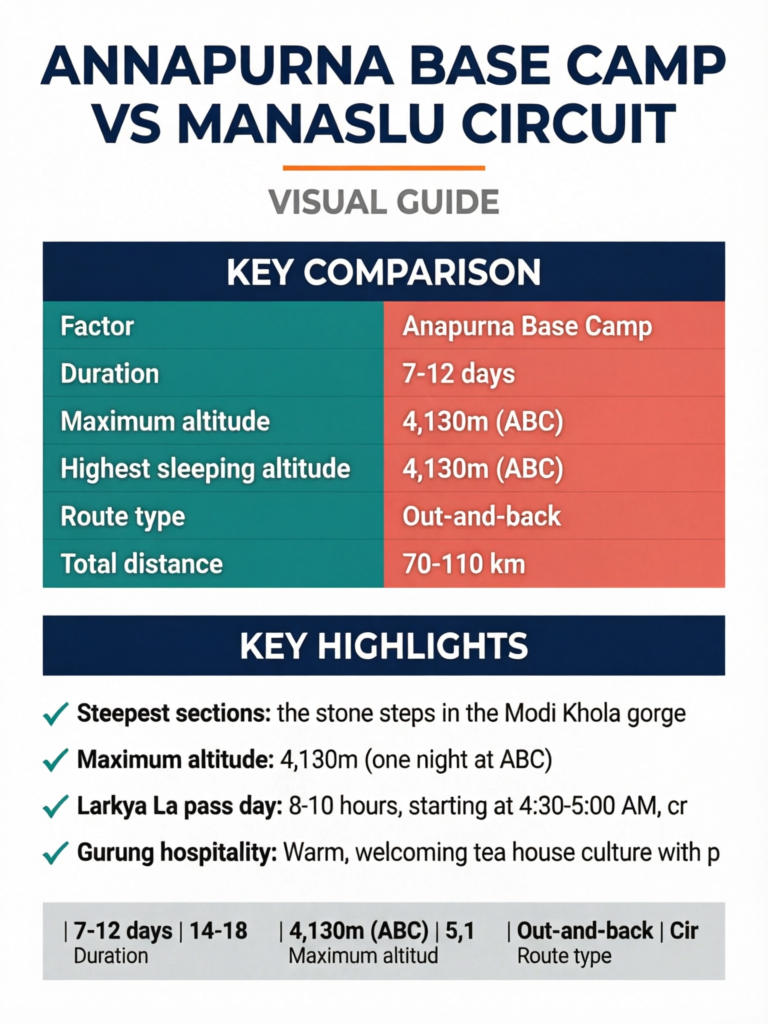
| Factor | Annapurna Base Camp | Manaslu Circuit | Advantage |
|---|---|---|---|
| Duration | 7-12 days | 14-18 days | ABC (shorter, more flexible) |
| Maximum altitude | 4,130m (ABC) | 5,160m (Larkya La) | Depends on goals |
| Highest sleeping altitude | 4,130m (ABC) | 4,800-4,850m (Dharamsala/Larkya Phedi) | ABC (lower) |
| Route type | Out-and-back | Circuit (loop) | Manaslu (no backtracking) |
| Total distance | 70-110 km | 170-210 km | ABC (shorter) |
| Difficulty | Moderate | Challenging | ABC (easier) |
| Guide required? | No (recommended) | Yes (mandatory) | ABC (more freedom) |
| Permits needed | ACAP + TIMS ($50) | Restricted area + MCAP + TIMS ($200-350+) | ABC (much cheaper) |
| Agency required? | No | Yes (TAAN licensed) | ABC (independent option) |
| Minimum group size | None | 2 trekkers minimum | ABC (solo-friendly) |
| Total budget (mid-range) | $800-$1,800 | $1,500-$3,500 | ABC |
| Crowds (October) | 150-300 daily | 30-80 daily | Manaslu |
| Tea house quality | Good to very good | Basic to good (improving) | ABC |
| Cultural experience | Gurung villages, Modi Khola gorge | Nubri/Tsum communities, Tibetan border culture | Manaslu (more authentic) |
| Mountain views | Annapurna I, Machapuchare, Annapurna South (amphitheater) | Manaslu (8,163m), Peak 29, Himalchuli | Tie (different character) |
| Trail variety | Forest, gorge, alpine, glacial amphitheater | Gorge, forest, alpine, high pass, Tibetan desert | Manaslu (more diverse) |
| Road encroachment | Minimal on main ABC trail | Increasing on lower sections | Tie |
| Starting point | Pokhara (taxi to trailhead) | Kathmandu (drive to Soti Khola/Machha Khola) | ABC (easier access) |
| Wilderness feeling | Moderate (well-developed trail) | High (remote, less infrastructure) | Manaslu |
| Physical demands | Moderate -- sustained uphill, manageable daily distances | High -- long days, high pass crossing, rough terrain | ABC (less demanding) |
| Altitude sickness risk | Moderate (max 4,130m) | High (pass at 5,160m, camping near 4,800m) | ABC (lower risk) |
| Best for | Independent trekkers, beginners upgrading, those with 7-10 days | Experienced trekkers seeking remote, authentic experience | Depends on experience |
The Permit Puzzle: Why Manaslu Costs More
The single biggest logistical difference between these two treks is the permit structure, and it significantly affects both cost and planning flexibility.
ABC Permits: Simple and Cheap
The ABC trek requires just two permits:
- Annapurna Conservation Area Permit (ACAP): $30 for foreigners
- TIMS Card: $20 for independent trekkers, $10 for organized groups
Total: $40-50
Both permits can be obtained in Pokhara or Kathmandu in 30 minutes to 1 hour. No agency involvement is required. You can decide to trek ABC on a whim and be on the trail within a day.
Manaslu Permits: Complex and Expensive
The Manaslu Circuit requires multiple permits through a licensed agency:
- Manaslu Restricted Area Permit: $100 per person per week (September-November), $75 per week (December-August). Most treks require 2-3 weeks, so $150-300
- Manaslu Conservation Area Permit (MCAP): $30
- TIMS Card: $10 (through agency)
- Mandatory guide fee: Built into agency package
- Agency service fee: Variable, but agencies typically charge $300-800+ above permit costs for logistics, guide, and support
Total permit/agency cost: $400-1,000+ (permits plus mandatory guide and agency fees)
The restricted area permit must be obtained through a TAAN-licensed trekking agency. You cannot trek Manaslu independently -- it is a legal requirement, enforced by checkpoint inspections throughout the route. The minimum group size is officially two trekkers, meaning solo travelers must either find a partner or pay a single supplement.
Manaslu Solo Trekker Reality
If you are a solo trekker, the Manaslu Circuit creates a logistical challenge. The two-person minimum requirement means you either need to find a trekking partner (online forums and Thamel notice boards are good sources), join a group departure, or pay a single supplement ($100-300+ extra) through your agency. Some agencies will process permits for a "solo" trekker by listing the guide as the second person, though this approach exists in a regulatory gray area. Budget-conscious solo trekkers may find ABC's independent trekking option significantly more attractive.
Pro Tip
Cost Comparison: The Full Financial Picture
| Cost Category | ABC (10 days, independent) | Manaslu Circuit (16 days, guided) |
|---|---|---|
| Permits | $50 (ACAP + TIMS) | $200-350 (restricted + MCAP + TIMS) |
| Agency/guide fees | $250-350 (mandatory guide) | $500-1,200 (mandatory, included in package) |
| Transport to trailhead | $15-30 (Pokhara to Nayapul/Kimche) | $40-80 (Kathmandu to Soti Khola by bus/jeep) |
| Transport from trailhead | $15-30 (back to Pokhara) | $30-60 (Dharapani/Besisahar to Kathmandu) |
| Accommodation (per night) | $3-8 | $3-10 |
| Food (per day) | $15-30 | $15-35 (limited options at some stops) |
| Hot showers (total) | $10-25 | $10-30 |
| WiFi/charging (total) | $10-20 | $15-30 (less available, higher prices) |
Total Budget Estimates
| Budget Level | ABC (10 days) | Manaslu Circuit (16 days) | Difference |
|---|---|---|---|
| Budget independent (ABC) / budget guided (Manaslu) | $600-1,000 | $1,300-2,200 | +$700-1,200 |
| Mid-range | $800-1,400 | $1,800-3,000 | +$1,000-1,600 |
| Comfortable guided | $1,200-1,800 | $2,500-3,500 | +$1,300-1,700 |
| Premium | $1,500-2,500 | $3,000-4,500 | +$1,500-2,000 |
The cost difference is substantial, driven primarily by the Manaslu restricted area permit, the mandatory guide and agency fees, and the longer duration. A budget-conscious trekker can complete the ABC trek for $600-800 independently, while the Manaslu Circuit's minimum realistic cost is $1,300-1,500 even with the most budget-friendly agency.
For detailed breakdowns, see our ABC trek cost guide and Manaslu Circuit cost guide.
Is Manaslu Worth the Extra Cost?
The extra $700-1,700 you spend on Manaslu buys you: a remote wilderness experience, dramatically fewer crowds, Tibetan border culture, a challenging high pass crossing, and the knowledge that you are trekking one of Nepal's truly special routes. Whether that is "worth it" depends entirely on your priorities and budget. For experienced trekkers who have done the more accessible routes, the Manaslu premium is almost universally considered excellent value.
The Experience Comparison: Amphitheater vs Circuit
ABC: The Mountain Cathedral
The ABC trek's climax is one of the most dramatic natural settings in the Himalayas. Annapurna Base Camp sits at 4,130m in a glacial amphitheater -- a natural bowl surrounded by towering peaks on all sides:
- Annapurna I (8,091m) -- the world's tenth-highest mountain, looming above
- Annapurna South (7,219m) -- massive and close
- Machapuchare (6,993m) -- the sacred "Fish Tail" mountain, whose summit remains unclimbed
- Hiunchuli (6,441m) -- guarding the sanctuary entrance
- Annapurna III (7,555m) -- completing the amphitheater walls
- Gangapurna (7,454m) -- visible from certain angles
Standing at ABC, you are surrounded by mountains on virtually every side. The sunrise here, when golden light slowly descends the amphitheater walls, is one of Nepal's most photographed moments. The feeling of being enclosed within a cathedral of peaks is profound and unlike anything on the Manaslu Circuit.
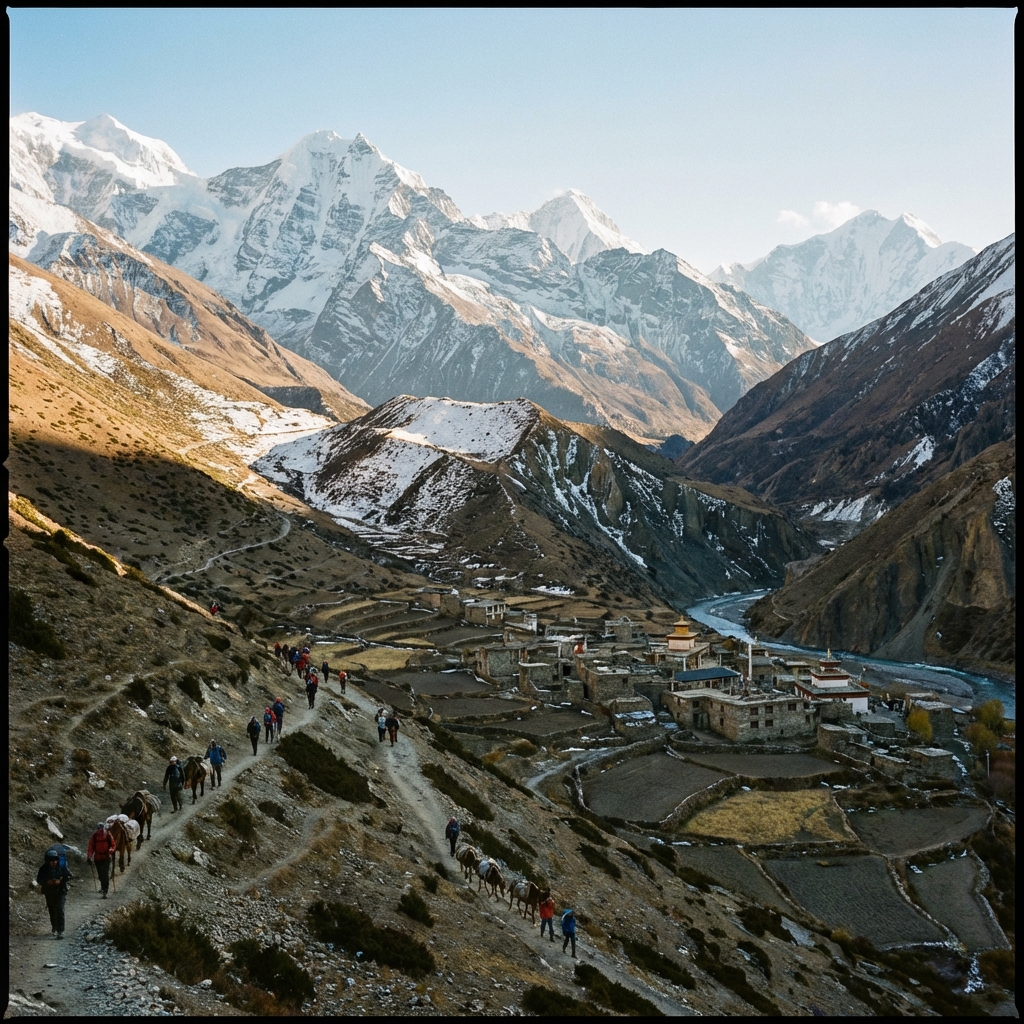
The journey to ABC follows the Modi Khola gorge through bamboo forest, rhododendron groves, and alpine meadows. The trail is well-marked, the tea houses are good, and the progression from lush subtropical forest to stark glacial moraine is dramatic and satisfying.
Manaslu Circuit: The World-Class Loop
The Manaslu Circuit is a fundamentally different kind of trek -- a 170-210 km loop around Mount Manaslu (8,163m), the world's eighth-highest peak. Rather than ascending to a single dramatic viewpoint, you spend 14-18 days walking through a continuously changing landscape:
Days 1-4: The River Gorge
- Deep gorge of the Budhi Gandaki river
- Subtropical vegetation, waterfalls, suspension bridges
- Small Gurung and Tamang villages clinging to hillsides
- Some of Nepal's most dramatic gorge scenery
Days 5-8: The Cultural Transition
- Transition to Tibetan-influenced culture as you approach the border
- Nubri Valley villages with gompa monasteries and prayer wheels
- Mani walls (carved prayer stone walls) line the trail
- Samagaon (3,530m) -- the largest village on the circuit, with views of Manaslu
Days 9-11: The High Alpine
- Sparse vegetation, yak pastures, moraines
- Samdo (3,860m) -- the last village before the pass
- Dharamsala/Larkya Phedi (4,460-4,850m) -- the basic shelter before the pass
- Views of Manaslu, Peak 29 (Ngadi Chuli, 7,871m), and surrounding glaciers
Days 12-13: The Pass and Descent
- Larkya La (5,160m) -- the trek's defining moment
- A long, demanding pass day (8-10 hours, often starting at 4-5 AM)
- Descent into the Marsyangdi Valley on the western side
- Dramatic change in landscape and culture
Days 14-16: The Western Descent
- Joining the upper Annapurna Circuit trail
- Lower altitude, warmer temperatures, different vegetation
- Road access increasingly present as you descend
The Manaslu Circuit's strength is the journey itself -- the daily progression through different landscapes, cultures, and altitude zones. There is no single "arrival moment" comparable to reaching ABC, but the cumulative experience of two-plus weeks in increasingly remote territory creates its own powerful narrative.
Pro Tip
Difficulty Comparison: Moderate vs Challenging
ABC: Achievable for Most Fit Trekkers
The ABC trek is rated moderate -- demanding enough to feel like an achievement but accessible to anyone with reasonable fitness and determination.
Physical demands:
- 7-12 days of trekking (flexible itinerary)
- 5-7 hours walking per day on most days
- Total elevation gain approximately 2,500m from trailhead to base camp
- Steepest sections: the stone steps in the Modi Khola gorge area
- Maximum altitude: 4,130m (one night at ABC)
Technical requirements:
- None -- the trail is well-marked with no technical sections
- Trekking poles recommended but not essential
- Basic fitness sufficient (regular walking or light exercise 3-4 times per week)
Altitude sickness risk:
- Moderate -- the ascent to 4,130m is gradual over several days
- Most trekkers acclimatize well if they follow a reasonable itinerary
- Headache and mild fatigue are common at Machhapuchhre Base Camp (3,700m) and ABC (4,130m)
- Serious altitude sickness is rare on the standard itinerary
Manaslu Circuit: A Serious Undertaking
The Manaslu Circuit is rated challenging and represents a significant step up from ABC in every physical dimension.
Physical demands:
- 14-18 days of continuous trekking (limited flexibility)
- 6-8 hours walking per day, with some 8-10 hour days
- Total elevation gain approximately 8,000-9,000m over the circuit
- Multiple steep ascents and descents
- Larkya La pass day: 8-10 hours, starting at 4:30-5:00 AM, crossing at 5,160m
Technical requirements:
- No technical climbing skills needed
- Good fitness essential -- the trek demands sustained effort over two weeks
- Comfort with basic trail conditions (some rough, unmaintained sections)
- Experience with high altitude (previous trek above 4,000m recommended)
- Mental resilience for remote conditions and basic accommodation
Altitude sickness risk:
- High -- the Larkya La pass reaches 5,160m
- The night before the pass at Dharamsala/Larkya Phedi (4,460-4,850m) is the highest sleeping altitude
- Limited descent options if altitude sickness develops near the pass
- Acclimatization in Samagaon and Samdo is essential
- Previous high-altitude experience strongly recommended
The Larkya La Pass: Manaslu's Defining Challenge
The Larkya La pass crossing at 5,160m is the single most demanding day on the Manaslu Circuit. You start walking at 4:30-5:00 AM from Dharamsala (4,460m) or Larkya Phedi (4,850m) in freezing darkness, climb to the pass at 5,160m, and then descend steeply to Bimthang (3,590m) -- a total descent of over 1,500m. The day typically takes 8-10 hours and is physically exhausting. Snow on the pass is possible in late autumn and winter, making the crossing significantly more difficult. This is not a day to underestimate -- it requires genuine fitness, good acclimatization, and appropriate gear.
Best Season Comparison
ABC: Flexible Seasonal Window
| Season | Conditions | Rating |
|---|---|---|
| Oct-Nov | Clear skies, cold nights at ABC, excellent views | Best |
| March-April | Clear skies, warming, rhododendrons blooming below 3,000m | Excellent |
| May | Warm lower, cool upper, increasing afternoon cloud | Good |
| December | Cold, clear, fewer trekkers, excellent views | Good (cold at ABC) |
| Jan-Feb | Cold, possible snow at ABC, clear skies | Challenging |
| Jun-Sep | Monsoon -- rain, leeches, cloud, trail erosion | Not recommended |
Manaslu Circuit: Narrower Weather Window
| Season | Conditions | Rating |
|---|---|---|
| Oct-Nov | Best conditions, clear skies, cold at pass | Best |
| March-April | Warming, generally clear, some snow possible at pass | Good |
| May | Warm lower, snow melt at pass, possible pre-monsoon storms | Fair |
| December | Very cold, possible heavy snow at Larkya La, some tea houses close | Challenging |
| Jan-Feb | Larkya La often blocked by snow, very cold, few services | Not recommended |
| Jun-Sep | Monsoon -- rain, landslides on road, leeches, trail erosion | Not recommended |
Key seasonal difference: The Manaslu Circuit has a narrower weather window than ABC due to the Larkya La pass. Snow at the pass can make crossing dangerous or impossible, which eliminates winter trekking for all but the most experienced groups. ABC's lower maximum altitude means it is trekable year-round (uncomfortable in monsoon, cold in winter, but physically possible).
Pro Tip
Cultural Experience Comparison
ABC: Gurung Heritage
The ABC trek passes through the heartland of the Gurung people, one of Nepal's major mountain communities. Cultural highlights include:
- Ghandruk and Chhomrong: Traditional Gurung villages with stone houses, slate roofs, and spectacular mountain settings
- Gurung hospitality: Warm, welcoming tea house culture with personal attention
- Modi Khola gorge: The sacred canyon leading to the Annapurna Sanctuary, historically considered a forbidden zone
- Seasonal village life: Terraced agriculture, livestock herding, and traditional craftsmanship visible along the lower trail
Manaslu: Tibetan Border Culture
The Manaslu Circuit offers a richer and more diverse cultural experience:
- Nubri Valley communities: Villages with strong Tibetan cultural connections, including gompa monasteries, prayer wheels, and Buddhist ritual practices
- Mani walls: Elaborately carved stone prayer walls lining the trail, some hundreds of meters long
- Samagaon: A significant settlement at 3,530m with an ancient monastery and direct views of Manaslu
- Tibetan refugee communities: Some villages along the route house Tibetan refugee populations
- Less tourism influence: Manaslu's restricted status and lower visitor numbers mean local culture is less modified by tourism than in the Annapurna region
Cultural Sensitivity on the Manaslu Circuit
Several villages on the Manaslu Circuit have specific cultural practices that trekkers should respect. Always walk clockwise around mani walls and chortens (Buddhist shrines). Ask permission before photographing people, especially monks. Some gompa monasteries welcome visitors; others are private. Your mandatory guide will advise on appropriate behavior at each location. This cultural sensitivity is one of the reasons the restricted area permit system exists -- to manage tourism's impact on traditional communities.
Choose ABC If...
- You want trekking independence -- the freedom to go at your own pace, without an agency or mandatory guide
- Budget matters -- ABC can be done for half the cost of Manaslu
- You have 7-10 days for trekking (Manaslu requires 14-18 days minimum)
- You prefer a dramatic destination -- the ABC amphitheater is one of the most spectacular single viewpoints in the Himalayas
- This is your first major trek and you want a moderate challenge with excellent infrastructure
- You are a solo trekker and do not want to find a partner or pay group supplements
- Tea house comfort is important -- ABC's infrastructure is more developed
- You are based in Pokhara and want a trek that starts and ends conveniently
- Rhododendron forests in bloom are on your wish list (spring season)
- You want a proven route with abundant information and straightforward logistics
Choose Manaslu Circuit If...
- You want a remote, less-touristed experience -- Manaslu's restricted status keeps crowds very low
- Cultural authenticity is a high priority -- the Nubri Valley's Tibetan-influenced culture is exceptional
- You have 14-18 days for a more immersive trek
- You want a circuit trek -- walking a loop rather than retracing your steps
- A high pass crossing appeals to you -- Larkya La at 5,160m is a significant achievement
- You have previous trekking experience and are ready for a more challenging route
- You are comfortable with guided trekking and value having an experienced guide
- You have already done ABC and want a different experience in the same general region
- You are drawn to Tibetan Buddhist culture visible in monasteries, mani walls, and village life
- You are prepared for the cost premium and see the restricted area permit as buying exclusivity
Which Trek Is Harder?
The Manaslu Circuit is significantly harder than ABC. Manaslu involves 14-18 days of continuous trekking, a demanding Larkya La pass crossing at 5,160m, and longer daily distances over rougher terrain. ABC is a moderate trek achievable by most fit trekkers in 7-12 days, with a maximum altitude of 4,130m and well-maintained trails. If you have never been above 4,000m, start with ABC.
Which Trek Is Cheaper?
ABC is substantially cheaper. A mid-range ABC trek costs $800-1,400, while the Manaslu Circuit runs $1,800-3,000. The cost gap is driven by Manaslu's restricted area permit ($100-300), mandatory guide and agency fees, and longer duration. Independent trekkers can complete ABC for as little as $600-800, whereas Manaslu's minimum realistic cost is $1,300-1,500 even with the most budget-friendly agency. See our Nepal trekking permits guide for full permit details.
Which Trek Has Better Views?
Both offer exceptional but different mountain scenery. ABC places you inside a glacial amphitheater surrounded by Annapurna I (8,091m), Machapuchare, and Annapurna South -- an intimate, overwhelming 360-degree panorama at a single viewpoint. The Manaslu Circuit provides varied views of Manaslu (8,163m) from multiple angles over two weeks, plus views of Peak 29, Himalchuli, and diverse gorge and alpine scenery. Most trekkers rate ABC's amphitheater higher for single-viewpoint impact, but Manaslu's overall journey as more rewarding. Check our complete gear list for packing advice for either trek.
Which Should You Choose?
For first-time Nepal trekkers or those with limited time: Choose ABC. It is one of Nepal's finest treks, offering an extraordinary mountain amphitheater experience that requires no agency booking, no special permits, and no previous altitude experience. The trek is well-suited to independent travelers, can be completed in 7-10 days, and starts conveniently from Pokhara. It is a genuinely world-class trek, not a "lesser" option.
For experienced trekkers seeking something special: Choose Manaslu. If you have done ABC, EBC, or other popular Nepal treks, the Manaslu Circuit represents a genuine step up in terms of remoteness, cultural depth, and physical challenge. The restricted area status keeps the experience authentic, and the Larkya La crossing is one of Nepal's great trekking achievements. The higher cost and mandatory guided requirement are the price of admission to one of Nepal's finest treks.
For trekkers who can do both: Do ABC first and Manaslu second. ABC provides excellent altitude preparation (4,130m) and trekking experience that will serve you well on the more demanding Manaslu Circuit. Completing ABC also helps you evaluate whether you want the additional challenge, remoteness, and cost of Manaslu.
The honest assessment: ABC is the better first trek. Manaslu is the better second trek. ABC delivers immediate gratification -- a stunning destination reached through beautiful terrain. Manaslu delivers cumulative satisfaction -- two-plus weeks of increasingly rewarding trekking through diverse landscapes and cultures. Both are exceptional; they simply serve different trekking needs.
Pro Tip
Frequently Asked Questions
Can I trek Manaslu Circuit independently with a mandatory licensed guide?
No. The Manaslu Circuit is in a restricted area that legally requires trekkers to travel with a licensed TAAN agency and a registered guide. Checkpoints along the route verify permits and guide credentials. There is no legal way to trek Manaslu independently, and attempting to do so will result in being turned back at checkpoints. See our Manaslu cost guide for agency pricing details.
Is ABC too crowded to enjoy?
During October peak season, the trail sees 150-300 trekkers daily, and tea houses at ABC and Machhapuchhre Base Camp can be full. However, "crowded" is relative -- this is still a mountain trail, not a city sidewalk. The crowds thin significantly in shoulder seasons (early October, late November, March). If crowds are a major concern, choose Manaslu instead, or trek ABC in shoulder season. See our ABC best time guide for optimal timing.
How difficult is the Larkya La pass on Manaslu?
The Larkya La (5,160m) is a demanding pass crossing that typically takes 8-10 hours. The ascent from Dharamsala involves steep switchbacks on rocky terrain, and the descent to Bimthang is long and relentless. While not technically difficult (no climbing skills needed), the combination of altitude, cold, and duration makes it physically exhausting. Previous high-altitude experience is strongly recommended. See our Manaslu difficulty assessment for detailed preparation advice.
What are the tea houses like on each trek?
ABC tea houses range from good to very good, with private rooms, attached bathrooms at lower stops, and varied menus. Above Machhapuchhre Base Camp, facilities are more basic but still comfortable. Manaslu tea houses have improved significantly in recent years but remain generally more basic than ABC's -- shared rooms are more common, menus are more limited, and facilities above Samagaon are simple. Both treks offer dal bhat, noodle soup, and basic Western options at all stops.
Can I combine ABC and Manaslu in one trip?
While geographically close, the two treks start from different locations and combining them requires significant planning. A possible approach: complete ABC from Pokhara (10 days), return to Kathmandu, arrange Manaslu permits (1-2 days), and start the Manaslu Circuit (16 days). Total: approximately 30 days including travel and rest. This is feasible for trekkers with a month available and provides an extraordinary Himalayan experience.
What is the minimum group size for Manaslu?
The official minimum is two trekkers. Solo travelers must either find a trekking partner (online forums, Thamel notice boards, or agency-organized groups) or pay a single supplement. Some agencies are flexible about the two-person rule, listing the guide as the second person, but this varies by agency and regulatory enforcement. Discuss this specifically with your chosen agency before booking.
Which trek has better mountain views?
Both offer exceptional views, but of different character. ABC places you inside an amphitheater surrounded by 7,000-8,000m peaks -- it is intimate and overwhelming. Manaslu offers varied mountain views throughout the circuit, with the massive bulk of Manaslu (8,163m) visible from multiple angles over several days. ABC's views are concentrated at the destination; Manaslu's views unfold gradually over the journey. Most trekkers who have done both rate ABC's amphitheater slightly higher for sheer visual impact but Manaslu's overall trek as the more rewarding experience.
What permits do I need for each trek?
ABC: ACAP ($30) + TIMS ($20) = $50 total. Obtainable in Pokhara or Kathmandu, no agency required. Manaslu: Restricted area permit ($100/week in peak season), MCAP ($30), TIMS ($10 through agency). Must be arranged through a TAAN-licensed agency. Total permit cost alone is $170-250+ depending on trek duration. See our permits guide for complete details.
How fit do I need to be for each trek?
ABC: Moderate fitness required. If you can comfortably walk 5-6 hours on hilly terrain, you can do ABC. Regular exercise 3-4 times per week for 4-6 weeks before the trek is sufficient preparation. Manaslu: Good fitness required. You should be comfortable walking 6-8 hours on rough terrain with significant elevation changes. Training should include cardiovascular exercise, strength work, and ideally some multi-day hiking. See our fitness requirements guide for specific training advice.
Is Manaslu Circuit worth the extra money?
For experienced trekkers who value remoteness, cultural depth, and physical challenge, Manaslu is almost universally considered worth the premium. The restricted area status creates an authenticity that cannot be found on more accessible routes. For first-time trekkers or those on a tight budget, ABC delivers an exceptional experience at significantly lower cost. The "value" depends entirely on your priorities.
When do tea houses close on each trek?
On the ABC trek, most tea houses remain open year-round, though some at higher altitudes may close or reduce staff in deep winter (January-February) and monsoon (July-August). On the Manaslu Circuit, tea houses above Samagaon typically close from late December through February due to heavy snowfall and minimal trekker traffic. Some lower-altitude tea houses remain open year-round. Check with your agency for specific seasonal availability.
Can I extend the Manaslu Circuit?
Yes. The most popular extension is the Tsum Valley, a sacred Tibetan-influenced valley that branches off the main circuit between Chhekampar and Mu Gompa. This adds 5-7 days to the trek and requires an additional restricted area permit. The Tsum Valley is one of Nepal's most culturally significant trekking destinations and is highly recommended for trekkers with the time. See our Manaslu itinerary guide for planning details.
Which trek is better for wildlife?
The Manaslu Conservation Area has better wildlife potential due to lower human traffic. Himalayan tahr, musk deer, snow leopard (extremely rare), and various pheasant species inhabit the region. ABC's higher visitor numbers mean wildlife is more wary and sightings are less common, though Himalayan tahr and langur monkeys are occasionally spotted. Neither trek is primarily a wildlife experience, but Manaslu offers notably better chances.