Nepal and Peru are the world's two preeminent trekking destinations, and the comparison between them is one that serious trekkers inevitably face. Both countries offer extraordinary high-altitude trails through ancient cultures beneath towering mountain ranges. Both deliver experiences that redefine what trekking can be. And both have developed trekking infrastructure that supports visitors from complete beginners to hardened mountaineers.
Yet Nepal and Peru offer fundamentally different trekking experiences. Nepal is the land of tea houses, eight-thousanders, and Himalayan hospitality. Peru is the land of Inca ruins, Andean passes, and camping under southern skies. The Himalayas and the Andes are geologically, culturally, and experientially distinct mountain ranges, and the treks they produce reflect those differences in every dimension.
This guide provides an honest, detailed comparison across every factor that matters: altitude, difficulty, infrastructure, cost, culture, scenery, logistics, permits, food, crowds, and the intangible character of each destination. Whether you are choosing your next trekking destination or planning a lifetime of mountain adventures, this analysis will help you decide where to go first.
Who should read this guide:
- Trekkers choosing between a Nepal trip and a Peru trip
- Those planning a multi-year trekking bucket list
- Experienced Nepal trekkers considering Peru as their next destination (or vice versa)
- Anyone comparing the world's top trekking destinations
Quick Comparison: Side-by-Side Overview
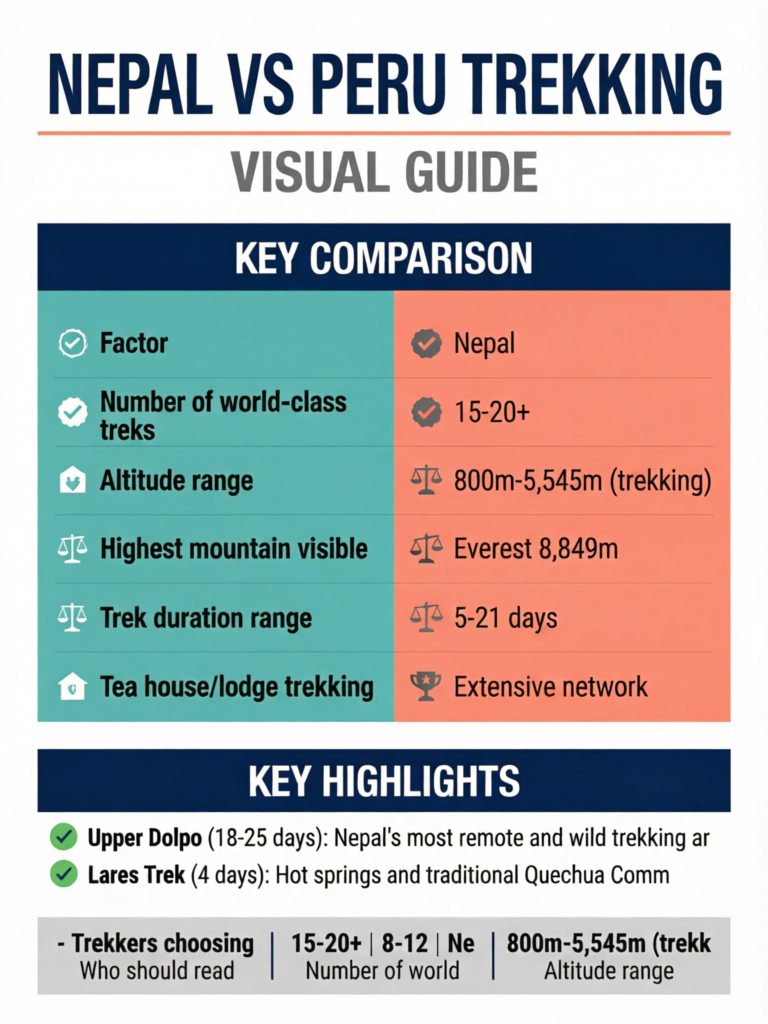
Nepal: EBC, Annapurna Circuit, Manaslu. Peru: Inca Trail, Huayhuash, Salkantay.
Nepal: 800m-5,545m (treks). Peru: 2,400m-5,000m (treks).
Nepal: Kala Patthar 5,545m. Peru: Huayhuash passes up to 5,000m.
Nepal: tea houses (lodges on trail). Peru: primarily camping (porters carry gear).
Nepal: $30-65. Peru: Inca Trail $250-300 (includes guide), others $10-30.
Nepal: $30-50/day. Peru: $40-70/day (camping treks).
Nepal: Oct-Nov, Mar-May. Peru: May-September (dry season).
Nepal: Sherpa, Gurung, Thakali villages. Peru: Inca ruins, Quechua communities.
Nepal: $700-1,500 from US/Europe. Peru: $400-1,000 from US, $600-1,200 from Europe.
Nepal: 7-21 days. Peru: 4-14 days (most treks shorter).
Nepal: extensive tea house network. Peru: established camping infrastructure with porters.
Nepal: walk lodge-to-lodge. Peru: camp-to-camp with support crew.
Master Comparison Table
| Factor | Nepal | Peru | Advantage |
|---|---|---|---|
| Number of world-class treks | 15-20+ | 8-12 | Nepal |
| Altitude range | 800m-5,545m (trekking) | 2,400m-5,000m (trekking) | Nepal (higher) |
| Highest mountain visible | Everest 8,849m | Huascaran 6,768m | Nepal |
| Trek duration range | 5-21 days | 4-14 days | Tie (different ranges) |
| Tea house/lodge trekking | Extensive network | Very limited | Nepal |
| Camping treks | Available everywhere | Primary trekking style | Peru (established system) |
| Permit complexity | Simple, cheap | Varies (Inca Trail complex) | Nepal |
| Daily cost (budget) | $30-50 | $40-70 | Nepal |
| International flight cost | $700-1,500 | $400-1,000 (from US) | Peru (from Americas) |
| Cultural ruins/sites | Monasteries, villages | Inca ruins (extraordinary) | Peru |
| Living mountain culture | Very strong (Sherpa, Gurung) | Strong (Quechua) | Tie |
| Food on trail | Tea house menus (dal bhat) | Cook prepares meals (camping) | Peru (better variety) |
| Crowd management | Open access (most treks) | Permit limits (Inca Trail) | Peru (controlled) |
| Guide requirement | Required (enforcement varies) | Required for Inca Trail only | Tie |
| Landscape diversity | Subtropical to arctic in one trek | Desert to glacier, but less range | Nepal |
| Wildlife | Limited large wildlife on trails | Condors, llamas, vicunas | Peru |
| Accessibility from gateway city | Kathmandu (domestic flights/buses) | Cusco (bus/train) | Tie |
| Non-trekking activities | Limited (rafting, safari) | Extensive (Machu Picchu, Amazon, Lima) | Peru |
| Safety | Very safe on trails | Very safe on trails | Tie |
| English spoken on trail | Widely | Moderately | Nepal |
| Season flexibility | Two seasons (spring/autumn) | One main season (May-Sep) | Nepal |
1. The Signature Treks: What Each Country Offers
Nepal's Major Treks
Nepal offers the world's deepest portfolio of high-altitude treks. The Himalayas provide an extraordinary range of routes across multiple regions:
Everest Region:
- Everest Base Camp (12-14 days): The world's most famous trek, reaching 5,364m at the foot of Everest
- Three Passes Trek (18-21 days): The expert-level Khumbu loop crossing three passes above 5,300m
- Gokyo Lakes Trek (10-14 days): Turquoise lakes beneath Cho Oyu
Annapurna Region:
- Annapurna Circuit (14-21 days): The classic Himalayan loop through five climate zones, crossing Thorong La at 5,416m
- Annapurna Base Camp (7-12 days): A shorter approach to the Annapurna Sanctuary
- Mardi Himal (5-7 days): A ridge trek with stunning Machapuchare views
Other Regions:
- Manaslu Circuit (12-16 days): A remote circuit rivaling the Annapurna Circuit
- Langtang Valley (7-10 days): Close to Kathmandu, culturally rich
- Upper Mustang (10-14 days): The restricted Tibetan kingdom
- Upper Dolpo (18-25 days): Nepal's most remote and wild trekking area
Peru's Major Treks
Peru offers fewer treks overall but several world-class routes, primarily in the Cusco and Cordillera Blanca regions:
Cusco Region:
- Classic Inca Trail (4 days): The iconic trek ending at Machu Picchu's Sun Gate, limited to 500 permits per day (including guides and porters)
- Salkantay Trek (5 days): A dramatic alternative to the Inca Trail with glacier views and cloud forest
- Lares Trek (4 days): Hot springs and traditional Quechua communities
- Choquequirao Trek (4-5 days): The "other Machu Picchu," remote and uncrowded
Cordillera Blanca/Huayhuash:
- Huayhuash Circuit (8-12 days): Considered one of the world's top five treks, a stunning loop around the Huayhuash range
- Santa Cruz Trek (4 days): A classic Cordillera Blanca trek through turquoise lakes and glacier valleys
- Alpamayo Base Camp (8-10 days): Approach to "the world's most beautiful mountain"
Other Regions:
- Ausangate Circuit (5-7 days): Rainbow Mountain and remote Andean landscapes
- Colca Canyon (2-3 days): One of the world's deepest canyons
Trek Portfolio Verdict
Nepal wins on quantity and variety. Nepal offers more treks, longer treks, higher treks, and greater route diversity. The Himalayan range spans the entire northern border, providing multiple distinct trekking regions.
Peru wins on combined trekking and cultural sites. The integration of Inca ruins into trekking routes (particularly the Inca Trail to Machu Picchu) creates a unique fusion of natural and archaeological wonder that Nepal cannot match.
2. Accommodation and Infrastructure: Tea Houses vs Camping
This is perhaps the most significant practical difference between Nepal and Peru trekking, and it fundamentally shapes the experience.
Nepal: The Tea House System
Nepal's trekking infrastructure is built around tea houses (also called lodges or bhattis). These are privately operated small guesthouses located along trekking routes, offering basic accommodation and meals.
What tea houses provide:
- Private or shared rooms with beds (foam mattresses, pillows)
- Communal dining room with wood-burning stove or heater
- Menus with 15-30 items (dal bhat, noodles, fried rice, soup, eggs, pancakes)
- Hot drinks (tea, coffee, hot chocolate)
- Charging facilities (for a fee at higher altitudes)
- Hot showers (for a fee, not always available above 4,000m)
- Basic toilets (flush or squat, improving over time)
What tea houses mean for trekkers:
- No tent, sleeping mat, stove, or cooking equipment needed
- Significantly lighter pack (8-12 kg versus 15-20 kg for camping)
- Social atmosphere every evening with fellow trekkers
- Ability to order hot meals without carrying food
- Less planning required (just walk to the next village)
Limitations:
- Quality varies dramatically (basic at altitude, comfortable at lower elevations)
- Can be crowded in peak season (limited rooms at key stops)
- Menus become repetitive over long treks
- Electricity and hot water are unreliable above 4,000m
Peru: The Camping System
Most Peruvian treks (except in a few areas with refugios) are camping-based. Trekkers either carry their own equipment or hire porters and cooks through an agency.
What the camping system provides (with agency):
- Porters carry tents, cooking equipment, food, and communal gear
- A cook prepares all meals (often surprisingly elaborate)
- Dining tent with table and chairs
- Personal tent (typically 2-person)
- Toilet tent
- Trekkers carry only a daypack (5-8 kg)
What camping means for trekkers:
- Fresh, varied food prepared by professional cooks (often the highlight)
- Complete wilderness immersion (no buildings, no electricity)
- Private campsite setup (not sharing with strangers)
- Agencies handle all logistics
- More "expedition" feel even on moderate treks
Limitations:
- More expensive (porter and cook fees add up)
- Less social interaction with other trekking groups
- No escape from weather (no warm dining room to retreat to)
- Cold nights in tents at altitude (no heated common rooms)
- Toilet facilities are more basic than tea house toilets
Pro Tip
If you have never done a multi-day camping trek, Peru's agency-supported camping system is an excellent introduction. The porters handle the heavy work, the cook feeds you well, and you focus entirely on walking and enjoying the scenery. It is a fundamentally different experience from backpacking, and most trekkers find it far more comfortable than they expected. Nepal's tea house system requires less preparation and lighter packing, which makes it ideal for trekkers who prefer simplicity and social atmosphere.
Infrastructure Verdict
Nepal wins for ease and accessibility. The tea house system allows trekkers to walk with a light pack, eat hot meals daily, and sleep in a bed every night without carrying camping equipment. This lower barrier to entry makes Nepal trekking accessible to a wider range of people.
Peru wins for food quality and wilderness immersion. The dedicated cook system produces remarkably good food (far beyond what tea house menus offer), and camping in pristine wilderness provides a deeper sense of isolation and adventure.
3. Altitude Comparison: The Roof of the World vs The Spine of South America
Nepal Altitude Profile
Nepal's trekking routes reach the highest altitudes in the trekking world:
- Starting elevations: 800-2,860m (depending on trek)
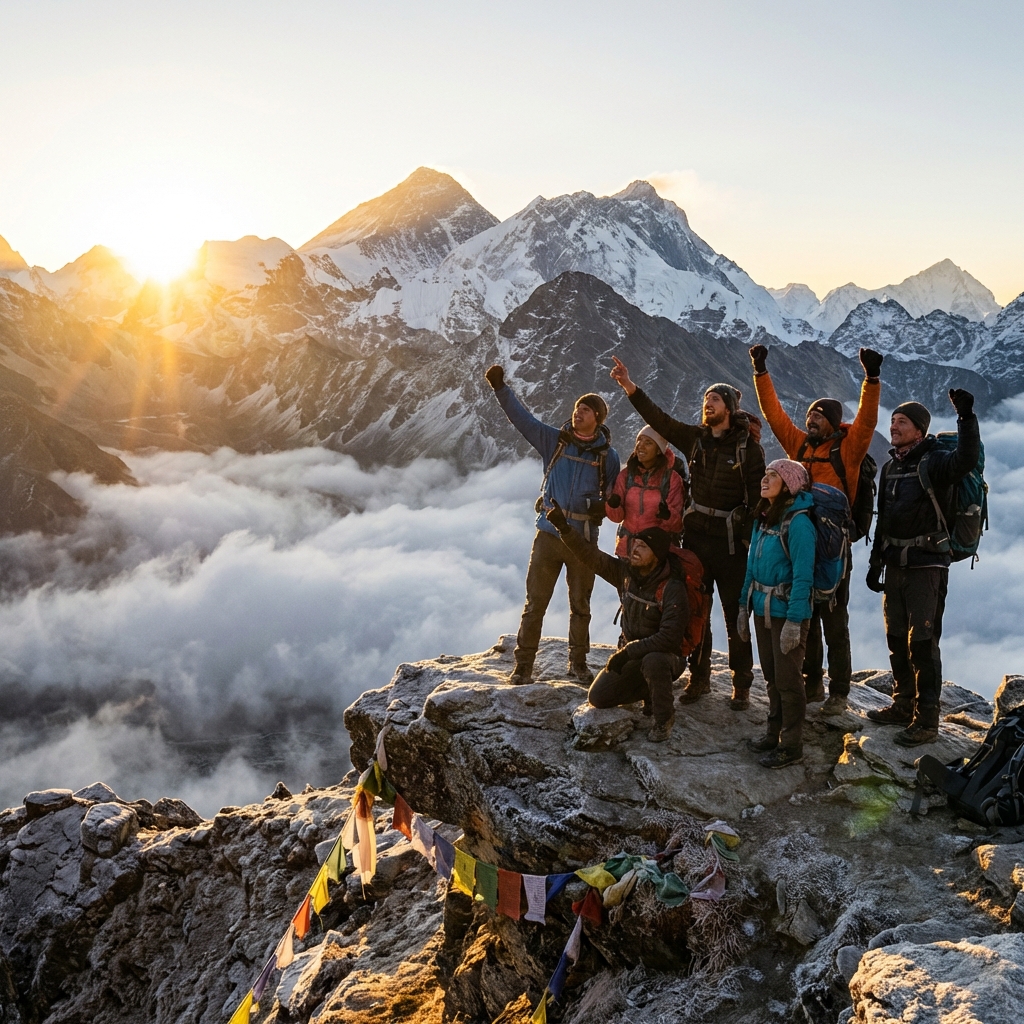
- Maximum trekking altitudes: 5,364m (EBC) to 5,545m (Kala Patthar)
- Pass crossings: Up to 5,416m (Thorong La) on standard treks
- Sleeping altitudes: Up to 5,164m (Gorak Shep)
- Eight-thousanders visible: Up to 5 from various viewpoints
Nepal's altitude advantage is not just about maximum height. The Himalayan range produces dramatic altitude profiles. The Annapurna Circuit takes trekkers from 800m to 5,416m within a single trek, a vertical range of over 4,600m. This produces the extraordinary landscape diversity that defines Nepal trekking.
Altitude sickness rates in Nepal: Approximately 40-50% of trekkers experience mild altitude sickness symptoms above 4,000m. Proper acclimatization protocols (gradual ascent, rest days) reduce serious incidents to under 5%.
Peru Altitude Profile
Peru's treks reach impressive altitudes, though not as extreme as Nepal:
- Starting elevations: 2,400-4,200m (Cusco itself sits at 3,400m)
- Maximum trekking altitudes: 4,600-5,000m (Huayhuash passes)
- Pass crossings: Up to 5,000m (Huayhuash), 4,200m (Inca Trail)
- Sleeping altitudes: Up to 4,500-4,700m
- Six-thousanders visible: Several (Huascaran 6,768m, Alpamayo 5,947m)
A critical difference: Peru's treks generally start higher than Nepal's. Cusco sits at 3,400m, meaning trekkers begin acclimatizing immediately upon arrival. The Inca Trail starts at 2,600m and reaches only 4,200m (Dead Woman's Pass), making it accessible to a wider fitness range. The Huayhuash Circuit, however, reaches 5,000m and is comparable in altitude challenge to Nepal's major treks.
Altitude sickness rates in Peru: Similar to Nepal at comparable altitudes. However, because many treks start from the already-high Cusco (3,400m), trekkers may experience symptoms before the trek even begins. Spending 2-3 days in Cusco acclimatizing before trekking is essential.
Altitude Verdict
Nepal reaches higher absolute altitudes and offers more dramatic altitude profiles (greater vertical range within single treks). Nepal is the destination for trekkers who specifically want to experience extreme high altitude.
Peru starts higher, which means less altitude range but also less acclimatization time needed for moderate treks like the Inca Trail. For treks that stay below 4,500m, Peru's altitude challenge is more manageable.
Altitude Sickness in Both Countries
Both Nepal and Peru pose serious altitude sickness risks. The symptoms, prevention, and treatment are identical regardless of location. Never ascend more than 300-500m per day above 3,000m. Take rest days every 1,000m of altitude gain. Stay hydrated. Descend immediately if symptoms worsen. Carry Diamox (acetazolamide) as a preventive option after consulting your doctor. Altitude sickness kills trekkers in both countries every year, almost always because warning signs were ignored.
4. Cost Comparison: Budget Breakdown
| Cost Category | Nepal (14-day EBC) | Peru (4-day Inca Trail) | Peru (10-day Huayhuash) |
|---|---|---|---|
| International flight | $700-1,500 | $400-1,000 (from US) | $400-1,000 (from US) |
| Domestic transport | $350-400 (Lukla flight) | $215-40 (bus to trailhead) | $30-60 (bus to trailhead) |
| Permits | $38-45 | $250-300 (includes guide) | $20-30 |
| Agency/guide fee | $300-600 | Included in permit | $400-800 |
| Porter/porter crew | $200-350 | Included in agency fee | $200-500 |
| Accommodation | $50-350 (tea houses) | Included (camping) | Included (camping) |
| Food on trek | $180-490 (tea house meals) | Included (cook prepares) | Included (cook prepares) |
| Gear rental | $20-50 | $50-100 | $80-150 |
| Gateway city expenses | $200-500 (Kathmandu 4-5 days) | $300-600 (Cusco 3-4 days) | $300-600 (Huaraz 3-4 days) |
| Travel insurance | $100-150 | $100-150 | $100-150 |
| Tips | $100-250 | $50-100 | $100-200 |
| Total budget range | $1,800-3,500 | $1,400-2,800 | $1,800-3,500 |
| Total mid-range | $2,500-4,500 | $2,000-3,500 | $2,500-4,500 |
Cost analysis:
- For comparable trek difficulty and duration, costs are similar
- Peru's Inca Trail is expensive for a 4-day trek due to high permit costs, but includes everything
- Nepal's tea house system allows more budget control (choose cheaper food and rooms)
- International flights favor Peru for American trekkers, Nepal for Asian trekkers
- Peru's camping treks include food and accommodation in agency fees, making budgeting simpler
Pro Tip
For American and Canadian trekkers, Peru is significantly cheaper on flights alone, often $300-800 less than flights to Kathmandu. For European trekkers, the flight cost difference is smaller. For Australian, Japanese, or Southeast Asian trekkers, Nepal is dramatically closer and cheaper to reach. Your home base significantly affects which destination is more cost-effective.
5. Cultural Experience: Himalayan Heritage vs Inca Legacy
Nepal's Cultural Richness
Nepal's trekking routes pass through living mountain communities that have inhabited these valleys for centuries:
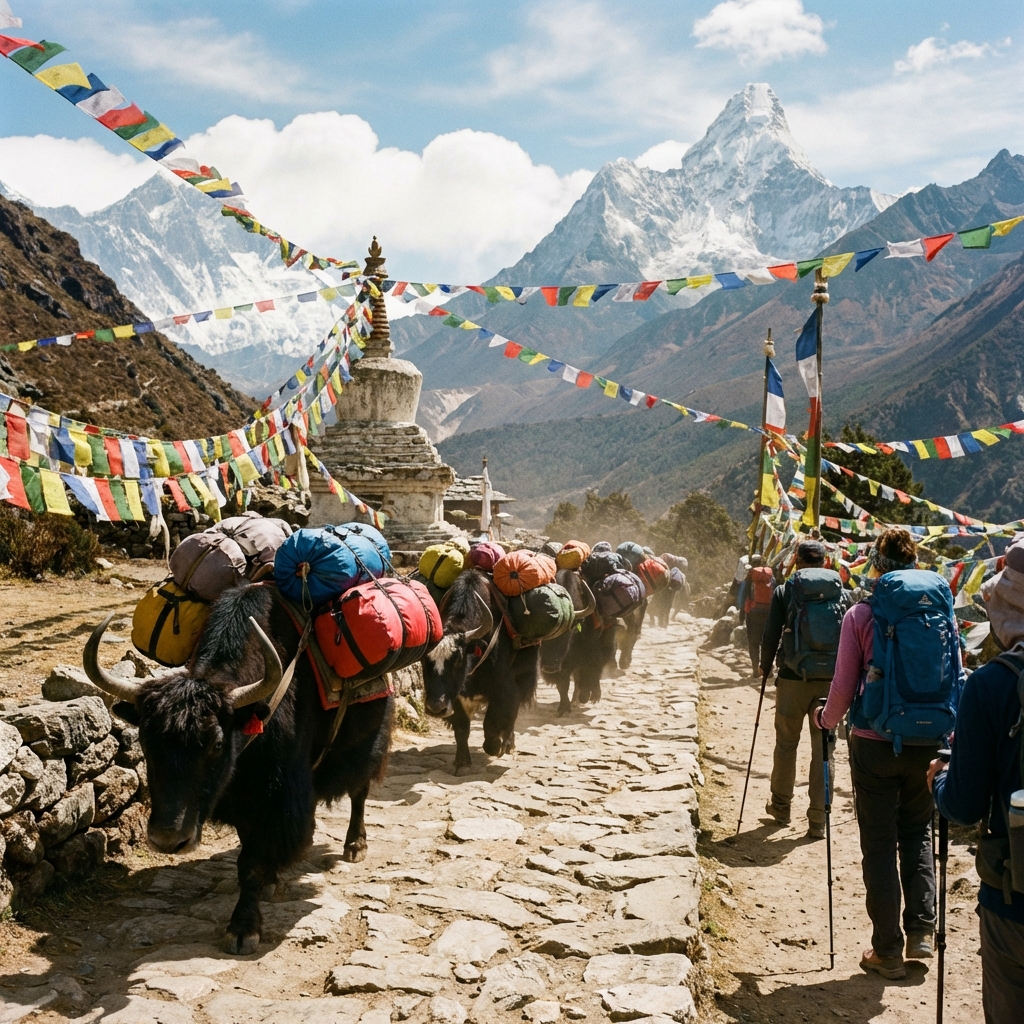
- Sherpa culture (Everest region): Buddhist monasteries, mountaineering heritage, mani walls and prayer flags, traditional hospitality
- Gurung culture (Annapurna region): Hindu-Buddhist blend, military tradition (Gurkhas), round stone houses
- Thakali culture (Kali Gandaki): Nepal's finest cuisine tradition, trading heritage, flat-roofed architecture
- Tamang culture (Langtang): Tibetan-influenced communities, cheese-making traditions
- Tibetan-influenced villages (Manang, Mustang): Buddhist monasteries, chortens, ancient Bon traditions
Nepal's cultural experience is integrated into the trekking infrastructure. Tea houses are family-run operations where you eat with local families, sleep in their homes, and interact naturally with community life. The cultural immersion is organic rather than staged.
Peru's Cultural Richness
Peru's trekking routes combine living Quechua culture with the extraordinary archaeological heritage of the Inca Empire:
- Inca ruins: Machu Picchu (arriving via the Sun Gate is one of travel's great moments), Choquequirao, Winawayna, countless smaller sites along trekking routes
- Quechua communities: Traditional weaving, agricultural terracing, llama and alpaca herding, Pachamama (Earth Mother) spiritual traditions
- Colonial heritage: Cusco's blend of Inca walls and Spanish churches creates a unique cultural landscape
- Textile traditions: Quechua textiles are among the world's finest, with patterns encoding cultural knowledge
- Agricultural heritage: Ancient terracing systems still in use, potato varieties numbering in the thousands
Peru's cultural experience has two layers: the living Quechua culture that persists in mountain communities, and the archaeological record of the Inca civilization that transforms trekking into a journey through history.
Cultural Verdict
Nepal wins for integrated, living cultural immersion. Staying in tea houses operated by mountain families provides daily, organic cultural interaction. The multi-ethnic nature of Nepal's trekking regions means cultural landscapes shift as you trek.
Peru wins for archaeological significance. Nothing in Nepal matches the impact of arriving at Machu Picchu through the Sun Gate after four days of trekking, or discovering Inca ruins embedded in remote mountain trails. The combination of living culture and ancient civilization creates a layered cultural experience.
The Machu Picchu Factor
If visiting Machu Picchu is a life goal, Peru trekking gains an extraordinary advantage that no amount of comparison can offset. The Inca Trail to Machu Picchu is not just a trek; it is a pilgrimage to one of the world's most remarkable archaeological sites. This single destination elevates Peru trekking into a category that combines natural wonder with human achievement in a way no other trekking destination can match. Even the Everest Base Camp trek, while extraordinary, does not deliver a comparable archaeological climax.
6. Scenery and Landscape: Himalayas vs Andes
Nepal Scenery
Nepal's Himalayan scenery is defined by extreme vertical relief and dramatic mountain architecture:
- Eight-thousanders: Eight of the world's fourteen peaks above 8,000m are in Nepal, including Everest (8,849m). These giants dominate the skyline on major treks.
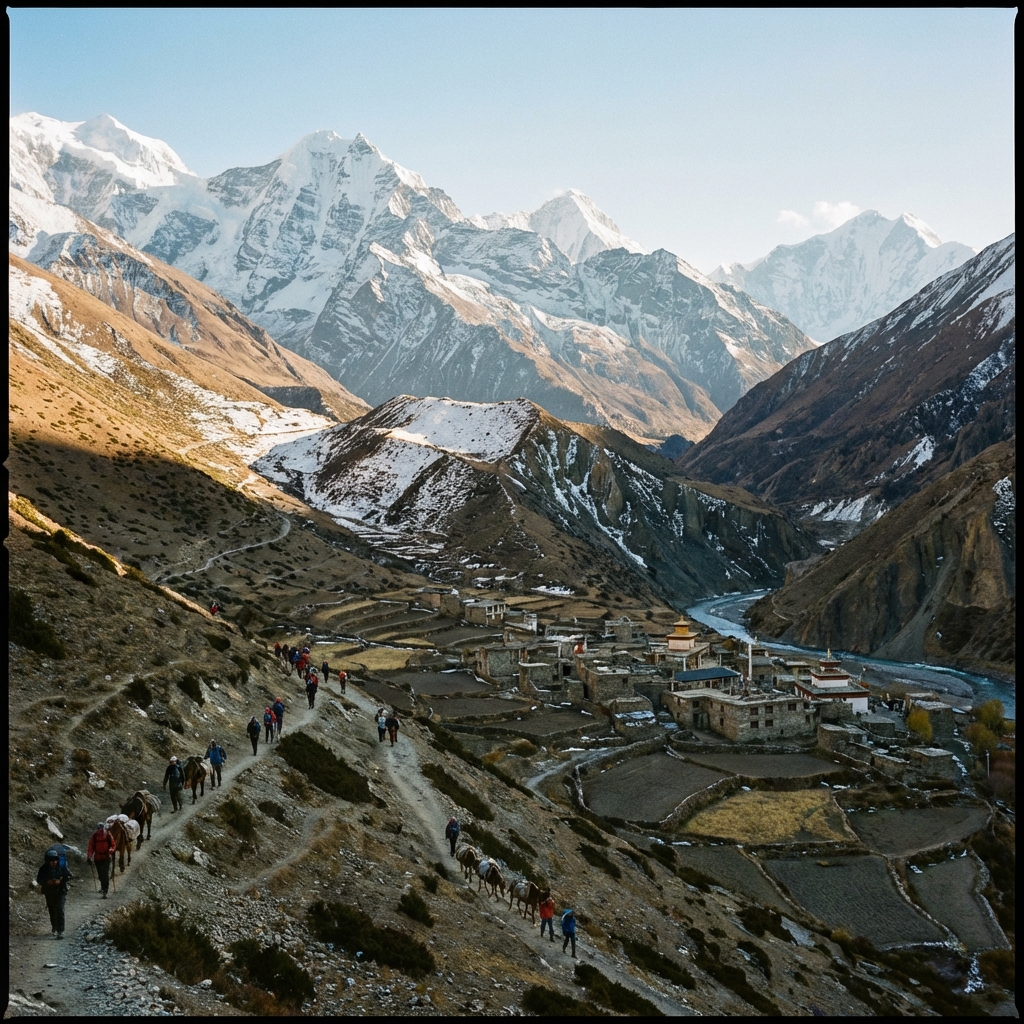
- Landscape diversity: The Annapurna Circuit alone traverses subtropical forest, temperate woodland, alpine meadow, high desert, and arid steppe. Nepal's vertical geography compresses multiple biomes into single treks.
- Glaciers: Massive Himalayan glaciers (Khumbu, Ngozumpa, Annapurna South) provide dramatic ice landscapes at high altitude.
- Gorges: The Kali Gandaki (world's deepest gorge) and numerous river canyons create dramatic valley scenery.
- Mountain architecture: Machapuchare's fishtail summit, Ama Dablam's soaring pyramid, and Everest's massive bulk represent some of the world's most photogenic peaks.
Peru Scenery
Peru's Andean scenery offers a different but equally stunning visual palette:
- Turquoise lakes: Cordillera Blanca and Huayhuash are famous for impossibly turquoise glacial lakes (Laguna 69, Laguna Churup, the chain of Huayhuash lakes). These vivid colors are Nepal's lakes' equal and arguably more visually striking.
- Snow-capped peaks: Huascaran (6,768m), Alpamayo (5,947m, often called "the world's most beautiful mountain"), and the Huayhuash range create dramatic mountain scenery.
- Desert-to-glacier contrasts: Peru's Pacific coast desert transitions to glacier-capped peaks within 150 km, creating extraordinary visual contrasts.
- Canyon landscapes: Colca Canyon (twice as deep as the Grand Canyon) and the Apurimac gorge provide dramatic depth.
- Cloud forest: The descent from Andes to Amazon on treks like the Salkantay passes through lush, misty cloud forest filled with orchids and hummingbirds.
- Rainbow Mountain (Vinicunca): Colorful sedimentary layers create a unique, surreal landscape at 5,036m.
Scenery Verdict
Nepal wins for mountain drama and vertical scale. The Himalayas are simply bigger. Seeing five peaks above 8,000m from a single viewpoint is an experience the Andes cannot replicate. The vertical scale of Nepal's mountains, with faces rising 3,000-4,000m above valley floors, creates a sense of awe that is difficult to match.
Peru wins for color and water features. Peru's turquoise glacial lakes are among the most visually striking natural features on Earth. The combination of vivid lake colors, snow-capped peaks, and unique formations like Rainbow Mountain creates a more colorful visual palette than Nepal's typically monochrome high-altitude landscapes.
7. Permits and Logistics
Nepal Permits
Nepal's permit system is relatively simple and inexpensive:
- TIMS Card: $10-20 (Trekkers' Information Management System)
- National Park/Conservation fees: $20-50 depending on area
- Restricted area permits: $50-500 for areas like Upper Mustang, Dolpo, and Manaslu
- Process: Permits can be arranged by agencies in Kathmandu in 1-2 days, or obtained at trailhead checkpoints
Nepal's permits are generally available without advance booking (except restricted areas). You do not need to book months ahead for standard treks like EBC or the Annapurna Circuit.
Peru Permits
Peru's permit system varies dramatically by trek:
- Inca Trail: $250-300 per person (includes mandatory guide). Limited to 500 people per day (including 300 porters and guides, leaving approximately 200 trekker spots). Must be booked 4-6 months in advance for peak season. This is the world's most restrictive trekking permit.
- Salkantay, Lares, Choquequirao: $10-30 permits, no daily limits, no advance booking required
- Huayhuash Circuit: $20-30 for community and park fees, no daily limits
- Santa Cruz Trek: $20-30, no daily limits
The Inca Trail permit is Peru's most important logistical consideration. Popular dates sell out months in advance, and there is no way to buy permits at the trailhead. This requires planning and commitment that no Nepal trek demands.
Inca Trail Permit Warning
Inca Trail permits for the peak season (June-August) regularly sell out 3-6 months in advance. If the Inca Trail is your primary reason for visiting Peru, book your permit and agency the moment you confirm your travel dates. There are no walk-up permits, no waiting lists, and no exceptions. Missing the permit window means choosing an alternative trek (Salkantay, Lares) or visiting Machu Picchu by train instead.
Logistics Verdict
Nepal is logistically simpler. Permits are cheap, readily available, and do not require months of advance planning. The tea house system eliminates the need to organize camping equipment, porters, and cooks independently.
Peru requires more advance planning for the Inca Trail but is logistically simpler for other treks. The agency-organized camping system (where the agency handles everything) can actually be easier than Nepal's tea house system, where trekkers make daily decisions about food, accommodation, and route variations.
8. Food on the Trail
Nepal Trail Food
Tea house menus across Nepal are remarkably standardized:
- Dal bhat: The national dish (rice, lentil soup, vegetables, pickles). All-you-can-eat at most tea houses. The best meal value on trail.
- Noodle soups: Thukpa and various noodle preparations
- Fried rice and noodles: Vegetable, egg, or chicken variations
- Momos: Dumplings (when available, typically at lower altitudes)
- Pancakes and porridge: Breakfast staples
- Eggs: Boiled, scrambled, or fried
- Chapati and bread: Freshly made at most tea houses
Food quality in Nepal is decent but repetitive. After 10-14 days of similar menus, most trekkers tire of the options. At higher altitudes, fresh vegetables become scarce and meals rely more on preserved and dried ingredients. Dal bhat remains the most reliable and nutritious option throughout.
Peru Trail Food
Agency-prepared camping meals in Peru are often surprisingly excellent:
- Breakfast: Pancakes, eggs, fresh fruit, cereal, hot drinks, fresh bread
- Lunch: Soup, rice or pasta dishes, salad, fresh fruit, hot drinks
- Dinner: Multi-course meals with soup, main course (often chicken, trout, or beef), vegetables, dessert
- Snacks: Trail mix, fruit, crackers, chocolate, coca tea
- Coca tea: The traditional Andean remedy for altitude, served throughout the day
Peru's cook system produces food that is genuinely good, varied, and often creative. Cooks take pride in their menus and compete to produce impressive meals from basic camp kitchen setups. Fresh ingredients are carried from town and supplemented along the route.
Food Verdict
Peru wins for food quality and variety. The dedicated cook system produces meals that are consistently better than Nepal's tea house menus. This is one of Peru trekking's genuine highlights and a frequent pleasant surprise for first-time Peru trekkers.
Nepal wins for convenience and independence. You can eat whenever you want, order what you want, and adjust portions and timing to your preferences. The tea house system gives trekkers food autonomy that the camping system does not.
9. Season and Weather
Nepal Seasons
Nepal has two primary trekking seasons:
- Autumn (October-November): The premier season. Clear skies after monsoon, excellent visibility, stable weather, cool temperatures. The busiest time on trails.
- Spring (March-May): Warmer temperatures, rhododendron bloom, Everest expedition season atmosphere at EBC. Some afternoon cloud buildup. Second-busiest season.
- Winter (December-February): Cold but clear at lower altitudes. High passes may be closed. Few trekkers, very quiet trails.
- Monsoon (June-September): Heavy rain, leeches, poor visibility, trail damage. Not recommended for most treks (exception: rain shadow areas like Upper Mustang and Dolpo).
Peru Seasons
Peru has one primary trekking season:
- Dry season (May-September): Clear skies, cold nights, minimal rainfall. June-August is peak season. This is the only season recommended for most treks.
- Shoulder season (April, October): Some rain, fewer crowds. Viable for shorter treks.
- Wet season (November-March): Heavy rain, trail closures, mudslides. The Inca Trail is closed entirely in February for maintenance. Not recommended.
Season Verdict
Nepal offers more seasonal flexibility with two good seasons separated by months. This provides more scheduling options for international travelers.
Peru's single dry season concentrates trekkers into May-September, making peak season busier relative to trail capacity. However, the dry season coincides with Northern Hemisphere summer vacation, which is convenient for many travelers.
Pro Tip
If you are planning to trek in both countries over your lifetime, the seasons complement each other perfectly. Nepal's autumn (October-November) and Peru's dry season (May-September) do not overlap, meaning you could trek Peru in June-August and Nepal in October-November within a single year. This is the ultimate trekking combination for those with the time and budget.
Which Destination Is Harder?
Nepal treks reach higher altitudes (up to 5,545m on EBC) with more days spent above 4,000m, making altitude the dominant challenge. Peru's top treks (Huayhuash at 5,000m, Inca Trail at 4,215m) are slightly lower but involve camping and carrying more gear. Nepal's tea house system reduces the burden of gear weight. Overall, Nepal's highest treks are harder due to altitude exposure. See our EBC route guide and Annapurna Circuit route guide for Nepal's signature treks.
Which Destination Is Cheaper?
Nepal is cheaper for trekking. Tea house treks cost $30-80/day with accommodation and food on-trail. Peru's camping treks require porters, equipment, and guides at $50-120/day. The Inca Trail permit alone costs $250-300 including mandatory guide. Nepal's trekking permits cost $30-65 for most routes. A two-week Nepal trek runs $1,200-3,000 vs $1,500-4,000 for comparable Peru treks.
Which Has Better Cultural Experiences?
Both are extraordinary but different. Nepal offers living mountain cultures -- Sherpa, Gurung, and Tamang communities in high-altitude villages, Buddhist monasteries, and Hindu temples along trekking routes. Peru offers the Inca archaeological legacy -- Machu Picchu, ancient ruins, Quechua communities, and colonial cities like Cusco. Nepal wins for cultural immersion during the trek itself; Peru wins for historical archaeology. See our best time to trek Nepal and pack with our gear list.
10. Decision Framework: Which Country Matches You?
Choose Nepal If:
You want the world's highest mountains. Nothing matches the Himalayas for sheer mountain scale. If seeing Everest, Annapurna, or Dhaulagiri matters to you, only Nepal delivers.
You prefer tea house (lodge) trekking. If carrying camping equipment (or organizing porters to carry it) does not appeal to you, Nepal's lodge network provides comfortable accommodation without tents.
You value landscape diversity within a single trek. The Annapurna Circuit's five climate zones in one trek is unmatched. Nepal's vertical geography produces extraordinary variety.
You want a longer trekking experience. Nepal's major treks are 12-21 days, providing deep immersion. Peru's most famous treks (Inca Trail, Santa Cruz) are 4-5 days.
You want multiple trekking options in one trip. Nepal's density of world-class treks allows combining shorter treks or choosing from numerous options based on your interests.
You are trekking from Asia or Oceania. Nepal is dramatically closer and cheaper to reach from Asia, Australia, and New Zealand.
Choose Peru If:
Machu Picchu is a life goal. The Inca Trail to Machu Picchu combines extraordinary trekking with one of the world's most remarkable archaeological sites. This single experience justifies choosing Peru.
You prefer a shorter trek with high impact. Peru's 4-5 day treks (Inca Trail, Santa Cruz, Salkantay) deliver extraordinary experiences in less time. If you have a limited vacation window, Peru's shorter treks are more time-efficient.
You want excellent food on the trail. Peru's cook-supported camping system produces meals that consistently surpass Nepal's tea house menus. If trail food matters to your experience, Peru wins.
You want a broader travel experience beyond trekking. Peru offers Machu Picchu, the Sacred Valley, Lake Titicaca, the Nazca Lines, the Amazon, and world-class cuisine in Lima. Nepal's non-trekking attractions are more limited.
You are trekking from the Americas. Peru is closer and cheaper to reach from North and South America than Nepal.
You value crowd control. The Inca Trail's permit system limits daily trekker numbers, ensuring a less crowded experience than Nepal's open-access popular treks.
You are interested in ancient civilizations. If Inca ruins, pre-Columbian history, and archaeological sites enhance your trekking experience, Peru provides a historical dimension that Nepal's trails lack.
Frequently Asked Questions
Which country is harder to trek in?
Nepal reaches higher altitudes and offers longer treks, making its major treks generally more physically demanding. Peru's Huayhuash Circuit is comparable in difficulty to Nepal's major treks, but the Inca Trail and Santa Cruz are moderate treks accessible to fit recreational hikers. Overall, Nepal's highest treks are harder than Peru's highest treks.
Can I do both in one trip?
Geographically impractical. Nepal and Peru are on opposite sides of the world. Combining them requires separate trips. However, the non-overlapping seasons make it possible to trek Peru in June-August and Nepal in October-November within the same year.
Which has better wildlife?
Peru has more visible wildlife on trekking routes: condors soaring above canyons, llamas and alpacas on trails, vicunas in high grasslands. Nepal's mountain wildlife (snow leopard, Himalayan tahr, red panda) is rarely seen on popular trekking routes, though birds are abundant.
Is Nepal or Peru safer for trekking?
Both are very safe for organized trekking. Nepal's primary risks are altitude sickness and occasional trail closures from weather. Peru's primary risks are altitude sickness and occasional petty theft in cities. On-trail crime is extremely rare in both countries. Both have well-established rescue and evacuation systems on major routes.
Which is better for a first-time international trekker?
Peru's shorter treks (Inca Trail, 4 days; Santa Cruz, 4 days) are more accessible for first-time trekkers. The lower altitude ceiling on many Peru treks reduces altitude risk. Nepal's major treks are longer and higher, demanding more fitness and altitude tolerance. However, Nepal's tea house system is simpler to navigate than Peru's camping logistics if trekking independently.
How does food safety compare?
Both countries require standard food safety precautions. In Nepal, eat freshly cooked food (dal bhat is always made to order) and avoid raw vegetables at higher altitudes. In Peru, cooks generally handle food safety well, and the fresh ingredient supply chain is reliable. Stomach issues are possible in both countries; carry appropriate medication.
Which has better trekking infrastructure overall?
Nepal has more extensive trekking infrastructure (more routes, more lodges, more guides, more agencies). Peru has more regulated infrastructure (better permit systems, controlled access, professional porter standards). Nepal is better for independent trekking; Peru is better for organized, agency-supported trekking.
Can I trek independently in Peru like in Nepal?
Most Peruvian treks outside the Inca Trail allow independent trekking with a mandatory licensed guide. However, the camping format means you need to carry all your own gear or hire porters locally. Nepal's tea house system makes independent trekking far simpler. The Inca Trail requires an authorized agency and guide by law.
What about the language barrier?
Nepal: English is widely spoken on popular trekking routes, especially in tea houses that serve international trekkers. Basic communication is rarely a problem.
Peru: English is spoken in tourist areas (Cusco, agencies) but less common in rural areas and on trails. Basic Spanish is very helpful and appreciated. Quechua is the primary language in remote mountain communities.
Which country should I visit first?
If you have time for a longer trek (12 or more days) and want the ultimate mountain experience, go to Nepal first. If you have a shorter window (5-7 days for trekking) and want to combine trekking with cultural sightseeing (Machu Picchu, Cusco, Lima), go to Peru first. Both will make you want to visit the other.
Related Resources
- Nepal Trekking 101: Complete Introduction
- Camping Treks in Nepal
- Tea House Trekking Explained
- Nepal vs Patagonia Trekking
- Best Time to Trek Nepal
- Budget vs Luxury Trekking Nepal
Final Verdict: Two Jewels in the Trekking Crown
Nepal and Peru are not competitors. They are complements. Each offers something the other cannot, and serious trekkers will eventually visit both.
Nepal is the mountain kingdom. It is where trekking reaches its highest expression, literally and figuratively. The Himalayas are the world's greatest mountain range, and Nepal's tea house system makes them accessible to committed trekkers without expedition logistics. For mountain drama, altitude achievement, landscape diversity, and the sheer number of world-class treks available, Nepal is unmatched.
Peru is the civilization trail. It is where trekking intersects with human history in ways that no other destination achieves. Walking the Inca Trail to Machu Picchu is not just a trek; it is a journey through time. The Andes provide stunning mountain scenery, turquoise lakes, and dramatic passes, but the integration of Inca ruins and living Quechua culture elevates Peru trekking into a category of its own.
For your first international trekking trip: choose based on time (Peru for shorter trips, Nepal for longer ones), proximity (Peru from the Americas, Nepal from Asia), and priority (mountains for Nepal, culture plus mountains for Peru).
Then plan the other one. Because you will want to.
Last updated: February 2026. Nepal data verified against Nepal Tourism Board and TAAN reports. Peru data verified against SERNANP and Peru Ministry of Culture records. International flight costs based on aggregate booking data for major departure cities. All costs in USD.