
Booking Tea Houses in Advance on Nepal Treks: When, How, and Do You Need To?
October-November and March-April
EBC and ABC routes in October-November
Most routes in shoulder and off-season
Before 2:00 PM for best room selection
Dining room floor sleeping happens in peak season
Agencies pre-book rooms through local contacts
Possible but unreliable above 3,500m
Some routes now require compulsory booking
"Do I need to book tea houses in advance?" is one of the most asked questions among trekkers planning a Nepal trip. The answer is not a simple yes or no -- it depends on your route, your season, your flexibility, and your risk tolerance. In peak season on the Everest Base Camp route, showing up without a reservation can mean sleeping in a dining room on the floor. On the Langtang trek in December, you might have an entire lodge to yourself.
This guide explains the booking landscape across Nepal's major trekking routes, how the booking process actually works, what to do if you arrive and everything is full, and the emerging regulatory changes that are reshaping how tea house accommodation works in Nepal.
For general tea house information, see our complete tea house trekking guide and our amenities by altitude breakdown.
When Booking in Advance Is Essential
Peak Season: October-November
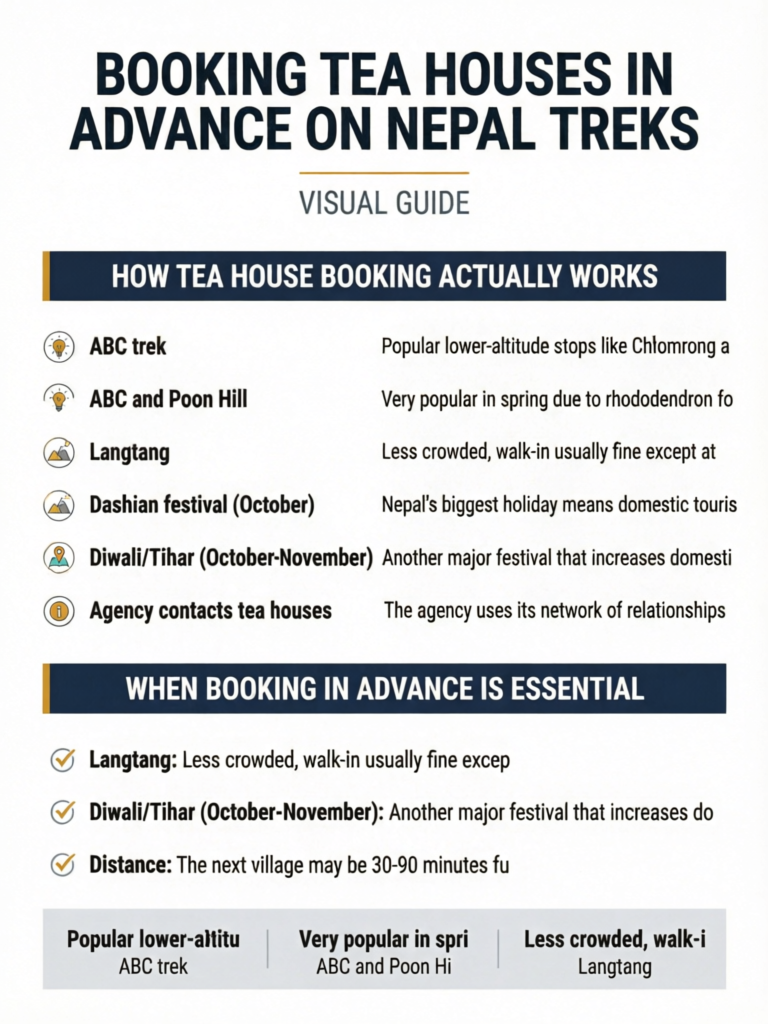
October and November are Nepal's prime trekking months. Clear skies after the monsoon, moderate temperatures, and stunning mountain views attract the majority of the annual trekking traffic. During these two months:
- EBC route: Tea houses at popular stops (Namche, Tengboche, Dingboche, Lobuche, Gorak Shep) regularly fill to capacity. Without a reservation, you may find no beds available at your planned overnight stop, forcing you to either continue to the next village (difficult and sometimes dangerous at altitude) or sleep in the dining room
- Annapurna Circuit: Less extreme than EBC, but Manang and Thorong Phedi can fill up. The section from Manang to Muktinath sees concentrated traffic as most trekkers cross the pass within a similar timeframe
- ABC trek: Popular lower-altitude stops like Chhomrong and Deurali can be packed. Annapurna Base Camp itself has limited lodge capacity
- Poon Hill / Ghorepani: Short, accessible trek that attracts large groups. Ghorepani fills up quickly, especially around sunrise viewpoint dates
During October-November, advance booking is strongly recommended for EBC and highly recommended for other popular routes.
Peak Season: March-April
The spring season is the second busiest period. Rhododendron blooms attract additional trekkers to the Annapurna region. While slightly less crowded than autumn:
- EBC route: Still busy enough that booking is recommended, especially for the higher-altitude stops
- ABC and Poon Hill: Very popular in spring due to rhododendron forests. Booking advised
- Annapurna Circuit: Manageable without booking at most stops, but Manang and Thorong Phedi should be reserved
- Langtang: Less crowded, walk-in usually fine except at Kyanjin Gompa
Specific Dates with Extreme Pressure
Certain dates create booking emergencies:
- Dashain festival (October): Nepal's biggest holiday means domestic tourism surges. Some tea houses near Kathmandu and Pokhara fill with Nepali travelers
- Diwali/Tihar (October-November): Another major festival that increases domestic travel
- Christmas and New Year: Surprisingly busy on EBC route as many international trekkers time trips around these holidays
- Chinese New Year / Korean holidays: Significant numbers of East Asian trekkers create peak demand during these periods
The Gorak Shep Bottleneck
Gorak Shep (5,164m), the final tea house stop before Everest Base Camp, has extremely limited accommodation -- roughly 100-150 beds across all lodges. During peak October-November season, 200-300+ trekkers may arrive in a single day. Without a booking, you may literally have no place to sleep. This is the single most important reservation on the EBC route. Your agency or guide should book this well in advance.
When Walk-In Is Fine
Shoulder Season: September, December, February, May
During shoulder months, tea house traffic drops significantly:
- September: Late monsoon transitioning to clear weather. Fewer trekkers, but some tea houses at highest elevations may still be closed from monsoon
- December: Cold but clear. Traffic drops 70-80% from October levels. Walk-in is fine on all routes
- February: Cold, some snow at altitude. Very few trekkers. Walk-in everywhere
- May: Late spring, warming temperatures and increasing cloud cover. Moderate traffic but far less than March-April
Off-Season: June-August, January
Monsoon season (June-August) and deep winter (January) see the lowest trekker numbers:
- Most routes are quiet enough that you can walk into any tea house and find a room
- Some high-altitude tea houses close entirely during these periods
- The challenge is not finding an available room but finding an open lodge
Less Popular Routes Year-Round
Some routes never need advance booking, even in peak season:
- Manaslu Circuit: Required group trekking and restricted area permits limit numbers. Walk-in is usually fine
- Upper Mustang: Expensive permits keep numbers low. No booking pressure
- Langtang trek: Lower traffic than EBC or Annapurna. Walk-in works most of the time except Kyanjin Gompa in October
- Mardi Himal: Gaining popularity but still manageable without booking
- Tsum Valley: Very few trekkers. No booking needed
The Crowd Calendar
How Tea House Booking Actually Works
Through a Trekking Agency
The most reliable booking method. Here is the process:
- You book a trek with an agency: When you book through a reputable trekking agency, accommodation booking is typically included in the package
- Agency contacts tea houses: The agency uses its network of relationships with tea house owners. Many agencies have long-standing arrangements with specific lodges along each route
- Rooms are reserved: The agency books rooms for your group at each planned overnight stop. This is done by phone or through local contacts, sometimes weeks in advance
- Your guide manages logistics: On the trail, your guide confirms reservations, handles check-in, and resolves any issues
- Flexibility is built in: Good agencies book rooms but can adjust if you need to change plans due to altitude sickness, weather, or preference changes
Advantages of agency booking:
- Guaranteed rooms at all stops, including bottleneck locations like Gorak Shep
- Lodge owners prioritize agency bookings because agencies bring consistent business
- Your guide handles all communication in Nepali
- Backup options available through the agency's network if plans change
Disadvantages:
- Less flexibility to spontaneously change your route
- You may be placed in lodges the agency has relationships with rather than the best lodge in town
- Agency markups on accommodation (usually minimal, NPR 200-500 per night)
For help selecting an agency, see our agency selection guide.
Independent Booking by Phone
If trekking independently, you can try booking tea houses directly:
- Get phone numbers: Lists of tea house phone numbers are available from TAAN, trekking forums, and guidebooks. Numbers change frequently
- Call in advance: Call 1-3 days before arrival. Many tea house owners speak basic English at lower altitudes. Above 3,500m, Nepali language skills help enormously
- Confirm details: State your name, number of people, date of arrival, and whether you want a twin or single room
- Understand the limitations: Phone bookings are informal. There is no written confirmation, no booking number, and no guarantee. Tea house owners sometimes overbook or give your room to someone who arrives in person before you
Advantages of phone booking:
- Free (no agency markup)
- Some flexibility maintained
- Direct relationship with lodge owners
Disadvantages:
- Unreliable above 3,500m where phone signal is poor
- No formal confirmation system
- Language barriers
- Overbooking is common during peak season
- You still need to arrive reasonably early to claim your room
Walk-In (No Booking)
The traditional approach. You arrive at a village, look at available tea houses, and pick one.
Advantages:
- Maximum flexibility -- change plans anytime
- Can choose the best-looking lodge upon arrival
- No commitment to any specific lodge
Disadvantages:
- Risk of no rooms during peak season at popular stops
- May end up in the worst room or in the dining room
- Stressful at altitude when you are tired and need rest
- Need to arrive early (before 2:00 PM) for best options
The Hybrid Strategy
What Happens When Tea Houses Are Full
It happens. Even with bookings, extreme peak season days can overwhelm tea house capacity. Here is what to expect:
Dining Room Floor Sleeping
The most common overflow solution. When all rooms are taken, tea house owners allow trekkers to sleep on the dining room floor after dinner. The stove keeps the room warm initially, but it cools down through the night.
What it is like:
- You lay your sleeping bag on the wooden floor or on thin mats provided
- Shared space with 5-20 other overflow trekkers
- Noise, headlamps, people stepping over you for bathroom visits
- Actually warmer than a private room in some cases because of residual stove heat
- No privacy whatsoever
Tips if it happens:
- Claim your floor space early (before others finish dinner)
- Position yourself near (but not too close to) the stove for warmth
- Earplugs are essential
- Use your daypack as a pillow
- Keep valuables in your sleeping bag with you
Room Sharing with Strangers
Tea house owners may pair solo trekkers with strangers in twin rooms. This is standard practice and generally accepted:
- You share a twin room with someone you have never met
- Communication is key -- introduce yourself and agree on headlamp use, alarm times, and snoring tolerance
- Keep valuables secure
- Most trekkers find this acceptable and sometimes make great friends this way
Moving to the Next Village
Sometimes the solution is continuing to another stop:
- Risk: Walking further at altitude when you are already tired is not ideal, especially in the afternoon when weather can deteriorate
- Distance: The next village may be 30-90 minutes further
- Safety: Do not continue past nightfall. If it is getting dark, dining room floor sleeping is safer than continuing in the dark
The "We Will Find Space" Promise
Tea house owners in Nepal rarely turn anyone away completely. Even if officially full, creative solutions emerge:
- Storage rooms converted to sleeping spaces
- The owner's family room offered to paying guests
- Mattresses placed in hallways
- Neighboring tea houses contacted
The Social Side of Overflow Nights
Some trekkers report that their best trek memories came from overflow nights -- crammed into a dining room with 15 other trekkers, playing cards, sharing stories, and bonding over the shared absurdity of the situation. A full tea house is uncomfortable but often hilarious in retrospect. Embrace it as part of the adventure.
Route-Specific Booking Advice
Everest Base Camp (EBC) Route
Peak season (Oct-Nov, Mar-Apr): Book in advance through an agency or by phone. Critical stops to reserve:
- Namche Bazaar (acclimatization night and return)
- Tengboche or Deboche
- Dingboche (acclimatization night)
- Lobuche
- Gorak Shep (most critical -- smallest village with highest demand)
Off-season: Walk-in is fine at all stops. Some high-altitude tea houses may be closed December through February.
See our detailed EBC accommodation guide and best lodges in the Everest region for specific lodge recommendations.
Annapurna Circuit
Peak season (Oct-Nov): Book Manang (acclimatization) and Thorong Phedi / High Camp. Other stops are usually manageable walk-in.
Spring (Mar-Apr): Moderate demand. Booking Thorong Phedi is wise. Other stops fine walk-in.
Off-season: Walk-in everywhere. Some tea houses close above 4,000m in deep winter.
Annapurna Base Camp (ABC) Trek
Peak season (Oct-Nov, Mar-Apr): Book Chhomrong, Deurali, and Annapurna Base Camp. ABC has limited capacity and fills during peak season.
Off-season: Walk-in fine. Snow may close the route above Deurali in deep winter.
Langtang Trek
Peak season: Book Kyanjin Gompa during peak October-November weeks. Otherwise walk-in is generally fine.
Off-season: Walk-in everywhere. Very few trekkers in winter.
Manaslu Circuit
All seasons: Walk-in is fine. Restricted area permits and mandatory guide requirements naturally limit trekker numbers. The route rarely has capacity issues.
Poon Hill / Ghorepani
Peak season: Book Ghorepani -- this small village gets heavy traffic from both independent trekkers and large groups all wanting to see sunrise from Poon Hill. Tikhedunga is another stop worth booking.
The Emerging Compulsory Booking System
Nepal's tourism authorities have been considering and in some cases implementing compulsory pre-booking requirements for certain routes:
Current Regulations (2026)
- EBC route: A trekking management system has been discussed that would require pre-registration and accommodation booking for the Sagarmatha (Everest) region. Implementation details continue to evolve. Check current requirements before your trek
- Annapurna Conservation Area: No compulsory booking currently, but discussions continue
- Manaslu and restricted areas: These already require organized group trekking through agencies, which effectively means pre-arranged accommodation
- New route permits: Some newer trekking routes require permit holders to have pre-arranged accommodation
What This Means for Trekkers
The trend is clearly toward more managed trekking, particularly on popular routes. This may mean:
- Mandatory pre-booking of accommodation before starting a trek
- Daily trekker caps on certain routes (already implemented on some routes for certain seasons)
- Digital booking systems replacing informal phone arrangements
- Less flexibility for walk-in and spontaneous route changes
- Potential price standardization by the government
Check Current Regulations Before Your Trek
Nepal's trekking regulations change frequently. Rules discussed one year may be implemented, modified, or abandoned the next. Before your trek, verify current booking requirements with TAAN, your trekking agency, or the Nepal Tourism Board. Do not rely on information from previous years' trip reports -- the situation may have changed.
Tips for Securing the Best Rooms
Whether booking in advance or walking in, these strategies help you get the best available accommodation:
Arrive Early
The single most effective strategy. Tea houses allocate rooms on a first-come, first-served basis:
- Aim for 1:00-2:00 PM arrival: This gives you the best room selection
- Before noon is even better: On rest days, use the morning for acclimatization hikes and return to secure your room
- After 3:00 PM: You get whatever is left. In peak season, this may be the dining room floor
Be Flexible on Room Type
- Accept a twin room even if traveling solo -- you may get a roommate, but you have a bed
- Take a room further from the dining room (it is colder but available when closer rooms are taken)
- Accept ground-floor or less desirable rooms in exchange for having a private space
Build Relationships Along the Route
- Lodge owners along the same route communicate. If you are friendly and respectful at one tea house, the owner may call ahead to their friend at the next village to reserve a room for you
- Eat at the lodge where you sleep -- this is expected and builds goodwill
- Learn a few Nepali phrases. "Dhanyabad" (thank you) and "mitho bhayo" (the food was delicious) go a long way
Use Your Guide's Network
If trekking with a guide (even an independent guide without an agency):
- Experienced guides have relationships with specific lodge owners built over years of repeated treks
- Your guide can call ahead, negotiate, and secure rooms that an independent trekker cannot
- Guide recommendations for specific lodges are usually trustworthy -- they know which owners maintain good standards
The Magic of the 12:30 PM Arrival
Frequently Asked Questions
Final Thoughts
The tea house booking situation in Nepal occupies a middle ground between the fully-booked hotel system you know from cities and the completely informal camping-wherever-you-want approach of wilderness backpacking. For most trekkers, the best approach is pragmatic: book the critical bottleneck nights, walk in everywhere else, arrive early, and maintain flexibility.
If the thought of accommodation uncertainty stresses you, book through a reputable trekking agency -- it eliminates the worry entirely and lets you focus on the trek itself. If you value maximum freedom and are comfortable with occasional uncertainty, go independent with a few key reservations at the tightest spots.
Either way, remember that tea house owners are remarkably hospitable. In decades of trekking history, stories of trekkers being truly left without any shelter are vanishingly rare. You will always find a place to sleep -- it might not always be your first choice, but it will be there.