
NPR 300-800+ depending on altitude
Gas-heated (most reliable and warmest)
2:00-4:00 PM after full sun
Around 3,500-4,000m on most routes
3-7 minutes typical at altitude
Baby wipes and wet wipe baths
3-7 days common above 4,000m
NPR 200-500 per thermos at high altitude
Let us be honest: hot showers on Nepal treks are one of those things that sound simple until you are actually standing in a concrete cubicle at 4,000 meters, watching your breath fog in front of you, wondering if the trickle of water will ever get warmer than "barely less freezing." The reality of showering on a Himalayan trek is far more nuanced than most trekking guides suggest.
This comprehensive guide covers everything about hot showers on Nepal treks -- the different heating systems, availability and costs across major routes, the best timing strategies, and crucially, how to maintain good hygiene when showers are not available. Because the truth is, on any trek above 4,000 meters, you will go days without a proper shower, and knowing how to handle that comfortably makes a real difference to your experience.
For a broader overview of tea house facilities, see our complete tea house trekking guide and our amenities by altitude breakdown.
Types of Hot Shower Systems in Nepal Tea Houses
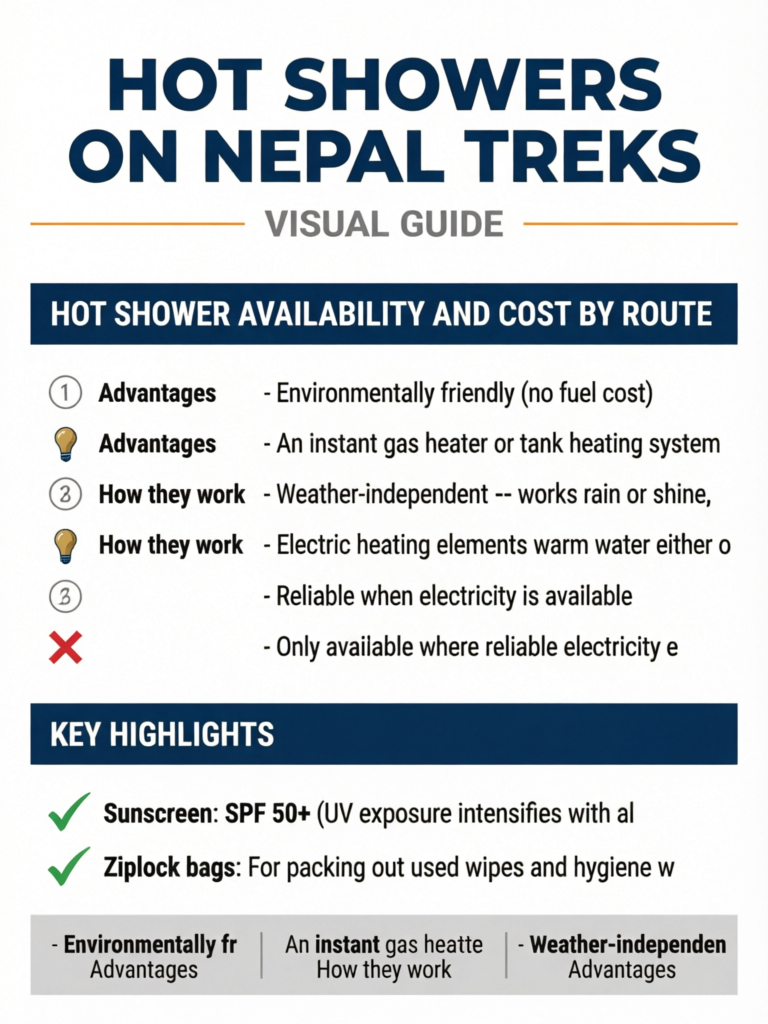
Not all hot showers are created equal. Nepal's tea houses use several different heating systems, each with distinct advantages and quirks.
Solar-Heated Showers
The most common system at mid-altitudes (2,500-3,500m), solar showers use black-painted water tanks or rooftop solar thermal panels to heat water using sunlight.
How they work: Water sits in black tanks or passes through solar panels mounted on the tea house roof. On sunny days, the water heats to a comfortable temperature by mid-afternoon.
Advantages:
- Environmentally friendly (no fuel cost)
- Available at many tea houses at no extra cost or low cost
- Can produce genuinely hot water on clear sunny days
Disadvantages:
- Completely weather-dependent -- cloudy, rainy, or snowy days mean cold water
- Water is only warm in the afternoon (usually after 2:00 PM)
- First person gets the hottest water; each subsequent user gets cooler water
- Limited capacity -- typically enough for 3-6 showers per day
- Useless at high altitude where temperatures are too cold for effective solar heating
Be the Early Afternoon Shower
Gas-Heated Showers
Gas-heated (propane/LPG) showers use bottled gas to heat water on demand or fill a heated tank. These are the most reliable shower systems on the trail.
How they work: An instant gas heater or tank heating system warms water as it flows, similar to domestic gas water heaters.
Advantages:
- Weather-independent -- works rain or shine, day or night
- Produces consistently hot water
- Available on demand (no need to time your shower)
- Can serve many trekkers in succession
Disadvantages:
- More expensive because gas must be carried to remote locations (NPR 400-800)
- Gas shortages occur, especially at high altitude during peak season
- Not all tea houses have gas systems
- Environmental impact of burning fossil fuel
Electric Showers
Found primarily at lower altitudes (below 2,500m) and in hub villages like Namche Bazaar where grid electricity or micro-hydro power is available.
How they work: Electric heating elements warm water either on demand or in a storage tank.
Advantages:
- Reliable when electricity is available
- Consistent temperature
- No fuel logistics
Disadvantages:
- Only available where reliable electricity exists (limited at altitude)
- Power outages mean no hot water
- Pressure can be low
Bucket Showers
At the most basic tea houses and high-altitude locations, the "shower" may simply be a bucket of hot water.
How they work: The kitchen heats water over the cooking fire or gas stove. You receive a bucket (usually 10-15 liters) and a small mug or jug. You stand in a shower stall or bathroom and pour water over yourself.
Advantages:
- Available almost anywhere with a kitchen
- You control exactly how much water you use
- Can be surprisingly effective and satisfying
Disadvantages:
- Not a "real" shower experience
- Limited water volume
- Requires some skill to wash efficiently with a small amount of water
- Water cools quickly in cold bathroom conditions
Hot Shower Availability and Cost by Route
Shower availability varies dramatically across Nepal's major trekking routes. Here is a detailed breakdown:
Everest Base Camp (EBC) Route
| Section | Altitude | Shower Type | Cost (NPR) | Availability |
|---|---|---|---|---|
| Lukla to Namche | 2,860-3,440m | Solar and gas | 300-500 | Good -- most lodges offer showers |
| Namche Bazaar | 3,440m | Gas and electric | 400-600 | Excellent -- multiple options, reliable hot water |
| Namche to Tengboche | 3,440-3,867m | Solar and gas | 400-600 | Good -- available at most stops |
| Tengboche to Dingboche | 3,867-4,410m | Solar (limited) | 500-700 | Fair -- solar only, weather dependent |
| Dingboche to Lobuche | 4,410-4,940m | Rare | 600-800 | Poor -- few lodges offer showers |
| Lobuche to Gorak Shep | 4,940-5,164m | Very rare | 800+ | Very poor -- most trekkers skip showers entirely |
Key notes for EBC: Namche Bazaar is your best opportunity for a hot shower. Take advantage of your acclimatization day there. Above Tengboche, shower quality drops dramatically. Most trekkers take their last proper shower around Dingboche or Tengboche and do not shower again until returning to those elevations on the way down.
Annapurna Circuit (AC) Route
| Section | Altitude | Shower Type | Cost (NPR) | Availability |
|---|---|---|---|---|
| Besisahar to Chame | 760-2,670m | Gas and electric | 300-400 | Excellent -- road access means reliable supply |
| Chame to Manang | 2,670-3,540m | Solar and gas | 400-600 | Good -- competitive lodges offer showers |
| Manang (acclimatization) | 3,540m | Gas | 400-600 | Good -- hub village with decent facilities |
| Manang to Thorong Phedi | 3,540-4,450m | Solar (limited) | 500-700 | Fair to poor -- declining availability |
| Thorong Phedi/High Camp | 4,450-4,850m | Very rare | 700+ | Very poor -- focus on survival, not cleanliness |
| Muktinath descent | 3,710m | Gas | 400-500 | Good -- facilities improve rapidly on descent |
| Jomsom to Pokhara | Below 2,700m | Gas and electric | 300-400 | Excellent -- road access and tourism infrastructure |
Key notes for AC: The Annapurna Circuit has a unique advantage -- the descent side (Muktinath to Jomsom) has road access, so facilities improve dramatically after crossing Thorong La Pass. Take your last good shower in Manang and look forward to a celebratory shower in Muktinath after the pass crossing.
Langtang Trek
| Section | Altitude | Shower Type | Cost (NPR) | Availability |
|---|---|---|---|---|
| Syabrubesi to Lama Hotel | 1,460-2,380m | Gas and solar | 300-500 | Good |
| Lama Hotel to Langtang Village | 2,380-3,430m | Solar | 400-600 | Fair -- fewer options than EBC route |
| Langtang Village to Kyanjin Gompa | 3,430-3,830m | Solar (limited) | 500-700 | Fair to poor -- weather dependent |
Key notes for Langtang: Fewer tea houses along the Langtang route means less competition and fewer shower options at equivalent altitudes compared to EBC. Solar showers work reasonably well in the relatively sunny Langtang Valley during autumn.
Annapurna Base Camp (ABC) Trek
| Section | Altitude | Shower Type | Cost (NPR) | Availability |
|---|---|---|---|---|
| Nayapul to Chhomrong | 1,070-2,170m | Gas and electric | 300-400 | Excellent |
| Chhomrong to Deurali | 2,170-3,230m | Solar and gas | 400-600 | Good |
| Deurali to Machhapuchhre BC | 3,230-3,700m | Solar (limited) | 500-700 | Fair |
| Machhapuchhre BC to ABC | 3,700-4,130m | Rare | 600-800 | Poor |
Key notes for ABC: The ABC trek is shorter than EBC, so the period without showers is briefer. Chhomrong is an excellent shower opportunity. Annapurna Base Camp itself has very limited shower facilities, but you typically only spend one night there before descending.
Do Not Shower in Cold, Drafty Conditions Without Drying Properly
At high altitude, getting wet and not drying thoroughly is a genuine health risk. Hypothermia can set in quickly when you emerge from a shower into a bathroom where the temperature is near or below freezing. If you do shower above 3,500m, bring your warm layers into the bathroom, dry off completely inside the shower stall before opening the door, and get dressed immediately. Wet hair at altitude can lead to rapid heat loss.
Best Strategies for Showering on Trek
Timing Your Showers
The single most important shower strategy is timing:
- Shower on acclimatization days: Rest days at Namche, Manang, or Dingboche give you the afternoon to shower without rushing for the next day's trek
- Solar showers: 2:00-3:30 PM: This is when solar-heated water is warmest. Arriving at your tea house early maximizes your chance
- Gas showers: anytime: If the lodge has gas heating, shower whenever convenient -- morning before trekking or evening before dinner
- Descending days: Take showers on the way back down as facilities reappear. The "return shower" at Namche or Tengboche after days at high altitude is one of the most satisfying moments of any trek
Making the Most of Limited Water
At altitude, water pressure is low and heating capacity is limited. Here is how to shower effectively with minimal water:
- Get wet quickly -- step under the water just long enough to wet your entire body and hair (30 seconds)
- Turn off the water -- step out of the stream and lather up with soap or shampoo
- Rinse efficiently -- turn the water back on and rinse off completely (60-90 seconds)
- Total time: 3-5 minutes is standard. Do not linger -- other trekkers are waiting and the hot water is finite
The Two-Minute Shower Technique
What Soap and Shampoo to Bring
- Biodegradable soap: Essential for environmental responsibility. Dr. Bronner's multi-use soap works for body, hair, and even laundry
- Travel-size shampoo: Bring small bottles, not full-size. You will only shower 6-10 times on a 14-day trek
- No-rinse shampoo: Dry shampoo or no-rinse cap styles work well when water is unavailable
- Skip conditioner at altitude: Your hair will survive. Simplify your routine above 3,000m
Hygiene Without Showers: The Real Guide
Here is the truth that many trekking guides avoid: on any trek above 4,000 meters, you will go 3-7 days without a proper shower. On some treks and in some seasons, it can be longer. Knowing how to stay reasonably clean and comfortable without showering is an essential trekking skill.
The Wet Wipe Bath
The wet wipe bath is the trekker's best friend at altitude. Here is the system:
- Get a basin of warm water from the kitchen (NPR 100-300) or use water from your thermos
- Use baby wipes or large wet wipes for a full-body wipe down in your room or bathroom
- Focus on key areas: Face, neck, armpits, groin, feet, and behind ears. These are where bacteria accumulate fastest
- Use a small towel dampened with warm water for a more thorough clean on face and hands
- Apply deodorant or use a fresh base layer afterward
- Dispose of wipes properly: Pack them out in a sealed ziplock bag. Never throw wipes in tea house toilets or bins
Daily Hygiene Routine Above 4,000m
Even without showers, maintain this daily routine:
Morning:
- Wash face and hands with warm water
- Brush teeth
- Apply sunscreen and lip balm
- Put on fresh or aired-out base layer
After trekking (afternoon):
- Wet wipe bath focusing on sweaty areas
- Change into dry evening base layer
- Wash socks and underwear if possible (hang in dining room near stove to dry)
- Clean feet and apply moisturizer to prevent cracking
Evening:
- Wash hands thoroughly before dinner
- Brush teeth after dinner
- Apply lip balm before sleep
The Fresh Base Layer Rotation
What to Pack for Trekking Hygiene
Essential hygiene kit for any Nepal trek above 3,000m:
- Baby wipes or biodegradable wet wipes: 2-3 packs of 80 (critical -- this is your primary cleaning method at altitude)
- Hand sanitizer: 2-3 small bottles (60-100ml)
- Biodegradable soap: One small bar or travel bottle
- Small quick-dry towel: Microfiber, packs tiny
- Dry shampoo: For greasy hair between washes
- Deodorant: Crystal deodorant or roll-on (spray cans are wasteful and bulky)
- Lip balm with SPF: Lips crack terribly at altitude
- Moisturizer: Small tube for hands and face (dry air at altitude destroys skin)
- Sunscreen: SPF 50+ (UV exposure intensifies with altitude)
- Ziplock bags: For packing out used wipes and hygiene waste
- Toilet paper: Your own supply, always
- Nail clippers: Nails get dirty and damaged on trek
- Toothbrush, toothpaste, floss: Normal dental hygiene kit
A Note on Body Odor at Altitude
Everyone smells on trek. This is normal, expected, and nobody judges you for it. The combination of physical exertion, limited washing, and wearing the same clothes for days means that by the third day at altitude, every trekker has accepted the situation. If it makes you feel better, the cold air actually reduces how much you notice body odor compared to trekking in tropical heat. Focus on keeping your skin healthy rather than smelling pristine.
Cultural Norms Around Bathing in Nepal
Understanding local perspectives on bathing helps you navigate tea house etiquette:
Water Conservation
In mountain communities, water is a precious resource that must be carried, pumped, or channeled from natural sources. Locals are accustomed to bathing far less frequently than most Western trekkers, particularly in winter. Long showers or excessive water use can strain limited supplies for an entire community. Be mindful and keep showers brief.
Modesty
Nepal is a conservative society. When using outdoor shower facilities or washing at communal taps:
- Keep covered: Wear shorts and a sports bra/tank top rather than stripping completely in shared areas
- Be discreet: Use shower stalls with doors and curtains when available
- Ask before washing at village taps: Some community water sources are for drinking only
- Respect gendered spaces: Some lodges have separate washing areas for men and women
Drying Clothes
Wet laundry is a constant challenge on trek. Cultural and practical tips:
- Ask permission before hanging laundry on tea house railings or lines
- Do not hang underwear prominently: In Nepali culture, undergarments displayed openly is considered inappropriate. Dry them discreetly or inside your room
- Use the dining room stove: Hanging socks and small items near (not on) the yak dung stove is common and accepted practice
- Carry a small clothesline: A length of cord or a travel clothesline lets you create a drying line in your room
Never Wash with Soap in Natural Water Sources
Do not wash yourself, your clothes, or your dishes in rivers, streams, or natural springs, even with biodegradable soap. Mountain water sources supply drinking water to communities downstream. Use tea house facilities or carry water at least 60 meters away from any water source before washing. This is both an environmental necessity and a cultural expectation.
Special Considerations for Women
Women on trek face additional hygiene challenges. Here are practical solutions:
Menstruation at Altitude
- Pack sufficient supplies: Bring enough pads, tampons, or menstrual cups for your entire trek plus a few extra days. Resupply options above Namche or Manang are essentially zero
- Disposal: Carry used pads and tampons out in sealed ziplock bags. Do not flush or throw them in tea house bins where waste management is basic
- Menstrual cups: Many female trekkers prefer cups because they create less waste and can be emptied and cleaned with boiled water. Sterilize with boiled water from the kitchen
- Period underwear: Absorbing backup for light days or as a supplement to other methods
- Pain relief: Altitude can affect menstrual cycles. Carry your usual pain medication
Privacy for Washing
- Request rooms with internal access to toilets where possible (mainly available at lower altitudes)
- Use a sarong or large towel as a wrap when walking to and from shared shower facilities
- Shower during quiet times: Early afternoon when most trekkers are still on the trail gives you the most privacy
- Carry a pee cloth: A small antimicrobial cloth for urination hygiene reduces toilet paper use and waste
The Women's Hygiene Kit
When to Splurge on a Shower
Not every shower opportunity is worth taking. Here is when experienced trekkers recommend spending the money:
Always shower:
- Acclimatization days in Namche, Manang, or other hub villages (you have time and the facilities are decent)
- The day before a major pass crossing (start the hardest day fresh)
- The descent day when you return to lower altitude (celebratory shower)
- After any illness with vomiting or diarrhea (hygiene and morale)
Skip the shower:
- At lodges above 4,000m where the water is barely warm and the bathroom is freezing
- On days when you are departing early the next morning (you will sweat again immediately)
- When the lodge only offers a bucket shower at an excessive price (use wet wipes instead)
- During cloudy days at lodges with only solar heating (the water will be cold)
Frequently Asked Questions
The Bottom Line on Trek Showers
Hot showers are a nice-to-have comfort on Nepal treks, not a necessity. The trekkers who have the best experience are those who mentally prepare for the reality: regular showers below 3,500 meters, occasional lukewarm showers between 3,500 and 4,000 meters, and wet wipe baths above that. Once you accept this reality and pack accordingly -- with plenty of wet wipes, a good hygiene routine, and fresh base layers -- the lack of showers becomes a minor inconvenience rather than a major issue.
And there is something oddly satisfying about that first proper hot shower when you descend back to civilization after a week at altitude. Nothing has ever felt so luxurious.