NPR 3,000 (~$23 USD)
NPR 1,500 (~$11 USD)
Free
Kathmandu NTB office, Monjo checkpoint, or via agency
Passport, 2 photos, TIMS card
1976 (UNESCO World Heritage 1979)
1,148 sq km
Monjo (2,835m)
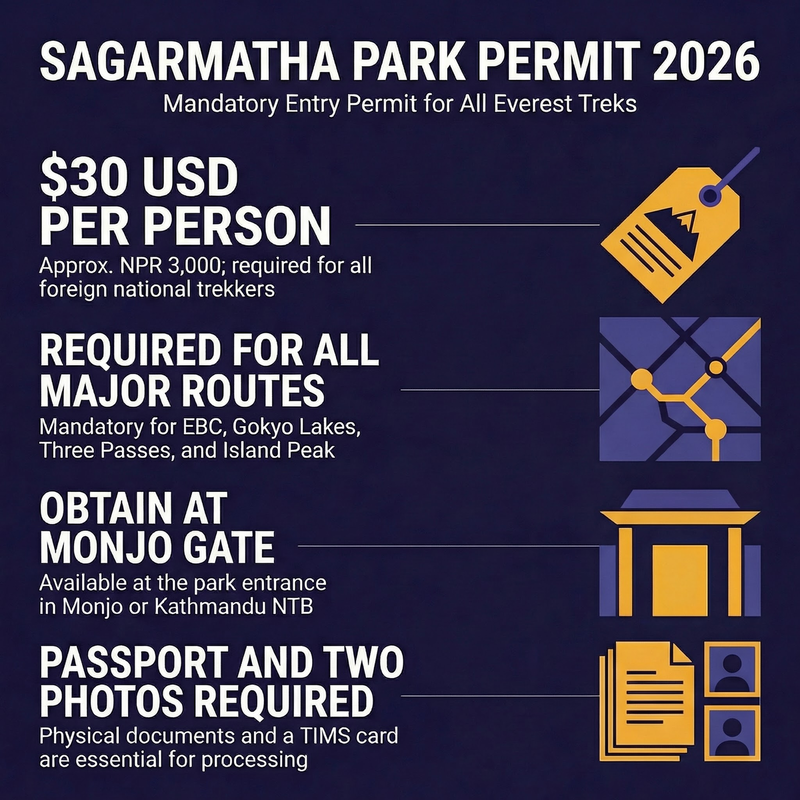
The Sagarmatha National Park permit costs NPR 3,000 (about $23) for foreign nationals and NPR 1,500 for SAARC nationals, with children under 10 free. Every trekker in the Everest region needs one. Get it at the Nepal Tourism Board office in Kathmandu, at the Monjo checkpoint, or have your agency arrange it.
If you are trekking anywhere in Nepal's Everest region -- whether that is the classic Everest Base Camp trek, the stunning Gokyo Lakes circuit, the challenging Three Passes route, or a climbing expedition to peaks like Island Peak -- you need a Sagarmatha National Park entry permit. There are no exceptions.
This permit is one of two essential documents for the Everest/Khumbu region (the other being the TIMS card). It funds the conservation of one of the most extraordinary protected areas on Earth: the home of Mount Everest, sacred Sherpa monasteries, and some of the rarest wildlife in the Himalayas.
This guide covers everything you need to know about the Sagarmatha National Park permit for 2026: current costs, where and how to obtain it, what documents you need, what the permit covers, checkpoint information, park rules, and what to do if something goes wrong.
What Is Sagarmatha National Park?
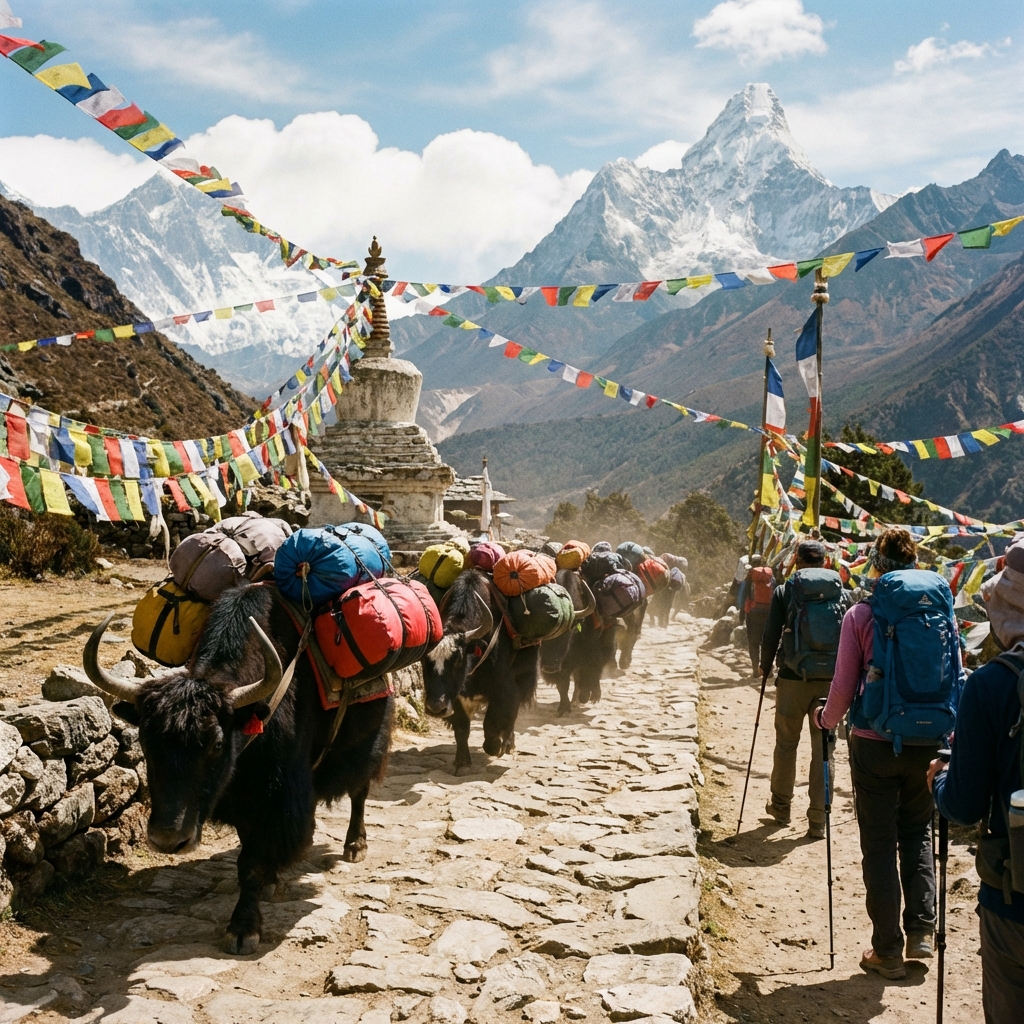
Sagarmatha National Park is Nepal's most famous protected area, encompassing the upper catchment of the Dudh Kosi and Bhote Kosi river systems in the Solukhumbu District of northeastern Nepal. "Sagarmatha" is the Nepali name for Mount Everest, meaning "Forehead of the Sky."
Key Facts About the Park
- Established: July 19, 1976
- UNESCO World Heritage Site: Designated in 1979, recognizing its outstanding natural value
- Area: 1,148 square kilometers (443 square miles)
- Buffer Zone: An additional 275 square kilometers surrounding the park
- Altitude Range: 2,845m (Monjo) to 8,849m (summit of Mount Everest)
- Location: Solukhumbu District, Province No. 1, northeastern Nepal
Notable Peaks Within the Park
The park contains some of the most famous mountains on Earth:
| Peak | Elevation | Rank (World) |
|---|---|---|
| Mount Everest (Sagarmatha) | 8,849m | 1st |
| Lhotse | 8,516m | 4th |
| Cho Oyu | 8,188m | 6th |
| Ama Dablam | 6,812m | -- |
| Pumori | 7,161m | -- |
| Nuptse | 7,861m | -- |
| Island Peak (Imja Tse) | 6,189m | -- |
| Lobuche East | 6,119m | -- |
The park also includes the Ngozumpa Glacier (the longest glacier in the Himalayas), the Gokyo Lakes system, and the Khumbu Icefall.
Cultural Significance
Beyond its natural grandeur, the park protects the homeland of the Sherpa people, who have lived in this region for over 500 years. The park contains several important Buddhist monasteries, including Tengboche Monastery (3,867m), which hosts the annual Mani Rimdu festival. The Sherpa culture of mountaineering, trade, and Buddhist practice is inseparable from the landscape the park protects.
Who Needs This Permit?
Every person entering Sagarmatha National Park needs this permit. This includes:
- Trekkers on the Everest Base Camp trek
- Trekkers on the Gokyo Lakes trek
- Trekkers attempting the Three Passes trek
- Climbers attempting any peak within the park (Island Peak, Lobuche, Mera Peak if entering via Khumbu, etc.)
- Mountaineering expeditions to Everest, Lhotse, Cho Oyu, Ama Dablam, and others
- Day visitors to areas within park boundaries
- Researchers, filmmakers, and journalists working in the park
The only people exempt are Nepali citizens residing within the park boundaries and children under 10 years of age (who may enter free but should still be registered).
Multiple Treks, Multiple Permits
The Sagarmatha National Park permit is valid for a single entry during your specified trekking period. If you leave the park and re-enter (for example, if you trek to Gokyo first, exit the park, and then re-enter for EBC), you may need a new permit. In practice, most trekking routes stay within the park once you enter at Monjo, so this is rarely an issue. Discuss your specific itinerary with the permit office if you have concerns.
2026 Permit Fees
The current Sagarmatha National Park entry fees for 2026 are:
| Category | Fee | Approximate USD |
|---|---|---|
| Foreign nationals | NPR 3,000 | ~$23 |
| SAARC nationals (India, Pakistan, Bangladesh, Sri Lanka, Maldives, Bhutan, Afghanistan) | NPR 1,500 | ~$11 |
| Nepali citizens | NPR 100 | ~$0.75 |
| Children under 10 (all nationalities) | Free | Free |
The fee is charged per person per entry, and the listed amounts are inclusive of the 13% VAT applied to national park entry fees.
Payment methods:
- Cash (Nepali Rupees) at all locations
- Some offices accept USD or other major currencies, though change may be given in NPR
- Credit/debit card payment is generally not available at the Monjo checkpoint -- bring cash as a backup
Pro Tip
Fee History and Changes
Nepal's national park fees have remained relatively stable in recent years, but periodic increases occur. Understanding the history helps you anticipate potential changes:
| Year | Foreign National Fee | Notes |
|---|---|---|
| Pre-2015 | NPR 1,000 | Long-standing rate |
| 2015-2022 | NPR 3,000 | Increased after 2015 earthquake to fund reconstruction |
| 2023-Present | NPR 3,000 | Rate maintained |
The government has periodically discussed increasing national park fees for foreign visitors. While no increase has been confirmed for the 2026 season, it is possible. Check with the Nepal Tourism Board for the most current rates before your trek.
Where to Obtain the Sagarmatha National Park Permit
You have several options for obtaining your permit, listed from most to least convenient:
Option 1: Through Your Trekking Agency (Recommended)
If you are trekking with a registered agency -- which is required under Nepal's 2026 trekking regulations for most routes -- your agency will typically obtain the Sagarmatha permit on your behalf as part of their service package.
Advantages:
- No need to visit any office yourself
- Agency handles paperwork and payment
- Often included in the trek package price
- Your guide carries the permit for the group
What to provide your agency:
- A copy of your passport (photo page)
- Two passport-sized photos (some agencies take these for you)
- Your trekking dates
What to verify:
- Confirm that the park permit is included in your package price
- Ask to see the actual permit before departure
- Ensure the dates on the permit match your trekking dates
Option 2: Nepal Tourism Board Office in Kathmandu
The Nepal Tourism Board (NTB) office in Kathmandu issues permits for all national parks and conservation areas.
Location: Pradarshani Marg, Bhrikutimandap, Kathmandu (near the Exhibition Ground)
Hours: Sunday-Thursday 10:00 AM - 5:00 PM, Friday 10:00 AM - 3:00 PM (closed Saturday and public holidays)
Process:
- Bring your passport, two passport-sized photos, and your TIMS card (or apply for TIMS at the same office)
- Fill out the application form (available at the office)
- Submit the form with your documents and photos
- Pay the fee
- Receive your permit card -- usually issued same day within 30-60 minutes
Pro Tip
Option 3: Monjo Checkpoint (On the Trail)
If you did not obtain your permit in Kathmandu, you can get it at the Monjo checkpoint, which is the official entrance to Sagarmatha National Park.
Location: Monjo village, approximately 2,835m, between Phakding and Namche Bazaar on the EBC trail
When you will reach it: Typically on Day 2 of the EBC trek (Day 1 after flying to Lukla)
Hours: Generally open during daylight trekking hours (approximately 7:00 AM to 5:00 PM)
Process:
- Present your passport and two passport-sized photos
- Fill out the entry form
- Pay the fee in cash (NPR preferred)
- Receive your permit card
Advantages:
- Convenient if you forgot or could not get it in Kathmandu
- Available right on the trail
Disadvantages:
- Can create delays if there is a queue
- Cash only -- if you do not have NPR, you may face difficulties
- Photos are required and difficult to obtain on the trail
- If there are any issues (missing documents, etc.), you are stuck on the trail with limited options
Do Not Rely on Getting Your Permit at Monjo
While it is technically possible to obtain your permit at the Monjo checkpoint, we strongly recommend getting it in Kathmandu or through your agency before departure. Arriving at the checkpoint without proper documents or cash can result in being turned away, and there are no photo studios or ATMs in Monjo. Additionally, if you are trekking with a guide (now required), your agency should handle this for you.
Required Documents
To obtain your Sagarmatha National Park permit, you need:
- Valid passport -- Must be the original (not a photocopy) with at least 6 months validity remaining
- Two passport-sized photographs -- Recent photos (taken within the last 6 months). Standard 35mm x 45mm. White or light background. Some offices may accept digital photos on your phone, but physical photos are more reliable.
- TIMS card -- Your Trekkers' Information Management System card. If you do not have one yet, you can apply for both TIMS and the national park permit at the NTB office simultaneously. See our TIMS card guide.
- Completed application form -- Available at the issuing office. Basic information: name, nationality, passport number, trekking route, dates, emergency contact.
If trekking with an agency:
- Your agency may also need a copy of your passport photo page
- The agency will have a group trekking permit letter that lists all members
Pro Tip
Application Process Step by Step
At the NTB Office in Kathmandu
- Arrive at the NTB office at Bhrikutimandap during business hours
- Request the application form from the permit counter
- Fill out the form with your personal details, passport number, trekking route (e.g., "Everest Base Camp"), estimated entry and exit dates, emergency contact information, and insurance details
- Attach one passport photo to the form and hand the second to the officer
- Submit the form along with your passport for verification
- Pay the fee (NPR 3,000 for foreign nationals)
- Wait for processing -- typically 15-30 minutes
- Receive your permit card -- a laminated card with your photo, personal details, and validity dates
- Check all details on the permit card before leaving. Ensure your name, passport number, and dates are correct.
Through Your Agency
- Provide your passport copy and photos to your agency when booking
- The agency submits the application on your behalf (often as a group application for all trekkers)
- The agency pays the fee (included in your package or charged separately)
- Your guide carries the permits for the group
- Verify your details on the permit before departure
Permit Validity
- Single entry: The permit allows one entry into Sagarmatha National Park
- Duration: Valid for the dates specified on your permit (your trekking period)
- No time limit within the park: Once inside, you can stay as long as your permit dates allow. There is no daily fee -- just the one-time entry fee.
- Cannot be extended: If your trek takes longer than planned, you may need to clarify your situation at the park office. In practice, rangers are understanding about weather delays and medical issues.
- Not transferable: The permit is linked to your passport number and cannot be used by anyone else
Checkpoints on the Trail
Your permit will be checked at official checkpoints within and around the park. Be prepared to show it at:
Monjo Checkpoint (2,835m)
This is the main entry checkpoint to Sagarmatha National Park, located in the village of Monjo between Phakding and Namche Bazaar.
- What happens here: Park rangers check your Sagarmatha permit and TIMS card. Your details are recorded in the park's trekker log. If you do not have a permit, you can purchase one here (cash only).
- Typical wait time: 5-15 minutes during normal periods, up to 30-45 minutes during peak season mornings
- Important: This checkpoint is where the trail crosses the Dudh Kosi river via a suspension bridge. The park boundary officially begins here.
Jorsalle Checkpoint
A secondary checkpoint located between Monjo and the steep ascent to Namche Bazaar. Permits may be checked here as well, particularly during busy seasons when the park increases monitoring.
Other Checkpoints
Occasional permit checks may occur at:
- Namche Bazaar -- Police checkpoint (checks permits and TIMS)
- Tengboche -- Occasionally staffed
- Pheriche/Dingboche area -- Periodic checks
- Lobuche -- Periodic checks during peak season
Pro Tip
What Your Permit Covers
The Sagarmatha National Park entry fee funds a range of conservation and infrastructure activities within the park:
Conservation Programs
- Wildlife protection and anti-poaching patrols
- Habitat restoration and vegetation monitoring
- Snow leopard conservation program (camera trap surveys, prey population monitoring)
- Climate change research (glacier monitoring, weather stations)
Trail and Infrastructure Maintenance
- Trail maintenance -- Repairing and improving trekking paths, bridges, and steps
- Signage -- Trail markers, safety signs, and distance indicators
- Waste management -- Clean-up campaigns, waste collection points, recycling programs
- Toilet facilities -- Construction and maintenance of public toilets along trails
Community Development
- Local school funding in Sherpa communities
- Healthcare support for remote communities within the park
- Alternative energy projects (solar power, micro-hydro) to reduce firewood dependency
- Cultural heritage preservation -- Monastery maintenance and cultural programs
Emergency and Safety Services
- Ranger stations throughout the park for safety and information
- Search and rescue coordination with helicopter services
- Weather monitoring and warnings
Combining with TIMS Card
You need both the Sagarmatha National Park permit and a TIMS card to trek in the Everest region. These are separate documents issued by different authorities:
| Document | Issuing Authority | Purpose | Cost (Foreign) |
|---|---|---|---|
| Sagarmatha National Park Permit | Department of National Parks and Wildlife Conservation | Park entry and conservation funding | NPR 3,000 |
| TIMS Card | Nepal Tourism Board / TAAN | Trekker tracking and safety | NPR 2,000 (individual) / NPR 1,000 (group via agency) |
Both can be obtained at the NTB office in Kathmandu, or your agency can handle both. See our complete TIMS card guide for details on the TIMS application process.
2024 Solo Trekking Regulations
Since 2026, Nepal has required trekkers to hire a licensed guide for most trekking routes, including the Everest region. If you are trekking with a registered agency, your TIMS card will be issued as a "group" TIMS at a lower cost (NPR 1,000). Independent trekkers who obtain special permission will pay the higher "individual" rate (NPR 2,000). See our complete permits guide for details on these regulations.
The Second Permit You Need: Khumbu Pasang Lhamu Rural Municipality Permit
Most Everest region trekkers actually need two entry permits, not the Sagarmatha permit alone. Since 2018, the local government -- the Khumbu Pasang Lhamu Rural Municipality -- has charged its own entry fee that funds local trail upkeep and community services. In practice, this local permit, rather than a TIMS card, is the document checked alongside your Sagarmatha permit on the EBC trail.
| Item | Detail |
|---|---|
| Cost (all foreign and SAARC nationals) | NPR 3,000 (about $23) for the first 4 weeks; NPR 2,000 per additional week |
| Where to get it | Lukla (on arrival) or the Monjo checkpoint -- it is not issued in Kathmandu |
| Documents | Passport and two passport-sized photos |
| Who needs it | All trekkers entering the Khumbu, including EBC, Gokyo, and Three Passes |
You Cannot Get the Khumbu Permit in Kathmandu
Unlike the Sagarmatha National Park permit, the Khumbu Pasang Lhamu Rural Municipality permit is only issued locally -- at Lukla or Monjo. You pay it in cash (NPR) after you land in Lukla. If you trek with an agency, your guide collects it for the group, so most trekkers never handle this directly. Budget roughly NPR 6,000 total per person (NPR 3,000 Sagarmatha + NPR 3,000 Khumbu) for the two core Everest permits.
Trekking In Via Jiri? Add the Gaurishankar Permit
If you walk the classic Jiri to Everest Base Camp route instead of flying to Lukla, the first stretch passes through the Gaurishankar Conservation Area. That requires a separate Gaurishankar Conservation Area permit -- NPR 3,000 for foreign nationals, NPR 1,000 for SAARC nationals, and free for children under 10. You can obtain it at the Nepal Tourism Board office in Kathmandu before you set off.
Park Rules and Regulations
When entering Sagarmatha National Park, you agree to abide by the following rules:
Prohibited Activities
- Hunting or harming wildlife -- Strict penalties including fines and imprisonment
- Collecting plants, flowers, or natural objects -- Including rocks, fossils, and medicinal plants
- Setting open fires -- Use of firewood is restricted; lodges use kerosene, gas, or electricity
- Playing loud music -- Respect the tranquility of the park and local communities
- Using drones without specific permission from the park authority and the Civil Aviation Authority of Nepal
- Littering -- All waste must be packed out or disposed of in designated collection points
- Disturbing cultural sites -- Monasteries, mani walls, and chortens must be treated with respect
Environmental Responsibilities
- Stay on marked trails -- Do not create shortcuts or new paths
- Use designated campsites if camping (most trekkers use tea houses)
- Carry a waste bag and pack out all non-biodegradable waste
- Use toilet facilities where available; where not available, bury waste at least 30m from water sources
- Minimize plastic -- Bring reusable water bottles and purification methods. See our water purification guide
Cultural Etiquette
- Walk clockwise around mani walls and chortens (Buddhist monuments)
- Remove shoes before entering monasteries
- Ask permission before photographing people or religious ceremonies
- Dress modestly at cultural and religious sites
See our cultural etiquette guide for comprehensive guidance on respectful behavior.
Wildlife in Sagarmatha National Park
The park is home to remarkable biodiversity despite its extreme altitude. The permit fees directly fund protection of these species:
Mammals
- Snow leopard (Panthera uncia) -- The park's most iconic and elusive resident. Population estimated at 4-6 individuals. Camera trap surveys funded by park fees have provided vital data.
- Himalayan tahr (Hemitragus jemlahicus) -- Wild goat frequently spotted on steep hillsides, especially between Namche and Tengboche
- Himalayan musk deer (Moschus leucogaster) -- Small, endangered deer with distinctive canine tusks
- Red panda (Ailurus fulgens) -- Found in bamboo forests at lower elevations of the park (below 4,000m)
- Himalayan black bear -- Occasionally spotted at lower elevations
- Himalayan pika, weasel, and marten -- Smaller mammals common throughout the park
Birds
Over 150 bird species have been recorded in the park, including:
- Himalayan monal (Nepal's national bird) -- Stunningly colorful pheasant
- Blood pheasant -- Found in rhododendron forests
- Lammergeier (bearded vulture) -- Massive vulture with 2.5m wingspan, often seen soaring above valleys
- Yellow-billed chough -- Common at high altitude, often seen around Gorak Shep and EBC
Vegetation
- Rhododendron forests (spectacular blooms in March-May)
- Birch and juniper forests (3,000-4,000m)
- Alpine meadows (4,000-5,000m)
- Moss and lichen communities (above 5,000m)
Important Facilities Within the Park
Himalayan Rescue Association (HRA) Clinic - Pheriche
- Location: Pheriche, 4,371m (on the main EBC trail)
- Services: Altitude sickness diagnosis and treatment, supplemental oxygen, Gamow bag, emergency stabilization
- Staffing: Volunteer physicians during the main trekking seasons (March-May and September-November)
- Daily altitude sickness lecture: Free, usually at 3:00 PM -- highly recommended for all trekkers
- Cost: Consultations are donation-based; medications are charged at cost
Ranger Stations
Ranger stations are located at several points throughout the park, including Monjo, Namche Bazaar, and Tengboche. Rangers can provide:
- Trail condition updates
- Weather information
- Wildlife sighting reports
- Emergency assistance coordination
- General park information
Emergency Services
- Helicopter landing zones: Available at Namche Bazaar, Pheriche, Gorak Shep, and several other locations
- Communication: Most lodges above Namche have satellite phone access for emergencies
- Rescue coordination: The park works with helicopter companies and the Nepal Army for emergency evacuations
See our guide on helicopter rescue in Nepal for detailed evacuation information.
If You Lose Your Permit
Losing your permit during a trek is stressful but manageable:
- Report the loss to the nearest park ranger station or checkpoint
- Show your passport as identification -- rangers can look up your entry in their logs
- A replacement may be issued at the ranger station or at the Monjo checkpoint on your exit
- A replacement fee may apply (typically the same as the original permit cost)
- Having a photo of your permit on your phone helps speed up the replacement process
Pro Tip
Practical Tips for Permit Day
If Getting Permits in Kathmandu Before Your Trek
- Combine permit runs: Get your Sagarmatha permit and TIMS card at the NTB office in a single visit
- Go early: Arrive when the office opens (10:00 AM) to avoid afternoon crowds
- Bring exact change: NPR 3,000 for the park permit plus NPR 1,000-2,000 for TIMS
- Bring at least 4 passport photos: Two for each permit
- Bring your passport original: Photocopies are not accepted for verification
- Allow 1-2 hours: For both permits combined, including wait times
If Your Agency Is Handling Permits
- Confirm inclusion: Verify that all required permits are included in your package and their cost is covered
- Provide documents early: Send your passport copy and photos to the agency well before your trek start date
- Check the permits: Before your trek begins, ask to see the actual permits and verify your details are correct
- Carry your own copies: Even if your guide holds the originals, keep photocopies in your daypack
Sagarmatha National Park and the Best Time to Trek
The park is open year-round, but conditions vary dramatically by season:
| Season | Months | Conditions | Crowd Level |
|---|---|---|---|
| Peak Autumn | October-November | Clear skies, moderate temperatures, best views | Very high |
| Winter | December-February | Cold at altitude, clear skies, fewer trekkers, some lodges closed above Tengboche | Low |
| Peak Spring | March-May | Warming temperatures, rhododendron blooms, good visibility (hazier than autumn) | High |
| Monsoon | June-September | Heavy rain, leeches, clouds, trails slippery, most trekkers avoid this period | Very low |
See our complete guide to the best time to trek the Everest region for detailed seasonal information.
Frequently Asked Questions
Can I enter Sagarmatha National Park without a permit?
No. The Monjo checkpoint strictly controls entry, and you will not be allowed past without a valid Sagarmatha National Park permit. There are no alternative entry points that bypass the checkpoint system.
Is the Sagarmatha permit the only permit I need for EBC?
No. You also need a TIMS card. Some routes may require additional permits (for example, climbing permits for peak ascents like Island Peak). The Khumbu Pasang Lhamu Rural Municipality also charges a local fee. See our comprehensive permits guide for the full list.
Can I get the permit at Lukla airport?
No. There is no permit office at Lukla. You must either get the permit in Kathmandu, have your agency arrange it, or purchase it at the Monjo checkpoint on the trail.
How long is the permit valid?
The permit is valid for your specified trekking period (the dates listed on the permit card). There is no daily fee -- just the one-time entry fee regardless of how many days you spend in the park.
Do I need a separate permit for Gokyo Lakes or Three Passes?
No. The Sagarmatha National Park permit covers all areas within the park, including the Gokyo valley, Renjo La, Cho La, and Kongma La passes. The same permit covers EBC, Gokyo, Three Passes, and any combination thereof.
Can I pay in USD at the Monjo checkpoint?
The checkpoint primarily accepts Nepali Rupees. While they may accept USD in some cases, this is not guaranteed, and you may receive unfavorable exchange rates. Bring NPR cash to be safe.
What happens if my trek runs longer than planned?
If weather, illness, or other circumstances extend your trek beyond the dates on your permit, rangers are generally understanding. Explain your situation at the next checkpoint. You are unlikely to face penalties for legitimate delays. However, significantly exceeding your permit dates without explanation may raise questions.
Is the Sagarmatha permit the same as the Khumbu Pasang Lhamu Rural Municipality fee?
No. These are separate fees. The Sagarmatha National Park permit is a federal government fee for the national park. The Khumbu Rural Municipality fee is a local government fee. You may need to pay both. Your agency will typically handle all required fees.
Can I visit Sagarmatha National Park as a day trip?
Technically yes, but practically no. The park entrance is at Monjo, which requires at least a flight to Lukla and a day's trek to reach. There are no road access points to the park. Day visits are not feasible for most travelers.
Do children need a separate permit?
Children under 10 enter free but should still be registered at the checkpoint. Children 10 and older pay the full fee. Bring the child's passport as proof of age.
Can I get the Sagarmatha permit online?
No. There is currently no official online portal to buy and print the Sagarmatha National Park permit yourself. It is issued in person -- at the Nepal Tourism Board office in Kathmandu or the Monjo checkpoint -- or arranged on your behalf by a registered agency. Be cautious of third-party sites claiming to sell "online" permits; the simplest legitimate route is to let your agency handle it.
What is the total permit cost for the Everest Base Camp trek?
Budget about NPR 6,000 (roughly $46) per foreign trekker for the two core Everest permits: NPR 3,000 for the Sagarmatha National Park permit plus NPR 3,000 for the Khumbu Pasang Lhamu Rural Municipality permit. Add the Gaurishankar Conservation Area permit (NPR 3,000) only if you trek in via Jiri. For the full EBC budget, see our EBC trek cost breakdown.
Do I need a visa as well as a permit?
Yes -- a Nepal tourist visa and your trekking permits are separate things. You need a valid tourist visa to enter Nepal (available on arrival at Kathmandu airport or in advance), then your park permits to trek. See our Nepal visa guide for current visa fees and the on-arrival process.
Is a passport required for the permit?
Yes. Your original passport (valid at least 6 months) is required to issue the permit -- the permit is linked to your passport number and is non-transferable. A photocopy alone is not accepted for verification at the issuing office.
Summary
The Sagarmatha National Park permit is a straightforward but essential requirement for any trek in the Everest region. The simplest approach is to have your trekking agency handle it as part of your trek package. If you prefer to arrange it yourself, visit the NTB office in Kathmandu the day before your trek with your passport, photos, and cash.
The NPR 3,000 fee represents remarkable value -- it grants you access to a UNESCO World Heritage Site containing the highest mountain on Earth, extraordinary biodiversity, and one of the world's great trekking regions. The fee directly supports the conservation and community programs that keep this extraordinary place intact for future generations of trekkers and the Sherpa communities who call it home.
For the full picture of all permits required for trekking in Nepal, see our comprehensive Nepal trekking permits guide. For Everest region-specific planning, see our guides to the EBC trek, Gokyo Lakes, and the best time to trek the Everest region.
Let a Verified Local Agency Handle Your Everest Permits
Skip the paperwork. Book your Everest Base Camp trek with a verified Nepal agency and your Sagarmatha and Khumbu Pasang Lhamu permits are arranged for you.