
Snow above 4,500m, monsoon leech zones
40-100g per pair
200-450g per pair
$15-80 depending on type
Ankle gaiters block entry at boot top
Full gaiters keep snow out of boots
Basic gaiters available; premium options limited
Mid-height waterproof gaiter
Kathmandu Gaiters: Where to Buy, Rent, and What to Choose
You can buy gaiters in Kathmandu for NPR 500-2,000 ($4-16) from gear shops in Thamel, where basic nylon trail and mid-height gaiters are widely stocked. Premium brands like Outdoor Research and Black Diamond appear inconsistently and cost 20-40% more than online retail, so most trekkers buy budget gaiters in Kathmandu and bring quality pairs from home. Renting is possible but rare.
This guide covers Kathmandu gaiter shopping and rental, then explains exactly when you need gaiters for trekking in Nepal, which type to choose for snow, mud, and leeches, and honest product picks at every budget. Jump to buying gaiters in Kathmandu for shop-by-shop detail.
Gaiters are one of those pieces of gear that many Nepal trekkers overlook entirely and then wish they had on the trail. They are not on every standard packing list, and for good reason: on a clear October day on the main Everest Base Camp trail, you do not need them. But step off the beaten path, trek during shoulder seasons, encounter unexpected snowfall above 4,500m, or venture into the lower forests during monsoon season, and gaiters transform from unnecessary extra to the single item that saves your trek from misery.
A gaiter is a protective covering that wraps around your lower leg and the top of your boot, sealing the gap between your trekking pants and your boots. That gap is where snow enters on high passes, where mud splashes on rainy trail sections, where small rocks and debris work their way into your boot and cause blisters, and most memorably, where leeches in the lower forests of Nepal crawl up and find exposed skin or gaps in your clothing.
This guide covers when you actually need gaiters for Nepal trekking, the different types available, how to choose the right pair for your specific trek and season, and honest product recommendations at every budget level. We also cover the surprisingly effective budget alternatives that many experienced Nepal trekkers swear by.
When Do You Actually Need Gaiters in Nepal?
Not every Nepal trek requires gaiters. Understanding when they are necessary and when they are dead weight helps you make the right packing decision.
Scenario 1: Snow at High Altitude
Above 4,500m in Nepal, snow is possible in any month of the year and probable from November through April. On popular routes like EBC, the Annapurna Circuit, and Manaslu, the trail above 4,500m frequently crosses snowfields, especially early in the morning before the sun softens the surface.
When you walk through snow without gaiters, several problems emerge within minutes. Snow enters through the gap between your boot top and your pant leg. It melts against the warmth of your skin and sock, soaking your socks from the top down. Wet socks at altitude mean cold feet, and cold feet at 5,000m are not just uncomfortable but a genuine frostbite risk on long pass days. Full-height gaiters seal this gap completely, keeping snow out regardless of depth.
The worst conditions for snow entry are post-step holes in soft snow. Your foot punches through a crust, your leg sinks to mid-calf or knee, and without gaiters, snow packs itself into every gap in your footwear. Crossing Cho La (5,420m), Renjo La (5,360m), or Thorong La (5,416m) in snowy conditions without gaiters is a recipe for wet, cold feet within the first hour.
Early Season and Late Season Pass Crossings
Trekkers crossing high passes in early October or late November frequently encounter more snow than expected. Weather patterns do not follow rigid calendar schedules, and early snowfall can blanket passes in 15-30cm of fresh snow with no warning. If your trek includes any pass above 5,000m, carrying gaiters is cheap insurance even in peak season. They weigh 200-400g and can prevent a miserable pass day.
Scenario 2: Mud and Rain in Lower Valleys
The approach valleys to most Nepal treks -- the Lukla to Namche section of EBC, the Besisahar to Manang road on the Annapurna Circuit, the Soti Khola to Jagat section of Manaslu -- pass through lower-altitude forests and farmland where trails turn to mud after rain. During spring (March to May) and especially during and immediately after monsoon season (June to September), these sections can be ankle-deep mud baths that splash up onto your pants and seep into your boots.
Lightweight trail gaiters or mid-height gaiters in these conditions keep mud and splashback out of your boots and off your lower legs. They do not prevent your boots from getting muddy, but they prevent mud from entering through the boot top, which is the primary cause of the wet, gritty, blister-inducing misery that ruins lower-altitude trail days.
Scenario 3: Leech Protection During Monsoon
This is the scenario that most dramatically demonstrates the value of gaiters. Nepal's lower forests, particularly below 3,000m on the Annapurna, Manaslu, Langtang, and eastern Nepal routes, are home to land leeches during the monsoon months (June through September, with some activity in May and October in wet years). These small, thread-like creatures wait on leaves, soil, and trail edges, sensing the vibrations and warmth of passing trekkers. They attach to any exposed skin and crawl toward warm, moist areas -- and their favorite entry point is the gap between boot top and trouser hem.
Gaiters create a sealed barrier that leeches cannot penetrate. A properly fitted gaiter that covers from boot sole to mid-calf, with a tight seal at both top and bottom, eliminates the most common leech entry point. Combined with tucking trekking pants into the gaiter and applying DEET or salt solution to the gaiter exterior, this creates an effective leech defense system.
For more comprehensive leech protection strategies, see our detailed guide on leeches, bites, and insects during Nepal trekking.
Pro Tip
If you are trekking during monsoon season and want leech protection without buying dedicated gaiters, a pair of tall socks worn over your pants tucked into your boots, combined with liberal DEET application, provides about 80% of the protection at zero additional weight. However, purpose-built gaiters are more reliable because they cannot be dislodged by brush contact or gradually loosen during a full day of walking.
Scenario 4: Scree and Debris Protection
Several sections of popular Nepal treks cross loose scree slopes where small rocks and gravel constantly work their way into boots. The Kala Patthar climb above Gorak Shep, the approach to Tilicho Lake, and sections of the Manaslu Circuit near Larkya La are particularly rocky. Trail gaiters -- even the lightest, most minimal versions -- keep small debris out of your boots, preventing the hot spots and blisters that develop when a pebble works its way under your foot for hours.
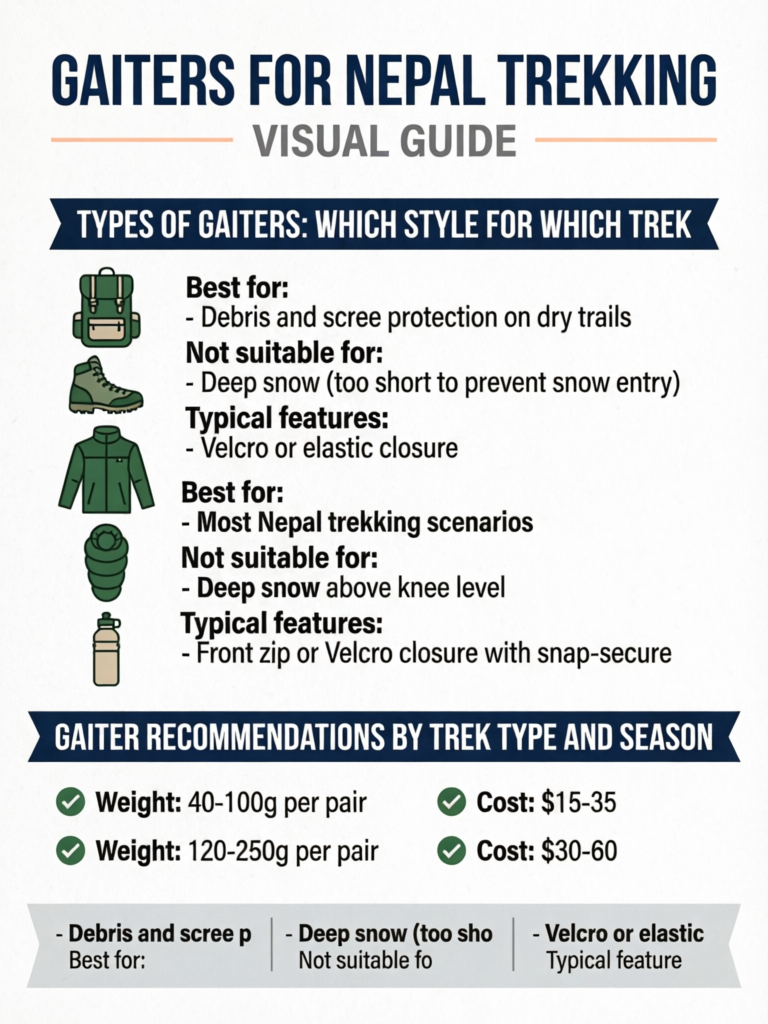
Types of Gaiters: Which Style for Which Trek
Gaiters come in three basic categories, each suited to different conditions. Understanding the differences helps you choose the right type rather than defaulting to the biggest, heaviest option.
Trail Running / Ankle Gaiters
These are the lightest and most minimal gaiter option. They cover from the boot sole (with an instep strap or integrated hook) to just above the ankle, typically 15-20cm of coverage. They are made from lightweight, breathable materials and weigh as little as 40-70g per pair.
Best for:
- Debris and scree protection on dry trails
- Light mud splash prevention
- Everyday trekking in peak season below 4,500m
- Trekkers who want minimal weight and bulk
Not suitable for:
- Deep snow (too short to prevent snow entry)
- Serious mud conditions (too short for full splash protection)
- Leech protection (insufficient coverage area)
Typical features:
- Velcro or elastic closure
- Instep strap or hook
- Breathable mesh or nylon construction
- Weight: 40-100g per pair
- Cost: $15-35
Mid-Height Gaiters
These extend from the boot sole to mid-calf, typically 25-35cm of coverage. They offer a balance between protection and weight, and are the most versatile option for Nepal trekking. They provide enough height to block snow entry in moderate conditions, prevent mud splashes, and create a leech barrier.
Best for:
- Most Nepal trekking scenarios
- Moderate snow conditions (up to 15-20cm depth)
- Mud and rain protection
- Leech protection during monsoon
- Trekkers who want one gaiter for all conditions
Not suitable for:
- Deep snow above knee level
- Technical mountaineering
Typical features:
- Front zip or Velcro closure with snap-secured storm flap
- Instep strap (rubber or nylon)
- Drawcord or elastic top closure
- Water-resistant or waterproof fabric
- Weight: 120-250g per pair
- Cost: $30-60
Full-Height Mountaineering Gaiters
These extend from the boot sole to just below the knee, providing maximum protection. They are made from heavy-duty waterproof materials, often with a reinforced lower section for crampon and rock abrasion resistance. They are the standard for peak climbing and high-altitude mountaineering in Nepal.
Best for:
- Deep snow conditions above 5,000m
- Pass crossings in winter conditions
- Peak climbing expeditions
- Cold and windy high-altitude conditions
- Trekkers who will encounter sustained deep snow
Not suitable for:
- Lower-altitude trekking in warm conditions (too hot and heavy)
- Lightweight or fast trekking (excessive weight penalty)
Typical features:
- Heavy-duty waterproof outer (Gore-Tex or equivalent)
- Reinforced Cordura lower panel
- Heavy-duty front zip with storm flap
- Wire or plastic instep cable
- Drawcord and buckle top closure
- Weight: 250-450g per pair
- Cost: $50-120
The 80/20 Rule for Nepal Gaiters
For 80% of Nepal trekkers on standard tea house routes in peak season, a mid-height gaiter is the best single purchase. It handles the snow you might encounter on passes, the mud you will encounter in valleys, and the debris that is constant on rocky trails. Full mountaineering gaiters are overkill for most tea house treks, and trail gaiters are too minimal for pass crossings. A mid-height gaiter weighing 150-200g is the sweet spot.
Gaiter Materials: What Works in the Himalayas
Waterproof Breathable (Gore-Tex, eVent, Proprietary Membranes)
Premium gaiters use waterproof breathable membranes identical to those in rain jackets. These provide complete waterproofing while allowing some moisture vapor to escape, reducing sweat buildup inside the gaiter. The advantage is obvious in wet conditions: your lower legs stay dry from external moisture while not becoming soaked from trapped perspiration.
The downside is cost. Gore-Tex gaiters typically run $60-120, roughly double the price of non-membrane alternatives. For trekkers who will encounter sustained rain or wet snow, the investment is worthwhile. For trekkers in peak dry season who primarily want debris protection, a non-membrane gaiter works fine.
Water-Resistant Nylon (DWR-Coated)
Most mid-range gaiters use a nylon or polyester outer fabric with a DWR (Durable Water Repellent) coating. This sheds light rain and snow effectively but is not truly waterproof under sustained wet conditions. After extended use, the DWR coating degrades and water begins to soak through.
For peak season Nepal trekking where sustained rain is uncommon, DWR-coated gaiters provide adequate water resistance at a lower weight and cost than membrane gaiters. They handle snow contact, splash, and brief rain showers well. For monsoon trekking or extended wet conditions, they are inadequate.
Cordura and Reinforced Panels
The lower portion of quality gaiters -- from the instep to about 10cm above the boot sole -- takes the most abuse. It contacts rocks, scrapes against trail surfaces, and is repeatedly compressed by the instep strap. Premium gaiters use Cordura nylon or similar ballistic-weight fabric in this zone for abrasion resistance, while using lighter fabric above.
If you are crossing rocky passes or climbing peaks, reinforced lower panels significantly extend gaiter life. For trail trekking on maintained paths, this reinforcement is less critical.
Gaiter Recommendations by Trek Type and Season
The following table provides specific gaiter recommendations based on where you are going and when. Use this as a decision framework for your specific trek.
| Trek / Season | Gaiter Type | Priority | Notes |
|---|---|---|---|
| EBC Peak Season (Oct-Nov) | Mid-height, water-resistant | Recommended | Snow possible above Lobuche; debris on Kala Patthar |
| EBC Winter (Dec-Feb) | Full-height, waterproof | Essential | Deep snow likely above Dingboche |
| EBC Spring (Mar-May) | Mid-height, waterproof | Recommended | Variable snow, some rain in lower sections |
| Annapurna Circuit Peak (Oct-Nov) | Mid-height, water-resistant | Recommended | Thorong La snow; mud in Marsyangdi valley |
| Annapurna Circuit Monsoon (Jun-Sep) | Mid-height, waterproof | Essential | Heavy rain, mud, active leech zone below 3,000m |
| Manaslu Circuit Peak (Oct-Nov) | Mid-height, waterproof | Recommended | Larkya La snow; muddy lower sections |
| Langtang Peak Season | Mid-height, water-resistant | Optional | Moderate terrain; useful for Kyanjin Ri snow |
| Any trek Monsoon Season | Mid-height, waterproof | Essential | Leech protection and rain/mud management |
| Peak Climbing (any season) | Full-height, waterproof | Essential | Deep snow, crampon compatibility required |
| Lower Altitude Treks (below 4,000m) | Trail/ankle gaiters | Optional | Debris protection; leech protection if monsoon |
Pro Tip
If you are doing the Three Passes Trek (EBC with Cho La, Renjo La, and Kongma La), upgrade to full-height waterproof gaiters regardless of season. The three passes frequently have deeper snow than the main EBC trail, the approaches are steeper with more postholing potential, and you will spend more time in exposed, windy conditions above 5,000m. Mid-height gaiters are barely adequate for a single pass; three passes demand full protection.
Product Comparison: Best Gaiters for Nepal Trekking
Trail and Ankle Gaiters
| Product | Weight | Height | Material | Waterproof | Price | Best For |
|---|---|---|---|---|---|---|
| Dirty Girl Gaiters | 42g | 10cm | Stretch nylon | No | $20 | Debris only, ultralight |
| Trail Gaiter by Outdoor Research | 68g | 15cm | Nylon with DWR | Water-resistant | $28 | Light trail use, debris |
| Salomon Trail Gaiters Low | 55g | 12cm | Stretch mesh | No | $25 | Trail running crossover |
| Black Diamond CircAccess Gaiter | 74g | 18cm | Nylon, Cordura base | Water-resistant | $32 | Debris and light mud |
Mid-Height Gaiters (Best All-Around for Nepal)
| Product | Weight | Height | Material | Waterproof | Price | Best For |
|---|---|---|---|---|---|---|
| Outdoor Research Rocky Mountain Low | 170g | 28cm | Nylon with Cordura | Water-resistant | $39 | Budget all-rounder |
| REI Co-op Backpacker Gaiter | 195g | 30cm | Nylon with DWR | Water-resistant | $35 | Value pick |
| Outdoor Research Verglas Gaiters | 180g | 32cm | Gore-Tex | Fully waterproof | $65 | Premium wet conditions |
| Black Diamond Frontpoint Gaiter | 210g | 33cm | Gore-Tex, Cordura lower | Fully waterproof | $75 | Rugged conditions |
Full-Height Mountaineering Gaiters
| Product | Weight | Height | Material | Waterproof | Price | Best For |
|---|---|---|---|---|---|---|
| Outdoor Research Crocodile | 380g | 42cm | Gore-Tex, Cordura | Fully waterproof | $89 | Industry standard, peak climbing |
| Black Diamond Apex GTX | 360g | 40cm | Gore-Tex | Fully waterproof | $85 | Premium mountaineering |
| Rab Latok Alpine Gaiter | 340g | 38cm | eVent, Cordura | Fully waterproof | $79 | Lighter mountaineering option |
| Budget Kathmandu Gaiter | 420g | 40cm | Coated nylon, basic | Water-resistant | $15-25 | Budget option, limited durability |
How to Fit and Use Gaiters Properly
Even the best gaiter fails if fitted incorrectly. Proper fitting takes five minutes and ensures your gaiters actually work when conditions demand them.
Step 1: Instep Strap Placement
The instep strap passes under your boot sole, between the heel and the ball of the foot. It should sit flat against the boot sole without twisting. If the strap rides forward under the ball of the foot, it will press uncomfortably against your foot with every step. If it rides too far back under the heel, it may slip off.
Step 2: Front Closure Alignment
The front closure (zip, Velcro, or snap-secured flap) should run straight up the front of your shin, centered over the boot tongue. Most gaiters are designed with left and right designations -- check the labels and ensure you have the correct gaiter on each leg. The closure flap should face outward so that brush and debris contact deflects over the closure rather than catching and opening it.
Step 3: Top Closure Tension
The drawcord or elastic at the top of the gaiter should be snug enough to prevent snow and debris entry but not so tight that it restricts blood flow or bunches your trekking pants uncomfortably. You should be able to slide two fingers between the gaiter top and your leg. For leech protection, tighten the top closure more firmly and tuck your pant legs inside the gaiter.
Step 4: Boot Hook Engagement
Many gaiters have a small metal or plastic hook at the bottom front that clips to your boot laces. This prevents the gaiter from riding up as you walk. Ensure the hook is engaged and the lace it clips to is securely tied. On multi-day treks, check this hook periodically as it can work loose on rocky terrain.
Pro Tip
For monsoon trekking with leech concerns, apply a band of DEET insect repellent or a salt-water solution around the top edge of your gaiter and along the instep strap. Leeches are deterred by DEET and killed by concentrated salt solution. Re-apply every few hours as rain and sweat dilute the treatment. This creates a chemical barrier that supplements the physical barrier of the gaiter itself.
Budget Alternatives and Kathmandu Options
Not everyone needs or wants to invest in premium gaiters, and Nepal offers several budget alternatives that work surprisingly well for standard trekking conditions.
Buying Gaiters in Kathmandu
Where to buy gaiters in Kathmandu: head to the gear shops clustered around Thamel, Kathmandu's trekking-equipment district. They stock gaiters in three tiers:
- Budget unbranded/copy gaiters — NPR 500-2,000 ($4-16): simple Velcro closures, basic instep straps, water-resistant (not waterproof) nylon. Adequate for a single peak-season trek.
- Genuine-brand stock (Outdoor Research, Black Diamond, Rab) — typically 20-40% above online retail: availability varies week to week, so do not count on a specific model being in stock.
- Convincing copies of brand gaiters: priced between the two; quality is hit or miss, so inspect the instep strap stitching and zip before buying.
Thamel's gear shops stock these basic nylon gaiters most reliably. They are typically unbranded or Chinese-manufactured, with simple Velcro closures, basic instep straps, and water-resistant nylon construction. For a single trek in non-extreme conditions, they work adequately. The Velcro tends to clog with mud and lose grip after a few days, and the instep straps are the first point of failure, but for the price, they provide reasonable protection.
If you need a gaiter you can trust on a snowy 5,000m+ pass, buy a reputable brand before your trip and bring it with you — Kathmandu's genuine-brand availability is too inconsistent to plan around. For everything else, picking up a NPR 1,000-1,500 pair in Thamel on arrival is the cheapest sensible option. Pair your gaiter shopping with the rest of your kit using our Kathmandu rent vs buy gear guide and Kathmandu gear rental guide.
Can You Rent Gaiters in Kathmandu?
Renting gaiters in Kathmandu is possible but uncommon. A few Thamel rental shops keep gaiters alongside sleeping bags and down jackets, but stock is inconsistent and the condition of rental pairs varies widely. Because gaiters are cheap to buy outright (NPR 500-1,500) and must fit your specific boots, buying a budget pair almost always beats renting. Reserve rental for big-ticket items like four-season sleeping bags and expedition down jackets instead.
The Plastic Bag Gaiter Hack
Experienced Nepal trekkers often mention the plastic bag method for emergency snow protection. Wrap a heavy-duty plastic bag or trash bag around your lower leg and over your boot top, securing it with rubber bands or cord. This is ugly, noisy, and temporary, but it prevents snow entry in a pinch. It is not a substitute for real gaiters on a planned pass crossing, but it works as emergency backup if conditions deteriorate unexpectedly.
DIY Leech Guards
For monsoon trekking where leech protection is the primary concern, some trekkers use tall sports socks worn over their pant legs and boot tops, secured with rubber bands. Others use tobacco-soaked cloth strips wrapped around their ankles. These traditional methods have been used by Nepali farmers and porters for generations and provide reasonable leech deterrence for lower-altitude trekking.
Do Not Skip Gaiters for Monsoon Treks Below 3,000m
The lower-altitude forests of Nepal during monsoon season can have extraordinary leech density. On some sections of the Annapurna trail below Ghorepani and the Langtang trail below Lama Hotel, trekkers report dozens of leeches attempting to attach during a single day of walking. Without gaiters or equivalent protection, you will spend more time removing leeches from your boots and socks than actually enjoying the trek. The small weight and cost of a pair of mid-height gaiters is trivial compared to the discomfort and distraction of persistent leech encounters.
Care and Maintenance
Gaiters require minimal maintenance but a few practices extend their life significantly.
Cleaning After Each Trek
Rinse gaiters thoroughly with fresh water after each trek to remove mud, salt (from sweat), and debris. Pay particular attention to the Velcro closures, which trap small stones and organic matter that degrade their grip. Use a soft brush to clean the Velcro hooks. Allow gaiters to air-dry completely before storage to prevent mildew.
DWR Restoration
The DWR coating on water-resistant gaiters degrades with use, washing, and UV exposure. After a few treks, you will notice water no longer beads on the surface but instead soaks into the fabric. Restore DWR by washing the gaiters and then tumble-drying them on medium heat for 20 minutes (the heat reactivates the DWR) or by applying a spray-on DWR treatment like Nikwax TX.Direct.
Instep Strap Inspection
The instep strap is the highest-wear component of any gaiter. Before each trek, check the strap for fraying, the buckle or connector for cracks, and the attachment points for loosening stitches. A broken instep strap mid-trek renders the gaiter nearly useless, as it will ride up with every step. Carry a small length of cord or a cable tie as emergency instep strap replacement.
Storage
Store gaiters loosely in a dry location, not compressed or folded tightly. Ensure all closures are open to allow air circulation. Do not store in direct sunlight, as UV degrades both the fabric and the DWR coating over time.
How Gaiters Work with the Rest of Your Gear
Gaiters do not exist in isolation. They interact with your boots, pants, and lower-body layering system, and the right combination matters.
Gaiters and Boot Compatibility
Not all gaiters work with all boots. The instep strap must be wide enough to wrap around your boot sole, and the gaiter circumference must accommodate your boot's volume at the ankle. Before your trek, put on the boots you will actually wear and fit the gaiters over them. Walking around the house for 30 minutes reveals any fit issues.
High-cut boots work best with mid-height and full-height gaiters because the gaiter sits over the boot's upper, creating a continuous sealed surface. Low-cut trail shoes with ankle gaiters are a valid ultralight combination for lower-altitude treks in dry conditions but offer limited protection for snow or leech scenarios.
Gaiters and Pants Integration
Your trekking pants should work smoothly with your gaiters. The pant leg should either sit over the gaiter top (standard for debris and snow protection) or tuck inside the gaiter (preferred for leech protection). Pants with narrow ankle cuffs or internal snow cuffs sometimes interfere with gaiter placement, so test the combination before your trek.
Gaiters and Crampons
For peak climbing or high-altitude trekking where crampons are required, your gaiters must be compatible with crampon straps. Full-height mountaineering gaiters are designed with reinforced lower sections that resist the abrasion of crampon points and accommodate crampon attachment straps without interference. Lighter gaiters can be punctured and torn by crampon points within hours.
Frequently Asked Questions
Where can I buy gaiters in Kathmandu?
Gear shops in Thamel are the place to buy gaiters in Kathmandu. Basic nylon trail and mid-height gaiters cost NPR 500-2,000 ($4-16), and a few shops carry genuine Outdoor Research, Black Diamond, or Rab gaiters at 20-40% above online retail. Buy budget pairs in Thamel on arrival; bring a trusted brand from home if you are crossing snowy high passes.
How much do gaiters cost in Kathmandu?
Budget unbranded gaiters in Kathmandu cost NPR 500-2,000 (about $4-16). Genuine-brand gaiters, when available in Thamel, run roughly $40-100 — typically 20-40% more than buying online. For a single tea house trek, a NPR 1,000-1,500 pair is enough.
Can I rent gaiters in Kathmandu?
A few Thamel rental shops stock gaiters, but availability is inconsistent and the condition varies. Because gaiters are cheap to buy (NPR 500-1,500) and need to match your specific boots, buying a budget pair makes more sense than renting. Save rentals for sleeping bags and down jackets.
Do I need gaiters for the Everest Base Camp trek?
For peak season (October-November), gaiters are recommended but not essential for the standard EBC route. Snow is possible above Lobuche (4,910m) and on the approach to EBC itself, and gaiters keep debris out on the rocky Kala Patthar climb. For shoulder seasons and winter, gaiters become essential. If your budget and pack space allow, carrying a lightweight pair is worthwhile insurance.
Are gaiters necessary for the Annapurna Circuit?
In peak season, they are recommended for the Thorong La pass crossing where snow is common. For monsoon or late spring trekking, they become essential for leech protection in the lower Marsyangdi valley. The Annapurna Circuit covers such a wide altitude range that a mid-height gaiter handles all conditions from the lower forests to the pass.
Can I rent gaiters in Kathmandu?
Some gear rental shops in Thamel stock gaiters, but availability is inconsistent and the condition of rental gaiters varies widely. Unlike sleeping bags or down jackets, gaiters are inexpensive enough that buying a budget pair in Kathmandu (NPR 500-1,500) makes more sense than renting. The fit needs to match your specific boots, which is harder to guarantee with rental stock.
What size gaiters should I buy?
Gaiter sizing is based on boot size and calf circumference. Most manufacturers offer Small, Medium, and Large sizes. Measure your calf circumference at its widest point and check the manufacturer's sizing chart. When in doubt, size up -- a gaiter that is too tight restricts blood flow and is uncomfortable during all-day wear, while a slightly loose gaiter can be tightened with the top drawcord.
Do gaiters make your legs too hot?
In warm, lower-altitude conditions (below 3,000m), full-height gaiters can trap heat and cause excessive sweating. Trail gaiters and mid-height gaiters with breathable panels mitigate this. For warm-weather trekking, put gaiters on only when conditions demand them (entering a leech zone, crossing a muddy section) rather than wearing them all day. Above 4,000m, heat buildup is rarely an issue because ambient temperatures are cooler.
Are gaiters waterproof?
It depends on the construction. Gore-Tex and similar membrane gaiters are fully waterproof. DWR-coated nylon gaiters are water-resistant (they shed light rain and snow but soak through in sustained wet conditions). Mesh and lightweight trail gaiters are not waterproof at all. For monsoon trekking or heavy snow conditions, invest in a truly waterproof gaiter.
Can I use gaiters with trail running shoes?
Yes, and many ultralight trekkers do. Ankle gaiters designed for trail running shoes seal the gap between shoe and sock without adding bulk. This combination works well for lower-altitude treks, fast approaches, and dry conditions. For snow, deep mud, or leech zones, higher boots with mid-height gaiters provide more complete protection.
How do I prevent leeches from getting past my gaiters?
Ensure the top of the gaiter is snug against your leg with no gaps. Tuck your pant legs inside the gaiter rather than over it. Apply DEET insect repellent or a concentrated salt solution around the gaiter top, instep strap, and any seams where leeches might find entry points. Check for leeches during rest stops by lifting your pant leg and inspecting the gaiter interior. See our complete leech protection guide for more strategies.
Should I bring gaiters for a short trek like Poon Hill?
For the Poon Hill trek in peak season, gaiters are optional. The trail stays below 3,200m with no snow and well-maintained paths. However, if you are trekking Poon Hill during or near monsoon season (May-September), lightweight gaiters for leech protection are advisable on the forested sections between Nayapul and Ghorepani.
How long do gaiters last?
Quality gaiters from reputable brands (Outdoor Research, Black Diamond, Rab) last 3-5 years or 50-100 trek days with proper care. Budget gaiters purchased in Kathmandu may last only one trek before the Velcro, instep strap, or fabric fails. The instep strap is typically the first component to fail, followed by Velcro closure degradation.
Can I just use tall socks instead of gaiters?
Tall socks pulled over your pant legs provide some debris and leech protection, but they lack the waterproofing, secure fit, and durability of dedicated gaiters. They are a viable emergency substitute but not a reliable long-term solution. Socks slip down during walking, get soaked in wet conditions, and provide no protection from the boot sole up (no instep coverage).
Do porters and guides use gaiters?
Nepali guides working at high altitude frequently use gaiters, especially for pass crossings and peak climbing. Many porters do not use gaiters even in snow, relying on experience and adaptation. However, the porters' approach is not recommended for trekkers -- they have years of conditioning to cold and wet conditions that visitors simply do not have. Follow the gear standards for trekkers, not for porters.
Do I Need Gaiters for Nepal Trekking?
It depends on your route, season, and altitude. For peak season (October-November) tea house treks staying below 4,500m, gaiters are optional but recommended. For any trek crossing high passes above 5,000m -- including Thorong La, Cho La, or Larkya La -- mid-height gaiters are strongly recommended for snow protection. For monsoon trekking (June-September) on any route, gaiters are essential for leech protection in the lower forests. At 150-200g and $30-60, they are lightweight, affordable insurance against some of the most common trek-disrupting problems. See our complete packing list for how gaiters fit into your overall gear setup.
What Gaiters Do I Need for Everest Base Camp?
For the standard Everest Base Camp trek in peak season, a mid-height water-resistant gaiter handles every condition you are likely to encounter. Snow is possible above Lobuche (4,910m) and on the approach to EBC itself, and debris protection matters on the rocky Kala Patthar climb. For winter EBC or the Three Passes Trek, upgrade to full-height waterproof gaiters. Pair them with properly fitted trekking boots and suitable trekking pants. Check our rent vs buy guide for Kathmandu gaiter options.
Final Recommendation
For most Nepal trekkers on standard tea house routes, a mid-height waterproof gaiter weighing 150-200g is the ideal choice. It handles the occasional snow at high passes, keeps mud and debris out in lower valleys, provides leech protection if needed, and weighs so little that carrying it as insurance costs you almost nothing in pack weight.
If you are peak climbing or doing winter trekking above 5,000m, upgrade to full-height mountaineering gaiters. If you are doing a low-altitude trek in dry season and want only debris protection, trail gaiters are sufficient.
The one scenario where you should never skip gaiters is monsoon trekking below 3,000m. Leech protection alone justifies the weight and cost, and the combination of rain, mud, and leeches makes a waterproof mid-height gaiter one of the most valuable pieces of gear in your pack.
Pair your gaiters with the right trekking boots, appropriate trekking pants, a solid layering system, and a well-organized packing system for a complete lower-body protection system that handles everything Nepal's diverse terrain and climate can deliver.