
Basic Trekking Skills for Beginners: Essential Techniques for Your First Nepal Trek
You've chosen your trek, bought your gear, and trained your body. But have you thought about the actual skills you'll need on the trail? Many first-time trekkers assume that walking is walking—that if you can hike a local trail, you can trek in Nepal. The reality is more nuanced.
Nepal trekking requires specific techniques that transform exhausting slogs into sustainable, enjoyable journeys. The difference between struggling up every hill and flowing rhythmically through mountain landscapes often comes down to skills that experienced trekkers take for granted but rarely explain to newcomers.
This comprehensive guide breaks down every essential skill you'll need for your first Nepal trek—from the proper way to walk uphill to communicating with your guide to sleeping well at altitude. These aren't advanced mountaineering techniques; they're fundamental skills that any beginner can learn and practice before departure.
Walking, Navigation, Recovery, Safety
2-4 weeks before departure
Easy - all are beginner-friendly
Transforms the experience
Bistari bistari (slowly, slowly)
Proper pacing and rest
Why Skills Matter Even on "Easy" Treks
Before we dive into specific techniques, let's address a common misconception: many beginners assume that "beginner-friendly" treks require no particular skills beyond basic fitness. This couldn't be further from the truth.
Even the Poon Hill trek—Nepal's easiest popular route—involves:
- 3,000+ stone steps in a single day
- 4-6 hours of continuous walking
- Altitude gains of 800+ meters
- Unpredictable weather changes
- Trail junctions without clear signage
- Cold nights requiring sleep adaptation
The difference between a miserable slog and a transformative experience often comes down to technique, not fitness. I've seen ultra-marathon runners struggle on Himalayan trails while moderately fit trekkers with proper technique cruise past them.
The 80/20 Rule of Trekking Skills
About 80% of trekking success comes from mastering a few fundamental skills: proper pacing, effective rest breaks, foot care, and hydration. The remaining 20% is everything else. Focus on these core skills first, and you'll handle most situations competently.
Walking Techniques: The Foundation of Trekking
Walking seems like the most basic human activity, yet most people walk inefficiently when faced with mountain terrain. Proper technique conserves energy, protects your joints, and allows you to trek longer with less fatigue.
Pacing and Rhythm: The Art of Bistari Bistari
The most important trekking skill has a Nepali name: bistari bistari—slowly, slowly. This isn't just friendly advice; it's the fundamental principle of sustainable mountain travel.
Why slow is fast:
- Energy conservation: Walking 10% slower can reduce energy expenditure by 20-30%
- Altitude adaptation: Slower movement allows better oxygen absorption
- Sustainability: A pace you can maintain for hours beats a pace that exhausts you in 30 minutes
- Enjoyment: You actually see the scenery rather than just staring at your feet
Finding your trekking pace:
The ideal trekking pace is one where you can:
- Hold a conversation without gasping
- Maintain consistently for 45-60 minutes
- Feel challenged but not exhausted
- Keep your heart rate in aerobic zone (roughly 60-70% of max)
The "talk test": If you can't speak a full sentence without pausing for breath, you're going too fast. Slow down until conversation flows naturally.
Rhythm establishment:
Once you find your pace, establish a rhythm:
- Breathing rhythm: Match steps to breath (e.g., 2-3 steps per inhale, 2-3 per exhale)
- Step rhythm: Consistent step length and cadence
- Rest rhythm: Regular micro-breaks at set intervals
Pro Tip
Count your steps to establish rhythm. Many experienced trekkers count to 100 repeatedly—it creates meditative focus and prevents the "how much further" mental trap. When you lose count, you know your mind wandered, and you simply start again.
Common pacing mistakes:
- Starting too fast when fresh (depletes energy for later)
- Speeding up to "get it over with" (always backfires)
- Trying to keep up with faster trekkers (everyone has different optimal pace)
- Walking faster than your guide (they set sustainable pace deliberately)
Uphill Walking Technique
Ascending is where most energy is spent and where technique matters most. Poor uphill technique exhausts you; proper technique makes climbing almost meditative.
The rest step technique:
Used by mountaineers worldwide, the rest step allows sustained uphill movement:
- Step forward with one foot
- Lock your back knee completely straight, transferring weight to bone rather than muscle
- Pause momentarily (even a half-second) with weight on locked leg
- Step forward with opposite foot
- Lock and pause on new back leg
- Repeat indefinitely
This technique lets muscles rest with each step while bones support your weight. It feels slow initially but allows indefinite climbing without stopping.
Uphill body position:
- Lean slightly forward from ankles (not waist)
- Keep hips over feet rather than behind them
- Shorten your stride significantly on steep sections
- Plant full foot if possible, not just toes
- Engage glutes to take pressure off quads
Breathing on uphills:
At altitude, your body needs more oxygen than at sea level. Conscious breathing helps:
- Deep belly breaths rather than shallow chest breaths
- Exhale forcefully to clear lungs fully (the "pressure breath")
- Sync with steps: Inhale for 2-3 steps, exhale for 2-3 steps
- Slow down if you can't maintain breathing rhythm
The pressure breath technique:
Used above 3,500m to maximize oxygen exchange:
- Inhale deeply through nose
- Purse lips as if blowing through a straw
- Exhale forcefully against resistance
- This creates back-pressure that opens more lung surface area
Practice this at home before your trek—it feels strange at first but becomes natural.
Zigzag technique for steep terrain:
On extremely steep sections without switchbacks:
- Don't walk straight up—traverse at an angle
- Take longer, gentler paths even if they seem inefficient
- Create your own switchbacks when trail allows
- This reduces grade from 40% to perhaps 20%
The Stone Step Secret
Nepal's trails feature endless stone steps, especially in the Annapurna region. For step climbing: step on the ball of your foot (not toes), push through your heel, and let your calf muscle do minimum work. This is the opposite of gym stair climbing technique and saves your calves for day after day of ascent.
Downhill Walking Technique: Protecting Your Knees
Descending destroys more trekkers than ascending. The repeated impact on knees and quads can end a trek prematurely. Proper technique is protective.
The bent-knee approach:
Never descend with locked knees:
- Keep knees slightly bent at all times
- Let muscles absorb impact, not joints
- Think "soft landing" with each step
- Engage your core to stabilize your body
Shortening stride:
- Take small, controlled steps downhill
- Plant foot directly below body, not reaching forward
- This keeps weight centered and controlled
- Long strides increase knee impact dramatically
Trekking pole technique for descent:
Poles are most valuable descending:
- Plant poles before stepping, not after
- Transfer weight partially to poles
- This reduces knee impact by 20-30%
- Use both poles simultaneously for steep descents
The "quiet feet" technique:
Imagine you're sneaking—each footfall should be quiet:
- Quiet feet = controlled landing = less impact
- Loud, stamping steps = uncontrolled impact = joint damage
- If you hear your footsteps clearly, you're landing too hard
Body position for descent:
- Don't lean back (this forces you to brake with each step)
- Lean slightly forward over your feet
- Look ahead 3-5 steps, not directly at your feet
- Keep center of gravity over feet, not behind them
Managing quad fatigue:
Your quadriceps do enormous work descending. When they tire:
- Take more breaks rather than pushing through
- Vary your technique (side-stepping on very steep sections)
- Use poles more to share the load
- Massage quads during breaks
- Stretch gently at rest stops
Pro Tip
After a long descent day, do gentle quad stretches before bed and elevate your legs against a wall for 10-15 minutes. This reduces next-day soreness dramatically. Many experienced trekkers also take ibuprofen after major descent days to reduce inflammation (consult your doctor about appropriate use).
Using Trekking Poles Properly
Trekking poles aren't optional accessories—they're essential equipment that reduce fatigue, protect joints, and improve stability. But only if used correctly.
Pole height adjustment:
For flat terrain:
- Grip pole with arm at 90-degree angle at elbow
- Forearm parallel to ground
- This is your baseline setting
For uphill:
- Shorten poles by 5-10 cm
- Keeps arm angle correct as terrain rises
- Don't plant poles above chest height
For downhill:
- Lengthen poles by 5-10 cm
- Allows planting ahead without bending excessively
- Provides better support and braking
Proper grip technique:
- Insert hand up through strap from below
- Let strap wrap around wrist
- Grip pole with strap supporting wrist weight
- This transfers force through strap, not grip strength
- Relaxed grip prevents hand fatigue
Walking rhythm with poles:
Opposite hand/foot pattern (recommended):
- Left pole forward with right foot
- Right pole forward with left foot
- Mimics natural arm swing
- Most energy-efficient
Double pole plant (for steep terrain):
- Plant both poles simultaneously
- Step between them
- Used for very steep ascent/descent
- Provides maximum stability and support
Common pole mistakes:
- Gripping too tightly (causes hand fatigue)
- Poles too long for uphill (forces arm up awkwardly)
- Not using straps (misses much of the benefit)
- Planting poles too far forward (unbalances you)
- Not adjusting height for terrain changes
When to stow poles:
- Scrambling sections requiring hands
- Very crowded trail sections
- Inside tea houses (trip hazard)
- When using fixed ropes or chains
Breathing Techniques at Altitude
Oxygen levels decrease with altitude, requiring conscious breathing adaptation. These techniques prevent altitude sickness symptoms and maintain energy.
Diaphragmatic breathing:
Practice breathing into your belly, not your chest:
- Place hand on stomach
- Inhale—stomach should push out
- Exhale—stomach contracts
- Chest moves minimally
This engages your diaphragm fully and maximizes lung capacity.
The pressure breath (reviewed):
Essential above 3,500m:
- Inhale deeply through nose
- Purse lips
- Exhale forcefully against resistance
- Creates internal pressure that improves oxygen absorption
Rhythmic breathing:
Sync breath with steps:
| Altitude | Breathing Rhythm | Steps per Breath |
|---|---|---|
| Below 3,000m | Normal | 3-4 steps inhale, 3-4 exhale |
| 3,000-4,000m | Deliberate | 2-3 steps inhale, 2-3 exhale |
| Above 4,000m | Conscious | 1-2 steps inhale, 1-2 exhale |
Catch-up breathing:
When you get winded:
- Stop walking completely
- Lean forward slightly, hands on knees
- Take 3-5 very deep breaths
- Resume walking at slower pace
- Don't wait until completely exhausted to stop
Breathing Warning Signs
If you experience any of these despite proper technique, stop immediately and assess for altitude sickness:
- Can't catch your breath even at rest
- Breathing rate doesn't normalize after 5-minute stop
- Persistent dry cough (possible early HAPE sign)
- Shortness of breath while lying down These require immediate attention and possible descent.
Trail Navigation Basics
Nepal's trails range from well-marked highways to faint paths that disappear in fog. Basic navigation skills prevent getting lost and reduce stress.
Reading Trail Markers
Nepal uses several marking systems:
Painted markers:
- Red and white stripes: Standard Himalayan trail marker
- Blue and white stripes: Alternative route or secondary trail
- Yellow arrows: Used on some newer trails
- Usually painted on rocks, walls, or trees
Cairns (stone piles):
- Stacked rocks marking trail route
- Common above treeline where paint isn't visible
- Follow line of cairns, not single isolated ones
- Don't add to cairns (confuses navigation)
Prayer flags and mani stones:
- Often mark trail intersections
- Prayer wheels indicate village proximity
- Mani stones (carved prayer stones) line major routes
- Always pass these on your left (clockwise)
Missing markers:
Markers sometimes disappear due to:
- Weather damage
- Landslides covering painted rocks
- Snow covering cairns
- New construction altering routes
When markers disappear:
- Stop and look around carefully
- Check for worn path on ground
- Look for cairns in distance
- Return to last clear marker if uncertain
- Wait for other trekkers or ask locals
Following Your Guide
If you have a guide (required on most treks since 2023), following them effectively is a skill itself.
Optimal following distance:
- Stay within verbal communication range (20-50 meters typically)
- Close enough to see their route choices
- Far enough to have your own experience
- Closer in poor visibility or technical terrain
Communication with your guide:
- Agree on pace expectations at day's start
- Signal when you need breaks (don't just stop)
- Ask about terrain ahead so you can prepare
- Tell them immediately about any physical problems
When guide is out of sight:
- Continue on obvious trail
- Stop at any junction and wait
- Don't take unmarked shortcuts
- Guides typically wait at junctions and check behind periodically
Pro Tip
Learn your guide's name and use it. Establish a whistle signal for emergencies—two sharp blasts means "stop and wait," three means "come here." This simple system prevents many separated-group problems.
What to Do If Separated
Getting separated from your group or guide happens occasionally. Don't panic—follow this protocol:
Immediate actions:
- Stop walking immediately when you realize separation
- Stay on the trail you're currently on
- Make yourself visible if safe (bright clothing, stand in open)
- Wait at least 15-20 minutes before taking other action
- Blow whistle if you have one (three blasts = need help)
If no one appears after 20 minutes:
- Backtrack slowly to last junction or clear landmark
- Wait there for another 15-20 minutes
- Ask any passing trekkers if they've seen your group
- Ask at nearest tea house for information
If you must continue alone:
- Stay on main trail (most obvious, most worn path)
- Head toward your day's destination village
- Don't take shortcuts or alternative routes
- Leave obvious markers if you leave main trail (arranged rocks)
- Inform anyone you meet about your situation
Prevention strategies:
- Exchange phone numbers with guide (even if spotty coverage)
- Photograph day's itinerary with village names
- Carry map showing route
- Know your destination village name and ask directions if needed
Using Maps and GPS Apps
Modern technology supplements traditional navigation, but with important caveats.
Recommended offline map apps:
- maps.me: Free, excellent offline trekking maps
- Gaia GPS: Detailed topo maps, subscription required
- Avenza Maps: Downloadable PDF maps including NMA maps
- Google Maps: Limited but useful for major trails (download offline)
Essential preparation:
- Download all offline maps before leaving Kathmandu
- Download region-specific maps, not just route
- Test offline functionality at home
- Bring backup charging (power bank)
GPS accuracy notes:
- GPS works in Nepal's mountains (satellite-based)
- But battery drains faster at cold temperatures
- Phone screens difficult to see in bright sunlight
- Altitude readings may be inaccurate
- Don't rely solely on technology
When to use GPS:
- To confirm you're on right trail at junctions
- To estimate distance to next village
- To track your altitude (useful for acclimatization)
- To record your route for sharing later
Traditional map skills:
Even with GPS, understand basic map reading:
- Contour lines show terrain steepness
- Closer lines = steeper terrain
- Rivers flow downhill (follow to villages)
- Ridges run between valleys
- Major trails follow valleys, not ridges
Map Recommendation
Purchase the Nepal Map Publisher (NMP) or Himalayan Map House physical map for your region before your trek. These cost $5-10 in Kathmandu bookstores, are waterproof, and provide backup when electronics fail. Mark your tea house stops on the map before starting.
Rest and Recovery Skills
How you rest matters as much as how you walk. Strategic rest prevents exhaustion and improves overall performance.
When and How to Take Breaks
The 45-60 minute rule:
Take a brief break every 45-60 minutes of walking:
- Duration: 5-10 minutes
- Purpose: Hydrate, snack, adjust clothing/gear
- Don't sit if you'll stiffen up (stand or walk slowly)
- Use natural benches (rocks, walls) to rest pack weight
Longer breaks every 2-3 hours:
- Duration: 15-20 minutes
- Purpose: More substantial snack, boot adjustment, stretching
- Remove pack completely
- Assess how you're feeling physically
Lunch break:
- Duration: 1-1.5 hours
- Allow food to digest before resuming
- Don't rush—this isn't wasted time
- Remove boots to air feet if warm enough
Strategic break locations:
- Just before steep sections (prepare mentally and physically)
- At viewpoints (combine rest with reward)
- At water sources (refill bottles)
- In shade during hot sections
- In sun during cold sections
What NOT to do on breaks:
- Sit in cold wind (cools core rapidly)
- Remove too many layers (get chilled)
- Stay too long (legs stiffen, hard to restart)
- Skip breaks entirely (leads to bonking later)
Pro Tip
The hardest moment of any break is the first 30 seconds after starting again. Expect your legs to feel heavy and reluctant. This passes within 2-3 minutes as blood flow resumes. Don't let post-break stiffness convince you that you're too tired to continue—it's just body mechanics.
Stretching on the Trail
Brief stretching during breaks maintains flexibility and prevents next-day soreness.
Essential trail stretches (30 seconds each):
Quad stretch:
- Stand on one leg (use pole or rock for balance)
- Grab opposite ankle, pull heel toward glutes
- Keep knees together, hips square
- Feel stretch in front of thigh
Calf stretch:
- Stand facing rock or wall
- Step one foot back, heel pressing toward ground
- Lean forward keeping back leg straight
- Feel stretch in calf
Hip flexor stretch:
- Lunge position, back knee down if comfortable
- Push hips forward
- Feel stretch in front of back hip
Hamstring stretch:
- Prop heel on rock or step
- Keep leg straight, lean forward from hips
- Feel stretch in back of thigh
Lower back release:
- Stand feet shoulder-width
- Place hands on hips
- Gently lean back, looking at sky
- Relieves compression from carrying pack
When to stretch:
- During longer breaks (not brief water stops)
- After extended descents (quads and knees)
- Before bed (prevents morning stiffness)
- In morning before starting (wake up muscles)
Stretching cautions:
- Don't stretch cold muscles intensely
- Don't bounce—hold stretches steady
- Don't stretch to point of pain
- Skip stretching if you're shivering (warm up first)
Managing Energy Throughout the Day
Energy management is as important as pace management. Running out of energy (bonking) ruins days and can be dangerous.
Morning energy strategy:
- Eat substantial breakfast (even if not hungry)
- Start conservatively—don't deplete glycogen early
- Warm up gradually over first 15-20 minutes
Mid-morning:
- Snack during first break
- Maintain hydration (minimum 500ml by mid-morning)
- Don't push pace just because you feel fresh
Lunch:
- Eat more than you think necessary
- Carbohydrates for afternoon energy
- Protein for muscle recovery
- Allow digestion time before resuming
Afternoon:
- This is typically hardest period
- Accept slower pace as normal
- More frequent snacking
- Stay hydrated (tendency to forget when tired)
End of day:
- Don't sprint to finish—maintain steady pace
- Reserve energy for potential challenges
- Arrival time is less important than arrival condition
Energy foods for trail:
- Quick energy: Candy, chocolate, dried fruit
- Sustained energy: Nuts, energy bars, biscuits
- Emergency reserve: Glucose tablets, gel packs
- Always carry more than you think you'll need
Bonking Warning Signs
If you experience these symptoms, you're running low on energy and must eat immediately:
- Sudden weakness or shakiness
- Irritability or emotional instability
- Difficulty concentrating
- Cold sweat despite exertion Eat fast-acting carbs (candy, glucose) immediately, then follow with substantial food. Don't try to push through—it gets worse, not better.
Self-Care on the Trail
Daily self-care prevents minor issues from becoming trek-ending problems. These routines should become automatic.
Foot Care and Blister Prevention
Blisters are the most common trek injury—and the most preventable.
Pre-trek foot preparation:
- Break in boots with 50+ km of walking
- Identify and address problem spots (tape them pre-emptively)
- Trim toenails straight across, not too short
- Keep feet dry and callused (don't over-moisturize)
Daily foot care routine:
Morning:
- Inspect feet for hot spots or developing blisters
- Apply anti-chafe product (BodyGlide, petroleum jelly) to friction areas
- Put on fresh, dry socks
- Ensure no wrinkles in socks (common blister cause)
During trek:
- Stop immediately if you feel hot spot developing
- Apply tape or blister prevention patch before blister forms
- Change socks if wet from sweat or water crossing
Evening:
- Wash feet if possible (even just wipe with wet cloth)
- Inspect thoroughly—between toes, heels, balls of feet
- Air dry completely
- Treat any blisters (see below)
- Sleep in clean, dry socks or barefoot
Hot spot treatment: A hot spot is skin irritation before it becomes a blister:
- Clean area gently
- Apply tape, moleskin, or blister patch
- Ensure smooth coverage (no edges to catch)
- Monitor throughout day
Blister treatment:
Small blisters (smaller than pencil eraser):
- Don't pop—fluid cushions and protects
- Cover with blister-specific bandage or moleskin donut
- Monitor for changes
Large blisters (larger than pencil eraser):
- May need drainage for walking comfort
- Clean area with alcohol wipe
- Sterilize needle with flame or alcohol
- Pierce edge of blister (not center)
- Let drain naturally, don't squeeze
- Apply antibiotic ointment
- Cover with sterile bandage and protective padding
Pro Tip
Carry Leukotape or Elastoplast tape—far superior to standard athletic tape for blister prevention. Apply to problem areas each morning before socks. This single item has saved more treks than any fancy gear.
Staying Hydrated
Dehydration accelerates altitude sickness, reduces energy, and impairs judgment. Yet most trekkers drink too little.
Daily water requirements:
- Below 3,000m: 3-4 liters
- 3,000-4,000m: 4-5 liters
- Above 4,000m: 4-5+ liters
Hydration schedule:
- Morning: 500ml with breakfast
- Pre-departure: 250ml before starting
- On trail: 250ml every 30-45 minutes
- Lunch: 500ml minimum
- Afternoon: Continue 250ml per 30-45 minutes
- Evening: 500ml with dinner
- Before bed: 250ml (balance with night bathroom trips)
Hydration indicators:
- Urine color: Aim for light yellow (dark = dehydrated)
- Urination frequency: Should be every 2-3 hours
- Energy levels: Dehydration causes fatigue
- Headache: Often first dehydration symptom (also altitude)
Water sources on trail:
- Tea houses (boiled water, $1-3/liter)
- Water purification (tablets or UV) from streams
- ACAP safe water stations (filtered, $0.50-1)
- Avoid untreated stream water near villages (contamination)
Making yourself drink:
- Flavor water with electrolyte tablets or powder
- Set phone reminders if you forget
- Track intake with bottle markings
- Drink before feeling thirsty (thirst lags actual need)
Cold weather hydration challenges:
- Water freezes in bottles overnight
- Desire to drink decreases in cold
- But needs remain high (altitude + exertion)
- Sleep with bottles in sleeping bag
- Insulated bottle covers help
Layering Clothes Properly
Proper layering maintains comfort across temperature swings from -10°C to +25°C that can occur in a single day.
The layering system:
Base layer (next to skin):
- Material: Merino wool or synthetic moisture-wicking
- Purpose: Moves sweat away from skin
- When to change: Start with it; may remove if overheating
- Key quality: Must dry quickly
Mid layer (insulation):
- Material: Fleece, light down, or synthetic insulation
- Purpose: Traps warm air
- When to change: Add when stopped, remove when moving
- Key quality: Warmth-to-weight ratio
Outer layer (shell):
- Material: Waterproof/breathable fabric
- Purpose: Blocks wind and rain
- When to change: Add in wind, rain, or exposed ridges
- Key quality: Must breathe to prevent inside wetness
Layering in practice:
Cold morning start:
- All layers on
- Remove outer layer after 15-20 minutes of warming up
- Remove mid layer if still too warm
Uphill in sunshine:
- Often just base layer needed
- Sweat regulation more important than warmth
- Open zippers for ventilation before removing layers
Rest breaks:
- Add mid layer immediately when stopping
- Core cools rapidly when not moving
- Remove again when starting
Descent:
- Usually cooler than ascent (less exertion)
- Wind may increase on exposed sections
- Add layers preemptively before getting cold
Common layering mistakes:
- Waiting until cold to add layers (hard to warm back up)
- Overdressing for uphills (sweat soaks base layer)
- Removing too much at breaks (get chilled)
- Not carrying layers "just in case" (weather changes fast)
The Arm Test
Not sure if you need to adjust layers? Check how your arms feel. Arms are first to feel temperature changes. Cold arms = add layer. Sweaty arms = remove layer or open vents. This simple check prevents major temperature swings.
Sun and Weather Protection
High altitude means more intense sun and faster weather changes. Protection must be proactive.
Sun protection:
UV intensity increases:
- 4% more UV per 1,000m elevation
- At 4,000m = 16% more UV than sea level
- Snow and ice reflect additional UV
- Cloud cover doesn't block UV significantly
Essential sun protection:
- Sunscreen SPF 50+, reapply every 2 hours
- Lip balm with SPF (lips burn easily at altitude)
- Sunglasses with side shields (snow blindness risk)
- Hat with brim
- Neck coverage (buff, collar, or sunscreen)
Weather protection:
Rain gear rules:
- Carry waterproof shell always, even in dry season
- Put on rain gear at first drops (not when soaked)
- Waterproof your pack or use rain cover
- Keep dry clothes in waterproof bag inside pack
Wind protection:
- Wind chill dramatically lowers effective temperature
- Light wind shell weighs almost nothing—carry it
- Protect face and ears in high wind
- Turn back from exposed ridges in severe wind
Weather awareness signs:
- Clouds building on peaks (storms approach from heights)
- Dropping pressure (ears may pop)
- Increasing wind
- Temperature drops
- Animals seeking shelter
Weather response:
- If storm approaches: Seek shelter in nearest tea house
- If caught in storm: Find natural shelter, put on all layers
- If lightning: Get off ridges, away from isolated trees
- Never try to outrun weather at altitude
Safety Awareness
These skills keep you safe when situations go sideways.
Recognizing Your Limits
The hardest skill for eager beginners: knowing when to stop, turn around, or ask for help.
Physical limit signs:
- Exhaustion that doesn't improve with rest
- Pain (not just discomfort) in joints or muscles
- Persistent dizziness or nausea
- Inability to maintain balance
- Extreme shortness of breath at rest
Mental limit signs:
- Making poor decisions (forgetting gear, wrong turns)
- Emotional instability (crying, anger, despair)
- Lack of interest in safety
- Denial of obvious problems
- Conflict with guide over safety decisions
When to turn back:
- Your guide recommends it (trust their experience)
- Altitude sickness symptoms don't improve with rest
- Injury that makes continued trekking dangerous
- Weather conditions deteriorate severely
- You genuinely feel unable to continue safely
The turnaround mindset:
- Turning back is not failure—it's wisdom
- The mountains will be there next time
- Living to trek again beats pushing to disaster
- Many successful expeditions include tactical retreats
Never Push Through These
These symptoms require immediate descent, not "pushing through":
- Severe headache not relieved by medication
- Loss of coordination or balance (ataxia)
- Confusion or altered mental state
- Gurgling or crackling when breathing (HAPE)
- Coughing up pink or bloody fluid
- Inability to walk a straight line These can progress to death within hours. Descend immediately, even at night.
Weather Awareness
Mountain weather changes faster and more severely than lowland weather. Awareness saves lives.
Reading the sky:
- Clear morning sky: Best weather, but can change
- High wispy clouds: Fair weather
- Towering clouds (cumulus): Afternoon storms possible
- Flat grey overcast: Precipitation likely
- Lenticular clouds (lens-shaped over peaks): High winds
Time-based patterns:
- Dawn: Usually calmest, best visibility
- Mid-morning: Still good, clouds beginning to build
- Early afternoon: Cloud buildup, storms most likely
- Late afternoon: Clearing begins
- Evening: Usually calm again
Seasonal patterns:
- Pre-monsoon (Apr-May): Afternoon storms common
- Monsoon (Jun-Sep): Rain daily, often all day
- Post-monsoon (Oct-Nov): Most stable
- Winter (Dec-Feb): Cold but often clear, snow possible
Weather response protocols:
- Check forecast before departure each day
- Plan to reach destination before afternoon storms
- Never start late push over high passes
- Be prepared to wait out weather in tea houses
Wildlife Encounters
Nepal's trails pass through animal habitat. Most wildlife avoids humans, but preparation helps.
Animals you might encounter:
Himalayan tahr (wild goat):
- Common in high pastures
- Not aggressive, will flee
- Don't approach or feed
Langur monkeys:
- Curious, may approach for food
- Don't feed (creates problem animals)
- Secure food in tea houses
Dogs (village and stray):
- Very common on trails
- Usually harmless but may bark
- Don't run (triggers chase instinct)
- Walk calmly past
- Carry rocks or walking pole for aggressive dogs
- Consider rabies risk if bitten
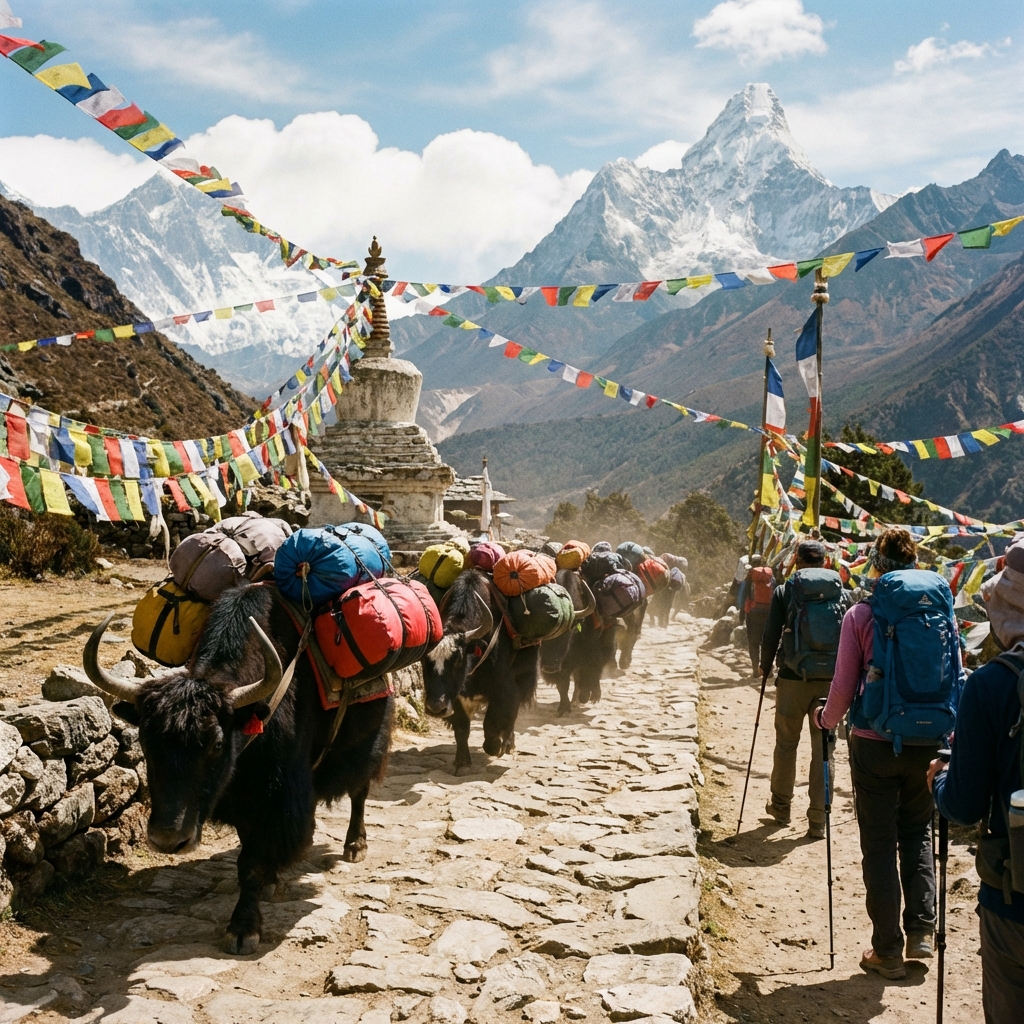
Yaks and dzopkyos (yak-cattle hybrid):
- Common pack animals above 3,000m
- Always pass on uphill side (they push toward edge)
- Give them right of way
- Don't touch or startle
Snow leopards, bears:
- Extremely rare encounters
- Make noise on trail (talking, singing)
- Never approach or photograph at close range
- Report sightings to locals
Leeches (monsoon season):
- Common in wet forests during monsoon
- Not dangerous but unpleasant
- Tuck pants into socks
- Use salt or DEET to remove
- Check body at breaks
River and Stream Crossings
Water crossings are common on Nepal treks. Most are bridged, but some require fording.
Bridge types:
Suspension bridges:
- Common in Nepal, can be long and high
- Walk steadily (don't stop in middle)
- Hold handrails
- Don't panic at swaying (it's designed to move)
- Let porters and animals cross first
Log bridges:
- Check stability before committing
- Use trekking poles for balance
- Consider removing pack if very narrow (balance issue)
- One person at a time
Stone stepping:
- Common for smaller streams
- Test each stone before full weight
- Wet stones are slippery (step on dry spots)
- Trekking poles essential
- Accept wet feet rather than dangerous jumps
Fording streams (no bridge):
When you must walk through water:
- Scout crossing up and downstream for easier spot
- Remove socks, keep boots on (protect feet, provide traction)
- Unbuckle pack waist and chest straps (can shed if you fall)
- Use poles (plant upstream for stability)
- Face upstream, step sideways
- Take small steps, feel bottom before committing weight
- Choose wider, slower sections over narrow, fast ones
When not to cross:
- Fast, murky water you can't see bottom of
- Water above knee height
- During or right after heavy rain
- If you're unsure of your ability
- Wait for water to drop (glacial streams lower in morning)
Tea House Etiquette and Skills
Tea houses are more than lodging—they're cultural experiences. Understanding etiquette makes your stay better and supports local communities.
Arriving and Settling In
The arrival routine:
- Remove boots before entering (or in designated area)
- Greet the host: "Namaste" with palms together
- Ask about room availability (through guide or directly)
- View room if possible before committing
- Agree on meal expectations (most tea houses expect you to eat there)
- Register your details (passport sometimes required)
Room selection tips:
- Corner rooms are often quieter
- Rooms away from kitchen/dining get more sleep
- Higher floors are warmer (heat rises)
- Check for multiple blankets if no sleeping bag
- Test the light switch actually works
Room setup:
- Air out sleeping bag if possible
- Check bed for stability (loose slats, etc.)
- Locate light switch and bathroom in daylight
- Note fire exits if multi-story building
Ordering Food Efficiently
Tea houses have limited staff and basic kitchens. Ordering strategically speeds service and improves experience.
Ordering strategy:
- Order breakfast the night before (faster morning departure)
- Order as a group, same items (efficient cooking)
- Choose dal bhat (always available, cooked in bulk)
- Order "same-same" as your friends for faster prep
Menu reality:
- All menus look identical (price fixing by committees)
- "Not available" is common (limited supplies)
- Preparation takes 20-45 minutes minimum
- Hot drinks come quickly; food takes time
What to order:
- Dal bhat: Best value, unlimited refills, always fresh
- Noodle soup: Quick, warming, easy on digestion
- Fried rice: Filling, simple preparation
- Momos: Delicious but take time to prepare
What to avoid ordering:
- "Pizza" at high altitude (disappointing)
- Meat above 3,500m (refrigeration questionable)
- Complex Western dishes (ingredients limited)
- Different orders for everyone (slows kitchen)
Tea house economics:
- Rooms are cheap; food is profit center
- Eating at your lodge supports the family
- Buying food elsewhere is considered rude
- This system keeps rooms affordable
Pro Tip
Learn "Dal bhat, please" in Nepali: "Dal bhat dinus." The smile you get from even basic Nepali phrases opens doors to warmer hospitality. Follow with "Mitho cha!" (It's delicious!) after eating.
Sleeping at Altitude Tips
Quality sleep is difficult at altitude but essential for recovery and acclimatization.
Why altitude disrupts sleep:
- Periodic breathing (Cheyne-Stokes): Irregular breathing pattern
- Frequent urination (altitude diuresis)
- Cold temperatures
- Lower oxygen levels
- Unfamiliar environment
Strategies for better sleep:
Before bed:
- Limit fluids 2 hours before (but stay hydrated during day)
- Avoid alcohol (disrupts sleep, worsens altitude symptoms)
- Light walk after dinner (aids digestion and sleep)
- Avoid screens (blue light disrupts melatonin)
- Use bathroom immediately before bed
Sleep environment:
- Keep room as warm as possible (close windows unless too stuffy)
- Wear warm layers (hat, socks, thermals)
- Create darkness (eye mask helps)
- Block noise (earplugs essential)
- Sleep with head slightly elevated (reduces fluid in head)
Sleep aids:
- Melatonin (1-3mg) can help without altitude side effects
- Avoid sleeping pills (depress breathing dangerously at altitude)
- White noise app if you need it
- Favorite small pillow from home (tea house pillows are thin)
When sleep fails:
- Don't stress about poor sleep (stress makes it worse)
- Rest quietly even if not sleeping (still beneficial)
- One bad night won't ruin your trek
- Nap briefly at lunch if exhausted (but not too long—affects night sleep)
Periodic breathing:
- Common above 3,500m
- You stop breathing briefly, then gasp
- May wake you repeatedly
- Scary but not dangerous
- Usually improves with acclimatization
- Consider Diamox if severe (consult doctor)
Communication Skills
Effective communication enhances safety and cultural experience.
Basic Nepali Phrases
You don't need to be fluent, but these phrases transform interactions:
Essential greetings:
- Namaste (nah-mah-stay): Hello/goodbye, formal greeting
- Namaskar (nah-mah-skar): More formal/respectful version
- Dhanyabad (dhan-ya-bahd): Thank you
- Tapai lai kasto cha? (ta-pie lie kas-toe cha): How are you?
- Ramro cha (ram-roe cha): I'm fine/It's good
Trail communication:
- Bistari bistari (bis-tar-ee): Slowly slowly
- Kati phar cha? (ka-tee par cha): How far is it?
- Pugyo (poo-gyo): We've arrived/That's enough
- Chiso (chee-so): Cold
- Taato (tah-toe): Hot
- Paani (pah-nee): Water
Tea house phrases:
- Kotha cha? (koe-tah cha): Is there a room?
- Khana cha? (kha-nah cha): Is there food?
- Dal bhat dinus (dahl baht dee-nus): Please give me dal bhat
- Kati paisa? (ka-tee pie-sah): How much money?
- Mitho cha (mee-toe cha): It's delicious
- Pugyo (poo-gyo): Enough/That's all
Politeness additions:
- Hajur (ha-jur): Formal yes, or polite attention-getter
- Dinus (dee-nus): Please give (adds politeness)
- Garnuhos (gar-noo-hose): Please do (polite request)
Pronunciation Guide
Nepali is phonetic—pronounced as written. The "a" sounds like "uh," not "ay." Double vowels are held longer. Practice with your guide on trail—they'll appreciate the effort and gently correct you. Even badly pronounced Nepali is received warmly.
Communicating with Guides
Your guide is your safety net, cultural bridge, and local expert. Effective communication maximizes their value.
Setting expectations:
- Discuss pace expectations on day one
- Agree on communication signals for breaks
- Clarify your interests (photos, culture, nature)
- Share any health concerns or limitations
- Ask about their experience and background
Daily communication:
- Morning briefing: day's plan, distance, difficulty
- Trail communication: call attention to hazards, points of interest
- Regular check-ins: how are you feeling?
- Evening debrief: how was the day, any concerns?
Asking good questions:
- "What is that peak called?"
- "Why do people live here?"
- "What's growing in that field?"
- "How long have you been guiding?"
- "What's your favorite trek?"
Giving feedback:
- Be direct about pace preferences
- Mention if you need more/fewer breaks
- Share when you're struggling (they can adjust)
- Express appreciation for good service
When you disagree:
If you disagree with a guide's decision:
- Ask for their reasoning first
- Understand they have experience you don't
- On safety issues, defer to their judgment
- For preference issues, negotiate compromise
- Never override safety decisions
Non-verbal Communication
When language fails, universal signals help:
Positive signals:
- Thumbs up: Good, yes, okay
- Head wobble side-to-side: Actually means "yes" in Nepal (confusing!)
- Smiling: Universal friendliness
- Palms together: Respect, greeting
Trail signals:
- Pointing: Direction
- Raised hand: Stop
- Beckoning: Come here
- Shaking head: No, danger
- Shrugging: Don't know
Universal signals for needs:
- Tapping mouth: Hungry
- Tilting head on hands: Sleep/tired
- Pointing at water then mouth: Thirsty
- Holding stomach: Not feeling well
- Shivering gesture: Cold
Photography etiquette:
- Point at camera, then at person, raise eyebrows questioningly
- Wait for nod before shooting
- Show them the photo after
- Accept "no" gracefully
Physical space:
- Less personal space in Nepal than Western cultures
- Hand-holding between same-sex friends is normal
- Physical closeness isn't aggressive
- But inappropriate touching is still wrong
Frequently Asked Questions
Related Resources
Final Thoughts: Skills Develop on the Trail
Reading about trekking skills is important, but true skill develops only through practice. The techniques in this guide will feel awkward at first—conscious pacing, deliberate rest-stepping, constant hydration monitoring. But by day three or four, they become automatic. By day seven, you won't remember hiking any other way.
The beautiful secret of trekking skills is that they compound. Good pacing leads to better energy management. Better energy leads to better judgment. Better judgment leads to proper rest. Proper rest leads to sustainable pacing. Each skill supports the others in a virtuous cycle.
Start practicing these skills on local hikes before your Nepal trip. Walk consciously slowly. Take deliberate breaks. Use your poles on every hike. Layer your clothing even if it seems unnecessary. Build the habits now so they're automatic when you need them on trail.
The difference between trekkers who struggle through Nepal and those who flow through the mountains isn't fitness or experience—it's skills. And skills can be learned. You now have the knowledge. Practice turns knowledge into ability.
Your first Nepal trek awaits. You have the skills to not just survive it, but to genuinely enjoy it.
Bistari bistari. Slowly, slowly. One step at a time. That's how you trek the Himalayas.
This guide is maintained by the Nepal Trekking Team with input from licensed guides and thousands of first-time trekkers. Last updated February 2026. For corrections or updates, contact our editorial team.