



Best Winter Treks in Nepal: The Complete December to February Guide
Winter trekking in Nepal is one of the Himalaya's best-kept secrets. While the majority of international trekkers crowd the trails during the peak months of October and November, a quieter revolution happens from December through February. The trails empty out, costs drop significantly, and the skies remain remarkably clear. For trekkers willing to embrace cold temperatures and shorter days, winter offers an experience that is, in many ways, more authentic and more rewarding than the crowded peak season.
The conventional wisdom has long been that Nepal's winter is "off-season" and best avoided. This advice is partially correct, but it paints with too broad a brush. While high-altitude passes close, extreme cold makes remote camping treks inadvisable, and some teahouses in less-visited areas shut down, there are numerous routes that not only work in winter but actually excel. Lower-altitude treks enjoy crisp, clear mornings with towering mountain views. The Everest region, though cold, remains accessible and strikingly beautiful under winter conditions. And routes that are uncomfortably warm in autumn become perfectly pleasant.
This comprehensive guide covers everything you need to know about winter trekking in Nepal: which treks shine in winter, which to avoid entirely, what temperatures to expect at every altitude, essential cold-weather gear, teahouse availability, cost savings, and whether winter trekking is right for you.
December 1 - February 28
Clear skies, cold temperatures, very low precipitation
Excellent - comparable to October (best of the year)
Very Low - 70-90% fewer trekkers than peak season
25-50% less than October pricing on agencies and services
Below 4,000m for comfortable winter trekking
Most closed (Thorong La, Cho La, Larkya La often impassable)
Approximately 10-10.5 hours (shorter than other seasons)
Main routes open; remote/high-altitude lodges may close
Budget travelers, solitude seekers, photographers, culture lovers
All levels (on appropriate routes)
Cold at altitude, especially nights above 3,500m
Why Winter Trekking Works in Nepal
The Clear Sky Advantage
Nepal's winter is defined by one overwhelming positive: exceptionally clear skies. From December through February, the monsoon is long gone, and the dry continental air mass from Central Asia dominates. This creates day after day of cloudless blue skies with visibility stretching hundreds of kilometers.
For mountain views, winter rivals and sometimes exceeds October. The atmosphere is dust-free (no agricultural burning, no road dust stirred by traffic), and the lower humidity means zero haze. Mountain photographers often rate January as the single best month for Himalayan clarity, slightly edging out October because the air is even drier.
The irony is striking: many trekkers visit Nepal primarily for mountain views, yet they avoid the season with arguably the best visibility simply because of cold temperatures that can be managed with proper gear.
The Solitude Factor
If you have ever dreamed of having Nepal's famous trails largely to yourself, winter delivers. The statistics are remarkable:
| Route | October Trekkers (Monthly) | January Trekkers (Monthly) | Reduction |
|---|---|---|---|
| Everest Base Camp | 15,000-18,000 | 2,000-3,500 | 75-85% fewer |
| Annapurna Region | 20,000-25,000 | 3,000-5,000 | 80-85% fewer |
| Poon Hill | 5,000-7,000 | 800-1,500 | 75-80% fewer |
| Langtang | 3,000-4,000 | 400-800 | 80-85% fewer |
This reduction transforms the trekking experience. Teahouses that require arriving by noon in October are empty and welcoming at 3 PM in January. Lodge owners have time for genuine conversation. Villages feel lived-in rather than tourist-oriented. The trail itself becomes a meditative experience rather than a social one.
Pro Tip
Winter is the best time to form genuine connections with teahouse owners and local communities. With fewer guests, lodge families have time to share meals, stories, and cultural insights. Some of the most meaningful Himalayan experiences happen around a winter teahouse stove with no other guests in the lodge.
Significant Cost Savings
Winter trekking can save you 25-50% compared to peak season. These savings appear across every category.
Agency Costs:
- Guided trek packages are typically 20-35% less than October pricing
- Some agencies offer specific winter promotions with further discounts
- Guide and porter day rates may be lower due to reduced demand
- Many agencies negotiate harder for your business during the quiet season
On-Trail Costs:
- Teahouse room rates often drop (some lodges waive room charges entirely with meal orders)
- Food prices remain similar, but there is less pressure to buy extras
- Charging fees for electronics may be reduced or waived
- Hot showers and other amenities are more readily available
Transportation:
- Domestic flights are easier to book and occasionally discounted
- Lukla flights have much higher availability (though weather delays are still possible)
- Private vehicles and taxis are easier to negotiate
- Hotels in Kathmandu and Pokhara offer winter rates
Overall Savings Example:
| Cost Category | October (Peak) | January (Winter) | Savings |
|---|---|---|---|
| 14-day guided EBC trek | $1,800-2,500 | $1,200-1,800 | $215-700 |
| Lukla flights (round trip) | $215-450 | $350-400 | $30-50 |
| Kathmandu hotel (per night) | $40-80 | $25-50 | $15-30 |
| Total trip savings | $500-1,000+ |
The Best Winter Treks in Nepal
1. Poon Hill Trek (The Ultimate Winter Short Trek)
Winter Rating: 9.5/10
Poon Hill is arguably the single best winter trek in Nepal. Its moderate altitude (maximum 3,210 meters) keeps temperatures manageable, while the iconic sunrise viewpoint delivers its mountain panorama with even more clarity than in autumn. The 3-5 day duration means limited exposure to cold conditions, and the well-established teahouse infrastructure on this route remains fully operational year-round.
3-5 days
3,210m (Poon Hill)
Daytime: 5-10C | Night: -5 to 0C
Pre-dawn: -8 to -3C | After sunrise: 0-5C
Low
All open year-round
Dry, clear, occasional frost above 2,800m
None
Why Poon Hill Excels in Winter:
The Poon Hill sunrise experience is actually enhanced in winter. With fewer trekkers on the viewpoint (perhaps 20-30 instead of 200 or more in October), you can choose your position, set up photography equipment without jostling, and absorb the panorama in relative peace. The views of Dhaulagiri (8,167m), Annapurna I (8,091m), and Machapuchare (6,993m) are often sharper than in any other season.
The trails between Tikhedhunga, Ghorepani, and Ghandruk pass through beautiful rhododendron forests that, while not blooming in winter (that is March-April), provide a serene forest walking experience. The stone steps are dry and easier to navigate than during or immediately after monsoon.
Winter Considerations:
- The pre-dawn hike to Poon Hill summit (approximately 45 minutes from Ghorepani) is cold. Expect temperatures of -8 to -3C. Full winter layers including down jacket, warm hat, and gloves are essential
- Shorter daylight means you should plan to reach your destination by 4:00-4:30 PM
- Lodge dining rooms cluster around a central stove in winter, creating a cozy communal atmosphere
Pro Tip
At Ghorepani in winter, request a room that gets morning sun. South-facing rooms warm up significantly once the sun hits them, making the difference between a cold night and a tolerable one. Lodge owners are happy to accommodate room preferences when the lodge is not full.
2. Lower Everest Region (Lukla to Namche Bazaar)
Winter Rating: 8.5/10
For trekkers who want to experience the legendary Khumbu region without the extreme cold of Everest Base Camp in winter, the trek to Namche Bazaar offers a perfect compromise. At 3,440 meters, Namche is cold but manageable, and the surrounding viewpoints deliver stunning Everest views.
7-8 days (round trip from Lukla)
3,880m (Everest View Hotel viewpoint) or 3,440m (Namche)
Daytime: 2-8C | Night: -8 to -3C
Low
All major lodges open
Operating but subject to weather delays
Why Stop at Namche in Winter:
Namche Bazaar is the Sherpa capital of the Khumbu, a vibrant hill town with bakeries, gear shops, internet cafes, and stunning architecture. The famous viewpoint above Namche (near the Everest View Hotel at Syangboche) provides a panoramic vista of Everest, Lhotse, Ama Dablam, and Thamserku that is absolutely spectacular in winter's clear air.
The trek from Lukla to Namche through the Dudh Kosi valley passes through traditional Sherpa villages, crosses dramatic suspension bridges, and enters Sagarmatha National Park. In winter, the forests of pine and rhododendron are quiet and peaceful, and the river runs crystal clear.
You can extend to Tengboche Monastery (3,867m) for even more spectacular views and a cultural highlight, adding 2-3 days to the itinerary.
Winter-Specific Benefits:
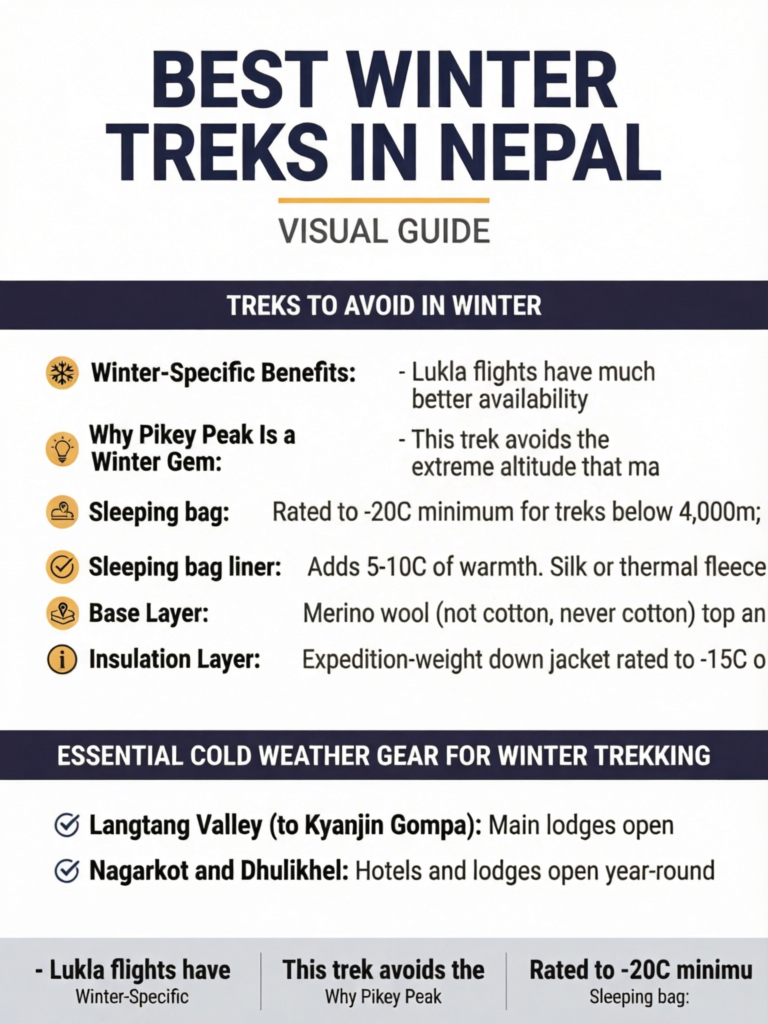
- Lukla flights have much better availability than October
- Namche lodges are uncrowded, and you can often choose the best rooms
- The Saturday market in Namche (where traders arrive from lower villages) continues year-round
- Monastery visits are more intimate with fewer tourists
3. Pikey Peak Trek
Winter Rating: 9/10
Pikey Peak (4,065m) is an increasingly popular alternative to Everest Base Camp that is specifically well-suited for winter. Located in the Solukhumbu district south of the main Khumbu region, it offers a remarkable panorama of the Everest range from a vantage point that Sir Edmund Hillary reportedly called "the best view of Everest."
5-7 days
4,065m
Daytime: 0-5C | Night: -10 to -5C
Very Low
Drive from Kathmandu to Phaplu/Salleri (no flights needed)
Basic but operational
Why Pikey Peak Is a Winter Gem:
This trek avoids the extreme altitude that makes winter EBC challenging. At 4,065 meters, the summit is cold but not dangerously so. The panoramic view stretches from Everest and Makalu in the east to Annapurna and Dhaulagiri in the west, encompassing virtually the entire Himalayan range of Nepal.
The route passes through Sherpa villages at moderate altitude (2,500-3,500m) where winter temperatures are comfortable during the day. There are no high passes, no glacier crossings, and no extreme altitude challenges. The trail is culturally rich, passing through villages where traditional Sherpa life continues undisturbed by tourist crowds.
Winter Advantage: No Lukla flight dependency. Access is by road from Kathmandu to Phaplu or Salleri (8-10 hours by jeep), eliminating the flight delays and cancellations that plague winter Lukla travel.
4. Ghorepani-Tadapani-Ghandruk Loop
Winter Rating: 9/10
This extended version of the Poon Hill trek adds the picturesque settlement of Tadapani and the traditional Gurung village of Ghandruk, creating a more comprehensive cultural and scenic experience. The loop format means you walk new terrain each day rather than retracing your steps.
5-7 days
3,210m (Poon Hill)
Daytime: 8-18C (lower) to 5-10C (upper) | Night: -5 to 5C
Low
Gurung villages, terraced farmland, forest walks
Excellent in winter
Winter Highlights:
- Ghandruk village, with its stone houses and slate roofs framed by Annapurna South and Machapuchare, is particularly photogenic under clear winter skies
- The forests between Tadapani and Ghandruk are quiet and atmospheric in winter
- Gurung cultural museum in Ghandruk is less rushed without October crowds
- The terrace farming landscape is in its post-harvest golden phase
5. Nagarkot to Dhulikhel Trek
Winter Rating: 9/10
This short trek on the rim of the Kathmandu Valley is perhaps the most accessible winter trekking experience in Nepal. Just 1-2 hours from Kathmandu by vehicle, Nagarkot and Dhulikhel offer panoramic Himalayan views from a comfortable altitude of 1,500-2,200 meters.
1-3 days
2,175m (Nagarkot)
Daytime: 10-18C | Night: 2-8C
Very Low on trail (some tourists at viewpoints)
1-2 hours from Kathmandu by taxi
Hotels and lodges at both ends; basic teahouses between
Why It Works in Winter:
At barely over 2,000 meters, winter temperatures are mild. The panoramic view from Nagarkot stretches from Langtang Lirung in the northwest to Everest in the east, and on clear winter mornings, the entire range is visible. The walking route between Nagarkot and Dhulikhel passes through traditional Newari farming villages, providing cultural immersion within easy reach of Kathmandu.
Perfect For: Travelers with limited time, those waiting for other arrangements (Lukla flights, permit processing), families, and anyone wanting a gentle introduction to Himalayan trekking before a longer expedition.
6. Helambu Trek
Winter Rating: 8.5/10
Helambu, located north of Kathmandu Valley, offers an accessible trek through Sherpa and Tamang villages without extreme altitude. The maximum height of approximately 3,650 meters (Tharepati Pass) is manageable in winter, and the cultural experience is rich.
5-7 days
3,650m (Tharepati)
Daytime: 2-8C | Night: -8 to -3C
Very Low
Bus from Kathmandu to Sundarijal (no flights needed)
Sherpa and Tamang villages
Winter Appeal:
- No flights or long drives needed, just a short bus ride from Kathmandu
- Sherpa villages at 2,500-3,500m are comfortable in winter sunshine
- Clear views of Langtang Himal, Jugal Himal, and even distant Everest
- Apple orchards and traditional farming villages provide gentle walking terrain
- Can be combined with a Langtang Valley extension if conditions and fitness allow
7. Everest Base Camp (For Experienced Winter Trekkers)
Winter Rating: 7/10 (experienced trekkers only)
The full EBC trek is possible in winter and rewards those who attempt it with extraordinary solitude and clarity. However, it demands respect. Temperatures above 4,000 meters are extreme, some teahouses may be closed, and the physical demands increase substantially.
14-16 days (extra acclimatization recommended)
5,545m (Kala Patthar) or 5,364m (EBC)
Daytime: -5 to 0C | Night: -20 to -12C
Pre-dawn: -25 to -15C
Very Low
Main route lodges open; some may close above Dingboche
Experienced trekkers with cold-weather gear and tolerance
Winter EBC Is Not for Beginners
Winter EBC requires a sleeping bag rated to -30C or colder, full winter mountaineering layers, and mental preparedness for sustained cold. Nights at Gorak Shep and EBC are genuinely harsh. Water freezes in bottles inside your sleeping bag. Getting out of bed at 4 AM for the Kala Patthar sunrise in -20C requires determination. This is a wonderful experience for prepared trekkers but should not be anyone's first trek.
The Reward:
- Kala Patthar sunrise with perhaps 5-10 other people instead of 100 or more
- Crystal-clear views that can extend to peaks in Tibet
- An intensely personal experience in one of the world's most iconic landscapes
- Bragging rights that you trekked EBC in January
Pro Tip
If you are attempting winter EBC, consider a helicopter return from EBC or Gorak Shep rather than retracing the entire trail. After days of extreme cold at altitude, the helicopter descent provides welcome relief, saves 3-4 days, and is more readily available in winter due to lower demand.
8. Short Annapurna Treks (Mardi Himal Base or Korchon viewpoint)
Winter Rating: 8/10
The lower portions of the Annapurna region work beautifully in winter. The Mardi Himal trek to around 3,500-4,000m (rather than the full 4,500m high camp) or viewpoint treks to Korchon and Australian Camp offer accessible mountain panoramas.
3-6 days
3,500-4,000m (lower Mardi) or 2,100m (Australian Camp)
Daytime: 5-10C | Night: -5 to 0C
Low
Taxi from Pokhara to trailhead
Machapuchare, Annapurna South, Hiunchuli
Treks to Avoid in Winter
Not all Nepal treks are suitable for winter conditions. The following routes are either closed, extremely dangerous, or simply not enjoyable from December to February.
Closed or Extremely Dangerous
Annapurna Circuit (Full Circuit with Thorong La): Thorong La Pass at 5,416m receives heavy snowfall in winter. The pass is frequently closed from late November through March. Even when technically passable, avalanche risk, extreme cold, and the lack of rescue options make winter crossings extremely hazardous. Do not attempt this in winter unless you are an experienced mountaineer with full expedition gear and local weather intelligence.
Three Passes Trek (Everest Region): Cho La (5,420m), Renjo La (5,360m), and Kongma La (5,535m) are snow-covered and frequently impassable in winter. These passes require crampon and ice axe skills even in good conditions, and winter adds avalanche risk and extreme wind chill. This trek should be done in October or November only.
Manaslu Circuit (Larkya La): Larkya La Pass at 5,160m is typically closed from December through March due to snow accumulation. The remote nature of the Manaslu region means rescue options are even more limited than other areas. The restricted-area permit requirements remain, but agencies should not be operating this route in deep winter.
Inadvisable Due to Conditions
Upper Dolpo: While technically a rain-shadow area with relatively dry conditions, Upper Dolpo's extreme remoteness and altitude (passes above 5,000m) make winter trekking dangerous. Teahouses close, and rescue is virtually impossible.
Kanchenjunga Base Camp: Remote eastern Nepal sees severe winter conditions. The trek reaches above 5,000m, teahouses thin out dramatically, and rescue infrastructure is minimal.
Makalu Base Camp: Similar concerns as Kanchenjunga. High altitude, remote location, and limited winter infrastructure.
Winter Pass Crossings - The Rule
As a general rule, any trek requiring a pass crossing above 5,000 meters should not be attempted between December and February unless you have mountaineering experience, expedition-grade gear, and current local conditions information from your guide or agency. The exception is some experienced trekkers who do winter EBC (which does not cross a pass but reaches 5,364m at Base Camp).
Winter Temperature Expectations by Altitude
Understanding temperature patterns is crucial for winter trek planning and gear selection.
Daytime Temperatures (In Sunshine)
| Altitude | December | January | February |
|---|---|---|---|
| Kathmandu (1,400m) | 15-20C | 12-18C | 15-22C |
| 2,000m | 10-16C | 8-14C | 10-18C |
| 2,500m | 8-14C | 5-12C | 8-15C |
| 3,000m | 5-10C | 2-8C | 5-12C |
| 3,500m | 2-8C | 0-5C | 2-8C |
| 4,000m | 0-5C | -3 to 2C | 0-5C |
| 4,500m | -3 to 2C | -5 to 0C | -3 to 2C |
| 5,000m | -5 to 0C | -10 to -3C | -5 to 0C |
Nighttime Temperatures
| Altitude | December | January | February |
|---|---|---|---|
| Kathmandu (1,400m) | 3-7C | 1-5C | 4-8C |
| 2,000m | 0-5C | -3 to 2C | 0-5C |
| 2,500m | -3 to 2C | -5 to 0C | -3 to 2C |
| 3,000m | -5 to 0C | -8 to -3C | -5 to 0C |
| 3,500m | -8 to -3C | -12 to -5C | -8 to -3C |
| 4,000m | -12 to -5C | -15 to -8C | -10 to -5C |
| 4,500m | -15 to -8C | -20 to -12C | -15 to -8C |
| 5,000m | -18 to -10C | -25 to -15C | -18 to -10C |
The Sunshine Factor
Winter temperature tables can be misleading because they don't capture the dramatic difference between sun and shade. At 3,000 meters on a clear January day, it might be -5C in the shade at 7 AM but 10C in direct sunshine by 10 AM. The sunny side of the trail can feel 15-20 degrees warmer than the shaded side. This is why timing your walking hours to coincide with sunshine is crucial in winter trekking.
Essential Cold Weather Gear for Winter Trekking
Winter gear requirements go significantly beyond what you need for October trekking. Every layer matters, and skimping on any item can lead to misery or danger.
Sleeping
- Sleeping bag: Rated to -20C minimum for treks below 4,000m; rated to -30C for treks approaching 5,000m. Down fill is lighter and packs smaller; synthetic is cheaper and performs better if it gets damp
- Sleeping bag liner: Adds 5-10C of warmth. Silk or thermal fleece
- Foam sleeping pad: Many teahouse beds are simple plywood platforms. A thin foam pad adds insulation from below (this is where you lose the most heat)
Layering System
Base Layer: Merino wool (not cotton, never cotton) top and bottom. Wear this 24/7 above 3,000m in winter.
Mid Layer: Fleece jacket (200-300 weight) plus a down vest or light down jacket.
Insulation Layer: Expedition-weight down jacket rated to -15C or colder. This is your most important single piece of gear.
Shell Layer: Windproof and waterproof outer layer. Winter wind chill is the main enemy.
Legs: Thermal base layer plus trekking pants plus waterproof/windproof over-trousers for passes and windy sections.
Extremities (Where You Lose the Most Heat)
- Head: Warm fleece or wool hat that covers ears, plus a balaclava for extreme cold
- Hands: Liner gloves plus insulated outer gloves or mittens (mittens are warmer than gloves). Carry hand warmers as backup
- Feet: Thick merino wool socks (2 pairs to layer if needed), insulated boot liners, and boots that can accommodate thick socks without compressing your toes (compressed feet lose circulation and get cold)
- Face: Neck gaiter/buff that can be pulled over nose and mouth in extreme cold or wind
Other Winter-Specific Gear
- Insulated water bottle cover: Water freezes quickly above 3,500m in winter. An insulated cover plus storing bottles upside down (ice forms at the top) prevents this
- Extra batteries: Cold dramatically reduces battery life. Carry batteries inside your jacket next to your body
- Chemical hand and toe warmers: Inexpensive insurance against cold extremities
- Thermos: Fill with hot water at your morning teahouse stop. Warm drinks throughout the day are a morale lifesaver
- Microspikes or traction devices: For icy trail sections, especially north-facing slopes that don't see winter sun
For comprehensive gear guides, see our sleeping bag guide, down jacket guide, and layering system guide.
Pro Tip
The single most common winter trekking mistake is underestimating how cold teahouse rooms get at night. Even below 3,000 meters, lodge rooms (which are unheated) can drop to freezing or below overnight. Your sleeping bag is your shelter. Invest in the best one you can afford. If renting in Kathmandu, test the bag before you leave and supplement with a liner.
Shorter Daylight Hours: Planning Implications
Winter days in Nepal are significantly shorter than summer or even autumn days. This has practical implications for trek planning.
| Month | Sunrise | Sunset | Usable Daylight |
|---|---|---|---|
| October | 5:50 AM | 5:30 PM | 11.5 hours |
| December | 6:45 AM | 5:15 PM | 10.5 hours |
| January | 6:50 AM | 5:30 PM | 10.5 hours |
| February | 6:30 AM | 5:50 PM | 11.3 hours |
Practical Impact:
- Start later: There is no point starting before dawn in winter (unless targeting a sunrise viewpoint). Trails can be icy and dangerous before the sun hits them. Wait for sunshine.
- Finish earlier: Aim to reach your teahouse by 3:00-3:30 PM. Temperatures drop rapidly after the sun goes behind mountains (which happens well before actual sunset in valleys).
- Shorter trekking days: Plan for 5-6 hours of actual walking rather than the 6-8 hours possible in October. This may add a day to standard itineraries.
- Long evenings: You will spend 13-14 hours in or around the teahouse each night. Bring books, cards, a journal, or a fully loaded e-reader. The dining room stove becomes the social center.
Teahouse Availability in Winter
Teahouse availability varies significantly by route and altitude.
Fully Operational Year-Round
- Poon Hill / Ghorepani circuit: All major lodges remain open
- Annapurna region (below 3,500m): Most lodges open, some with reduced staff
- Everest region (Lukla to Namche): All major lodges open
- Everest region (Namche to Tengboche): Most lodges open
- Langtang Valley (to Kyanjin Gompa): Main lodges open
- Nagarkot and Dhulikhel: Hotels and lodges open year-round
Reduced Operations (Some Lodges Closed)
- Everest region (above Dingboche): Some smaller lodges close; main ones remain
- Annapurna region (above 3,500m): Reduced operations, Manang and above partially closed
- Helambu: Most lodges open but staffing may be minimal
Largely Closed
- Thorong La area (Annapurna Circuit high section): Most lodges close
- Three Passes area (above Gokyo/Chukhung): Many lodges close
- Remote regions (Dolpo, Kanchenjunga, Makalu): Most infrastructure closes
- Manaslu Circuit (above Samdo): Lodges close near the pass
Confirming Teahouse Status
Before setting out on any winter trek, have your guide or agency confirm current teahouse availability along your specific route. Conditions vary year to year, and a lodge that was open last January may be closed this January. Your guide's local network is invaluable for this real-time intelligence.
Winter vs. Autumn: A Detailed Comparison
| Factor | October-November (Autumn) | December-February (Winter) |
|---|---|---|
| Visibility | Excellent | Excellent (arguably better) |
| Temperature | Comfortable across all altitudes | Cold above 3,000m, harsh above 4,500m |
| Crowds | Peak season | Very quiet |
| Cost | Highest | 25-50% lower |
| High Passes | All open | Most closed above 5,000m |
| Available Routes | All routes accessible | Low-to-mid altitude routes only |
| Daylight | 11-11.5 hours | 10-10.5 hours |
| Teahouses | All open, may be full | Many open, rarely full |
| Cultural Experience | Dashain/Tihar festivals | Quiet village life, Lhosar (late Feb) |
| Photography | Outstanding | Outstanding (may be slightly better) |
| Overall Atmosphere | Social, energetic | Quiet, contemplative, intimate |
Who Should Choose Winter:
- Budget-conscious trekkers willing to trade comfort for savings
- Solitude seekers who value empty trails over social atmosphere
- Photographers prioritizing the clearest possible conditions
- Experienced trekkers who enjoy the challenge of cold conditions
- Cultural travelers wanting authentic village interactions without tourist crowds
- Those whose schedules restrict them to December-February
Who Should Choose Autumn:
- First-time trekkers who want optimal comfort and full infrastructure
- High-altitude trekkers targeting passes above 5,000m
- Those who prefer a social trekking atmosphere
- Trekkers uncomfortable with cold conditions
- Anyone planning Manaslu, Three Passes, or full Annapurna Circuit
Month-by-Month Winter Breakdown
December: Early Winter
December is the transition month. The first two weeks can feel like late autumn at lower altitudes, with comfortable daytime temperatures. By late December, full winter conditions have settled in.
Best for: Trekkers who want winter solitude with slightly milder conditions than January. The holiday season (Christmas and New Year) sees a small bump in international trekkers.
Key Events: Christmas and New Year celebrations in Kathmandu and tourist areas. Some lodges offer holiday meals and festivities.
Conditions: Increasingly cold, very clear skies, snow possible above 3,500m.
For month-specific details: Trekking Nepal in December.
January: Deep Winter
January is the coldest month in Nepal. Nighttime temperatures at altitude reach their annual lows. But it is also the driest and often the clearest month. For those who can handle the cold, January offers the most extreme version of winter trekking's rewards.
Best for: Experienced trekkers, photographers seeking the clearest possible conditions, extreme budget travelers (lowest prices of the year).
Key Events: Maghe Sankranti (Nepali festival, mid-January) celebrates the end of the coldest period. Locals gather at rivers and warm themselves with special foods.
Conditions: Coldest month. Very clear. Minimal precipitation except occasional snowfall at altitude.
For month-specific details: Trekking Nepal in January.
February: Late Winter / Early Spring Transition
February is arguably the best winter month for trekking. Temperatures begin to warm compared to January (particularly in the second half), days get noticeably longer, and the rhododendron buds begin forming at lower altitudes. It offers winter's clarity and solitude with a hint of spring's warmth.
Best for: Those who want winter conditions with slightly more comfort than January. Late February starts the transition to spring season.
Key Events: Lhosar (Tibetan/Sherpa/Tamang New Year), usually in February, is celebrated widely in mountain communities. Timing your trek to coincide with Lhosar provides extraordinary cultural experiences.
Conditions: Cold but warming, especially second half. Increasing daylight. First signs of spring at lower altitudes.
For month-specific details: Trekking Nepal in February.
Pro Tip
If you must choose one winter month, choose February. You get 90% of winter's benefits (clear skies, no crowds, lower costs) with noticeably warmer temperatures than January, longer days, and the beginning of rhododendron bud formation that hints at the spectacular spring blooms to come. Late February, in particular, offers an excellent balance.
Who Winter Trekking Suits (And Who Should Avoid It)
Winter Trekking Is Ideal For:
Budget Travelers: If cost is your primary constraint, winter offers the best value in Nepal trekking. A December or January trek can save you $500-1,000 or more compared to the same route in October. Agency fees, lodge rates, and service costs are all at their annual lows.
Solitude Seekers: If your ideal trekking day involves walking for hours without seeing another trekker, eating dinner in a teahouse with only your guide and the lodge family, and standing at a viewpoint completely alone, winter delivers this consistently.
Photographers: Professional and serious amateur photographers often prefer winter for the unmatched atmospheric clarity. The combination of crystal-clear air, snow-covered peaks, and dramatic low-angle winter light creates conditions that are slightly superior even to October for mountain photography.
Experienced Trekkers: If you have trekked in Nepal before (or in cold conditions elsewhere) and want a different experience, winter reveals a side of the Himalayas that most trekkers never see. It is a more challenging but deeply rewarding way to experience the mountains.
Culture Enthusiasts: Winter is when Nepali mountain communities are at their most authentic. Without the overlay of tourism, you see daily life as it actually is: farming, animal husbandry, religious practice, family life. If genuine cultural immersion matters more to you than comfort, winter is your season.
Winter Trekking Is Not Recommended For:
First-Time Trekkers (on routes above 4,000m): The combination of altitude challenge and cold weather creates a steep learning curve. First-timers can absolutely do winter treks, but should choose lower-altitude options like Poon Hill or Nagarkot-Dhulikhel.
Cold-Sensitive Individuals: If you are someone who is genuinely uncomfortable in cold conditions, winter trekking at altitude will not be enjoyable. There is no way to sugar-coat the reality: tea house rooms above 3,000m in January are very cold at night.
Those Wanting Social Atmosphere: The communal teahouse experience of peak season, where trekkers share stories and meals around crowded tables, is largely absent in winter. If the social dimension is important to you, choose autumn.
Anyone Planning a High Pass Crossing: If your heart is set on Thorong La, Cho La, or Larkya La, winter is not the time. Wait for October or November.
Safety Considerations for Winter Trekking
Hypothermia Awareness
The primary safety risk in winter trekking is cold-related injury, specifically hypothermia. Symptoms progress from shivering and confusion to loss of coordination and, in extreme cases, unconsciousness. Prevention is straightforward:
- Stay dry (wet clothing dramatically accelerates heat loss)
- Maintain caloric intake (your body burns more calories in cold conditions)
- Recognize early symptoms in yourself and companions
- Have an emergency plan for rewarming (hot drinks, dry clothes, sleeping bag, body heat from companion)
Trail Conditions
Winter trails can be icy, particularly on north-facing slopes and in morning shade. Microspikes or simple traction devices are lightweight insurance. Early morning frost makes stone steps slippery. Wait for sunshine to hit the trail if the route is particularly exposed.
Communication and Rescue
Most major trekking routes have cell coverage at key points, even in winter. Satellite communicators (Garmin inReach, etc.) provide backup communication in remote areas. Helicopter rescue remains available in winter but may be delayed by cold-related mechanical issues or short daylight windows.
Travel Insurance
Ensure your travel insurance specifically covers winter trekking at the altitudes you plan to reach. Some policies exclude "winter mountaineering" or have altitude limits. Verify that helicopter evacuation is covered. See our travel insurance guide.
Frequently Asked Questions
Is it safe to trek in Nepal during winter?
Yes, on appropriate routes with proper gear and preparation. The key is choosing routes that match winter conditions. Poon Hill, Pikey Peak, Nagarkot-Dhulikhel, Helambu, and the lower Everest region are all safe winter destinations. The dangers arise when trekkers attempt high-altitude passes or remote routes that are not suitable for winter conditions.
How cold does it actually get?
Temperatures depend entirely on altitude. At 2,000m, winter days are pleasant (10-16C) and nights are cold but manageable (0-5C). At 3,500m, days are cool (2-8C) and nights are cold (-8 to -3C). At 5,000m, conditions are genuinely extreme (-10 to -3C days, -25 to -15C nights). Most comfortable winter treks stay below 4,000m.
Are teahouses heated?
Teahouse rooms are not heated. The dining room typically has a central stove (wood or yak dung in higher regions) that provides warmth during evening hours. You eat, socialize, and warm up in the dining room, then retreat to your cold room for sleep. Your sleeping bag is your primary source of warmth at night.
Can beginners trek in Nepal during winter?
Yes, absolutely, on appropriate routes. Poon Hill, Nagarkot-Dhulikhel, and the Ghorepani-Ghandruk loop are all suitable for beginners in winter. The key is staying at lower altitudes where cold is manageable and infrastructure is reliable. First-time trekkers should not attempt winter EBC or high-altitude winter routes.
Do I need crampons or ice axes for winter trekking?
For standard tea house treks below 4,000m, no. Simple microspikes (lightweight traction devices that slip over your boots) are sufficient for occasional icy patches. Crampons and ice axes are only needed for high-pass crossings or glacier travel, which should not be attempted in winter without mountaineering experience.
Will Lukla flights operate in winter?
Yes, Lukla flights continue through winter, though with increased weather-related delays. Clear winter skies can actually make flying conditions excellent, but cold morning fog in the valleys can delay departures. Build extra buffer days into your itinerary. Helicopter services also operate and are more available due to lower demand.
How much money can I save trekking in winter?
Expect 25-50% savings compared to October. A guided 14-day EBC trek that costs $2,000-2,500 in October might cost $1,200-1,800 in January. Kathmandu hotels, restaurants, and services all offer lower prices. The savings are real and significant.
What is the best winter month for trekking?
February is generally the best winter month, offering warming temperatures (especially the second half), longer days than December or January, continued clear skies, and the beginning of the transition to spring. January offers the clearest skies but the coldest temperatures. December is the mildest winter month but still colder than November.
Can I do the Annapurna Circuit in winter?
The full circuit including Thorong La Pass is not recommended in winter due to heavy snow on the pass. However, you can do sections of the circuit: the lower Marshyangdi Valley to Manang, or the Jomsom-Muktinath side. These partial circuits are rewarding but do not include the iconic pass crossing.
Is winter a good time for wildlife viewing while trekking?
Yes, particularly for bird watching. Many bird species descend to lower altitudes in winter, concentrating them along trekking routes. Danphe (the Impeyan pheasant, Nepal's national bird) is more commonly spotted in winter. In Langtang, red pandas are occasionally seen, and Himalayan thar are active on lower slopes.
Do I need a guide for winter trekking?
Nepal requires guides for all national park and conservation area treks, regardless of season. Beyond the legal requirement, a guide is especially valuable in winter for navigating trail conditions, confirming teahouse availability, managing cold-weather logistics, and providing safety backup. Winter is not the time for independent trekking experimentation.
What about snow on the trails?
Below 3,000m, snow is rare on trails. Between 3,000-4,000m, light snowfall is possible but usually melts within a day or two on south-facing trails. Above 4,000m, snow can accumulate and persist, especially on north-facing slopes. Trails to Namche Bazaar and Kyanjin Gompa may have patches of snow and ice, particularly in January, but remain navigable.
Final Thoughts
Winter trekking in Nepal rewards those who embrace its unique character. You will not have the comfortable temperatures, long days, and full infrastructure of the October peak season. What you will have is something increasingly rare in the modern trekking world: genuine solitude in one of the planet's most spectacular landscapes, authentic cultural encounters, crystal-clear mountain views that rival or exceed any other season, and the satisfaction of experiencing the Himalayas on their own terms.
The key to successful winter trekking is simple: choose the right route for the season, invest in proper cold-weather gear (especially your sleeping bag), and adjust your expectations. Winter trekking is slower, colder, and quieter than peak season. For many who experience it, that combination becomes addictive.
Start with a lower-altitude classic like Poon Hill or Pikey Peak. If you find that winter resonates with you, consider the lower Everest region the following year, and eventually, perhaps, a winter EBC attempt. The progression mirrors the beauty of Nepal trekking itself: always another level, always another experience waiting.
For comprehensive seasonal planning, explore our Nepal trekking seasons overview, and for beginner route selection, see our best beginner treks guide.
Ready to plan your winter trek? Start with our how to choose a trekking agency guide and budget trekking guide to maximize your winter savings.