
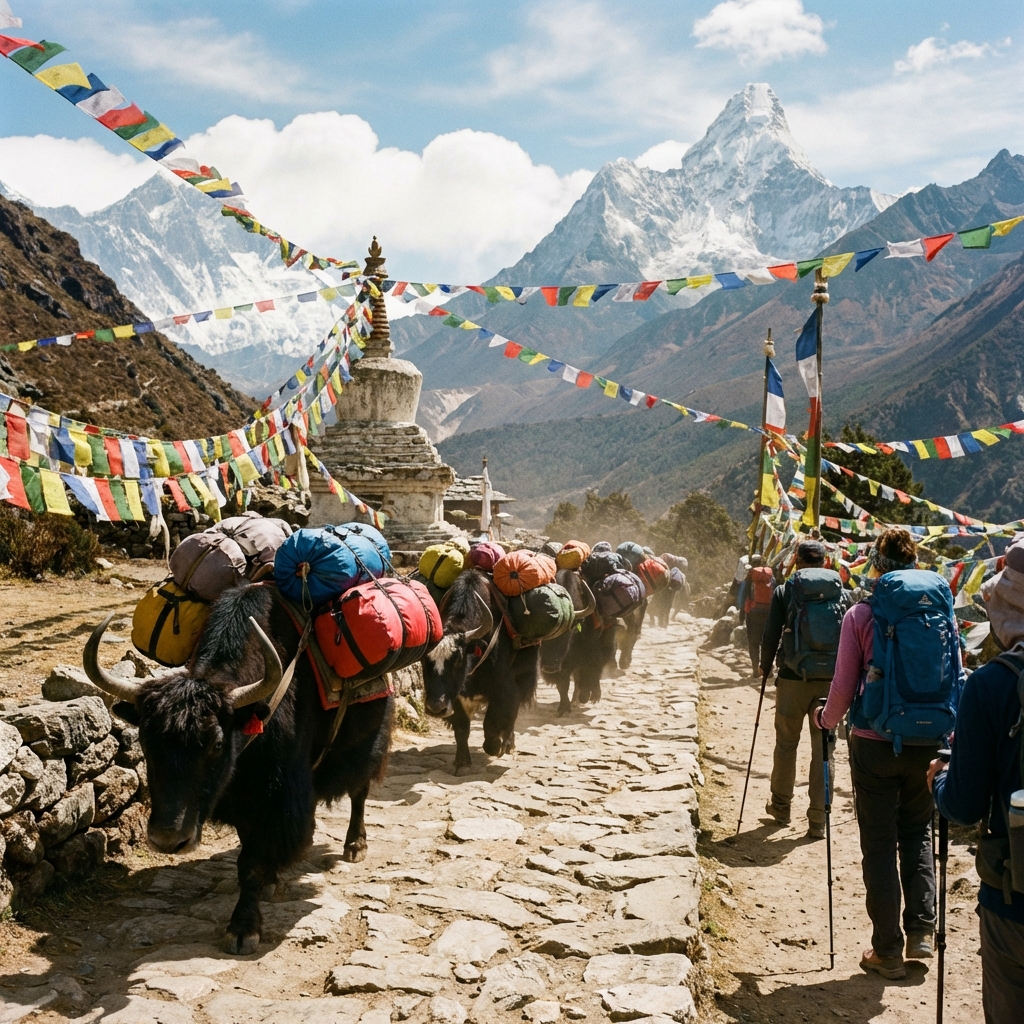
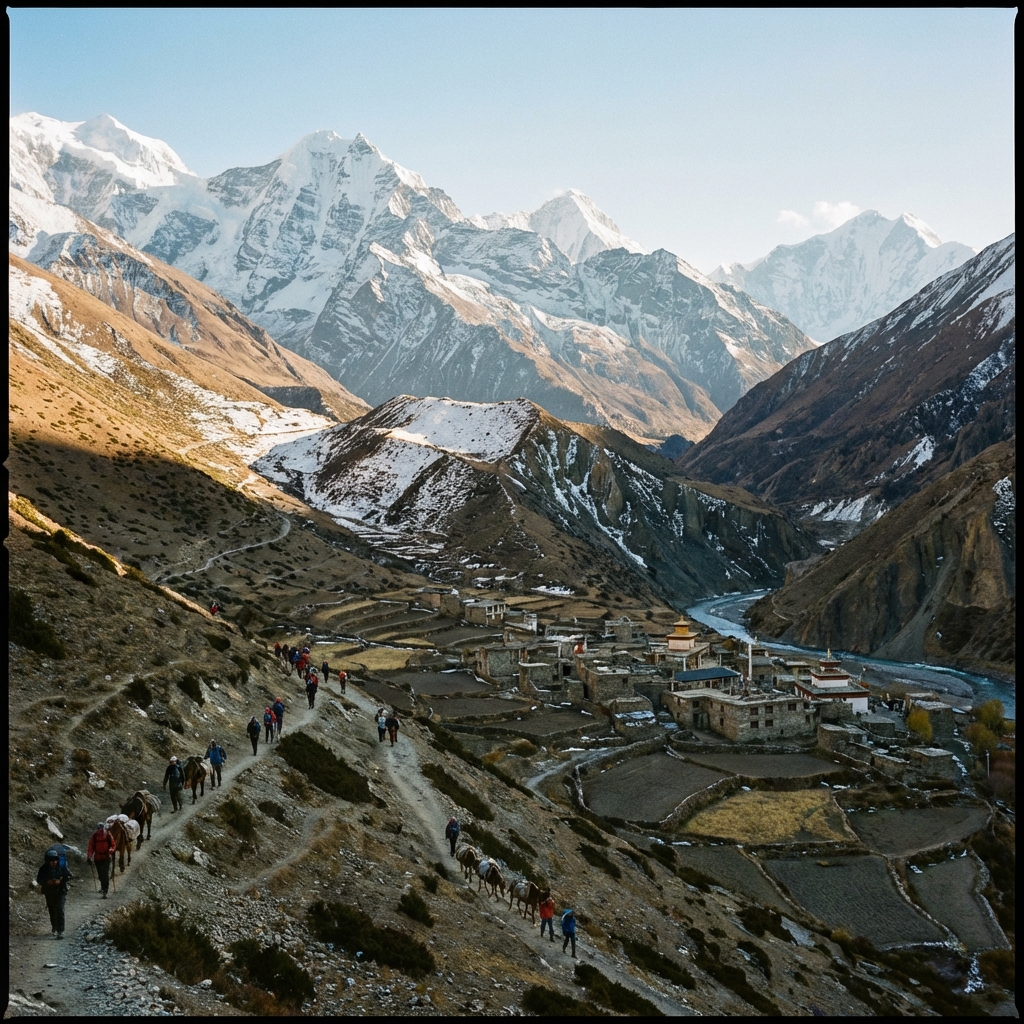
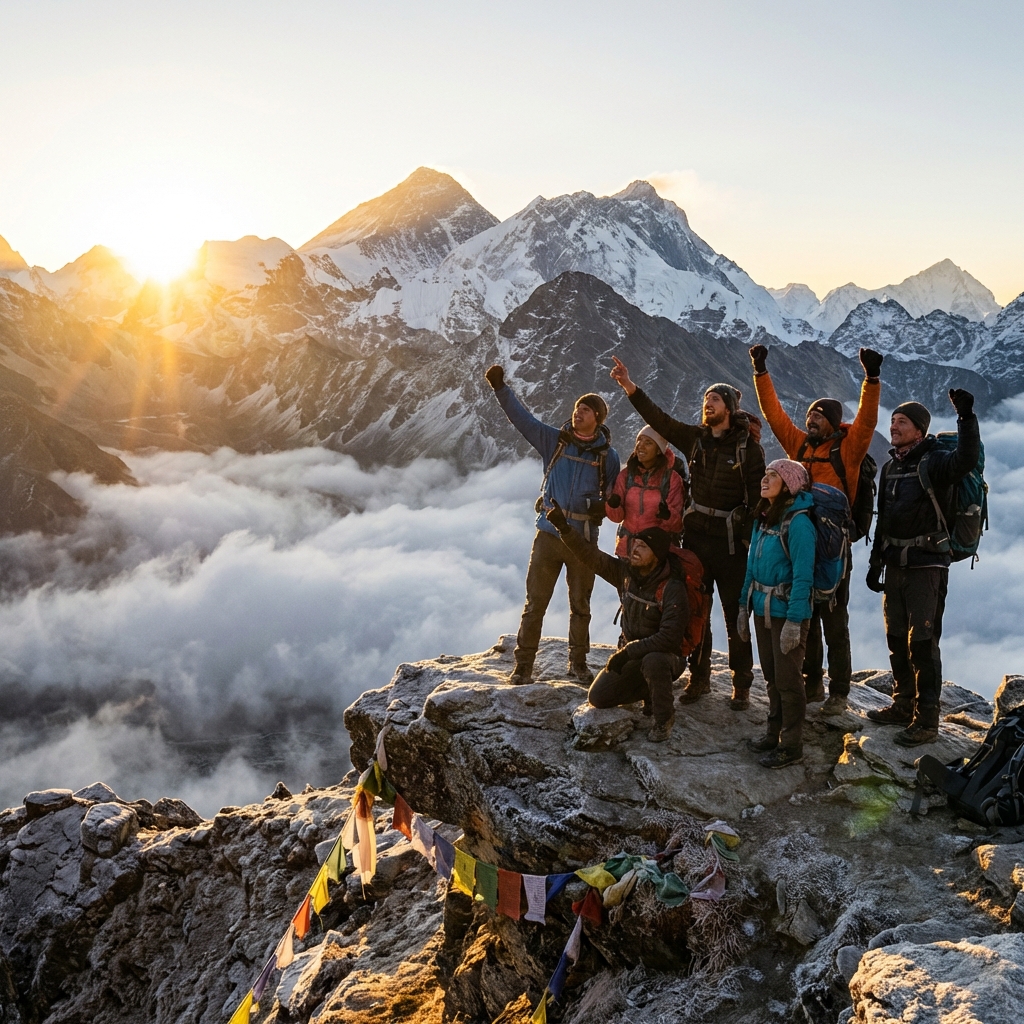
The Himalayas draw visitors from around the world, but for many trekkers, the experience begins and ends with mountain views. They pass through villages with eyes fixed on peaks, miss the significance of prayer flags fluttering overhead, and return home with photographs of scenery but no connection to the people whose ancestors have walked these trails for centuries.
Cultural immersion trekking offers something different: a journey where the destination is not a summit or a base camp but rather an understanding of the remarkable human cultures that have flourished in some of Earth's most demanding environments. These are treks where staying in a Tamang family's home matters more than reaching a particular altitude, where watching a Buddhist ritual in a remote monastery holds as much wonder as any mountain panorama, and where learning to grind roasted barley into tsampa or spin wool into yarn creates memories that outlast any photograph.
Nepal hosts over 125 distinct ethnic groups speaking more than 120 languages, each with unique traditions, belief systems, art forms, and ways of life shaped by geography, history, and centuries of adaptation. The cultural richness compressed into this small nation is staggering—from the Buddhist Sherpas of the high Khumbu to the animist Rai and Limbu of the eastern hills, from the Tibetan-influenced Thakalis of the Kali Gandaki valley to the Hindu-Buddhist Newars of the Kathmandu Valley.
This guide explores Nepal's finest cultural immersion treks: routes specifically designed or particularly suited for deep cultural engagement. You'll learn not just where to go but how to approach cultural trekking—the etiquette, the timing around festivals, the homestay experience, the ethical considerations of cultural tourism, and the practices that transform you from tourist to respectful guest.
Whether you're a first-time visitor seeking more than mountain views or an experienced Nepal hand ready to explore beyond the famous routes, cultural immersion trekking offers the most authentic and meaningful way to experience the Himalayan nation.
125+ distinct groups
123+ languages and dialects
Buddhism, Hinduism, Animism
Tamang, Ruby Valley, Mohare Danda
Tsum Valley
350+ registered networks
Dashain, Tihar, Mani Rimdu, Losar
Oct-Nov (festival season)
Why Choose Cultural Treks Over Traditional Routes?
The vast majority of Nepal's trekkers follow the same well-worn paths: Everest Base Camp, Annapurna Circuit, Langtang Valley. These are magnificent routes, but they share certain characteristics that limit cultural immersion. Commercial lodges have replaced family homes along popular trails. Menus feature pizza, pasta, and pancakes rather than traditional cuisine. English is spoken everywhere, and the experience—while comfortable—can feel sanitized of genuine cultural contact.
Cultural immersion treks prioritize different values:
Authentic Community Interaction
On cultural treks, particularly those featuring homestays, you become a guest in real families' homes rather than a customer in a commercial lodge. You share meals prepared in family kitchens, sleep in rooms where generations have lived, and participate in daily routines that haven't changed for centuries. The interaction is genuine because you're experiencing normal life, not a performance staged for tourists.
Economic Benefits Stay Local
When you stay in a commercial lodge on popular routes, much of your spending goes to owners who may live in Kathmandu or even abroad. Homestay programs ensure that tourism revenue reaches the families and communities you actually visit. Your nightly fee pays for your hosts' children's education, healthcare, and community improvements rather than enriching distant investors.
Less Crowded, More Meaningful
Cultural routes see a fraction of the traffic on famous trails. The Tamang Heritage Trail receives perhaps 3,000 trekkers annually compared to over 150,000 on Annapurna routes. This relative solitude creates conditions for genuine interaction—villagers have time to talk, to share stories, to teach you about their lives. On crowded routes, there's simply no space for such connection.
Preservation Through Tourism
Thoughtfully managed cultural tourism provides incentives for communities to maintain traditional practices. When visitors come specifically to witness Tamang dances, purchase Gurung textiles, or learn about Thakali cuisine, these traditions gain economic value that supports their continuation. Cultural tourism done right becomes an engine of preservation rather than destruction.
The Right Mindset for Cultural Trekking
Cultural immersion requires active participation and genuine curiosity. You'll need patience for language barriers, flexibility when schedules shift (village time runs differently than tourist time), and openness to unfamiliar foods, customs, and ways of living. The rewards—authentic human connection across cultural boundaries—are worth the adjustment.
Nepal's Ethnic Diversity: Understanding the Communities You'll Meet
Nepal's ethnic tapestry is extraordinarily complex, shaped by migrations over millennia, geographic isolation in mountain valleys, and the meeting of South Asian and Tibetan cultural spheres. Understanding this diversity enriches cultural trekking immensely.
Sherpa People
Perhaps the most internationally famous Nepali ethnic group, the Sherpas migrated from Tibet's Kham region approximately 500 years ago, settling in the Solu-Khumbu (Everest) region. They practice Tibetan Buddhism of the Nyingma school, with religious life centered on monasteries like Tengboche, Pangboche, and Thame.
Key Cultural Elements:
- Tibetan Buddhist monasteries and rituals
- Mani Rimdu festival (October-November)
- Traditional architecture with stone walls and wooden beams
- Butter tea and tsampa as staple foods
- Strong clan system and community mutual aid traditions
Best Cultural Experiences: Tengboche monastery visit, Mani Rimdu festival, Namche Bazaar Saturday market, Khumjung village exploration
Tamang People
The Tamang are one of Nepal's largest indigenous groups, inhabiting the hills surrounding Kathmandu Valley and regions including Langtang, Rasuwa, and Sindhupalchok. Their name possibly derives from Tibetan words meaning "horse warrior."
Key Cultural Elements:
- Tibetan Buddhism with indigenous elements
- Distinctive circular Damphu drums and Selo music
- Thangka painting and woodcarving traditions
- Strong community-based tourism initiatives
- Traditional stone houses with slate roofs
Best Cultural Experiences: Tamang Heritage Trail homestays, traditional dance performances, monastery visits at Gatlang or Chilime, Ruby Valley community treks
Gurung People
The Gurung inhabit the Annapurna and Manaslu foothills, known both for their Gurkha military tradition and their sophisticated agricultural practices on terraced hillsides.
Key Cultural Elements:
- Mixed Buddhist, Hindu, and Bon (shamanic) practices
- Rodhi houses—traditional youth gathering places
- Honey hunting traditions (harvesting wild cliff honey)
- Famous for their hospitality and musical traditions
- Strong tradition of service in British and Indian armies
Best Cultural Experiences: Ghandruk village (model community tourism), Poon Hill route through Gurung villages, traditional honey hunting observation (rare), Ghale Gaun community tourism
Thakali People
The Thakalis of the Kali Gandaki valley are renowned as Nepal's finest innkeepers and traders, historically controlling salt trade between Tibet and India. Their cuisine—considered Nepal's finest—and hospitality traditions make any Thakali village a cultural highlight.
Key Cultural Elements:
- Sophisticated trading and business culture
- Exceptional cuisine featuring dal bhat, buckwheat, and local specialties
- Mixed religious practices (Buddhist, Hindu, Bon)
- Traditional flat-roofed architecture
- Strong family and clan networks
Best Cultural Experiences: Marpha village (apple capital of Nepal), Tukuche historical trading town, Thakali dal bhat anywhere on the Annapurna Circuit, traditional Thakali lodge stays
Ethnic Groups of the Remote Northwest
Nepal's remote northwest—Upper Mustang, Dolpo, Humla—hosts communities with particularly strong Tibetan cultural connections, having been largely isolated from both Nepal and modernization until recently.
Loba People (Upper Mustang):
- Preserved medieval Tibetan Buddhist culture
- Kingdom of Lo maintained independence until 2008
- Extraordinary cave complexes and cliff monasteries
- Traditional polyandry practices in some communities
- Tiji festival (May) celebrates mythological horse race
Dolpo-pa (Dolpo Region):
- Among Nepal's most isolated communities
- Bon religion alongside Tibetan Buddhism
- Yak caravan trading traditions
- Featured in "Himalaya" documentary
- Shey-Phoksundo National Park homeland
Learning Before You Go
Reading about the ethnic groups you'll encounter transforms cultural trekking from passive observation to informed appreciation. Books like David Snellgrove's "Himalayan Pilgrimage," Peter Matthiessen's "The Snow Leopard" (for Dolpo), and scholarly works on Sherpa culture provide essential background. Even brief research pays dividends in understanding what you witness.
Top Cultural Immersion Treks
1. Tamang Heritage Trail: Community Tourism Pioneer
The Tamang Heritage Trail represents Nepal's most successful community-based tourism initiative. Developed after the 2015 earthquake as an economic recovery program, this trek through Rasuwa District showcases Tamang culture while ensuring that tourism benefits reach local families directly.
7-10 days
3,165m (Nagthali viewpoint)
Easy to Moderate
March-May, October-November
Community homestays throughout
$500-$900 all-inclusive
Langtang National Park permit, TIMS
Tamang villages, monasteries, traditional dance
Route Overview:
The trail forms a loop from Syabrubesi (the gateway to Langtang Valley), passing through traditional villages including Gatlang, Tatopani, Thuman, Timure, Briddim, and Nagthali. Each village offers registered community homestays where families take turns hosting guests, distributing tourism income equitably.
Why It's Special for Cultural Immersion:
The Tamang Heritage Trail was designed specifically to showcase culture rather than scenery. While the mountain views (Langtang Lirung, Ganesh Himal, the Tibetan plateau) are magnificent, the trek's heart lies in its villages. Each evening, hosts prepare traditional meals, and guests often witness or participate in cultural programs including:
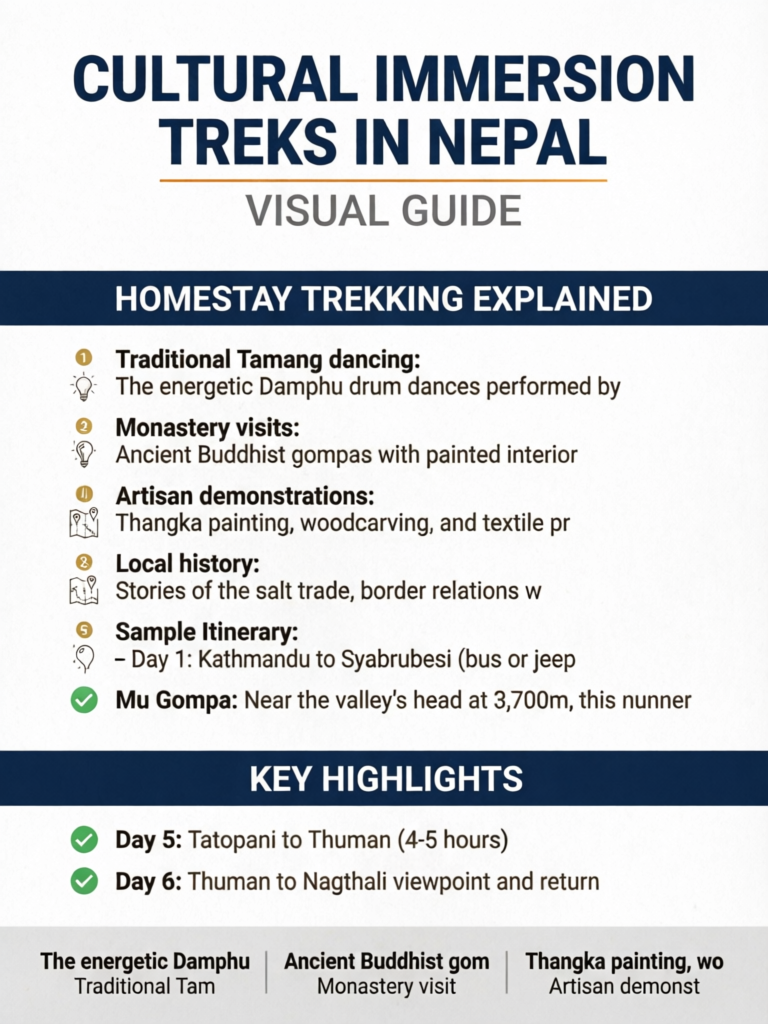
- Traditional Tamang dancing: The energetic Damphu drum dances performed by villagers
- Monastery visits: Ancient Buddhist gompas with painted interiors and resident monks
- Artisan demonstrations: Thangka painting, woodcarving, and textile production
- Agricultural participation: Depending on season, guests may join in planting, harvesting, or processing
- Local history: Stories of the salt trade, border relations with Tibet, and village legends
Day-by-Day Cultural Highlights:
Gatlang: One of Nepal's oldest Tamang settlements with a beautifully preserved monastery (Parvati Kunda) and traditional stone architecture. The village has a functioning water-powered grain mill and offers some of the best-preserved traditional houses.
Tatopani (Chilime): Named for its natural hot springs, this village sits near an important hydropower project that has brought development while challenging traditional life. The hot springs themselves hold spiritual significance.
Thuman: Perhaps the trail's most picturesque village, featuring a hilltop monastery with stunning views and deeply traditional families. Thuman's community tourism committee has won national awards for their homestay program.
Briddim: A mixed Tamang-Tibetan village with strong connections to Tibetan Buddhism. The monastery here is particularly active, and older residents may speak Tibetan alongside Tamang and Nepali.
Sample Itinerary:
- Day 1: Kathmandu to Syabrubesi (bus or jeep, 8-9 hours)
- Day 2: Syabrubesi to Gatlang (5-6 hours trekking)
- Day 3: Gatlang exploration, monastery visit, cultural program
- Day 4: Gatlang to Tatopani (5-6 hours)
- Day 5: Tatopani to Thuman (4-5 hours)
- Day 6: Thuman to Nagthali viewpoint and return (4-5 hours)
- Day 7: Thuman to Briddim (5-6 hours)
- Day 8: Briddim to Syabrubesi (5-6 hours)
- Day 9: Syabrubesi to Kathmandu
Read our complete Tamang Heritage Trail guide
2. Tsum Valley: The Hidden Buddhist Kingdom
Tsum Valley may be Nepal's most culturally intact trekking destination. Closed to foreigners until 2008 and still requiring special permits, this deeply sacred "hidden valley" (beyul in Tibetan Buddhist tradition) preserves traditions that have vanished elsewhere. The valley's isolation—tucked against the Tibetan border north of Manaslu—protected it from both political upheaval and tourist development.
14-20 days (often combined with Manaslu)
3,700m (Mu Gompa)
Moderate
March-May, September-November
Basic tea houses, monastery guesthouses
$1,500-$2,500 all-inclusive
Special restricted area permit ($35/week), MCAP, ACAP
Ancient monasteries, living Buddhist traditions, Tibetan culture
Why Tsum Valley Is Extraordinary:
Tsum Valley was deliberately closed to outside influence for centuries—first by its own leaders who wanted to protect its sacred character, then by the Nepali government due to its sensitive border location. The result is a living museum of Tibetan Buddhist culture, where medieval practices continue in a landscape that residents believe was blessed by Guru Rinpoche (Padmasambhava) himself.
Cultural Highlights:
Rachen Gompa: One of Nepal's most significant Nyingma monasteries, founded in the 14th century. The resident monks perform daily rituals unchanged for centuries, and visitors can witness teachings, ceremonies, and monastic life with minimal tourist infrastructure interference.
Mu Gompa: Near the valley's head at 3,700m, this nunnery is among the highest in the Himalayas. The approximately 70 resident nuns live largely self-sufficiently, and their welcome of visitors offers rare insight into female monastic life.
Milarepa's Meditation Caves: The great Tibetan poet-saint Milarepa is said to have meditated in caves throughout the valley. These sites remain pilgrimage destinations, and elderly villagers recount stories passed down through generations.
Traditional Village Life: Unlike more touristed areas, Tsum Valley villages function largely as they have for centuries. Agriculture (barley, potatoes, buckwheat) follows traditional methods. Yak herding continues seasonally. Houses maintain traditional architecture with prayer rooms and carved wooden details.
Restrictions and Respect:
Tsum Valley's special permit exists partly to limit visitor numbers and protect cultural integrity. Trekkers must travel with registered agencies in groups of at least two. These restrictions aren't obstacles but rather safeguards that keep Tsum special. Approaching the valley with appropriate reverence—following all monastic protocols, dressing modestly, asking permission before photography—honors the sacred character that makes Tsum extraordinary.
Read our complete Tsum Valley guide
3. Nar-Phu Valley: Remote Tibetan Culture
The Nar-Phu Valley, hidden behind the Annapurna massif, offers perhaps the most demanding cultural trek in Nepal—and among the most rewarding. This restricted area, opened only in 2003, preserves Tibetan culture in villages so remote that residents historically had more contact with Tibet than with lowland Nepal.
12-16 days
5,320m (Kang La Pass)
Challenging
April-May, September-October
Very basic tea houses, camping sections
$1,800-$3,000 all-inclusive
Special restricted area permit ($90/week), ACAP
Tibetan villages, ancient monasteries, authentic traditional life
The Villages:
Phu (4,080m): One of Nepal's highest permanent settlements, Phu seems to emerge organically from its rocky hillside. The compact village of flat-roofed stone houses clusters around a monastery with origins dating to the 15th century. Residents speak a Tibetan dialect, practice Tibetan Buddhism, and maintain seasonal migration patterns—moving to summer herding settlements above and winter quarters below.
Nar (4,110m): Slightly more accessible than Phu, Nar occupies a broader valley with more agricultural potential. The village's Tashi Lhakhang Gompa houses important religious artifacts, and the annual festival (typically September) draws the scattered community together for rituals, dances, and celebrations that have continued unbroken for centuries.
Why Nar-Phu Demands Commitment:
This is not an easy trek. The approach involves crossing the high Kang La Pass (5,320m), the trails are rough, accommodation is extremely basic, and facilities that trekkers take for granted elsewhere simply don't exist. Weather windows are narrow, and flexibility is essential.
But the cultural rewards match the effort. These are communities where tourism remains a novelty rather than an industry. Genuine interactions happen naturally because hosts have little experience with performative hospitality. The Buddhism practiced in Nar and Phu monasteries connects directly to Tibetan traditions without the mediation of tourism, and witnessing daily rituals feels like privilege rather than entertainment.
Combining with Annapurna Circuit:
Most Nar-Phu treks begin from Koto on the Annapurna Circuit, detour into the restricted valleys, and rejoin the Circuit at Ngawal or Manang. This combination offers both cultural depth (Nar-Phu) and classic Himalayan trekking (the Circuit itself, crossing Thorong La at 5,416m).
Read our complete Nar-Phu Valley guide
4. Mohare Danda: The Community Homestay Model
Mohare Danda (3,300m) has become Nepal's showcase for community-based tourism done right. This viewpoint ridge between the Annapurna and Dhaulagiri ranges offers magnificent mountain panoramas, but its true significance lies in demonstrating how tourism can benefit communities equitably while preserving cultural authenticity.
5-8 days
3,300m (Mohare Danda)
Easy to Moderate
October-November, March-May
Community homestays, community lodge at summit
$400-$700 all-inclusive
ACAP permit
Magar and Gurung villages, community tourism model
The Community Tourism Model:
The Mohare Danda Community Trail was developed with support from the Annapurna Conservation Area Project and international partners as a model for sustainable tourism. Key features include:
Rotating Homestays: Each village maintains a roster of registered homestay families who host guests in rotation, ensuring that tourism benefits are distributed throughout the community rather than concentrating with a few families.
Fixed Pricing: Standard rates for accommodation and meals prevent competition from driving prices down (which hurts families) or up (which limits accessibility). Families know their income, and trekkers know their costs.
Cultural Programming: Villages organize traditional cultural programs, with performers and participants compensated fairly. This creates economic incentive to maintain traditional music, dance, and crafts.
Local Guides: The program trains and employs local guides from participating communities rather than bringing guides from Pokhara or Kathmandu.
Route and Villages:
The trail connects Gurung and Magar villages between Nayapul (the Poon Hill trailhead) and Beni, passing through communities including Tikot, Dobato, Banskharka, Nangi, and others. Each village offers homestays with similar basic amenities: a clean bed, warm blankets, simple but delicious meals prepared by your hosts, and genuine family hospitality.
Nangi Village: This Magar community has received international recognition for its community development programs, including a wireless internet network, women's cooperatives, and organic farming initiatives. Trekking through Nangi offers insight into how isolated mountain communities can embrace development while maintaining cultural identity.
Mohare Danda Summit: The ridge-top viewpoint hosts a community-run lodge rather than a private business. The sunrise views—Dhaulagiri, Annapurna South, Machhapuchhare, and ranges stretching to the horizon—rival those from Poon Hill with a fraction of the crowds.
5. Ruby Valley: The Emerging Cultural Gem
Ruby Valley represents the next frontier of community-based cultural trekking in Nepal. Named for the gemstones historically found in the region, this circuit through Ganesh Himal offers stunning mountain scenery, pristine forests, sacred lakes, and authentic Tamang village life.
9-12 days
3,842m (Pangsang Pass)
Moderate
March-May, October-November
Community homestays throughout
$800-$1,500 all-inclusive
TIMS only (no national park fee)
Traditional Tamang villages, sacred lakes, minimal tourism
Why Ruby Valley Stands Out:
Ruby Valley was "discovered" by TAAN (Trekking Agencies' Association of Nepal) in 2012 and developed specifically as a model for responsible tourism. Unlike trails where commercial development preceded community involvement, Ruby Valley began with community structures in place. Every night you stay in a family homestay; there are no commercial lodges.
The Immersion Experience:
With only a few hundred trekkers annually, Ruby Valley hosts have time and inclination for genuine interaction. Expect:
- Home-cooked meals: Your hosts prepare traditional Tamang food—dal bhat, but also local specialties including fermented vegetables, homemade alcohol (tongba), and seasonal dishes
- Family participation: Depending on timing, you may join in agricultural work, food preparation, or daily household tasks
- Cultural performances: Villages organize traditional music and dance, with authentic rather than staged performances
- Sacred site visits: The valley includes important Buddhist sites including Kalo Kunda and Seto Kunda (Black and White sacred lakes)
Combining with Langtang:
Ruby Valley and Langtang Valley share the same gateway (Syabrubesi), making combination treks possible. This pairing offers contrast between Ruby Valley's community homestay model and Langtang's more developed tea house infrastructure—both culturally rich but in different ways.
6. Helambu: Sherpa Villages Near Kathmandu
Helambu offers the most accessible cultural trekking experience in Nepal—Sherpa-influenced villages just a few hours from Kathmandu. While less dramatic than the high Khumbu, Helambu provides genuine cultural immersion without the logistics, expense, or altitude challenges of more remote regions.
5-7 days
3,640m (Tharepati Pass)
Easy to Moderate
October-May (year-round possible)
Tea houses and homestays
$400-$700 all-inclusive
Langtang National Park permit, TIMS
Helambu Sherpa culture, monasteries, apple orchards
Helambu's Cultural Character:
The Helambu region hosts a distinct Sherpa community (Helambu Sherpa or Yolmo) with cultural connections to both the Khumbu Sherpas and Tibetan populations. Their traditions blend Nyingma Buddhism with local practices, expressed through distinctive architecture, festivals, and spiritual traditions.
Key Villages:
Sermathang: The valley's largest settlement, featuring traditional Yolmo houses, an important monastery, and growing community tourism infrastructure.
Tarkeghyang (Tarke Ghyang): One of Nepal's most beautiful villages, with a stunning monastery complex and traditional architecture. The village has made remarkable recovery since the 2015 earthquake and offers excellent homestay options.
Melamchi Gaon: A quieter alternative with strong cultural traditions and fewer visitors.
Why Choose Helambu:
For trekkers with limited time or those uncomfortable with high altitude, Helambu provides cultural richness accessible from Kathmandu without the logistical complexity of more remote areas. The maximum altitude (around 3,600m) poses minimal altitude sickness risk, and the relatively short duration makes it perfect for combining with Kathmandu Valley cultural exploration.
Homestay Trekking Explained
Homestays form the heart of cultural immersion trekking. Understanding what to expect—and how to be a good guest—makes the experience rewarding for both visitors and hosts.
What Is a Homestay?
A registered community homestay is a family home where designated rooms or spaces host guests. Unlike commercial tea houses (which are essentially small hotels), homestays involve living with families—sharing meals, common spaces, and daily rhythms.
Physical Setup:
Most homestays provide:
- A private sleeping room with beds, mattresses, and blankets
- Shared family bathroom facilities (varying from basic pit toilets to modern bathrooms depending on location)
- Shared common/dining area, often the family's main living space
- Kitchen access varies—some hosts welcome guests to observe or assist, others prefer cooking privately
Meals:
Homestay meals are typically included in your nightly rate and feature traditional family food rather than tourist menus. Expect:
- Morning: Tea, perhaps eggs, chapatti or rice
- Midday: Dal bhat (lentils, rice, vegetables, pickles) or similar traditional meal
- Evening: Dal bhat or regional specialties
Dietary Considerations
Communicate dietary restrictions before booking, but understand that options are limited. Vegetarian is usually fine—most village meals are naturally meat-light. Vegan is more challenging, as dairy features prominently. Severe allergies may be difficult to accommodate in remote homestays where ingredient substitution isn't possible.
Being a Good Homestay Guest
Your behavior directly affects your hosts' experience and their attitude toward future guests.
Respect the Home:
- Remove shoes before entering living and sleeping areas
- Ask before entering the kitchen (it may have religious significance)
- Keep your belongings organized and don't spread them throughout common areas
- Use water sparingly—it may be carried from distant sources
Participate Appropriately:
- Show interest in family activities without imposing yourself
- Offer to help with simple tasks (carrying water, chopping vegetables), but accept gracefully if declined
- Join family meals even if the food is unfamiliar
- Engage in conversation even across language barriers—smiles, gestures, and shared photos communicate much
Photography Protocol:
- Always ask before photographing family members, especially elders and children
- Religious objects, shrines, and certain spaces may be off-limits for photos
- Offer to send photos to families (and follow through)
Financial Respect:
- Pay the agreed homestay rate without bargaining
- Tips beyond the set rate are appreciated but not expected
- If offered goods for sale (crafts, food items), understand that declining is fine but aggressive negotiation is inappropriate
Homestay Networks and Booking
Community Homestay Network Nepal (CHNN): The umbrella organization coordinating community homestay programs. Their website lists registered homestay communities, and they can assist with bookings and information.
Direct Booking: Some communities accept direct contact for booking. This often requires phone calls (with Nepali assistance) or coordination through local contacts.
Agency Booking: Most trekking agencies can arrange homestay-based itineraries. Choose agencies with demonstrated community partnerships rather than those simply using homestays for cheap accommodation.
Bringing Useful Gifts
Rather than candy or trinkets, bring items of genuine use: reading glasses (various strengths), simple first aid supplies, quality pens and notebooks for students, or photographs from your home country. Consult with your guide or homestay coordinator about appropriate gifts for specific families.
Cultural Etiquette and Respect
Respectful behavior makes cultural trekking meaningful rather than extractive. These guidelines apply broadly across Nepal's diverse communities.
Religious Respect
Buddhist Sites:
- Walk clockwise around stupas, mani walls, and monasteries
- Don't touch religious objects without explicit permission
- Remove hats and shoes when entering monastery interiors
- Sit with feet pointed away from altars and religious images
- Ask before photographing ceremonies, monks, nuns, or sacred objects
- Leave small donations when visiting active monasteries
Hindu Sites:
- Respect that some temples prohibit non-Hindu entry
- Remove shoes before entering temple grounds
- Don't touch religious images or offerings
- Dress modestly (shoulders and knees covered)
- Accept tikka (blessing marks) graciously when offered
Social Etiquette
Greetings:
- "Namaste" (palms together, slight bow) is universally appropriate
- "Tashi Delek" is the traditional greeting in Sherpa and Tibetan Buddhist communities
- Greet elders first and with particular respect
Physical Contact:
- Avoid touching people's heads (considered sacred)
- Don't point feet toward people or religious objects
- Handshakes are increasingly common but namaste remains more traditional
- Physical contact between genders in public is considered inappropriate
Meals:
- Accept food and drink offered—refusing hospitality causes offense
- Eat with your right hand if eating by hand
- Don't touch communal food with utensils that have touched your mouth
- Complimenting the food honors your host's effort
Dress:
- Dress modestly, especially in villages and at religious sites
- Women should cover shoulders and wear pants or long skirts
- Avoid tight or revealing clothing
- Remove shoes when entering homes and temples
Photography Ethics
The camera can be a barrier to genuine connection. Constantly photographing—especially without asking—treats community members as exotic objects rather than people. Put the camera away during meaningful interactions. Ask permission before photographing individuals. Offer to share photos with subjects. Never photograph people who have refused or seem uncomfortable.
Festivals to Time Your Trek Around
Timing your trek to coincide with cultural festivals transforms already immersive experiences into extraordinary ones. These are living traditions, not performances.
Major Festivals
Dashain (September-October) Nepal's biggest festival, celebrating the goddess Durga's victory over evil. The 15-day celebration involves family gatherings, animal sacrifices (at Hindu sites), swinging, kite flying, and blessing ceremonies. Trekking routes through Hindu communities during Dashain offer unparalleled cultural immersion—but be aware that many businesses close and transportation becomes scarce as Nepalis travel to ancestral homes.
Tihar/Deepawali (October-November) The festival of lights follows Dashain by about two weeks. Five days celebrate crows, dogs, cows, oxen, and siblings through specific rituals. Homes are illuminated with candles and electric lights, rangoli (colored powder designs) decorate doorsteps, and the atmosphere is magical. Excellent time for trekking in any region.
Mani Rimdu (October-November at Tengboche, May at Thame) The Sherpa festival of masked dances celebrating Buddhism's triumph over Bon. Monks perform elaborate ritual dances in colorful costumes. The Tengboche celebration (Everest region) draws hundreds of spectators; Thame's event is smaller and more intimate. Essential experience for Everest region cultural trekking.
Losar (February-March) Tibetan New Year celebrations occur throughout Buddhist communities in Sherpa, Tamang, and Tibetan-influenced regions. Monasteries perform special rituals, families prepare traditional foods, and communities gather for prayers and celebration.
Tiji Festival (May) Upper Mustang's most important festival, a three-day celebration of a Buddhist deity's victory over a demon. Monks perform elaborate rituals at Lo Manthang's central square while the community gathers. Combining Upper Mustang trekking with Tiji is an extraordinary experience—book far in advance, as permit numbers are limited.
Regional and Village Festivals
Beyond major festivals, individual communities celebrate local events, monastery anniversaries, harvest festivals, and observances of local deities. Your guide or homestay hosts can inform you of upcoming events—attending a village festival no tourist has ever witnessed creates uniquely meaningful memories.
Supporting Communities Ethically
Cultural tourism's potential for good—or harm—depends entirely on how it's practiced. Thoughtful engagement supports communities; careless tourism extracts value while giving little back.
Economic Ethics
Pay Fair Prices: Bargaining is appropriate in Kathmandu markets but not in village homestays. Agreed homestay rates ensure families receive fair compensation. Attempting to negotiate lower prices takes money from people with limited alternatives.
Hire Locally: When possible, hire guides and porters from the communities you'll visit rather than bringing staff from Kathmandu. This keeps more tourism money in villages and creates incentive for communities to maintain cultural offerings.
Buy Local: Purchase snacks, handicrafts, and supplies from village shops rather than stocking up in cities. The price difference is usually minimal for you but significant for village economies.
Tip Appropriately: While fixed homestay rates exist, tips for exceptional service are appreciated. Porter and guide tips follow general Nepal trekking standards ($15-25/day for guides, $10-15/day for porters as baselines).
Cultural Ethics
Don't Treat Culture as Performance: Village dances, monastery rituals, and daily life are authentic practices, not entertainment staged for tourists. Show respect rather than treating cultural experiences as shows you've paid to watch.
Avoid Creating Dependency: Random gift-giving, especially to children, creates expectations and dependency. If you want to contribute, donate to community funds, schools, or development projects rather than distributing individual gifts.
Protect What You Came to See: Share locations of vulnerable sites carefully. Photography and social media exposure can transform quiet cultural destinations into Instagram destinations almost overnight—not always for the better.
The Photographer's Responsibility
That perfect photograph of an elder spinning prayer wheels or a child in traditional dress can, when shared widely, bring waves of photographers seeking the same shot. Consider whether publication serves the community or merely your social media presence. When in doubt, keep special moments private.
What to Expect from Village Life
Cultural trekking means adapting to village rhythms rather than expecting villages to adapt to you.
Daily Rhythms
Village life follows patterns shaped by agriculture, religion, and the sun:
- Dawn: Families rise early, often before sunrise. You may hear prayer chants, roosters, livestock
- Morning: Light breakfast, agricultural work begins in farming communities
- Midday: Main meal (dal bhat), rest during heat
- Afternoon: More work, children returning from school, social time
- Evening: Dinner around sunset, family time, early sleep (often by 8-9 PM)
Basic Amenities
Electricity: Many villages have electricity but power cuts (load shedding) are common. Charging devices is usually possible but don't assume outlets everywhere. Bring adequate battery capacity.
Water: Running water varies. Hot water for showers is often unavailable or costs extra (heated by fire). Carry water purification for drinking.
Toilets: Standards range from Western-style bathrooms to basic pit latrines. Bring toilet paper and hand sanitizer.
Heating: Most village homes lack central heating. Evenings can be cold, especially above 2,500m. Common rooms may have wood stoves; sleeping rooms are typically unheated.
Connectivity: Cell service exists in many villages but can be spotty. WiFi is rare in true village homestays. Prepare to disconnect.
Food
Village food is simple, nutritious, and repetitive. Expect:
- Dal bhat: Rice, lentil soup, vegetables, pickles—often twice daily
- Potatoes: Boiled, fried, in curry—a staple especially at altitude
- Seasonal vegetables: Whatever is currently growing or stored
- Limited meat: Meat is expensive and often unavailable; when present, it's usually chicken or goat
- Tea: Endless cups of sweet milk tea
Adventurous eating enhances cultural trekking. Try local specialties: gundruk (fermented leafy greens), tongba (fermented millet drink), sel roti (rice flour doughnuts), and regional preparations you won't find on any tea house menu.
Photography and Cultural Sensitivity
Photography creates lasting memories but requires particular sensitivity in cultural contexts.
Ask Permission—Always
This cannot be overstated. Before photographing:
- Individuals: Make eye contact, gesture to camera, receive clear assent
- Groups: Ask someone in the group
- Religious sites: Check with monastery staff or visible signage
- Ceremonies: Often restricted; always ask
- Children: Ask parents, not children themselves
When Photography Is Inappropriate
Some situations call for putting the camera away entirely:
- Funeral ceremonies and death-related rituals
- Private family moments you happen to witness
- Anyone who has refused or seems uncomfortable
- Situations where photography would interrupt or alter what's happening
- Interior monastery spaces without explicit permission
Technical Considerations
Portraits: Use moderate focal lengths (50-85mm equivalent) rather than obvious telephoto shooting from a distance, which feels intrusive. Closer engagement with permission creates better photographs and human connection.
Documentation vs. Art: Consider your purpose. Documenting a craft process differs from seeking dramatic portraits. Different purposes suggest different approaches.
Sharing: Offer to share photos with subjects. Show portraits on your camera screen immediately. Get addresses or email contacts for sending images later—and actually follow through.
Publishing: Think carefully before publishing images widely. That perfect photograph of a village elder may bring photographers who disrupt daily life seeking similar shots.
Leave the Drone at Home
Drones are increasingly regulated in Nepal and prohibited in many areas including national parks. Beyond legality, drone photography in villages is intrusive, noisy, and disrespectful. The aerial shots aren't worth the disruption to communities and fellow trekkers.
Planning Your Cultural Trek
Choosing the Right Trek
Consider these factors when selecting a cultural immersion trek:
Your Physical Condition: Cultural treks range from gentle (Helambu, Mohare Danda) to demanding (Nar-Phu, Upper Mustang). Honest fitness assessment ensures enjoyment rather than suffering.
Available Time: Short trips suit Helambu (5-7 days) or Poon Hill with cultural extensions (6-8 days). Deeper immersion requires 10-20 days for treks like Ruby Valley, Tamang Heritage Trail, or Tsum Valley.
Cultural Interests:
- Buddhist traditions: Tsum Valley, Nar-Phu, Upper Mustang
- Community tourism models: Mohare Danda, Ruby Valley, Tamang Heritage Trail
- Accessible cultural trekking: Helambu, Poon Hill villages
- Remote authenticity: Nar-Phu, Upper Dolpo
Budget: Restricted area permits (required for Tsum, Nar-Phu, Upper Mustang) add significant cost. Homestay-based treks (Ruby Valley, Tamang Heritage) are often more affordable than tea house routes.
Selecting a Guide
Cultural trekking benefits enormously from the right guide. Seek:
Local Guides: Guides from the community you're visiting provide authentic cultural interpretation and benefit the community economically.
Cultural Knowledge: Ask potential guides about their knowledge of local customs, religious practices, and history. Enthusiasm for sharing cultural information suggests a good cultural trekking guide.
Language Skills: In remote areas, your guide's ability to translate conversations with hosts and community members makes the difference between observation and interaction.
Best Seasons for Cultural Trekking
October-November: Post-monsoon clarity, major festivals (Dashain, Tihar, Mani Rimdu), comfortable temperatures. Peak season with best weather.
March-May: Spring warmثبت rhododendron blooms, warming temperatures, some festivals (Losar, Tiji). Good alternative to crowded autumn.
December-February: Cold but clear. Fewer trekkers means more authentic village interactions. Lower-altitude cultural treks (Helambu, Poon Hill villages) remain comfortable.
June-September: Monsoon season limits most trekking, but rain shadow areas (Upper Mustang, Upper Dolpo) remain viable with unique seasonal culture to witness.
Conclusion: Trekking That Transforms
Cultural immersion trekking in Nepal offers something beyond scenic beauty and physical challenge: genuine human connection across vast cultural differences. The grandmother who shares her life story through your guide's translation, the monastery where you're invited to sit quietly during morning prayers, the village festival where you're pulled into the dancing circle—these moments transcend tourism and touch something deeper.
Nepal's remarkable ethnic diversity, living religious traditions, and communities that have thrived in challenging mountain environments for centuries offer insights unavailable anywhere else on Earth. The Tamang weaver continuing techniques practiced for generations, the Sherpa family preparing for Mani Rimdu as their ancestors did, the Thakali innkeeper maintaining hospitality traditions from the salt trade era—these aren't museum exhibits but living cultures that welcome respectful visitors into their midst.
Cultural trekking requires more from you than traditional routes. You'll face unfamiliar foods, basic facilities, language barriers, and situations where you're clearly the outsider. But the rewards—authentic relationships, genuine cultural understanding, and the knowledge that your tourism actively supports the communities you visit—make the effort worthwhile.
The mountains will always be there, magnificent and eternal. But the cultures that have flourished beneath them face unprecedented challenges from modernization, migration, and climate change. Your respectful engagement through cultural immersion trekking contributes, in small but real ways, to the continuation of traditions that enrich not only Nepal but humanity's cultural heritage.
Travel well. Travel respectfully. And return home transformed not just by the mountains but by the remarkable people who call them home.