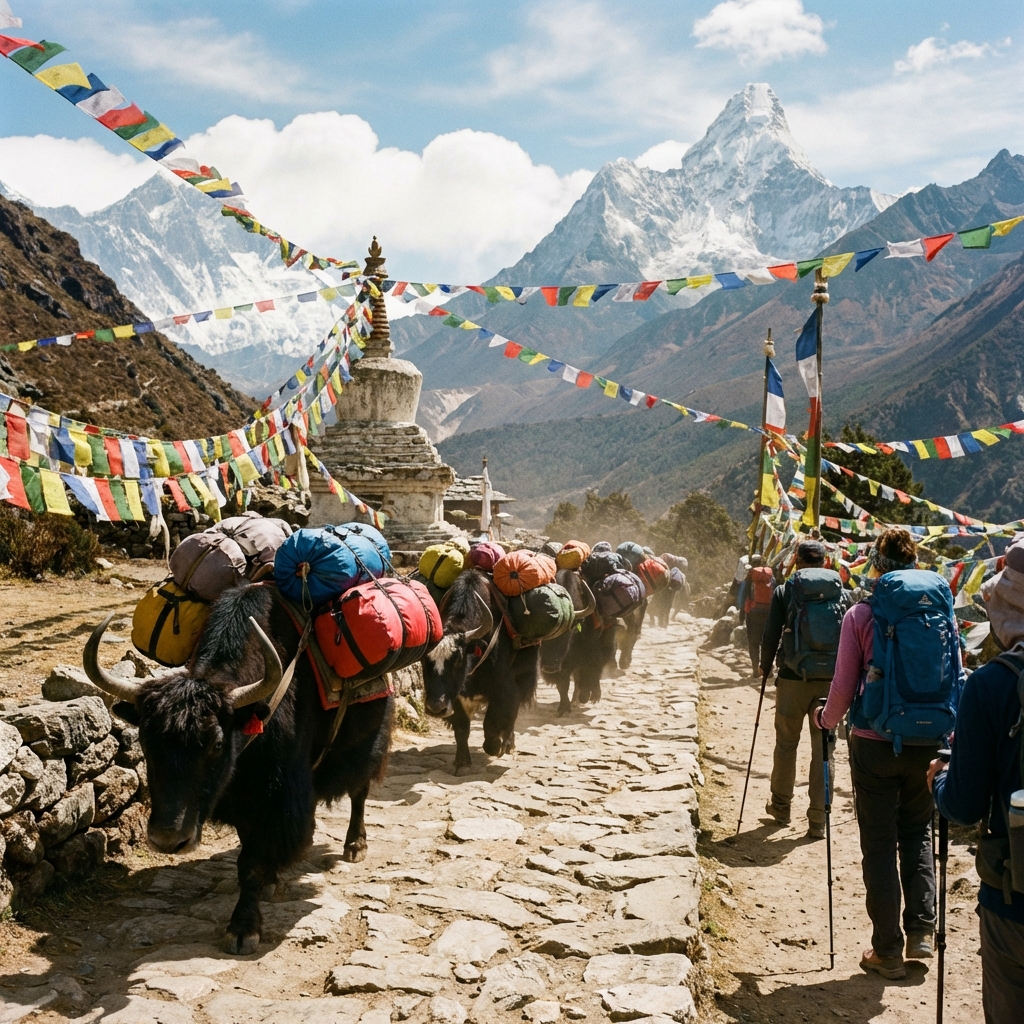
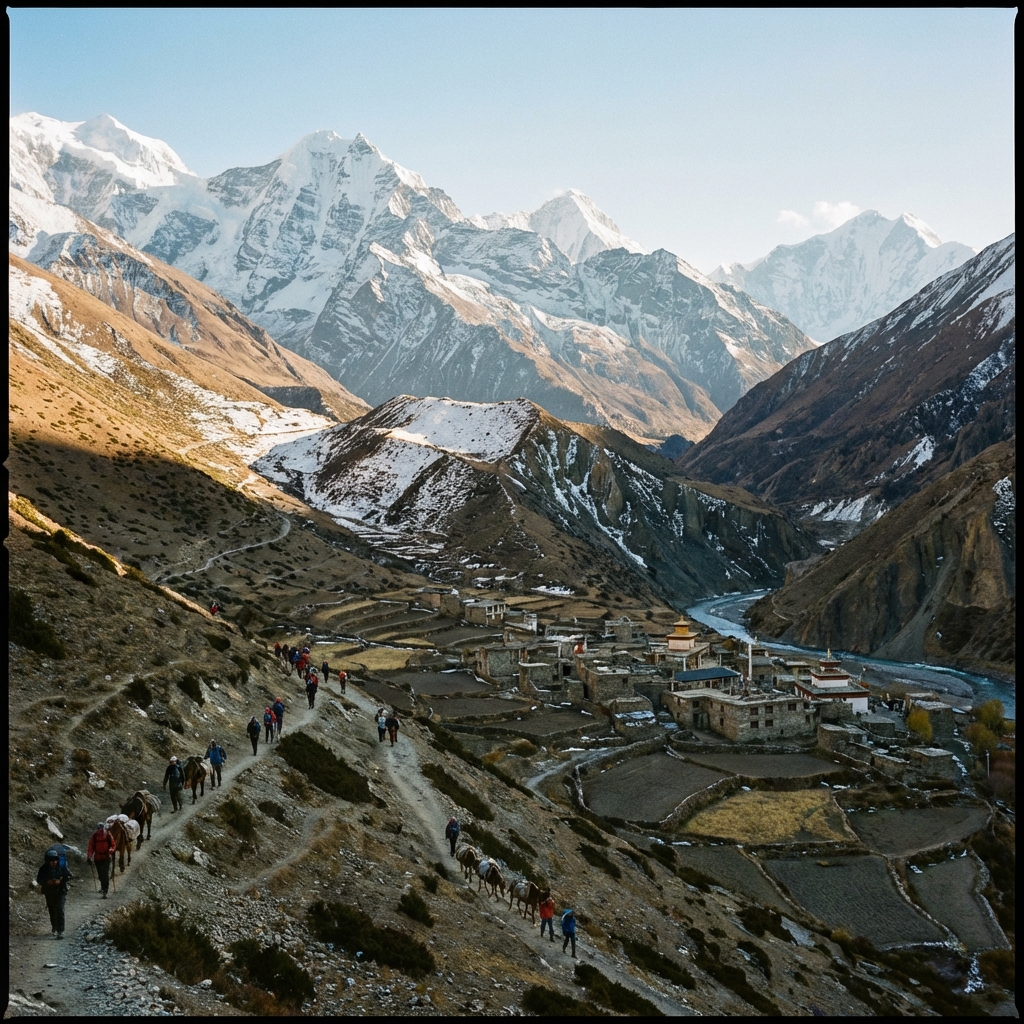
The Gokyo Lakes trek is the Everest region's best-kept alternative, offering turquoise sacred lakes, a panoramic viewpoint that rivals Kala Patthar, the longest glacier in the Himalayas, and a fraction of the foot traffic that clogs the classic Everest Base Camp trail. If you want to stand in the shadow of Everest without the crowds, Gokyo is where you should be heading.
Six turquoise lakes, collectively known as the Gokyo Lakes, sit at the edge of the Ngozumpa Glacier between 4,700m and 5,000m elevation. These are among the highest freshwater lake systems in the world, and their supernatural color, caused by glacial mineral suspension, looks almost artificial against the grey moraine landscape. Above them, the summit of Gokyo Ri (5,357m) delivers a 360-degree panorama that includes four of the world's fourteen 8,000m peaks: Everest (8,849m), Lhotse (8,516m), Makalu (8,485m), and Cho Oyu (8,188m).
The standard Gokyo Lakes trek takes 12-14 days and follows the same route as EBC through Namche Bazaar and Phortse (or Dole), before diverging west into the quieter Gokyo Valley. For trekkers who want the Everest region experience without committing to the full EBC trek, or for those who have already done EBC and want something different, the Gokyo Lakes trek is the definitive alternative.
Quick Facts
12-14 days (trek only)
10-12 days on trail
5,357m (Gokyo Ri)
6 major lakes
Moderate-Strenuous (Grade 3-4 of 5)
Oct-Nov (prime), Mar-May (good)
Lukla (35-min flight from Kathmandu)
Sagarmatha Entry Permit + Khumbu Rural Municipality Fee
$1,400-2,800 (independent to guided)
Tea houses throughout
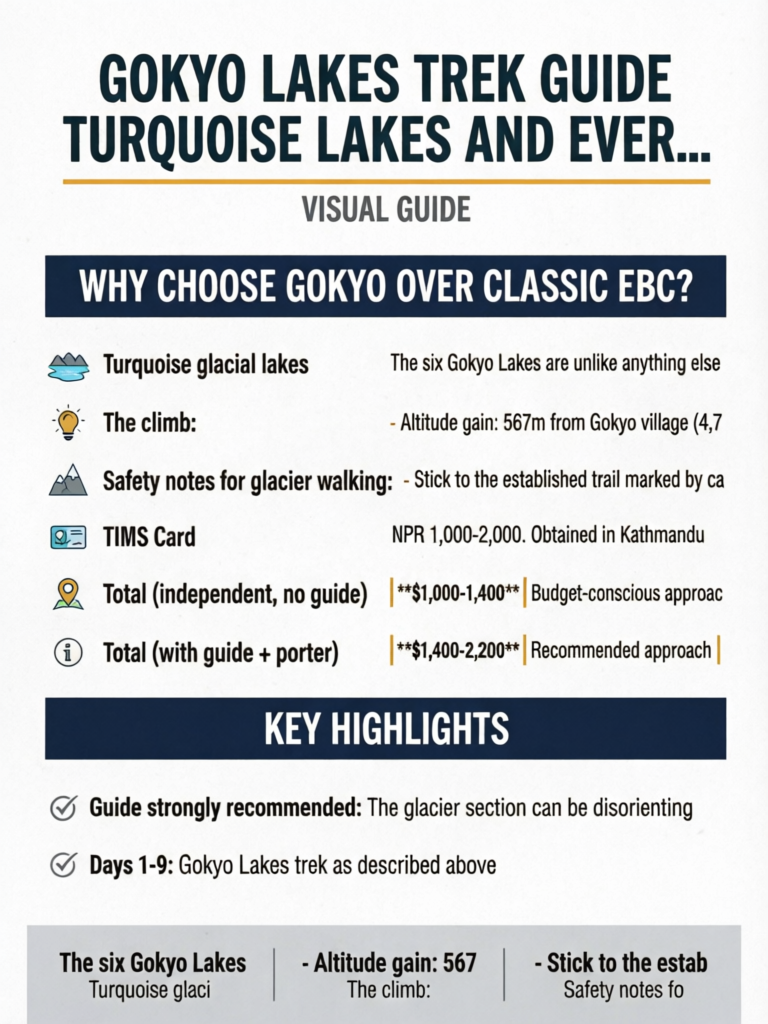
Why Choose Gokyo Over Classic EBC?
The Everest Base Camp trek is deservedly famous, but it has drawbacks that the Gokyo Lakes route avoids. Understanding the trade-offs helps you make the right choice.
Fewer Crowds, More Solitude
During peak season, the EBC trail sees 300-500 trekkers per day passing through bottleneck sections. Gokyo receives perhaps 50-80. Above the second lake, you may go hours without seeing another trekker. The tea houses are smaller and more intimate, and the overall atmosphere is quieter and more contemplative.
Arguably Better Everest Views
This is a bold claim, but many experienced Khumbu trekkers agree: the view of Everest from Gokyo Ri is superior to the view from Kala Patthar. From Kala Patthar (the EBC viewpoint), you see Everest's summit ridge rising above the Lhotse-Nuptse wall. From Gokyo Ri, you see Everest in fuller profile with the entire south face visible, plus Lhotse, Makalu, and Cho Oyu in a single panorama. You also look down on the turquoise Gokyo Lakes and the massive Ngozumpa Glacier, adding foreground drama that Kala Patthar lacks.
Unique Natural Features
The Gokyo Valley offers landscapes that the EBC trail simply does not have:
- Turquoise glacial lakes: The six Gokyo Lakes are unlike anything else in Nepal
- Ngozumpa Glacier: At approximately 36 km, it is the longest glacier in the Himalayas. You walk alongside and on parts of it
- Alpine meadows: The area around the second and third lakes features surprisingly green meadows (in season) contrasting with the grey moraine
- Wildlife: Himalayan tahr, musk deer, and snow cock inhabit the valley. Snow leopard tracks have been found in the upper reaches
The Lakes Themselves
| Lake | Local Name | Altitude | Notes |
|---|---|---|---|
| First Lake | Longponga Tsho | 4,700m | Smallest, passed on approach |
| Second Lake | Taboche Tsho | 4,740m | Beautiful turquoise, passed on trail |
| Third Lake | Gokyo Tsho | 4,790m | Main lake beside Gokyo village |
| Fourth Lake | Thonak Tsho | 4,870m | Requires half-day side trip |
| Fifth Lake | Ngozumpa Tsho | 4,990m | Full-day trip, very few trekkers reach here |
| Sixth Lake | Gyazumpa Tsho | 5,010m | Most remote, rarely visited |
Beyond the Third Lake
Most trekkers only see the first three lakes and climb Gokyo Ri. The fourth and fifth lakes are spectacularly beautiful and far less visited. If you have a rest day at Gokyo, spend it walking to the fourth lake (1.5 hours each way) and, if energy permits, the fifth lake (3 hours each way). The fifth lake sits at the very head of the Ngozumpa Glacier beneath Cho Oyu's massive south face, and the solitude there is profound. Fewer than 10% of Gokyo trekkers make it to the fifth lake.
Route Overview and Day-by-Day Itinerary
Standard 13-Day Itinerary
| Day | Route | Altitude | Hours | Key Features |
|---|---|---|---|---|
| 1 | Fly Kathmandu to Lukla, trek to Phakding | 2,610m | 3-4h | Scenic mountain flight, Dudh Koshi valley |
| 2 | Phakding to Namche Bazaar | 3,440m | 5-6h | Suspension bridges, first Everest views |
| 3 | Namche Bazaar acclimatization day | 3,440m | Half day | Everest View Hotel hike, Namche exploration |
| 4 | Namche to Phortse | 3,840m | 5-6h | Leave EBC trail, quieter path, monastery |
| 5 | Phortse to Machhermo | 4,470m | 4-5h | Alpine terrain, Himalayan tahr sightings |
| 6 | Machhermo acclimatization day | 4,470m | Half day | Short hike above village for views |
| 7 | Machhermo to Gokyo | 4,790m | 4-5h | Pass first and second lakes, arrive at Gokyo |
| 8 | Gokyo Ri sunrise + lake exploration | 5,357m | 5-6h | Sunrise summit, afternoon fourth lake visit |
| 9 | Gokyo exploration or fifth lake | 4,990m | 5-7h | Optional fifth lake journey, glacier walk |
| 10 | Gokyo to Dole | 4,200m | 4-5h | Begin descent, different return path option |
| 11 | Dole to Namche Bazaar | 3,440m | 5-6h | Downhill through forest and villages |
| 12 | Namche Bazaar to Lukla | 2,840m | 6-7h | Long descent day, final night in Khumbu |
| 13 | Fly Lukla to Kathmandu | - | 35 min | Morning flight, buffer day recommended |
Lukla Flight Buffer
Lukla flights are cancelled approximately 30-40% of days during peak season due to weather and limited runway visibility. Always keep at least one buffer day in Kathmandu at the end of your trek. Better yet, keep two. Missing an international connection because of a Lukla delay is common and expensive. See our complete Kathmandu-Lukla flights guide for contingency strategies.
The Namche Bazaar Section (Shared with EBC)
The first three days of the Gokyo trek are identical to the EBC route: fly to Lukla, trek to Phakding, climb to Namche Bazaar, and spend an acclimatization day. For detailed guidance on this shared section, including the famous Hillary Suspension Bridge crossing and the first Everest views at the Namche viewpoint, see our Namche Bazaar village guide.
Namche Market Day
Saturday is the legendary market day in Namche Bazaar. Traders from surrounding villages and even Tibet bring goods for the weekly market. If your schedule allows, time your acclimatization day for a Saturday. The market offers local cheese, yak meat, Tibetan jewelry, and practical trekking supplies. It is also the best people-watching opportunity in the Khumbu.
The Divergence Point: Leaving the EBC Trail
At Namche Bazaar, the Gokyo trail diverges from the EBC trail. While EBC trekkers head northeast toward Tengboche and Dingboche, Gokyo trekkers head northwest toward Phortse and the Gokyo Valley. This is where the crowds thin dramatically.
Two route options from Namche to the Gokyo Valley:
- Via Phortse (recommended): Namche to Phortse to Machhermo. This route passes through the authentic Sherpa village of Phortse, offers better acclimatization, and avoids the steeper Mong La pass
- Via Dole (direct): Namche to Mong La to Dole to Machhermo. This is slightly shorter but involves a steep climb over Mong La pass (3,973m) and less interesting villages
We recommend going up via Phortse and returning via Dole for maximum route variety.
Phortse: The Authentic Sherpa Village
Phortse is one of the most authentic Sherpa villages in the Khumbu, home to many of the region's most accomplished climbing Sherpas. Unlike Namche, which has become a bustling trekking hub, Phortse retains a quiet, traditional atmosphere. The village monastery is worth visiting, and the terraced potato fields cascading down the hillside offer beautiful photography. Choosing the Phortse route over the direct Dole route adds minimal extra time but significantly enriches the cultural dimension of the trek.
Gokyo Ri: The Crown of the Trek
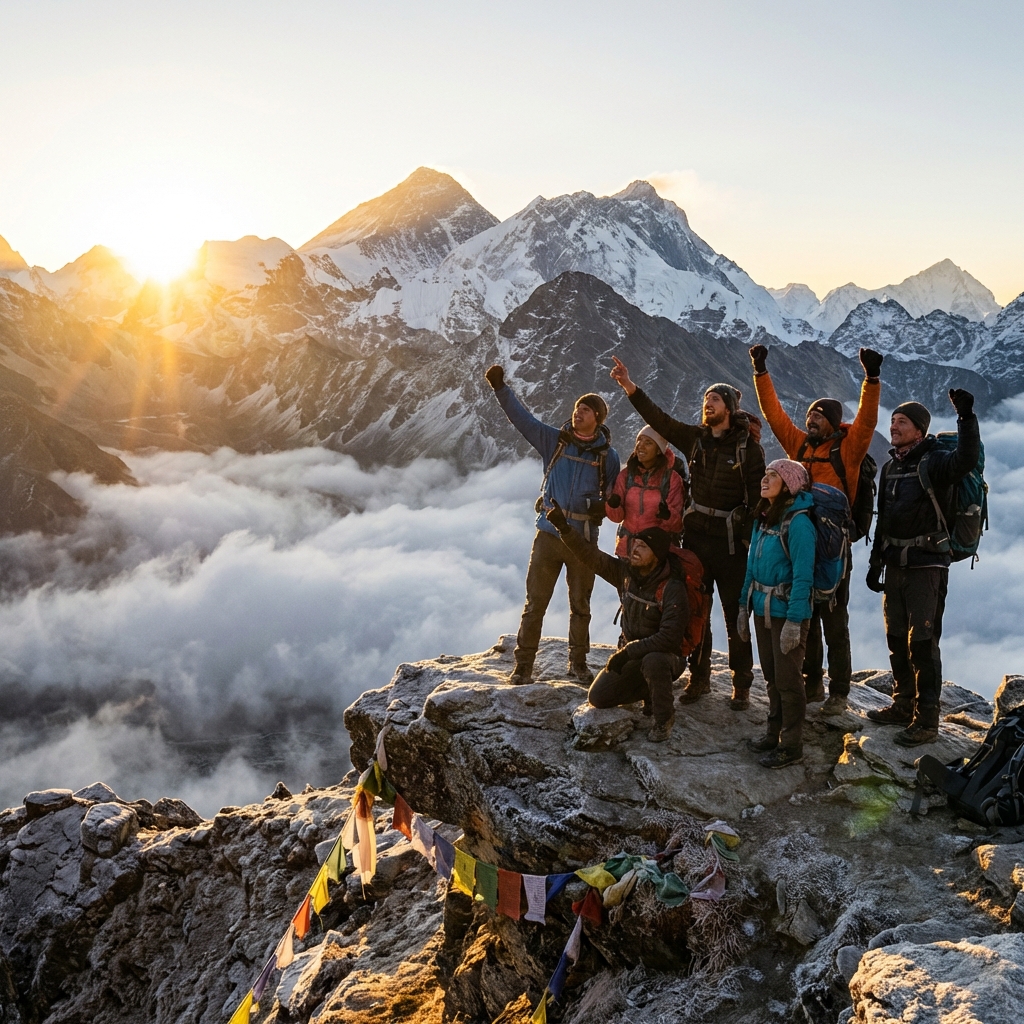
Sunrise from 5,357m
The summit of Gokyo Ri is the emotional and visual climax of the trek. Most trekkers attempt it before dawn to catch sunrise illuminating the Himalayan peaks. Here is what you need to know:
The climb:
- Altitude gain: 567m from Gokyo village (4,790m) to summit (5,357m)
- Duration: 2-3 hours up, 1.5-2 hours down
- Difficulty: Steep but non-technical, well-worn trail
- Start time: 4:00-4:30 AM for sunrise (bring headlamp)
What you see from the summit:
- Everest (8,849m), Lhotse (8,516m), Makalu (8,485m), and Cho Oyu (8,188m) in a single panorama
- The turquoise Gokyo Lakes spread below you like jewels
- The massive Ngozumpa Glacier winding north toward Cho Oyu
- Gyachung Kang (7,952m), Pumori (7,161m), and dozens of other peaks
- The curvature of the earth's atmosphere visible at the horizon
Altitude on Gokyo Ri
At 5,357m, Gokyo Ri is high enough for altitude to be a serious concern. Do not attempt the summit if you are experiencing AMS symptoms (persistent headache, nausea, dizziness). The climb is steep and the cold pre-dawn air makes breathing harder. Take it slow, drink plenty of water the day before, and turn back if you feel unwell. There is no shame in reaching 5,000m and deciding that is enough. The views are already outstanding from the lower ridges. For detailed altitude management strategies, see our acclimatization guide.
Gokyo Ri Twice
If weather is uncertain, consider climbing Gokyo Ri in the afternoon of your first day in Gokyo for sunset views, then again the next morning for sunrise. The afternoon ascent serves as a reconnaissance and acclimatization hike, making the pre-dawn summit bid the following morning significantly easier. The sunset light on Everest is different from sunrise, warm and golden rather than pink and amber, and worth seeing in its own right.
The Ngozumpa Glacier
The Ngozumpa Glacier is the longest glacier in the Himalayas, stretching approximately 36 km from its source below Cho Oyu to its terminus below Gokyo. Walking alongside and on sections of this glacier is one of the Gokyo trek's unique experiences.
Walking on the Glacier
Between the third and fourth lakes, the trail runs along the lateral moraine of the Ngozumpa Glacier. In places, you walk on the glacier surface itself, navigating between ice towers (seracs), glacial pools, and debris-covered ice. This is not technical glacier travel, but it is uneven, unstable terrain that requires attention.
Safety notes for glacier walking:
- Stick to the established trail marked by cairns
- Do not approach glacial pools or ice cliffs, which can collapse without warning
- Use trekking poles for stability on the shifting moraine
- Travel during morning hours when the glacier surface is more stable
- Never walk on the glacier alone
Glacial Recession
Like glaciers worldwide, the Ngozumpa is retreating. The retreat is visible in the lowering ice surfaces, expanding glacial lakes, and increasingly exposed rock. This is a sobering reminder of climate change's impact on the Himalayan environment and the communities that depend on glacial meltwater.
Permits and Costs
Required Permits
-
Sagarmatha National Park Entry Permit: NPR 3,000 for foreign trekkers (approximately $23). Can be obtained at the park entrance at Monjo or in advance at the Nepal Tourism Board office in Kathmandu
-
Khumbu Pasang Lhamu Rural Municipality Fee: NPR 2,000 (approximately $15). Collected at Lukla or Monjo
-
TIMS Card: NPR 1,000-2,000. Obtained in Kathmandu
Cost Breakdown
| Expense | Budget Range | Notes |
|---|---|---|
| Kathmandu-Lukla flights | $215-400 return | Book early, prices rise in peak season |
| Permits (all) | $38-46 | Park entry + municipality + TIMS |
| Tea house accommodation | $3-8/night | Twin room, basic facilities |
| Food on trail | $20-35/day | Dal bhat, snacks, drinks |
| Guide | $25-35/day | Highly recommended |
| Porter | $20-28/day | For your main bag (12-15kg) |
| Tips | $100-200 | For guide and porter, 12-14 day trek |
| Travel insurance | $80-150 | Must cover helicopter evacuation |
| Gear rental (if needed) | $50-100 | Sleeping bag, down jacket |
| Total (independent, no guide) | $1,000-1,400 | Budget-conscious approach |
| Total (with guide + porter) | $1,400-2,200 | Recommended approach |
| Total (agency all-inclusive) | $1,800-2,800 | Everything arranged |
Gokyo vs. EBC Cost Comparison
The Gokyo Lakes trek costs roughly the same as EBC per day, but the shorter duration (12-14 days vs. 14-16 days for full EBC) means lower total expenditure. Lukla flights, permits, and daily tea house costs are identical.
| Factor | Gokyo Lakes Trek | Classic EBC Trek |
|---|---|---|
| Duration | 12-14 days | 14-16 days |
| Lukla flights | Same | Same |
| Permits | Same | Same |
| Daily food/lodge cost | Same | Same |
| Total estimated cost | $1,400-2,800 | $1,600-3,200 |
| Crowds | Light-moderate | Heavy |
For a detailed comparison of the two treks, see our Gokyo Lakes vs. EBC comparison.
Difficulty Assessment
Physical Demands
The Gokyo Lakes trek is rated Grade 3-4 (Moderate to Strenuous). It is slightly less demanding than the full EBC trek in terms of maximum altitude (5,357m at Gokyo Ri vs. 5,545m at Kala Patthar) and total duration, but the daily physical demands are similar.
Key challenges:
- Sustained trekking at altitudes above 4,000m for 5-6 days
- The Gokyo Ri summit climb (567m gain at high altitude)
- Uneven moraine terrain near the glacier
- Cold temperatures at Gokyo (nighttime lows of -10 to -20 degrees Celsius in autumn)
- Basic tea house conditions at higher elevations
Fitness Requirements
You should be able to:
- Hike 5-7 hours per day on uneven terrain for 10-12 consecutive days
- Climb 700-1,000m of elevation gain in a single day
- Carry a 5-7 kg daypack at altitude
- Handle cold conditions and basic accommodation
Acclimatization Strategy
Proper acclimatization is critical for the Gokyo trek. The recommended strategy:
- Namche acclimatization day (Day 3): Hike to the Everest View Hotel (3,880m) and return to Namche (3,440m). This "climb high, sleep low" approach kickstarts acclimatization
- Machhermo acclimatization day (Day 6): Take a short hike above Machhermo to 4,700-4,800m and return. This prepares you for sleeping at Gokyo the next night
- Gradual ascent: The itinerary limits altitude gain to approximately 400-500m per day above 3,000m
- Hydration: Drink 3-4 liters of water daily at altitude
- Diamox: Consider prophylactic use (125mg twice daily) from Namche onward. Consult your doctor before the trek
The Machhermo Acclimatization Hike
On your acclimatization day at Machhermo, hike to the ridge above the village on the east side. The trail climbs 300-400m and offers excellent views of Cho Oyu and the upper Gokyo Valley. More importantly, it pushes your body to an altitude similar to Gokyo village, making the next day's trek significantly more comfortable. The Himalayan Rescue Association used to operate an aid post in Machhermo with afternoon altitude sickness talks. Check if this is still active when you arrive.
Best Season for the Gokyo Lakes Trek
Autumn (October-November) - Prime Season
October and November offer the most reliable conditions:
- Clear skies and maximum visibility for Gokyo Ri panorama
- Stable weather with low precipitation
- Comfortable daytime temperatures (5-15 degrees Celsius at mid-altitudes)
- Lakes at their most vivid turquoise color
- Peak trekking season but still far fewer crowds than EBC
Late October is the single best window, combining post-monsoon clarity with manageable cold.
Spring (March-May) - Excellent Alternative
Spring brings different advantages:
- Warmer temperatures at altitude (easier sleeping conditions)
- Rhododendron blooms below 4,000m
- Longer daylight hours for photography
- Slightly more haze than autumn but still good visibility
- The lakes may have some ice at the edges in early March, creating unique photographic opportunities
What to Avoid
- Monsoon (June-September): Heavy rain below 4,000m, clouds obscure views, trails are muddy, leeches in lower sections
- Deep winter (December-February): Extreme cold at Gokyo (minus 25 degrees Celsius or colder at night), some tea houses closed, shorter days. Possible but only for experienced winter trekkers with proper gear
For detailed seasonal information, see our Gokyo Lakes best time guide.
TIMS and Permit Update 2026
As of 2026, the TIMS card and Sagarmatha National Park permit requirements have been restructured. Verify current fees and procedures with your trekking agency or at the Nepal Tourism Board office in Kathmandu before departure. The Khumbu Rural Municipality has also introduced its own fee, collected at Lukla or Monjo. Permit requirements can change between publication and your travel date, so always confirm the latest status.
Extending via Cho La Pass to EBC
For trekkers who want both Gokyo and EBC, the Cho La Pass (5,420m) connects the two valleys. This extension adds 3-4 days to the Gokyo trek and creates the EBC-Gokyo combination trek, widely considered the ultimate Khumbu experience.
The Cho La Crossing
The Cho La Pass is a genuine mountain pass requiring basic mountaineering awareness:
- Altitude: 5,420m
- Duration: 7-9 hours from Gokyo side (Thagnag/Dragnak) to EBC side (Dzongla)
- Difficulty: The eastern (Gokyo) side involves a steep, rocky scramble. The western side has a short glacier crossing requiring crampons or sturdy boots with good traction
- Weather dependent: The pass should only be attempted in clear, stable weather. Fresh snow makes it dangerous
- Guide strongly recommended: The glacier section can be disorienting in cloud
Cho La Is Not a Casual Extension
Do not add Cho La to your itinerary on a whim. The pass is significantly more demanding than anything on the standard Gokyo trek. It requires good fitness, proper acclimatization (you should be comfortable at 5,000m before attempting it), and ideally a guide who knows the route. Trekkers have died on Cho La due to weather exposure, falls on the glacier, and altitude complications. If weather is poor, wait a day or retreat. The pass is not worth risking your safety.
Combined Itinerary Overview
If extending via Cho La to EBC, the full trek typically takes 18-19 days:
- Days 1-9: Gokyo Lakes trek as described above
- Day 10: Gokyo to Thagnag (4,700m)
- Day 11: Thagnag to Dzongla via Cho La (5,420m)
- Day 12: Dzongla to Gorak Shep, afternoon EBC
- Day 13: Kala Patthar sunrise, descend to Pheriche
- Days 14-18: Descent to Lukla
See our complete EBC-Gokyo combination guide for the full itinerary.
Tea House Accommodation on the Gokyo Trail
What to Expect
Tea house quality on the Gokyo trail is generally good through Namche and Phortse, then becomes more basic as you gain altitude.
| Location | Room Quality | Food Quality | Amenities |
|---|---|---|---|
| Lukla-Namche | Good | Good-Excellent | WiFi, hot showers, charging |
| Namche Bazaar | Good-Excellent | Excellent | Full amenities, bakeries, bars |
| Phortse | Moderate | Good | Basic amenities |
| Machhermo | Basic-Moderate | Good | Limited charging, no WiFi |
| Gokyo | Basic | Moderate-Good | Charging (paid), limited menu |
At Gokyo village (4,790m), expect:
- Simple twin rooms with thin mattresses and blankets (bring your sleeping bag)
- Shared toilets, mostly squat-style
- Dining room heated by a yak dung stove in the evening
- Limited menu: dal bhat, noodles, potatoes, eggs, limited bakery items
- Charging: NPR 300-500 per device
- No hot showers (or cold-water only at extreme altitude)
Room Selection at Gokyo
When you arrive at Gokyo, ask for a room on the sunny side of the lodge. The afternoon sun can warm a room by several degrees, making a significant difference to your comfort at 4,790m. Also, rooms near the dining room stove pipe benefit from residual heat. These details matter when nighttime temperatures drop well below freezing.
Gear Specific to the Gokyo Trek
Beyond standard Khumbu trekking gear (see our EBC packing list), consider these Gokyo-specific items:
- Gaiters: Useful for moraine walking near the glacier
- Microspikes/crampons: Essential if extending via Cho La, useful for icy sections near Gokyo Ri
- Extra warm layers: Gokyo can be colder than equivalent altitudes on the EBC trail due to glacial proximity
- Sunglasses with high UV protection: Glacier glare is intense
- Water purification: Fewer safe water filling stations at altitude
Frequently Asked Questions
Is the Gokyo Lakes trek easier than EBC?
Slightly. The maximum altitude is lower (5,357m at Gokyo Ri vs. 5,545m at Kala Patthar), and the total trek duration is shorter. However, the daily difficulty is comparable, and the terrain near the glacier is rougher. If you can do EBC, you can do Gokyo. If you are unsure about EBC, Gokyo is a marginally gentler introduction to high-altitude Khumbu trekking.
Can I do the Gokyo Lakes trek independently?
Yes. The trail is well-marked through Namche, and the Gokyo Valley section has clear paths. However, a guide is recommended for several reasons: the trail above Machhermo can be confusing in poor visibility, the moraine sections near the glacier are tricky, and the Gokyo Ri pre-dawn climb is safer with someone who knows the route. Independent trekking is feasible but not optimal.
How many days should I spend at Gokyo?
Two nights (one full day) is the minimum to climb Gokyo Ri and see the third lake. Three nights (two full days) allows you to visit the fourth and fifth lakes and potentially attempt Gokyo Ri twice for different lighting conditions. If weather is poor on your first day, a third night gives you a second chance at clear views.
Is Gokyo Ri harder than Kala Patthar?
Gokyo Ri is shorter in terms of altitude gain from the village (567m vs. 381m from Gorak Shep to Kala Patthar) but the base altitude is lower (4,790m vs. 5,164m). In practice, most trekkers find them comparable. Gokyo Ri has a more defined trail and feels less exposed. Kala Patthar requires functioning at a higher absolute altitude, which is the harder factor for most people.
What if I cannot make it to the top of Gokyo Ri?
No problem. The views improve steadily throughout the climb. At 5,000m (about halfway), you already have excellent panoramas of the lakes and surrounding peaks. At 5,200m, you can see Everest clearly. Going higher only adds breadth to the panorama. Turn around whenever you feel you have reached your limit. The experience is rewarding at any height on the ridge.
Are the Gokyo Lakes safe to swim in?
No. The water temperature is close to freezing year-round, and the lakes are considered sacred by local Sherpa communities. Swimming, bathing, and washing clothes or equipment in the lakes is prohibited. Respect the cultural and environmental significance of these waters.
How crowded is the Gokyo trail in peak season?
Significantly less crowded than EBC. In October (the busiest month), you might share Gokyo village with 30-50 other trekkers. Compare this to Gorak Shep (the EBC equivalent), which can host 100-200+ trekkers on busy nights. The trail between Machhermo and Gokyo typically has only 10-20 trekkers walking on any given day.
Can I do Gokyo as a side trip from the EBC trail?
Not easily as a day trip, but you can incorporate it as a multi-day extension. From the EBC trail at Gorak Shep, you would need to cross Cho La Pass (a full day) to reach the Gokyo Valley. This is the basis of the EBC-Gokyo combination trek. A "quick" visit to Gokyo from the EBC trail requires at least 3-4 additional days.
What wildlife might I see on the Gokyo trek?
Himalayan tahr (a wild mountain goat) are commonly seen on the slopes between Machhermo and Gokyo. Musk deer inhabit the forests below Phortse. Snow cock and blood pheasant are present but hard to spot. Danphe (Himalayan monal), Nepal's national bird, is occasionally seen in the forests around Phortse and Dole. Snow leopard presence has been documented in the upper valley but sightings are exceptionally rare.
Do I need crampons for the Gokyo trek?
For the standard Gokyo trek without Cho La, crampons are not necessary but lightweight microspikes can be helpful for the Gokyo Ri climb in icy conditions (especially in early morning). If extending via Cho La, crampons or at minimum sturdy microspikes are recommended for the glacier crossing.
How does Gokyo compare to Annapurna Base Camp?
Both are approximately 12-14 day treks at similar difficulty levels. Gokyo offers higher altitude, glacial lake scenery, and Everest views. ABC offers the dramatic Annapurna Sanctuary amphitheater and lower maximum altitude (4,130m vs. 5,357m). Gokyo requires the Lukla flight (cost and delay risk); ABC is accessible by road. For a first high-altitude trek, ABC may be slightly easier. For the most dramatic landscape, Gokyo wins. See our complete EBC vs. ABC comparison for region-level analysis.
Final Thoughts
The Gokyo Lakes trek deserves to be considered on its own merits, not just as an alternative to EBC or an add-on via Cho La. The turquoise lakes, the Ngozumpa Glacier, and the Gokyo Ri panorama together create a trekking experience that is distinct, beautiful, and deeply satisfying.
For trekkers who value natural beauty over historical fame, solitude over social atmosphere, and lakes over ice falls, Gokyo may actually be the better Khumbu trek. And for those who cannot decide, the Cho La extension offers the best of both worlds, at the cost of additional days and effort.
Either way, the Gokyo Valley is one of the crown jewels of Nepal trekking. Do not let EBC's fame cause you to overlook it.
Related guides: