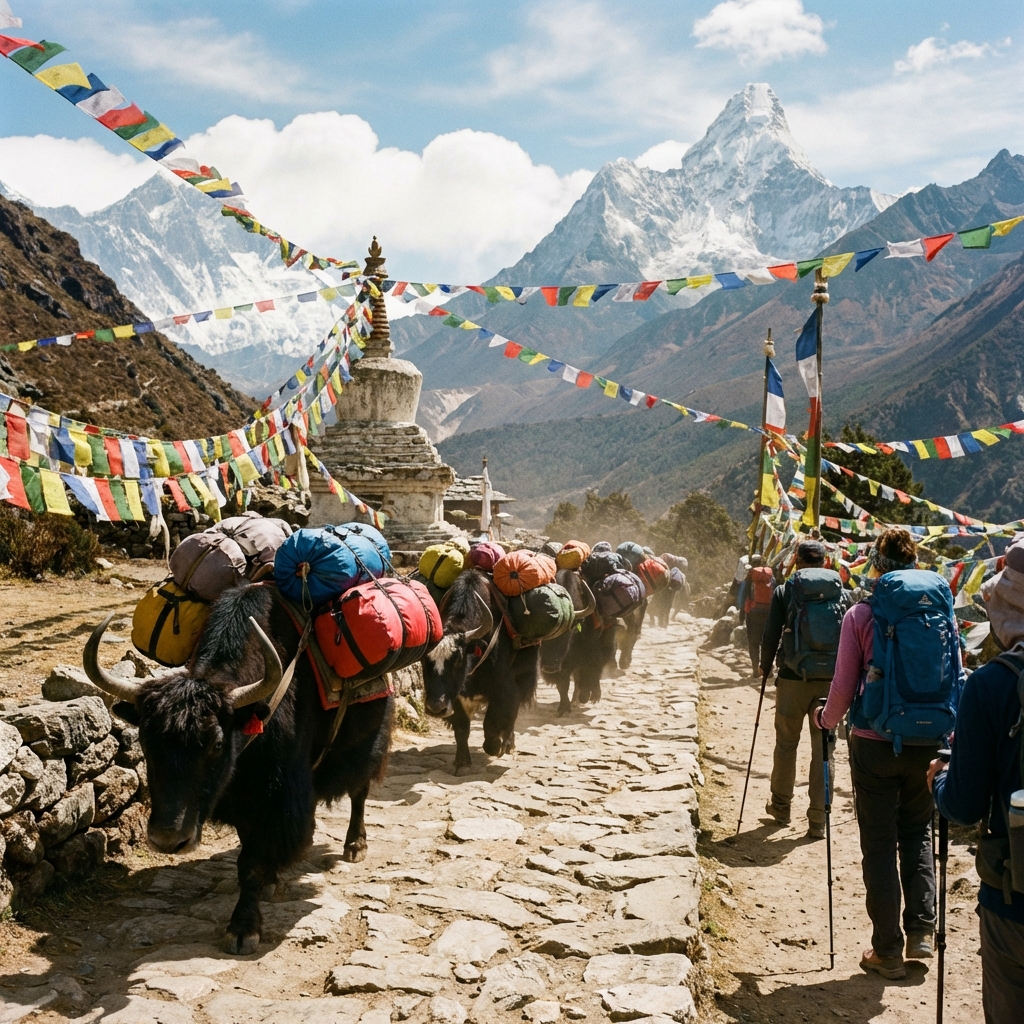
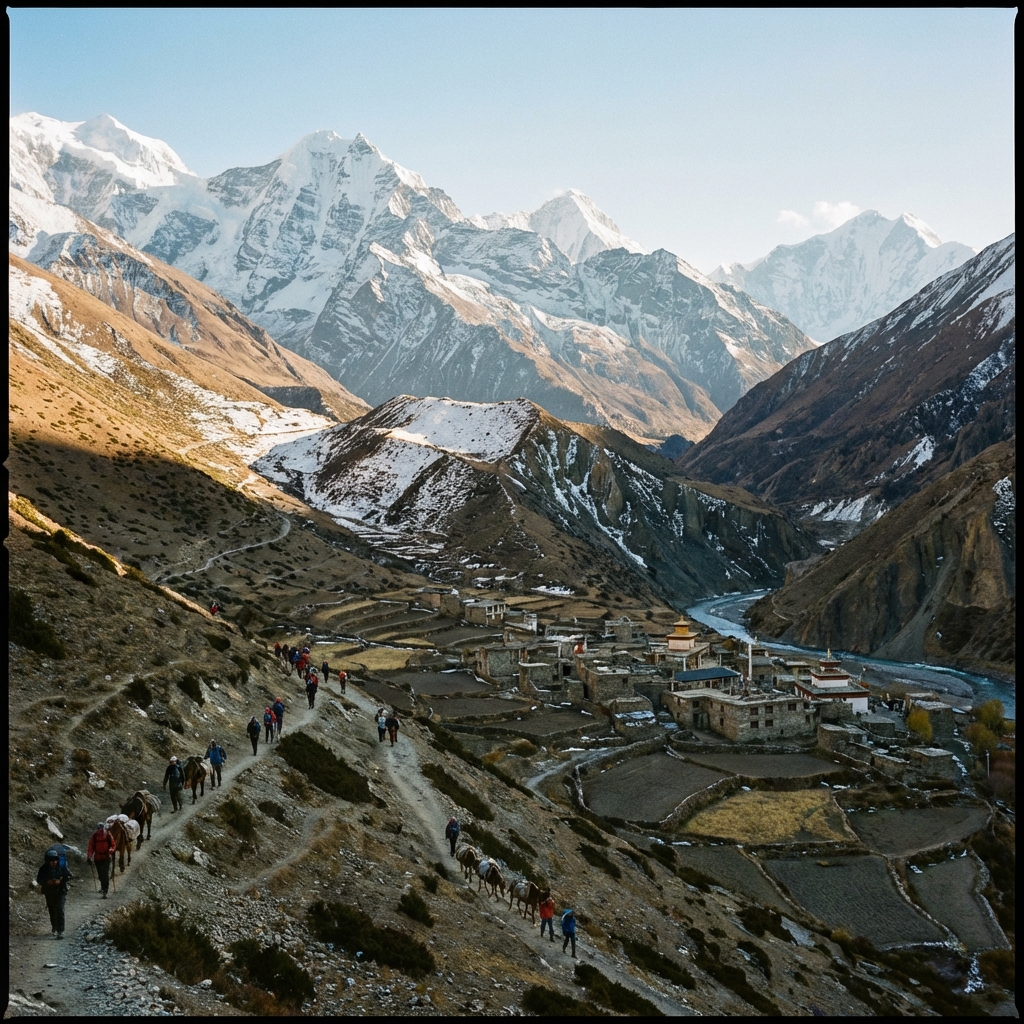
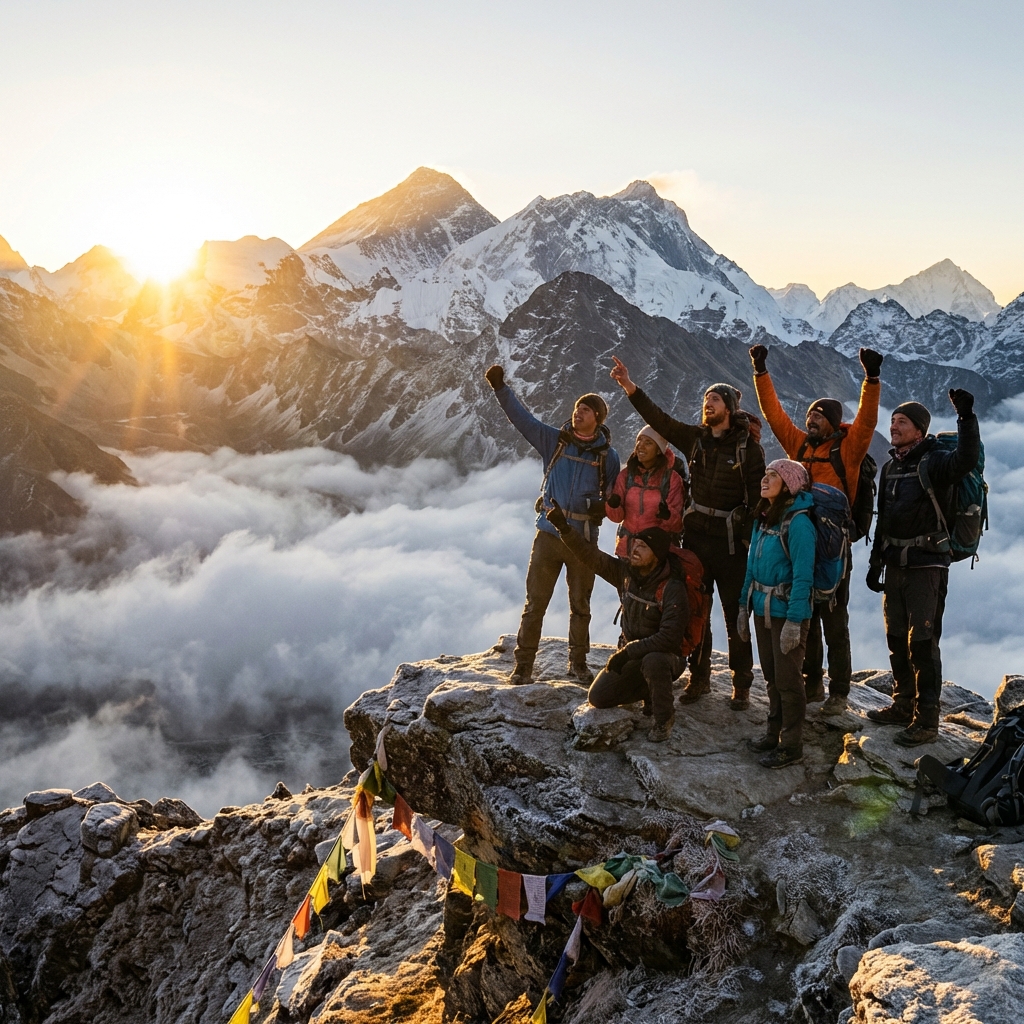
The EBC and Gokyo Lakes Combined Trek is the definitive Khumbu experience, stitching together Nepal's two most iconic high-altitude destinations into a single, unforgettable journey. Instead of choosing between the historic drama of Everest Base Camp and the ethereal turquoise beauty of the Gokyo Lakes, this 18-day itinerary gives you both, connected by the thrilling Cho La Pass crossing at 5,420m.
This is not a trek for the casual hiker. The combination route demands strong fitness, careful acclimatization, and genuine respect for high-altitude mountain terrain. But for those who commit, the reward is unmatched: you will stand at the foot of the world's tallest mountain, gaze upon a chain of sacred turquoise lakes, summit two of the Khumbu's finest viewpoints (Kala Patthar at 5,545m and Gokyo Ri at 5,357m), and cross a glacier-covered pass that offers a taste of genuine mountaineering.
What makes this combination special: You experience the full spectrum of the Khumbu region. The bustling Sherpa capital of Namche Bazaar, the serene monastery at Tengboche, the raw power of the Khumbu Glacier at Gorak Shep, the otherworldly stillness of the Gokyo Lakes, and the adrenaline of the Cho La Pass. No single trek in the Everest region covers this much ground or delivers this much variety.
Quick Facts: EBC-Gokyo Combined Trek
18 days (19 with buffer day)
16 days on trail
5,545m (Kala Patthar)
Kala Patthar (5,545m) + Gokyo Ri (5,357m)
Cho La Pass (5,420m)
170-180 km
Strenuous (Grade 4 of 5)
Oct-Nov (prime), Mar-May (good)
Sagarmatha Entry Permit + Khumbu Rural Municipality Fee
$40-60 per day on trail
$1,800-3,500 (independent to guided)
Strongly recommended for Cho La
Why Combine EBC and Gokyo Lakes?
Most trekkers visiting the Everest region face a difficult choice: the classic Everest Base Camp trek, or the less-traveled Gokyo Lakes route. Both are extraordinary, but each leaves you wondering about the other. The combined trek eliminates that dilemma entirely.
The Best of Both Worlds
From the EBC side, you get:
- Standing at Everest Base Camp (5,364m) beside the Khumbu Icefall
- Sunrise from Kala Patthar (5,545m) with panoramic views of Everest, Lhotse, Nuptse, and Changtse
- Walking the legendary trail through Namche Bazaar, Tengboche Monastery, and the upper Khumbu
- The raw power and drama of the Khumbu Glacier
From the Gokyo side, you get:
- The six sacred Gokyo Lakes, among the world's highest freshwater lake systems
- Sunrise from Gokyo Ri (5,357m), widely regarded as the best Everest viewpoint in the region
- A quieter, more remote trekking experience with fewer crowds
- The dramatic Ngozumpa Glacier, the longest glacier in the Himalayas
The Cho La connection gives you:
- A genuine high-pass crossing at 5,420m with glacier travel
- A taste of mountaineering that pure trekking routes do not offer
- The satisfaction of completing one of the Khumbu's most challenging traverses
- Bragging rights that go well beyond the standard EBC trek
Who Is This Trek For?
This combination is ideal for trekkers who:
- Have moderate to strong fitness and ideally some prior high-altitude experience
- Can dedicate 18-20 days to the trek (including travel days)
- Want the most comprehensive Everest region experience possible
- Are comfortable with one day of technical terrain (Cho La Pass)
- Seek a challenge beyond the standard EBC route
This trek is not recommended for:
- First-time trekkers with no hiking experience
- Those with fewer than 16 days available
- Anyone uncomfortable with steep, icy, or exposed terrain
- Trekkers unable to carry or rent crampons and basic mountaineering gear
How This Differs from the Three Passes Trek
The EBC-Gokyo combination crosses one high pass (Cho La). The Three Passes Trek crosses three passes (Kongma La, Cho La, and Renjo La) over 19-21 days. If the EBC-Gokyo combination is the complete Khumbu experience, the Three Passes Trek is the ultimate Khumbu marathon. The combination trek is significantly more accessible while still delivering an extraordinary adventure.
The Direction Debate: Gokyo-First vs. EBC-First
One of the most important decisions for this trek is which direction to travel. You can start with the EBC side and cross Cho La to Gokyo, or start with Gokyo and cross Cho La toward EBC. Both directions work, but there are strong reasons to favor one approach.
Our Recommendation: Gokyo-First (West to East)
We recommend trekking to Gokyo Lakes first, crossing Cho La, then continuing to EBC. Here is why:
Better acclimatization profile:
- The Gokyo Valley provides a more gradual altitude gain
- You acclimatize at Gokyo (4,790m) before attempting Cho La (5,420m)
- By the time you reach Gorak Shep (5,164m) and Kala Patthar (5,545m), your body has already adapted to extreme altitude
- Statistically lower rates of acute mountain sickness on the Gokyo-first approach
Logistical advantages:
- Cho La is slightly easier to navigate from west to east (Gokyo side to EBC side)
- The descent from Cho La toward Dzongla is more straightforward than the reverse
- If Cho La is closed due to weather, you can still complete the Gokyo Lakes portion and return via Namche to attempt the standard EBC route separately
The experience factor:
- Gokyo Lakes are quieter and more pristine, offering a powerful start to the journey
- You build toward the crescendo of EBC and Kala Patthar
- The trek ends with the most iconic moment, standing at the base of Everest
The Case for EBC-First (East to West)
Some trekkers prefer the EBC-first approach, and there are valid reasons:
- You tackle the highest points (Kala Patthar at 5,545m) when freshest
- If you run out of time, you have already completed EBC
- The standard EBC trail is better marked and more populated, easing you into the trek
- You descend into the peaceful Gokyo Valley after the intensity of base camp
The trade-off: The EBC-first approach means you cross Cho La from east to west, which involves a slightly more challenging navigation on the glacier section and a steeper approach from Dzongla. Your acclimatization profile is also less optimal since you hit Kala Patthar (5,545m) before having the Gokyo Valley adaptation days.
The Acclimatization Edge
Trekkers who go Gokyo-first report significantly fewer headaches and sleep disturbances at Gorak Shep compared to those who tackle EBC first. The extra day or two of gradual acclimatization in the Gokyo Valley makes a measurable difference at 5,000m and above. If this is your first time above 5,000m, go Gokyo-first without question.
Complete 18-Day Itinerary (Gokyo-First Route)
This itinerary follows the recommended Gokyo-first direction. All elevations are for sleeping altitude unless otherwise noted. Walking times are estimates for an average-paced trekker with a daypack.
Day 1: Kathmandu to Lukla, Trek to Phakding (2,610m)
Flight: 35 minutes (weather permitting) Trek: 3-4 hours, gentle descent Elevation change: Lukla (2,840m) to Phakding (2,610m)
The adventure begins with the legendary flight to Lukla's Tenzing-Hillary Airport, one of the world's most dramatic runway approaches. After landing, you organize gear and begin the trek along the Dudh Koshi River valley. The trail descends gently through pine forests and small Sherpa settlements. This is an easy first day designed to let you find your rhythm.
Key details:
- Morning flights are most reliable; afternoon flights have higher cancellation rates
- Register your permits at the Lukla checkpoint
- Phakding has numerous tea houses ranging from basic to comfortable
- Phone charging available (NPR 300-500 per charge)
Lukla Flight Delays
Lukla flights are cancelled approximately 30-40% of days during peak season due to weather. Always keep a buffer day in Kathmandu at the end of your trek. If your flight is delayed on Day 1, you can compress Days 1-2 into a single longer day without significantly affecting your itinerary. See our Kathmandu to Lukla flights guide for detailed contingency planning.
Day 2: Phakding to Namche Bazaar (3,440m)
Trek: 5-6 hours Elevation change: +830m Key landmarks: First Everest viewpoint, Hillary Suspension Bridge, Sagarmatha National Park entrance
This is the first significant ascent of the trek. The trail follows the Dudh Koshi River through dense forest, crossing multiple suspension bridges. After the Sagarmatha National Park checkpoint, the route climbs steeply for approximately 2 hours up to Namche Bazaar, the Sherpa capital of the Khumbu.
Key details:
- Enter Sagarmatha National Park at Monjo (your permits will be checked)
- The steep climb to Namche is the most physically demanding section of the first few days
- Arrive early if possible to explore Namche's shops, bakeries, and gear stores
- Namche has ATMs, though they are unreliable; bring sufficient cash from Kathmandu
Day 3: Acclimatization Day in Namche Bazaar (3,440m)
Activity: Rest day with optional high hike Recommended excursion: Hike to Everest View Hotel (3,880m) or Khumjung village (3,790m)
This rest day is critical. Do not skip it. Your body needs time to adjust to 3,440m before going higher. The classic acclimatization hike goes up to the Everest View Hotel for your first proper panoramic view of Everest, Lhotse, Ama Dablam, and Thamserku.
Key details:
- Follow the "climb high, sleep low" principle: hike up 300-400m during the day, return to sleep at the same elevation
- Visit the Sherpa Culture Museum in Namche
- Stock up on snacks, sunscreen, and any forgotten gear
- Drink at least 3-4 liters of water throughout the day
Namche Market Day
Saturday is market day in Namche Bazaar. If your schedule allows, time your acclimatization day for a Saturday to experience the vibrant weekly market where Sherpa traders from surrounding villages sell everything from yak cheese to imported goods carried up from the lowlands.
Day 4: Namche Bazaar to Phortse Thanga (3,680m)
Trek: 4-5 hours Elevation change: +240m (with undulations)
This is where the Gokyo-first route diverges from the standard EBC trail. Instead of continuing to Tengboche, you take the upper trail toward Phortse Thanga (also called Phortse Tenga), the gateway to the Gokyo Valley. The trail traverses high above the Dudh Koshi valley with stunning views of Ama Dablam, Thamserku, and Kangtega.
Key details:
- The trail splits at the top of Namche: right goes to Tengboche (EBC), left goes toward Khumjung and Phortse Thanga (Gokyo)
- Phortse Thanga is a small settlement with limited but comfortable tea houses
- The trail passes through beautiful rhododendron and birch forests
- You may spot Himalayan tahr (wild goats) on the hillsides above
Day 5: Phortse Thanga to Machhermo (4,470m)
Trek: 5-6 hours Elevation change: +790m
A steady climb up the Gokyo Valley, following the Dudh Koshi's western branch. You pass through Dole (4,110m) and Luza (4,360m) before reaching Machhermo. This is a significant altitude gain day, so maintain a slow, steady pace and hydrate constantly.
Key details:
- Machhermo has a Himalayan Rescue Association (HRA) aid post; attend their free afternoon altitude sickness lecture if available
- The trail passes through yak pastures and alongside small streams
- Watch for Himalayan monal pheasants (Nepal's national bird) in the forest sections
- Tea house rooms at Machhermo are basic but adequate
Altitude Awareness from Machhermo Onward
From Machhermo (4,470m) onward, you are sleeping above 4,000m for the rest of the trek until your descent. Monitor yourself and trekking partners carefully for AMS symptoms: persistent headache, nausea, dizziness, loss of appetite, and difficulty sleeping. Mild symptoms are normal and manageable. Severe or worsening symptoms require immediate descent. Read our complete acclimatization guide before your trek.
Day 6: Machhermo to Gokyo (4,790m)
Trek: 4-5 hours Elevation change: +320m
A beautiful and relatively moderate day that takes you along the edge of the Ngozumpa Glacier, the longest glacier in the Himalayas, and past the first two Gokyo Lakes. The turquoise color of these lakes is striking, caused by glacial flour suspended in the water. You arrive at Gokyo village on the shore of the third and largest lake (Dudh Pokhari).
Key details:
- The first lake (Longponga) appears after about 2 hours
- The second lake (Taboche Tsho) is even more vivid in color
- Gokyo village sits beside the third lake and has 6-8 tea houses
- Afternoon is free; walk along the lakeshore or rest for tomorrow's early start
- Hot showers available at most lodges (NPR 500-700)
Day 7: Gokyo Ri Sunrise and Exploration Day (4,790m)
Activity: Pre-dawn summit of Gokyo Ri (5,357m), afternoon exploration Elevation gain: +567m (return to Gokyo to sleep)
This is one of the most extraordinary days of the entire trek. You wake at 4:00-4:30 AM and climb Gokyo Ri in darkness, reaching the summit for sunrise. The view from the top is often considered the finest in the Everest region: a 360-degree panorama encompassing Everest, Lhotse, Makalu, Cho Oyu, and the entire chain of Gokyo Lakes stretching below you like jewels. Many trekkers who have done both Kala Patthar and Gokyo Ri rate this as the superior viewpoint.
Key details:
- The climb to Gokyo Ri takes 2-3 hours; descent is 1-1.5 hours
- Bring a headlamp, warm layers, and a thermos of hot water
- The final 30 minutes is steep and exposed; take care on loose rock
- After returning, explore the fourth lake (Thonak Tsho) if energy permits
- Rest well tonight; tomorrow begins the Cho La approach
The Fourth and Fifth Lakes
If you have energy after Gokyo Ri, the walk to the fourth lake (Thonak Tsho, 4,870m) takes about 1.5 hours each way and is far less crowded than Gokyo Ri. The truly ambitious can push to the fifth lake (Ngozumpa Tsho, 4,990m), which sits at the very head of the Ngozumpa Glacier beneath Cho Oyu. Very few trekkers make it this far, and the solitude is remarkable.
Day 8: Gokyo to Thagnag/Dragnag (4,700m)
Trek: 3-4 hours Elevation change: -90m
A short but important day. You trek along the lateral moraine of the Ngozumpa Glacier to reach Thagnag (sometimes spelled Dragnag), the staging village for the Cho La Pass crossing. The terrain involves some boulder-hopping and moraine walking, which is a preview of what Cho La demands. Use the afternoon to rest, check gear, and confirm conditions for the pass with your guide or other trekkers.
Key details:
- Thagnag has limited tea house options (3-4 lodges); arrive early for the best room
- Check your crampons, gaiters, and warm layers for tomorrow
- Talk to trekkers who have recently crossed Cho La for current conditions
- Early dinner and early bed; you will start before dawn tomorrow
- Fill all water bottles tonight; water sources are scarce on Cho La
Day 9: Cho La Pass Crossing to Dzongla (5,420m pass, sleep at 4,830m)
Trek: 7-9 hours (the longest and most demanding day) Elevation change: +720m ascent, -590m descent Pass altitude: 5,420m (17,782ft)
This is the crux day of the entire trek. The Cho La Pass crossing involves rocky scrambling, glacier travel, and steep descents. Read the detailed Cho La section below before attempting this day.
Key details:
- Depart Thagnag by 5:00-5:30 AM at the latest
- The approach involves 2-3 hours of steep rocky scrambling
- The glacier section takes 1-1.5 hours; crampons are essential
- Summit the pass, then descend steeply to Dzongla (4,830m)
- Total day: 7-9 hours depending on conditions and fitness
- Dzongla has several tea houses; hot meals will taste incredible tonight
Day 10: Dzongla to Lobuche (4,940m)
Trek: 2-3 hours Elevation change: +110m
A deliberately short day to recover from Cho La. The trail follows the lateral moraine of the Khumbu Glacier through a stark, high-altitude landscape dotted with memorial cairns dedicated to climbers who lost their lives on Everest and its surrounding peaks. The memorial chortens near Lobuche are a sobering and moving experience.
Key details:
- Visit the climbers' memorials, including those for Scott Fischer and other notable mountaineers
- Lobuche has more tea house options than Dzongla
- Use the afternoon to rest and hydrate for the big days ahead
- You are now on the standard EBC trail; expect more trekkers
Day 11: Lobuche to Gorak Shep (5,164m)
Trek: 3-4 hours Elevation change: +224m
The trail crosses a challenging section of the Khumbu Glacier moraine to reach Gorak Shep, the last settlement before Everest Base Camp. This is a sandy, windswept place at 5,164m. The altitude is palpable: you will feel breathless, movements will be slow, and sleep will be difficult. This is completely normal.
Key details:
- Gorak Shep has 4-5 tea houses; all are basic at this altitude
- Rooms are cold; temperatures regularly drop below -15C at night
- Eat well despite low appetite; your body needs calories at this altitude
- Rest this afternoon; tomorrow is a double-header day (EBC + Kala Patthar)
- Water costs significantly more here (NPR 400-600 per liter)
Day 12: Gorak Shep to EBC (5,364m) and Kala Patthar (5,545m)
Activity: Trek to Everest Base Camp in the morning, Kala Patthar at sunset Elevation change: +200m to EBC, return, then +381m to Kala Patthar
The climactic day. In the morning, trek across the Khumbu Glacier moraine to Everest Base Camp (5,364m). During climbing season (April-May), the camp is a colorful city of expedition tents. Outside climbing season, it is a windswept rocky expanse beneath the Khumbu Icefall, but the sense of standing at the foot of Everest is overwhelming regardless.
Return to Gorak Shep for lunch, then climb Kala Patthar (5,545m) in the late afternoon for sunset. This is the highest point of your entire trek and provides the classic Everest photograph: the golden evening light illuminating the summit while the surrounding peaks glow pink and orange.
Key details:
- EBC round trip takes 4-5 hours from Gorak Shep
- Kala Patthar climb takes 2-3 hours up, 1.5 hours down
- This is an extremely demanding double day at extreme altitude
- Some trekkers prefer to split this across two days (see Day 13 alternative)
- Bring all warm layers for Kala Patthar; wind chill can reach -25C or below
Splitting Day 12 Into Two Days
If you have a buffer day in your itinerary, consider doing EBC in the afternoon of Day 11 and Kala Patthar at sunrise on Day 12. This reduces the strain of a double-header at extreme altitude and gives you a sunrise Kala Patthar experience instead of sunset. The sunrise light on Everest is equally spectacular.
Day 13: Gorak Shep to Pangboche (3,985m)
Trek: 7-8 hours Elevation change: -1,179m
A long descent day that takes you from the stark, barren landscape above 5,000m back into the lush, forested valleys below 4,000m. The drop in altitude is dramatic and your body will thank you. You pass back through Lobuche, Periche/Dingboche, and descend to Pangboche, home to the oldest monastery in the Khumbu.
Key details:
- The descent is steep in sections; trekking poles are essential
- You will feel noticeably stronger as you lose altitude
- Visit Pangboche Monastery if time allows (it dates to the 16th century)
- Tea houses in Pangboche are comfortable with better food than higher up
- Your appetite returns dramatically below 4,000m
Day 14: Pangboche to Namche Bazaar (3,440m)
Trek: 5-6 hours Elevation change: -545m
Continue descending through Tengboche (visit the famous monastery if you did not stop on the way up), then through dense forest down to the Dudh Koshi river before climbing back up to Namche Bazaar. This is your victory lap through the heart of the Khumbu.
Key details:
- Tengboche Monastery holds daily prayer ceremonies at 6:00 AM and 3:00 PM
- The trail between Tengboche and Namche is one of the most beautiful in the Khumbu
- Namche will feel luxurious after the sparse tea houses above
- Celebrate with a hot shower, bakery treats, and real coffee
- Last chance to buy souvenirs and Sherpa handicrafts
Day 15: Namche Bazaar to Lukla (2,840m)
Trek: 6-7 hours Elevation change: -600m
The final trekking day retraces your steps from Namche down to the Dudh Koshi and then up to Lukla. It is a long day with significant distance to cover, but the trail is well-graded and mostly downhill. Arrive in Lukla with a profound sense of accomplishment.
Key details:
- Start early to arrive in Lukla by mid-afternoon
- The trail is busy with trekkers heading in both directions
- Your legs will be tired from accumulated descent; take breaks as needed
- Confirm your flight for the next morning at the airline counter in Lukla
- Celebrate at one of Lukla's restaurants with fellow trekkers
Day 16: Lukla to Kathmandu
Flight: 35 minutes (weather permitting)
Your flight back to Kathmandu marks the end of the trekking portion. If weather delays your flight, you have buffer days built in.
Days 17-18: Buffer Days in Kathmandu
These buffer days are essential, not optional. Lukla flights are notoriously weather-dependent, and having two spare days in your itinerary prevents the stress of a missed international connection. If your flights go smoothly, use these days to explore Kathmandu's cultural sites, enjoy Thamel's restaurants, and decompress from the trek.
Helicopter Backup
If weather grounds flights for multiple days and you are running out of time, helicopter evacuation from Lukla to Kathmandu costs approximately $400-600 per person (shared helicopter) or $2,000-2,500 for a private charter. Many trekkers pre-book a helicopter return for peace of mind. See our helicopter return guide for details.
Cho La Pass: The Detailed Guide
The Cho La Pass crossing is the technical and psychological crux of the EBC-Gokyo combination trek. This section provides everything you need to cross safely.
Route Description (West to East: Thagnag to Dzongla)
Phase 1: The Rocky Approach (2-3 hours) From Thagnag, the trail climbs steeply through a boulder field and rocky terrain. There is no defined path in many sections; instead, you follow cairns (stone piles) and the tracks of other trekkers. The terrain is Class 2 scrambling, meaning you will use your hands in places for balance and stability. Footing is uneven and requires constant attention.
Phase 2: The Glacier Crossing (1-1.5 hours) At approximately 5,300m, you reach the Cho La Glacier. This is where crampons become essential. The glacier stretches roughly 1.5-2 km and harbors crevasses that can be hidden under fresh snow. In good conditions with clear visibility, the route across the glacier is well-trodden and straightforward. In poor visibility or after fresh snowfall, navigation becomes genuinely dangerous.
Phase 3: The Summit and Descent (3-4 hours) After crossing the glacier, a short steep climb brings you to the Cho La summit at 5,420m. Prayer flags mark the top. The descent toward Dzongla is steep and rocky, with some sections requiring careful downclimbing. The trail is better defined on this side, and you gradually leave the glacial terrain behind.
Critical Timing
Start time: Depart Thagnag no later than 5:30 AM. Earlier is better.
Why timing matters: Clouds typically build from late morning, obscuring the glacier and making navigation dangerous. Afternoon storms bring snow, wind, and plummeting temperatures. Most accidents on Cho La occur to parties that started too late.
Target schedule:
- 5:00-5:30 AM: Depart Thagnag
- 7:30-8:30 AM: Reach the glacier
- 9:00-9:30 AM: Cho La summit
- 12:00-1:00 PM: Arrive Dzongla
Danger Zones
Crevasses on the glacier: The Cho La Glacier has active crevasses. While most are visible in good conditions, fresh snow can create bridges that collapse under weight. Stay on the established track and never wander off-route.
Rockfall on the approach: The rocky approach from Thagnag crosses below loose cliff bands. Move quickly through these sections and do not linger.
Ice on the descent: The Dzongla-side descent can have ice patches, especially early in the morning. Crampons should stay on until you are well below the snow line.
Whiteout conditions: If visibility drops below 50 meters on the glacier, stop and wait for improvement if safe to do so, or retreat to Thagnag. Attempting to cross the glacier in a whiteout is extremely dangerous and has resulted in trekker fatalities.
When to Turn Back
Do not attempt Cho La if: fresh snow has fallen in the past 24 hours and the trail is not broken, visibility is poor, you are experiencing AMS symptoms, or it is after 8:00 AM and you have not yet reached the glacier. Turning back is not failure; it is good judgment. You can wait a day in Thagnag and try again, or retreat to Gokyo and reach EBC via the standard trail through Namche.
Essential Gear for Cho La
| Item | Why It Is Essential | Notes |
|---|---|---|
| Crampons | Glacier crossing on ice | Rent in Namche (NPR 500-800/day) or Kathmandu |
| Gaiters | Snow entry prevention | Lightweight gaiters are sufficient |
| Trekking poles | Balance on rocky terrain and glacier | Adjustable poles with snow baskets |
| Headlamp | Pre-dawn start | Fresh batteries and backup |
| Warm layers | Temperatures below -15C at the pass | Down jacket, fleece, thermal base layers |
| Sun protection | Intense UV on glacier | SPF 50+, glacier-rated sunglasses, lip balm |
| Water (2-3L) | No water sources on the pass | Fill all bottles the night before |
| Snacks | 7-9 hour day with high calorie demands | Energy bars, nuts, chocolate |
For a complete gear list, see our EBC packing checklist.
Altitude Profile
The following table shows your sleeping altitude each day, maximum altitude reached, and the elevation change. This profile follows the Gokyo-first (recommended) direction.
| Day | Route | Sleeping Altitude | Max Altitude Reached | Change |
|---|---|---|---|---|
| 1 | Lukla to Phakding | 2,610m | 2,840m (Lukla) | -230m |
| 2 | Phakding to Namche Bazaar | 3,440m | 3,440m | +830m |
| 3 | Acclimatization in Namche | 3,440m | 3,880m (Everest View Hotel) | 0m |
| 4 | Namche to Phortse Thanga | 3,680m | 3,800m | +240m |
| 5 | Phortse Thanga to Machhermo | 4,470m | 4,470m | +790m |
| 6 | Machhermo to Gokyo | 4,790m | 4,790m | +320m |
| 7 | Gokyo Ri and exploration | 4,790m | 5,357m (Gokyo Ri) | 0m |
| 8 | Gokyo to Thagnag | 4,700m | 4,790m | -90m |
| 9 | Cho La Pass to Dzongla | 4,830m | 5,420m (Cho La) | +130m |
| 10 | Dzongla to Lobuche | 4,940m | 4,940m | +110m |
| 11 | Lobuche to Gorak Shep | 5,164m | 5,164m | +224m |
| 12 | EBC and Kala Patthar | 5,164m | 5,545m (Kala Patthar) | 0m |
| 13 | Gorak Shep to Pangboche | 3,985m | 5,164m | -1,179m |
| 14 | Pangboche to Namche | 3,440m | 3,985m | -545m |
| 15 | Namche to Lukla | 2,840m | 3,440m | -600m |
EBC-Gokyo Combined vs. Doing Them Separately
Many trekkers wonder whether to combine the two treks or do them as separate trips. Here is a detailed comparison.
| Feature | Combined Trek (18 days) | Separate Treks (26 days total) |
|---|---|---|
| Total Duration | 18-19 days | 14 days (EBC) + 12 days (Gokyo) = 26 days |
| Total Cost | $1,800-3,500 | $3,000-6,000 (two trips) |
| Flights to Lukla | 2 (round trip) | 4 (two round trips) |
| Permits | 1 set of permits | 2 sets of permits |
| Acclimatization | Excellent (continuous) | Restart each trip |
| Physical Demand | High (continuous 18 days) | Moderate per trip |
| Technical Challenge | Cho La Pass crossing | None (standard trails) |
| Cho La Experience | Included | Not included |
| Time Efficiency | Excellent | Poor (repeated approaches) |
| Flexibility | Less (committed schedule) | More (separate planning) |
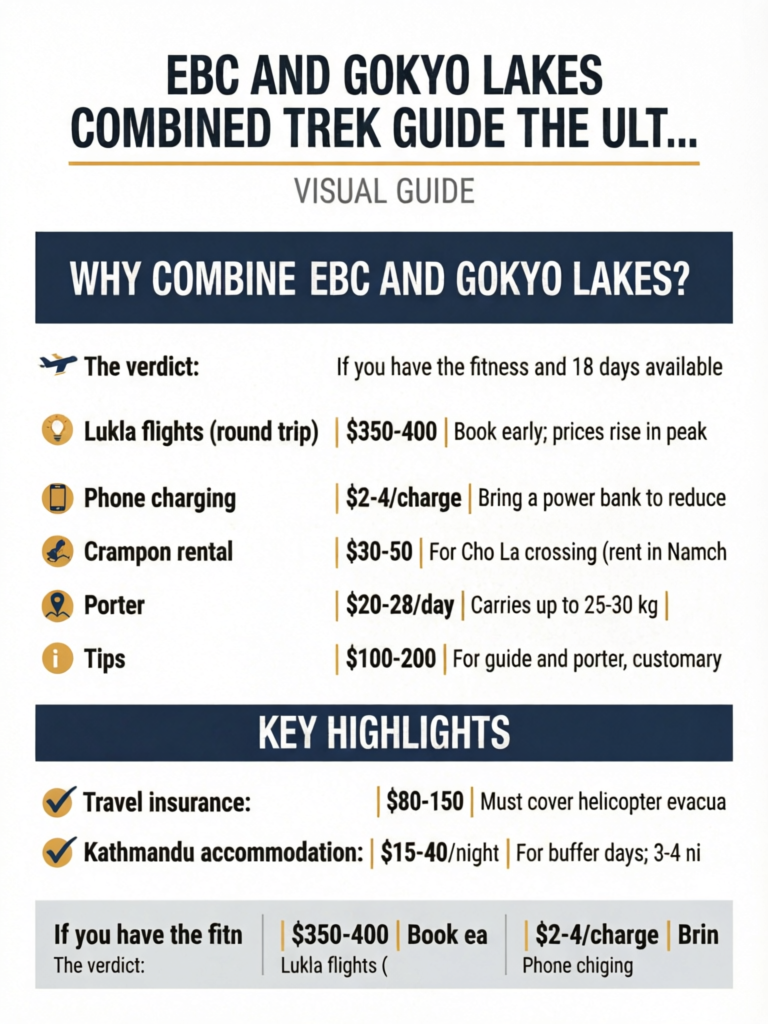
The verdict: If you have the fitness and 18 days available, the combined trek is overwhelmingly superior. You save a week of time, significant money, eliminate redundant Lukla flights and repeated acclimatization periods, and gain the Cho La Pass experience that separate treks do not include.
Cost Breakdown
The total cost depends heavily on whether you trek independently or with an agency. Here is a realistic breakdown for 2026 pricing.
Independent Trekking Costs
| Category | Cost Range | Notes |
|---|---|---|
| Lukla flights (round trip) | $215-400 | Book early; prices rise in peak season |
| Permits | $60-70 | Sagarmatha Entry Permit ($30) + Khumbu Rural Municipality Fee ($30-40) |
| Tea house accommodation | $5-15/night | Higher at altitude; NPR 500-1,500 per room |
| Meals (3 per day) | $20-35/day | Dal bhat $8-15, breakfast $5-8, snacks $3-5 |
| Drinks and snacks | $5-10/day | Water, tea, chocolate; prices increase with altitude |
| Hot showers | $3-5/shower | Not available at all tea houses above 4,500m |
| Phone charging | $2-4/charge | Bring a power bank to reduce costs |
| Crampon rental | $30-50 | For Cho La crossing (rent in Namche) |
| Guide (recommended) | $25-35/day | Essential for Cho La; optional on standard sections |
| Porter | $20-28/day | Carries up to 25-30 kg |
| Tips | $100-200 | For guide and porter, customary at end of trek |
| Travel insurance | $80-150 | Must cover helicopter evacuation above 5,000m |
| Kathmandu accommodation | $15-40/night | For buffer days; 3-4 nights total |
Total independent estimate (with a mandatory licensed guide): $1,800-2,200 Total independent estimate (with guide): $2,400-3,000
Guided/Agency Trek Costs
| Package Type | Cost Range | What is Included |
|---|---|---|
| Budget agency | $1,500-2,000 | Guide, permits, accommodation, most meals, domestic flights |
| Mid-range agency | $2,000-3,000 | Above plus porter, better lodges, more meals, gear rental |
| Premium agency | $3,000-5,000 | All-inclusive, experienced Cho La guide, best lodges, all meals, insurance coordination |
For a detailed cost analysis, see our EBC trek cost breakdown guide.
Where to Save, Where to Splurge
Do not cut costs on your guide for the Cho La crossing day. A good guide who knows the glacier route, carries emergency equipment, and can make sound weather decisions is worth every rupee. Where you can save: eat dal bhat instead of Western food (cheaper and more calories), carry a power bank instead of paying for charging, and bring a water purification system instead of buying bottled water.
Permits and Documentation
You need two permits for the EBC-Gokyo Combined Trek, both of which cover the entire route since the trek stays within the Sagarmatha (Everest) region. For the latest permit details and costs, see our Sagarmatha National Park permit guide.
Required Permits
1. Sagarmatha National Park Entry Permit
- Cost: NPR 3,000 ($30) for SAARC nationals, NPR 3,000 ($30) for foreigners
- Obtained at: Sagarmatha National Park entry gate at Monjo, or pre-purchased in Kathmandu at the Nepal Tourism Board office
- Validity: Single entry, covers the duration of your trek
2. Khumbu Pasang Lhamu Rural Municipality Fee
- Cost: NPR 2,000-4,000 (varies by season)
- Obtained at: Lukla or Namche checkpoints
- This local municipal fee was introduced to support infrastructure in the Khumbu region
TIMS Card Update 2026
As of 2026, the TIMS (Trekkers' Information Management System) card requirement has been restructured. Check current requirements with your agency or at the Nepal Tourism Board office in Kathmandu before departure. Requirements may change between publication and your travel date.
Best Seasons for the EBC-Gokyo Combined Trek
Peak Season: October to November
This is the optimal window. Post-monsoon skies are the clearest of the year, offering unobstructed mountain views. Temperatures are cold but manageable, and Cho La is at its most accessible. The trade-off is crowds on the standard EBC trail (though the Gokyo side remains relatively quiet).
October: Arguably the single best month. Clear skies, comfortable trekking temperatures (daytime 10-15C at lower elevations, -5 to -10C at altitude), and reliable Cho La conditions.
November: Slightly colder, especially at night (temperatures below -20C above 5,000m are common), but even clearer skies. Fewer trekkers than October. Late November can bring early winter snow that closes Cho La.
Secondary Season: March to May
Spring brings warmer temperatures and rhododendron blooms at lower elevations. Visibility is generally good, though not quite as pristine as autumn. Afternoons tend to be cloudier.
March-April: Warming temperatures, rhododendron forests in bloom, and increasing daylight. Good Cho La conditions in most years.
May: Pre-monsoon heat at lower elevations, but stable conditions at altitude. Late May can bring early monsoon moisture that affects Cho La.
Seasons to Avoid
June-September (Monsoon): Heavy rain, leeches at lower elevations, obscured views, and extremely dangerous Cho La conditions. Not recommended.
December-February (Winter): Extreme cold at altitude (below -30C at night above 5,000m), short days, and Cho La is frequently closed by snow. Only for experienced winter mountaineers.
What to Pack for the EBC-Gokyo Combined Trek
The packing list for this trek is similar to the standard EBC trek with critical additions for the Cho La crossing. Here are the Cho La-specific items you must have beyond the standard trekking kit.
Cho La-Specific Gear
- Crampons (strap-on type): Essential for the glacier crossing. Rent in Namche Bazaar (NPR 500-800/day) or buy/rent in Kathmandu. Practice putting them on before Cho La day.
- Gaiters: Keep snow out of your boots during the glacier and summit sections.
- Trekking poles with snow baskets: Standard rubber tips are insufficient on snow; switch to snow baskets for Cho La day.
- Balaclava or face covering: Wind chill at the pass can be extreme.
- Emergency bivvy sack: Lightweight (less than 200g) insurance if you are forced to stop on the pass.
- Extra water capacity: Carry at least 2.5-3 liters; there are no water sources on Cho La.
Additional Recommendations
- 4-season sleeping bag rated to -20C: Essential for nights at Gorak Shep and high tea houses. Rent in Kathmandu if you do not own one.
- Down jacket: Your most important single item above 4,500m.
- Layering system: Base layer, insulating mid-layer, windproof outer shell. See our layering guide.
- UV-blocking sunglasses (Category 4): Glacier-rated with side shields. Snow blindness is a real risk on Cho La.
- First aid kit: Including Diamox (acetazolamide) for AMS prevention if prescribed by your doctor.
For the complete list, see our EBC packing checklist.
Training and Preparation
The EBC-Gokyo combination is significantly more demanding than the standard EBC trek. Here is what you should aim for in the 3-6 months before your trek.
Fitness Requirements
Cardiovascular endurance: You need the ability to walk 6-8 hours daily at altitude for 16 consecutive days, with one day exceeding 9 hours (Cho La). Train with sustained cardio: hiking with a loaded pack, stair climbing, cycling, or running.
Leg strength: The combination of steep ascents, rocky scrambles, and long descents demands strong quadriceps, hamstrings, and calves. Include squats, lunges, step-ups, and calf raises in your routine.
Core stability: Critical for balance on the Cho La glacier and rocky moraine sections. Planks, dead bugs, and balance exercises are valuable.
Minimum benchmarks:
- Hike 15-20 km with a 10 kg pack on hilly terrain without extreme fatigue
- Climb 1,000m of elevation gain in a single day
- Walk 5-6 hours consecutively at a moderate pace
- Complete a multi-day hiking trip (3 or more consecutive days) to test gear and endurance
For a structured training plan, see our EBC training plan guide.
Frequently Asked Questions
Related Guides and Resources
- Everest Base Camp Route Overview
- EBC 14-Day Standard Itinerary
- Three Passes Trek Itinerary
- Cho La Pass Detailed Guide
- Acclimatization Guide for Nepal Trekking
- Sagarmatha National Park Permit Guide
- EBC Trek Cost Breakdown
- EBC Complete Packing Checklist
- Kathmandu to Lukla Flights Guide
- EBC Training Plan
- Best Lodges in the Everest Region
- Helicopter Return from Lukla
Final Thoughts
The EBC and Gokyo Lakes Combined Trek is, in our assessment, the single best trek you can do in the Everest region if you have 18 days and the fitness to match. It delivers everything the Khumbu has to offer: the raw power of Everest Base Camp, the serene beauty of the Gokyo Lakes, the thrill of a genuine high-pass crossing at Cho La, and two world-class summit viewpoints in Kala Patthar and Gokyo Ri.
This is not the easiest trek in Nepal, and it should not be your first if you have no trekking experience. But if you have hiked at altitude before, maintain good fitness, and are willing to invest in proper preparation, this route will reward you with memories that last a lifetime.
Start with the Gokyo Valley. Cross Cho La with respect and good timing. Stand at the foot of Everest. Watch the sun rise from 5,545 meters. Then walk back down through the forests and villages of the Khumbu, knowing you have experienced the ultimate Himalayan journey.
Ready to Plan Your EBC-Gokyo Combined Trek?
Connect with verified trekking agencies who specialize in the EBC-Gokyo combination route. Get custom itineraries, transparent pricing, and expert guidance for your Cho La crossing.