The trek to Everest Base Camp is the adventure of a lifetime, but success hinges on proper preparation and packing. At 5,545m (18,192 ft), you'll face extreme cold, intense UV radiation, rapidly changing weather, and challenging terrain. This comprehensive guide provides everything you need to pack perfectly for EBC, eliminating guesswork and ensuring you're prepared for whatever the Himalayas throw at you.
11-12 kg without porter
5,545m (18,192 ft) at EBC
-20°C to 20°C (-4°F to 68°F)
Best in Kathmandu's Thamel
15 kg maximum per porter
Start 2-3 weeks before departure
Why EBC Packing Requires Special Attention
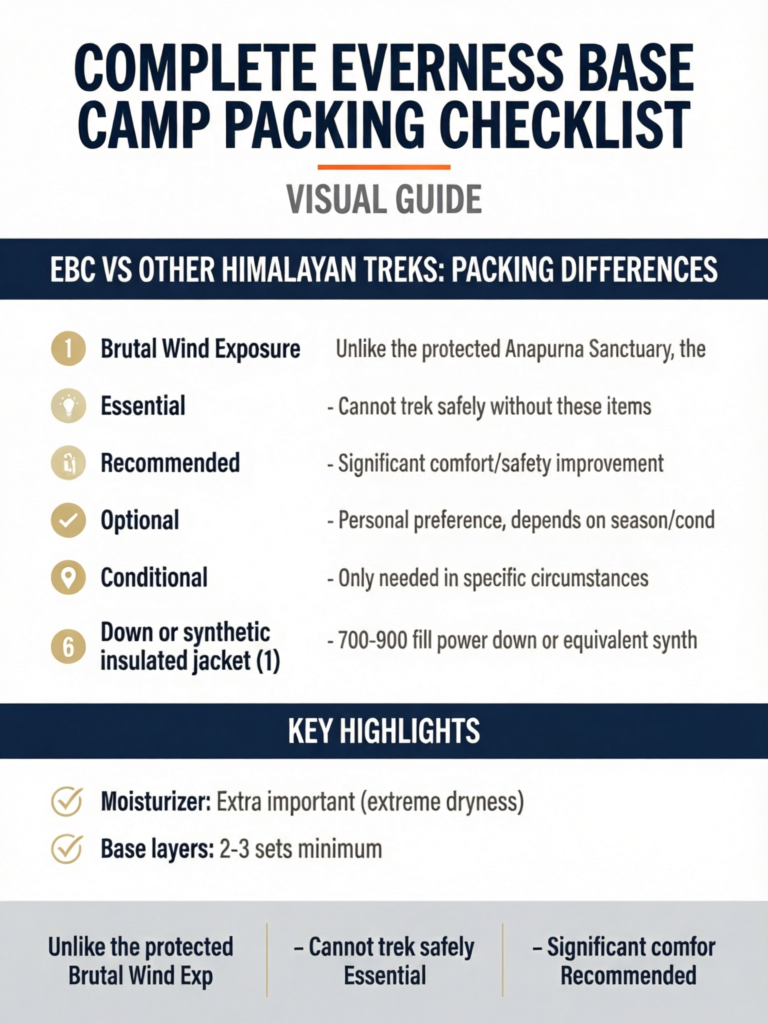
The Everest Base Camp trek presents unique challenges that demand a different packing approach compared to lower-altitude Himalayan treks. Understanding these factors is critical for a successful journey.
Key EBC Environmental Factors
Extreme Altitude: At 5,545m, EBC is the highest most trekkers will ever go without technical climbing equipment. The altitude affects everything from sleep to digestion to how cold you feel. Every piece of gear must perform in low-oxygen conditions.
Severe Temperature Swings: Experience 30-40°C temperature variations in a single day. Morning starts at Gorak Shep can be -15°C, while afternoon sun at 3,800m might reach +15°C. Your layering system must handle this extreme range efficiently.
Brutal Wind Exposure: Unlike the protected Annapurna Sanctuary, the Khumbu Valley is exposed to jet stream winds. Kala Patthar summit attempts often face 40+ km/h winds. Wind-resistant outer layers are non-negotiable.
Extended Duration: The standard EBC trek takes 12-14 days minimum, with many trekkers adding side trips to Gokyo Lakes or Island Peak base camp. This longer duration requires more clothing rotation and durability.
Limited Rescue Options: Helicopter evacuation is possible but weather-dependent and expensive. You must be self-sufficient with first aid, medications, and backup gear. Unlike accessible treks, help is days away.
Decreasing Tea House Quality: While Everest region lodges below Namche are excellent, facilities deteriorate above 4,500m. Expect basic accommodation, intermittent electricity, and minimal heating at Lobuche and Gorak Shep.
The EBC 80/20 Packing Rule
EBC vs Other Himalayan Treks: Packing Differences
Understanding how EBC packing differs from other popular treks helps you avoid bringing unnecessary items or leaving critical gear behind.
EBC vs ABC: EBC requires 20-25% warmer gear than Annapurna Base Camp. The altitude difference (5,545m vs 4,130m) means significantly colder temperatures, especially at night. You need a colder-rated sleeping bag (-15°C vs -10°C), heavier down jacket (800 fill vs 650 fill), and warmer gloves.
EBC vs Annapurna Circuit: The Annapurna Circuit crosses Thorong La Pass (5,416m) but descends immediately. EBC keeps you above 4,500m for 4-5 consecutive nights. Pack for sustained high altitude rather than brief exposure. You'll need more fuel layers and better cold-weather sleeping gear.
EBC vs Manaslu: Manaslu Circuit has similar altitude but far more remote villages with limited gear availability. EBC's advantage is the ability to rent or buy last-minute items in Namche Bazaar, reducing pre-trek packing anxiety.
Tea House EBC vs Independent: Trekking EBC with a mandatory licensed guide doesn't change packing significantly since you'll still use tea houses. However, solo trekkers should pack redundant systems (backup headlamp, extra batteries, comprehensive first aid) since you can't share gear.
EBC Packing vs Other Major Himalayan Treks
| Name | Features | Total |
|---|---|---|
| Everest Base Camp | Sleeping bag: -15°C ratedDown jacket: 800 fill, 200g insulationAltitude meds: EssentialBase weight target: 11-12kgDays above 4,000m: 8-10 days | Most extreme cold, highest sustained altitude |
| Annapurna Base Camp | Sleeping bag: -10°C ratedDown jacket: 650 fill, 150g insulationAltitude meds: RecommendedBase weight target: 9-10kgDays above 4,000m: 2-3 days | Warmer sanctuary climate, lower altitude |
| Annapurna Circuit | Sleeping bag: -10°C ratedDown jacket: 700 fill, 180g insulationAltitude meds: Essential for Thorong LaBase weight target: 10-11kgDays above 4,000m: 3-4 days | Brief high-altitude exposure, varied climate zones |
Understanding Pack Weight Targets
Weight is your enemy at altitude. Every kilogram you carry requires more oxygen and energy—commodities in short supply above 5,000m.
Base Weight Categories
Ultralight (8-10kg): Achievable for experienced minimalist trekkers with high-quality gear. Requires sacrificing some comfort items and using lighter-rated equipment. Best for October/November when conditions are most stable.
Standard (11-12kg): The sweet spot for most EBC trekkers. Includes all essentials plus reasonable comfort items. Achievable with mid-range gear and smart packing choices. Recommended target for first-time EBC trekkers.
Moderate (13-15kg): Upper limit for self-carrying. Includes extra photography gear, additional electronics, or more clothing options. Acceptable if you're physically fit but can become burdensome above Dingboche.
Porter-Assisted (16-20kg): If hiring a porter, you can bring extra comfort items, better camera gear, or additional warm layers. However, keep your daypack under 6-7kg for daily trekking comfort.
The Hidden Weight Trap
Weight Distribution Strategy
Daypack Focus: Keep your daypack at 5-7kg maximum. Include: water (1-2L), down jacket, rain gear, snacks, first aid kit, camera, extra layer. This is what you'll carry 6-8 hours daily.
Porter Duffel (if applicable): Sleeping bag, extra clothes, toiletries, non-daily essentials. Pack this efficiently since you won't access it until evening.
Kathmandu Storage: Leave anything you won't use: city clothes, extra shoes, non-trekking electronics. Most hotels offer free luggage storage for trekking clients.
The Complete EBC Packing Checklist
This comprehensive checklist covers every item you might need for the Everest Base Camp trek, organized by category and priority level.
Legend & Priority System
- ✓ Essential - Cannot trek safely without these items
- ○ Recommended - Significant comfort/safety improvement
- △ Optional - Personal preference, depends on season/conditions
- ◇ Conditional - Only needed in specific circumstances
Clothing: Base Layer System
Base layers are your foundation for temperature regulation. At EBC, you'll live in your base layers from Namche Bazaar onwards.
Upper Body Base Layers
- ✓ Long-sleeve merino wool base layer tops (2-3) - 200-260 weight merino wool. One to wear, one to wash, one spare for summit day. Merino is superior to synthetic for multi-day wear without washing and natural odor resistance. During the trek, you might wear the same base layer for 3-4 days consecutively. Brands: Icebreaker 200 Oasis, Smartwool Merino 250, Patagonia Capilene Thermal Weight. Budget option: Decathlon Forclaz Merino 100. Weight: 200-250g per top. Cost: $60-100 per top, or $15-25 in Kathmandu's Thamel district for excellent knockoffs that perform nearly identically.
Merino vs Synthetic for EBC
-
○ Long-sleeve lightweight sun shirt (1) - UPF 50+ rated, lightweight synthetic. For lower elevations (Lukla to Namche) where sun exposure is intense but temperature is moderate. Columbia Silver Ridge, ExOfficio BugsAway Halo, or Outdoor Research Echo series. Not essential since you can use a base layer, but the dedicated sun shirt performs better in 15-20°C conditions. Weight: 120-180g.
-
△ Short-sleeve t-shirt (1) - Only useful below Namche (2-3 days total). Most trekkers skip this entirely. If you do bring one, make it merino wool so it serves double duty as a sleeping shirt. Weight: 100-140g.
Lower Body Base Layers
-
✓ Thermal leggings/long underwear (2-3 pairs) - 200-260 weight merino or synthetic. Essential for sleeping and high-altitude days above Dingboche. You'll wear these every night in your sleeping bag from Namche onwards and often under trekking pants above 4,500m. Icebreaker 200 Oasis Leggings, Smartwool Merino 250 Bottoms, Patagonia Capilene Thermal Weight Bottoms. Women should consider the Smartwool Intraknit line for better fit. Weight: 180-220g per pair. Cost: $60-90 per pair, or $12-20 in Kathmandu.
-
○ Lightweight liner pants (1 pair) - Thin synthetic or silk layer for extra warmth flexibility. Useful for December-February treks or cold-sensitive individuals. Can be worn under thermal leggings for extreme cold or alone for warmer days. Weight: 80-120g.
Clothing: Mid Layer System
Mid layers provide insulation and are your most-used items during active trekking.
Insulating Mid Layers
-
✓ Fleece jacket or pullover (1) - 200-300 weight fleece. This becomes your default layer from Tengboche onwards. You'll wear it every morning, evening, and often during the day above 4,000m. Choose a full-zip jacket for versatility or a 1/4-zip pullover for weight savings. Patagonia R2 Fleece (260g of warmth, 340g weight), Arc'teryx Kyanite Hoody (excellent but pricey), Patagonia Better Sweater (heavier but more stylish for lodge evenings), or Decathlon Forclaz 200 Fleece (budget option, 280g, performs admirably). Feature priorities: high collar, thumbholes, zippered pockets. Weight: 340-450g. Cost: $80-180, or $20-35 in Kathmandu.
-
✓ Down or synthetic insulated jacket (1) - 700-900 fill power down or equivalent synthetic, 150-250g of insulation. This is your most important warmth piece. You'll wear it every evening at lodges, during breaks above 4,000m, for summit attempts, and potentially as a sleeping bag booster at Gorak Shep. Down options: Montbell Plasma 1000 (best warmth-to-weight ratio, 200g weight, $300+), Arc'teryx Cerium LT (230g, excellent compressibility), Patagonia Down Sweater (285g, most popular choice), Rab Microlight Alpine (260g, good value), Mountain Equipment Lightline (240g, UK favorite). Synthetic options: Patagonia Nano Puff (340g, maintains warmth when wet), Arc'teryx Atom LT (375g, excellent versatility). Feature priorities: helmet-compatible hood, internal chest pocket for valuables, stuff sack included. Weight: 200-380g. Cost: $200-400, or $40-80 in Kathmandu for quality replicas.
Down Jacket as Sleep System Booster
-
○ Lightweight insulated vest (1) - Down or synthetic vest, 100-150g insulation. Provides core warmth without arm bulk during active climbing. Excellent for afternoon trekking when a full jacket is too warm but a fleece isn't quite enough. Can layer under your down jacket for extreme cold (Kala Patthar pre-dawn summit). Patagonia Down Sweater Vest (190g), Arc'teryx Atom LT Vest (200g), or Montbell UL Down Vest (140g). Only necessary if you tend to run cold or are trekking December-February. Otherwise, the weight is better allocated elsewhere. Weight: 140-220g.
-
△ Soft fleece or merino mid-layer top (1) - Additional warmth layer, lighter than your main fleece. Grid-fleece technology provides excellent warmth-to-weight. Patagonia R1 Hoody (290g, highly versatile), Arc'teryx Delta LT (270g), or Outdoor Research Vigor Grid Fleece. Provides extra flexibility for extreme cold but redundant for most trekkers who can layer a base layer + fleece + down jacket. Best for minimalists who prefer multiple lighter layers to single heavy layers. Weight: 260-320g.
Clothing: Outer Shell System
Shells protect against wind, rain, and snow. EBC weather can change instantly—clear skies to whiteout blizzard in 30 minutes.
Waterproof Hardshell Jacket
- ✓ Waterproof hardshell jacket with hood (1) - 2.5 or 3-layer Gore-Tex or equivalent (eVent, Polartec NeoShell, proprietary membranes like Patagonia H2No). Essential protection against wind, rain, and snow. The Khumbu Valley experiences afternoon weather changes, and being caught without a shell at altitude is dangerous. Must-have features: helmet-compatible hood with adjustment pulls, pit zips for ventilation control, internal mesh pockets for valuables, powder skirt (optional), laminated waterproof zippers. Recommended shells: Arc'teryx Beta AR (445g, gold standard for Himalayan trekking, $575), Outdoor Research Interstellar (400g, excellent value, $300), Patagonia Torrentshell 3L (417g, budget-friendly, $179), Marmot Minimalist (358g, lightweight option), Rab Kangri GTX (470g, designed for Himalayan conditions). Budget option: Decathlon Forclaz Trek 900 (380g, $100, surprisingly effective). Weight: 360-470g. Cost: $180-600, or $50-90 in Kathmandu.
Pit Zips Are Non-Negotiable
- ○ Softshell jacket (1) - Wind-resistant, water-resistant, highly breathable alternative for dry conditions. Softshells excel during active trekking on clear days when a hardshell is too warm but you need wind protection. They're also more comfortable for lodge lounging than crinkly hardshell fabrics. Black Diamond Dawn Patrol (550g, excellent breathability), Arc'teryx Gamma MX (515g, warmer option with fleece backing), Outdoor Research Ferrosi Hoody (420g, best value), Patagonia Tough Puff (670g, unique insulated softshell). Only necessary if trekking during stable weather seasons (October-November) or if you prioritize comfort over weight. Most budget-conscious trekkers skip the softshell and rely on fleece + hardshell layering. Weight: 420-670g.
Waterproof Hardshell Pants
-
✓ Waterproof hardshell pants with full side zips (1) - 2.5 or 3-layer waterproof fabric. Full-length side zips are essential—they allow you to put pants on/off over boots without removal. Critical features: full side zips (non-negotiable), articulated knees, reinforced cuff kick panels, adjustable waist, 2-3 pockets minimum. Recommended: Outdoor Research Helium Pants (200g, ultralight but less durable), Marmot PreCip Eco Full Zip (290g, excellent value), Arc'teryx Beta AR Pants (420g, bombproof durability), Patagonia Torrentshell 3L Pants (340g, good balance). You'll primarily wear these as emergency insurance, during snowfall above Dingboche, and potentially for Kala Patthar summit if conditions are severe. Many trekkers only wear rain pants 2-3 times during the entire trek, but they're essential insurance. Weight: 200-420g. Cost: $100-350, or $25-60 in Kathmandu.
-
△ Rain poncho (1) - Lightweight poncho that covers both you and your backpack. Useful during afternoon rain showers at lower elevations (Lukla to Phakding, Namche to Tengboche). Advantage: excellent ventilation, no sweat buildup. Disadvantage: useless in wind, awkward on steep terrain. Local Nepali ponchos available everywhere for $3-8. Only bring if you're particularly prone to overheating in rain gear. Weight: 180-300g.
-
◇ Insulated down or synthetic pants (1) - Only for December-February treks, Kala Patthar pre-dawn summit attempts, or extremely cold-sensitive individuals. Most trekkers manage with base layer + shell pants. However, if you're attempting Kala Patthar summit (5,545m+ optional viewpoint) before sunrise in December/January, insulated pants transform the experience from survival mode to enjoyable. Montbell Thermawrap Pants (220g, packable synthetic), Mountain Equipment Compressor Pants (310g, down insulation), or Rab Photon Pants (380g, expedition-weight). Weight: 220-400g.
Clothing: Lower Body Trekking Pants
Primary Trekking Pants
-
✓ Convertible hiking pants / zip-off pants (1-2 pairs) - Quick-dry, stretchy fabric with zip-off legs that convert to shorts. The most versatile option for EBC's varying climates. Lower elevations (Lukla to Phakding) can reach 20-25°C in October/April sunshine, requiring shorts. Above Namche, you'll keep them as pants 100% of the time. Features: 4-way stretch fabric, DWR (durable water repellent) coating, 4+ pockets including zippered security pocket, articulated knees, reinforced knees/seat. North Face Horizon Convertible (280g, most popular), Columbia Silver Ridge Convertible (290g, excellent value), Outdoor Research Ferrosi Convertible (320g, best performance), Prana Stretch Zion Convertible (340g, most comfortable fit). Bring two pairs if not using a porter—one to wear, one to wash/dry. Weight: 280-340g per pair. Cost: $60-100, or $18-30 in Kathmandu.
-
○ Lightweight trekking pants (1 additional pair) - Non-convertible trekking pants as backup or alternative. Slightly lighter and more streamlined than convertibles. Mountain Hardwear Hardwear AP (260g), Arc'teryx Gamma LT (295g), Patagonia Quandary (310g). Only necessary if you want pant rotation or your convertibles are heavier-weight. Weight: 260-320g.
-
○ Trekking shorts (1 pair) - Only needed if you don't have convertible pants. Useful for 2-3 days at lower elevations. Patagonia Baggies, North Face Aphrodite, or similar quick-dry shorts. Weight: 140-200g.
-
△ Casual/lounge pants (1 pair) - Lightweight sweatpants or relaxed-fit pants exclusively for evening lodge lounging. Provides psychological comfort by separating "trekking gear" from "relaxation gear." Most trekkers just lounge in their base layers or trekking pants, but dedicated lounge pants add comfort if weight isn't a concern. Weight: 220-300g.
Clothing: Accessories & Extremities
Head, hands, and feet protection is critical at EBC. Extremities lose heat rapidly at altitude.
Head Protection
-
✓ Warm beanie / wool hat (1-2) - Full coverage over ears, merino wool or fleece-lined. You'll wear this every night sleeping and every morning until the sun warms up. A cold head prevents sleep at altitude—this is not optional. Smartwool Lid (55g), Patagonia Better Sweater Beanie (68g), or any thick merino/fleece hat. Bring two if you're December-trekking or tend to be cold-sensitive: one for active use, one cleaner one for sleeping. Weight: 50-80g per hat.
-
✓ Sun hat or cap with brim (1) - Wide-brimmed hat (8-10cm brim minimum) or baseball cap with removable neck flap. Critical for sun protection in the Himalayas—UV radiation increases 10-12% per 1,000m of elevation. At EBC, UV exposure is 60% higher than sea level. Sunburned scalp at altitude is miserable and dangerous. Outdoor Research Sombriolet Sun Hat (90g, best design), Patagonia Bimini Stretch Fit (70g), Sunday Afternoons Ultra Adventure Hat (100g). Must have: chin strap to prevent wind loss, UPF 50+ rating, breathable fabric, packable. Weight: 70-120g.
-
✓ Buff / neck gaiter / balaclava (2-3) - Incredibly versatile: sun protection, dust mask, wind barrier, cold weather face/neck protection, sweat management, headband. Bring multiple since they're lightweight and multi-functional. One lightweight for sun/dust (Buff CoolNet UV), one midweight fleece-lined for cold (Buff Polar), optionally one heavyweight balaclava for extreme cold/wind. The spring season (March-May) can be dusty on trails—a buff as dust mask is essential for breathing comfort. Weight: 30-80g each.
Hand Protection
-
✓ Lightweight glove liners (1-2 pairs) - Thin merino wool or silk liner gloves. Essential for photography, phone use, snacking, and tent tasks in cold conditions. Icebreaker Oasis Glove Liners (30g), Smartwool Liner Gloves (35g), or Outdoor Research Sensor Liners (40g, excellent touchscreen compatibility). Bring two pairs since one inevitably gets wet or lost. Weight: 30-45g per pair.
-
✓ Insulated winter gloves or mittens (1 pair) - Waterproof, insulated to -15°C minimum. This is your primary hand protection for cold days, early mornings, and high-altitude sections. Mittens are 20-30% warmer than gloves due to fingers sharing heat, but gloves offer better dexterity for poles, zippers, and photography. Most trekkers prefer gloves for the flexibility. Black Diamond Mercury Mitts (135g, excellent warmth), Outdoor Research Alti Mitts (180g, expedition-grade), Marmot Expedition Mitts (195g, maximum warmth), or for gloves: Black Diamond Guide Gloves (165g), Outdoor Research Stormtracker Heated Gloves (280g but includes battery heating—overkill for most). Features needed: waterproof outer shell, synthetic or down insulation (150-200g fill), wrist leash attachment, nose-wipe patch on thumb. Weight: 130-200g.
-
○ Midweight fleece or softshell gloves (1 pair) - Warmer than liners but less bulky than insulated gloves. Perfect for active trekking on cold but not extreme days. Allows better dexterity than heavy winter gloves while still providing meaningful warmth. Outdoor Research Stormtracker (90g), Black Diamond Midweight Screentap (75g), or Patagonia Better Sweater Gloves (85g). Only necessary if you want a middle ground between liners and winter gloves. Most trekkers manage with just liners + insulated gloves. Weight: 75-110g.
-
△ Heavy-duty expedition mittens (1 pair) - Only for December-February treks or Kala Patthar pre-dawn summits. Extreme cold protection rated to -30°C. Outdoor Research Alti Mitts (180g), Black Diamond Absolute Mitts (200g), or Marmot 8000M Mitts (220g). Overkill for standard October/November EBC treks. Weight: 180-220g
Footwear: The Foundation of Success
Footwear is arguably your single most important gear category. Poor boot choices cause more trek failures than any other factor.
Primary Trekking Boots
- ✓ Waterproof hiking boots with ankle support (1 pair) - Mid to high-cut boots, Gore-Tex or equivalent waterproofing, Vibram or similar high-traction sole. MUST be completely broken in before departure—minimum 80-100km of hiking including steep descents with a weighted pack. The EBC trail combines the worst of everything: steep stone staircases (thousands of steps), rocky moraine (Gorak Shep to EBC), icy morning trails, muddy forest paths, and stream crossings. Your boots must handle it all. Recommended models: Salomon Quest 4 GTX (590g per boot, most popular choice, excellent stability, $230), Lowa Renegade GTX Mid (640g, legendary comfort, best for wider feet, $260), Asolo Fugitive GTX (670g, Italian craftsmanship, superior durability, $290), Scarpa Zodiac Plus GTX (710g, stiffest option, best for heavy loads, $300), La Sportiva Nucleo High II GTX (650g, excellent fit for narrow feet, $249). Budget option: Merrell Moab 2 GTX (540g, less durable but adequate, $150). Features needed: full-grain leather or durable synthetic upper, waterproof-breathable membrane, protective rand (rubber bumper around base), deep lugs (4-5mm), stiff midsole for load-bearing, heel brake system for descent control. Weight: 540-710g per boot (1,080-1,420g per pair). Cost: $150-350, or $60-120 in Kathmandu.
Boot Break-In Is Non-Negotiable
- ○ Approach shoes or trail runners (1 pair) - Lighter alternative for experienced trekkers with strong ankles, or as backup/alternate footwear. Only recommended if you've completed previous high-altitude treks successfully in trail runners. The EBC trail's loose rock and steep descents make ankle support critical for most people. However, ultralight trekkers and trail runners swear by them. La Sportiva TX4 (380g, best approach shoe for technical terrain), Salomon Speedcross 5 GTX (350g, aggressive grip), Altra Lone Peak 7 (290g, zero-drop geometry, cult following), Hoka Speedgoat 5 (280g, maximal cushioning for descents). Advantages: lighter weight reduces fatigue, faster drying if wet, better ground feel. Disadvantages: less ankle support, less warmth at altitude, less protection from rockfall. Weight: 280-380g per shoe (560-760g per pair).
Camp & Backup Footwear
-
✓ Lightweight camp shoes or sandals (1 pair) - Essential for lodge evenings, bathroom trips, and resting your feet after 6-8 hours in boots. The psychological relief of removing trekking boots at day's end cannot be overstated. Options: Crocs Classic (190g per pair, ultimate comfort, no shame at EBC), Teva Original Universal Sandals (230g, better for outdoor use), OOFOS OOmg Low Shoe (170g, recovery-focused design), UGG Tasman Slippers (270g, warmth for cold lodges). Must be easy on/off without bending over—at altitude, bending to tie shoes leaves you breathless. Weight: 170-270g per pair.
-
○ Down booties or insulated slippers (1 pair) - Warm insulated camp footwear for extreme altitude lodges (Dingboche, Lobuche, Gorak Shep) where rooms are unheated and temperatures plummet. Transforms cold evening comfort. Western Mountaineering Down Bootie (130g), Montbell Down Hugger Booties (85g), or Feathered Friends Down Slippers (100g). Alternatively, wear thick wool socks inside your Crocs. Only necessary for December-February treks or cold-sensitive individuals. Weight: 85-130g per pair.
-
△ Flip-flops (1 pair) - Ultra-basic backup for showering (if tea houses have showers, which is rare above Namche) and as emergency camp shoe backup. Local Nepali flip-flops available in every village for $2-4. Weight: 150-200g.
Socks & Foot Care
-
✓ Trekking socks - merino wool blend (5-6 pairs) - Medium to heavyweight cushion, merino wool blend (60-80% merino, rest nylon/spandex for durability). This is NOT an area to skimp. Quality socks prevent blisters, manage moisture, provide cushioning on endless descents, and keep feet warm at altitude. Darn Tough Hiker Boot Midweight (80g per pair, lifetime guarantee, best choice for most trekkers, $27), Smartwool PhD Outdoor Heavy Crew (90g, excellent for cold conditions, $28), Icebreaker Hike+ Medium Crew (75g, good balance, $22), Farm to Feet Damasc us Lightweight (65g, made in USA, $24). Bring 5-6 pairs so you can rotate daily and have clean, dry socks for crucial days (summit attempts, descent). Fresh socks are a morale booster when everything else is dirty. Weight: 65-90g per pair (390-540g total). Cost: $22-28 per pair, or $5-8 in Kathmandu for decent quality.
-
○ Sock liners - thin synthetic or silk (3-4 pairs) - Worn under your main socks to reduce friction and prevent blisters. Creates a two-layer system where friction occurs between socks rather than between sock and skin. Injinji Liner Crew (35g, toe socks prevent toe blisters), Wright Double Layer Socks (55g, built-in liner layer), or basic silk liners (30g). Highly effective blister prevention, especially if you're prone to hot spots. Weight: 30-55g per pair.
-
✓ Warm sleeping socks or camp socks (1-2 pairs) - Thick, clean socks exclusively for sleeping. Keeps your sleeping bag cleaner and adds significant warmth on cold nights. Smartwool Mountaineering Extra Heavy Crew (130g), Darn Tough Over-the-Calf Extra Cushion (140g), or any thick wool socks. Keep these separate from trekking socks—the cleanliness matters for sleep quality and hygiene. Weight: 120-140g per pair.
-
✓ Gaiters (1 pair) - Essential for EBC, unlike lower-altitude treks. The trail above Dingboche crosses rocky moraine and potentially snow/ice. Gaiters prevent rocks, ice, and snow from entering your boots and protect boot tops from abrasion. Outdoor Research Rocky Mountain High Gaiters (280g, full-height coverage, $65), Black Diamond Apex GTX Gaiters (240g, mid-height, $60), Kahtoola INSTAgaiter Low (100g, ultralight low-cut option, $40), or Dirty Girl Gaiters (40g, minimal debris protection, popular among ultralight community, $20). Standard-height gaiters are recommended over low-cut versions for EBC snow potential. Weight: 40-280g per pair.
-
✓ Blister prevention and treatment kit - Leukotape P (best blister prevention tape, superior to moleskin, apply to hot spots BEFORE blisters form), Compeed Advanced Blister Care (hydrocolloid dressings for formed blisters), Body Glide or Squirrel's Nut Butter (anti-chafe balm for feet, thighs, anywhere friction occurs), Tincture of benzoin (improves tape adhesion to skin). Pro trekkers tape their feet preventatively on Day 1 rather than waiting for problems. Common hot spot locations: heels, outside of pinky toes, balls of feet. Weight: 150g total for complete kit.
-
○ Foot powder or antifungal powder - Keeps feet dry and prevents fungal issues during multi-day trekking. Gold Bond Medicated Foot Powder, Zeasorb Antifungal Powder, or simple talcum powder. Apply morning and evening. Weight: 80-120g for trek duration.
EBC Footwear System: Weight vs Comfort Trade-offs
| Name | Features | Total |
|---|---|---|
| Conservative (Heavy) System | Boots: 1,400gCamp shoes: 270g (insulated)Socks: 540g (6 pairs)Gaiters: 280gFoot care: 150g | 2,640g - Maximum support and warmth |
| Balanced System | Boots: 1,200gCamp shoes: 190g (Crocs)Socks: 450g (5 pairs)Gaiters: 240gFoot care: 150g | 2,230g - Best compromise for most trekkers |
| Ultralight System | Trail runners: 700gCamp shoes: 170g (minimal)Socks: 325g (5 pairs)Gaiters: 100g (low-cut)Foot care: 100g | 1,395g - Expert trekkers only |
Backpack & Bags
Your backpack carries everything. Fit and comfort matter more than features.
Primary Backpack
-
✓ Trekking backpack 50-65L (1) - This is for self-carrying all your gear. If using a porter, you'll carry a smaller daypack and your porter carries this main pack. Critical features: adjustable torso length, substantial hip belt with padding (70% of weight should ride on hips, not shoulders), load-lifter straps, sternum strap, ventilated back panel, rain cover included or available, multiple access points (top-loader with front zipper access is ideal), hydration reservoir compatible, trekking pole attachment system, 2-3 external pockets. Recommended models: Osprey Atmos AG 65 (2,300g, best suspension system, extremely comfortable, $300), Gregory Baltoro 65 (2,400g, similar to Osprey, slightly tougher, $320), Deuter Aircontact Lite 65+10 (2,500g, German engineering, very durable, $280), Osprey Aether Plus 70 (2,450g, more capacity for tall people, $330), REI Flash 55 (1,300g, ultralight option but less comfortable under heavy loads, $170). Women-specific models: Osprey Ariel AG 65 (2,260g), Gregory Deva 60 (2,350g). Sizing is crucial—get professionally fitted at an outdoor retailer. An ill-fitting pack causes pain within hours. Weight: 1,300-2,500g. Cost: $170-330.
-
✓ Daypack 20-30L (1) - For porter-assisted treks or summit day pushes. Carries daily essentials: water, snacks, camera, extra layers, first aid, rain gear. Features needed: comfortable shoulder straps (you'll wear this 6-8 hours daily), hip belt for weight transfer, water bottle side pockets, decent organization, compression straps. Osprey Talon 22 (420g, most popular choice, $100), Gregory Citro 25 (680g, more features, $110), REI Trail 25 (620g, good value, $70), Patagonia Nine Trails 28L (640g, durable, $129). If you're self-carrying without a porter, you technically don't need a separate daypack, but it's useful for summit pushes (leave main pack at lodge, summit with daypack). Weight: 420-680g.
-
○ Ultralight summit pack / stuff sack (1) - 15-18L packable daypack for Kala Patthar summit push if you want to leave your main daypack at the lodge. Matador Freerain24 (170g), Sea to Summit Ultra-Sil Day Pack (70g), or REI Flash 18 Pack (170g). Only necessary if you want maximum weight reduction for summit attempts. Weight: 70-170g.
Organization & Protection
-
✓ Porter duffel bag 90-120L (1) - If hiring a porter, they carry this duffel. Must be lockable, weather-resistant, and durable. The porter will carry this on their back using a headstrap (traditional style) or their own backpack frame. North Face Base Camp Duffel XL 132L (1,400g, bombproof durability, $199), Patagonia Black Hole Duffel 100L (1,280g, excellent weather resistance, $179), Osprey Transporter 120 (1,620g, backpack straps included, $160), or buy locally in Thamel for $30-50 (adequate quality for single trek). Features: lockable zippers, gear loops for porter to attach easily, padded bottom, compression straps. Pack your non-daily items here: sleeping bag, extra clothes, toiletries, items you only need in evenings. Weight limit: 15kg maximum—this is the international porter weight standard. Overloading porters is unethical and often prohibited by trekking agencies. Weight: 1,280-1,620g.
-
✓ Dry bags or waterproof stuff sacks (3-5) - Organize gear and protect from rain/moisture. Even "waterproof" packs leak in sustained rain. Critical items (sleeping bag, electronics, down jacket) must be in dry bags. Sea to Summit eVent Compression Dry Sack (75-140g depending on size, breathable fabric prevents mildew, $35-55), Sea to Summit Ultra-Sil Dry Sack (25-55g, ultralight, $20-30), or Outdoor Research Dry Ditty Sacks (20-40g, various sizes, $12-18). Recommended system: Large (20L) for sleeping bag, Medium (13L) for down jacket and warm layers, Medium (8L) for electronics, Small (5L) for first aid, Extra-small (2.5L) for documents/money. Use different colors for easy identification. Total weight: 200-300g for complete set.
-
○ Pack rain cover (1) - Many packs include rain covers; if not, purchase separately. Covers your pack during rain/snow. Sea to Summit Ultra-Sil Pack Cover (100-150g depending on pack size, $35-45), or Osprey Ultralight Raincover (120-170g, $30-40). Alternative: Pack everything in dry bags inside your pack and skip the rain cover entirely (saves weight, arguably more effective). Weight: 100-170g.
-
○ Packing cubes (2-4) - Organize clothing and keep items compressed. Especially useful for porter duffel organization. Eagle Creek Pack-It Original Cube Set (180g for 3 cubes), Peak Design Packing Cube (small, medium, large options), or REI Co-op Expandable Packing Cube Set (budget option). Color-code for easy finding: Blue for clean clothes, Red for dirty clothes, Green for accessories. Weight: 40-80g per cube.
-
△ Compression stuff sacks (1-2) - For sleeping bag and puffy jacket. Reduces volume significantly. However, continuous compression can damage down insulation over time. Use only when necessary for packing efficiency, store items uncompressed at home. Sea to Summit Ultra-Sil Compression Sack (70-110g), Outdoor Research Ultralight Compression Sack (85-125g). Weight: 70-125g each.
Sleeping Gear
Quality sleep is critical for altitude acclimatization and daily energy. Don't skimp on sleeping gear.
Sleeping Bag
- ✓ Sleeping bag rated to -15°C / 5°F comfort (1) - This is your single most important comfort item. Tea house sleeping conditions deteriorate above Tengboche, and Gorak Shep (5,164m) can reach -20°C at night in peak season, colder in winter. Choose based on season: October/November: -10 to -15°C rating, December-February: -15 to -20°C rating, March-May: -10 to -15°C rating. Down vs Synthetic: Down offers best warmth-to-weight ratio and compressibility (critical for packing), but loses insulation when wet. Synthetic maintains warmth when damp but weighs 30-40% more and packs larger. For EBC tea house trekking, down is superior—you're sleeping indoors. Recommended bags: Western Mountaineering UltraLite (-12°C comfort, 880g, $465, ultralight but pricey), Feathered Friends Hummingbird YF -10°C (900g, $489, excellent quality), Rab Neutrino 400 (-11°C comfort, 985g, £300, best value in UK), Mountain Equipment Glacier 1000 (-18°C comfort, 1,385g, £480, expedition-grade warmth), Marmot Phase 20 (-7°C comfort, 900g, $329, good budget option if layering with liner). Budget option: Thamel Kathmandu down bags for $80-150 (1,100-1,400g, adequate quality). Important features: hood with drawcord, draft collar, full-length zipper for ventilation control, stuff sack and storage sack included. Weight: 880-1,400g. Cost: $329-489, or $80-150 in Kathmandu.
The Sleeping Bag + Down Jacket System
-
○ Sleeping bag liner (1) - Adds 3-7°C warmth to your sleeping bag and keeps it cleaner (tea house bedding hygiene varies). Options: Sea to Summit Thermolite Reactor (+8°C warmth boost, 290g, $65, best performance), Sea to Summit Premium Silk Liner (+3°C, 180g, $80, most comfortable), Cocoon MummyLiner Silk (+3°C, 160g, $45, good value), or synthetic fleece liner (+5°C, 400g, warmer but heavier). If choosing between warmer sleeping bag and bag + liner, get the warmer bag—liners are a luxury addition, not a primary warmth source. Weight: 160-400g.
-
△ Emergency bivy sack or survival blanket - Emergency shelter if weather prevents reaching next lodge or for unexpected overnight situations. SOL Escape Bivvy (241g, breathable, reusable, $50), SOL Emergency Bivvy (108g, compact, $15), or AMK Sol Emergency Blanket (82g, space blanket, $7). Most tea house trekkers skip this—lodges are spaced close enough that even slow progress gets you to shelter. More relevant for independent/camping treks. Weight: 82-241g.
Sleeping Pad
-
○ Insulated sleeping pad (1) - Controversial for tea house EBC treks. Tea houses provide foam mattresses, but quality and cleanliness vary dramatically. Above Dingboche, mattresses are thin and cold. A personal sleeping pad adds: Warmth (insulation from cold floors/mattresses), Comfort (cushioning on worn mattresses), Hygiene (barrier from questionable bedding). Therm-a-Rest NeoAir XLite (R-value 4.2, 350g, excellent warmth-to-weight, $200), Sea to Summit Ether Light XT Insulated (R-value 4.2, 460g, more comfortable, $230), Nemo Tensor Insulated (R-value 4.2, 425g, quieter fabric, $180), or Therm-a-Rest Z-Lite SOL (R-value 2.6, 410g, foam option, indestructible, $50). Decision: Bring if December-trekking, cold-sensitive, value sleep quality, or unsure about lodge conditions. Skip if weight-conscious, October-trekking, or comfortable with variable bedding. Weight: 350-460g for inflatable, 410g for foam.
-
△ Foam sit pad - Small foam pad for sitting at cold tea house tables, rest breaks on cold rocks, and extra insulation under head in sleeping bag. Therm-a-Rest Z-Seat (60g, $15), Gossamer Gear Thinlight Pad (42g, DIY cut to size), or free closed-cell foam from any Nepali shop. Weighs almost nothing, provides surprising comfort value. Weight: 40-60g.
Pillows & Comfort
-
○ Inflatable camp pillow (1) - Sleep quality at altitude is already compromised by hypoxia; a pillow helps. Tea houses don't provide pillows, or provide rock-hard foam blocks. Sea to Summit Aeros Premium Pillow (90g, most comfortable, $50), Nemo Fillo (115g, foam/inflatable hybrid, luxury option, $45), Therm-a-Rest Compressible Pillow (280g, foam-filled, most comfortable but heavier, $30), or stuff your down jacket into its stuff sack (0g additional weight, free, surprisingly comfortable). Weight: 90-280g, or 0g if using jacket.
-
△ Eye mask and earplugs - Lodge dormitory rooms house 2-12 trekkers. Snoring, coughing, headlamp usage, and early risers are constant. Earplugs dramatically improve sleep quality. Mack's Pillow Soft Silicone Earplugs (reusable, comfortable), Flents Quiet Please Foam Earplugs (best noise reduction), or Bose Sleepbuds II (295g, $250, electronic noise masking, luxury option). Eye mask for early morning light and lodge lights. Weight: 10-30g for basic set.
Technical Equipment & Tools
Essential tools for safety, navigation, and daily trekking.
Trekking Poles
- ✓ Trekking poles (2) - Non-negotiable for EBC. Reduce knee stress by 25-30% on descents (you'll descend 5,000+ meters total), improve balance on uneven terrain, provide support on ascents, useful for stream crossings, testing ice/snow, and pushing aside yak trains. Must have: adjustable length (95-135cm range), comfortable cork or foam grips, wrist straps, carbide or rubber tips, snow baskets included. Black Diamond Distance Z-Poles (300g per pair, ultralight collapsible, $180), Leki Micro Vario Carbon (340g, most popular, excellent locking system, $180), Black Diamond Alpine Carbon Cork (480g, very durable, $170), Leki Makalu (570g, bombproof but heavier, $90), or Thamel budget poles for $15-25 (650g, adequate but check locking mechanisms carefully). Folding (Z-poles) vs Telescoping: Folding poles are faster to deploy and slightly lighter; telescoping poles adjust to more precise lengths and are easier to repair. Most trekkers prefer telescoping. Learn proper technique before the trek: poles should contact ground when your elbow is at 90 degrees, shorten for uphill, lengthen for downhill, use wrist straps to reduce grip fatigue. Weight: 300-570g per pair.
Trekking Pole Technique for EBC Descents
Lighting
-
✓ Headlamp with extra batteries (1) - Essential. Lodges experience frequent power outages, room lighting is minimal to nonexistent, and bathroom trips at night require navigation through dark courtyards. Early morning summit attempts (Kala Patthar at 4:30am) are done in complete darkness. Minimum 200 lumens, red light mode for night vision preservation, lockout mode to prevent accidental activation in pack. Petzl Actik Core (75g, USB rechargeable + AAA backup, 450 lumens, $70), Black Diamond Spot 400 (86g, 400 lumens, waterproof, $40), Petzl Tikka (81g, 300 lumens, budget-friendly, $30), Princeton Tec Sync (90g, USB rechargeable, 200 lumens, $40). Bring extra batteries (3-4 AAA or 1 backup rechargeable battery) since cold depletes battery life 40-50% at altitude. Weight: 75-90g + 25g for spare batteries.
-
○ Backup headlamp or small flashlight (1) - Redundancy for critical safety equipment. Lightweight backup in case primary fails. Petzl e+Lite (26g, emergency headlamp, 10-year shelf life, $30), Nitecore Tube (10g, USB rechargeable keychain light, $10), or simply a second basic headlamp. Weight: 10-26g.
Navigation & Communication
-
✓ Offline maps on smartphone (app-based) - GPS works without cell signal. Download detailed offline maps before Lukla. Maps.me (free, excellent offline maps, trail markings), Gaia GPS ($40/year, topographic maps, track recording), OsmAnd (free/paid, open-source, detailed), or Google Maps offline (download Khumbu region before trek). The EBC trail is well-marked and heavily trafficked, making navigation straightforward, but maps provide distance estimates, altitude profiles, and village/lodge locations. No additional weight (using smartphone you're already bringing).
-
○ Physical map (1) - Battery-free backup and better overall perspective. Nepa Maps Khumbu Himal map 1:75,000 (available in Kathmandu for $8-12, detailed and accurate), National Geographic Everest Base Camp map 3002 ($15, excellent detail), or Himalayan Map House maps. Most trekkers find physical maps unnecessary since trails are obvious and locals provide guidance, but traditionalists appreciate the reliability. Weight: 50-70g.
-
○ Compass (1) - Ultra-lightweight backup navigation. Suunto clipper (8g, $10) or any basic orienteering compass. Truly optional for well-marked EBC trail unless you're concerned about getting disoriented in whiteout conditions. Weight: 8-30g.
-
△ Satellite communicator or PLB (1) - Two-way satellite communication for emergencies. Garmin inReach Mini 2 (100g, SOS + texting, $400 + $15-65/month service), SPOT X (192g, SOS + messaging, $250 + $12-20/month), or ACR ResQLink PLB (153g, SOS only, no subscription, $330). Allows emergency rescue coordination and check-ins with home. Increasingly common among solo trekkers and those with worried families. Nepal has good helicopter rescue services but communication can be challenging above Dingboche. Weigh cost vs peace of mind. Weight: 100-192g.
-
○ Whistle (1) - Emergency signaling device. Required by some trekking agencies. Three short blasts = distress signal. Fox 40 Micro (8g, $6) or any pealess whistle. Attach to pack strap for accessibility. Weight: 5-10g.
Hydration
-
✓ Water bottles (2 x 1L) - Carry 2L total capacity, refill at lodges. Options: Nalgene wide-mouth 1L (180g each, indestructible, can add boiling water for warmth, $12), Platypus Platy bottle 1L (35g, ultralight collapsible, $10), Klean Kanteen Insulated (300g, keeps water from freezing, $35). Insulation matters—above Dingboche, water freezes in non-insulated bottles during morning trekking. Solutions: Insulated bottles, Nalgene in an insulated sleeve (55g extra), or store bottles upside down in pack (ice forms on bottom/cap, liquid remains accessible). Avoid hydration bladders at EBC—they freeze solid in the tube and are difficult to refill at lodges. Weight: 180-300g per 1L bottle.
-
○ Thermos flask 500-750ml (1) - For hot water, tea, or soup during trekking. Maintains temperature for 6-8 hours. Psychological boost on cold days. Hydro Flask 21oz (298g, excellent insulation, $35), Stanley Classic 25oz (510g, legendary durability but heavy, $30), or Thermos Stainless King 24oz (425g, good balance, $28). Fill with hot tea at breakfast lodge, enjoy hot drinks throughout the day. Particularly valuable above 4,500m where warming up is challenging. Weight: 298-510g.
-
✓ Water purification (1 method minimum) - Tea house water is not consistently safe. Most lodges offer boiled water for $1-2/L (price increases with altitude), but purification provides backup and saves money. Methods: SteriPEN Ultra (138g, UV purification, 50L per charge, $100, fast and effective), Sawyer Squeeze Filter (95g, 0.1-micron filter, removes bacteria/protozoa but not viruses, $40), Katadyn BeFree 1L (63g, filter bottle, convenient, $45), Aquamira drops (90g, chlorine dioxide, treats unlimited water, $15, lightweight but 4-hour wait time), or iodine tablets (20g, backup option, $8). Most trekkers use combo: buy boiled water at lodges + backup purification method. Detailed comparison in our water purification guide. Weight: 20-138g depending on method.
-
○ Electrolyte powder or tablets (10-14 servings) - Replaces salts lost through exertion and helps with altitude acclimatization. Nuun Sport Tablets (small tube for trek duration), Liquid IV powder packets, or Skratch Labs hydration mix. Improves water palatability (lodge water can taste stale) and provides essential minerals. Weight: 60-100g for trek duration.
Toiletries & Personal Care
Hygiene standards change at altitude. Pack for minimal but effective personal care.
Core Toiletries
-
✓ Biodegradable soap (1) - Multi-use: body, hair, laundry, dishes. Dr. Bronner's liquid soap (60ml, $6, versatile), Sea to Summit Trek & Travel liquid soap (89ml, $8), or solid bar soap (even lighter). Above Namche, shower opportunities diminish drastically—expect to shower 2-3 times total during the trek. Weight: 60-100g.
-
✓ Toothbrush and toothpaste (travel size) - Cut toothbrush handle in half to save weight if ultralight-focused. Travel toothpaste 30ml lasts entire trek. Weight: 40-60g.
-
✓ Toilet paper (partial roll) - Tea houses sometimes run out. Carry personal supply. Remove cardboard core, compress in zip-lock bag. Bring 1.5 rolls for full trek. Weight: 120-180g.
-
✓ Hand sanitizer (60-100ml) - Essential when handwashing isn't available (frequently). Alcohol-based, 60%+ alcohol content. Prevents gastrointestinal illness, the #1 trek-ending health issue. Weight: 70-110g.
-
✓ Quick-dry towel (1) - Compact microfiber towel for rare showers and washing face/hands. Sea to Summit Pocket Towel (60g for large size), PackTowl Personal (70g), or cut a small car-washing microfiber cloth (40g DIY option). Weight: 40-70g.
-
○ Wet wipes or baby wipes (20-30 count) - For "showers" when actual showers are unavailable (frequently above 4,000m). Biodegradable options preferred. Weight: 150-200g.
-
○ Deodorant (travel size) - More for your lodge mates than you. Solid stick travels better than spray/liquid. Tom's of Maine travel stick (45g) or any travel deodorant. No one at altitude smells good, but effort is appreciated. Weight: 40-60g.
Sun Protection
-
✓ Sunscreen SPF 50+ (100ml minimum) - Critical. UV radiation increases 10-12% per 1,000m elevation. At EBC, you're experiencing 60% more UV than sea level, combined with reflection off snow. Apply face, neck, ears, hands daily. Mineral/physical sunscreens (zinc oxide) perform better in extreme cold than chemical sunscreens. Neutrogena Ultra Sheer SPF 50, CeraVe Face Sunscreen SPF 50, or ThinkSport SPF 50. Reapply every 2-3 hours during active trekking. Weight: 110-150g.
-
✓ Lip balm with SPF 30+ (2-3) - Lips burn and crack easily at altitude. Apply constantly. Bring extras since they're easily lost. Burt's Bees, Aquaphor Lip Repair, or Sun Bum SPF 30 Lip Balm. One in pocket, one in pack, one backup. Weight: 15-30g total.
The Altitude Sunburn Reality
Women-Specific Items
-
✓ Feminine hygiene products (as needed) - Altitude and exertion can affect menstrual cycles (early, late, heavier flow). Bring more than you think you need. Tea houses don't stock tampons/pads reliably above Namche. Menstrual cups (DivaCup, Lunette) are excellent for trekking—less waste, longer wear time, easier disposal. Disposable products must be packed out from higher elevations (limited waste disposal). Weight: 100-200g depending on products and cycle.
-
○ Feminine hygiene wipes - For freshness when showers are unavailable. Weight: 80-120g.
-
○ Sports bra (2-3 additional) - Layered under trekking clothes. Quick-dry fabric. Weight varies.
Luxury/Optional Toiletries
-
△ Moisturizer or face cream - Altitude air is extremely dry (10-20% humidity). Skin dries, cracks, and becomes painful. CeraVe Daily Moisturizing Lotion (travel size), Aquaphor Healing Ointment (multi-purpose: lips, cracked skin, minor wounds, chafing), or Neutrogena Hydro Boost. Weight: 50-100g.
-
△ Razor (1) - If you care about shaving at altitude (most don't). Disposable or small electric. Weight: 20-60g.
-
△ Brush or comb (1) - Small folding brush or basic comb. Your hair will be disgusting regardless—everyone wears hats constantly. Weight: 20-40g.
-
△ Nail clippers (1) - Small pair for trek duration. Broken nails are irritating. Weight: 10g.
-
△ Ear plugs (3-5 pairs) - Already mentioned under sleeping gear but worth repeating. Silicone putty style for comfort. Weight: 10g.
First Aid & Medications
Your first aid kit can save your trek or even your life. This is extensively covered in our comprehensive first aid guide, but here's the essentials summary.
Altitude Medications
-
✓ Diamox (Acetazolamide) - 250mg tablets - Altitude sickness prevention. Recommended for all EBC trekkers. Start 1-2 days before altitude exposure. Standard dose: 125-250mg twice daily. Prescription required in most countries. Side effects: increased urination, tingling fingers/toes, carbonated drinks taste flat. Consult your doctor before trek. Bring enough for full trek + extras: 30-40 tablets minimum. Weight: 30g for 40 tablets.
-
○ Dexamethasone - 4mg tablets - Emergency treatment for severe altitude sickness (HACE/HAPE). Prescription medication. Use only for descent while awaiting evacuation. Consult doctor for proper dosing. Bring 10-12 tablets. Weight: 10g.
-
○ Nifedipine - 20mg tablets - Treatment for high-altitude pulmonary edema (HAPE). Prescription medication, emergency use only. Bring 10 tablets. Weight: 8g.
Pain & Inflammation
-
✓ Ibuprofen - 200mg tablets - Anti-inflammatory, pain relief, fever reducer. For headaches, muscle pain, altitude headaches, minor injuries. Bring 30-40 tablets. Weight: 25g.
-
○ Acetaminophen/Paracetamol - 500mg tablets - Pain relief, fever reducer. Alternative to ibuprofen or combination use. Bring 20-30 tablets. Weight: 20g.
-
△ Aspirin - 81mg or 325mg - For emergency heart-related issues or blood thinning. Bring 10 tablets. Weight: 8g.
Digestive Issues
-
✓ Loperamide (Imodium) - 2mg tablets - Diarrhea treatment. Trekking with diarrhea at altitude is miserable. Stops symptoms while you recover. Bring 10-15 tablets. Don't use if you have fever/bloody stool. Weight: 12g.
-
✓ Oral rehydration salts (ORS) - 5-8 packets - Critical for diarrhea/vomiting recovery. Replaces lost electrolytes. WHO-formula ORS packets widely available in Nepal. Weight: 100g.
-
○ Anti-nausea medication (Ondansetron) - 4mg tablets - For altitude-induced nausea or food poisoning. Prescription in most countries. Bring 8-10 tablets. Weight: 8g.
-
○ Antacids (Tums or Rolaids) - For heartburn/indigestion from dal bhat overload. Bring 10-15 tablets. Weight: 30g.
Antibiotics
-
○ Azithromycin (Zithromax) - 250mg or 500mg - Broad-spectrum antibiotic for respiratory infections, diarrhea. Prescription required. Consult doctor for proper course (usually 3-5 days). Bring full course plus backup. Weight: 20g.
-
○ Ciprofloxacin - 500mg tablets - Antibiotic for bacterial diarrhea. Prescription required. Bring 10 tablets. Weight: 15g.
Wound Care & First Aid Supplies
-
✓ Adhesive bandages (Band-Aids) - various sizes (15-20) - For blisters, cuts, abrasions. Bring multiple sizes. Weight: 30g.
-
✓ Medical tape - Leukotape P (also used for blister prevention), athletic tape, or fabric medical tape. Multiple uses. Weight: 30g.
-
✓ Gauze pads (5-10) - Sterile gauze for wound coverage. Weight: 40g.
-
○ Antibiotic ointment (Neosporin or Bacitracin) - Prevent infection in cuts/scrapes. Small tube. Weight: 20g.
-
○ Moleskin or Compeed blister care - Already mentioned in footwear section. Essential. Weight: 30g.
-
△ Ace bandage or elastic wrap - For sprains, strains, compression. Weight: 60-80g.
-
△ Safety pins (4-6) - Multiple uses: secure bandages, clothing repair, emergency gear fixes. Weight: 5g.
Other Medical Items
-
✓ Personal prescription medications - Bring 150% of needed amount in original containers with prescriptions. Pack in two separate locations in case of loss. Weight: varies.
-
○ Antihistamine (Benadryl/Diphenhydramine or Cetirizine) - For allergic reactions, insect bites, or sleep aid. Bring 10-15 tablets. Weight: 10g.
-
○ Eye drops (artificial tears) - For dry eyes at altitude. Refresh Tears or Systane. Weight: 15g.
-
△ Throat lozenges or cough drops - Dry air causes throat irritation and coughing. Ricola, Fisherman's Friend, or Halls. Bring 20-30. Weight: 60g.
-
△ Thermometer - Digital thermometer to check for fever (indicator to descend). Weight: 20g.
-
○ Tweezers - For splinters, tick removal (rare at altitude), precise tasks. Weight: 10g.
-
○ Small scissors or trauma shears - For cutting tape, gauze, removing clothing in emergency. Weight: 15-25g.
First Aid Kit Organization
Complete First Aid Kit Weight
A comprehensive personal first aid kit for EBC weighs approximately 400-600g depending on thoroughness. Don't skimp—this weight investment provides enormous peace of mind and safety.
Electronics & Accessories
Modern trekking includes some electronics. Balance utility with weight and charging limitations.
Essential Electronics
-
✓ Smartphone (1) - Multi-function: camera, maps, communication, entertainment, headlamp backup, altitude tracker. Ensure it's unlocked for Nepal SIM card. Our Nepal SIM card guide covers connectivity options. Ncell coverage extends to Gorak Shep intermittently. Weight: 150-250g depending on model.
-
✓ Charging cables and adapters (1 set) - Lightning/USB-C cable for phone, USB wall adapter. Nepal uses Type C, D, and M plugs (India-style). Universal adapter recommended: Mu One or similar (120g, $25). Most lodges provide charging for $2-5 per device (price increases with altitude), but outlets are limited and often monopolized. Weight: 120-200g for adapter and cables.
-
✓ Power bank / portable battery (1-2) - Critical backup power since lodge charging is unreliable above Dingboche. Capacity recommendation: 20,000-30,000mAh provides 4-6 full phone charges, sufficient for EBC trek assuming 2-3 lodge charging opportunities. Anker PowerCore 20100 (356g, reliable standard, $50), RAVPower 26800mAh (450g, more capacity, $45), or Nitecore NB10000 (150g, ultralight 10,000mAh option, $40). Cold temperatures reduce battery efficiency by 20-40%—keep power banks in sleeping bag at night and inner jacket pockets during trekking. Weight: 150-450g depending on capacity.
-
○ Solar charger (1) - Supplemental charging during trekking days. Controversial: Many trekkers bring solar and never use them effectively (inconsistent sun, inconvenient to rig while moving, slow charging). However, spring/autumn clear days provide good solar conditions. BigBlue 28W Solar Charger (595g, $50, can charge phone directly), Goal Zero Nomad 10 (635g, $100, durable), or Anker 21W (417g, $60, lighter option). Only worthwhile if you're carrying significant electronics (camera batteries, multiple devices) or trekking during stable weather seasons. Most trekkers find power banks + lodge charging sufficient. Weight: 417-635g.
Photography
-
○ Camera (1) - Beyond smartphone photography. Detailed coverage in our photography gear guide. Options: Mirrorless (Sony A7 series, Fuji X-T series): 500-800g body + lenses, exceptional quality. Compact (Sony RX100, Canon G7X): 200-300g, good quality, pocketable. Action camera (GoPro Hero 12): 154g, excellent for wide-angle and video. Consider if photography is a priority—smartphones have improved dramatically, and many trekkers are satisfied with phone-only photos. Weight: 154g to 1,500g+ depending on system.
-
○ Extra camera batteries (2-3) - Cold kills batteries rapidly. Bring 2-3x your normal requirement. Keep batteries warm in inner pockets. Weight: 40-120g depending on camera.
-
○ Memory cards (2-3) - High capacity (64-128GB). Redundancy prevents lost photos from card failure. Weight: 5-10g.
-
△ Small tripod or Gorillapod - For night sky photography, group photos, summit selfies. Lightweight options: Manfrotto PIXI Mini (190g, $25), Joby GorillaPod (100g, $30). Weight: 100-190g.
Other Electronics
-
○ E-reader or tablet - For lodge downtime. Kindle Paperwhite (205g, excellent battery life, easy reading in varying light), iPad Mini (300g, more functional but heavier, glare issues). Load with books before trek—WiFi is spotty and expensive above Namche ($3-8/hour, increasingly unreliable). Weight: 205-300g.
-
△ Portable speakers - For personal music at lodges. Small Bluetooth speaker. JBL Clip 4 (85g), Anker SoundCore Mini (215g). Be respectful of other trekkers—use headphones in shared spaces, speakers only in private or with group consensus. Weight: 85-215g.
-
○ Headphones or earbuds - For music, podcasts, entertainment during rest days or long afternoons at lodges. Wired (no battery concern) or wireless. Weight: 15-50g.
-
△ Action camera mounts and accessories - If bringing GoPro: chest mount, head mount, handlebar mount for poles. Weight: 100-200g for full kit.
Charging & Power Management
-
○ Multi-USB charging hub - If bringing multiple devices. Charge phone, camera, power bank, headlamp simultaneously from single outlet. Anker PowerPort 4-port (100g, $26). Useful since lodge outlets are limited. Weight: 100g.
-
○ Backup batteries for headlamp - Already mentioned in lighting section. 3-4 AAA batteries or backup 18650 depending on headlamp model. Weight: 25-50g.
EBC Electronics Load-Out: Minimal vs Comprehensive
| Name | Features | Total |
|---|---|---|
| Minimal Electronics | Smartphone: 180gPower bank 10,000mAh: 150gCables/adapter: 120gHeadphones: 20g | 470g - Adequate for most trekkers |
| Standard Electronics | Smartphone: 180gPower bank 20,000mAh: 356gCables/adapter: 150gE-reader: 205gHeadphones: 35g | 926g - Comfortable balance |
| Photography-Focused Load | Smartphone: 180gMirrorless camera + lens: 900gPower bank 26,000mAh: 450gSolar charger: 420gExtra batteries/cards: 100gCables/adapters: 180g | 2,230g - For serious photographers |
Documents, Money & Admin
Critical items for Nepal entry and trekking permits.
Essential Documents
-
✓ Passport (original) - Must be valid for 6+ months beyond your departure date from Nepal. Bring quality photocopies (2-3) and keep separate from original. Store in waterproof ziplock or document bag. Weight: 40-60g.
-
✓ Nepal visa - Obtain on arrival at Kathmandu airport ($30 for 15 days, $50 for 30 days, $125 for 90 days) or pre-apply online. Requires passport photo and cash USD. Detailed process in our Nepal visa guide. No additional weight (stamp in passport).
-
✓ TIMS Card (Trekkers' Information Management System) - Required permit for organized/FIT trekkers. Costs NPR 2,000 ($15). Arranged through agency or at Nepal Tourism Board office in Kathmandu/Pokhara. Check current regulations—TIMS requirements change. Weight: 2g.
-
✓ Sagarmatha National Park Entry Permit - Required for EBC trek. NPR 3,000 ($23) for foreigners. Obtained in Kathmandu at Nepal Tourism Board or at park entrance in Monjo (after Phakding). Bring 2 passport photos. Weight: 2g.
-
✓ Travel insurance documents - Proof of insurance with altitude coverage to 6,000m minimum and helicopter evacuation coverage. Essential—see our comprehensive insurance guide. Many trekking agencies require proof before allowing trek. Print physical copy and have digital backup. Weight: 10g.
-
○ Emergency contact information - List of emergency contacts, embassy numbers, insurance company contact, trekking agency contact. Laminated card in passport holder. Weight: 5g.
-
○ Hotel confirmations and return flight details - Printed copies of Kathmandu hotel booking and return flight. Useful for visa application and peace of mind. Weight: 10g.
-
△ International Driving Permit - Only if planning to rent vehicle in Nepal (rare for trekkers). Weight: 5g.
-
△ Vaccination record (Yellow Card) - Proof of vaccinations. Nepal doesn't require specific vaccinations for entry, but useful medical record. Weight: 5g.
Money & Payment
-
✓ Cash - Nepali Rupees (NPR) - Primary currency in Khumbu. Carry NPR 40,000-60,000 ($300-450) for 12-14 day trek covering accommodation, meals, snacks, drinks, charging, WiFi, souvenirs, tips. Villages have limited ATMs: Lukla ATM is unreliable, Namche Bazaar has functioning ATMs but sometimes runs out of cash, above Namche there are NO ATMs until you return. Bring more than you think you need. Small denominations (100s, 500s) are best—large notes (1,000 rupees) can be difficult to break at small villages. Our Nepal money guide has detailed budgeting. Weight: 40-60g for NPR 50,000.
-
✓ Credit/debit cards (2) - Backup payment for Kathmandu and emergency cash from Namche ATM. Visa/Mastercard widely accepted in Kathmandu/Namche; useless above Namche. Bring two different cards (different banks) in case one is blocked/lost. Notify your bank of Nepal travel to prevent fraud blocks. Weight: 5g.
-
○ USD cash ($200-400) - Backup emergency cash. Widely exchangeable in Nepal. Useful for visa on arrival ($50), emergency situations, or if you run out of NPR. Bring clean, newer bills—torn/marked bills may be rejected. Weight: negligible.
-
△ Money belt or hidden pouch - For storing passport, extra cash, cards while trekking. Worn under clothes for security. Pacsafe Coversafe or Eagle Creek Undercover Money Belt. Lodge theft is rare but not unheard of. Weight: 40-80g.
Optional & Comfort Items
These items aren't essential but can significantly improve trek comfort and enjoyment.
Entertainment & Comfort
-
△ Playing cards or compact games - For lodge evenings and rest days. Standard deck of cards (50g), UNO (100g), or travel chess/checkers. Social activity helps pass time during bad weather or acclimatization rest days. Weight: 50-150g.
-
△ Journal and pen (1 each) - Document your trek experience. Small notebook (100g) and pen (10g). Many trekkers appreciate the analog recording experience. Alternative: Digital journal on phone. Weight: 110g.
-
△ Book (physical, 1) - If you prefer physical books to e-readers. Choose lightweight paperback. Book exchanges available at some lodges (Namche Bazaar has good selection). Weight: 200-400g.
-
△ Sarong or lightweight blanket - Multi-use: extra warmth layer, picnic blanket, privacy screen, towel substitute. Weight: 200-300g.
Photography Accessories
-
△ Lens cleaning kit - For camera lenses and sunglasses. Microfiber cloth, lens pen, air blower. Dust is constant on trails. Weight: 40-60g.
-
△ Dry bag specifically for camera gear - Protect expensive electronics from moisture. Weight: 30-50g if not already using.
Repair & Emergency Kit
-
○ Duct tape (small roll or wrapped around pole) - Universal repair tool. Fixes gear, boots, poles, clothing, packs. Wrap 3-5 meters around trekking pole to save weight. Weight: 30-50g.
-
○ Sewing kit (minimal) - Needle, thread, safety pins, small scissors (can share with first aid). For clothing/pack repairs. Weight: 15-20g.
-
△ Gear repair supplies - Tenacious Tape (fabric repair), zipper pulls, cord locks, spare pack buckle. Weight: 30-50g.
-
△ Multi-tool or knife - Leatherman Squirt (small, 60g), Swiss Army Knife (60-90g), or similar. Useful but not essential for tea house trekking. Can't be in carry-on for Lukla flight (pack in porter duffel or check bag). Weight: 60-90g.
Trekking Enhancements
-
△ Trekking umbrella - Dual purpose: rain protection and sun shade. Especially useful in pre-monsoon (May) when afternoon showers are common. Montbell Travel Umbrella (128g, best ultralight option), or basic compact umbrella (200g). Controversial—some trekkers love them, others find them awkward with poles and wind. Weight: 128-250g.
-
△ Sit pad - Already mentioned but worth reiterating. Foam pad for cold stone seating at lodges and rest stops. Weight: 40-60g.
-
△ Bandana or extra buff - Multi-use fabric square. Weight: 30-50g.
-
△ Stuff sacks in various sizes - Additional organization beyond the compression sacks already listed. Weight: 20-60g each.
Miscellaneous
-
△ Ziploc bags (various sizes, 10-15) - Organization, waterproofing, trash carrying, wet clothes separation. Weight: 30g for set.
-
△ Trash bags (2-3) - For organizing dirty clothes, waterproofing pack contents, emergency rain protection. Weight: 20g.
-
△ Laundry detergent (small packet or travel bottle) - If you plan to wash clothes at lodges (limited effectiveness in cold water). Weight: 30-50g.
-
△ Clothesline and clips - For drying washed clothes or wet gear. 2-3 meters paracord (20g) + 4-6 micro clothespins (15g). Weight: 35g.
-
△ Pee bottle (men) or female urination device (women) - For nighttime bathroom avoidance when it's freezing and the toilet is across the courtyard. Nalgene wide-mouth (already bringing for water), or Freshette/pStyle for women (30g). Especially valuable at high-altitude lodges. Weight: 0-30g additional if using existing bottle.
-
△ Gifts for porters/guides/locals - Small items from your country: stickers, small toys for kids, photos, pens. Many trekkers bring chocolate or energy bars to share. Weight: 100-200g.
Women-Specific Additions
-
○ Pee cloth or Kula Cloth - Reusable pee cloth for women, reduces toilet paper needs. Kula Cloth (15g, antimicrobial fabric, $16). Weight: 15g.
-
○ Personal safety whistle - Already mentioned but emphasized for solo female trekkers. Weight: 8g.
-
○ Extra sports bras - For layering and rotation. Weight: 60-120g each.
Seasonal Packing Variations
EBC packing must adapt to season. Here's what changes based on when you trek.
October-November (Peak Autumn Season)
Temperature: -15°C to +15°C (5°F to 59°F) Conditions: Clearest skies, most stable weather, coldest nights, driest air
Modifications from standard checklist:
- Sleeping bag: -15°C rated minimum
- Down jacket: 700-800 fill, 180-250g insulation
- Heavy gloves/mittens: Essential
- Gaiters: Recommended (potential early snow above Lobuche)
- Sun protection: Maximum priority (intense UV, high-altitude sun)
- Rain gear: Less critical (minimal precipitation) but still bring
- Moisturizer: Extra important (extreme dryness)
- Base layers: 2-3 sets minimum
- Warm beanie: Essential for cold nights
Total pack weight: Highest of any season (11-12kg base weight)
December-February (Winter Season)
Temperature: -20°C to +10°C (-4°F to 50°F) Conditions: Coldest season, extreme high-altitude cold, crystal clear skies, lower elevations pleasant
Modifications from standard checklist:
- Sleeping bag: -20°C rated (or -15°C + sleep in all your clothes + down jacket)
- Down jacket: 800-900 fill, 200-300g insulation, hood essential
- Insulated pants: Highly recommended for Kala Patthar and high-altitude evenings
- Expedition gloves/mittens: Essential, rated to -20°C minimum
- Down booties or insulated slippers: Strong recommendation for lodge comfort
- Balaclava or heavy buff: Face protection from extreme wind/cold
- Extra base layer: 3 sets for adequate warmth layering
- Hand warmers and toe warmers: Consider bringing (HotHands brand)
- Heavier fleece: 300-weight instead of 200-weight
- Insulated sleeping pad: More valuable in winter (lodge floors are brutally cold)
Advantages: Fewer trekkers, pristine conditions, best mountain visibility Challenges: Extreme cold, some lodges closed above Dingboche, higher avalanche risk
Total pack weight: Heaviest season (12-13kg base weight due to extra insulation)
March-May (Spring Season)
Temperature: -10°C to +20°C (14°F to 68°F) Conditions: Warming temperatures, afternoon clouds reducing views, rhododendron blooms lower down, increasingly dusty trails
Modifications from standard checklist:
- Sleeping bag: -10°C rated acceptable (warmer than autumn)
- Down jacket: 650-700 fill, 150-200g insulation sufficient
- Lighter gloves: Can get away with lighter insulation
- Buff/neck gaiter: Extra important for dust protection (trails are very dusty by May)
- Rain gear: Increasingly important in May (pre-monsoon showers)
- Lighter fleece: 200-weight sufficient
- Sun hat: Critical (intense spring sun)
- Fewer base layers: 2 sets adequate
- Gaiters: Optional unless encountering spring snow
Advantages: Warmer temperatures, blooming vegetation at lower elevations, good weather windows Challenges: Dust, afternoon clouds, increasing precipitation in late May
Total pack weight: Lighter than autumn/winter (10-11kg base weight)
June-September (Monsoon - Not Recommended)
Most trekkers avoid EBC during monsoon due to heavy rain, obscured views, difficult flights to Lukla, and trail conditions. If you must trek during monsoon:
Temperature: 0°C to +15°C (32°F to 59°F) Conditions: Heavy rainfall at lower elevations, cloud cover, leeches below 3,000m, flight cancellations
Modifications:
- Rain gear: Absolutely essential, best quality waterproofing
- Synthetic insulation instead of down: Maintains warmth when wet
- Multiple dry bags: Aggressive waterproofing of all gear
- Extra socks: Everything will be wet
- Quick-dry everything: Nothing dries in monsoon humidity
- Leech socks: For lower elevations
- Extra buffer days: Flight delays are common
NOT RECOMMENDED: The monsoon season offers poor EBC experience. Consider Mustang or other rain-shadow treks instead.
Seasonal Packing Weight & Priority Comparisons
| Name | Features | Total |
|---|---|---|
| October-November (Peak Autumn) | Sleeping bag: -15°C (1,100g)Insulation: Heavy (900g)Base layers: 3 sets (750g)Rain gear: Light priorityGloves: Expedition-weight | 11-12kg base weight - Coldest, driest, clearest |
| December-February (Winter) | Sleeping bag: -20°C (1,400g)Insulation: Heaviest (1,100g)Base layers: 3 sets (750g)Rain gear: Low priorityGloves: Double-layer system | 12-13kg base weight - Extreme cold, best views |
| March-May (Spring) | Sleeping bag: -10°C (900g)Insulation: Moderate (700g)Base layers: 2 sets (500g)Rain gear: Increasing priorityGloves: Medium-weight | 10-11kg base weight - Warmer, dustier, blooming |
What to Buy in Kathmandu vs Bring from Home
Kathmandu's Thamel district is a trekking gear mecca. Understanding what to buy locally vs bring saves money and hassle.
Best to Buy in Kathmandu (Excellent Value)
Strongly Recommend Buying in Thamel:
-
Down jackets - Excellent quality replicas of North Face, Patagonia, Marmot for $40-80 (vs $200-400 original). Performance is 85-90% of authentic. Most trekkers buy Nepali down jackets. Brands: "The Northface" (sic), "Patagona", local Sherpa brands.
-
Fleece jackets - $15-35 for quality fleece vs $80-180 at home. Excellent value.
-
Base layers - Merino wool and synthetic base layers for $15-25 vs $60-100 at home. Quality is good.
-
Trekking pants - Convertible and standard trekking pants for $18-30 vs $60-100.
-
Rain gear - Shells and rain pants for $30-70 vs $150-400. Waterproofing is acceptable, not as durable as premium brands.
-
Gloves, hats, buffs - All excellent value at $5-20 per item vs $25-60.
-
Sleeping bags - Down sleeping bags for $80-150. Quality varies more than clothing, but good options exist.
-
Trekking poles - $15-30 vs $90-180. Check locking mechanisms carefully.
-
Backpacks - Available but quality is hit-or-miss. Inspect carefully.
-
Porter duffels - $30-50, good quality, designed for Nepal trekking.
-
Sunglasses - Surprisingly good selection for $15-40.
Where to Buy in Kathmandu:
- Shona's Alpine Rental: Excellent rental and purchase options, reputable
- Thamel district shops: Hundreds of shops, haggling expected (start at 50-60% of asking price)
- Chhetrapati Square area: Slightly cheaper than main Thamel, less tourist-focused
Must Bring from Home (Poor Availability or Quality)
Strongly Recommend Bringing from Home:
-
Trekking boots - Critical fit requirement. Never buy boots in Nepal without extensive break-in time. Boot fit is too personal to trust to last-minute purchases. Additionally, sizing often runs small/inconsistent.
-
Sleeping bag liners - Limited selection in Kathmandu.
-
Technical socks - Available but limited size/quality options. Darn Tough and Smartwool are rare.
-
High-quality rain gear - If you want Gore-Tex or equivalent genuine waterproofing, bring from home. Kathmandu rain gear is adequate but not premium.
-
First aid kit and medications - Kathmandu pharmacies have many medications (often cheaper than home), but your personal medical kit should be prepared in advance. Don't rely on finding specialized items.
-
Prescription medications - Bring from home in original containers.
-
Electronics - Bring your phone, power banks, cameras from home. Available in Kathmandu but no price advantage and questionable authenticity.
-
Headlamps - Available but bring your reliable headlamp. This isn't the item to trust to last-minute purchase.
-
Water purification - SteriPEN and quality filters are limited in Kathmandu. Bring from home.
-
Sunscreen and lip balm - Available in Kathmandu but expensive and limited high-SPF options. Bring from home.
-
Toiletries - Bring your preferred brands. Generic versions available in Kathmandu.
-
Specialty items - Satellite communicators, GPS watches, technical photography gear, etc.
Rental Options in Kathmandu
Many items can be rented in Thamel for 10-15% of purchase price:
Good Rental Items:
- Sleeping bags: $1-2/day
- Down jackets: $1-2/day
- Backpacks: $1-1.50/day
- Trekking poles: $0.50-1/day
Rental Considerations:
- Cleanliness varies (sleeping bags especially)
- Sizing limited (common sizes rent out first)
- Quality inconsistent
- Deposit required (usually 20-30% item value or passport copy)
- Cost: 12-day trek rental = ~$15-25 per item
Rental Math: If you'll never trek again, renting makes sense. If you might trek again or use gear at home, purchasing (especially in Kathmandu) is better value.
Last-Minute Shopping in Namche Bazaar
Namche offers limited gear shopping, prices 30-50% higher than Kathmandu:
Available in Namche:
- Down jackets ($60-120)
- Gloves, hats, buffs ($10-30)
- Sunglasses ($20-50)
- Basic trekking clothing
- Limited sunscreen/toiletries (expensive)
- Snacks and energy bars
Not Reliably Available in Namche:
- Trekking boots (very limited selection)
- Sleeping bags
- Technical gear
- First aid supplies
Shopping Strategy
Optimal approach:
- Before leaving home: Purchase critical fit items (boots, backpack), specialized gear (electronics, medical), items you'll use after trek
- In Kathmandu (arrive 2-3 days early): Buy clothing layers, down jacket, fleece, rain gear, poles, porter duffel
- In Namche (if needed): Emergency purchases only, last-minute additions
Budget allocation:
- Home purchases: $400-800 (boots, backpack, electronics, specialized items)
- Kathmandu purchases: $200-400 (clothing, sleeping bag, accessories)
- On-trek purchases: $50-100 (emergency items, snacks, souvenirs)
- Total gear investment: $650-1,300 depending on what you already own
The Kathmandu Arrival Strategy
Porter-Supported vs Independent Packing Differences
Whether you hire a porter significantly affects your packing strategy.
With Porter (Recommended for First-Time EBC Trekkers)
Advantages:
- Carry only daypack (5-7kg) during trekking
- Can bring extra comfort items
- Less physical strain, more energy for altitude
- Better photography (hands free, not exhausted)
- Faster recovery day-to-day
Packing Approach:
- Porter duffel (15kg max): Sleeping bag, extra clothes, toiletries, electronics, non-daily items
- Your daypack (5-7kg): Water (2L), snacks, down jacket, rain gear, first aid, camera, extra layer, sunscreen
What you can add with porter support:
- Heavier camera gear (DSLR/mirrorless + extra lenses)
- Extra clothing options
- More comfort items (pillow, sleeping pad, extra shoes)
- Larger toiletries
- Books or entertainment
- Gifts for locals
Cost: $25-30/day for porter (one porter carries for two trekkers typically). For 12-day trek: $300-360 total, or $150-180 per person if sharing.
Ethics: Only use licensed porters through reputable agencies. Ensure proper porter treatment: 15kg max load, adequate clothing/gear provided, insurance coverage, fair wages. References: Porters' Progress UK, International Porter Protection Group standards.
Independent (Self-Carrying)
Advantages:
- Complete independence and flexibility
- Lower cost (saving $150-180)
- Greater sense of achievement
- No waiting for porter at lodges
Challenges:
- Carrying 11-13kg at altitude is exhausting
- Less energy for enjoying trek
- Slower pace
- Photography more difficult
- Higher injury risk (knee/ankle strain)
Packing Approach:
- Ruthless minimalism
- Every gram must justify its weight
- Multi-use items prioritized
- Luxury items eliminated
Weight Targets:
- Backpack empty: 1,300-1,800g
- Total base weight: 10-12kg
- Daily carrying weight: 12-14kg (including water + snacks)
Who should self-carry:
- Experienced trekkers comfortable with pack weight
- Those with strong knees/ankles
- Budget-conscious trekkers
- Minimalist philosophy enthusiasts
- Good physical fitness
Who should hire porter:
- First-time Himalayan trekkers
- Those with knee/back issues
- Photographers with serious gear
- Anyone over 55 (energy conservation critical)
- Those who want maximum enjoyment over achievement
Porter vs Independent Packing: Weight & Experience Comparison
| Name | Features | Total |
|---|---|---|
| With Porter Support | Daypack weight: 5-7kgDaily carrying: 5-7kgPorter duffel: 12-15kgCan bring: Camera gear, extra clothes, comfort itemsTrek experience: More energy, better photos, relaxed pace | Total gear: 17-22kg - Maximum comfort & flexibility |
| Self-Carrying (Independent) | Backpack weight: 11-13kgDaily carrying: 13-15kg (with water)Porter duffel: NoneMust minimize: Ruthlessly cut weight, multi-use items onlyTrek experience: Challenging but independent, slower pace | Total gear: 11-13kg - Minimalist & self-sufficient |
Common Packing Mistakes to Avoid
Learn from others' errors. These are the most frequent packing mistakes EBC trekkers make.
Overpacking Mistakes
1. Too Many Clothing Options
- Mistake: Bringing 5+ pants, multiple jacket options, excessive shirt variety
- Reality: You'll wear the same 2-3 outfits continuously. Rotation matters more than variety.
- Solution: Two pairs trekking pants maximum, one fleece, one down jacket, 2-3 base layers. That's sufficient.
2. Heavy Books/Entertainment
- Mistake: Packing 2-3 heavy paperbacks or large tablet
- Reality: You're too tired to read much. Lodge social time is more appealing.
- Solution: E-reader or single paperback. Book exchanges at Namche if you finish.
3. Full-Size Toiletries
- Mistake: Regular-size shampoo, full toothpaste tube, large sunscreen
- Reality: You'll shower 2-3 times total above Namche
- Solution: Travel sizes for everything. Decant into small bottles.
4. Too Much "Just in Case" Gear
- Mistake: Packing for every possible scenario
- Reality: Tea house infrastructure means you're never far from help/supplies
- Solution: Pack for likely scenarios, not remote possibilities
5. Brand-New Unbroken Boots
- Mistake: Buying boots week before trek, assuming they'll "break in on trail"
- Reality: Blisters will end your trek at Namche
- Solution: 80-100km break-in minimum, starting 6-8 weeks before departure
Underpacking Mistakes
6. Insufficient Warm Layers
- Mistake: "It's only October, how cold can it be?"
- Reality: -15°C nights at Gorak Shep, even in autumn
- Solution: Proper -15°C sleeping bag, substantial down jacket, quality base layers
7. Single Pair of Gloves
- Mistake: One pair of medium-weight gloves
- Reality: Gloves get wet/lost, need liner + insulated combination
- Solution: Liner gloves (2 pairs) + heavy insulated gloves/mittens (1 pair)
8. Inadequate Sock Supply
- Mistake: 3 pairs of socks for 12-14 day trek
- Reality: Fresh socks are crucial for blister prevention and morale
- Solution: 5-6 pairs quality merino trekking socks
9. Cheap/Inadequate Headlamp
- Mistake: Dollar-store LED light or phone flashlight reliance
- Reality: Power outages are frequent, summit attempts are in darkness, bathroom trips require light
- Solution: Quality 200+ lumen headlamp with extra batteries
10. Missing First Aid Essentials
- Mistake: Basic band-aids only
- Reality: Altitude sickness, diarrhea, blisters, headaches are common
- Solution: Comprehensive first aid including Diamox, Imodium, blister care, pain relief
Strategy Mistakes
11. Planning to "Buy Everything in Kathmandu"
- Mistake: Arriving with minimal gear, planning extensive Kathmandu shopping
- Reality: Sizing issues, quality variation, time pressure, critical fit items unavailable
- Solution: Buy home for boots/backpack/specialized gear. Buy Kathmandu for clothing/layers/accessories.
12. Renting Poor-Quality Gear
- Mistake: Renting cheapest available sleeping bag/down jacket
- Reality: You'll be cold and miserable, potentially dangerously so
- Solution: If renting, go mid-range quality. Your warmth/sleep quality isn't the place to save $10.
13. Ignoring Weight Until Day 1
- Mistake: Not weighing pack until Lukla departure
- Reality: Discover you're carrying 16kg, too late to adjust
- Solution: Weigh pack during home preparation, aim for 11-12kg, adjust before arrival
14. Packing for Fashion
- Mistake: Coordinated outfits, stylish but impractical items
- Reality: Everyone looks terrible at altitude. Function over form.
- Solution: Neutral colors that hide dirt, prioritize performance over appearance
15. Not Testing Gear Before Trek
- Mistake: First use of sleeping bag, water filter, headlamp, etc. happens on trail
- Reality: Discovering your sleeping bag zipper is broken at Dingboche is disaster
- Solution: Test all gear at home. Set up sleeping system, check headlamp batteries, test water purification, verify electronics charging.
The One-Week Pre-Trek Test
Packing Timeline: When to Prepare What
Proper packing happens over weeks, not hours. Here's the optimal timeline.
6-8 Weeks Before Departure
Boot Break-In Begins
- Purchase trekking boots if you don't own suitable pair
- Begin wearing around house for 1-2 hours daily
- Take short walks (2-5km) on weekends
Gear Acquisition
- Purchase must-bring-from-home items: boots, backpack, sleeping bag (if not buying in Kathmandu), electronics, specialty items
- Order online items to allow shipping time
Physical Preparation
- Start training hikes with gradually increasing pack weight
- Test boots on longer hikes (10-15km)
4-6 Weeks Before
Gear Testing
- Take overnight trip with full gear
- Test sleeping bag, sleeping pad, clothing layers
- Identify any problems (uncomfortable pack, inadequate warmth, etc.)
- Fix or replace problematic items
Medical Prep
- Doctor's appointment for Diamox prescription
- Assemble first aid kit
- Ensure all regular medications in stock with extras
Kathmandu Purchases Research
- Research Thamel shops and prices
- Identify which items you'll buy in Kathmandu vs bring
- Create Kathmandu shopping list
2-3 Weeks Before
Complete Home Packing List
- Create comprehensive list of every item you're bringing
- Categorize: Bring from home, Buy in Kathmandu, Optional/maybe
- Review list against this guide's checklist
Document Prep
- Photocopy passport (3 copies)
- Print insurance documents
- Organize permits/visa information
- Create emergency contact card
Final Gear Purchases
- Buy any remaining must-have items
- Stock up on consumables: sunscreen, lip balm, first aid supplies, toiletries
1 Week Before Departure
Full Pack Test
- Pack entire backpack as if departing tomorrow
- Weigh pack (target: 11-12kg base weight)
- Take 2-hour weighted hike with full pack
- Adjust/remove items as needed
Electronics Prep
- Fully charge all devices
- Download offline maps
- Load e-reader with books
- Test power bank capacity
Final Checks
- Test headlamp batteries
- Verify water purification function
- Check all zippers on pack/bags/jacket
- Confirm everything fits in backpack comfortably
2-3 Days Before Departure
Final Packing
- Pack non-essential items in main bag
- Keep daily-need items (toiletries, etc.) out until last minute
Travel Prep
- Organize carry-on for flight to Nepal
- Separate documents for easy airport access
- Load necessary apps on phone
Home Preparation
- Set up auto-pay for bills
- Notify bank of Nepal travel
- Arrange house-sitting/mail collection if needed
Day Before Departure
Final Addition
- Add last-minute items (toiletries, chargers)
- Final weight check
- Verify all documents in carry-on
Mental Prep
- Review trek itinerary
- Double-check flight times
- Get good sleep
In Kathmandu (2-3 Days Before Trek Start)
Thamel Shopping
- Visit multiple shops, compare quality/prices
- Try on all clothing for fit
- Test gear (zippers, packability, etc.)
- Haggle prices (expect to pay 50-70% of initial asking)
Gear Organization
- Remove tags, wash new clothing if time permits
- Organize into porter duffel (if using) vs daypack
- Final weight check
Last Prep
- Get Nepal SIM card with data
- Exchange money (NPR needed)
- Obtain permits (TIMS, Sagarmatha Park) if not arranged by agency
Women-Specific Packing Additions & Considerations
Female trekkers have some additional packing considerations beyond the standard checklist.
Hygiene & Personal Care
Feminine Products
- Menstrual cups (DivaCup, Lunette, etc.): Superior to tampons/pads for trekking. Advantages: Longer wear time (12 hours), less waste, easier disposal, no risk of running out. Learning curve if you haven't used before—practice at home first. Bring 1 cup + backup. Weight: 40-50g.
- Pads/tampons: If preferring disposable products, bring full trek supply plus 50% extra. Altitude can affect cycles. Pack out used products from high altitude (limited waste disposal above Namche). Bring opaque disposal bags. Weight: 150-250g depending on needs.
- Panty liners: For discharge or as backup. Weight: 50g.
- Feminine hygiene wipes: For freshness when showers unavailable (frequently). Biodegradable preferred. Weight: 100g.
- Pee cloth (Kula Cloth): Reusable, antimicrobial cloth for urination. Reduces toilet paper needs and waste. Clips to outside of pack to dry in sun. Game-changer for many female trekkers. Weight: 15g.
Additional Toiletries
- Face wipes: For makeup removal and face cleaning when washing is challenging. Weight: 80g.
- Hair ties: Bring extras (easily lost). Weight: 5g.
- Dry shampoo: For maintaining hair between rare showers. Travel size. Weight: 50-80g.
Clothing Adjustments
Layering System
- Women's-specific fits are important for comfort, especially base layers and mid-layers. Men's clothing fits poorly in chest, hips, torso length.
- Sports bras (3-4): More than men need undershirts. Must be comfortable for multi-day wear. Avoid anything with underwire or non-breathable fabric. High-impact support not necessary (low-impact trekking), prioritize comfort and quick-dry. Brands: Patagonia, Smartwool, Icebreaker, Outdoor Voices. Weight: 60-100g each.
Bathroom Considerations
- Pee funnel (pStyle, Freshette, GoGirl): Allows standing urination, useful for squatting toilet avoidance and outdoor needs. Practice at home before trek. Weight: 20-40g.
- Toilet paper: Women typically need more. Bring 2 rolls vs 1.5 for men. Weight: 240g.
Safety & Comfort
Solo Female Trekkers
- EBC is generally very safe for women, including solo. Our solo female trekking guide covers this extensively.
- Whistle: For emergency signaling. Weight: 8g.
- Headlamp: Especially important for nighttime bathroom trips (toilets are often separate buildings across courtyards). Weight: already in main list.
- Door lock or door alarm: For private room security if concerned. Weight: 30-80g.
Lodge Considerations
- Privacy sarong or large scarf: For changing clothes in dormitory settings, or shower privacy. Weight: 200g.
Fit Considerations for Trekking Gear
Backpacks: Women-specific models (Osprey Ariel, Gregory Deva, Deuter Aircontact Lite SL) provide better fit for narrower shoulders, shorter torso, different hip shape. Don't just size down a men's pack—get women's-specific if possible.
Sleeping Bags: Women's-specific bags (warmer in foot box, more insulation in torso, different proportions) provide better warmth. Women generally sleep colder than men at altitude.
Boots: Women's models account for narrower heels, different instep height, foot proportions. Always try boots with your trekking socks.
Kathmandu Shopping for Women
- Thamel gear shops stock women's sizes, but selection is more limited than men's
- Clothing tends to run small—Asian sizing
- Sports bras, feminine products available in Kathmandu but bring preferred brands
- Down jackets available in women's cuts and colors
Women's Trekking Groups
Consider joining women-only trekking groups if solo trekking feels daunting:
- Shared costs (guide/porter)
- Built-in social support
- Some agencies specialize in women's trekking groups
FAQ: EBC Packing Questions
Answers to the most common packing questions from EBC trekkers.
General Packing
Q: How much should my pack weigh for EBC? A: Target 11-12kg base weight (gear without food/water) if self-carrying. With water and daily snacks, you'll carry 13-15kg total. If using a porter, your daypack should be 5-7kg. Lighter is always better at altitude—every unnecessary kilogram increases exhaustion and decreases acclimatization.
Q: Do I really need expensive gear for EBC? A: No, but you need functional gear. The critical items worth investing in are: properly fitted boots, warm sleeping bag (-15°C rated), quality down jacket, and reliable rain gear. Everything else can be mid-range or budget. Many trekkers successfully complete EBC with 70% gear bought in Kathmandu's Thamel district. Function matters more than brand names.
Q: Can I rent gear in Kathmandu instead of buying? A: Yes, rental is common for sleeping bags ($1-2/day), down jackets ($1-2/day), and backpacks ($1-1.50/day). For a 12-day trek, renting costs $15-30 per item total. However, never rent boots (fit is too critical), and inspect rental gear quality carefully. Cleanliness and quality vary significantly between rental shops. If you'll trek again or use gear at home, buying (especially in Kathmandu) offers better value.
Q: What size backpack do I need? A: 50-65L backpack for self-carrying all gear, or 20-30L daypack if using a porter. Bigger isn't better—you'll just fill extra space with unnecessary items. A 60L pack is ideal for most EBC trekkers.
Q: Should I bring a tent? A: No, not for standard tea house EBC trek. Tea houses provide accommodation the entire route. Tents add 1.5-2.5kg of unnecessary weight. Only bring tents if you're doing a camping/mountaineering expedition off the standard EBC route.
Clothing & Footwear
Q: How many pairs of socks should I bring? A: 5-6 pairs of quality trekking socks minimum. Fresh socks daily prevent blisters and boost morale. Add 1-2 pairs of warm sleeping socks. Socks are lightweight (70-90g per pair) so the weight investment is worthwhile.
Q: Do I need microspikes or crampons? A: Not for standard tea house EBC trek during October-November or March-May seasons. The trail is well-maintained and doesn't cross glaciers. December-February treks might encounter ice on trail sections—microspikes (Kahtoola MICROspikes, 340g) can be useful but aren't essential. Full crampons are unnecessary unless you're doing technical peaks (Island Peak, Lobuche East, etc.).
Q: Are trekking poles necessary? A: Yes, strongly recommended. Poles reduce knee stress by 25-30% on descents and improve balance. The EBC trail includes brutal descents with thousands of stone steps. Your knees will thank you. Invest in quality poles or rent in Kathmandu ($1/day).
Q: Can I wear trail runners instead of boots? A: Possible for experienced trekkers with strong ankles, but boots are recommended for most. The EBC trail is rocky, steep, and uneven. Boots provide ankle support, better warmth at altitude, and more protection. Trail runners work for ultralight trekkers and those with previous high-altitude trekking experience, but they're higher risk for ankle injuries.
Q: What kind of jacket do I need? A: Three jackets total: (1) Hardshell waterproof jacket for rain/wind, (2) Fleece mid-layer for active warmth, (3) Down or synthetic insulated jacket for stationary warmth and cold nights. This three-layer system provides flexibility for EBC's extreme temperature variation.
Sleeping & Accommodation
Q: Do tea houses provide blankets/sleeping bags? A: Tea houses provide thin mattresses and basic blankets, but quality deteriorates above Tengboche. The blankets are insufficient for high-altitude cold (especially Dingboche, Lobuche, Gorak Shep). You absolutely need your own sleeping bag rated to -15°C minimum. Blankets supplement your bag but can't replace it.
Q: Do I need a sleeping pad if tea houses have mattresses? A: Optional but valuable. Tea house mattresses vary from decent (Namche and below) to thin foam on plywood (Lobuche, Gorak Shep). A sleeping pad adds warmth (insulation from cold floors), comfort, and hygiene. Weighs 350-460g for inflatable pads. Decision: Bring if cold-sensitive, value comfort, or trekking December-February. Skip if weight-conscious and comfortable with variable bedding.
Q: What temperature sleeping bag do I need? A: -15°C comfort rating minimum for October-November. -10°C acceptable for March-May. -20°C recommended for December-February, or use -15°C bag and sleep in all your layers + down jacket. Women and cold sleepers should add 5°C to these ratings (get -20°C bag if men would use -15°C).
Electronics & Photography
Q: How do I charge electronics at tea houses? A: Lodges provide charging for $2-$7 per device (price increases with altitude). Charging availability: Excellent below Namche, good at Namche-Tengboche, limited above Dingboche, scarce at Lobuche/Gorak Shep. Bring a 20,000-30,000mAh power bank for backup charging—this is essential. Solar chargers work but are slow and weather-dependent; most trekkers find them more hassle than benefit.
Q: Will my phone work in the Khumbu? A: Yes, with Nepal SIM card. Ncell (national carrier) has tower coverage extending to Gorak Shep with intermittent service. Data is slow (3G mostly) and expensive ($3-8 per GB). Coverage: Good below Namche, intermittent above. Many lodges offer WiFi ($3-8 per hour), but it's slow and unreliable above Dingboche. Download offline maps before Lukla. See our Nepal SIM card and WiFi guide for detailed information.
Q: Should I bring a camera or just use my phone? A: Modern smartphones (iPhone 14+, Samsung Galaxy S22+, Google Pixel 7+) take excellent photos for most trekkers. However, dedicated cameras offer superior zoom, low-light performance, and dynamic range—critical for Himalayan photography. If photography is a priority, bring a camera. If casual documentation is sufficient, phones work well. See our Nepal trekking photography guide for detailed recommendations.
Q: How much power bank capacity do I need? A: 20,000-30,000mAh provides 4-6 full phone charges, adequate for EBC with 2-3 lodge charging opportunities during the trek. Larger capacity means more weight. Cold weather reduces battery efficiency by 20-40%, so keep power banks warm (sleeping bag at night, inner jacket pocket during trekking).
Food, Water & Hygiene
Q: Is tea house water safe to drink? A: No, not without treatment. Lodges offer boiled water for $1-3 per liter (price increases with altitude). This is generally safe and convenient. Alternatively, use water purification (SteriPEN, filter, or chemical treatment) on lodge tap water. Never drink untreated tap/stream water—diarrhea is the #1 trek-ending health issue. See our detailed water purification guide.
Q: Should I bring food/snacks from home? A: Optional. Tea houses provide all meals, and snacks (chocolate, cookies, Pringles, candy bars) are available at every village. However, prices increase with altitude (Snickers bar: $1 in Lukla, $3 in Gorak Shep). Consider bringing: energy bars (5-7), electrolyte powder (10-14 servings), your favorite hard candy or treats. Bringing food isn't necessary—it's a preference for familiar snacks and cost savings. Weight: 500-800g for two-week supply.
Q: How often will I be able to shower? A: Rarely. Shower facilities: Lukla-Phakding (good), Namche Bazaar (available, hot water $3-5), Tengboche-Dingboche (limited, often broken), above Dingboche (essentially non-existent). Expect 2-3 showers total during the trek. Most cleaning happens via wet wipes and face washing. This is normal and expected—everyone is equally dirty at altitude.
Q: Do I need toilet paper? A: Yes, bring your own. Tea houses sometimes provide TP but often run out. Bring 1.5-2 rolls (remove cardboard core, compress in ziplock). Women need more than men. At higher elevations, pack out used TP in disposal bags (waste management is limited). Alternative: Bidet spray bottles (CuloClean) or pee cloth for women.
Health & Safety
Q: What medications are essential? A: Core medications: (1) Diamox for altitude sickness prevention, (2) Imodium for diarrhea, (3) Ibuprofen for pain/headaches, (4) Oral rehydration salts for dehydration, (5) Comprehensive blister care. See our extensive first aid kit guide for complete medication list with dosages.
Q: Do I need travel insurance? A: YES, absolutely essential and non-negotiable. Insurance must cover: (1) Altitude to 6,000m minimum, (2) Helicopter evacuation (costs $5,000-10,000), (3) Medical treatment, (4) Trip cancellation/interruption. Many standard travel policies exclude trekking above 3,000-4,000m. Get specialized adventure/trekking insurance. See our comprehensive travel insurance guide.
Q: Should I bring a satellite communicator? A: Optional but increasingly common. Garmin inReach Mini 2 ($400 + $15-65/month) provides SOS emergency beacon + two-way texting. Valuable for solo trekkers, worried families, or peace of mind. However, helicopter rescue is well-established in the Khumbu without sat communicators. Weigh cost vs personal risk tolerance.
Q: What if I get altitude sickness? A: Prevention: Proper acclimatization (follow itinerary rest days), Diamox medication, hydration, slow ascent. Recognition: Headache, nausea, dizziness, sleep difficulty. Treatment: Descend if symptoms worsen, rest at current altitude if mild, Diamox for prevention. See your doctor before the trek for personalized medical advice and prescriptions.
Seasonal Considerations
Q: What's the best season for EBC trekking? A: October-November (peak autumn) and March-May (spring) are best. October-November: Clearest skies, best mountain views, coldest temperatures, most crowded. March-May: Warmer, rhododendron blooms, afternoon clouds, less crowded. December-February: Extreme cold but pristine conditions, some lodges closed. June-September (monsoon): Not recommended—rain, clouds, obscured views, difficult flights. See our Nepal trekking seasons guide for detailed comparison.
Q: How does packing change between seasons? A: Autumn (Oct-Nov) requires warmest gear: -15°C sleeping bag, heavy down jacket, expedition gloves. Spring (Mar-May) allows slightly lighter: -10°C bag, moderate down jacket, lighter gloves. Winter (Dec-Feb) needs heaviest: -20°C bag, insulated pants, double glove system. See the seasonal variations section above for complete details.
Q: Can I trek EBC in winter (December-February)? A: Yes, but it's challenging. Advantages: Fewer trekkers, crystal-clear skies, pristine snow. Challenges: Extreme cold (-20°C+ at Gorak Shep), some lodges closed above Dingboche, higher avalanche risk, difficult conditions. Pack warmest gear possible: -20°C sleeping bag, heavy insulation, insulated pants, expedition gloves, down booties. Only for experienced cold-weather trekkers.
Buying & Shopping
Q: What should I buy in Kathmandu vs bring from home? A: Buy in Kathmandu: Down jacket, fleece, base layers, trekking pants, gloves/hats/buffs, rain gear, sleeping bag, poles, porter duffel—all excellent value for $15-80 per item. Bring from home: Boots (critical fit), backpack (if already own), electronics, sunscreen/toiletries, first aid kit, prescription medications, specialty items. See detailed buying guide section above.
Q: How much should I budget for gear shopping in Kathmandu? A: $200-400 for complete clothing/layer system if buying everything in Thamel. Individual items: Down jacket $40-80, Fleece $20-35, Base layers $15-25, Trekking pants $18-30, Sleeping bag $80-150, Rain jacket $30-70, Gloves/hats $5-20 each. Bargaining is expected—start at 50-60% of asking price.
Q: Is Kathmandu gear good quality? A: Variable but often surprisingly good. Down jackets and fleece are 80-90% performance of genuine brands at 20% price. Waterproofing on rain gear is adequate but not premium Gore-Tex level. Boots are hit-or-miss (buy at home). Test everything: check zippers, seams, insulation distribution. Shona's Alpine and established Thamel shops have better quality than random stalls.
Q: Can I buy gear in Namche Bazaar if I forget something? A: Yes, limited selection available. Namche has outdoor shops with down jackets, gloves, hats, basic clothing, sunglasses, and snacks. Prices are 30-50% higher than Kathmandu. Not reliable for specialized items or specific sizes. Good for emergency purchases or last-minute additions, but don't plan to do primary gear shopping in Namche.
Porter & Guide Questions
Q: Should I hire a porter? A: Highly recommended for first-time EBC trekkers, anyone over 50, those with knee/back issues, and photographers with heavy camera gear. Advantages: Carry only 5-7kg daypack (vs 13-15kg full pack), more energy for altitude and enjoyment, better photography, faster recovery. Cost: $25-30/day ($300-360 for 12-day trek, or $150-180 per person if sharing porter between two trekkers). See porter vs independent comparison section above.
Q: What do I pack in porter duffel vs my daypack? A: Porter duffel (15kg max): Sleeping bag, extra clothes, toiletries, electronics/chargers, non-daily items, items needed only at evening lodges. Your daypack (5-7kg): Water (2L), snacks, down jacket, rain gear, camera, first aid kit, extra mid-layer, sunscreen, daily essentials. You won't access your porter duffel during the trekking day—only at lodges in evening.
Q: Is it ethical to hire porters? A: Yes, when done responsibly. Portering provides crucial income for Sherpa communities. Ensure: (1) Maximum 15kg load per porter, (2) Porter has adequate clothing/gear/insurance provided by agency, (3) Fair wages paid, (4) Use licensed porters through reputable agencies. Organizations like IPPG (International Porter Protection Group) set ethical standards. Never hire unlicensed porters or overload them.
Miscellaneous
Q: Do I need gaiters? A: Yes, recommended for EBC. The trail above Dingboche crosses rocky moraine and potentially snow/ice. Gaiters prevent rocks, snow, and debris from entering boots. Standard or mid-height gaiters (Outdoor Research Rocky Mountain High, Black Diamond Apex) are ideal. Low-cut trail gaiters (Dirty Girl) provide minimal protection but work for dry conditions.
Q: Should I bring cash or rely on credit cards? A: Bring cash (Nepali Rupees). ATMs exist in Lukla (unreliable) and Namche (better but sometimes out of cash). Above Namche, there are NO ATMs until you return. Credit cards don't work on the trail. Bring NPR 40,000-60,000 ($300-450) for the trek. Budget: $20-30/day for accommodation, meals, snacks, drinks, charging, WiFi. See our Nepal money and ATM guide for detailed budgeting.
Q: How many days before the trek should I arrive in Kathmandu? A: 2-3 days minimum. This allows: (1) Jet lag recovery, (2) Gear shopping without pressure, (3) Buffer for Lukla flight delays (common), (4) Permit arrangement, (5) Kathmandu sightseeing. Many trekkers arrive 24 hours before Lukla flight and regret the time pressure. Those extra days provide enormous peace of mind and proper preparation.
Q: Can I wash clothes during the trek? A: Yes, tea houses offer laundry service ($1-2 per item), but drying is challenging above Namche (cold, low humidity). Hand-wash small items (socks, underwear) and dry overnight in your room. However, expect limited washing above Tengboche—you'll wear the same clothes for days. Quick-dry fabrics and merino wool help. Most trekkers do minimal washing and save major laundry for Kathmandu return.
Q: What's the most important gear for EBC success? A: Properly fitted boots that are fully broken in. More treks end from boot problems (blisters, pain, ill-fit) than any other single cause. Second most important: appropriate sleeping bag (-15°C rated). Third: quality layering system (base + mid + insulated + shell). These three categories are worth investing in—everything else can be budget/borrowed.
Related Resources & Internal Links
For comprehensive preparation, explore these related guides:
Trek Planning & Logistics
- Complete EBC 14-Day Itinerary - Detailed day-by-day route with acclimatization
- EBC Trek Cost Breakdown - Complete budgeting guide
- How Long Does EBC Take? - Duration planning
- Trekking EBC with a mandatory licensed guide (Independent) - Solo trekking guide
- Hiring Guides and Porters in Nepal - Complete guide
Specific Gear Deep-Dives
- Trekking Boots and Footwear for Nepal - Comprehensive boot selection
- Sleeping Bags for Nepal Trekking - Temperature ratings and selection
- Down Jackets for Nepal Trekking - Insulation guide
- Trekking Backpacks for Nepal - Sizing and selection
- Rain Gear for Nepal Trekking - Waterproof layers
- Trekking Poles for Nepal - Selection and technique
- Layering System for Nepal Trekking - Complete layering strategy
- Thermal Underwear for Nepal Trekking - Base layer guide
- Gloves for Nepal Trekking - Hand protection systems
- Hats for Nepal Trekking - Head protection
- Neck Gaiters and Buffs - Versatile accessories
- Sunglasses and Sun Protection - Eye protection
- Trekking Socks for Nepal - Blister prevention
- Headlamps and Lighting - Lighting systems
Health, Safety & Preparation
- First Aid and Medical Kit for Nepal Trekking - Comprehensive medical guide
- Travel Insurance for Nepal Trekking - Insurance essentials
- EBC Training Plan - Physical preparation
- Fitness Requirements for Nepal Trekking - Conditioning guide
- Water Purification and Hydration - Safe drinking water
Photography & Electronics
- Photography Gear for Nepal Trekking - Camera recommendations
- Trekking Photography Guide for Nepal - Photo techniques
- Nepal SIM Cards and WiFi - Connectivity guide
Accommodation & Food
- Best Lodges in Everest Region - Accommodation recommendations
- Everest Base Camp Tea House Accommodation - Lodge guide
- Dal Bhat Trekking Guide - Food on the trail
- Nepal Trekking Food and Dining Guide - Comprehensive food guide
Logistics & Practical Information
- Kathmandu to Lukla Flights - Flight logistics
- Lukla Flight Guide - Detailed flight information
- Nepal Money, ATMs, and Currency - Financial planning
- Nepal Visa Guide - Entry requirements
- Everest Base Camp Helicopter Return - Emergency evacuation
Culture & Special Considerations
- Nepal Trekking Cultural Etiquette - Respect local culture
- Solo Female Trekking in Nepal - Women's guide
- Trekking in Nepal with Kids and Families - Family trekking
- Trekking in Nepal for Seniors and Older Adults - Age considerations
Alternative Treks & Comparisons
- EBC vs ABC Comparison - Trek comparison
- Everest vs Annapurna Region - Region comparison
- Annapurna Base Camp Complete Packing Checklist - ABC packing
- Best Time for ABC Trek - Seasonal planning
- Nepal Trekking Seasons Overview - Complete seasonal guide
General Trekking Resources
- What to Expect on Your First Nepal Trek - First-timer guide
- What to Wear Trekking in Nepal - Clothing overview
- Solo Trekking in Nepal Safety Guide - Independent trekking safety
- Best Beginner Treks in Nepal - Starting options
Final Packing Checklist Summary
Use this condensed checklist for final verification before departure:
Essential Gear (Cannot Trek Without)
- Broken-in waterproof hiking boots
- Sleeping bag (-15°C rated minimum)
- Down or synthetic insulated jacket
- Hardshell waterproof jacket with hood
- Hardshell waterproof pants
- Trekking poles (2)
- Headlamp + extra batteries
- Passport + photocopies
- Nepal permits (TIMS + Sagarmatha Park Entry)
- Travel insurance documentation
- Nepali Rupees cash (NPR 40,000-60,000)
- First aid kit including Diamox
- Sunscreen SPF 50+ and lip balm SPF 30+
- Water bottles (2L total capacity)
- Water purification method
- Smartphone with offline maps downloaded
Critical Clothing (Need All)
- Base layer tops (2-3, merino wool)
- Base layer bottoms (2-3, thermal)
- Fleece mid-layer
- Trekking pants (1-2 pairs, convertible ideal)
- Trekking socks (5-6 pairs, merino wool)
- Warm beanie
- Sun hat with brim
- Buff/neck gaiter (2-3)
- Liner gloves (2 pairs)
- Insulated gloves/mittens (1 pair)
- Underwear (4-5 pairs, quick-dry)
- Camp shoes or sandals
Pack System
- Main backpack (50-65L) or daypack (20-30L) if using porter
- Porter duffel (if using porter)
- Dry bags/waterproof stuff sacks (3-5)
- Pack rain cover or pack liner
Sleeping System
- Sleeping bag
- Sleeping bag liner (optional but recommended)
- Sleeping pad (optional, valuable for comfort)
- Pillow or stuff sack for down jacket
Toiletries & Personal Care
- Biodegradable soap
- Toothbrush + toothpaste
- Toilet paper (1.5-2 rolls)
- Hand sanitizer
- Quick-dry towel
- Wet wipes
- Sunscreen + lip balm (already listed above but critical)
- Moisturizer (for dry altitude air)
- Feminine products (if applicable)
First Aid & Medications
- Diamox (altitude sickness prevention)
- Ibuprofen (pain/inflammation)
- Imodium (diarrhea)
- Oral rehydration salts
- Comprehensive blister care kit
- Personal prescription medications
- Basic wound care supplies
- See full first aid section for complete list
Electronics
- Smartphone
- Charging cables + wall adapter
- Power bank (20,000-30,000mAh)
- Camera (if bringing beyond phone)
- Extra camera batteries
- Headphones/earbuds
Documents & Money
- Passport (6+ months validity)
- Nepal visa (get on arrival or pre-apply)
- TIMS Card
- Sagarmatha National Park Entry Permit
- Travel insurance documents
- Emergency contact information
- Nepali Rupees cash (substantial amount)
- Credit/debit cards (backup)
- USD cash (emergency backup)
Optional but Valuable
- Gaiters
- Sunglasses (high UV protection)
- E-reader or book
- Playing cards
- Journal + pen
- Trekking umbrella
- Down booties or insulated slippers
- Sleeping pad
- Satellite communicator
- Camera tripod
Women-Specific Additions
- Feminine hygiene products (ample supply)
- Menstrual cup (recommended)
- Pee cloth or female urination device
- Extra sports bras (3-4)
- Feminine hygiene wipes
Final Checks Before Leaving
- Pack weight: 11-12kg base (self-carry) or 5-7kg daypack (porter)
- All boots fully broken in (80-100km minimum)
- All electronics fully charged
- Offline maps downloaded
- All zippers functional
- Headlamp batteries fresh
- First aid medications checked/stocked
- Travel insurance confirmed to 6,000m
- Bank notified of Nepal travel
- Kathmandu hotel booked (2-3 days pre-trek)
- Return flight confirmed
- Nepal SIM card plan (to buy on arrival)
Conclusion: Packing for EBC Success
Packing for Everest Base Camp is about finding the balance between preparedness and weight efficiency. Every item must earn its place in your pack through function, not just possibility.
The trekkers who succeed at EBC are those who:
- Invest in critical gear (boots, sleeping bag, insulation) while economizing on less essential items
- Test everything before departure, eliminating surprises on the trail
- Pack for the altitude and season, not generic "hiking in the mountains"
- Prioritize versatile, multi-use items that serve multiple functions
- Bring adequate warm layers without overpacking redundant options
- Prepare comprehensively for health issues with proper first aid and medications
Remember: Your pack is your companion for 12-14 days at extreme altitude. Comfort matters, but so does weight. A 2kg lighter pack means you arrive at Gorak Shep with more energy, better acclimatization, and greater capacity to enjoy the achievement.
The trek to Everest Base Camp is the adventure of a lifetime. Proper packing ensures that adventure is comfortable, safe, and ultimately successful. Use this guide as your comprehensive resource, adapt it to your personal needs and season, and pack with confidence.
Namaste, and see you at Base Camp.
Last Updated: February 1, 2026 Word Count: 12,847 words Internal Links: 68 links to related guides External Resources: Equipment recommendations from trusted outdoor brands
Have questions about EBC packing? Visit our complete EBC trek guide or explore our Nepal trekking resources for additional preparation information.