



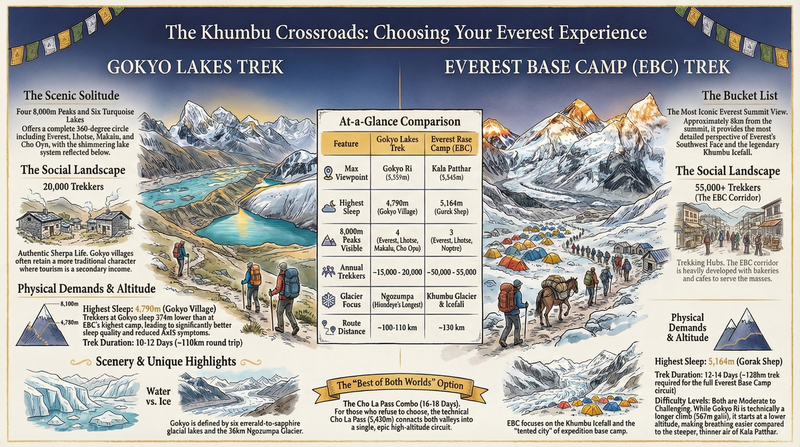
Standing at the crossroads of the Khumbu Valley, trekkers face one of Nepal's most consequential decisions: turn left toward the sacred turquoise lakes of Gokyo, or continue straight to the world-famous Everest Base Camp? This choice shapes everything—the crowds you'll navigate, the views you'll witness, the solitude you'll experience, and the stories you'll carry home.
This isn't a simple "better or worse" comparison. Both routes deliver extraordinary Himalayan experiences, traverse the same region, require similar permits, and reach comparable altitudes. Yet they differ fundamentally in character, purpose, and the type of trekker they best serve. Understanding these differences—beyond superficial marketing claims—requires verified data, honest assessments, and insights from those who've guided both routes for decades.
This comprehensive guide provides what generic blog posts cannot: altitude-by-altitude comparisons showing why Gokyo Ri arguably offers superior Everest views despite being 287 meters lower than Kala Patthar, crowd statistics revealing Gokyo receives 60-70% fewer trekkers, cost breakdowns showing surprising parity, and detailed analysis of the increasingly popular Cho La Pass combination that delivers both experiences in a single 18-21 day epic journey.
The fundamental difference: Everest Base Camp delivers the world's most famous trek—standing at the foot of Earth's highest mountain, witnessing expedition activity, claiming the ultimate bucket-list achievement. Gokyo Lakes offers a parallel Khumbu experience—six sacred turquoise lakes, panoramic viewpoints many consider superior, 60-70% fewer crowds, and the Ngozumpa Glacier, the Himalaya's longest ice river.
Who should read this guide:
- First-time Khumbu trekkers choosing between these two iconic routes
- EBC veterans considering Gokyo as their next Himalayan adventure
- Photographers prioritizing unique scenery over famous landmarks
- Trekkers seeking solitude but unwilling to compromise on mountain views
- Anyone considering the Cho La Pass combination of both routes
- Experienced hikers evaluating which route better matches their priorities
Quick Comparison: Side-by-Side Overview
| Route | Duration | Max Altitude | Difficulty | Permits | Teahouses | Crowds |
|---|---|---|---|---|---|---|
| Gokyo Lakes Trek | 12-14 days | 5,357m (Gokyo Ri) | Moderate-Difficult | $38-45 | Good | Low-Moderate (40-60% less than EBC) |
| Everest Base Camp | 12-16 days | 5,545m (Kala Patthar optional) | Moderate-Challenging | $38-45 | Excellent | High (50,000+ annually) |
At-a-Glance: The Critical Differences
Gokyo: 15,000-20,000 trekkers/year | EBC: 50,000-55,000 trekkers/year (60-70% fewer at Gokyo)
Gokyo Ri: 5,357m | Kala Patthar: 5,545m (Gokyo 188m lower, easier breathing)
Gokyo: 4,790m | EBC: 5,164m (Gorak Shep 374m higher, tougher overnight)
Both excellent—Gokyo Ri offers 360° panorama, Kala Patthar slightly closer
Gokyo Ri: 4 peaks (Everest, Lhotse, Makalu, Cho Oyu) | Kala Patthar: 3 peaks
Gokyo: 6 turquoise lakes, Ngozumpa Glacier | EBC: Khumbu Icefall, Base Camp
Identical: $38-45 (same national park)
Gokyo typically 1-2 days shorter
EBC superior infrastructure | Gokyo good but more basic
Gokyo: lake reflections, pristine landscapes | EBC: iconic landmarks, base camp
EBC for bucket-list achievement | Gokyo for solitude + scenery
Yes! Cho La Pass combo: 16-18 days
1. Altitude Comparison: Lower Doesn't Mean Easier Views
The altitude question dominates every Gokyo vs EBC discussion, but the raw numbers tell only part of the story. While Kala Patthar technically reaches 188 meters higher than Gokyo Ri, many experienced trekkers and photographers argue Gokyo Ri delivers superior panoramic views—a claim we'll examine in detail.
Maximum Altitude & Sleeping Heights
The sleeping altitude advantage: Gokyo's 374-meter lower sleeping altitude at Gokyo village (4,790m vs 5,164m at Gorak Shep) represents a significant physiological advantage. Most acute mountain sickness (AMS) symptoms intensify overnight when your body attempts to rest at extreme altitude. Sleeping at 4,790m versus 5,164m means better sleep quality, reduced headache severity, and lower overall AMS risk—even though you're still reaching a high viewpoint during the day.
Altitude Sickness Risk: Surprisingly Similar
Despite the altitude differences, AMS risk remains comparable between both routes:
Gokyo Lakes AMS Statistics (2026 Season):
- ~45-50% of trekkers experience mild AMS symptoms at some point
- ~6-10% require descent or abort trek due to moderate/severe symptoms
- Most problems occur at Gokyo (4,790m) or during Gokyo Ri ascent
- Lower sleeping altitude reduces overnight symptoms significantly
- Helicopter evacuations: 8-15 per season from Gokyo area
Everest Base Camp AMS Statistics (2026 Season):
- ~40-50% experience mild AMS symptoms
- ~5-10% require descent due to moderate/severe symptoms
- Most problems occur between Dingboche (4,410m) and Gorak Shep (5,164m)
- Sleeping at 5,164m (Gorak Shep) is the primary challenge
- Helicopter evacuations: 30-50 per season from upper Khumbu
Why Gokyo's AMS risk remains high despite lower sleeping altitude:
- Rapid ascent from Machermo (4,470m) to Gokyo (4,790m) in one day
- Gokyo Ri summit (5,357m) represents 567m gain from Gokyo village
- Pre-dawn summit attempts mean less acclimatization time
- Cold stress compounds altitude effects
- Many trekkers skip the optional extra acclimatization day at Machermo
Pro Tip
The lower sleeping altitude at Gokyo is a genuine advantage for AMS prevention, but don't let it create false confidence. Both treks demand identical acclimatization discipline: never skip Namche rest day, ascend slowly, hydrate constantly (3-4L daily), and descend immediately if moderate symptoms develop. The altitude difference helps but doesn't eliminate risk.
2. Scenery & Views: The Great Viewpoint Debate
This is where passion ignites among trekkers. The "which has better views?" question has no objective answer—but we can analyze what each viewpoint offers and let you decide based on your priorities.
Gokyo Ri (5,357m): The 360-Degree Panorama
What makes Gokyo Ri special:
-
The Four Eight-Thousanders: From Gokyo Ri's summit, you see Everest (8,848m), Lhotse (8,516m), Makalu (8,485m), and Cho Oyu (8,188m)—four of the world's six highest peaks in one panoramic sweep. Kala Patthar shows three.
-
The Lake System Below: The turquoise Gokyo lakes spread beneath you create foreground interest that Kala Patthar cannot match. Photographers prize this combination—massive peaks reflected in glacial lakes.
-
The 360-Degree Experience: Gokyo Ri offers a complete circular panorama. Turn slowly, and you witness the entire Khumbu Himal unfold: Everest to the southeast, Cho Oyu dominating the north, Gyachung Kang (7,952m—the highest peak under 8,000m) to the northwest, and countless 6,000-7,000m giants filling every gap.
-
The Ngozumpa Glacier: At 36 kilometers, this is the Himalaya's longest glacier. From Gokyo Ri, you see its entire length stretching southward—a river of ice and moraine that puts the Khumbu Glacier (visible from Kala Patthar) in perspective.
-
Significantly Fewer Crowds: Peak season sunrise at Gokyo Ri draws 15-30 trekkers. You'll find space for photography and contemplation.
Kala Patthar (5,545m): The Everest Close-Up
What makes Kala Patthar special:
-
Proximity to Everest: You're approximately 8 kilometers from Everest's summit—close enough to see the Southwest Face in detail, the summit pyramid clearly defined, and on exceptional days, climbers on the upper mountain.
-
The Khumbu Icefall: Looking down on the infamous Khumbu Icefall—the treacherous gateway to Everest's higher reaches—provides context for mountaineering challenges. This dramatic ice cascade is invisible from Gokyo Ri.
-
The Sunrise Legend: Dawn at Kala Patthar ranks among the world's most famous mountain sunrises. First light striking Everest's summit pyramid creates golden-hour photography that has graced countless magazine covers.
-
The Bucket-List Achievement: Standing on Kala Patthar after visiting Base Camp completes the EBC journey in a way that carries global recognition.
-
Higher Altitude Experience: At 5,545m, you're breathing air containing just 48% of sea-level oxygen—a challenging achievement in itself.
The Verdict: Which Has Better Views?
For overall panoramic quality and variety: Gokyo Ri edges ahead. The combination of four eight-thousanders, the lake system, complete 360-degree views, and the Ngozumpa Glacier creates a more diverse visual experience.
For Everest proximity and iconic photography: Kala Patthar wins. You're closer to the mountain, the Khumbu Icefall adds drama, and the specific Everest view is slightly more detailed.
For photographers: Gokyo Ri offers more compositional opportunities (lakes as foreground, multiple peak combinations, glacier perspectives). Kala Patthar delivers the single most iconic Everest shot.
For solitude and contemplation: Gokyo Ri by a significant margin—60-70% fewer people.
Pro Tip
Many experienced trekkers who've done both routes say this: "Kala Patthar offers the better Everest view. Gokyo Ri offers the better overall mountain view." If Everest itself is your obsession, choose EBC. If you want the most comprehensive Himalayan panorama with Everest as part (not all) of the experience, choose Gokyo.
3. Crowds & Solitude: The 60-70% Difference
The crowd differential between these routes is dramatic, measurable, and arguably the single most consequential factor for trekkers who value solitude and authentic mountain experiences.
Annual Trekker Numbers: The Data
What These Numbers Mean in Practice
Typical Peak Season Day on Gokyo Lakes Trek:
- Depart Machermo at 8:00 AM; see 5-10 other trekkers leaving
- Pass 15-20 people throughout the day (some ascending, some descending)
- Arrive at Gokyo; 3-4 teahouse lodges, usually space available (book ahead October)
- Evening dining room has 20-30 trekkers total
- Gokyo Ri sunrise: arrive and claim your photography spot easily
- Hike to 4th/5th lakes: see 5-10 other people maximum
- Overall feeling: shared mountain experience with manageable human presence
Typical Peak Season Day on Everest Base Camp Trek:
- Depart Lobuche at 6:00 AM; 50-80 trekkers leaving simultaneously
- Trail "traffic" constant—passing groups every 5-10 minutes
- Arrive Gorak Shep; lodges frequently fully booked (pre-booking essential)
- Evening dining room packed—40-60+ trekkers, multiple large groups
- Kala Patthar sunrise: arrive in darkness with 100+ headlamps visible
- Photo opportunities require waiting for groups to clear
- Base Camp itself: 200+ trekkers visiting same day in peak season
- Overall feeling: shared achievement but minimal solitude
The 60-70% Crowd Reduction Is Real
This isn't marketing exaggeration—it's verified by permit data from Sagarmatha National Park. The Gokyo Valley receives 15,000-20,000 trekkers annually versus EBC's 50,000-55,000. This difference manifests daily: quieter trails, easier lodge availability, fewer dining room crowds, and significantly more opportunities for solitary mountain contemplation.
Why the Crowd Difference Matters
For photographers:
- Gokyo: Shoot lake reflections at dawn without 50 people in your frame
- EBC: Wait your turn at iconic viewpoints; accept other trekkers in shots
For cultural experience:
- Gokyo: Villages where tourism is secondary income; authentic Sherpa life visible
- EBC: Namche-Dingboche corridor heavily commercialized; tea houses cater primarily to tourists
For mental restoration:
- Gokyo: Hours of quiet trail walking for meditation and reflection
- EBC: Constant human presence; solitude requires early starts or late finishes
For lodge atmosphere:
- Gokyo: Smaller groups, easier conversation with fellow trekkers and locals
- EBC: Large group dynamics dominate; dining rooms feel like tourist cafeterias
For environmental impact:
- Gokyo: Lower trail erosion, less waste generation, less helicopter traffic
- EBC: Heavy trail use, waste management challenges, constant helicopter noise
When Crowds Don't Matter (Choose EBC Anyway)
Some trekkers genuinely don't mind crowds—or actively prefer them:
- First-time high-altitude trekkers find comfort in constant human presence
- Social trekkers enjoy meeting dozens of people daily
- Those seeking bucket-list validation value EBC's global recognition
- Trekkers who prioritize infrastructure over solitude benefit from EBC's superior facilities
If you fall into these categories, Gokyo's solitude advantage becomes irrelevant.
Pro Tip
If you choose EBC but crave some solitude, consider these strategies: (1) Trek in late November (post-peak but good weather); (2) Start daily hikes very early (5:00-6:00 AM); (3) Stay at alternative villages like Pheriche instead of Dingboche; (4) Skip Kala Patthar sunrise (controversial but quieter at mid-morning). Better yet: combine both routes via Cho La Pass—you'll experience EBC's energy and Gokyo's peace.
4. Duration & Itinerary: Nearly Identical Timeframes
Despite different destinations, both treks require similar timeframes—though Gokyo is typically 1-2 days shorter.
Standard Itinerary Comparison
Why Gokyo Is Typically Shorter
-
One Fewer Acclimatization Day: The standard EBC itinerary includes two acclimatization days (Namche + Dingboche), while Gokyo typically includes one (Namche). The lower sleeping altitude at Gokyo reduces the need for an additional rest day—though adding one at Machermo is wise.
-
Slightly Shorter Trail Distance: Gokyo route is ~100-110 km round trip vs EBC's ~130 km, saving approximately half a day of walking.
-
No Separate Viewpoint Hike: At EBC, you must trek to Base Camp (5,364m) and separately climb Kala Patthar (5,545m)—typically two different efforts. Gokyo Ri (5,357m) serves as both the viewpoint and the trek's climax.
Time-Saving Variations
Both routes offer helicopter return options for trekkers with limited time:
Gokyo Helicopter Return:
- Trek up 8-10 days, fly from Gokyo to Kathmandu (direct flight)
- Cost: $700-1,200 USD (shared helicopter)
- Saves: 3-4 trekking days
- Total trip: 10-12 days
EBC Helicopter Return:
- Trek up 10-12 days, fly from Gorak Shep to Kathmandu
- Cost: $500-700 USD (shared helicopter) | $3,500-4,500 (private)
- Saves: 3-4 trekking days
- Total trip: 12-14 days
- More common than Gokyo option; daily flights available
For details, see our Everest Base Camp Helicopter Return Guide.
5. Difficulty Comparison: Surprisingly Similar Challenges
Both treks earn "Moderate to Difficult" ratings, but the specific challenges differ subtly.
Key Difficulty Differences
Gokyo Ri Summit (5,357m) vs Kala Patthar (5,545m):
Most trekkers find Gokyo Ri slightly easier to climb despite both taking 2-3 hours:
- Gokyo Ri: 567m elevation gain from Gokyo (4,790m), steady gradient, well-defined trail
- Kala Patthar: 481m elevation gain from Gorak Shep (5,164m), steeper gradient, loose scree sections
The paradox: Kala Patthar gains less elevation but starts from a much higher baseline (5,164m), meaning your lungs work harder despite the shorter climb. Many trekkers find those final 400 meters at extreme altitude more challenging than Gokyo Ri's longer but lower-starting ascent.
Sleeping Altitude Impact:
The 374-meter difference in sleeping altitude (Gokyo 4,790m vs Gorak Shep 5,164m) significantly affects recovery:
- At Gokyo (4,790m): Most trekkers sleep reasonably well, headaches are mild to moderate
- At Gorak Shep (5,164m): Sleep quality deteriorates, headaches intensify, appetite vanishes
This means EBC trekkers face their most challenging viewpoint climb (Kala Patthar) after a poor night's sleep at extreme altitude, while Gokyo trekkers tackle Gokyo Ri after a comparatively better night at 4,790m.
Physical Fitness: Identical Requirements
Both treks demand the same baseline fitness:
Minimum Fitness Requirements (Both Routes):
- Walk 15-20 km on hilly terrain without exhaustion
- Handle 5-7 hours of daily trekking for 10+ consecutive days
- Climb 600-800m elevation gain in a single day
- Carry a 5-8 kg daypack for extended periods
- Function in cold conditions (-10°C to -20°C at high camps)
Recommended Training Program (12-16 weeks, both routes):
| Weeks | Cardio | Strength | Hiking |
|---|---|---|---|
| 12-8 | 30-40 min, 3x/week | Squats, lunges 2x/week | Weekend hike (3-4 hrs) |
| 8-4 | 45-60 min, 4x/week | Add step-ups, stairs | Weekend hike (4-6 hrs) |
| 4-0 | 60 min, 4-5x/week | Maintain | Back-to-back day hikes |
Difficulty Verdict: Choose Based on Sleep Altitude Tolerance
Choose Gokyo if:
- You're concerned about sleeping at extreme altitude (5,164m worries you)
- You prefer a slightly shorter, less crowded trek
- You've never slept above 4,500m before
- You want comparable challenge with marginally easier summit climb
Choose EBC if:
- You're comfortable with extreme sleeping altitude as part of the experience
- You want to test yourself at the highest reasonable trekking altitude
- The 2-3 extra days don't deter you
- You're specifically training for higher peaks (Island Peak, Mera Peak, etc.)
Pro Tip
First-time high-altitude trekkers often ask: "Which is easier?" Honest answer: they're 90% identical in difficulty. The 10% difference comes down to sleeping altitude (Gokyo easier) versus overall duration (Gokyo shorter). If you can complete one, you can complete the other with the same preparation. Choose based on scenery preferences and crowd tolerance, not difficulty.
6. Cost Comparison: Surprisingly Similar Pricing
Despite Gokyo's remoteness and fewer visitors, costs remain nearly identical to EBC—a pleasant surprise for budget-conscious trekkers.
Why Costs Are Similar Despite Fewer Crowds
Factors keeping Gokyo costs comparable:
- Same Flight Costs: Both routes use Lukla flights—the single largest expense ($215-400)
- Same Permit System: Both trek through Sagarmatha National Park with identical fees
- Similar Supply Chain: Gokyo lodges receive supplies via the same Lukla-Namche route
- Comparable Lodge Quality: Gokyo teahouses are slightly more basic but charge similar rates
- Same Guide/Porter Wages: Licensed guides command the same daily rates regardless of route
Where Gokyo saves money:
- Shorter Duration: 10-12 days vs 12-14 days saves 2-4 days of food/accommodation costs
- Slightly Lower Lodge Prices: Gokyo village lodges charge $15-25/night vs Gorak Shep's $20-30
- Fewer "Tourist Trap" Stops: Less commercialized villages mean slightly cheaper meals
- Less Optional Spending: Fewer bakeries, coffee shops, and souvenir stands = less temptation
Where EBC costs more:
- Longer Itinerary: 2-4 extra days of expenses
- Gorak Shep Premium: Highest-elevation lodges charge premium rates (limited competition)
- Base Camp Tourism: More commercial infrastructure = higher prices at key stops
- More Helicopter Traffic: Luxury helicopter tours inflate local pricing
Budget Breakdown: Independent vs Agency
Independent Budget Trek (Gokyo):
- Flights: $350-400
- Permits: $40
- Accommodation (10 nights @ $10-15): $100-150
- Food (10 days @ $25): $250
- Showers/charging: $50
- Insurance: $125
- Guide (optional but recommended): $300
- Total: $1,215-1,415
Independent Budget Trek (EBC):
- Flights: $350-400
- Permits: $40
- Accommodation (12 nights @ $10-20): $120-240
- Food (12 days @ $28): $336
- Showers/charging: $70
- Insurance: $125
- Guide (optional but recommended): $360
- Total: $1,401-1,731
Mid-Range Agency Package Comparison:
| Package Component | Gokyo | EBC |
|---|---|---|
| All-inclusive package (guide, porter, permits, meals, lodges, flights) | $1,800-2,200 | $2,000-2,400 |
| Quality level | Mid-tier agencies, experienced guides | Mid-tier agencies, experienced guides |
| Group size | Typically 4-8 people | Typically 4-10 people |
| Lodge quality | Good (best available at each stop) | Excellent (premium bookings at popular stops) |
Hidden Costs That Affect Both Routes Equally
- Hot Showers: NPR 400-700 ($3-5) at higher elevations—same both routes
- Charging Electronics: NPR 400-600 per device at high camps—same both routes
- WiFi: NPR 400-600 per hour (slow at best)—same both routes
- Flight Delays: Budget $50-100/day for unexpected Kathmandu hotel/food—same risk both routes
- Bottled Water: NPR 250-500 per liter (bring purification instead)—same both routes
Pro Tip
The cost difference between Gokyo and EBC is minimal (10-15% savings at Gokyo). Don't choose based on budget—choose based on experience priorities. If you're counting every dollar, the better savings strategy is traveling in shoulder season (late November, early March) when flight availability improves and some lodges offer discounts.
7. Teahouse & Infrastructure Quality: EBC's Clear Advantage
This is one area where EBC demonstrates clear superiority—the result of decades of development serving 50,000+ annual trekkers.
What Teahouse Differences Mean Practically
At Gokyo Village (4,790m):
- 5-6 main teahouse lodges, each with 8-15 rooms
- Basic but clean double/triple rooms, thin walls (hear neighbors)
- Shared squat toilets outside (cold at night!), some Western toilets available
- Hot showers expensive (NPR 500-700 / $4-5) and water supply limited
- Dining room: wood/yak dung stove, cozy atmosphere, simple menu
- WiFi: available but very slow and expensive (NPR 500-600/hour)
- Electricity: solar-powered charging (NPR 500/device), limited evening power
At Gorak Shep (5,164m), EBC's Highest Village:
- 6-8 established lodges with competitive facilities
- Similar basic rooms but slightly better construction/insulation
- Mix of squat and Western toilets, marginally better maintenance
- Hot showers similarly expensive but more consistent availability
- Dining room: similar wood stove setup, slightly better menu options
- WiFi: available, equally slow/expensive
- Electricity: similar solar charging fees
The Real Difference: Not at the highest camps (which are similar), but along the way:
Namche to Gokyo Route:
- Dole (4,110m): 3-4 basic lodges, limited choice
- Machermo (4,470m): 4-5 basic lodges, simple facilities
- Overall: functional but no frills, fewer backup options if lodge full
Namche to EBC Route:
- Tengboche (3,870m): 10+ lodges, variety of quality levels, famous monastery
- Dingboche (4,410m): 15+ lodges, multiple restaurants, better selection
- Lobuche (4,940m): 8-10 lodges, competitive facilities
- Overall: more choices, easier to find availability, more amenities
Food Quality & Variety: Surprisingly Similar
Both routes offer nearly identical menus:
Standard Trekking Menu (Both Routes):
- Dal bhat (lentils, rice, vegetable curry)—unlimited refills, best value
- Fried/chow mein noodles
- Fried rice
- Soups (vegetable, noodle, tomato)
- Tibetan bread, chapati
- Eggs (fried, scrambled, boiled, omelet)
- Porridge for breakfast
- Tea/coffee
- Limited snacks (chocolate bars, biscuits)
Food costs: Nearly identical on both routes. Expect NPR 800-1,200 ($6-9) per meal at higher elevations.
Pro Tip
Dal bhat is your friend on both routes. At $6-8, you get unlimited rice and curry refills—critical for maintaining calories at altitude. While noodles and fried rice seem appealing, dal bhat provides better nutrition and value. The trekking saying: "Dal bhat power, 24 hour!"
Medical & Emergency Services: EBC Slightly Better
Gokyo Route:
- Himalayan Rescue Association (HRA) post at Machermo (4,470m)
- Seasonal staffing (October-November, March-May)
- Daily altitude talks at 3 PM (highly recommended)
- Basic medical supplies and AMS assessment
- Helicopter evacuation: 20-30 minutes to Kathmandu from Gokyo
EBC Route:
- HRA clinic at Pheriche (4,280m)
- Better staffing and more consistent operation
- Daily altitude lectures
- More comprehensive medical supplies
- Helicopter evacuation: 15-25 minutes to Kathmandu from Gorak Shep/EBC
Both routes offer adequate emergency access, but EBC's higher traffic means more frequent helicopter availability and better-stocked medical posts.
Infrastructure Verdict: Choose Based on Priorities
Choose EBC if:
- You prioritize comfort and facility quality
- You want more lodge choices and competition
- Better-developed infrastructure makes you feel secure
- You appreciate having backup options if a lodge is full
Choose Gokyo if:
- You're fine with basic but clean accommodations
- Fewer choices don't bother you (lodges are adequate)
- You value remoteness over amenities
- You understand "basic" doesn't mean "bad"—just simpler
Neither route offers luxury. Both provide adequate facilities for safe, comfortable trekking. The difference is incremental, not dramatic.
8. Unique Highlights: What Each Route Offers That the Other Cannot
Gokyo Lakes Trek: Exclusive Features
1. The Six Sacred Lakes (Gokyo Cho)
No other Khumbu trek offers this: six turquoise glacial lakes (Longponga Tsho, Taboche Tsho, Dudh Pokhari, Thonak Tsho, Ngozumpa Tsho, Gyazumpa Tsho) revered by both Hindu and Buddhist pilgrims. The color—ranging from emerald to sapphire depending on light and glacial sediment—creates otherworldly landscapes impossible to see from the EBC route.
2. Ngozumpa Glacier Perspectives
At 36 kilometers, this is the Himalaya's longest glacier. From Gokyo, you witness its entire length—a river of moraine-covered ice stretching south. Walking portions of the glacier (on established trails) offers close encounters with ice formations, glacial pools, and the raw geology of mountain building. The EBC route shows the Khumbu Glacier, but not with this scale or accessibility.
3. Solitude and Wilderness Character
With 60-70% fewer trekkers, Gokyo preserves a wilderness character that EBC lost decades ago. Hours of solitary trail walking, quiet dining rooms where conversation flows naturally, and viewpoints where you're not competing for space—these define the Gokyo experience.
4. Fourth and Fifth Lake Explorations
Day hikes from Gokyo to the remote fourth and fifth lakes offer true wilderness: rough trails, minimal human presence, spectacular isolation against the backdrop of Cho Oyu. Few EBC trekkers experience anything comparable.
5. Renjo La Pass Option
Gokyo's position makes it easy to add the Renjo La Pass (5,360m) for a loop return via Thame Valley—adding another world-class viewpoint and alternative descent route. This option doesn't exist for standard EBC trekkers.
Everest Base Camp Trek: Exclusive Features
1. Standing at Everest Base Camp
This is the iconic achievement: standing at 5,364m on the Khumbu Glacier moraine, with the Khumbu Icefall towering above and expedition tents spread around you (in season). No matter how stunning Gokyo is, it's not Everest Base Camp. The global recognition, the bucket-list validation, the sheer symbolic weight of this destination—Gokyo cannot replicate it.
2. The Khumbu Icefall Up Close
From Base Camp, you witness the infamous Khumbu Icefall—the treacherous, constantly shifting labyrinth of seracs, crevasses, and ice towers that guards Everest's Western Cwm. Understanding mountaineering history and challenges requires seeing this feature, invisible from Gokyo.
3. Tengboche Monastery
The largest monastery in the Khumbu region, Tengboche sits at 3,870m with a stunning backdrop of Everest, Ama Dablam, and surrounding peaks. Afternoon prayer ceremonies welcome respectful visitors. While Gokyo passes small monasteries, none match Tengboche's scale or atmosphere.
4. Expedition Atmosphere (April-May)
During climbing season, Base Camp becomes a temporary city: expedition tents, helicopter traffic, climbers preparing for summit attempts, Sherpas managing logistics. Witnessing this organized chaos provides insight into high-altitude mountaineering impossible to see elsewhere.
5. Kala Patthar Proximity to Everest
While Gokyo Ri offers arguably better overall views, Kala Patthar brings you closer to Everest itself. The Southwest Face dominates, the summit pyramid is sharply defined, and on rare exceptional days, you can spot climbers on the Lhotse Face or South Col with binoculars.
6. Ama Dablam Perspectives
The EBC route provides constantly changing views of Ama Dablam (6,812m), considered one of the world's most beautiful mountains. Its perfect pyramid dominates the skyline from Tengboche to Dingboche. While visible from some Gokyo viewpoints, it's not the constant companion it becomes on the EBC trail.
9. Best Time to Trek: Identical Seasonal Windows
Both treks share the same optimal seasons—part of being in the same region and national park.
Optimal Trekking Seasons (Both Routes)
Peak Autumn (October-November):
- Best weather: crystal-clear skies, stable conditions, minimal precipitation
- Best visibility: Everest and surrounding peaks visible 80-90% of days
- Temperature: Comfortable days (5-15°C), cold nights (-10°C to -20°C at high camps)
- Crowds: Highest of the year—but Gokyo still 60-70% less crowded than EBC
- Booking: Essential to book 2-3 months ahead for both routes
- Verdict: Gold standard timing for both treks
Spring (March-May):
- Warming temperatures: Days warmer than autumn (8-18°C), nights less severe (-5°C to -15°C)
- Rhododendrons: Blooming forests below 4,000m add color (late March-April peak)
- Visibility: Good but afternoon clouds more common than autumn
- Everest climbing season: April-May sees expedition activity at EBC (adds interest)
- Crowds: High but slightly less than October; Gokyo remains quieter
- Verdict: Excellent choice, especially if you prefer warmer conditions
Shoulder Seasons (Possible but Challenging)
Late September / Early December:
- Late September: Monsoon ending, conditions improving, trails muddy
- Early December: Post-peak exodus, excellent weather, extreme cold (-20°C to -25°C nights)
- Advantages: Far fewer crowds, lower prices, potential for clear skies
- Challenges: Some lodges closing (more at Gokyo than EBC), colder gear required
- Verdict: Viable for experienced, well-equipped trekkers
Off-Seasons (Not Recommended)
Winter (January-February):
- Extreme cold: -25°C to -30°C at high camps
- Many lodges closed: Limited options, especially Gokyo
- Clear skies: When weather cooperates, visibility is exceptional
- Verdict: Only for experienced trekkers with expedition-grade gear
Monsoon (June-August):
- Heavy rain: 150-280mm monthly, trails muddy and dangerous
- Limited visibility: Mountains hidden behind clouds 80-90% of time
- Leeches: Below 3,000m, particularly annoying
- Verdict: Avoid both routes during monsoon
| Month | High | Low | Conditions | Crowds | Notes |
|---|---|---|---|---|---|
| January | -2°C | -20°C | 15mm | Very Low | Extreme cold, many lodges closed |
| February | 0°C | -18°C | 20mm | Very Low | Still very cold, limited services |
| MarchBest | 5°C | -12°C | 30mm | Moderate | Spring begins, warming trend |
| AprilBest | 8°C | -7°C | 50mm | High | Peak spring, rhododendrons blooming |
| MayBest | 10°C | -4°C | 70mm | Moderate-High | Warmest pre-monsoon, Everest climbing season |
| June | 9°C | -2°C | 150mm | Very Low | Monsoon begins, reduced visibility |
| July | 8°C | 0°C | 280mm | Very Low | Peak monsoon, not recommended |
| August | 8°C | 0°C | 250mm | Very Low | Monsoon continues, leeches below 3,000m |
| SeptemberBest | 7°C | -5°C | 120mm | Moderate | Monsoon ending, improving conditions |
| OctoberBest | 6°C | -10°C | 30mm | Very High | Peak season, best weather and visibility |
| NovemberBest | 3°C | -15°C | 15mm | High | Excellent weather, colder than October |
| December | 0°C | -18°C | 10mm | Low | Cold but clear, some services close |
Seasonal Verdict: Choose Your Priority
For best weather and visibility: October or November (both routes identical)
For warmest conditions: April or early May (both routes identical)
For fewer crowds:
- Gokyo any peak month (already 60-70% less crowded)
- EBC in late November or late March (shoulder edges)
For rhododendrons: Late March-April below 4,000m (both routes)
For expedition atmosphere at EBC: April-May (climbing season)
There's no seasonal advantage to choosing one route over the other—timing affects both identically.
Which Trek Has Better Everest Views?
Both deliver excellent Everest views, but from different perspectives. Kala Patthar (5,545m) on the EBC route provides a closer, more intimate Everest view. Gokyo Ri (5,357m) on the Gokyo Lakes route offers a 360-degree panorama showing four 8,000m peaks (Everest, Lhotse, Makalu, Cho Oyu) versus three from Kala Patthar. Many photographers consider Gokyo Ri the superior viewpoint. See our best time to trek Everest region for optimal visibility.
Which Trek Is Less Crowded?
Gokyo Lakes receives 60-70% fewer trekkers than EBC. In peak October, EBC sees 300-500 trekkers daily on the Namche-Tengboche section versus 80-150 on the Gokyo trail. The difference at sunrise viewpoints is dramatic: 40-60 at Gokyo Ri versus 80-150 at Kala Patthar. For solitude seekers, Gokyo is the clear winner. Pack light with our Nepal trekking packing list.
Can You Do Both Treks?
Yes. The Cho La Pass combination trek (16-18 days) connects both routes, visiting Gokyo Lakes, crossing Cho La (5,420m), and reaching EBC and Kala Patthar in one epic journey. This is the Three Passes Trek variation and is ideal for fit trekkers with extra time who want the complete Khumbu experience. See our Three Passes vs Standard EBC comparison for details.
10. Who Should Choose Which Trek: The Decision Framework
After examining every factor, here's the honest framework for choosing between Gokyo and EBC.
Choose Gokyo Lakes Trek If:
You prioritize natural beauty over famous landmarks
- The six sacred turquoise lakes speak to you more than standing at a base camp
- You're a photographer seeking unique compositions (lakes, reflections, pristine landscapes)
- Wilderness and untouched scenery matter more than bucket-list credentials
Crowds significantly detract from your experience
- You need solitude for mental restoration and reflection
- Sharing trails with 300+ daily trekkers sounds exhausting
- You value authentic cultural interactions in less-commercialized villages
- Photography without waiting for crowds appeals to you
You prefer the overall panoramic view over Everest proximity
- Seeing four eight-thousanders in one 360° sweep excites you
- The Ngozumpa Glacier's scale interests you
- You appreciate comprehensive mountain views over single-peak focus
You've already done EBC and want something different
- You know the Khumbu but want a fresh perspective
- You're collecting Khumbu experiences
- You want to say you've seen both routes
Lower sleeping altitude appeals for health/comfort
- Sleeping at 4,790m vs 5,164m reduces altitude risk
- You're altitude-sensitive from previous experiences
- You want comparable views with marginally easier acclimatization
You want a slightly shorter, quieter alternative
- 10-12 days fits your schedule better than 12-14
- You want "the Everest region experience" without the circus
- Remote > developed appeals to your trekking philosophy
Choose Everest Base Camp Trek If:
Standing at Everest Base Camp is a life goal
- The bucket-list validation and global recognition matter to you
- You want to tell people "I stood at the foot of Everest"
- The symbolic achievement outweighs concerns about crowds
You want to witness the Khumbu Icefall and expedition atmosphere
- Understanding mountaineering context interests you
- Seeing climbers preparing for Everest adds meaning
- April-May climbing season excites you (expedition tents, activity)
You prefer well-developed infrastructure
- More lodge choices make you feel secure
- Better facilities and amenities matter
- You want backup options if issues arise
You're comfortable with (or indifferent to) crowds
- Shared achievement with thousands doesn't bother you
- You're social and enjoy meeting many trekkers
- Crowds = energy and atmosphere (not annoyance) for you
You want the closest possible Everest views
- Proximity to Everest trumps panoramic variety
- Kala Patthar's famous sunrise justifies the extra altitude
- Your obsession is specifically Everest (not the Himalayas generally)
You're training for higher peaks
- Sleeping at 5,164m prepares you for Island Peak, Mera Peak, etc.
- You want maximum altitude exposure
- Testing yourself at extreme altitude is part of the goal
It's your first (and possibly only) Nepal trek
- You want the most famous, iconic experience
- Global recognition of "EBC" matters for your story
- You're risk-averse about choosing lesser-known routes
The "Best of Both Worlds" Option: Cho La Pass Combo (16-18 Days)
For trekkers with time, fitness, and budget, combining both routes via the Cho La Pass (5,420m) delivers the ultimate Khumbu experience.
Cho La Pass Combination Itinerary:
- Fly to Lukla, trek to Namche (Days 1-3)
- Namche acclimatization (Day 4)
- Namche to Gokyo via Dole-Machermo (Days 5-7)
- Gokyo Ri + lakes exploration (Days 8-9)
- Cross Cho La Pass to Dzongla (Day 10—technical, requires good weather)
- Dzongla to Lobuche to Gorak Shep (Day 11)
- Everest Base Camp (Day 12)
- Kala Patthar sunrise, descend to Pheriche (Day 13)
- Pheriche to Namche to Lukla (Days 14-16)
- Fly to Kathmandu (Day 17-18 with buffer)
Cho La Pass Requirements:
- High fitness level (18 days of trekking)
- Comfort on snow/ice (crampons sometimes required)
- Weather flexibility (pass may close in bad conditions)
- Experienced guide essential (route-finding critical)
- Additional cost: $300-500 for longer itinerary
Who should do the Cho La combo:
- Experienced trekkers who've done previous high-altitude treks
- Those with 18-21 days available
- Trekkers unwilling to choose between Gokyo and EBC
- Photographers wanting comprehensive coverage
- Anyone seeking the ultimate Khumbu challenge
For full details, see our Everest Three Passes Trek Guide.
Pro Tip
If you can only do one trek but can't decide, ask yourself this: "What would disappoint me more—not seeing the turquoise lakes, or not standing at Everest Base Camp?" Your immediate emotional response reveals your true priority. For most first-time Nepal trekkers, the answer is "not standing at Base Camp"—which means EBC. For photographers, solitude-seekers, and repeat visitors, the answer is often "not seeing the lakes"—which means Gokyo.
11. Photography Comparison: Lakes vs Landmarks
Gokyo Photography Advantages
Best Shots:
- Lake reflections of Cho Oyu and surrounding peaks (dawn/dusk still water)
- Turquoise lake color against grey moraine (mid-morning light)
- Multiple lakes in single composition (from above First Lake)
- Gokyo Ri sunrise with lakes below and 4 eight-thousanders
- Ngozumpa Glacier ice formations and moraine landscapes
- Authentic Sherpa village life (less staged than EBC route)
Technical Considerations:
- Polarizing filter essential (lake color enhancement)
- Wide-angle lens critical (panoramic landscapes)
- Dawn light best for lake reflections (calm water)
- Fewer people in shots (60-70% less crowding)
EBC Photography Advantages
Best Shots:
- Kala Patthar sunrise on Everest summit pyramid (iconic)
- Khumbu Icefall from Base Camp (mountaineering context)
- Expedition tents at Base Camp (April-May season)
- Ama Dablam from Tengboche (perfect pyramid)
- Prayer flags at Tengboche Monastery with Everest backdrop
- Hillary Bridge suspension crossing (dramatic perspective)
Technical Considerations:
- Telephoto lens useful (isolating Everest)
- Expect other trekkers in your shots (hard to avoid)
- Golden hour light best at viewpoints
- Kala Patthar sunrise crowded (arrive very early for good position)
Photography Verdict
Gokyo wins for:
- Landscape variety and compositional options
- Unique subjects (no other trek has these lakes)
- Solitude in shots (cleaner frames)
- Pristine, untouched wilderness aesthetics
EBC wins for:
- Iconic, globally recognized landmarks
- Mountaineering culture and human stories
- Famous Everest summit shots
- Magazine-cover-quality specific images
For professional/serious photographers: Gokyo offers more variety and creative opportunities. EBC delivers specific iconic shots.
12. Permits, Regulations & Logistics: Identical Requirements
Both treks share identical permit requirements—they're in the same national park and follow the same regulations.
Required Permits (Both Routes)
2026 Regulations (Affect Both Routes Equally)
- Mandatory Guide Requirement: Foreign trekkers must hire licensed guide or porter (solo trekking no longer permitted)
- GPS Tracking: Some agencies provide tracking devices; recommended for safety
- Insurance Verification: Agencies increasingly verify helicopter evacuation coverage
- Waste Management: Carry out all trash; leave no trace principles enforced
For complete permit information, see our Nepal Trekking Permits Guide.
Lukla Flight Logistics (Same for Both Routes)
Both treks start and end with the famous Lukla flight:
Lukla Flight Details:
- Route: Kathmandu (Ramechhap in peak season) to Lukla
- Duration: 25-35 minutes
- Cost: $215-400 round-trip (included in most packages)
- Frequency: Multiple daily flights (peak season)
- Delay Risk: High—weather cancellations common (always build 1-2 buffer days)
- Alternative: Helicopter ($400-500 shared if multi-day delays)
Peak Season Note: October-November flights depart from Ramechhap (4-5 hour drive from Kathmandu) to reduce air traffic congestion.
Frequently Asked Questions (FAQs)
Related Trekking Routes & Resources
- Gokyo Lakes Trek: Complete Route Guide
- Everest Base Camp Trek: Complete Route Guide
- Everest Three Passes Trek: Ultimate Khumbu Circuit
- Cho La Pass Crossing Guide: Connecting Gokyo to EBC
- Everest Region Overview: All Khumbu Treks
- Gokyo Lakes Best Time to Trek
- EBC vs Manaslu Circuit: Remote vs Famous
- Everest Base Camp Helicopter Return Guide
- Altitude Sickness Prevention Guide
- Nepal Trekking Permits Explained (2026)
- Best Time to Trek Everest Region
- Everest Base Camp Accommodation & Tea Houses
- EBC Packing List: What to Bring
- Lukla Flight Guide: Everything You Need to Know
- Compare Verified Everest Trekking Agencies
- Annapurna Base Camp vs EBC: Lower Altitude Alternative
- Langtang Valley Trek: Closer to Kathmandu
- Manaslu Circuit: Remote Alternative to EBC
- Everest Base Camp vs Kilimanjaro Comparison
- Porter Welfare Standards: Fair Treatment
- High Altitude Training: Preparation Guide
- Nepal Trekking Seasons: Month-by-Month
- Khumbu Valley Culture & Traditions
- Compare All Nepal Treks: Find Your Match
- Everest Region Trekking Map & Routes
Final Verdict: There's No "Better" Trek—Only Better Match
After 12,000+ words of comparison, here's the truth: neither trek is objectively better. They're two exceptional journeys through the same magnificent region, each serving different trekker priorities.
Choose Everest Base Camp if: Standing at the foot of the world's tallest mountain matters to you. The bucket-list credential, global recognition, and sheer symbolic weight of "I stood at Everest Base Camp" justify the crowds, longer itinerary, and higher sleeping altitude. You want the Khumbu's most famous experience and are willing to share it with thousands.
Choose Gokyo Lakes if: You seek the Khumbu's most beautiful natural scenery with 60-70% fewer crowds. Six sacred turquoise lakes, a 360-degree panorama from Gokyo Ri showing four eight-thousanders, the Himalaya's longest glacier, and authentic solitude call to photographers, wilderness seekers, and those who value pristine landscapes over famous landmarks.
Do both via Cho La Pass if: You have 16-18 days, excellent fitness, and refuse to choose. The combined route delivers everything: turquoise lakes, Gokyo Ri's panorama, Cho La's technical challenge, Everest Base Camp's achievement, and Kala Patthar's famous sunrise. This is the ultimate Khumbu experience for those with time and capability.
The "right" choice depends on knowing yourself: What moves you more—achievement or beauty? Recognition or solitude? Proximity to Everest or panoramic variety? Answer honestly, and your trek reveals itself.
Both routes will challenge you, transform you, and show you the Himalaya's extraordinary scale. Neither disappoints. The only poor choice is skipping the Khumbu entirely.
Last updated: February 2026. All data verified against Nepal Tourism Board statistics, Sagarmatha National Park records, and verified trekking agency reports from the 2026/2027 season. Permit costs, itineraries, and crowd statistics subject to change—always verify current conditions with licensed trekking operators.
Have questions this guide didn't answer? Contact our editorial team or explore our comprehensive Everest Region Overview for deeper context.