



The world's two most iconic high-altitude trekking adventures—Everest Base Camp in Nepal and Mount Kilimanjaro in Tanzania—represent bucket-list dreams for adventurers worldwide. But which one should you choose? Which is harder? Which offers better value? And can you do both?
This comprehensive 14,000+ word comparison guide provides data-driven analysis across every critical decision factor: altitude exposure, acclimatization profiles, physical difficulty, costs, success rates, scenery, cultural experiences, infrastructure, and timing. Unlike generic travel content, this guide synthesizes verified data from trekking agencies, climber statistics, medical research on altitude sickness, and first-hand accounts from thousands who've completed one or both journeys.
Whether you're a first-time high-altitude adventurer deciding between Africa and Asia, an experienced trekker evaluating technical differences, or a completist planning to do both, this resource helps you make an informed choice based on your fitness, budget, available time, and personal goals.
Quick Comparison: At-a-Glance
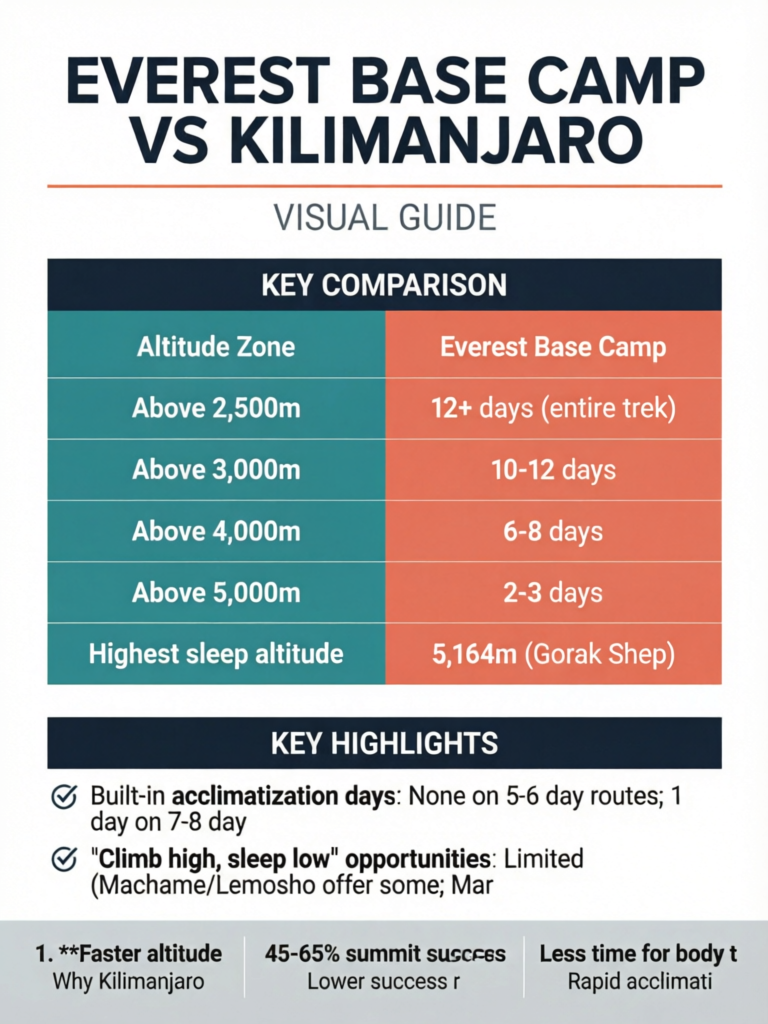
EBC vs Kilimanjaro: Essential Stats
| Feature | Ebc | Kilimanjaro | Winner |
|---|---|---|---|
| Maximum Altitude | 5,545m (Kala Patthar) | 5,895m (Uhuru Peak) | Kilimanjaro (+350m higher) |
| Base Camp/Trek Altitude | 5,364m (EBC itself) | 5,895m (summit is the goal) | Kilimanjaro (no base camp equivalent) |
| Days Above 4,000m | 6-8 days | 2-4 days (route dependent) | EBC (more altitude exposure) |
| Days Above 5,000m | 2-3 days | Summit day only (6-12 hours) | EBC (more time at extreme altitude) |
| Total Duration | 12-16 days | 6-9 days (5-day minimum, 8-9 recommended) | Kilimanjaro (shorter) |
| Success Rate | 90-95% | 45-65% (route dependent) | EBC (significantly higher) |
| Cost Range | $1,200-3,000 | $2,000-5,000+ | EBC (more affordable) |
| Accommodation | Tea houses (lodges) | Camping mandatory (except Marangu route huts) | EBC (more comfortable) |
| Difficulty Rating | Moderate-Challenging | Challenging-Very Challenging | EBC (generally easier) |
| Scenery Focus | Himalayan peaks, Sherpa villages, glaciers | 5 climate zones, African plains to arctic summit | Tie (different styles) |
Kilimanjaro is 350m higher at summit (5,895m vs 5,545m)
EBC spends 6-8 days above 4,000m vs Kili's 2-4 days
Kilimanjaro is harder: 45-65% success rate vs EBC's 90-95%
EBC is 30-60% cheaper ($1,200-3,000 vs $2,000-5,000+)
Kilimanjaro is shorter (6-9 days vs 12-16 days)
EBC superior gradual profile vs Kili's rushed ascent
EBC tea houses vs Kilimanjaro camping (except Marangu)
EBC: Sherpa villages throughout; Kili: minimal trail culture
EBC 90-95% vs Kilimanjaro 45-65% (route dependent)
Jan-Mar and Sept-Oct work for both destinations
The Verdict Up Front: Which Is Harder?
Kilimanjaro is objectively harder to summit than reaching Everest Base Camp, despite EBC spending more total days at high altitude. Here's why:
Why Kilimanjaro is harder:
- Faster altitude gain: Most routes ascend from 1,640m to 5,895m in 5-7 days—EBC takes 12-14 days to reach 5,364m
- Summit push brutality: The 1,200m climb from Barafu Camp (4,673m) to Uhuru Peak (5,895m) starts at midnight, takes 6-8 hours up in darkness, extreme cold (-20°C to -30°C), and involves steep scree slopes
- Lower success rates: 45-65% summit success (route dependent) vs EBC's 90-95%
- Rapid acclimatization demands: Less time for body to adapt, higher AMS risk
- Sleep deprivation: Summit night involves waking at 11 PM-midnight after minimal sleep
Why EBC is harder in some aspects:
- Longer duration: 12-16 days of consecutive trekking vs 6-9 days
- More days at extreme altitude: 2-3 days above 5,000m vs Kili's single summit day
- Cumulative fatigue: Two weeks of trekking wears on even fit adventurers
- Terrain variety: Rocky moraines, suspension bridges, steep ascents/descents daily
The consensus from those who've done both: Kilimanjaro's summit night is harder than anything on EBC, but EBC's overall trek is longer and more demanding from an endurance perspective. If you can only summit one, Kilimanjaro is the tougher achievement. If you want the more immersive trekking experience, EBC delivers.
Pro Tip
The most common trekker opinion: "Kilimanjaro is a harder mountain to climb, but Everest Base Camp is a harder trek to complete." The distinction matters—one is a summit push, the other is a journey through the Himalayas.
1. Altitude Comparison: The Critical Difference
Altitude is the single most important factor distinguishing these adventures. Both ventures into the "death zone" approaches (above 5,000m), but the profile of altitude exposure differs dramatically.
Maximum Altitude: Kilimanjaro Wins by 251 Meters
Mount Kilimanjaro - Uhuru Peak: 5,895m (19,341 ft)
- Africa's highest point
- Freestanding mountain (not part of a range)
- 350 meters higher than Kala Patthar
- Summit is the goal (not a base camp)
Everest Base Camp - Kala Patthar: 5,545m (18,192 ft)
- Highest viewpoint on the standard EBC trek
- Overlooks Everest Base Camp (5,364m) and the Khumbu Icefall
- Optional extension (most trekkers include it)
- Everest Base Camp itself sits at 5,364m—531m lower than Kilimanjaro summit
The headline altitude comparison: Kilimanjaro's Uhuru Peak is higher—5,895m vs 5,545m at Kala Patthar or 5,364m at Everest Base Camp proper. However, maximum altitude alone doesn't tell the difficulty story.
Time Spent at Altitude: EBC Dominates
Altitude sickness risk correlates not just with maximum height reached, but time spent at high altitude. This is where EBC and Kilimanjaro diverge dramatically.
Days Above Critical Thresholds:
| Altitude Zone | Everest Base Camp | Kilimanjaro (7-day Machame) |
|---|---|---|
| Above 2,500m | 12+ days (entire trek) | 6-7 days (entire climb) |
| Above 3,000m | 10-12 days | 5-6 days |
| Above 4,000m | 6-8 days | 2-4 days (route dependent) |
| Above 5,000m | 2-3 days | Summit day only (6-12 hours) |
| Highest sleep altitude | 5,164m (Gorak Shep) | 4,673m (Barafu Camp, pre-summit) |
The critical insight: EBC spends nearly a full week above 4,000m, allowing gradual acclimatization through the "climb high, sleep low" principle. Kilimanjaro spends only 2-4 days above 4,000m (route dependent), with most routes ascending too rapidly for optimal adaptation.
Acclimatization Profile: EBC Superior, Kilimanjaro Rushed
Everest Base Camp - Gradual Ascent Profile:
- Avg ascent rate: ~300-500m per day above 3,000m
- Built-in acclimatization days: 2 mandatory rest days (Namche 3,440m, Dingboche 4,410m)
- "Climb high, sleep low" days: Multiple (e.g., climb to 3,900m, sleep at 3,440m)
- Time to reach max altitude: 9-10 days from start
- Descent schedule: Gradual over 3-4 days
Kilimanjaro - Rapid Ascent Profile:
- Avg ascent rate: ~700-1,000m per day on shorter routes
- Built-in acclimatization days: None on 5-6 day routes; 1 day on 7-8 day routes
- "Climb high, sleep low" opportunities: Limited (Machame/Lemosho offer some; Marangu/Rongai minimal)
- Time to reach max altitude: 5-7 days from start (route dependent)
- Descent schedule: Rapid—summit to gate in 1-2 days
Acclimatization Schedule Comparison
| Feature | Ebc | Kilimanjaro | Winner |
|---|---|---|---|
| Ascent Rate (avg) | 300-500m/day above 3,000m | 700-1,000m/day (route dependent) | EBC (safer, gradual) |
| Mandatory Rest Days | 2 (Namche, Dingboche) | 0-1 (route dependent) | EBC (better acclimatization) |
| Time 3,000m to Summit | 8-9 days | 4-6 days | EBC (nearly double the adjustment time) |
| Highest Sleep Altitude | 5,164m (Gorak Shep) | 4,673m (Barafu Camp) | EBC (+491m higher sleep) |
| Acclimatization Philosophy | Gradual, methodical, conservative | Rapid ascent, summit push mentality | EBC (medically superior) |
Medical perspective: The Wilderness Medical Society recommends ascending no faster than 300-500m per day above 3,000m, with a rest day every 3-4 days. EBC's itinerary closely follows these guidelines. Most Kilimanjaro routes (except 8-9 day variants) violate these recommendations, which directly correlates to lower summit success rates.
Altitude Sickness Risk & Success Rates
Everest Base Camp:
- Overall success rate: 90-95% reach Base Camp
- AMS incidence: ~15-25% experience mild symptoms; <5% require descent
- HACE/HAPE incidence: <1% (rare with proper acclimatization)
- Primary risk factors: Rushing itinerary, ignoring symptoms, pre-existing conditions
Kilimanjaro:
- Overall success rate: 45-65% reach Uhuru Peak (route and duration dependent)
- AMS incidence: 50-75% experience symptoms; 20-30% require descent before summit
- HACE/HAPE incidence: 1-3% (higher than EBC due to rapid ascent)
- Primary risk factors: Short routes (5-6 days), inadequate acclimatization, summit push timing
Success Rates by Kilimanjaro Route (correlated with acclimatization time):
| Route | Duration | Success Rate | Acclimatization Quality |
|---|---|---|---|
| Northern Circuit | 8-9 days | 85-95% | Excellent (longest route, best profile) |
| Lemosho | 7-8 days | 85-90% | Excellent |
| Machame | 6-7 days | 75-85% (7-day), 60-70% (6-day) | Good (7-day), Marginal (6-day) |
| Rongai | 6-7 days | 70-85% (7-day), 60-70% (6-day) | Moderate |
| Marangu | 5-6 days | 50-65% | Poor (rapid ascent, no "climb high, sleep low") |
| Umbwe | 5-6 days | 40-50% | Very Poor (steepest, fastest route) |
The altitude verdict: Kilimanjaro is higher (5,895m vs 5,545m), but EBC's superior acclimatization profile results in dramatically higher success rates (90-95% vs 45-65%). If your goal is to successfully reach your destination, EBC's gradual approach is medically and statistically superior. Kilimanjaro's rapid ascent makes it significantly harder despite only 350m additional altitude.
Pro Tip
Want Kilimanjaro with EBC-level success rates? Choose the 8-9 day Lemosho or Northern Circuit routes. These longer itineraries provide gradual acclimatization similar to EBC, boosting summit success to 85-95%. Yes, they cost more and take longer—but you're dramatically more likely to summit.
2. Physical Difficulty: Summit Push vs Endurance Trek
Altitude aside, how do these adventures compare in raw physical difficulty?
Daily Trekking Hours
Everest Base Camp:
- Average trekking time: 5-7 hours per day
- Range: 3-8 hours depending on day
- Consecutive days: 10-12 days of trekking (with 2 rest days)
- Longest day: Lobuche to Gorak Shep to EBC (6-8 hours) or Kala Patthar sunrise + descent (7-8 hours)
- Terrain: Rocky trails, suspension bridges, gradual ascents/descents
- Pack weight: 5-8 kg (porters carry main luggage)
Kilimanjaro:
- Average trekking time: 4-8 hours per day
- Range: 3-14 hours (summit day 10-16 hours total)
- Consecutive days: 5-8 days depending on route
- Longest day: Summit day—Barafu (4,673m) to Uhuru (5,895m) to Mweka Camp (3,100m) = 1,222m up, 2,795m down in 10-16 hours
- Terrain: Forest, moorland, alpine desert, scree slopes (summit), steep descents
- Pack weight: Minimal (porters carry everything except daypack)
Daily Physical Demands
| Feature | Ebc | Kilimanjaro | Winner |
|---|---|---|---|
| Avg Trekking Hours/Day | 5-7 hours (consistent) | 4-8 hours (except summit day 10-16 hours) | EBC (more predictable) |
| Hardest Single Day | Kala Patthar sunrise (7-8 hours, 5,545m max) | Summit day (10-16 hours, 1,222m up, 2,795m down) | Kilimanjaro (significantly harder) |
| Cumulative Elevation Gain | ~4,500m total over 12-14 days | ~5,000m total over 6-8 days | Similar (Kili more compressed) |
| Cumulative Elevation Loss | ~4,500m total (gradual descent) | ~5,000m total (brutal post-summit descent) | EBC (more gradual) |
| Consecutive Days Trekking | 10-12 days | 5-8 days | Kilimanjaro (shorter) |
| Rest Days | 2 built-in acclimatization days | 0-1 (route dependent) | EBC (better recovery) |
| Sleep Quality | Moderate (tea house beds, altitude effects) | Poor (tents, summit night ~2-3 hours sleep) | EBC (better rest) |
The Kilimanjaro Summit Day: The Hardest Challenge
The single hardest day on either adventure is Kilimanjaro's summit push. Nothing on EBC compares to this:
Kilimanjaro Summit Day Timeline (Machame/Lemosho routes via Barafu):
- 11:00 PM-Midnight: Wake at Barafu Camp (4,673m) after 2-3 hours of restless sleep
- Midnight-1:00 AM: Begin ascent in darkness, -15°C to -25°C temperatures
- 1:00-6:00 AM: Zigzag up steep scree slopes, headlamp-lit, slow "pole pole" pace
- 6:00-7:00 AM: Reach Stella Point (5,756m)—many turn back here due to exhaustion/AMS
- 7:00-8:00 AM: Final 1-hour traverse to Uhuru Peak (5,895m)—sunrise over Africa
- 8:00-11:00 AM: Descend 1,222m back to Barafu Camp (3-4 hours down scree)
- 11:00 AM-12:00 PM: 30-minute rest, pack camp
- 12:00-4:00 PM: Descend another 1,573m to Mweka Camp (3,100m)
- Total time: 10-16 hours continuous
- Total elevation change: +1,222m, -2,795m
- Sleep deficit: Start after 2-3 hours sleep, no rest until 4 PM
Why summit day is so brutal:
- Sleep deprivation: You wake at midnight after minimal sleep at 4,673m
- Extreme cold: -20°C to -30°C at summit, darkness until sunrise
- Altitude: Fighting hypoxia at 5,500m+ while sleep-deprived
- Duration: 10-16 hours continuous exertion
- Mental challenge: Darkness, cold, exhaustion, and altitude create a psychological crucible
- Descent danger: Most accidents occur descending when exhausted
EBC's hardest day (Kala Patthar sunrise):
- 4:00 AM: Wake at Gorak Shep (5,164m)
- 4:30-6:30 AM: Climb 381m to Kala Patthar (5,545m) for sunrise
- 7:00-9:00 AM: Descend to Gorak Shep, breakfast
- 10:00 AM-3:00 PM: Trek down to Pheriche (4,280m)
- Total time: 7-9 hours
- Total elevation change: +381m, -1,265m
- Sleep: Full night's sleep before early start
The comparison: Kilimanjaro's summit day involves double the elevation change (3,017m vs 1,844m), starts at midnight with no sleep, operates at higher altitude longer, and requires 10-16 hours vs EBC's 7-9 hours. It's objectively harder.
Terrain Difficulty
Everest Base Camp:
- Trail surface: Well-maintained stone paths, some rocky sections
- Suspension bridges: Multiple high bridges over Dudh Koshi gorges (exhilarating but safe)
- Steepest sections: Namche climb (600m in 2 hours), Tengboche descent/ascent
- Technical difficulty: None—no scrambling, ropes, or exposure
- Footing: Generally good, occasional loose rocks above 4,500m
- Moraine walking: Final sections to EBC cross glacial debris (uneven but manageable)
Kilimanjaro:
- Trail surface: Varies dramatically—forest paths, moorland, alpine desert, scree
- Scree slopes: Summit approach on Machame/Lemosho = steep, loose volcanic rock (2 steps forward, 1 slide back)
- Steepest sections: Barranco Wall (scramble with hands, 257m, not technical but exposed), summit scree
- Technical difficulty: None on standard routes (Western Breach is an exception)
- Footing: Excellent in forest, moorland; challenging on scree and post-summit descent
- Climate zones: 5 distinct zones from rainforest to arctic summit
Pro Tip
Both treks require zero technical climbing skills—no ropes, harnesses, or mountaineering experience needed. However, Kilimanjaro's summit scree and Barranco Wall scramble are more physically demanding than any single section on EBC. If you have knee issues, EBC's gradual ascent/descent is kinder than Kilimanjaro's brutal post-summit plunge.
Fitness Requirements
Minimum fitness baseline for Everest Base Camp:
- Walk 15-20 km on hilly terrain comfortably
- Climb 1,000m elevation gain in 5-7 hours
- Handle 5-7 hours daily hiking for 10+ consecutive days
- Prior multi-day trekking experience helpful but mandatory since April 2023
Minimum fitness baseline for Kilimanjaro:
- Walk 15-20 km on varied terrain comfortably
- Climb 1,200m elevation gain in 6-8 hours
- Handle one extremely long day (12-16 hours) after 5-6 days of trekking
- Mental toughness for summit night (cold, dark, exhausted, altitude)
- Prior multi-day trekking very helpful
Training recommendations:
| Training Focus | EBC Preparation | Kilimanjaro Preparation |
|---|---|---|
| Cardio base | 45-60 min, 4x/week for 12+ weeks | 60 min, 4-5x/week for 12+ weeks |
| Hiking with elevation | Weekend hikes with 800-1,200m gain | Weekend hikes with 1,000-1,500m gain |
| Back-to-back days | 2-day back-to-back hikes to build endurance | 2-day back-to-back hikes + one very long day (8+ hours) |
| Mental preparation | Manage discomfort, altitude headaches | Summit night simulation (night hike, sleep deprivation) |
| Altitude pre-acclimatization | Helpful if you live at sea level | Very helpful—consider altitude tent or prior high-altitude trip |
Physical Difficulty Verdict
Kilimanjaro is physically harder:
- Summit day is the single hardest challenge on either trek
- Sleep deprivation compounds altitude effects
- 45-65% success rate reflects genuine difficulty
- Scree slopes and post-summit descent punish knees
EBC is endurance-harder:
- Longer duration (12-16 days vs 6-9 days) tests stamina
- More consecutive days above 4,000m
- Cumulative fatigue from two weeks of trekking
Who finds EBC harder: Trekkers with low endurance but good summit-push ability; those who struggle with long treks but excel at single-day challenges.
Who finds Kilimanjaro harder: Most people—the 45-65% success rate vs EBC's 90-95% speaks for itself. Summit night is a physical and mental crucible that many underestimate.
3. Cost Comparison: Budget Breakdown
Cost is a major decision factor. Surprisingly, EBC is significantly cheaper than Kilimanjaro—30-60% less expensive in most budget categories.
Total Cost Overview
Total Cost Comparison (2026)
| Feature | Ebc | Kilimanjaro | Winner |
|---|---|---|---|
| Budget Trek (basic) | $1,200-1,800 | $2,000-2,500 | EBC (40-45% cheaper) |
| Mid-Range Trek (standard) | $1,800-2,500 | $2,500-3,500 | EBC (30-40% cheaper) |
| Premium Trek (comfort) | $2,500-3,500 | $3,500-5,000+ | EBC (30-40% cheaper) |
| Luxury Trek (top-tier) | $3,500-5,000 | $5,000-8,000+ | EBC (significantly cheaper) |
Detailed Cost Breakdown
Everest Base Camp (14-day standard trek):
| Cost Element | Budget | Mid-Range | Premium |
|---|---|---|---|
| Lukla flights (return) | $215-400 | $350-400 | $350-400 |
| Permits (TIMS, SNP, Municipality) | $45 | $45 | $45 |
| Guide (12-14 days) | $300-400 | $400-500 | $500-700 |
| Porter (optional, 12-14 days) | $240-350 | $300-400 | $400-500 |
| Tea house accommodation | $100-200 | $200-350 | $350-500 |
| Meals (3x/day, 12-14 days) | $250-400 | $400-600 | $600-800 |
| Hot showers, charging, WiFi | $50-100 | $100-150 | $150-200 |
| Kathmandu accommodation (3-4 nights) | $40-80 | $100-200 | $200-400 |
| Gear rental (if needed) | $0-150 | $0-150 | $0 |
| Tips (guide, porter) | $150-250 | $200-300 | $300-400 |
| Emergency/buffer | $100-200 | $150-250 | $250-400 |
| TOTAL | $1,625-2,530 | $2,245-3,345 | $3,145-4,345 |
Mount Kilimanjaro (7-day Machame route):
| Cost Element | Budget | Mid-Range | Premium |
|---|---|---|---|
| Park fees (7 days) | $980 | $980 | $980 |
| Rescue fee | $20 | $20 | $20 |
| Camping fees (6 nights) | $180 | $180 | $180 |
| Guide, assistant guide, porters, cook | $500-700 | $800-1,200 | $1,200-1,800 |
| Food (provided by operator) | Included | Included | Included |
| Camping equipment rental | $150-250 | $300-400 | $500-700 |
| Transport (Moshi-gate-Moshi) | $50-80 | $80-120 | $120-200 |
| Hotel (2 nights Moshi/Arusha) | $60-100 | $150-250 | $300-500 |
| Tips (mandatory—guide, crew) | $250-350 | $350-500 | $500-800 |
| Gear (if buying) | $0-300 | $0-300 | $0-200 |
| Visa, vaccinations | $150-250 | $150-250 | $150-250 |
| Emergency/buffer | $100-200 | $150-250 | $250-400 |
| TOTAL | $2,440-3,410 | $3,160-4,250 | $4,220-6,030 |
Why Kilimanjaro costs more:
- Park fees: Tanzania's Kilimanjaro National Park charges $980 for 7-day climbs (park entry + camping + rescue). Nepal's permits total ~$45.
- Mandatory crew: Kilimanjaro regulations require guides, porters, and cooks—typical 7-day climb has 1 guide, 1 assistant guide, 1 cook, 3-4 porters per client. EBC needs 1 guide (porter optional).
- Camping infrastructure: All food, tents, cooking equipment hauled up and down (costs passed to climbers). EBC uses tea houses (family-run, lower costs).
- Tips: Kilimanjaro tipping culture expects $250-500+ per climber for full crew. EBC tips ~$150-300 for guide/porter.
- Shorter routes = higher daily costs: 7-day Kilimanjaro spreads $2,500-4,000 over 7 days. 14-day EBC spreads $1,800-3,000 over 14 days.
Hidden Costs & Budget Alerts
Everest Base Camp:
- Flight delays: Lukla weather delays common—budget 1-2 buffer days in Kathmandu ($50-100/day)
- Hot showers: $3-7 per shower above 4,000m (can add $40-100 total)
- Charging devices: $2-$7 per charge (can add $50-80 for phones, cameras, batteries)
- WiFi: $3-7 per hour (slow, unreliable above Namche)
- Bottled water: $1.50-4 per liter above 4,000m ($30-80 total if not treating water)
- Snacks, beer, extras: Can add $100-300 depending on indulgence
Kilimanjaro:
- Tips are mandatory, not optional: Budget $250-500+ per person—crews depend on tips
- Park fees non-negotiable: $980+ for 7-day routes regardless of operator
- Longer routes = higher costs: 8-day Lemosho = $3,500-5,500; 9-day Northern Circuit = $4,000-6,500
- Summit gear rental: If you don't own -20°C sleeping bag, expedition parka ($50-150 rental)
- Tanzanian visa: $50-100 (obtained on arrival)
- Vaccinations: Yellow fever (mandatory if coming from endemic country), others recommended ($150-300)
Independent vs Guided Costs
Everest Base Camp:
- Independent trekking (with guide, as required by 2024+ law): $900-1,500 (arrange guide in Kathmandu, book tea houses en route)
- Agency package: $1,500-3,500 (everything pre-arranged, Kathmandu accommodation, flights, permits)
- Savings going independent: $300-800 but requires more logistics, no backup if issues arise
Kilimanjaro:
- Independent climbing: Not allowed—Tanzania National Parks requires registered guide companies
- Agency package: Mandatory—all climbers book through licensed operators
- No independent option: Regulations prohibit solo climbs or self-organized attempts
Pro Tip
Kilimanjaro's mandatory guided structure means all costs flow through operators, with park fees alone consuming $980+ of your budget. EBC's tea house infrastructure allows more budget flexibility. For backpackers, EBC offers 30-60% cost savings. For those wanting guided experiences, EBC is still 25-40% cheaper.
Cost Verdict
EBC is dramatically cheaper:
- Budget option: EBC $1,200-1,800 vs Kili $2,000-2,500 (30-50% cheaper)
- Mid-range: EBC $1,800-2,500 vs Kili $2,500-3,500 (30-40% cheaper)
- Premium: EBC $2,500-3,500 vs Kili $3,500-5,000 (30-40% cheaper)
Why budget matters: If you have $2,500 total budget, you can do a comfortable mid-range EBC trek with buffers OR a basic-budget Kilimanjaro with tight margins. The cost difference is substantial enough to influence decisions.
Exception: If you're splurging on luxury ($5,000+), both offer premium options—but EBC's luxury delivers more comfort (better lodges) vs Kilimanjaro's luxury which primarily goes to park fees and larger crew.
4. Scenery & Highlights: Himalayas vs Africa
Both treks offer world-class scenery, but the aesthetic is completely different—high-altitude Himalayan grandeur vs Africa's ecological diversity.
Everest Base Camp: Himalayan Giants & Sherpa Culture
What you'll see:
Mountain Views:
- Mount Everest (8,849m): World's highest peak, visible from Kala Patthar and multiple points
- Lhotse (8,516m): Fourth highest peak, Everest's neighbor
- Nuptse (7,861m): Dramatic wall forming Everest's south face
- Ama Dablam (6,812m): "Matterhorn of the Himalayas"—arguably the most beautiful peak in Khumbu
- Pumori (7,161m): "Daughter Peak" visible from Gorak Shep
- Thamserku, Kangtega, Taboche: Stunning secondary peaks lining the valley
Landscapes:
- Khumbu Icefall: Legendary seracs and crevasses leading to Everest's summit
- Glacial moraines: Walking on ancient glacial debris fields above Lobuche
- Suspension bridges: Iconic high bridges crossing Dudh Koshi gorges
- Alpine desert: Stark, rocky terrain above 4,500m
- Sherpa villages: Stone-built settlements (Namche, Tengboche, Dingboche)
- Tengboche Monastery: Largest monastery in Khumbu, incredible Everest backdrop
Photographic highlights:
- Sunrise from Kala Patthar: Everest's summit pyramid golden in dawn light
- Ama Dablam reflected in morning mist
- Everest Base Camp with expedition tents (April-May climbing season)
- Prayer flags streaming across suspension bridges
- Sherpa villages with traditional architecture
EBC scenery character: High-altitude alpine grandeur. The scale is overwhelming—you're walking through the world's highest mountains. Stark, rugged, and dominated by rock, ice, and sky. Limited vegetation above 4,000m. The aesthetic is "high and mighty."
Mount Kilimanjaro: Five Climate Zones & African Panoramas
What you'll see:
Climate Zones (ascending):
- Rainforest (1,640m-2,800m): Dense jungle, colobus monkeys, lush vegetation
- Moorland (2,800m-4,000m): Giant heathers, unique flora, open landscapes
- Alpine Desert (4,000m-5,000m): Barren, rocky, sparse vegetation, surreal beauty
- Arctic Summit Zone (5,000m-5,895m): Glaciers, ice fields, volcanic crater
Views:
- Mawenzi Peak (5,149m): Kilimanjaro's second summit, dramatic rocky spire
- Kibo Crater: Massive volcanic caldera at summit plateau
- Furtwängler Glacier: Remnant ice field (shrinking due to climate change)
- African plains: Views down to savanna on clear days
- Sunrise over Africa: Summit dawn reveals Tanzania and Kenya below
Landscapes:
- Barranco Wall: 257m near-vertical scramble with exposure (thrilling but safe)
- Lava Tower (4,600m): Iconic volcanic plug, lunch stop, acclimatization point
- Shira Plateau: Vast volcanic plateau at 3,850m, otherworldly landscape
- Scree slopes: Loose volcanic rock approaching summit (challenging underfoot)
- Uhuru Peak sign: Africa's highest point—the ultimate summit photo
Photographic highlights:
- Sunrise from Uhuru Peak: First light over Africa's curvature
- Stars at Barafu Camp (pre-summit)—incredibly dark skies
- Giant groundsels and lobelias in moorland (alien-looking plants)
- Barranco Wall scramble with porters carrying loads
- Glaciers and crater rim at summit
Kilimanjaro scenery character: Ecological journey from jungle to arctic. The variety is the signature—you pass through five distinct climate zones in 6-8 days. Each day looks completely different. The aesthetic is "diversity and transition."
Scenery Comparison
Scenery & Aesthetic Comparison
| Feature | Ebc | Kilimanjaro | Winner |
|---|---|---|---|
| Mountain Views | Everest (8,849m) + 4 other 8,000m peaks nearby | Freestanding mountain, no other peaks (Mawenzi 5,149m secondary) | EBC (more dramatic mountain scenery) |
| Ecological Diversity | Low (mostly above treeline, alpine/rocky) | Very High (rainforest to arctic in one trek) | Kilimanjaro (5 climate zones) |
| Cultural Villages | Excellent—Sherpa villages throughout (Namche, Tengboche, Dingboche) | Minimal—start/end at gate, camping above | EBC (immersive village trekking) |
| Wildlife | Limited (yaks, Himalayan tahr, occasional pheasant) | Moderate (colobus monkeys, birds, small mammals in forest) | Kilimanjaro (more wildlife) |
| Vegetation | Minimal (some pine/rhododendron low, barren above 4,000m) | Extensive (rainforest, heathers, giant groundsels, alpine flowers) | Kilimanjaro (unique Afro-alpine flora) |
| Glacier Views | Extensive (Khumbu Icefall, Ngozumpa Glacier visible) | Limited (summit glaciers shrinking rapidly) | EBC (more glacial scenery) |
| Unique Landscape Features | Suspension bridges, Khumbu Icefall, moraine walking | Barranco Wall, Lava Tower, Shira Plateau, volcanic landscapes | Tie (both have unique features) |
| Photographic Variety | High-altitude alpine focus, monastery architecture | Extreme variety (jungle to glaciers) | Kilimanjaro (more shot diversity) |
Scenery Verdict
Choose EBC if:
- You want the world's highest mountains and Himalayan grandeur
- Alpine scenery (rocky, high-altitude) appeals more than ecological variety
- Cultural immersion in mountain villages is important
- You're a peak-bagger focused on famous summits (Everest, Lhotse, Ama Dablam)
- Monastery visits and Tibetan Buddhism interest you
Choose Kilimanjaro if:
- You want maximum ecological diversity in one trek (jungle to arctic)
- You've never seen African landscapes
- Unique Afro-alpine flora (giant groundsels, lobelias) interests you
- You prefer a freestanding mountain experience
- You want to combine with Tanzania safari (common add-on)
Subjective take: EBC delivers more consistent "wow" moments with 8,000m peaks dominating every view. Kilimanjaro delivers more variety—each day looks completely different. If forced to choose scenery alone, mountain lovers choose EBC; ecological diversity lovers choose Kilimanjaro.
5. Infrastructure & Comfort: Tea Houses vs Camping
Daily comfort levels differ dramatically—EBC offers lodge-based trekking, Kilimanjaro requires camping (except one route).
Everest Base Camp: Tea House Trekking Paradise
What are tea houses? Family-run lodges providing basic accommodation and meals. Nepal's tea house network is one of the world's best-developed trekking infrastructures, allowing lodge-to-lodge trekking without camping gear.
Accommodation standards:
- Rooms: Twin or dormitory (2-6 beds), basic mattresses
- Bedding: Sleeping bag required (rentals available)
- Bathrooms: Shared, squat or western toilets
- Heating: Communal dining rooms heated (yak dung, kerosene); bedrooms unheated
- Electricity: Solar power (limited hours for charging)
- Hot water: Available for fee ($3-7 per shower above 4,000m)
Meals:
- Full menus: Dal bhat, momos, pasta, pizza, soups, pancakes, eggs
- Unlimited dal bhat refills (trekker staple)
- Tea, coffee, hot chocolate available
- Western food expensive but available
- Food quality excellent at lower elevations, basic but adequate above 4,500m
Tea house progression (cost increases with altitude):
- Lukla (2,860m): $5-10/night, full facilities
- Namche Bazaar (3,440m): $10-15/night, best facilities (bakeries, WiFi, hot showers)
- Tengboche (3,870m): $12-18/night, monastery views
- Dingboche (4,410m): $15-20/night, basic but comfortable
- Lobuche (4,940m): $20-25/night, very basic, cold
- Gorak Shep (5,164m): $25-30/night, most basic (highest lodge)
Amenities:
- WiFi: Available most places ($3-7/hour; slow, unreliable above 4,500m)
- Phone charging: $3-5 per device
- Hot showers: $3-7 (bucket showers at high camps)
- Laundry: Available in Namche ($5-10)
- Western toilets: Increasingly common (squat toilets still prevalent above 4,000m)
Social atmosphere:
- Communal dining halls foster trekker interaction
- Meet other adventurers from around the world
- Local families run lodges—cultural interaction built in
- Solo trekkers easily find walking partners
Mount Kilimanjaro: Camping Expedition
Accommodation (all routes except Marangu):
- Tents: Provided by operator (2-person tents, sleeping pads)
- Sleeping bags: Must bring or rent (-20°C rated required)
- Bathrooms: Pit latrines at campsites, portable toilets optional (extra cost)
- Heating: None—sleep in all your layers
- Electricity: None—headlamps essential
- Hot water: Sometimes provided by crew for washing (basin)
Marangu Route (only route with huts):
- A-frame huts: Dormitory-style, bunk beds (4-20 beds per room)
- Sleeping bags: Still required
- Bathrooms: Shared outhouses at each hut
- Dining: Communal dining halls
- Cost: No cheaper than camping routes despite huts
- Success rate: Lower (65-70%)—rapid ascent profile offsets hut comfort
Meals:
- Prepared by camp cook (included in package)
- Breakfast: Porridge, eggs, toast, tea/coffee
- Lunch: Packed (sandwiches, fruit, snacks) or hot lunch at camp
- Dinner: Soup, main course (rice/pasta + vegetables/meat), dessert, tea
- Snacks: Provided or bring your own
- Quality: Good—operators provide substantial meals to fuel climbers
Camp progression:
- Machame Route (7-day): Machame Camp (3,100m), Shira Camp (3,850m), Barranco Camp (3,950m), Barafu Camp (4,673m), summit, Mweka Camp (3,100m)
- Lemosho Route (8-day): Similar + additional camps for acclimatization
Crew support:
- Guide: Leads group, monitors health, summit decisions
- Assistant guide: Supports on summit day, helps strugglers
- Cook: Prepares all meals
- Porters (3-4 per climber): Carry tents, food, equipment, your duffel
- Toilet porter (optional): Carries portable toilet ($100-150 extra)
Camp facilities:
- Mess tent: Communal dining/hanging out
- Toilet tent: Portable toilet (if paid for) or pit latrines
- Water: Provided by crew (treated/boiled)
- Washing: Basin of warm water provided morning/evening
- No WiFi, no phone signal (above 3,000m)
Infrastructure Comparison
Daily Comfort & Infrastructure
| Feature | Ebc | Kilimanjaro | Winner |
|---|---|---|---|
| Accommodation Type | Tea house lodges (family-run) | Camping (tents) or huts (Marangu only) | EBC (more comfortable) |
| Sleeping Arrangements | Beds with mattresses (bring sleeping bag) | Sleeping pad in tent (bring -20°C sleeping bag) | EBC (better sleep quality) |
| Bathroom Facilities | Shared toilets (mix of western/squat), toilet paper available | Pit latrines or portable toilet (extra cost) | EBC (better facilities) |
| Hot Showers | Available for $3-7 at most tea houses | No showers—basin wash only | EBC (can shower) |
| Meal Variety | Full menus, order what you want | Set meals prepared by crew (no choice) | EBC (more variety, choice) |
| WiFi Availability | Available (paid, slow) up to 5,000m | None above gate | EBC (can stay connected) |
| Charging Devices | Solar charging available ($2-$7 per device) | No charging—bring power banks | EBC (can recharge) |
| Social Interaction | High—communal dining halls, meet other trekkers | Moderate—mess tent with your group only | EBC (more social) |
| Pack Weight | Daypack only (porters carry duffel) ~5-8 kg | Daypack only (porters carry duffel) ~5-8 kg | Tie (both use porters) |
| Privacy | Moderate (shared rooms unless pay premium) | High (own tent, though voices carry) | Kilimanjaro (more privacy) |
Comfort Verdict
EBC is significantly more comfortable:
- Sleep in beds vs sleeping pads on ground
- Hot showers available (for a fee) vs basin wash only
- Toilet facilities better than pit latrines
- Meal variety and choice vs set camp meals
- WiFi and charging available vs total disconnection
- Social communal atmosphere vs isolated group camping
Kilimanjaro advantages:
- More privacy (own tent vs shared lodge rooms)
- Total disconnection from digital world (if that's your goal)
- Crew does ALL setup/breakdown—you never touch a tent
- Wilderness camping experience vs commercial lodges
Who prefers camping: Adventurers who love expedition-style camping, want total wilderness immersion, and don't mind roughing it. Also those who've done EBC and want a different experience.
Who prefers tea houses: Most first-time high-altitude trekkers, those over 50, anyone who values comfort and social interaction. The ability to shower, charge devices, and sleep in a bed (however basic) matters after 10+ days of trekking.
Pro Tip
If you're unsure about camping at altitude, EBC's tea house infrastructure is significantly more approachable for first-timers. You can trek with less gear, enjoy better sleep, and have more flexibility. Kilimanjaro's camping is an expedition—if you don't love camping at sea level, you won't love it at 4,500m in -15°C temperatures.
6. Cultural Experience: Sherpa Villages vs Tanzanian Gateway
Cultural immersion differs dramatically—EBC offers village-to-village trekking through Sherpa heartland; Kilimanjaro offers minimal trail culture.
Everest Base Camp: Immersive Sherpa Culture
The Sherpa People: Internationally renowned for mountaineering, the Sherpa people of the Khumbu region have guided Himalayan expeditions for over a century. Their Tibetan Buddhist culture permeates the entire trek.
Cultural highlights throughout the trek:
Namche Bazaar (3,440m):
- Khumbu's largest settlement (~1,500 residents)
- Saturday market (locals trade goods)
- Sherpa Culture Museum
- Sagarmatha National Park Museum
- Edmund Hillary School
- Bakeries, gear shops, restaurants, Irish pubs
- Gateway to Everest—buzzing with expedition energy
Tengboche (3,870m):
- Tengboche Monastery—largest in Khumbu
- Daily prayer ceremonies (3-4 PM, visitors welcome)
- Monks bless Everest expeditions before summit attempts
- Incredible Ama Dablam and Everest backdrop
- Monastery-run lodge and facilities
Pangboche (3,930m):
- Oldest monastery in Khumbu Valley
- Traditional Sherpa village architecture
- Agricultural community (yak herding, potatoes)
- Less touristy than Namche or Tengboche
Dingboche (4,410m):
- High-altitude farming village
- Stone-walled fields (wind protection)
- Yak and nak herding community
- Traditional Sherpa stone houses
Throughout the trek:
- Mani stones: Hand-carved Buddhist prayers lining trails
- Prayer wheels: Spin clockwise for blessings
- Chortens (stupas): Buddhist shrines marking sacred sites
- Prayer flags: Strung across bridges, passes, villages
- Monasteries: Multiple opportunities to visit, attend ceremonies
- Sherpa guides: Share culture, stories, mountaineering history
Cultural interaction opportunities:
- Stay in Sherpa-run tea houses (family-operated)
- Share meals with local families
- Attend monastery prayers
- Visit Sherpa Culture Museum in Namche
- Learn about mountaineering history (Hillary, Tenzing, modern expeditions)
- Witness expedition prep (April-May climbing season)
Language:
- Sherpa (Tibeto-Burman language)
- Nepali (national language, widely spoken)
- English (very common in tourism areas)
Festivals (if trekking during):
- Mani Rimdu (Oct/Nov): Tengboche monastery festival with masked dances
- Losar (Feb): Sherpa New Year celebrations
Mount Kilimanjaro: Limited Cultural Exposure
The reality: Kilimanjaro offers minimal cultural interaction along the trail itself. You spend nights camping in designated campsites with your group, not in villages.
Cultural exposure:
Pre-trek (Moshi/Arusha):
- Chagga people: Indigenous to Kilimanjaro region, historically farmers/coffee growers
- Moshi town: Gateway to Kilimanjaro, market town
- Optional cultural tours: Chagga village visits, coffee plantation tours (separate activity, not part of climb)
On the trail:
- Park gates: Machame Gate, Marangu Gate (starting points)
- Campsites: Designated sites with pit latriles, no villages
- Porter culture: Interact with your Tanzanian crew (guides, porters, cooks)
- Minimal villages: No villages above gate; camping isolates you from local communities
Post-trek (if extending):
- Safari combination: Most climbers add 3-5 day safari (Serengeti, Ngorongoro)
- Zanzibar beach extension: Island culture and beach relaxation
- Arusha/Moshi exploration: Markets, cultural centers
Your crew provides cultural connection:
- Guides share Tanzanian culture, Swahili language, local history
- Porters sing traditional songs at camps (famous Kilimanjaro tradition)
- Cooks prepare local-style meals
- Tipping ceremony final night—cultural exchange
Language:
- Swahili: National language ("Jambo" = hello, "Hakuna matata" = no worries, "Pole pole" = slowly slowly)
- English: Widely spoken by guides
- Tribal languages: Chagga, others
Cultural Comparison
Cultural Immersion Comparison
| Feature | Ebc | Kilimanjaro | Winner |
|---|---|---|---|
| Village Trekking | Every night in Sherpa villages (Namche, Tengboche, Dingboche, etc.) | No villages—camping in designated sites | EBC (immersive village experience) |
| Local Interaction | Daily (tea house owners, villagers, guides, porters) | Limited (your crew, other climbing groups) | EBC (more authentic interaction) |
| Religious Sites | Multiple monasteries, stupas, prayer walls throughout trek | None on trail (Christian/Muslim influences in lowlands) | EBC (rich Buddhist culture) |
| Cultural Fame | Sherpa mountaineering heritage (internationally recognized) | Chagga farming culture (less internationally known) | EBC (more famous cultural heritage) |
| Traditional Livelihoods | Visible (yak herding, farming, tourism, mountaineering) | Not visible on trail (farming in lowlands only) | EBC (see daily life) |
| Museums & Cultural Centers | Sherpa Culture Museum, Sagarmatha National Park Museum (Namche) | None on trail (cultural centers in Moshi/Arusha) | EBC (accessible during trek) |
| Language Learning | Sherpa and Nepali phrases useful throughout | Swahili phrases used with crew | Tie (both offer language exposure) |
| Festival Opportunities | Mani Rimdu, Losar (if timing aligns) | No trail festivals (tribal celebrations off-mountain) | EBC (on-trail festivals) |
Cultural Verdict
EBC offers vastly superior cultural immersion:
- Village-to-village trekking through Sherpa communities
- Daily interaction with local families (tea house owners)
- Monastery visits and Buddhist culture throughout
- Witness traditional livelihoods (yak herding, farming)
- Mountaineering history and legacy (Hillary, Tenzing, modern expeditions)
Kilimanjaro's cultural experience is crew-focused:
- Your guides, porters, and cooks provide cultural connection
- Learn Swahili, hear traditional songs
- Understand Tanzanian mountain culture through crew interactions
- Cultural experiences require extensions (village tours, safaris)
If culture is a priority: EBC wins decisively. The Sherpa cultural immersion is woven into every day of the trek. Kilimanjaro is a nature/summit experience with cultural add-ons available off-mountain.
7. Best Time to Trek: Seasonal Windows
Both destinations have optimal seasons, with some overlap but important differences.
Everest Base Camp: Best Seasons
Prime Seasons:
Autumn (September-November):
- Best months: October, November
- Weather: Clear skies, stable conditions, best mountain visibility
- Temperatures: Daytime 10-15°C at mid-elevations, -10°C to -15°C at high camps
- Crowds: Peak season—expect full tea houses, busy trails
- Pros: Unparalleled visibility, dry trails, all lodges open
- Cons: Busiest months, higher prices, need to book ahead
Spring (March-May):
- Best months: April, May
- Weather: Warming temperatures, occasional afternoon clouds
- Temperatures: Daytime 12-18°C at mid-elevations, -5°C to -10°C at high camps
- Crowds: High but slightly less than October
- Pros: Rhododendrons blooming (low elevations), Everest climbing season (expedition atmosphere at Base Camp)
- Cons: Afternoon clouds more common, warming = occasional rain
Shoulder Seasons:
Winter (December-February):
- Conditions: Very cold (-20°C+ at high camps), clear skies, low crowds
- Feasibility: Possible for experienced cold-weather trekkers
- Challenges: Some lodges closed, extreme cold requires serious gear
- Best month: Late February (winter easing, spring approaching)
Monsoon (June-August):
- Conditions: Heavy rain, leeches, landslides, clouded mountain views
- Feasibility: Not recommended—dangerous trail conditions
- Success rate: Low due to weather
Mount Kilimanjaro: Best Seasons
Prime Seasons:
Dry Season 1 (January-March):
- Best months: January, February
- Weather: Short dry season, clear mornings, mild days (20-25°C at gate)
- Summit conditions: Freezing nights, minimal precipitation
- Crowds: Moderate (lower than June-Oct)
- Pros: Clear skies, solid trails, excellent visibility
- Cons: Still cold at summit (-15°C to -25°C)
Dry Season 2 (June-October):
- Best months: July, August, September
- Weather: Main dry season, minimal rain, clear skies
- Summit conditions: Coldest (-7°C to -29°C at summit)
- Crowds: Peak season (busiest June-September)
- Pros: Best weather reliability, clearest skies
- Cons: Colder than Jan-Mar, busiest camps
Shoulder/Rainy Seasons:
Long Rains (April-May):
- Conditions: Heavy rainfall, muddy trails, clouded views
- Feasibility: Not recommended—hazardous conditions
- Success rates: Lower due to weather
Short Rains (November):
- Conditions: 3-4 weeks of afternoon rains (less intense than April-May)
- Feasibility: Possible but not ideal
- Challenges: Slippery trails, reduced visibility
December:
- Conditions: Transitioning from short rains to dry season
- Feasibility: Increasingly viable late December
- Crowds: Low (between seasons)
Seasonal Overlap: When You Can Do Both
Best overlap months for both destinations:
January-February:
- EBC: Shoulder season (cold, low crowds, clear skies)
- Kilimanjaro: Prime season (dry, clear, milder summit temps)
- Verdict: Excellent for Kilimanjaro, challenging but possible for EBC
September-October:
- EBC: Prime season (autumn, best weather, high crowds)
- Kilimanjaro: Prime season (dry season, colder summit, high crowds)
- Verdict: Excellent for both—if you're doing both in one trip, Sep-Oct works
March:
- EBC: Spring begins (warming, rhododendrons, good weather)
- Kilimanjaro: End of dry season (still good conditions)
- Verdict: Good for both
Month-by-Month Breakdown
| Month | EBC Conditions | Kilimanjaro Conditions | Best For |
|---|---|---|---|
| January | Cold (-20°C high camps), clear, low crowds | Prime (dry, clear, warm summit) | Kilimanjaro |
| February | Cold but improving, clear | Prime (best overall month) | Kilimanjaro |
| March | Spring begins, warming, blooms | Good (dry season ending) | Both |
| April | Excellent, expedition season | Long rains (avoid) | EBC only |
| May | Excellent, warmest month | Long rains (avoid) | EBC only |
| June | Pre-monsoon (avoid) | Prime (dry season begins) | Kilimanjaro |
| July | Monsoon (avoid) | Prime (coldest, driest) | Kilimanjaro |
| August | Monsoon (avoid) | Prime (cold, dry) | Kilimanjaro |
| September | Excellent (monsoon ending) | Prime (dry, excellent) | Both (ideal) |
| October | Excellent (peak season) | Prime (peak season) | Both (best visibility) |
| November | Excellent (autumn peak) | Short rains (marginal) | EBC only |
| December | Cold, some lodges closed | Transitioning (late Dec OK) | Neither (shoulder) |
Seasonal Verdict
For EBC: October-November (autumn) or April-May (spring) are optimal. September and late February also excellent.
For Kilimanjaro: January-February (milder summit) or July-September (coldest but driest) are optimal.
If doing both in one trip: Schedule September-October when both destinations offer prime conditions. Alternatively, do Kilimanjaro in January-February and EBC in October-November in separate trips.
Crowd avoidance: Late February (both), late November (EBC only), or June (Kilimanjaro only) offer quieter experiences.
8. Success Rates & Why They Differ
Success rates tell the difficulty story more clearly than any marketing material.
The Numbers
Everest Base Camp:
- Overall success rate: 90-95% reach Base Camp
- Kala Patthar addition: 85-90% also climb Kala Patthar (optional but recommended)
- Turn-back rate: 5-10% due to AMS, injury, or personal reasons
- Evacuation rate: <2% require helicopter evacuation
Kilimanjaro:
-
Overall success rate: 45-65% reach Uhuru Peak (varies significantly by route/duration)
-
Route-specific success rates:
- Northern Circuit (9 days): 90-95%
- Lemosho (8 days): 85-90%
- Lemosho (7 days): 80-85%
- Machame (7 days): 75-85%
- Machame (6 days): 60-70%
- Rongai (7 days): 70-80%
- Rongai (6 days): 60-70%
- Marangu (6 days): 60-65%
- Marangu (5 days): 50-55%
- Umbwe (6 days): 40-50%
-
Turn-back points:
- Barafu Camp (don't attempt summit): ~10-15%
- Stella Point (5,756m, 139m below summit): ~10-15%
- Between Stella Point and Uhuru: ~5-10%
-
Evacuation rate: 2-5% require evacuation or serious medical intervention
Why Kilimanjaro's Success Rate Is Lower
1. Rapid Ascent = Poor Acclimatization:
- Most routes ascend 1,640m to 5,895m in 5-7 days
- Body doesn't have time to produce sufficient red blood cells
- Acute Mountain Sickness (AMS) strikes 50-75% of climbers
- Those with severe symptoms must descend
2. Summit Night Brutality:
- Start at midnight after 2-3 hours sleep
- 1,222m climb in 6-8 hours at 5,000m+ altitude
- -20°C to -30°C temperatures
- Darkness until sunrise
- Mental and physical exhaustion compounds altitude effects
- Many turn back at Stella Point (5,756m) just 139m from summit
3. Sleep Deprivation:
- Summit night involves waking at 11 PM-midnight
- Poor sleep at 4,673m (Barafu Camp) before attempt
- Sleep deprivation exacerbates altitude sickness symptoms
- Cognitive impairment makes decision-making harder
4. Commercial Pressure:
- Shorter routes marketed as "affordable" but have <65% success rates
- Many first-time climbers choose 5-6 day routes (cheapest) without understanding altitude risk
- Operators may not adequately screen clients or educate on acclimatization
5. Individual Altitude Response:
- Genetic factors affect altitude tolerance
- No correlation with fitness—very fit athletes can fail due to AMS
- Impossible to predict who will struggle until you're at altitude
Why EBC's Success Rate Is Higher
1. Superior Acclimatization Schedule:
- 12-16 days allows body to adapt gradually
- Two mandatory rest/acclimatization days
- "Climb high, sleep low" principle practiced multiple times
- 300-500m ascent per day above 3,000m (medically recommended)
2. No Extreme Summit Push:
- EBC itself (5,364m) is reached after gradual trek, not overnight push
- Kala Patthar (5,545m) is a 2-3 hour climb from Gorak Shep (5,164m)—hard but not brutal
- Kala Patthar climbed at dawn after full night's sleep, descend same day
3. Better Sleep Quality:
- Tea house beds (however basic) beat sleeping pads in tents
- More consecutive nights of adequate sleep
- Ability to rest, recharge in communal dining areas
4. Flexibility to Turn Back:
- If feeling unwell, can rest extra day at any village
- Descent is always available (tea houses every few hours)
- Less pressure to "push through" symptoms
5. Experienced Guidance:
- Sherpa guides have generational knowledge of altitude sickness
- Conservative approach to ascent (err on side of caution)
- Well-established evacuation protocols
Success Rate Comparison by Route Length
Kilimanjaro—Duration Matters:
| Route Duration | Success Rate | Why |
|---|---|---|
| 5 days | 40-55% | Dangerously fast ascent, minimal acclimatization |
| 6 days | 60-70% | Still rushed, marginal acclimatization |
| 7 days | 75-85% | Adequate acclimatization on better routes (Machame, Lemosho) |
| 8 days | 85-90% | Good acclimatization, approaching EBC-level success |
| 9 days | 90-95% | Excellent acclimatization (Northern Circuit), rivals EBC |
EBC—Duration Less Variable:
| Trek Duration | Success Rate | Why |
|---|---|---|
| 12 days | 85-90% | Minimum recommended, still rushed |
| 14 days | 90-95% | Standard, proper acclimatization |
| 16 days | 95%+ | Extra acclimatization, very high success |
The lesson: Kilimanjaro's success rate rises dramatically with longer routes. The 9-day Northern Circuit (90-95% success) rivals EBC's standard 14-day itinerary (90-95% success). But most climbers choose 6-7 day routes (60-85% success) for cost/time reasons, dragging down overall average.
Success Rate Verdict
EBC has objectively higher success rates (90-95% vs 45-65%) primarily due to superior acclimatization. If your goal is to successfully reach your destination, EBC offers better odds.
Kilimanjaro's lower success rate reflects genuine difficulty—the rapid ascent and summit night push are hard, and many underestimate them. Success rates improve dramatically with longer routes (8-9 days), but these cost significantly more.
Choose Kilimanjaro understanding: There's a real chance (35-55% on shorter routes) you won't summit. The achievement is meaningful precisely because it's difficult. Choose the longest route you can afford.
Choose EBC if: Success is important (90-95% reach Base Camp), you want high odds of completing your goal, or you're risk-averse about altitude.
Pro Tip
If you're committed to Kilimanjaro, spend the extra $1,000-1,500 for an 8-day Lemosho or 9-day Northern Circuit. Yes, they're more expensive—but your success rate jumps from 60-70% to 85-95%. The money buys acclimatization time, which is the single biggest determinant of success.
Which Trek Is Cheaper?
EBC is more affordable at $1,200-3,000 compared to Kilimanjaro's $2,000-5,000+. Kilimanjaro's high cost reflects mandatory park fees ($70/day), rescue fees, camping equipment, and guide/porter teams that are all required. EBC benefits from Nepal's competitive tea house system and lower permit costs ($38-45). See our Nepal trekking permits guide for EBC permit details.
Which Has Better Views?
Both offer extraordinary but different scenery. EBC provides 12-14 days of continuous Himalayan mountain views -- Everest, Lhotse, Ama Dablam, and Sherpa villages throughout. Kilimanjaro traverses five climate zones from tropical forest to arctic summit but has limited views until summit day. For sustained mountain scenery, EBC wins decisively. For climate zone diversity on a single peak, Kilimanjaro is unique. Check our best trekking season guide for optimal timing.
Which Has a Higher Success Rate?
EBC has a significantly higher success rate (90-95%) compared to Kilimanjaro (45-65% depending on route). The difference is acclimatization: EBC's 12-14 day itinerary allows gradual altitude adaptation, while Kilimanjaro's 5-9 day ascent gives the body far less time to adjust despite reaching 350m higher. Prepare properly using our complete trekking gear list.
9. Who Should Choose Which?
Practical decision framework based on your specific situation.
Choose Everest Base Camp If:
Time:
- You have 12-16 days available (minimum 14 recommended)
- Your vacation schedule is flexible enough to absorb 1-2 day flight delays
- You prefer longer, immersive treks over short summit pushes
Budget:
- You have $1,200-3,500 total budget
- You want better value for money (more days of trekking per dollar)
- You're cost-conscious and appreciate tea house infrastructure savings
Fitness & Altitude:
- You prefer gradual acclimatization over rapid ascent
- You're a first-time high-altitude trekker and want built-in safety margins
- You have good endurance but aren't sprint-athlete fit
- You handle long consecutive days better than extreme single-day pushes
Scenery & Culture:
- You want the world's highest mountains (Everest, Lhotse, Ama Dablam)
- Himalayan peaks and glaciers are your dream scenery
- Sherpa culture and Tibetan Buddhism interest you
- You want village-to-village cultural immersion
- Mountaineering history fascinates you
Comfort & Logistics:
- You value tea house comfort over camping
- Hot showers, WiFi, and charging devices matter
- You want social interaction with other trekkers
- You prefer predictable daily routines (arrival at lodge, menu choice)
Goals:
- "Everest Base Camp" is a bucket-list item for you
- You want Asia/Himalayas as your adventure destination
- You plan to return for Gokyo Lakes, Three Passes, or other Khumbu extensions
- Success rate (90-95%) is important to you
Choose Kilimanjaro If:
Time:
- You have 8-10 days total (minimum, though 7 days trekking + travel works)
- You're time-constrained and can't commit to 14-16 days
- You want a shorter, more intense adventure
Budget:
- You have $2,500-5,000+ budget (Kilimanjaro is more expensive)
- Cost isn't the primary concern
- You're willing to pay premium for longer routes (8-9 days for better success rates)
Fitness & Altitude:
- You're very fit with strong cardiovascular capacity
- You excel at single-day extreme efforts (e.g., you crush long trail races)
- You want to test yourself at maximum altitude (5,895m vs 5,545m)
- You have previous high-altitude experience and know you adapt well
- You're comfortable with summit push mentality (midnight start, 12-16 hour day)
Scenery & Culture:
- You want Africa as your adventure destination
- Ecological diversity (5 climate zones) excites you more than single-aesthetic mountains
- You've never seen African landscapes, wildlife, or ecosystems
- You plan to add safari or Zanzibar (common Kilimanjaro extensions)
- Afro-alpine flora (giant groundsels, lobelias) interests you
Comfort & Logistics:
- You love camping and wilderness expeditions
- You prefer total disconnection (no WiFi, no charging)
- You want expedition-style support (crew sets up everything)
- Privacy (own tent) appeals more than social tea houses
- You're comfortable with pit latrines and basin washing
Goals:
- Summiting Africa's highest peak is your bucket-list item
- You want the achievement of reaching 5,895m (higher than EBC's 5,545m)
- You're a peak-bagger focused on "Seven Summits" training
- The challenge of lower success rates (45-65%) motivates you
- You want to say you summited a mountain, not just reached a base camp
Choose Both (In Separate Trips or One Extended Journey) If:
- You're a serious trekker building a portfolio of iconic adventures
- You have the time and budget for both ($3,500-7,000+ total for both)
- You want to compare Africa vs Asia, camping vs tea houses, summit push vs endurance trek
- You're training for bigger peaks (Aconcagua, Denali, etc.) and want altitude experience
- You have a gap year, sabbatical, or extended travel period
Recommended sequence for both:
- Option A: ABC first (warm-up), then EBC (Nepal double-header) in one 4-5 week trip
- Option B: EBC in autumn (Sep-Nov), Kilimanjaro in winter/spring (Jan-Mar) of same season
- Option C: Kilimanjaro first (Jan-Feb), EBC later same year (Oct-Nov)—two separate trips
Age-Based Recommendations
18-30 years old:
- Either works—fitness usually excellent
- Budget may favor EBC
- If time-limited (vacation days), Kilimanjaro's 7-8 days works better
- Social tea house atmosphere of EBC often appeals
30-50 years old:
- Either works with proper training
- EBC's gradual acclimatization may be preferable
- Budget less likely to be constraint
- Many in this group do both over several years
50-65 years old:
- EBC strongly recommended—gradual acclimatization, better success rates, more comfortable infrastructure
- Kilimanjaro possible but choose 8-9 day routes only
- Tea house beds and facilities more important with age
- Lower AMS risk on EBC means safer experience
65+ years old:
- EBC recommended—multiple trekkers 65-75+ complete it successfully each year
- Kilimanjaro risky unless exceptional fitness and altitude experience
- Consult physician and consider guide-to-client ratio (private guide ideal)
- Success depends on individual health, not age alone
Solo Traveler Recommendations
EBC advantages for solo travelers:
- Easy to meet other trekkers (communal dining halls)
- Well-established solo trekking culture
- Flexible—can join up with others or trek alone (with guide per regulations)
- Tea house social atmosphere reduces loneliness
Kilimanjaro for solo travelers:
- Typically join group climbs (solo climbs rare due to cost)
- Less social interaction (camping with your specific group)
- More expensive solo (need to cover full crew costs)
- Bonding with crew (guides, porters) provides social connection
First-Time High-Altitude Recommendation
For first-timers, EBC is the better choice:
- Gradual acclimatization = higher success rate (90-95%)
- Tea house infrastructure more forgiving
- Longer duration allows adaptation
- Easier to descend if symptoms occur
- Better "learning experience" for altitude response
Kilimanjaro as first high-altitude trek:
- Risky unless choosing 8-9 day routes
- Rapid ascent doesn't teach gradual acclimatization
- Lower success rates (45-65%) mean real chance of failure
- Summit night is tough introduction to extreme altitude
10. Can You Do Both? Combination Strategies
Yes—and many adventurers complete both, either in one trip or separate journeys.
Doing Both in One Extended Trip
Feasibility: Possible, but requires 25-35 days total
Minimum Timeline:
- Kilimanjaro: 9-10 days (7-day route + travel to/from Tanzania)
- Rest period: 3-5 days (Zanzibar, Nairobi, or fly to Nepal)
- EBC: 16-18 days (14-day trek + flight delays buffer + Kathmandu time)
- Total minimum: 28-33 days
Recommended Timeline (comfortable):
- Kilimanjaro: 12-14 days (8-day Lemosho route + pre/post trek)
- Rest period: 5-7 days (Zanzibar beach recovery, safari, or travel to Nepal)
- EBC: 18-20 days (14-day trek + flight buffers + Kathmandu)
- Total recommended: 35-40 days
Recommended Sequence:
Option 1: Kilimanjaro First (Recommended)
- Week 1-2: Kilimanjaro (7-8 day climb)
- Week 2-3: Recovery in Zanzibar or Tanzania safari
- Week 3-6: Fly to Nepal, EBC trek
- Why this order: Kilimanjaro is shorter, more intense—get it done first. Rest period allows recovery. EBC's longer duration becomes a "cool-down" after Kili's intensity. By the time you reach high altitude on EBC, you're already acclimatized from Kilimanjaro.
Option 2: EBC First
- Week 1-4: EBC trek (14 days + buffers)
- Week 4-5: Rest in Kathmandu or fly to Tanzania
- Week 5-6: Kilimanjaro (7-8 day climb)
- Why this order: You build endurance on EBC's long trek, then apply that fitness to Kilimanjaro. However, EBC's gradual altitude exposure means you'll have de-acclimatized during rest period, losing some benefit.
Cost for both in one trip:
- Budget (basic routes): $3,500-5,000
- Mid-range: $5,000-7,500
- Premium: $7,500-10,000+
Who should attempt both in one trip:
- Gap year travelers
- Sabbatical-takers
- Retirees with time flexibility
- Serious adventurers building climbing resume
- Those who can commit 5-6 weeks
Doing Both in Separate Trips (More Common)
Advantages:
- Better rest and recovery between adventures
- Spread financial cost across two budget years
- Experience different seasons (e.g., Kili in Jan, EBC in Oct)
- Reduce risk (if one trip has issues, doesn't ruin the other)
- Each trip gets full focus and excitement
Recommended Timing:
Option A: Same Year, Different Seasons
- Winter/Spring: Kilimanjaro (Jan-Mar, prime conditions)
- Autumn: EBC (Sep-Nov, prime conditions)
- Benefits: Both in optimal weather, full year of anticipation between
Option B: Consecutive Years
- Year 1: EBC (Oct-Nov)
- Year 2: Kilimanjaro (Jan-Feb)
- Benefits: Spread costs, use EBC as "warm-up" for Kilimanjaro the following year
Option C: Opposite Order
- Year 1: Kilimanjaro (Jan-Feb)
- Year 2: EBC (Oct-Nov)
- Benefits: "Harder" summit first, then longer immersive trek
Alternative Combinations
Instead of Kilimanjaro, pair EBC with:
- Annapurna Base Camp: Same country, 10-12 days, 4,130m max—do both Nepal base camps in 4-5 weeks
- Gokyo Lakes: Same region as EBC, can combine in 16-18 days
- Manaslu Circuit: 14-18 days, remote, less crowded than EBC
Instead of EBC, pair Kilimanjaro with:
- Mount Kenya: 4-5 days, 4,985m, technical scrambling, nearby
- Rwenzori Mountains (Uganda): 7-10 days, 5,109m, lush rainforest-to-glacier
- Atlas Mountains (Morocco): Toubkal (4,167m), 3-4 days, different continent
Budget for Both Adventures
| Budget Level | Kilimanjaro Cost | EBC Cost | Both Combined | Savings (if any) |
|---|---|---|---|---|
| Budget | $2,000-2,500 | $1,200-1,800 | $3,200-4,300 | None (no multi-trek discounts) |
| Mid-Range | $2,500-3,500 | $1,800-2,500 | $4,300-6,000 | Possible $200-500 if same agency |
| Premium | $3,500-5,000 | $2,500-3,500 | $6,000-8,500 | Possible $300-700 if packaged |
Additional costs for combined trip:
- International flights: Factor Africa + Asia routing ($1,500-3,000 depending on origin)
- Rest period: Zanzibar, safari, or Nepal travel between treks ($500-2,000)
- Visas: Tanzania ($50-100), Nepal ($50-125 depending on nationality/duration)
- Travel insurance: Extended coverage for 5-6 weeks ($150-400)
Training for Both
If doing both in one trip:
- Train for the harder challenge (Kilimanjaro summit day)
- Build endurance for EBC's 12-16 day duration
- Focus on: cardio base, back-to-back day hiking, weighted pack training, altitude pre-acclimatization if possible
- Recommended training: 16-20 weeks before departure
If doing both in separate trips:
- Train specifically for each 12-16 weeks before that trip
- Use first trek as "real-world training" for second
- Example: EBC teaches you altitude response, which informs Kilimanjaro prep
Combining with Other Activities
Tanzania extensions (pair with Kilimanjaro):
- Serengeti Safari: 3-5 days, see Big Five, Great Migration (timing dependent)
- Ngorongoro Crater: 2-3 days, world's largest caldera, dense wildlife
- Zanzibar Beach: 5-7 days, Stone Town, spice tours, diving, relaxation
- Cost: $1,500-4,000 depending on safari luxury and beach resort
Nepal extensions (pair with EBC):
- Chitwan National Park: 2-3 days, jungle safari, rhinos, elephants ($200-500)
- Pokhara: 2-3 days, paragliding, boating, relaxation ($150-400)
- Kathmandu Valley: 2-3 days, UNESCO sites, temples, cultural tours ($100-300)
- Annapurna Base Camp: 10-12 days, second Nepal trek (add $1,200-2,500)
Success Story: Those Who've Done Both
Common consensus from adventurers who completed both:
- "Kilimanjaro is a harder mountain, but Everest Base Camp is a better trek."
- "EBC felt like a journey through culture and mountains; Kilimanjaro felt like a summit mission."
- "I loved the tea houses on EBC; camping on Kilimanjaro was tough but rewarding."
- "Summit night on Kilimanjaro was the hardest thing I've done; nothing on EBC compared."
- "EBC's gradual acclimatization spoiled me—Kilimanjaro felt rushed."
- "Both are bucket-list worthy for completely different reasons."
- "Do both if you can—they're so different, you won't regret either."
Combination Verdict
Can you do both? Absolutely.
Should you do both in one trip? Only if you have 5-6 weeks and significant budget. Most adventurers prefer separate trips.
Which order? Kilimanjaro first (short, intense) then EBC (long, immersive) works best for most. But EBC first builds endurance that helps Kilimanjaro later.
Worth doing both? Yes—they're different enough that completing both gives you Africa and Asia, camping and tea houses, summit push and endurance trek, Kilimanjaro's 5,895m vs Everest proximity. Together, they're iconic adventure resume-builders.
11. Frequently Asked Questions (25+ Essential Answers)
Planning & Logistics
Q1: Which is harder, Kilimanjaro or Everest Base Camp?
Kilimanjaro is objectively harder to summit (45-65% success rate vs EBC's 90-95%). Summit night—a midnight start, 1,222m climb to 5,895m in 6-8 hours at -20°C—is more brutal than any single day on EBC. However, EBC is a longer endurance test (12-16 days vs 6-9 days). Most who've done both agree: Kilimanjaro's summit is harder, but EBC's overall trek requires more stamina.
Q2: Which is higher, Kilimanjaro or Everest Base Camp?
Kilimanjaro's Uhuru Peak is higher: 5,895m (19,341 ft) vs Everest Base Camp at 5,364m (17,598 ft) or Kala Patthar at 5,545m (18,192 ft). Kilimanjaro wins by 251-531m depending on comparison point.
Q3: Which is cheaper, EBC or Kilimanjaro?
EBC is significantly cheaper—30-60% less expensive. EBC costs $1,200-3,500 vs Kilimanjaro's $2,000-5,000+. The difference comes from Tanzania's $980+ park fees, mandatory camping infrastructure, and larger crew requirements vs Nepal's $45 permits and tea house lodging.
Q4: Which takes longer?
EBC takes longer: 12-16 days total vs Kilimanjaro's 6-9 days. If time-constrained, Kilimanjaro fits into shorter vacation windows. If you have 2+ weeks, EBC's gradual approach offers better acclimatization and higher success rates.
Q5: Can I do both in one trip?
Yes, but requires 28-40 days total (4-6 weeks). Recommended sequence: Kilimanjaro first (7-9 days), rest period (5-7 days in Zanzibar or safari), then EBC (14-18 days). Most adventurers prefer separate trips to spread cost and allow full recovery.
Q6: Which has better success rates?
EBC has dramatically higher success rates: 90-95% reach Base Camp vs Kilimanjaro's 45-65% summit rate (route dependent). Kilimanjaro's rapid ascent and brutal summit night cause many to turn back. Longer Kilimanjaro routes (8-9 days) achieve 85-95% success, rivaling EBC.
Q7: Which is better for beginners?
EBC is better for first-time high-altitude trekkers: gradual acclimatization, tea house comfort, higher success rates, and more forgiving if you struggle. Kilimanjaro's rapid ascent and camping make it harder for beginners, though 8-9 day routes are manageable.
Q8: Do I need technical climbing skills for either?
No. Both are non-technical treks—no ropes, harnesses, or mountaineering experience required. Kilimanjaro's Barranco Wall involves brief scrambling with hands, but it's not technical. Fitness and altitude tolerance matter more than climbing ability.
Altitude & Health
Q9: Which has better acclimatization?
EBC has vastly superior acclimatization: 12-16 days to reach 5,364m with two mandatory rest days and gradual 300-500m daily ascents. Kilimanjaro ascends 1,640m to 5,895m in 5-7 days—too fast for optimal adaptation. This explains EBC's 90-95% success vs Kili's 45-65%.
Q10: What percentage of people get altitude sickness on each?
EBC: ~15-25% experience mild AMS symptoms; <5% require descent. Kilimanjaro: 50-75% experience symptoms; 20-30% must descend before summit. Kilimanjaro's rapid ascent dramatically increases AMS risk despite only 251-531m more altitude than EBC.
Q11: Can I take Diamox (altitude medication) for either trek?
Yes. Discuss with your doctor. Diamox is commonly used on both, especially Kilimanjaro where rapid ascent increases AMS risk. Typical dose: 125-250mg twice daily starting 1-2 days before ascending above 3,000m. It aids acclimatization but doesn't eliminate AMS risk.
Q12: Which is safer?
EBC has better safety profile: lower AMS risk (gradual acclimatization), tea house infrastructure (easier evacuation), and road access at trailheads. Kilimanjaro's rapid ascent and camping remoteness add risk. Both are safe with proper preparation, but EBC has more built-in safety margins.
Q13: What's the highest sleeping altitude on each?
EBC: 5,164m at Gorak Shep (night before Base Camp/Kala Patthar). Kilimanjaro: 4,673m at Barafu Camp (night before summit). EBC sleeps 491m higher, which paradoxically improves acclimatization—more time at extreme altitude with gradual approach.
Physical & Fitness
Q14: Which requires better fitness?
Both require good fitness, but different types. Kilimanjaro demands explosive summit-day capacity (12-16 hour push) and altitude tolerance under stress. EBC requires endurance for 10-12 consecutive trekking days. Very fit people can struggle on Kilimanjaro due to altitude; average fitness trekkers succeed on EBC via gradual pace.
Q15: What's the hardest day on each trek?
EBC: Kala Patthar sunrise (4 AM start, 381m climb to 5,545m, then descend to Pheriche—total 7-9 hours). Kilimanjaro: Summit day (midnight start, 1,222m up to 5,895m, then 2,795m down to 3,100m—total 10-16 hours). Kilimanjaro's summit day is objectively harder—longer, higher, colder, more elevation change.
Q16: How much training do I need?
Both: 12-16 weeks minimum. Build cardio base (45-60 min, 4x/week), practice hiking with elevation gain (weekend hikes with 800-1,500m gain), and do back-to-back day hikes. For Kilimanjaro, add one very long day (8+ hours) to simulate summit push. For EBC, focus on consecutive-day endurance.
Q17: Which is harder on knees?
Kilimanjaro is harder on knees—especially post-summit descent. After summiting at 5,895m, you descend 2,795m to 3,100m in one day, much on steep scree. EBC's descents are gradual over 3-4 days. If you have knee issues, EBC is kinder.
Cost & Budget
Q18: Why is Kilimanjaro more expensive?
Tanzania's Kilimanjaro National Park charges $980+ for 7-day climbs (park fees + camping fees + rescue fee). Add mandatory guides, porters, cooks, and camping infrastructure—costs balloon. Nepal's permits total ~$45, and tea house infrastructure keeps costs lower. Result: Kilimanjaro costs 30-60% more than EBC.
Q19: What's included in typical packages?
EBC packages: Permits, guide, porter (optional), tea house accommodation, meals, Lukla flights (usually). Excludes: Hot showers, charging, WiFi (paid separately), tips ($150-300), Kathmandu accommodation.
Kilimanjaro packages: All park fees, guide, assistant guide, porters, cook, tents, meals, transport to/from gate. Excludes: Tips ($250-500+ mandatory), hotel in Moshi, gear rental, visa.
Q20: Are tips mandatory?
EBC: Tips customary but mandatory since April 2023—budget $10-15/day for guide, $8-10/day for porter (~$150-300 total).
Kilimanjaro: Tips effectively mandatory and higher—crews depend on them. Budget $250-500+ per climber for full crew (guide, assistant guide, cook, porters). Stingy tipping is culturally inappropriate and harms crew welfare.
Scenery & Experience
Q21: Which has better mountain views?
EBC has more dramatic mountain views: Everest (8,849m), Lhotse (8,516m), Ama Dablam (6,812m), Nuptse, and dozens of 7,000m+ peaks. Kilimanjaro is a freestanding mountain (Mawenzi 5,149m is secondary peak). If world-class mountain scenery is priority, EBC wins.
Q22: Which has more cultural experiences?
EBC offers vastly more culture: village-to-village trekking through Sherpa communities, monastery visits (Tengboche), daily interaction with locals, Namche Bazaar cultural hub. Kilimanjaro has minimal trail culture—you camp in designated sites, not villages. Cultural experiences require pre/post-trek extensions (Chagga villages, Moshi).
Q23: Which offers more ecological diversity?
Kilimanjaro wins decisively: 5 climate zones from rainforest (1,640m) to arctic summit (5,895m). You see tropical jungle, moorland with giant groundsels, alpine desert, and glaciers. EBC is mostly above treeline—high-altitude alpine scenery throughout. If variety excites you, Kilimanjaro delivers.
Q24: Which is more comfortable?
EBC is significantly more comfortable: tea house beds vs sleeping pads, hot showers available (paid), toilet facilities vs pit latrines, WiFi/charging vs total disconnection, meal choice vs set camp meals. Kilimanjaro is expedition camping—if you love camping, great; if not, EBC's infrastructure is far superior.
Timing & Seasons
Q25: When is the best time for each?
EBC: October-November (autumn peak) or April-May (spring). Clear skies, stable weather, full facilities.
Kilimanjaro: January-March (dry, milder summit) or July-September (coldest but driest). Both avoid rainy seasons.
Overlap: September-October works for both—ideal if doing both in one trip.
Q26: Can I trek EBC or Kilimanjaro in winter?
EBC in winter (Dec-Feb): Possible but very cold (-20°C+ at high camps). Some lodges closed. Requires serious cold-weather gear. Best for experienced cold-weather trekkers.
Kilimanjaro in winter: December is transitional (avoid early Dec). January-February is prime season (dry, clear, milder summit temps than July-Aug). Winter is actually excellent for Kilimanjaro.
Q27: Which is less crowded?
Depends on season. Peak season (Oct on EBC, Jul-Sep on Kilimanjaro): both busy. Overall annual trekkers: EBC sees 50,000-60,000/year, Kilimanjaro 35,000-50,000/year. EBC feels busier due to concentrated tea house hubs (Namche). Kilimanjaro disperses groups across campsites. For solitude, trek shoulder seasons (Feb for both, late Nov for EBC).
Final Decision
Q28: If I can only do one, which should I choose?
Depends on priorities:
- Choose EBC if: Limited budget ($1,200-2,500), want high success rate (90-95%), prefer comfort (tea houses), value culture (Sherpa villages), have 14+ days, want Himalayan peaks, or are first-time high-altitude trekker.
- Choose Kilimanjaro if: Have bigger budget ($2,500-5,000), want Africa experience, prefer short intense adventure (7-9 days), want to summit higher (5,895m), love camping/expeditions, or want ecological diversity (5 climate zones).
Q29: Do most people regret their choice?
No. Both deliver world-class experiences. Regret typically stems from: choosing wrong route length (5-day Kilimanjaro = low success), underestimating difficulty, or not training adequately. Choose based on honest self-assessment of time, budget, fitness, and preferences—you're unlikely to regret either.
Q30: What do people who've done both recommend?
Common advice: "Do both if you can—they're too different to compare." Most recommend EBC first (builds altitude experience, less expensive, higher success rate) then Kilimanjaro later (harder challenge, unique Africa experience). But many also love Kilimanjaro first (shorter, get the "harder" one done) then EBC as longer immersive follow-up.
12. Final Verdict: The Complete Comparison Summary
After 14,000+ words of analysis, here's the comprehensive verdict:
Kilimanjaro Wins:
✅ Maximum altitude: 5,895m vs 5,545m (Kala Patthar) or 5,364m (EBC)—251-531m higher ✅ Ecological diversity: 5 climate zones (rainforest to arctic) vs EBC's high-altitude alpine focus ✅ Shorter duration: 6-9 days vs 12-16 days (better for limited vacation time) ✅ Privacy: Own tent vs shared tea house rooms ✅ Wildlife: More varied (colobus monkeys, birds) vs minimal on EBC ✅ Unique flora: Afro-alpine giant groundsels and lobelias (otherworldly) ✅ Africa experience: If you've never been to Africa, this combines summit with safari potential ✅ Summit achievement: Reaching 5,895m peak vs trekking to 5,364m base camp has different prestige
Everest Base Camp Wins:
✅ Cost: 30-60% cheaper ($1,200-3,000 vs $2,000-5,000+) ✅ Success rate: 90-95% vs 45-65% (dramatically higher) ✅ Acclimatization: Superior gradual profile (12-16 days vs 6-9 days) ✅ Comfort: Tea house beds, hot showers, WiFi vs camping, pit latrines, no facilities ✅ Cultural immersion: Sherpa village-to-village trekking vs isolated camping ✅ Mountain scenery: Everest (8,849m) + four 8,000m neighbors vs freestanding Kilimanjaro ✅ Social atmosphere: Meet trekkers worldwide in communal dining halls vs group-only camping ✅ Endurance building: 12-16 days builds serious stamina and altitude tolerance ✅ Safety margins: Gradual acclimatization, easier evacuation, tea house infrastructure ✅ Monasteries & religious sites: Tengboche, Pangboche, prayer wheels, mani stones throughout
The Tie:
🤝 Both offer world-class bucket-list experiences 🤝 Both require zero technical climbing skills (fitness and altitude tolerance only) 🤝 Both have optimal seasons with overlap (Sep-Oct works for both) 🤝 Both attract 35,000-60,000 adventurers annually (proven, established treks) 🤝 Both can be extended (EBC + Gokyo; Kilimanjaro + safari) 🤝 Both test you at 5,000m+ altitude (genuine high-altitude challenge) 🤝 Both use porter support (you carry daypack only ~5-8 kg) 🤝 Both deliver stunning photography opportunities (completely different aesthetics)
The Nuanced Reality:
Kilimanjaro is harder to summit, but EBC is a better trek.
-
Kilimanjaro's summit night is the single hardest day on either adventure—nothing on EBC compares to the midnight start, 1,222m climb, -20°C to -30°C cold, and 10-16 hour push to 5,895m. The 45-65% success rate (on standard routes) reflects genuine difficulty.
-
EBC's endurance test requires 10-12 consecutive trekking days, spending 6-8 days above 4,000m and 2-3 days above 5,000m. It's longer, more immersive, and tests stamina differently than Kilimanjaro's short sharp shock.
For most first-time high-altitude trekkers: EBC is the better choice.
- Higher success rate (90-95%)
- Better acclimatization (safer, more comfortable adaptation)
- More affordable ($400-2,000 less)
- Superior cultural immersion (Sherpa villages throughout)
- Comfortable infrastructure (tea houses vs camping)
- Longer timeframe teaches altitude tolerance
For peak-baggers and Africa dreamers: Kilimanjaro delivers.
- Higher summit (5,895m—Africa's roof)
- Unique Africa experience (pair with safari/Zanzibar)
- Shorter timeframe (fits 8-10 day vacations)
- Ecological diversity (5 climate zones)
- Expedition camping experience
- Genuine challenge (lower success rates reflect difficulty)
For serious adventurers: Do both.
- They're different enough to justify both
- Kilimanjaro first (short, intense) + EBC later (long, immersive) works well
- Or EBC first (build experience) + Kilimanjaro later (test yourself)
- Together: Africa + Asia, camping + tea houses, summit push + endurance trek
- Combined cost: $3,500-7,500 (budget to premium)
How to Decide
Ask yourself:
- Budget: Can I spend $2,000-5,000 (Kilimanjaro) or prefer $1,200-3,000 (EBC)?
- Time: Do I have 8-10 days (Kilimanjaro) or 14-16 days (EBC)?
- Success importance: Does 90-95% success (EBC) matter, or am I OK with 45-65% (Kili)?
- Comfort: Do I need tea house beds/showers (EBC) or embrace camping (Kili)?
- Culture: Is Sherpa village immersion important (EBC) or secondary (Kili)?
- Scenery preference: Himalayan giants (EBC) or ecological diversity (Kili)?
- Destination: Asia/Himalayas (EBC) or Africa (Kili)?
- Achievement type: Reach base camp of world's highest (EBC) or summit Africa's highest (Kili)?
If still undecided: Flip a coin. Seriously. Both deliver world-class experiences. You won't regret either—only delaying the decision to do the other one later.
Related Content & Next Steps
Essential Planning Guides
For Everest Base Camp:
- Everest Base Camp Complete Guide—14-day itinerary, costs, agencies
- EBC Trek Cost Breakdown—detailed budget analysis
- EBC Training Plan—12-16 week preparation program
- Best Time to Trek Everest Region—month-by-month conditions
- Altitude Sickness Prevention—AMS signs, treatment
For Nepal Trekking:
- Nepal Trekking Permits Explained—TIMS, park permits
- Nepal Trekking Packing List—complete gear checklist
- Tea House Trekking Explained—what to expect
- Best Beginner Treks Nepal—if EBC seems too ambitious
- How to Choose a Trekking Agency—agency selection criteria
Alternative Treks to Consider
If EBC seems right but altitude concerns you:
- Annapurna Base Camp Trek—4,130m max, 10-12 days, 30% cheaper
- Langtang Valley Trek—4,984m max, 7-10 days, closer to Kathmandu
- Gokyo Lakes Trek—4,790m max, alternative Khumbu route
If you want longer, more challenging than EBC:
- Everest Three Passes Trek—18-21 days, three 5,400m+ passes
- Manaslu Circuit—14-18 days, 5,160m, remote, restricted area
- Annapurna Circuit—12-21 days, 5,416m Thorong La Pass
For true beginners:
- Poon Hill Trek—4-5 days, 3,210m, perfect introduction to Himalayas
- Mardi Himal Trek—5-7 days, 4,500m, less crowded than ABC/EBC
Kilimanjaro Resources (External)
Since this site focuses on Nepal/Himalayas, we recommend these verified Kilimanjaro resources:
- Climbing Kilimanjaro: Routes & Success Rates
- Ultimate Kilimanjaro: Route Comparison
- Altezza Travel: Kilimanjaro vs EBC Detailed Comparison
- Ian Taylor Trekking: EBC vs Kilimanjaro Analysis
Compare Similar Guides
- EBC vs ABC Comparison—Nepal's two most popular base camp treks
- EBC vs Manaslu Circuit—classic vs remote Himalayan trek
- Everest vs Annapurna Region—choosing your Nepal region
Final Thoughts:
Everest Base Camp and Mount Kilimanjaro represent two of the world's most iconic trekking adventures. They're different enough that completing both is worthwhile—one doesn't diminish the other. Kilimanjaro tests your ability to summit Africa's highest peak via rapid ascent and brutal summit push. Everest Base Camp immerses you in Sherpa culture, Himalayan grandeur, and high-altitude endurance over two weeks.
Choose based on honest self-assessment of time, budget, fitness, and goals. Train properly. Choose longer routes (8-9 days on Kilimanjaro, 14-16 on EBC). Listen to your body at altitude. And most importantly: enjoy the journey—both deliver once-in-a-lifetime experiences that will stay with you forever.
Which will you choose? Or will you do both?
This comparison guide is maintained by HimalayanNepal's editorial team with data from Nepal Tourism Board, Tanzania National Parks Authority, verified trekking agencies, medical research, and climber statistics from 2026-2026 seasons. Last updated January 31, 2026.
Sources:
- Climbing Kilimanjaro: EBC vs Kilimanjaro Difficulty
- Tusker Trail: EBC vs Kilimanjaro Analysis
- Follow Alice: Kilimanjaro vs EBC Comparison
- Roaming Nanny: Detailed Trek Comparison
- Altezza Travel: Kilimanjaro vs EBC Guide
- Skyhook Adventure: Comparing Two Iconic Treks
- Mount Kilimanjaro Guide: EBC Comparison
- 5K Treks: EBC vs Kilimanjaro Trekking Giants
- Ian Taylor Trekking: Three Key Differences
- Explore in Nepal: EBC Cost Breakdown 2026
- All Nepal Hiking: EBC Cost Guide 2026
- Climbing Kilimanjaro: Success Rates by Route
- Ultimate Kilimanjaro: Success Rate Analysis
- Climbing Kilimanjaro: Best Time to Climb
- Kilimanjaro Heroes: Weather by Month 2026/2027