
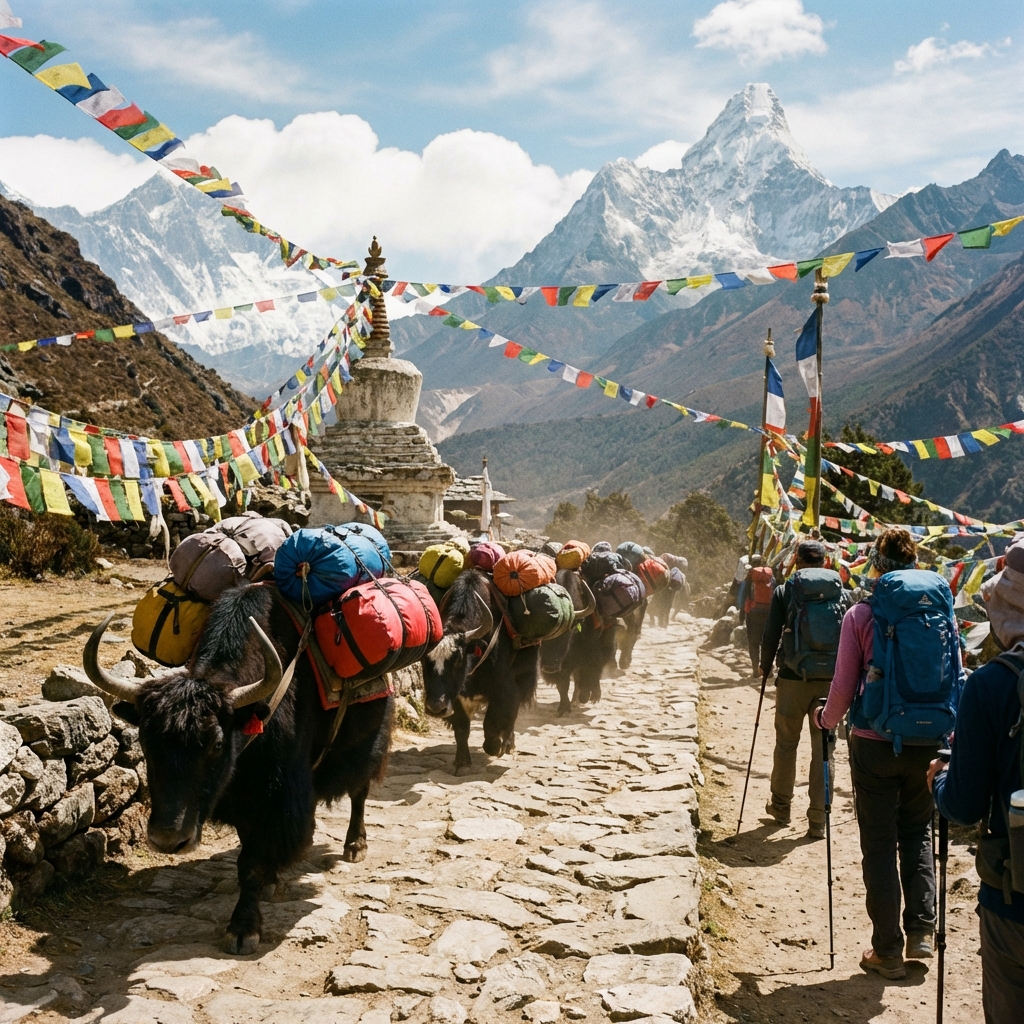
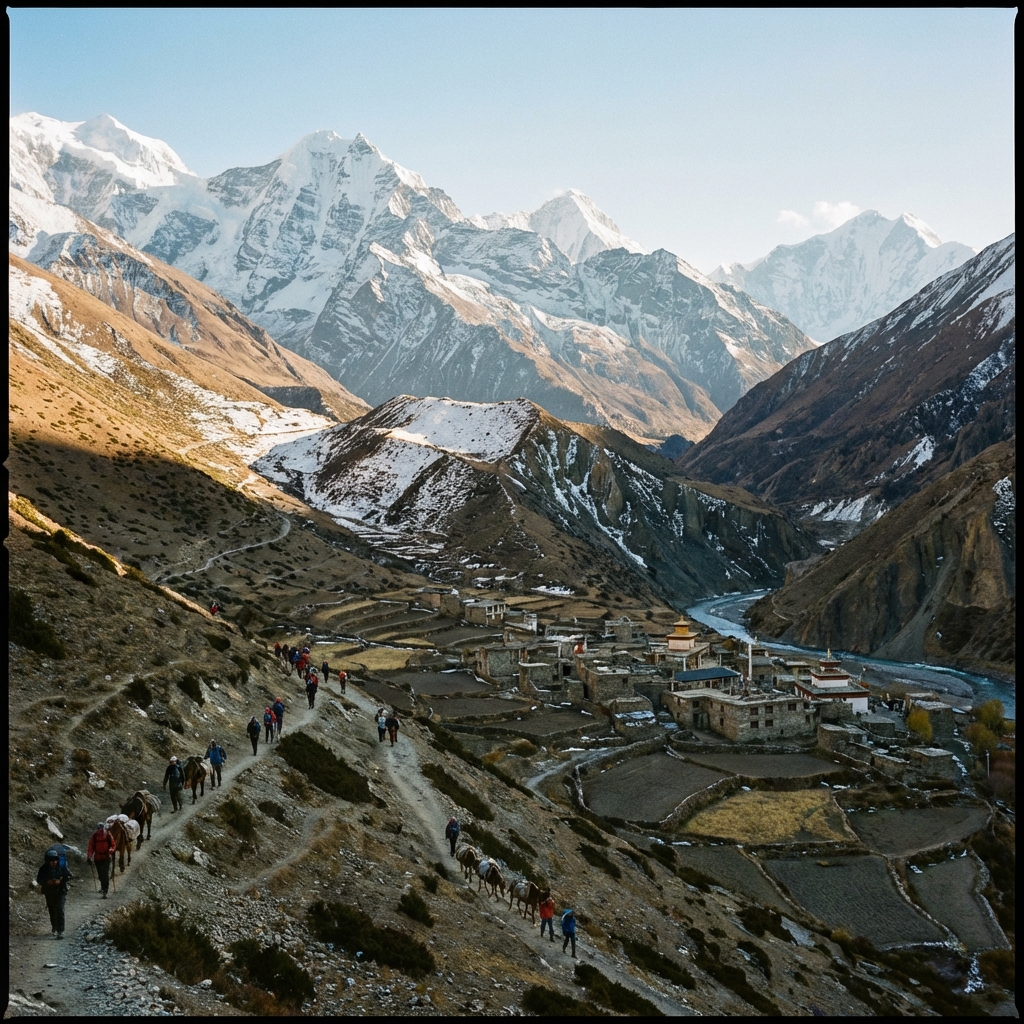
Best Trekking Agencies for Mardi Himal Trek 2026: The Hidden Gem Guide
If you're researching Nepal treks and feeling overwhelmed by the crowds at Everest Base Camp or seeking something more intimate than the popular Annapurna Base Camp route, there's a good chance Mardi Himal has appeared on your radar. And with good reason: this 5-7 day trek is rapidly becoming the Annapurna region's best-kept secret, delivering spectacular close-up Machapuchare views, genuine off-the-beaten-path atmosphere, and a satisfying altitude challenge at 4,500 meters, all without the teahouse traffic jams that characterize more popular routes.
But here's the critical question that brings most trekkers to this guide: How do you choose an agency for a trek that's still relatively unknown, with varying trail conditions, basic high-camp infrastructure, and guides of widely differing experience levels on this specific route?
The answer requires understanding what makes Mardi Himal different from established classics like ABC or Poon Hill. This isn't a trek where any experienced Nepal operator will do. The trail has evolved significantly since its "discovery," conditions at High Camp and Viewpoint remain basic compared to mainstream routes, and guide familiarity with current conditions varies dramatically between operators.
This guide cuts through the uncertainty to help you understand exactly what you need from a Mardi Himal agency, how to evaluate operators offering this increasingly popular route, what you should expect to pay at different experience levels, and how to avoid agencies that treat Mardi Himal as "just another short trek" without understanding its unique requirements.
We've analyzed over 350 verified customer reviews, compared pricing from 25+ agencies actively offering Mardi Himal, and consulted with returned trekkers and Pokhara-based guides to create this definitive Mardi Himal agency selection resource for 2026.
5-7 days (6 days standard)
4,500m (Mardi Himal Viewpoint)
$400-600
$700-1,000
$1,200-1,600
90-95% (weather dependent)
Yes (since April 2023)
Oct-Nov, Mar-May
The Annapurna Region's Best-Kept Secret: Why Mardi Himal is Different
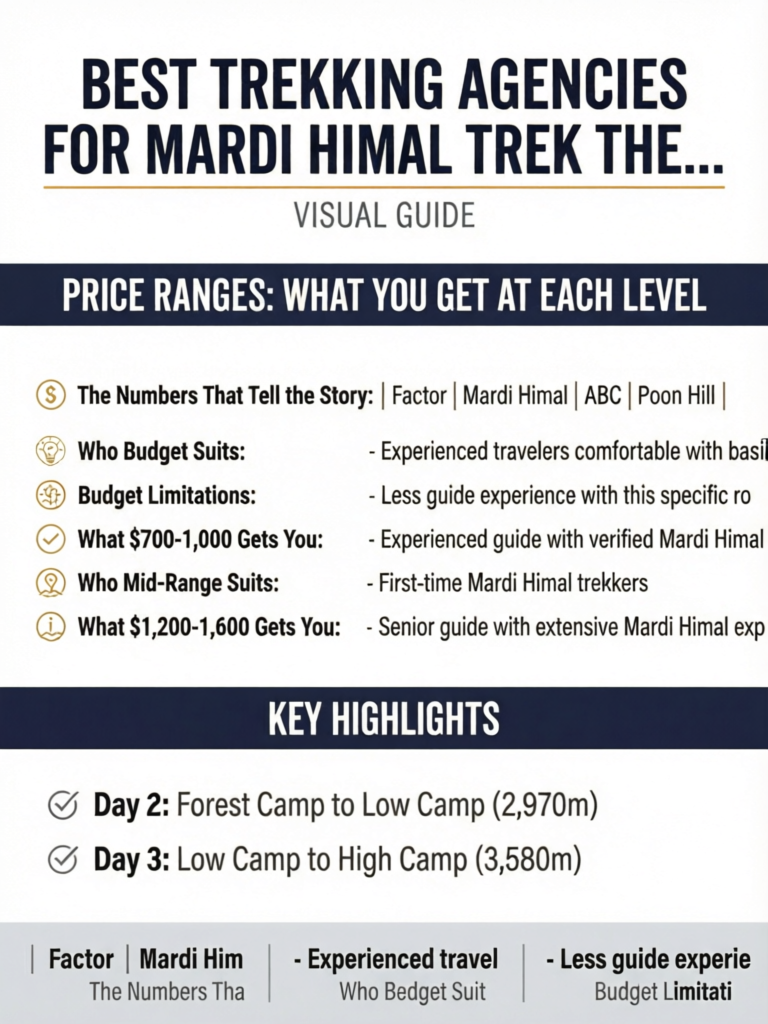
Before diving into agency selection, understanding what makes Mardi Himal unique helps you appreciate why operator choice matters differently here than for established routes.
A Rising Star Among Nepal Treks
Mardi Himal has existed as a trekking route for decades, but it remained virtually unknown until approximately 2012-2015 when adventurous trekkers seeking Annapurna alternatives began documenting this dramatic ridge walk. Since then, its popularity has grown exponentially, yet it retains an off-the-beaten-path character that mainstream routes lost long ago.
The Numbers That Tell the Story:
| Factor | Mardi Himal | ABC | Poon Hill |
|---|---|---|---|
| Daily Trekkers (Peak Season) | 50-100 | 500-800 | 300-500 |
| Maximum Altitude | 4,500m | 4,130m | 3,210m |
| Standard Duration | 5-7 days | 10-14 days | 4-5 days |
| Teahouse Density | Sparse above Low Camp | High | Very High |
| Trail Definition | Variable | Well-defined | Excellent |
| Crowd Level | Low-Moderate | High | Very High |
What You'll Actually Experience:
Standing at Mardi Himal Viewpoint (4,500m) at sunrise, you'll have what many consider the most intimate Machapuchare encounter possible without mountaineering. The sacred "Fishtail" peak looms directly across the valley, its distinctive twin peaks close enough that you can observe individual snow formations. Behind you, the entire Annapurna massif stretches across the horizon. Below, clouds often fill the valleys, creating a sense of floating among giants.
This isn't a crowded viewpoint with dozens of trekkers jostling for photos. On most days during peak season, you'll share the sunrise with perhaps 20-30 others. Off-peak, you might have it entirely to yourself.
The ABC Alternative: Why Trekkers Choose Mardi Himal
Mardi Himal has gained specific popularity as an Annapurna Base Camp alternative, and understanding this context helps you evaluate agency appropriateness.
Time Efficiency: Where ABC requires 10-14 days, Mardi Himal delivers comparable altitude and views in 5-7 days. For trekkers with limited vacation time, this efficiency is transformative. You can experience genuine high-altitude Himalayan trekking without dedicating half your trip to a single route.
Crowd Avoidance: ABC sees 80,000+ trekkers annually. During October-November, you'll pass dozens of people hourly and compete for teahouse beds. Mardi Himal's lower profile means encountering perhaps 10-20 trekkers daily, with teahouse availability rarely an issue except at High Camp during absolute peak weekends.
Altitude Achievement: At 4,500m, Mardi Himal Viewpoint actually exceeds ABC's 4,130m, providing a more significant altitude challenge within a shorter timeframe. For trekkers testing their high-altitude response or building toward bigger objectives, Mardi Himal offers efficient acclimatization assessment.
Authentic Atmosphere: The "discovery trek" feeling still exists on Mardi Himal. You're not walking a tourist highway. Trail markers are occasional, teahouses at higher elevations remain basic, and the experience feels genuinely adventurous rather than packaged.
The Best-Kept Secret is Getting Out
Mardi Himal's popularity has grown dramatically since 2020, accelerating post-pandemic as travelers seek alternatives to crowded routes. While it remains significantly quieter than ABC or Poon Hill, the secret is spreading. October-November 2026 saw record numbers, and 2026 will likely continue this trend. Booking with agencies that understand current trail conditions, not outdated information from 2018, matters more than ever.
Why Mardi Himal is Gaining Popularity
Understanding the specific appeals driving Mardi Himal's growth helps you communicate effectively with agencies and evaluate whether their knowledge is current.
Shorter Duration Without Sacrificing Altitude
The fundamental appeal is mathematical: comparable Himalayan experience in half the time.
Duration Comparison:
| Trek | Standard Duration | Max Altitude | Altitude/Day Ratio |
|---|---|---|---|
| Mardi Himal | 6 days | 4,500m | 750m/day |
| ABC | 12 days | 4,130m | 344m/day |
| EBC | 14 days | 5,364m | 383m/day |
| Poon Hill | 4 days | 3,210m | 803m/day |
Mardi Himal offers an aggressive altitude-to-duration ratio, second only to Poon Hill (which maxes out much lower). This efficiency attracts time-pressed professionals, travelers squeezing treks into broader Asia itineraries, and anyone who finds two-week commitments impractical.
What This Means for Agencies: Quality Mardi Himal operators understand this efficiency comes with acclimatization trade-offs. They build appropriate rest time into itineraries, monitor altitude symptoms carefully given the rapid ascent, and don't treat the short duration as permission to rush. Agencies describing Mardi Himal as "just 5 days, anyone can do it" miss crucial safety considerations.
Fewer Crowds, More Authentic Experience
The crowd differential isn't marginal. It's transformative.
Peak Season Comparison (October-November):
-
ABC Trail (Chhomrong to MBC): Expect to pass 50-100 trekkers per hour on popular sections. Teahouse common rooms buzz with multiple languages. The experience is international, social, and distinctly touristy.
-
Mardi Himal (Low Camp to High Camp): You might pass 10-20 trekkers in an entire day. Teahouse common rooms often hold only your group and perhaps one other. Conversations with guides and teahouse owners feel personal rather than transactional.
This atmosphere difference attracts photographers seeking uncluttered compositions, introverts preferring solitude to social trekking, cultural enthusiasts wanting genuine local interaction, and anyone who's experienced ABC or EBC and seeks something less commercial.
What This Means for Agencies: Operators experienced with Mardi Himal understand that lower teahouse density at higher elevations requires different planning than ABC. High Camp has limited beds; agencies should manage peak-season reservations or have backup plans. The basic facilities require appropriate expectation-setting rather than promising ABC-level comfort.
Stunning Close-Up Machapuchare Views
For many trekkers, Machapuchare is Nepal's most beautiful mountain. Its distinctive fishtail twin peaks are an iconic Himalayan image. But from most viewpoints, including ABC, Machapuchare appears as one peak among many, competing for attention with the massive Annapurna range.
Mardi Himal changes this. The ridge position and angle create what's arguably the most dramatic Machapuchare viewing position accessible to trekkers. The mountain dominates the horizon, close enough that you feel you could reach out and touch it. Sunrise transforms the snow pink, orange, and gold in a display that has created countless viral travel photos.
Photography Value: This Machapuchare proximity is a significant factor for photography-focused trekkers. The composition possibilities, the mountain's scale in frame, and the intimate feeling of the viewpoint create images distinct from standard "Himalayan panorama" shots that every Nepal trek provides.
What This Means for Agencies: Quality operators understand the photography appeal and can advise on optimal High Camp or Viewpoint timing for light conditions. They know which seasons offer clearest morning views versus afternoon cloud risk. Photography-focused agencies may offer extended viewpoint time rather than rushed departures.
Good Altitude Challenge Without Extreme Risk
At 4,500 meters, Mardi Himal Viewpoint provides meaningful high-altitude experience without entering the extreme-risk category.
Altitude Risk Spectrum:
| Altitude | Risk Level | Example Trek |
|---|---|---|
| 3,000-3,500m | Low | Poon Hill (3,210m) |
| 3,500-4,500m | Moderate | Mardi Himal (4,500m), ABC (4,130m) |
| 4,500-5,500m | Moderate-High | EBC (5,364m), Thorong La (5,416m) |
| 5,500m+ | High | Island Peak (6,189m) |
Mardi Himal sits in the moderate-risk zone: high enough for genuine acclimatization challenge and potential mild AMS symptoms, but low enough that severe cases remain uncommon with proper pacing. This makes it attractive for:
- First-time high-altitude trekkers testing their response
- Trekkers preparing for bigger objectives (EBC, Annapurna Circuit, Island Peak)
- Those wanting altitude achievement without extreme risk
- Older trekkers seeking meaningful challenge within safety limits
What This Means for Agencies: Quality Mardi Himal operators take altitude seriously despite the trek's short duration. They:
- Include appropriate acclimatization (usually a night at Low Camp before ascending to High Camp)
- Monitor symptoms actively
- Carry emergency communication devices
- Know descent routes if altitude problems develop
- Don't dismiss AMS risk because "it's only 4,500m"
Same Pokhara Base as ABC and Poon Hill
Logistically, Mardi Himal shares ABC's and Poon Hill's advantage: Pokhara base. This creates several benefits:
No Expensive Internal Flights: Unlike EBC (requiring $350+ Lukla flights), Mardi Himal involves only a 1-2 hour drive from Pokhara to trailheads (Kande or Australian Camp area). This eliminates flight uncertainty, reduces cost, and simplifies logistics.
Established Tourism Infrastructure: Pokhara's trekking agency ecosystem is mature and competitive. You can research, meet, and book agencies in person if desired. Last-minute arrangements are often possible.
Combination Potential: Mardi Himal's Pokhara base enables easy combination with Poon Hill (adding 3-4 days) or even ABC (though this creates a significant multi-week commitment). Agencies experienced in the region can create seamless multi-trek itineraries.
Pro Tip
If you have 10-12 days, consider the Mardi Himal + Poon Hill combination. This provides both the intimate Machapuchare views of Mardi and the famous sunrise panorama of Poon Hill, covering the Annapurna region's two most distinctive viewpoints in a single trip. Quality agencies offer this as a package or can customize based on your schedule.
Mardi Himal Agency Considerations: What Makes This Trek Different
Selecting an agency for Mardi Himal requires different evaluation criteria than established routes. Understanding these distinctions helps you ask the right questions and avoid operators treating Mardi Himal as "just another short trek."
Newer Route Means Varying Trail Knowledge
Unlike ABC or EBC where trails have been walked for decades with well-documented conditions, Mardi Himal's trail has evolved significantly since its popularization and continues changing.
Trail Evolution Factors:
- Local communities developing new teahouse locations
- Monsoon damage creating route variations annually
- Trail improvement efforts by local tourism committees
- Multiple path options at various points (not all equally safe)
- Seasonal variations in which routes are passable
What This Means for Agency Selection: Ask specifically about guides' recent Mardi Himal experience. A guide who last trekked Mardi Himal in 2019 may have outdated trail knowledge. Quality agencies ensure guides complete the route at least once per season to maintain current conditions awareness.
Questions to Ask:
- "When did my assigned guide last complete Mardi Himal?"
- "How has the trail changed in the past year?"
- "Which route sections have multiple options?"
- "Are there any current trail issues or diversions?"
The Outdated Information Problem
Many online Mardi Himal resources contain outdated information from 2015-2019 when the trek was less developed. Teahouse locations, trail conditions, and even the "standard" itinerary have evolved. Agencies relying on old information rather than current guide experience can provide inaccurate expectations and poor route guidance. Verify that operators have recent, first-hand trail knowledge.
Basic Tea Houses at Higher Elevations
One of Mardi Himal's charms is its undeveloped character. However, this means tea house standards above Low Camp differ significantly from ABC or Poon Hill routes.
Accommodation Reality by Elevation:
| Location | Elevation | Accommodation Standard |
|---|---|---|
| Pitam Deurali | 2,100m | Basic but comfortable |
| Forest Camp | 2,550m | Simple rooms, shared bathroom |
| Low Camp | 2,970m | Basic rooms, limited electricity |
| High Camp | 3,580m | Very basic, often no electricity |
| Viewpoint Area | 4,500m | No accommodation (day visit) |
What "Basic" Means at High Camp:
- Thin plywood walls that don't fully block cold or sound
- Foam mattresses rather than actual mattress beds
- No electricity in some lodges (bring headlamp, power bank)
- Limited hot water (bucket wash available, not hot showers)
- Shared toilet facilities (basic but functional)
- Common room heating may be wood-burning stove dependent on fuel supply
What This Means for Agency Selection: Quality agencies set appropriate expectations. They describe High Camp conditions honestly rather than implying ABC-level comfort. They advise on what to bring (sleeping bag liner, extra warm layers, fully charged devices) and which lodges offer marginally better facilities if comfort is a priority.
Red Flags:
- Agencies promising "comfortable accommodation throughout"
- No mention of basic conditions at higher elevations
- Comparing Mardi Himal teahouses to ABC quality
- No advice on what to bring for basic facilities
Ridge Walking Exposure
Mardi Himal's most distinctive feature is the ridge walk from Forest Camp to High Camp and beyond. Unlike valley-floor treks, this ridge presents exposure that some trekkers find challenging.
Exposure Considerations:
- Steep drop-offs on one or both sides of trail sections
- Narrow trail points (single-file only)
- Wind exposure without valley protection
- Some scrambling sections with hand use helpful
- Limited shelter if weather turns suddenly
What This Means for Agency Selection: Guides familiar with Mardi Himal understand these exposure points and:
- Assess trekker comfort with heights before committing
- Provide appropriate support at challenging sections
- Monitor weather carefully for wind conditions
- Have contingency plans if conditions become unsafe
- Know which sections are most challenging and prepare trekkers accordingly
Questions to Ask:
- "How exposed is the ridge walking?"
- "What support do guides provide at technical sections?"
- "At what wind speed would you turn back?"
- "Is this trek suitable for someone uncomfortable with heights?"
Weather Sensitivity
Mardi Himal's ridge position creates heightened weather sensitivity compared to valley treks.
Weather Vulnerability:
- Cloud can roll in rapidly, reducing visibility to meters
- Ridge position means no protection from wind
- Afternoon weather typically deteriorates faster than on valley routes
- High Camp can become extremely cold with wind chill
- Snow at viewpoint is common even in shoulder season
What This Means for Agency Selection: Quality operators build weather flexibility into Mardi Himal itineraries rather than rigid day-by-day schedules. They:
- Include buffer days or flexibility for weather delays
- Plan early morning starts for Viewpoint (before afternoon clouds)
- Have communication devices for weather updates
- Know when conditions require turning back
- Don't push through dangerous weather to maintain schedule
Agency Red Flags:
- Rigid itinerary with no weather contingency
- "We go regardless of conditions" attitude
- No communication devices for weather monitoring
- Dismissing weather concerns as tourist overcaution
Weather Danger is Real
Mardi Himal's exposed position means weather isn't just about comfort; it's about safety. Trekkers have experienced dangerous whiteout conditions, hypothermia risk from wind exposure, and trail difficulties from unexpected snow. Quality agencies treat weather monitoring as a safety priority, not an inconvenience. If an operator seems casual about weather contingencies, consider it a serious red flag.
What Makes a Good Mardi Himal Agency
Understanding specific quality indicators helps you evaluate any Mardi Himal operator, whether or not they appear on recommendation lists.
Recent Route Experience: The Non-Negotiable
For Mardi Himal specifically, recent guide experience matters more than generalized Nepal trekking expertise.
Why Recent Experience Matters:
- Trail conditions change seasonally and annually
- Teahouse availability fluctuates
- New lodges open, some close or change ownership
- Route variations exist and evolve
- Snow conditions at viewpoint vary significantly
Verification Questions:
- "How many times have your guides completed Mardi Himal in 2026-2026?"
- "When was your most recent staff Mardi Himal trek?"
- "What trail changes have you observed recently?"
- "Which High Camp lodge do you use, and why?"
- "What's the current condition of the viewpoint trail?"
Quality Indicator: Agencies with strong Mardi Himal programs send guides to complete the route each season before tourist season begins. They can describe current conditions specifically rather than generally. They know lodge owners by name and understand recent developments.
Red Flag: Agencies that can't answer specific Mardi Himal questions, provide vague responses like "our guides know all the Annapurna trails," or assign guides who've never completed this specific route.
Understanding of Basic High Camp Conditions
Quality agencies prepare trekkers appropriately for High Camp's basic facilities.
What Quality Preparation Includes:
- Clear description of High Camp accommodation reality
- Specific packing list recommendations (sleeping bag liner, layers, etc.)
- Advice on charging devices before High Camp
- Expectation-setting for cold nights, basic food
- Information about which lodges offer slightly better conditions
Documentation Check: Before booking, quality agencies provide:
- Detailed day-by-day itinerary with overnight locations named
- Packing list specific to Mardi Himal conditions
- Clear description of teahouse standards at each elevation
- Information about what's included vs. extra costs
Red Flag: Agencies that describe Mardi Himal accommodation as "comfortable teahouses throughout" or fail to distinguish between lower and higher elevation standards are either inexperienced or deliberately misleading.
Flexible Weather Planning
The ridge-walk nature of Mardi Himal requires weather flexibility more than most Nepal treks.
What Flexibility Looks Like:
- Itinerary with built-in buffer time
- Clear policy for weather delays (extra night at High Camp, etc.)
- Guide discretion to alter timing based on conditions
- Early morning viewpoint visits as standard (before weather deterioration)
- Communication devices for weather updates
Policy Questions:
- "What happens if weather prevents viewpoint visit on scheduled day?"
- "Is there cost for additional nights if weather delays us?"
- "Who makes the decision to turn back in poor weather?"
- "What communication devices do guides carry?"
Quality Response: "We typically build flexibility into Mardi Himal itineraries because the ridge is weather-exposed. If conditions prevent the viewpoint visit on Day 4, we assess whether waiting is safe and feasible. Extra night costs at High Camp are covered by our contingency budget up to one additional night. Final safety decisions rest with the guide based on conditions."
Red Flag Response: "We stick to the itinerary. Weather is rarely a problem."
Good Acclimatization Knowledge
Despite its short duration, Mardi Himal reaches 4,500m, requiring proper acclimatization.
Why Acclimatization Matters on Mardi Himal: The rapid ascent profile (trailhead around 1,700m to 4,500m in 4-5 days) creates acclimatization challenges. While most trekkers experience only mild symptoms, some face serious AMS. The short duration means less time for natural adjustment.
Quality Acclimatization Approach:
- Night at Low Camp (2,970m) before High Camp ascent
- Optional extra acclimatization day if symptoms appear
- Active symptom monitoring by guides
- Understanding of when to descend
- Knowledge of descent routes if emergency evacuation needed
Questions to Ask:
- "How does your itinerary handle acclimatization?"
- "What altitude symptoms do guides monitor for?"
- "At what point would you descend a trekker early?"
- "Do guides carry any altitude-related medical supplies?"
Quality Response: "Our standard itinerary includes a night at Low Camp specifically for acclimatization before the High Camp push. Guides monitor for headache, nausea, fatigue, and breathing difficulties. If symptoms are significant at Low Camp, we add an extra acclimatization day. If symptoms worsen at High Camp, we descend immediately rather than attempting the viewpoint."
Red Flag Response: "Mardi Himal isn't high enough for altitude sickness. It's not like Everest."
Pro Tip
For first-time high-altitude trekkers, consider the 7-day Mardi Himal itinerary rather than the 5-day express version. The extra days provide more acclimatization time and reduce AMS risk significantly. Quality agencies recommend the longer itinerary for anyone without high-altitude experience, even if the 5-day version is technically possible for fit individuals.
Red Flags to Avoid When Choosing a Mardi Himal Agency
Mardi Himal's growing popularity attracts agencies treating it as "just another short trek" without understanding its unique requirements. Recognize these warning signs.
Treating Mardi Himal as "Just Like Poon Hill"
Some agencies group Mardi Himal with Poon Hill as "short Pokhara treks" without distinguishing the significant differences.
Why This Is a Red Flag:
- Poon Hill maxes at 3,210m; Mardi Himal reaches 4,500m
- Poon Hill has excellent teahouse infrastructure; Mardi Himal has basic high-camp facilities
- Poon Hill is well-marked throughout; Mardi Himal has variable trail definition
- Poon Hill has no significant exposure; Mardi Himal involves ridge walking
- Poon Hill weather risk is minimal; Mardi Himal weather is a genuine concern
What to Listen For:
- "It's basically another version of Poon Hill"
- "No real altitude concerns, similar to Poon Hill"
- "Standard teahouse quality throughout"
- "Any guide can do Mardi Himal if they know Poon Hill"
Quality Alternative: Agencies that specifically distinguish Mardi Himal requirements and don't conflate it with Poon Hill conditions.
No Specific Mardi Himal Experience
Generalized "Annapurna region expertise" doesn't equal Mardi Himal competence.
Why This Matters: An agency with extensive ABC or Annapurna Circuit experience may never have sent guides up Mardi Himal's ridge. The route is different enough that regional knowledge doesn't transfer completely.
Warning Signs:
- Can't name specific High Camp lodges
- Vague answers about current trail conditions
- Guides assigned have only ABC/Poon Hill experience
- No specific Mardi Himal pricing (bundled into generic "short trek" category)
- Photos on website are ABC or Poon Hill, not Mardi Himal
Verification: Ask for photos from their recent Mardi Himal treks. Request guide names and their Mardi Himal experience specifically. Agencies with genuine experience can provide this easily.
Impossibly Cheap Prices
Mardi Himal can be done affordably, but rock-bottom prices indicate corner-cutting.
Understanding Mardi Himal Costs:
| Component | Minimum Cost | Notes |
|---|---|---|
| Guide (6 days) | $120-150 | Experienced guide rate |
| Permits (ACAP, TIMS) | $40-50 | Non-negotiable fees |
| Transport | $30-50 | Pokhara-trailhead round trip |
| Accommodation | $50-80 | 5-6 nights including High Camp |
| Meals | $100-150 | Full board 6 days |
| Agency overhead | $50-100 | Insurance, operations, profit |
| Minimum Total | $390-580 |
Price Warning Thresholds:
- Under $350: Almost certainly cutting serious corners
- $350-500: Scrutinize carefully what's included
- $500-700: Budget but achievable ethically
- $700-1,000: Mid-range with quality services
- $1,000+: Premium features should be evident
What Gets Cut at Rock-Bottom Prices:
- Guide insurance and proper licensing
- Experienced guides (substituting cheap labor)
- Adequate meals (breakfast only, "meals at your expense")
- Emergency communication devices
- Proper porter welfare (if porter included)
The $250 Mardi Himal Package Trap
Some Pokhara agencies advertise Mardi Himal packages under $300 or even $250. At these prices, the agency is either losing money (unsustainable and suspicious) or cutting essential corners. No legitimate operator can provide quality Mardi Himal service at these rates. You may arrive at High Camp to find your "guide" is actually an inexperienced porter, no emergency communication exists, and meals beyond basic rice and dal require additional payment.
Dismissing Weather or Altitude Concerns
Any agency that treats Mardi Himal as risk-free isn't taking the trek seriously.
Warning Phrases:
- "Weather is never a problem"
- "Mardi Himal isn't high enough for altitude sickness"
- "The ridge walk is easy, nothing technical"
- "Anyone can do Mardi Himal, no experience needed"
- "We've never had any issues"
Reality Check: Weather has delayed and endangered trekkers on Mardi Himal regularly. Altitude sickness occurs at 4,500m; it's not common severe cases, but dismissing it entirely shows ignorance. The ridge walk includes exposed sections that challenge some trekkers. While Mardi Himal is achievable for most moderately fit people, it's not effortless.
Quality Alternative: Agencies that acknowledge risks while explaining how they manage them. "Weather can be challenging, so we build in flexibility and our guides carry Garmin devices for weather monitoring" demonstrates competence.
No Written Itinerary or Contract Before Deposit
Before any payment, legitimate agencies provide:
- Day-by-day itinerary with overnight locations
- Clear inclusion/exclusion list
- Cancellation and refund policy
- Emergency contact information
- Guide assignment (name and experience if possible)
- Total price breakdown
Warning Signs:
- "We'll send details after you pay"
- Verbal agreements only
- Vague "standard package" descriptions
- Reluctance to specify guide experience
- No emergency contact information provided
What Should Be Included in Mardi Himal Packages
Understanding standard inclusions helps you compare packages accurately and identify agencies cutting corners.
Transportation (Pokhara-Kande-Pokhara)
Standard Transport:
- Pickup from Pokhara hotel/bus station
- Private or shared vehicle to Kande (trailhead), approximately 1 hour
- Return transport from trail end (typically Sidhing or Australian Camp area)
- Drop-off at Pokhara hotel/bus station
Transport Quality Variations:
| Level | Transport Type | Comfort |
|---|---|---|
| Budget | Shared local jeep | Basic, possibly crowded |
| Mid-Range | Agency vehicle, shared with small group | Comfortable |
| Premium | Private vehicle | Maximum comfort, flexible timing |
What to Clarify:
- "Is transport shared or private?"
- "Where exactly does pickup occur?"
- "What vehicle type is used?"
- "Is the return transport confirmed or arranged on-the-spot?"
Permits (ACAP, TIMS)
Two permits are required for Mardi Himal:
ACAP (Annapurna Conservation Area Permit):
- Cost: NPR 3,000 (~$23 USD)
- Required for entry to Annapurna Conservation Area
- Obtained in Pokhara (Tourism Board office) or Kathmandu
TIMS (Trekking Information Management System):
- Cost: NPR 2,000 (~$15 USD)
- Required for all organized treks with agencies
- Agencies typically process this on your behalf
What Quality Agencies Provide:
- Both permits included in package price
- Agency processes permits (you provide passport photos, copies)
- Permits ready before trek start
- Clear explanation of which permits and why
Red Flag: "Permits are extra" or unclear permit handling suggests either hidden costs or an operator unfamiliar with proper procedures.
Experienced Guide Familiar with Current Trail
The guide is your most important agency deliverable. For Mardi Himal specifically, current route experience matters.
Standard Guide Service Includes:
- Licensed trekking guide (government-issued license)
- Guide present throughout trek (not sharing between groups)
- Guide meals and accommodation (covered by agency)
- Guide insurance
- Trail guidance and pace management
- Teahouse check-in assistance
- Emergency response coordination
Mardi Himal-Specific Requirements:
- Recent Mardi Himal completion (within past season)
- Familiarity with current trail variations
- Knowledge of High Camp lodge options
- Understanding of ridge exposure and weather patterns
- Altitude sickness recognition training
Questions to Ask:
- "What is my guide's name and experience level?"
- "How many times has this guide completed Mardi Himal?"
- "When did the guide last trek Mardi Himal?"
- "Is this specific guide guaranteed, or might substitution occur?"
- "Can I speak with the guide before booking?"
Accommodation and Meals
Standard Package Includes:
Accommodation:
- All teahouse nights (typically 5-6 nights)
- Private room (twin-share basis usually)
- Basic facilities at High Camp, better at lower elevations
Meals (Full Board):
- Breakfast daily (porridge, eggs, toast, tea/coffee)
- Lunch daily (dal bhat, noodles, fried rice options)
- Dinner daily (dal bhat, pasta, similar options)
- Hot drinks with meals (tea/coffee)
Usually Excluded (Budget Separately):
- Bottled water (bring purification)
- Soft drinks, juices
- Alcohol
- Snacks between meals
- Extra hot drinks
- Hot showers (may be unavailable at High Camp)
- WiFi and charging (limited availability)
Questions to Clarify:
- "Are all three meals included every trekking day?"
- "What drinks are included with meals?"
- "Are there snacks beyond main meals?"
- "What accommodation is used at High Camp specifically?"
| Trek | Duration | Max Altitude | Difficulty | Best For | Cost |
|---|---|---|---|---|---|
| Budget Package | 5-6 days | $400-600 | Basic teahouses | Budget travelers, experienced | Essential services only |
| Mid-Range Package | 6-7 days | $700-1,000 | Best available lodges | Most trekkers | Full service, good value |
| Premium Package | 7+ days | $1,200-1,600 | Premium facilities, flexibility | Comfort-focused | Maximum support |
Price Ranges: What You Get at Each Level
Understanding what different price points deliver helps you choose appropriately for your priorities.
Budget ($400-600): Achievable but Basic
What $400-600 Gets You:
- Licensed guide (may be less experienced with Mardi Himal specifically)
- All required permits
- Basic teahouse accommodation throughout
- Three meals daily (standard trekking food)
- Ground transport to/from trailhead
- Usually group joining departures
Who Budget Suits:
- Experienced travelers comfortable with basic conditions
- Budget-conscious trekkers
- Those who've trekked in Nepal before
- Flexible solo travelers joining groups
Budget Limitations:
- Less guide experience with this specific route
- Minimal flexibility for weather delays
- Basic accommodation at all levels (not best available)
- Limited agency support if issues arise
- Group schedule, not customizable
True Cost Reality: A $500 budget package becomes approximately $600-650 total after adding:
- Tips ($40-60)
- Hot showers where available ($15-20)
- Charging/WiFi ($10-15)
- Snacks and extra drinks ($20-30)
- Emergency margin ($50)
Budget Can Work If You Know What You're Getting
Some excellent small Pokhara agencies offer budget Mardi Himal packages with experienced guides and fair practices. The key is verification. A TAAN-registered budget agency whose owner personally knows the guide can provide better service than expensive operators subcontracting to unknown partners. Ask specifically about guide experience and verify recent Mardi Himal completions.
Mid-Range ($700-1,000): The Sweet Spot
What $700-1,000 Gets You:
- Experienced guide with verified Mardi Himal knowledge
- Best available teahouse selection at each stop
- Full board with reasonable meal variety
- All permits processed efficiently
- Comfortable transport
- Some weather flexibility built in
- Responsive agency support
- Often includes Pokhara hotel night(s)
- Private trek or small group joining
Who Mid-Range Suits:
- First-time Mardi Himal trekkers
- Those wanting quality without luxury pricing
- Trekkers who value reliability and professionalism
- Anyone who wants the experience without logistics stress
- Photographers needing some scheduling flexibility
Why Mid-Range is the Sweet Spot: For Mardi Himal specifically, the mid-range premium buys meaningful differences:
- Guides who know current trail conditions, not outdated information
- Better accommodation at High Camp (lodges with slightly thicker walls, better bedding)
- Flexibility if weather delays viewpoint visit
- Agency support accessible if issues arise
True Cost Reality: An $850 mid-range package becomes approximately $950-1,000 total after extras and tips.
Premium ($1,200-1,600): Maximum Comfort and Flexibility
What $1,200-1,600 Gets You:
- Senior guide with extensive Mardi Himal experience
- Best available lodges throughout (including premium High Camp options)
- Enhanced meal options and variety
- All logistics handled seamlessly
- Private trek as standard
- Multiple Pokhara hotel nights
- Maximum flexibility for weather and personal pace
- 24/7 agency support
- Porter included as standard
- Photography timing flexibility
- Extension options easily arranged (Poon Hill add-on, etc.)
Who Premium Suits:
- Older trekkers (55+) wanting comfort assurance
- Special occasions (birthdays, celebrations)
- Trekkers with physical concerns needing extra support
- Photographers prioritizing optimal conditions over schedule
- Those for whom budget isn't the primary constraint
- First-time Nepal visitors wanting stress-free experience
When Premium is Worth It:
Photography Focus: Premium flexibility allows waiting for weather windows, multiple viewpoint visits if conditions improve, and guide assistance with equipment.
Physical Concerns: If you're uncertain about fitness or have any health considerations, premium support provides confidence. Porter included means lighter pack; experienced guide means appropriate pacing.
Once-in-a-Lifetime Trip: If this is your one Nepal trek and you want everything optimized, premium removes all friction.
True Cost Reality: A $1,400 premium package typically includes most extras, making true total approximately $1,500-1,600 after tips and minimal additions.
Itinerary Options: Matching Your Time and Goals
Understanding route variations helps you choose the right package and evaluate agency expertise.
Express Mardi (5 Days)
Typical Itinerary:
- Day 1: Pokhara to Kande, trek to Low Camp (2,970m)
- Day 2: Low Camp to High Camp (3,580m)
- Day 3: High Camp to Viewpoint (4,500m) and back to High Camp
- Day 4: High Camp to Forest Camp or Low Camp
- Day 5: Descend to Sidhing, drive to Pokhara
Characteristics:
- Fastest possible Mardi Himal experience
- Limited acclimatization time (higher AMS risk)
- No buffer for weather delays
- Demanding daily distances
- Requires good fitness
Price Range: $400-700 typically
Best For: Very fit trekkers with extremely limited time who accept acclimatization risks
Who Should Avoid: First-time high-altitude trekkers, anyone with flexibility in schedule, those prioritizing safety margins
Classic Mardi (6-7 Days)
Standard 6-Day Itinerary:
- Day 1: Pokhara to Kande, trek to Forest Camp (2,550m)
- Day 2: Forest Camp to Low Camp (2,970m)
- Day 3: Low Camp to High Camp (3,580m)
- Day 4: High Camp to Viewpoint (4,500m), return to High Camp or descend to Low Camp
- Day 5: Descend through Forest Camp to Sidhing
- Day 6: Sidhing to Pokhara (or trek to Australian Camp, then transport)
7-Day Variation:
- Adds acclimatization day at Low Camp before High Camp push
- Provides weather buffer
- More relaxed pace throughout
Characteristics:
- Most popular itinerary
- Adequate acclimatization for most people
- Some weather flexibility
- Manageable daily distances
- Suitable for moderate fitness
Price Range: $600-1,000 typically
Best For: Most first-time Mardi Himal trekkers; this is the default recommendation
Pro Tip
The 7-day itinerary is worth considering even if you could manage 6 days. The extra day provides valuable acclimatization at Low Camp, reducing AMS risk significantly. It also creates a weather buffer if conditions prevent viewpoint access on the scheduled day. Quality agencies often recommend 7 days for first-time high-altitude trekkers.
Mardi + Poon Hill Combo (8-10 Days)
Typical Combined Itinerary:
- Days 1-5: Mardi Himal trek (express version)
- Day 6: Transfer between trails (rest in Pokhara or connect via Sidhing)
- Days 7-10: Poon Hill trek
Alternative Flow:
- Start with Poon Hill (lower altitude, acclimatization)
- Rest day in Pokhara
- Complete Mardi Himal
Characteristics:
- Two distinct trekking experiences
- Comprehensive Annapurna viewpoints (Mardi for Machapuchare, Poon Hill for panorama)
- Poon Hill provides acclimatization for Mardi if done first
- Significant physical demand over 8-10 days
- Excellent photography diversity
Price Range: $900-1,500 typically
Best For: Trekkers with 10+ days wanting comprehensive Annapurna experience; photographers seeking diverse viewpoints; those who want both intimate Machapuchare views and broad Himalayan panoramas
Mardi as ABC Warm-Up (12-14 Days Total)
Combined Itinerary Concept:
- Days 1-5: Mardi Himal (acclimatization and fitness testing)
- Day 6: Rest in Pokhara
- Days 7-12: Annapurna Base Camp trek
- Days 13-14: Return to Pokhara/buffer
Characteristics:
- Uses Mardi Himal as ABC acclimatization
- Tests altitude response before longer commitment
- Efficient regional coverage
- Significant time commitment
- Demanding overall
Price Range: $1,400-2,500 typically
Best For: Serious trekkers wanting comprehensive Annapurna experience; those testing altitude response before major future treks; travelers with 2+ weeks dedicated to trekking
Practical Consideration: This combination is less common than Mardi + Poon Hill because ABC is a significant additional commitment. Most agencies offer it as custom itinerary rather than standard package. Ensure the agency has experience combining these treks and understands the logistics.
Booking Considerations: Pokhara vs. Kathmandu vs. Online
Where you book your Mardi Himal trek affects your experience, pricing, and options.
The Pokhara Advantage
Mardi Himal starts from Pokhara, and Pokhara-based agencies have significant advantages for this specific trek.
Why Pokhara Works Best for Mardi Himal:
Local Expertise: Pokhara agencies specializing in Annapurna short treks often have guides who complete Mardi Himal monthly during season. Their current conditions knowledge surpasses Kathmandu operators who may send guides less frequently.
Lower Overhead: Without Kathmandu office costs, Pokhara agencies can offer equivalent services at 10-20% lower prices while maintaining guide pay.
Last-Minute Flexibility: Need to start tomorrow? Pokhara agencies can often arrange permits, guide, and transport quickly. Kathmandu agencies require coordination time.
Direct Relationships: Pokhara operators often know High Camp teahouse owners personally, securing better rooms and communicating about conditions directly.
When to Book in Pokhara
Ideal Scenarios:
- Flying directly to Pokhara (Pokhara International Airport)
- Mardi Himal is your primary Nepal trek
- You have 2+ days in Pokhara before trekking
- Budget is a significant factor
- You enjoy meeting agencies in person before deciding
How to Book in Pokhara:
- Research 3-5 agencies online before arrival (read reviews, note questions)
- Walk Lakeside's agency streets upon arrival
- Meet 2-3 agencies in person, ask Mardi-specific questions
- Evaluate responsiveness, trail knowledge, guide experience
- Book with the most knowledgeable, transparent option
When Kathmandu Booking Makes Sense
Kathmandu Advantages:
- Combining Mardi Himal with Kathmandu activities
- Want everything confirmed before arrival
- Complex itinerary requiring coordination
- Limited time, can't shop around in Pokhara
- Combining multiple treks (EBC + Mardi Himal, etc.)
Kathmandu Considerations:
- May subcontract to Pokhara partner (ask explicitly)
- Higher prices typical (15-25% premium)
- Less Mardi Himal-specific expertise usually
- More established booking systems
Online International Booking
When Online Booking Works:
- Working with established international operators
- Want everything confirmed months in advance
- Require specific languages or specialized services
- Corporate or group bookings requiring contracts
Online Booking Cautions:
- International operators often subcontract locally
- Significant markup for international overhead
- May have less current Mardi Himal knowledge
- Harder to verify guide experience beforehand
Verification for Online Bookings:
- Ask explicitly: "Who operates the trek on the ground?"
- Request local partner details and verify independently
- Confirm guide experience with Mardi Himal specifically
- Read reviews mentioning Mardi Himal by name
The Direct Flight Factor
Pokhara International Airport now receives direct international flights. If you fly directly to Pokhara, booking with a Pokhara agency is almost always optimal for Mardi Himal. You avoid Kathmandu entirely, save money, and work with local specialists. This changes the equation significantly compared to when all international arrivals came through Kathmandu.
Last-Minute Booking Options
Mardi Himal is one of Nepal's more accessible treks for last-minute arrangements, though constraints exist.
Same-Week Booking is Often Possible
Off-Season (December-February, June-September):
- Same-day starts sometimes possible
- Agencies have guide availability
- Teahouse space abundant
- Less optimal weather but arrangement flexibility high
Shoulder Season (Early October, Late November, Early March, Late May):
- 2-4 days notice typically sufficient
- Some agency coordination needed
- Good availability usually
Peak Season (Mid-October to Mid-November, Mid-March to Mid-April):
- 5-7 days minimum recommended
- Guide availability may be constrained
- High Camp accommodation may require advance reservation
- Popular agencies may be fully booked
Last-Minute Process
Option A: Agency in Pokhara
- Arrive in Pokhara
- Walk Lakeside trekking agency area
- Visit 2-3 agencies, explain your timeframe
- Get quotes and verify guide availability
- Book with best option
- Start trekking (can begin same or next day off-season)
Option B: Hotel Assistance
- Ask your Pokhara hotel for trekking agency recommendations
- Hotel staff often have relationships with reliable operators
- They can call to check availability
- Meet agency representative at hotel if interested
- Verify credentials before booking
Last-Minute Costs: Expect slight premium (10-15%) for urgent arrangements. More than 25% premium for last-minute suggests opportunistic pricing.
Questions to Ask Before Booking
Send these questions to any agency you're seriously considering. Response quality reveals operational competence.
About Route Knowledge
- "When did your guides last complete Mardi Himal?" (Should be within current season)
- "What trail changes have you observed recently?"
- "Which High Camp lodge do you use, and why?"
- "What's the current condition of the viewpoint trail?"
- "Are there any known trail issues right now?"
About Your Specific Guide
- "What is my guide's name?"
- "How many times has this specific guide completed Mardi Himal?"
- "Is this guide guaranteed, or might substitution occur?"
- "What altitude training does the guide have?"
- "Can I speak with the guide before booking?"
About Weather and Flexibility
- "What happens if weather prevents viewpoint access?"
- "Is there cost for additional nights if weather delays us?"
- "What communication devices do guides carry?"
- "Who makes the final decision on safety in poor conditions?"
- "How do you monitor weather forecasts?"
About Accommodation and Services
- "What is High Camp accommodation really like?"
- "Which specific lodges do you use at each stop?"
- "Are all three meals included every day?"
- "What drinks/snacks are included beyond main meals?"
- "Is porter service included or optional?"
About Logistics and Policies
- "What time do we depart Pokhara on Day 1?"
- "What transport is used?"
- "What's your cancellation policy?"
- "What emergency procedures exist?"
- "Do you have TAAN registration I can verify?"
Pro Tip
Create a simple spreadsheet to compare agency responses. Quality agencies answer thoroughly and quickly. Those who evade questions, take days to respond, or become defensive reveal potential problems. Pay particular attention to Mardi Himal-specific knowledge: agencies that answer generically rather than specifically likely lack current experience.
Frequently Asked Questions
How much should I budget for Mardi Himal with an agency?
Total Budget by Experience Level:
| Level | Package Cost | Extras/Tips | Total Budget |
|---|---|---|---|
| Budget | $400-600 | $100-150 | $500-750 |
| Mid-Range | $700-1,000 | $100-150 | $800-1,150 |
| Premium | $1,200-1,600 | $100-150 | $1,300-1,750 |
For most trekkers: Budget $800-1,000 total for a quality mid-range experience. This provides experienced guides, reasonable flexibility, and appropriate support for Mardi Himal's unique challenges.
Is Mardi Himal harder than Poon Hill?
Yes, significantly. Key differences:
| Factor | Poon Hill | Mardi Himal |
|---|---|---|
| Max Altitude | 3,210m | 4,500m |
| Altitude Risk | Very low | Moderate |
| Trail Definition | Excellent | Variable |
| Teahouse Quality | Excellent | Basic at height |
| Ridge Exposure | Minimal | Significant |
| Weather Sensitivity | Low | High |
Mardi Himal requires better fitness, altitude awareness, and comfort with exposure. It's not a Poon Hill equivalent.
Can I do Mardi Himal independently without an agency?
Not completely. Since April 2023, all foreign trekkers in Nepal require a licensed guide. You must have guide accompaniment.
Your Options:
- Agency package: Everything arranged, most convenient
- Guide-only hire: Hire licensed guide in Pokhara, arrange permits/accommodation yourself
- Minimal package: Guide and permits only, handle accommodation independently
For Mardi Himal specifically, agency packages often represent good value because High Camp logistics benefit from advance arrangement.
When is the best time for Mardi Himal?
Peak Season (October-November):
- Best weather, clearest views
- Moderate crowds (still less than ABC)
- All facilities open
- Coldest nights at High Camp
- Book 1-2 weeks ahead for quality agencies
Spring Season (March-May):
- Good weather, rhododendron blooms at lower elevations
- Slightly more variable conditions
- Some afternoon clouds
- Pleasant temperatures
- Second-most popular season
Winter (December-February):
- Cold, especially at High Camp (can drop below -15°C)
- Excellent views when clear
- Very few trekkers
- Some lodges may close
- Requires cold-weather gear
Monsoon (June-September):
- Avoid. Trail conditions poor, leeches, minimal views, dangerous conditions.
How fit do I need to be for Mardi Himal?
Recommended Fitness:
- Able to walk 5-7 hours uphill daily
- Comfortable with steep terrain and some exposure
- No serious cardiovascular issues
- Able to carry 5-8kg daypack if not using porter
Preparation Suggestions:
- Regular cardio training (hiking, running, cycling) for 4-6 weeks before
- Practice walking uphill with a pack
- Include stair climbing if possible
- Test altitude response if opportunity exists
First-Timer Consideration: Mardi Himal is achievable for moderately fit first-time trekkers, but it's not the easiest option. If you're concerned about fitness, consider starting with Poon Hill, or choose the 7-day Mardi itinerary for more gradual acclimatization.
What if weather prevents reaching the viewpoint?
Quality agencies handle weather contingencies by:
- Building flexibility into itinerary (7-day vs. 5-day option)
- Offering to wait at High Camp for conditions to improve
- Attempting viewpoint visit at different times if weather windows appear
- Absorbing cost of extra night when weather causes delay (up to reasonable limit)
Your Protection:
- Book agencies with clear weather contingency policies
- Choose 6-7 day itinerary over 5-day for buffer time
- Have realistic expectations (weather is uncontrollable)
- Travel insurance should cover trip changes
Reality Check: Some percentage of trekkers miss clear viewpoint views due to weather. This is Himalayan reality. The trek itself remains beautiful even if summit views are obscured.
Are tips expected?
Yes. Tips are customary and form significant portion of guide income.
Recommended Mardi Himal Tipping:
- Guide: $8-12 per day = $50-70 for 6-day trek
- Porter (if used): $5-8 per day = $30-50 for 6-day trek
How to Tip:
- Give directly to each person (not through agency)
- Present at farewell meal or in Pokhara
- Cash in Nepali Rupees or USD acceptable
- Express personal appreciation along with tip
How does Mardi Himal compare to ABC?
| Factor | Mardi Himal | ABC |
|---|---|---|
| Duration | 5-7 days | 10-14 days |
| Max Altitude | 4,500m | 4,130m |
| Crowds | Low-Moderate | High |
| Teahouse Quality | Basic at height | Good throughout |
| Trail Definition | Variable | Excellent |
| Views | Intimate Machapuchare | Panoramic Annapurna bowl |
| Best For | Time-limited, seeking solitude | Classic Nepal experience |
Choose Mardi Himal if: You have limited time, want fewer crowds, and prioritize intimate mountain experience over comprehensive infrastructure.
Choose ABC if: You have 2 weeks, want classic Nepal trek, prefer well-developed trails and teahouses.
Can I combine Mardi Himal with other treks?
Common Combinations:
Mardi + Poon Hill (8-10 days): Most popular combination. Get both intimate Machapuchare views and famous Poon Hill panorama.
Mardi + ABC (14-18 days): Comprehensive Annapurna coverage. Mardi serves as acclimatization for ABC.
Mardi + Langtang (14+ days): Different regions, requires significant time and logistics. Less common but possible.
Logistical Considerations:
- Rest days between treks recommended
- Combined packages often offer value over separate bookings
- Quality agencies can customize combinations
Related Resources
Preparing for your Mardi Himal trek involves more than agency selection. Explore these guides:
Route and Trek Information:
- Poon Hill Complete Guide - Popular combination option
- ABC Trek Overview - Alternative in same region
- Best Beginner Treks Nepal - Where Mardi Himal fits
Preparation Guides:
- What to Wear Trekking in Nepal - Gear essentials
- Fitness Requirements for Nepal Trekking - Physical preparation
- Best Time for Annapurna Trekking - Seasonal considerations
Agency and Guide Resources:
- How to Choose a Trekking Agency - General selection guide
- Hiring Guides and Porters in Nepal - Independent hiring options
- Best Poon Hill Agencies - For combination treks
- Best ABC Agencies - If considering ABC instead
Practical Information:
- Pokhara Guide for Trekkers - Gateway city information
- Travel Insurance for Nepal Trekking - Coverage requirements
- Budget Trekking in Nepal - Cost-saving strategies
Your Decision Framework: Choosing the Right Mardi Himal Agency
After reading this guide, use this framework for your final decision.
Step 1: Confirm Mardi Himal is Right for You
Choose Mardi Himal if:
- You have 5-7 days for trekking
- You want intimate mountain experience over crowded trails
- You're comfortable with basic high-altitude accommodation
- You have moderate-good fitness
- Ridge walking exposure doesn't concern you
Consider Alternatives if:
- You want maximum comfort (choose ABC)
- You prefer well-defined trails throughout (choose Poon Hill or ABC)
- Altitude concerns you significantly (choose Poon Hill)
- You want the "classic Nepal trek" experience (choose ABC)
Step 2: Set Your Budget Realistically
| Your Situation | Recommended Tier | Total Budget |
|---|---|---|
| Experienced, budget priority | Budget | $500-750 |
| First-timer, want quality | Mid-Range | $800-1,150 |
| Comfort priority, special occasion | Premium | $1,300-1,750 |
Step 3: Choose Your Itinerary
| Available Time | Recommended Itinerary |
|---|---|
| 5 days (tight) | Express Mardi (higher AMS risk) |
| 6 days | Classic Mardi |
| 7 days | Classic with acclimatization day (recommended) |
| 8-10 days | Mardi + Poon Hill combination |
Step 4: Decide Where to Book
| Your Situation | Book In |
|---|---|
| Flying to Pokhara, Mardi focus | Pokhara agency |
| Limited time before trek | Online or Kathmandu |
| Have 2+ days in Pokhara | Meet agencies in person |
| Complex Nepal itinerary | Kathmandu or online |
Step 5: Shortlist and Compare Agencies
Based on budget and booking location:
- Search TAAN-registered agencies
- Check reviews mentioning Mardi Himal specifically
- Request quotes and Mardi-specific guide information
- Evaluate response quality and route knowledge
- Verify current trail experience
Step 6: Verify Before Booking
Before payment, confirm:
- Written itinerary with overnight locations
- Clear inclusion/exclusion list
- Guide name and Mardi Himal experience
- Weather contingency policy
- Cancellation terms
- Emergency contacts
Ready to Choose
You now have everything needed to select a Mardi Himal agency confidently. Remember: for this rising-star trek, current route experience matters more than general Nepal credentials. An agency that did excellent EBC treks may lack Mardi Himal-specific knowledge. Prioritize operators who can discuss current trail conditions, name specific High Camp lodges, and demonstrate recent guide experience on this specific route.
Final Thoughts
Mardi Himal represents something increasingly rare in Nepal trekking: a genuine hidden gem that delivers world-class Himalayan experience without world-class crowds. Its rapid rise in popularity makes 2026 an interesting moment. The trek remains significantly quieter than ABC or Poon Hill, yet infrastructure improvements continue and more agencies now offer it. The secret is out, but it hasn't been ruined.
Choosing an agency for Mardi Himal requires different considerations than established routes. The newer trail, variable conditions, basic high-camp infrastructure, and ridge exposure all demand operators with specific, current experience. Generic "Annapurna region expertise" doesn't suffice. You need agencies whose guides walk this ridge regularly and understand its unique demands.
The best Mardi Himal operators:
- Send guides to complete the route each season before tourists arrive
- Set honest expectations about High Camp conditions
- Build weather flexibility into itineraries
- Take altitude seriously despite the trek's short duration
- Demonstrate current, specific route knowledge in pre-booking communications
At 4,500 meters, watching sunrise illuminate Machapuchare's sacred twin peaks from the intimate viewpoint, you'll understand why Mardi Himal is capturing trekkers' hearts. The fishtail summit fills the sky, close enough to feel personal. Below, clouds fill valleys while you stand above them among giants. It's the Himalayan moment that Instagram photos can't capture but that stays with you forever.
With the right agency, you'll reach that moment safely, appropriately prepared, and supported by guides who know every step of the ridge walk that brought you there. Take your time with this decision. Research thoroughly. Verify claims. And then, with confidence, book your trek to Nepal's most exciting rising star.
Namaste, and safe travels on your Mardi Himal adventure.
About This Guide
This comprehensive guide was researched and written by the Nepal Trekking Directory editorial team based on:
- Analysis of 350+ verified customer reviews (2023-2026)
- TAAN membership verification for 25+ agencies offering Mardi Himal
- Price comparison across 20+ operators
- Interviews with returned Mardi Himal trekkers
- Consultation with Pokhara-based guides specializing in this route
- Nepal Tourism Board regulations review
- Trail condition updates from February 2026
We update this guide quarterly to reflect changing conditions, pricing, and agency status. Last updated: February 2026.
Found this guide helpful? If you've trekked Mardi Himal with an agency, consider sharing your experience in reviews to help future trekkers discover this remarkable route.