
Best Trekking Agencies for Poon Hill Trek 2026: Guide for First-Timers
If you're researching your first Nepal trek, there's a good chance Poon Hill is on your list. And for good reason: this 4-5 day trek delivers everything a first-timer could want. World-famous sunrise views over Dhaulagiri and Annapurna. Manageable altitude that won't leave you gasping. Excellent teahouse infrastructure. And it's all just a short drive from Pokhara.
But here's the question that brings most first-timers to this guide: Do you actually need a trekking agency for Poon Hill? And if so, which one?
The answer isn't as straightforward as you might expect. Unlike longer, higher treks where agency support is crucial for safety, Poon Hill exists in a middle ground. You definitely need a guide (mandatory since 2023), but whether you need a full agency package or can hire a guide independently depends on your priorities, comfort level, and budget.
This guide cuts through the marketing noise to help you understand exactly what you need for Poon Hill, how to evaluate agencies offering this popular route, what you should pay at different budget levels, and how to avoid the red flags specific to short-trek operators who sometimes cut corners because "it's just Poon Hill."
We've analyzed over 400 verified customer reviews, compared pricing from 35+ agencies, and consulted with returned trekkers to create this definitive Poon Hill agency selection resource for 2026.
3-5 days (4 days standard)
3,210m (Poon Hill)
$300-450
$500-700
$800-1,100
98%+ (low altitude)
Yes (since April 2023)
Oct-Nov, Mar-May
Why Poon Hill is Nepal's Perfect First Trek
Before diving into agency selection, understanding why Poon Hill earned its reputation helps you appreciate what you're evaluating agencies for.
The Ideal Introduction to Himalayan Trekking
Poon Hill isn't just popular because it's easy (though it is accessible). It's popular because it delivers an authentic, spectacular Himalayan experience in a short timeframe with minimal risk. For first-timers with limited vacation time or uncertainty about their trekking abilities, this combination is unbeatable.
The Numbers That Matter:
| Factor | Poon Hill | Why It Matters |
|---|---|---|
| Maximum Altitude | 3,210m | Below serious AMS threshold |
| Duration | 4-5 days | Fits most vacation schedules |
| Daily Walking | 4-6 hours | Manageable for moderate fitness |
| Success Rate | 98%+ | Almost everyone who starts finishes |
| Distance from Pokhara | 2 hours drive | Easy logistics, quick start |
| Teahouse Quality | Excellent | Comfortable, frequent lodges |
What You'll Actually See:
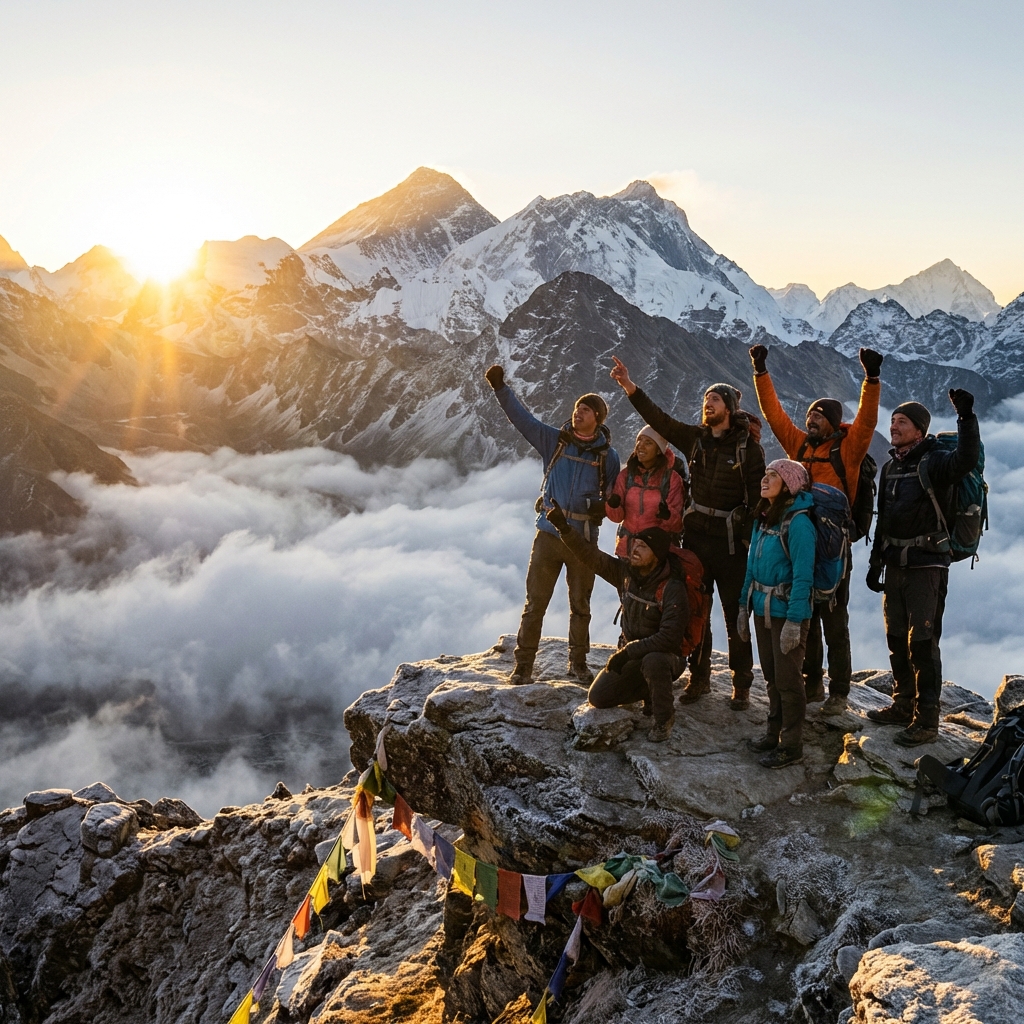
Standing at Poon Hill at sunrise, you'll have panoramic views of:
- Dhaulagiri (8,167m) - The world's 7th highest peak
- Annapurna I (8,091m) - The world's 10th highest peak
- Annapurna South (7,219m)
- Machapuchare (6,993m) - The iconic "Fishtail" peak
- Hiunchuli (6,441m)
- Plus dozens of additional peaks in the Annapurna and Dhaulagiri ranges
This mountain panorama rivals or exceeds views from much longer, harder treks. You're getting an incredible visual reward for relatively modest effort.
Short Duration, Real Adventure
At 4-5 days, Poon Hill is achievable for trekkers with limited vacation time. But don't confuse "short" with "not a real trek." You'll:
- Climb over 3,300 stone steps on the iconic Tikhedhunga-Ghorepani staircase
- Trek through ancient rhododendron forests that bloom spectacularly in spring
- Stay in traditional Gurung villages untouched by modernization
- Wake at 4:30 AM to climb 300m to Poon Hill for sunrise
- Experience authentic Nepali teahouse culture and cuisine
This is a genuine multi-day mountain adventure with challenging moments, cultural immersion, and the satisfaction of earning your views through physical effort.
Low Altitude Means Low Risk
At 3,210 meters maximum, Poon Hill sits well below the 3,500m threshold where altitude sickness becomes common. While mild symptoms are possible (slight headache, minor fatigue), serious altitude-related emergencies are extremely rare. This dramatically simplifies both medical preparation and agency safety requirements.
Altitude Comparison:
| Trek | Max Altitude | AMS Risk |
|---|---|---|
| Poon Hill | 3,210m | Very Low |
| Langtang Valley | 4,773m | Low-Moderate |
| ABC | 4,130m | Low |
| EBC | 5,364m | Moderate-High |
| Annapurna Circuit | 5,416m | Moderate-High |
This low altitude profile means agencies don't need the extensive high-altitude protocols required for EBC or Annapurna Circuit. While this reduces costs, it unfortunately also attracts corner-cutting operators who view Poon Hill as requiring minimal expertise.
The Accessibility Paradox
Poon Hill's accessibility is both its strength and a potential pitfall. The same factors that make it perfect for beginners (low altitude, short duration, close to Pokhara) also attract fly-by-night agencies offering unsustainably cheap packages. These operators reason that "nothing serious can happen on Poon Hill" and cut corners accordingly. Your job is finding agencies that maintain professional standards regardless of the trek's relative simplicity.
Do You Actually Need an Agency for Poon Hill?
This is the first question most first-timers should answer before comparing agencies. The honest answer is nuanced.
The Guide Requirement: Yes, Mandatory
Since April 2023, all foreign trekkers in Nepal must trek with a licensed guide or porter. This rule ended the era of completely independent trekking on popular routes including Poon Hill. Violators face fines at checkpoints, and permits won't be issued to unaccompanied trekkers.
What This Means Practically:
You must have at minimum a licensed guide or porter accompanying you. This person must carry government credentials verifiable at TIMS checkpoints. You cannot legally complete Poon Hill alone, even if you're an experienced trekker.
Agency vs. Hiring a Guide Directly
With a guide required, your real choice is between:
Option A: Book Through an Agency
- Agency handles all logistics (permits, transport, accommodation)
- Package pricing includes everything
- Less flexibility but less planning required
- Quality control depends on agency reputation
- Higher cost but more convenience
Option B: Hire a Guide Independently
- Find and hire a licensed guide in Pokhara directly
- Arrange your own permits, transport, and accommodation
- More flexibility in schedule and pace
- Requires more research and Pokhara time
- Lower cost but more effort
When a Full Agency Package Makes Sense
Book with an agency if:
- This is your first Nepal trip and you want everything handled
- You have limited time in Pokhara before trekking
- You're uncomfortable with language barriers and local negotiations
- You prefer knowing exact costs upfront
- You want a safety net if anything goes wrong
- You're traveling solo and want structured group joining
- You value convenience over maximum cost savings
Agency Advantages for First-Timers:
- No Pokhara research time - Arrive and start trekking
- Pre-negotiated services - No haggling over prices
- Accountability - Someone to contact if problems arise
- Permit handling - No navigating bureaucracy
- Transport arranged - No finding buses or jeeps
- Teahouse reservations - Guaranteed rooms in peak season
- Group joining - Meet other trekkers on shared departures
When Hiring a Guide Directly Makes Sense
Go independent-with-guide if:
- You have 2+ days in Pokhara to arrange logistics
- You're comfortable negotiating in unfamiliar environments
- You want maximum flexibility in your schedule
- Budget is a primary concern
- You have previous Asia travel experience
- You want to build direct relationships with local guides
- You prefer arranging services piecemeal
Independent-With-Guide Advantages:
- Lower total cost - 20-30% savings possible
- More flexibility - Change plans as you go
- Direct relationship - Know exactly who your guide is
- Support local directly - More money goes to guide, less to middlemen
- Customize everything - Your pace, your teahouses, your itinerary
Pro Tip
If you have 48 hours in Pokhara before trekking, consider walking through Lakeside's trekking agency streets and meeting guides directly. A face-to-face conversation reveals more about guide quality than any online booking. Many excellent freelance guides work this area and offer better value than agency packages for short treks like Poon Hill.
The Cost Difference
Understanding the math helps you decide:
Agency Package (Mid-Range): $500-700 total Includes: Permits, transport, guide, accommodation, meals
Independent Arrangement: $350-500 total
- Guide: $25-30/day x 4-5 days = $100-150
- Permits: $40-50
- Transport: $30-50
- Accommodation: $5-10/night x 4 nights = $20-40
- Meals: $20-30/day x 5 days = $100-150
- Your time: Several hours arranging
Savings: $100-200 with independent arrangement
Hidden Costs of Independent:
- Time researching guides and logistics
- Risk of inexperienced or unlicensed guide
- No backup if guide gets sick
- Potential teahouse availability issues in peak season
For most first-timers, the $100-200 premium for agency convenience is money well spent. Experienced travelers who enjoy the logistics may find independent arrangement rewarding.
What Makes a Good Poon Hill Agency
Now that you've decided an agency makes sense, how do you evaluate them? Poon Hill agencies need different qualities than high-altitude trekking operators.
Licensed and Registered Operations
Even for a "simple" trek like Poon Hill, legitimate business registration matters.
TAAN Membership (Trekking Agencies Association of Nepal)
TAAN registration indicates legitimate business operation, insurance compliance, and industry accountability. While not a guarantee of quality, unlicensed agencies lack even basic accountability mechanisms.
Verification Process:
- Visit www.taan.org.np/members
- Search for the agency name
- Confirm membership is current
- Call TAAN office: +977 1 4440921 for verification
Why This Matters for Poon Hill:
The low barrier to offering Poon Hill packages attracts unlicensed operators. Some are legitimate small operations building their businesses; others are individuals with no insurance, unverified guides, and no accountability if things go wrong. TAAN registration is your first filter.
Good Value, Not Just Cheap
Poon Hill shouldn't be expensive. The short duration, low altitude, and proximity to Pokhara mean legitimate costs are modest. Quality agencies offer good value rather than suspiciously cheap packages.
Understanding Poon Hill Costs:
| Component | Budget | Mid-Range | Premium |
|---|---|---|---|
| Guide (4-5 days) | $80-100 | $100-150 | $150-200 |
| Permits (ACAP + TIMS) | $40-50 | $40-50 | $40-50 |
| Transport | $30-40 | $40-60 | $60-100 |
| Accommodation | $20-30 | $30-50 | $50-100 |
| Meals | $80-100 | $100-140 | $140-200 |
| Agency overhead/profit | $50-80 | $100-150 | $200-300 |
| Total | $300-400 | $450-600 | $640-950 |
Red Flag Pricing:
- Under $250: Almost certainly cutting corners
- $250-300: Bare minimum, scrutinize carefully
- $300-450: Budget but achievable ethically
- $500-700: Mid-range with quality services
- $800+: Premium features justify cost
The $200 Poon Hill Package Trap
If you see Poon Hill packages under $200, run. The math simply doesn't work. At that price, agencies either use unlicensed guides, skip insurance, provide insufficient meals, or plan to hit you with hidden fees. No legitimate operator can provide ethical Poon Hill service at that rate.
Flexible Scheduling
Quality Poon Hill agencies recognize that short treks attract diverse schedules and offer flexibility accordingly.
Flexibility Indicators:
- Multiple departure dates or private treks available
- Daily departures in peak season
- Willingness to customize standard itinerary
- Options to extend to Ghandruk Loop or add Mardi Himal
- Clear policy on weather delays
Questions to Ask:
- "Can I start on [specific date] rather than group departure dates?"
- "What if weather delays our Poon Hill sunrise?"
- "Can we extend one day at Ghorepani if I want more time?"
- "Is adding Ghandruk to the return route possible?"
Extension Options
Good Poon Hill agencies offer natural extensions for trekkers wanting more:
Common Extension Options:
| Extension | Additional Days | What It Adds |
|---|---|---|
| Ghandruk Loop | +1 day | Traditional village, different return route |
| Tadapani extension | +1 day | Forest walking, ABC approach views |
| Mardi Himal add-on | +4-5 days | Higher altitude, remote experience |
| ABC combination | +6-7 days | Complete Annapurna Sanctuary experience |
Why This Matters:
Agencies that only offer standard Poon Hill packages may lack regional expertise. Those presenting extension options demonstrate Annapurna region knowledge and can help you if you decide partway through that you want more trekking.
Experienced Local Guides
For Poon Hill, you don't need high-altitude mountaineering experts. But you do need guides who:
- Hold valid government trekking guide licenses
- Know the Poon Hill route thoroughly
- Speak functional English
- Understand basic first aid
- Know the cultural and natural history of the region
- Can manage weather delays competently
Questions About Guides:
- "Will the same guide stay with me throughout?"
- "How many Poon Hill treks has this guide completed?" (Look for 20+)
- "Is the guide from the Annapurna region?"
- "Does the guide have first aid training?"
- "Can I speak with or video call the guide before booking?"
Pro Tip
For Poon Hill specifically, local Gurung or Magar guides add cultural depth beyond basic route knowledge. They can explain village customs, translate conversations with teahouse owners, and share insights about their home region that outside guides cannot. Ask agencies if their Poon Hill guides are from the Annapurna region.
Transparent Inclusions
Quality agencies are clear about what's included and what's not. No surprises.
Standard Poon Hill Package Should Include:
- Airport/bus station pickup in Pokhara
- Transport to Nayapul (trailhead) and return
- ACAP permit and TIMS card
- Licensed English-speaking guide
- All teahouse accommodation (twin-sharing usually)
- All meals on trek (breakfast, lunch, dinner)
- Basic first aid kit
Usually Not Included (Budget Separately):
- Pokhara hotel nights (varies by package)
- Porter (optional on Poon Hill)
- Hot showers ($2-4 per shower)
- WiFi and charging ($2-4)
- Soft drinks, alcohol, snacks beyond meals
- Tips for guide ($40-60 recommended)
- Travel insurance
- Personal trekking gear
Hidden Costs to Clarify:
- "Is Pokhara accommodation included before/after trek?"
- "Are all three meals included every trekking day?"
- "What drinks are included with meals?"
- "Is the single room supplement?" (if traveling solo)
- "What about hot water for showers?"
Red Flags for Short Trek Agencies
Poon Hill's popularity and perceived simplicity attract operators who shouldn't be running treks. Recognize these warning signs.
Ultra-Cheap Prices Without Explanation
As outlined above, Poon Hill can be done affordably, but not for $150-200. When prices fall that low, something is being cut:
What Gets Cut at Rock-Bottom Prices:
- Unlicensed guides (no training, no accountability)
- No guide insurance (you're liable if they're injured)
- Shared guides (1 guide for 8+ trekkers)
- Minimal meals (breakfast only, or "meals at your expense")
- Cheapest teahouses (less clean, less safe)
- No emergency backup or office support
Dismissing Preparation as Unnecessary
Watch for agencies that oversell Poon Hill's ease:
Warning Phrases:
- "Anyone can do Poon Hill, no preparation needed"
- "Just show up, no fitness required"
- "It's basically a walk in the park"
- "Even my grandmother did it"
Reality: Poon Hill involves 4-6 hours of daily walking, over 3,000 stone steps on day 2, and altitude that can cause mild symptoms. While accessible to moderately fit people, it's not a casual stroll. Agencies dismissing preparation don't take your experience seriously.
What Quality Agencies Say:
- "Moderate fitness is recommended"
- "Some preparation helps you enjoy it more"
- "The Tikhedhunga stairs are challenging but achievable"
- "We'll match our pace to your fitness level"
No Clear Guide Assignment
Quality agencies assign specific guides and facilitate introduction. Red flags include:
- "You'll meet your guide at the trailhead"
- "We'll assign whoever is available"
- Refusal to provide guide details before departure
- No option to speak with the guide beforehand
- Vague answers about guide experience
Pressure Tactics
Legitimate agencies don't need high-pressure sales:
Warning Signs:
- "This price is only valid today"
- "Book now or lose your spot" (for non-peak season)
- "Everyone else has already booked"
- Unwillingness to answer questions before payment
- Pushing deposits before providing written itinerary
No Written Itinerary or Contract
Before any payment, you should receive:
- Day-by-day itinerary with overnight locations
- Clear list of inclusions and exclusions
- Cancellation and refund policy
- Emergency contact information
- Guide assignment (name, experience)
- Total price breakdown
Agencies unwilling to provide written documentation before deposit suggest they want flexibility to change terms later.
The Subcontracting Risk
Some Kathmandu agencies offering Poon Hill packages simply subcontract to unknown Pokhara operators, adding markup without quality control. Ask directly: "Does your company operate this trek, or do you subcontract to a local partner?" There's nothing inherently wrong with partnerships, but you should know who actually handles your trek and verify their credentials independently.
What Should Be Included in Poon Hill Packages
Understanding standard inclusions helps you compare packages accurately.
Transportation
Pokhara to Trailhead (Nayapul):
- 1.5-2 hour drive, usually by shared jeep or private vehicle
- Some agencies use public bus (lower cost but less comfortable)
- Premium packages offer private vehicle
Return Transport:
- From Nayapul (if returning same way) or Lumle/Birethanti (if Ghandruk loop)
- Usually same standard as outbound
Quality Differences:
| Level | Transport Type | Comfort |
|---|---|---|
| Budget | Shared local jeep | Basic, crowded |
| Mid-Range | Agency jeep, shared | Comfortable |
| Premium | Private vehicle | Maximum comfort |
Permits
Two permits required for Poon Hill:
ACAP (Annapurna Conservation Area Permit):
- Cost: NPR 3,000 (~$23 USD) for SAARC nationals, NPR 3,000 for others
- Required for entry to Annapurna Conservation Area
- Obtained in Pokhara (Tourism Board office) or Kathmandu
TIMS (Trekking Information Management System):
- Cost: NPR 2,000 (~$15 USD)
- Required for all organized treks
- Since 2023 guide requirement, agencies handle this for you
What to Verify:
- "Are both ACAP and TIMS permits included?"
- "Will you process permits, or must I obtain them myself?"
- "How long does permit processing take?"
Guide Services
Standard Guide Service Includes:
- Licensed trekking guide (verify license number)
- Guide present throughout trek (no guide-sharing)
- Guide meals and accommodation (covered by agency)
- Guide insurance
- Basic trail information and pace management
- Assistance with teahouse check-in
Premium Guide Service May Add:
- Senior guide with 50+ Poon Hill completions
- Cultural interpretation and local knowledge
- Photography assistance at viewpoints
- Language skills beyond English
Accommodation
Teahouse Standards on Poon Hill Route:
The Poon Hill route has excellent teahouse infrastructure. Even budget packages should provide:
- Private room (twin beds usually)
- Clean bedding (blankets provided)
- Shared bathroom (private bathroom in better lodges)
- Common dining area with heating
What Varies by Price:
| Level | Room Standard | Bathroom | Extras |
|---|---|---|---|
| Budget | Basic room, shared | Shared | Minimal |
| Mid-Range | Quality teahouse, private | Shared or attached | Hot water available |
| Premium | Best available lodge | Private attached | Guaranteed hot water |
Peak Season Note: In October-November and March-April, better teahouses fill quickly. Agency pre-booking provides accommodation security that independent trekkers may struggle to achieve.
Meals
Standard Meal Inclusion (Full Board):
- Breakfast: Porridge, eggs, toast, tea/coffee
- Lunch: Dal bhat, noodles, or similar
- Dinner: Dal bhat, pasta, or similar
- Hot drinks with meals (tea/coffee)
Usually Excluded:
- Bottled water (bring purification)
- Soft drinks
- Alcohol
- Snacks between meals
- Extra hot drinks
Meal Quality Reality: Teahouse food on Poon Hill is generally good but repetitive. Expect dal bhat (rice, lentils, vegetables) at most meals. This is authentic trekking food - nutritious and filling if not gourmet. Premium packages may include more menu variety.
Porter Service (Optional)
Unlike longer treks, porters are genuinely optional on Poon Hill. Many trekkers carry their own daypacks.
Porter Makes Sense If:
- You have knee issues or concerns about stairs
- You want to trek light for enjoyment
- You're older and want less strain
- You prefer maximum comfort
Poon Hill Porter Details:
- Cost: $15-25/day additional
- Carries 10-15kg maximum for short trek
- Usually shared porter (2 trekkers : 1 porter)
- Walks separately, meets you at teahouses
Skip Porter If:
- You're reasonably fit and enjoy carrying a pack
- Your daypack is under 6-8kg
- Budget is a significant concern
- You prefer self-sufficiency
| Trek | Duration | Max Altitude | Difficulty | Best For | Cost |
|---|---|---|---|---|---|
| Budget Package | 4 days | $300-450 | Basic teahouse | Budget travelers, experienced | Essential services only |
| Mid-Range Package | 4-5 days | $500-700 | Quality teahouse | Most first-timers | Full service, good value |
| Premium Package | 5+ days | $800-1,100 | Best available lodges | Comfort-focused, special occasions | Maximum comfort and flexibility |
Price Ranges: What You Get at Each Level
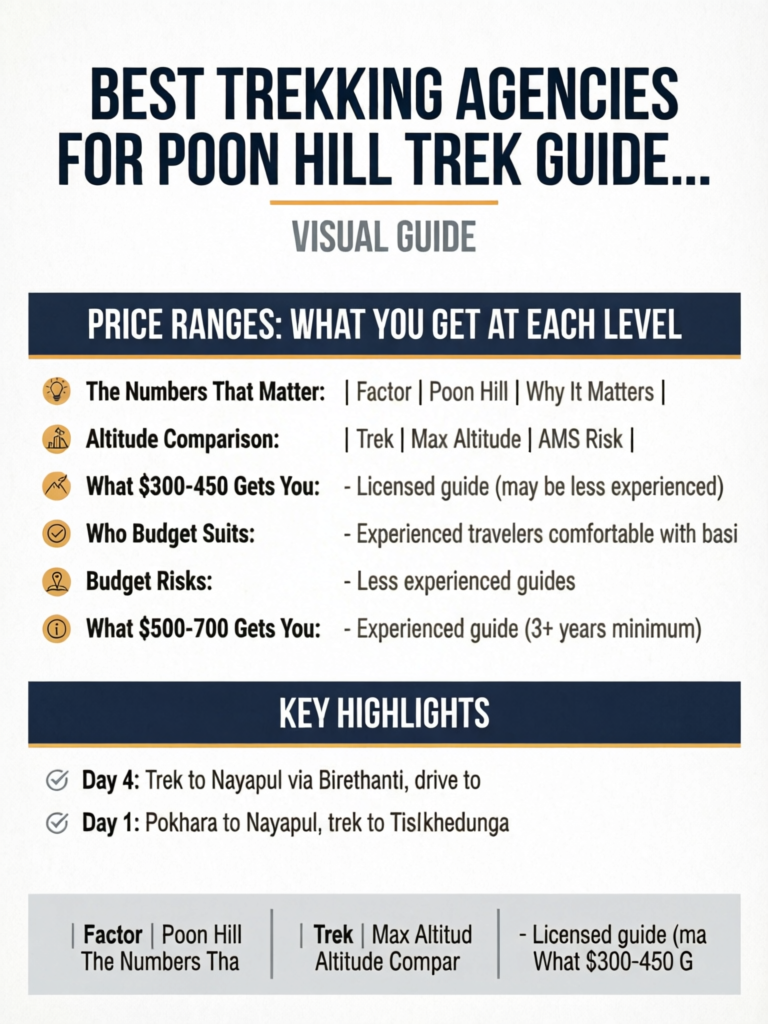
Budget ($300-450): Achievable but Bare Bones
What $300-450 Gets You:
- Licensed guide (may be less experienced)
- Basic teahouse accommodation (clean but simple)
- Three meals daily (standard trekking food)
- Essential permits included
- Group transport (shared jeep)
- Usually group departures only
Who Budget Suits:
- Experienced travelers comfortable with basics
- Budget-conscious trekkers
- Those who've trekked before
- Younger travelers who don't need extras
- Solo travelers joining groups
Budget Reality Check:
A $350 Poon Hill package becomes approximately $450 total after adding:
- Tips ($40-50)
- Hot showers ($15-20)
- Charging/WiFi ($10-15)
- Snacks/drinks ($20-30)
Budget Risks:
- Less experienced guides
- No flexibility for changes
- Basic accommodations
- Shared guides possible
- Minimal agency support
Budget Can Still Be Ethical
Some excellent small Pokhara agencies offer budget packages with experienced guides and fair practices. The key is verification. A TAAN-registered budget agency with strong reviews can provide better service than expensive international operators subcontracting to unknown partners.
Mid-Range ($500-700): The Sweet Spot for First-Timers
What $500-700 Gets You:
- Experienced guide (3+ years minimum)
- Quality teahouse selection
- Full board with more menu options
- All permits processed and included
- Comfortable transport
- Flexible scheduling options
- Private trek or quality group joining
- Responsive agency support
- Some Pokhara accommodation often included
Who Mid-Range Suits:
- First-time Nepal trekkers
- Those who value quality over minimum cost
- Couples and small groups
- Trekkers wanting reliability
- Anyone wanting the experience without worrying about logistics
Why Mid-Range is the Sweet Spot:
For first-timers, the $150-250 premium over budget buys peace of mind and better experience quality. You get:
- Guides who enhance rather than just accompany
- Teahouses with hot water and better food
- Flexibility if you need itinerary adjustments
- Responsive support if anything goes wrong
- More enjoyable overall experience
Mid-Range True Cost:
A $600 mid-range package becomes approximately $700-750 total after:
- Tips ($50-60)
- Showers/charging ($25-30)
- Extra drinks/snacks ($20-30)
Premium ($800-1,100): Maximum Comfort and Flexibility
What $800-1,100 Gets You:
- Senior guide with extensive experience
- Best available lodges at each stop
- Enhanced meal options
- All logistics handled seamlessly
- Private treks as standard
- Multiple Pokhara hotel nights
- Maximum flexibility for changes
- 24/7 agency support
- Some gear provided or included
- Photography assistance often available
- Extension options easily arranged
Who Premium Suits:
- Older trekkers wanting comfort (55+)
- Special occasions (honeymoons, milestone birthdays)
- Those with health concerns needing extra attention
- Photographers wanting maximum flexibility
- Corporate groups
- Anyone for whom budget isn't the primary constraint
When Premium is Worth It:
Special Occasions: Honeymoons, milestone birthdays, retirement celebrations benefit from premium attention and comfort.
Physical Concerns: If you're uncertain about your fitness or have health considerations, premium support provides confidence and flexibility.
Photography Focus: Premium flexibility allows waiting for weather, extra sunrise time, and pace adjustments for golden hour.
Limited Time: If your Nepal trip is a once-in-a-lifetime experience, maximizing enjoyment may be worth the premium.
Premium True Cost:
An $900 premium package typically includes most extras, making true total approximately $1,000-1,100 after tips and minor additions.
Poon Hill Itinerary Options
Understanding route variations helps you choose the right package and evaluate agency expertise.
Express Poon Hill (3-4 Days)
Typical Itinerary:
- Day 1: Pokhara to Nayapul, trek to Tikhedhunga (1,540m)
- Day 2: Trek to Ghorepani (2,860m) - the big staircase day
- Day 3: Poon Hill sunrise (3,210m), trek to Nayapul, drive to Pokhara
- Optional Day 4: Buffer day
Characteristics:
- Fastest option, sunrise plus return same day
- Longer hiking on day 3 (descent to Nayapul)
- Less time to enjoy Ghorepani/Tadapani area
- Best for time-pressed trekkers
- More demanding physically
Price Range: $300-600 typically
Best For: Very fit trekkers with extremely limited time
Classic Poon Hill (4-5 Days)
Standard 4-Day Itinerary:
- Day 1: Pokhara to Nayapul, trek to Tikhedhunga (1,540m)
- Day 2: Trek to Ghorepani (2,860m)
- Day 3: Poon Hill sunrise (3,210m), trek to Tadapani (2,630m)
- Day 4: Trek to Nayapul via Birethanti, drive to Pokhara
Characteristics:
- Most popular itinerary
- Manageable daily distances
- Time to enjoy sunrise properly
- Different descent route adds variety
- Suitable for moderate fitness levels
Price Range: $400-700 typically
Best For: Most first-timers, this is the default recommendation
Extended Ghorepani-Ghandruk Loop (5-6 Days)
Typical Itinerary:
- Day 1: Pokhara to Nayapul, trek to Tikhedhunga (1,540m)
- Day 2: Trek to Ghorepani (2,860m)
- Day 3: Poon Hill sunrise (3,210m), trek to Tadapani (2,630m)
- Day 4: Trek to Ghandruk (1,940m) - famous Gurung village
- Day 5: Explore Ghandruk, trek to Nayapul, drive to Pokhara
- Optional Day 6: Buffer
Characteristics:
- Includes iconic Ghandruk village
- More cultural immersion
- Varied scenery and villages
- Less rushed overall
- Better photo opportunities
Price Range: $500-900 typically
Best For: Those wanting cultural depth, photographers, travelers with an extra day
Pro Tip
The Ghandruk extension is highly recommended if you have an extra day. Ghandruk is one of Nepal's most beautiful traditional villages, with well-preserved Gurung architecture, excellent mountain views, and authentic cultural experiences. The additional day transforms Poon Hill from "great short trek" to "complete Annapurna introduction."
Poon Hill + Mardi Himal (8-10 Days)
Typical Itinerary:
- Days 1-4: Standard Poon Hill loop
- Day 5: Return to Pokhara, rest/resupply
- Days 6-9: Mardi Himal trek (different route, higher altitude)
- Day 10: Return to Pokhara
Characteristics:
- Two distinct trekking experiences
- Higher altitude on Mardi section (4,500m viewpoint)
- More off-the-beaten-path feel
- Significant step up in difficulty
- Requires good fitness and acclimatization
Price Range: $900-1,600 typically
Best For: Those wanting more challenge, trekkers with 10+ days, Mardi Himal provides wilder experience
Poon Hill as ABC Warm-Up (12-14 Days Total)
Combined Itinerary:
- Days 1-4: Poon Hill loop (acclimatization)
- Day 5: Travel to ABC trailhead
- Days 6-12: Annapurna Base Camp trek
- Days 13-14: Return to Pokhara
Characteristics:
- Uses Poon Hill as acclimatization for ABC
- Complete Annapurna region experience
- Efficient if you want both experiences
- Requires significant time commitment
- More demanding overall
Price Range: $1,200-2,200 typically
Best For: Those wanting the full Annapurna experience with built-in acclimatization
Pokhara Agencies vs. Booking from Kathmandu
Where you book matters for Poon Hill, perhaps more than for longer treks.
The Pokhara Advantage
Poon Hill starts from Pokhara, and Pokhara-based agencies have significant advantages:
Local Expertise: Pokhara agencies specialize in Annapurna region treks. Their guides do Poon Hill repeatedly, maintaining current knowledge of trail conditions, teahouse quality, and seasonal considerations.
Lower Overhead: Without Kathmandu office costs, Pokhara agencies can offer equivalent services at 10-20% lower prices while paying guides equally.
Last-Minute Flexibility: Need to start tomorrow? Pokhara agencies can often accommodate, arranging guides and permits quickly. Kathmandu agencies need coordination time.
Direct Relationships: Pokhara operators have direct relationships with Poon Hill teahouses and guides, ensuring quality control without middlemen.
Personal Service: Smaller Pokhara operations provide more personal attention. Owners are often directly involved in trek oversight.
When Pokhara Booking Makes Sense
Book with Pokhara agency if:
- You're flying directly to Pokhara
- Poon Hill is your primary Nepal trek
- Budget matters (Pokhara is cheaper)
- You value local expertise
- You want flexibility and personal service
- You have time to meet agencies in person
How to Book in Pokhara:
- Before Arrival: Email 3-5 agencies requesting quotes and guide information
- In Pokhara: Walk Lakeside's agency streets, meet operators in person
- Compare: Evaluate responsiveness, transparency, and guide details
- Verify: Check TAAN registration, read recent reviews
- Book: Pay deposit (usually 50%), get written itinerary
When Kathmandu Booking Makes Sense
Book with Kathmandu agency if:
- You're combining Poon Hill with other Nepal activities
- You want everything arranged before leaving home
- You prefer established international booking systems
- You're doing ABC or EBC afterward with the same agency
- You don't have time to shop around in Pokhara
Kathmandu Agency Considerations:
Subcontracting: Many Kathmandu agencies subcontract Poon Hill to Pokhara partners, adding markup without direct quality control. Ask explicitly: "Do you operate this trek or use a Pokhara partner?"
Higher Costs: Kathmandu agencies typically charge 15-25% more for equivalent Poon Hill packages due to overhead and margins.
Less Specialization: Kathmandu agencies handle Nepal-wide operations. Their Annapurna expertise may be less focused than Pokhara specialists.
The Hybrid Approach
Some agencies maintain both Kathmandu headquarters and Pokhara operations. These can provide Kathmandu booking convenience with Pokhara local expertise. Ask:
- "Do you have a Pokhara office?"
- "Who specifically operates your Poon Hill treks?"
- "Will my guide be Pokhara-based or sent from Kathmandu?"
The Direct Flight Factor
If you fly directly to Pokhara (increasingly common with Pokhara International Airport), booking with a Pokhara agency makes overwhelming sense. You avoid Kathmandu entirely, save money, and work with local specialists.
Last-Minute Booking Options
Poon Hill is one of Nepal's most accessible treks for last-minute arrangements.
Same-Week Booking is Usually Possible
Unlike EBC or restricted area treks requiring advance permits, Poon Hill can often be arranged within days:
Off-Season (Dec-Feb, Jun-Sep): Same-day or next-day starts are possible. Agencies have guides available and teahouse space is abundant.
Shoulder Season (Early Oct, Late Nov, Early Mar, Late May): 2-3 days notice usually sufficient. Some agency coordination needed.
Peak Season (Mid-Oct to Mid-Nov, Mid-Mar to Mid-Apr): 4-7 days minimum recommended. Guide availability and teahouse reservations require advance arrangement.
How to Arrange Last-Minute
Option A: Agency in Pokhara
- Walk Lakeside trekking streets
- Visit 3-4 agencies, explain your timeframe
- Get quotes and guide availability
- Book with the most responsive, transparent option
- Start trekking (can begin same or next day off-season)
Option B: Direct Guide Hire
- Ask at your hotel for guide recommendations
- Meet the guide in person, verify credentials
- Arrange permits (guide assists)
- Purchase bus/jeep tickets to Nayapul
- Start trekking
Last-Minute Costs: Expect to pay slightly more for urgent arrangements, but nothing excessive. Last-minute premiums of 10-15% are reasonable; more than 25% suggests opportunistic pricing.
Peak Season Last-Minute Challenges
October-November is peak season with thousands of daily trekkers. Last-minute challenges include:
Teahouse Availability: Popular stops like Ghorepani fill completely. Without reservations, you may face substandard lodges or having to continue to less convenient stops.
Quality Guide Availability: Better guides are booked in advance. Last-minute guides may be less experienced.
Group Joining Limited: Scheduled group departures fill up. You may need more expensive private trek.
Solution: Even in peak season, agencies can usually arrange something. Flexibility about exact itinerary and willingness to pay private trek rates increases options.
Questions to Ask Before Booking
Send these questions to any agency you're seriously considering. Their response quality reveals operational transparency.
About Your Guide
- "What is my guide's name and how many years has he/she been guiding?"
- "How many times has this guide completed the Poon Hill trek?" (Look for 20+)
- "Is the guide from the Annapurna region?"
- "Does the guide have a government trekking guide license?" (Request number)
- "What first aid training does the guide have?"
- "Can I speak with or video call the guide before booking?"
- "Is this specific guide guaranteed, or might you substitute?"
About Services and Inclusions
- "What exactly is included in the quoted price?"
- "What is NOT included that I should budget for?"
- "How many Pokhara hotel nights are included (if any)?"
- "What is the teahouse standard - basic or quality?"
- "Are all three meals included every trekking day?"
- "What drinks are included with meals?"
- "Is the single room supplement included for solo travelers?"
About Logistics
- "Which starting point do you use - Nayapul or Birethanti?"
- "Which return route - same way or Ghandruk loop?"
- "How long does permit processing take?"
- "What time do we depart on Day 1?"
- "What transport is used - shared jeep or private vehicle?"
About Flexibility
- "Can the itinerary be modified if I want to extend?"
- "What happens if weather delays Poon Hill sunrise?"
- "Can I add the Ghandruk extension during the trek?"
- "What if I'm struggling and need a slower pace?"
About Policies
- "What is your cancellation and refund policy?"
- "What happens if you need to cancel due to conditions?"
- "Do you have travel insurance, and what does it cover?"
- "What emergency procedures are in place?"
Pro Tip
Create a simple spreadsheet comparing agency responses. Agencies that answer all questions completely and promptly demonstrate professionalism. Those who evade questions, take days to respond, or become defensive reveal potential problems before you pay anything.
Frequently Asked Questions About Poon Hill Agencies
How much should I budget for a Poon Hill trek with an agency?
Total budget recommendation by tier:
| Tier | Package Cost | Extras | Total Budget |
|---|---|---|---|
| Budget | $300-450 | $100-150 | $400-600 |
| Mid-Range | $500-700 | $100-150 | $600-850 |
| Premium | $800-1,100 | $50-100 | $850-1,200 |
Extras include: Tips ($40-60), hot showers ($15-25), charging/WiFi ($10-20), snacks and drinks ($20-40), travel insurance (varies)
For most first-timers: Budget $600-800 total for a comfortable mid-range experience.
Can I do Poon Hill without an agency?
You cannot do Poon Hill completely independently due to the 2023 guide requirement. However, you can:
Option A: Hire a guide directly in Pokhara and arrange logistics yourself (permits, transport, accommodation). This saves 20-30% but requires more effort.
Option B: Book a minimal package that includes only the required guide and permits, arranging accommodation yourself. This offers middle ground.
Not Possible: Trekking completely alone. Checkpoints verify guide accompaniment and will fine unaccompanied trekkers.
Should I book online or in Pokhara?
Book Online If:
- You want certainty before arriving
- You're arriving with very limited time
- You prefer everything confirmed in advance
- You're combining multiple activities requiring coordination
- You don't want to spend Pokhara time shopping agencies
Book in Pokhara If:
- You have 2+ days before trekking
- You want to meet guides in person
- Budget is a significant concern
- You prefer supporting local directly
- You're flexible about departure dates
Best Approach for First-Timers: If you have 2+ days in Pokhara, meet 2-3 agencies in person before deciding. Face-to-face conversation reveals more than any website. If time is tight, book online with a well-reviewed agency and don't worry about potentially paying slightly more.
What's the difference between Pokhara and Kathmandu agencies for Poon Hill?
Pokhara Agencies:
- Lower prices (10-20% typically)
- Better local expertise
- More flexible for changes
- Smaller, more personal service
- May have simpler booking systems
- Ideal for Poon Hill-focused trips
Kathmandu Agencies:
- Higher prices, more overhead
- Convenient if doing Kathmandu activities
- Established international systems
- May subcontract to Pokhara partners
- Better for complex multi-activity itineraries
- Less specialized for Annapurna region
Recommendation: For Poon Hill specifically, Pokhara agencies offer better value and expertise. Only choose Kathmandu agencies if combining with significant Kathmandu-based activities.
How far in advance should I book?
Peak Season (Oct-Nov, Mar-Apr):
- Ideal: 2-4 weeks advance
- Minimum: 1 week advance
- Last-minute: Possible but limited options
Shoulder Season:
- Ideal: 1-2 weeks advance
- Minimum: A few days
- Last-minute: Usually fine
Off-Season:
- Ideal: 1 week advance
- Minimum: 2-3 days
- Last-minute: Often same-day possible
Factors Requiring Earlier Booking:
- Specific guide requests
- Premium agencies with limited capacity
- Festival periods (Dashain, Tihar)
- Large groups
- Extension options (ABC add-on, etc.)
Is a porter necessary for Poon Hill?
Usually No. Poon Hill is a short trek (4-5 days) with excellent infrastructure. If you can carry a 6-8kg daypack comfortably, you don't need a porter.
Consider a Porter If:
- You have knee problems (the stairs are challenging)
- You're 55+ and want less strain
- You have any physical concerns
- You simply prefer trekking without weight
- Budget isn't a significant constraint ($15-25/day)
Skip Porter If:
- You're reasonably fit
- You prefer self-sufficiency
- Budget matters
- Your pack is light (under 8kg)
What if weather prevents Poon Hill sunrise?
Clouds or rain occasionally obstruct the famous sunrise view. Quality agencies handle this by:
Good Agency Response:
- Building flexibility into itinerary
- Offering to wait an extra morning if weather might clear
- Adjusting schedule without penalty
- Providing alternative viewpoints
Poor Agency Response:
- Rigid itinerary with no flexibility
- Blaming you for "bad luck"
- Refusing any schedule adjustments
- Charging extra for additional nights
Your Protection:
- Ask about weather contingency before booking
- Build buffer days into your Nepal schedule
- Have realistic expectations (weather is uncontrollable)
- Remember: the trek itself is beautiful even without clear sunrise
Are tips mandatory?
Tips are expected and customary in Nepal, forming significant portion of guide income.
Recommended Poon Hill Tipping:
- Guide: $8-12 per day = $35-50 for 4-day trek
- Porter (if used): $5-8 per day = $20-35 for 4-day trek
How to Tip:
- Give directly to each person
- Present at farewell in Pokhara or final trail meal
- Cash in Nepali Rupees or USD acceptable
- Express personal thanks along with tip
Tipping Etiquette:
- Tips reflect service quality
- Exceptional guides deserve higher tips
- Don't tip through agency (may not reach staff)
- Smaller tips are acceptable if service was poor
What happens if I can't complete the trek?
Injury or Illness:
- Guide arranges safe descent
- Transport back to Pokhara arranged
- Medical care coordinated if needed
- No refund for unused trek days (standard policy)
- Travel insurance covers medical costs
Fitness Issues:
- Pace adjustment possible within reason
- Extra rest stops can be arranged
- Shortening itinerary possible (skip Tadapani extension)
- Emergency descent if truly struggling
Weather Closure:
- Wait for conditions to improve
- Alternative viewpoints if main route closed
- No refund for weather (uncontrollable)
- Quality agencies provide maximum flexibility
Your Protection:
- Have comprehensive travel insurance
- Be honest about fitness level when booking
- Build buffer days into overall schedule
- Choose agency with flexible policies
How do I know if reviews are genuine?
Signs of Authentic Reviews:
- Specific details (guide names, teahouse names, weather conditions)
- Mix of positives and minor negatives
- Various nationalities and writing styles
- Photos that look genuine
- Spread across many months
- Present on multiple platforms
Signs of Fake Reviews:
- All 5-star with generic praise
- Similar writing style across reviews
- Reviews clustered on same dates
- No specific details mentioned
- Only on agency's own website
- Reviewer profile has only 1 review
Verification Strategy:
- Check TripAdvisor, Google Reviews, and Facebook
- Search agency name on Reddit travel forums
- Look for 3-4 star reviews (most honest)
- Find guide names mentioned repeatedly (consistency suggests legitimacy)
- See how agency responds to negative reviews (professionalism indicator)
Related Resources
Preparing for your Poon Hill trek involves more than agency selection. Explore these guides:
Route Planning:
- Poon Hill Trek Complete Guide - Full route overview
- Ghandruk Village Guide - Extended loop destination
- Best Beginner Treks Nepal - Alternative options
Preparation Guides:
- What to Wear Trekking in Nepal - Gear guide
- Fitness Requirements for Nepal Trekking - Physical preparation
- Best Time for Annapurna Trekking - Seasonal guide
Agency and Guide Resources:
- How to Choose a Trekking Agency - General selection guide
- Hiring Guides and Porters in Nepal - Independent hiring
- Independent vs Guided Trekking - Decision framework
- Budget Trekking in Nepal - Cost-saving strategies
Practical Information:
- Pokhara Guide for Trekkers - Gateway city information
- Travel Insurance for Nepal Trekking - Coverage requirements
- Nepal Visa Guide - Entry requirements
- Nepal Trekking Permits Explained - Permit types and costs
Related Trek Agency Guides:
- Best ABC Trekking Agencies - If extending to ABC
- Best EBC Trekking Agencies - For future treks
Your Decision Framework: Choosing the Right Poon Hill Agency
After reading this guide, use this framework for your final decision.
Step 1: Decide Agency vs. Independent-With-Guide
Choose Agency If:
- First Nepal trip
- Limited Pokhara time
- Value convenience over savings
- Want structured experience
Choose Independent If:
- 2+ days in Pokhara
- Budget is priority
- Previous Asia travel experience
- Enjoy arranging logistics
Step 2: Set Your Budget Realistically
| Your Situation | Recommended Tier | Budget Range |
|---|---|---|
| Tight budget, experienced traveler | Budget | $400-600 total |
| First-timer, reasonable budget | Mid-Range | $600-850 total |
| Comfort priority, special occasion | Premium | $850-1,200 total |
Step 3: Choose Your Itinerary
| Available Time | Recommended Itinerary |
|---|---|
| 3-4 days only | Express Poon Hill |
| 4-5 days | Classic Poon Hill (recommended) |
| 5-6 days | Ghorepani-Ghandruk Loop |
| 8-10 days | Poon Hill + Mardi Himal |
Step 4: Decide Where to Book
| Your Situation | Book In |
|---|---|
| Flying to Pokhara, Poon Hill only | Pokhara |
| Limited time before trek | Online/Kathmandu |
| Combining with Kathmandu activities | Kathmandu |
| Have 2+ days in Pokhara | Meet agencies in person |
Step 5: Shortlist 3-5 Agencies
Based on budget and booking location:
- Search TAAN-registered agencies
- Check reviews on TripAdvisor, Google, forums
- Request quotes and guide information
- Evaluate response quality
Step 6: Compare Using Questions List
Send the comprehensive questions list to shortlisted agencies. Track:
- Response time
- Answer completeness
- Guide details provided
- Transparency about costs
- Flexibility indicators
Step 7: Trust Your Judgment
After research, trust your instincts:
- Did communication feel professional?
- Were questions answered fully?
- Did anything feel "off"?
- Does the price-quality balance feel right?
The right agency should leave you feeling confident and excited rather than pressured or uncertain.
Ready to Choose
You now have everything needed to select a Poon Hill agency confidently. Remember: for this accessible, popular trek, the "best" agency is the one that matches your specific priorities, budget, and expectations. A well-reviewed budget agency might be perfect for an experienced traveler, while a first-timer might appreciate mid-range support. Choose based on your needs, verify claims independently, and trust the process.
Final Thoughts
Choosing a trekking agency for Poon Hill requires different considerations than selecting an operator for longer, higher treks. The relative simplicity of Poon Hill (short duration, low altitude, excellent infrastructure) means you don't need the extensive high-altitude protocols required for EBC or Annapurna Circuit. However, this same simplicity attracts corner-cutting operators who view Poon Hill as not requiring professional standards.
Your job is finding agencies that maintain quality regardless of the trek's accessibility. The best Poon Hill operators:
- Provide experienced guides who enhance your cultural and natural appreciation
- Maintain ethical treatment of staff regardless of the trek's "easy" reputation
- Offer flexibility appropriate to a short trek
- Charge fair prices that allow quality service without exploitation
- Communicate transparently before, during, and after your trek
Poon Hill is often called "the perfect first trek" for good reasons. In just 4-5 days, you experience world-class mountain panoramas, traditional Gurung culture, challenging but achievable physical demands, and the magic of Himalayan teahouse trekking. With the right agency or guide, it becomes more than a short trek: it's an introduction to a lifelong love of mountain travel.
The 3,300 stone steps to Ghorepani will challenge your legs. The 4:30 AM wake-up call for Poon Hill sunrise will test your motivation. But standing at 3,210 meters as dawn illuminates Dhaulagiri, Annapurna, and Machapuchare is a moment that changes how you see mountains forever.
Take your time with this decision. Research thoroughly. Verify claims. And then, with confidence, book your trek to Poon Hill.
Namaste, and safe travels on your first Himalayan adventure.
About This Guide
This comprehensive guide was researched and written by the Nepal Trekking Directory editorial team based on:
- Analysis of 400+ verified customer reviews (2026/2027)
- TAAN membership verification for 35+ agencies
- Price comparison across 30+ operators
- Interviews with returned Poon Hill trekkers
- Consultation with Pokhara-based guides and agency owners
- Nepal Tourism Board regulations review
- Personal experience with multiple Poon Hill completions
We update this guide quarterly to reflect changing conditions, pricing, and agency status. Last updated: February 2026.
Found this guide helpful? If you've trekked Poon Hill with an agency, consider sharing your experience in reviews to help future first-time trekkers make informed decisions.