



Best Everest Base Camp Trek Companies 2026: How to Choose
The best Everest Base Camp trek companies are TAAN-registered Nepal-based operators with 100+ verified reviews, guides holding Wilderness First Aid and altitude training, ethical IPPG porter policies, and transparent all-in pricing. Mid-range operators ($1,500-2,200) suit most first-time trekkers; book directly with a verified local agency for the best value.
Choosing the right trekking agency for Everest Base Camp is arguably the most important decision you'll make for your Himalayan adventure. Unlike selecting a hotel or restaurant where a bad choice means minor inconvenience, choosing the wrong EBC agency can result in altitude emergencies with untrained guides, exploited porters carrying dangerous loads, hidden costs that double your budget, or worst-case scenarios that end in evacuation or tragedy.
This comprehensive guide doesn't just list agencies. It empowers you to evaluate any operator, ask the right questions, spot red flags, and ultimately select a partner worthy of guiding you to 5,364 meters at the foot of the world's highest peak. We've analyzed over 800 verified customer reviews, verified TAAN registrations, compared 50+ operator pricing structures, and interviewed dozens of returned trekkers to create this definitive resource.
Whether you're considering budget operators at $800 or premium services at $4,000+, this guide provides the framework to ensure your investment buys safety, quality, and an unforgettable experience rather than regret and risk.
200+ TAAN registered
$800-1,200
$1,500-2,200
$2,500-4,000+
85-92% with good agency
12-16 days
How to Choose the Best Everest Base Camp Trek Company
To pick the best EBC trek operator, verify these six signals in order before you pay a deposit:
- TAAN registration — confirm current membership at taan.org.np/members (90%+ of legitimate agencies are listed).
- Verified reviews — 100+ reviews across TripAdvisor and Google with a 4.0+ average and recent dates.
- Guide credentials — Wilderness First Aid certification, altitude-sickness training, and 5+ years of Everest Base Camp experience.
- Ethical porter policy — IPPG-standard 25kg max loads, insurance, and proper clothing for staff.
- Transparent pricing — itemized inclusions and exclusions, with Lukla flights clearly stated (not a hidden $215-400 extra).
- Direct local booking — Nepal-based operators run 30-50% cheaper than international resellers who subcontract to the same local crews.
The "best" company is the one that matches your priorities — budget, safety, comfort, or customization. Compare your shortlist using the questions to ask trekking agencies and watch for trekking agency red flags and scams before committing. If you want a quick starting point, see our top Nepal trekking agencies directory and best budget trekking agencies.
Introduction: Why Agency Choice Matters for Everest Base Camp
Everest Base Camp is Nepal's most famous trek, drawing over 50,000 trekkers annually to follow in the footsteps of legendary mountaineers. The 130-kilometer round trip from Lukla to Base Camp at 5,364 meters crosses multiple climate zones, challenging terrain, and life-threatening altitude where the air contains 50% less oxygen than at sea level.
Your agency choice directly determines:
Safety and Emergency Response At high altitude, the difference between a trained guide who recognizes cerebral edema symptoms and an inexperienced one who dismisses "just a headache" can be the difference between timely descent and fatal consequences. Quality agencies employ guides with wilderness first aid certification, altitude sickness training, and years of EBC experience. They carry pulse oximeters, maintain satellite communication, and have established helicopter evacuation protocols.
Acclimatization Success The #1 reason trekkers fail to reach EBC is altitude sickness caused by rushing acclimatization. Reputable agencies build proper rest days into itineraries (typically at Namche Bazaar and Dingboche), monitor symptoms daily, and have flexibility to add extra acclimatization days when needed. Budget operators cutting corners often compress schedules dangerously.
Porter and Staff Treatment The ethics of your agency reflects in how they treat the Nepali staff who make your trek possible. Porters carry 25-30kg baskets through thin air and freezing temperatures. Ethical agencies provide proper clothing, insurance, fair wages, and reasonable loads. Unethical operators exploit workers with poverty wages, excessive loads, and no insurance, contributing to preventable injuries and deaths.
Overall Experience Quality Beyond safety, your guide's knowledge, personality, and communication skills shape every moment of the trek. Quality guides share cultural insights about Sherpa villages, point out wildlife and mountain peaks, and become trusted companions. Poor guides treat the job as mere walking, offering minimal engagement or local knowledge.
The Stakes Are Real
Between 2013-2023, the Everest region averaged 10-15 trekker deaths annually from altitude sickness, falls, and exposure. Many deaths involve trekkers with inadequate agency support, inexperienced guides, or insufficient acclimatization. Your agency choice isn't just about comfort - it's about returning home safely.
What Makes a Good EBC Trekking Agency
Understanding quality indicators helps you evaluate any operator, whether or not they appear on recommendation lists.
Licensed and Registered Operations
TAAN Membership (Trekking Agencies Association of Nepal) TAAN membership indicates legitimate business registration, insurance compliance, and adherence to industry standards. Members pay annual fees, submit to ethical guidelines, and can be held accountable through TAAN dispute resolution.
Verification Process:
- Visit www.taan.org.np/members
- Search for the agency name
- Confirm membership is current (renewed annually)
- Call TAAN office: +977 1 4440921 if needed
Nepal Tourism Board (NTB) License All legal trekking operators must hold NTB licensing, demonstrating minimum capital requirements, tax compliance, and government oversight. Ask for the license number and verify with NTB if concerned.
Why Registration Matters: Unregistered agencies operate illegally with no accountability, no insurance requirements, and no recourse if problems arise. They employ unlicensed guides, skip insurance, and often vanish when disputes occur. A Rs. 200 saved per day isn't worth the risk.
Experienced Guides with Altitude Training
Quality EBC guides possess specific qualifications beyond basic trekking licenses:
Essential Guide Qualifications:
- Government-issued trekking guide license
- Wilderness First Aid (WFA) or Wilderness First Responder (WFR) certification
- Altitude sickness recognition and response training
- 5+ years of EBC trekking experience
- Fluent English communication
- Knowledge of emergency evacuation procedures
Questions to Ask:
- "How many times has this guide completed the EBC trek?" (Look for 20+ completions)
- "What medical training does the guide hold? Can I see certificates?"
- "What is your guide-to-client ratio?" (1:4 maximum for high altitude, 1:2 ideal)
- "Will the same guide stay with us the entire trek?"
- "Can I speak with the guide before booking?"
Pro Tip
Request a video call with your assigned guide before booking. Assess their English fluency, personality, and enthusiasm. If the agency refuses or only offers communication through sales staff, consider it a yellow flag.
Safety Protocols and Emergency Procedures
Reputable EBC agencies have documented, tested emergency protocols:
Communication Equipment:
- Satellite phone or Garmin InReach for areas without cellular coverage
- Backup battery systems
- Regular check-ins with Kathmandu office
Medical Preparedness:
- Comprehensive first aid kit (not just bandages)
- Pulse oximeter for daily monitoring above 3,000m
- Emergency oxygen (at least temporary supply)
- Altitude medications (Diamox, dexamethasone) available
- Clear protocols for when to descend
Evacuation Coordination:
- Pre-arranged helicopter evacuation contacts
- Understanding of insurance claim processes
- Alternate descent routes if helicopter unavailable
- Knowledge of nearest medical facilities (Khunde Hospital, Pheriche clinic)
Weather Monitoring:
- Daily weather forecast awareness
- Flexibility to adjust schedule for storms
- Knowledge of safe shelter options
Red Flag: Agencies that say "we'll figure it out if something happens" rather than describing specific protocols.
A quality benchmark to ask about: The best-run EBC operators track their helicopter evacuation rate and keep it low through careful acclimatization and daily monitoring — leading companies report rescue rates under 2-3% of trekkers, well below the regional average. A precise, confident answer signals an operator that prevents emergencies rather than just reacting to them. For the full picture of how rescues work and what insurance must cover, read our helicopter rescue in Nepal and insurance claims process guides.
Fair Porter Treatment Policies
Ethical porter treatment is a non-negotiable indicator of agency integrity:
IPPG (International Porter Protection Group) Standards:
- Maximum load: 25kg per porter (excluding personal gear)
- Proper clothing provided: warm jacket, boots, gloves, hat, sunglasses
- Sleeping bag for high altitude nights
- Equal quality food and accommodation as trekkers
- Fair wages: Rs. 2,500-3,000+ per day (approximately $20-25)
- Insurance coverage for injury, illness, and death
- No children under 16 employed
What to Ask:
- "What is your porter welfare policy? Is it documented?"
- "What equipment do you provide to porters?"
- "What is the maximum porter load?"
- "Are porters insured? Can I see the coverage?"
- "Where do porters sleep and eat?"
During Trek Verification:
- Observe porter loads (should be manageable, not crushing)
- Check porter clothing (boots, not sandals; warm layers, not thin shirts)
- Ensure porters eat meals at teahouses, not scraps
- Report concerns to your guide and agency immediately
Ethical Choice Impact
Your agency choice directly impacts Nepali families. A porter earning fair wages can send children to school, access healthcare, and build a better future. Exploitation perpetuates poverty and causes preventable injuries. Choose agencies that treat staff with dignity.
Transparent Pricing
Quality agencies provide crystal-clear pricing without hidden costs or surprise fees:
What Transparent Pricing Looks Like:
- Itemized breakdown of all inclusions
- Specific list of exclusions
- Clear statement of tipping expectations
- Written confirmation of total cost
- No "and other fees" vague clauses
- Honest about additional expenses (showers, charging, etc.)
Pricing Document Should Include:
- Guide fees with daily rate
- Porter fees with number assigned
- Accommodation standard specified
- Meal plan (all meals vs. some meals)
- Permit costs itemized
- Transport details (bus, flight, helicopter options)
- Kathmandu hotel nights (if included)
- Insurance requirements stated
- Gear provided or rental costs
Red Flag Language:
- "Price starts from..." (final price often much higher)
- "Additional charges may apply" (without specifics)
- "Permits not included" (major costs hidden)
- "Flights booked separately" (adds $350-400)
Good Communication
Pre-booking communication quality predicts trek-time support:
Green Flags:
- Response within 24-48 hours
- Detailed answers to specific questions
- Proactive information sharing
- Willingness to have phone/video calls
- Professional email formatting
- Clear explanations of policies
- Patience with repeat questions
- Customization discussions welcomed
Red Flags:
- Multiple days without response
- Vague or generic replies
- Irritation at detailed questions
- Only answers some questions while ignoring others
- Pressure to book immediately
- Different information from website vs. email
- Difficulty reaching anyone by phone
Pro Tip
Test communication quality by asking 5-6 specific questions in one email. Observe whether they answer ALL questions thoroughly or cherry-pick easy ones. Agencies that provide incomplete responses will likely provide incomplete service.
Red Flags to Avoid: Protecting Yourself from Bad Agencies
Recognizing warning signs protects you from dangerous, unethical, or simply incompetent operators.
Too-Cheap Prices: What Corners Are Cut
When EBC prices fall significantly below market rates, agencies cut costs in dangerous ways:
How Ultra-Cheap Agencies Save Money:
| Cost-Cutting Method | Risk to You |
|---|---|
| Unlicensed guides | No emergency training, permit issues |
| No guide insurance | Liability falls to you if incident occurs |
| Minimal first aid supplies | Insufficient response to injuries |
| No satellite communication | Cannot call for help in emergencies |
| Compressed itinerary | Inadequate acclimatization, higher AMS risk |
| Cheapest teahouses | Poor food quality, unsanitary conditions |
| Overworked porters | Staff exhaustion, accidents, ethical issues |
| No porter equipment | Frostbite, hypothermia risk for staff |
| Fake insurance documents | Claims denied when you need coverage |
Price Reality Check: Quality 14-day EBC treks cost $85-130 per day when including all services. If an agency quotes $40-50 per day, they're cutting corners that affect your safety and their staff's welfare.
The Math:
- Guide salary: $25-35/day
- Porter salary: $20-25/day
- Permits: $70+ total
- Food: $20-30/day
- Teahouse: $5-10/day
- Transport: Lukla flights $215-400
- Insurance, equipment, office costs, profit margin
Minimum viable daily cost for ethical operation: approximately $75-90/day
Agencies offering $40-50/day must cut from safety or staff treatment.
No Clear Cancellation Policy
Reputable agencies have written, specific cancellation terms:
What Legitimate Policies Include:
- Exact deadlines with specific percentages
- Deposit refund conditions
- Weather/disaster cancellation terms
- Medical cancellation with doctor's note provisions
- Rescheduling options as alternative to refund
- Force majeure definitions
Warning Signs:
- "No refunds" with no exceptions
- No written policy available
- Policy only revealed after booking
- Different verbal vs. written terms
- "We'll work something out" vagueness
Standard Cancellation Structure:
- 60+ days: 10-20% fee, remainder refunded
- 30-59 days: 30-50% forfeited
- 15-29 days: 50-75% forfeited
- Under 14 days: Usually no refund
- Weather cancellation: Reschedule without penalty or partial refund
Vague Inclusions
Quality agencies provide explicit inclusions lists. Vague operators hide costs.
Vague Language Examples (Red Flags):
- "Meals included" - Which meals? All three daily?
- "Accommodation provided" - What standard? Private or shared?
- "Guide service" - Licensed? How many guides per group?
- "Porter support" - How many porters? What load allowance?
- "Transport arranged" - Included or at extra cost?
Clear Language Examples (Green Flags):
- "Three meals daily (breakfast, lunch, dinner) at teahouses"
- "Twin-share teahouse accommodation with private room"
- "Licensed TAAN guide with maximum 4 trekkers per guide"
- "One porter per two trekkers, 15kg per person allowance"
- "Kathmandu-Lukla return flights included in package"
No Verifiable Reviews
Trustworthy agencies have extensive review histories across multiple platforms:
Minimum Review Thresholds:
- 50+ reviews minimum on TripAdvisor or Google
- Reviews from last 12 months (proving active operation)
- 4.0+ average rating across platforms
- Mix of nationalities in reviewers
- Detailed reviews with specific experiences
Review Red Flags:
- All reviews are 5-star (suspicious)
- Reviews clustered on same dates (purchased)
- Generic praise without details ("Great trip!")
- Reviewers have no other reviews (fake accounts)
- Similar writing styles across reviews (same author)
- No negative reviews addressed
- Reviews only on agency's own website
How to Verify Review Authenticity:
- Cross-reference across TripAdvisor, Google, Facebook
- Read 3-star reviews (most honest)
- Check if agency responds to criticism professionally
- Look for specific guide names mentioned consistently
- Search Reddit and Lonely Planet forums for mentions
Pressure Tactics
Professional agencies never pressure you to book immediately:
Pressure Tactic Examples:
- "This price only valid today"
- "Group filling up, book now or miss out"
- "Discount expires in 24 hours"
- "We can only hold this rate until tomorrow"
- "Other trekkers are inquiring about your dates"
- Repeated emails/calls pushing for commitment
Professional Agency Approach:
- Provide quote with reasonable validity (1-2 weeks)
- Answer questions without pushing for decision
- Respect your timeline
- Offer to answer more questions
- Provide references for independent research
- Welcome comparison shopping
If It Feels Wrong, It Is Wrong
Trust your instincts. If communication feels pushy, answers seem evasive, or prices look too good to be true, walk away. Hundreds of legitimate agencies want your business. Never let pressure override judgment for a decision this important.
What Should Be Included in EBC Packages
Understanding standard inclusions helps you compare packages accurately and identify missing elements.
Standard Inclusions Breakdown
Transportation:
| Service | Standard | Premium |
|---|---|---|
| Airport pickup | Often included | Always included |
| Kathmandu-Lukla flights | Sometimes included | Usually included |
| Ground transport to/from trailhead | Always included | Always included |
| Helicopter options | Extra cost | Sometimes included |
Accommodation:
| Service | Standard | Premium |
|---|---|---|
| Teahouse rooms | Twin-sharing | Private room option |
| Room quality | Basic, clean | Best available lodges |
| Kathmandu hotels | 1-2 nights budget | 2-3 nights mid-range |
| Lukla accommodation | If needed | Included |
Meals:
| Service | Standard | Premium |
|---|---|---|
| Trek meals | Breakfast, lunch, dinner | All meals + snacks |
| Meal quality | Dal bhat focused | Menu variety |
| Drinks | Tea/coffee with meals | Hot drinks included |
| Kathmandu meals | Not usually included | Some included |
Staff:
| Service | Standard | Premium |
|---|---|---|
| Guide | Licensed, English-speaking | Senior, experienced |
| Guide ratio | 1:6 maximum | 1:4 or 1:2 |
| Porter | Shared (2:1) | Dedicated (1:1) |
| Porter allowance | 10-12kg per person | 15-20kg per person |
| Staff insurance | Included | Comprehensive |
Permits and Fees:
| Service | Standard | Premium |
|---|---|---|
| TIMS card | Always included | Always included |
| Sagarmatha National Park | Always included | Always included |
| Khumbu Pasang Lhamu Municipality | Usually included | Always included |
| Permit processing | Included | Included |
Equipment and Support:
| Service | Standard | Premium |
|---|---|---|
| First aid kit | Basic | Comprehensive |
| Oximeter | Usually included | Always included |
| Duffel bag | Often provided | Provided |
| Sleeping bag | Rental extra | Sometimes included |
| Down jacket | Rental extra | Sometimes included |
Common Exclusions
These items are typically NOT included and should be budgeted separately:
Always Extra:
- International flights to/from Kathmandu
- Nepal visa fees ($30-125 depending on duration)
- Travel insurance (mandatory, $80-200)
- Tips for guide and porter ($150-250 recommended)
- Personal trekking gear
- Alcoholic beverages
- Snacks and extra food beyond meals
- Personal expenses
Usually Extra:
- Hot showers ($3-7, increasing with altitude)
- WiFi access ($3-5 per day)
- Battery/device charging ($2-5 per charge)
- Bottled water ($1-4 per liter)
- Soft drinks and extra hot drinks
- Laundry service
- Single room supplement ($200-400)
Sometimes Extra:
- Kathmandu-Lukla flights ($215-400 if not included)
- Extra Kathmandu hotel nights
- Sleeping bag rental ($1-2 per day)
- Down jacket rental ($1-2 per day)
- Gear storage in Kathmandu
- Airport departure taxes
Hidden Costs to Ask About
Before booking, specifically ask about these potential surprise costs:
Transportation Ambiguities:
- "Are Lukla flights included, or arranged separately?"
- "What happens if Lukla flights are cancelled? Who pays for extra nights and rebooking?"
- "Is helicopter option available and at what cost?"
- "Are airport transfers included both ways?"
Accommodation Questions:
- "How many Kathmandu hotel nights are included?"
- "What standard of teahouse is booked?"
- "What is the single room supplement?"
- "Are there any upgrade options and costs?"
Meal Clarifications:
- "Are all three meals included every day?"
- "What drinks are included with meals?"
- "Are meals in Kathmandu included?"
- "What if I have dietary restrictions - any extra cost?"
Permit and Fee Questions:
- "Are ALL permits included in the quoted price?"
- "Are there any local fees not mentioned?"
- "What about the new Khumbu municipality fees?"
Staff Questions:
- "What is the porter weight allowance per person?"
- "What happens if I need extra porter capacity?"
- "Is the guide assignment guaranteed or subject to change?"
Pro Tip
Create a checklist of these questions and send to every agency you're considering. Their response comprehensiveness tells you about their transparency. Agencies that answer everything clearly are agencies that operate clearly.
Price Ranges and What You Get
Understanding what different price points deliver helps set realistic expectations.
Budget ($800-1,200): What to Expect
Typical Package at $800-1,200:
- 12-14 day standard itinerary
- Licensed guide (possibly newer, less experienced)
- Shared porter (2 trekkers per porter)
- Basic teahouse accommodation (may share rooms in peak season)
- Three meals daily (limited menu choice)
- Essential permits included
- Lukla flights usually EXTRA (add $215-400)
- No Kathmandu accommodation
- Basic first aid kit
- Group departures only
Who Budget Suits:
- Experienced trekkers comfortable with basic conditions
- Budget-conscious travelers prioritizing value
- Physically fit individuals who won't need flexibility
- Solo travelers joining group departures
- Those who've trekked at altitude before
Budget Reality Check: Many "$800 EBC" packages become $1,200+ after adding Lukla flights, Kathmandu hotels, and other "extras." Always calculate TRUE total cost:
| Item | Cost |
|---|---|
| Base package | $800 |
| Lukla flights | $215 |
| Kathmandu hotels (2 nights) | $60 |
| Hot showers (10x) | $50 |
| Charging/WiFi | $40 |
| Tips | $120 |
| TRUE TOTAL | $1,450 |
Budget Agency Advantages:
- Lowest advertised price point
- Good for repeat trekkers who know the route
- Efficient, no-frills experience
- Some excellent local agencies operate at this level
Budget Agency Risks:
- Guide experience may be limited
- Compressed itineraries with less acclimatization
- Teahouse quality varies significantly
- Less flexibility for changes
- Emergency support may be limited
- Porter treatment may not meet ethical standards
Budget Can Still Be Quality
Some excellent local agencies offer budget packages with experienced guides and ethical practices. The key is verification. A TAAN-registered budget agency with 100+ positive reviews can be safer than an expensive international operator subcontracting to unknown local partners.
Mid-Range ($1,500-2,200): The Sweet Spot for Most
Typical Package at $1,500-2,200:
- 14-16 day itinerary with proper acclimatization
- Experienced guide (5+ years EBC experience)
- Dedicated porter or shared at 1.5:1 ratio
- Better teahouse selection (pre-booked quality lodges)
- Full board with more meal variety
- All permits included
- Lukla flights often included
- 1-2 nights Kathmandu hotel included
- Comprehensive first aid and oximeter
- Flexible scheduling
- Private trek option available
- Emergency support protocols
Who Mid-Range Suits:
- First-time high-altitude trekkers
- Those wanting comfort without luxury
- Families and couples
- Trekkers who value guide expertise
- Those with limited time who need efficiency
- Anyone prioritizing safety and reliability
Why Mid-Range is the Sweet Spot: This price range buys the fundamentals that matter:
- Experienced guides who've handled emergencies
- Proper acclimatization schedule
- Quality teahouses with reliable food
- Flexibility if weather or health requires changes
- Ethical treatment of staff
- Responsive agency support
Mid-Range Value Calculation:
| Item | Included |
|---|---|
| Base services | $1,500 |
| Lukla flights | Included |
| Quality teahouses | Included |
| Experienced guide | Included |
| Proper porter ratio | Included |
| Emergency protocols | Included |
| Additional costs | |
| Tips | $215 |
| Showers/charging | $70 |
| TRUE TOTAL | $1,720 |
For an additional $300-500 over true budget costs, you receive dramatically improved safety, comfort, and experience quality.
Premium ($2,500-4,000+): When It's Worth It
Typical Package at $2,500-4,000+:
- 14-18 day customized itinerary
- Senior guide with medical training
- Personal porter (dedicated 1:1)
- Premium lodge selection (best available rooms)
- Gourmet meal options, dietary accommodations
- All permits and internal flights included
- 3-4 star Kathmandu hotels (2-3 nights)
- Helicopter options available
- Comprehensive emergency equipment (satellite phone, oxygen)
- Fully flexible scheduling
- Private treks standard
- 24/7 support from agency
- Pre-trek briefings and gear consultation
- Some gear provided (sleeping bags, jackets)
Who Premium Suits:
- Older trekkers (55+) wanting comfort and support
- Those with medical concerns needing extra monitoring
- Photographers wanting flexibility for shots
- Time-constrained trekkers needing efficiency
- Honeymoons or special celebrations
- Corporate groups
- Those for whom budget isn't primary constraint
- Anyone wanting maximum safety margin
When Premium is Worth the Extra Cost:
Medical Concerns: If you have any health conditions (controlled but present), premium agencies provide better monitoring, more experienced guides, and faster emergency response.
Limited Time: Premium packages often include helicopter options, pre-booking priority, and flexibility that prevents time-wasted delays.
Physical Concerns: Older trekkers or those uncertain about fitness benefit from dedicated porters (carrying more weight), slower pace flexibility, and better recovery accommodations.
Photography: Premium flexibility allows waiting for weather, changing schedule for golden hour, and spending extra time at key viewpoints.
Peace of Mind: Sometimes the extra cost buys confidence. If worrying about safety would diminish your experience, premium support is worth it.
| Trek | Duration | Max Altitude | Difficulty | Best For | Cost |
|---|---|---|---|---|---|
| Budget Package | 12-14 days | $800-1,200 base | Group only | Experienced budget trekkers | Basic support, essential services |
| Mid-Range Package | 14-16 days | $1,500-2,200 | Group or private | First-timers, most trekkers | Full support, quality service |
| Premium Package | 14-18 days | $2,500-4,000+ | Fully customized | Comfort-focused, special needs | Maximum support, luxury touches |
Types of EBC Trek Packages
Understanding package structures helps you choose the format that matches your preferences.
Group Treks: Pros and Cons
Group departures place you with other trekkers on fixed dates and itineraries.
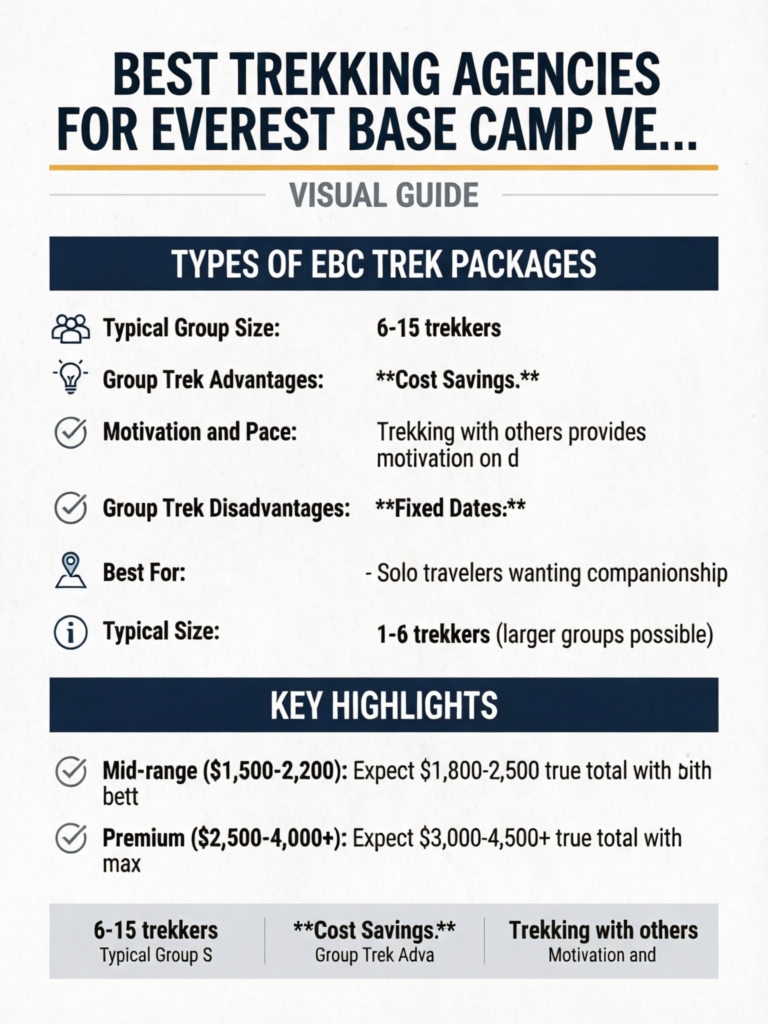
Typical Group Size: 6-15 trekkers Guide Ratio: 1 guide per 6-8 trekkers, plus assistant guide for larger groups
Group Trek Advantages:
Cost Savings: Group treks cost 30-50% less than private options by spreading fixed costs across more people. For budget-conscious trekkers, this is the most affordable way to trek EBC with agency support.
Built-in Community: Solo travelers gain instant companions for the 14-day journey. Shared experiences, mealtime conversations, and mutual encouragement create lasting friendships and memories.
Proven Itinerary: Group itineraries are tested routes that work. You benefit from the agency's accumulated experience optimizing the schedule.
Motivation and Pace: Trekking with others provides motivation on difficult days. Seeing others push through challenge helps you do the same.
Group Trek Disadvantages:
Fixed Dates: You must match agency departure schedules, limiting flexibility for your own timeline.
Pace Compromises: Groups move at the speed of the slowest member. Faster trekkers may feel held back; slower ones may feel rushed.
Less Personal Attention: Guide attention divides across 8-15 people. Individual questions or concerns receive less focus.
Personality Lottery: You don't choose your trekking companions. Personality conflicts or mismatched energy levels can affect your experience.
Limited Flexibility: Itineraries rarely change for individual preferences. If you want extra time at a viewpoint or alternative side trips, group structure prevents it.
Best For:
- Solo travelers wanting companionship
- Budget-conscious first-time trekkers
- Those with flexible travel dates
- Social personalities who enjoy group dynamics
Private Treks: Pros and Cons
Private treks provide dedicated guide and porter for your party only.
Typical Size: 1-6 trekkers (larger groups possible) Guide Ratio: 1 guide per 2-4 trekkers (often 1:2)
Private Trek Advantages:
Complete Flexibility: Choose any start date, customize daily walking hours, add rest days, take side trips, or adjust based on conditions and your energy.
Personal Attention: Your guide focuses entirely on your needs. Questions get complete answers, concerns receive immediate attention, and pace matches your fitness precisely.
Privacy: Intimate experience with your travel companions only. No strangers at meals, in teahouses, or on the trail.
Deeper Engagement: One-on-one guide interaction enables deeper cultural learning, local stories, and relationship building impossible in group settings.
Customization: Add extensions to Gokyo Lakes, attempt Kala Patthar multiple times for sunrise, or include Island Peak climbing. Private treks accommodate special interests.
Safety: Guide focuses entirely on monitoring your health and acclimatization without distraction from other trekkers' needs.
Private Trek Disadvantages:
Higher Cost: Private treks cost 30-60% more than equivalent group packages. Solo trekkers face the highest premiums.
Less Social: No built-in trekking companions. For those wanting social interaction beyond guide conversation, private treks can feel isolating.
Solo Premium: Single travelers pay significantly more - often 50-100% above per-person couple rates - for exclusive guide and porter services.
Best For:
- Couples and families
- Those with specific date requirements
- Photographers wanting flexibility
- Trekkers seeking cultural depth
- Those with special pace or acclimatization needs
- Travelers valuing privacy
Pro Tip
For solo travelers on tight budgets, consider booking a "private trek" with openness to agency adding other solo trekkers. You get flexibility benefits while potentially sharing costs if compatible travelers book the same dates.
Customized Itineraries
Beyond choosing group vs. private, many agencies offer itinerary customization:
Common EBC Customizations:
Extended Acclimatization: Adding extra days at Namche (2 nights instead of 2) or Dingboche (3 nights instead of 2) for those concerned about altitude response.
Side Trip Additions:
- Gokyo Lakes extension: 3-4 extra days
- Cho La Pass crossing: Combines EBC and Gokyo
- Kala Patthar sunrise (multiple attempts): Flexibility days
- Island Peak climbing: 5-7 extra days, technical climbing
Helicopter Options:
- Fly out from Gorak Shep after reaching base camp
- Fly one way (in or out) to save time
- Emergency helicopter on standby
Luxury Lodges: Yeti Mountain Homes and Everest Summit Lodges offer premium accommodation at key stops. Customized itineraries can book these specifically.
Photography Focus: Extra days for sunrise/sunset shoots, flexible scheduling around weather, visits to less-crowded viewpoints.
Cultural Emphasis: Extended time in Namche, visits to Tengboche Monastery during festivals, homestays in Sherpa villages.
Questions for Customization:
- "Can the standard itinerary be modified?"
- "What is the cost for additional days?"
- "Can we combine EBC with Gokyo or other destinations?"
- "Are helicopter options available? At what cost?"
- "Can you accommodate special dietary needs?"
How to Verify an Agency
Don't trust claims - verify everything independently.
Check NTB Registration
Nepal Tourism Board License Verification:
- Ask agency for their Department of Tourism license number
- Contact NTB Trade Division: +977 1 4256909
- Visit NTB office in Kathmandu (Bhrikuti Mandap) if in Nepal
- Email inquiry with agency name for confirmation
What NTB License Confirms:
- Legal authority to operate tourism business
- Minimum capital requirement met (NPR 25 lakh)
- Registered with government authorities
- Tax compliance verified
TAAN Membership Verification
Online Verification:
- Visit www.taan.org.np/members
- Search for agency name in member list
- Note membership expiration date (should be current)
Phone/Email Verification:
- Call TAAN: +977 1 4440921
- Email: [email protected]
- Provide agency name and ask for membership confirmation
In-Person Verification: Visit TAAN office in Kathmandu (Maligaun, near Pashupatinath) with agency name.
What TAAN Membership Means:
- Company legally registered
- Annual membership fee paid (Rs. 15,000)
- Subject to TAAN ethical guidelines
- Access to TAAN dispute resolution
- Insurance requirements met
TAAN Membership Note
TAAN membership is not legally mandatory, but 90%+ of legitimate agencies are members. Non-membership requires extra verification of other credentials. Very small operators may lack TAAN membership while still being legitimate - but for EBC's complexity, TAAN-registered agencies provide safer choices.
Review Authenticity Assessment
Cross-Platform Verification: Check reviews across multiple platforms. Legitimate agencies have consistent feedback across:
- TripAdvisor
- Google Reviews
- Facebook Page
- TourRadar (if listed)
- Trustpilot
Authentic Review Indicators:
- Specific details (guide names, teahouse names, dates)
- Unique photos from trek
- Mix of ratings (4-5 stars mostly, but some 3s)
- Reviewer has other reviews on their profile
- Various nationalities represented
- Spread across many months
- Agency responds to negative reviews professionally
Fake Review Warning Signs:
- All 5-star ratings
- Generic praise without specifics
- Reviews clustered on same dates
- Reviewers have no other reviews
- Similar writing styles
- Perfect grammar (copy-pasted)
- Only positive, no negatives mentioned
- Stock photos or no photos
Ask the Right Questions
Beyond verification, questioning reveals agency quality:
Questions That Reveal Competence:
- "What is your altitude sickness protocol?" (Should describe specific symptoms, monitoring, and descent triggers)
- "What happens if Lukla flights are cancelled for multiple days?" (Should have contingency plans)
- "Can you describe a recent emergency situation and how you handled it?" (Should have examples)
Questions That Reveal Ethics:
- "What is your porter welfare policy?" (Should have written policy)
- "What do porters earn per day?" (Should be Rs. 2,500+ or $20+)
- "What equipment do you provide to porters?" (Should list boots, jacket, sleeping bag, etc.)
Questions That Reveal Transparency:
- "What is your cancellation policy?" (Should be specific, documented)
- "What costs are NOT included in the package?" (Should provide complete list)
- "What is the typical total cost including extras?" (Should give honest estimate)
How They Answer Matters: Evaluate not just what they say but how:
- Do they answer all questions or dodge some?
- Are answers detailed or vague?
- Do they seem patient or irritated?
- Is information consistent with website?
- Do they provide documentation when requested?
Questions to Ask Before Booking
Compile this list and send to every agency you're seriously considering.
About Guides and Experience
- "How many years of EBC experience does the assigned guide have?"
- "How many EBC treks has this guide completed?" (Look for 20+)
- "What certifications does the guide hold? Can I see them?"
- "Does the guide speak fluent English?" (Request video call to verify)
- "What is the guide-to-client ratio?" (1:4 maximum for high altitude)
- "Will the same guide stay with us the entire trek?"
- "Can I meet or video call with the guide before booking?"
- "What happens if the assigned guide becomes unavailable?"
About Safety and Emergencies
- "What is your altitude sickness protocol? When do you mandate descent?"
- "What medical training do guides have?" (Minimum: Wilderness First Aid)
- "What emergency equipment is carried?" (Oximeter, first aid, satellite phone)
- "Do you carry emergency oxygen?"
- "What is your helicopter evacuation procedure?"
- "What happens if I get AMS and must descend early?"
- "What communication equipment is used in areas without cell coverage?"
- "Have you had any serious incidents in the past 5 years? How were they handled?"
About Logistics and Inclusions
- "What exactly is included in the quoted price?" (Get itemized list)
- "What is NOT included?" (Get complete exclusions list)
- "Are Lukla flights included or extra?"
- "How many Kathmandu hotel nights are included?"
- "What standard of teahouse accommodation is booked?"
- "What is the porter weight allowance per person?"
- "What meals are included? All three daily?"
- "Are permits included? Which ones specifically?"
About Flexibility and Cancellation
- "What is your cancellation policy? Please provide exact deadlines and percentages."
- "Can I reschedule instead of cancel?"
- "What happens if Lukla flights are cancelled? Who pays for extra nights?"
- "What if Nepal closes to tourists (natural disaster, political situation)?"
- "Can the itinerary be modified during the trek if needed?"
- "What flexibility exists for acclimatization if I'm struggling?"
Pro Tip
Create a spreadsheet tracking each agency's answers to these questions. Objective comparison reveals which agencies are transparent, competent, and trustworthy versus those who evade, provide incomplete answers, or seem unprepared.
Booking Timeline and Process
Optimal booking timing maximizes choice and minimizes risk.
When to Book
Peak Season (October-November, March-May): Book 3-6 months in advance.
Why early booking matters for peak season:
- Lukla flights fill up completely
- Best guides get assigned early
- Quality teahouses reach capacity
- Group departures fill quickly
- Popular dates (around Dashain, Tihar festivals) book out
Off-Season (June-September monsoon, December-February winter): Book 1-3 months in advance.
Off-season advantages:
- More availability
- Potential discounts (10-20%)
- Better negotiation leverage
- Less crowded trails
Last-Minute Booking (2-4 weeks): Possible but risky:
- Limited agency and guide choices
- Possibly only budget options available
- Lukla flights may require expensive rebooking
- Less time to prepare properly
- Sometimes desperate agencies offer discounts
Optimal Booking Window: 3-4 months before departure provides the sweet spot:
- Good agency selection
- Prime guide availability
- Lukla flight access
- Adequate preparation time
- Some early-bird discounts possible
What to Confirm Before Paying
Before deposit:
- Written quote with all inclusions/exclusions
- Cancellation policy document
- Sample itinerary
- Agency TAAN verification completed
- Reviews checked across platforms
- Questions answered satisfactorily
- Guide information shared (or video call completed)
Before final payment:
- Signed contract with all terms
- Guide assignment confirmed
- Detailed day-by-day itinerary
- Permit application process started
- Emergency contact numbers
- Insurance requirements clarified
- Meeting point/time in Kathmandu
What Contract Must Include:
- Complete itinerary with dates
- Accommodation standard
- Meal plan
- Staff assignment (guides, porters, ratio)
- Total cost with payment schedule
- Inclusions itemized
- Exclusions listed
- Cancellation policy
- Emergency procedures
- Insurance requirements
- Both party signatures
Payment Best Practices
Payment Structure:
- Deposit: 20-30% to confirm booking
- Balance: 70-80% before trek starts (but not 100% until you're satisfied with pre-trek arrangements)
Safe Payment Methods:
| Method | Protection Level | Notes |
|---|---|---|
| Credit card | High | Chargeback protection available |
| PayPal | High | Dispute resolution, 180-day window |
| Bank transfer | Low | Verify company bank details |
| Wise/TransferWise | Medium | Lower fees, minimal protection |
| Cash in Nepal | None | Get detailed receipt |
Payment Red Flags:
- Demand for 100% payment before trek
- Personal account rather than company account
- Bank account name different from company name
- Cash-only requirement
- No receipt provided
- "Special discount for untraceable payment"
Protection Strategies:
- Use credit card for deposit (chargeback protection)
- Pay balance after arriving and meeting guide
- Keep all receipts and confirmations
- Document payments in writing
- Save all email communications
- Photo contract and receipts
Never Pay 100% Before Trek
No legitimate agency requires full payment before you arrive and verify arrangements. Standard practice is deposit to book, balance after arrival. If an agency demands 100% upfront with no flexibility, this is a red flag regardless of their reviews or reputation.
Frequently Asked Questions About EBC Agencies
How much should I budget for an EBC trekking agency?
Budget breakdown by tier:
- Budget ($800-1,200 base): Expect $1,400-1,700 true total including Lukla flights, tips, and extras
- Mid-range ($1,500-2,200): Expect $1,800-2,500 true total with better inclusions
- Premium ($2,500-4,000+): Expect $3,000-4,500+ true total with maximum comfort
Additional costs to budget regardless of package:
- Travel insurance: $100-200
- Tips: $150-250
- Hot showers/charging: $50-100
- Extra food/drinks: $50-100
- Visa: $50-125
- Gear purchases/rentals: $50-300
Realistic total budget: $2,000-3,500 for most trekkers (excluding international flights)
Can I trek EBC without an agency?
Yes, EBC is not a restricted area and independent trekking with a mandatory licensed guide is no longer permitted (mandatory guide rule since April 2023). However, consider:
Independent Trekking Pros:
- Lower cost (no guide/porter fees)
- Complete freedom and flexibility
- Potentially more authentic experience
- Self-reliance builds confidence
Independent Trekking Cons:
- No expert altitude sickness monitoring
- Must navigate permits and logistics alone
- No emergency support system
- Carrying all your own gear (significant at altitude)
- Less cultural insight with a mandatory licensed guide
- Teahouse booking challenges in peak season
Independent Trekking Requirements:
- Previous high-altitude experience
- Thorough research on route and acclimatization
- Excellent physical fitness
- Comprehensive travel insurance
- Self-sufficiency for emergencies
- Detailed knowledge of AMS symptoms and response
Our Recommendation: For first-time high-altitude trekkers, use a reputable agency. The Himalayas are unforgiving, and experienced guidance is invaluable. Save independent trekking for after you've completed an EBC trek with support and understand the terrain, altitude, and conditions.
What's the difference between booking locally vs. internationally?
Booking with Nepal-Based Agency Directly:
| Aspect | Advantage | Disadvantage |
|---|---|---|
| Cost | 30-50% cheaper | Less consumer protection |
| Customization | More flexible | Requires more research |
| Communication | Direct with operator | Time zone challenges |
| Payment | More options | Less protection |
| Support | On-ground knowledge | No home-country backup |
Booking with International Operator:
| Aspect | Advantage | Disadvantage |
|---|---|---|
| Trust | Familiar company | Subcontracting unknown |
| Protection | Home country laws | Higher prices |
| Convenience | All-inclusive booking | Less customization |
| Communication | Same time zone | Extra middleman |
| Support | Accessible complaints | Removed from ground |
Best Approach: Book directly with established Nepal-based agencies (TAAN registered, 100+ reviews, 5+ years operation). You get better prices and direct relationship while maintaining quality through verification. International operators often subcontract to the same local agencies at marked-up prices.
How do I know if reviews are fake?
Fake Review Indicators:
- All 5-star ratings (real agencies have some 4s and 3s)
- Reviews posted in clusters on same days
- Generic praise: "Best trek ever!" "Highly recommend!"
- Reviewer profile has no other reviews
- Similar writing style across multiple reviews
- No specific details (no guide names, teahouse names, dates)
- Perfect grammar across all reviews (suggests copy-paste)
- Only on agency's own website, not independent platforms
Authentic Review Indicators:
- Mix of ratings (mostly 4-5, some 3)
- Spread across many months
- Specific details: "Our guide Pemba explained..."
- Unique photos from different trekkers
- Reviewer has reviewed other businesses
- Various nationalities and writing styles
- Both positives and negatives mentioned
- Present on multiple platforms with consistency
Verification Strategy:
- Cross-reference TripAdvisor, Google, Facebook
- Read 3-star reviews (most honest)
- Search agency name on Reddit and travel forums
- Look for guide names mentioned consistently (real guides get repeat mentions)
- Check if agency responds to negative reviews professionally
What if my trek is cancelled due to weather?
Flight Cancellation (Common Issue): Lukla flights cancel frequently due to weather, especially in monsoon.
Reputable Agency Response:
- Wait for next available flight (may be 1-3 days)
- Provide or arrange accommodation during wait
- Offer helicopter option at your cost
- Adjust itinerary to accommodate delays
- Consider Jiri trekking start alternative
Cost Responsibility:
- Extra Kathmandu nights: Usually your responsibility
- Helicopter alternative: Your cost ($300-500 per person)
- Food during delay: Your cost
- Itinerary shortening: No refund typically
Protection Strategies:
- Build 2-3 buffer days into your schedule
- Have travel insurance covering delays
- Book return flight with flexibility
- Discuss cancellation scenarios before booking
On-Trek Weather Cancellation: If severe weather prevents completing the trek:
- Agency should prioritize safety over summit pressure
- Alternative routes may be offered
- Partial refund unlikely for unused days
- Insurance may cover interruption costs
Should I book a group trek or private trek?
Choose Group If:
- Traveling solo and wanting companionship
- Budget is primary concern
- Flexible on dates
- Enjoy meeting other travelers
- First-time trekker wanting community support
- Comfortable following set itinerary
- Don't need customization
Choose Private If:
- Traveling as couple or family
- Have specific dates that must match
- Want customized itinerary
- Prefer own pace without group constraint
- Need flexibility for photography
- Have special dietary or medical needs
- Value privacy and intimate experience
- Budget allows premium
Cost Difference:
- Group: $1,200-1,800 per person
- Private (2 people): $1,500-2,500 per person
- Private (solo): $2,000-3,500 per person
Hybrid Option: Some agencies offer "join a group" private booking where you have your own guide but stay at same teahouses as other groups, sharing some costs while maintaining independence.
What happens if I get altitude sickness?
Reputable Agency Protocol:
Prevention:
- Daily oximeter readings (SpO2 monitoring)
- Questions about symptoms each morning
- Proper acclimatization schedule built in
- Guide trained to recognize warning signs
- Education about symptoms and self-monitoring
Mild AMS Response:
- Rest day added to itinerary
- Hydration and symptom monitoring
- No altitude gain until symptoms resolve
- Diamox consideration with guide advice
Moderate AMS Response:
- Immediate descent to lower altitude
- Guide accompanies throughout
- Continuous monitoring during descent
- Medical evaluation at Pheriche clinic or Khunde Hospital
Severe AMS (HACE/HAPE):
- Emergency descent immediately
- Oxygen administration if available
- Helicopter evacuation coordination
- Emergency contacts notified
- Insurance claim process initiated
Your Responsibility:
- Report ALL symptoms honestly
- Never hide how you feel to "not slow the group"
- Follow guide recommendations for descent
- Have comprehensive travel insurance
- Know emergency contact numbers
Cost Implications:
- Helicopter evacuation: $3,000-5,000 (insurance should cover)
- Hospital treatment: $500-2,000+
- Unused trek days: Usually no refund
- Additional accommodation: Your cost
- Insurance excess/deductible: Check policy
How far in advance should I book?
Peak Season (October-November, March-May):
- Ideal: 3-6 months ahead
- Minimum: 6-8 weeks ahead
- Last-minute: Possible but limited options
Off-Season (December-February, June-September):
- Ideal: 2-3 months ahead
- Minimum: 3-4 weeks ahead
- Last-minute: Usually possible
Factors Requiring Earlier Booking:
- Popular dates (around Tihar festival)
- Premium agencies with limited capacity
- Specific guide requests
- Combined treks (EBC + Gokyo)
- Peak climbing additions (Island Peak)
- Large groups
Last-Minute Advantages:
- Sometimes desperate agencies offer discounts
- More flexibility in negotiations
- Can visit offices in Kathmandu before committing
Last-Minute Disadvantages:
- Best guides already assigned
- Quality teahouses booked
- Lukla flights more difficult
- Less preparation time
- Limited agency choices
Are tips mandatory?
Tipping Culture: Tipping is expected and customary in Nepal, forming a significant portion of guide and porter income. It's not technically mandatory, but failing to tip for good service is culturally inappropriate and harms workers who depend on tips.
Standard Tipping Guidelines:
| Role | Per Day | 14-Day Trek Total |
|---|---|---|
| Guide | $10-15 | $140-210 |
| Porter | $7-10 | $100-140 |
| Assistant Guide | $7-10 | $100-140 |
Factors for Higher Tips:
- Exceptional service or knowledge
- Emergency assistance or health support
- Extra effort (carrying your gear, special requests)
- Difficult conditions handled well
- Outstanding personality and engagement
Factors for Lower Tips:
- Minimal engagement or effort
- Poor communication
- Arriving late or unprepared
- Dismissive attitude
- But always tip something unless serious misconduct
Tipping Process:
- Give tips directly to each person (not to agency)
- Present at farewell dinner on final night
- Envelope with simple card is appreciated
- Cash in Nepali Rupees or USD acceptable
- Express personal thanks verbally
Budget Planning: Budget $150-250 total for tips (guide + porter for 14-day trek). This is standard expectation, not generous; staff members depend on tips as substantial income supplement.
Related Resources
Preparing for your EBC trek involves more than just agency selection. Explore these comprehensive guides:
Route Planning:
- Everest Base Camp Route Guide - Complete trek overview
- Kala Patthar Guide - Best viewpoint for Everest
- Gokyo Lakes Alternative - Less crowded option
- Three Passes Trek - Challenging EBC extension
Preparation Guides:
- EBC Training Plan - Physical preparation
- Altitude Sickness Prevention - Critical safety knowledge
- EBC Packing List - Complete gear checklist
- What to Expect on Your First Nepal Trek - First-timer orientation
Agency and Guide Resources:
- How to Choose a Trekking Agency - General agency selection
- Hiring Guides and Porters in Nepal - Independent hiring guide
- Best Budget Trekking Agencies - Budget operator options
- Independent vs Guided Trekking - Decision framework
Practical Information:
- Kathmandu-Lukla Flights Guide - Flight booking and tips
- Travel Insurance for Nepal Trekking - Coverage requirements
- Nepal Visa Guide - Entry requirements
- Nepal Trekking Permits Explained - Permit types and costs
Timing Your Trek:
- Best Time to Trek Everest Region - Seasonal guide
- Nepal Trekking Seasons Overview - Full seasonal breakdown
Your Decision Framework: Choosing the Right EBC Agency
After reading this comprehensive guide, use this framework to make your final decision:
Step 1: Define Your Priorities
Rank these factors in your order of importance:
- Budget (total cost)
- Safety (guide experience, emergency protocols)
- Comfort (teahouse quality, flexibility)
- Ethics (porter treatment)
- Customization (itinerary flexibility)
- Group vs. Private preference
Step 2: Set Your Budget Realistically
Calculate TRUE total cost, not just advertised package price:
- Package cost
- Lukla flights (if not included)
- Kathmandu hotels (if not included)
- Tips ($215-250)
- Hot showers/charging ($50-100)
- Travel insurance ($100-200)
- Extras (drinks, snacks, $50-100)
Step 3: Shortlist 3-5 Agencies
Based on your budget tier, identify agencies to evaluate:
- Budget: TAAN-registered agencies with 50+ reviews
- Mid-range: Established agencies with 100+ reviews
- Premium: Specialist operators with exceptional ratings
Step 4: Verify and Question
For each shortlisted agency:
- Verify TAAN membership
- Check reviews across platforms
- Send comprehensive question list
- Evaluate response quality
- Request video call if possible
Step 5: Compare Objectively
Create comparison spreadsheet tracking:
- Total true cost
- Inclusions (score completeness)
- Guide experience
- Response quality
- Review ratings
- Gut feeling
Step 6: Trust Your Judgment
After research and comparison, trust your instincts:
- Did communication feel professional and patient?
- Were questions answered completely?
- Did price seem reasonable for services offered?
- Did anything feel "off" despite good reviews?
The right agency should leave you feeling confident, informed, and excited rather than pressured, confused, or uncertain.
You're Ready to Choose
Armed with this knowledge, you can confidently evaluate any EBC trekking agency. Remember: the goal isn't finding the "best" agency in some absolute sense - it's finding the best agency for YOUR priorities, budget, and expectations. A TAAN-registered budget operator with excellent reviews might be perfect for an experienced trekker, while the same person's less-experienced friend might benefit from mid-range support. Choose based on your needs, verify claims independently, and trust the process.
Final Thoughts
Choosing a trekking agency for Everest Base Camp is one of the most consequential decisions in your travel life. The right partner transforms an ambitious journey into an unforgettable achievement. The wrong choice can turn a dream trek into a nightmare of inadequate support, hidden costs, or dangerous incompetence.
This guide has equipped you with the knowledge to:
- Understand what separates good agencies from bad
- Recognize red flags before they become problems
- Ask questions that reveal true agency quality
- Verify claims independently
- Compare packages accurately
- Make confident decisions
The Himalayas don't forgive poor preparation. Your agency choice determines whether you have expert support when altitude sickness threatens, ethical treatment of the Nepali workers who make your trek possible, and the quality of experience during one of the most challenging adventures of your life.
Take your time. Ask questions. Verify everything. And then, with confidence, book your trek to the foot of the world's highest peak.
Namaste, and safe travels to Everest Base Camp.
Ready to Choose Your Everest Base Camp Trek Company?
Compare verified, TAAN-registered EBC operators, read authentic reviews, and get quotes from budget, mid-range, and premium agencies — then book with a verified local agency with confidence.
About This Guide
This comprehensive guide was researched and written by the Nepal Trekking Directory editorial team based on:
- Analysis of 800+ verified customer reviews (2026/2027)
- TAAN membership verification for 50+ agencies
- Price comparison across 40+ operators
- Interviews with returned EBC trekkers
- Consultation with TAAN officials
- Nepal Tourism Board regulations review
- International Porter Protection Group standards
- Personal experience with multiple Everest region treks
We update this guide quarterly to reflect changing conditions, pricing, and agency status. Last updated: June 2026.
Found this guide helpful? If you've trekked EBC with an agency (positive or negative experience), consider sharing your experience in reviews to help future trekkers make informed decisions.