Prayer Flags, Mani Walls & Buddhist Symbols on Nepal Treks
From the moment you step onto a trekking trail in Nepal, you are surrounded by symbols. Strings of colorful flags flutter from ridgelines and bridges. Walls of carved stone line the path, their surfaces covered in ancient script. Stone monuments with painted eyes gaze across valleys. Cylindrical devices spin beside trail junctions, turned by passing hands or flowing water. These are not decorations. They are the visible expressions of a spiritual tradition that has shaped life in the Himalaya for centuries, and understanding them transforms a trek from a physical journey through landscape into a meaningful passage through living culture.
Most trekkers recognize prayer flags and stupas when they see them, but few understand the specific symbolism, the rules governing interaction with these sacred objects, or the deeper meanings they carry. This guide provides that understanding. We cover every major Buddhist symbol you'll encounter on Nepal's trekking trails—from the five colors of prayer flags to the eyes on stupas, from the mantras carved into mani stones to the sacred scrolls inside prayer wheels. We also explain the practical etiquette for interacting with each symbol, the differences between Buddhist and Hindu sacred objects you'll see in Nepal, and where you'll encounter specific symbols on popular routes.
Whether you're heading to Everest Base Camp, the Annapurna Circuit, the Manaslu Circuit, or any trail in between, this cultural context will enrich every step.
Blue, White, Red, Green, Yellow
Always pass on the left (wall to your right)
Om Mani Padme Hum
Always walk clockwise
Always spin clockwise
White (most common)
Tibetan Buddhism, primarily Nyingma school
Sacred objects also serve as route markers
Table of Contents
- Why Understanding Symbols Enriches Your Trek
- Prayer Flags: Colors, Meaning, and Etiquette
- Mani Walls and Mani Stones
- Stupas and Chortens
- Prayer Wheels
- Katas: The White Ceremonial Scarves
- The Dharma Wheel
- The Lotus Symbol
- The Eight Auspicious Symbols
- Butter Lamps and Incense
- How Symbols Mark the Trail
- Buddhist vs. Hindu Symbols in Nepal
- Where You'll Encounter Each Symbol
- Frequently Asked Questions
Why Understanding Symbols Enriches Your Trek
A trek through Nepal's Himalaya is, at its core, a walk through a sacred landscape. The mountains themselves hold spiritual significance—Machapuchare is considered sacred to Shiva, Khumbu Yul Lha protects the Everest region, and Manaslu's very name derives from the Sanskrit word for "spirit." The trails you walk have been pilgrimage routes for centuries before they became trekking paths.
The symbols you encounter are not incidental to this landscape—they are integral to it. Prayer flags at a mountain pass aren't placed there for aesthetics; they're placed at the highest point to catch winds that will carry their printed prayers across the greatest distance. Mani walls along the trail aren't arbitrary structures; they're positioned to bless travelers and mark the way. Stupas at village entrances aren't monuments; they're protective presences guarding the community.
When you understand what these symbols mean, every element of the landscape tells a story. The trek becomes a narrative of spiritual geography—a journey through a world where the physical and sacred are inseparable. And this understanding also guides respectful behavior: when you know why a mani wall exists, passing on the correct side isn't an arbitrary rule but a meaningful act of cultural participation.
Prayer Flags: Colors, Meaning, and Etiquette
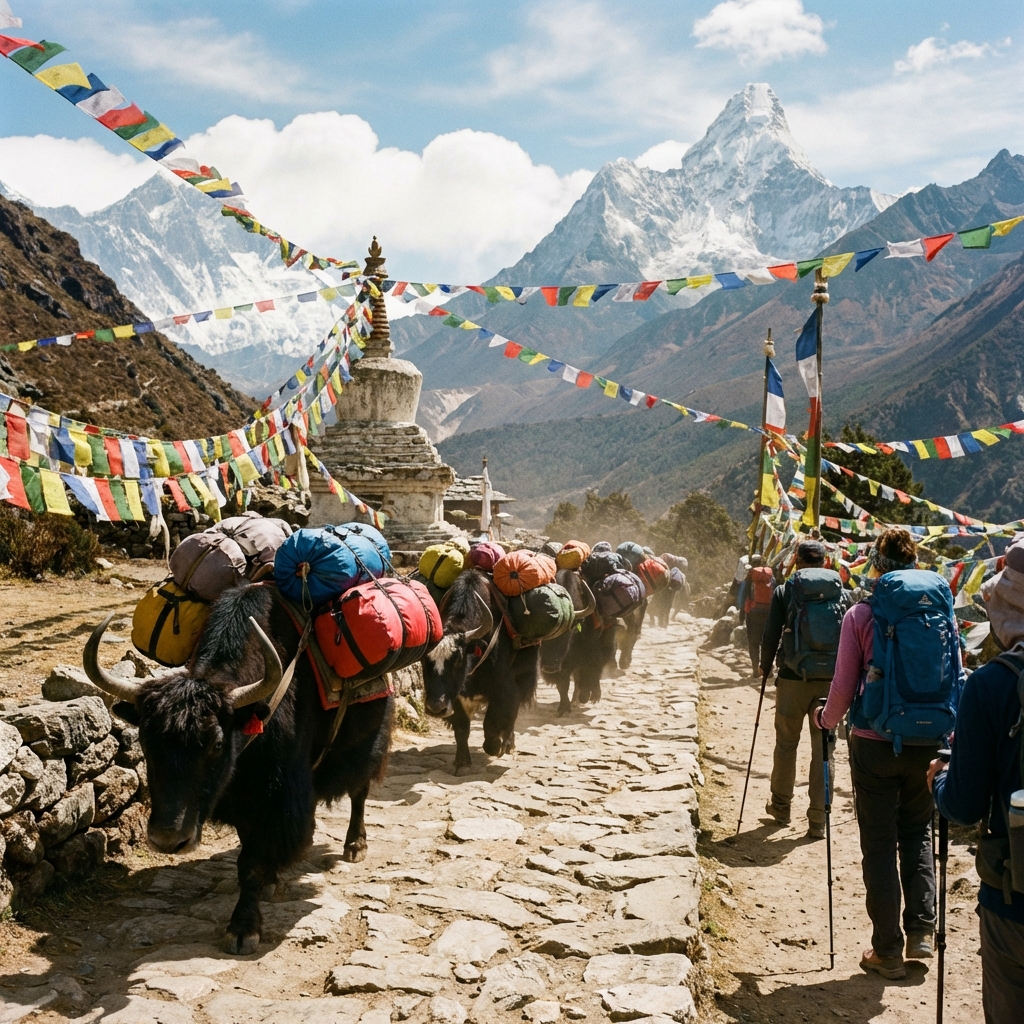
Prayer flags are perhaps the most iconic symbol of Himalayan Buddhism and the image most closely associated with Nepal trekking. Those colorful rectangles of cloth, strung in lines across passes, bridges, and rooftops, are far more than decorative—they are instruments of continuous prayer.
The Five Colors and Their Meanings
Prayer flags always appear in a specific sequence of five colors, each representing an element and a direction:
| Color | Element | Direction | Additional Symbolism |
|---|---|---|---|
| Blue | Sky/Space | Center | Wisdom, purity of mind |
| White | Air/Wind | East | Compassion, purity |
| Red | Fire | South | Life force, passion |
| Green | Water | North | Balance, harmony |
| Yellow | Earth | West | Renunciation, rootedness |
The five colors also represent the five Buddha families in Tibetan Buddhism and correspond to five forms of wisdom. Together, they symbolize the balance and completeness of the natural world.
The Two Types of Prayer Flags
Lung Ta (Horizontal Flags) The most common type, these are rectangular cloths strung on a line between two points—between poles, across bridges, along ridgelines, or between buildings. "Lung ta" means "wind horse," referring to the mythical horse often printed at the center of the flag that carries prayers on the wind. The horse is typically surrounded by four other animals: the dragon, garuda (eagle), tiger, and snow lion, representing the four cardinal directions.
Dar Cho (Vertical Flags) These are single rectangular flags attached vertically to a pole, planted in the ground. They're common at mountain passes, on rooftops, and at sacred sites. Dar cho flags tend to be larger than lung ta flags and often mark specific sacred locations or commemorate specific events.
What's Printed on Prayer Flags
Prayer flags are printed (traditionally woodblock-printed) with:
- Mantras — Sacred syllables, most commonly "Om Mani Padme Hum"
- Sutras — Passages from Buddhist scriptures
- Prayers — Invocations for compassion, wisdom, and the well-being of all sentient beings
- Images — The wind horse (lung ta), the four dignities (dragon, garuda, tiger, snow lion), and various Buddhist symbols
Why Flags Are Placed Where They Are
The placement of prayer flags is intentional:
- Mountain passes: The highest point catches the strongest winds, carrying prayers the farthest. This is why passes on Nepal treks are festooned with flags.
- Bridges: Crossing water is considered spiritually significant; flags bless the crossing and protect travelers
- Rooftops: Protecting the household beneath
- Monastery grounds: Surrounding the sacred space with continuous prayer
- Ridgelines and hilltops: Maximizing exposure to wind
How Prayer Flags Work (Spiritually)
The concept is elegantly simple: as wind passes over the surface of the flags, the air is sanctified by the prayers and mantras printed on the cloth. This blessed wind then carries positive energy across the countryside. The flags don't pray to anyone—they generate compassion and goodwill that benefits all beings touched by the wind.
As the flags fade and fray from weather exposure, this is also meaningful. The deterioration represents the Buddhist concept of impermanence (anicca)—all things are transient. When flags are completely worn, they're replaced with new ones, and the cycle continues.
Prayer Flag Etiquette for Trekkers
Do:
- Appreciate and photograph prayer flags freely (they're meant to be seen and to spread their message)
- Walk beneath or through strings of prayer flags—the blessed wind touches you as it touches the flags
- Observe the traditional practice of adding new flags on auspicious days if you're invited to participate
Don't:
- Step on prayer flags, whether they're hanging or fallen on the ground
- Use prayer flags as napkins, handkerchiefs, or rags
- Take prayer flags as souvenirs by removing them from where they've been placed
- Burn prayer flags (the traditional disposal method when they're worn out, but this is done ceremonially, not casually)
- Use prayer flags as clothing, bandanas, or fashion accessories—this is considered disrespectful in Buddhist culture
Prayer Flags as Souvenirs
Purchasing new prayer flags from shops in Kathmandu or along the trail is perfectly fine—this is a common and appropriate souvenir. What is disrespectful is removing prayer flags that have already been placed at passes, bridges, or sacred sites. These flags have been consecrated and placed with intention. Buy your own from a shop and have them blessed at a monastery if you wish.
The Lung Ta: Wind Horse Symbolism
The wind horse at the center of most prayer flags deserves special attention. In Tibetan Buddhism, the lung ta represents:
- Good fortune that travels on the wind
- The human soul's journey through the spiritual realm
- Life force energy that animates all living beings
- The speed of the horse carrying prayers across the world
The four creatures surrounding the wind horse—dragon (wisdom), garuda (confidence), tiger (bravery), and snow lion (fearlessness)—represent qualities that protect and empower the spiritual journey.
Pro Tip
Mani Walls and Mani Stones
If prayer flags are the signature of the sky on Nepal treks, mani walls are the signature of the earth—solid, enduring structures that have lined Himalayan trails for centuries.
What Are Mani Walls?
Mani walls are structures built from flat stones that have been carved or painted with mantras, most commonly "Om Mani Padme Hum" (the six-syllable mantra of Avalokiteshvara, the bodhisattva of compassion). The walls range from small roadside collections of a few dozen stones to enormous structures hundreds of meters long.
The most famous mani wall in Nepal is in the village of Pheriche on the Everest Base Camp route—a massive structure that takes several minutes to walk past. But you'll encounter mani walls throughout the Khumbu, Annapurna, Manaslu, and Langtang regions.
Om Mani Padme Hum: The Meaning
This mantra is the most widely recited in Tibetan Buddhism. While translations vary and the full meaning is considered beyond simple translation, the essential significance is:
- Om — The sacred syllable representing the body, speech, and mind of the Buddha
- Mani — "Jewel," representing the altruistic intention to become enlightened for the benefit of all beings
- Padme — "Lotus," representing wisdom
- Hum — Indivisibility of wisdom and practice
Together, the mantra invokes the blessing of Avalokiteshvara, the embodiment of compassion. By reciting or reading the mantra, the practitioner generates compassion for all beings.
Who Creates Mani Stones?
Mani stones are carved by:
- Professional stone carvers who make their living through this religious art
- Monks as part of their spiritual practice
- Lay devotees who commission or create stones as acts of merit
- Community members honoring deceased relatives or seeking blessings
Creating a mani stone is considered an act of significant merit. Some mani walls have been growing for centuries, with each generation adding new stones.
Mani Wall Etiquette: The Left-Side Rule
The most important etiquette rule for mani walls: always pass on the left side, keeping the wall to your right. This ensures you circumambulate the sacred object in a clockwise direction, consistent with Buddhist practice.
This rule applies to:
- All mani walls, regardless of size
- Chortens and stupas along the trail
- Sacred stone piles with prayer flags
- Any clearly sacred roadside structure
Why clockwise? In Tibetan Buddhism, clockwise movement follows the path of the sun and symbolizes moving in harmony with the universe. All circumambulation of sacred objects—whether walking around a stupa, a monastery, or a mani wall—follows this clockwise principle.
Other Mani Wall Guidelines
- Never remove stones from a mani wall, even loose ones at the edges
- Never sit on a mani wall or place your pack on it
- Never step over a mani wall, even a low one—walk around it
- Appreciate the artistry — Many mani stones feature exquisite calligraphy and are genuine works of art
- Notice the variety — Some stones are simply carved with the mantra; others feature images of the Buddha, deities, or elaborate scenes
Modern Mani Walls
New mani stones are still being carved and added to walls throughout Nepal. This is a living tradition, not a historical relic. You may see freshly carved stones with bright paint alongside centuries-old stones weathered to near-illegibility. The continuity represents the unbroken thread of faith that connects past and present in these communities.
Stupas and Chortens
Stupas (called chortens in Tibetan) are the dome-shaped structures that are among the most recognizable Buddhist architectural forms. From the massive Boudhanath Stupa in Kathmandu to tiny trail-side chortens in the Khumbu, these structures carry profound symbolism.
Structure and Symbolism
A traditional stupa has five distinct architectural elements, each representing one of the five elements:
| Level | Shape | Element | Symbolism |
|---|---|---|---|
| Base | Square | Earth | Stability, foundation |
| Dome | Hemisphere | Water | Fluidity, containment |
| Spire | Cone/Triangle | Fire | Aspiration, transformation |
| Umbrella | Disc | Air | Protection, compassion |
| Pinnacle | Jewel/Flame | Space/Ether | Enlightenment |
The Eyes of Buddha
On larger stupas, particularly those in the Kathmandu Valley (Boudhanath, Swayambhunath), you'll see a pair of eyes painted on the harmika (square base of the spire). These are the "all-seeing eyes of the Buddha," gazing in all four cardinal directions. Between the eyes, the Nepali numeral "1" (which looks like a question mark) represents the unity of all things and the path to enlightenment.
What's Inside a Stupa
Stupas are not hollow—they contain relics and sacred objects sealed within:
- Relics of holy figures (bones, ashes, hair)
- Sacred texts and manuscripts
- Precious and semi-precious stones
- Ritual objects consecrated by lamas
- Tsa-tsa (small clay tablets stamped with Buddhist images)
The contents are sealed during a consecration ceremony and are never removed. The stupa is, in essence, a physical embodiment of the Buddha's enlightened mind.
Stupa Etiquette
- Circumambulate clockwise — Walk around stupas in a clockwise direction, keeping the stupa to your right
- Don't climb on stupas — Never climb on, lean against, or sit on a stupa
- Don't point your feet toward a stupa if sitting nearby
- Offerings — Butter lamps, incense, or flowers can be offered at the base of a stupa
- Photography — External photography of stupas is almost always acceptable; they are designed to be seen and contemplated
Trail-Side Chortens
Along trekking trails, you'll encounter numerous small chortens. These serve multiple purposes:
- Memorial markers for deceased community members
- Trail markers indicating the correct path
- Spiritual protection for travelers at dangerous points
- Boundary markers indicating entry into a sacred area
Pass all trail-side chortens on the left, keeping them to your right—the same rule as mani walls.
Pro Tip
Prayer Wheels
Prayer wheels are ingenious devices for multiplying the power of mantra recitation. They are among the most interactive Buddhist symbols—trekkers are actively encouraged to spin them.
How Prayer Wheels Work
Each prayer wheel contains a tightly wound scroll of paper or fabric printed with the mantra "Om Mani Padme Hum" thousands or even millions of times. When the wheel is spun, it is believed that the effect is the same as orally reciting each of those mantras. One spin of a large prayer wheel containing a million printed mantras generates the merit of a million recitations.
Types of Prayer Wheels
Hand-held prayer wheels (mani wheels): Small cylinders mounted on a handle, spun by a wrist rotation. You'll see monks and laypeople spinning these as they walk—a continuous practice that generates merit throughout the day. Weighted with a small metal ball on a chain, the wheel's momentum keeps it spinning smoothly.
Wall-mounted prayer wheels: Rows of metal cylinders set into walls, typically at monastery entrances or along approach paths. As you walk past, you spin each wheel with your right hand in a continuous flowing motion. These are designed for interaction—spin them as you pass.
Large freestanding prayer wheels: Tall cylinders, sometimes reaching several meters in height, found inside or near monasteries. These may contain millions of mantras and require significant effort to spin. Spinning a large wheel is considered an act of considerable merit.
Water-powered prayer wheels: Perhaps the most elegant variation—prayer wheels placed in streams or beside water channels, turned continuously by the flow of water. These generate merit 24 hours a day, rain or shine, without human intervention. You'll see them near rivers and streams throughout the Buddhist Himalaya, particularly on the Manaslu Circuit and in the Khumbu.
Prayer Wheel Etiquette
- Always spin clockwise — When viewed from above, the wheel should rotate clockwise. This is critical; counter-clockwise spinning is believed to reverse the prayers
- Use your right hand — Traditionally, the right hand is used to spin prayer wheels
- Spin gently and deliberately — Not aggressively or carelessly
- Don't attempt to open a prayer wheel to see what's inside
- Don't skip wheels in a row — If you start spinning a row of wall-mounted wheels, spin each one as you pass (though you don't have to spin every row you encounter)
Katas: The White Ceremonial Scarves
Katas (also spelled khatas) are white silk or synthetic scarves that play an important role in Tibetan Buddhist ceremony and social interaction.
Significance
The kata represents:
- Purity — The white color symbolizes the pure intention behind the gesture
- Compassion — Offering a kata expresses goodwill toward the recipient
- Respect — Katas are offered to show honor, greeting, and reverence
- Blessing — When returned (placed around your neck), the kata becomes a blessing from the recipient
When Katas Are Offered
- Upon meeting or greeting important people (lamas, community leaders)
- At monasteries — Offered to the altar or to monks
- During ceremonies — Weddings, funerals, festivals, and other significant events
- At mountain passes — Some trekkers tie katas to pass cairns alongside prayer flags
- At departure — Offered when saying goodbye to hosts or guides
Etiquette for Receiving and Offering Katas
Offering: Hold the kata draped over both open palms, arms extended, with a slight bow. If offering to a religious figure or an elder, bow more deeply. The kata may be accepted and placed around your neck as a blessing, or accepted and placed on the altar.
Receiving: If someone places a kata around your neck, accept it graciously with a slight bow. Don't remove it immediately—wear it for a time as a sign of respect for the blessing. You can remove it later and keep it as a meaningful souvenir.
Where to Buy Katas
Katas are inexpensive and widely available:
- Shops in Kathmandu's Thamel district
- Stalls near Boudhanath Stupa
- Shops in Namche Bazaar and other major trekking villages
- Price: NPR 100-500 for standard katas; higher for silk or high-quality versions
The Dharma Wheel
The Dharma wheel (Dharmachakra) is one of the oldest Buddhist symbols, representing the Buddha's first teaching—"turning the wheel of Dharma"—at Sarnath, India. You'll see it on monastery rooftops, painted on walls, and depicted in religious art throughout Nepal.
Structure and Meaning
The wheel typically has eight spokes, representing the Noble Eightfold Path:
- Right Understanding
- Right Intention
- Right Speech
- Right Action
- Right Livelihood
- Right Effort
- Right Mindfulness
- Right Concentration
The wheel's rim represents meditative concentration. The hub represents moral discipline. The spokes represent wisdom. Together, they depict the three trainings of Buddhist practice.
Where You'll See It
- Mounted on monastery rooftops, typically flanked by two deer (representing the deer park at Sarnath where the Buddha first taught)
- Painted on monastery walls and entrance gates
- Carved on stone tablets and mani walls
- Depicted in thangka paintings and religious art
The Lotus Symbol
The lotus (padma) is one of the most pervasive symbols in both Buddhist and Hindu art. Its significance is both beautiful and profound.
Meaning
The lotus grows from muddy water but blooms pristine and unsoiled above the surface. This is a metaphor for spiritual development: just as the lotus rises from mud to bloom in purity, so can the human spirit rise above suffering, attachment, and ignorance to achieve enlightenment.
Different colored lotuses carry additional meanings:
- White lotus — Mental purity, spiritual perfection
- Pink lotus — The supreme lotus, associated with the Buddha himself
- Red lotus — Compassion and love
- Blue lotus — Wisdom and knowledge
Where You'll See It
The lotus appears everywhere in Buddhist Nepal:
- Throne bases for Buddha statues (the Buddha typically sits on a lotus)
- Wall paintings and murals
- Carved decorations on monastery walls and pillars
- The mantra "Om Mani Padme Hum" itself—padme means lotus
The Eight Auspicious Symbols
The Ashtamangala (Eight Auspicious Symbols) is a set of sacred symbols that appears frequently in Tibetan Buddhist art, often painted on monastery walls, woven into textiles, or carved into wood and stone.
| Symbol | Name | Meaning |
|---|---|---|
| Parasol | Chattra | Protection from evil, royalty |
| Golden Fish (pair) | Matsya | Freedom, fertility, abundance |
| Treasure Vase | Kalasha | Wealth, abundance, inexhaustible treasures |
| Lotus | Padma | Purity, enlightenment rising from suffering |
| Conch Shell | Shankha | The fame of Buddha's teachings spreading |
| Endless Knot | Shrivatsa | Infinite wisdom and compassion, interconnection |
| Victory Banner | Dhvaja | Victory of knowledge over ignorance |
| Dharma Wheel | Dharmachakra | The Buddha's teachings (see above) |
Where You'll See Them
The eight symbols often appear as a group:
- Painted on either side of monastery entrances
- On the banners hanging in prayer halls
- Carved into wooden door frames
- Printed on textiles and wall hangings
- On the bases of statues and ritual objects
Pro Tip
Butter Lamps and Incense
Two of the most sensory elements of Buddhist practice in Nepal are butter lamps and incense—you'll encounter both in every monastery and many tea houses.
Butter Lamps
What they are: Small bowls (traditionally brass or copper) filled with clarified yak butter and a wick. Modern versions sometimes use vegetable ghee.
Symbolism: Light dispelling darkness represents wisdom dispelling ignorance. Lighting a butter lamp is one of the simplest and most common devotional acts in Tibetan Buddhism.
What you'll see: Rows of butter lamps burning before altars in every monastery. The warm, flickering light creates the distinctive amber atmosphere of Himalayan gompa. At larger monasteries, hundreds of lamps may burn simultaneously.
Can you light one? Yes, in most monasteries, visitors can light a butter lamp as an offering. A small donation (NPR 50-100) to cover the cost of butter is customary. Light the lamp from an existing flame—don't use a lighter or match.
Incense
What it is: Tibetan incense is typically made from aromatic herbs, particularly juniper (shukpa), and comes in stick form. Juniper smoke is especially significant—it's believed to purify spaces and attract positive energies.
Where you'll encounter it: Monastery interiors, household altars, village entryways, and trail-side incense burners. The scent of juniper smoke is one of the defining sensory experiences of trekking in Buddhist Nepal.
Etiquette: Don't blow out incense that's been lit as an offering. If smoke bothers you, move to a different position rather than extinguishing someone else's offering.
How Symbols Mark the Trail
One of the most practical aspects of Buddhist symbols on Nepal treks is their function as trail markers. Sacred objects are placed along routes for spiritual reasons, but they also serve navigational purposes.
Prayer Flags at Passes
When you see prayer flags, you're almost certainly at or near the highest point of a pass. This is true for every significant pass on Nepal's trekking routes:
- Thorong La (5,416m) on the Annapurna Circuit
- Cho La (5,420m) in the Khumbu
- Renjo La (5,360m) in the Khumbu
- Kongma La (5,535m) in the Khumbu
- Larkya La (5,160m) on the Manaslu Circuit
In foggy or snowy conditions when visibility is poor, spotting prayer flags ahead confirms you're approaching the pass and on the correct route.
Mani Walls Along the Trail
Mani walls are placed along established trails. Following the mani walls (passing on their left) keeps you on the correct path. This is particularly useful in the Khumbu, where the trail network can be confusing and multiple paths diverge from villages.
Chortens at Village Entrances
Chortens often mark the entrance to a village or the beginning/end of a trail section. Seeing a chorten ahead usually means habitation is near—useful information after a long day of trekking.
Stupas at Dangerous Points
Stupas and chortens are sometimes placed at dangerous trail sections—narrow ridges, avalanche-prone areas, or river crossings—to provide spiritual protection. Their presence can also serve as a warning to proceed carefully.
Navigation and Respect Combined
The beautiful thing about Buddhist trail markers is that respecting them also helps you navigate. Passing mani walls on the left keeps you on the right side of the trail. Following prayer flags leads you to the pass. Circumambulating chortens clockwise keeps you on established paths. Cultural respect and practical navigation work together on Nepal's trails.
Buddhist vs. Hindu Symbols in Nepal
Nepal is a uniquely multi-religious landscape. While the high-altitude trekking regions are predominantly Buddhist, lower elevations and the Kathmandu Valley feature a complex interweaving of Buddhist and Hindu traditions. Understanding the differences helps you navigate this spiritual landscape.
Buddhist Symbols You'll See
- Prayer flags, mani walls, chortens/stupas, prayer wheels
- Images of the Buddha (seated in meditation)
- Bodhisattvas (especially Avalokiteshvara/Chenrezig)
- Dharma wheel with deer
- Lotus motifs
- Mantras in Tibetan script
Hindu Symbols You'll See
- Trident (trishul) — Symbol of Shiva, common at Hindu temples
- Om (Aum) in Devanagari script — Sacred syllable shared by both traditions
- Tilaka marks — Colored marks on foreheads
- Marigold garlands — Common offerings at Hindu temples
- Nandi (bull) — Vehicle of Shiva, found at Shiva temples
- Ganesh images — Elephant-headed deity, found at many doorways
- Lingam — Abstract representation of Shiva
Where Traditions Overlap
Nepal has a remarkable tradition of religious syncretism:
- Muktinath on the Annapurna Circuit is sacred to both Buddhists and Hindus
- Swayambhunath in Kathmandu has both Buddhist and Hindu shrines
- Many families celebrate both Buddhist and Hindu festivals
- Some deities are shared between traditions (Avalokiteshvara/Lokeshwar)
- The Buddha is considered an avatar of Vishnu in some Hindu traditions
Practical Impact for Trekkers
- At lower elevations (below 2,500m), you'll see a mix of Hindu and Buddhist symbols
- At higher elevations (above 3,000m), Buddhist symbols dominate
- In the Kathmandu Valley, both traditions are thoroughly intertwined
- When unsure whether a site is Buddhist or Hindu, observe and follow the behavior of locals
Where You'll Encounter Each Symbol
Here's a guide to which symbols you'll see on specific popular treks:
Everest Base Camp Trek
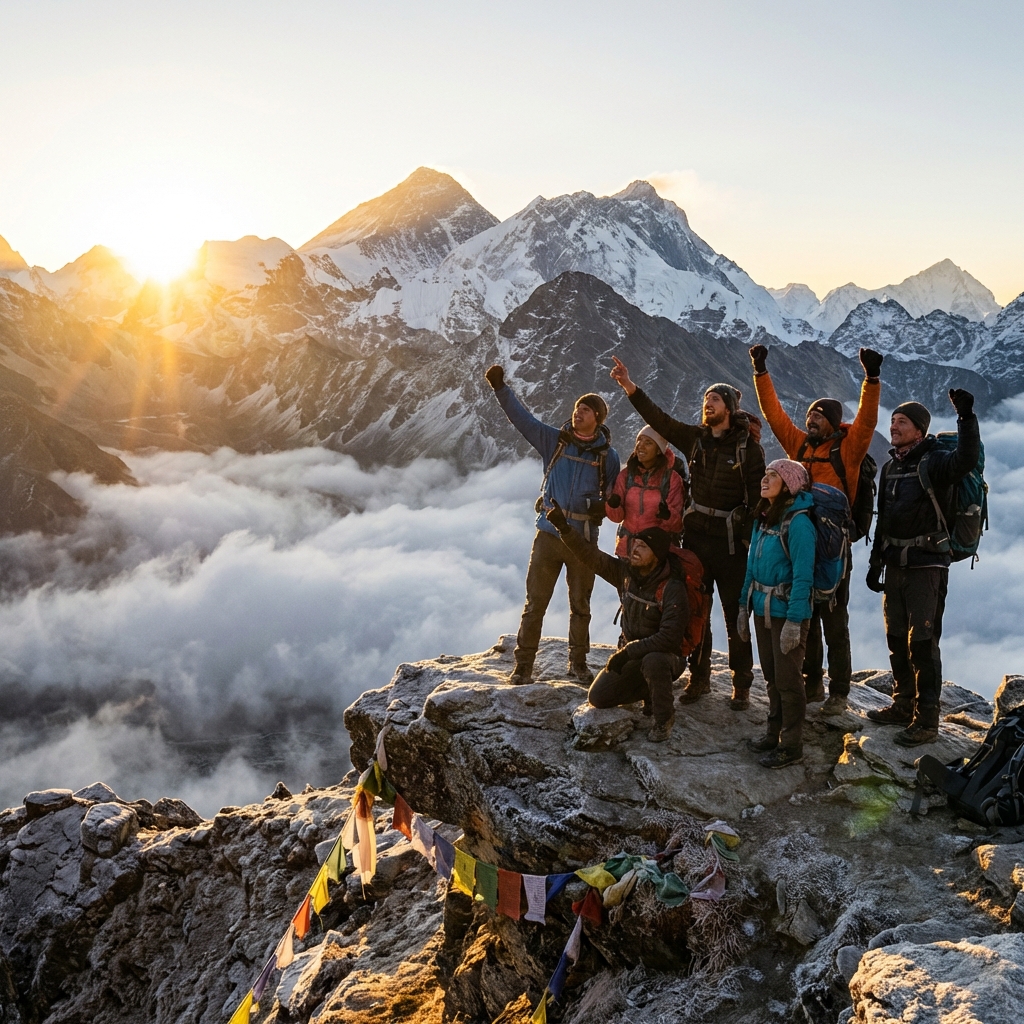
- Prayer flags: Abundantly at every pass and bridge, particularly dramatic at Kala Patthar and Everest Base Camp
- Mani walls: Extensive throughout the Khumbu, especially between Namche Bazaar and Tengboche
- Prayer wheels: At every monastery and many tea house entrances
- Stupas/chortens: Numerous throughout, including the memorial chortens at Dughla honoring fallen climbers
- Katas: Common at monasteries and offered by Sherpa guides
Annapurna Circuit
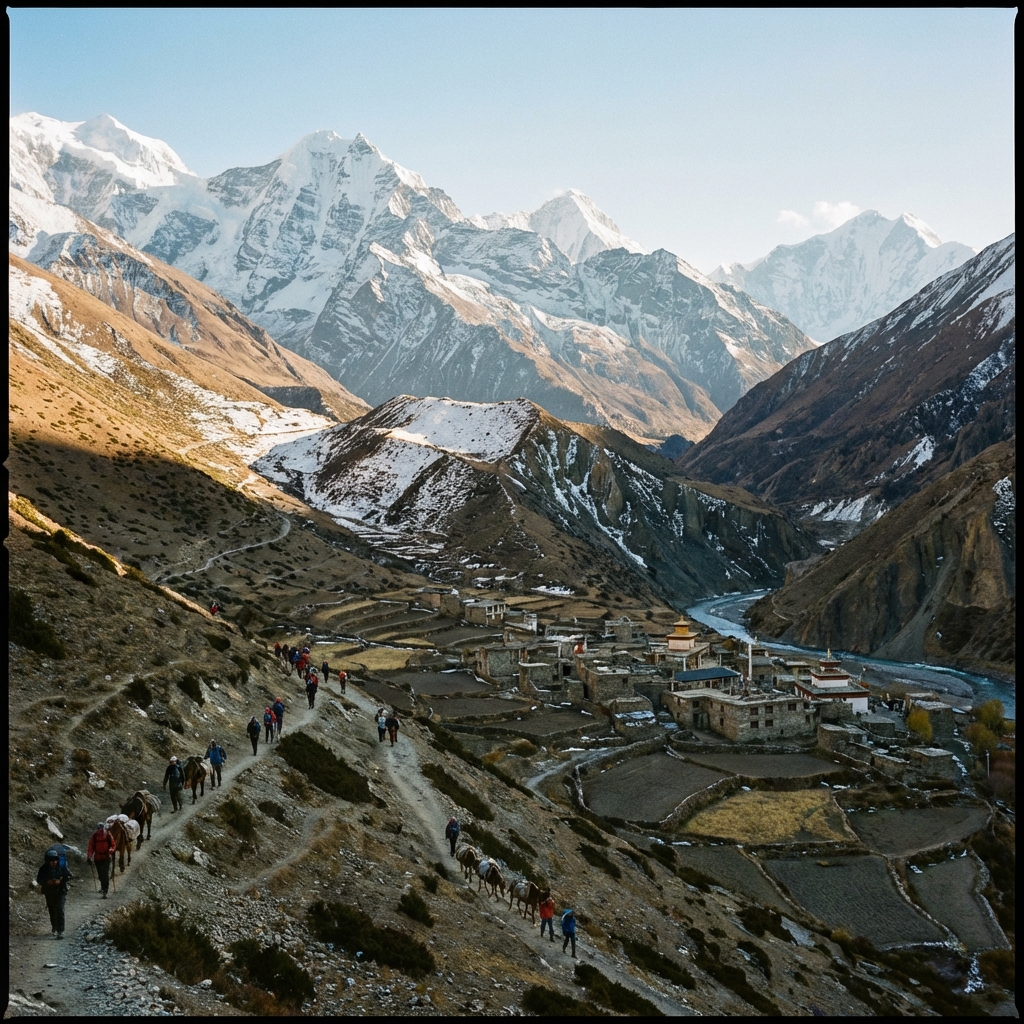
- Prayer flags: Spectacular displays at Thorong La and throughout the Manang valley
- Mani walls: Common in upper Manang and the Muktinath valley
- Hindu-Buddhist overlap: Muktinath is the primary example of dual-faith sacred space
- Prayer wheels: Large wheels at Muktinath and Braga monastery
- Butter lamps: Particularly atmospheric at Braga's ancient monastery
Manaslu Circuit
- Prayer flags: At Larkya La and throughout the upper circuit
- Mani walls: Extensive between Samagaun and Samdo
- Water-powered prayer wheels: Common along rivers in the upper valley
- Stupas: Beautiful examples in Samagaun village
- Tibetan influence: Stronger here than on most other treks due to border proximity
Langtang Valley
- Prayer walls: The famous long mani wall at Langtang village (rebuilt after 2015 earthquake)
- Prayer flags: At Kyanjin Ri and Tserko Ri viewpoints
- Tamang Buddhist traditions: Slightly different artistic style from Sherpa Buddhism
- Memorial chortens: Many built after the devastating 2015 avalanche
Frequently Asked Questions
Can I buy prayer flags and have them blessed?
Yes. Purchase new prayer flags from shops in Kathmandu or trekking towns, and ask a lama at a monastery to bless them. Hanging blessed flags at a pass or sacred spot during your trek is a meaningful way to participate in the tradition. Your guide can help arrange the blessing.
Is it okay to hang prayer flags at home after my trek?
Opinions vary. In Buddhist tradition, prayer flags should be hung outside where wind can carry the prayers. Hanging them indoors or purely as decoration is seen by some as disrespectful. If you want to hang flags at home, do so outdoors where they can serve their intended purpose—and treat them with respect rather than as mere decor.
What does it mean when prayer flags are faded and tattered?
Faded and tattered flags are not neglected—they represent the Buddhist teaching of impermanence. The gradual deterioration shows the prayers being released to the wind. When flags are completely worn, they're traditionally burned (not thrown in trash) and replaced with new ones on auspicious dates.
Why do some mani stones have different colored paint?
Mani stones are painted to highlight the carved letters and to add devotional beauty. Common colors include:
- Gold for the main mantra letters
- Red for borders and decorative elements
- Blue and green for backgrounds Fresh paint indicates recent maintenance or new additions; faded paint indicates age.
Are the eyes on stupas always the same?
The basic design—two eyes with the Nepali numeral "1" between them—is consistent, but artistic style varies. Some stupas feature more detailed or stylized eyes. The eyes always face the four cardinal directions, representing the Buddha's omniscience (all-seeing wisdom).
What's the difference between a stupa and a chorten?
They are essentially the same structure. "Stupa" is the Sanskrit/Nepali term, while "chorten" is the Tibetan term. In practice, "stupa" tends to be used for larger, more elaborate structures (like Boudhanath), while "chorten" is used for smaller trail-side structures. But the terms are often used interchangeably.
Can I spin the large prayer wheels inside monasteries?
Yes, visitors are generally welcome to spin prayer wheels at monasteries. Spin clockwise (when viewed from above), gently and deliberately. For more on monastery visiting behavior, see our monastery etiquette guide.
What is the significance of the swastika symbol I see in Nepal?
The swastika is an ancient symbol in South Asian religions predating its appropriation by Nazi Germany by thousands of years. In Buddhist and Hindu Nepal, it represents good fortune, prosperity, and the eternal cycle. You'll see it on buildings, textiles, and religious objects. The traditional swastika faces clockwise (turning right), while some Buddhist versions face counter-clockwise. It has no connection to European fascism.
Final Thoughts
The Buddhist symbols that surround you on Nepal's trekking trails are invitations—invitations to slow down, observe, contemplate, and connect with a spiritual tradition that has sustained mountain communities for centuries. Every prayer flag, mani stone, stupa, and prayer wheel was placed with intention, created with devotion, and maintained with care.
You don't need to be Buddhist to appreciate these symbols. You don't need to understand every nuance of Tibetan Buddhist philosophy. What matters is approaching them with the same qualities the symbols themselves represent: awareness, respect, compassion, and an open mind.
When you pass a mani wall on its correct side, spin a prayer wheel in the right direction, or sit quietly in a monastery absorbing the atmosphere of centuries of devotion, you're not just following rules—you're participating, however briefly, in one of the world's most profound spiritual traditions. And that participation, however small, enriches both your trek and the communities through which you travel.
For comprehensive monastery visiting guidelines, see our monastery etiquette guide. For deeper understanding of the Sherpa people and their Buddhist traditions, see our Sherpa culture guide. And for broader cultural guidelines on trekking in Nepal, see our cultural etiquette guide.