
Best Trekking Agencies for Annapurna Circuit 2026: Thorong La Pass Experts
The Annapurna Circuit isn't just another Nepal trek—it's the original classic that defined Himalayan tea house trekking. This 160-230 kilometer journey circumnavigates the Annapurna massif, crossing the legendary Thorong La Pass at 5,416 meters, traversing four distinct climate zones from subtropical jungle to alpine desert, and requiring 14-21 days of sustained effort through some of Earth's most dramatic terrain.
Unlike the shorter Annapurna Base Camp (ABC) trek where agency choice affects comfort and convenience, your Annapurna Circuit agency selection directly impacts whether you successfully cross Thorong La—the crux that makes or breaks the entire journey. A qualified agency brings Thorong La-specific expertise, flexible itinerary management for unpredictable weather windows, and logistics mastery for this unique one-way trek that begins and ends in different locations.
This comprehensive guide goes beyond simple recommendations. It explains what distinguishes a competent Annapurna Circuit operator from one that's merely adequate, how to evaluate Thorong La expertise specifically, navigate the controversial NATT road situation, and ultimately select an agency worthy of guiding you through Nepal's most iconic trekking experience.
14-21 days
5,416m (Thorong La)
160-230 km
$1,000-1,400
$1,600-2,200
$2,500-3,500+
Oct-Nov, Mar-Apr
Yes (for Thorong La)
Introduction: The Classic Nepal Trek and Why Agency Choice Matters
The Annapurna Circuit holds legendary status in the trekking world. First explored by foreign trekkers in the 1970s, it became the definitive multi-week Himalayan experience—a journey that takes you from rice paddies at 800 meters through pine forests, Buddhist villages, alpine meadows, and finally over the world's most-traversed high pass into the rain shadow of the Kali Gandaki valley.
Every year, approximately 25,000-35,000 trekkers attempt the circuit, making it Nepal's second most popular trek after Everest Base Camp. Yet unlike EBC's relatively straightforward out-and-back route, the Annapurna Circuit presents unique challenges that make agency selection genuinely consequential:
The Thorong La Factor
At 5,416 meters, Thorong La Pass is higher than Everest Base Camp (5,364m) and crosses genuine alpine terrain where weather windows matter, altitude sickness risk peaks, and navigation becomes critical in poor visibility. Your agency's Thorong La expertise—not their general Himalayan experience—determines your crossing success.
One-Way Logistics
Unlike most Nepal treks that return to their starting point, the Annapurna Circuit is a traverse. You begin in Besisahar or Bhulbhule (east) and finish in Nayapul or Jomsom (west). This requires coordinated transportation at both ends, flexible scheduling for weather delays, and contingency planning that circular routes don't demand.
Weather Window Dependency
Thorong La conditions can shift from clear skies to whiteout in hours. Quality agencies build flexible itineraries with buffer days, monitor weather patterns, and know when to push forward versus wait. Rigid agencies following fixed schedules regardless of conditions put clients at risk.
The Road Dilemma
The controversial NATT (New Annapurna Trekking Trail) road construction has transformed the classic circuit. Your agency's approach to road sections—whether using jeeps strategically, following alternative trails, or simply walking on roads—significantly impacts your experience.
This Is NOT Annapurna Base Camp
The Annapurna Circuit and Annapurna Base Camp (ABC) are completely different treks. ABC is a 10-14 day out-and-back route reaching 4,130m. The Circuit is a 14-21 day traverse crossing 5,416m Thorong La Pass. Agencies experienced in ABC may lack Circuit-specific expertise. Always verify an agency's Annapurna Circuit experience specifically, not just their Annapurna region experience.
Annapurna Circuit vs Annapurna Base Camp: Key Differences
Before selecting an agency, understand what makes the Annapurna Circuit fundamentally different from the shorter ABC trek—and why these differences matter for agency selection.
Circuit vs ABC: Why They Require Different Agency Expertise
| Feature | Annapurna Circuit | Annapurna Base Camp |
|---|---|---|
| Duration | 14-21 days | 10-14 days |
| Maximum Altitude | 5,416m (Thorong La) | 4,130m (ABC) |
| Route Type | One-way traverse | Out-and-back |
| Distance | 160-230 km | 80-100 km |
| Major Pass | Yes (Thorong La) | No major pass |
| Climate Zones | 4 distinct zones | 2-3 zones |
| Transportation Logistics | Different start/end points | Same start/end point |
| Weather Sensitivity | High (pass dependent) | Moderate |
| Agency Expertise Needed | Thorong La specific | General Annapurna |
Duration and Commitment
Annapurna Circuit: 14-21 days depending on itinerary, side trips (Tilicho Lake, Ice Lake), and whether you use jeeps for road sections. This is a significant time commitment requiring proper acclimatization strategy across the entire journey.
ABC: 10-14 days for the standard trek. Shorter commitment, less complex acclimatization, more forgiving schedule.
Agency Implication: Circuit agencies must manage long-duration logistics, maintain guide and porter welfare over three weeks, and handle the extended supply chain. ABC experience doesn't prepare agencies for Circuit complexity.
Maximum Altitude and Risk Profile
Annapurna Circuit: Thorong La at 5,416m is serious high altitude where the air contains roughly 50% of sea-level oxygen. Altitude sickness risk is significant, and the pass crossing occurs on a single demanding day with limited bailout options.
ABC: Maximum 4,130m at Annapurna Base Camp. While still requiring acclimatization, this is 1,286m lower than Thorong La with easier descent options if problems arise.
Agency Implication: Circuit guides need specific Thorong La training, not just general altitude experience. The pass demands knowledge of timing, weather assessment, emergency response on technical terrain, and recognition of altitude sickness in challenging conditions.
Route Type and Transportation
Annapurna Circuit: One-way traverse beginning in Besisahar/Bhulbhule (Lamjung District) and ending in Nayapul/Jomsom (Mustang/Myagdi District). This requires:
- Transportation to trailhead (6-8 hours from Kathmandu/Pokhara)
- Transportation from trail end (different location)
- Contingency transport if weather forces early exit
- Porter logistics for one-way journey
ABC: Circular route starting and ending at Nayapul/Jhinu. Same transportation works both directions. Simpler logistics.
Agency Implication: Circuit agencies must coordinate multiple transportation legs, maintain flexibility for weather-dependent scheduling, and have contingency vehicles available. This operational complexity distinguishes experienced Circuit operators.
Weather Sensitivity
Annapurna Circuit: Thorong La Pass is weather-dependent. Heavy snow can close the pass for days. Poor visibility makes navigation dangerous. Agencies must build buffer days into itineraries and be prepared to wait.
ABC: While weather affects conditions, there's no critical pass crossing. Treks can proceed through moderate weather, and turning back from intermediate points is straightforward.
Agency Implication: Circuit agencies need weather monitoring capabilities, flexible scheduling protocols, and the operational flexibility to extend trips when conditions demand. Rigid, schedule-bound operators struggle with Circuit's variability.
Pro Tip
When evaluating agencies, ask specifically: "How many Annapurna Circuit treks has this agency completed in the past 12 months?" Then ask: "How many of those involved Thorong La crossing delays due to weather, and how were they handled?" Answers reveal whether the agency has current Circuit experience and knows how to manage real-world conditions.
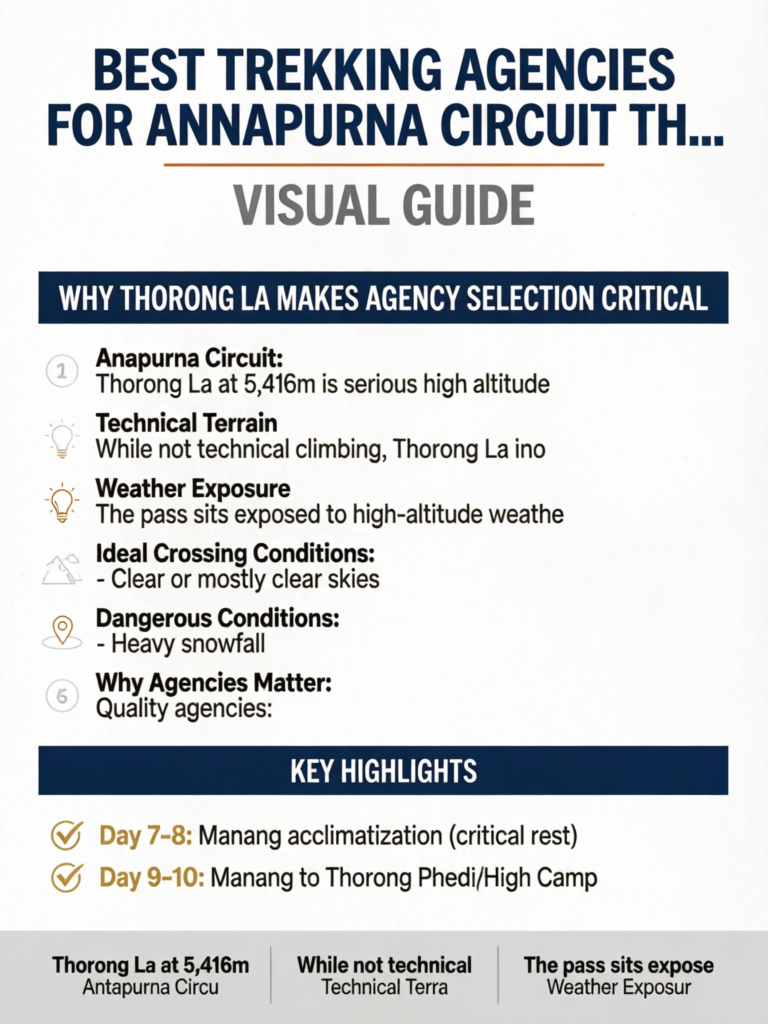
Why Thorong La Makes Agency Selection Critical
Thorong La Pass (5,416m) is the crux of the Annapurna Circuit. This single crossing determines whether your 14-21 day journey succeeds or fails. Understanding what makes Thorong La challenging explains why agency expertise here matters more than on any other aspect of the trek.
The 5,416-Meter Challenge
At 5,416 meters, Thorong La presents several simultaneous challenges:
Altitude Physiology
The air at Thorong La contains approximately 50% of sea-level oxygen. Your body is working at reduced capacity while facing a demanding 8-10 hour crossing day. Even well-acclimatized trekkers experience reduced energy, slower thinking, and compromised coordination.
Acute Mountain Sickness Risk
Thorong La is where AMS risk peaks on the circuit. The typical crossing involves:
- Starting from High Camp (4,600m) or Thorong Phedi (4,450m)
- Ascending 800-950m on pass day
- Rapid descent to Muktinath (3,710m)
This profile—high starting altitude, significant ascent, long exposure above 5,000m—creates prime AMS conditions. Quality agencies monitor symptoms aggressively and know when to abort.
Technical Terrain
While not technical climbing, Thorong La involves:
- Steep, rocky ascent on the east side
- Potential snow and ice year-round
- Loose scree requiring careful footing
- Steep descent into Muktinath valley
- Navigation challenges in poor visibility
Weather Exposure
The pass sits exposed to high-altitude weather patterns:
- Rapid weather changes (clear to whiteout in hours)
- High winds with significant wind chill
- Snow possible in any season
- Afternoon cloud build-up (why early starts are essential)
- Limited shelter options on the pass itself
Thorong La Claims Lives
This pass sees trekker deaths every year from altitude sickness, hypothermia, and accidents. Most fatalities involve insufficient acclimatization, crossing in dangerous weather, or guides without proper Thorong La experience. Your agency's pass expertise isn't a nice-to-have—it's a life-safety requirement.
Weather Window Importance
Thorong La success depends on catching weather windows. Unlike lower trails where you can trek through moderate weather, the pass demands specific conditions:
Ideal Crossing Conditions:
- Clear or mostly clear skies
- Light winds (under 30 km/h)
- No active precipitation
- Good visibility for navigation
- Stable weather forecast for 6+ hours
Dangerous Conditions:
- Heavy snowfall
- Whiteout visibility
- Winds above 40-50 km/h
- Active storm systems
- Deteriorating weather mid-crossing
Why Agencies Matter:
Quality agencies:
- Monitor weather forecasts using multiple sources
- Have local knowledge of Thorong La weather patterns
- Build 2-3 buffer days into itineraries for weather delays
- Know when conditions warrant waiting versus pushing through
- Have relationships with High Camp lodge staff for real-time updates
- Are willing to delay even when clients pressure for schedule
Poor agencies:
- Follow fixed schedules regardless of conditions
- Lack weather monitoring capability
- Push clients across in marginal conditions to maintain schedule
- Don't build buffer days into itineraries
- Blame clients for "not being fit enough" when weather forces turnaround
Altitude Sickness Risk at Thorong La
The standard Thorong La crossing profile creates significant AMS risk:
Day Before (High Camp/Thorong Phedi):
- Sleep at 4,450-4,600m
- Already at significant altitude
- Symptoms may already be developing
- Last chance to assess fitness for crossing
Crossing Day:
- 3:00-5:00 AM start
- 4-6 hours ascending to pass (5,416m)
- 2-4 hours exposed above 5,000m
- 4-5 hours descending to Muktinath (3,710m)
- 8-10 hours total effort at altitude
Critical Recognition Points:
Quality guides recognize AMS warning signs and act decisively:
- Severe headache not responding to medication
- Persistent nausea or vomiting
- Ataxia (unsteady gait, loss of coordination)
- Altered mental status (confusion, inappropriate behavior)
- Extreme fatigue disproportionate to effort
Agency Response Protocol:
| Symptom | Appropriate Response | Dangerous Response |
|---|---|---|
| Mild headache | Monitor, continue if improving | Ignore, push on |
| Severe headache + nausea | Assess for descent | "Just push through" |
| Ataxia | Immediate descent | "We're almost there" |
| Confusion | Emergency descent | Continue regardless |
| Persistent vomiting | Descent + medical eval | Blame "bad food" |
Route Variations and NATT Road Changes
The New Annapurna Trekking Trail (NATT) road construction has fundamentally changed the Annapurna Circuit experience. Quality agencies navigate this reality thoughtfully:
Road Impact:
- Roads now reach Manang from both directions
- Classic walking trail disrupted in multiple sections
- Dust and vehicles diminish wilderness experience
- Some trekkers use jeeps to skip road sections
- Alternative trails exist but require local knowledge
Agency Approaches:
Trail-Focused Agencies:
- Know alternative trails avoiding roads
- Use old trail sections where still accessible
- Accept longer walking days to stay off roads
- Provide detailed briefings about road sections
Road-Accepting Agencies:
- Use jeeps strategically for road sections
- Focus walking on trail-only portions
- Offer shorter itineraries using vehicle transport
- May compromise wilderness experience for convenience
Poor Agencies:
- Walk clients on dusty roads without alternatives
- Don't mention road sections until arrival
- Lack knowledge of trail alternatives
- Provide neither walking alternatives nor jeep options
Pro Tip
Ask agencies specifically: "How do you handle the road sections on the Annapurna Circuit? What alternatives do you offer?" Quality agencies have thoughtful answers—either explaining trail alternatives they use or being transparent about jeep sections. Agencies that seem surprised by the question or give vague answers lack current Circuit knowledge.
What Makes a Good Annapurna Circuit Agency
Beyond standard agency qualities, Annapurna Circuit operators need specific expertise:
Thorong La Experience Specifically
General high-altitude experience is insufficient. Thorong La has unique characteristics that require specific knowledge:
What to Look For:
Guide Thorong La Crossings:
- Minimum 10+ successful crossings (look for 20+)
- Experience in various weather conditions
- Experience managing altitude sickness on the pass
- Knowledge of descent routes if crossing fails
Agency Track Record:
- Multiple Circuit operations per season (minimum 10-15 groups annually)
- Documented weather delay management
- No fatalities or serious incidents at Thorong La
- Positive reviews mentioning pass crossing specifically
Questions to Ask:
- "How many Thorong La crossings has my assigned guide completed?"
- "Describe your most challenging Thorong La crossing. What happened?"
- "What weather conditions would cause you to delay crossing?"
- "What happens if weather closes the pass for multiple days?"
- "What percentage of your Circuit groups successfully cross Thorong La?"
Red Flag Answers:
- Vague response about "years of experience" without specifics
- "We've never had to delay a crossing" (unrealistic or lying)
- Guide has fewer than 10 Thorong La crossings
- Cannot articulate specific weather criteria for crossing decisions
- No clear protocol for extended weather delays
Flexible Itinerary for Weather
Weather flexibility distinguishes competent Circuit operators:
Flexible Itinerary Indicators:
Built-In Buffer Days:
- 2-3 contingency days in itinerary
- Clearly communicated to clients before booking
- Not marketed as "optional extensions" but actual buffer
- No additional cost for weather-related use
Weather Monitoring:
- Access to reliable forecasts (not just village gossip)
- Daily weather briefings in Manang and above
- Communication with High Camp about real-time conditions
- Protocols for go/no-go decisions
Alternative Activities:
- Acclimatization hikes during weather delays (Ice Lake, Tilicho Lake)
- Cultural activities in Manang valley
- Rest day programming that keeps clients comfortable
Scheduling Flexibility:
- Transportation arranged with delay contingency
- No penalties for weather-extended trips
- Guide availability for extended duration
- Porter arrangements that accommodate delays
Red Flags:
- "14-day fixed itinerary" with no buffer
- Extra charges for weather delay days
- Pressure to cross in marginal conditions "to stay on schedule"
- Transportation booked for fixed dates without flexibility
- "Weather is usually fine" dismissiveness
Knowledge of Road vs Trail Options
Current Circuit expertise requires understanding the road situation:
Road Reality (2026):
- Road reaches Manang from Besisahar (completed)
- Road reaches Muktinath from Jomsom (completed)
- Significant sections of classic trail now parallel roads
- Alternative trails exist but require local knowledge
- Road conditions vary seasonally (monsoon damage, winter ice)
Quality Agency Approaches:
Option 1: Trail-Focused Itinerary
- Uses alternative trails avoiding roads where possible
- Accepts longer walking days for better experience
- May include some road walking where unavoidable
- Clearly communicates which sections are on/near roads
- Generally 16-21 day itineraries
Option 2: Hybrid Approach
- Uses jeeps for worst road sections (Besisahar-Chame, Jomsom-Nayapul)
- Walks trail-only sections (Chame-Manang-Muktinath)
- Saves time on less scenic portions
- Generally 12-16 day itineraries
Option 3: Classic-Purist Itinerary
- Walks entire route including road sections
- Uses original trail alignments where still accessible
- Accepts road walking where alternatives don't exist
- Longest itineraries (18-21 days)
What to Ask:
- "What percentage of the Circuit is now on or near roads?"
- "What trail alternatives do you use?"
- "Which sections do you recommend using jeeps for?"
- "Can I see a map showing road versus trail portions?"
- "How has road construction changed the route since 2015?"
Acclimatization Expertise
Proper acclimatization strategy prevents AMS and enables successful Thorong La crossing:
Standard Circuit Acclimatization:
| Day | Location | Altitude | Notes |
|---|---|---|---|
| 1-3 | Besisahar to Chame | 800-2,670m | Gradual gain, minimal risk |
| 4-5 | Chame to Upper Pisang | 2,670-3,300m | Entering moderate altitude |
| 6 | Upper Pisang to Manang | 3,300-3,540m | First significant altitude |
| 7 | Manang rest day | 3,540m | CRITICAL acclimatization |
| 8 | Manang acclimatization hike | 3,540m + hike to 4,000m+ | Active acclimatization |
| 9-10 | Manang to Thorong Phedi | 3,540-4,450m | Careful ascent |
| 11 | High Camp or rest | 4,450-4,600m | Final acclimatization |
| 12 | Thorong La crossing | 5,416m peak | The crux day |
Quality Agency Acclimatization Features:
Mandatory Rest Days:
- Minimum 2 nights in Manang (not optional)
- Active acclimatization day with hike to Ice Lake or Gangapurna viewpoint
- Option for 3rd night if symptoms present
Altitude Monitoring:
- Daily oximeter readings above 3,000m
- Symptom questionnaire each morning
- Guide authority to add rest days as needed
- Clear protocols for when to descend
Education:
- Pre-trek altitude briefing
- Daily reminders about hydration, pacing, symptoms
- "Climb high, sleep low" strategy implementation
- Diamox information and availability
Flexibility:
- Willing to add acclimatization days at no penalty
- Alternative slower itineraries for concerned clients
- Option to skip Tilicho Lake side trip if acclimatization concerns
The Manang Rule
Quality agencies NEVER skip the Manang acclimatization stop. At 3,540m, Manang is the critical transition point before high-altitude sections. Agencies offering "fast" itineraries that minimize or skip Manang time are prioritizing schedule over safety. No legitimate reason exists to rush through Manang—it's the foundation for successful Thorong La crossing.
Red Flags to Avoid
Certain warning signs indicate agencies that shouldn't be trusted with your Annapurna Circuit journey:
Unrealistic Itineraries
Red Flag: "10-Day Annapurna Circuit"
The Problem: The Annapurna Circuit cannot be safely completed in 10 days without:
- Skipping critical acclimatization
- Using jeeps for majority of route
- Rushing Thorong La crossing
- Eliminating flexibility for weather
Reality Check:
- Minimum safe duration: 14 days (with some jeep use)
- Recommended duration: 16-18 days
- Complete experience: 18-21 days
What Happens: Agencies offering ultra-short itineraries either:
- Use jeeps for 60%+ of the route (barely trekking)
- Compress acclimatization dangerously
- Have no buffer for weather
- Experience high failure rates at Thorong La
No Thorong La-Specific Experience
Red Flag: "Our guides are experienced in the Annapurna region"
The Problem: Annapurna region includes ABC, Poon Hill, Mardi Himal, and other lower-altitude treks. Experience at 4,000m doesn't translate to 5,416m pass expertise.
Questions That Reveal Inexperience:
- Cannot specify number of Thorong La crossings
- Describes pass as "straightforward" or "easy"
- No specific weather protocols for pass
- Guide has primarily ABC experience
- Cannot describe previous challenging pass situations
Fixed Schedule with No Weather Flexibility
Red Flag: "14-day itinerary, fixed departure and return"
The Problem: Thorong La weather is unpredictable. Fixed schedules create dangerous pressure to cross in marginal conditions.
What to Look For:
- Does the contract include buffer days?
- What happens if weather delays the crossing?
- Who pays for additional nights?
- Are there penalties for schedule changes?
- Is transportation flexible?
Red Flag Contract Language:
- "Itinerary is fixed and cannot be modified"
- "Additional days charged at $X per day"
- "Client responsible for schedule delays"
- "Transportation arranged for specific dates only"
Suspiciously Low Prices
Red Flag: "$600 all-inclusive 16-day Annapurna Circuit"
The Math Doesn't Work:
| Cost Component | Minimum Realistic |
|---|---|
| Guide salary (16 days) | $320-400 |
| Porter salary (16 days) | $250-320 |
| ACAP + TIMS permits | $45 |
| Transportation (both ends) | $60-100 |
| Agency overhead, profit | $150-200 |
| Minimum viable package | $825-1,065 |
Agencies pricing below $900-1,000 must cut somewhere:
- Unlicensed or inexperienced guides
- No porter support
- Skipped permits
- No emergency equipment
- Compressed itinerary
"Guaranteed" Thorong La Crossing
Red Flag: "We guarantee successful Thorong La crossing"
The Problem: No one can guarantee weather. Agencies making this claim either:
- Will push you across in dangerous conditions
- Define "success" loosely (crossing via helicopter counts?)
- Are lying to secure bookings
- Will blame you if crossing fails
Reality: Even the best agencies have occasional failed crossings due to weather. Honest agencies quote success rates (typically 85-95% in peak season) rather than guarantees.
The Guarantee Trap
If an agency guarantees Thorong La crossing, ask: "What happens if weather makes crossing unsafe for 5 consecutive days?" Their answer reveals the guarantee's emptiness. Either they'll pressure you across dangerously, or the "guarantee" is worthless. Neither is acceptable.
What Should Be Included in Annapurna Circuit Packages
Understanding standard inclusions helps you compare packages accurately:
Essential Inclusions
Permits (All Should Be Included):
- Annapurna Conservation Area Permit (ACAP): NPR 3,000 (~$22)
- TIMS Card: NPR 2,000 (as of 2026 for organized treks)
- Any local fees
Licensed, Experienced Guide:
- Government trekking guide license
- Specific Thorong La experience (10+ crossings minimum)
- English fluency
- Altitude sickness training
- Wilderness first aid certification (ideal)
Porter Support:
- Weight allowance specified (typically 10-15kg per person)
- Proper cold-weather gear for porters
- Insurance coverage for porters
- IPPG-compliant treatment standards
Transportation:
- Kathmandu/Pokhara to Besisahar or starting point
- Ending point (Nayapul/Jomsom) to Pokhara/Kathmandu
- Flexibility for weather-related schedule changes
Accommodation:
- All tea house nights during trek
- Twin-sharing standard
- Single room supplement option
Meals:
- Three meals daily during trek
- Breakfast, lunch, dinner at tea houses
Emergency Equipment:
- Comprehensive first aid kit
- Pulse oximeter for altitude monitoring
- Satellite communication device or established check-in protocol
Inclusions by Price Range
| Inclusion | Budget ($1,000-1,400) | Mid-Range ($1,600-2,200) | Premium ($2,500-3,500+) |
|---|---|---|---|
| Permits | Included | Included | Included |
| Licensed guide | Yes (less experienced) | Yes (experienced) | Yes (senior) |
| Guide ratio | 1:6-8 | 1:4-5 | 1:2-3 |
| Porter | Shared or none | Dedicated | Personal |
| Porter allowance | 8-10 kg | 12-15 kg | 15-20 kg |
| Tea houses | Basic available | Pre-booked, better | Best available |
| Meals | 3 daily, basic | 3 daily, variety | All meals + snacks |
| Transportation | Shared bus/jeep | Private or shared | Private vehicle |
| Pokhara/Ktm hotel | Not included | 1-2 nights | 2-3 nights |
| Buffer days | Minimal | 2-3 days | 3-5 days |
| Sleeping bag | Rental extra | Often included | Included |
| Down jacket | Rental extra | Sometimes included | Included |
| Emergency comms | Basic | Satellite device | Satellite + backup |
Common Exclusions
Budget for these regardless of package:
Always Extra:
- International flights to Nepal
- Nepal visa ($50-125)
- Travel insurance ($100-250, mandatory)
- Tips for guide and porter ($200-400 recommended)
- Personal trekking gear
- Alcoholic beverages
- Personal expenses
Usually Extra:
- Hot showers ($2-5 per shower, increasing with altitude)
- Device charging ($2-5 per charge)
- WiFi access ($3-5 per day)
- Bottled water/purification
- Extra snacks and drinks
- Laundry service
Sometimes Extra:
- Single room supplement ($150-300)
- Sleeping bag rental ($1-2/day if not included)
- Down jacket rental ($1-2/day if not included)
- Side trips (Tilicho Lake, Ice Lake)
- Extended days due to personal choice (not weather)
Price Ranges: What You Get
Understanding what different price points deliver helps set realistic expectations:
Budget Range ($1,000-1,400): Minimum Viable
What Budget Packages Include:
- 14-16 day basic itinerary
- Licensed guide (possibly newer, less experienced)
- Shared porter or no porter included
- Basic tea house accommodation (available, not pre-booked)
- Three meals daily (limited menu variety)
- Essential permits
- Shared transportation
- Group departures only
- Basic first aid kit
- No Pokhara/Kathmandu accommodation
True Cost Reality:
Many "$1,000" packages become $1,400-1,600 with realistic additions:
| Item | Cost |
|---|---|
| Base package | $1,000 |
| Sleeping bag rental (16 days) | $32 |
| Down jacket rental (16 days) | $32 |
| Pokhara hotel (2 nights) | $30 |
| Hot showers (10x) | $40 |
| Charging/WiFi | $50 |
| Tips (guide + porter) | $200 |
| TRUE TOTAL | $1,384 |
Who Budget Suits:
- Experienced high-altitude trekkers
- Budget-conscious travelers comfortable with basic conditions
- Those who don't need dedicated porter support
- Flexible travelers who can adapt to group schedules
Budget Risks:
- Guide may have limited Thorong La experience
- Less flexibility for weather delays
- Basic or no emergency communication equipment
- Tea house quality varies significantly
- May feel rushed through acclimatization
Mid-Range ($1,600-2,200): The Sweet Spot
What Mid-Range Packages Include:
- 16-18 day itinerary with proper acclimatization
- Experienced guide (5+ years, 15+ Thorong La crossings)
- Dedicated porter (1:1 or 1:2 ratio)
- Better tea houses (pre-booked at key locations)
- Three meals daily with more variety
- All permits
- Private or comfortable shared transportation
- 1-2 nights Pokhara accommodation
- Comprehensive first aid kit and oximeter
- 2-3 buffer days built into itinerary
- Satellite communication device
- Sleeping bag often included
Who Mid-Range Suits:
- First-time high-altitude trekkers
- Those valuing comfort without luxury
- Families and couples
- Photographers wanting flexibility
- Anyone prioritizing safety and reliability
Why Mid-Range is the Sweet Spot:
This price range buys the fundamentals that matter:
- Experienced guides who've handled Thorong La emergencies
- Proper acclimatization schedule
- Weather flexibility without stress
- Quality tea houses with reliable facilities
- Ethical treatment of staff
- Responsive agency support
Mid-Range Value Calculation:
| Item | Included |
|---|---|
| Experienced guide | Included |
| Dedicated porter | Included |
| Quality tea houses | Included |
| Buffer days | Included |
| Emergency equipment | Included |
| Sleeping bag | Usually included |
| Additional costs | |
| Tips | $250 |
| Showers/charging | $80 |
| TRUE TOTAL | $1,930-2,530 |
For $400-600 more than true budget costs, you receive dramatically improved safety, comfort, and flexibility.
Premium Range ($2,500-3,500+): Maximum Support
What Premium Packages Include:
- 18-21 day customized itinerary
- Senior guide with extensive Thorong La experience (20+ crossings)
- Personal porter (dedicated 1:1)
- Premium tea house selection (best available rooms)
- All meals with dietary accommodations
- All permits
- Private vehicle transportation
- 2-3 nights Pokhara/Kathmandu hotels (3-4 star)
- 3-5 buffer days
- Comprehensive emergency equipment
- Satellite phone carried
- Sleeping bag and down jacket provided
- Pre-trek briefing and gear consultation
- 24/7 agency support
- Side trip options (Tilicho Lake, Ice Lake) often included
Who Premium Suits:
- Older trekkers (55+) wanting maximum support
- Those with medical concerns needing extra monitoring
- Photographers wanting complete flexibility
- Time-constrained trekkers needing efficiency
- Honeymoons or special celebrations
- Corporate groups
- Anyone wanting maximum safety margin
When Premium is Worth It:
Medical Concerns: Better monitoring, experienced guides, faster emergency response.
Photography: Unlimited flexibility for weather, light, and additional stops.
Limited Time: Private transport, optimized itinerary, no group delays.
Peace of Mind: Some trekkers simply want maximum support for confidence.
Pro Tip
Premium packages make the most sense for first-time Himalayan trekkers over 50, anyone with controlled but present medical conditions, serious photographers wanting schedule flexibility, or those for whom the cost difference is insignificant compared to the experience investment.
Itinerary Options
The Annapurna Circuit offers several itinerary variations. Quality agencies offer multiple options and help you choose based on your priorities:
Classic Circuit (14-18 days)
The standard Annapurna Circuit experience:
Duration: 14-18 days depending on pace and road sections
Route: Besisahar/Bhulbhule - Manang - Thorong La - Muktinath - Jomsom - Nayapul
Key Stops:
- Day 1-3: Besisahar to Chame (gaining altitude gradually)
- Day 4-6: Chame to Manang (entering high altitude zone)
- Day 7-8: Manang acclimatization (critical rest)
- Day 9-10: Manang to Thorong Phedi/High Camp
- Day 11: Thorong La crossing to Muktinath
- Day 12-14: Muktinath to Jomsom to Nayapul (descent)
Best For:
- First-time Circuit trekkers
- Those with 2-3 weeks available
- Balanced experience seekers
- Standard fitness levels
Considerations:
- May include significant road sections
- Weather buffer limited in 14-day versions
- Extensions possible for side trips
Extended with Tilicho Lake (18-21 days)
Adds the spectacular Tilicho Lake side trip:
Duration: 18-21 days
Additional Content:
- 2-3 extra days from Manang
- Visit Tilicho Lake (4,919m) - one of world's highest lakes
- Additional acclimatization benefit
- Stunning high-altitude scenery
Route Addition:
- Day 8-9: Manang to Tilicho Base Camp
- Day 9-10: Tilicho Lake day trip
- Day 10-11: Return to Manang or continue toward Thorong La
Best For:
- Trekkers with 3 weeks available
- Those wanting extra acclimatization
- High-altitude lake enthusiasts
- Photographers seeking dramatic scenery
Considerations:
- Tilicho trail is challenging and exposed
- Weather can impact lake visibility
- Adds significant altitude gain (4,919m)
- Requires good fitness
Circuit + ABC Combination (22-28 days)
Epic combination of both major Annapurna treks:
Duration: 22-28 days
Options:
- Sequential: Complete Circuit, rest in Pokhara, then ABC
- Connected: Circuit to Jomsom, then trek to Ghorepani and ABC
- Reverse: ABC first, then Circuit (less common)
Best For:
- Trekkers with 4+ weeks available
- Those wanting complete Annapurna experience
- Strong fitness levels
- Extended Nepal visits
Considerations:
- Significant physical demand
- Requires careful pacing
- Higher overall cost
- Maximum Annapurna region experience
Shortened Versions Using Jeeps (10-14 days)
For time-limited trekkers:
Duration: 10-14 days
Approach:
- Jeep Besisahar to Chame or Manang (skip lower road sections)
- Walk Manang - Thorong La - Muktinath (essential trekking)
- Fly or jeep Jomsom to Pokhara
Benefits:
- Focuses on high-altitude highlights
- Avoids dusty road sections
- Fits into 2-week vacation
- Maintains Thorong La crossing experience
Trade-offs:
- Misses lower-altitude villages and scenery
- Less gradual acclimatization
- Feels more like "Thorong La crossing" than "Circuit"
- Higher AMS risk due to faster altitude gain
The 14-Day Minimum
Regardless of jeep use, 14 days is the minimum safe duration for proper Thorong La acclimatization. Itineraries under 14 days either skip critical rest days or use helicopters/flights that eliminate acclimatization benefit. For safety, don't book under 14 days.
The NATT Road Controversy
Understanding the road situation is essential for realistic expectations:
How Road Construction Changed the Trek
The New Annapurna Trekking Trail (NATT) road development began in the early 2000s and has progressively transformed the Annapurna Circuit:
Current Road Status (2026):
| Section | Road Status | Trail Option |
|---|---|---|
| Besisahar to Bhulbhule | Paved road | Old trail exists (longer) |
| Bhulbhule to Chame | Rough road | Some trail alternatives |
| Chame to Upper Pisang | Road present | Trail alternatives available |
| Upper Pisang to Manang | Mixed road/trail | Good trail options |
| Manang to Thorong Phedi | Trail only | No road access |
| Muktinath to Jomsom | Road | Limited alternatives |
| Jomsom to Tatopani | Road | Some trail sections |
| Tatopani to Nayapul | Road | Old trail exists |
Trail vs Road Options
Trail-Focused Approach:
Quality agencies offer routes that maximize trail time:
- Use old trail alignments where maintained
- Cross ridges to avoid valley-bottom roads
- Accept longer days for better experience
- Provide maps showing trail vs road portions
Specific Trail Alternatives:
| Road Section | Trail Alternative | Added Time |
|---|---|---|
| Lower Marshyangdi valley | Ridge trail via Bahundanda | +1-2 hours |
| Tal to Chame | Upper trail via Danaque | +1-2 hours |
| Pisang area | Upper Pisang route (standard) | Minimal |
| Jomsom descent | Fly to Pokhara | N/A |
Agency Approaches to This Issue
Transparent Agencies:
- Clearly communicate road situation before booking
- Offer multiple itinerary options
- Explain trail alternatives and their trade-offs
- Provide percentage estimates (e.g., "70% trail, 30% road")
- Don't oversell "pristine wilderness" that no longer exists
Evasive Agencies:
- Downplay or don't mention roads
- Use outdated marketing photos
- Vague about specific route details
- Surprised when clients complain about roads
Questions to Ask:
- "What percentage of the route is currently on or near roads?"
- "Which sections do you recommend using jeeps for?"
- "What trail alternatives do you use?"
- "When was your marketing material last updated?"
- "Can I see a current map showing road versus trail sections?"
Pro Tip
Accept that the Annapurna Circuit has changed. The "classic" 1980s wilderness experience no longer exists throughout the route. Quality agencies help you optimize what remains—maximizing trail time, using jeeps strategically, and setting realistic expectations. Agencies promising unchanged wilderness are either uninformed or dishonest.
Questions to Ask Before Booking
Compile this list and send to every agency you're considering:
About Thorong La Expertise
- "How many Thorong La crossings has the assigned guide completed?" (Look for 15+)
- "What weather conditions would cause you to delay the crossing?"
- "Describe a difficult Thorong La crossing your guides have managed."
- "What equipment do you carry specifically for the pass?"
- "What happens if weather prevents crossing for multiple days?"
- "What is your Thorong La success rate over the past 2 years?"
- "What happens if a trekker develops severe AMS above Manang?"
- "Can I speak with the guide before booking?"
About Itinerary and Flexibility
- "How many buffer days are built into the itinerary?"
- "What are the extra costs if weather extends the trek?"
- "What is your acclimatization strategy for Manang?"
- "What happens to transportation if the schedule changes?"
- "Can the itinerary be modified during the trek?"
- "What side trips are possible? (Tilicho Lake, Ice Lake)"
- "How do you handle the road sections?"
About Safety and Emergency
- "What emergency communication do you carry?"
- "What is your altitude sickness monitoring protocol?"
- "What medical training does the guide have?"
- "What is your helicopter evacuation procedure?"
- "Have you had any serious incidents on the Circuit? How were they handled?"
About Logistics and Inclusions
- "What exactly is included in the quoted price?" (Get itemized list)
- "What is NOT included?" (Get complete list)
- "What transportation is arranged and when?"
- "What is the porter weight allowance?"
- "What quality of tea houses do you book?"
- "Are sleeping bag and down jacket included?"
About Cancellation and Policies
- "What is your cancellation policy?" (Get specific percentages and deadlines)
- "Can I reschedule instead of cancel?"
- "What happens if you need to cancel?"
- "What travel insurance coverage do you require?"
Frequently Asked Questions
Can I trek the Annapurna Circuit without an agency?
Yes, solo trekking with a mandatory licensed guide is banned in all protected areas since April 2023. You must hire a licensed guide through a registered agency for Annapurna Circuit. Unlike restricted areas like Manaslu, no agency is legally required.
However, consider carefully:
Arguments for Independent:
- Lower cost (save $500-1,000+)
- Complete schedule flexibility
- Your own pace and decisions
- More authentic local interactions
Arguments for Agency (Especially First-Timers):
- Thorong La expertise and weather judgment
- Altitude sickness monitoring
- Navigation in poor visibility at pass
- Emergency response capability
- Logistics handling (permits, transport)
- Local knowledge of trail conditions
Our Recommendation:
For first-time high-altitude trekkers or first-time Annapurna Circuit attempts, use a reputable agency—the Thorong La crossing involves genuine risk that benefits from experienced support. For experienced Himalayan trekkers with high-altitude history, independent trekking is reasonable with proper preparation.
What is the best time to trek the Annapurna Circuit?
Peak Seasons:
- October-November: Best overall. Post-monsoon clarity, stable weather, excellent Thorong La conditions. Busiest period.
- Late March-April: Second best. Warming temperatures, rhododendron blooms, good conditions. Less crowded than October.
Shoulder Seasons:
- December-February: Cold but possible. Very cold at altitude (High Camp -20°C), but clear and uncrowded.
- May-early June: Warming pre-monsoon. Hotter at low altitude, clouds building, but still passable.
Avoid:
- June-September: Monsoon. Heavy rain on Marshyangdi side, dangerous Thorong La conditions, leeches at lower elevation.
How difficult is the Annapurna Circuit?
Overall Difficulty: Challenging (6-7/10)
Physical Demands:
- 14-21 days of sustained trekking
- 160-230 km total distance
- Significant daily elevation gain (300-800m on hiking days)
- One very demanding day (Thorong La crossing: 8-10 hours)
Altitude Challenge:
- Maximum 5,416m (higher than EBC)
- Multiple nights above 4,000m
- Serious AMS risk without proper acclimatization
Technical Difficulty:
- No technical climbing required
- Good trail throughout (though rocky/steep in sections)
- Navigation straightforward in good weather
- Pass crossing challenging in poor visibility
Fitness Requirement:
- Regular cardio exercise for 2-3 months before trek
- Ability to walk 6-8 hours daily
- Comfort with sustained multi-day activity
- Mental stamina for 2-3 week journey
What permits do I need for the Annapurna Circuit?
Required Permits (2026):
| Permit | Cost | Where to Get |
|---|---|---|
| ACAP (Annapurna Conservation Area Permit) | NPR 3,000 (~$22) | ACAP office in Kathmandu or Pokhara |
| TIMS (Trekker Information Management System) | NPR 2,000 for organized treks, NPR 2,000 for independents | Tourism Board offices |
Total Permit Cost: $22-40 depending on trek type
Agency Handling: All legitimate agencies include permit processing in their packages. You provide passport photos and copies; they handle applications.
Independent Trekkers: Can obtain permits at ACAP offices in Kathmandu (Tourist Service Center, Bhrikuti Mandap) or Pokhara (ACAP Office, Lakeside).
How much should I budget for the Annapurna Circuit?
Package Costs:
- Budget: $1,000-1,400
- Mid-range: $1,600-2,200
- Premium: $2,500-3,500+
Additional Costs (All Trekkers):
- Travel insurance: $100-250
- Tips: $200-400
- Hot showers/charging: $50-100
- Extra food/drinks: $50-100
- Gear rentals (if needed): $30-60
- Nepal visa: $50-125
Total Realistic Budget:
- Budget approach: $1,600-2,000
- Mid-range approach: $2,200-2,800
- Premium approach: $3,200-4,500
(Excluding international flights and pre/post-trek tourism)
What if Thorong La is closed when I get there?
Common Closure Causes:
- Heavy snowfall (most common)
- High winds
- Whiteout conditions
- Trail damage
Typical Closure Duration:
- Light snow: 1-2 days
- Heavy snow: 2-5 days
- Severe conditions: 5+ days (rare in peak season)
Options If Closed:
- Wait: Stay at Thorong Phedi/High Camp and monitor conditions
- Return: Trek back to Manang and wait
- Alternative Route: Return via Marshyangdi valley (no pass crossing)
- Helicopter: Emergency evacuation if unable to wait (~$3,000-4,000)
Agency Responsibility:
- Quality agencies build buffer days for this situation
- Should not charge extra for weather delays (up to buffer limit)
- Guide should advise on realistic waiting period
- Transportation should be flexible
Should I book a group trek or private trek?
Choose Group If:
- Traveling solo and wanting companions
- Budget is primary concern
- Flexible on departure dates
- Enjoy meeting other travelers
- Comfortable following set itinerary
Choose Private If:
- Traveling as couple/family
- Have specific date requirements
- Want customized itinerary
- Prefer own pace
- Need flexibility for photography
- Have special dietary/medical needs
- Value privacy
Cost Difference:
- Group: $1,200-1,800 per person
- Private (2 people): $1,600-2,500 per person
- Private (solo): $2,200-3,500 per person
What's the difference between Circuit agencies and ABC agencies?
Key Differences:
| Aspect | Circuit Agency | ABC Agency |
|---|---|---|
| Thorong La experience | Essential | Not required |
| Itinerary duration expertise | 14-21 days | 10-14 days |
| Weather contingency | Critical | Less critical |
| Transportation logistics | Complex (two ends) | Simple (same start/end) |
| Altitude expertise | 5,416m required | 4,130m sufficient |
| Pass crossing knowledge | Essential | Not applicable |
Important: An agency excellent for ABC may be inadequate for Circuit. Always verify Circuit-specific experience, not just "Annapurna region" experience.
Related Resources
Preparing for your Annapurna Circuit involves more than just agency selection:
Route Information:
- Annapurna Circuit Route Guide - Complete trek overview
- Thorong La Pass Guide - Pass crossing details
- Tilicho Lake Side Trip - Extension option
- Annapurna Region Overview - Regional context
Preparation Guides:
- Best Time for Annapurna Circuit - Seasonal planning
- Altitude Sickness Prevention - Critical safety knowledge
- What to Wear Trekking in Nepal - Gear guidance
- Fitness Requirements for Nepal Trekking - Physical preparation
Agency and Planning Resources:
- How to Choose a Trekking Agency - General agency selection
- Hiring Guides and Porters in Nepal - Independent hiring guide
- Independent vs Guided Trekking - Decision framework
- Travel Insurance for Nepal Trekking - Coverage requirements
Comparison Guides:
- Everest vs Annapurna Region - Regional comparison
- EBC vs ABC Comparison - Trek comparison
- Best Trekking Agencies for ABC - ABC-specific agencies
Practical Information:
- Nepal Visa Guide - Entry requirements
- Pokhara Guide for Trekkers - Gateway city
- Nepal Trekking Permits Explained - Permit details
Your Decision Framework
After reading this guide, use this framework to select your Annapurna Circuit agency:
Step 1: Define Your Priorities
Rank these factors in order of importance:
- Thorong La expertise and safety
- Budget constraints
- Itinerary flexibility
- Comfort level (tea house quality)
- Road vs trail preference
- Group vs private preference
Step 2: Set Realistic Budget
Calculate TRUE total cost:
- Package cost
- Tips ($200-400)
- Travel insurance ($100-250)
- Hot showers/charging ($50-100)
- Extras ($50-100)
- Gear rentals if needed
Step 3: Shortlist Agencies
Based on budget tier, identify 3-5 agencies with:
- TAAN registration
- Verifiable Annapurna Circuit experience
- Positive reviews mentioning Thorong La specifically
- Clear itinerary and inclusion information
Step 4: Ask the Right Questions
Send comprehensive question list to shortlisted agencies:
- Thorong La expertise questions
- Flexibility and weather questions
- Road/trail handling questions
- Safety and emergency questions
Step 5: Evaluate Responses
Create comparison evaluating:
- Response quality and completeness
- Thorong La experience claims
- Flexibility for weather
- Transparency about road situation
- Overall professionalism
Step 6: Verify and Decide
- Verify TAAN membership
- Cross-check review platforms
- Request video call with guide if possible
- Trust your instincts about professionalism
Ready to Choose
Armed with this knowledge, you can confidently evaluate any Annapurna Circuit agency. Remember: the Circuit's unique challenges—Thorong La crossing, one-way logistics, weather dependency, and road situation—require specific expertise beyond general trekking capability. Choose agencies that demonstrate this expertise, build in appropriate flexibility, and communicate transparently about what to expect.
Final Thoughts
The Annapurna Circuit remains one of Earth's great trekking experiences despite road development and changing conditions. Circumnavigating the Annapurna massif, crossing Thorong La at 5,416 meters, and descending into the rain shadow of the Kali Gandaki valley delivers landscape diversity and cultural richness unmatched by almost any other trek.
Your agency choice shapes this experience fundamentally. A knowledgeable agency with Thorong La expertise, weather flexibility, and honest communication transforms potential frustrations into manageable challenges. They know when to push forward and when to wait, how to optimize the trail-versus-road balance, and how to ensure you cross the pass safely while making the most of the 14-21 days you've committed to this journey.
Take time to evaluate agencies properly. Ask specific questions about Thorong La experience. Verify their approach to weather flexibility and road sections. And choose an operator whose expertise matches the genuine challenges of Nepal's classic trek.
The mountains will be there. Find the right partner to help you experience them safely.
Namaste, and may your Thorong La crossing be blessed with clear skies.
About This Guide
This comprehensive guide was researched and written by the Nepal Trekking Directory editorial team based on:
- Analysis of 700+ verified customer reviews (2026/2027)
- TAAN membership verification for 40+ Annapurna Circuit operators
- Price comparison across 35+ agencies
- Interviews with returned Circuit trekkers
- Consultation with ACAP officials
- Current NATT road status assessment (January 2026)
- Personal experience with multiple Annapurna Circuit completions
- Weather data from Thorong La station records
We update this guide quarterly to reflect changing conditions, pricing, road development, and agency status. Last updated: February 2026.
Found this guide helpful? If you've completed the Annapurna Circuit with an agency (positive or negative experience), consider sharing your experience in reviews to help future trekkers make informed decisions.