Best Trekking Agencies for Upper Mustang 2026: Permits, Requirements & Verified Operators
Upper Mustang is not like other treks in Nepal. This ancient Tibetan kingdom, sealed from the outside world until 1992, operates under rules that make agency selection not just important but legally mandatory. You cannot obtain permits as an individual. You cannot trek solo. You cannot negotiate directly with immigration offices. Your journey to Lo Manthang—the medieval walled capital of the last forbidden kingdom—begins and ends with choosing the right trekking agency.
This matters more here than perhaps anywhere else in Nepal. The restricted area permit costs $500 for the first ten days alone, making Upper Mustang Nepal's most expensive trek permit by a significant margin. Add the mandatory guide requirement, the minimum two-person rule, and the cultural sensitivity required to navigate Tibetan Buddhist communities properly, and you understand why agency expertise becomes the foundation of your entire experience.
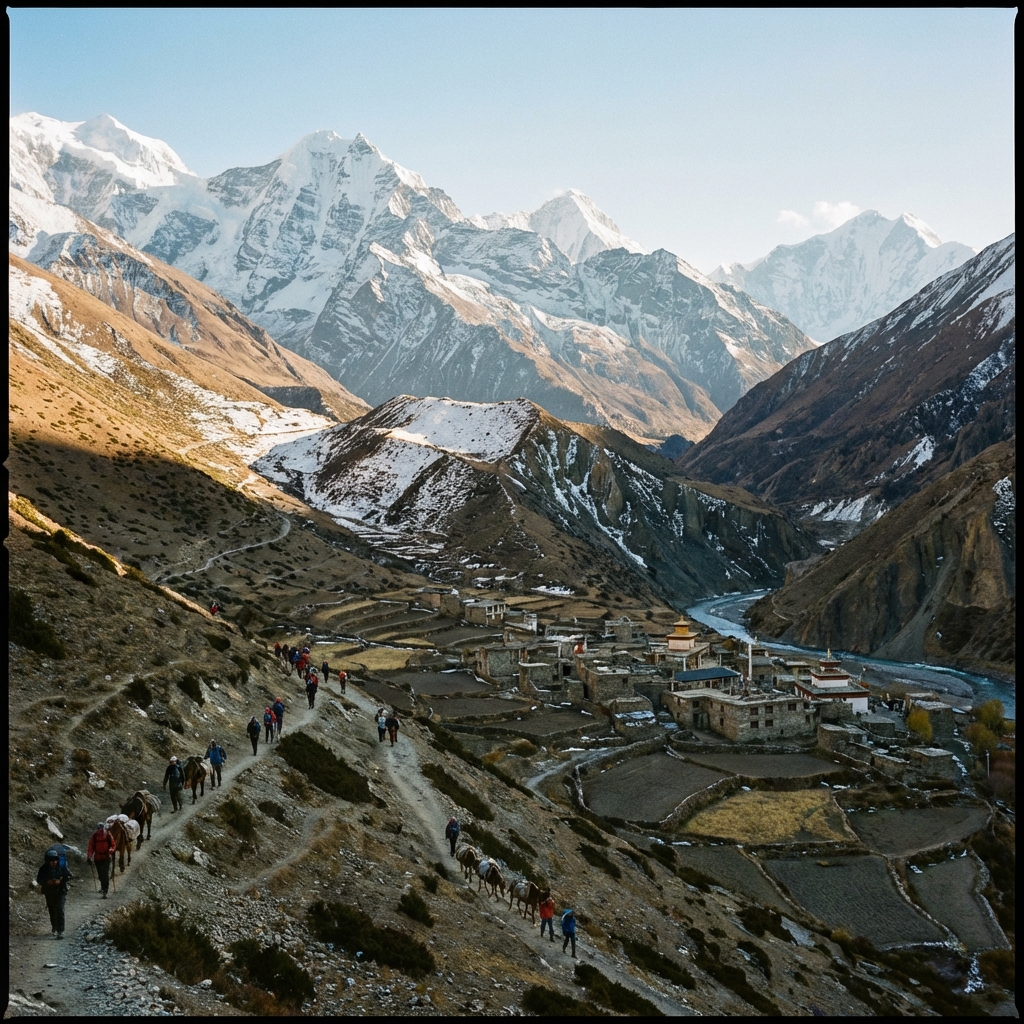
But Upper Mustang rewards those who plan carefully. You'll walk through high-altitude desert landscapes painted in shades of ochre, red, and gray. You'll explore 15th-century monasteries with priceless murals untouched by mass tourism. You'll enter Lo Manthang through ancient gates that have welcomed travelers for six centuries. And you'll experience Tibetan Buddhist culture more authentically preserved than almost anywhere on Earth—even Tibet itself, where Chinese modernization has transformed traditional ways of life.
This guide provides everything you need to select an agency worthy of this extraordinary destination. We'll explain the permit system in detail, clarify what cultural expertise actually looks like, identify red flags that indicate problematic operators, and help you understand realistic cost expectations for one of the world's most exclusive trekking experiences.
Mandatory (Restricted Area)
2 trekkers required
USD 50 per day (no minimum) days
$50 per day after 10
$2,500-3,500
$4,000-6,000+
10-14 days
4,200m (Dhakmar La Pass)
Monsoon trekking possible
Upper Mustang: Why This Trek Demands Agency Expertise
The Last Forbidden Kingdom
Upper Mustang represents something increasingly rare in modern travel—a living museum of Tibetan culture that hasn't been diluted by mass tourism. Founded in 1380 by King Ame Pal, the Kingdom of Lo maintained semi-autonomous rule for over 600 years. The Nepalese government kept the region completely closed to foreigners until 1992, and even after opening, strict permit restrictions have limited annual visitors to fewer than 1,000 trekkers.
This isolation created a time capsule. While Chinese modernization transformed Tibet itself, Upper Mustang preserved ancient ways unchanged. The Sakyapa sect of Tibetan Buddhism flourishes in monasteries built six centuries ago. Polyandry (multiple brothers sharing one wife) continues in some families. Traditional medicine practitioners called Amchi still treat ailments with herbal remedies passed down through generations. Prayer wheels spin constantly in villages where daily life revolves around Buddhist practice rather than tourism.
Your agency doesn't just handle permits—they serve as your interpreters of this fragile cultural world. A guide who understands Tibetan Buddhism's significance, who speaks local dialects, who has relationships in Lo Manthang built over years of repeated visits, transforms your trek from sightseeing into genuine cultural immersion.
Why Agencies Are Legally Mandatory
The Nepalese government designated Upper Mustang as a Restricted Area for interconnected reasons that directly impact your planning:
Border Security: Upper Mustang shares a border with Chinese-controlled Tibet. The sensitive geopolitical situation requires regulated access to monitor movement in the region. Your permits are checked at Kagbeni checkpoint before entering the restricted zone.
Cultural Preservation: Limited trekker numbers—controlled through expensive permits and mandatory agency requirements—protect the Loba people's traditional ways of life from overwhelming tourism pressure. The permit fees fund monastery restoration, community development, and cultural heritage preservation.
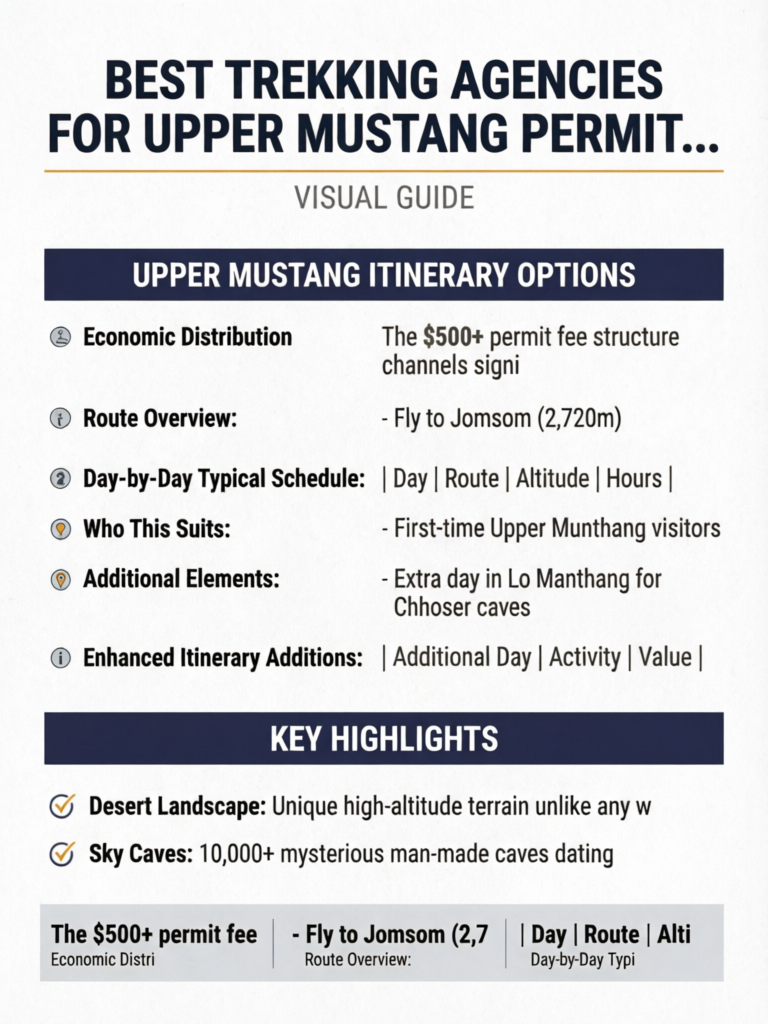
Economic Distribution: The $500+ permit fee structure channels significant revenue to conservation and local communities. These funds support trail maintenance, health posts, school supplies, and the very cultural preservation that makes Upper Mustang worth visiting.
Tourism Quality Control: By requiring agency involvement, authorities ensure all visitors have proper support in a region with limited emergency services, basic facilities, and complex cultural protocols.
This Is Not Optional
Trekking Upper Mustang without a registered agency is illegal. The Restricted Area Permit (RAP) can only be obtained through licensed trekking agencies—individual applications are not accepted. Permit checkpoints at Kagbeni verify that all trekkers have proper documentation. Attempting to enter without proper permits results in immediate return and potential fines. There are no exceptions for experienced trekkers, no "special arrangements," and no independent options.
The Rain Shadow Advantage
Upper Mustang offers something no other major Nepal trek provides: reliable trekking during monsoon season (June-August). The Annapurna and Dhaulagiri ranges block moisture from reaching this high-altitude desert, creating a microclimate that receives just 250-400mm annual rainfall compared to 2,500-5,000mm in southern Nepal.
When Everest Base Camp trails turn to mud, when Annapurna Circuit clouds obscure mountain views, when leeches emerge on lowland paths—Upper Mustang remains dry and trekking-friendly. This unique advantage means quality agencies can operate successful Upper Mustang treks year-round except for the coldest winter months (December-February).
Agencies with genuine Upper Mustang expertise understand this seasonal opportunity. They don't just run trips in October and November—they offer monsoon departures that give you Upper Mustang practically to yourself, with clearer skies than you'd expect and warmer daytime temperatures than spring or autumn.
Upper Mustang Permit Requirements: Complete Breakdown
Understanding the permit system helps you evaluate whether agencies are quoting fair prices and handling documentation correctly. Upper Mustang has Nepal's most expensive and complex permit requirements.
Required Permits for Upper Mustang (2026)
| Permit | Cost | Duration | Notes |
|---|---|---|---|
| Upper Mustang Restricted Area Permit (RAP) | USD 50 per person per day (no minimum days required — changed from previous $500/10-day minimum) | 10-day minimum | Must be arranged through licensed agency |
| Additional RAP Days | $50 per day | Beyond 10 days | For extended itineraries |
| Annapurna Conservation Area Permit (ACAP) | NPR 3,000 (~$23) | Trek duration | Conservation fee |
| TIMS Card | NPR 2,000 (as of 2026) | Trek duration | Trekker registration |
Why Upper Mustang Has Nepal's Most Expensive Permits
The USD 50/day minimum permit cost—plus $50 for each additional day—makes Upper Mustang dramatically more expensive than any other trek in Nepal:
Permit Cost Comparison:
| Trek | Permit Cost | Notes |
|---|---|---|
| Upper Mustang | $500-700+ | 10-14 day standard trek |
| Manaslu Circuit | $150-200 | 14-16 day trek |
| Everest Base Camp | $45-50 | No restricted area fees |
| Annapurna Circuit | $40-50 | No restricted area fees |
This pricing structure is intentional. The Nepalese government uses expensive permits to limit visitor numbers, preserving Upper Mustang's unique character while generating significant revenue for conservation and community development. Fewer than 1,000 foreign trekkers visit annually compared to 40,000+ on Everest Base Camp.
The Minimum Two Trekkers Requirement
Official regulations require a no minimum (solo trekkers allowed with licensed guide) per group for Upper Mustang. This rule exists for several reasons:
Safety Considerations: The remote region has limited emergency services. Two trekkers provide mutual support.
Economic Efficiency: The expensive permit system makes individual permits administratively inefficient for the small numbers allowed.
Cultural Sensitivity: Group travelers are considered less intrusive to local communities than solo wanderers.
Practical Impact for Solo Travelers:
- You cannot obtain a solo permit under any circumstances
- Legitimate agencies offer group departures you can join
- You can be paired with another solo trekker by the agency
- You can pay a "single supplement" (effectively paying for two permits)
- Any agency claiming they can arrange "solo permits" is either lying or operating illegally
Pro Tip
The two-person minimum often works in your favor. Contact agencies about existing bookings around your dates. Being paired with another solo trekker saves you the single supplement cost while providing companionship on a multi-week journey. Many lasting travel friendships begin with agency pairings on Upper Mustang.
Permit Processing: What Your Agency Handles
The permit application process explains why individual arrangements are impossible:
RAP Application Requirements:
- Submitted to Department of Immigration in Kathmandu
- Requires agency letterhead and registration documents
- Lists assigned licensed guide by name and license number
- Specifies all trekkers by passport details (names, numbers, nationalities)
- Includes detailed itinerary with overnight locations
- Requires passport-sized photos of all participants
- Processing takes 2-5 business days
- Additional days added for extended trips
Agency Responsibilities:
- Prepare and verify all application documents
- Submit applications to Department of Immigration
- Pay fees to government offices (cash only, in person)
- Collect physical permit documents
- Handle any corrections or changes
- Carry original permits for checkpoint verification
- Coordinate ACAP permits through National Trust for Nature Conservation
Individual trekkers cannot access the Department of Immigration's permit window for RAP applications—only registered agency representatives are processed.
Total Permit Cost for Standard Treks
For a standard 10-12 day Upper Mustang trek:
| Permit | Cost |
|---|---|
| RAP (10 days) | USD 50/day |
| RAP (additional 2 days) | $100 |
| ACAP | $23 |
| TIMS | NPR 2,000 |
| Total (10 days) | $523 |
| Total (12 days) | $623 |
For an extended 14-day trek:
| Permit | Cost |
|---|---|
| RAP (10 days base) | $500 |
| RAP (additional 4 days) | $200 |
| ACAP | $23 |
| TIMS | NPR 2,000 |
| Total (14 days) | $723 |
Verify Permit Costs in Quotes
When comparing agency quotes, ensure the RAP cost is correctly calculated for your itinerary duration. A 12-day trek requires $600 in RAP fees ($500 base + $100 for 2 extra days), not $500. Some agencies quote only the minimum permit cost, adding "extra day fees" later as unexpected charges.
What Makes Upper Mustang Unique: Understanding the Trek
Quality agencies understand what makes this destination special. Their expertise should go beyond logistics into the cultural and environmental factors that define the Upper Mustang experience.
The High-Altitude Desert Landscape
Upper Mustang sits in the rain shadow of the Annapurna and Dhaulagiri ranges, creating an ecosystem unlike anywhere else in Nepal. You'll walk through terrain reminiscent of the American Southwest or the Tibetan plateau—towering red cliffs carved by ancient winds, deep gorges with layered sedimentary rock, and barren highlands where vegetation survives only through irrigation.
This landscape tells a 100-million-year story. The layered formations were once the floor of the ancient Tethys Sea. Tectonic forces thrust them skyward during the collision of Indian and Asian continental plates. Fossils of marine life—including ammonites—can still be found embedded in the rock.
What This Means for Agency Selection:
- Guides should understand the geological significance, not just trail directions
- Itineraries should allow time for landscape appreciation, not just village-hopping
- Photography-focused trips require guides who know optimal timing and viewpoints
- Desert environment expertise (sun protection, hydration, dust management) matters
Ancient Tibetan Buddhist Culture
Upper Mustang is a stronghold of the Sakyapa sect of Tibetan Buddhism. The culture here is purer and less commercialized than in more touristed regions—even purer than much of modern Tibet, where Chinese policies have altered traditional practices.
Lo Manthang contains three ancient 15th-century monasteries—Jampa Lhakhang, Thubchen Gompa, and Chode Gompa—featuring centuries-old murals, golden statues, and priceless manuscripts. These aren't museums frozen in time; they're living centers of worship where monks continue traditions passed down through generations.
Cultural Elements Your Guide Should Understand:
- Sakyapa Buddhist traditions and how they differ from other Tibetan Buddhist sects
- Monastery visiting protocols (clockwise circumambulation, appropriate dress, photography rules)
- Village social structures and the role of Buddhism in daily life
- The significance of mani walls, chortens, and prayer flags
- Traditional practices like sky burial, polyandry, and Amchi medicine
- The Tiji Festival and its meaning (if timing your trip accordingly)
- Historical relationship between the Kingdom of Lo and Tibet
Cultural Interpretation Matters
The difference between a logistics-focused guide and a culturally knowledgeable guide transforms Upper Mustang from sightseeing into genuine understanding. When you enter Thubchen Gompa, do you see "old paintings" or do you understand the Buddhist cosmology depicted in the mandalas, the significance of specific deities, and why villagers still light butter lamps before these 600-year-old murals? Agency selection determines which experience you receive.
Lo Manthang: The Walled Capital
Lo Manthang represents the spiritual and political heart of Upper Mustang. The name translates to "Heart's Desired Land." Walking through the main gate transports you into a living medieval settlement where approximately 900 Loba people maintain traditions largely unchanged for centuries.
The earthen walls stretch 856 meters in circumference, standing 6 meters high and 1 meter thick. Narrow alleyways wind between traditional mud-brick homes with flat roofs that serve as gathering spaces. The Royal Palace—home to the ruling dynasty for centuries—still dominates the central square, though formal monarchy ended in 2008.
Quality Agency Indicators:
- Itineraries allowing 1.5-2 full days in Lo Manthang (not rushed single-day visits)
- Monastery visits scheduled during appropriate hours (typically 3:00-5:00 PM)
- Guides with established relationships in Lo Manthang (knowing which monks speak English, which homes welcome visitors)
- Understanding of the three major monasteries' distinct characteristics
- Options for side trips (Chhoser caves, Ghar Gompa, royal palace museum)
The Sky Caves: Archaeological Mystery
Over 10,000 man-made caves carved into sheer cliff faces throughout Upper Mustang remain one of archaeology's enduring mysteries. Dating back 2,000-3,000 years, these caves served as dwellings, meditation chambers, burial sites, and storage facilities.
The Chhoser cave complex near Lo Manthang offers the most accessible exploration opportunity. Caves contain ancient murals, artifacts, and engineering feats that astound modern researchers. How were they carved at extreme heights using primitive tools? Who built them, and why?
Agency Expertise Indicators:
- Extended itineraries including Chhoser cave day trip
- Guides who can explain archaeological significance
- Safety awareness for cave exploration (some require scrambling)
- Understanding of which caves are accessible vs. unstable
Physical Demands: Less Extreme Than You Might Expect
Upper Mustang is rated Moderate in difficulty—significantly easier than Everest Base Camp or Manaslu Circuit in terms of altitude and physical demands:
| Factor | Upper Mustang | Everest Base Camp | Manaslu Circuit |
|---|---|---|---|
| Maximum altitude | 4,200m | 5,364m | 5,160m |
| Daily hiking hours | 5-7 hours | 5-7 hours | 6-8 hours |
| Major pass crossing | Dhakmar La (4,200m) | None (unless Cho La) | Larkya La (5,160m) |
| Technical difficulty | Low | Low | Moderate |
| Tea house quality | Basic-Good | Good-Excellent | Basic |
This accessibility makes Upper Mustang suitable for fit trekkers without extreme high-altitude experience. It's often recommended as an alternative for those who want Himalayan adventure without Everest-level physical demands.
What This Means for Agency Selection:
- Agencies shouldn't oversell difficulty to justify premium pricing
- Proper acclimatization still matters—reject "express" itineraries
- Jeep-supported options are legitimate for those with physical limitations
- The cultural experience, not physical challenge, should drive itinerary design
What to Look for in Upper Mustang Agencies
Beyond standard agency evaluation criteria, Upper Mustang demands specific qualifications related to cultural knowledge, permit expertise, and local relationships.
Cultural Sensitivity and Knowledge
This is the most critical differentiator for Upper Mustang agencies. The trek's primary value lies in cultural immersion, making guide expertise paramount:
Questions to Ask:
- "Can you describe the difference between Sakyapa Buddhism and other Tibetan Buddhist traditions?"
- "What monastery visiting protocols should I follow?"
- "How do guides explain the significance of the murals in Thubchen Gompa?"
- "What cultural experiences are included beyond standard monastery visits?"
- "Do your guides speak local Loba/Tibetan dialects or only Nepali/English?"
What Quality Agencies Demonstrate:
- Guides with multiple Upper Mustang seasons (10+ trips minimum)
- Training or background in Tibetan Buddhist studies
- Relationships with monastery monks and local families
- Cultural programming beyond checklist tourism (cooking demonstrations, Amchi consultations, family visits)
- Understanding of sensitive topics (polyandry, sky burial, Chinese border issues)
Red Flags:
- Guides who've done Upper Mustang "once or twice"
- No cultural content in itinerary descriptions beyond "visit monastery"
- Unable to answer basic questions about Buddhist practices
- Treating Upper Mustang as "just another trek"
Permit Handling Expertise
Given the expense and complexity of Upper Mustang permits, agencies must demonstrate competent administrative capabilities:
Verification Points:
- How far in advance do they submit permit applications? (Should be 2-4 weeks minimum)
- Can they explain the permit cost structure correctly?
- What documentation do they require from you, and when?
- What's their process if permit issues arise?
- Do they provide permit copies before departure?
Quality Indicators:
- Clear, written breakdown of all permit costs in quotes
- Request for passport copies and photos well in advance
- Explanation of checkpoint procedures
- Contingency plans for permit delays
Red Flags:
- Vague about permit costs or calculating incorrectly
- Late requests for documentation (creates processing delays)
- Claims of "special connections" for permit discounts or solo arrangements
- Permit costs appearing as surprise additions to base quotes
Local Connections in Lo Manthang
Agencies with genuine Upper Mustang expertise have established relationships that enhance your experience:
What Relationships Enable:
- Priority accommodation at best available lodges
- Access to monastery areas not always open to tourists
- Introductions to local families and artisans
- Real-time information about cultural events
- Local knowledge beyond guidebook information
- Emergency support from community connections
Questions to Verify:
- "Which lodges do you use in Lo Manthang, and do you have relationships with owners?"
- "Can you arrange visits beyond the three main monasteries?"
- "What happens if festival dates change—do you have local contacts for updates?"
- "How long has your company been operating in Upper Mustang?"
Jeep vs. Trekking Options
A rough dirt road now connects Jomsom to Lo Manthang, creating options for those who can't or prefer not to trek the entire distance:
Legitimate Jeep Uses:
- Medical conditions limiting walking
- Time constraints requiring shortened itinerary
- Hybrid approach (jeep outbound, trek return or vice versa)
- Photography tours needing equipment transport
- Emergency evacuation capability
Quality Agency Approach:
- Offers jeep-supported as option, not default
- Understands which sections are best trekked vs. driven
- Provides cost transparency for vehicle options
- Doesn't push jeep tours to maximize profit
- Maintains walking emphasis for cultural immersion
Red Flags:
- Default itineraries featuring extensive jeep transport
- Vague about road conditions or walking alternatives
- Unable to provide trekking-only options
- Pricing structures that incentivize jeep over walking
Photography and Cultural Focus Options
Upper Mustang attracts photographers seeking unique landscapes and cultural subjects. Quality agencies offer specialized options:
Photography Trek Features:
- Extended time at key viewpoints for optimal light
- Flexible schedule allowing weather-dependent adjustments
- Guides who understand composition and subject access
- Early morning/late afternoon scheduling for golden hour
- Knowledge of photography-friendly monastery policies
- Support for equipment carrying
Cultural Immersion Features:
- Home visits and local interaction arranged
- Festival timing for Tiji or other celebrations
- Extended Lo Manthang stays beyond standard duration
- Side valley exploration (Chhoser, Ghar Gompa)
- Archaeological focus on sky cave complexes
- Amchi medicine consultations
- Cooking or craft demonstrations
Pro Tip
If photography or deep cultural immersion is your primary goal, communicate this explicitly during agency selection. Standard itineraries prioritize covering ground efficiently. Specialized trips sacrifice distance for depth—which is often exactly what Upper Mustang rewards. Ask agencies: "How would you modify a standard itinerary for someone prioritizing photography?" Their answer reveals their flexibility and understanding.
Red Flags to Avoid in Upper Mustang Agencies
Upper Mustang's high costs and cultural significance make certain warning signs particularly serious.
Rushed Itineraries Missing Key Sites
The permit structure (10-day minimum) creates pressure for some agencies to compress experiences into the shortest possible time. This approach fundamentally misunderstands Upper Mustang's value:
Red Flag Itinerary Signs:
- Only one night in Lo Manthang (insufficient for three monasteries, palace, exploration)
- No rest/acclimatization day in Lo Manthang
- Skipping alternative return route (missing Drakmar, Ghar Gompa)
- No time for Chhoser caves or side explorations
- Identical outbound and return route (repetitive, misses half the experience)
Appropriate Itinerary Standards:
- Minimum 1.5-2 days in Lo Manthang for monastery exploration
- Different outbound and return routes
- Rest day built into schedule for acclimatization or weather delays
- Options for extended exploration (caves, side valleys)
Questions to Ask:
- "How many nights do we spend in Lo Manthang?"
- "Do we take the same route in both directions?"
- "Is there time for Chhoser caves or other side trips?"
- "What happens if weather delays require schedule adjustment?"
No Cultural Interpretation
Agencies treating Upper Mustang as a standard tea house trek with expensive permits miss the entire point:
Warning Signs:
- Itineraries listing only villages and distances, no cultural content
- Guides described only by trekking experience, not cultural knowledge
- No mention of monastery visits, cultural protocols, or local traditions
- Standard "trekking guide" rather than Upper Mustang specialist
- Reviews mentioning language barriers or guide disinterest
What Quality Cultural Interpretation Includes:
- Monastery significance explained before and during visits
- Historical context for villages and sites
- Buddhist practice explanations (prayer flags, mani walls, circumambulation)
- Local customs and appropriate behavior guidance
- Stories and legends of the Kingdom of Lo
- Explanations of traditional architecture, agriculture, and daily life
Hidden Permit Costs
Given that permits alone cost $500+, any agency obscuring these costs is problematic:
Red Flag Pricing Tactics:
- Base price quoted "excluding permits"
- Permit costs listed vaguely as "approximately $500"
- No breakdown of RAP vs. ACAP vs. other fees
- "Additional day fees" appearing as surprises
- Different permit costs quoted to different inquiries
Transparent Pricing Standards:
- Clear itemization: "RAP (USD 50/day (no minimum days)), ACAP ($23), total permits: $523"
- Upfront disclosure of cost for extended itineraries
- Written confirmation of all-inclusive pricing
- Explanation of what happens if extra days are needed
The $500 Question
Any agency quoting significantly below $2,000 for a 10-day Upper Mustang trek is either hiding permit costs, cutting corners on services, or operating illegitimately. Permits alone cost $500+. Add guide fees, accommodation, meals, transport, and agency margin, and legitimate costs simply cannot go much lower than $2,000-2,500 for budget packages. If a quote seems too good to be true, it is.
Agencies Promising "Solo Permits"
The two-person minimum is non-negotiable. Any agency claiming otherwise raises serious concerns:
The Reality:
- Solo permits do not exist for Upper Mustang
- "Special arrangements" for solo travelers are either fraudulent or illegal
- Checkpoints verify group composition against permit details
- Solo trekkers with improper documentation are turned back at Kagbeni
Legitimate Solo Traveler Options:
- Join agency group departures
- Be paired with another solo trekker
- Pay single supplement (effectively two permits, one person)
- Travel with a friend or family member
Red Flag Language:
- "We can arrange solo permits through special connections"
- "The two-person rule isn't really enforced"
- "We know people at immigration who can help"
- Any suggestion the rules can be circumvented
Inadequate Emergency Protocols
Upper Mustang's remoteness requires serious emergency planning:
Critical Requirements:
- Satellite communication device (cell coverage is sporadic to nonexistent)
- Established evacuation protocols
- Knowledge of helicopter landing zones
- Relationships with evacuation services
- Understanding of nearest medical facilities (Jomsom health post, Pokhara hospitals)
Questions to Ask:
- "What emergency communication do you carry beyond cell phones?"
- "What's your protocol if a trekker develops serious altitude sickness in Lo Manthang?"
- "Where are helicopter evacuation possible from, and who coordinates this?"
- "Does your guide carry a satellite phone or InReach device?"
Red Flags:
- "Cell phones work in most villages" (unreliable, not for emergencies)
- Vague about evacuation procedures
- No mention of satellite communication
- Unable to describe specific emergency scenarios
What Should Be Included in Upper Mustang Packages
Non-Negotiable Inclusions
These items must be included in any legitimate Upper Mustang package:
All Required Permits:
- Upper Mustang Restricted Area Permit (calculated correctly for your itinerary duration)
- Annapurna Conservation Area Permit
- TIMS card
- Any additional permits for extended routes
Licensed, Culturally Knowledgeable Guide:
- Government-certified trekking guide license
- Specific Upper Mustang experience (multiple seasons)
- English fluency for cultural interpretation
- Understanding of Tibetan Buddhist traditions
- First aid and altitude sickness training
Appropriate Porter Support:
- Weight allowance specified (typically 10-15kg per person)
- Proper gear for high-altitude conditions
- Insurance coverage for porters
- Fair wages and treatment
Transportation:
- Kathmandu to Pokhara (flight or bus depending on package)
- Pokhara to Jomsom flights (both directions)
- Any ground transport included in itinerary
Accommodation:
- All tea house accommodation during trek
- Quality varies by price level, but should be clearly specified
- Pre-booking at key stops (especially Lo Manthang)
Meals:
- Three meals daily during trek (breakfast, lunch, dinner)
- Clarity about included beverages vs. extra charges
Standard Inclusions Breakdown
| Service | Budget ($2,500-3,500) | Standard ($3,500-4,500) | Premium ($4,500-6,000+) |
|---|---|---|---|
| All permits | Included | Included | Included |
| Licensed guide | 1 guide per 4-6 trekkers | 1 guide per 2-4 trekkers | Private guide |
| Porter | 1 porter per 2 trekkers | Dedicated porter | Dedicated porter |
| Tea house quality | Basic, available | Better, pre-booked | Best available, priority |
| Meals | Three daily, basic | Three daily, variety | All meals, snacks, beverages |
| Flights | Economy, shared transfers | Economy, better logistics | Premium timing, private transfers |
| Kathmandu hotel | Not included | 1-2 nights | 2-3 nights, 4-star |
| Sleeping bag | Rental extra | Often included | Included |
| Cultural programming | Standard monastery visits | Enhanced cultural content | In-depth cultural immersion |
Common Exclusions
Budget for these additional costs regardless of package:
Always Extra:
- International flights to/from Kathmandu
- Nepal visa ($50-125 depending on duration)
- Travel insurance (mandatory, $100-300)
- Tips for guide and porter ($150-250 recommended)
- Personal trekking gear
- Alcoholic beverages
- Personal expenses
Usually Extra:
- Hot showers ($2-5 per shower)
- Device charging ($2-5 per charge)
- WiFi access ($3-5 per session, when available)
- Extra snacks and drinks beyond meals
- Monastery entrance fees (NPR 1,000 combined in Lo Manthang)
- Sleeping bag rental if not included ($1-2/day)
Sometimes Extra:
- Single room supplement ($200-400)
- Helicopter evacuation (insurance should cover)
- Extra days beyond itinerary
- Extended exploration options (Chhoser caves, side valleys)
Price Ranges for Upper Mustang: What You Get
Budget Range ($2,500-3,500): Essential Experience
What Budget Packages Typically Include:
- 10-12 day standard itinerary
- All required permits (correctly calculated)
- Licensed guide (possibly less experienced)
- Shared porter arrangements
- Basic tea house accommodation
- Three meals daily
- Pokhara-Jomsom flights
- Group departures only
Reality Check:
Many "$2,500" packages become $3,200+ after realistic additions:
| Item | Cost |
|---|---|
| Base package | $2,500 |
| Sleeping bag rental (10 days) | $15 |
| Hot showers (5x) | $20 |
| Device charging (10x) | $40 |
| Monastery entrance | $8 |
| Tips (guide + porter) | $200 |
| Extra drinks/snacks | $50 |
| TRUE TOTAL | $2,833 |
Who Budget Suits:
- Experienced trekkers comfortable with basic facilities
- Those prioritizing the experience over comfort
- Trekkers joining group departures
- Budget-conscious travelers accepting limitations
- Those with time flexibility for group schedules
Budget Risks on Upper Mustang:
- Less experienced or culturally knowledgeable guides
- Basic tea houses may be uncomfortable
- Less flexibility for weather or schedule adjustments
- Rushed itineraries to minimize days
- Limited cultural interpretation
Budget Can Work—With Verification
Budget Upper Mustang packages from reputable, TAAN-registered agencies can deliver meaningful experiences. The key is verification: confirm guide experience specifically in Upper Mustang, verify cultural knowledge during pre-booking conversations, and accept that comfort will be limited. Don't choose budget if cultural depth is your priority—the savings come partly from guide expertise reduction.
Standard Range ($3,500-4,500): Recommended for Most
What Standard Packages Typically Include:
- 10-14 day itinerary with proper pacing
- All required permits
- Experienced guide with multiple Upper Mustang seasons
- Dedicated porter support
- Better tea house selection, pre-booked
- Full board with more meal variety
- Domestic flights with better scheduling
- Kathmandu hotel (1-2 nights)
- Sleeping bag often included
- Flexibility for private or small group
- Enhanced cultural programming
Why Standard Is the Sweet Spot:
This price range secures the fundamentals that matter on Upper Mustang:
- Culturally knowledgeable guides who've led dozens of Upper Mustang trips
- Proper itinerary pacing without schedule pressure
- Quality tea houses pre-booked at key stops
- Adequate porter support with ethical treatment
- Flexibility if weather or health requires changes
- Enhanced cultural content beyond checklist tourism
True Cost Calculation:
| Item | Cost |
|---|---|
| Base package | $3,800 |
| Gear rentals | Often included |
| Kathmandu hotels | Often included |
| Extras (showers, charging) | $50 |
| Tips | $200 |
| Extra snacks/drinks | $30 |
| TRUE TOTAL | $4,080 |
Who Standard Suits:
- First-time Upper Mustang trekkers
- Those wanting cultural depth without luxury
- Couples, small groups, families
- Trekkers prioritizing experience quality
- Those with limited time who need reliable execution
Premium Range ($4,500-6,000+): Maximum Experience
What Premium Packages Typically Include:
- 12-16 day customized itinerary
- All permits with priority processing
- Senior guide with extensive Upper Mustang expertise, cultural training
- Dedicated porter (1:1 ratio)
- Best available tea houses, priority booking
- Gourmet meal options, dietary accommodations
- Premium flight scheduling, private ground transfers
- Quality Kathmandu hotel (4-star, 2-3 nights)
- Full gear provision
- Comprehensive emergency equipment
- Fully flexible scheduling
- Private treks standard
- In-depth cultural programming
- 24/7 agency support
- Extended exploration options
When Premium Is Worth It:
Cultural Immersion Focus: If understanding Tibetan Buddhist culture—not just seeing monasteries—is your goal, premium packages provide guides with genuine expertise, extended time for deep exploration, and access beyond standard tourism.
Photography Priorities: Premium flexibility allows waiting for weather, schedule adjustments for optimal light, extended time at key locations, and guides who understand composition needs.
Limited Time with High Expectations: Premium efficiency maximizes meaningful experience per day. Every element is optimized for quality rather than cost.
Special Occasions: Honeymoons, milestone birthdays, retirement trips—moments warranting the best possible experience.
Older Trekkers (55+): Premium packages provide comfortable pacing, dedicated support, flexibility to adjust without schedule pressure, and enhanced emergency protocols.
| Trek | Duration | Max Altitude | Difficulty | Best For | Cost |
|---|---|---|---|---|---|
| Budget Package | 10-12 days | $2,500-3,500 base | Group departures only | Experienced, budget-conscious trekkers | Basic support, essential services |
| Standard Package | 10-14 days | $3,500-4,500 | Group or private options | Most trekkers, cultural seekers | Full support, quality cultural experience |
| Premium Package | 12-16 days | $4,500-6,000+ | Fully customized | Maximum immersion, special occasions | Complete support, in-depth cultural access |
Upper Mustang Itinerary Options
Classic Upper Mustang (10-12 Days)
The standard itinerary covers the essential Upper Mustang experience:
Route Overview:
- Fly to Jomsom (2,720m)
- Trek to Kagbeni (2,810m) - Gateway to restricted area
- Ascend through Chele, Syangboche, Ghami, Tsarang
- Reach Lo Manthang (3,840m) - The walled capital
- Explore monasteries, royal palace, local culture
- Return via different route (Drakmar, Dhakmar La Pass)
- Trek back to Jomsom for flight
Day-by-Day Typical Schedule:
| Day | Route | Altitude | Hours |
|---|---|---|---|
| 1 | Kathmandu-Pokhara-Jomsom-Kagbeni | 2,810m | 3-4h trek |
| 2 | Kagbeni to Chele | 3,050m | 5-6h |
| 3 | Chele to Syangboche | 3,800m | 5-6h |
| 4 | Syangboche to Ghami | 3,520m | 5-6h |
| 5 | Ghami to Tsarang | 3,560m | 4-5h |
| 6 | Tsarang to Lo Manthang | 3,840m | 4-5h |
| 7 | Explore Lo Manthang | 3,840m | Rest day |
| 8 | Lo Manthang to Drakmar | 3,810m | 6-7h |
| 9 | Drakmar to Ghiling | 3,806m | 6-7h |
| 10 | Ghiling to Chhusang | 2,980m | 5-6h |
| 11 | Chhusang to Jomsom | 2,720m | 4-5h |
| 12 | Jomsom-Pokhara-Kathmandu | - | Flights |
Who This Suits:
- First-time Upper Mustang visitors
- Those with 2-week windows
- Standard budget/timeline constraints
- Trekkers wanting complete essential experience
Extended with Side Valleys (14-16 Days)
Adding exploration depth transforms the experience:
Additional Elements:
- Extra day in Lo Manthang for Chhoser caves
- Extended exploration of sky cave complexes
- Side trip to Ghar Gompa (oldest monastery)
- More time for cultural interactions
- Buffer days for weather or acclimatization
- Possible extension toward Korala Pass (Tibet border viewpoint)
Enhanced Itinerary Additions:
| Additional Day | Activity | Value |
|---|---|---|
| Lo Manthang +1 | Chhoser cave exploration | Archaeological mystery, unique experience |
| Lo Manthang +2 | Extended monastery visits, local interactions | Deeper cultural immersion |
| Ghar Gompa | Side trip from return route | One of Mustang's oldest monasteries |
| Buffer day | Weather/health flexibility | Insurance against delays |
Who This Suits:
- Cultural immersion seekers
- Those with 3-week availability
- Photography enthusiasts
- Archaeology buffs interested in sky caves
- Trekkers wanting in-depth experience
Upper Mustang + Lower Mustang Combination
Extending into Lower Mustang adds pilgrimage sites and diverse experiences:
Additional Lower Mustang Elements:
- Muktinath Temple (sacred Hindu/Buddhist pilgrimage site)
- Marpha village (famous for apple brandy)
- Jomsom town exploration
- Lower elevation variety (greener landscapes)
- No additional restricted area permits required
Combined Route Approach:
- Complete Upper Mustang circuit as described
- Add 2-3 days for Lower Mustang exploration
- Visit Muktinath as significant cultural addition
- Total duration: 14-17 days
Who This Suits:
- Those wanting comprehensive Mustang experience
- Pilgrims interested in Muktinath
- Trekkers with extended time availability
- Those seeking landscape variety
Jeep-Supported Options
For those with physical limitations or time constraints:
Jeep Support Approaches:
Partial Jeep:
- Jeep outbound to Lo Manthang (2 days)
- Trek return via different route (4-5 days)
- Captures trekking experience while reducing total walking
Trek Out, Jeep Return:
- Full trek to Lo Manthang (5 days)
- Jeep return directly to Jomsom (1 day)
- Maximizes trekking while enabling faster exit
Hybrid:
- Jeep the dusty road sections sharing vehicle track
- Trek the scenic portions on traditional paths
- Best of both approaches
Who This Suits:
- Trekkers with knee or joint issues
- Those with tight schedules
- Photographers needing equipment transport
- Older trekkers preferring reduced walking
- Those prioritizing cultural experience over physical challenge
Pro Tip
The new road to Lo Manthang has changed Upper Mustang dynamics. Quality agencies understand which sections are best trekked (scenic traditional paths) versus where jeep makes sense (dusty road sections). Don't accept all-jeep itineraries unless medically necessary—you'll miss the journey that makes Upper Mustang meaningful.
Best Time for Upper Mustang
The Monsoon Season Advantage
Upper Mustang's position in the rain shadow creates Nepal's best monsoon trekking opportunity:
Why Monsoon Works (June-August):
- Minimal rainfall (250-400mm annually, mostly light afternoon showers)
- Other Nepal treks muddy, leech-infested, cloud-covered
- Warmer daytime temperatures (20-25°C)
- Fewer trekkers, better prices
- Green vegetation at lower elevations
- Dramatic cloud formations around surrounding peaks
Monsoon Considerations:
- Dusty conditions when wind blows
- Strong afternoon winds in Kali Gandaki valley
- Occasional afternoon clouds (rarely sustained rain)
- Fewer group departures available
- Some tea houses may have reduced staff
Why This Matters for Agency Selection: Quality agencies with genuine Upper Mustang expertise offer monsoon departures confidently. They understand the rain shadow advantage and don't simply copy schedules from other regions. If an agency claims "monsoon is bad for Upper Mustang," they lack route-specific knowledge.
Peak Season: Spring and Autumn
Spring (March-May):
- Warming temperatures, comfortable trekking
- Wildflowers at lower elevations
- Barley fields green around villages
- Tiji Festival in May (exact dates vary by lunar calendar)
- Moderate crowds
- Excellent weather stability
Tiji Festival Timing:
- Three-day celebration in Lo Manthang
- Masked dances depicting victory of good over evil
- Entire community participation
- Must book 4-6 months in advance
- 20-30% premium on standard rates
- Once-in-a-lifetime cultural experience
Autumn (September-November):
- Crystal-clear skies, exceptional visibility
- Post-monsoon clarity
- Harvest season cultural experiences
- Comfortable temperatures (10-20°C)
- Moderate to high crowds (peak season)
- Best photography conditions
Month-by-Month Rating
| Month | Trekking Rating | Notes |
|---|---|---|
| January | 2/5 | Very cold, snow at passes, many lodges closed |
| February | 2/5 | Cold, improving but still winter conditions |
| March | 4/5 | Trek season begins, clear skies |
| April | 5/5 | Excellent, spring blooms, stable weather |
| May | 5/5 | Peak spring, Tiji Festival possible |
| June | 4/5 | Monsoon elsewhere, dry in Mustang |
| July | 4/5 | Warmest month, monsoon advantage |
| August | 4/5 | Good conditions, green at lower elevations |
| September | 5/5 | Post-monsoon clarity, harvest season |
| October | 5/5 | Peak autumn, best visibility |
| November | 4/5 | Late season, excellent views, colder |
| December | 2/5 | Early winter, some lodges closing |
Solo Trekker Solutions
The two-person minimum creates specific challenges—and opportunities—for solo travelers.
How to Find Trek Partners
Agency Group Departures: Most quality agencies operate fixed departure dates where solo trekkers are grouped:
- Book onto advertised group departures
- Agency handles permit groupings automatically
- Meet fellow trekkers from various countries
- Share costs for guides, porters, and permits
- Most economical solo option
Trek Partner Matching:
- Request agency assistance pairing with another solo
- Check online forums (Lonely Planet Thorn Tree, Reddit r/Nepal)
- Post in trekking Facebook groups
- Contact agencies about existing solo bookings around your dates
International Trekking Communities:
- TourRadar aggregates group departures from multiple operators
- Adventure travel platforms (G Adventures, Intrepid) run Upper Mustang groups
- Trekking-specific communities and forums
Agency Group Departures: How They Work
Quality agencies offer scheduled Upper Mustang departures throughout trekking season:
Typical Structure:
- Fixed start dates (peak season: weekly or bi-weekly)
- Group size: 4-10 trekkers
- Single supplement may apply for private room
- Shared guide and porter support
- Pre-set itinerary
- Price per person lower than private arrangements
Advantages:
- Most affordable solo option
- Built-in community for 2-week journey
- Proven itinerary and logistics
- No need to find trek partner independently
Considerations:
- Fixed dates may not match your schedule
- Pace dictated by group dynamics
- Less personal attention from guide
- Must adapt to group personalities
Solo Supplement Option
If group travel doesn't work, you can pay for the minimum permit requirement:
How It Works:
- Pay for two RAP permits (your $500 + "phantom" $500 = $1,000)
- Trek as private group of one with guide
- Complete flexibility on dates and pace
- Premium experience at premium cost
Cost Impact:
- Permit cost doubles (from $500+ to $1,000+)
- Guide cost not shared (full daily rate)
- Porter cost not shared
- Total increase: typically 50-80% over per-person group rate
When This Makes Sense:
- Schedule that doesn't match group departures
- Strong preference for private experience
- Budget allows premium for flexibility
- Specific itinerary requirements
- Photography focus requiring personal schedule control
Pro Tip
Contact agencies about existing solo bookings 6-8 weeks before your target dates. Many have solo trekkers waiting to be matched. Even a few days of schedule flexibility often enables pairing, saving you $500+ in permit costs while providing compatible companionship. The cost of adjusting your dates slightly is usually far less than the solo supplement.
Questions to Ask Upper Mustang Agencies
Permit and Legal Questions
-
"How do you calculate the RAP cost for a 12-day trek?"
- Correct answer: $500 (10-day base) + $100 (2 extra days) = $600
-
"How far in advance do you submit permit applications?"
- Good answer: 2-4 weeks minimum, earlier for peak season
-
"Can you provide a sample permit or describe what documentation I'll receive?"
- Legitimate agencies can show previous permit examples
-
"What happens if my permit application is delayed?"
- Look for: Clear policy, alternative arrangements, proactive communication
-
"What information do you need from me, and when?"
- Should request: Passport copy, photos, insurance details—well in advance
Guide Experience and Cultural Knowledge
-
"How many Upper Mustang treks has the assigned guide led?"
- Look for: 10+ trips, multiple seasons
-
"Can you describe the difference between Sakyapa Buddhism and other Tibetan Buddhist traditions?"
- Tests cultural knowledge beyond logistics
-
"What cultural experiences are included beyond monastery visits?"
- Look for: Specific programming, not generic answers
-
"Does the guide speak local Loba or Tibetan dialects?"
- Enhances cultural interpretation significantly
-
"Can I speak with or video call the guide before booking?"
- Legitimate agencies allow this
Itinerary and Experience Questions
-
"How many nights do we spend in Lo Manthang?"
- Should be 1.5-2 minimum for proper exploration
-
"Do we take the same route in both directions?"
- Quality itineraries use different outbound/return routes
-
"Is there time for Chhoser caves or extended exploration?"
- Reveals depth vs. rushed scheduling
-
"What happens if weather delays our schedule?"
- Should have flexibility built in
-
"What makes your Lo Manthang monastery visits different from standard tourism?"
- Tests cultural programming depth
Safety and Emergency Questions
-
"What emergency communication do you carry?"
- Must have: Satellite phone or InReach device
-
"What's your protocol if a trekker develops serious altitude sickness in Lo Manthang?"
- Should describe: Specific recognition, descent options, evacuation coordination
-
"Where can helicopters land for evacuation?"
- Should know: Lo Manthang, Jomsom, other possible locations
-
"What first aid training does the guide have?"
- Minimum: Basic WFA; better: Wilderness First Responder
-
"Have you handled emergencies in Upper Mustang before?"
- Experienced agencies have stories and lessons learned
Logistics and Pricing Questions
-
"What exactly is included in the quoted price?" (Get itemized list)
-
"What is NOT included?" (Get complete exclusions)
-
"Are all permit costs included as quoted, with no additional fees?"
-
"What tea houses do you use in Lo Manthang?"
- Specific names indicate relationships
-
"What is your cancellation policy with exact deadlines and percentages?"
Frequently Asked Questions
Can I trek Upper Mustang without an agency?
No. Upper Mustang is a restricted area where independent trekking is strictly prohibited. You cannot obtain the Restricted Area Permit as an individual—only licensed trekking agencies can submit applications to the Department of Immigration. Additionally, you must trek with a licensed guide and meet the minimum two-person requirement. Checkpoint verification at Kagbeni ensures compliance. This is not a rule that can be circumvented with experience, "local connections," or unofficial arrangements.
Why is Upper Mustang so much more expensive than other treks?
The $500+ permit cost (vs. $40-50 for Everest or Annapurna) is an intentional policy to limit visitor numbers and preserve the region's unique cultural character. Fewer than 1,000 foreign trekkers visit annually compared to 40,000+ on Everest Base Camp. The high permit fees fund monastery restoration, community development, and cultural preservation. When you factor in mandatory guide requirements and the additional logistics of this remote region, total costs naturally exceed more accessible treks.
How much does Upper Mustang cost in total?
Realistic total budgets (including all costs):
| Budget Level | Package Cost | True Total |
|---|---|---|
| Budget | $2,500-3,500 | $3,000-4,000 |
| Standard | $3,500-4,500 | $4,000-5,000 |
| Premium | $4,500-6,000+ | $5,000-7,000+ |
These totals include permits ($500+), guide, porter, accommodation, meals, transport, tips ($150-250), and typical extras. They exclude international flights, Nepal visa, travel insurance, and personal gear.
Can I trek Upper Mustang during monsoon season?
Yes—this is actually one of Upper Mustang's unique advantages. The rain shadow created by Annapurna and Dhaulagiri ranges blocks monsoon moisture, making June-August excellent for trekking when other Nepal regions are muddy and cloud-covered. You'll experience warmer temperatures, fewer crowds, and the rare opportunity to trek in the Himalayas during summer. Quality agencies offer monsoon departures and understand this advantage.
What's the best month to trek Upper Mustang?
October offers the best overall conditions (crystal-clear skies, excellent visibility, comfortable temperatures). May provides spring warmth plus potential Tiji Festival timing. June-August offers the monsoon advantage with warmer temperatures and virtually empty trails. March-April and September-November all provide excellent trekking. Avoid December-February unless you're experienced with extreme cold and flexible about weather delays.
Is Upper Mustang difficult?
Upper Mustang is rated Moderate—significantly easier than Everest Base Camp or Manaslu Circuit:
| Factor | Upper Mustang | Comparison |
|---|---|---|
| Maximum altitude | 4,200m | EBC: 5,364m, Manaslu: 5,160m |
| Major pass | Dhakmar La (4,200m) | Larkya La: 5,160m |
| Technical difficulty | Low | No specialized skills required |
| Daily hours | 5-7 hours | Similar to other major treks |
The challenge is cultural and administrative rather than physical. Proper acclimatization matters, but fit trekkers without extreme altitude experience can successfully complete Upper Mustang.
What about solo female travelers?
Upper Mustang is very safe for solo female trekkers:
- Mandatory guide accompaniment (never actually alone)
- Conservative Buddhist culture with deep respect for guests
- Very low crime rate
- Fellow trekkers on the route (though fewer than popular treks)
- Tea house accommodation with other guests present
Request a female guide if preferred (available though less common). Join group departures to meet other trekkers. Dress conservatively in villages (cover shoulders, knees).
Can I extend my Upper Mustang permit?
Yes. Extensions cost $50 per person per additional day. Process through your trekking agency at the Jomsom immigration office or arrange in advance in Kathmandu. Must apply before the permit expires. This is useful if weather delays require extra days or you want extended exploration in Lo Manthang.
What happens if flights are delayed?
Jomsom flights are weather-dependent, with delays common during windy conditions. Quality agencies:
- Build buffer days into schedules
- Have backup plans (jeep to Pokhara as last resort)
- Communicate delays proactively
- Handle rebooking logistics
Budget for schedule flexibility—rigid return flights create stress when weather intervenes.
What makes Upper Mustang worth the high permit cost?
Unique experiences justifying the investment:
- Last Forbidden Kingdom: One of Earth's most isolated cultural regions, opened only in 1992
- Tibetan Culture Preservation: More authentic than much of modernizing Tibet
- Exclusivity: Fewer than 1,000 annual trekkers vs. 40,000+ on EBC
- Desert Landscape: Unique high-altitude terrain unlike anywhere else in Nepal
- Ancient Monasteries: 15th-century murals, golden statues, living Buddhist traditions
- Sky Caves: 10,000+ mysterious man-made caves dating back millennia
- Lo Manthang: Medieval walled city functioning as it has for 600+ years
- Monsoon Trekking: Only major Nepal trek possible during summer months
At $50/day for permit access to one of Earth's most extraordinary cultural and natural landscapes, many consider it exceptional value for truly discerning travelers.
Related Resources
Route Information
- Upper Mustang Trek Complete Guide - Full route details, itinerary, altitude profile
- Manaslu Circuit Trek - Alternative restricted area trek
- Annapurna Circuit Trek - Connects through Jomsom gateway
Agency and Planning Guides
- How to Choose a Trekking Agency - General agency selection framework
- Best Trekking Agencies for Manaslu - Compare restricted area agency options
- Hiring Guides and Porters in Nepal - Understanding staff options
- Best Budget Trekking Agencies - Budget-conscious options
Permit and Legal Information
- Nepal Trekking Permits Explained - Complete permit guide including restricted areas
Preparation Guides
- Altitude Sickness Prevention - Essential safety knowledge
- What to Expect on Your First Nepal Trek - First-timer orientation
- Travel Insurance for Nepal Trekking - Coverage requirements
- Nepal Visa Guide - Entry requirements
Timing Your Trek
- Best Time to Trek Nepal - Seasonal overview
- Nepal Trekking Seasons Overview - Full seasonal breakdown
Cultural Context
- Tibetan Buddhism in Nepal - Understanding religious practices
- Festival Calendar Nepal - Annual festival dates including Tiji
Your Decision Framework: Choosing the Right Upper Mustang Agency
Step 1: Accept the Unique Framework
Upper Mustang requires a different mindset than other Nepal treks. Your agency isn't just a logistics provider—they're your cultural interpreter, permit handler, and key to accessing a living museum of Tibetan civilization. Accept that this trek demands more agency involvement and costs more than alternatives. The experience justifies both.
Step 2: Define Your Priorities
Rank these factors for your specific situation:
- Cultural Depth (guide expertise, programming beyond checklist tourism)
- Budget (total cost ceiling including hidden costs)
- Schedule (group departures vs. private flexibility)
- Comfort (tea house quality, pace, support level)
- Extended Exploration (caves, side valleys, extra Lo Manthang time)
- Group vs. Private (social experience or intimacy)
Step 3: Set Realistic Budget
Calculate TRUE total cost:
- Package cost (including all permits)
- Single supplement (if applicable)
- Tips ($150-250)
- Extras (showers, charging, monasteries: $80-150)
- Travel insurance ($100-300)
- Nepal visa ($50-125)
- Buffer for contingencies ($100-200)
Step 4: Shortlist 3-5 Agencies
Based on your budget and priorities:
- Research agencies with specific Upper Mustang expertise
- Verify TAAN membership and tourism board licensing
- Check reviews mentioning Upper Mustang specifically
- Note agencies offering your preferred format (group/private)
- Look for cultural programming descriptions, not just logistics
Step 5: Deep Verification
For each shortlisted agency:
- Send comprehensive question list (see Questions section)
- Evaluate response quality, cultural knowledge, professionalism
- Verify guide experience specifically in Upper Mustang
- Request itinerary details (Lo Manthang time, route variety)
- Ask about Tiji Festival if timing applies
- Consider video call to assess cultural understanding
Step 6: Compare Objectively
Create comparison tracking:
- True total cost (all inclusions/exclusions clarified)
- Guide experience and cultural expertise verification
- Itinerary depth (Lo Manthang time, side trips)
- Response quality score
- Review ratings (Upper Mustang-specific)
- Cultural programming content
- Red flag assessment
Step 7: Trust Informed Judgment
After thorough research:
- Did communication demonstrate cultural knowledge or just logistics focus?
- Were Upper Mustang-specific questions answered knowledgeably?
- Did price seem reasonable for services described?
- Does the itinerary reflect understanding of what makes Upper Mustang special?
- Would you trust this agency to interpret Tibetan Buddhist culture meaningfully?
The right agency should leave you confident about cultural depth, clear about costs, and excited about accessing one of the world's last forbidden kingdoms.
You're Ready to Choose
Upper Mustang's mandatory agency requirement isn't a constraint—it's recognition that this trek demands expertise beyond logistics. A quality agency transforms expensive permits into meaningful access, basic tea houses into cultural gateways, and ancient monasteries into living connections with 600 years of Tibetan Buddhist tradition. Choose carefully, verify cultural knowledge thoroughly, and then trust your preparation. The walled city of Lo Manthang awaits those who approach it with proper respect and expert guidance.
Final Thoughts
Upper Mustang represents something increasingly precious in our connected world—a place where ancient ways persist not as tourist attraction but as living culture. The expensive permits, mandatory agencies, and two-person requirements exist precisely to protect what makes this destination extraordinary. These aren't barriers; they're guardians of authenticity.
Your agency choice determines whether you experience Upper Mustang as a series of villages, mountains, and old buildings—or as entry into a preserved Tibetan Buddhist civilization that has survived where others have transformed beyond recognition. The difference is guide expertise, cultural knowledge, and the depth of programming that quality agencies provide.
The permits cost $500+. The total trip investment exceeds $3,000 minimum. These are significant sums. But consider what you're accessing: medieval monasteries with murals untouched by mass tourism, a walled capital where daily life follows six-century-old patterns, high-altitude desert landscapes painted in colors found nowhere else on Earth, and Buddhist traditions more authentic than much of modernizing Tibet itself.
Take your time selecting your agency. Ask the cultural questions, not just the logistics questions. Verify guide expertise in Tibetan Buddhist traditions, not just trekking experience. Choose operators who understand that Upper Mustang's value lies in cultural depth, not efficient itinerary completion.
Then, with confidence in your partner, prepare for one of trekking's most extraordinary experiences: the journey to Lo Manthang, heart's desired land, last capital of the forbidden kingdom.
The ancient gates await.
About This Guide
This comprehensive guide was researched and written by the Nepal Trekking Directory editorial team based on:
- Analysis of 400+ verified customer reviews (2026/2027)
- TAAN membership verification for Upper Mustang-operating agencies
- Department of Immigration permit regulation review
- Price comparison across 30+ operators
- Interviews with returned Upper Mustang trekkers
- Consultation with Upper Mustang Tourism Office
- Nepal Tourism Board regulations review
- Verification of 2026 permit costs and procedures
- Cultural consultation with Tibetan Buddhist scholars
We update this guide quarterly to reflect changing conditions, pricing, and regulations. Last updated: February 2026.
Found this guide helpful? If you've trekked Upper Mustang with an agency (positive or negative experience), consider sharing your experience in reviews to help future trekkers make informed decisions.